💥UPSC 2026, 2027, 2028 UAP Mentorship (March Batch) + Access XFactor Notes & Microthemes PDF

Search results for: “”

  • Personal freedom and the panel on Intercaste/Interfaith Marriages

    Interfaith

    Context

    • Following a report in this newspaper, the Maharashtra government has decided to limit the mandate of the recently constituted Intercaste/Interfaith Marriage-Family Coordination Committee (state level) to gathering information on interfaith marriages.

    Click and get your FREE Copy of CURRENT AFFAIRS Micro Notes

    Intercaste/Interfaith Marriage-Family Coordination Committee

    • Work under Women and child development: The renamed Interfaith Marriage-Family Coordination Committee will be under the state Women and Child Development Ministry.
    • Will Track frauds: The committee besides providing support and rehabilitation, when necessary, ostensibly track fraud committed in the name of love jihad.
    • Development come after walker case: The development came after the Shraddha Walkar case came to light in November. Walkar, 26, was murdered by her live-in partner Aaftab Poonawalla in May, 2022
    • Other states with anti-conversion legislation: With states such as Uttar Pradesh and Uttarakhand already having brought in anti-conversion legislation.

    What is love jihad?

    • “Love jihad” is a term often used by activists to allege a ploy by Muslim men to lure Hindu women into religious conversion through marriage.

    Interfaith

    How the initiative will work?

    • Will collect and keep details of interfaith marriages and ensure communication: This initiative will provide a platform for the women in intercaste/interfaith marriages and their families to access counselling, and communicate or resolve issues.
    • Committee will hold regular meetings: The committee has been assigned to hold meetings with district officials, and review work on seven parameters, including, gathering information about interfaith or inter-caste marriages from stamp duty and registrar offices, and collect information on such registered or unregistered marriages, among others.

    Interfaith

    What are the concerns raised?

    • Control over the lives of individual citizens: Such vigilance remains yet another indication of the State’s disproportionately burgeoning and utterly unacceptable interest in, and demand for, control over the lives of individual citizens.
    • Denial of women’s own choice: It is not just violative of one’s rights of freedom and equality, it also reeks of misogyny in its steadfast denial of a woman’s choice of partner as her own free will and not an act of coercion.
    • Committee can be armed: There is the IPC for all genuine complaints so the committee could be weaponised.
    • It will limit the freedoms of men and women: In every aspect, monitoring of a citizen’s life for her own supposed benefit is a cautionary tale, a limitation of the freedoms of men and women, designed to deter them from leading fuller, freer lives.

    Interfaith

    Basics: Right to Marriage

    • Comes under Right to life: The right to marry is a part of the right to life under Article 21 of the Indian Constitution.
    • As an integral part of Right to Life: Various courts across the country have also interpreted the right to marry as an integral part of the right to life under Article 21.
    • Stated under Human rights Charter: The right to marriage is also stated under Human Rights Charter within the meaning of the right to start a family.
    • Universal right: The right to marry is a universal right and it is available to everyone irrespective of their gender.
    • Forced marriage is illegal: A forced marriage is illegal in different personal laws on marriage in India, with the right to marry recognized under the Hindu laws as well as Muslim laws.

    How is religious freedom protected under the Constitution?

    • Article 25(1) of the Constitution guarantees the “freedom of conscience and the right freely to profess, practise and propagate religion”.
    • It is a right that guarantees a negative liberty which means that the state shall ensure that there is no interference or obstacle to exercise this freedom.
    • However, like all fundamental rights, the state can restrict the right for grounds of public order, decency, morality, health and other state interests.

    Conclusion

    • The marriage between politics and communalism is not a new phenomenon but to try to inhibit that idea of openness and possibility by casting communal aspersions on personal choice might be a travesty. There needs an innovative and inclusive approach to address the issues arise out of interfaith marriages.

    Mains question

    Q. Recently the Maharashtra government has set up a panel named “Intercaste/Interfaith marriage-family coordination committee (state level)” to gather information about couples in such marriages. Discuss the utility and concerns of such initiative?

    (Click) FREE 1-to-1 on-call Mentorship by IAS-IPS officers | Discuss doubts, strategy, sources, and more

  • Private Member’s Bill for women’s reservation

    Bill

    Context

    • As strong advocates of more representation of women in politics, looking at the number of women elected in the Gujarat and Himachal Pradesh assemblies has been saddening. With just 14.9 per cent women elected to our Lok Sabha, India ranks 144 out of 193 countries in the representation of women in parliament according to Inter-Parliamentary Union’s latest report. Among our immediate neighbours, India falls behind Bangladesh, Pakistan, and Nepal.

    Click and get your FREE Copy of CURRENT AFFAIRS Micro Notes

    Background: Recent elections and women’s participation

    • Gujrat: Gujarat elected just 8 per cent of women legislators in its 182-member assembly.
    • Himachal Pradesh: Himachal Pradesh, where every second voter is a female, has elected 67 men and only one woman.
    • National Average: The national average of women in all state assemblies remains around 8 per cent. The figure is grim
    • Representation of women in local governments increased: After the 73rd and 74th Constitutional Amendments, the representation of women in local governments increased from a mere 3-4 per cent to nearly 50 per cent now.

    Bill

    History of Women’s Reservation Bill

    • First introduced in 1996 but lapsed with the dissolution of Lok Sabha: The Women’s Reservation Bill was first introduced in 1996 by the Deve Gowda government. After the Bill failed to get approval in Lok Sabha, it was referred to a Joint Parliamentary Committee chaired by Geeta Mukherjee, which presented its report in December 1996. However, the Bill lapsed with the dissolution of the Lok Sabha and had to be reintroduced.
    • Bill reintroduced in 1998 but failed and lapsed: PM Vajpayee’s NDA government reintroduced the Bill in the 12th Lok Sabha in 1998. Yet again, it failed to get support and lapsed. In 1999, the NDA government reintroduced it in the 13th Lok Sabha.
    • One-third reservations for women: Subsequently, the Bill was introduced twice in Parliament in 2003. In 2004, the government included it in the Common Minimum Programme that said that the government will take the lead to introduce legislation for one-third reservations for women in Vidhan Sabhas and in the Lok Sabha.
    • The bill introduced and passed in Rajya Sabha: In 2008, the government tabled the Bill in the Rajya Sabha so that it does not lapse again. The Parliamentary Standing Committee on Law and Justice recommended the passage of the Bill in December 2009. It was cleared by the Union Cabinet in February 2010. On March 9, 2010, the Bill was passed in the Rajya Sabha with 186-1 votes after immense debate. History was created.
    • Lapsed again in 2014: The Bill, then, reached the Lok Sabha where it never saw the light of day. When the House was dissolved in 2014, it lapsed. Now we are back to square one.
    • Renewed push: In the current Winter Session of Parliament, there is a renewed push from most Opposition parties to pass the Women’s Reservation Bill.

    Bill

    The case study: Political parties and Women representation

    • Political parties that reserved seats for women for election candidature: So far only two regional political parties in India, Odisha’s Biju Janata Dal (BJD) and West Bengal’s Trinamool Congress (TMC) have reserved seats for women for election candidatures.
    • Candidature and results of 2019 general elections: TMC and BJD fielded 40 per cent and 33 per cent women candidates respectively. Interestingly, 65 per cent of the TMC’s women candidates won in comparison to 44 per cent of their men, whereas 86 per cent of the BJD’s women candidates won in comparison to 43 per cent of their men.

    Private Member’s Bill for women’s reservation in all legislative bodies

    • Acknowledging the inequality and barriers: Women have historically suffered due to systemic inequality and barriers. Without a gender quota, women’s representation will continue to remain marginal causing a massive deficit in our democracy.
    • Reserved seats for women: Understanding this reality, there is a need to introduce a Private Member’s Bill demanding women’s reservation in all legislative bodies Lower and Upper Houses, and also reserved seats within that for women who come from historically marginalised communities.
    • Ensuring greater representation: It is a single step that will, if passed, immediately ensure at least 33 per cent representation of women.

    What is Private Member’s Bill?

    • Piloted by member other than minister: A private member’s Bill is different from a government Bill and is piloted by Member of Parliament (MP) who is not a minister. A Member of Parliament who is not a minister is a private member.
    • To draw governments attention: Individual MPs may introduce private member’s Bill to draw the government’s attention to what they might see as issues requiring legislative intervention.

    bill

    Way ahead

    • The case for women’s reservation emanates from their lack of representation in legislative bodies. We cannot rely on incremental changes.
    • We cannot let another generation fight for what is fundamental to participating in a democracy the right to be heard and make decisions.
    • Women’s reservation will jump-start the democratic process. It will allow a significant majority to have a say in how their lives must be governed.
    • Over the years, though, women’s vote share has increased significantly, but the number of women in positions of power has not.

    Conclusion

    • Victor Hugo famously said, “No force on earth can stop an idea whose time has come”. Women’s reservation in legislatures is one idea which has been discussed, debated, and agreed upon by most political parties. It is now time to take it to fruition. With its massive women population, India has a huge reservoir of potential which, if unleashed, will take the country much ahead.

    Main Question

    Q. Women reservation bill has introduced and lapsed no of times. In this context discuss why it is necessary to have reserved seats for women in all legislative bodies?

    (Click) FREE 1-to-1 on-call Mentorship by IAS-IPS officers | Discuss doubts, strategy, sources, and more

  • Consistency comes from Discipline | If discipline is your #1 struggle, let us help plan a strategy for you | Get CD special Prelims Package for FREE – Fill Samanvaya form for IAS 2023

    Consistency comes from Discipline | If discipline is your #1 struggle, let us help plan a strategy for you | Get CD special Prelims Package for FREE – Fill Samanvaya form for IAS 2023

    This world is full of unsuccessful talents, unrewarded geniuses, and educated derelicts. Nothing in this world can take the place of discipline and persistence.

    Click here for details of CivilsDaily’s Preparatory package


    There comes a time in our lives when we realize our calling, in your case, it is cracking the UPSC IAS exam. When to get where we have to go – even if there are no doors or windows, we will walk through a wall. If this is that time for you please continue reading.

    In our discussion with over 1000 bright students last month, we realized that it wasn’t a lack of motivation that stood in the way of their success, it was something else…

    Motivation will get you started but it is discipline alone that will keep you growing. Remember, even a drop of rain every day will make a hole in the most stubborn stone. Be that goddamn drop of rain!

    It is persistence and discipline that is the bridge between your goals and accomplishments.


    Two phases of discipline: 4 failures and then success

    Before and After


    A common misconception about discipline is that it is about punishment and suffering. No, It is not! It is about accountability – daily, weekly, monthly.. for the entire journey of your IAS preparation.

    This image has an empty alt attribute; its file name is ashish.jpg
    The progress of CivilsDaily’s Mentorship student is closely monitored through regular interactions

    How to set and enforce that accountability to keep your journey disciplined and always on track?

    This is where our 3 tier mentoring comes in:

    1. 1st step starts with this Samanvaya call: Once you fill in the form, we get on a 30-40 minute call with you to understand your prep level, working/ study constraints, and current strategies and create a step-by-step plan for the next week, next month and so on

    You get a UPSC ranker as your personalized mentor

    2. You are directed and given access to relevant resources and invite-only platform, Habitat where you can ask your daily doubts, discuss your test-prep questions and have real-time, live sessions on news and op-eds, and find your optional groups.

    This image has an empty alt attribute; its file name is WhatsApp-Image-2021-05-05-at-10.14.09-AM-4-576x1024.jpeg
    Daily target monitoring.

    3. The third and the most personalized tier is the 1 on 1 mentor allotment who stays with you through the course of your UPSC preparation – always-on chat and on scheduled calls to help you assess, evaluate, and chart the next milestone of your IAS 2023-23 journey.

    This image has an empty alt attribute; its file name is Santosh-Sir-7-1024x512.jpg
    This image has an empty alt attribute; its file name is WhatsApp-Image-2022-06-24-at-11.29.32-AM-1024x512.jpeg

    Click to fill the form: Samanvaya for IAS 2023

    What you’ll get as a part of the Special Preparatory Package?

    1. FREE Mentorship session with Senior IAS Mentor on strategy and approach for UPSC 2023. (You can schedule by clicking here as well)
    2. Samachar Manthan’s current week’s module and Mains Questions
    3. Prelims Weekly MCQ PDF
    4. Mains 250+ Value notes
    5. Current month’s Monthly Magazine

    Who are you?

    1. Working Junta? If you are preparing for IAS 2023-24 and working simultaneously, we can help you design a timetable that fits right in your hectic schedule.
    2. First-time prep? If you are in the last year of college or thinking of dropping a year and preparing for IAS 2023-24 full-time, we can help you pick the right books and craft a practical & personal strategy.
    3. UPSC Veteran?

    You just have to take 5 minutes out and fill this form: Samanvaya For IAS 2023

    Once done, we will call you within 24 hours or so.


    Click to fill the form: Samanvaya for IAS 2023

  • [Sansad TV] Perspective: Inter-State Border Disputes in India

    Context

    • Union Home Minister held a meeting with the Chief Ministers of Maharashtra and Karnataka on the border dispute between the two States.
    • Both sides agreed that neither State will press their claims further till the judgement of the Supreme Court on this matter and discuss this issue in detail.

    Inter-state Border Disputes in India: A Backgrounder

    • As of now, no interstate border dispute has been resolved in independent India.
    • Karnataka and Maharashtra are not the only two States involved in the border dispute.  
    • There are boundary disputes arising out of the demarcation of boundaries and claims and counter-claims over territories between-
    states

    [1] Karnataka-Maharashtra

    • The Belgaum district is arguably part of one of the biggest inter-state border disputes in India.
    • The district has a large Marathi and Kannada-speaking populations and has been at the centre of a dispute for a long time.
    • The area came under Karnataka in 1956 when states were reorganized and till then it was under the Bombay presidency.

    [2] Assam-Mizoram

    • The border dispute between Assam and Mizoram is a legacy of two British-era notifications of 1875 and 1933, when Mizoram was called Lushai Hills, a district in Assam.
    • The 1875 notification differentiated Lushai Hills from the plains of Cachar and the other demarcated boundary between Lushai Hills and Manipur.
    • While Mizoram became a state only in 1987 following years of insurgency, it still insists on the boundary decided in 1875.
    • Assam, on the other hand, wants the boundary demarcated in 1986 (based on the 1933 notification).
    • Mizoram says the 1986 agreement is not acceptable as the Mizo civil society was not consulted at that time.

    [3] Haryana-Himachal Pradesh

    • The Parwanoo region has had the spotlight over the border dispute between the two states.
    • It is next to the Panchkula district of Haryana and the state has claimed parts of the land in Himachal Pradesh as its own.

    [4] Himachal Pradesh-Ladakh

    • Himachal and Ladakh lay claim to Sarchu, an area on the route between Leh and Manali.
    • It is considered a major point where travellers stop when travelling between the two cities.
    • Sarchu is in between Himachal’s Lahul and Spiti district and Leh district in Ladakh.

    [5] Arunachal Pradesh-Assam

    • Arunachal’s grievance is that the re-organisation of North Eastern states unilaterally transferred several forested tracts in the plains that had traditionally belonged to hill tribal chiefs and communities to Assam.
    • After Arunachal Pradesh achieved statehood in 1987, a tripartite committee was appointed which recommended that certain territories be transferred from Assam to Arunachal.
    • Assam contested this and the matter is before the Supreme Court.

    [6] Meghalaya-Assam

    • The problem between Assam and Meghalaya started when the latter challenged the Assam Reorganisation Act of 1971, which gave Blocks I and II of the Mikir Hills or present-day Karbi Anglong district to Assam.
    • Meghalaya contends that both these blocks formed part of the erstwhile United Khasi and Jaintia Hills district when it was notified in 1835.
    • Meghalaya bases its case on survey maps of 1872 and 1929 and certain notifications of 1878 and 1951, while Assam wants to go by the rejected recommendations of the Churachand Committee.

    [7] Assam-Nagaland

    • The longest-running border dispute in the North East is between Assam and Nagaland, which began soon after Nagaland became a state in 1963.
    • The Nagaland State Act of 1962 had defined the state’s borders according to a 1925 notification when Naga Hills and Tuensang Area (NHTA) were integrated into a new administrative unit.
    • Nagaland, however, does not accept the boundary delineation and has demanded that the new state should also have all Naga-dominated areas in North Cachar and Nagaon districts.
    • Since Nagaland did not accept its notified borders, tensions between Assam and Nagaland flared up soon after the latter was formed, resulting in the first border clashes in 1965.
    • This was followed by major clashes between the two states along the border in 1968, 1979, 1985, 2007, 2014 and 2021.

    Genesis of such disputes

    • Reorganization considerations: When India started carving out states in 1953, the States Reorganisation Commission said territorial readjustments between (states) should not assume the form of disputes between alien powers.
    • Lingual assertion: Several inter-state border disputes have their roots in the reorganisation of states in the 1950s … (which) was primarily based on language.
    • Colonial division: Many of these state demarcations were based on district boundaries created by the British. For example, partition of Bengal led to present day Assam issue.
    • Inequitable sharing of resources: These territorial contests are part of a larger set of differences over resources between states — over access to river waters.
    • Lack of constitutional mechanism: Article 262 is on the adjudication of disputes relating to waters of inter-state rivers or river valleys. There is no comparable provision on disputes on land.
    • Political opportunism: Frankly, no serious efforts have been made to resolve the disputes. Political parties have used this for vote bank politics.

    Why does NE have so many border disputes?

    • Ethnocentrism was ignored: States Reorganisation Commission went ahead and recommended the creation of just one state, Assam, which would administer what are now Mizoram, Meghalaya, Nagaland, Arunachal Pradesh and Tripura.
    • Difficult border demarcation due to terrain: The other complexity has been terrain — rivers, hills and forests straddle two states in many places and borders cannot be physically marked.
    • Primitive populations were ignored: Colonial maps had left out large tracts of the northeast outside Assam as “thick forests” or marked them “unexplored”. Indigenous communities were, for the most part, left alone.
    • Political motivations behind reorganization: Boundaries would be drawn for administrative convenience when the “need” arose. The 1956 demarcation did not resolve the discrepancies.
    • Historic discrepancies: Mizoram got its first recorded boundary in 1875 after a survey of 6,500 sq. miles of “new” territory, unmapped before, to separate it from Cachar and protect British tea plantations. When Mizoram was created, it was way smaller than the 1875 map by about 750 sq km.  
    • Apathy of centre: The Inter-State Council constituted to support Centre-state and inter-state coordination and collaboration hasn’t met for the last six years although it’s supposed to meet thrice a year.

    Resolving such conflict

    • Zonal councils: The States Reorganization Act, 1956, which established the new linguistic states, also set up an institutional mechanism to settle disputes. It had set five zonal councils, each comprising the chief and two other ministers of each of the constituent states, and a central minister as chairman.
    • Dialogue: Inter-state border disputes can be resolved by the states themselves or by the Centre through dialogue and political settlements.   
    • Central commissions: The Sundaram Commission recommended a border between Assam and Nagaland (but Nagaland rejected the report).
    • Judicial intervention: Disputes can also be settled by the Judiciary. For instance, the Belgaum issue is still pending in the Supreme Court.

    Issues with such disputes

    • Radicalism and Terrorism: Many terror activities in NE are triggered by the sense of alienation and demand for separate nations (as well as flags) to assert their individual identiy.
    • Secessionist tendencies and separatism: Inter-state disputes need to be settled quickly and impartially otherwise they become festering sores which create friction, prevent development, and give a perverse direction to separatism.
    • Blow to federalism: The ugly and violent clashes between the states are against to the spirit of mutual coexistence and thereby a blow to Ek Bharat, Shreshtha Bharat.
    • Domino effect: Domino effect or chain reaction at other disputed borders or in other inter-state disputes such as river water, migration of people etc. due to trust deficit between states.

    Way forward

    • Land survey-based boundary demarcation: The states must set up state committees to work with a survey of India and other neutral agencies for land surveys.
    • Involving indigenous communities: The local communities can also be engaged in this demarcation of borders.
    • Creating no-man’s land: The centre must remove the encroachments from both sides devise a “no lose” (non-zero sum) solution to territory dispute.
    • Strengthening of Inter-State Councils and Zonal Councils: Frequent meetings of thse Councils for convergence of interests between states and suggest institutional solutions to benefit both by dispute resolution.

    Conclusion

    • Mutual resolution: While states decide how best to settle their disputes, India needs a national, centrally enforced moratorium on actions.
    • Stopping provocations: The Election Commission must punish parties and politicians who engage in border provocations.
    • Political restrain: Political elites must not be allowed to inflame passions along disputed borders to satiate their electoral appetites and territorial ambitions.  
    • Preventing further escalations: The task of integrating the Princely States into the Union of India was far too messier. Following in Patel’s footsteps is easier said than done.

    Click and get your FREE Copy of CURRENT AFFAIRS Micro Notes

    (Click) FREE 1-to-1 on-call Mentorship by IAS-IPS officers | Discuss doubts, strategy, sources, and more

  • What is Vacation Bench of Supreme Court?

    Chief Justice of India D. Y. Chandrachud said no Vacation Benches will be available in the apex court during the winter break.

    Vacation Bench

    • A Vacation Bench of the Supreme Court is a special bench constituted by the Chief Justice of India.
    • The court takes two long vacations each year, the summer and winter breaks, but is technically not fully closed during these periods.
    • Litigants can still approach the Supreme Court and, if the court decides that the plea is an “urgent matter”, the Vacation Bench hears the case on its merits.
    • While there is no specific definition as to what an “urgent matter” is.
    • During vacations the court generally admits writs related to habeas corpus, certiorari, prohibition and quo warranto matters for enforcement of any fundamental right.

    Do you know?

    The Supreme Court has 193 working days a year for its judicial functioning, while the High Courts function for approximately 210 days, and trial courts for 245 days. High Courts have the power to structure their calendars according to the service rules.

    Legal Provisions for Vacation Bench

    • Under Rule 6 of Order II of The Supreme Court rules, 2013 the CJI has nominates the Division Benches for the hearing of urgent miscellaneous matters and regular hearing matters during the summer vacation for period.
    • The rule reads that CJI may appoint one or more Judges to hear during summer vacation or winter holidays all matters of an urgent nature which under these rules may be heard by a Judge sitting singly.
    • And, whenever necessary, he may likewise appoint a Division Court for the hearing of urgent cases during the vacation which require to be heard by a Bench of Judges.

    Which else can appoint vacation bench?

    • The High Courts and trial courts too have Vacation Benches to hear urgent matters under their jurisdiction.

    Has vacation benches made any historic judgments?

    • Vacation Benches of the Supreme Court have also authored historical decisions.
    • One of the best known is when a Vacation Bench Judge in June 1975, refused PM Indira Gandhi’s plea to stay an Allahabad High Court decision setting aside her election – a decision which triggered the Emergency.
    • A Constitution Bench of the court had heard the triple talaq case during vacation days.

    Issues with court vacations

    • Huge pendency: Extended frequent vacations is not good optics, especially in the light of mounting pendency of cases and the snail’s pace of judicial proceedings.
    • Creating further delays: For an ordinary litigant, the vacation means further unavoidable delays in listing cases.

    Arguments in favour

    • Rejuvenation of judges: Lawyers have often argued that in a profession that demands intellectual rigour and long working hours — both from lawyers and judges — vacations are much needed for rejuvenation.
    • Long working hours: Judges typically work for over 10 hours on a daily basis. Apart from the day’s work in court from 10.30 am to 4 pm, they also spend a few hours preparing for the next day.
    • Preparing for judgments: A frequently-made argument is that judges utilise the vacation to write judgments.
    • Courts not in session: Another argument is that judges do not take leave of absence like other working professionals when the court is in session.
    • Socialization: Family tragedies, health are rare exceptions, but judges rarely take the day off for social engagements.
    • No impact on pendency: Data show that the Supreme Court roughly disposes of the same number of cases as are instituted before it in a calendar year.

    Reforming the vacation clause

    • In 2000, the Justice Malimath Committee, set up to recommend reforms in the criminal justice system, suggested that the period of vacation should be reduced by 21 days.
    • It suggested that the Supreme Court work for 206 days, and High Courts for 231 days every year.
    • In its 230th report, the Law Commission of India headed by Justice A R Lakshmanan in 2009 called for reform in this system.
    • Considering the staggering arrears, vacations in the higher judiciary must be curtailed by at least 10 to 15 days and the court working hours should be extended by at least half an hour, it said.
    • In 2014, when the Supreme Court notified its new Rules, it said that the period of summer vacation shall not exceed seven weeks from the earlier 10-week period.


    Click and get your FREE Copy of CURRENT AFFAIRS Micro Notes

    (Click) FREE 1-to-1 on-call Mentorship by IAS-IPS officers | Discuss doubts, strategy, sources, and more

  • Missile destroyer INS Mormugao commissioned into Indian Navy

    mormugaon

    Indian Naval Ship (INS) Mormugao (Pennant 67), a P15B stealth-guided missile destroyer was commissioned into the Indian Navy.

    INS Mormugao 

    • This was the second ship to be inducted as a part of the four ‘Visakhapatnam’ class destroyers.
    • It is indigenously designed by the Navy’s in-house organisation Warship Design Bureau and constructed by Mazagaon Dock Shipbuilders Limited (MDL) in the country’s financial capital Mumbai.
    • The ship was named after a key port in the Indian state of Goa, it was inducted on the eve of Goa Liberation Day.
    • The ship was first launched in September 2016 and began sea trials last year on December 19 which coincided with the day that Goa was liberated from Portuguese rule six decades earlier with December 18 marking the launch of Operation Vijay by the Indian Armed Forces in 1961.
    • Singh also paid tributed former defence minister, the late Manohar Parrikar who had launched INS Mormugao in 2016.

    Features of INS Mormugao

    • The ship measures 163 metres by 17 metres and has the ability to fight in nuclear, biological, as well as chemical (NBC) warfare due to its total atmospheric control system (TACS).
    • Additionally, with a displacement of 7,400 tonnes, the INS Mormugao is loaded with state-of-the-art weapons.
    • It will be operated by a crew of at least 350 which would include 50 officers and 250 sailors.
    • Over 75 per cent of the ship’s content was manufactured and developed in India, either directly or designed and developed by Indian Original Equipment Manufacturers (OEMs) or through strategic tie-ups.
    • It is capable of achieving speeds of 30 knots (55 km/hour) as it is propelled by four powerful gas turbines in a ‘combined gas and gas’ (COGAG) configuration.

    Combat weaponry

    • INS Mormugao includes weapons like BrahMos surface-to-surface missiles and Barak-8 surface-to-air missiles.
    • It is also fitted with a modern surveillance radar which helps provide target data to the ship’s weapon system.
    • Additionally, the ship’s weaponry also includes indigenously-developed rocket launchers, torpedo launchers and ASW helicopters like Sea King or HAL Dhruv.

    Historic significance of Mormugao Port

    • Even as a port, Mormugao has contributed significantly to the growth of India’s maritime trade.
    • Even today, it is one of the oldest and largest ports in the country and will retain this special place due to the services it provides be it Mormugao fort or Mormugao port.
    • It is landmark since the 17th century Maratha campaign against the Portuguese under Chhatrapati Sambhaji (Ch. Shivaji Maharaj’s son).

    Back2Basics: Project PB15

    • P15B destroyers is a class of four ships built by the country’s MDSL with INS Visakhapatnam (Pennant D66), commissioned last year in November as the year.
    • These ships are set to be more advanced than the Kolkata class under the project named 15A which comprised INS Kolkata, INS Kochi, and INS Chennai.
    • The contract for the ships was signed back in 2011 and under Project 15B they were to be named after four major Indian cities like Visakhapatnam, Mormugao, Imphal, and Surat.
    • A group of ships with similar tonnage, usage, capabilities, and weaponry are referred to as a ship’s ‘class’.
    • P15B destroyers incorporate new design concepts for improved survivability, seakeeping and manoeuvrability.


    Click and get your FREE Copy of CURRENT AFFAIRS Micro Notes

    (Click) FREE 1-to-1 on-call Mentorship by IAS-IPS officers | Discuss doubts, strategy, sources, and more

  • Why banyan, peepal trees live longer?

    banyan

    Researchers at the Indian Institute of Science Education and Research (IISER) Bhopal have found out the carried out whole genome sequencing of banyan and peepal from leaf tissue samples.

    Science behind long life: Multiple Signs of Adaptive-evolution (MSA)

    • Scientists identified 25,016 coding gene sequences in banyan and 23,929 in peepal.
    • Both trees faced a population bottleneck around 0.8 million years ago and evolved genes with multiple signs of adaptive evolution (MSA).
    • In banyan, the MSA genes are mainly involved in root growth, pollen tube and seed development, leaf formation, cell wall synthesis, metabolism and other developmental processes.

    How MSA prolongs the life?

    • Disease resistance and other stress tolerance gene families showed expansion as well as high expression, contributing to the plants’ long lifespan.
    • The MSA genes of peepal are associated with root cell elongation, cell proliferation, seed and pollen tube growth, lateral organ development, controlling flowering time, metabolism and intracellular transport.
    • The team zeroed in on 17 MSA genes in banyan and 19 MSA genes in peepal that are mainly related to well-developed morphology, and tolerance against drought, oxidative stress and pathogens.
    • Genes involved in growth-regulating auxin signalling and plant senescence-regulating pathways also showed evolutionary signatures.
    • Also, 88% and 89% of the MSA genes in banyan and peepal trees, respectively, are associated with tolerance against biotic and abiotic stress responses.
    • This, in turn, helps these plants to survive when faced with environmental challenges.


    Click and get your FREE Copy of CURRENT AFFAIRS Micro Notes

    (Click) FREE 1-to-1 on-call Mentorship by IAS-IPS officers | Discuss doubts, strategy, sources, and more

  • How can mRNA vaccines help fight cancer?

    mrna

    The results of a trial of an experimental cancer vaccine built on the mRNA (messenger ribonucleic acid) platform, made by Moderna and MSD (Merck&Co.), have shown promising results.

    What is mRNA?

    mrna

    • Messenger RNA (mRNA) is a single-stranded RNA (Ribo Nucleic Acid) molecule that is complementary to one of the DNA strands of a gene.
    • The mRNA is an RNA version of the gene that leaves the cell nucleus and moves to the cytoplasm where proteins are made.
    • During protein synthesis, an organelle called a ribosome moves along the mRNA, reads its base sequence, and uses the genetic code to translate each three-base triplet, or codon, into its corresponding amino acid.

    What are mRNA vaccines?

    • mRNA vaccines work by introducing a piece of mRNA that corresponds to a viral protein, usually a small piece of a protein found on the virus’s outer membrane.
    • Individuals who get an mRNA vaccine are not exposed to the virus, nor can they become infected with the virus by the vaccine.
    • As part of a normal immune response, the immune system recognizes that the protein is foreign and produces specialized proteins called antibodies.
    • Antibodies help protect the body against infection by recognizing individual viruses or other pathogens, attaching to them, and marking the pathogens for destruction.
    • Once produced, antibodies remain in the body, even after the body has rid itself of the pathogen, so that the immune system can quickly respond if exposed again.

    How does the vaccine work?

    • The personalized cancer vaccine uses the same messenger-RNA technology that was used to produce the COVID vaccine.
    • It allows the body’s immune system to seek and destroy cancerous cells, in this case melanoma, but with the hope that it could lead to new ways to fight other types of cancers too.

    Why is it a significant feat?

    • The cancer vaccine showed a 44% reduction in the risk of dying of cancer or having the cancer progress.
    • As a personalized cancer vaccine, it is tailor-made for every patient.
    • As a consequence, it is expected to be very expensive to make.
    • But oncologists across the world have welcomed this as an exciting new opportunity in cancer care.


    Click and get your FREE Copy of CURRENT AFFAIRS Micro Notes

    (Click) FREE 1-to-1 on-call Mentorship by IAS-IPS officers | Discuss doubts, strategy, sources, and more

  • Disparities in Climate Change Financial Responsibility

    Financial

    Context

    • Extreme weather events are becoming more prevalent with each passing year and countries are increasingly taking cognizance of this. Yet, there remains a rift between developing and developed countries, largely on account of asymmetries between the incidence of and the financial responsibility assumed for climate change.

    Click and get your FREE Copy of CURRENT AFFAIRS Micro Notes

    Background: Rift between developed and developing countries

    • Historical emission by developed countries: It is estimated that 92 per cent of excess historical emissions are attributable to developed countries.
    • Burden on developing countries: Yet the economic impact of climate change is disproportionately borne by vulnerable developing countries. The 58 vulnerable countries (or V20) account for 5 per cent of global emissions while the costs incurred are significant.
    • UNEP estimates that efforts on climate adaptation would require $160-340 billion by 2030. But, current financial flows are inadequate, with developing countries receiving only a third of what is required.
    • The dual costs of shifting away from fossil fuels and that of climate catastrophes are expected to further chip away at fiscal resilience as developing countries reel under the pressures of slowdown, inflation and excess sovereign debt.

    Financial

    COP27 decisions on accelerating finance

    • Recognized the need of transforming the financial system: In its draft decision, the UN highlighted that to meet the scale of funding will require a transformation of the financial systems, structures and processes. It will require engaging with all financial actors.
    • Recognized discontent of green climate fund: In the past there have been funding facilities such as the Green Climate Fund, which were meant to support adaptation and mitigation. But there is wide discontent with the pace and extent of access to such facilities.
    • Announcement of Loss and Damage (L&D) fund: The announcement of a Loss and Damage (L&D) fund stole the attention. However, reflections from past experiences are essential.

    Challenges on developing inclusive financial structure

    • Visible reluctance to contribute among big economies: The institutional architecture of multilateral funds has been demonstrably slow to deliver. Then there is the visible reluctance to contribute among the big economies. To restore its lost legitimacy, the US made several announcements at COP27 but its lack of support to the L&D fund and financing of the global shield meant to support vulnerable countries to address risks of climate change must be factored in.
    • Mismatch between financial expectations, regulations and society’s requirement: As the demands placed on economies dwarf public finances, it is intuitive to expect private capital to step up. For decades, developing countries have competed to attract private capital leading to frail legal and tax systems. Even as private capital shifts to the green sectors on account of regulatory action, it is reasonable to expect that its pace will be tempered by financial expectations.
    • National carbon tax is rarely discussed: Interestingly, experts are beginning to see climate actions connected with tax policy. This is evident from the revival of the repeatedly shelved Financial Transaction Tax in the EU. Every package announced involves a redistribution of incomes within and across countries. Therefore, a general overhaul of tax architecture is inevitable. Yet, a dedicated national carbon tax is rarely discussed.

    Financial

    Hypocrisy of developed countries and India’s call of Phase down

    • Policy makers discussed the inadequacies of the system: COP27 was a spectacle of distractions. Experts from around the world assembled in the comforts of their echo chambers, reciting the promise of the transition, as policy makers reiterated the inadequacies of the system.
    • Growing pressure on developing countries to abandon access to fossil fuel: There is also growing pressure on developing countries to abandon their access to fossil fuels, overlooking the view that a hastened transition can have adverse consequences for growth.
    • Systematically sidelined India’s Phase down Call: There have been repeated questions as to why India chooses to use the term “phase down” and its slow response. The hypocrisy of the developed countries was stark as countries chose to sideline India’s call to phase down all fossil fuels.

    Way ahead

    • While the release of the long-term low carbon development strategy is a fitting response from India, there needs to be better guidance on the pathway to net zero.
    • With India chairing the G-20 this year, the question of phasing down coal will be asked repeatedly.
    • There is already growing interest in signing a just energy transition partnership with India.

    Conclusion

    • The learnings from COP27 must inform the G-20 presidency. It is also important to remain conscious that dramatic shifts in policy are pursued domestically and not all change is pursued by consensus. The principle of common but differentiated responsibility should not be traded for the promise of finance.

    Mains question

    In the context of COP27, The principle of common but differentiated responsibility should not be traded for the promise of finance. Comment

    (Click) FREE1-to-1 on-call Mentorship by IAS-IPS officers | Discuss doubts, strategy, sources, and more

  • A milestone in fusion energy

    fusion

    Context

    • For more than nine decades scientists have tried to replicate the process that produces energy for the sun and the stars fusion. On Tuesday, researchers at the National Ignition Facility (NIF) in California, USA, announced a milestone in this endeavor.

    Click and get your FREE Copy of CURRENT AFFAIRS Micro Notes

    fusion

    What is the research?

    • Merged two nuclei to produce a heavier nucleus: They merged two nuclei to produce a heavier nucleus. Their reactor produced about 1.5 times more energy than what was used in the process. In all the earlier attempts to harness the power of fusion, the reactors used up more energy than what was produced.
    • It will take at least two decades to be pioneered: But scientists say that it will be at least two decades before the process pioneered in the California laboratory can be scaled up.
    • Still a great leap where the world is in search of green technologies: Even then, in a world desperately searching for technologies that can power the developmental needs of nations without adding to the GHG load, the breakthrough at NIF has generated excitement.

    What is Fusion?

    • Fusion works by pressing hydrogen atoms into each other with such force that they combine into helium, releasing enormous amounts of energy and heat.
    • This process occurs in our Sun and other stars.
    • Creating conditions for fusion on Earth involves generating and sustaining a plasma.
    • Plasmas are gases that are so hot that electrons are freed from atomic nuclei.

    fusion

    What is Fusion Energy?

    • The process releases energy because the total mass of the resulting single nucleus is less than the mass of the two original nuclei.
    • The leftover mass becomes energy.

    Why is it perceived as energy of the future?

    • Carbon free: Fusion Reactions could one day produce nearly limitless, carbon-free energy, displacing fossil fuels and other traditional energy sources.
    • Efficient: Net energy gain has been an elusive goal because fusion happens at such high temperatures and pressures that it is incredibly difficult to control.
    • Clean: Unlike other nuclear reactions, it doesn’t create radioactive waste.

    fusion

    Why it is considered as significant research, though it will take at least two decades to be commercialized?

    • Countries are shifting towards renewable energies: Several countries are shifting to renewable energies to meet their international climate-related commitments. Yet, power generation currently is responsible for 25-30 per cent of global GHG emissions.
    • Unstable nature of renewables: The inherently unstable nature of renewables means that countries find it very difficult to jettison fossil-fuel energy sources.
    • Nuclear energy is relatively cleaner: Conventionally-produced nuclear energy that uses fission technology is relatively cleaner. But accidents at Chernobyl in 1986 and Fukushima in 2011 have raised serious questions over the safety of fission-powered plants. According to the IEA’s best-case scenario, the world’s nuclear energy generation capacity is likely to double by 2050 compared to 2020.

    Conclusion

    • The global body has repeatedly flagged concerns about the efficacy of the nuclear reactors by and large in the US and Europe given that about two-thirds of them have been in operation for more than 30 years. It has also maintained that the realisation of the best-case scenario would require significant investments in innovative nuclear technologies.

    Mains question

    Q. Recently researchers at the National Ignition Facility (NIF) in USA tried to replicate the process that produces energy for the sun and the stars fusion, discuss the significance of this research.

    (Click) FREE1-to-1 on-call Mentorship by IAS-IPS officers | Discuss doubts, strategy, sources, and more

  • How to prepare for MPSC-UPSC 2023 & 2024 from scratch? Get detailed strategy, timetable, and best resources for GS and Current Affairs | By IRS, Soham Mandhare, AIR 267, UPSC 2021

    How to prepare for MPSC-UPSC 2023 & 2024 from scratch? Get detailed strategy, timetable, and best resources for GS and Current Affairs | By IRS, Soham Mandhare, AIR 267, UPSC 2021

    On 17th December, 5:30 PM | Integrated Preparation for UPSC and MPSC 2023 -24 from scratch | Soham sir will share a detailed strategy, timetable, and best resources for GS and Current Affairs

    Post-webinar get PERSONALIZED Current Affairs Strategy + MENTORSHIP CALL for MPSC/UPSC 2023-24. 


    Aspirants, preparing for the Civil Service exam, be it UPSC or Maharashtra State Services (MPSC) take more than just hard work. It is about studying in the right direction.

    Now after the pattern change, the MPSC syllabus is aligned with the UPSC, and aspirants can now shoot two birds with one arrow. But for that, you need a perfect strategy, follow the most relevant resources, avoid things that waste your time/attempts, know where you are making mistakes, and fill those loopholes asap.

    Soham sir will be LIVE for a Webinar on 17th December to help to Strategize for UPSC-MPSC 2023/2024 even if you are starting from scratch. (Details below)


    Table of Content


    Post-webinar get PERSONALIZED Current Affairs Strategy + MENTORSHIP CALL for MPSC/UPSC 2023-24. 


    Details of UPSC/MPSC Webinar:

    Topic: How to prepare from scratch for UPSC and MPSC exam for 2023/2024 in an integrated manner?

    Detailed strategy, timetable, and best resources for GS and Current Affairs for an integrated Preparation for UPSC and MPSC

    Date and Time:

    17th December 2022 (Friday) at 5:30 pm

    FREE and Open to all

    Post-seminar CivilsDaily will share a special Preparatory Package both for UPSC & MPSC candidates.

    You are also entitled to a personalized intensive mentorship session by a senior IAS mentor wherein you can avail of a personalized study plan, schedule, and doubt resolution session.

    Post-webinar get PERSONALIZED Current Affairs Strategy + MENTORSHIP CALL for MPSC/UPSC 2023-24. 


    This is for you if you are:

    1. A UPSC/MPSC beginner – confused about the syllabus, prioritizing subjects, making timetables & targets, or just getting started.
    2. A working professional or college student who will be attempting UPSC 2023 -2024 with a job. Facing a serious time crunch and mismanagement in UPSC preparation.
    3. A veteran or aspirant trying to improve your rank in UPSC 2023-2024 attempt.

    Strategic planning will help you fully uncover your options, set priorities for them, and define the methods to achieve them.

    Post-webinar get PERSONALIZED Current Affairs Strategy + MENTORSHIP CALL for MPSC/UPSC 2023-24. 

    Details of the Webinar topics

    This is going to be an interactive 1-1 session with UPSC Ranker. You will get ample time and opportunity to discuss this with Soham sir. These points will be discussed.

    • Why and how to prepare for UPSC and MPSC? How to formulate an integrated preparation plan. Make a plan for the day. Day-to-day time management.
    • Strategy for absolute beginners for UPSC and MPSC
    • What will be the best minimum source that will cover current affairs topics for both exams?
    • Strategy on how to cover overlapping core areas.  
    • Should an aspirant participate in a study group and prepare?
    • What shall be the macro plan for the next 6 months and 18 months for 2024 attempt?
    • How to memorize facts, data, and huge syllabus? How to make revision Cycle strategy
    • How to make notes for both GS and Current Affairs?
    • How and when to start Answer Writing?

    Post-webinar get PERSONALIZED Current Affairs Strategy + MENTORSHIP CALL for MPSC/UPSC 2023-24. 


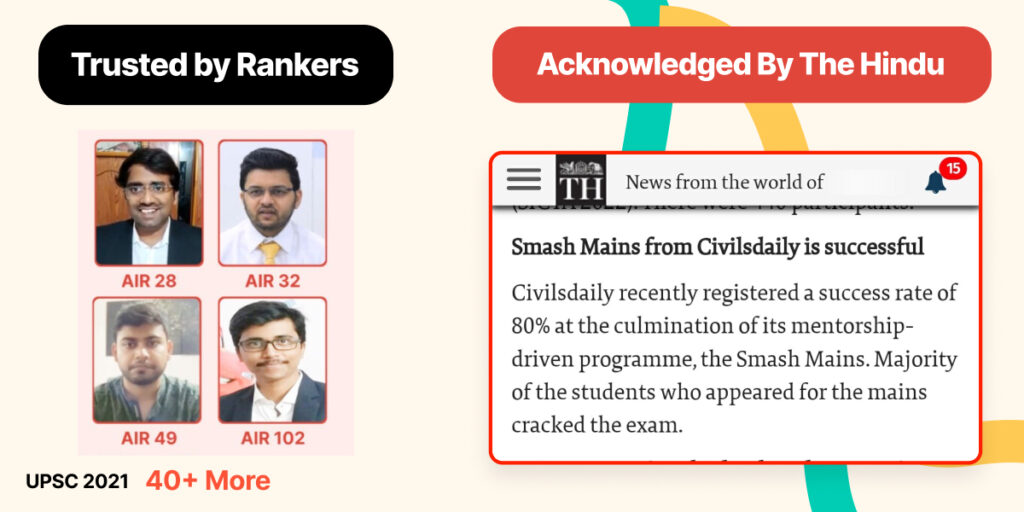
    upsc 2023 exam dateCivilsDaily’s mentorship: Acknowledged by The Hindu


    About Soham Mandhare

    Soham Mandhare’s story is about grit and determination. It is a story of fortitude. Despite all the hardships he secured an AIR 267 in UPSC 2021. She was a student of our Mentorship programs and was taking mentorship under Sajal sir and Sukanya ma’am.

    Soham’s optional was PSIR and he scored one of the highest marks in UPSC Mains exam. He will be mentoring CivilsDaily students as Super Mentor.


    What you’ll get as a part of the Special Preparatory Package?

    As a part of this:

    1. FREE Mentorship session with Senior IAS Mentor on strategy and approach for UPSC/MPSC 2023.
    2. Samachar Manthan (Marathi) current week’s module and Mains Questions
    3. Prelims Weekly MCQ PDF
    4. Mains 250+ Value notes
    5. Current month’s Monthly Magazine

    Post-webinar get PERSONALIZED Current Affairs Strategy + MENTORSHIP CALL for MPSC/UPSC 2023-24. 

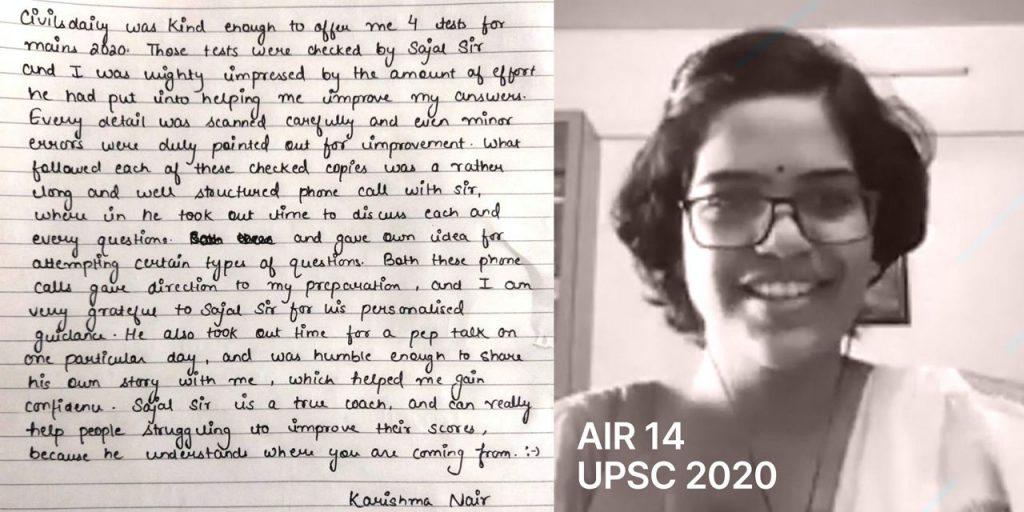
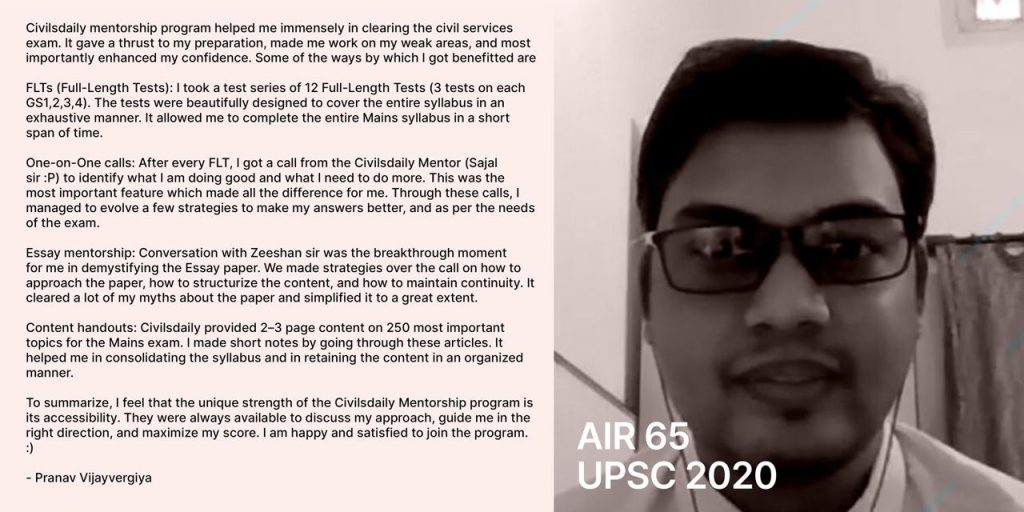
    Karishma Nair, AIR 14 was also CivilsDaily’s mentorship studentAIR 65, and Pranav was a mentorship student for UPSC 2020best coaching for upsc in delhi

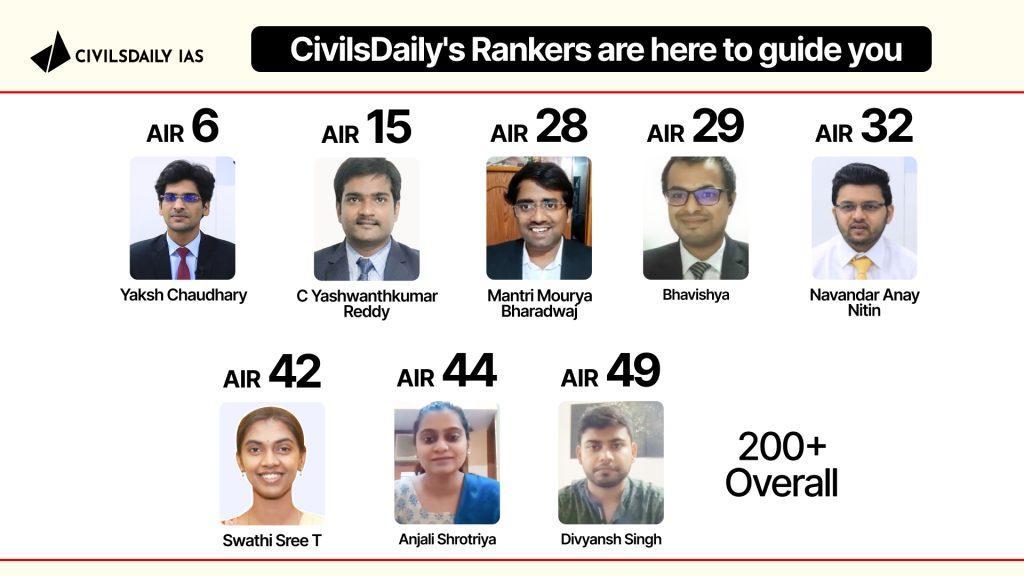
    Some of our Ranker from Maharashtra

    Post-webinar get PERSONALIZED Current Affairs Strategy + MENTORSHIP CALL for MPSC/UPSC 2023-24. 

  • Need to ensure that the digital gateways do not become gatekeepers of services

    digital

    Context

    • The ease of living enabled by digital technologies has turned digital innovations into essential services for the common public. Considered a novelty earlier, the internet has become a necessity for most day-to-day affairs.

    Click and get your FREE Copy of CURRENT AFFAIRS Micro Notes

    Internet access and restrictions

    • To enable access to the internet, various gateways have come up in the last few decades in the form of telecom service providers, personal computers and smartphones, operating systems, etc.
    • However, when these gateways enable and restrict access to other gateways or networks, the openness of the internet is threatened.
    • They then shift roles from being a facilitator to a regulator, from being a gateway to a gatekeeper. Hence, the need for a code of conduct or regulation arises to keep the playing field level and accessible to all.

    digital

    Analysis: Telecoms and Government

    • Telecom service providers: Telecom companies have been instrumental in providing a gateway to essential communication services such as voice calls, internet data, and text messages.
    • Government measures to regulate telecoms: We have seen governments across the world take measures from time to time to regulate these entities to ensure democratic access for the public. If this code of conduct was not enforced on these gateway providers, the internet would not be what it is today. These providers would have turned into gatekeepers, and the internet would have been controlled by them, thwarting innovation and its democratic expansion.
    • Code of conduct cannot catch up the pace of emerging digital tech: With the rate at which digital technologies are evolving, the code of conduct and regulations can’t catch up with the new gateway providers that are emerging. One such example is distribution platforms for smartphone applications.
    • Benchmarks set by bigtechs helps to bring some hygiene in smartphone apps: The two prominent operating systems emerging for smartphones, Google and Apple, enjoy a lion’s share of the app store market. They brought in good practices to ensure basic hygiene for smartphone applications, maintained quality benchmarks for the content on their operating systems, and safeguarded the interests of their users.
    • Lack of full proof regulation would be a slippery slope: Though, without proper regulations to oversee how they decide on what should be weeded and whose interests should be guarded, it’s a slippery slope.

    Policy on Net Neutrality put forwarded by Indian Government 

    • Enforcing a code of conduct on telecoms: Closer home, another example of the enforcement of this code of conduct on providers was when the Indian government came out with the policy on Net Neutrality which, inter-alia, stipulates that telecom networks should be neutral to all the information being transmitted through it.
    • Meaning of Net Neutrality: Networks should treat all communication passing through them equally, independent of their content, application, service, device, sender, or recipient address. Adopting Net Neutrality ensured that we took a democratic stance against Big Tech.

    digital

    Questionable practices of distribution platforms

    • Practices without consent of its users: Various practices range from restrictions on payment gateways, advertising choices, app policies and various other aspects of an application or business that could be considered discriminatory in both principle and practice.
    1. For instance, a case of Goggle’s Update: Recently a report placed before the Competition Commission of India found Google Play Store’s payments policy “unfair and discriminatory”. As per an update in Google’s Play Store billing policy in September 2020, all applications on its platform were mandated to use its payment services for any kind of in-app payments or subscriptions.
    2. Similar case of Apple’s appstore: Similar concerns have been raised for Apple’s App Store, with both platforms said to be charging up to 30 per cent commission on payments processed.
    • Market dominance and unilateral control over smartphone apps by the bigtechs: Google and Apple dominate the global market share of smartphone operating systems (OS). This has enabled them to garner unilateral control over the publishing of smartphone applications on their OS.
    • Developers are forced to bend to the diktats of these bigtech gatekeepers: Bigtechs force developers to make changes to their applications or resort to using their proprietary advertising engines if they wish their applications to see the light of day. As is evident from the overnight change in Google’s billing policy, various smartphone application-dependent businesses and developers continue to remain vulnerable to such internal business policy changes on these platforms.

    European Union’s Digital Markets Act (DMA) sets an example

    • Recognising these concerns: The European Union has recently enacted the Digital Markets Act; it is expected to be implemented by early 2023.
    • Aims to keep digimarket open for competition: The Digital Markets Act regulation aims to keep digital markets innovative and open to competition, through ex-ante regulation.
    • Prohibit anti-competitive practices: The DMA will prohibit the implementation of the most harmful anti-competitive practices by the largest digital platforms.
    • Objective is to maintain balance: The objective is to balance the relationship between these platforms that control access to digital markets and the companies that offer their services there.

    Conclusion

    • The Indian government has taken a huge leap forward in maintaining its sovereignty through the path-breaking and disruptive digital public goods it has created. Aadhaar, UPI, DigiLocker, and CoWIN are just a few names that adorn this list. However, there is still a wide dependence on various digital offerings enabled by multinational Big Tech companies. It is the need of the hour for the government to devise appropriate regulations to ensure a level playing field and not let the innovating gateways turn into tyrannical gatekeepers.

    Mains Question

    Q. India is the largest consumer of wireless internet. Analyze the role of big tech service providers in this and the role of government in ensuring a level playing field for all.

    (Click) FREE1-to-1 on-call Mentorship by IAS-IPS officers | Discuss doubts, strategy, sources, and more

  • [Burning issue] Wildlife (Protection) Amendment Bill, 2022

    wild

    Context

    • Rajya Sabha passed the Wildlife (Protection), Amendment Bill, 2022. The Lok Sabha passed the Bill in the Monsoon Session.
    • The amendment seeks to give effect to India’s obligations under the Convention on International Trade on Endangered Species of Wild Fauna and Flora (‘CITES’), which requires countries to regulate the trade of all listed specimens through permits.
    • In this context, this edition of the burning issue analyses the Wildlife (Protection) Amendment Bill, 2022.

    About the Wildlife Protection Act (WPA), 1972

    • WPA provides for the protection of the country’s wild animals, birds and plant species, in order to ensure environmental and ecological security.
    • It provides for the protection of a listed species of animals, birds and plants, and also for the establishment of a network of ecologically-important protected areas in the country.
    • It provides for various types of protected areas such as Wildlife Sanctuaries, National Parks etc.
    • The object and purpose of the WPA – to protect animals in their natural environment – was lent credence in the 42nd Constitutional Amendment Act,1976, which added the fundamental duty to “protect and improve … wildlife, and to have compassion for living creatures” under Article 51A(G).
    • This Amendment also inserted Article 48A in the Directive Principles of State Policy, which outlined the protection and safeguarding of wildlife as an ideal to be followed in the governance of the country.
    • There are six schedules provided in the WPA for the protection of wildlife species which can be concisely summarized as under:
    Schedule I:These species need rigorous protection and therefore, the harshest penalties for violation of the law are for species under this Schedule.
    Schedule II:Animals under this list are accorded high protection. They cannot be hunted except under threat to human life.
    Schedule III & IV:This list is for species that are not endangered. This includes protected species but the penalty for any violation is less compared to the first two schedules.
    Schedule V:This schedule contains animals which can be hunted.
    Schedule VI:This list contains plants that are forbidden from cultivation.

    About CITES

    • CITES stands for the Convention on International Trade in Endangered Species of Wild Fauna and Flora.
    • It is an international agreement aimed at ensuring “that international trade in specimens of wild animals and plants does not threaten their survival”.
    • It was drafted after a resolution was adopted at a meeting of the members of the International Union for Conservation of Nature (IUCN) in 1963.
    • It entered into force on July 1, 1975, and now has 183 parties.
    • The Convention is legally binding on the Parties in the sense that they are committed to implementing it; however, it does not take the place of national laws.
    • India is a signatory to and has also ratified CITES convention in 1976.

    It has three appendices:

    • Appendix I includes species threatened with extinction. Trade-in specimens of these species are permitted only in exceptional circumstances.
    • Appendix II provides a lower level of protection.
    • Appendix III contains species that are protected in at least one country, which has asked other CITES Parties for assistance in controlling trade.

    Provisions of the Wildlife Protection Amendment Bill, 2022

    • In line with CITES: Insert a new Schedule for specimens listed in the Appendices under CITES.
    • Constitute a Standing Committee: Amendment to Section 6 to constitute Standing Committee to exercise such powers and duties as may be delegated to it by the State Board for Wildlife.
    • Elephant usage: Amendment to Section 43 to permit elephants, a Schedule I animal, to be used for ‘religious or any other purpose’.
    • Management authority for export/import: Insert Section 49E to empower the Central government to designate a Management Authority to grant export or import permits for the trade of specimens. It further requires every person possessing live specimens of scheduled animals to obtain a registration certificate from the Management Authority.
    • Create a scientific authority: Insert Section 49F to empower the Central government to designate a Scientific Authority to advise on aspects related to the impact on the survival of the specimens being traded. These provisions are set to ensure the “sustainable” exploitation of flora and fauna.
    • Better control of sanctuaries: The Bill seeks to regulate the control of sanctuaries. It provides that the Chief Wildlife Warden shall act in accordance with the management plans for the sanctuary, to be prepared as per Central guidelines.
    • Creation of conservation reserve: It also empowers both Central and State governments to declare areas adjacent to national parks and sanctuaries as conservation reserves, for protecting flora and fauna, and their habitat.
    • Managing alien invasive species: The Bill also empowers the Central government to regulate and stop the import, trade or possession of invasive plant or animal alien species.
    • Enhanced penalties: The Bill also enhances the penalties prescribed for violation of provisions of the Act. For ‘General violations’, the maximum fine is increased from Rs 25,000 to Rs. 1 lakh. In the case of Specially protected animals, the minimum fine of Rs. 10,000 has been enhanced to Rs. 25,000.

    Positive aspects of the bill

    • Enhanced Protection of wild animals: Bill seeks to enhance punishment for trade in animal and plant specimens.
    • Locals use of Protected Areas: the bill permits certain activities like grazing of livestock and community use of drinking water by local communities.
    • Ease of elephant ownership: The Bill seeks to amend Section 43 of the principal Act to permit the transfer or transport of a captive elephant for a religious or any other purpose by a person having a valid certificate of ownership.

    Negative aspects of the bill

    • Vague clause in section 43: The Bill seeks to amend Section 43 of the principal Act to permit the transfer or transport of a captive elephant for a religious or any other purpose by a person having a valid certificate of ownership. Many members raised concern about this provision, stating that the phrase “any other purpose” is vague and has the potential of encouraging the commercial trade of elephants, their captivity and brutality.
    • Silent of important issues: The government missed the opportunity to address the issues relating to Human-Wildlife conflict, Eco-sensitive zone rule, etc.
    • The schedule lists not complete: They pointed out that the species listed in all the 3 schedules of the Bill are incomplete as per the report submitted by the Parliamentary Standing Committee and a need was felt for greater inclusion of scientists, botanists, biologists in process of listing all existing species of wildlife.
    • Reduced role of states in wildlife management: Protection of wild animals and birds is a subject under the Concurrent List of the Constitution. the proposed amendment bill renders the State Boards for Wildlife chaired by Chief Ministers defunct and provides for establishing a Standing Committee of Board for Wildlife to be headed by the Forest Minister with a maximum of 10 nominated members. This injures the federal structure of India.
    • Against the fundamental objective of WPA: The new proviso creates a legal pathway to encourage the further commercialization and transfer of elephants through the vague wording of “religious or any other purpose.” This goes against the fundamental object and purpose of the WPA.

    Way forward

    • An additional mechanism may be introduced for acquiring animals for religious institutions.
    • The Management and Scientific Authorities contemplated under the Bill must take into account the strong principles of Federalism and ensure constructive engagement of State governments.
    • Clauses related to human-animal conflicts and eco-sensitive zones should also be added to the law to provide a legal framework to deal with these issues.
    • State’s wildlife bodies should be given due importance in the conservation of wildlife as the subject is a concurrent subject.

    Conclusion

    • The amendment bill tries to bring the WPA law up to date with the CITES mandate and present environment scenario.
    • However, several lacunas have been highlighted by environmental experts which need attention from the government and need to be fixed to bring out the best for the nation’s wildlife.

    Click and get your FREE Copy of CURRENT AFFAIRS Micro Notes

    (Click) FREE 1-to-1 on-call Mentorship by IAS-IPS officers | Discuss doubts, strategy, sources, and more

  • Rupee Settlement Mechanism draws interest from more nations

    rupee

    India’s rupee trade settlement mechanism, a means of using rupees instead of dollars and other big currencies for international transactions, is attracting interest from more countries.

    More countries are interested

    • Tajikistan, Cuba, Luxembourg and Sudan have begun talking to India about using the mechanism.
    • They have shown interest in opening special rupee accounts, called vostro accounts.
    • Opening of these accounts needs approval from the Reserve Bank of India.
    • It has already been used by Russia following the imposition of sanctions on Moscow over the Ukraine war.

    Rupee Settlement System for International Trade

    • Banks acting as authorized dealers for such transactions would have to take prior approval from the regulator to facilitate this.
    • All exports and imports under the invoicing arrangement may be denominated and invoiced in Rupee.
    • The exchange rate between the currencies of the two trading partner countries may be market determined.
    • Exporters and importers can now use a Special Vostro Account linked to the correspondent bank of the partner country for receipts and payments denominated in rupees.
    • These accounts can be used for payments for projects and investments, import or export advance flow management, and investment in Treasury Bills subject to Foreign Exchange Management Act, 1999 (FEMA).
    • Also, the bank guarantee, setting-off export receivables, advance against exports, use of surplus balance, approval process, documentation, etc., related aspects would be covered under FEMA rules.

    Benefits of such a mechanism

    • Trade facilitation: This will also facilitate trade with countries like Russia which are facing sanctions.
    • FOREX savings: India imports more than it exports so the country will also save foreign currency under the new arrangement.
    • Rupee appreciation: The rupee is at a historic low against the dollar. It will also help stabilize rupee.
    • Mitigating war impact: Payments had become a pain point for exporters immediately after the Russia-Ukraine war broke out, especially after Russia was cut off from the SWIFT payment gateway.
    • Convertibility easing: We see this as a first step towards 100% convertibility of rupee.
    • Energy security: It will also help buy discounted crude oil from Russia, which now accounts for 10% of all imported crude.
    • Export promotion: As such, the new mechanism will help India promote its exports.

    Which countries would prefer this system?

    • War mongering Russia: For now, it looks like trade settlements in rupee will be limited to countries like Russia and Iran who are facing sanctions from the West
    • Bankrupt Sri Lanka: SL is going through economic turmoil and India has been consistently extending lines of credit to SL.
    • Immediate neighbors: Other countries may include immediate neighbors of India.

    Rupees over Dollars: Why countries would prefer Rupees?

    • At a very simplistic level, this is like two Indians deciding to use an alternative mode of exchange that they have come up with, instead of using rupees.
    • In other terms, this is similar to the barter system.
    • The main reason for countries to want to trade with India in rupees is this:
    1. USD has been going through a phase of strength against most currencies in the world
    2. Strong USD performance has essentially made imports expensive for most countries
    3. Sri Lanka, which is going through one of its worst economic crises in decades, is a glaring example of a country in which the economy has come to a halt due to a drastic fall in forex reserves
    • While the Sri Lankan Rupee has declined over 83 percent against the US Dollar, its fall against the Indian Rupee has been lower at 70 percent.
    • So instead of paying 83 percent more to make purchases in USD, Sri Lanka can pay in Indian Rupees and save some money.

    Challenges

    • Trade surplus countries’ preference: The question that RBI and the Indian government will have to answer is this – why would countries with a trade surplus with India want to trade in rupees?
    • Negative trade balance: China had a $73-billion trade surplus with India in 2021-22 – that is, Indian imports from China exceeded its exports to China by $73 billion.
    • Idle money lying useless: If China were to trade with India in rupees, it would have Indian rupees worth $73 billion (about ₹5.77 lakh crore) sitting idle in its Rupee Vostro accounts in an Indian bank.
    • Few countries interested: Countries whose exports to India are more than imports, will not be too enthusiastic to trade in rupees, especially if the difference is huge as in the case of China.


    Click and get your FREE Copy of CURRENT AFFAIRS Micro Notes

    (Click) FREE 1-to-1 on-call Mentorship by IAS-IPS officers | Discuss doubts, strategy, sources, and more

  • Acid Attack in India

    acid attack

    An acid attack in in Delhi has once again brought back to focus the heinous crime of acid attacks and the easy availability of corrosive substances.

    What is Acid Attack?

    • An acid attack, also called acid throwing, vitriol attack, or vitriolage, is a form of violent assault involving the act of throwing acid or a similarly corrosive substance onto the body of another.
    • It intends to disfigure, maim, torture, or kill.
    • Perpetrators of these attacks throw corrosive liquids at their victims, usually at their faces, burning them, and damaging skin tissue, often exposing and sometimes dissolving the bones.
    • The most common types of acid used in these attacks are sulphuric and nitric acid.
    • Hydrochloric acid is sometimes used but is much less damaging.

    How prevalent are acid attacks in India?

    • Though heinous, acid attacks on women are not as prevalent a crime as others against women.
    • According to data compiled by the National Crime Records Bureau (NCRB), there were 150 such cases recorded in 2019, 105 in 2020 and 102 in 2021.
    • West Bengal and UP consistently record the highest number of such cases generally accounting for nearly 50% of all cases in the country year on year.
    • The charge-sheeting rate of acid attacks stood at 83% and the conviction rate at 54% in 2019.
    • In 2020, the figures stood at 86% and 72% respectively.
    • In 2021, the figures were recorded to be 89% and 20% respectively.

    What is the law on acid attacks?

    • Until 2013, acid attacks were not treated as separate crimes.
    • However, following amendments carried out in the IPC, acid attacks were put under a separate section (326A) of the IPC.
    • Such attacks made punishable with a minimum imprisonment of 10 years which is extendable to life along with fine.
    • The law also has provisions for punishment for denial of treatment to victims or police officers refusing to register an FIR or record any piece of evidence.
    • Denial of treatment (by both public and private hospitals) can lead to imprisonment of up to one year and dereliction of duty by a police officer is punishable by imprisonment of up to two years.

    Creating deterrence against acid attack

    (1) Clear rules

    • In 2013, the Supreme Court took cognizance of acid attacks and passed an order on the regulation of sales of corrosive substances.
    • Based on the order, the MHA issued an advisory to all states on how to regulate acid sales and framed the Model Poisons Possession and Sale Rules, 2013 under The Poisons Act, 1919.
    • It asked states to frame their own rules based on model rules, as the matter fell under the purview of states.

    (2) Regulation of acid sale

    • In 2015, MHA issued an advisory to all states to ensure speedy justice in cases of acid attacks by expediting prosecution.
    • According to the MHA’s directions and the model rules, over-the-counter sale of acid was not allowed unless the seller maintains a logbook/register recording the sale of acid.
    • This logbook was to also contain the details of the person to whom acid is sold, the quantity sold, the address of the person and also specify the reason for procuring acid.
    • The buyer must also prove he/she is above 18 years of age.

    (3) Effective monitoring

    • Sellers are also required to declare all stocks of acid with the concerned Sub-Divisional Magistrate (SDM) within 15 days and in case of undeclared stock of acid.
    • The SDM can confiscate the stock and suitably impose a fine of up to Rs 50,000 for a breach of any of the directions.

    Rules for victim compensation and care

    • Free treatment: States are supposed to ensure that treatment provided to acid attack victims in any hospital, public or private, is free of cost.
    • Aftercare and rehabilitation: Based on Supreme Court directions, the MHA asked states to make sure acid attack victims are paid compensation of at least Rs. 3 lakhs by the concerned State Government/UT.
    • Funding to NGOs: MHA suggested states should also extend social integration programs to the victims for which NGOs could be funded to exclusively look after their rehabilitative requirements.

    Preventing such attacks

    • Still on rise: The regulations on acid sales largely help in tracking the accused and not so much in prevention.
    • Regulatory bottlenecks: Acid is still easily available in many places. Then these are crimes of passion. In a majority of cases the accused is not even thinking about consequences.

    Way forward

    • Things improve as social attitudes are changing and the focus of the police in dealing with crimes against women can cause some deterrence.
    • But the key to solving this problem will always remain in society.
    • We must create more awareness. Parents must teach their children the importance of boundaries and consent.


    Click and get your FREE Copy of CURRENT AFFAIRS Micro Notes

    (Click) FREE 1-to-1 on-call Mentorship by IAS-IPS officers | Discuss doubts, strategy, sources, and more

  • What is DNA Fingerprinting?

    dna

    Delhi Police has established identity of a victim of brutal murder and mutilation by DNA fingerprinting.

    What is DNA fingerprinting?

    • DNA fingerprinting was first developed in 1984 by Alec Jeffreys in the UK, after Jeffreys discovered that no two people could have the same DNA sequence.
    • Within three years of the discovery, the UK achieved the world’s first conviction based on DNA evidence in a case of rape and murder.

    How is DNA fingerprinting done?

    • Each person’s DNA, except for identical twins, is unique.
    • By analyzing selected DNA sequences (called loci), a crime laboratory can develop a profile to be used in identifying a suspect.
    • DNA can be extracted from many sources, such as hair, bone, teeth, saliva, and blood.
    • Because there is DNA in most cells in the human body, even a minuscule amount of bodily fluid or tissue can yield useful information.
    • Samples may even be extracted from used clothes, linen, combs, or other frequently used items.


    Deoxyribonucleic Acid (DNA)

    • DNA is the hereditary material in humans and almost all other organisms. Nearly every cell in a person’s body has the same DNA.
    • Most DNA is located in the cell nucleus (where it is called nuclear DNA), but a small amount of DNA can also be found in the mitochondria (where it is called mitochondrial DNA or mtDNA).
    • Mitochondria are structures within cells that convert the energy from food into a form that cells can use.
    • The information in DNA is stored as a code made up of four chemical bases: adenine (A), guanine (G), cytosine (C), and thymine (T).
    • Human DNA consists of about 3 billion bases, and more than 99 percent of those bases are the same in all people.
    • The order, or sequence, of these bases determines the information available for building and maintaining an organism, similar to the way in which letters of the alphabet appear in a certain order to form words and sentences.

    How it is used in criminal investigation?

    • DNA evidence is used to solve crimes in two ways:
    1. If a suspect is known, that person’s DNA sample can be compared to biological evidence found at a crime scene to establish whether the suspect was at the crime scene or whether they committed the crime.
    2. If a suspect is not known, biological evidence from the crime scene can be analyzed and compared to offender profiles in existing DNA databases to assist in identifying a suspect.
    • Beyond its accuracy, DNA fingerprinting can also sift through crime scene evidence in different ways, previously unavailable to investigators.
    • For instance, advanced DNA fingerprinting can make separate prints of various individuals even from a sample mixture found at the crime scene — this is of help during gang rape investigations as each perpetrator can be individually identified.

    DNA fingerprinting in India

    • By 1988, Lalji Singh, who had been in the UK from 1974 to 1987 on a Commonwealth Fellowship, developed DNA fingerprinting for crime investigations in Hyderabad.
    • Today, Lalji Singh, who passed away in 2017, is known as “the father of DNA fingerprinting in India.”
    • In 1989, DNA fingerprinting was first used in a case by the Kerala Police.
    • By the early 1990s, the technology had begun to be used for establishing paternity, and to link criminals and identify victims in sensational crimes.
    • From the 2000s onwards, the technology became a staple in rape cases where vaginal swab samples were matched with semen samples from suspects.

    Challenges with DNA fingerprinting in India

    • It is vital to ensure that the DNA of the investigators does not get mixed with that of the victims or the suspects.
    • Thus, picking up samples from a crime scene with sterile tools and storing samples in a proper manner are crucial for the evidence to stand a judicial test.
    • While India has rules and guidelines regarding this, India’s police forces have a lot of catching up to do with counterparts overseas.
    • While central agencies such as CBI have the expertise to ensure that crime scenes are protected and correct procedure is followed, state police forces are inadequately trained or fully equipped.

    Issues with such technology

    • The problem is not limited to the police awareness.
    • The capacity for DNA fingerprinting in the country itself is lacking.
    • DNA fingerprinting is available only at a few places — Maharashtra, West Bengal, Delhi, Hyderabad and Chandigarh.
    • Advanced practices in the technology are limited to the Centre for DNA Fingerprinting and Diagnostics (CDFD) in Hyderabad.


    Click and get your FREE Copy of CURRENT AFFAIRS Micro Notes

    (Click) FREE 1-to-1 on-call Mentorship by IAS-IPS officers | Discuss doubts, strategy, sources, and more

  • Kerala’s 5 agricultural products get GI Tag

    gi

    Five agricultural products of Kerala have been granted Geographical Indication (GI) status.

    Which are the 5 GI products?

    • These are the latest Geographical Indications that have been registered-
    1. Attappady Attukombu Avara: It cultivated in the Attappady region of Palakkad, is curved like a goat’s horn as its name indicates. Its higher anthocyanin content compared to other dolichos beans imparts violet colour in the stem and fruits. Anthocyanin is helpful against cardiovascular diseases along with its antidiabetic properties. Other than this, calcium, protein, and fibre content are also high. The higher phenolic content of imparts resistance against pest and diseases, making the crop suitable for organic cultivation.
    2. Attappady Thuvara: It is having seeds with white coat. Compared to other red grams, Attappady Thuvara seeds are bigger and have higher seed weight. This delicious red gram, which is used as vegetable and dal, is rich in protein, carbohydrate, fibre, calcium and magnesium.
    3. Kanthalloor-Vattavada Veluthulli (garlic): Compared to the garlic produced in other areas, this garlic contains higher amount of sulphides, flavonoids, and proteins. It is rich in allicin, which is effective against microbial infections, blood sugar, cancer, cholesterol, heart diseases, and damages to blood vessels. The garlic cultivated in this area is also rich in essential oil.
    4. Onattukara Ellu and its oil: It is famous for its unique health benefits. Relatively higher antioxidant content in Onattukara Ellu helps in fighting the free radicals, which destroy the body cells. Also, the high content of unsaturated fat makes it beneficial for heart patients.
    5. Kodungalloor Pottuvellari: It is cultivated in Kodungalloor and parts of Ernakulam is consumed as juice and in other forms. This snap melon, which is harvested in summer, is an excellent for quenching thirst. It contains high amount of Vitamin C. Compared to other cucurbits, nutrients such as calcium, magnesium, fibre and fat content are also high in that.
    • The unique features of the products, imparted by the agro-climatic conditions of the geographical area of their production, are the basis for getting a GI tag.

    What are the other GIs tags awarded?

    Adding to the present collection of Geographical Indications (GIs), nine new items, including-

    1. Gamocha of Assam
    2. Tandur red gram of Telangana
    3. Raktsey Karpo apricot of Ladakh, and
    4. Alibag white onion of Maharashtra


    Do you know?

    Karnataka and Tamil Nadu are states with the highest number of GI tags, followed by Kerala (35), Uttar Pradesh (34), and Maharashtra (31).

     

    About GI Tag

    • Recognised by the World Trade Organization (WTO), GI is used to denote the geographical territory from where a product, be it agricultural produce, natural product, or manufactured.
    • It conveys the assurance of quality, distinctiveness, and attributes that are unique to that specific geographic region/place of origin.
    • India became a signatory to this convention, when, as a member of WTO, it enacted the Geographical Indications (Registration and Protection) Act, 1999, which came into effect on September 15, 2003.
    • To protect the GI of goods, a GI registry has been established to administer the GI of Goods (Registration and Protection) Act, 1999, under the Controller General of Patents, Designs & Trade Marks.


    Click and get your FREE Copy of CURRENT AFFAIRS Micro Notes

    (Click) FREE 1-to-1 on-call Mentorship by IAS-IPS officers | Discuss doubts, strategy, sources, and more

More posts