💥UPSC 2026, 2027, 2028 UAP Mentorship (March Batch) + Access XFactor Notes & Microthemes PDF

Search results for: “”

  • In news: Hornbill Festival

    hornbill

    The logo for India’s upcoming G20 presidency was officially unveiled recently at the Hornbill festival in Nagaland.

    What is Hornbill Festival?

    • The Hornbill Festival is a celebration held every year from 1 – 10 December, in Kohima, Nagaland.
    • The festival was first held in the year 2000.
    • It is named after the Indian hornbill, the large and colourful forest bird which is displayed in the folklore of most of the state’s tribes.
    • Festival highlights include the traditional Naga Morungs exhibition and the sale of arts and crafts, food stalls, herbal medicine stalls, flower shows and sales, cultural medley – songs and dances, fashion shows etc.

    About Great Indian Hornbill

    IUCN status: Vulnerable (uplisted from Near Threatened in 2018), CITES: Appendix I

    • The great hornbill (Buceros bicornis) also known as the great Indian hornbill or great pied hornbill, is one of the larger members of the hornbill family.
    • The great hornbill is long-lived, living for nearly 50 years in captivity.
    • It is predominantly fruit-eating, but is an opportunist and preys on small mammals, reptiles and birds.
    • Its impressive size and colour have made it important in many tribal cultures and rituals.
    • A large majority of their population is found in India with a significant proportion in the Western Ghats and the Nilgiris.
    • The nesting grounds of the birds in the Nilgiris North Eastern Range are also believed to support some of their highest densities.

    Their ecological significance

    • Referred to as ‘forest engineers’ or ‘farmers of the forest’ for playing a key role in dispersing seeds of tropical trees, hornbills indicate the prosperity and balance of the forest they build nests in.

    Threats

    • Hornbills used to be hunted for their casques — upper beak — and feathers for adorning headgear despite being cultural symbols of some ethnic communities in the northeast, specifically the Nyishi of Arunachal Pradesh.
    • Illegal logging has led to fewer tall trees where the bird’s nest.


    Try this PYQ:

    In which of the following regions of India are you most likely to come across the ‘Great Indian Hornbill’ in its natural habitat? (CSP 2016)

    (a) Sand deserts of northwest India

    (b) Higher Himalayas of Jammu and Kashmir

    (c) Salt marshes of western Gujarat

    (d) Western Ghats


    Post your answers here.


    Click and get your FREE Copy of CURRENT AFFAIRS Micro Notes

    (Click) FREE 1-to-1 on-call Mentorship by IAS-IPS officers | Discuss doubts, strategy, sources, and more

  • (WATCH LIVE) UPSC (free) Prelims Webinar: 10 Steps Strategy to score more in less time in UPSC Prelims 2023 | Santosh sir, Asst. Commissioner, GST will share 24 week’s Micro -Macro strategy and Prelims PDF notes

    (WATCH LIVE) UPSC (free) Prelims Webinar: 10 Steps Strategy to score more in less time in UPSC Prelims 2023 | Santosh sir, Asst. Commissioner, GST will share 24 week’s Micro -Macro strategy and Prelims PDF notes

    Most important webinar by Prelims Guru, Santosh Sir | Get FREE Smash Prelims notes PDF, 24 weeks’ Micro-Macro masterplan, and MCQ tests.


    Only 24 weeks or less than 170 days are left for UPSC Prelims 2023. Starting today only those aspirants will be able to clear the Prelims who have a well-laid-out plan, the best or most relevant resources (notes, tests, etc.), guidance, and most important of all, a will to succeed.

    This is for you if:

    • You haven’t been able to clear prelims for the past 2-3 years
    • Perform well in mocks but get stuck in the 70-85 marks range in UPSC Prelims.
    • You don’t know how to approach a Prelims paper: should you go for the accuracy or maximum number of questions, should you start from questions 1 to 100, or go section-wise.
    • Don’t know the logical techniques to tackle bouncer-type completely random questions 
    • Can’t use smart and intelligent ways rather than just end up working hard without any use.

    Do you know that only 0.02% of aspirants are able to go beyond 120+ consistently? Achieving this in next 165 days will need a rock solid strategy.

    Santosh Gupta

    Let me reiterate the facts: Of all the candidates applying for IAS Prelims 2023, only 1% of them will clear Prelims 2023 it. And only a fraction of that will go beyond 120+ marks. Santosh sir, cleared all his 6 UPSC Prelims, every time scoring 120+ marks. Even his UPSC 2022 students scored 130+ without breaking a sweat.

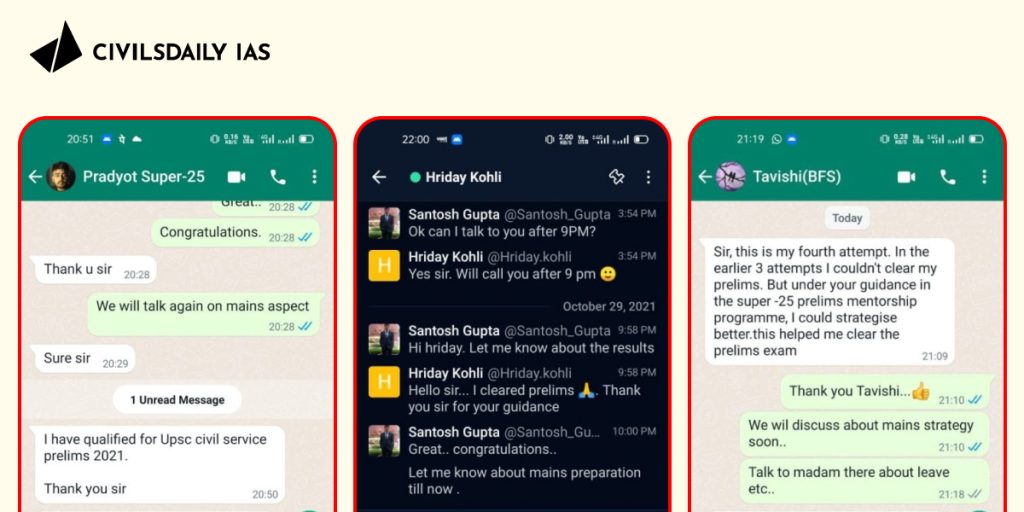
    Santosh sir has been helping aspirants clear UPSC Prelims year after year. Here is a screenshot of his students who wrote Mains 2022.

    Tavishi failed thrice in the Prelims before but after joining Santosh sir’s mentorship cleared Prelim 2022 on her 4th attempt.

    Santosh sir will be taking an important webinar for UPSC 2023 aspirants.

    Webinar Details: How to Smash Prelims 2023 in the next 165 days? Get a rock solid 24 week’s strategy and Prelims PDF notes

    Date: 12th December 2022 (Monday)

    Time: 7 pm

    We will email the invitation, Zoom link, and notes.

    What you’ll learn in the Webinar?

    1. How to prepare for UPSC Prelims 2023 successfully starting today? With less than 6 months in hand, how to go forward?
      • Santosh sir will share a workable and proven strategy for the next 165 days (around 24 weeks), including both micro and macro plans.
    2. A brief trend analysis of the past 5 yrs’ UPSC Prelims GS 1 paper. How to change your preparation methods right now?
    3. How to cover the massive UPSC prelims syllabus? both GS and Current Affairs
      • Most Probable Topics to Cover for Prelims 2023 for every GS subject.
      • How to cover Current Affairs? How many months of Current Affairs should be covered? From where?
    4. The 10 Steps of tackling Prelims 2023. How to maximize revision and minimize study materials?
    5. Learn time management –
      • Before the exam– Studying more and effectively in less time.
      • Inside the exam hall. Most of the time, twisted questions force you to take more time to answer. 
    6. How to filter out and attempt easy questions in the first round quickly and move on to the next with which moderate to difficult questions? will be discussed thoroughly. 
    7. Time-Tested Elimination Techniques. How to use these techniques in sample questions? only generalized preparation is not enough. You have to be ready for the worst. Besides usual ordinary questions, you have to solve more or less offbeat questions. Remember, Offbeat questions require an offbeat approach and it gets 120+ in prelims for you. So, how to apply ‘Intelligent guessing’‘the way of thinking, and ‘Core common sense.
    8. How to stay alert at the 5 worst mistakes areas, like unknown extremely factual questions, Random questions such as from sports in 2021, Questions from old current affairs, Ques. that are not directly from current affairs but inspired by current affairs, and Questions based on common sense such as questions in prelims-2021 
    9. How to avoid silly mistakes by using common sense to the plausibility of statements given. Usually, low-confident aspirants do not attempt these types of questions and overconfident ones make mistakes by overthinking.
    10. How to solve bouncer kind of questions? Around 5 questions in every paper have been asked by UPSC about which you have no idea and might have not even come across while preparing but they can make or break your chance.

    About Santosh Gupta Sir

    Santosh sir has scored above 140 twice in UPSC prelims and 120 plus in all 6 attempts. He has written all 6 mains and has appeared for Interviews 3 times. He has qualified for UPSC EPFO and BPSC 56-59th also. As the Prelims head at Civilsdaily, he has helped 15 out of 25 students clear the prelims examination this year.


    What The Hindu mentioned about Civilsdaily Mentorship?

  • Religious conversion and Fundamental right to freedom of religion

    religion

    Context

    • While hearing a petition seeking a ban on forced conversions, Division Bench judge of the apex court said, “The purpose of charity should not be conversion. Every charity or good work is welcome, but what is required to be considered is the intention,” The observation, loaded with significant implications, is to be considered in the light of the provisions of the Constitution relating to people’s fundamental right to freedom of religion, its legislative history and judicial interpretation.

    Click and get your FREE Copy of CURRENT AFFAIRS Micro Notes

    Fundamental right to freedom of religion

    • Right to freedom of thought, conscience and religion before the constitution of India: The Universal Declaration of Human Rights 1948, which was before the makers of the future Constitution for independent India had proclaimed: “Everyone has the right to freedom of thought, conscience and religion; this right includes freedom to change his religion or belief, and freedom, either alone or in community with others and in public or private, to manifest his religion or belief in teaching, practice, worship and observance” [Article 18].
    • Extensive debate on religious freedom as a people’s right in the Constituent Assembly: Keeping this in mind, religious freedom as a people’s right was repeatedly debated in the Constituent Assembly. In cognisance of Christianity’s traditions of evangelism and proselytisation, it was to include the right to propagate religion.

    religion

    Journey of a Right to freedom of religion before and after The Constitution

    • British rulers facilitated conversion to their religion: The British rulers of India, who were never shy of introducing measures to facilitate the conversion of others to their faith.
    • British rulers enacted Native Converts Marriage Dissolution Act in 1866: They had enacted in 1866 a Native Converts Marriage Dissolution Act to provide the facility of divorce to married Indians who converted to Christianity and were thereupon deserted by their non-converting spouses.
    • The Act recently dropped which was once thought to by the law commission of India: After Independence, the Law Commission of India recommended that this Act be revised to make it a general law on the effect of post-marriage change of religion, but the government did not take any action on it. The original Act remained in force till recently but was eventually dropped from the statute book by the Repealing and Amending Act of 2017.
    • Alerted by the missionaries’ princely states enforced anti conversion laws: Alerted by the missionaries’ evangelistic activities, several princely states of the pre-Independence era had enforced anti-conversion laws Raigarh, Udaipur and Bikaner among them.
    • Constitution Bench in case where state freedom of religion Acts was challenged: During 1967-68, state legislatures in Orissa and Madhya Pradesh enacted similar laws, both ostensibly titled as Freedom of Religion Act. Christian leaders lost no time in challenging their constitutional validity in the Supreme Court. Heading a Constitution Bench, Chief Justice of the time AN Ray, argued that converting people interfered with their religious freedom and held that Article 25 granted “not the right to convert another person to one’s own religion but (only) to transmit and spread one’s religion by an exposition of its tenets” .
    • The Constitution Bench decision inspired some other states to enact similar laws: Beginning with the Arunachal Pradesh Freedom of Religion Act 1978. Today there are such laws in about half of our states. Some of these have been either newly enacted or made more stringent, since the beginning of the present political dispensation in 2014. All of them prohibit converting people from one to another religion without their free will and, to indicate this, use various expressions like force, fraud, inducement and allurement.
    • Drafts on the conversion: While the first draft of the future Constitution proposed to restrain conversion except by one’s own free will, the second was to recognise the “right to preach and convert within limits compatible with public order and morality.”
    • Constitution recognised the right to propagate: Eventually, the Constitution recognised the right to propagate, along with freedom of conscience and the right to profess and practice, one’s religion as people’s fundamental right. Prima facie, individuals’ right to forsake their religion by birth and embrace another faith was integral to freedom of conscience
    • Supreme Courts observations regarding the right to propagate: As regards the propagation of religion, in two cases decided in 1954, the apex court observed that Article 25 covered every individual’s right “to propagate his religious views for the edification of others” (RP Gandhi) and that “it is the propagation of belief that is protected, no matter whether the propagation takes place in a church or monastery, or in a temple or parlour meeting” (Shirur Math).

    Do you know this interesting news?

    • The Bombay High Court has recently held that the freedom of conscience of a person “includes a right to openly say that he does not believe in any religion”

    religion

    Mahatma Gandhi’s view on freedom of religion

    • Mahatma Gandhi once said that “all faiths are equally true though equally imperfect”
    • He had pleaded that, instead of converting others to one’s own faith, “our innermost prayer should be that a Hindu should be a better Hindu, a Muslim a better Muslim and a Christian a better Christian” (Young India, 1924).
    • He had also once said: “If I had power and could legislate I should stop all proselytising” (Harijan, 1935).

    How is religious freedom protected under the Constitution?

    • Article 25(1) of the Constitution guarantees the “freedom of conscience and the right freely to profess, practise and propagate religion”.
    • It is a right that guarantees a negative liberty — which means that the state shall ensure that there is no interference or obstacle to exercise this freedom.
    • However, like all fundamental rights, the state can restrict the right for grounds of public order, decency, morality, health and other state interests.

    Conclusion

    • An observation made by the Supreme Court on “forced conversions” is to be considered in the light of the provisions of the Constitution relating to people’s fundamental right to freedom of religion, its legislative history and judicial interpretation and set the future roadmap to make. Pluralism and inclusiveness are characterized by religious freedom. Its purpose is to promote social harmony and diversity.

    Mains question

    Q. What is Fundamental right to freedom of religion? What was Mahatma Gandhi’s view on religion? How it is interpreted in the constitution of India?

    (Click) FREE1-to-1 on-call Mentorship by IAS-IPS officers | Discuss doubts, strategy, sources, and more


  • Day 6 | Daily Answer Wars| CD WarZone

    Topics for Today’s question:

    GS-3          Issues relating to development and management of Social Sector/Services relating to Health, Education, Human Resources.

    Question)


    HOW TO ATTEMPT ANSWERS IN DAILY ANSWER WARS (DAW)?

    1. Daily 1 question either from General Studies 1, 2, 3 or 4 will be provided via live You Tube video session.
    2. Announcement video: https://www.youtube.com/watch?v=kGzTviBKVpY; Day 5 winners: Deepali, Ritu, Mohi, Pooja, Manujanshu
    3. You can write your answer on an A4 sheet and scan/click pictures of the same.
    4. The answer needs to be submitted by joining the telegram group given in the link below.

      https://t.me/cdwarzone

    *In case your answer is not reviewed, reply to your answer saying *NOT CHECKED*. 

    1. For the philosophy of Daily Answer Wars and payment: 
  • [Burning Issue] Monetary Policy Of RBI

    [Burning Issue] Monetary Policy Of RBI

    Context

    • Recently, the Reserve Bank of India’s (RBI) Monetary Policy Committee (MPC)  hiked the repo rate by 35 basis points (bps) to 6.25 per cent with immediate effect.
    • The RBI policy rate is now at its highest level since August 2018 and this is the fifth rate hike by the central bank in this financial year.
    • In this context, this edition of the Burning Issue will talk about the Monetary policy of RBI, the tools used by it and its analysis.

    What is monetary policy?

    • Monetary policy is the macroeconomic policy laid down by the central bank. It involves the management of money supply and interest rate and is the demand side economic policy used by the government of a country to achieve macroeconomic objectives like inflation, consumption, growth and liquidity.
    • Economic statistics such as GDP, the rate of inflation, and industry and sector-specific growth rates influence monetary policy strategy.
    • A central bank may revise the interest rates it charges to loan money to the nation’s banks. As rates rise or fall, financial institutions adjust rates for their customers such as businesses or home buyers.
    • Additionally, it may buy or sell government bonds, target foreign exchange rates, and revise the amount of cash that the banks are required to maintain as reserves.

    Goals of Monetary Policy

    • Control Inflation: Contractionary monetary policy is used to target a high level of inflation and reduce the level of money circulating in the economy.
    • Reduce Unemployment: An expansionary monetary policy decreases unemployment as a higher money supply and attractive interest rates stimulate business activities and expansion of the job market.
    • Manage Exchange Rates: The exchange rates between domestic and foreign currencies can be affected by monetary policy. With an increase in the money supply, the domestic currency becomes cheaper than its foreign exchange.

    Types of Monetary Policy: Expansionary and contractionary

    • Contractionary policy: A contractionary policy increases interest rates and limits the outstanding money supply to slow growth and decrease inflation, where the prices of goods and services in an economy rise and reduce the purchasing power of money.
    • Expansionary policy: During times of slowdown or a recession, an expansionary policy grows economic activity. By lowering interest rates, saving becomes less attractive, and consumer spending and borrowing increase.

    Monetary policy in India and the Role of RBI

    • Aim of Monetary Policy: In India, the monetary policy of the Reserve Bank of India is aimed at managing the quantity of money to meet the requirements of different sectors of the economy and to increase the pace of economic growth.
    • Tools of Monetary Policy: The RBI implements the monetary policy through open market operations, bank rate policy, reserve system, credit control policy, moral persuasion and through many other instruments. Using any of these instruments will lead to changes in the interest rate or the money supply in the economy.
    • Types of Monetary policy: It can be expansionary and contractionary in nature. Increasing the money supply and reducing interest rates indicate an expansionary policy. The reverse of this is a contractionary monetary policy.
    • For instance, liquidity is important for an economy to spur growth. To maintain liquidity, the RBI is dependent on the monetary policy. By purchasing bonds through open market operations, the RBI introduces money into the system and reduces the interest rate.

    Monetary policy tools of RBI

    [A] Quantitative tools

    Bank Rate Policy

    • The bank rate is the minimum rate at which the central bank of a country provides a loan to the commercial bank of the country.
    • Bank rate is also called discount rate because the central bank provides finance to commercial banks by rediscounting bills.
    • The RBI uses bank rate to control credit in the economy.

    Open Market Operations

    • OMO are another important instrument of credit control.
    • OMO means the purchase and sale of securities by the RBI.
    • For instance, in an inflationary scenario, the RBI will start selling government securities, the selling of securities will reduce the money supply from the system (Since the buyer of the securities will pay for them in Rupee, hence currency from the system goes out), reduction in money supply will lead to a reduction in funds with the commercial banks, which further reduce their lending capability. A fall in lending thus contracts credit in the economy.

    Cash Reserve Ratio

    • Banks in India are required to keep certain proportions of their deposits in the form of cash with themselves as reserves.
    • If the legal CRR is 10%, then the bank will have to keep Rs 100 as reserves against the deposit of Rs 1000.

    Liquidity Adjustment Facility

    • LAF is a monetary policy instrument which allows commercial banks and primary dealers to borrow money through repurchase agreements or Repos/reverse repos.
    • LAF is used to aid banks in adjusting day-to-day fluctuations in liquidity.
    • RBI extends LAF facility only to commercial banks (excluding RRBs) and Primary dealers.
    • LAF allowed banks to park their excess money with the RBI in case of excess liquidity or to avail liquidity from the RBI at the time of deficit on an overnight basis against the collateral of government securities.

    Repo and reverse repo

    • Repos or Repurchase Agreements is an instrument which allows banks to borrow money from the RBI to manage short-term needs of liquidity against the selling of government securities with an agreement to repurchase the same government securities at a predetermined date and rate. The rate at which the RBI lends to the banks is called Repo Rate.
    • Reverse Repo is an instrument which allows the RBI to borrow from the banks by lending government securities. The rate at which the Banks lend to the RBI is called Reverse Repo Rate.
    • Repo injects money into the system whereas Reverse Repo takes money out of the system.
    • The RBI increases the Repo Rate during the time of inflation and decreases the Repo Rate during the time of deflation and low growth.

    Marginal Standing Facility

    • MSF is a new scheme announced by the RBI in the year 2011-12.
    • MSF is a penal rate at which banks can borrow money from the RBI over and above what they can borrow from the RBI under the LAF window.
    • MSF is a penal rate and is always fixed at a higher rate than the Repo rate.
    • The MSF would be a penal rate for banks, and the banks can borrow funds by pledging government securities within the limits of the statutory liquidity ratio.
    • The scheme has been introduced by RBI with the main aim of reducing volatility in the overnight lending rates in the inter-bank market and enabling smooth monetary transmission in the financial system.

    Statutory Liquidity Ratio

    • SLR is the percentage of the deposits that the banks have to hold with themselves in highly liquid government securities.
    • SLR is one of the many arrows in the RBI’s monetary policy quiver. These are used, sometimes in isolation, sometimes in combination, to manage the money supply, interest rates and credit availability in the country.
    • The SLR is an important tool of monetary policy, and its primary aim is to ensure that banks always have enough liquidity (cash and cash equivalent securities) to honour depositors’ demands and that they don’t lend away all their funds.

    Bank Base Rate

    • The Base Rate is the minimum interest rate of a bank below which it is not permissible to lend, except in some cases if allowed by the RBI.
    • BR is the minimum interest rate that a bank must charge because below the base rate it is not viable for the bank to lend.
    • The base rate, introduced with effect from 1st July 2011 by the Reserve Bank of India, is the new benchmark rate for lending operations of banks.
    • Thus, all categories of domestic rupee loans should be priced only with reference to the Base Rate.

    [B] Qualitative Measure of the RBI

    Fixing Margin Requirements

    • The margin refers to the “proportion of the loan amount which is not financed by the bank”. Or in other words, it is that part of a loan which a borrower has to raise in order to get finance for his purpose.
    • For example, If the RBI feels that more credit supply should be allocated to the agriculture sector, then it will reduce the margin and even 85-90 per cent loan can be given.

    Consumer Credit Regulation

    • Under this method, consumer credit supply is regulated through hire-purchase and instalment sale of consumer goods. Under this method, the down payment, instalment amount, loan duration, etc., is fixed in advance. This can help in checking credit use and then inflation in a country.

    Publicity

    • This is yet another method of selective credit control. Through it, Central Bank (RBI) publishes various reports stating what is good and what is bad in the system. This published information can help commercial banks to direct credit supply in the desired sectors. Through its weekly and monthly bulletins, the information is made public, and banks can use it for attaining goals of monetary policy.

    Credit Rationing

    • Central Bank fixes credit amount to be granted. Credit is rationed by limiting the amount available for each commercial bank. This method controls even bill rediscounting. For certain purpose, the upper limit of credit can be fixed, and banks are told to stick to this limit. This can help in lowering banks credit exposure to unwanted sectors.

    Moral Suasion

    • It implies pressure exerted by the RBI on the Indian banking system without any strict action for compliance with the rules. It is a suggestion to banks. It helps in restraining credit during inflationary periods. Commercial banks are informed about the expectations of the central bank through monetary policy. Under moral suasion, central banks can issue directives, guidelines and suggestions for commercial banks regarding reducing credit supply for speculative purposes.

    New Monetary Policy Framework: The MPC and Inflation Targeting

    What is Monetary Policy Agreement?

    • In 2015 The Government of India and the Reserve Bank of India signed a Monetary Policy Framework Agreement. The new monetary policy framework was formed following the recommendations of a committee headed by RBI Deputy Governor Urjit Patel.
    • The objective of monetary policy framework is to primarily maintain price stability while keeping in mind the objective of growth.
    • As per the agreement, RBI would set the policy interest rates and would aim to bring inflation below 6 per cent by January 2016 and within 4 per cent with a band of (+/-) 2 per cent for 2016-17 and all subsequent years.
    • The central bank will be deemed to have missed its target if consumer inflation is at more than 6 percent or at less than 2 percent for three consecutive quarters starting in the 2015/16 fiscal year.
    • If the central bank misses the inflation target, it will send a report to the government citing reasons and remedial actions.
    • The central bank will also need to give an estimated time period within which it expects to return to the target level.

    Significance of Monetary Policy Agreement 

    • While the agreement gives a free hand to the RBI Governor to decide on the monetary policy measures to achieve the inflation target, it also requires the RBI to give out to the Central Government a report in case the target is missed for some time. Thus, it is a fine balance between autonomy and accountability.
    • The World over, the Central banks are moving towards an inflation targeting based criteria for managing monetary policy. The MPA is a step in that direction.
    • The MPA will put India into the League of Nations that followed a rule-based monetary policy mechanism.

    Monetary policy committee

    • The monetary policy committee framework will replace the current system where the RBI governor and his internal team have complete control over monetary policy decisions. While a technical advisory committee advises the RBI on monetary policy decisions, the central bank is under no obligation to accept its recommendations.
    • The committee will have six members, with three appointed by the Reserve Bank of India (RBI) and the remaining nominated by an external selection committee. The RBI governor will have the casting vote in case of a tie.
    • According to the Finance Bill, the committee will consist of the RBI governor, the deputy governor in charge of monetary policy and one official nominated by the central bank.
    • The other three members will be appointed by the central government through a search committee.
    • This search committee will comprise the cabinet secretary, the secretary of the Department of Economic Affairs, the RBI governor and three experts in the field of economics or banking as nominated by the central government.
    • The members of the MPC appointed by the search committee shall hold office for a period of four years and shall not be eligible for re-appointment.
    • The idea to set up a monetary policy committee was mooted by an RBI-appointed committee led by deputy governor Urjit Patel in 2014.

    Assessment of the Monetary Policy of RBI

    Achievements

    • The overall requirements of expanding economic activities have been met adequately.
    • In respect of priority sectors, for example, the objective of providing 40 percent of the bank credit has been met.
    • Again, the funding of several important development programmes for the weaker sections of the population has been reasonably satisfactory.
    • Even in respect of the control of inflation, the monetary policy has fared well. Overall, inflation has remained in the desired bracket except in a few instances.

    Failures

    • The most unsatisfactory result has been in respect of the expansion of the money supply. The growth rate of money has been much more than the growth in real products.
    • Another shortcoming lies in the allocation of funds to various areas of sectors. The imbalances in credit allocation are more pronounced when one considers agriculture and small industry on the one hand and the large, organised industry and service sector on the other.
    • Agriculture continues to be dependent upon money lenders to a considerable extent for its credit needs. Very small industries, mostly in the unorganised sector, have virtually no institutional source for funds.
    • Also, there has been criticism that the new monetary policy framework has reduced RBI’s role to just inflation manager with little help from government fiscal policy.
    • Transmission of changes in policy rates is not fairly transferred by commercial banks to consumers. For example, In terms of the marginal cost lending rate (MCLR) by the banks (as per the data released by the RBI), the rate reduction was only 10 bps against the reduction of 250 bps by the RBI.

    Conclusion

    • Thus, monetary policy holds an important role in a country’s growth and development.
    • Till now, the monetary policy has fared well but there is a need to enhance the transmission of changes made to it by RBI to get better outcomes and impacts on the economy.

    Click and get your FREE Copy of CURRENT AFFAIRS Micro Notes

    (Click) FREE 1-to-1 on-call Mentorship by IAS-IPS officers | Discuss doubts, strategy, sources, and more

  • Need to expand the food safety net

    food

    Context

    • The National Food Security Act (NFSA), 2013, through the Public Distribution System (PDS), provides a crucial safety net for roughly 800 million people. Even critics of the PDS appreciated its services during the COVID-19 lockdown.

    Click and get your FREE Copy of CURRENT AFFAIRS Micro Notes

    Background: COVID-19 lockdown and policy gaps in ensuring food security

    • Too many still excluded from the PDS: The humanitarian crisis resulting from the COVID-19 lockdown, made it apparent that too many were still excluded from the PDS.
    • Governments decision: In response to the humanitarian crisis, the Government made one sensible policy decision swiftly. It doubled the entitlements of the 800 million who were already covered by the PDS (from five kilograms per person per month, to 10kg). But that does nothing for those without ration cards.

    National food security Act (NFSA)

    • Aims to provide subsidized food grains: The NFS Act, 2013 aims to provide subsidized food grains to approximately two-thirds of India’s 1.2 billion people.
    • Legal entitlements for existing food security programs: It was signed into law on 12 September 2013, retroactive to 5 July 2013. It converts into legal entitlements for existing food security programmes of the GoI.
    • Integrating various government schemes: It includes the Midday Meal Scheme, Integrated Child Development Services (ICDS) scheme and the Public Distribution System (PDS). The Midday Meal Scheme and the ICDS are universal in nature whereas the PDS will reach about wo-thirds of the population (75% in rural areas and 50% in urban areas).
    • It recognizes maternity entitlement: Pregnant women, lactating mothers, and certain categories of children are eligible for daily free cereals.
    • Key provisions: The NFSA provides a legal right to persons belonging to “eligible households” to receive foodgrains at a subsidised price. It includes rice at Rs 3/kg, wheat at Rs 2/kg and coarse grain at Rs 1/kg under the Targeted Public Distribution System (TPDS). These are called central issue prices (CIPs).

    How Public Distribution System (PDS) is determined?

    • PDS coverage is determined by Section 3(2) of the NFSA 2013.
    • It states that the entitlements of eligible households “shall extend up to seventy-five per cent of the rural population and up to fifty per cent of the urban population.”
    • Section 9 of NFSA required that the total number of persons to be covered “shall be calculated on the basis of the population estimates as per the census of which the relevant figures have been published.”

    food

    What are the exclusion problems?

    • Coverage ratio is too low: The exclusion problem could be because the NFSA coverage ratios were too low to start with, or due to the ‘freeze’ in coverage in absolute terms (around 800 million).
    • Population increase has not been accounted: Between the last Census in 2011 and today, population increase has not been accounted for in determining the number of ration cards. No one could have anticipated that the 2021 Census would be postponed indefinitely. This means that even a decadal update has not happened.
    • Lack of sensitivity to understand the problem: There is no attempt at understanding or addressing the hardships of people who are deprived of the food security net that the PDS provides.
    • Court’s observation and a suggestion: Government inaction led to the matter being taken to the Supreme Court of India in the Problems and Miseries of Migrant Labourers case. The Court agreed that the prayer to increase coverage “seems to be genuine and justified”. It directed the Union of India to “come out with a formula and/or appropriate policy/scheme, if any, so that the benefits under NFSA are not restricted as per the census of 2011 and more and more needy persons/citizens get the benefit under the National Food Security Act”. Going further, the Court said that the Government could consider “projection of population increase” to resolve this issue.
    • Burdening the states: In its response, the Government attempts repeatedly to shift the blame to State governments. But States are responsible for identifying people for PDS ration cards, once they are given the numbers to be covered by the central government.

    Way ahead

    • Several State governments have used their own resources this includes poor States such as Chhattisgarh and Odisha to expand coverage beyond the centrally determined quotas.
    • Robust procurement trends and a comfortable food stocks position are what make an expansion affordable.
    • Adjusting for population increase, as directed by the Supreme Court, will increase coverage by roughly 10% (from 800 million to 900 million).
    • Any sensible policy should have an in-built mechanism for updating coverage annually to account for population increase.

    Conclusion

    • Instead of allowing the Government to delay this any further (the matter has been in Court since 2020), the Supreme Court should be firm, directing the Government to get on with apportioning the additional coverage of roughly 100 million across States, so that the States can start identifying new ration card beneficiaries.

    Mains Question

    Q. What is food security? What is National food security Act? There is number some problems for expanding food security net through PDS. Analyse and suggest way forward.

    (Click) FREE1-to-1 on-call Mentorship by IAS-IPS officers | Discuss doubts, strategy, sources, and more

  • India-China trade deficit is at $51.5 Bn

    The trade deficit, difference between import and exports, between India and China has touched $51.5 billion during April-October this fiscal.

    Widening deficit

    • The deficit during 2021-22 had jumped to $73.31 billion as compared to $44.03 billion in 2020-21.
    • According to the data, imports during April-October this fiscal stood at $60.27 billion, while exports aggregated at $8.77 billion.
    • The merchandise exports from India to China had increased from $11.93 billion in 2014-15 to $21.26 billion in 2021-22.

    India-China bilateral trade

    • In 2021, annual two-way trade crossed $100 billion for the first time, reaching $125.6 billion, with India’s imports accounting for $97.5 billion, pegging the imbalance at close to $70 billion.
    • This is certainly a healthy deficit compared to the industrial development in both nations.

    A quick backgrounder

    • Trade ties began to boom since the early 2000s.
    • This was driven largely by India’s imports of Chinese machinery and other equipment.
    • It rose up from $3 billion in the year 2000 to $42 billion in 2008, the year China became India’s largest trading partner.

    The Hindi-Chini buy buy

    • A third of machinery and almost two-fifths of organic chemicals that India purchases from the world come from China.
    • Automotive parts and fertilizers are other items where China’s share in India’s import is more than 25 per cent.
    • Several of these products are used by Indian manufacturers in the production of finished goods, thus thoroughly integrating China in India’s manufacturing supply chain.
    • For instance India sources close to 90 per cent of certain mobile phone parts from China.

    India’s export to China

    • Even as an export market, China is a major partner for India.
    • China is the third-largest destination for Indian shipments.
    • At the same time, India only accounts for a little over two percent of China’s total exports, according to the Federation of Indian Export Organisation (FIEO).

    Should we worry about this?

    • Trade deficits/surpluses are just accounting exercises and having a trade deficit against a country doesn’t make the domestic economy weaker or worse off.
    • In this light, India’s trade imbalance with China should not be viewed in isolation.
    • For instance, pharmaceuticals that India exports to the world require ingredients that are imported from China.
    • Chinese imports of Indian seafood are one area that has recently shown robust growth and carries scope to grow in future.

    So, having a trade deficit is good?

    • Of course NOT. Running persistent trade deficits across all countries raises two main issues.
    1. Availability of foreign exchange reserves to “buy” the imports.
    2. Lack of domestic capacity to produce most efficiently.

    Can we ban trade with China?

    Ans. Certainly NOT!

    • It will hurt the Indian poor the most: This is because the poor are more price-sensitive. For instance, if Chinese TVs were replaced by either costlier Indian TVs or less efficient ones, unlike poor, richer Indians may buy the costlier option.
    • It will punish Indian producers and exporters: Several businesses in India import intermediate goods and raw materials, which, in turn, are used to create final goods — both for the domestic Indian market as well as the global market (as Indian exports).
    • Pharma sector could be worst hit: For instance, of the nearly $3.6 billion worth of ingredients that Indian drug-makers import to manufacture several essential medicines, China catered to around 68 percent.
    • Ban will barely hurt China: According to the United Nations Conference on Trade and Development (UNCTAD) data for 2018, 15.3% of India’s imports are from China, and 5.1% of India’s exports go to China.
    • Chinese money funds Indian unicorns: India and China have also become increasingly integrated in recent years. Chinese money, for instance, has penetrated India’s technology sector, with companies like Alibaba and Tencent strategically pumping in billions of dollars into Indian startups such as Zomato, Paytm, Big Basket and Ola.
    • India will lose policy credibility: It has also been suggested that India should renege on existing contracts with China. This can be detrimental to India’s effort to attract foreign investment.

    China is our Frenemy. Here is why.

    • The first thing to understand is that turning a border dispute into a trade war is unlikely to solve the border dispute.
    • Worse, given India and China’s position in both global trades as well as relative to each other, this trade war will hurt India far more than China.
    • Again, these measures will be most poorly timed since the Indian economy is already at its weakest point ever — facing a sharp GDP contraction.

    Way forward

    • In the long term, under the banner of self-reliance, India must develop its domestic capabilities and acquire a higher share of global trade by raising its competitiveness.
    • But no country is completely self-sufficient and that is why trade is such a fantastic idea.
    • For the long run, a more effective strategy needs to be built to provide an ecosystem that addresses the cost disability of Indian manufacturing leading to such imports.


    Click and get your FREE Copy of CURRENT AFFAIRS Micro Notes

    (Click) FREE 1-to-1 on-call Mentorship by IAS-IPS officers | Discuss doubts, strategy, sources, and more

  • Singapore Declaration of ILO

    CONTEXT: The 17th Asia-Pacific Regional Meeting of the International Labour Organisation (ILO) set ten-point priorities of national action under the Singapore Declaration.

    Singapore Declaration

    • It seeks to draw attention for the member countries to deal with the issue of dwindling wages of workers, inflation and unemployment.
    • It was adopted by the delegates representing governments, employers and workers’ governments, employers and workers in the regions.
    • Members agreed that social dialogue is essential to address labour market challenges and finding solutions in crisis situations such as the COVID-19 pandemic, natural disasters, and economic uncertainty.

    Key point priorities

    1. Ensure labour protection for all through the promotion of freedom of association
    2. Recognition of the right to collective bargaining, including for workers in vulnerable situations and workers in the informal economy, as enabling rights for decent work
    3. Closing gender gaps, increase women’s labour force participation, promote equal pay for work of equal value, balance work and responsibilities, and promoting women’s leadership.
    4. Develop and implement inclusive labour market programmes and policies that support life transitions and demographic shifts.
    5. Pursue collective and determined efforts to promote and accelerate a smooth and sustained transition from the informal to formal economy
    6. Strengthen governance frameworks and respect for freedom of association for migrant workers
    7. Strengthen the foundation for social and employment protection and resilience
    8. Expanding social protection to all workers, guaranteeing universal access to comprehensive, adequate and sustainable social protection for all


    Click and get your FREE Copy of CURRENT AFFAIRS Micro Notes

    (Click) FREE 1-to-1 on-call Mentorship by IAS-IPS officers | Discuss doubts, strategy, sources, and more

  • ISRO successfully conducts test of Scramjet Engine

    jet

    The ISRO successfully conducted test for credible next-generation air-breathing scramjet engines, in order to launch satellites in a predetermined orbit at a low cost.

    What is a jet engine?

    • A jet engine is a machine that converts energy-rich, liquid fuel into a powerful pushing force called thrust.
    • The thrust from one or more engines pushes a plane forward, forcing air past its scientifically shaped wings to create an upward force called lift that powers it into the sky.

    Ramjet vs. Scramjet Engine

    • Both scramjet and Ramjet are types of jet engines.
    • A ramjet is an air breathing jet engine which is usually associated with supersonic transport.
    • Ramjets can start at supersonic speeds only, so as a result they cannot be started at zero velocity and cannot produce thrust as there is a lack of airspeed.
    • Hence assisted take off flights or rockets are needed to or accelerate it to a supersonic speed from which it starts producing thrust.
    • This makes ramjet engine to be efficient only at supersonic speeds as it can accelerate to speeds of about Mach 6.
    • Ramjet has revolutionized Rocket Propulsion and Missile Technology over the years.

    How different is Scramjet?

    • The Scramjet or the Supersonic Combustion Ramjet is a further complex model and is efficient at hypersonic speeds, usually upwards of Mach 6.
    • They do not have any moving parts to compress the air as the air entering is already at high pressure.
    • Scramjets have a very similar working to that of the ramjet except the fact that combustion also takes place at supersonic speed.
    • This means that the air being compressed does not slow down as it enters the combustion chamber.


    Click and get your FREE Copy of CURRENT AFFAIRS Micro Notes

    (Click) FREE 1-to-1 on-call Mentorship by IAS-IPS officers | Discuss doubts, strategy, sources, and more

  • What is a Trisonic Wind Tunnel?

    tunnel

    The new trisonic wind tunnel at the Vikram Sarabhai Space Centre (VSSC) was inaugurated by conducting the first blow-down test successfully.

    What is a Wind Tunnel?

    • Wind tunnels are large tubes with air moving inside.
    • The tunnels are used to copy the actions of an object in flight.
    • Researchers use wind tunnels to learn more about how an aircraft will fly.
    • Space agencies uses wind tunnels to test scale models of aircraft and spacecraft. Some wind tunnels are big enough to hold full-size versions of vehicles.
    • The wind tunnel moves air around an object, making it seem like the object is really flying.

    How do Wind Tunnels work?

    • Most of the time, powerful fans move air through the tube.
    • The object to be tested is fastened in the tunnel so that it will not move.
    • The object can be a small model of a vehicle. It can be just a piece of a vehicle.
    • It can be a full-size aircraft or spacecraft. It can even be a common object like a tennis ball.
    • Smoke or dye can be placed in the air and can be seen as it moves. Threads can be attached to the object to show how the air is moving.
    • Special instruments are often used to measure the force of the air on the object.

    About Trisonic Wind Tunnel at VSCC

    • ‘Trisonic’ refers to the tunnel’s capability to test in three speed regimes—below the speed of sound (subsonic), at the speed of sound (transonic), and above the speed of sound (supersonic).
    • Its parts include air storage vessels, a settling chamber where the airflow is ‘smoothened’ out, and nozzles for releasing the air into the test section.
    • It is about 160 metres long and measures 5.4 metres at its widest part.
    • In a ‘blow down test’, stored gases are released and blown through the tunnel’s test section, simulating flight conditions.
    • The tunnel can simulate flight conditions from 0.2 times the speed of sound (68 metres per second) to four times the speed of sound (1,360 metres per second), according to the space agency.
    • Commissioned in 2017, this tunnel can simulate flow speeds up to Mach 12.


    Click and get your FREE Copy of CURRENT AFFAIRS Micro Notes

    (Click) FREE 1-to-1 on-call Mentorship by IAS-IPS officers | Discuss doubts, strategy, sources, and more

  • Three Himalayan medicinal plants enter IUCN Red List

    Three medicinal plant species found in the Himalayas have made it to IUCN Red List of Threatened Species following a recent assessment.

    Species assessed-

    1. Meizotropis pellita : ‘Critically Endangered’
    2. Fritilloria cirrhosa : ‘Vulnerable’
    3. Dactylorhiza hatagirea : ‘Endangered’

    (1) Meizotropis pellita

    iucn

    • Commonly known as Patwa, is a perennial shrub with restricted distribution that is endemic to Uttarakhand.
    • The species is listed as ‘critically endangered’ based on its limited area of occupancy (less than 10 sq. km)
    • The species is threatened by deforestation, habitat fragmentation and forest fires.
    • The essential oil extracted from the leaves of the species possesses strong antioxidants and can be a promising natural substitute for synthetic antioxidants in pharmaceutical industries.

    (2) Fritillaria cirrhosa

    iucn

    • Also called, Himalayan fritillary, it is a perennial bulbous herb.
    • It is reasonable to conclude a decline of at least 30% of its population over the assessment period (22 to 26 years).
    • Considering the rate of decline, long generation length, poor germination potential, high trade value, extensive harvesting pressure and illegal trade, the species is listed as ‘vulnerable’.
    • In China, the species is used for the treatment of bronchial disorders and pneumonia.
    • The plant is also a strong cough suppressant and source of expectorant drugs in traditional Chinese medicine.

    (3) Dactylorhiza hatagirea

    iucn

    • Known as Salampanja, it is threatened by habitat loss, livestock grazing, deforestation, and climate change.
    • It is extensively used in Ayurveda, Siddha, Unani and other alternative systems of medicine to cure dysentery, gastritis, chronic fever, cough and stomach aches.
    • It is a perennial tuberous species endemic to the Hindu Kush and Himalayan ranges of Afghanistan, Bhutan, China, India, Nepal, and Pakistan.

    Back2Basics: IUCN Red List

    • The IUCN Red List of Threatened Species founded in 1964, has evolved to become the world’s most comprehensive inventory of the global conservation status of biological species.
    • It uses a set of criteria to evaluate the extinction risk of thousands of all species and subspecies.
    • A series of Regional Red Lists are produced by countries or organizations, which assess the risk of extinction to species within a political management unit.
    • The IUCN aims to have the category of every species re-evaluated every five years if possible, or at least every ten years.
    • For plants, the 1997 Red List is the most important source.
    • The formally stated goals of the Red List are-
    1. to provide scientifically based information on the status of species and subspecies at a global level,
    2. to draw attention to the magnitude and importance of threatened biodiversity,
    3. to influence national and international policy and decision-making, and
    4. to provide information to guide actions to conserve biological diversity.

    Red List Categories of IUCN

    Species are classified by the IUCN Red List into nine groups specified through criteria such as rate of decline, population size, area of geographic distribution, and degree of population and distribution fragmentation. They are:

    • Extinct (EX) – beyond reasonable doubt that the species is no longer extant.
    • Extinct in the wild (EW) – survives only in captivity, cultivation and/or outside native range, as presumed after exhaustive surveys.
    • Critically endangered (CR) – in a particularly and extremely critical state.
    • Endangered (EN) – very high risk of extinction in the wild, meets any of criteria A to E for Endangered.
    • Vulnerable (VU) – meets one of the 5 red list criteria and thus considered to be at high risk of unnatural (human-caused) extinction without further human intervention.
    • Near threatened (NT) – close to being at high risk of extinction in the near future.
    • Least concern (LC) – unlikely to become extinct in the near future.
    • Data deficient (DD)
    • Not evaluated (NE)


    Click and get your FREE Copy of CURRENT AFFAIRS Micro Notes

    (Click) FREE 1-to-1 on-call Mentorship by IAS-IPS officers | Discuss doubts, strategy, sources, and more

  • Post UPSC Mains 2022 result do one of these three things| 85% of our Mains students cleared UPSC Mains 2022 know how

    Post UPSC Mains 2022 result do one of these three things| 85% of our Mains students cleared UPSC Mains 2022 know how

    After UPSC Mains 2022 there are three things that you must do immediately. Read below.

    It has been a couple of days since UPSC Mains results were announced. We hope all the resulting euphoria or disappointment might have settled down. Now is the time to collect yourself and prepare for the next step.


    85% of CivilsDaily’s Mains students cleared UPSC Mains 2022

    CD Mentors were flooded with calls from delighted aspirants all expressing gratitude for the guidance.


    Keep reading if you have cleared the Mains 2022 stage!

    (click- What to do if you weren’t able to crack UPSC Mains 2022 even after multiple attempts- click here)

    For first category of students, congratulations on clearing the UPSC 2022 Mains exam. We salute your grit and determination. You’re one of very few amongst lakhs of candidates who wrote prelims 2022 and now reached the final stage of selection. Give yourself a pat on the back.

    However, now that time has not come yet. This time is not for self-complacent. Instead, now is the time to cross the last hurdle (UPSC Personality Test) between you and the Civil Service.

    “It is time to work harder and smarter. There is just 1 stage that can separate you from your ultimate goal.”

    It is time to start the interview preparation. DAF II has been released now and must be submitted till 14th December, but it must be filled diligently.

    Register here for a LIVE 1-1 session on DAF II filling on with a senior bureaucrat.

    For those who couldn’t find their name on the list, it is a time for introspection and reflection.

    “Failure is the opportunity to begin again more intelligently.”Henry Ford

    Even after giving your full-hearted attempt, you weren’t able to clear Mains and on the other hand, you might have encountered your friends and fellow aspirants who were able to clear it with ease.

    Certainly, there are things that must have been avoided and certain things that you must have done while preparing for UPSC Mains 2022.

    There might be issues at the fundamental level.

    Let us discuss and uncover issues that you are facing in your preparation and together we will resolve them. Fill up FREE Samanvaya mentorship form in which we will connect you to senior IAS faculty for a 1-1 detailed call.

    But we would suggest you have a detailed discussion by filling up the Samanvaya form for 1-1 session, this is FREE

    What about Smash Mains?

    This is for the third category of students. Smash Mains is a highly personalized and intensive handholding program for the crème-de-la-crème (veterans) amongst UPSC aspirants.

    This is for those aspirants who have been able to ‘almost’ clear UPSC and might have appeared for interviews in the past, but due to poor or not up-to-the-mark performance in Mains are unable to sail through.

    Click here for more details about Smash Mains program.

  • G20: India at Urban20 (U20)

    G20

    Context

    • Fifty percent of the world’s population currently lives in urban areas, which is projected to increase by 1.5 times to 6 billion. However, cities continue to face mounting challenges in accommodating the needs of this rapidly expanding population. As a catalyst for global change, what promises can India’s presidency hold for half the world’s urban population?

    Background

    • India’s G20 presidency began on December 1. It will be driven by the underlying vision of “Vasudhaiva Kutumbakam”, best encapsulated by the motto “One Earth, One Family, One Future”.
    • G20’s Sustainable Development agenda aligns itself with sustainable actions to meet the goals of the 2030 Agenda.

    Click and get your FREE Copy of CURRENT AFFAIRS Micro Notes

    G20

    What is Urban 20 (U20)?

    • A city diplomacy initiative within G20 ecosystem: Within the G20 ecosystem, a city diplomacy initiative called the “Urban 20” (U20) was launched in December 2017. As one of the formal Engagement Groups under G20, the U20 forum was meant to collectively raise critical urban issues of G20 cities during the G20 negotiations.
    • Special emphasis on cities: U20’s City Sherpas emphasise on the increasing importance of cities (both G20 and non-G20) as a country’s engines of innovation, economic growth, and productivity.
    • Focus on climate change and sustainable development: U20 specifically focuses on climate change, sustainable development, and socio-economic issues in connection with the Sustainable Development Goals.
    • Largely remained a platform of recommendation: Despite U20’s concerted efforts to run parallel to G20, the absence of any written constitution, procedures, or formal agreement has made U20 unable to effectively address the aspirations and concerns of cities. U20 seems to have largely remained a platform for expression and making recommendations without being able to directly influence urban planning or implement policy initiatives.
    • In this backdrop India has a unique opportunity: Within this framework, India now has the unique opportunity to outline and action specific U20 goals to link with the larger objectives of one of the most influential international forums.

    How U20 2023 provides an unique opportunity to India?

    • India’s U20 prospect can work towards engaging in meaningful policymaking and investments towards fulfilling the global 2030 Agenda.
    • By mindfully planning the allocation of urban resources and inspiring sustainable practices, India can set a new balanced template. While learning from the best practices of some of the soundest cities,

    G20

    How India can initiate actions at U20

    • Prioritizing post Covid urban social and emotional wellbeing: In a post-pandemic world, U20 2023 can priorities the role of urban mental health to raise awareness of its bearing as a consequence of an overpowering-built environment Urban amenities must account for the improvement of the overall quality of life and social-emotional well-being.
    • Emphasizing on efficient data and policies: U20 2023 can create a primer for effective data collection, analysis, monitoring, and reporting for timely assessment or urban plans to align with G20 and national agendas. Going further, India must emphasize policies for efficient data use and supporting data governance.
    • Increasing efficiency of digital services and bridging the digital divide gap: Digital literacy in urban India is only at 61 percent, suggesting a pervading low awareness of the government’s e-services. Moreover, gender biases in technology and digital skills lead to a greater gender digital divide suggesting a huge disparity in access to digital services. New regulatory frameworks are needed to encourage research and investment in bridging such gaps.
    • Gender inclusive planning to develop equitable cities: U20 2023 can call for global collaborations to develop equitable cities by engaging in dialogues around gender-inclusive planning. This is not only to benefit women and children but to include representation of diverse marginalised genders and LGBTQ+ persons in the urban planning process.
    • Prioritizing capacity building and training for city planners: It is also essential to highlight the importance of capacity building and training for planners and civic officials about the various sensitivities and impacts of urban development plans. India can bolster global joint discussions around increased investment in urban healthcare facilities.
    • Boosting investment in sustainable energy transition: While delivering on the Paris Agreement and the New Urban Agenda and 2030 Agenda, India can reinforce direct investment in areas such as sustainable energy and mobility transition. For instance, managing the risks of urban flooding in a changing climate has become a global focus area for policymakers.
    • Investing in quality education and skill development: With cities bourgeoning, investing in quality education and skilling has become critical to better prepare for the future of work and jobs for. Policies, across sectors, must support better skilling and training for entrepreneurship. For example, while the PM Employment Generation Programme and other Credit Support Schemes support MSMEs for training the youth and generating employment, we are yet to see their effectiveness and outreach. On the other hand, the rising trend of the gig economy demands innovative policymaking to accommodate the aspirations of the urban youth.
    • Local participation must be enhanced: Most importantly, U20 2023 can reinforce the importance of local-regional involvement for the integration of perspectives at the national and sub-national government bodies as the way forward. Urban Local Bodies (ULBs) can be strengthened further to facilitate basic infrastructure needs, inclusive economic growth and equitable development.

    G20

    How India can lead?

    • India’s theme of G20 2023 holds the promise of interconnectedness to bring in an attitudinal change through deliberation, partnerships, dialogues, cooperation and knowledge-sharing.
    • India can lead the way for global response and action by setting the stage for newer partnerships and agreements to facilitate community empowerment and social justice at both the local and societal levels.
    • By stressing on equity, inclusivity, sustainability and resilience, U20 2023 will be able to honour its commitment to establish better cities.

    Conclusion

    • By exploring the interlinkages and shared issues related to urban planning, India can help pave the way to bring about a global consensus for renewed urban vigour.


  • Status of Maternal mortality in India

    Maternal mortality

    Context

    • India has improved its maternal mortality ratio (MMR) to 97 deaths per lakh in 2018-2020 from 103 deaths per lakh in 2017-2019. This is a considerable improvement from the 130 deaths per lakh in 2014-2016, the latest data released by the office of the Registrar General of India showed.

    What is maternal mortality?

    • As per World Health Organization, Maternal death is the death of a woman while pregnant or within 42 days of termination of pregnancy, irrespective of the duration and site of the pregnancy, from any cause related to or aggravated by the pregnancy or its management but not from accidental or incidental causes.

    Click and get your FREE Copy of CURRENT AFFAIRS Micro Notes

    Maternal mortality

    Maternal mortality ratio (MMR)

    • Main indicator: Maternal mortality ratio is a Kay indicator maternal mortality ratio.
    • Definition: The maternal mortality ratio (MMR) is defined as the number of maternal deaths during a given time period per 100,000 live births during the same time period.
    • Shows risk of maternal death: It depicts the risk of maternal death relative to the number of live births and essentially captures the risk of death in a single pregnancy or a single live birth.
    • SDG target: Target 3.1 of Sustainable Development Goals (SDG) set by the United Nations aims at reducing the global maternal mortality ratio to less than 70 per 100,000 live births.

    Maternal mortality

    Maternal mortality Ratio (MMR) in India: An overview of recent figures

    • North eastern states show improvement: In 2014-2016, the north-eastern state’s MMR was at a dangerously high 237 deaths per one lakh live births. This has improved significantly over the years to 229 in 2015-2017, 215 in 2016-2018 and 205 in 2017-2019, showed the data released November 28, 2022.
    • Southern states always better than national average: The southern state was always performing better than the national average and has almost consistently brought down even that figure from 46 in 2014-2016, 42 in 2015-2017, 43 in 2016-2018 and 30 in 2017-2019.
    • Kerala the best performer: Kerala continues to remain the best performer, with a low MMR of 19 per one lakh live births.
    • On regional level Assam improved but continues to have high MMR: On the regional level, Assam continues to have the highest MMR (195) but has improved its own performance over the years.
    • Better performing states: Among the better-performing states with an MMR lower than 100, barring Kerala, are Maharashtra (33), Telangana (43), Andhra Pradesh (45) and Gujarat (57).
    • Other states with high MMR: Madhya Pradesh (173), Uttar Pradesh (167), Chhattisgarh (137), Odisha (119), Bihar (118), Rajasthan (113), Haryana (110), Punjab (105) and West Bengal (105).
    • Sates with high MMR mostly belongs to socioeconomically poor regions: Most of these states belong to the Empowered Action Group (EAG) a classification of socioeconomically poor regions on whom the country’s development depends.

    The Statistics including Maternal Mortality Rate and lifetime risk

    • Maternal mortality rate: It is the maternal deaths of women in the ages 15-49 per lakh of women in that age group.
    • As defined by Registrar General of India: The Registrar General of India defines as “the probability that at least one woman of reproductive age (15-49 years) will die due to childbirth or puerperium (postpartum period), assuming that chance of death is uniformly distributed across the entire reproductive span.”

    Maternal Mortality Ratio (MMR) v/s Maternal Mortality Rate

    • Maternal Mortality Ratio (MMR): This is derived as the proportion of maternal deaths per 1,00,000 live births, reported under the Sample Registration System (SRS).
    • Maternal Mortality Rate: This is calculated as maternal deaths of women in the ages 15-49 per lakh of women in that age group, reported under SRS.

    Maternal mortality

    Maternal mortality rate in India

    • India’s maternal mortality rate is six.
    • poor-performing states include Madhya Pradesh (15.3), Uttar Pradesh (14.3), Assam (12.1), Bihar (11) and Chhattisgarh (9.9).
    • Kerala is the only state to achieve a maternal mortality rate of less than one, at 0.9.
    • Other states in the leading category include Maharashtra (1.8), Telangana (2.3), Andhra Pradesh (2.4) and Tamil Nadu (2.7).
    • The lifetime risk figures also show a similar trend, with Madhya Pradesh leading the way at 0.53 per cent, followed by Uttar Pradesh (0.50 per cent), Assam (0.42 per cent), Bihar (0.39 per cent) and Chhattisgarh (0.35 per cent).
    • At the national level, the lifetime risk of maternal mortality stands at 0.21 per cent.

    Conclusion

    • India’s performance on the maternal mortality front has been improving consistently as the country achieves its national target of reducing MMR to below 100.But it still lags behind the UN-mandated Sustainable Development Goals target of an MMR equivalent to 70 deaths per 100,000 live births. The country has eight years to meet this benchmark by 2030. Other indicators assessing maternal health indicate large room for improvement.

    Mains question

    Q. What is Maternal mortality. What is the difference between Maternal mortality ratio (MMR) and Maternal mortality rate. Evaluate India’s progress in reducing MMR.

    (Click) FREE1-to-1 on-call Mentorship by IAS-IPS officers | Discuss doubts, strategy, sources, and more

  • Why climate action needs women?

    climate

    Context

    • Women have historically been underrepresented at the UN’s global conference on climate change, and this year’s COP 27 congregation in Egypt, was no exception. A photo of the heads of state and government representatives participating in the event which went viral across social media, at the beginning of the summit, in fact, showcased the presence of only seven women leaders among the grand total of 110 attendees.

    Women participation in climate negotiations

    • Analysis by BBC percentage of women is very less: As per an analysis conducted by the BBC, women accounted for a mere 34 percent of the committee members in negotiations rooms with some country teams having more than 90 percent men.
    • Participation women at recent COP27 was one of the lowest: According to the Women’s Environment and Development Organisation (WEDO), which tracks women’s participation in climate forum, the recent COP27 numbers represented one of the lowest concentrations of women seen at the UN climate summit.
    • Despite of collective pledge to increase women participation, number fallen: These number have in fact, fallen from a peak of 40 percent women’s participation during COP24 in 2018 and despite the countries collective pledge to increase female representation at these talks as early as 2011.
    • Skewed gender ration in negotiations on key climate issues: This skewed gender ratio, however, reflected the broader trend across delegation teams, which participated in negotiations on key climate issues such as funding, limiting the use of fossil fuels, carbon emissions, etc.

    Click and get your FREE Copy of CURRENT AFFAIRS Micro Notes

    climate

    Why climate action needs women?

    • Women are most disproportionately affected by disasters: Females are in fact, most disproportionately affected when disasters hit as they suffer greater economic repercussions, bear an additional burden of unpaid care and domestic work, have lesser access to resources, and are pushed to drop out of school or marry early to help manage the family’s financial stress.
    • Domestic household responsibilities become more worse in disasters: Their responsibility to secure water, food, and fuel for their families becomes much more difficult during floods, droughts, or other climate-related crises, forcing them to travel to longer distances, putting their own health at risk.
    • Climate change also increases women’s vulnerability: As per new research published by ActionAid, climate change also increases women’s vulnerability to gender-based violence, further bringing about damaging consequences for their reproductive as well as psychological health.
    • Sustainable development and gender equality are intrinsically linked: The goal of pursuing sustainable development and bringing about gender equality are intrinsically linked, and one cannot be achieved without the attainment of the other.
    • Considering the various roles women play in the management of natural resources: Women just like any other member impact the overall management of natural resources through the various roles that they play including in the economy, in households, and the society. Their inclusion in climate negotiations is thus, crucial to ensure the development and implementation of a balanced approach to the diverse dimensions of sustainable development such as the economic, social and environmental.
    • Women have been at the forefront on environment related movements: Women and girls in all their diversity for centuries have played a transformative role in climate change adaptation as well as mitigation, and have been at the forefront of movements related to environmental and climate justice, putting forth some of the most creative and effective approaches for the promotion of sustainable energy transitions that help in the protection of local systems and are based on indigenous knowledge.
    • Gender diverse corporate boardrooms resulted in the adoption of more climate-friendly policies: There exists a growing body of evidence that shows the association between women’s participation and leadership in climate action, and better resource governance, conversation outcomes, and disaster readiness. This stands true, even for the private sector, where diversifying corporate boardrooms on the basis of gender have resulted in the adoption of more climate-friendly policies. For instance, according to a working paper series by the European Central Bank, “a 1 percent increase in the share of female firm managers leads to a 0.5 percent decrease in CO2 emissions
    • Comprise nearly half of the world’s population: The question, which therefore needs to be raised, is whether climate change mitigation, disaster reduction, and adaptation strategies can really be holistically developed without the inclusion of women who comprise of nearly half of the world’s population.
    • Women with their strong body of knowledge and expertise should, thus, be recognised as co-owners and agenda-settlers of the climate process with their skills, knowledge and experience being utilised to improve climate governance outcomes at the local and national levels as well as in multilateral climate forums and the private sector.

    climate

    What can be done to increase women participation in climate change negotiations?

    • Quotas can be provided not only to increase participation but also to address inequalities: To begin with, measures, including quotas can be put in place to not only increase women’s meaningful participation and leadership at all levels of climate action decision-making but also to address persisting inequalities including in terms of their access and control of resources such as land, technology, and finance.
    • Integrating a gender perspective across spectrums: Secondly, a conscious effort needs to be made by the policy makers to integrate a gender perspective across spectrums, ranging from design, monitoring and evaluation, implementation and funding of all national climate policies, plans and actions to ensure that the needs and concerns of women are being adequately addressed.
    • Expanding gender responsive finance and services: The member states must expand gender-responsive finance as well as gender-responsive public services, healthcare systems, universal social protections, combining measures both to eliminate gender-based violence in climate policies and to promote a care economy, thereby, guaranteeing the provision and access to justice for women.
    • Implementing the ways to multiply gender equality, thereby empowering women to harness their skills: Heads of states must identify and implement ways to multiply gender equality, empowering women and young girls. To put it simply, global investments, especially for women and girls belonging to marginalise communities must be focused on directly amplifying and fostering their skills, resilience and knowledge, thereby, removing critical barriers that hinder their participation in decision-making positions.

    climate

    Way ahead

    • There remains no doubt that climate change inevitably results in the exacerbation of gender inequalities.
    • The world leaders, therefore, need to pay attention to the voices of women who continue to bear a differential impact with mitigations strategies and negations being specifically tailored to the gender issues that women are confronted with during a climate-related crisis.

    Conclusion

    • Climate change is a complex global phenomenon, which requires comprehensive global action that includes each and every individual. The UN Climate Change Conference, one of the biggest summits instead of excluding women, should therefore, serve as an opportunity to recognise and augment the innovative climate actions that are being brought by women. It should also provide a platform for understanding how existing structures prevent women’s engagement and subsequently, develop response mechanisms with policy measures that take into account the immediate as well as long-term gendered impacts of environmental calamities.

    Mains Question

    Q. Women have historically been underrepresented at the UN’s global conference on climate change and COP 27 have been no exception. Why climate action needs women? What can be done? Discuss.

    (Click) FREE1-to-1 on-call Mentorship by IAS-IPS officers | Discuss doubts, strategy, sources, and more


  • [EPW] Healthcare as a Right

    [EPW] Healthcare as a Right

    Context

    • In September this year, the Rajasthan State government introduced the Rajasthan Right to Health Bill, 2022 in the state legislative assembly.
    • As it is still being debated in the legislative assembly and has become a major part of public discourse among health care providers as well as different interest groups.
    • It becomes important to understand its legal dimensions, and more importantly, the short term and long term implications of its implementation.

    What is Right to Health?

    • The right to health is the economic, social, and cultural right to a universal minimum standard of health to which all individuals are entitled.
    • It was first articulated in the WHO Constitution (1946).
    • It states that the enjoyment of the highest attainable standard of health is one of the fundamental rights of every human being.
    • It defines health as a state of complete physical, mental and social well-being and not merely the absence of disease or infirmity.

    Features of this Right

    The 1948 Universal Declaration of Human Rights mentioned health as part of the right to an adequate standard of living (article 25). It covers-

    1. Highest attainable standard of physical and mental health
    2. Reduction of the stillbirth-rate and of infant mortality
    3. Healthy development of the child
    4. Environmental and industrial hygiene
    5. Prevention, treatment and control of epidemic, endemic, occupational and other diseases
    6. Assure to all medical service and medical attention in the event of sickness

    Locating right to health in India

    • Fundamental rights: Article 21 of the Constitution protects and upholds the right to life and liberty.  Courts have often taken a progressive stance in expanding the scope of the right to life to include the right to health.
    • Directive Principles: Articles 38, 39, 42, 43, & 47 of the DPSP put the obligation on the state in order to ensure the effective realization of the right to health.
    • Judicial observations: In State of Punjab and Ors versus Mohinder Singh Chawla (1996), the Supreme Court proclaimed the right to life includes within its fold the right to health.

    What is the Rajasthan Bill about?

    • In bringing forth the right to health bill, the Rajasthan government has acted on its constitutional mandate by providing health care services to residents of the state.
    • Falling under Item 6 of the State List in the Seventh Schedule of the Constitution, the state governments have the duty to ensure the promotion of public health and provision of medical services.

    What are the rights and duties prescribed in the Bill?

    • OOP Expenditure control: The preamble of the Bill at the outset makes the intentions of the government clear -promoting health care without causing catastrophic out-of-pocket expenditure.
    • Free checkups: The Bill provides for free and affordable health check-ups, and surgery in both private and public hospitals.
    • Special provisions for residents: It makes it a matter of right for the residents to avail free services as laid down in various insurance schemes.
    • Right to medical information: The Bill goes one step further in in tackling another thorny issue of the right to medical information in medical establishments.
    • Rights to healthcare providers: The Bill has also provided rights for health care providers such as exemption from liability in bona fide acts, a safe working environment, and access to protective gears.

    Key feature: Balancing the burden of rights

    • While the residents have enough incentives and protection to seek medical care and information about the same, health care providers would not be at a disadvantage in doing their duty.
    • If followed in other states, this balance of rights and duties can help in creating a robust health infrastructure and improving overall public health levels.

    Obligations on the state government

    With rights, come duties.  The government would be obligated to-

    1. Provide funds
    2. Set up institutions
    3. Set up grievance redressal systems
    4. Coordinate among different departments and offices for adequate and
    5. Safe drinking water and sanitation

    Issues in the realization of Right to Health

    • Poor Infrastructure:  There is a dearth of hospitals in India.
    • Fewer doctors per thousand: The WHO mandates that the doctor-to-population ratio should be 1:1,000, while India had a 1:1,404 ratio as of February 2020.
    • Lack of primary healthcare services: The existing public primary health care model is not adequate for existing healthcare burden.
    • Lack of funding: Expenditure on public health funding has been consistently low in India (approximately 1.3% of GDP).
    • Burden of NCDs: Heart ailments are rising like anything in India. It is challenging to tackle Non-communicable Diseases, which is all about prevention and early detection.

    Major policy move: Ayushman Bharat

    The Ayushman Bharat Yojana, now called the Pradhan Mantri Jan Arogya Yojana (PMJAY), aims to be one of the world’s largest health insurance schemes. It covers-

    • Healthcare cover of Rs. 5 lakh per family
    • All families listed in the SECC database to be covered
    • Priority to the girl child, women and senior citizens
    • Secondary and tertiary care
    • Cashless and paperless registration and administration
    • Private sector participation in helping to achieve public health goals

    Way forward

    • Universal health coverage: As part of the SDGs, all countries have pledged to deliver universal health coverage (UHC) by 2030.
    • Increasing healthcare professionals in numbers: India has handled the COVID-19 pandemic exceptionally well. However, considering the rise in the number of infections, India is in dire need of more medical staff and amenities.
    • More funding: Public funding on health should be increased to at least 2.5% of GDP as envisaged in the National Health Policy, 2017.
    • Revamping medical education: The government needs to rapidly build medical institutions and increase the number of doctors.
    • Enhancing pandemic preparedness: With COVID-19 we risk once again falling into the trap of a narrow vertical disease-specific approach.
    • Use of technology: There is a growing use of mobile apps, online consultations, e-pharmacies, and other tools. These are all welcome and must be leveraged.

    Conclusion

    • The Bill appears to be an ideal starting point for making the right to health a more attainable and tangible fundamental right.

    Click and get your FREE Copy of CURRENT AFFAIRS Micro Notes

    (Click) FREE 1-to-1 on-call Mentorship by IAS-IPS officers | Discuss doubts, strategy, sources, and more

  • RS clears Wildlife (Protection) Amendment Bill, 2022

    wild

    The Rajya Sabha has passed the Wildlife (Protection) Amendment Bill, 2022.

    Wildlife (Protection) Amendment Bill, 2022

    • The Bill amends the Wild Life (Protection) Act, 1972 by increasing the species protected under the law.
    • There are 50 amendments to the Act proposed in the Bill.
    • Substituting the definition of ‘Tiger and other Endangered Species’ to ‘Wild Life’, this Bill includes flora, fauna and aqua under its protection.
    • The Bill also regulates wild life trade as per the Convention on International Trade in Endangered Species of Wild Fauna and Flora (CITES).

    Key propositions

    (1) Implementing CITES

    • The Bill aims to implement CITES — which was signed in Washington D.C. on March 3, 1973, and later amended in 1979 — to trade plant and animal specimens with other governments.
    • Regulating the possession of specimens, the Bill defines ‘specimen’ as any animal or plant (dead or alive).
    • It also constitutes a Management authority which will issue permits for the trade of scheduled specimens in accordance with CITES.
    • The Centre can designate a management authority to grant export or import permits for the trade of specimens and a scientific authority to give advice on the trade impact on the survival of the specimens, as per the Bill.

    (2) Classification of specimens

    • Classifying animals into two specially protected schedules, the Bill prohibits their trade by anyone, barring certain exceptions.
    • The Bill removes the present schedule for vermin species and inserts a new schedule for specimens listed for extinction under CITES.
    • The Bill also lists 131 mammals, 112 birds, 43 birds, 26 fishes, 63 insects, 388 corals under schedule I and 41 mammals, 864 birds, 12 reptiles, 58 insects, molluscs, and sponges under schedule II.
    • A separate schedule for plants is also listed.

    (3) Prohibitions

    • The Bill seeks to empower the Centre to regulate or prohibit the import, trade, possession or proliferation of plant or animal species not native to India – invasive alien species.
    • Apart from states, the Centre too can notify a conservation reserve — an area adjacent to national parks and sanctuaries.
    • Any person can voluntarily surrender any captive animals or animal products to the Chief Wild Life Warden (an appointee of state governments).
    • However, no compensation will be paid to the person for it and the surrendered items become the property of the state government.
    • Under the Bill, the fine for General violation is up to Rs 1,00,000 and for specially protected animals is at least Rs 25,000.

    Concerns raised

    (1) Elephants transportation

    • The amendment has given huge discretion for the transportation of live elephants and expressed concern on protecting the animal.
    • The elephant is a national heritage animal for India.
    • The Standing Committee accepted the religious significance of the elephant, but the Minister has also included the words ‘any other purpose’

    (2) Vermins

    • The damage to the national economy due to crop depredation by wild animals has never been computed.
    • Since 1972, the WLPA has identified a few species — fruit bats, common crows and rats — as vermin.
    • Killing animals outside this list was allowed under two circumstances:
    1. Under Section 62 of WLPA, given sufficient reasons, any species other than those accorded the highest legal protection (such as tigers and elephants but not wild boars or nilgais) can be declared vermin at a certain place for a certain time.
    2. Under Section 11 of WLPA, the chief wildlife warden of a state can allow the killing of an animal, irrespective of its status in the Schedules, if it becomes “dangerous to human life”.
    • The issue of the declaration of Vermins has since entered the realm of centre-state politics.

    Back2Basics:  Wildlife (Protection) Act, 1972

    • WPA provides for the protection of the country’s wild animals, birds and plant species, in order to ensure environmental and ecological security.
    • It provides for the protection of a listed species of animals, birds and plants, and also for the establishment of a network of ecologically-important protected areas in the country.
    • It provides for various types of protected areas such as Wildlife Sanctuaries, National Parks etc.

    There are six schedules provided in the WPA for the protection of wildlife species which can be concisely summarized as under:

    Schedule I: These species need rigorous protection and therefore, the harshest penalties for violation of the law are for species under this Schedule.
    Schedule II: Animals under this list are accorded high protection. They cannot be hunted except under threat to human life.
    Schedule III & IV: This list is for species that are not endangered. This includes protected species but the penalty for any violation is less compared to the first two schedules.
    Schedule V: This schedule contains animals which can be hunted.
    Schedule VI: This list contains plants that are forbidden from cultivation.


    Click and get your FREE Copy of CURRENT AFFAIRS Micro Notes

    (Click) FREE 1-to-1 on-call Mentorship by IAS-IPS officers | Discuss doubts, strategy, sources, and more

More posts