💥UPSC 2026, 2027, 2028 UAP Mentorship (March Batch) + Access XFactor Notes & Microthemes PDF

Search results for: “”

  • What are Gift Taxes?

    The Supreme Court recently ruled that shares within the lock-in period are not ‘quoted shares’, and thus they need to be valued as ‘unquoted shares’ to determine the gift tax liability.

    What are quoted and unquoted shares?

    • According to the Wealth Tax Act, ‘quoted share’ in relation to an equity share or a preference share means a share quoted on any recognised stock exchange with regularity from time to time.
    • The quotations of such shares are based on current transactions made in the ordinary course of business.
    • An ‘unquoted share’ is simply a share that is not a quoted share.
    • So according to the SC order, if the locked-in shares of the promoter falls in the ‘unquoted share’ category, their price treatment can’t be that of the ‘quoted shares’, and so gift tax will not be applicable.

    What are Gift Taxes?

    • Gift tax is a provision introduced by the Parliament of India in 1958.
    • It was introduced to impose tax on giving and receiving gifts under certain circumstances which is specified under the act.
    • These gifts can be in any form including cash, jewellery, property, shares, vehicle, etc.

    Gift Tax on Transfers

    • The gift tax is also applicable on certain transfers that is not considered as a gift.
    • The transfer of existing movable or immovable property in money or money’s worth qualifies for gift tax.

    Certain exemptions

    • Though gift tax is applicable on gifts whose value exceeds Rs.50,000, the gift is exempted from tax if it was given by a relative.
    • The income tax rule specifies who can be considered as a relative and the list is mentioned below.
    1. Parent
    2. Spouse
    3. Siblings
    4. Spouse’s siblings
    5. Lineal descendants
    6. Lineal descendants of the spouse

    Listed below are other situations in which the gift will be exempted from tax.

    1. Gifts received during weddings are usually exempted from tax.
    2. Gifts received as part of inheritance is exempted from tax.
    3. Cash or rewards received by local authorities or educational institutions on the basis of merit is exempted from tax.


    UPSC 2023 countdown has begun! Get your personal guidance plan now! (Click here)

  • What is Web 3.0?

    web

    India has a rapidly-growing Web3 ecosystem with more than 450 active start-ups in the space that raised $1.3 billion in funding till April 2022.

    What is Web 3.0?

    • Web3 help users interact with decentralized applications built on blockchain technology.
    • Web3 technologies like distributed ledgers, artificial intelligence, Metaverse and others aim to create the next-generation internet, which is accessible to everyone and offers benefits.
    • Web2 is what we know and use today.

    Why need Web 3?

    • Centralization has helped onboard billions of people to the World Wide Web (www) and created the stable, robust internet infrastructure.
    • At the same time, a handful of centralized entities have a stronghold on large swathes of the World Wide Web.
    • They unilaterally decide what should and should not be allowed over Internet.

    Key features of a Web3

    • Immutable ecosystem, i.e., trust that people will download the digital product just as the original creator intended.
    • Enhanced transparency and security,
    • Quicker browsing performance,
    • Complete user anonymity and confidentiality,
    • Integrating cryptocurrency wallets with multiple blockchains,
    • Complete control over the content due to decentralization.

    Evolution of (world-wide) web

    • The Web most of us know today is quite different from originally imagined.
    • To understand this better, it’s helpful to break the Web’s short history into loose periods—Web 1.0 and Web 2.0.

    (1) Web 1.0: Read-Only (1990-2004)

    • The first inception of ‘Web 1.0’, occurred roughly between 1990 to 2004.
    • It was mainly static websites owned by companies, and there was close to zero interaction between users – individuals seldom produced content – leading to it being known as the read-only web.

    (2) Web 2.0: Read-Write (2004-now)

    • The Web 2.0 period began in 2004 with the emergence of social media platforms.
    • Instead of a read-only, the web evolved to be read-write.
    • Instead of companies providing content to users, they also began to provide platforms to share user-generated content and engage in user-to-user interactions.
    • As more people came online, a handful of top companies began to control a disproportionate amount of the traffic and value generated on the web.
    • Web 2.0 also birthed the advertising-driven revenue model.
    • While users could create content, they didn’t own it or benefit from its monetization.

    How is Web3 prospected to be?

    • The premise of ‘Web 3.0’ was coined by Ethereum co-founder Gavin Wood shortly after Ethereum launched in 2014.
    • Gavin put into words a solution for a problem that many early crypto adopters felt: the Web required too much trust.
    • That is, most of the Web that people know and use today relies on trusting a handful of private companies to act in the public’s best interests.

    Core ideas of Web3

    Although it’s challenging to provide a rigid definition of what Web3 is, a few core principles guide its creation.

    • Web3 is decentralized: instead of large swathes of the internet controlled and owned by centralized entities, ownership gets distributed amongst its builders and users.
    • Web3 is permission-less: everyone has equal access to participate in Web3, and no one gets excluded.
    • Web3 has native payments: it uses cryptocurrency for spending and sending money online instead of relying on the outdated infrastructure of banks and payment processors.
    • Web3 is secure: It operates using incentives and economic mechanisms instead of relying on trusted third-parties.

    Why is Web3 important?

    • Ownership: Web3 gives you ownership of your digital assets in an unprecedented way. Web3 allows for direct ownership through non-fungible tokens (NFTs).
    • Censorship resistance: The power dynamic between platforms and content creators is massively imbalanced.
    • Decentralized autonomous organizations (DAOs): As well as owning your data in Web3, you can own the platform as a collective, using tokens that act like shares in a company.


    UPSC 2023 countdown has begun! Get your personal guidance plan now! (Click here)

  • Competition panel penalizes Google

    The Competition Commission of India (CCI) has imposed a ₹1,337.76-crore penalty on Google for abusing its dominant position in multiple markets in the Android mobile device ecosystem.

    What did Google do?

    • Google had abused its dominance in the licensing of its operating system for smart mobile devices, app store market for Android smart mobiles among others.
    • The CCI examined various practices of Google with respect to its licensing and various proprietary mobile applications, including Play Store, Google Search, Google Chrome, YouTube, etc.

    About Competition Commission of India

    • CCI is the competition regulator in India.
    • It is a statutory body responsible for enforcing The Competition Act, 2002 and promoting competition throughout India and preventing activities that have an appreciable adverse effect on competition in India.
    • It was established on 14 October 2003. It became fully functional in May 2009.

    Its establishment

    • A need was felt to promote competition and private enterprise especially in the light of 1991 Indian economic liberalization.
    • The idea of CCI was conceived and introduced in the form of The Competition Act, 2002 by the Vajpayee government.
    • The Competition Act, 2002, as amended by the Competition (Amendment) Act, 2007, follows the philosophy of modern competition laws.
    • The Act prohibits anti-competitive agreements, abuse of dominant position by enterprises, and regulates combinations (acquisition, acquiring of control, and Merger and acquisition), which causes or likely to cause an appreciable adverse effect on competition within India.


    UPSC 2023 countdown has begun! Get your personal guidance plan now! (Click here)

  • 20th October 2022| Daily Answer Writing Enhancement

    Topics for Today’s questions:

    GS-1          Urbanization, their problems and their remedies.

    GS-2         Salient features of the Representation of People’s Act.

    GS-3         Indian Economy and issues relating to planning, mobilization, of resources, growth, development and employment.

    GS-4          Contributions of moral thinkers and philosophers from India and the world.

    Question 1)


    Q.1 Cities in India function as magnets. However, the unprecedented urbanization comes at a price. Discuss. (15 Marks)


    Question 2)

    Q.2 Critically evaluate the electoral bonds in context of introducing transparency in the electoral system. (15 Marks)

    Question 3)

    Q.3 International Monetary Fund (IMF) recently lauded India’s Direct Benefit Transfer (DBT) Scheme as a “logistical marvel”. Highlighting the objectives of the scheme, elaborate upon its achievements. (15 Marks)

    Question 4)  

    Q.4 “Change does not roll in on the wheels of inevitability, but comes through continuous struggle.” – Martin Luther King Jr. What does this quote mean to you? (10 Marks)


    HOW TO ATTEMPT ANSWERS IN DAILY ANSWER WRITING ENHANCEMENT(AWE)?

    1. Daily 4 questions from General studies 1, 2, 3, and 4 will be provided to you.

    2. A Mentor’s Comment will be available for all answers. This can be used as a guidance tool but we encourage you to write original answers.

    3. You can write your answer on an A4 sheet and scan/click pictures of the same.

    4.  Upload the scanned answer in the comment section of the same question.

    5. Along with the scanned answer, please share your Razor payment ID, so that paid members are given priority.

    6. If you upload the answer on the same day like the answer of 11th  February is uploaded on 11th February then your answer will be checked within 72 hours. Also, reviews will be in the order of submission- First come first serve basis

    7. If you are writing answers late, for example, 11th February is uploaded on 13th February , then these answers will be evaluated as per the mentor’s schedule.

    8. We encourage you to write answers on the same day. However, if you are uploading an answer late then tag the mentor like @Staff so that the mentor is notified about your answer.

    *In case your answer is not reviewed, reply to your answer saying *NOT CHECKED*. 

    1. For the philosophy of AWE and payment: 

  • Q.4 “Change does not roll in on the wheels of inevitability, but comes through continuous struggle.” – Martin Luther King Jr. What does this quote mean to you? (10 Marks)

    Mentor’s Comments-

    • Briefly write about interpretation of the quote.
    • Discuss how change is pursued through continuous struggle and it is not inevitable.
    • Conclude accordingly.
  • Q.2 Critically evaluate the electoral bonds in context of introducing transparency in the electoral system. (15 Marks)

    Mentor’s Comments-

  • Q.1 Cities in India function as magnets. However, the unprecedented urbanization comes at a price. Discuss. (15 Marks)

    Mentor’s Comments-

    • Start the answer by giving a brief on Urbanization in India.
    • Give a brief about the significance of Urbanization.
    • Discuss issues associated with Urbanization.
    • Conclude your answer by giving a way forward.
  • Election Commission can not breach Fundamental Rights

    Election

    Context

    • Preparations are going on in full swing for the upcoming Assembly elections in Gujarat. Election Commission had signed MoUs with over 1,000 corporate houses undertaking to monitor electoral participation of their workforce and publish on their websites and notice boards those who do not vote.

    Background

    • In June, the EC had asked central and state government departments, public sector units and corporate entities with over 500 employees to appoint nodal officers to identify employees who take leave on polling day but do not vote, The Indian Express reported.
    • The Chief Electoral Officer of Gujarat has said that the employees of state public sector units and government departments who don’t vote will also be tracked.
    • The report also mentioned that on a recent visit to Gujarat, the CEC himself had said that though the commission cannot enforce compulsory voting, it “wanted to identify workers in big industries who don’t vote despite availing the holiday”.

    All you need to know about Election Commission of India

    • The ECI is a constitutional authority whose responsibilities and powers are prescribed in the Constitution of India under Article 324.
    • In the performance of its functions, the Election Commission is insulated from executive interference.
    • It is the Commission that decides the election schedules for the conduct of elections, whether general elections or by-elections.
    • ECI decides on the location of polling stations, assignment of voters to the polling stations, location of counting centers, arrangements to be made in and around polling stations and counting centers and all allied matters.

    Importance of Election Commission of India

    • Conduction of Election: The ECI has been successfully conducting national as well as state elections since 1952.
    • Electoral participation: In recent years, however, the Commission has started to play a more active role to ensure greater participation of people.
    • Discipline of political parties: It had gone to the extent of disciplining the political parties with a threat of derecognizing if the parties failed in maintaining inner-party democracy.
    • Upholds federalism: It upholds the values enshrined in the Constitution viz, equality,
      equity, impartiality, independence; and rule of law in superintendence, direction, and control over electoral governance.
    • Free and fair elections: It conducts elections with the highest standard of credibility, freeness, fairness, transparency, integrity, accountability, autonomy and professionalism.

    What is the criticism over the EC’s move to track who do not vote?

    • Unethical and against the democracy: Any coercion particularly coercion of the kind being proposed by the EC in this case betrays an authoritarian approach that is not only antithetical to democracy but is directly violative of the Constitution and the laws of the land.
    • Against the freedom of Expression: Constitution provides a fundamental right of freedom of expression. (Article 19). It is individual’s choice to cast their Right to vote or not to vote.
    • Revealing Identity would be violative of Article 14: Protection of elector’s identity and affording secrecy is therefore integral to free and fair elections and an arbitrary distinction between a voter who casts and a voter who does not cast his vote is violative of Article 14. Thus, secrecy is to be maintained for both categories of persons.” the list of non-voters be put up on a company’s notice board or website? It will clearly be contempt of court.
    • Supreme Court’s judgement on NOTA and mandatory voting: The Supreme Court, in PUCL vs Union of India, 2013, (popularly known as the NOTA judgment) has held that abstention from voting and negative voting are protected as freedom of expression a fundamental right. Earlier, in April 2009, the Court had taken the same view while dismissing a plea that sought to make voting mandatory on grounds of governments not representing the majority because of low turnouts.
    • No of circumstances that one can’t vote on the day: In every election, there will be those who do not vote out of conviction or for ideological reasons. More importantly, there are millions of daily wage workers, and many homeless and ill.

    Election

    What are the legal and constitutional provisions for a citizen?

    • Section 79 D of RPA Act: Section 79 of the Representation of People Act, 1951 defines “electoral right” to mean the right of a person to vote or refrain from vote at an election”. The law completely enables, but does not force, citizens to vote. The same provision exists in the Indian Penal Code, vide Section 171A (b).
    • Section135B of the RPA Act: Section135B of the Representation of People Act, 1951, grants a paid holiday to every person employed in any business, trade, industrial undertaking or any other establishment.
    • A compulsory paid Holiday: Even a daily wage worker shall be paid for the day.The only exception is essential services Contravention of the law carries a fine for the employer which may extend to Rs 500, which was fixed over 25 years ago.

    Rulings of the supreme court on the matter of voting rights

    • Free and fair election is a basic structure: In PUCL vs Union of India, the Court said: “free and fair election is a basic structure of the Constitution and necessarily includes within its ambit the right of an elector to cast his vote without fear of reprisal, duress or coercion.

    Election

    What does the Election Commission say over this new development?

    • Clarification by Chief Electoral Officer of Gujarat: MoU’s are signed in the form of appeal for increasing registration and voter turnout, establish voter awareness forum in their organizations.
    • To track electoral participation: Election Commission said that it will help to track electoral participation of their workforce.
    • Less voting percentage: Out of seven least voting percentage districts during 2019 general elections, four were metropolitan cities. Voting percentage in urban areas is generally less, pulling down the overall voting percentage.
    • Purpose is to educate voters: CEC clarified MoU’s are only for voter education and facilitation and not for compelling them to vote.

    Election

    How to address the issue of less participation of voters?

    • Systematic voter education programme: The noble objective of enhanced voter participation can be best achieved through systematic voter education, amply demonstrated by the ECI in elections in all the states and Union territories since 2010 when a voter education division was set up. This soon evolved into its SVEEP programme. This has led to all elections ever since seeing the highest-ever turnouts.
    • Through Motivation and facilitation: The EC’s consistent efforts should be towards motivation and facilitation, rather than compulsion, are the best ways to address the issue.
    • The voter education programme: The voter education programme has sought to motivate the youth to participate in democracy by registering as voters, voting in every election and voting ethically that is, without inducement. It has involved schools and colleges to take the registration facility to the doorstep by introducing voter clubs, and youth icons and placing drop boxes in the public locations and online drop boxes.
    • Awareness in the corporate setup: Employers have been encouraged to create similar facilities in their offices. They are legally obliged to close their establishments on poll day, but this is seldom enforced.

    Conclusion

    • The noble objective of enhanced voter participation can be best achieved through systematic voter education, and awareness programs and not the cost of fundamental rights of the citizen which is enshrined the fundamental law of the land. Motivation and awareness could be the way for enhancing voter participation.

    Mains Question

    Q. What is the role of Election Commission of India? How do you see the compulsory voting in the light of the Constitution of India under the EC’s mandate of free and fair election? Discuss

    UPSC 2023 countdown has begun! Get your personal guidance plan now! (Click here)

  • An Indian Pioneer of ORT

    ORT

    Context

    • In the demise of Dilip Mahalabnis on October 16 we lost a pioneering public health physician the ORS pioneer who helped save millions of lives. In 1978, a Lancet editorial termed ORS the most important medical advance in this century.

    Background

    • ORT was first introduced worldwide in the 1970s to treat millions of children suffering from severe dehydration in crisis-stricken and impoverished areas. At the time, the world’s leading general medical journal The Lancet called ORT “potentially the most important medical advance since penicillin.”
    • A Lancet editorial in 1978 termed it “potentially the most important medical advance this century”.

    Interesting story of Dilip Mahalabnis and invention of ORT

    • Mahalanabis was trained as a paediatrician and joined the Cholera Research Programme of the Johns Hopkins University Center for Medical Research and Training (JHCMRT) in Calcutta in 1966.
    • His team was treating cases of the cholera epidemic in a camp in Bangaon, West Bengal that housed 3,50,000 refugees but ran out of intravenous fluids. He thought that it would be opportune to use ORS. As no ORS packets were available, they mixed salt and sugar solution (ORS) in drums and administered it to the cholera patients in the camps.
    • The library of the JHCMRT was converted into a factory. This was not a mandated mode of treatment and at great personal risk, Mahalanabis chose to respond to the humanitarian crisis in this manner.
    • It was evident in two to three weeks’ time that not only was the therapy working but that it was possible to administer ORT through volunteers (in the absence of a sufficient number of trained workers).
    • It was subsequently analyzed that ORS reduced mortality due to cholera or acute diarrhoeal diseases in these camps from 40 per cent to 5 per cent. They coined the term “oral saline” and rest is the story.

    ORT

    What is Oral Rehydration Therapy (ORT)?

    • A fluid to correct dehydration: Oral Rehydration Therapy (ORT) entails drinking water with modest amounts of sugar and salts, specifically sodium and potassium to correct dehydration due to fluid losses from diarrhoea.
    • ORT ingredients: ORT combines three ingredients such as salts, sugars and water to quickly reverse the signs of dehydration. Through the process of osmosis, the salts and sugars pull water into your bloodstream and speed up rehydration.
    • Essential electrolytes which replenish Blood: ORT also replenishes your blood with essential electrolytes (minerals) that are lost due to intense exercise, exposure to extreme weather conditions, or diarrhea and other illnesses. Water doesn’t contain electrolytes and so, ironically, water alone cannot cure dehydration like ORT.
    • An effective electrolyte: Administration of fluids through the intravenous route used to be the mainstay of management of cholera till the results of a study demonstrated that an oral solution of glucose and electrolytes was effective for replacing water and electrolyte losses.
    • Quick and efficient: The translation of the basic science concept to quick and efficient practice was, however, not easy. And that is the fascinating story and sterling contribution of Mahalanabis and his co-workers on ORT.

    What is Dehydration?

    • Dehydration occurs when you use or lose more fluid than you take in, and your body doesn’t have enough water and other fluids to carry out its normal functions. If you don’t replace lost fluids, you will get dehydrated.

    ORT

    What is Disease Cholera?

    • Cholera is an acute diarrhoeal infection caused by ingestion of food or water contaminated with the bacterium Vibrio cholerae that can kill within hours if left untreated.
    • Most of those infected will have no or mild symptoms and can be successfully treated with oral rehydration solution. Cholera affects both children and adults.
    • Provision of safe water and sanitation is critical to prevent and control the transmission of cholera and other waterborne diseases.
    • Cholera remains a global threat to public health and an indicator of inequity and lack of social development.

    Recent outbreak of cholera In India

    • Cholera is said to be endemic in India. However, the reported cases in India tend to be much lesser than the actual numbers, say doctors and experts.
    • The number of cases is rising in India because we still lack the basic sanitation, hygiene and access to clean water in many communities,
    • The country reports nearly 20,000 to 30,000 cases of cholera every year, usually during the monsoon season of July to September.
    • Climate change adds up another layer to the cholera outbreak.

    Contribution of ORT to the world.

    • As a perfect alternative over the prevailing doctrine: ORT was in marked contrast to the then prevailing doctrine of patients being given only sips of water without food, euphemistically called “resting the stomach”, often worsening the underlying malnutrition.
    • For Diarrhoea: An estimated 54 million diarrhoeal deaths were averted by ORT alone between 1978 and 2008, such was the magnitude of its beneficial impacts. ORT for the management of severe diarrhea was developed in the latter half 1960s. WHO launched a worldwide campaign in 1978 to reduce mortality related to diarrhea, with ORT as one of the key elements.
    • For cholera: Administration of fluids through the intravenous route used to be the mainstay of management of cholera till the results of a study demonstrated that an oral solution of glucose and electrolytes was effective for replacing water and electrolyte losses
    • Cholera pandemic: This period coincided with the seventh cholera pandemic (El Tor biotype) that started in Indonesia in 1961 and spread to East Pakistan (Bangladesh) by 1963 and to India in 1964. Though experiments with ORS were underway, the WHO responded in 1970 by distributing large amounts of intravenous fluids – a move marked by high transportation costs and limited utilization on account of a shortage of a trained health workforce. The focus of the Southeast Asia Treaty Organization (SEATO), through the Cholera Research Laboratory in Dhaka, was to find a vaccine to protect the US troops from cholera attacks in Southeast Asia.
    • One solution for everyone: Athletes; people with illnesses, especially babies and toddlers; seniors; military personnel stationed in extreme climates; air travelers who lose electrolytes every time they fly: They all stand to dramatically improve their health and well-being with ORT.

    ORT

    Conclusion

    • Dilip Mahalanabis pioneered a simple and effective solution for diarrhoea that saves millions of lives which can be considered as one of the greatest contributions of Indian in medical sciences. To carry the carry legacy forward young scientists should step in.

    Mains Question

    Q. What do you Understand by Oral Rehydration Therapy? How it could be effective in tackling the yearly outbreaks of Cholera in India and the world. Discuss.

    UPSC 2023 countdown has begun! Get your personal guidance plan now! (Click here)

  • PM launches Mission LiFE

    World

    Context

    • Our world today is in turmoil, facing multiple, mutually reinforcing crises. for the first time since it began over 30 years ago, the United Nations Development Programme’s Human Development Report has warned that global human development measures have declined across most countries in the past two years.

    Background

    • Ever increasing Existential threat: The greatest existential threat of all, the triple planetary crisis of climate change, pollution and biodiversity loss.
    • Climate change and extreme forms of weather events associated with it: Nine of the warmest years on record have come in the past decade alone. This year’s record-breaking heat waves, floods, droughts, and other extreme forms of weather have forced us to face these increasingly devastating impacts.
    • Window for action is closing fast: Climate change is a disruption multiplier in a disrupted world, rolling back progress across the global Sustainable Development Goals. Commitments we have now will not keep warming below the 1.5°C target that gives us the best chance of averting catastrophe.
    • LIFE, a fresh perspective: LIFE, or Lifestyle for Environment, announced by Prime Minister Narendra Modi at COP26 in November 2021, brings a fresh and much-needed perspective.

    World

    What is “LIFE” called by PM Narendra Modi?

    • LIFE: “LIFE – Lifestyle for the Environment”, PM Modi had proposed the one-word mass movement “LIFE” at the 26th session of the Conference of the Parties to the UN Framework Convention on Climate Change at Glasgow last November.
    • A theme for COP27: “LIFE”, a global initiative launched by Prime Minister Narendra Modi, will be the theme of the India pavilion at the upcoming COP27 at Sharm-El-Sheikh in Egypt.
    • LIFE Movement: Subsequently, PM Modi launched ‘Lifestyle for the Environment – LIFE Movement’ on 5 June on the occasion of world environment day.
    • What is the vision of LIFE: The vision of ‘LIFE’ is to live a lifestyle that is in tune with our planet and does not harm it The people who live such a lifestyle can be called “Pro-Planet people.”

    What is LiFE-Movement?

    • Objective of LiFE: The idea promotes an environmentally conscious lifestyle that focuses on ‘mindful and deliberate utilisation’ instead of ‘mindless and wasteful consumption’.
    • Aim of LiFE: The LiFE Movement aims to utilise the power of collective action and nudge individuals across the world to undertake simple climate-friendly actions in their daily lives. The LiFE movement, additionally, also seeks to leverage the strength of social networks to influence social norms surrounding climate.
    • Creating Pro-planet people: The Mission plans to create and nurture a global network of individuals, namely ‘Pro-Planet People’ (P3), who will have a shared commitment to adopt and promote environmentally friendly lifestyles.
    • Seeks to behavioural change and individual actions: Through the P3 community, the Mission seeks to create an ecosystem that will reinforce and enable environmentally friendly behaviours to be self-sustainable. LIFE recognizes that small individual actions can tip the balance in the planet’s favour.
    • Mission liFE for India: Mission LiFE borrows from the past, operates in the present and focuses on the future. Reduce, Reuse and Recycle are the concepts woven into our life. The Circular Economy has been an integral part of our culture and lifestyle.

    World

    What can be done to fulfil the vision of LiFE?

    • Cultivating the attitude of individual responsibility starting from the home: Mindful choices cultivated by LIFE animate this spirit actions such as saving energy at home; cycling and using public transport instead of driving; eating more plant-based foods and wasting less; and leveraging our position as customers and employees to demand climate-friendly choices.
    • Applying the nudging techniques to encourage positive behaviour: Many of the goals of LIFE can be achieved by deploying ‘nudges’, gentle persuasion techniques to encourage positive behaviour. The UN Environment Programme (UNEP) employs proven nudging techniques such as discouraging food waste by offering smaller plates in cafeterias; encouraging recycling by making bin lids eye-catching; and encouraging cycling by creating cycle paths.
    • Adopting greener consumption habits: According to the UNEP, more than two-thirds of greenhouse gas emissions can be attributed to household consumption and lifestyles the urgent cuts to global emissions we need can only be achieved through widespread adoption of greener consumption habits.

    World

    How India could be the torch bearer?

    • Historical wisdom: “Vasudhaiv kutumbakam” which means the world is one family, India insists on this philosophy. In the words of Mahatma Gandhi, “the world has enough for everyone’s need, but not enough for everyone’s greed.” Even The Prime Minister recalled that Mahatma Gandhi talked about a zero-carbon lifestyle.
    • India’s proven track record of mass movements: India has a proven track record translating the aspirations of national missions into whole-of-society efforts. The success of the Swachh Bharat Mission, which mobilised individuals and communities across socio-economic strata to become drivers of collective good health and sanitation is an example.
    • India is strong to uphold Climate Justice: LIFE resonates with the global climate justice India has rightfully called for highlighting enhanced obligations those in developed countries bear, to support climate adaptation and mitigation for those most affected, yet least responsible. The average carbon footprint of a person in high income country is more than 80 times higher than that of a person in a least developed country. It is common sense and only fair to call on the developed world to shoulder a proportionate share of this transition.
    • Indi’s leadership on climate action at the international stage: From the Panchamrit targets announced by Mr. Modi at COP26, to support for the International Solar Alliance, the Coalition for Disaster Resilient Infrastructure and South-South cooperation platforms, from the world’s fifth largest economy with vibrant businesses making enormous investments in renewables and electric mobility, to a world class public digital tech stack, India brings scale, expertise and legitimacy; a well-positioned founding UN Member State bridging the G20 and G77.
    • India’s COP pavilions setting up an example: India has been setting up its pavilions at COPs since 2015 to showcase its achievements in climate actions. Several think tanks, civil society organizations, industry bodies and private sector organise side events at the India pavilion.

    Conclusion

    • While governments and industry carry the lion’s share of responsibility for responding to the crisis of climate change, we as consumers play a large role in driving unsustainable production methods. With COP27 next month, we should commit to be an active partner of a global network of ‘Pro-Planet People’ (P3), to adopt and promote environmentally friendly lifestyles.

    Mains Question

    Q. In the time of the triple planetary crisis of climate change, pollution and biodiversity loss, India shows a path for mitigating the climate crisis through LiFE movement. Discuss.

    UPSC 2023 countdown has begun! Get your personal guidance plan now! (Click here)

  • [Sansad TV] Perspective: Data Localization- Is India prepared?

    UPSC 2023 countdown has begun! Get your personal guidance plan now! (Click here)

    Context

    • In 2006 British mathematician Clive Humbly said that Data is the oil of the 21st Century.  This has indeed turned out to be true with the rapid growth of the digital economy.
    • Data plays an increasingly important role as an economic and strategic resource.
    • In this article, we shall learn about our stand on the issue of data localization and what are the challenges on this front.

    The ‘Data’ under debate

    data-localization
    • Data is any collection of strategic, personal and transactional information that is stored in a way so computers can easily read it.
    • These days, most people refer to data to mean information about their messages, social media posts, online transactions, and browser searches.
    • Big data refers to the immense amount of data that can now be collected, stored, and analyzed to find patterns.

    What is Data Localization?

    data
    • Data localization refers to various policy measures that restrict data flows by limiting the physical storage and processing of data within a given jurisdiction’s boundaries.
    • As per the UN’s digital economy report, 2021 64.2 zettabytes of data were created in 2020 which is a 314 percent increase from 2015.
    • It can be used to make decisions with economic impacts, environmental impacts or effects on health, education or society in general.
    • The volume of data in the world is increasing exponentially.

    Why is Data important?

    • This large collection of information about people’s online habits has become an important source of profits.
    • Your online activity can expose a lot about who you are, and companies find it valuable to use the information to target advertisements to you.
    • Governments and political parties have also gained interest in these data sets for elections and policymaking.

    India’s favor for Data Localization

    • India’s recent drafts and statements have strong signals for data localization, which means that data of Indians (even if collected by an American company) must be stored and processed in India.
    • Along with an RBI directive to payment companies to localize financial data, the Ministry of Commerce’s draft e-commerce policy is currently in public consultation.
    • The IT Ministry has drafted a data protection law that will be introduced in Parliament and has also framed draft intermediary rules that were leaked earlier.
    • These laws, broadly speaking, could require Facebook, Google, and Amazon to store and process in India information such as an Indian’s messages, searches, and purchases.
    • In some cases, they restrict what type of data these companies can collect. In others, it requires only a copy of the data to be in the country.
    • By requiring a copy of the data to be stored in India (data mirroring), the government hopes to have more direct control over these companies, including the option to levy more taxes on them.
    • The government also argues for data localization on the ground of national security, to prevent foreign surveillance and attacks.

    Arguments in favor of data localization

    • Data accessibility: It will help Indian law enforcement access user data. This especially gained prominence when incidences of lynchings across the country were linked to WhatsApp rumours whose stance on encrypted content frustrated government officials.
    • Cost saving: Along with government support, most domestic-born technology companies (which tend to have heavy foreign investments) support data localization. Most of these firms store their data exclusively in India.
    • Privacy protection: Some Indian companies have strongly argued that data regulation for privacy and security will have little teeth without localization, citing models in China and Russia.
    • Prevent snooping: Secures citizen’s data and provides data privacy and data sovereignty from foreign surveillance. Example – Facebook shared user data with Cambridge Analytica to influence voting.
    • Employment generation: Many argue that localization would lead to a larger presence of MNC’s in India overall, such as local offices, and increase tax liability and open more jobs.
    • Corporate accountability: Greater accountability from firms like Google, Facebook etc. about the end use of data. Minimizes conflict of jurisdiction due to cross-border data sharing and delay in justice delivery in case of data breach.

    Argument against data localization

    • Backlash from partner countries: Industry bodies, especially those with significant ties to the US, have slung heavy backlash.
    • Politicization of issue: Much of this sentiment hampers to the values of a globalised, competitive internet marketplace, where costs and speeds determine information flows, rather than nationalistic borders.
    • Unease of doing business: Opponents say that this, in turn, may backfire on India’s own young start-ups that are attempting global growth, or on larger firms that process foreign data in India.
    • Domestic misuse of data: Critics caution against state misuse and surveillance of personal data. They also argue that security and government access is not achieved by localisation.
    • Huge cost of storage:  Huge costs are involved to fulfill data localisation requirements. The servers need 24×7 power supply and the power outages may lead to shutdown of critical ins

    Policy moves in India: Data Protection Bill

    • The Justice Srikrishna Committee in its report accompanying the draft Personal Data Protection Bill notes that eight of the top 10 most accessed websites in India are owned by U.S. entities
    • The Bill calls for a copy of user data to be mandatorily localized in India.
    • This reality has often hindered Indian law enforcement agencies when investigating routine crimes or crimes with a cyber element.

    Is location sole measure of claiming data rights?

    • Questions around whether access to data is determined by the location of the user, location of data or the place of incorporation of the service provider have become central considerations for governments seeking to solve the cross-border data sharing conundrum
    • The Clarifying Lawful Overseas Use of Data (CLOUD) Act, passed by the U.S. Congress earlier this year, seeks to de-monopolize control over data from U.S. authorities
    • The law will for the first time allow tech companies to share data directly with certain foreign governments
    • This requires an executive agreement between the U.S. and the foreign country certifying that the state has robust privacy protections and respect for due process and the rule of law
    • The CLOUD Act creates a potential mechanism through with countries such as India can request data not just for crimes committed within their borders but also for transnational crimes involving their state interests

    Identifying the Indian Government’s Stated Goals

    The first step is to identify and define the Indian government’s objectives precisely. As explained in the previous section, the following four objectives have been articulated in multiple Indian government documents.

    • securing faster and better access to personal data for law enforcement
    • spurring increased economic growth and employment
    • preventing foreign surveillance, and
    • better enforcing data protection laws

    Way Forward

    • Conduct a full-scale assessment: To understand the exact requirements and to reach alignment on the necessary actions.
    • Review the potential market opportunity: This should be done in a particular region or country to determine if it warrants its own IT and data infrastructure.
    • Define a target state for a possible regional IT and data infrastructure and operations: This should include the extent to which the company will use local providers or set up its own localized capabilities.
    • Implement proper budgeting and planning: This should include the necessary support from global and regional IT and data teams.
    • Identify specific security and privacy controls: Given the data types and the severity of the risks, these might include tokenization to protect personally identifiable information (PII) during the migration to local infrastructure and field-level encryption for securing sensitive personal data.
    • Infrastructure development: Undertake the actual data migration and set up the local infrastructure and operations securely.

    UPSC 2023 countdown has begun! Get your personal guidance plan now! (Click here)

  • China’s total trade surplus with India ‘surpasses $1 trillion’

    china

    The favourable trade balance that China has enjoyed with India, since bilateral trade began to boom in the early 2000s, has now exceeded $1 trillion.

    India-China bilateral trade

    • In 2021, annual two-way trade crossed $100 billion for the first time, reaching $125.6 billion, with India’s imports accounting for $97.5 billion, pegging the imbalance at close to $70 billion.
    • This is certainly a healthy deficit compared to the industrial development in both nations.

    A quick backgrounder

    • Trade ties began to boom since the early 2000s.
    • This was driven largely by India’s imports of Chinese machinery and other equipment.
    • It rose up from $3 billion in the year 2000 to $42 billion in 2008, the year China became India’s largest trading partner.

    The Hindi-Chini buy buy

    • A third of machinery and almost two-fifths of organic chemicals that India purchases from the world come from China.
    • Automotive parts and fertilizers are other items where China’s share in India’s import is more than 25 per cent.
    • Several of these products are used by Indian manufacturers in the production of finished goods, thus thoroughly integrating China in India’s manufacturing supply chain.
    • For instance India sources close to 90 per cent of certain mobile phone parts from China.

    India’s export to China

    • Even as an export market, China is a major partner for India.
    • China is the third-largest destination for Indian shipments.
    • At the same time, India only accounts for a little over two percent of China’s total exports, according to the Federation of Indian Export Organisation (FIEO).

    Should we worry about this?

    • Trade deficits/surpluses are just accounting exercises and having a trade deficit against a country doesn’t make the domestic economy weaker or worse off.
    • In this light, India’s trade imbalance with China should not be viewed in isolation.
    • For instance, pharmaceuticals that India exports to the world require ingredients that are imported from China.
    • Chinese imports of Indian seafood are one area that has recently shown robust growth and carries scope to grow in future.

    So, having a trade deficit is good?

    • Of course NOT. Running persistent trade deficits across all countries raises two main issues.
    1. Availability of foreign exchange reserves to “buy” the imports.
    2. Lack of domestic capacity to produce most efficiently.

    Can we ban trade with China?

    Ans. Certainly NOT!

    • It will hurt the Indian poor the most: This is because the poor are more price-sensitive. For instance, if Chinese TVs were replaced by either costlier Indian TVs or less efficient ones, unlike poor, richer Indians may buy the costlier option.
    • It will punish Indian producers and exporters: Several businesses in India import intermediate goods and raw materials, which, in turn, are used to create final goods — both for the domestic Indian market as well as the global market (as Indian exports).
    • Pharma sector could be worst hit: For instance, of the nearly $3.6 billion worth of ingredients that Indian drug-makers import to manufacture several essential medicines, China catered to around 68 per cent.
    • Ban will barely hurt China: According to the United Nations Conference on Trade and Development (UNCTAD) data for 2018, 15.3% of India’s imports are from China, and 5.1% of India’s exports go to China.
    • Chinese money funds Indian unicorns: India and China have also become increasingly integrated in recent years. Chinese money, for instance, has penetrated India’s technology sector, with companies like Alibaba and Tencent strategically pumping in billions of dollars into Indian startups such as Zomato, Paytm, Big Basket and Ola.
    • India will lose policy credibility: It has also been suggested that India should renege on existing contracts with China. This can be detrimental to India’s effort to attract foreign investment.

    China is our Frenemy. Here is why.

    • The first thing to understand is that turning a border dispute into a trade war is unlikely to solve the border dispute.
    • Worse, given India and China’s position in both global trades as well as relative to each other, this trade war will hurt India far more than China.
    • Again, these measures will be most poorly timed since the Indian economy is already at its weakest point ever — facing a sharp GDP contraction.

    Way forward

    • In the long term, under the banner of self-reliance, India must develop its domestic capabilities and acquire a higher share of global trade by raising its competitiveness.
    • But no country is completely self-sufficient and that is why trade is such a fantastic idea.
    • For the long run, a more effective strategy needs to be built to provide an ecosystem that addresses the cost disability of Indian manufacturing leading to such imports.


    UPSC 2023 countdown has begun! Get your personal guidance plan now! (Click here)

  • TN bans online ‘Games of chance’ and Gambling

    Online gambling and online games of chance have been banned in Tamil Nadu. At the same time, the other online games will be regulated.

    What is Online Gaming?

    • Online games refer to games that are played over some form of computer network, most often the Internet.

    Types of gaming

    • The types of online gaming include:
    1. E-sports (well-organized electronic sports which include professional players) ex. Chess
    2. Fantasy sports (choosing real-life sports players and winning points based on players’ performance) ex. MPL cricket
    3. Skill-based (mental skill) ex. Archery
    4. Gamble (based on random activity) ex. Playing Cards, Rummy

    Online gaming sector in India

    • In the past few years, India’s nascent online gaming industry witnessed an unprecedented rise, catapulting it to the top five mobile gaming markets in the world.
    • Registering a growth rate of 38%, online gaming is the next sunrise industry.
    • Currently, there are more than 400 gaming companies in India, and it is home to 420 million online gamers, second only to China, according to an analysis by KPMG.

    Why is the gaming industry booming in India?

    1. Digital India boom in the gaming industry
    2. Narrowing of the digital divide
    3. IT boom

    Other factors promoting the boom

    1. Growing younger population
    2. Higher disposable income
    3. Inexpensive internet data
    4. Introduction of new gaming genres, and
    5. Increasing number of smartphone and tablet users

    Prospects of online gaming

    • State List Subject:  The state legislators are, vide Entry No. 34 of List II (State List) of the Seventh Schedule, given exclusive power to make laws relating to betting and gambling.
    • Distinction in laws: Most Indian states regulate gaming on the basis of a distinction in law between ‘games of skill’ and ‘games of chance’.
    • Classification on dominant element: As such, a ‘dominant element’ test is utilized to determine whether chance or skill is the dominating element in determining the result of the game.
    • Linked economic activity: Staking money or property on the outcome of a ‘game of chance’ is prohibited and subjects the guilty parties to criminal sanctions.
    • ‘Game of Skill’ debate: Placing any stakes on the outcome of a ‘game of skill’ is not illegal per se and may be permissible. It is important to note that the Supreme Court recognized that no game is purely a ‘game of skill’ and almost all games have an element of chance.

    Need for regulation

    • No comprehensive regulation:  India currently has no comprehensive legislation with regards to the legality of online gaming or boundaries that specify applicable tax rates within the betting and gambling industry.
    • Ambiguity of the sector: The gaming sector is nascent and is still evolving, and many states are bringing about legislation seeking to bring about some order in the online gaming sector.
    • State list subject: Online gaming in India is allowed in most parts of the country. However, different states have their own legislation with regards to whether online gaming is permitted.
    • Economic advantage: Well-regulated online gaming has its own advantages, such as economic growth and employment benefits.

    Issues with online gaming

    • Gaming addiction: Numerous people are developing an addiction to online gaming. This is destroying lives and devastating families.
    • Compulsive gaming: Gaming by children is affecting their performance in schools and impacting their social lives & relationships with family members. Ex. PUBG
    • Impact on psychological health: Online games like PUBG and the Blue Whale Challenge were banned after incidents of violence and suicide.
    • Threat to Data privacy: Inadvertent sharing of personal information can lead to cases of cheating, privacy violations, abuse, and bullying.
    • Betting and gambling: Online games based on the traditional ludo, arguably the most popular online game in India, have run into controversy, and allegations of betting and gambling.

    Why hasn’t a comprehensive law yet materialized?

    • Earlier, states like Tamil Nadu, Telangana, Andhra Pradesh, and Karnataka also passed laws banning online games.
    • However, they were quashed by state High Courts on grounds that an outright ban was unfair to games of skill:
    1. Violation of fundamental rights of trade and commerce, liberty and privacy, speech and expression;
    2. Law being manifestly arbitrary and irrational insofar as it did not distinguish between two different categories of games, i.e. games of skill and chance;
    3. Lack of legislative Competence of State legislatures to enact laws on online skill-based games.

    Way forward

    • Censoring: Minors should be allowed to proceed only with the consent of their parents — OTP verification on Aadhaar could resolve this.
    • Awareness: Gaming companies should proactively educate users about potential risks and how to identify likely situations of cheating and abuse.
    • Regulating mechanism: A Gaming Authority in the central government should be created.
    • Accountability of the gaming company: It could be made responsible for the online gaming industry, monitoring its operations, preventing societal issues, suitably classifying games of skill or chance, overseeing consumer protection, and combatting illegality and crime.
    • All-encompassing legislation: the Centre should formulate an overarching regulatory framework for online games of skill. India must move beyond skill-versus-chance debates to keep up with the global gaming industry.

    UPSC 2023 countdown has begun! Get your personal guidance plan now! (Click here)

  • Lothal: ‘Oldest Dock in the World’, to get heritage complex

    lothal

    Prime Minister has reviewed the construction of the National Maritime Heritage Complex (NMHC) site at Gujarat’s Lothal via video conferencing.

    Where is Lothal?

    • Lothal was one of the southernmost sites of the Indus Valley civilization, located in the Bhal region of what is now the state of Gujarat.
    • The port city is believed to have been built in 2,200 BC. Lothal was a thriving trade centre in ancient times, with its trade of beads, gems and ornaments reaching West Asia and Africa.
    • The meaning of Lothal (a combination of Loth and (s) thal) in Gujarati is “the mound of the dead”.
    • Incidentally, the name of the city of Mohenjo-daro (also part of the Indus Valley Civilisation, now in Pakistan) means the same in Sindhi.
    • In the region, it can be compared with other Indus port towns of Balakot (Pakistan), Khirasa (in Gujarat’s Kutch) and Kuntasi (in Rajkot).

    When was it discovered?

    • Indian archaeologists started the search for cities of the Harappan Civilisation post-1947 in Gujarat’s Saurashtra.
    • Archaeologist SR Rao led the team which discovered a number of Harappan sites at the time, including the port city of Lothal.
    • Excavation work was carried out in Lothal between February 1955 and May 1960.
    • Adjacent to the excavated areas stands the archaeological site museum, where some of the most prominent collections of Indus-era antiquities in India are displayed.

    How was it identified as port city?

    • The National Institute of Oceanography in Goa discovered marine microfossils and salt, gypsum crystals at the site, indicating that sea water once filled the structure and it was definitely a dockyard.
    • It had the world’s earliest known dock, connecting the city to an ancient course of the Sabarmati river.
    • A metropolis with an upper and a lower town had in on its northern side a basin with vertical wall, inlet and outlet channels which has been identified as a tidal dockyard.
    • Satellite images show that the river channel, now dried, would have brought in considerable volume of water during high tide, which would have filled the basin and facilitated sailing of boats upstream.

    What heritage value does it hold?

    • Lothal was nominated in April 2014 as a UNESCO World Heritage Site, and its application is pending on the tentative list of UNESCO.
    • It is the only port-town of the Indus Valley Civilisation.
    • Its heritage value is comparable to following ancient port-towns around the world-
    1. Xel Ha (Peru)
    2. Ostia (Port of Rome)
    3. Carthage (Port of Tunis) in Italy
    4. Hepu in China,
    5. Canopus in Egypt
    6. Gabel (Byblos of the Phoenicians),
    7. Jaffa in Israel,
    8. Ur in Mesopotamia
    9. Hoi An in Vietnam

    Building up of Heritage Complex

    • The project began in March 2022, and is being developed at a cost of Rs 3,500 crore.
    • It will have several innovative features such as Lothal mini-recreation, which will recreate Harappan architecture and lifestyle through immersive technology.
    • It has four theme parks – Memorial theme park, Maritime and Navy theme park, Climate theme park, and Adventure and Amusement theme park.


    UPSC 2023 countdown has begun! Get your personal guidance plan now! (Click here)

  • What is RNA Origami?

    rna

    This newscard is an excerpt of the original article published in The Hindu.

    Note: It appears to be too much biological. And suddenly out of our ease of understanding.

    What is Ribo Nucleic Acid (RNA)?

    • RNA is an important biological macromolecule that is present in all biological cells.
    • It is principally involved in the synthesis of proteins, carrying the messenger instructions from DNA, which itself contains the genetic instructions required for the development and maintenance of life.
    • In some viruses, RNA, rather than DNA, carries genetic information.
    • The type of RNA dictates the function that this molecule will have within the cell.
    • Aside from the coding region of messenger RNA (mRNA) molecules that will be translated into proteins, other cellular RNA elements are involved in different processes.

    What are RNA Origami?

    • RNA origami is the nanoscale folding of RNA, enabling the RNA to create particular shapes to organize these molecules.
    • It is an attempt to generate complex human-made RNA-based devices.
    • They are stable in cells, interact with other biomolecules, including other RNA and proteins, and enable unique applications, particularly in the context of gene regulation.

    Why are they used?

    So far there have been two approaches in RNA origami and both attempt to regulate the production of protein.

    (1) To achieve precise control of protein production

    • Self-inhibiting protein expression cassettes were made by installing a strong binding site for the expressed protein in its own gene.
    • Afterwards, RNA origami decorated with the same protein-binding sites was expressed in large excess.
    • In this way, the RNA origami serves as a protein-sponge that sequesters proteins in the cell and allows expression of the self-inhibited protein.
    • This approach helped to regulate several proteins simultaneously and turn on enzymatic pathways for improved product yields.

    (2) Using for gene editing

    • The RNA origamis were integrated in the small RNAs that guide CRISPR-Cas9 enzyme to target specific sequences in the DNA genome.
    • Its scaffolds were decorated with protein-binding sites capable of recruiting transcription factors.
    • By targeting the RNA scaffolds to promoter regions, the transcription factors activated gene expression.
    • Researchers have shown that the expression strength can be tuned by the orienting the scaffold and level of transcription factors recruited.
    • These multi-enzyme pathways could be controlled for high-yield production of the anti-cancer drug violacein.


    UPSC 2023 countdown has begun! Get your personal guidance plan now! (Click here)

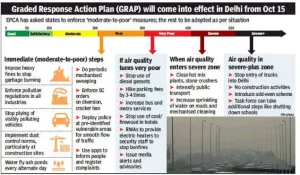
  • GRAP Stage II kicks in as Delhi’s air quality may turn ‘very poor’

    The Commission for Air Quality Management directed New Delhi authorities to enforce stage II of the Graded Response Action Plan (GRAP) with immediate effect.

    Graded Response Action Plan (GRAP)

    • In 2014, when a study by the WHO found that Delhi was the most polluted city in the world, panic spread in the Centre and the state government.
    • Approved by the Supreme Court in 2016, the plan was formulated after several meetings that the Environment Pollution (Prevention and Control) Authority (EPCA) held with state government and experts.
    • The result was a plan that institutionalized measures to be taken when air quality deteriorates.
    • GRAP also works as an emergency measure.
    • It includes strict measures such as a ban on the entry of heavy vehicles, the odd-even road rationing restrictions, and a halt of construction work – each of which is likely to be impractical at a time when the pandemic has exacted heavy economic costs and public transport has been seen as an infection risk.

    How does it work?

    • As such, the plan does not include action by various state governments to be taken throughout the year to tackle industrial, vehicular and combustion emissions.
    • When the air quality shifts from poor to very poor, the measures listed under both sections have to be followed since the plan is incremental in nature.
    • If air quality reaches the severe+ stage, GRAP talks about shutting down schools and implementing the odd-even road-space rationing scheme.

    Measures taken under GRAP

    1) Severe+ or Emergency

    (PM 2.5 over 300 µg/cubic metre or PM10 over 500 µg/cu. m. for 48+ hours)

    • Stop entry of trucks into Delhi (except essential commodities)
    • Stop construction work
    • Introduce odd/even scheme for private vehicles and minimise exemptions
    • Task Force to decide any additional steps including shutting of schools

    2) Severe

    (PM 2.5 over 250 µg/cu. m. or PM10 over 430 µg/cu. m.)

    • Close brick kilns, hot mix plants, stone crushers
    • Maximise power generation from natural gas to reduce generation from coal
    • Encourage public transport, with differential rates
    • More frequent mechanized cleaning of road and sprinkling of water

    3) Very Poor

    (PM2.5 over 121-250 µg/cu. m. or PM10 over 351-430 µg/cu. m.)

    • Stop use of diesel generator sets
    • Enhance parking fee by 3-4 times
    • Increase bus and Metro services
    • Apartment owners to discourage burning fires in winter by providing electric heaters during winter
    • Advisories to people with respiratory and cardiac conditions to restrict outdoor movement

    4) Moderate to poor

    (PM2.5 over 61-120 µg/cu. m. or PM10 over 101-350 µg/cu. m.)

    • Heavy fines for garbage burning
    • Close/enforce pollution control regulations in brick kilns and industries
    • Mechanized sweeping on roads with heavy traffic and water sprinkling
    • Strictly enforce a ban on firecrackers


    UPSC 2023 countdown has begun! Get your personal guidance plan now! (Click here)

  • 19th October 2022| Daily Answer Writing Enhancement

    Topics for Today’s questions:

    GS-1          Population and associated issues

    GS-2         Salient features of the Representation of People’s Act.

    GS-3          Various Security forces and agencies and their mandate.

    GS-4          Emotional intelligence-concepts, and their utilities and application in administration and governance.

    Question 1)


    Q.1 Recently, the country has seen a growth in the number of hate crimes. Highlighting the reasons for it, suggest ways of responding to such crimes. (10 Marks)


    Question 2)

    Q.2. Delineate the grounds of disqualification under The Representation of the People Act, 1951. Also, discuss the remedial measures available to the disqualified representatives. (15 Marks)

    Question 3)

    Q.3 What are the trans-national challenges to policing? How can Interpol help to manage such challenges? (10 Marks)

    Question 4)  

    Q.4 “It is very important to understand that emotional intelligence is not opposite of intelligence, it is not triumph of heart on head, it is a unique intersection of both.”- David Caruso. Examine the statement with suitable examples in the context of a public servant discharging his/her duties. (10 Marks)


    HOW TO ATTEMPT ANSWERS IN DAILY ANSWER WRITING ENHANCEMENT(AWE)?

    1. Daily 4 questions from General studies 1, 2, 3, and 4 will be provided to you.

    2. A Mentor’s Comment will be available for all answers. This can be used as a guidance tool but we encourage you to write original answers.

    3. You can write your answer on an A4 sheet and scan/click pictures of the same.

    4.  Upload the scanned answer in the comment section of the same question.

    5. Along with the scanned answer, please share your Razor payment ID, so that paid members are given priority.

    6. If you upload the answer on the same day like the answer of 11th  February is uploaded on 11th February then your answer will be checked within 72 hours. Also, reviews will be in the order of submission- First come first serve basis

    7. If you are writing answers late, for example, 11th February is uploaded on 13th February , then these answers will be evaluated as per the mentor’s schedule.

    8. We encourage you to write answers on the same day. However, if you are uploading an answer late then tag the mentor like @Staff so that the mentor is notified about your answer.

    *In case your answer is not reviewed, reply to your answer saying *NOT CHECKED*. 

    1. For the philosophy of AWE and payment: 

  • Q.4 “It is very important to understand that emotional intelligence is not opposite of intelligence, it is not triumph of heart on head, it is a unique intersection of both.”- David Caruso. Examine the statement with suitable examples in the context of a public servant discharging his/her duties. (10 Marks)

    Mentor’s Comments-

    • Introduce by defining the terms intelligence and emotional intelligence (EI).
    • Explain why they aren’t opposites of each other and EI is not just about the hearty matters.
    • Discuss how an intersection of both is required for a public servant to discharge his/her duties effectively by mentioning examples of the same.
  • Q.3 What are the trans-national challenges to policing? How can Interpol help to manage such challenges? (10 Marks)

    Mentor’s Comments-

More posts