The Union Cabinet under the chairmanship of PM has approved the addition of four tribes to the list of Scheduled Tribes (ST), including those from Himachal Pradesh, Tamil Nadu and Chhattisgarh.
Which tribes are we talking about?
Hatti tribe in the Trans-Giri area of Sirmour district in Himachal Pradesh
Narikoravan and Kurivikkaran hill tribes of Tamil Nadu and
Binjhia tribe in Chhattisgarh, which was listed as ST in Jharkhand and Odisha but not in Chhattisgarh
Other tribes in news
The Cabinet also approved ‘Betta-Kuruba’ as a synonym for the Kadu Kuruba tribe In Karnataka.
Who are the Scheduled Tribes?
The term ‘Scheduled Tribes’ first appeared in the Constitution of India.
Article 366 (25) defined scheduled tribes as “such tribes or tribal communities or parts of or groups within such tribes or tribal communities as are deemed under Article 342 to be Scheduled Tribes for the purposes of this constitution”.
Article 342 prescribes procedure to be followed in the matter of specification of scheduled tribes.
Article 342(1) empowers the President of India to specify, by public notification, the tribes or tribal communities deemed to be Scheduled Tribes in each state and union territory.
Among the tribal groups, several have adapted to modern life but there are tribal groups who are more vulnerable.
The Dhebar Commission (1973) created a separate category “Primitive Tribal Groups (PTGs)” which was renamed in 2006 as “Particularly Vulnerable Tribal Groups (PVTGs)”.
How are STs notified?
The first specification of Scheduled Tribes in relation to a particular State/ Union Territory is by a notified order of the President, after consultation with the State governments concerned.
These orders can be modified subsequently only through an Act of Parliament.
Status of STs in India
The Census 2011 has revealed that there are said to be 705 ethnic groups notified as Scheduled Tribes (STs).
Over 10 crore Indians are notified as STs, of which 1.04 crore live in urban areas.
The STs constitute 8.6% of the population and 11.3% of the rural population.
INS Satpura and a P8 I Maritime Patrol Aircraft of the Indian Navy reached Darwin in Australia on for participation in the multinational Exercise Kakadu – 2022, hosted by the Royal Australian Navy.
Exercise KAKADU
Exercise KAKADU, which started in 1993, is the premier multilateral regional maritime engagement exercise hosted by the Royal Australian Navy (RAN) and supported by the Australian Air Force.
The exercise is held biennially in Darwin and the Northern Australian Exercise Areas (NAXA).
It derives its name from Kakadu National Park, which is a protected area in the northern territory of Australia, 171 km south-east of Darwin
During the exercise, professional exchanges in harbour and diverse range of activities at sea, including complex surface, sub-surface and air operations would enable sharing of best practices and honing of operational skills.
India’s presence at the exercise
Indian Navy’s participation in KAKADU provides an excellent opportunity to engage with regional partners and undertake multinational maritime activities ranging from constabulary operations to high-end maritime warfare in a combined environment
It is aimed at enhancing interoperability and developing of common understanding of procedures for maritime operations gaining importance with the Indo-Pacific narrative.
India will be facing the immediate challenge –The ageing of the population. Challenge to ensure a decent quality of life for the old age people in the near future, planning and providing for it must begin today.
Background
Life expectancy in India has more than doubled since Independence from around 32 years in the late 1940s to 70 years or so today, a historical achievement.
Over the same period, the fertility rate has crashed from about six children per woman to just two, which liberated women from the cycle of continuous child bearing and child care.
What is ageing of the population?
Meaning: Population ageing is a shift in the distribution of a country’s population towards older ages.
Reason behind it: Decline in the fertility rate and Rise In the life expectancy. An increase in longevity increases the average age of the population by increasing the numbers of surviving older people.
Impact of the ageing population:, labor supply shortage, change in patterns of saving and investment, deteriorate fiscal balance, lack of adequate welfare system etc.
Challenges they impose: Social security, elderly Healthcare, Dependence on the family etc.
What is the status in India?
According to the National Commission on Population, The share of the elderly (persons aged 60 years and above) close to 9% in 2011.
Depression: According to survey by Abdul Latif Jameel foundation in Tamilnadu, 30-50% of people above age of 60 has a symptoms of depression.The proportion with depression symptoms is much higher for women than men, and rises sharply with age. In most cases, depression remains undiagnosed and untreated.
Loneliness: Loneliness one the major factor leading to depression. A large majority of elderly persons living alone are women, mainly widows.
Hardship of age: Monetary assistance can certainly help to cope with many health issues.
Poverty and poor health: Old age pensions are vital. Cash helps to lead a dignified life.
Current government schemes for elderly
Pradhan Mantri Vaya Vandana Scheme – This is one of the most popular senior citizen pension schemes in India.
Designed for senior citizens above 60 years of age, the policy term of this Prime Minister Senior Citizen Scheme extends to ten years.
The pensioner can choose the frequency of the payment – monthly/quarterly/half- yearly/annually.
You can earn interest of 8% per annum over this scheme.
The minimum and maximum capping of pension are Rs. 3,000 per month and 10,000 per month, respectively
National Programme for the Health Care of Elderly (NPHCE)–
Introduced in 2010, this scheme concentrates on preventive as well as promotive, care for the maintenance of overall health.
This program was launched to address the health issues faced by seniors.
The district-level objectives include providing dedicated health facilities in district hospitals, community health centres (CHC), primary health centres (PHC), and sub-centres (SC) levels through State Health Society.
These facilities maybe free or highly subsidized.
Varishta Mediclaim Policy –
This policy aids seniors by covering the cost of medicines, blood, ambulance charges, and other diagnosis related charges.
Designed for senior citizens between the age of 60 and 80 years, this helps meet the health-related expenses of senior citizens.
Income tax benefits are allowed for payment of premium.
Although the policy period is for one year, you can extend the renewal up to the age of 90 years.
Rashtriya Vayoshri Yojana –
This scheme provides physical aids and assisted-living devices to the elderly above 60 years of age that belong to the BPL (below the poverty line) category.
If senior citizens wish to avail this, then they must have a BPL card.
This is a Central Sector Scheme and is entirely funded by the Central Government.
Varishta Pension Bima Yojana –
This pension scheme, launched by the Ministry of Finance, is for senior citizens above 60 years.
The LIC of India has the authority to operate this scheme.
Any Medical check-ups is not necessary to avail this policy.
It offers assured pension with a guaranteed interest rate of 8% per annum for up to 10 years –
You can opt for monthly, quarterly, half-yearly, and yearly pension – depends on how you’d like to receive it.
Vayoshreshtha Samman –
This scheme focuses on those seniors who have made significant contributions in their disciplines and recognized their efforts.
It was upgraded to the National Award in 2013, and since then, awards have been granted below thirteen categories.
Conclusion
Social security pensions, of course, are just the first step towards a dignified life for the elderly. They also need other support and facilities such as health care, disability aids and assistance with daily tasks, recreation opportunities and a good social life. They can be the active contributor to the economy having the years of experience and mentorship to the demographic dividend.
Mains Question Q.
Discuss the challenges before our elderly today? What steps have been taken by government to address these challenges?
Some opine that the Prelims is the toughest stage in the UPSC exam. On the contrary, some toppers say that they cracked it on the very first attempt with 120+ marks. Is there any game of luck? Or the rankers are especially blessed by God!
The simple answer is ‘NO!’ 99% of aspirants fail the IAS Prelims even in their last attempt because while keeping an eye on many things, they cannot pay attention to the real points.
UPSC exam is such a weird exam that only those who study for 6 hours a day & keep an alert-eye on these 5 points, can clear the exam with 120+ marks for 100% sure.
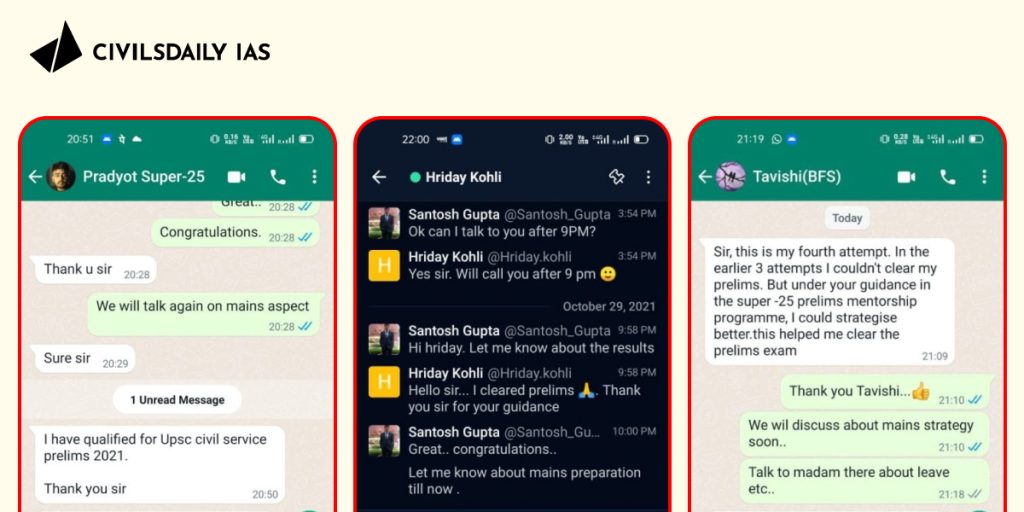
Santosh Gupta heads the Smash Prelims program for CivilsDaily.
Ascertaining the most problematic part of the exam, which the students face, we are conducting an on-demand MASTERCLASS where Prelims Guru, Santosh Gupta sir will be disclosing those 5 vital areas on which If you work, you will pass for sure.
UPSC Prelims Masterclass Details: 15th September, (Thursday) at 7 PM.
Crucial 5 points will be discussed in the Masterclass
How to cover the syllabus as widely as possible. First, let’s divide everything into its respective topics because UPSC does not provide any syllabus for prelims. So, how to do a UPSC-Prelims-centric study will be discussed.
How to maintain a proper balance between memorization & understanding. Both are co-ordinating parts. So, how much you have to memorize will be discussed 1-1.
How to develop MCQs solving skills. One agrees or not, for UPSC prelims without developing MCQs solving skills, one returns home increasing negative marking. So, how to start solving MCQs without much -ve marking, is going to be discussed.
How not to lose hope if more offbeat questions come in the paper? UPSC Prelims trends to more offbeat questions. How to identify offbeat questions! And how to use the offbeat approach will be disclosed by Santosh Sir.
What is ‘Intelligent Guessing’ (TIKDAM)? How to utilize it. Intelligent guessing means finding clues in the question or options themselves.
Many more untold secrets that only a UPSC Prelims expert can highlight.
Think that CSP is more of a test of our skills than our knowledge base. As such, general knowledge is the most specialized skill for prelims. Many times, your learning from our masterclass will come to help and this is why we always insist on taking our session seriously. It helps you develop basic concepts, confidence, and a good self-image.
“You must be aware that clearing prelims are probably the toughest part of one’s CSE journey these days. Not only are the questions random and difficult, but even the options are also getting more mysterious every year.“
So, apart from the above, some more extra crucial points will be discussed in the Masterclass
• How to keep one source for one subject confidently
• Learning to compile things; books, notes, test solutions
• Revising PYQs as much as possible
• Practicing the most useful MCQs
• Making notes, especially for Prelims of daily current affairs
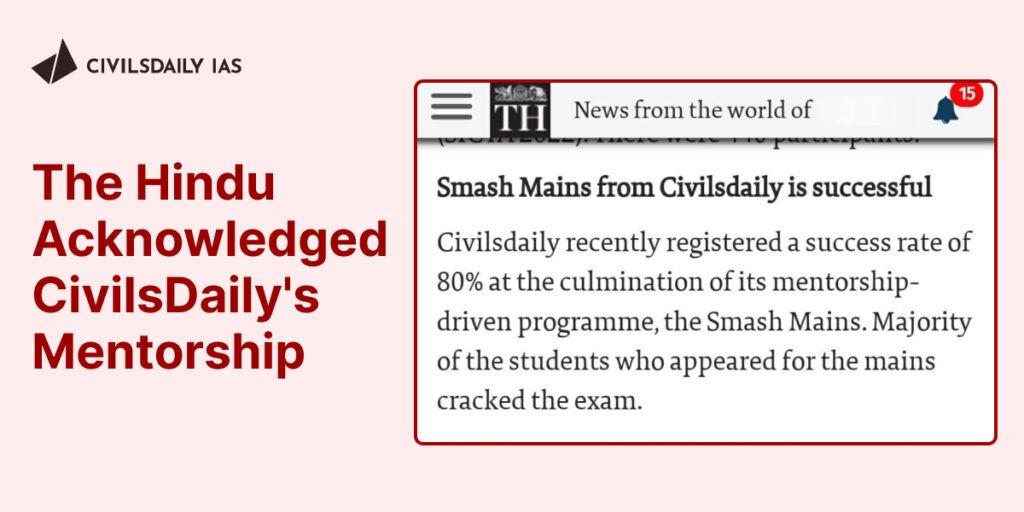
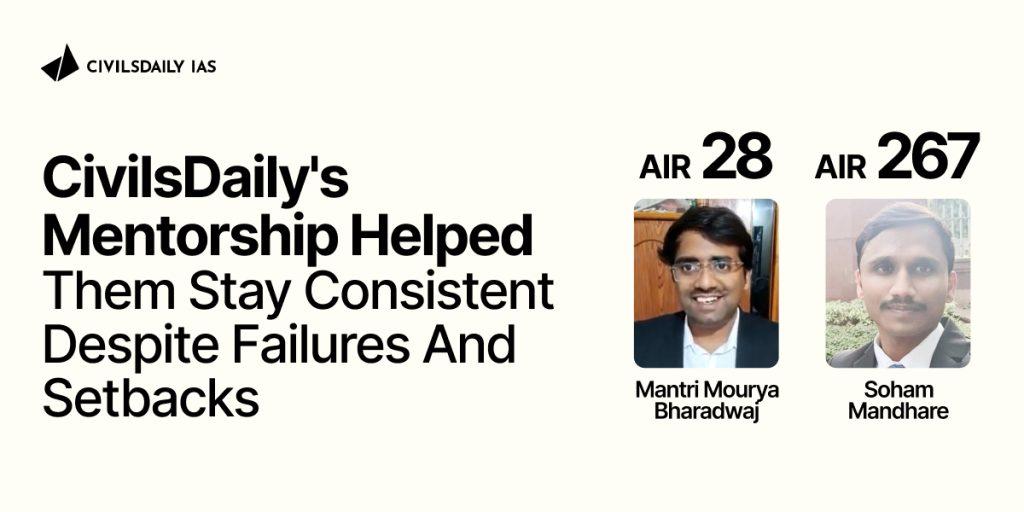
What The Hindu mentioned about Civilsdaily Mentorship
GS-1 The Freedom Struggle — its various stages and important contributors/contributions from different parts of the country.
GS-2 Bilateral, regional and global groupings and agreements involving India and/or affecting India’s interests.
GS-3 Indian Economy
GS-4 Ethics and Human Interface: Essence, determinants and consequences of Ethics in-human actions; dimensions of ethics; ethics – in private and public relationships.
HOW TO ATTEMPT ANSWERS IN DAILY ANSWER WRITING ENHANCEMENT(AWE)?
Daily 4 questions from General studies 1, 2, 3, and 4 will be provided to you.
A Mentor’s Comment will be available for all answers. This can be used as a guidance tool but we encourage you to write original answers.
You can write your answer on an A4 sheet and scan/click pictures of the same.
Upload the scanned answer in the comment section of the same question.
Along with the scanned answer, please share your Razor payment ID, so that paid members are given priority.
If you upload the answer on the same day like the answer of 11th February is uploaded on 11th February then your answer will be checked within 72 hours. Also, reviews will be in the order of submission- First come first serve basis
If you are writing answers late, for example, 11th February is uploaded on 13th February , then these answers will be evaluated as per the mentor’s schedule.
We encourage you to write answers on the same day. However, if you are uploading an answer late then tag the mentor like @Staff so that the mentor is notified about your answer.
*In case your answer is not reviewed, reply to your answer saying *NOT CHECKED*.
The Eurozone is almost certainly entering a recession, with surveys showing a deepening cost-of-living crisis and a gloomy outlook that is keeping consumers wary of spending.
What is Recession?
A recession is a significant decline in economic activity that lasts for months or even years.
Experts declare a recession when a nation’s economy experiences negative GDP, rising levels of unemployment, falling retail sales, and contracting measures of income and manufacturing for an extended period of time.
Recessions are considered an unavoidable part of the business cycle—or the regular cadence of expansion and contraction that occurs in a nation’s economy.
What causes Recessions?
These phenomena are some of the main drivers of a recession:
A sudden economic shock: An economic shock is a surprise problem that creates serious financial damage. The coronavirus outbreak, which shut down economies worldwide, is a more recent example of a sudden economic shock.
Excessive debt: When individuals or businesses take on too much debt, the cost of servicing the debt can grow to the point where they can’t pay their bills. Growing debt defaults and bankruptcies then capsize the economy.
Asset bubbles: When investing decisions are driven by emotion, bad economic outcomes aren’t far behind. Investors can become too optimistic during a strong economy.
Too much inflation: Inflation is the steady, upward trend in prices over time. Inflation isn’t a bad thing per se, but excessive inflation is a dangerous phenomenon. Central banks control inflation by raising interest rates, and higher interest rates depress economic activity.
Too much deflation: While runaway inflation can create a recession, deflation can be even worse. Deflation is when prices decline over time, which causes wages to contract, which further depresses prices. When a deflationary feedback loop gets out of hand, people and business stop spending, which undermines the economy.
Technological change: New inventions increase productivity and help the economy over the long term, but there can be short-term periods of adjustment to technological breakthroughs. In the 19th century, there were waves of labour-saving technological improvements.
What’s the difference between Recession and Depression?
Recessions and depressions have similar causes, but the overall impact of a depression is much, much worse.
There are greater job losses, higher unemployment and steeper declines in GDP.
Most of all, a depression lasts longer—years, not months—and it takes more time for the economy to recover.
Economists do not have a set definition or fixed measurements to show what counts as a depression. Suffice to say, all the impacts of a depression are deeper and last longer.
In the past century, the US has faced just one depression: The Great Depression.
The Great Depression
The Great Depression started in 1929 and lasted through 1933, although the economy didn’t really recover until World War II, nearly a decade later.
During the Great Depression, unemployment rose to 25% and the GDP fell by 30%.
It was the most unprecedented economic collapse in modern US history.
By way of comparison, the Great Recession was the worst recession since the Great Depression.
During the Great Recession, unemployment peaked around 10% and the recession officially lasted from December 2007 to June 2009, about a year and a half.
Some economists fear that the coronavirus recession could morph into a depression, depending how long it lasts.
How long do recessions last?
Gulf War Recession (July 1990 to March 1991): At the start of the 1990s, the U.S. went through a short, eight-month recession, partly caused by spiking oil prices during the First Gulf War.
The Great Recession (2008-2009): As mentioned, the Great Recession was caused in part by a bubble in the real estate market.
Covid-19 Recession: The most recent recession began in February 2020 and lasted only two months, making it the shortest US recession in history.
Can we predict a recession?
Given that economic forecasting is uncertain, predicting future recessions is far from easy. However, the following warning signs can give you more time to figure out how to prepare for a recession before it happens:
An inverted yield curve: The yield curve is a graph that plots the market value—or the yield—of a range. When long-term yields are lower than short-term yields, it shows that investors are worried about a recession. This phenomenon is known as a yield curve inversion, and it has predicted past recessions.
Declines in consumer confidence: Consumer spending is the main driver of the US economy. If surveys show a sustained drop in consumer confidence, it could be a sign of impending trouble for the economy.
Drop in the Leading Economic Index (LEI): Published monthly by the Conference Board, the LEI strives to predict future economic trends. It looks at factors like applications for unemployment insurance, new orders for manufacturing and stock market performance.
Sudden stock market declines: A large, sudden decline in stock markets could be a sign of a recession coming on, since investors sell off parts and sometimes all of their holdings in anticipation of an economic slowdown.
Rising unemployment: It goes without saying that if people are losing their jobs, it’s a bad sign for the economy.
How does a recession affect individuals?
We may lose your job during a recession, as unemployment levels rise. It becomes much harder to find a job replacement since more people are out of work.
People who keep their jobs may see cuts to pay and benefits, and struggle to negotiate future pay raises.
Investments in stocks, bonds, real estate and other assets can lose money in a recession, reducing your savings and upsetting your plans for retirement.
Business owners make fewer sales during a recession, and may even be forced into bankruptcy.
With more people unable to pay their bills during a recession, lenders tighten standards for mortgages, car loans, and other types of financing.
The most ambitious Delhi’s Alcohol Policy 2021-22 which brought in big discounts for consumers was scrapped on July 31 amid allegations of corruption and irregularities in the drafting and implementation of the policy.
After scrapping the new policy, the Delhi government decided to bring back the ‘old excise regime’ that was in force before.
Definitely! We shall not nit-pick the old vs. new policy. Let us generally understand how alcohol is regulated in India.
Alcohol laws of India: A backgrounder
The legal drinking age in India and the laws which regulate the sale and consumption of alcohol vary significantly from state to state.
In India, consumption of alcohol is prohibited in the states of Bihar, Gujarat, Nagaland and Mizoram.
There is partial ban on alcohol in some districts of Manipur.
All other Indian states permit alcohol consumption but fix a legal drinking age, which ranges at different ages per region.
In some states the legal drinking age can be different for different types of alcoholic beverage.
Regulation
Alcohol is a subject in the State List under the Seventh Schedule of the Constitution of India.
Therefore, the laws governing alcohol vary from state to state.
Liquor in India is generally sold at liquor stores, restaurants, hotels, bars, pubs, clubs and discos but not online.
Some states, like Kerala and Tamil Nadu, prohibit private parties from owning liquor stores making the state government the sole retailer of alcohol in those states.
In some states, liquor may be sold at groceries, departmental stores, banquet halls and/or farm houses.
Some tourist areas have special laws allowing the sale of alcohol on beaches and houseboats.
Drunk driving law
The blood alcohol content (BAC) legal limit is 0.03% or 0.03 mg alcohol in 100 ml blood.
On 1 March 2012, the Union Cabinet approved proposed changes to the Motor Vehicle Act.
Higher penalties were introduced, including fines from ₹2,000 to ₹10,000 and imprisonment from 6 months to 4 years.
Different penalties are assessed depending on the blood alcohol content at the time of the offence.
Dry days
Dry days are specific days when the sale of alcohol is not permitted.
Most of the Indian states observe these days on major national festivals/occasions such as Republic Day (26 January), Independence Day (15 August) and Gandhi Jayanti (2 October).
Dry days are also observed during elections in India.
Taxation on Alcohol
Most states levy either Value added Tax (VAT) or Excise duty or both.
Excise duty is a tax levied to discourage the consumption of a product.
It is calculated on a per-unit basis. Meaning, if you buy 1 litre of liquor, you pay a fixed excise duty of Rs 15.
Value-added Tax is charged in the proportion of the product. If a bottle costs Rs 100, and the state levies 10 percent VAT, the price rises to Rs 110.
Tax rates in States
The 29 states/UTs in India approach liquor taxation differently.
For instance, Gujarat has banned its citizens from consuming liquor since 1961.
But outsiders with special licenses can still buy.
Puducherry, on the other hand, earns most of its revenue from alcohol trading.
Bihar has prohibited alcohol consumption entirely, meaning the state’s revenue from liquor consumption is nil.
Its neighbour, Uttar Pradesh, earns the most excise duty on liquor.
The state does not levy VAT but a special duty on liquor, collecting funds for particular purposes.
Do you know?
Andhra Pradesh, Telangana, Kerala, Karnataka, and Tamil Nadu consume as much as 45 percent of the liquor sold in the country.
Nationally, Maharashtra charges the highest rate but draws only a portion of its revenue from its sales.
Why alcohol isn’t banned everywhere?
Taxes from alcohol sales roughly form a quarter of state revenues.
If this stream suddenly stops, states have to compulsorily cut some important spending.
Also, moderate alcohol consumption may provide some health benefits.
From less than 10 MW in 2010, India has added significant PV capacity over the past decade, achieving over 50 GW by 2022.
Solar energy in India
Solar photovoltaics (PV) has driven India’s push towards the adoption of cleaner energy generation technologies.
India is targeting about 500 GW by 2030, of renewable energy deployment, out of which ~280 GW is expected from solar PV.
This necessitates the deployment of nearly 30 GW of solar capacity every year until 2030.
Key components
A typical solar PV value chain consists of first fabricating polysilicon ingots which need to be transformed into thin Silicon wafers that are needed to manufacture the PV mini-modules.
The mini-modules are then assembled into market-ready and field-deployable modules.
Various challenges
There are challenges that need to be overcome for the sustainability of the PV economy.
(1) PV Modules
Indian solar deployment or installation companies depend heavily on imports.
It currently imports 100% of silicon wafers and around 80% of cells even at the current deployment levels.
India currently does not have enough module and cell manufacturing capacity.
India’s current solar module manufacturing capacity is limited to ~15 GW per year.
The demand-supply gap widens as we move up the value chain — for example, India only produces ~3.5 GW of cells currently.
India has no manufacturing capacity for solar wafers and polysilicon ingots.
(2) Field deployment
Also, out of the 15 GW of module manufacturing capacity, only 3-4 GW of modules are technologically competitive and worthy of deployment in grid-based projects.
India remains dependent on the import of solar modules for field deployment.
(3) Size and technology
Most of the Indian industry is currently tuned to handling M2 wafer size, which is roughly 156 x 156 mm2, while the global industry is already moving towards M10 and M12 sizes, which are 182 x 182 mm2 and 210 x 210 mm2 respectively.
The bigger size has an advantage in terms of silicon cost per wafer, as this effectively means lower loss of silicon during ingot to wafer processing.
In terms of cell technology, most of the manufacturing still uses Al-BSF technology, which can typically give efficiencies of ~18-19% at the cell level and ~16-17% at the module level.
By contrast, cell manufacturing worldwide has moved to PERC (22-23%), HJT(~24%), TOPCON (23-24%) and other newer technologies, yielding module efficiency of >21%.
(4) Land issue
Producing more solar power for the same module size means more solar power from the same land area.
Land, the most expensive part of solar projects, is scarce in India — and Indian industry has no choice but to move towards newer and superior technologies as part of expansion plans.
(5) Raw materials supply
There is a huge gap on the raw material supply chain side as well.
Silicon wafer, the most expensive raw material, is not manufactured in India.
India will have to work on technology tie-ups to make the right grade of silicon for solar cell manufacturing — and since >90% of the world’s solar wafer manufacturing currently happens in China.
It is not clear how and where India will get the technology.
Other key raw materials such as metallic pastes of silver and aluminium to form the electrical contacts too, are almost 100% imported.
Thus, India is more of an assembly hub than a manufacturing
(6) Lack of investment
India has hardly invested in this sector which can help the industry to try and test the technologies in a cost-effective manner.
Current govt policy
The government has identified this gap, and is rolling out various policy initiatives to push and motivate the industry to work towards self-reliance in solar manufacturing, both for cells and modules.
Key initiatives include:
40% duty on the import of modules and
25% duty on the import of cells, and
Production Linked Incentive (PLI) scheme to support manufacturing capex
Compulsion to procure modules only from an approved list of manufacturers (ALMM) for projects that are connected to state/ central government grids
Only India-based manufacturers have been approved
Way forward
India’s path to become a manufacturing hub for the same requires more than just putting some tax barriers and commercial incentives in the form of PLI schemes, etc.
It will warrant strong industry-academia collaboration in an innovative manner to start developing home-grown technologies which could, in the short-term.
It needs to work with the industry to provide them with trained human resource, process learnings, root-cause analysis through right testing and, in the long term, develop India’s own technologies.
High-end technology development requires substantial investment in several clusters which operate in industry-like working and management conditions, appropriate emoluments, and clear deliverables.
Finance Minister has defended the windfall tax imposed by the Centre on domestic crude oil producers, saying that it was not an ad hoc move but was done after full consultation with the industry.
What is a Windfall Tax?
Windfall taxes are designed to tax the profits a company derives from an external, sometimes unprecedented event — for instance, the energy price-rise as a result of the Russia-Ukraine conflict.
These are profits that cannot be attributed to something the firm actively did, like an investment strategy or an expansion of business.
The US Congressional Research Service (CRS) defines a windfall as an “unearned, unanticipated gain in income through no additional effort or expense”.
One area where such taxes have routinely been discussed is oil markets, where price fluctuation leads to volatile or erratic profits for the industry.
When did India introduce this?
In July this year, India announced a windfall tax on domestic crude oil producers who it believed were reaping the benefits of the high oil prices.
It also imposed an additional excise levy on diesel, petrol and air turbine fuel (ATF) exports.
Also, India’s case was different from other countries, as it was still importing discounted Russian oil.
How is it levied?
Governments typically levy this as a one-off tax retrospectively over and above the normal rates of tax.
The Central government has introduced a windfall profit tax of ₹23,250 per tonne on domestic crude oil production, which was subsequently revised fortnightly four times so far.
The latest revision was on August 31, when it was hiked to ₹13,300 per tonne from ₹13,000.
Why govt. introduced windfall tax?
There have been varying rationales for governments worldwide to introduce windfall taxes like:
Redistribution of unexpected gains when high prices benefit producers at the expense of consumers,
Funding social welfare schemes, and
Supplementary revenue stream for the government
Why are countries levying windfall taxes now?
Prices of oil, gas, and coal have seen sharp increases since last year and in the first two quarters of the current year, although they have reduced recently.
Pandemic recovery and supply issues resulting from the Russia-Ukraine conflict shored up energy demands, which in turn have driven up global prices.
The rising prices meant huge and record profits for energy companies while resulting in hefty gas and electricity bills for households in major and smaller economies.
Since the gains stemmed partly from external change, multiple analysts have called them windfall profits.
Issues with imposing such taxes
Companies are confident in investing in a sector if there is certainty and stability in a tax regime.
Since windfall taxes are imposed retrospectively and are often influenced by unexpected events, they can brew uncertainty in the market about future taxes.
IMF says that taxes in response to price surges may suffer from design problems—given their expedient and political nature.
It added that introducing a temporary windfall profit tax reduces future investment because prospective investors will internalise the likelihood of potential taxes when making investment decisions.
There is another argument about what exactly constitutes true windfall profits; how can it be determined and what level of profit is normal or excessive.
Another issue iswho should be taxed — only the big companies responsible for the bulk of high-priced sales or smaller companies as well— raising the question of whether producers with revenues or profits below a certain threshold should be exempt.
The recent National Family Health Survey (NFHS-5) data shows anaemia rates increased from 53 per cent to 57 per cent in women and 58 per cent to 67 per cent in children in 2019-21.
Definition of anaemia
The WHO defines anaemia as a condition where the number of red blood cells or the haemoglobin concentration within them is lower than normal. This compromises immunity and impedes cognitive development.
Why anaemia is a concern?
Adverse effects of anaemia affect all age groups lower physical and cognitive growth and alertness among children and adolescents, and lesser capacity to learn and play, directly impacting their future potential as productive citizens.
Anaemia among adolescent girls (59.1 per cent) advances to maternal anaemiaand is a major cause of maternal and infant mortality and general morbidity and ill health in a community.
What causes anaemia?
Imbalanced diet: Cereal-centric diets, with relatively less consumption of iron-rich food groups like meat, fish, eggs, and dark green leafy vegetables (DGLF), can be associated with higher levels of anaemia.
Underlying factors: High levels of anaemia are also often associated with underlying factors like poor water quality and sanitation conditions that can adversely impact iron absorption in the body.
Iron deficiency is major cause: A diet that does not contain enough iron, folic acid, or vitamin B12 is a common cause of anaemia.
Some other conditions: That may lead to anaemia include pregnancy, heavy periods, blood disorders or cancer, inherited disorders, and infectious diseases.
Why is anaemia so high in the country?
Low vitamin intake: Iron-deficiency and vitamin B12-deficiency anaemia are the two common types of anaemia in India.
High population and nutrition deprivation: Among women, iron deficiency prevalence is higher than men due to menstrual iron losses and the high iron demands of a growing foetus during pregnancies.
Overemphasis on cereals: Lack of millets in the diet due to overdependence on rice and wheat, insufficient consumption of green and leafy vegetables could be the reasons behind the high prevalence of anaemia in India.
What isIron fortification?
Iron fortification of food is a methodology utilized worldwide to address iron deficiency. Iron fortification programs usually involve mandatory, centralized mass fortification of staple foods, such as wheat flour.
Why need iron fortification?
Iron deficiency anaemia is due to insufficient iron.
Without enough iron, the body can’t produce enough of a substance in red blood cells that enables them to carry oxygen (haemoglobin).
Severe anaemia during pregnancy increases risk of premature birth, having a low birth weight baby and postpartum depression. Some studies also show an increased risk of infant death immediately before or after birth.
Success story / value addition
Nepal’s success story to improve maternal anaemia by national action plan .
The scheme aims to reduce the prevalence of anaemia in India.
It provides bi weekly iron Folic acid supplementation to all under five children through Asha workers.
Also, it provides biannual Deworming for children and adolescents. The scheme also establishes institutional mechanisms for advanced research in anaemia.
It also focuses on non-nutritional causes of anaemia.
We need to focus on the following interventions
Prophylactic Iron and Folic Acid supplementation.
Intensified year-round Behaviour Change Communication Campaign (Solid Body, Smart Mind).
Appropriate infant and young child feeding practices.
Increase in intake of iron-rich food through diet diversity/quantity/frequency and/or fortified foods with focus on harnessing locally available resources.
Testing and treatment of anaemia, using digital methods and point of care treatment, with special focus on pregnant women and school-going adolescents
Mandatory provision of Iron and Folic Acid fortified foods in government-funded public health programmes
Way forward
India’s nutrition programmes must undergo a periodic review.
The Integrated Child Development Services (ICDS), which is perceived as the guardian of the nation’s nutritional well-being must reassess itself and address critical intervention gaps, both conceptually and programmatically, and produce rapid outcomes.
The nutritional deficit which ought to be considered an indicator of great concern is generally ignored by policymakers and experts. Unless this is addressed, rapid improvement in nutritional indicators cannot happen.
Conclusion
When a person is anaemic, the capacity of his blood cells to carry oxygen decreases. This reduces the productivity of the person which in turn affects the economy of the country. Therefore, it is highly important to cover Anaemia under National Health Mission.
Mains question
Q.“Every second adolescent girl has anaemia. Every second woman of reproductive age is anaemic”. In this context do you think Women’s empowerment will not have any meaning without tackling anaemia? Discuss.
 Context
 Current government schemes for elderly
  Conclusion






 Context
  Why is anaemia so high in the country?
 Why need iron fortification?
 Success story / value addition