💥UPSC 2026, 2027, 2028 UAP Mentorship (March Batch) + Access XFactor Notes & Microthemes PDF

Search results for: “”

  • Q.1 Discuss the rationale behind anti-conversion laws in India. Also, state the concerns that have been raised with regard to these laws. (10 Marks)

    Mentor’s Comments-

    • Give a brief introduction about anti-conversion laws in India.
    • Discuss the rationale behind anti-conversion laws in India.
    • Bring out the various concerns that are being raised with regard to these laws.
    • Conclude accordingly.
  • [Burning issue] Opposition in India: Role, Challenges and Way forward

    “Disruption is replacing discussion as the foundation of our legislative functioning”

    Context

    • The recently concluded monsoon session of the Parliament again witnessed a high level of ruckus from Opposition Members of Parliament leading to the suspension of several of them by the Speaker.
    • Also, last month several Opposition leaders criticized the post and powers of the President as ‘Rubber Stamp’ thus dishonoring the highest executive position in the country.
    • These incidences point toward the ‘crisis’ that the Opposition is facing in India at several levels. In this article, we will analyze this issue in depth, its implications and possible solutions.

    What is Opposition in a democracy?

    • Parliamentary democracy is based on the party system of government. It is a government by criticism and exposition and therefore, it has to be governed by two political parties – a party or parties in power and a party or parties in Opposition.
    • Opposition is defined as a person or group of people opposing, criticizing, or protesting something, someone, or another group. Political Opposition is different and is defined as ‘the major political party opposed to the party in power and seeking to replace it.

    Role of Opposition in a democracy

    • Constructive criticism – In the legislature, Opposition Party has the role of Constructive criticism of the government and its policies.
    • Check the excesses of Government– The role of the Opposition in the legislature is basically to check the excesses of the ruling or dominant party, and not to be antagonistic.
    • Uphold accountability of government– Their main role is to question the government of the day and hold them accountable to the public. This also helps to fix the mistakes of the Ruling Party. This is mainly done through methods like debates and bringing a no-confidence motion.
    • Public welfare– The Opposition is equally responsible for upholding the best interests of the people of the country. For example, the demonstrations by the Opposition on roads against fuel price hikes or inflation.
    • Safeguarding liberty and right of people– For example, Opposition member Brinda Karat filed the petition in Supreme Court against the demolition drive of Delhi Municipal corporation to protect the right to life of citizens.
    • Expression of public opinion– Opposition members put forth the demands of the public and their opinion in Parliament, the highest forum of discussion.

    Opposition in India

    • Multi-party based– Being a multiply party system democracy, India has several political parties that form Opposition in multiple states and Parliament. For example SP in Uttar Pradesh and Congress in Madhya Pradesh.
    • Official recognition– Official Opposition (recognized Opposition party) designates the political party which has secured the second largest number of seats in either upper or lower houses. To get formal recognition in either upper or lower houses, the concerned party must have at least 10% of the total strength of the house.
    • 10% rule– A single party has to meet the 10% seat criterion, not an alliance. Many of the Indian state legislatures also follow this 10% rule while the rest of them prefer the single largest Opposition party according to the rules of their respective houses.

    Issues with Opposition in India

    • Leaderless Opposition– the Opposition today in India is leaderless. There are indeed good political leaders heading major regional political parties but there is no consensus on the name of one person or party as Opposition leader.
    • Highly fragmented– Today, the Opposition is divided among several political parties and coalitions holding different ideologies and working styles leading to its fragmentation and thus hampering unity.
    • Lacks an Original Agenda– the Opposition today lacks an original agenda or plan to put against the government, but is instead involved in just reacting to government actions rather than putting an alternative choice to the electorate.
    • Involved in adverse politics– The opposition sees government as its adversary and remains involved in unnecessary criticism and do not support even good policies. For example, the opposition criticized Gaganyaan Mission, Construction of the New Parliament Building as wasteful expenditure.
    • Not being innovative– Opposition parties remain involved in older ideologies of left and right, walk-outs from houses of Parliament and primitive methods like demonstrations and rallies, rather involving in new methods like Facebook live, virtual rallies, podcasts etc. This leads to a disconnect from the youth of the country.
    • Playing the role of investigative agencies– where Opposition parties keep hunting for scams and misappropriation of funds in government schemes rather than upholding government accountability.
    • Loss of credibility– continuous disruptions in Parliament proceeds, blind Opposition of government and lack of connection to ground level have led to the loss of credibility of the Opposition in the eyes of the electorate.

    Issues with the regime

    • Indifference attitude of government- towards Opposition leaders and parties. For example, the government did not recognize the leader of Opposition in loksabha for 1.5 years after 2019 elections and still has a vacant deputy speaker post in loksabha which usually goes to the Opposition party.
    • Labeling Opposition as Anti-national and roadblock to development– if Opposition asks for details and clarification about government actions.
    • Misuse of power– by using institutions like Police, CBI, ED against Opposition leaders. There are allegations against the government of using Pegasus software for snooping on Opposition leaders.
    • Lack of pre-legislative discussion- with Opposition parties on legislative bills leads to the sidelining of Opposition in the legislative process and thus poor debates in Parliament.

    Consequences of a weak Opposition

    • Leads to Politics of enmity– as both government and Opposition see each other as rivals and indulge in ugly politics. Slogans like “Congress mukt Bharat”, “Samajvaad Mukt UP” are a manifestation of such enmity.
    • Weakening of democracy– as evident from dropping rankings in several key indices like Democracy index (labeled India a ‘flawed democracy’), V-Dem report (called India ‘Electoral Autocracy’)
    • Decline of Parliament– Parliament as an institution is the biggest victim of weak Opposition. The ability of Parliament to seek accountability of the executive has been severely hampered. Productivity of Loksabha in 2021 monsoon was just 22% due to disruption by Opposition. Informed debates have also reduced.

    “Debates are rare, informed debates are even rare. Government and Opposition meet as two warring camps in Parliament” – Former Vice President Dr. Hamid Ansari

    • Autocracy of government increased- as evident from reducing the number of bills being referred to the Parliamentary committee has reduced from 76 in the 15th loksabha (2009-14) to 27 in 16th loksabha(2014-19), and important bills have been passed by simple voice vote.
    • Ordinance raj– Continuous disruptions by Opposition in Parliament have led the government to take up the ordinance route very frequently. From 2014 to 2021, the Government promulgated 76 ordinances which are 14 higher than UPA’s 10 years of rule.
    • Side-lining of public issues– Finally, in this rivalry, important public issues such as unemployment, inflation, economic distress are side-lined and less essential topics like the arrest of any Opposition political leader takes centre stage in Parliament and leads to disruption of the house by that political party members.

    How to improve the situation?

    “Without debate, without criticism, no administration and no country can succeed and no republic can survive”   – JF Kennedy

    • Stop unnecessary criticism-The Opposition has to complement in the running of the government. Merit-based Opposition to specific government acts is welcome, but opposing for the sake of opposing can only be counterproductive.
    • Work at grassroots level– There is an imperative need for the Opposition to develop an ability to read the nation’s pulse by going in between the public and then adopt a constructive approach.
    • Develop a new ideology and structure– It is necessary for a ‘New Opposition’ in India to emerge. It must have a centrist ideology that appeals to the majority of the people. It must be supported by a rank-and-file organization, with a decentralized structure.
    • Bring its own house in order– It must practice internal democracy to bring up good leaders. And it must have a practical agenda, with good slogans.
    • Consensus building– Government should also understand the importance of Opposition and should try to take Opposition together on important issues like national security. Pre-legislative consultations should also be promoted to improve the quality of debates in Parliament.

    Good practices related to Opposition in different countries

    • Shadow Cabinet system of the UK- The shadow cabinet is made up of senior members of the main Opposition party in Westminster who act as spokespeople for the Opposition in specific policy areas. Shadow ministers are appointed by the leader of the Opposition and generally take roles that mirror the current government. Their job is to scrutinize those they ‘shadow’ in government and develop policies for their party.
    • The practice of Opposition day– An Opposition day is a day in a legislature in which an Opposition party sets the agenda for the whole day. Most days the Parliamentary agenda is set by the government; Opposition days allow the smaller parties to choose the subject for debate. It is a regular practice in UK and Canada where 20 days are allotted to the Opposition to set the agenda.

    Way forward

    • The Opposition must be tolerated because if it is left to the party in power to decide what is healthy and unhealthy criticism, then every criticism of the latter will be treated as unhealthy.
    • While the Opposition must be credible and strong, it is for the Opposition to make itself credible and strong. It must feel the pulse of the people.
    • Unless it makes itself respectable, it cannot demand any respect. This is the biggest challenge facing the opposition today.

    Conclusion

    Accommodation and understanding, not division and confrontation, lay at the heart of any Parliamentary democracy. Thus, disruption and confrontation in Parliament must be stopped.

    The opposition, as well as government, must come to the table to draw a common working plan for the sake of improving the health of Indian Democracy, fulfilling our commitment to the founding fathers and making the Grand Experiment called ‘India’ a success.

  • Controversial visit of a Chinese vessel to Hambantota

    Much recently, Sri Lanka approved the arrival of a Chinese satellite-tracking vessel to its southern Chinese-funded Hambantota port.

    Why in news?

    • India has raised concerns over the ship’s visit.
    • Caught in a delicate diplomatic and geopolitical spot, Colombo gave its nod despites India’s requests to deny the permission.
    • It is asserted that bankrupt Sri Lanka succumbed to Chinese pressure after initially refusing the ship to dock.

    Yuan Wang 5: The vessel

    • Yuan Wang 5 was described by the Sri Lankan government as a “scientific research ship”.
    • The BRISL (Belt & Road Initiative Sri Lanka), a Colombo-based organisation studying China’s ambitious connectivity project, was the first to draw attention to the visit.
    • It said that the Yuan Wang 5 will conduct “satellite control and research tracking in the northwestern part of the Indian Ocean Region”.
    • Vessels of the Yuan Wang class are said to be used for tracking and supporting satellite as well as intercontinental ballistic missiles by the People’s Liberation Army Strategic Support Force.

    India’s reaction

    • India has expressed its concern over the Chinese vessel visit.
    • It is carefully monitoring any development having a bearing on its security and economic interests.

    How have other countries reacted?

    • The developments showed that Colombo was caught between the U.S. and India on the one hand, and China on the other.
    • That too at a time when the Sri Lankan government is counting on all their support as the island nation, hit by a devastating economic crisis, embarks on debt restructuring ahead of a promised IMF package.

    How did China respond?

    • China reacted strongly at Sri Lanka, following concerns voiced by India.
    • It clarified that Sri Lanka is a transportation hub in the Indian Ocean.
    • Scientific research vessels from various countries including China have made port calls in Sri Lanka for replenishment.
    • Secondly, it invoked Sri Lanka’s sovereignty and the right to develop relations with other countries based on its development interests.

    What is Sri Lanka’s stand?

    • It is reported that the US and Indian envoys were asked to provide concrete reasons for their objections.
    • Not satisfied with the reasons being sufficient to refuse entry to the Chinese vessel, SL decided to inform the Chinese embassy in Colombo to inform the ship to continue its journey to Hambantota.


    UPSC 2023 countdown has begun! Get your personal guidance plan now! (Click here)

  • Five years after SC verdict, talaq petitioners living as ‘half-divorcees’

    Five years after the Supreme Court’s five-judge Bench under then CJI J.S. Khehar invalidated instant triple talaq in August 2017, the women petitioners continue to live a life of half-divorcees.

    What is triple talaq?

    • ‘Triple Talaq’ is a procedure of divorce under the Sharia Law which is a body of the Islamic law.
    • Under this, a husband can divorce his wife by pronouncing ‘Talaq’ thrice.
    • The Supreme Court invalidated instant triple talaq in the Shayara Bano versus the Union of India case while refraining from commenting on the state of their marriages directly.

    What was the issue all about?

    • The case dates back to 2016 when the Supreme Court had sought assistance from the then Attorney General Mukul Rohatgi on pleas challenging the constitutional validity of “triple talaq”.
    • The hearing also included cases of “nikah halala” and “polygamy”, to assess whether Muslim women face gender discrimination in cases of divorce.
    • The issue gained political momentum on March 2017 when the Personal Law Board (AIMPLB) told the Supreme Court that the issue of triple talaq falls outside the judiciary’s realm.
    • However, on August 22, the Supreme Court set aside the decade-old practice of instant triple talaq saying it was violative of Article 14 and 21 of the Indian Constitution.

    Why was triple talaq abolished?

    • In spite of protests by Muslim women and activists world-wide the procedure was most prevalent throughout the country.
    • There are several instances where ‘triple talaq’ has enabled husbands to divorce arbitrarily, devoid of any substantiation.
    • Oral talaq or ‘triple talaq’ delivered through social media platforms like Skype, text messages, email and WhatsApp have become an increasing cause of worry for the community.
    • The ‘triple talaq’ has been abolished in 21 countries including Pakistan, but is still prevalent in India.
    • The Centre reasons that these practices are against constitutional principles such as gender equality, secularism, international laws etc.
    • When these practices are banned in Islamic theocratic countries, the practices could have absolutely no base in religion and are only prevalent to permit the dominance of men over women.

    Why in news now?

    • Half-divorce: Technically still married, practically divorced, they enjoy no conjugal rights nor receive any regular maintenance from the estranged husbands.
    • Cannot remarry: Practically abandoned, the women cannot remarry in the absence of a legally valid divorce.
    • No legal action: After the verdict, none of the men were visited by law enforcement bodies and told to take back their wives.
    • No legal implementation: Further, no arrests could be made for giving instant triple as the Muslim Women (Protection of Rights on Marriage) Act, 2019 came into force long after the pronouncement of instant talaq.


    UPSC 2023 countdown has begun! Get your personal guidance plan now! (Click here)

  • Coastal ecosystem norms

    This week, the Comptroller and Auditor General (CAG) of India tabled a report in Parliament on whether steps taken by the Union Environment Ministry to conserve India’s coastal ecosystems have been successful.

    Why in news?

    • The CAG frequently undertakes ‘performance audits’ of government programmes and ministries.

    Centre’s obligations on conserving the coastline

    • The government has issued notifications under the Environment Protection Act, 1986, to regulate activities along India’s coasts particularly regarding construction.
    • The Coastal Regulation Zone Notification (CRZ), 2019 implemented by the Ministry, classifies the coastal area into different zones to manage infrastructure activities and regulate them.

    The three institutions responsible for the implementation of the CRZ are:

    1. National Coastal Zone Management Authority (NCZMA) at the Centre,
    2. State/Union Territory Coastal Zone Management Authorities (SCZMAs/UTCZMAs) in every coastal State and Union Territory
    3. District Level Committees (DLCs) in every district that has a coastal stretch and where the CRZ notification is applicable

    Functions under CRZ rules

    • These bodies examine if CRZ clearances granted by the government are as per procedure, if project developers are once given the go-ahead are complying with conditions and if the project development objectives under the Integrated Coastal Zone Management Programme (ICZMP) are successful.
    • They also evaluate the measures taken up by the government towards achieving the targets under Sustainable Development Goals.

    Why did the CAG undertake this audit?

    • The CAG has a constitutional mandate to investigate and report on publicly funded programmes.
    • The CAG conducted “pre-audit studies” and found that there were large-scale CRZ violations in the coastal stretches.
    • Incidences of illegal construction activities (reducing coastal space) and effluent discharges from local bodies, industries and aquaculture farms had been reported by the media and this prompted it to undertake a detailed investigation.

    What did the recent audit find?

    The audit pointed out various categories of violations.

    • There were instances of the Expert Appraisal Committees —who evaluate the feasibility of an infrastructure project and its environmental consequences — not being present during project deliberations.
    • There were also instances of the members of the EAC being fewer than half of the total strength during the deliberations.
    • The SCZMA had not been reconstituted in Karnataka and there was delayed reconstitution in the States of Goa, Odisha and West Bengal.
    • The DLCs of Tamil Nadu lacked participation from local traditional communities. In Andhra Pradesh, DLCs were not even established.
    • There were instances of projects being approved despite inadequacies in the Environment Impact Assessment (EIA) reports.

    What problems did the CAG find in the States?

    • Lack of strategy: Tamil Nadu didn’t have a strategy in place to conserve the Gulf of Mannar Islands.
    • Lack of monitoring: In Goa, there was no system for monitoring coral reefs and no management plans to conserve turtle nesting sites.
    • No scientific oversight: In Gujarat, instruments procured to study the physiochemical parameters of soil and water of the inertial area of the Gulf of Kutch weren’t used.
    • Monitoring issues: Sea patrolling in Gahirmatha Sanctuary, in Kendrapara, Odisha did not happen.
    • No information in public domain: There was no website to disseminate the information related to the NCZMA, the CAG found, which is a clear violation of the mandated requirements of the Authority.

    What lies ahead?

    • These reports are placed before the Standing Committees of Parliament, which select those findings and recommendations that they judge to be the most critical to public interest and arrange hearings on them.
    • In this case, the Environment Ministry is expected to explain omissions pointed out by the CAG and make amends.

    Back2Basics: Comptroller and Auditor General (CAG) of India

    • The CAG is the Constitutional Authority, established under Article 148 of the Constitution of India.
    • They are empowered to Audit all receipts and expenditure of the GoI and the State Governments, including those of autonomous bodies and corporations substantially financed by the Government.
    • The CAG is also the statutory auditor of Government-owned corporations.
    • It conducts supplementary audit of government companies in which the Government has an equity share of at least 51 per cent or subsidiary companies of existing government companies.
    • The reports of the CAG are laid before the Parliament/Legislatures and are being taken up for discussion by the Public Accounts Committees (PACs) and Committees on Public Undertakings (COPUs).


  • Panel moots district-level survey to bring more children into adoption ambit

    A report recently tabled on “Review of Guardianship and Adoption Laws” in Parliament has stated that- India despite a country with millions of orphans, there are only 2,430 children available for adoption.

    What is the news?

    • There are many enthusiastic parents who are ready to adopt children.
    • To address this paradox, a Parliamentary panel has recommended district-level surveys to proactively identify orphaned and abandoned children.
    • According to the report, there were 27,939 prospective parents registered with the Child Adoption Resource Authority (CARA) as on December 2021, up from nearly 18,000 in 2017.

    What is CARA?

    • Central Adoption Resource Authority (CARA) is an autonomous and statutory body of the Ministry of Women and Child Development. It was set up in 1990.
    • It functions as the nodal body for the adoption of Indian children and is mandated to monitor and regulate in-country and inter-country adoptions.
    • CARA is designated as the Central Authority to deal with inter-country adoptions in accordance with the provisions of the 1993 Hague Convention on Inter-country Adoption, ratified India in 2003.
    • It primarily deals with the adoption of orphaned, abandoned and surrendered children through its associated and recognized adoption agencies.

    Adoption Process

    • The eligibility of prospective adoptive parents living in India, duly registered on the Child Adoption Resource Information and Guidance System (CARINGS), irrespective of marital status and religion, is Procedure for adoption adjudged by specialised adoption agencies preparing home study reports.
    • The specialized adoption agency then secures court orders approving the adoption.
    • All non-resident persons approach authorized adoption agencies in their foreign country of residence for registration under CARINGS.
    • Their eligibility is adjudged by authorised foreign adoption agencies through home study reports.
    • CARA then issues a pre-adoption ‘no objection’ certificate for foster care, followed by a court adoption order.
    • A final ‘no objection’ certificate from CARA or a conformity certificate under the adoption convention is mandatory for a passport and visa to leave India.

    What else regulates child adoption?

    • The Juvenile Justice (Care and Protection of Children) Act, 2015 permits the adoption of same-sex children, allowing biological or adopted parents to adopt a child of the same gender.
    • A single or divorced person can adopt under the JJ Act, but a single male cannot adopt a girl child.
    • According the Hindu Adoption and Maintenance Act, 1956 (HAMA), a Hindu parent or guardian can place a child for adoption with another Hindu parent under the Act.
    • A prospective parent can also adopt a male child if he has no other male children or grandchildren, or a female child if he has no other female children or grandchildren.

    Issues with child adoption in India

    • Parent-centrism: The current adoption approach is very parent-centred, but parents must make it child-centred.
    • Age of child: Most Indian parents also want a child between the ages of zero and two, believing that this is when the parent-child bond is formed.
    • Institutional issues: Because the ratio of abandoned children to children in institutionalised care is lopsided, there are not enough children available for adoption.
    • Lineage discrimination: Most Indians have a distorted view of adoption because they want their genes, blood, and lineage to be passed down to their children.
    • Red-tapism: Child adoption is also not so easy task after the Juvenile Justice Rules of 2016 and the Adoption Regulations of 2017 were launched.


    UPSC 2023 countdown has begun! Get your personal guidance plan now! (Click here)

  • Who was Kakasaheb Gadgil?

    The Gadgil Wada of Pune was recently lighted into tricolour for the 75th anniversary of Independence.

    Gadgil Wada was where plans for the reconstitution of the socialist Rashtra Seva Dal took place in early 1940s, with socialists like S.M. Joshi, N.G. Gore, Shirubhau Limaye and Kakasaheb in the lead.

    Kakasaheb Gadgil

    • Gadgil was an Indian freedom fighter and politician from Maharashtra, India.
    • He was also a writer. He wrote in both Marathi and English.
    • Gadgil graduated from Fergusson College in Pune in 1918, and obtained a degree in Law in 1920.
    • In India’s pre-independence days, freedom fighters Lokmanya Tilak, Mahatma Gandhi, Jawaharlal Nehru, and Vallabhbhai Patel influenced Gadgil.
    • He joined the Indian National Congress in 1920, immediately after obtaining his law degree and started his active participation in the national freedom movement.
    • He suffered imprisonment from the ruling British government eight times for the participation.

    Notable work during freedom struggle

    • In India’s pre-independence days, Gadgil served as the secretary of Poona District Congress Committee (1921–25), the president of Maharashtra Pradesh Congress Committee (1937–45).
    • He was elected to the central Legislative Assembly in 1934.
    • Gadgil was a pioneer in social reform movements in Maharashtra in the 1930s.
    • During the Civil Disobedience Movement, which began in 1930, Gadgil was listed as a leader for the Maharashtra Civil Disobedience Committee and the Pune War Council.
    • He was associated with several public associations and institutions, including Sarvajanik Sabha, Pune; Young Men’s Association, Pune; Maharashtra Youth League, Bombay; Pune Central Cooperative Bank; and Pune Municipality.

    Service after India’s independence

    • Between 1947 and 1952 Gadgil served as a minister in the first central cabinet of independent India.
    • He held the portfolios of Public Works, and Mines and Power.
    • In his first year in the central Cabinet, he initiated the project of building a military-caliber road from Pathankot to Srinagar via Jammu in Kashmir as a part of India’s activities in the 1947 Indo-Pakistan War.
    • As a cabinet minister, he also initiated the important development projects pertaining to Bhakra, Koyna, and Hirakund dams.
    • He was a member of the Congress Working Committee from 1952 to 1955.
    • His son Vitthalrao Gadgil was a veteran congressman and MP from Pune Lok Sabha constituency, and his grandson Anant Gadgil is currently spokesman for Maharashtra Pradesh Congress Committee.

    Authorship

    • Gadgil wrote several books and articles on politics, economics, law, and history.
    • The following are some of Gadgil’s books:
    1. Pathik (autobiography)
    2. Rajya Shastra Wichar
    3. Shubha Shastra
    4. Waktrutwa Shastra
    5. Gyanbache Arthashastra
    6. Government from Inside
    7. Shikhancha Itihaas (history of Sikhs)


    UPSC 2023 countdown has begun! Get your personal guidance plan now! (Click here)

  • Punjab bans use of 10 insecticides

    Amid reports that several samples of basmati rice contained the residue of certain pesticides above the maximum residue level (MRL), the Punjab government has decided to ban the use of 10 formulations.

    Which are the chemicals banned?

    • The State government believed that the sale, stock distribution, and use of Acephate, Buprofezin, Chloropyriphos, Methamidophos, Propiconazole, Thiamethoxam, Profenofos, Isoprothiolane, Carbendazim, and Tricyclazole was not in the interest of basmati rice growers.
    • It is said that there is a risk of breaching the MRL fixed by the competent authority for basmati rice.

    What is the Maximum Residue Limit (MRL)?

    • MRL is the highest level of pesticide residue that is legally tolerated in or on food or feed when pesticides are applied correctly in accordance with Good Agricultural Practice promulgated by Food and Agriculture Organization (FAO).
    • The MRL is usually determined by repeated (on the order of 10) field trials at an appropriate pre-harvest interval or withholding period has elapsed.
    • For many pesticides, this is set at the Limit of determination (LOD) – since only major pesticides have been evaluated and understanding of acceptable daily intake (ADI) is incomplete.


    UPSC 2023 countdown has begun! Get your personal guidance plan now! (Click here)

  • Women heroes of India’s freedom struggle, mentioned by PM in his I-Day speech

    In his Independence Day address to the nation the Prime Minister paid tributes to women freedom fighters for showing the world the true meaning of India’s “nari shakti”. A look at the women he named in his speech:

    Rani Laxmibai

    • The queen of the princely state of Jhansi, Rani Laxmibai is known for her role in the First War of India’s Independence in 1857.
    • Born Manikarnika Tambe in 1835, she married the king of Jhansi.
    • The couple adopted a son before the king’s death, which the British East India Company refused to accept as the legal heir and decided to annex Jhansi.
    • Refusing to cede her territory, the queen decided to rule on behalf of the heir, and later joined the uprising against the British in 1857.
    • Cornered by the British, she escaped from Jhansi fort. She was wounded in combat near Gwalior’s Phool Bagh, where she later died.
    • Sir Hugh Rose, who was commanding the British army, is known to have described her as “personable, clever…and one of the most dangerous Indian leaders”.

    Jhalkari Bai

    • A soldier in Rani Laxmibai’s women’s army, Durga Dal, she rose to become one of the queen’s most trusted advisers.
    • She is known for putting her own life at risk to keep the queen out of harm’s way.
    • Till date, the story of her valour is recalled by the people of Bundelkhand, and she is often presented as a representative of Bundeli identity.
    • According to Ministry of Culture’s Amrit Mahotsav website, “Many Dalit communities of the region look up to her as an incarnation of God and also celebrate Jhalkaribai Jayanti every year in her honour.”

    Durga Bhabhi

    • Durgawati Devi, who was popularly known as Durga Bhabhi, was a revolutionary who joined the armed struggle against colonial rule.
    • A member of the Naujawan Bharat Sabha, she helped Bhagat Singh escape in disguise from Lahore after the 1928 killing of British police officer John P Saunders.
    • During the train journey that followed, Durgawati and Bhagat Singh posed as a couple, and Rajguru as their servant.
    • Later, as revenge for the hanging of Bhagat Singh, Rajguru, and Sukhdev, she made an unsuccessful attempt to kill the former Punjab Governor, Lord Hailey.
    • Born in Allahabad in 1907 and married to Hindustan Socialist Republican Association (HSRA) member Bhagwati Charan Vohra, Durgawati, along with other revolutionaries, also ran a bomb factory in Delhi.

    Rani Gaidinliu

    • Born in 1915 in present-day Manipur, Rani Gaidinliu was a Naga spiritual and political leader who fought the British.
    • She joined the Heraka religious movement which later became a movement to drive out the British. She rebelled against the Empire, and refused to pay taxes, asking people to do the same.
    • The British launched a manhunt, but she evaded arrest, moving from village to village.
    • Gaidinliu was finally arrested in 1932 when she was just 16, and later sentenced for life. She was released in 1947.
    • Then PM Nehru described Gaidinliu as the “daughter of the hills”, and gave her the title of ‘Rani’ for her courage.

    Rani Chennamma

    • The queen of Kittur, Rani Chennamma, was among the first rulers to lead an armed rebellion against British rule.
    • Kittur was a princely state in present-day Karnataka.
    • She fought back against the attempt to control her dominion in 1824 after the death of her young son. She had lost her husband, Raja Mallasarja, in 1816.
    • She is seen among the few rulers of the time who understood the colonial designs of the British.
    • Rani Chennamma defeated the British in her first revolt, but was captured and imprisoned during the second assault by the East India Company.

    Begum Hazrat Mahal

    • After her husband, Nawab of Awadh Wajid Ali Shah, was exiled after the 1857 revolt, Begum Hazrat Mahal, along with her supporters, took on the British and wrested control of Lucknow.
    • She was forced into a retreat after the colonial rulers recaptured the area.

    Velu Nachiyar

    • Many years before the revolt of 1857, Velu Nachiyar waged a war against the British and emerged victorious. Born in Ramanathapuram in 1780, she was married to the king of Sivagangai.
    • After her husband was killed in battle with the East India Company, she entered the conflict, and won with support of neighbouring kings.
    • She went on to produce the first human bomb as well as establish the first army of trained women soldiers in the late 1700s.
    • Her army commander Kuyili is believed to have set herself ablaze and walked into a British ammunition dump.
    • She was succeeded by her daughter in 1790, and died a few years later in 1796.


    UPSC 2023 countdown has begun! Get your personal guidance plan now! (Click here)

  • History of the PIN code, which turns 50 this I-Day

    The 75th Independence Day coincides with another milestone in the country’s history — it was on August 15, 1972, that the Postal Index Number (PIN) was introduced in India.

    As the PIN code turns 50 on Monday, we look at its history and evolution.

    Why was the PIN code introduced?

    • According to the Department of Posts, there were 23,344 post offices, primarily in urban areas, in India at the time of Independence.
    • But, the country was growing rapidly and the postal network had to keep pace.
    • The PIN code was meant to ease the process of mail sorting and delivery in a country where different places, often, have the same or similar names, and letters are written in a wide variety of languages.

    How does the PIN code work?

    • The PIN is made up of six digits.
    • The first number indicates the postal region — Northern, Eastern, Western, Southern; and number 9, which signifies the Army Postal Service.
    • The second number denotes a sub-region, and the third represents the sorting district.
    • The remaining numbers narrow the geography further to the specific post office making the delivery.

    Who was the person behind the initiative?

    • The person behind the initiative was Shriram Bhikaji Velankar, additional secretary in the Union Ministry of Communications and a senior member of the Posts and Telegraphs Board.
    • Velankar was also a Sanskrit poet of eminence who had been conferred the President’s Award for Sanskrit in 1996, three years before he died in Mumbai.
    • He had set up a cultural group in Mumbai, called the Dev Vani Mandiram, which worked to create awareness about Sanskrit in India and foreign countries.
    • Velankar was also the chairman of the World Philatelic Exhibition, called Indipex, which was held in New Delhi in 1973 and featured 120 countries.
    • He retired from his government service on December 31, 1973.

    What are some parallel systems followed world over?

    • Globally, in the US, the Zone Improvement Plan (ZIP) code was introduced July 1, 1963, under the aegis of the Postal Service Nationwide Improved Mail Service plan to improve the speed of mail delivery.
    • Under the old system letters went through about 17 sorting stops – the new system was going to be considerably less time-consuming utilizing newer, more mechanical systems.

    Is the PIN code still relevant?

    • With the spread of the Internet, when people are sending fewer letters, it is easy to question the relevance of the PIN code.
    • But try to order food delivery or a parcel over online shopping and the importance of Velankar’s work in India will become evident.


    UPSC 2023 countdown has begun! Get your personal guidance plan now! (Click here)

  • How to stop procrastinating and make the best use of 5hrs/day for UPSC preparation?

    How to stop procrastinating and make the best use of 5hrs/day for UPSC preparation?

    Procrastination, the thief of your time and the killer of your UPSC dream.


    Procrastination is the act of unnecessarily delaying or postponing decisions or actions. For a UPSC aspirant, it is a sure-shot killer of their IAS dream.

    A certain UPSC dream killer.

    You decide to study a particular topic or write answers for the day – You get distracted or are lazy or simply confused- You put off these for later and promise to do them tomorrow – That tomorrow never comes – You realize that you have wasted your time – You regret – You are sad the whole day thinking about it – You waste the whole day mourning your wasted time – You realize you have wasted another day – Days turn to weeks and weeks to months. And it is yet another wasted attempt.

    Procrastination is often detrimental to people’s ability to successfully pursue their goals.

    It also results in anxiety, low self-esteem, demotivation, low confidence, stress, and at times depression. A good chunk of UPSC aspirants face these issues.


    CivilsDaily’s mentorship ensured Working Professional aspirants like Mourya, AIR 28 made the best use of the time they have. Click and Talk to Mourya’s mentor


    We need to understand why we procrastinate

    After talking to thousands of aspirants and Rankers from CivilsDaily we came to a conclusion that almost 99% of the aspirants procrastinate, to varying degrees. You are not alone. There are several reasons for putting things off for a later time:

    1. Fear of failure, or performing badly in the initial stages of preparation is one of the chief reasons. Aspirants often feel underconfident and not prepared to start writing answers, or attempting a Prelims Mock.

    Hedge the risk of failure with mentorship or guidance from seniors or UPSC experienced people. Click and schedule a FREE mentorship session with CivilsDaily’s senior mentors.

    2. Overthinking, mostly about irrelevant things – due to ignorance, excess of information. Most of the IAS aspirants waste a lot of time thinking a lot on the best resources, reading a lot of irrelevant books, discussing and fantasizing about various political concepts, etc. You gotta stop it.

    3. Perfectionism or waiting for the most appropriate time– 95% is not good as 100%. But its a lot better than zero

    It’s tempting to want the best UPSC resources, collect the finest of the notes, try to memorize every concept before you start writing your first answer, or attempt your first IAS Prelims mock.

    Don’t wait till you have covered the whole GS syllabus to write your first Essay or first answer. Writing daily answers, even if they are not of UPSC standard will take you a long way to actually writing UPSC level answers in the actual UPSC Mains exam hall.

    4. Fear of the wrong choice- any decision is better than no decision. But when a lot of time (attempts), finances, and efforts are at stake the informed decision is the best. Talk to a senior mentor to decide on optional, when, and how to start writing answers, when to start attempting the mock tests, and other important decisions.

    5. Boring topics, culture, geography, CSAT, writing long essays. You can’t delegate here, and nor can you leave it, especially when you have time. Talk to some senior, mentor, or teacher who will point out important topics, will help make it a fun activity, or chart out a plan to cover the ‘boring topics’.

    You need to understand the reasons why you are procrastinating before you can begin to tackle it. 

    How to beat procrastination?

    Aspirants and people, in general, shy away from routines, timetables, systems, and processes because they want to have “freedom” or maybe due to ignorance. But in order to get things done, you need a process, bound by certain rules. It will include:
    1. Breaking down the whole syllabus into small chunks (chapters and sections).
    2. Setting a clear plan of action for the coming week and months, daily targets which are flexible as per your time requirement, and considering other factors. Click here to get a timetable made by UPSC Ranker
    3. Make yourself accountable to the process or mentor so that you are executing (covering the syllabus, giving tests, etc.) on a daily basis.
    4. Measuring your progress on a regular basis. This is best done by a senior or someone experienced who can evaluate your progress based on the tests, and answer writing.
    5. Not fearing bad performance, but instead understanding where you went wrong and how to improve.

    Why do you need a mentor to help you fight procrastination?

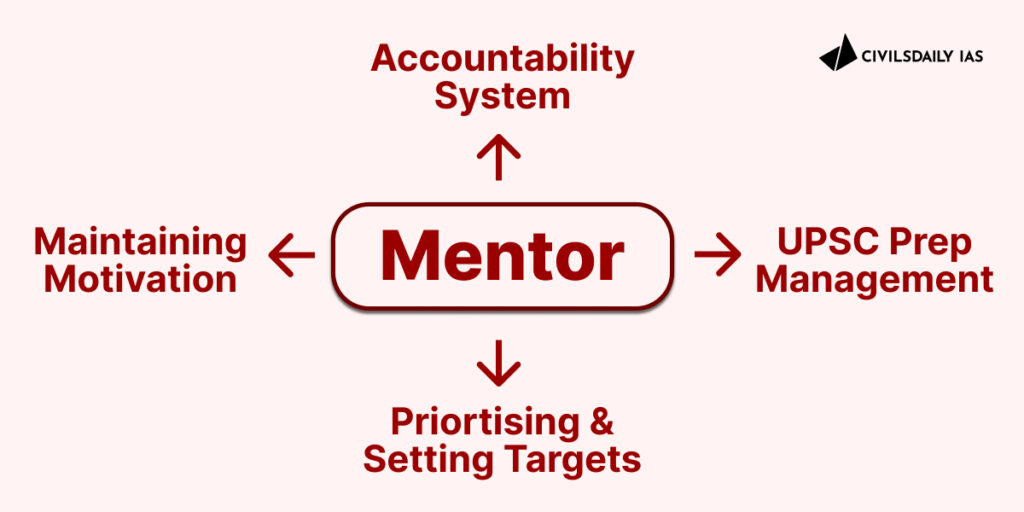
    1. Setting an accountability system in place: If you make yourself accountable to someone else, you’re far more likely to achieve your goals. Ask them to check in on your progress from time to time.

    2. Setting your own deadlines never works. We rarely respect self-imposed deadlines because we don’t feel too bad about breaking promises we’ve made to ourselves. But we do respect promises we make to others. 

    Introducing three layers of Mentorship with IAS/UPSC Ranker as your mentor.


    3. Prioritising and target setting: A experienced mentor will help you prioritize topics beforehand and set targets. At times aspirants leave topics or subjects like Ethics, Optional till the post-prelims preparation phase. A mentor will integrate these into your preparation from the start.

    4. Maintaining motivation and emotional self-control: Not always you will be in a jolly mood or motivated. UPSC prep is a long journey and there will be bouts of lows. An experienced mentor who has gone through the same journey helps in maintaining sanity during the UPSC process.

    Mentoring UPSC aspirants like an elder brother.

    How does Samanvaya Mentorship work? Introducing 3 layers of mentorship: Get IAS or UPSC ranker as your mentor

    1. 1st step starts with this Samanvaya call: Once you fill in the form, we get on a 30-40 minute call with you to understand your prep level, working/ study constraints, and current strategies and create a step-by-step plan for the next week, next month and so on.

    2. You are directed and given access to relevant resources and invite-only platform, Habitat where you can ask your daily doubts, discuss your test-prep questions and have real-time, live sessions on news and op-eds, and find your optional groups.

    Daily target monitoring.

    3. The third and the most personalized tier is the 1 on 1 mentor allotment who stays with you through the course of your UPSC preparation – always-on chat and on scheduled calls to help you assess, evaluate, and chart the next milestone of your IAS 2023-23 journey.

    We will also connect you to a UPSC ranker or IAS, who will mentor you in this journey.

    Layer 1: You will be assigned a dedicated in-house mentor who will keep track of our progress from start till your final interview.

    Layer 2: Sajal Singh sir and the team will be constantly with you through various programs like Samachar Manthan, Prelims, Essay, etc.

    Layer 3: A UPSC IAS ranker (one who has cleared this exam) will be supervising your progress as your super mentor.

    Who are you?

    1. Working Junta? If you are preparing for IAS 2023-24 and working simultaneously, we can help you design a timetable that fits right in your hectic schedule.
    2. First-time prep? If you are in the last year of college or thinking of dropping a year and preparing for IAS 2023-24 full-time, we can help you pick the right books and craft a practical & personal strategy.
    3. UPSC Veteran?

    You just have to take 5 minutes out and fill this form: Samanvaya For IAS 2023

    Once done, we will call you within 24 hours or so.

    Click to fill out the form: Samanvaya for IAS 2023

  • How did Dilpreet, working full-time as a PCS, study 4hrs/day, and become an IPS in UPSC 2020?| FREE Masterclass on Time management and consistency for working professionals. (Register for recorded video + Free mentorship)

    How did Dilpreet, working full-time as a PCS, study 4hrs/day, and become an IPS in UPSC 2020?| FREE Masterclass on Time management and consistency for working professionals. (Register for recorded video + Free mentorship)

    Special session with IPS, Dilpreet Singh, concluded| Register for the recorded video and get a personalised Timetable, and 1-1 mentorship session.


    In our interaction with almost 12,000 working professional aspirants (those with a full-time job and preparing for UPSC CSE) over the past couple of months it was revealed that Time management and consistency were the major issue to their preparation.

    This is something you aspirants can’t avoid and move on. This Sunday we conducted another power-packed FREE Masterclass session with an IPS officer.

    Dilpreet Singh was a CivilsDaily’s mentorship and Samachar Manthan student. He was a Mechanical Engineer who cleared PCS twice and was a working professional at the time of his UPSC attempt which landed him an AIR 237 and IPS.

    Why time management?

    Time management with the help of a mentor makes your preparation effective.

    Time management is a #UPSCskill that tops all other skills in this long journey. Moreover, the complexity and vastness of the syllabus, unpredictability and ever-changing pattern of the UPSC exam, and cut-throat competition necessitate you to invest your time wisely.

    Over that, if you are a working professional, college student, or homemaker, and preparing for this exam, and if you don’t have a workable timetable, you won’t be able to stay consistent and your preparation will suffer.

    There is no consistency and discipline without time-management. You need guidance for that.

    Consistency is the key

    Masterclass details

    Dilpreet took up an interactive session (1-1 questions) from the aspirants on time management, timetable, and staying consistent. This session in particular is a must for UPSC aspirants who are working professionals and in general, for all aspirants with a serious time crunch.

    Other than the points mentioned above we will be discussing the following issues as well.

    1. Management of Priorities – UPSC, family, life, and work.
    2. Reducing time on non-priorities and maintaining focus on daily and weekly targets.
    3. Planning ahead, making targets, staying consistent w.r.t targets and your UPSC preparation.
    4. How should the syllabus be approached to complete it 2 months before UPSC Prelims?
    5. Balancing prelims-mains on one hand and GS-current affairs on the other.
    6. How to determine the primary focus areas of the Prelims, Mains, and Personality tests?
    7. How to apply bookish as well as classroom knowledge to the exam?

    What The Hindu mentioned about Civilsdaily Mentorship

    click and book your slot with IPS, Dilpreet | GEt FREE Mentorship + Samachar Manthan module

  • India @75 –Relooking our democracy

    Context

    • As we celebrate the nation @75 , we must also reflect on the mixed nature of our democracy

    Definition of democracy

    • “Government of the people, by the people and for the people” were the words used by Abraham Lincoln in the year 1863 while talking about democracy.

    Purpose of democracy

    • Cornerstones of democracy include freedom of assembly, association, property rights, freedom of religion and speech, inclusiveness and equality, citizenship, consent of the governed, voting rights, freedom from unwarranted governmental deprivation of the right to life and liberty, and minority rights.

    Background

    • India is a parliamentary democratic secular republic in which the president of India is the head of state & first citizen of India and the prime minister of India is the head of government.
    • It is based on the federal structure of government, although the word is not used in the Constitution itself.

    How it has performed

    (1) Political front

    • India is the world’s the largest democracy proved success in accommodation of group and regional demands in a complex, quasi-federal, polity.
    • During the first general election in the 1951 India had 54 political parties and now it has grown up to 464 in the 2014 general election as an evident of deepening of the democratic process.
    • In the first General election 1951, 173 million citizens were given right to vote.
    • In the 16th general election in 2014, the size of the electorate had increased to 814 million.

    (2) Social front

    • The democratic process has brought about a shift of political power from the middle and higher castes and classes of urban society to backward classes who are now the politically most influential ones in the country.
    • They have won reservations for themselves in legislatures and government services as were accorded to the Scheduled Castes and Scheduled Tribes after independence through Constitutional provisions.

    (3) Economic Front

    • These include strategic affairs and security, politico-legal democratic governance as well as society and economy.
    • India has been able to emerge as a regional power in Asia and super power in south Asia backed by its economic, military and nuclear capabilities.

    Contradictions in democracy

    • Performance of Bureaucracy: Dishonest officials to protect themselves from the consequences of their wrong-doings have largely exploited constitutional protection for the Services under Article 311.
    • Administration of Justice: Judicial system has not been able to meet even the modest expectations of the society. Its delays and costs are frustrating, its processes slow and uncertain. People are pushed to seek recourse to Extra-legal methods for relief. Trial system both on the civil and criminal side has utterly broken down.
    • Areas of Concern: There is a fundamental breach of the constitutional faith on the part of the Governments and their method of governance lies in the neglect of the people who are the ultimate source of all political authority.
    • Regionalism: Issues of national integrity and security have not received adequate and thoughtful attention. Mechanisms for the assessment of early warning symptoms of social unrest are absent.
    • Corruption: The increasing instability of elected governments is attributable to opportunistic politics and unprincipled defections.

    Some positive suggestions to government

    • Feedback: The Government should hear criticism rather than rejecting it outrightly. Suggestions on eroding democratic values need a thoughtful, and respectful response.
    • Freedom of press: The press and the judiciary which are considered the pillars of India’s Democracy, require to be independent of any executive interference.
    • Opposition: strong democracy requires strong opposition. Without an alternative choice, the very objective of election to provide a check on arbitrary power gets defeated.

    Way forward

    • The institutionalization of constitutional democracy has helped the people of India realize the importance of democracy and inculcate democratic sensibilities among them.
    • At the same time, it is important that all the government organs work in harmony to uphold the trust people of the country have held in them and ensure the objectives of true democracy.

    Mains question

    Q.We are celebrating Azadi ka amrit mahotsav India @75, trace the journey of democracy critically by providing some suggestions for robust democracy.

    UPSC 2023 countdown has begun! Get your personal guidance plan now! (Click here)

  • Reaping our demographic dividend

    Context

    • India’s biggest strength is its ‘demographic dividend’ and people need to fully leverage it to fast-track the country’s progress in various sectors

    Why in news

    • The 2022 edition of the World Population Prospects (WPP) of the United Nations has projected that India may surpass China as the world’s most populous country next year.
    • The report estimates that India will have a population of 1.66 billion in 2050, ahead of China’s 1.317 billion around that time.

    What is demographic dividend?

    • Demographic dividend, as defined by the United Nations Population Fund, is “the economic growth potential that can result from shifts in a population’s age structure, mainly when the share of the working-age population is larger than the non-working-age share of the population”.

    Current status for India

    • India entered the demographic dividend opportunity window in 2005-06 and will remain there till 2055-56.
    • This is the period when the working age ratio is equal to or more than 150% and the dependency ratio is equal to or lower than 66.7%, generally taken as the cut-off for the demographic dividend window.

    How India can leverage this dividend

    (1) Investment in right direction

    • Investments in human and physical infrastructure will need to be scaled up dramatically to promote entrepreneurship and create jobs.
    • Investment in education is crucial for ensuring that working-age people are prepared for the demands of the economy.
    • Increase spending on health
    • Increase investments in Research and Development

    (2) Absorption of labour into productive employment

    • Promote entrepreneurship and job creation
    • Service sector like tourism, logistics should be promoted
    • Skill development of the working-age population so that they can turn out to be productive for the country’s economy

    Challenges in reaping this

    • Drastic quality improvement: India’s challenge is to create conditions for faster growth of productive jobs outside of agriculture, especially in the organized manufacturing and in services.
    • Severe shortages: India currently faces a severe shortage of well trained, skilled workers. Large sections of the educated workforce have little or no job skills, making them largely Unemployable.
    • Dismal health sector: A closer look implies various factors such as poor health which although obvious, play a major role in the poor performance of working population.
    • Socio economic dimensions: The status of institutions in India regarding caste discrimination, gender inequalities, widening income gap between the rich and the poor, religious differences, inefficient and slow legal system- all contribute to the poor standard of living of the masses.

    Government steps

    • National Skill Development Corporation (NSDC): incorporated on 31st July, 2008, is a first-of-its-kind Public Private Partnership (PPP) in India set up to facilitate the development and upgrading of the skills of the growing Indian workforce through skill training programs.
    • National Skill Development Agency: Currently, skill development efforts are spread across approximately20 separate ministries, 35 State Governments and Union Territories and the private sector.
    • National Skill Certification and Money Reward Scheme: encouragement is given for skill development for youth by providing monetary rewards for successful completion of approved training programs.

    Way forward

    • Strategies exist to exploit the demographic window of opportunity that India has today, but they need to be adopted and implemented.
    • The dreams of huge income flow and resultant economic growth due to demographic dividend could be realized only when we inculcate the required skills in the work force to make it as competent as its counterparts in the developed world.

    Important data for mains

    • India’s working-age population has numerically outstripped its non-working age population.
    • India’s total fertility rate (TFR) has declined from 2.2 in 2015-16 to 2.0 in 2019-21, indicating the significant progress of population control measures, revealed the report of the fifth round of the National Family Health Survey (NFHS-5).
    • The TFR is the average number of children born to a woman in her lifetime.

    Mains question

    Q. Do you think the right has come that India should adopt moving away policy from population control towards reaping its demographic dividends? Critically examine.

  • Govt. to enumerate Sanitation Workers

    The Ministry of Social Justice and Empowerment (MoSJ&E) is now preparing to undertake a nationwide survey to enumerate all people engaged in the hazardous cleaning of sewers and septic tanks.

    Why such move?

    • Cleaning of sewers and septic tanks has led to at least 351 deaths since 2017.

    Various initiatives for sanitation workers

    • The ministry now has proper distinction between sanitation work and manual scavenging.
    • The practice of manual scavenging no longer takes place in the country as all manual scavengers had been accounted for and enrolled into the rehabilitation scheme, said the ministry.
    • The enumeration of sanitization workers is soon to be conducted across 500 AMRUT (Atal Mission for Rejuvenation and Urban Transformation) cities, as a part of National Action Plan for Mechanised Sanitation Ecosystem (NAMASTE).
    • The NAMASTE scheme aims to eradicate unsafe sewer and septic tank cleaning practices.

    Manual Scavenging in India

    • Manual scavenging is the practice of removing human excreta by hand from sewers or septic tanks.
    • India banned the practice under the Prohibition of Employment as Manual Scavengers and their Rehabilitation Act, 2013 (PEMSR).
    • The Act bans the use of any individual for manually cleaning, carrying, disposing of or otherwise handling in any manner, human excreta till its disposal.
    • In 2013, the definition of manual scavengers was also broadened to include people employed to clean septic tanks, ditches, or railway tracks.
    • The Act recognizes manual scavenging as a “dehumanizing practice,” and cites a need to “correct the historical injustice and indignity suffered by the manual scavengers.”

    Why is it still prevalent in India?

    • Low awareness: Manual scavenging is mostly done by the marginalized section of the society and they are generally not aware about their rights.
    • Enforcement issues: The lack of enforcement of the Act and exploitation of unskilled labourers are the reasons why the practice is still prevalent in India.
    • High cost of automated: The Mumbai civic body charges anywhere between Rs 20,000 and Rs 30,000 to clean septic tanks.
    • Cheaper availability: The unskilled labourers, meanwhile, are much cheaper to hire and contractors illegally employ them at a daily wage of Rs 300-500.
    • Caste dynamics: Caste hierarchy still exists and it reinforces the caste’s relation with occupation. Almost all the manual scavengers belong to lower castes.

    Various policy initiatives

    • Prohibition of Employment as Manual Scavengers and their Rehabilitation (Amendment) Bill, 2020: It proposes to completely mechanise sewer cleaning, introduce ways for ‘on-site’ protection and provide compensation to manual scavengers in case of sewer deaths.
    • Prohibition of Employment as Manual Scavengers and their Rehabilitation Act, 2013: Superseding the 1993 Act, the 2013 Act goes beyond prohibitions on dry latrines, and outlaws all manual excrement cleaning of insanitary latrines, open drains, or pits.
    • Rashtriya Garima Abhiyan: It started national wide march “Maila Mukti Yatra” for total eradication of manual scavenging from 30th November 2012 from Bhopal.
    • Prevention of Atrocities Act: In 1989, the Prevention of Atrocities Act became an integrated guard for sanitation workers since majority of the manual scavengers belonged to the Scheduled Caste.
    • Compensation: As per the Prohibition of Employment of Manual Scavengers and their Rehabilitation (PEMSR) Act, 2013 and the Supreme Court’s decision in the Safai Karamchari Andolan vs Union of India case, a compensation of Rs 10 lakh is awarded to the victims family.
    • National Commission for Safai Karamcharis (NCSK): It is currently a temporary non-statutory body that investigates the conditions of Safai Karamcharis (waste collectors) in India and makes recommendations to the Government.


    UPSC 2023 countdown has begun! Get your personal guidance plan now! (Click here)

  • Foundation November batch launched | Introducing Super Mentorship Program: Three layers of mentorship – AIR 109, Areeba as your mentor | Starts 15th November 2022 (only 5 seats left)

    Foundation November batch launched | Introducing Super Mentorship Program: Three layers of mentorship – AIR 109, Areeba as your mentor | Starts 15th November 2022 (only 5 seats left)

    Youngest IAS, Mridul Shivhare, AIR 247 will join as the Super Mentor for Batch 1. Invite only program. Please register and schedule a mentorship call.

    https://youtu.be/xj7xoicdZZc

    Not every UPSC aspirant has an IAS uncle or bhaiya to guide them in this UPSC journey. Moreover, due to the sheer competition in this exam, vast and complex syllabus, and the unpredictable nature of UPSC clearing this exam becomes a task not all can achieve.

    Aspirants due to lack of guidance get stuck in a vicious cycle of back-to-back failures. We at CivilsDaily understand the importance of mentorship and we have upgraded our mentorship program to include three layers in Super Mentorship Program:

    Layer 1: You will be assigned a dedicated in-house mentor who will keep track of our progress from start till your final interview.

    Layer 2: Sajal Singh sir and the team will be constantly with you through various programs like Samachar Manthan, Prelims, Essay, etc.

    Layer 3: A UPSC IAS ranker (one who has cleared this exam) will be supervising your progress as your super mentor.

    New Batch starting from 15th November 2022:

    This is a limited-seat, invite-only program. Please fill up the form to register.

    AIR 109, UPSC 2021 Areeba will be Super Mentor for UPSC 2023-24

    Subsequent batches will have different UPSC Rankers (IPS, IAS, IRS, IFS, etc.) as their Super Mentor.

    Details for Super Mentorship Program:

    Fees: Rs 90,000 76,700 (Early bird discount)

    SMP includes UAP, and August Batch onwards .

    *Students have to enroll for MasterClass separately.

    Next batch starts: 15th November 2022

    Timetable for November batch

    A look at the programs in Our UAP Program

    PRELIMS TS

    • 40 PRELIMS MOCK TESTS (36 PAPER 1, 4 CSAT)
    • DEDICATED MONTHLY CA TEST
    • ALL INDIA RANKINGS
    • DETAILED EXPLANATIONS
    • MONTHLY CA MAGAZINES (NEWS, OP-ED, PIB, GOVT.REPORTS)

    SAMACHAR MANTHAN

    • WEEKLY NEWS ANALYSIS (VIDEO + NOTES)
    • MAINS LEVEL Q&A EVALUATION TO COMPLIMENT THE LECTURES
    • CHECKED COPY DISCUSSION ON PHONE/ IN-PERSON

    MAINS TS

    • 12 SECTIONAL + 12 FLTS
    • MODEL ANSWER SOLUTIONS
    • CHECKED COPY DISCUSSION ON PHONE/ IN-PERSON

    ESSAY TS

    • 14 TESTS (28 ESSAYS) ON 8 BROAD UPSC TRENDS SINCE 2010
    • SAMPLE STRUCTURE, VIEW SOLUTIONS, PERSONALISED EVALUATIONS
    • SHARING BEST ESSAY COPY (REAL-TIME)
    • PERSONALISED IMPROVEMENT TRACKING EXCEL

    DECIMATE PRELIMS

    • 36 PRELIMS MOCK TESTS (32 PAPER 1, 4 CSAT)
    • DEDICATED MONTHLY CA TEST
    • ALL INDIA RANKINGS
    • Tikdam FOR SMART HACKS & INTELLIGENT GUESSTIMATES
    • DETAILED EXPLANATIONS
    • MONTHLY CA MAGAZINES (NEWS, OP-ED, PIB, GOVT.REPORTS)
    The masterclass is included in the Foundation batch.

  • Explained: Baloch Freedom Movement

    Baloch separatism under the Baloch Liberation Army (BLA) has been an ongoing issue in Pakistan since the birth of the nation in 1947.

    Who are the BLA fighters?

    • The BLA announced itself in 2005 with a rocket attack on a paramilitary camp in Balochistan Kohlu during a visit by then President Pervez Musharraf.
    • It is a nationalist militant group that has been waging an insurgency for Baloch self-determination and a separate homeland for the Baloch people.

    Rise of Baloch nationalism

    • While the BLA’s armed insurgency is about two decades old, demands of Baloch nationalists for political autonomy and threats of secession date back to 1947.
    • The Khan of Kalat (who claimed sovereignty over the four princely states of Kalat, Lasbela, Kharan and Makran) held out for independence, and the Pakistan Army forced his accession in March 1948.
    • Between 1973 and 1977, the Zulfikar Ali Bhutto-led government sent in the Pakistan Army to crush a leftist guerilla war inspired by the liberation of Bangladesh.
    • The tribal sardars of Balochistan, who had been at the forefront of Baloch nationalism, and were co-opted by the state in the late 1970s, grew rebellious again.
    • The insurgency gathered momentum from 2006, after the Pakistan Army killed the Bugti sardar, Nawab Akbar Khan Bugti, who had been also been a chief minister and governor of the province.

    Why it is gaining momentum now?

    • The Pakistan Army’s operations against Baloch nationalists over the last two decades have seen hundreds of disappearances, and other alleged human rights violations.
    • Baloch nationalists also see the sudden influx of jihadist groups in the province as a move by the Pakistan security establishment to counter their nationalist demands.
    • In 2012, the US Congress convened a hearing on Balochistan and supported the demand for a free Baloch land.
    • In a significant shift in policy, back then in 2016, PM Modi had made a reference to the Baloch freedom struggle in his Independence Day speech.

    Why does Balochistan matters?

    • Balochistan borders Afghanistan and Iran.
    • The people are mostly tribal with secular principles and are admirers of ties with India.
    • With gas, oil, copper and gold deposits, it is the most resource-rich of Pakistan’s four provinces.
    • It makes up half of Pakistan’s area, but has only 3.6% of its population.
    • Pakistan alleges that the insurgency is backed by India.
    • This is the region where a former Indian Navy officer Kulbhushan Jadhav was abducted from Iran and charged for espionage supporting Baloch activism in Pakistan.
    • Many Baloch activists had been seeking asylum and has applied for Indian citizenship. New Delhi neither confirmed nor deny the reports.

    Why did BLA target the Chinese now?

    • The BLA claimed it attacks Chinese nationals because Beijing ignored warnings not to enter deals and agreements regarding Balochistan before the province had been “liberated”.
    • Baloch people see China-Pakistan Economic Corridor (CPEC) as a neo-colonist move against their sovereignty.
    • Among China’s major projects in Balochistan is the port of Gwadar, strategically located near the Strait of Hormuz – a crucial oil shipping route in the Arabian Sea.
    • The security of its nationals in Pakistan has become a major issue for Beijing, especially since it launched the CPEC.
    • Such attacks has literally stalled the work in progress of CPEC projects making it a sheer failure.

    Significance of recent events

    • It is rare that the BLA deployed female suicide bombers. Recent attack was done by a highly educated lady and mother of two.
    • This is also the first time that a non-jihadist ethno-nationalist group has deployed a woman suicide bomber in the manner of Sri Lanka’s LTTE.
    • According to security experts familiar with the Baloch insurgency, it marks a worsening security situation in Pakistan.
    • As the training camps are alleged by Pakistan to be in Afghanistan, the incident may also be a pointer to Pakistan’s loss of control over the Talibans.


    UPSC 2023 countdown has begun! Get your personal guidance plan now! (Click here)

  • What is Essential Commodities Act?

    The Centre has invoked the Essential Commodities Act of 1955 to ask States to monitor and verify the stocks of Arhar/Tur Dal available with traders.

    Essential Commodities Act

    • The ECA, 1955 was established to ensure the delivery of certain commodities or products, the supply of which, if obstructed due to hoarding or black marketing, would affect the normal life of the people.
    • The list of items under the Act includes drugs, fertilizers, pulses, and edible oils, as well as petroleum and petroleum products.
    • The Centre can include new commodities as and when the need arises, and takes them off the list once the situation improves.
    • Additionally, the government can also fix the maximum retail price (MRP) of any packaged product that it declares an “essential commodity”.

    How ECA works?

    (1) Centre notifying stock limit holding

    • If the Centre finds that a certain commodity is in short supply and its price is spiking, it can notify stock-holding limits on it for a specified period.
    • The States act on this notification to specify limits and take steps to ensure that these are adhered to.
    • Anybody trading or dealing in the commodity, be it wholesalers, retailers or even importers are prevented from stockpiling it beyond a certain quantity.

    (2) States can opt-out

    • A State can, however, choose not to impose any restrictions.
    • But once it does, traders have to immediately sell into the market any stocks held beyond the mandated quantity.

    What happens for non-compliance?

    • As not all shopkeepers and traders comply, State agencies conduct raids to get everyone to toe the line and the errant are punished.
    • The excess stocks are auctioned or sold through fair price shops.
    • This improves supplies and brings down prices.

    Ex: The Union Government has brought masks and hand-sanitizers under the ECA to make sure that these products, key for preventing the spread of Covid-19 infection, are available to people at the right price and in the right quality. Later this move was reverted.

    What about Food Items?

    (1) Items covered:

    Rice, wheat, atta, gram dal, arhar dal, moong dal, urad dal, masoor, dal, tea, sugar, salt, Vanaspati, groundnut oil, mustard oil, milk, soya oil, palm oil, sunflower oil, gur, potato, onion and tomato.

    (2) Price Stabilization Fund (PSF):

    The government utilizes the buffer of agri-horticultural commodities like pulses, onion, etc. built under Price Stabilization Fund (PSF) to help moderate the volatility in prices.

    Recent amendments to the ECA

    In 2020, the EC Act was amended for the stock limit to be imposed only under exceptional circumstances such as famine or other calamities.

    • Exceptional circumstances: It allowed the centre to delist certain commodities as essential, allowing the government to regulate their supply and prices only in cases of war, famine, extraordinary price rises, or natural calamities.
    • Commodities de-regulated: The commodities that have been deregulated are food items, including cereals, pulses, potatoes, onion, edible oilseeds, and oils.

    Exceptions provided

    • The government regulation of stocks will be based on rising prices, and can only be imposed if there is
    1. A 100% increase in retail price in the case of horticultural produce and
    2. A 50% increase in retail price in the case of non-perishable agricultural food items
    • These restrictions will not apply to stocks of food held for public distribution in India.


    UPSC 2023 countdown has begun! Get your personal guidance plan now! (Click here)

  • SMILE-75 scheme to rehabilitate Beggars

    The Social Justice and Empowerment Ministry has launched the ‘SMILE-75’ initiative for comprehensive rehabilitation of persons engaged in begging in 75 identified municipalities as a part of the celebrations of 75 years of Independence.

    SMILE Scheme

    • SMILE is an acronym for Support for Marginalised Individuals for Livelihood and Enterprise.
    • This scheme is a sub-scheme under the ‘Central Sector Scheme for Comprehensive Rehabilitation of persons engaged in the act of Begging’.
    • It also focuses on rehabilitation, provision of medical facilities and intervention, counselling, education, skill development, economic linkages to transgender persons.
    • It covers several comprehensive measures including welfare measures for persons who are engaged in the act of begging.
    • The focus of the scheme is extensively on rehabilitation, provision of medical facilities, counselling, basic documentation, education, skill development, economic linkages and so on.

    Its implementation

    • The scheme would be implemented with the support of State/UT Governments/Local Urban Bodies, Voluntary Organizations, Community Based Organizations (CBOs), institutions and others.
    • The scheme provides for the use of the existing shelter homes available with the State/UT Governments and Urban local bodies for rehabilitation of the persons engaged in the act of Begging.
    • In case of the non-availability of existing shelter homes, new dedicated shelter homes are to be set up by the implementing agencies.


    UPSC 2023 countdown has begun! Get your personal guidance plan now! (Click here)

  • [Burning Issue] Recurring Floods in India

    UPSC 2023 countdown has begun! Get your personal guidance plan now! (Click here)

    Context

    • With the beginning of the monsoon season in June, pictures of floods in several parts of India have started coming up.
    • Recently, Bihar, Andhra Pradesh, Kerala and Assam have witnessed floods fury. Also, cities like Hyderabad witnessed urban flooding leaving millions of people displaced.
    • Thus, the flooding in India topic becomes relevant for the upcoming UPSC Mains examination 2022.

    What are floods and their frequency in India?

    • A flood is an overflow of water that submerges land which is usually meant to be dry. While it may occur along river banks, lakes and sea coasts, river flooding is the most common of all around the world.
    • According to National Disaster Management Authority, NDMA, India is highly vulnerable to floods. Out of the total geographical area of 329 million hectares (mha), more than 40 mha is flood prone.
    • On average every year, 75 lakh hectares of land is affected, 1600 lives are lost and the damage caused to crops, houses and public utilities is Rs.1805 crores due to floods. 

    Why floods are becoming a cause of concern?

    • Large share in total annual disasters-The Asian Development Bank has estimated that floods are the most devastating among climate-related disasters in India. They account for more than 50 per cent of all climate-related disasters in the country.
    • Increasing intensification– According to a study commissioned by the Asian Development Bank, Extreme precipitation and flooding cause large-scale impacts on people, and are further intensified by rapid urbanisation, infrastructure expansion, and large numbers of people residing in informal settlements in destitute conditions
    • Causes huge destruction– An analysis by the DTE-CSE Data Centre of the Central Water Commission (CWC) data showed that in the last 65 years (1952-2018, Floods killed 109,412 people in the span. Over 258 million hectares of crops were damaged and 81,187,187 houses were raged. The total economic losses due to crop, house and other property damages came to Rs 4.69 trillion.   
    • Increasing financial losses– In November, 2019, the Union Minister of State for Jal Shakti, Ratan Lal Kataria told the Rajya Sabha that India suffered a loss of Rs 95,736 crore in the 2018 floods. This was 2.6 times more than the financial loss due to floods in 2017.

    Causes of flooding in India

    A) Man-made Reasons:

    • Continued settlement in flood-prone areas: Floodplains of several rivers, especially in the northern plains like Kosi, Ghaghra, Gandak, Sarayu etc are flooded every year. Yet, these areas have been settled by people. This has led to recurring losses in the face of floods, especially in the Assam and Bihar plains.
    • Encroachment over natural bodies: The destruction of natural wetlands including marshes and lakes has led to the blocking of areas that had earlier served as water sinks. This is the primary reason behind Chennai floods.
    • Rapid and unplanned urbanisation: Construction of houses in a haphazard manner without getting plans approved has led to the washing away of several buildings during flash floods due to cloudbursts in the Himalayan region.
    • Nature’s destruction: With increasing deforestation especially along coastal areas and river banks, the first line of defence against floods has been removed. This is the reason that cyclone caused floods result in severe destruction along the coasts.

    B) Physiological Reasons:

    • Heavy precipitation: Heavy rainfall is one of the major reasons for the flood in India. Over natural bank of rivers, the rainfall of about 15 cm or more in a single day exceeds the carrying capacity of rivers causes a flood in that region. Such effect can be seen in the West Coast region of the Western Ghat, Assam and sub-Himalayan West Bengal.
    • Rise in river bed: The river bed rises due to large silt and sand gradients carried by the Himalayan Rivers. The deposition of silt enhances the catchment area of rivers which reduces the carrying capacity of rivers.
    • The meandering tendency of river-flow: The tendency to meander or change the course within a specific boundary of rivers in the flat terrains also causes a flood in the meandering regions like the lower reaches of the Brahmaputra and Gangetic plains.
    • Silting in Delta areas: The deposition of silt on the river-mouths by the sea tides deteriorates the discharging capacity of rivers which causes a flood in that region.
    • Earthquake and Landslide: Sometimes it has been found that the river changes its course after natural calamities like earthquake, landslide which causes a flood in the same region.  Such instances can found in the mountain of hilly region states like Jammu and Kashmir, Himachal Pradesh, and Uttarakhand etc.
    • Obstruction of free-flow of rivers: Roads, embankments, railway lines, canals etc. obstruct the free flow of rivers leading to floods in the area.
    • Cloudburst: Cloud bursts lead to a high amount of rainfall within a short time leading to flash floods. Flash flood generally occurs in the Himalayan region.

    Consequences of Floods

    • Financial Burden: while some flood-caused damages and losses are covered by insurance, others are not. Damages incurred due to natural disasters are usually not covered by insurance companies. It is important for landlords and property owners to check and enquire with their insurance agents about their plans and coverage for natural disasters. In some cases, state-wise aid is offered by the government to flood-affected people.
    • Physical loss: the effects of floods are destructive for the property. Floodwaters can disrupt vegetation by destroying land due to shoreline erosion and soil stripping. Heavy flowing water can damage natural vegetation at its roots. It can contaminate water supplies, damage drainage systems, and farm crops.
    • Emotional trauma: experiencing a wide range of emotions, flood-affected people often go through anxiety, fear, sadness, grief, and frustration during and after the disaster. Such conditions are often followed by symptoms like loss of sleep, loss of appetite, and mood swings.

    Another cause of concern- Rising Urban Flooding

    What are Urban Floods?

    • Urban floods stem from a combination of various meteorological and hydrological extremes, such as extreme precipitation and flows in short periods.
    • Thus, flooding in urban areas is caused by intense and/or prolonged rainfall, which overwhelms the capacity of the drainage system.
    • It increases the flood peaks from 1.8 to 8 times and flood volumes by up to 6 times. Consequently, flooding occurs very quickly due to faster flow times.

    Causes of urban floods

    [A] Natural

    • Meteorological Factors: Heavy rainfall, cyclonic storms and thunderstorms cause water to flow quickly through paved urban areas and impound in low lying areas.
    • Hydrological Factors: Overbank flow channel networks, the occurrence of high tides impeding the drainage in coastal cities.
    • Climate Change: Climate change due to various anthropogenic events has led to extreme weather events.

    [B] Anthropological

    • Population densities: Population density and proximity to urban centers significantly alter the dynamics and complexity when it comes to urban flooding.
    • Unplanned Urbanization: This is the key cause of urban flooding. A major concern is the blocking of natural drainage pathways through construction activity and encroachment on catchment areas, riverbeds and lakebeds.
    • Encroachment: Ideally, the natural drains should have been widened to accommodate the higher flows of stormwater. But on the contrary, there have been large-scale encroachments. Habitations started growing over them.
    • Drainage System: Stormwater drainage systems in the past were designed for a rainfall intensity of 12 – 20 mm. These capacities have been getting very easily overwhelmed whenever rainfall of higher intensity has been experienced.
    • Destruction of lakes: Lakes can store the excess water and regulate the flow of water. However, pollution of natural urban water bodies and converting them for development purposes has increased the risk of floods.

    Flood management in India

    • Federal working- The responsibility of flood management in India is divided between the Union and the State Governments with the Union Ministry of Agriculture being the central agency for coordination with states.
    • Sharing of responsibilities: The role of the central government is technical and advisory in nature whereas the states are the actual implementers of the flood plans. Funds are also released by the centre to states in case of heavy flooding in any state.

    Why flood management failing in India?

    • New flood zones are coming up– such as drier areas of Gujarat, Rajasthan and in urban areas especially tier 1 cities like Chennai, Hyderabad. This is leading to the failure of previous flood zoning and estimates.
    • Use of obsolete methods– like aerial surveys of flooded areas by PM, CM’s before releasing funds for flood management and use of decades-old flood zoning records.
    • Fire fighting approach- the reaction to floods has been rather reactive than proactive. It is only after the flood has occurred that government machinery comes into action.

    Possible Solutions to the flooding problem

    • Improved flood warning systems: effective flood warning systems can help take timely action during natural calamities and can save lives. Pre-planning can significantly reduce the effects of floods, giving people time to migrate to safer locations and stock up essentials.
    • Building flood-resilient housing systems: concreting floors can be very useful during floods. Houses should be water proofed and electric sockets should be placed at higher levels up the walls to reduce the chances of shocks.
    • Constructing buildings above flood levels: buildings should be constructed a metre above from the ground to prevent flood damage and evacuation during floods.
    • Resilience to Climate change: drastic climate changes have increased the frequency of natural disasters in many parts of the world. Governments should bring about environment-friendly policy level changes and eliminate the ones hazardous to the environment to tackle the problem of global warming.
    • Create wetlands and encourage reforestation: creating more and more wetlands can help soak up excessive moisture since wetlands act as sponges. Wooded areas can also slow down heavy water flow, minimizing the effects of floods. Reforesting upstream regions can significantly reduce the effects of flood damage.
    • Improve soil conditions: improper soil management, animal hooves, and machinery can make soil compacted. As a result, instead of holding water in and absorbing moisture, the water runs off immediately. Properly drained soil can absorb large amounts of rainwater and can prevent it from flowing into the rivers.
    • Installing flood barriers: these are flood gates designed to prevent the area behind the barrier from flooding. They can also be kept around buildings to keep floodwaters outside the boundary created.
    • Development of GIS– Geographical Information System (GIS) based National Database for disaster management. GIS is an effective tool for emergency responders to access information in terms of crucial parameters for disaster-affected areas.
    • Developing a Federal flood management plan– with responsibilities of union and state clearly defined.
    • Creation of 2nd flood commission– (Rashtriya Barh Aayog, created in 1976) to study the flood situation in India under rising challenges of climate change and propose a national-level flood resilience and management plan.

    Some international models of flood management

    • The Dutch Model of Flood Management– ‘Live with Water, Built with Nature’ sees cities as ‘waterscape’ and not ‘landscape’ as most of our cities are built along water bodies like river banks or coastal areas. The model proposes nature-based solutions for flood management in cities.
    • Yongning River Park model– of china where artificial wetlands are created in and around cities to allow periodic flooding in these parks and act as a buffer for cities and thus preventing flooding. 

    Steps taken for flood management in India

    • NDMA has released National level flood management guidelines.
    • IN-FLOWS flood control systems have been installed in Chennai and Mumbai.
    • National River Interlinking Project has been launched to control flooding and also to prevent droughts.
    • Flood management And border area development program (FMBAP) has been launched of control of floods in border areas specially Bihar.

    NITI Aayog’s Committee Recommendations on Flood Management

    NITI Aayog in 2021 had constituted a committee on flood management under the chairmanship of Vice Chairman Rajiv Kumar which has suggested several measures like-

    • Priority to non-structural measures: The committee held the view to provide priority to non-structural measures to mitigate the floods and shall go for long term and medium-term structural measures when and where those are unavoidable.

    “In the majority of the places, less expensive non-structural measures like flood forecasting, flood plain zoning, flood proofing etc should be adopted to accommodate high spat of water,” the report said.

    • Better dam management: The report also pitched for the policy to provide flood cushion in the existing dams to accommodate peak time flood so that the tragedy like the Kerala floods doesn’t repeat itself.
    • Use of advanced technology: It stressed the use of advanced technology like artificial intelligence, satellites, remote sensing and GIS for flood forecasting and warning systems.
    • Creation of a national water model– to feed information that can provide support services by predicting precipitation and forecasting.

    Way forward

    • Creating a national body: Since flooding has been a recurring phenomenon across multiple states, the need is to create a national-level institution to promote cooperation among states and states and union.
    • Developing resilience in people: The rapid transformation in rainfall characteristics and flooding patterns demands building people’s resilience.
    • Reconsider projects: Construction projects that impede the movement of water and sediment across the floodplain must be reconsidered.
    • Use of technology: At the same time, climate-imposed exigencies demand new paradigms of early-warning and response systems and securing livelihoods and economies.

    Conclusion

    With growing climate change impacts, flooding in India is also all set to increase in magnitude and intensity. Thus, the need of the hour is to adopt the Sendai framework’s Disaster risk resilience approach in flood management in India.

    In doing so, India’s achievements in the successful management of the cyclone crisis in recent years, as recognized by the UN also, can be a torchbearer.

    UPSC 2023 countdown has begun! Get your personal guidance plan now! (Click here)

More posts