💥UPSC 2026, 2027, 2028 UAP Mentorship (March Batch) + Access XFactor Notes & Microthemes PDF

Search results for: “”

  • Supreme Court orders status quo on Kaleshwaram Project expansion


    The Supreme Court has ordered status quo on the Kaleshwaram Lift Irrigation Project (KLIP) after it was told the Telangana government was increasing the capacity of the project without any environmental clearances.

    Kaleshwaram Lift Irrigation Project (KLIP)

    • The KLIP is a multi-purpose irrigation project on the Godavari River in Kaleshwaram, Bhupalpally in Telangana.
    • Currently the world’s largest multi-stage lift irrigation project, its farthest upstream influence is at the confluence of the Pranhita and Godavari rivers.
    • The Pranahita River is itself a confluence of various smaller tributaries including the Wardha, Painganga, and Wainganga rivers which combine to form the seventh-largest drainage basin on the subcontinent.
    • It remains untapped as its course is principally through dense forests and other ecologically sensitive zones such as wildlife sanctuaries.

    Grandeur of the project

    • Till date, the biggest lift schemes in the world were the Colorado lift scheme in America and the Great Manmade River in Egypt.
    • The capacities of these schemes are in horsepower and they took over three decades for completion.
    • Now, the Kaleshwaram lift irrigation project, an Indian lift scheme has become the worlds biggest in terms of capacities.

    Key facts associated

    • Built across Godavari river, KLIP will lift the water to a height of half-a-kilometre.
    • It is designed to irrigate 45 lakh acres for two crops in a year, meet the drinking water requirement of 70 percent of the state and also cater to the needs of the industry.
    • The foundation stone for the Rs 80,500 crore project was laid in 2016 and claimed to be the world’s biggest project of its kind, completed in the shortest time.
    • The government is planning to lift two thousand million cubic (TMC) feet of Godavari water per day from Medigadda barrage.
    • Claimed to be an engineering marvel, the project comprises 1,832 km water supply route, 1,531 km gravity canal, 203 km tunnel routes, 20 lifts, 19 pump houses and 19 reservoirs with a storage capacity of 141 TMCs.
    • It requires nearly 4,992 MW of electricity to pump 2 TMC of water every day in the first phase. The requirement will go up to 7,152 MW for lifting 3 TMC from next year.

    How important is KLIP to Telangana?

    • The project will enable farmers in Telangana to reap multiple crops with a year-round supply of water wherein earlier they were dependent on rains resulting in frequent crop failures.
    • This year, Telangana farmers have already delivered bumper rabi crops of paddy and maize due to better irrigation facilities and an extended monsoon.
    • KLIS covers several districts which used to face rainfall deficit and the groundwater is fluoride-contaminated.
    • Apart from irrigation, a main component of the project is the supply of drinking water to several towns and villages and also to twin cities of Hyderabad and Secunderabad.
    • Mission Bhagiratha, to supply drinking water to every household in villages, draws a large quantity of water from the KLIS and some quantity from projects on River Krishna.
    • There is a burgeoning freshwater fishing industry in the state.

    Issues with the Project

    • The NGT has observed that the Telangana government subsequently changed the design of the project to increase its capacity.
    • By increasing its capacity to pump 3 TMC water from 2 TMC, large tracts of forest land and other land were taken over and massive infrastructure was built causing an adverse impact on the environment.
    • Extraction of more water certainly requires more storage capacity and also affects hydrology and riverine ecology of Godavari River.
    • Such issues have to be examined by the statutory authorities concerned.

    Back2Basics: National Green Tribunal

    • It is a specialized body set up under the National Green Tribunal Act (2010) for effective and expeditious disposal of cases relating to environmental protection and conservation of forests and other natural resources.
    • With the establishment of the NGT, India became the third country in the world to set up a specialized environmental tribunal, only after Australia and New Zealand, and the first developing country to do so.
    • NGT is mandated to make disposal of applications or appeals finally within 6 months of filing of the same.
    • The NGT has five places of sittings, New Delhi is the Principal place of sitting and Bhopal, Pune, Kolkata and Chennai are the other four.

    Structure of NGT

    • The Tribunal comprises of the Chairperson, the Judicial Members and Expert Members. They shall hold office for a term of five years and are not eligible for reappointment.
    • The Chairperson is appointed by the Central Government in consultation with the Chief Justice of India (CJI).
    • A Selection Committee shall be formed by the central government to appoint the Judicial Members and Expert Members.
    • There are to be at least 10 and a maximum 20 full-time judicial members and Expert Members in the tribunal.


    UPSC 2023 countdown has begun! Get your personal guidance plan now! (Click here)

  • Celebrating World Tiger Day

    As the world celebrates yet another World Tiger Day July 29, 2022, there is sobering news.

    Why in news?

    • The International Union for the Conservation of Nature (IUCN) recently confirmed that the tiger has gone extinct in Cambodia, Laos and Vietnam.

    Tigers in India

    • India is home to a third of the global tiger population and the country’s success in saving the big cat is crucial to global efforts to protect their numbers.
    • India was the first country in the world to champion the cause of conservation of the tiger and its natural habitats.
    • The aesthetic, ethical and cultural value of tigers have also proved to be critical factors for saving tigers, which has also ensured the success of tiger conservation in India.

    Why is it necessary to conserve Tigers?

    The tiger is a unique animal that plays a pivotal role in the health and diversity of an ecosystem.

    • Predation balance: It is a top predator which is at the apex of the food chain.
    • Regulation of herbivores: It keeps the population of wild ungulates in check, thereby maintaining the balance between prey herbivores and the vegetation upon which they feed.
    • Ecosystem balance: Therefore, the presence of tigers in the forest is an indicator of the well being of the ecosystem.
    • Tourism: Apart from the ecological services provided by the animal, the tiger also offers direct use such as attracting tourists, which provide incomes for local communities.

    Various efforts to save Tigers

    India is home to 70 percent of the global tiger population. Therefore, the country has an important role to play in tiger conservation.

    [1] Project Tiger

    • The Government of India started ‘Project Tiger’ in 1972 with a view to conserving the animal.
    • As part of this project nine core buffer areas for maintaining tiger population were notified. Now, this has >expanded to 48 tiger reserves.

    [2] CITES (Convention on International Trade in Endangered Species of Wild Fauna and Flora)

    • Besides protecting tiger territory, other measures being taken to save the tiger include: curbing wildlife trade through international agreements.
    • CITES is an international agreement between governments aimed at ensuring that international trade in specimens of wild animals and plants, including tigers, does not threaten their survival. India ratified this treaty in 1976.

    [3] Global Tiger Forum and Tiger Range Countries

    • Established in 1994, the Global Tiger Forum is the only inter-governmental body for tiger conservation.
    • Its membership includes seven tiger range countries: Bangladesh, Bhutan, India, Cambodia, Myanmar, Nepal and Vietnam.

    [4] CA|TS

    • 14 tiger reserves have been accredited under CA|TS (Conservation Assured | Tiger Standards) categories.
    • The CA|TS is a set of criteria that examines the management of tiger sites to gauge the success rates of tiger conservation.

    [5] St. Petersburg Declaration

    • This resolution was adopted In November 2010, by the leaders of 13 tiger range countries (TRCs) assembled at an International Tiger Forum in St. Petersburg, Russia
    • It aimed at promoting a global system to protect the natural habitat of tigers and raise awareness among people on white tiger conservation.

    [6] Various NGOs

    • International NGO members consist of World Wildlife Fund, International Fund for Animal Welfare (IFAW), and TRAFFIC.
    • Several national NGOs from India and Nepal are also members.

    Success of these efforts

    The four-year tiger census report, Status of Tigers in India, 2018 shows the number of the big cat has increased across all landscapes.

    The total count has risen to 2,967 from 2,226 in 2014 — an increase of 741 individuals (aged more than one year), or 33%, in four years.

    • At present, India has around 75% of tiger population and its source areas amongst the 13 tiger range countries in the world.
    • 2.24% of country’s geographical area is spread out in 51 tiger reserves in 18 States.

    Various threats to Tigers

    • Despite measures being initiated to protect wild tigers, habitat loss and poaching continue to pose a threat to the animal’s survival.
    • Tiger parts are used in traditional Chinese medicines, tiger skin is used for decorative and medicinal purposes and tiger bones are again used for medicinal purposes for curing body pain, et al.
    • Between 2000 and 2014, TRAFFIC’s research found that parts of a minimum of 1,590 Tigers were seized in Tiger range States, an average of two Tigers per week.

    Other existential threats to tigers

    • Man-Animal conflict: This largely seems a normal phenomenon in India. We broadly remember the case of Tigress Avni which was finally shot dead by the forest officials in Maharashtra.
    • Shrinking habitat: This often leads to territorial conflicts among the Tigers.
    • Issues with Tourism: Excess of tourist activities is problematic for animals. Frequent visits in reserved forests areas disrupt them to move freely for their prey.
    • Climate Change: The effects of climate change and floods are a major problem.  The latest study by WWF shows that Sundarban which is one of the biggest home of tigers in India would sink entirely in 2070.

    Way forward

    • The process of tiger conservation should be more dynamic and compatible with the future possibilities of climatic changes as well.
    • The Forest Department and the Central government can collaborate to protect the natural corridors to ensure the free movement of the tigers for better food resources.
    • Campaigns such as ‘Save the Tiger’ are recommended as effective measures to make people across the country and globe aware of the significance of conserving tiger species.
    • Sensitization of local communities against poaching is also a crucial measure in this regard.
    • We have to make the environment and development co-exist and go hand in hand by planning our future developmental goals in such a manner that our environmental goals are not compromised.


    UPSC 2023 countdown has begun! Get your personal guidance plan now! (Click here)

  • INS Vikrant inducted into Indian Navy

    The Indian Navy took delivery of IAC-1 the ‘Vikrant’, the nation’s first indigenously built aircraft carrier from its manufacturer, Cochin Shipyard Ltd.

    Vikrant

    • INS Vikrant also known as Indigenous Aircraft Carrier 1 (IAC-1), is an aircraft carrier constructed by the Cochin Shipyard Limited (CSL) for the Indian Navy.
    • It is the first aircraft carrier to be built in India.
    • It is named ‘Vikrant’ as a tribute to India’s first aircraft carrier, Vikrant (R11).
    • The name Vikrant means “courageous” in Sanskrit.
    • Work on the ship’s design began in 1999, and the keel was laid in February 2009.
    • The carrier was floated out of its dry dock on 29 December 2011 and was launched on 12 August 2013.

    Why is it important for India to have an aircraft carrier?

    • An aircraft carrier is one of the most potent marine assets for any nation, which enhances a Navy’s capability to travel far from its home shores to carry out air domination operations.
    • Many experts consider having an aircraft carrier as essential to be considered a “blue water” navy — that is, a navy that has the capacity to project a nation’s strength and power across the high seas.
    • An aircraft carrier generally leads as the capital ship of a carrier strike/ battle group.
    • As the aircraft carrier is a prized and sometimes vulnerable target, it is usually escorted in the group by destroyers, missile cruisers, frigates, submarines, and supply ships.

    And why is it a big deal that this warship has been Made in India?

    • Only five or six nations currently have the capability of manufacturing an aircraft carrier, and India has joined this prestigious club now.
    • Experts and Navy officials said India has demonstrated the capacity and self-reliance to build what is considered to be one of the most advanced and complex battleships in the world.
    • India’s has had aircraft carriers earlier too — but those were built either by the British or the Russians.
    • The ‘INS Vikramaditya’, which was commissioned in 2013 and which is currently the Navy’s only aircraft carrier, started out as the Soviet-Russian warship ‘Admiral Gorshkov’.
    • India’s two earlier carriers, the ‘INS Vikrant’ and the ‘INS Viraat’, were originally the British-built ‘HMS Hercules’ and ‘HMS Hermes’.
    • These two warships were commissioned into the Navy in 1961 and 1987 respectively.

    Why will this new warship be named ‘INS Vikrant’?

    • IAC-1 — as the carrier is currently codenamed — has been designed by the Indian Navy’s Directorate of Naval Design (DND), and built at Cochin Shipyard Limited (CSL).
    • Once commissioned, it will be called ‘INS Vikrant’, the name that originally belonged to India’s much-loved first aircraft carrier.
    • It was a source of immense national pride over several decades of service before it was decommissioned in 1997.
    • The original ‘Vikrant’, a Majestic-class 19,500-tonne warship, which was acquired from the UK in 1961, played a stellar role in the 1971 War with Pakistan.

    What weapons and equipment will the new ‘Vikrant’ have?

    • The new warship is comparable to India’s existing carrier ‘INS Vikramaditya’, which is a 44,500-tonne vessel and can carry up to 34 aircraft, including both fighter jets and helicopters.
    • The Navy had earlier said that once commissioned, IAC-1 will be “the most potent sea-based asset”, which will operate the Russian-made MiG-29K fighter aircraft and Kamov-31 Air Early Warning Helicopters.
    • The new ‘Vikrant’ will also operate the soon-to-be-inducted MH-60R Seahawk multirole helicopter manufactured by the American aerospace and defence company Lockheed Martin.
    • It will also take onboard the Advanced Light Helicopter (ALH) built by Bengaluru-based Hindustan Aeronautics Ltd.


  • Tiger conservation

    Context

    India is now reporting increased tiger numbers, and a recent International Union for Conservation of Nature assessment suggests that tiger numbers have increased by 40% since 2005. This is cause for celebration. But is the rise in tiger numbers enough to prevent their extinction?

    Relations between distribution and genetic variation

    • Decades of research in ecology and evolution suggest that numbers are critical to avoid extinction. 
    • Populations that are smaller than 100 breeding individuals have a high probability of extinction.
    • At the same time, for populations to persist, they should be part of larger landscapes with other such populations that are connected.
    • This is because small populations are subject to chance/random events.
    • These chance events may cause them to lose advantageous genetic variants, while other, detrimental genetic variants might increase in frequency.
    • This process is called genetic drift.
    • Individuals in small populations are more likely to be related, leading to inbreeding.
    • This exposes the many slightly disadvantageous genetic variants that are present in all genomes.
    • When expressed together, these detrimental genetic variants cause inbreeding depression, and reduced survival and reproduction of inbred individuals.
    • A closer look at the distribution of tigers across their range shows that most tiger ‘populations’ are smaller than 100.
    • This raises a question why are we not seeing extinctions happening more often? Is this because tiger populations are connected to each other?

    Research findings about movement of tigers

    • One way to answer the question about not so frequent extinction is to use movement data sourced from radio-collared tigers, often difficult to come by for a rare and endangered species.
    • Alternatively, tigers can be genetically sampled using their excreta/scat, hair and other biological samples from different tiger reserves and analysed in a laboratory.
    • Genetic variants in tiger DNA can be identified and analysed and compared across tiger reserves.
    • Genetic variation in landscape with connectivity: Sets of tiger reserves that show shared genetic variation are well connected — the inference is that the intervening landscapes facilitate connectivity or movement.
    • On the flip side, sets of tiger reserves that share less genetic variation must have barriers or landscapes that impede movement and connectivity.
    • Most land-use types were not too bad for tiger connectivity, including agricultural fields.
    • However, the presence of built-up areas and high traffic roads greatly impeded tiger movement.
    • Results showed that extinction could be avoided if corridors were safeguarded.
    • In summary, as long as we manage landscapes outside tiger reserves to allow tiger movement, and protect prey and tigers inside tiger reserves, tigers are sure to survive in landscapes such as central India.

    Genetic changes in isolated tiger population

    • Black tigers were found only in the Similipal tiger reserve in Odisha.
    • Genome sequences of a litter of zoo tigers that included pseudo-melanistic cubs revealed that a single spelling mistake (or mutation) in a specific gene causes these tigers to look this way.
    • Pseudo-melanistic or black tigers found in Odisha has demonstrated the genetic effects of isolation.
    • Results of the research pointed to genetic drift, or random events that have lead to this genetic variant that causes pseudomelanistic coat colour becoming common only in Similipal.
    • On the other side of India, in Rajasthan, genome sequences from wild tigers reveal that individuals in the Ranthambore tiger reserve show inbreeding.
    • In short, we are seeing the genetic effects of isolation and small population size in wild tigers at some locations.

    Way forward

    • Focus on connectivity: While we celebrate the recovery of tiger populations only by looking at numbers, we must not lose sight of other factors that are critical to their continued survival, such as connectivity.
    • Special attention is needed for populations that are becoming isolated and facing the genetic consequences of such isolation.
    • The future of such populations may depend on genetic rescue or even the introduction of novel genetic variants.

    Conclusion

    We are fortunate that novel genome sequencing technology provides an opportunity to understand tigers much better in the context of their conservation. The future of tigers will require a ‘dialogue’ between such data and management strategies in order to ensure their survival. India is lucky to have so many wild tigers and we must work together to save them.

    UPSC 2022 countdown has begun! Get your personal guidance plan now! (Click here)


    Back2Basics: Pseudo-melanism

    • Tigers have a distinctive dark stripe pattern on a light background of white or golden.
    • A rare pattern variant, distinguished by stripes that are broadened and fused together, is also observed in both wild and captive populations.
    • This is known as pseudo-melanism, which is different from true melanism, a condition characterised by unusually high deposition of melanin, a dark pigment.
    • While truly melanistic tigers are yet to be recorded, pseudo-melanistic ones have been camera-trapped repeatedly, and only, in Simlipal, a 2,750-km tiger reserve in Odisha, since 2007
  • Register for recorded video + templates | Brainstorming and rough work – The 1st step to 150+ marks | FREE UPSC Essay Masterclass by Zeeshan sir | Read example inside.

    Register for recorded video + templates | Brainstorming and rough work – The 1st step to 150+ marks | FREE UPSC Essay Masterclass by Zeeshan sir | Read example inside.

    Special session with Zeeshan Hashmi sir concluded. | Register and get: VIDEO RECORDING + FREE ESSAY TEMPLATES, TEST + MENTORSHIP CALL


    For those who missed the amazing session by Zeeshan Hashmi sir on Brainstorming and rough work for UPSC Essay. Get the recording of the session and a super important webinar PDF.

    Get the full PDF in your email id.

    The Webinar was a great success and many important points were discussed

    Writing a good essay in the UPSC mains exam is a skill that must be perfected with practice. And before that one must know the nuances of the skill. There is a process to a great essay.

    A great UPSC essay starts with brainstormed random ideas, disjointed facts…chaos, formulated into a ‘blueprint’. That’s the first step before you actually start writing it.

    The moment you zero in on the topic from a particular section, you start thinking about various points, facts, concepts, quotes, etc. to be put into that essay. The first few minutes before you start your essay become chaotic.

    The process to brainstorm and make a blueprint through rough work will channel that chaos into something beautiful, a 150+ scorer essay.

    Develop a method to ‘brainstorming madness’ with Zeeshan Hashmi

    Webinar details: Following points and themes will be touched upon and discussed.

    Session concluded yesterday.

    The zoom link will be emailed to you.

    What you will get post-webinar?

    1. Best practices PDF by Zeeshan
    2. Two FREE UPSC essay tests
    3. Access to CivilsDaily Mains Bootcamp telegram group

    Example Topic: Life must be understood backwards but it must be lived forward.

    Students find it difficult to pen down relevant points/ideas. But when provided with templates, they find it relatively easy to think of new points/ideas.

    Zeeshan sir will share such templates and help you make one in the webinar.

    Example: PESTEL is a commonly known template.

    ‘L’ Stands for legal. Taking an example, Section 377 of IPC (Homosexuality), it imposes Victorian morality on Contemporary India. The Supreme Court of India has partially struck it down in consonance with the need of the time. Thus Indian Judiciary has kept the legacy of the law alive by not completely striking it down but suitably modifying it to meet the changing needs of the time.

    Note:- Above elaboration is ‘Analytical’ in nature and not just factual. The same rule needs to be followed in Essays. We pick content, dada, facts, figures, and examples that we have and link them to the main demand of the topic.


    Feedback on Zeeshan sir’s mentorship by AIR 65, Pranav (from Quora: https://qr.ae/pvH4yA)

    Similarly, many dimensions/points can be drawn from the ‘economic’ component of the template.

    1. Indian Constitution describes itself to be Socialistic but India is very much a free market economy
    2. LPG Reforms gave a huge impetus to the Tertiary sector
    3. Economic Planning has been reduced to an indicative exercise through the setting up of the NITI Ayog.

    Similarly, Zeeshan sir will discuss and share a template on brainstorming.

    About Zeeshan Hashmi sir

    Zeeshan sir is a senior IAS mentor at CivilsDaily and he has been mentoring UPSC aspirants and now rankers for more than 6 years now. He has an experience with 5 UPSC interviews (including IFoS). He will be taking up your questions in the webinar and would be connecting with you in the Telegram group as well.

    AIR 117, Nisha was Zeeshan sir’s student

    Zeeshan sir will be taking a LIVE webinar on coming Thursday. Through a LIVE Essay writing session, he will be teaching and helping you master the skills required to make a blueprint for UPSC essay.

    What The Hindu mentioned about Civilsdaily Mentorship

  • 28th July 2022| Daily Answer Writing Enhancement(AWE)

    Topics for Today’s questions:

    GS-1          Social Empowerment, Regionalism, Communalism & Secularism

    GS-2         Governance: Government policies and interventions for development in various sectors and issues arising out of their design and implementation.

    GS-3        Indian Economy, Inclusive Growth & Issues

    GS-4        Contributions of moral thinkers and philosophers from India and the world.

    Question 1)


    Q.1 Regionalism in India is a multi-dimensional phenomenon, at once geo-cultural, politico-economic and, above all, psychological. Discuss. (15 Marks)


    Question 2)

    Q.2 How populist policies and freebies affect the interest of the country? What are the factors that need to be considered while formulating the policies for welfare? (10 Marks)

    Question 3)

    Q.3 What is gross domestic product (GDP) ? What are the implications of weakened correlation between GDP growth and formal sector jobs? (10 Marks)

    Question 4)  

    Q.4 “I understand democracy as something that gives the weak the same chance as the strong.” ― Mahatma Gandhi. Explain. (10 Marks)


    HOW TO ATTEMPT ANSWERS IN DAILY ANSWER WRITING ENHANCEMENT(AWE)?

    1. Daily 4 questions from General studies 1, 2, 3, and 4 will be provided to you.

    2. A Mentor’s Comment will be available for all answers. This can be used as a guidance tool but we encourage you to write original answers.

    3. You can write your answer on an A4 sheet and scan/click pictures of the same.

    4.  Upload the scanned answer in the comment section of the same question.

    5. Along with the scanned answer, please share your Razor payment ID, so that paid members are given priority.

    6. If you upload the answer on the same day like the answer of 11th  February is uploaded on 11th February then your answer will be checked within 72 hours. Also, reviews will be in the order of submission- First come first serve basis

    7. If you are writing answers late, for example, 11th February is uploaded on 13th February , then these answers will be evaluated as per the mentor’s schedule.

    8. We encourage you to write answers on the same day. However, if you are uploading an answer late then tag the mentor like @Staff so that the mentor is notified about your answer.

    *In case your answer is not reviewed, reply to your answer saying *NOT CHECKED*. 

    1. For the philosophy of AWE and payment: 

  • Q.4 “I understand democracy as something that gives the weak the same chance as the strong.” ― Mahatma Gandhi. Explain. (10 Marks)

    Mentor’s Comments-

    • Explain the meaning of the quote from author’s perspective along with suitable examples.
    • Provide the significance of the quote in contemporary period.
    • Conclude the answer.
  • Q.3 What is gross domestic product (GDP) ? What are the implications of weakened correlation between GDP growth and formal sector jobs? (10 Marks)

    Mentor’s comment-
    • https://www.thehindu.com/opinion/lead/whose-gdp-is-it-anyway/article65685838.ece
    • In the intro, mention the issue of obsession with GDP in the political as well as economic space.
    • In the body mention the weakened employment intensity of GDP growth and its implications for economy and polity. In the next part, mention that the phenomenon is at the global level and not just India.
    • Conclude by mentioning the need for an overhaul of India’s economic performance measurement framework.
  • Q.2 How populist policies and freebies affect the interest of the country? What are the factors that need to be considered while formulating the policies for welfare? (10 Marks)

    Mentor’s comment-
    • https://indianexpress.com/article/opinion/columns/pm-modis-remarks-on-revdi-culture-should-be-heeded-by-those-promising-imprudent-unsustainable-subsidies-8055674/
    • In the intro, mention the recent debate on the welfare policies and thin line between such policies and freebies.
    • In the body mention the difference between freebies and the welfare policies. In the next part mention how freebies affect the state finances and divers resources away from where these are required. In the suggestions mention factors that should be considered such as sustainability and challenge of equality of access to basic facilities, use of technology, priorities of expenditure, and impact on the economy etc.
    • Conclude by mentioning the need for nationwide debate on the issue of fiscally imprudent and unsustainable subsidies.
  • Q.1 Regionalism in India is a multi-dimensional phenomenon, at once geo-cultural, politico-economic and, above all, psychological. Discuss. (15 Marks)

    Mentor’s Comments-

    • Briefly explain the concept of regionalism.
    • With the help of examples, discuss how regionalism in India is a multi-dimensional phenomenon that includes geo-cultural, politico-economic and psychological factors.
    • Conclude accordingly.
  • SC upholds powers of arrest raid under PMLA for ED

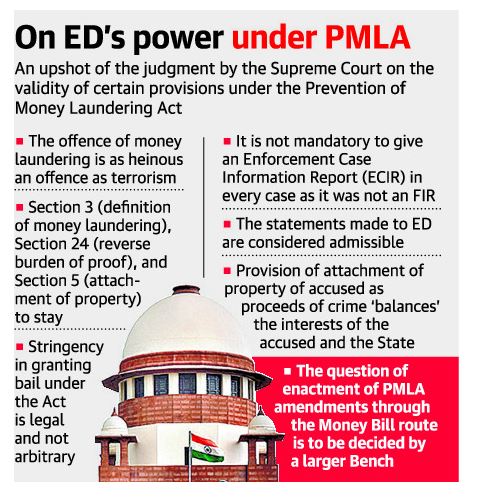
    The Supreme Court upheld the core amendments made to the Prevention of Money Laundering Act (PMLA), which gives the government and the Enforcement Directorate (ED) virtually unbridled powers of summons, arrest, and raids, and makes bail nearly impossible while shifting the burden of proof of innocence on to the accused rather than the prosecution.

    Did the judgement say?

    • The Supreme Court called the PMLA a law against the “scourge of money laundering” and not a hatchet wielded against rival politicians and dissenters.
    • Money laundering is an offence against the sovereignty and integrity of the country. It is no less a heinous offence than the offence of terrorism, the court noted.

    Why in news?

    • The verdict came on an extensive challenge raised against the amendments introduced in 2002 Act by way of Finance Acts.
    • The three-judge Bench said the method of introduction of the amendments through Money Bills would be separately examined by a larger Bench of the top court.

    What were the petitions?

    • Petitions were filed against the amendments, which the challengers claimed would violate personal liberty, procedures of law and the constitutional mandate.
    • The petitioners included many veteran politicians who all claimed that the “process itself was the punishment”.
    • There were submissions that the accused’s right against self-incrimination suffered when the ED summoned them and made them sign statements on threats of arrest.
    • But the court said these statements were recorded as part of an “inquiry” into the proceeds of crime.
    • A person cannot claim right against self-incrimination at a summons stage.

    About Enforcement Directorate (ED)

    • It goes back to May 1, 1956, when an ‘Enforcement Unit was formed in the Department of Economic Affairs.
    • It then aimed for handling Exchange Control Laws violations under the Foreign Exchange Regulation Act (FERA).
    • The ED today is a multi-dimensional organisation investigating economic offences under the Prevention of Money Laundering Act (PMLA), Fugitive Economic Offenders Act, Foreign Exchange Management Act and FERA.

    From where does the ED get its powers?

    • When proceeds of crime (property/money) are generated, the best way to save that money is by parking it somewhere, so one is not answerable to anyone in the country.
    • Therefore, there was a need to control and prevent the laundering of money.
    • The PMLA was brought in for this exact reason in 2002, but was enacted only in 2005.
    • The objective was to prevent parking of the money outside India and to trace out the layering and the trail of money.
    • So as per the Act, the ED got its power to investigate under Sections 48 (authorities under act) and 49 (appointment and powers of authorities and other officers).

    At what stage does the ED step in when a crime is committed?

    • Whenever any offence is registered by a local police station, which has generated proceeds of crime over and above ₹1 crore, the investigating police officer forwards the details to the ED.
    • Alternately, if the offence comes under the knowledge of the Central agency, they can then call for the First Information Report (FIR) or the chargesheet if it has been filed directly by police officials.
    • This will be done to find out if any laundering has taken place.

    What differentiates the probe between the local police and officers of the ED?

    Case study:

    • If a theft has been committed in a nationalised bank, the local police station will first investigate the crime.
    • If it is learnt that the founder of the bank took all the money and kept it in his house, without being spent or used, then the crime is only theft and the ED won’t interfere because the amount has already been seized.
    • But if the amount which has been stolen is used after four years to purchase some properties, then the ill-gotten money is brought back in the market.
    • Or if the money is given to someone else to buy properties in different parts of the country, then there is ‘laundering’ of money.
    • Hence the ED will need to step in and look into the layering and attachment of properties to recover the money.
    • If jewellery costing ₹1 crore is stolen, police officers will investigate the theft. The ED, however, will attach assets of the accused to recover the amount of ₹1 crore.

    What are the other roles and functions of the ED?

    • The ED carries out search (property) and seizure (money/documents) after it has decided that the money has been laundered, under Section 16 (power of survey) and Section 17 (search and seizure) of the PMLA.
    • On the basis of that, the authorities will decide if arrest is needed as per Section 19 (power of arrest).
    • Under Section 50, the ED can also directly carry out search and seizure without calling the person for questioning.
    • It is not necessary to summon the person first and then start with the search and seizure.
    • If the person is arrested, the ED gets 60 days to file the prosecution complaint (chargesheet) as the punishment under PMLA doesn’t go beyond seven years.
    • If no one is arrested and only the property is attached, then the prosecution complaint along with attachment order is to be submitted before the adjudicating authority within 60 days.

    Can the ED investigate cases of money laundering retrospectively?

    • If an ill-gotten property is acquired before the year 2005 (when the law was brought in) and disposed off, then there is no case under PMLA.
    • But if proceeds of the crime were possessed before 2005, kept in storage, and used after 2005 by buying properties, the colour of the money is still black and the person is liable to be prosecuted under PMLA.

    Under Section 3 of PMLA, a person shall be guilty of money-laundering, if such person is found to have directly or indirectly attempted to indulge or knowingly assist a party involved in one or more of the following activities:

    • Concealment; possession; acquisition; use; or projecting as untainted property; or claiming as untainted property in any manner etc.


    Also read:

    [Burning Issue] Enforcement Directorate (ED): Dreaded nightmare of Indian Politicians & Businessmen

    UPSC 2023 countdown has begun! Get your personal guidance plan now! (Click here)

  • Replacement Level Fertility achieved in India

    India has achieved replacement level fertility, with 31 States and UTs reaching a Total Fertility Rate (an average number of children per woman) of 2.1 or less, Union Minister of State for Health and Family Welfare has informed Parliament.

    What is Replacement Level Fertility?

    • Replacement level fertility is the level of fertility at which a population exactly replaces itself from one generation to the next.
    • In simpler terms, it denotes the fertility number required to maintain the same population number of a country over a given period of time.
    • In developed countries, replacement level fertility can be taken as requiring an average of 2.1 children per woman.
    • In countries with high infant and child mortality rates, however, the average number of births may need to be much higher.
    • RLF will lead to zero population growth only if mortality rates remain constant and migration has no effect.

    Benefits of achieving RLF

    • RLF helps ensure greater food security.
    • The reduced demand for food would in turn lessen agri- culture’s impact on the environment.
    • It would also likely lead to economic benefits through a “demographic dividend.”
    • Finally, achieving replacement level fertility would yield significant social benefits―especially for women.

    How did India achieve this?

    • Between 2012 and 2020, the country added more than 1.5 crore additional users for modern contraceptives, thereby increasing their use substantially.
    • India has witnessed a paradigm shift from the concept of population control to population stabilisation to interventions being embedded toward ensuring harmony of continuum care.

    Way forward

    • Although India has achieved replacement level fertility, there is still a significant population in the reproductive age group that must remain at the centre of our intervention efforts.
    • India’s focus has traditionally been on the supply side, the providers and delivery systems but now it’s time to focus on the demand side which includes family, community and society.
    • Significant change is possible with this focus, instead of an incremental change.


    UPSC 2023 countdown has begun! Get your personal guidance plan now! (Click here)

  • What is Household Consumption Expenditure Survey (HCES)?

    The Centre has kicked off the process for conducting the quinquennial Household Consumption Expenditure Survey (HCES) this month.

    What is the Household Consumer Expenditure Survey (CES)?

    • The HCES is traditionally a quinquennial (recurring every five years) survey conducted by the government’s National Sample Survey Office (NSSO).
    • It is designed to collect information on the consumer spending patterns of households across the country, both urban and rural.
    • Typically, the Survey is conducted between July and June and this year’s exercise is expected to be completed by June 2023.

    Why HCES?

    • The HCES is used to arrive at estimates of poverty levels as well as review key economic indicators like Gross Domestic Product (GDP).
    • The results of the survey are also utilised for updating the consumption basket and for base revision of the Consumer Price Index.
    • It helps generate estimates of household Monthly Per Capita Consumer Expenditure (MPCE) as well as the distribution of households and persons over the MPCE classes.
    • It is used to arrive at estimates of poverty levels in different parts of the country and to review economic indicators such as the GDP, since 2011-12.

    Why need this survey?

    • India has not had any official estimates on per capita household spending.
    • It provides separate data sets for rural and urban parts, and also splice spending patterns for each State and Union Territory, as well as different socio-economic groups.

    What about the previous survey?

    • The survey was last held in 2017-2018.
    • The government announced that it had data quality issues.
    • Hence the results were not released.


    UPSC 2023 countdown has begun! Get your personal guidance plan now! (Click here)

  • UN panel tells Hong Kong to repeal National Security Law

    Hong Kong’s controversial national security law should be repealed, experts on the UN Human Rights Committee said, amid concerns the legislation is being used to crack down on free speech and dissent in the former British colony.

    Why in news?

    • Chinese and Hong Kong officials have repeatedly used the NSL imposed by Beijing in 2020 to restore stability after the city was rocked for months by sometimes violent anti-government and anti-China protests in 2019.
    • The committee, which monitors the implementation of the International Covenant on Civil and Political Rights (ICCPR) by state parties, released its findings on Hong Kong following a periodic review.
    • The Hong Kong Special Administrative Region is a signatory to the ICCPR but China is not.

    About Hong Kong

    • A former British Colony and Autonomous Territory: Hong Kong is an autonomous territory, and a former British colony, in south-eastern China.
    • It became a colony of the British Empire at the end of the First Opium War in 1842.
    • Sovereignty over the territory was returned to China in 1997.
    • Special Administrative Region (SAR): As a SAR, Hong Kong maintains governing power and economic systems that are separate from those of mainland China.
    • The 1984 Sino-British Joint Declaration guarantees the Basic Law for 50 years after the transfer of sovereignty.
    • It does not specify how Hong Kong will be governed after 2047.
    • Thus, the central government’s role in determining the territory’s future system of government is the subject of political debate and speculation in Hong kong.

    What is this law all about?

    • Hong Kong was always meant to have a security law, but could never pass one because it was so unpopular.
    • So this is about China stepping in to ensure the city has a legal framework to deal with what it sees as serious challenges to its authority.
    • The details of the law’s 66 articles were kept secret until after it was passed. It criminalises any act of:
    1. Secession – breaking away from the country
    2. Subversion – undermining the power or authority of the central government
    3. Terrorism – using violence or intimidation against people
    4. Collusion–  with foreign or external forces

    What provisions do fall under the law?

    • The law came into effect at 23:00 local time on 30 June 2020, an hour before the 23rd anniversary of the city’s handover to China from British rule.
    • It gives Beijing power to shape life in Hong Kong it has never had before.
    • Its key provisions include:
    1. Crimes of secession, subversion, terrorism and collusion with foreign forces are punishable by a maximum sentence of life in prison
    2. Damaging public transport facilities can be considered terrorism
    3. Those found guilty will not be allowed to stand for public office
    4. Companies can be fined if convicted under the law
    5. This office can send some cases to be tried in mainland China – but Beijing has said it will only have that power over a “tiny number” of cases
    6. In addition, Hong Kong will have to establish its own national security commission to enforce the laws, with a Beijing-appointed adviser
    7. Hong Kong’s chief executive will have the power to appoint judges to hear national security cases, raising fears about judicial autonomy
    8. Importantly, Beijing will have power over how the law should be interpreted, not any Hong Kong judicial or policy body. If the law conflicts with any Hong Kong law, the Beijing law takes priority
    9. Some trials will be heard behind closed doors.
    10. People suspected of breaking the law can be wire-tapped and put under surveillance
    11. Management of foreign non-governmental organizations and news agencies will be strengthened
    12. The law will also apply to non-permanent residents and people “from outside [Hong Kong]… who are not permanent residents of Hong Kong“.

    What has changed in Hong Kong since the law was introduced?

    • Hundreds of protestors, activists and former opposition lawmakers have been arrested since the law came into force.
    • The arrests are an ominous sign that its crackdown on Hong Kong is only going to escalate.
    • Beijing has said the law is needed to bring stability to the city, but critics say it is designed to squash dissent.

    Why did China do this?

    • Hong Kong was handed back to China from British control in 1997.
    • But under a unique agreement – a mini-constitution called the Basic Law and a so-called “one country, two systems” principle.
    • They are supposed to protect certain freedoms for Hong Kong: freedom of assembly and speech, an independent judiciary and some democratic rights – freedoms that no other part of mainland China has.
    • Under the same agreement, Hong Kong had to enact its own national security law – this was set out in Article 23 of the Basic Law – but it never happened because of its unpopularity.

    How can China do this?

    • Many might ask how China can do this if the city was supposed to have freedoms guaranteed under the handover agreement.
    • The Basic Law says Chinese laws can’t be applied in Hong Kong unless they are listed in a section called Annex III – there are already a few listed there, mostly uncontroversial and around foreign policy.
    • These laws can be introduced by decree – which means they bypass the city’s parliament.
    • Critics say the introduction of the law this way amounts to a breach of the “one country, two systems” principle, which is so important to Hong Kong – but clearly, it is technically possible to do this.

    Must read:

    [Burning Issue] National Security Law debate in Hong Kong


    UPSC 2023 countdown has begun! Get your personal guidance plan now! (Click here)

  • Centre to amend Warehousing Act

    The Union Food and Public Distribution Ministry has suggested major amendments to the Warehousing (Development and Regulation) Act of 2007.

    Warehousing Act, 2007

    • The GOI has introduced a negotiable warehouse receipt system in the country by enacting the Warehousing (Development and Regulation) Act, 2007 (37 of 2007).
    • It has been made effective with effect from the 25th October, 2010.
    • The Negotiable Warehouse Receipt (NWR) system was formally launched on the 26th April, 2011.

    Why was this Act enacted?

    • To make provisions for the development and regulation of warehouses, negotiability of warehouse receipts, establishment of a Warehousing Development and Regulatory Authority (WDRA) and related matters.
    • The Negotiable Warehouse Receipts (NWRs) issued by the warehouses registered under this Act would help the farmers to seek loans from banks against NWRs.
    • It will avoid distress sale of agricultural produce.

    What is the amendment about?

    • The aim is to help farmers get access to the services of quality warehouses.
    • The amendment is:
    1. To make registration of godowns compulsory
    2. To raise the penalty for various offences and
    3. To do away the jail term as a punishment for the offences
    • Central government will have powers to exempt any class of warehouses from registration with the Authority.
    • At present, registration with the Warehousing Development and Regulation Authority (WDRA) is optional.
    • After the proposed amendment, which is yet to be cleared by the cabinet, registration of all third party warehouses throughout the country, will be undertaken in a phased manner.
    • The Act wants to establish a system of negotiable and non-negotiable warehouse receipt (NWR), which is now in electronic form.

    Issues

    • Farmers pressure groups fears that the amendments are for bringing back certain provisions of the repealed Farmers’ Produce Trade and Commerce (Promotion and Facilitation) Act through the backdoors.


    UPSC 2023 countdown has begun! Get your personal guidance plan now! (Click here)

  • Money Bill verdict holds the key: SC

    The court has left it open for a seven-judge Bench to decide whether the amendments to the PMLA could have been made to the PMLA through the Money Bill route.

    What was the case about Money Bill?

    • In November 2019, a five-judge Bench led by then CJI Ranjan Gogoi had referred to a larger Bench the issue and question posed in the Roger Mathew vs South Indian Bank Ltd. Case.
    • It inquired to whether amendments like these can be passed as a Money Bill in violation of Article 110 of the Constitution.
    • The petitioners had questioned the legality of the PMLA amendments which were introduced via Finance Acts/Money Bills.

    Correlation Money Bill

    • A Money Bill is deemed to contain only provisions dealing with all or any of the matters under clauses (a) to (g) of Article 110(1), largely including the appropriation of money from the Consolidated Fund of India and taxation.
    • In other words, a Money Bill is restricted only to the specified matters and cannot include within its ambit any other matter.

    What is a Money Bill?

    • A money bill is defined by Article 110 of the Constitution, as a draft law that contains only provisions that deal with all or any of the matters listed therein.
    • These comprise a set of seven features, broadly including items such as-
    1. Imposition, abolition, remission, alteration or regulation of any tax
    2. Regulation of the borrowing of money by the GOI
    3. Custody of the Consolidated Fund of India (CFI) or the Contingency Fund of India, the payment of money into or the withdrawal of money from any such fund
    4. Appropriation of money out of the CFI
    5. Declaration of any expenditure charged on the CFI or increasing the amount of any such expenditure
    6. Receipt of money on account of the CFI or the public account of India or the custody or issue of such money, or the audit of the accounts of the Union or of a state
    7. Any matter incidental to any of the matters specified above.

    Who controls such bills?

    • In the event proposed legislation contains other features, ones that are not merely incidental to the items specifically outlined, such a draft law cannot be classified as a money bill.
    • Article 110 further clarifies that in cases where a dispute arises over whether a bill is a money bill or not, the Lok Sabha Speaker’s decision on the issue shall be considered final.

    Difference between money and finance bill

    • While all Money Bills are Financial Bills, all Financial Bills are not Money Bills.
    • For example, the Finance Bill which only contains provisions related to tax proposals would be a Money Bill.
    • However, a Bill that contains some provisions related to taxation or expenditure, but also covers other matters would be considered a Financial Bill.
    • Again, the procedure for the passage of the two bills varies significantly.

    Issues with notifying a bill as Money Bill

    • The Rajya Sabha (where the ruling party might not have the majority) has no power to reject or amend a Money Bill.
    • However, a Financial Bill must be passed by both Houses of Parliament.
    • The Speaker (nonetheless, a member of the ruling party) certifies a Bill as a Money Bill, and the Speaker’s decision is final.
    • Also, the Constitution states that parliamentary proceedings, as well as officers responsible for the conduct of business (such as the Speaker), may not be questioned by any Court.


    UPSC 2023 countdown has begun! Get your personal guidance plan now! (Click here)

  • Universal Service Obligation Fund (USOF)

    The Union Cabinet has approved a project for providing 4G mobile services in thousands of villages across the country under the USOF.

    What do you mean by Universal Service?

    • In the modern world, universal service refers to having a phone and affordable phone service in every home.
    • It means, providing telecommunication service with access to a defined minimum service of specified quality to all users everywhere at an affordable price.
    • In 1837, the concept was rolled on by Rowland Hill, a British educator and tax reformer, which included uniform rates across the UK and prepayment by sender via postage stamps.

    What is USOF?

    • The Universal Service Obligation Fund (USOF) was formed by an Act of Parliament, was established in April 2002 under the Indian Telegraph (Amendment) Act 2003.
    • It aims to provide financial support for the provision of telecom services in commercially unviable rural and remote areas of the country.
    • It is an attached office of the Department of Telecom, and is headed by the administrator, who is appointed by the central government.

    Scope of the USOF

    • Initially, the USOF was established with the fundamental objective of providing access to ‘basic’ telecom services to people in rural and remote areas at affordable and reasonable prices.
    • Subsequently, the scope was widened.
    • Now it aims to provide subsidy support for enabling access to all types of telecom services, including mobile services, broadband connectivity and the creation of infrastructure in rural and remote areas.

    Funding of the USOF

    • The resources for the implementation of USO are raised by way of collecting a Universal Service Levy (USL), which is 5 percent of the Adjusted Gross Revenue (AGR) of Telecom Service Providers.

    Nature of the fund

    • USOF is a non-lapsable Fund.
    • The Levy amount is credited to the Consolidated Fund of India.
    • The fund is made available to USOF after due appropriation by the Parliament.


    UPSC 2023 countdown has begun! Get your personal guidance plan now! (Click here)

More posts