💥UPSC 2026, 2027, 2028 UAP Mentorship (March Batch) + Access XFactor Notes & Microthemes PDF

Search results for: “”

  • EKLAVYA: Free Scholarship Test to get up to 60% discount on Foundation 2023 || Test on 17th July at 10 AM || Registration Open

    EKLAVYA: Free Scholarship Test to get up to 60% discount on Foundation 2023 || Test on 17th July at 10 AM || Registration Open

    Attend & score above the cut-off marks and get 60% on all the Civilsdaily courses under Smash Foundation Course.

    https://youtu.be/aANKfbU0cy4

    Dear Students!

    Civilsdaily is glad to announce that we are back with our pioneering initiative that has given our institute several top positions since its inception: the much-acclaimed Mentorship Programs!

    But wait, we have another exciting news! We will conduct an entrance-cum-scholarship exam, Mission Eklavya 2023 on July 17, 2022.

    It can be the best kick-start opportunity to save your Time, Money and Energy up to 60%.


    Table of Content


    1. What is Mission Eklavya 2023 program?

    Guys, Mission Ekalavya is a National Scholarship Test Program for UPSC 2023. This is the perfect opporunity for a beginner who has no idea about UPSC, but want to check if he has the aptitude for the same. If you take the upcoming free UPSC national scholarship test and come out with flying colours, you will get about 60% scholarship on the Civilsdaily Flagship Foundation Course.

    Ultimate Assessment Program and Foundation Program includes – 

    • Mentorship (1:1, throughout the preparation till Interview stage)
    • Masterclasses (complete GS syllabus covered, Only provided in Foundation course)
    • Samachar Manthan (Current affairs Programme)
    • Decimate Prelims (Prelims Crash course)
    • Mains Answer Writing Initiative (On a weekly basis)
    • Smash Mains (upon Qualifying prelims 2023)
    • Essay Guidance Program (To score above 120+ in Essay Mains Paper)
    • Interview Guidance Program (more than 1 mock interview will be conducted with a panel)
    • Civilsdaily IAS Community for Peer to Peer Interaction
    Get all the Civilsdaily courses under Smash Foundation Course for 60% off after you attend our scholarship test and score above the cut-off marks!

    2. Details of the Civilsdaily Free National Scholarship Test

    Date – 17th July, 2022.

    CLICK: Register Here for ‘EKLAVYA’

    • Mode: Online
    • Registration Fee – Free
    • Language: English
    • Time: 2 Hrs
    • Syllabus: GS Paper 1 (Preliminary exam)
    • No. of Questions: 100
    • Date: 17th July
    • Time: 10 AM
    • Result: 27/07/2022

    3. Mentorship: Our Every student is a batch.

    An average aspirant, pays for Prelims Course, Mains Program, Interview Guidance, Test Series & Study Materials all separately. The fees then comes up to 2-3 Lakhs for one attempt alone.

    Identifying this issue, Civilsdaily has designed the Flagship mentorship cum Foundation Course for 2023 aspirants. This course covers the entire 3-stage journey of a UPSC aspirant. From Prelims to Interview –

    • 1:1 Mentorship: Dedicated mentor to each student
    • Weekly, Monthly, Quarterly Study Plans
    • Weekly Test Series
    • Classes & Study Materials will be provided.

    Another benefit of the program is that it’s an umbrella course wherein an aspirant can access other paid courses of Civilsdaily for FREE.

    The main objective of the program is to identify and nurture serious aspirants to become future UPSC toppers. And that’s why we have designed a scholarship test.

    Our foundation course will be intensive yet personalised. You will be getting individual coaching on how to conquer the basics, develop analytical skills, inculcate conceptual clarity and acquire the necessary knowledge to face the unpredictable and dynamic UPSC.

    Apart from conducting subject-wise classes that covers all the Prelims-Mains syllabus from scratch, aspirants will follow a customised timetable and will complete their revision on a daily basis to attempt our weekly prelims and mains tests. Once the test is over, they will get a strategy call from a mentor, who will clear their doubts and tell them how to improve their performance from next test onwards.

    Simply put, like Ekalavya you will be getting a unique coaching experience that eludes other UPSC aspirants. Even aspects like Essay, Ethics and CSAT which is ignored in other normal coaching programs, will be covered over here with tests, mentorship, classes and notes.


    4. Toppers’ Talk


    5. Why should you take the CD’s Scholarship Test? 

    1. Test your preparation on UPSC-CSE grade questions, at national level.

    2. Chance to compete against the best. See where you stand.

    3. Identify your subjectwise strengths, weak points, and problem areas before you start preparation.

    4. Mentors will provide personalised counselling based on your performance in the scholarship test. 

    5. A detailed discussion will help you navigate through the challenges during the preparation.

    6. Achieve up to 60% scholarship in our exclusive umbrella foundation course.

    As the program is rigorous and involves individual attention, we can take only limited enrollments. Hence, we are conducting a Scholarship Exam to identify serious UPSC aspirants on 13th and 20th of March. Depending on your relative score, you can get up to a 60% scholarship.

    We are looking for

    1. Serious and hardworking aspirants.

    2. Ready to dedicate a minimum of 5-8 hours daily.

    3. Can complete assigned targets and tests without fail.

    4. Only 1 thought in mind and that is – to clear UPSC Civil Services 2023.

    5. Willing to take constructive feedback from mentors after each test.

  • [Yojana Archive] Decoding Modern Tech Terms

    UPSC 2023 countdown has begun! Get your personal guidance plan now! (Click here)

    In this article, we shall discuss some very popular and important modern tech terms.

    This is just an introductory article. All these technologies will be discussed in detail in subsequent articles.

    Blockchain Technology

    • A system whereby information about transactions is stored on a countless comuters spread across the glob.
    • It is considered an alternative to the conventional banking system.
    • Along with banks, this also applies to mobile payment system.

    NFTs

    • The success of Blockchain as an independent means of storing and authenticating information has created many more inoovations, one of these is Non Fungible Token or NFT.
    • Here the information is stored in the blockchain system itself, especially in a system called ethereum.
    • Under NFT system a kind of digital certificate is issued that such an original thing unique in the world.

    IOT

    • Internet of Things or, more accurately the internet of devices, is all about connecting devices over the internet and letting them ‘talk’ to us, applications and each other.
    • This allows huge amounts of data to be collected and transferred, which can then be used for multiple practical purposes.
    • However, Internet of Things doesn’t necessarily have to be connected to the internet, it can also be a network of things.
    • A common example are wristwatches with sensors that can track the wearers’ heartbeat and pass on the information to our smartphones via bluetooth.
    • The smartphone can store that data on cloud after which it can be accessed at any point of time to view a report card of how your heart has been behaving for over a period of a week or a month.

    Metaverse

    • A simplistic way to look at the metaverse is as a parallel, virtual, world where users can have different identities, possessions and characters.
    • In the complex explanation, Metaverse is supposed to be the post-Internet world, a decentralised computing platform of sorts if you will, which is continuous, and live.
    • It is an entirely digital economy, and the way most Silicon valley intellectuals see this, metaverse exists both in the digital and physical realm.
    • Virtual reality would be an element of this metaverse, but the idea goes beyond just donning a VR headset and starting to play a game.
    • According to Ball, the metaverse does not reset or pause or end, but “continues indefinitely.”
    • Metaverse is not something that just one company can build. Nor is Facebook the only one working on this. Epic Games, the creator of Fortnite, has big plans for the metaverse using its unreal engine.
    • In fact, Fortnite already has many elements which would conform to the idea such as live events, its own currency, etc.

    Quantum Computing

    • The Quantum computing is much talked about because of its infinite power.
    • A Quantum computer can perform calculations millions of times faster than a normal computer, and that is why it can prove to be a boon for humanity.
    • Traditional computers work based on a fundamental unit of binary digits(0-1 Bit).
    • On the other hand the quantum computers adopts qubit(quantum bit).
    • The qubit value can be 0, 1 or both.

    Artificial Intelligence

    • AI refers to ability of human beings to learn analyse think, understand, solve problems, make decision, etc, similar to human being.
    • Machines equipped with AI will become powerful and intelligent and compete with human beings capabilities.
      For example features like machine translation, voice-to-text conversion and voice assistance these days are reached to us because of AI.

    Cloud Computing

    • Cloud computing implies using the resources available on the internet on your computers or devices.
    • Cloud computing has made vast computational power and storage space available to us, and technology like AI is required for its calculations.

     UPSC 2023 countdown has begun! Get your personal guidance plan now! (Click here)

  • Register for recorded video| Webinar -Tackle UPSC Mains GS paper 2 and LIVE answer writing with Anuradha Suneja, AIR 266| One of the highest scorers in 2021 Mains GS papers | Get Telegram group, FREE Prelims package, and mentorship call

    Register for recorded video| Webinar -Tackle UPSC Mains GS paper 2 and LIVE answer writing with Anuradha Suneja, AIR 266| One of the highest scorers in 2021 Mains GS papers | Get Telegram group, FREE Prelims package, and mentorship call

    Register for the recorded session.

    18th July, 7 pm |Learn how to tackle UPSC Main GS paper 2 with Anuradha Suneja, CD mentorship students, and AIR 266, UPSC 2021. Submit your query, and get Telegram group + access to FREE resources.


    CivilsDaily is back with another super important #UPSCskill webinar. This time you will meet one of our mentorship students (under Sajal sir) and now a UPSC ranker – Anuradha Suneja. AIR 266, UPSC 2021.

    Anuradha Suneja, was one of the highest scorers in UPSC 2021 Mains GS papers (among top 50) and scored in the top three in UPSC Mains GS paper 2.

    Webinar: Master UPSC mains GS Paper 2 and LIVE answer writing

    Webinar on 18th July, 7 pm – Monday

    Anuradha Suneja will be taking a LIVE webinar on coming Monday. Through a LIVE answer writing session, she will be teaching and helping you master UPSC mains GS paper 2, its syllabus, case studies and approach towards UPSC mains in general.

    Feedback for the last #UPSCskill Webinar

    18th July, 7 pm |Learn how to tackle UPSC Main GS paper 2 with a UPSC ranker, Anuradha Suneja, AIR 266, UPSC 2021. Submit your query, and get Telegram group + access to FREE resources.

    About Anuradha Suneja

    Anuradha Suneja secured an AIR 266 in UPSC 2021. She was a student of our Mentorship programs and was taking mentorship under Sajal sir. Anuradha hails from Haryana and is a Delhi University graduate. She also has a masters in Political Science. She was a topper through and through. Anuradha loves diary writing and playing badminton.

    anuradha suneja upsc air 266 sajal sir

    In her Mains 2021 attempt, she not only improved in her GS papers but the quality of her answers increased to such an extent that even after skipping (mistakenly) questions worth 50 marks she was able to score awesomely in Mains.

    She profusely thanks Sajal sir, our mentorship, and student-centric approach for her success. It is a humbling and heartening moment for CivilsDaily and we wish her all the very best for her future.

    What The Hindu mentioned about Civilsdaily Mentorship

    The Hindu has acknowledged the success rate of CD’s Smash mains Mentorship

    Quora Digests:

    18th July, 7 pm |Learn how to tackle UPSC Main GS paper 2 with a UPSC ranker, Anuradha Suneja, AIR 266, UPSC 2021. Submit your query, and get Telegram group + access to FREE resources.

  • Draft disability policy

    Context

    The Department of Empowerment of Person with Disabilities (DoEPwD) recently released the draft of the national policy for persons with disabilities.

    Why new policy?

    • Signing of UN convention: The necessity for a new policy which replaces the 2006 policy was felt because of multiple factors such as India’s signing of the United Nations Convention on Rights of Persons with Disabilities.
    • Increased number of disabilities: Enactment of Rights of Persons with Disabilities Act 2016, which increased the number of disabilities from seven conditions to 21 necessitated the change.
    • Incheon Strategy: Being a party to the Incheon Strategy for Asian and Pacific Decade of Persons with Disabilities, 2013-2022 (“Incheon commitment”).
    • Changed discourse from medical model to human right: These commitments have changed the discourse around disability by shifting the focus from the individual to society, i.e., from a medical model of disability to a social or human rights model of disability.
    • The principle of the draft policy is to showcase the Government’s commitment to the inclusion and empowerment of persons with disabilities by providing a mechanism that ensures their full participation in society.

    Absence of commitment to political uplift

    • Article 29 of the Convention on Rights of Persons with Disabilities mandates that state parties should “ensure that persons with disabilities can effectively and fully participate in political and public life on an equal basis with others, directly or through freely chosen representatives….”
    • The Incheon goals also promote participation in political processes and in decision making.
    • The Rights of Persons with Disabilities Act 2016 embodies these principles within its fold.
    • India does not have any policy commitment that is aimed at enhancing the political participation of disabled people.
    • The exclusion of disabled people from the political space happens at all levels of the political process in the country, and in different ways.
    • Section 11 of the Rights of Persons with Disabilities Act prescribes that “The Election Commission of India and the State Election Commissions shall ensure that all polling stations are accessible to persons with disabilities and all materials related to the electoral process are easily understandable by and accessible to them”.
    • Although this mandate has been in existence for a few years, the disabled people still report accessibility issues before and on election day. 
    • There is often a lack of accessible polling booths in many locations.
    • Lack of aggregate data: The lack of live aggregate data on the exact number of the disabled people in every constituency only furthers their marginalisation.

    Lack of representation

    • Representation plays an imperative role in furthering the interests of the marginalised community.
    • Disabled people are not represented enough at all three levels of governance.
    • However, few States have begun the initiative at local levels to increase participation.
    • For instance, Chhattisgarh started the initiative of nominating at least one disabled person in each panchayat.
    • If a disabled person is not elected then they are nominated as a panchayat member as per changes in the law concerned.
    • This is a step that has increased the participation of the disabled in the political space at local level.
    • The goal of the policy document — of inclusiveness and empowerment — cannot be achieved without political inclusion.

    Suggestions: Follow four pronged approach

    • The policy can follow a four-pronged approach:
    • 1] Capacity building: Building the capacity of disabled people’s organisations and ‘empowering their members through training in the electoral system, government structure, and basic organisational and advocacy skills’;
    • 2] Legal and regulatory framework: The creation, amendment or removal of legal and regulatory frameworks by lawmakers and election bodies to encourage the political participation of the disabled;
    • 3] Participation of civil society: Inclusion of civil societies to ‘conduct domestic election observation or voter education campaigns’;
    • 4] Framework for outreach by political parties: A framework for political parties to ‘conduct a meaningful outreach to persons with disabilities when creating election campaign strategies and developing policy positions’.

    Conclusion

    The document lays emphasis on the point that central and State governments must work together with other stakeholders to “make the right real”. This right can be made real only when it includes political rights/political participation within it.

    UPSC 2023 countdown has begun! Get your personal guidance plan now! (Click here)

  • Parliamentary language in the digital age

    Context

    Language not only changes across region but also profession. Similarly, Parliament, too, has its own list of absurd and archaic phrases.

    Debate over expunged words

    • Today there is much debate on language again after the Lok Sabha Secretariat compiled a list of 151 words, which have been expunged in 2021 and 2020 in Parliaments across the Commonwealth countries and State Assemblies in India.
    • Many of these words may look harmless, but in a heated exchange between parliamentarians, they may not exactly be virtuous.
    • The current compilation has especially caused consternation among Opposition parties which see this as an attempt to restrict their vocabulary.
    • The government argues that this list is at best only “instructive” and not “definitive”.
    • The preface of the document states that the context in which these words were used is far more important than the words themselves.
    • Ultimately, the final call of whether a word is “unparliamentary” or not lies with the presiding officer of the House.
    • In the first two decades of the Indian Parliament, English was the primary language used for parliamentary work.
    • This changed as the social composition of Parliament changed from the 1970s onwards.
    • At present, as many as 30 languages are used by parliamentarians during speeches, with many insisting on speaking their mother tongue during crucial debates.
    • Perhaps, the next such compilation will also have words expunged from different regional languages.

    Challenges in digital age

    •  The proceedings of both Houses of Parliament are relayed in real time on TV channels and YouTube.
    • There have been instances where live transmission has been halted on the Chair’s orders.
    • To circumvent this, many members have recorded the proceedings on their mobile phone cameras.
    • There are many instances of the Chair intervening and expunging words or phrases that it finds “objectionable”.
    • Herein lies the problem. The order of the Chair is often relayed by late evening to reporters, but by then, the video clip would have already been circulated many times over.
    • Print reporters are careful and abide by the orders, but in a digital ecosystem, this is not easy.

    Conclusion

    The problems posed to the Parliament in terms of language and words should be dealt with keeping in focus the freedom of speech of the members.

    UPSC 2023 countdown has begun! Get your personal guidance plan now! (Click here)

  • Get in your email: 87 pages PDF and Video Recording | Important Webinar #UPSCskill: Writing awesome introductions and conclusions to UPSC Mains answers by Sumit sir| Register for Telegram link, FREE Prelims package, and mentorship call

    Get in your email: 87 pages PDF and Video Recording | Important Webinar #UPSCskill: Writing awesome introductions and conclusions to UPSC Mains answers by Sumit sir| Register for Telegram link, FREE Prelims package, and mentorship call

    For those who missed the amazing session by Sumit sir on writing Introductions and Conclusions for UPSC Mains answers. Get the recording of the session and super important 87 pages PDF.

    The Webinar was a great success and many important points were discussed like:

    5 ideas to write an intro for UPSC Mains answers

    We will email you the full PDF

    How to write impactful introductions? and seven cardinal mistakes

    Get PDF and recording in your email. Register for FREE

    Other points discussed were:

    Examples of Good and Bad Introductions, Good and Bad Conclusions,

    Register and unlock the full PDF
    Register for the full PDF and recording

    The session was conducted on 14th July, 7 pm and it was a great success. Aspirants, we have started the #UPSCskill series for webinars by UPSC toppers and senior IAS mentors from CivilsDaily. As a part of this initiative, we will be taking up another super important skill that an aspirant must master.

    Feedback for the last #UPSCskill Webinar

    Webinar: Master Introductions and Conclusions for UPSC Mains Answers (successfully concluded)

    Webinar on 14th July, 7 pm – Thursday – Successfully concluded

    Sumit sir took a LIVE webinar on past Thursday. Through a LIVE answer writing session, he tought and helped aspirants master the skills required to formulate amazing introductions and conclusions.

    The Webinar was a great success and many important points were discussed.

    About Sumit Haritwal sir

    Sumit sir is a senior IAS mentor at CivilsDaily and he has been mentoring UPSC aspirants and now rankers for more than 4 years now. A public policy and international affairs enthusiast Sumit sir has an experience of 3 UPSC interviews and has cleared the PSC and CAPF exam earlier. He will be taking up your questions in the webinar and would also be connecting with you in the Telegram group.

    What The Hindu mentioned about Civilsdaily Mentorship

    The Hindu has acknowledged the success rate of CD’s Smash mains Mentorship

    Quora Digests:

    Register for the webinar. Submit your query and get Telegram group + access to FREE resources. Sumit sir will also share a special PDF with you post-webinar.

  • IPS full form

    IPS=Indian Police Service


    Table of Content:


    What is IPS?

    The complete form of IPS is the Indian Police Service, formed by the Government of India in October 1948. The Indian Police Service (IPS) is an administrative diplomatic civil service under the Central Civil Service, the executive branch of government. India. The Indian Police Service was first established in 1948. The Ministry of Home Affairs currently regulates it. Becoming an IPS officer is one of the biggest dreams of almost every Indian youth. To become an IPS officer, candidates have to take an entrance exam which is basically known as the IPS exam or UPSC (Union Public Service Commission) Civil Service exam. This is one of the most challenging tests in the country.

    Power of an IPS officer?

    IPS officers lead and manage central police agencies such as the Intelligence Bureau, Central Bureau of Investigation, Border Security Force, Central Reserve Police Force, Indo-Tibetan Border Police, National Security Guard, and Vigilance Org.

    IPS officers lead and manage the civil and armed police forces in all the states and union territories.

    IPS officers work at the policy-making level of the Center and States and in RAWs and public sector undertakings in the Ministries & Departments of the Central and State Governments.

    IPS officers must interact and coordinate closely with other All India Services and members of the Central Civil Services and Armed Forces.

    Eligibility for IPS

    Certain basic eligibility criteria are

    1 . Nationality: Indian

    2. Academic Qualification:

    Minimum a bachelor degree from any recognized university or an equivalent qualification.

    3. Age Limit:

    A candidate must be between 21 and 37 years of age depending on the categories he/she falls under.

    • 21 to 32 years for general candidates
    • 21 to 35 years for Other Backward Category candidates
    • 21 to 37 years for SC/ST candidates
    • Age limits for the physical handicapped are set @ 42, 45 and 47 years for General, OBC, and SC/ST categories respectively.

    4. Physical ability

    • The height of a male candidate should be at least 165 CM. And 160 cm for SC and OBC candidates.
    • The height of a female candidate should be at least 150 cm. And 145 cm for SC/OBC candidates.
    • A healthy eye vision should be 6/6 or 6/9. A vision of week eyes must be 6/12.

    How to Prepare for IPS!

    Read more…

    Attend Free Online Workshop on IPS Preparation Strategy, ETC.

    Civilsdaily doesn’t believe in luck or in hard work without the so-called “work smart”. It’s not all about how you work hard but it’s about how you manage your time, resources, and mind to work together for a better output. Now Attend free workshop on UPSC Preparation strategy and find the ways IPS dreams start.

  • UPSC Full form

    The full form of UPSC is Union Public Service Commission.


    Table of Contents:


    What is UPSC?

    UPSC is the central body in India that conducts examinations like the Civil Services Exam (CSE) for the recruitment of candidates in top government services like IAS, IPS, IFS, etc. UPSC recruits candidates for both Civil Service as well as Defense Services.

    What is the full form of UPSC?

    The full form of UPSC is Union Public Service Commission.

    What are the Exams Conducted by UPSC for Civil Services Selection?

    • Civil Services Examination (CSE)
    • Engineering Service Examination (ESE).
    • Indian Forest Service (IFoS) Examination.
    • Central Armed Police Force Examination (CAPF).
    • Indian Economic Service and Indian Statistical Service (IES/ISS).
    • Combined Geological and Geological Experiments.
    • Combined Medical Services (CMS).
    • Special Class Railway Trainee Examination (SCRA).
    • Limited Departmental Competitive Examination for Selection of Assistant Commandant. (Executive) in CISF.

    Defense Exams are conducted by UPSC

    • National Defense Academy and Naval Academy Examinations – NDA and NA (I).
    • National Defense Academy and Naval Academy Examinations – NDA and NA (II).
    • Combined Defense Services Examination – CDS (I).
    • Combined Defense Services Test – CDS (II).

    How to Prepare for the UPSC-CSE exam

    Carrying up a decision to crack the UPSC examination defines an individual’s ambitions and goals. An individual must have wondered that one year is enough for IAS preparation. The answer is yes. One year is sufficient to crack the IAS exam no matter how difficult the UPSC exam is, only if it is prepared with complete devotion. Read more…..

    Free Online Workshop on UPSC Civil Service Preparation

    Civilsdaily doesn’t believe in luck or in hard work without the so-called “work smart”. It’s not all about how you work hard but it’s about how you manage your time, resources, and mind to work together for a better output. Now Attend free workshop on UPSC Preparation strategy and find the ways UPSC dreams start.

  • 15th July 2022| Daily Answer Writing Enhancement(AWE)

    Topics for Today’s questions:

    GS-1         Post-independent India

    GS-2        Bilateral relations

    GS-3        Indian Economy

    GS-4        Case Studies

    Question 1)


    Q.1 Explaining the term Non-alignment, discuss the rationale behind its adoption in the postcolonial era. (15 Marks)


    Question 2)

    Q.2 South Korea’s new willingness to become a global pivotal state and play an active role in regional affairs is bound to create multiple opportunities for a multi-dimensional India- Korea partnership. Comment. (10 Marks)

    Question 3)

    Q.3 What were the improvements made in the GST to ensure stricter compliance? Suggest the improvements needed in the GST structure. (10 Marks)

    Question 4)  

    Q.4 You are the principal of a college which has a long history of student politics. However, due to your personal belief, you are not in favour of conducting student elections and thus have kept the process of yearly student elections pending without any official announcement. While you are mulling over the decision of not conducting elections, you get representation from some professors as well as students who criticize the activities of student unions as obstructive to the academic environment of the college. Some time later, student leaders also come to talk to you regarding conduct of elections, and you tell them about the representation received by you against allowing student elections. You further tell them that you are contemplating suspending all activities related to student politics in the campus. On hearing this, student leaders become aggressive and start sloganeering and destroying college property. In this context, answer the following questions: (a) What are the issues involved in the case above? (b) How can you separate your personal ethics from professional ethics? (c) How would you deal with this situation? (20 Marks)


    HOW TO ATTEMPT ANSWERS IN DAILY ANSWER WRITING ENHANCEMENT(AWE)?

    1. Daily 4 questions from General studies 1, 2, 3, and 4 will be provided to you.

    2. A Mentor’s Comment will be available for all answers. This can be used as a guidance tool but we encourage you to write original answers.

    3. You can write your answer on an A4 sheet and scan/click pictures of the same.

    4.  Upload the scanned answer in the comment section of the same question.

    5. Along with the scanned answer, please share your Razor payment ID, so that paid members are given priority.

    6. If you upload the answer on the same day like the answer of 11th  February is uploaded on 11th February then your answer will be checked within 72 hours. Also, reviews will be in the order of submission- First come first serve basis

    7. If you are writing answers late, for example, 11th February is uploaded on 13th February , then these answers will be evaluated as per the mentor’s schedule.

    8. We encourage you to write answers on the same day. However, if you are uploading an answer late then tag the mentor like @Staff so that the mentor is notified about your answer.

    *In case your answer is not reviewed, reply to your answer saying *NOT CHECKED*. 

    1. For the philosophy of AWE and payment: 

  • Q.3 What were the improvements made in the GST to ensure stricter compliance? Suggest the improvements needed in the GST structure. (10 Marks)

    Mentor’s comment-
    • https://indianexpress.com/article/opinion/columns/gst-2-0-next-stage-of-reform-in-the-tax-regime-requires-creating-federal-institutions-8029959/
    • In the intro, mention the completion of five years of GST.
    • In the body mention improvements such as input credit to the buyer only after the seller uploads the invoice, introduction of e-invoicing and the introduction of e-waybill. In the suggestions mention need to amend the law to provide that all units buying from unregistered GST suppliers would have to pay duty on a reverse charge basis. This would help the large buyers to buy from units whose turnover is below the threshold. Next mention the need to increase the average GST rate without fueling the inflation. Third mention the need for a federal institution in the form of the GST state secretariat.
    • Conclude by mentioning that these changes will add to the success of the GST regime.
  • Q.2 South Korea’s new willingness to become a global pivotal state and play an active role in regional affairs is bound to create multiple opportunities for a multi-dimensional India- Korea partnership. Comment. (10 Marks)

    Mentor’s comment-
    • https://www.thehindu.com/opinion/op-ed/scale-up-the-india-south-korea-bilateral-partnership/article65636221.ece
    • In the intro, mention the divergence in the objectives of the two countries in the last five years and current shift in the South Korean foreign and security policies.
    • In the body mention that South Korea aims to become a “global pivotal state, anchored in liberal values and a rules-based order” this stand to create multiple opportunities for India-South Korea partnership. In the next part mention the possibilities in the bilateral trade to achieve the target of $50 billion by 2030, progress on the CEPA, defence cooperation, and dealing with the China challenge. In the challenges mention pressure from China and threat to peace from North Korea.
    • Conclude by mentioning that the time has come for the Indian and South Korean bilateral partnership to be strategically scaled up at the political, diplomatic and security domain levels.
  • Q.1 Explaining the term Non-alignment, discuss the rationale behind its adoption in the postcolonial era. (15 Marks)

    Mentor’s Comments-

    • Introduce by briefly writing about Non-Aligned movement.
    • Mention different reasons responsible for adoption of non-aligned movement by most countries including India.
    • End with a brief and relevant conclusion.
  • IAS full form

    IAS= Indian Administrative Service

    ‘I’ stands for ‘Indian‘, ‘A’ stands for ‘Administrative‘, ‘S’ stands for ‘Service


    Table of Content


    What is IAS?

    Many of us hear about the term ‘IAS officers’. But we seldom know the full form of the IAS officer. So let’s first learn the full form of IAS. IAS stands for Indian Administrative Service. It is one of the most prestigious government jobs in India.

    Read here ‘What is IPS?’


    Role and responsibilities of an IAS officer

    • To formulate important policies and advise the ministers on important issues
    • maintain law and order among the citizens
    • implement important policies
    • collect revenue 
    • the caretaker of various expenditures 
    • takes important decisions were necessary 
    • oversees the proper implementation of them by formulating policies accordingly. 
    • Policy maker

    Eligibility Criteria – Age limit

    The minimum age criterion for the UPSC CSE exam is age at least 21 years. The maximum age limit where a candidate can be an IAS officer for the general section is 32 years, the maximum limit for the OBC section is 35 years, and 37 years for SC / ST section.


    Educational qualification

    To be an IAS officer and to pass the UPSC CSE exam, a candidate must have a bachelor’s degree from any recognized university. 

    Even a candidate in the final year of graduation can take part in this exam. 

    Candidates who have taken correspondence education are also eligible for this examination. 

    Digits with a technical degree are also eligible. 

    Even professionals can apply for this special test. 

    A medical student is also eligible to apply for this test. But only if he completes the degree and goes through an internship program. 

    A candidate who has passed CA, ICWA, and ICSI is also eligible to apply for this position.


    Number of attempts

    For the general category, the candidate is limited to 6 attempts. And for OBC closure, the candidate has 9 effort limits. There is no age limit of 37 years for an SC / ST candidate.


    How to Become An IAS officer!

     To become an IAS officer, Indian youths have to fulfill only 3 conditions:

    • Get a graduate degree
    • Clear the UPSC-CSE exam
    • Complete training successfully

    Passing the UPSC exam is not simple, many obstacles may be suffered during the process of the assessment. Even a serious aspirant without a hand-holding strategy, uncompromising attitude, and proper guidance may fail. Read More….


    Online Workshop

    Have you set career goals for yourself and are ready to do anything to achieve your goals? Then, yes you are in the right place. Here, we, the Civilsdaily team conduct a weekly live workshop to tell you how to become an IAS officer after the 12th in easy steps. 

  • Persistent | After facing multiple failures in a row, A taste of success, | Amit Anand, AIR 411, UPSC 2021 | Civilsdaily Mentorship Student | Get in touch with his mentor

    “A good mentor is always a big +”-Amit Anand mentioned in an interview with CD. 

    Amit Anand, AIR 411, UPSC 2021. a Student under under Smash Mains (Sajal Sir)

    Amit Anand was one of the mentorship students under Sajal sir, and other CD mentors under the Smash Mains program. 

    Before getting in touch with Sajal Sir in 2021, He had been facing failure consistently. His UPSC journey started in 2016. Although he reached interviews 2 times, he couldn’t get on the final merit list. He said that he couldn’t figure out the necessary things which are highly required to work on.

    He came to know about Sajal Sir and his Smash Mains Program from one of his friends. As soon as he heard, he connect with Sajal Sir and join his Mains Program.

    In 2021, he got in touch with Sajal Sir, and received the remedial advice, he was looking for. He attributed his success to the remedial advice of Sajal Sir under Smash Mains.

    • Sajal Sir’s tireless mentorship helped him to find those core areas in GS papers on which he had to improve tremendously. 
    • Sajal Sir’s guidance got him 10 times likely to prepare in a very short time. 
    • Next level evaluation of answers helped him a lot to fetch more scores in GS papers.
    •  Resource consolidation on Mains’ Preparation.

    He improved his marks drastically in this 2021 Mains. In a candid conversation with Siddhart sir, Amit shared his journey, motivations, up and downs, lessons learned, and his secret of what kept him going. Listen to his story.

    Amit’s optional was Geography. He hails from Deoghar and has been exceptional in his studies all through school and college. He is an engineering graduate by education. 

    Amit has made us proud by securing AIR 411 in UPSC 2021 exam. It is yet another validation of CivilsDaily’s vision and approach to personalized mentorship.

    Amit has inspired us and we wish him all the best. He’s going to be an administrator of great integrity!

    Register for Amit’s mains answers copies and notes.

    Schedule your FREE mentorship session with Amit’s mentors.

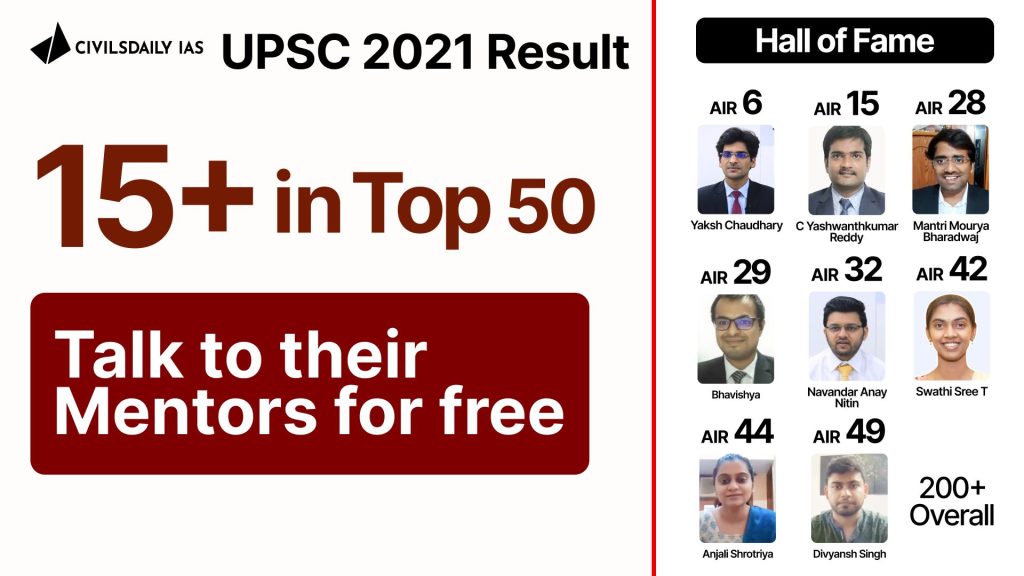
    Amit is one of 200 rankers from CivilsDaily’s mentorship programs.

  • Fundamental Duties

    The Supreme Court has allowed the Centre’s request for two months’ time to file a reply to a petition seeking the enforcement of fundamental duties of citizens, including patriotism and unity of nation, through “comprehensive, and well-defined laws”.

    Why in news?

    • The need to enforce fundamental duties arises due to new illegal trend of protest by protesters in the garb of freedom of speech and expression.
    • Vandalism, blocking of road and rail routes in order to compel the government to meet their demands is a sheer violation of the FDs which are generally not enforceable.

    What are Fundamental Duties?

    • The fundamental duties of citizens were added to the constitution by the 42nd Amendment in 1976, upon the recommendations of the Swaran Singh Committee.
    • It basically imply the moral obligations of all citizens of a country and today, there are 11 fundamental duties in India, which are written in Part IV-A of the Constitution, to promote patriotism and strengthen the unity of India.
    • The FDs obligate all citizens to respect the national symbols of India, including the constitution, to cherish its heritage, preserve its composite culture and assist in its defence.
    • They also obligate all Indians to promote the spirit of common brotherhood, protect the environment and public property, develop scientific temper, abjure violence, and strive towards excellence in all spheres of life.

    Judicial interpretation of FDs

    • The Supreme Court has held that FDs are not enforceable in any Court of Law.
    • It ruled that these fundamental duties can also help the court to decide the constitutionality of a law passed by the legislature.
    • There is a reference to such duties in international instruments such as the Universal Declaration of Human Rights and International Covenant on Civil and Political Rights, and Article 51A brings the Indian constitution into conformity with these treaties.

    Total FDs

    • Originally ten in number, the fundamental duties were increased to eleven by the 86th Amendment in 2002.

    The 10 fundamental duties are as follows:

    1. To oblige with the Indian Constitution and respect the National Anthem and Flag
    2. To cherish and follow the noble ideas that inspired the national struggle for freedom
    3. To protect the integrity, sovereignty, and unity of India
    4. To defend the country and perform national services if and when the country requires
    5. To promote the spirit of harmony and brotherhood amongst all the people of India and renounce any practices that are derogatory to women
    6. To cherish and preserve the rich national heritage of our composite culture
    7. To protect and improve the natural environment including lakes, wildlife, rivers, forests, etc.
    8. To develop scientific temper, humanism, and spirit of inquiry
    9. To safeguard all public property
    10. To strive towards excellence in all genres of individual and collective activities

    The 11th fundamental duty which was added to this list is:

    1. To provide opportunities for education to children between 6-14 years of age, and duty as parents to ensure that such opportunities are being awarded to their child. (86th Amendment, 2002)


    Try this PYQ:

    Which of the following is/are among the Fundamental Duties of citizens laid down in the Indian Constitution?

    1. To preserve the rich heritage of our composite culture
    2. To protect the weaker sections from social injustice
    3. To develop the scientific temper and spirit of inquiry
    4. To strive towards excellence in all spheres of individual and collective activity.

    Select the correct answer using the codes given below:

    (a) 1 and 2 only

    (b) Only 2

    (c) 1, 3 and 4 only

    (d) 1, 2, 3 and 4


    Post your answers here.


    UPSC 2023 countdown has begun! Get your personal guidance plan now! (Click here)

  • Pradhan Mantri Fasal Bima Yojana (PMFBY)

    Andhra Pradesh has decided to rejoin the crop insurance scheme Pradhan Mantri Fasal Bima Yojana (PMFBY) from the ongoing kharif season.

    Why in news?

    • Andhra Pradesh was one of six states that have stopped the implementation of the scheme over the last four years.
    • The other five, which remain out, are Bihar, Jharkhand, West Bengal, Jharkhand, and Telangana.

    What is PMFBY?

    • The PMFBY was launched in February 2016. It is being administered by Ministry of Agriculture.
    • It provides a comprehensive insurance cover against failure of the crop thus helping in stabilising the income of the farmers.
    • It is implemented by general insurance companies.

    Its functioning

    • PMFBY insures farmers against all non-preventable natural risks from pre-sowing to post-harvest.
    • Farmers have to pay a maximum of 2 per cent of the total premium of the insured amount for kharif crops, 1.5 per cent for rabi food crops and oilseeds as well as 5 per cent for commercial / horticultural crops.
    • The balance premium is shared by the Union and state governments on a 50:50 basis and on a 90:10 basis in the case of northeastern states.

    Farmers covered

    • All farmers growing notified crops in a notified area during the season who have insurable interest in the crop are eligible.
    • Earlier to Kharif 2020, the enrolment under the scheme was compulsory for following categories of farmers:
    1. Farmers in the notified area who possess a Crop Loan account/KCC account (called as Loanee Farmers) to whom credit limit is sanctioned/renewed for the notified crop during the crop season. and
    2. Such other farmers whom the Government may decide to include from time to time.

    Risks covered under the scheme

    • Comprehensive risk insurance is provided to cover yield losses due to non-preventable risks, such as Natural Fire and Lightning, Storm, Hailstorm, Cyclone, Typhoon, Tempest, Hurricane, Tornado.
    • Risks due to Flood, Inundation and Landslide, Drought, Dry spells, Pests/ Diseases also will be covered.
    • Post-harvest losses coverage will be available up to a maximum period of 14 days from harvesting for those crops which are kept in “cut & spread” condition to dry in the field.
    • For certain localized problems such as loss/damage resulting from the occurrence of identified localized risks like hailstorm, landslide, and Inundation affecting isolated farms in the notified area would also be covered.

    Why many states has opted out?

    The opting-out states had mentioned several reasons:

    • The scheme should be voluntary.
    • States should be given options to choose the risks covered and the scheme should be universal.
    • State should be given option to use their own database of E-crop, an application used by the state government to collect information about crops.
    • Many state government wanted zero premium for farmers (meaning the entire premium should be paid by the government.
    • The non-payment of the State Share of premium subsidy within the prescribed timelines as defined in the seasonality discipline lea to the disqualification of the State Government.
    • The reason for West Bengal not implementing the PMFBY is purely “political” as it wants to implement the scheme without mentioning Pradhan Mantri in the name.

    How was the scheme structured, and what has changed since?

    • Initially, the scheme was compulsory for loanee farmers; in February 2020, the Centre revised it to make it optional for all farmers.
    • Now states and UTs are free to extend additional subsidy over and above the normal subsidy from their budgets.
    • In February 2020, the Centre decided to restrict its premium subsidy to 30% for unirrigated areas and 25% for irrigated areas (from the existing unlimited). Earlier, there was no upper limit.
    • Food crops (cereals, millets and pulses); oilseeds; and annual commercial / annual horticultural crops are broadly covered under the scheme.


    UPSC 2023 countdown has begun! Get your personal guidance plan now! (Click here)

  • Increase in Current Account Deficit (CAD)

    The Finance Ministry has asserted that the current account deficit (CAD) could, however, deteriorate this year mainly due to rising trade deficits.

    What is Current Account Deficit (CAD)?

    • A current account is a key component of balance of payments, which is the account of transactions or exchanges made between entities in a country and the rest of the world.
    • This includes a nation’s net trade in products and services, its net earnings on cross border investments including interest and dividends, and its net transfer payments such as remittances and foreign aid.
    • A CAD arises when the value of goods and services imported exceeds the value of exports, while the trade balance refers to the net balance of export and import of goods or merchandise trade.

    Components of Current Account

    Current Account Deficit (CAD) = Trade Deficit + Net Income + Net Transfers

    (1) Trade Deficit

    • Trade Deficit = Imports – Exports
    • A Country is said to have a trade deficit when it imports more goods and services than it exports.
    • Trade deficit is an economic measure of a negative balance of trade in which a country’s imports exceeds its exports.
    • A trade deficit represents an outflow of domestic currency to foreign markets.

    (2) Net Income

    • Net Income = Income Earned by MNCs from their investments in India.
    • When foreign investment income exceeds the savings of the country’s residents, then the country has net income deficit.
    • This foreign investment can help a country’s economy grow. But if foreign investors worry they won’t get a return in a reasonable amount of time, they will cut off funding.
    • Net income is measured by the following things:
    1. Payments made to foreigners in the form of dividends of domestic stocks.
    2. Interest payments on bonds.
    3. Wages paid to foreigners working in the country.

    (3) Net Transfers

    • In Net Transfers, foreign residents send back money to their home countries. It also includes government grants to foreigners.
    • It Includes Remittances, Gifts, Donation etc

    How Current Account Transaction does takes place?

    • While understanding the Current Account Deficit in detail, it is important to understand what the current account transactions are.
    • Current account transactions are transactions that require foreign currency.
    • Following transactions with from which component these transactions belong to :
    1. Component 1 : Payments connection with Foreign trade – Import & Export
    2. Component 2 : Interest on loans to other countries and Net income from investments in other countries
    3. Component 3 : Remittances for living expenses of parents, spouse and children residing abroad, and Expenses in connection with Foreign travel, Education and Medical care of parents, spouse and children

    What has been the recent trend?

    • In Q4 FY 2021-22, CAD improved to 1.5% of GDP or $13.4 billion from 2.6% of GDP in Q3 FY 2021-22 ($22.2 billion).
    • The difference between the value of goods imported and exported fell to $54.48 million in Q4FY 2021-22 from $59.75 million in Q3 FY2021-22.
    • However, based on robust performance by computer and business services, net service receipts rose both sequentially and on a year-on-year basis.
    • Remittances by Indians abroad also rose.

    What are the reasons for the current account deficit?

    • Intensifying geopolitical tensions and supply chain disruptions leading to crude oil and commodity prices soaring globally have been exerting upward pressure on the import bill.
    • A rise in prices of coal, natural gas, fertilizers, and edible oils have added to the pressure on trade deficit.
    • However, with global demand picking up, merchandise exports have also been rising.

    How will a large CAD affect the economy?

    • A large CAD will result in demand for foreign currency rising, thus leading to depreciation of the home currency.
    • Nations balance CAD by attracting capital inflows and running a surplus in capital accounts through increased foreign direct investments (FDI).
    • However, worsening CAD will put pressure on inflow under the capital account.
    • Nevertheless, if an increase in the import bill is because of imports for technological upgradation it would help in long-term development.


    UPSC 2023 countdown has begun! Get your personal guidance plan now! (Click here)

More posts