💥UPSC 2026, 2027, 2028 UAP Mentorship (March Batch) + Access XFactor Notes & Microthemes PDF

Search results for: “”

  • Last few seats for Smash Mains 2023 | Let us get you in the top 100 this time | 1:1 personalized mentorship from GS topper 2017 and Sajal sir | (Invite only)

    Last few seats for Smash Mains 2023 | Let us get you in the top 100 this time | 1:1 personalized mentorship from GS topper 2017 and Sajal sir | (Invite only)

    Trusted by Rankers, Acknowledged by The Hindu | (Advanced program for Veterans and High Potential candidates) Register now!

    With UPSC Prelims 2023 knocking at the door, it is time you get into Mains mode quickly.

    We launched Smash Mains Program for UPSC 2023 earlier this month and now 5 seats are remaining.

    If you have appeared for UPSC interview(s) previously and are super close to clearing this exam but Mains is your Achilles heel. Then this is for you.

    Smash Mains Program is a highly personalized and intensive handholding program for the crème-de-la-crème (veterans) amongst UPSC aspirants (the intake is 50 students & Last 5 seats are remaining).

    Unique Features of the program:

    • Invite/Register-only
    • Those who are scoring less marks in GS in mains consistently, need to send your mark sheet and test copy here.
    • Based on that Sajal sir will select the students.
    • One-to-one detailed and in-depth interaction with Sajal sir.
    https://youtu.be/_9wRoQUPiAs
    The Hindu has acknowledged CD’s 80% success rate in Answer writing & Smash Mains.
    Why UPSC toppers are convinced that Smash Mains helped them succeed?
    Check our reviews on Quora

    https://www.quora.com/What-is-your-review-of-the-Civilsdaily-Mains-test-series-How-are-the-personalised-guidance-and-the-evaluation-of-copies/

    CLICK HERE FOR THE SCHEDULE OF THE SMASH MAINS PROGRAM

    We deliver what we promise.

    CLICK HERE FOR THE SCHEDULE OF THE SMASH MAINS PROGRAM


    With over 80% of enrolled students in 2021 becoming UPSC Top rankers, Smash Mains 2022 is back. Also, what we have noticed is about 85% of questions in UPSC Mains paper are from Smash Test Series.

    As an aspirant if you have taken many test series, but are unable to score above 100 marks and want to improve your scores before Mains 2022, then this program is for you!

    How has Smash Mains helped 2021-2022 Aspirants in Preparing for UPSC?

    What do aspirants need in their UPSC preparation journey? They need a senior who will give them moral support and the required logistics to prepare for the tough exam in a simplified manner.

    You can clear the exam only with confidence and consistency. And to achieve both, you require a personalized mentor. Many aspirants feel that just attending classes or tests is not beneficial for them. So we tweaked our program to include mentorship both in our tests series and classes. Aspirants feel they can reach out to us anytime with their concerns and we are available to sort them out.

    Message from Sajal Sir

    Dear Students,

    For some of you, prelims have never been a challenge for you. You have been missing the main cut-off with a small margin (repeatedly). This means that there are some fundamental issues with your approach. You might be aware or not of this. But just realization is not enough, you have to work on its execution as well. And bringing that to fruition will be possible through a guided process under a meticulously designed plan.

    Note: The Entry is Restricted to those who have appeared in UPSC interviews in the past 2 years or have missed the mains cut off by a whisker.

    The focus is on identifying and highlighting the issues with your preparation (information/analysis / utilization). According to your strength and weaknesses, a tailor-made strategy is developed. Under Sajal sir’s strict monitoringincremental improvements are aimed every day, after every session.

    My marks in UPSC 2017 GS Mains paper were:

    • GS Paper 1 – 132
    • GS Paper 2 – 125
    • GS Paper 3 – 130

    Key Takeaways About Smash Mains 2023

    Almost 35+ Ranker in the Top 100 of UPSC 2021 is a Civilsdaily Student.

    Your mentor, Sajal Sir is himself the 2017 topper of GS Mains. He has appeared for interviews many times.

    Over 400 students have emerged as toppers under Sajal Sir’s mentorship in the last 7 years.

    Sajal Sir will daily motivate you on our chat-based platform, Habitat, and have weekly 1-on-1 discussions with you after every test.

    You don’t have to waste any more time finding the strategy (value-added notes, test series, or timetable ) for the next 3 months. You will get guidance for it.

    You will gain access to Civildaily’s Samachar Manthan – For holistic and comprehensive coverage of Current Affairs.

    You will have exclusive membership to Smash Mains club in Habitat.

    One of our other Civilsdaily Students cleared the exams in 2020 to become an IPS Officer. He wrote the 2021 exam again as he aims for an IAS posting. This is what he said about our program

    Progression of Smash Mains 2023

    After completing the Mains Test series, you will have a one-to-one detailed and in-depth interaction with Sajal sir. Final refinements are done to every answer. Value addition material, as well as pointers, will be provided here. We will work with you to ensure you have enough material for value addition. Our focus will be on providing tips that add the missing X factor to your answers.

    Why is Smash 2023 the best way to prepare for mains?

    Individual attention and approachability are the USPs of this program. Listen to what our Smash Mains 2020 student and topper Pooja Gupta (AIR 42) says about the program.

    Not putting Penguins among the Fowls – You already know how to write an average answer (you’re missing it by a few marks actually). You want to know how to increase your score from 90 to 110-115. The approach followed by other institutes in their Test series is the same for a veteran and a complete newbie and here lies the problem. Without personalized one-to-one interaction with someone like Sajal sir (who has scored these awesome marks), it will be difficult for you to rectify these minute yet very important shortcomings.

    Evaluation is a strength of this program and we put it on a high priority. Sajal sir himself is involved in the process, unlike other institutes where evaluation is outsourced to those who themselves might not have appeared for mains (It’s bizarre). It shouldn’t be based on ‘model answers’ as there are 3-4 ways of approaching an answer. Only a seasoned player will be able to go beyond these model answers and be able to appreciate your approach (If it’s innovative) even if it differs from the model answers provided.

    Test copies get checked in a time-bound manner. The questions, answers and material provided are of the highest quality.

    Always on time and insightful discussions end with a reality check and motivation to perform better in the next test.

    Emphasis on execution and utilization of knowledge – Mains is not only about knowledge but the way you express the relevant knowledge in the most optimum manner.

    Sajal sir’s interventions are highly specific and not generalized. Sitting right in front of you he walks you through each and every question. Always there, he will not let you lose your focus.

    AIR 148 UPSC 2020 topper and our Civilsdaily student, Ponmani explains why answer writing with mentorship is necessary for Mains.

    CLICK HERE FOR THE SCHEDULE OF THE SMASH MAINS PROGRAM

    The Batch of Smash Mains Program will start soon.
  • Anti-defection Law

    The unfolding political crisis in Maharashtra has thrown the spotlight on the anti-defection law, and the roles of the Deputy Speaker and the Governor.

    What is the news?

    • Some legislators have aligned themselves with the party’s rebel leader and are camping in Guwahati.
    • The party has warned its MLAs that their absence from the meeting would lead to the presumption they wanted to leave the political party.
    • And this would therefore lead to action against them under the anti-defection law.

    What is the Anti-Defection Law?

    • The anti-defection law provides for the disqualification of MLAs who, after being elected on the ticket of a political party, “voluntarily give up their party membership”.
    • The Supreme Court has interpreted the term broadly and ruled an MLA’s conduct can indicate whether they have left their party.
    • The law is also applicable to independent MLAs.
    • But the anti-defection law does not apply if the number of MLAs who leave a political party constitute two-thirds of the party’s strength in the legislature.
    • These MLAs can merge with another party or become a separate group in the legislature.

    How does the two-thirds rule work in the current situation in Maharashtra?

    • Reports indicate that 30 MLAs are with rebel leader.
    • Taking this number at face value means it does not reach the two-thirds (37) mark of the 55 MLAs the party has in the Maharashtra Assembly.
    • Therefore, the protection under the anti-defection law would not be available to the rebel group.

    What adds more to this high-stage political drama?

    • It is the Assembly Speaker who decides whether an MLA has left a party or a group that constitutes two-thirds of a party.
    • The position of the Speaker of the Maharashtra Assembly is, however, currently vacant.
    • Article 180(1) of the Constitution states that the Deputy Speaker performs the Speaker’s duties when the office is vacant.
    • Since then, the Deputy Speaker has been acting as the Speaker.

    How would a decision be taken whether the anti-defection law applies in this case?

    Under the current circumstances, two ways would lead to adjudication under the law.

    (1) Approaching the acting Speaker to file defection petition

    • First, any MLA of the Assembly can petition that certain MLAs have defected from their political party.
    • Such a petition has to be accompanied by documentary evidence.
    • The Deputy Speaker would then forward the petition to the MLAs against whom their colleagues are making the charge of defection.
    • The MLAs would have seven days or such time that the Deputy Speaker decides is sufficient to enable them to put across their side of the story.

    (2) Proving of two-third majority

    • Rebel leader and MLAs supporting too can write to the Deputy Speaker with evidence claiming that they represent two-thirds of the strength and claim protection under the anti-defection law.
    • In either case, Speakers will decide the matter after hearing all parties, which could take time.

    How much time does it usually take? Why delay occurs?

    • In recent years, one of the fastest decisions in a defection proceeding was delivered by Rajya Sabha Chairman Venkaiah Naidu.
    • However in state legislatures, defection petitions have taken much longer.
    • For example, in 2020, the Supreme Court used its extraordinary power to remove a Manipur minister from his position.
    • But whether the Speaker decides quickly or takes time, the Speaker is usually challenged in court, which further delays the decision.
    • Both Venkaiah Naidu and the Supreme Court have recommended that Speakers decide on defection cases in three months.

    What is the Governor’s role?

    (1) Declaration of Presidents Rule (NA)

    • The Governor has a crucial role when there is political instability in a state.
    • Before 1994, Governors were quick to dismiss a state government, charging that it did not have a majority in the state legislature and recommending the imposition of the President’s rule in the state.
    • But the Supreme Court ended this practice with its judgment in the S R Bommai case in 1994.

     (2) Holding Assembly

    • In this landmark case, the court ruled that the place for deciding whether a government has lost its majority was in the legislature.
    • Hence, Maharashtra Governor can ask Chief Minister to convene the Assembly and prove his majority on the floor of the House.

     (3) Governors Discretion

    • The CM can recommend to the Governor to dissolve the legislature before the end of its five-year term and call for elections under Article 174(2)(b).
    • Here, the Governor’s discretion comes into play.
    • The Governor may choose not to dissolve the legislature.
    • This is when if he or she believes that the recommendation is coming from a council of ministers who do not enjoy the confidence of the state legislature.

    Note: In 2020, the Supreme Court, in Shivraj Singh Chouhan & Ors versus Speaker, MP Legislative Assembly & Ors, upheld the powers of the Speaker to call for a floor test if there is a prima facie view that the government has lost its majority.

    (4) Floor test

    • Under Article 175(2), the Governor can summon the House and call for a floor test to prove whether the government has the numbers.
    • In a detailed judgment, the Court also explained the scope of the power of the Governor and the law revolving around floor tests.
    • When the House is in session, it is the Speaker who can call for a floor test.
    • But when the Assembly is not in session, the Governor’s residuary powers under Article 163 allow him to call for a floor test.

    Conclusion

    • The spectacle of rival political parties whisking away their MLAs to safe destinations does little credit to the state of our democratic politics.
    • It is an unfortunate reflection on the confidence which political parties hold in their own constituents and a reflection of what happens in the real world of politics.
    • Political bargaining, or horse-trading, as we noticed, is now an oft repeated usage in legal precedents.


    UPSC 2023 countdown has begun! Get your personal guidance plan now! (Click here)

  • PM to attend G-7 summit in Germany

    PM Modi will fly to the Germany as a special invitee to the meeting of G-7 countries.

    Group of 7

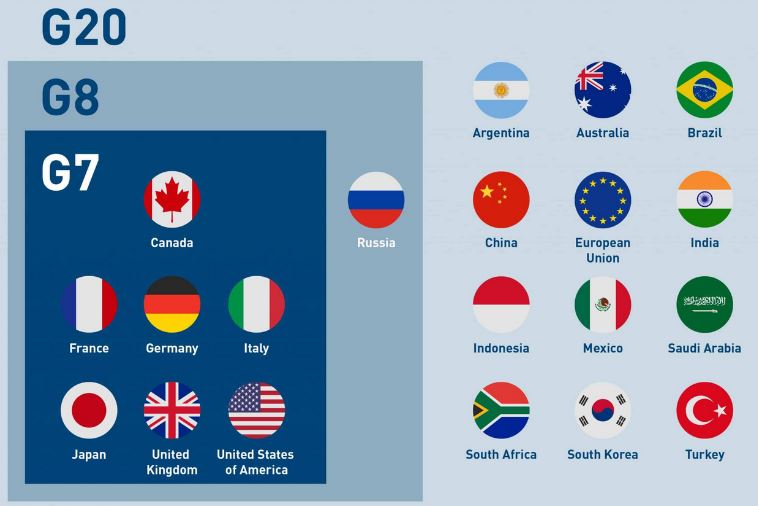
    • The G-7 or ‘Group of Seven’ includes Canada, France, Germany, Italy, Japan, the United Kingdom, and the United States.
    • It is an intergovernmental organisation that was formed in 1975 by the top economies of the time as an informal forum to discuss pressing world issues.
    • Initially, it was formed as an effort by the US and its allies to discuss economic issues.
    • The G-7 forum now discusses several challenges such as oil prices and many pressing issues such as financial crises, terrorism, arms control, and drug trafficking.
    • It does not have a formal constitution or a fixed headquarters. The decisions taken by leaders during annual summits are non-binding.
    • Canada joined the group in 1976, and the European Union began attending in 1977.

    Evolution of the G-7

    • When it started in 1975—with six members, Canada joining a year later—it represented about 70% of the world economy.
    • And it was a cosy club for tackling issues such as the response to oil shocks.
    • Now it accounts for about 40% of global GDP.
    • Since the global financial crisis of 2007-09 it has sometimes been overshadowed by the broader G20.
    • The G-7 became the G-8 in 1997 when Russia was invited to join.

    Why was Russia expelled?

    • The G-7 was known as the ‘G-8’ for several years after the original seven were joined by Russia in 1997.
    • The Group returned to being called G-7 after Russia was expelled as a member in 2014 following the latter’s annexation of the Crimea region of Ukraine.
    • Since his election in 2016, President Trump has suggested on several occasions that Russia be added again, given what he described as Moscow’s global strategic importance.

    Why in news now?

    • New Delhi is preparing for more pressure from the G-7 countries.
    • These countries (Canada, France, Germany, Italy, Japan, the UK, the US and the EU) have unitedly imposed sanctions on Russia since it invaded Ukraine.
    • They want India to cooperate in restricting its purchase of Russian oil, not circumvent the sanctions by using a rupee-rouble mechanism.
    • It also wants India to lift the ban on the export of wheat.

    Relevance of G7 for India

    • India will get more voice, more influence and more power by entering the G7.
    • After UN Security Council (UNSC), this is the most influential grouping.
    • If the group is expanded it will collectively address certain humongous issues in the global order.
    • Diplomatically, a seat at the high table could help New Delhi further its security and foreign policy interests, especially at the nuclear club and UNSC reforms.
    • It will further protect its interests in the Indian Ocean.

    Challenges for India’s entry

    • The decision to expand the grouping cannot be taken by the US alone.
    • There needs to be a consensus.
    • However, a special invitation to India is no mean achievement.


    UPSC 2023 countdown has begun! Get your personal guidance plan now! (Click here)

  • Tribes in news: Santhal Tribe

    The Santhal community is in the spotlight after a political alliance nominated one of its leaders for the Presidential election, Droupadi Murmu, for the election to the highest Constitutional post of India.

    Santhal Tribe

    • Santhal, also spelt as Santal, literally means a calm, peaceful man. Santha means calm, and ala means man in the Santhali (also spelt as Santali) language.
    • Santhals are the third largest Scheduled Tribe community in India after Gonds and Bhils.
    • The Santhali population is mostly distributed in Jharkhand, Odisha and West Bengal.

    Historical background

    • The Santhals were a nomadic stock before they chose to settle in the Chotanagpur plateau.
    • By the end of the 18th century, they had concentrated in the Santhal Parganas of Jharkhand (earlier Bihar).
    • From there, they migrated to Odisha and West Bengal.

    Demographic details

    • Tribal communities, outside the Northeast, generally have lower levels of literacy.
    • But the Santhals have higher – a result of a pro-school education awareness since at least the 1960s – literacy rate compared to other tribes in Odisha, Jharkhand and West Bengal.
    • Many of the community have entered the creamy layer of Indian society.
    • For example, Jharkhand CM Hemant Soren is a Santhal.
    • The incumbent Comptroller and Auditor General of India (CAGI) Girsh Chandra Murmu, who was the first Lt Governor of the UT of Jammu and Kashmir, is also a Santhal.

    Cultural features of Santhals

    (1) Religion

    • Despite their social upliftment, the Santhals are usually connected to their roots.
    • They are nature worshippers and could be seen paying obeisance at Jaher (sacred groves) in their villages.
    • River Damodar holds a special place in the religious life cycle of a Santhal.
    • When a Santhal dies, his or her ashes and bones are immersed in the Damodar for a peaceful afterlife.
    • Their traditional dress includes dhoti and gamuchha for men and a short-check saree, usually blue and green, for women, who generally put on tattoos.

     (2) Society

    • Various forms of marriage are accepted in the Santhal society – including elopement, widow remarriage, levirate, forced (rare) and the one in which a man is made to marry the woman he has impregnated.
    • Divorce is not a taboo in the Santhal society. Either of the couple could divorce the other.

    (3) Artforms

    • Santhals are fond of their folk song and dance that they perform at all community events and celebrations.
    • They play musical instruments like kamak, dhol, sarangi and flutes.
    • Most Santhals are agriculturists, depending on their farmlands or forests.
    • Their homes, called Olah, have a particular three-colour pattern on the outer walls.
    • The bottom portion is painted with black soil, the middle with white and the upper with red.

    (4) Language

    • Their tribal language is called Santhali, which is written in a script called Ol chiki, developed by Santhal scholar Pandit Raghunath Murmu.
    • Santhali language belongs to the Munda group.
    • Santhali written in OI-Chiki script is recognised as one of the scheduled languages in the Eighth Schedule to the Constitution.

    Back2Basics: Santhal Rebellion

    • The Santhal rebellion also known as Santhal Hool was a revolt by the Santhal in present-day Jharkhand, India, against the British East India Company and the Zamindari System.
    • It began on June 30, 1855, and the East India Company declared martial law on November 10, 1855, which lasted until January 3, 1856, when martial law was lifted.
    • The insurrection was put down by the Presidency soldiers.
    • The four Murmu Brothers – Sidhu, Kanhu, Chand, and Bhairav – spearheaded the revolt.


    UPSC 2023 countdown has begun! Get your personal guidance plan now! (Click here)

  • Bedti-Varada Interlinking Project

    Environmental groups in Karnataka have criticised the project to link the Bedti and Varada rivers in Karnataka, calling it ‘unscientific’ and a ‘waste of public money’.

    Bedti-Varada Interlinking Project

    • The Bedti-Aghanashini-Varade river-linking project was also included in the country’s major rivers project devised by the then PM Vajpayee government.
    • The Central Government had created a task force to prepare action plans for interlinking the riverbeds in 2002.
    • The project cost and the source of investments were ascertained and suggested that the project be taken up in 2016.

    Key details

    • The Bedti-Varada project was envisaged in 1992 as one to supply drinking water by the then government.
    • The plan aims to link the Bedti, a river flowing west into the Arabian Sea, with the Varada, a tributary of the Tungabhadra river, which flows into the Krishna, which in turn flows into the Bay of Bengal.
    • A massive dam will be erected at Hirevadatti in Gadag district under the project. A second dam will be built on the Pattanahalla river at Menasagoda in Sirsi, Uttara Kannada district.
    • Both dams will take water to the Varada via tunnels of length 6.3 kilometres and 2.2-km. The water will reach at a place called Kengre.
    • It will then go down a 6.88 km tunnel to Hakkalumane, where it will join the Varada.
    • The project thus envisages taking water from the water surplus Sirsi-Yellapura region of Uttara Kannada district to the arid Raichur, Gadag and Koppal districts.


  • [Yojana Archive] Safeguarding Children

    May 2022

    UPSC 2023 countdown has begun! Get your personal guidance plan now! (Click here)

    Context

    • India has 2.96 crore orphaned or abandoned children, according to the United Nations Children’s Fund (UNICEF).
    • The Ministry of Women and Child Development reported in its annual report for 2020-21 that there were 2.56 lakh children living in 7,164 child care institutions (CCIs) across the country.
    • 1.45 lakh children were reunited with their birth families after the Supreme Court ordered states to investigate the possibility of reuniting these children in care institutions with their birth families as a pandemic precaution.

    Adoption Laws in India

    (A) The Hindu Adoption and Maintenance Act, 1956 (HAMA)

    • A Hindu parent or guardian can place a child for adoption with another Hindu parent under the Act.
    • A prospective parent can also adopt a male child if he has no other male children or grandchildren, or a female child if he has no other female children or grandchildren.
    • If the adoptive mother is a woman and the person being adopted is a man, she must be at least 21 years old.
    • After complying with all Act provisions, the adoption process is completed with a registered adoption deed through court.

    (B) Juvenile Justice (Care and Protection of Children) Act, 2015

    • The JJ Act also permits the adoption of same-sex children, allowing biological or adopted parents to adopt a child of the same gender.
    • Prospective parents can adopt their relatives’ children whether they live in India or abroad. A single or divorced person can adopt under the JJ Act, but a single male cannot adopt a girl child.
    • A home study is conducted by the Specialised Adoption Agency (SAS) to determine if a person is eligible to adopt a child, and the process ends with an adoption order.
    • SAS and the Authorised Foreign Adoption Agency (AFAA) are required to follow up with the adoptive family for two years after the adoption.

    Reasons for low adoption in India

    • Parent-centrism: The current adoption approach is very parent-centred, but parents must make it child-centred.
    • Age of child: Most Indian parents also want a child between the ages of zero and two, believing that this is when the parent-child bond is formed.
    • Institutional issues: Because the ratio of abandoned children to children in institutionalised care is lopsided, there are not enough children available for adoption.
    • Lineage discrimination: Most Indians have a distorted view of adoption because they want their genes, blood, and lineage to be passed down to their children.
    • Red-tapism: Child adoption is also not so easy task after the Juvenile Justice Rules of 2016 and the Adoption Regulations of 2017 were launched.

    Government Initiatives  

    (1) Mission Vatsalya:  

    • Mission Vatsalya shall include Child Protection Services and Child Welfare Services. It brings together services and structures to help children in distress.

    (2) Mission POSHAN 2.0:  

    • Mission POSHAN 2.0 shall include Umbrella Integrated Child Development Scheme – Anganwadi Services, Poshan Abhiyan, Scheme for Adolescent Girls, and National Creche Scheme.

    (3) Mission Shakti:

    • Mission Shakti envisions a unified citizen-centric lifecycle support system for women that includes integrated care, safety, protection, rehabilitation, and empowerment to free women as they move through different stages of life.
    • ‘Sambal’ and ‘Samarthya’ are two sub-schemes of Mission Shakti.
    • The “Sambal” sub-scheme is for women’s safety and security, while the “Samarthya” sub-scheme is for women’s empowerment.

    (4) PM CARES for Children Scheme:

    • The government announced a special “PM CARES for Children” program for all children orphaned by Covid-19 who lost their parents or single parents or legal guardians or adoptive parents due to Covid-19.
    • These children can also receive support through scholarships or education loans equivalent to tuition fees during their higher education, and the loan interest is paid by the PM CARES Fund.

    (5) CARA

    • Central Adoption Resource Authority (CARA) is an autonomous and statutory body of the Ministry of Women and Child Development. It was set up in 1990.
    • It functions as the nodal body for the adoption of Indian children and is mandated to monitor and regulate in-country and inter-country adoptions.
    • CARA is designated as the Central Authority to deal with inter-country adoptions in accordance with the provisions of the 1993 Hague Convention on Inter-country Adoption, ratified India in 2003.
    • It primarily deals with the adoption of orphaned, abandoned and surrendered children through its associated and recognized adoption agencies.

  • Places in news: Keibul Lamjao National Park (KLNP)

    Activists surrounding the Keibul Lamjao National Park (KLNP) in Manipur have now taken up the cudgels to ensure that the government does not shift the proposed heritage park from the approved site.

    Keibul Lamjao National Park (KLNP)

    • The KLNP is a national park in the Bishnupur district of the state of Manipur in India.
    • It is 40 km2 in area, the only floating park in the world, located in North East India, and an integral part of Loktak Lake.
    • The national park is characterized by floating decomposed plant material locally called Phumdi at the south–eastern side of the Loktak Lake, which has been declared a Ramsar site.
    • It was created in 1966 as a wildlife sanctuary to preserve the natural habitat of the endangered Eld’s deer.
    • In 1977, it was gazetted as national park.

    Key faunas

    • KLNP is home to the last of the brow-antlered deer (Rucervus eldii eldii), one of the most endangered deer in the world.
    • It is locally called as Sangai.
    • The animal is, in fact, in danger of losing its home—most of the phumdis, or floating swamps, are unable to sustain its weight.
    • In 1951, it was reported extinct, but British tea planter and naturalist Edward Pritchard Gee rediscovered it in 1953.


    UPSC 2023 countdown has begun! Get your personal guidance plan now! (Click here)

  • Preparing for UPSC Mains 2022? Secure A top ten rank with Civilsdaily’s Mains Program

    Preparing for UPSC Mains 2022? Secure A top ten rank with Civilsdaily’s Mains Program

    ‘Good luck is a residue of preparation’-Civilsdaily

    Hi Guys, Now it’s time to cross the higher bar. The Main Examination is intended to estimate the overall intellectual qualities and depth of understanding of candidates rather than merely the range of their information and memory. 

    The core and benchmark of questions in the General Studies papers (Paper II to Paper V) will be such that a well-evaluated candidate will be competent to answer them. The questions are likely to test the candidate’s basic understanding of all relevant issues, and ability to analyze & summarize, and take a view on conflicting socio-economic goals, objectives, and demands. And you must give applicable, meaningful, and succinct answers. 

    So, acknowledging the need to ensure framing a rule of thumb to answer only what the question demands, Civilsdaily has been providing some advanced, single-source UPSC-CSE Mains Programs. Our 2021 Hall of Fame rankers have to say that If there’s a one-stop, time-saving platform available to clear UPSC mains, it is CD’s mains 1-1 mentorship Programs.

    The Hindu has acknowledged CD’s Mains Mentorship Programs.

    What our UPSC 2021 Hall of Fame rankers have to say about Mains Programs

    Mourya’s struggle from repeated failures to Rank, 28 UPSC 2021

    Explore our ‘Be Mains Ready Programs’

    Smash Mains Programs

    One of the demanding programs for UPSC mains candidates. Because this program is designed specially to assure 100 marks above the cut-off.

    Program inclusion:

    • One-to-One mentorship by Sajal sir.
    • Mains Test Series
    • On-call discussion with Sajal sir after every test.
    • Samachar Manthan – For holistic and comprehensive coverage of Current Affairs.
    • Exclusive membership to Smash Mains club in Habitat.

    Click Here To Know More About The Program

    Have a query about the program? Reach Us

    Mains Essential Program FLT EDITION 2022

    Program Inclusion Details:

    • 12 Full-length tests: After the prelims, it is time to go full gear. Practice 3 rounds of FLT based on 4 GS paper.
    • Quality Enrichment Program Notes: QEP is an intensive and holistic program for IAS Mains 2022 GS papers. We aim to cover up to 250 most relevant issues with a 360-degree view, covering all dimensions of each and every topic. Not only you’ll learn and analyze these issues but will also understand how to utilize them via Daily Answer Writing and Mains Test Series.
    • Personalized discussion in 1-to-1 mentorship: You doubt why you are scoring less or how you can improve your score for the next paper. No worries! Just schedule a call with our mentor to clear all your doubts and queries.
    • Civilsdaily’s handholding
    • Civilsdaily magazine: Your current affairs will be covered with access to our 1-year subscription.

    Click Here to Check Details

    Have a query about the program? Reach Us

    Smash Ethics Program

    Smash Ethics 2022 (Batch 2) with 1-to-1 Mentorship | Score 110+ in Ethics GS-4

    Program Inclusion:

    • Comprehensive Video Lectures covering Paper 4
    • Full syllabus Notes.
    • 8 FLT tests
    • 1-1 Mentorship support after every test
    • Membership of Ethics group (exclusive) on Civilsdaily’s Habitat
    • Doubt resolution session on Habitat

    Click Here to Enroll the Course

    Have a query about the program? Reach Us

    MEP Super 100 2023

    Program inclusion:

    • 12 Sectional tests: The whole syllabus will be divided into portions like history, economics, and geography. The test will be spread for a period of 8 months. This will ensure that your basic static preparation happens on a continuous basis alongside your mains answer writing program. Killing two birds with one stone!
    • 12 Full-length tests: After the prelims, it is time to go full gear.
    • Personalized discussion: You doubt why you are scoring less or how you can improve your score for the next paper. No worries! Just schedule a call with our mentor to clear all your doubts and queries.
    • Civilsdaily’s handholding: You will be provided membership to Mains 2023 club on Habitat. There you can put up your doubts and queries. Also can be used to interact with peers on strategies to improve your mains writing. You can also contact mentors like Sajal sir, Sukanya ma’am, Sudhanshu sir and Poornima Ma’am. They all have interview-level experience, so utilize their experience to your benefit.
    • Civilsdaily magazine: Your current affairs will be covered with access to our 1-year subscription. (June 2022 to May 2023)

    Click Here to Enroll the Course

    Have a query about the program? Reach Us

    Essay Program

    Program inclusion:

    • 8 FLTs
    • Detailed orientation for beginners
    • Process building Sessions
    • Content/Approach Building Sessions
    • Model essays
    • One-to-one mentorship
    • Membership in exclusive Essay group on Habitat
    • Notes and references on Habitat
    • Topic-wise arranged PYQs

    Check Out Now

    Have a query about the program? Reach Us

    About the faculty leading these programs:

    Sajal Singh

    Sajal sir is known to make Economics and IR as easy as a cakewalk. He scored one of the highest marks in GS in the 2017 UPSC exam. Under his guidance, more than 80 percent of Students qualified for UPSC interview 2020 in Smash mains Program.

    Sukanya Rana

    Sukanya ma’am has firsthand experience of 4 mains and 2 interviews of UPSC. She has also appeared in the State PCS interview. Before she worked as an officer in a public sector bank and now as a Mentor at Civilsdaily, she aims to guide future aspirants in finding success. Sukanya Ma’am has scored consistently 100+ marks in ethics and in 2019 her marks were 140 in GS 4. In 2020, under her mentorship, many smash mains students were able to secure 120+ marks.

    NOTE: Acknowledging the need to ensure fastest mentorship response, Senior IAS mentor like Partha Sir, Swatantra Sir, and Suhel sir will also receive your call.

    For Students…

    In these programs we will tackle one of the most important challenges faced by CSE aspirants i.e. how to write a good answer in the Mains examination.

    It is said that answer writing is an art.The good news is that any form of art can be learnt over a period of time. All it takes is will and effort, regular practice and proper guidance of toppers’ mentors and teachers. We are here to provide you help with the guidance part and we hope you successfully integrate the tips we are going to provide in your preparation.

    These answer writing programs have been divided into three sections – Basic, Intermediate and Advanced. As the names for the section headings suggest, one should proceed step by step, understanding each section completely before proceeding to the next. Ultimately you should be able to use the tips from all sections in your answer writing in a holistic manner.

  • The tricky restructuring of global supply chains

    Context

    After the go-go 1990s and 2000s the pace of economic integration stalled in the 2010s, as firms grappled with the aftershocks of a financial crisis, a populist revolt against open borders and President Donald Trump’s trade war.

    Background of globalisation

    • After the Berlin Wall fell in 1989, main theme of globalisation was efficiency.
    • Companies located production where costs were lowest, while investors deployed capital where returns were highest.
    • Governments aspired to treat firms equally, regardless of their nationality, and to strike trade deals with democracies and autocracies alike.
    • Low prices: All this kept prices low for consumers and helped lift 1bn people out of extreme poverty as the emerging world, including China, industrialised.


    Recent worries with globalisation

    • Volatile capital flows destabilised financial markets. Many blue-collar workers in rich countries lost out.
    • Recently, two other worries have loomed large.
    • Cost in case of disruption is high: First, some lean supply chains are not as good value as they appear: mostly they keep costs low, but when they break, the bill can be crippling.
    • Covid-19 was a shock, but wars, extreme weather or another virus could easily disrupt supply chains in the next decade.
    • Dependencies on autocracies have increased: The second problem is that the single-minded pursuit of cost advantage has led to a dependency on autocracies that abuse human rights and use trade as a means of coercion.
    • Hopes that economic integration would lead to reform—what the Germans call “change through trade”—have been dashed: autocracies account for a third of world gdp.

    The fragile state of the international trade and beginning of new phase in globalisation

    • The pandemic and war in Ukraine have triggered a once-in-a-generation reimagining of global capitalism in boardrooms and governments.
    • Supply chain resilience: The supply chains are being transformed, from the $9trn in inventories, stockpiled as insurance against shortages and inflation, to the fight for workers as global firms shift from China into Vietnam.
    • Preferring security over efficiency: This new kind of globalisation is about security, not efficiency: it prioritises doing business with people you can rely on, in countries your government is friendly with.
    • One indication that companies are shifting from efficiency to resilience is the vast build-up in precautionary inventories: for the biggest 3,000 firms globally these have risen from 6% to 9% of world gdp since 2016.
    • Many firms are adopting dual sourcing and longer-term contracts.
    • Investment pattern is inverted: The pattern of multinational investment has been inverted: 69% is from local subsidiaries reinvesting locally, rather than parent firms sending capital across borders.
    • Strategic autonomy: The industries under most pressure are already reinventing their business models, encouraged by governments that from Europe to India are keen on “strategic autonomy”.
    • Moving towards vertical integration: The car industry is copying Elon Musk’s Tesla by moving towards vertical integration, in which you control everything from nickel mining to chip design.
    • Long-term supply deals: In energy, the West is seeking long-term supply deals from allies rather than relying on spot markets dominated by rivals.

    Challenges

    • Protectionism: The danger is that a reasonable pursuit of security will morph into rampant protectionism, jobs schemes and hundreds of billions of dollars of industrial subsidies.
    • Long-run inefficiencies: The long-run inefficiency from indiscriminately replicating supply chains would be enormous.
    • Were you to duplicate a quarter of all multinational activity, the extra annual operating and financial costs involved could exceed 2% of world gdp.

    Way forward

    • Restraint: Because of the above challenges, restraint is crucial.
    • Diversification: Governments and firms must remember that resilience comes from diversification, not concentration at home.
    • Diversify in the areas controlled by autocracies: The choke-points autocracies control amount to only about a tenth of global trade, based on their exports of goods in which they have a leading market share of over 10% and for which it is hard to find substitutes.
    • The answer is to require firms to diversify their suppliers in these areas, and let the market adapt. 

    Conclusion

    Will today’s governments be up to the task? Myopia and insularity abound. But if you are a consumer of global goods and ideas—that is to say, a citizen of the world—you should hope globalisation’s next phase involves the maximum possible degree of openness.

    UPSC 2023 countdown has begun! Get your personal guidance plan now! (Click here)

  • Judicial Reforms in India

    Context

    Following are the reforms needed in the various aspects of the higher judiciary

    Removing the disparity between retirement ages of HC and SC judges

    • High Court judges now retire at 62 and Supreme Court judges at 65.
    • It is high time that we did away with the disparity between the retirement ages of High Court and Supreme Court judges.
    • There is no good reason for this difference.
    • Intense pressure and competition: The obvious negative fallout of a differential retirement age simply is intense pressure and competition to make it to the top court and thus get three more years.
    • If this is done away with, several judges of mettle would prefer to be Chief Justices and senior judges in the High Courts exercising wide power of influence rather than being a junior judge on a Bench of the Supreme Court.
    • There is good work to be done in the High Courts, and we need good men there.

    Create a cadre of public service for retired judges

    • SeveralSupreme Court judges focus on arbitrations after retirement.
    • A minority of judges devote themselves to public service; sadly, this is a very small minority.
    • Another lot are appointed to various constitutional posts and tribunals and commissions.
    • It would be worthwhile reform to create a cadre of public service for retired judges and from this pool make appointments to the constitutional and statutory posts and special assignments.
    • Such judges should receive the full pay and the facilities of a judge of the Supreme Court for life.
    • We should have a culture of public service for senior judges, and those who do not fit in such culture should not be a part of senior ranks.

    Reform in the process of appointment of Chief Justice of India

    • No constitutional basis: It is generally assumed that the seniormost judge of the Supreme Court should be the Chief Justice of India.
    • The Constitution mandates no such thing.
    • Article 124 merely states that the President will appoint every judge of the Supreme Court, and this includes the Chief Justice, and each of these judges shall hold office until they attain the age of 65 years.
    • The requirement about appointing the seniormost judge to be the CJI was devised in the Second Judges case (1993) and the consequent Memorandum of Procedure which is an usurpation of the President’s power.
    • There is no good reason why any one particular person should have a vested interest in the top job, and we are better served by eliminating such expectation.
    • Let all serve equally under the constitutional throne for the entire length of their tenure.

    But who then shall be the CJI?

    • As per the Constitution the judges of the High Court, senior advocates and distinguished jurists are eligible for the appointment as the judge of the Supreme Court.
    • Chief Justice of HC: When a serving CJI retires, his successor should be the best reputed Chief Justice of a High Court who has proved himself worthy both in judicial office as well as administrative leadership and has those qualities of heart and head which mark a good leader.
    • The same process is followed in the appointment of the Chief Justice of the United States Supreme Court.
    • Security of tenure: The appointee should have a clear three-year term.
    • He should not function as the primus super pares — calling the shots and having their unfettered way.
    • He should instead function in a true collegiate manner, especially in regard to the roster of allotment of cases, especially the sensitive ones, and appointments to the Supreme Court and High Courts and other important matters of judicial and administrative importance.

    Conclusion

    Though there are several issues that need reforms in the higher judiciary, the above reforms can serve as the precursor to the other reforms to come.

    UPSC 2023 countdown has begun! Get your personal guidance plan now! (Click here)

  • (Zoom LINK inside) Result out! UPSC Prelims 2022 | PDF inside | What to do next? Discuss it 1-1 with AIR 67, Anand Malhotra at 7 pm today | FREE WEBINAR Mains special

    (Zoom LINK inside) Result out! UPSC Prelims 2022 | PDF inside | What to do next? Discuss it 1-1 with AIR 67, Anand Malhotra at 7 pm today | FREE WEBINAR Mains special

    Join using this link, 7pm today: https://us06web.zoom.us/j/83627975251?pwd=ZTAzTXFYY3pJVVlKZHlHemtwaHhRdz09

    You need to register to submit a question for AIR 67, Anand Malhotra and get access to Telegram group.

    Congratulation to those who have cleared for Mains 2022. PDF below. Tell us in the comments about your result. Now get ready for Mains in ~80 days? Kick off your Mains prep with AIR 67, Anand, today.


    UPSC has just now released the result for Civil Services or UPSC Prelims examination 2022 which was conducted on June 5th. We’ll soon share name wise list.

    We, at Civilsdaily, are extremely happy for everyone who has cleared prelims this time. Thank you for giving us a reason to cheer for you. It’s important to give yourself a pat or two, share the news with your family, eat a sweet, and start working for Mains immediately.

    CivilsDaily’s topper Anand Malhotra, AIR 67, UPSC 2021 wants to discuss a few things with you regarding UPSC Mains preparation. For that, he will be taking a LIVE session (Webinar).

    Webinar Details

    • Date: 22nd June 2022 (Wednesday)
    • Time: 7 pm
    • Zoom link will be emailed to you post-registration.
    • The webinar is Open to All (FREE)

    We will email the Telegram group and Mains resources to you post-registration.

    What to expect in the Webinar?

    1. You will be strategizing with Anand Malhotra, 1-1 for your Integrated UPSC preparation, especially Mains.
    2. Learning to make 1-2 page notes for the most important topics from every subject which helped Anand finish an answer within 250 words?
    3. How to study in the last 80 days for Mains 2022?
    4. When to start writing Mains answers. Is it better to practice 2-3 answers every day even if there is a year more for the UPSC exam?
    5. How many times in a month did Anand Malhotra write Essay answers? Why practicing Essay Paper is important even as a beginner?
    6. How to develop perseverance and self-confidence while preparing for UPSC CSE?

    About Anand Malhotra, AIR 67

    An engineer and an IIM grad, Anand Malhotra secured AIR 67 in his second attempt. Before this, Anand had a stint with a startup and a tech MNC as well. His optional was Sociology.

    Anand loves watching talk shows like TED and would love to motivate and guide you. Watch the video to know more about him.

    Important Links:

  • India and Australia

    Context

    India and Australia, which share common values and interests, must work together with resolve to shape the economic and strategic environment so that it continues to support collective security and prosperity.

    India-Australia ties: A background

    • The ties are a Comprehensive Strategic Partnership full of practical, tangible actions that strengthen ties and benefit the region.
    • India and Australia are a small group of countries to hold annual leaders’ summits and biennial 2+2 talks involving foreign and defence ministers.
    • The defence forces of both the countries are undertaking more complex activities together, such as in Exercise Malabar with the US and Japan.
    • We coordinate closely on maritime domain awareness.
    • This year both countries deployed P-8 surveillance aircraft to each other’s territories for joint patrols.
    • Australia has also committed to a package of partnership initiatives in our update to the India Economic Strategy.
    • Cooperation on climate and sustainability: India and Australia have great potential to cooperate on climate and sustainability.

    Why India matters to Australia

    • Securing supply chain: India’s economy, manufacturing capabilities and talent ensure it will play a key role in securing supply chains and restarting post-pandemic growth.
    • Balance of power: Its military has the capacity and capability to respond to natural disasters, help stabilise an uncertain region and contribute to an effective balance of power.
    • Technological and scientific capabilities: Its technological and scientific capabilities are gateways to a cleaner and more sustainable world.
    •  Commitment to democracy: Most of all, India’s people have the optimism, the commitment to democracy, the drive and the goodwill to make our region safer, freer and better.

    Vision for open, inclusive and resilient Indo-Pacific region

    • As the bilateral relationship deepens, both the countries must begin to work more together with others in the region.
    • Responding to humanitarian crises and natural disasters: There is enormous potential in the Indian and Pacific oceans, where we each have vital interests in combating climate change, illegal fishing and people smuggling and responding to humanitarian crises and natural disasters.
    •  Australia has a vision for an open, inclusive and resilient Indo-Pacific region.
    • It is a vision for a region that is more integrated rather than divided, where trade and investment flow freely based on agreed rules and treaty commitments, where disputes are resolved through dialogue in accordance with international law, and where a strategic culture that respects the rights of all states, big and small, prevails.
    • It is a vision that Australia share with partners like ASEAN, and partners like India.
    • Whether through joint activities with like-minded countries, or the support of regional and multilateral architecture, Australia is ensuring the region has options and balance.

    Conclusion

    India and Australia’s interests don’t just align, they are inextricably entwined. Expect this relationship to grow and prosper, our cooperation to deepen.

    UPSC 2023 countdown has begun! Get your personal guidance plan now! (Click here)

  • 22nd June 2022| Daily Answer Writing Enhancement(AWE)

    Topics for Today’s questions:

    GS-1         Urbanization, their problems and remedies

    GS-2         Bilateral, regional and global groupings and agreements involving India and/or affecting  India’s interests.

    GS-3        Indian Economy

    GS-4      Contribution of moral thinkers and philosophers from India and the world.

    Question 1)


    Q.1 Giving an account of the initiatives taken by the government for urban development in recent years, explain how they seek to solve some of the major problems of urbanization faced in India.


    Question 2)

    Q.2 Countries which share common values and interests must work together with resolve to shape our economic and strategic environment so that it continues to support our collective security and prosperity. Examine how India-Australia relations are based on that conviction. (10 Marks)

    Question 3)

    Q.3 How the central bank influences inflation expectations? Why communication between the Monetary Policy Committee and the RBI is important?

    Question 4)  

    Q.4 The core of Gandhiji’s philosophy lies in internal moral power. Discuss. (10 Marks)


    HOW TO ATTEMPT ANSWERS IN DAILY ANSWER WRITING ENHANCEMENT(AWE)?

    1. Daily 4 questions from General studies 1, 2, 3, and 4 will be provided to you.

    2. A Mentor’s Comment will be available for all answers. This can be used as a guidance tool but we encourage you to write original answers.

    3. You can write your answer on an A4 sheet and scan/click pictures of the same.

    4.  Upload the scanned answer in the comment section of the same question.

    5. Along with the scanned answer, please share your Razor payment ID, so that paid members are given priority.

    6. If you upload the answer on the same day like the answer of 11th  February is uploaded on 11th February then your answer will be checked within 72 hours. Also, reviews will be in the order of submission- First come first serve basis

    7. If you are writing answers late, for example, 11th February is uploaded on 13th February , then these answers will be evaluated as per the mentor’s schedule.

    8. We encourage you to write answers on the same day. However, if you are uploading an answer late then tag the mentor like @Staff so that the mentor is notified about your answer.

    *In case your answer is not reviewed, reply to your answer saying *NOT CHECKED*. 

    1. For the philosophy of AWE and payment: 

  • Q.4 The core of Gandhiji’s philosophy lies in internal moral power. Discuss. (10 Marks)

    Mentor’s Comments-

    • Start with a brief introduction around Gandhiji’s moral philosophy.
    • Highlight how the core of Gandhiji’s philosophy lies in internal moral power.
    • Conclude accordingly.
  • Q.3 How the central bank influences inflation expectations? Why communication between the Monetary Policy Committee and the RBI is important?

    Mentor’s comment-
    • https://indianexpress.com/article/opinion/columns/mpc-monetary-policy-committee-rbi-7983009/
    • In the intro, briefly introduce the MPC.
    • In the body, mention the role played by the RBI in shaping the expectations of the people. In the next part, mention the moves such as separate policy statements, the introduction of GSAP, changes in the reverse repo, and intervention in the foreign exchange market that indicate the lack of communication and highlight the need for a framework to ensure the policy coherence.
    • Conclude by mentioning the need for communication between MPC and the RBI.
  • Q.2 Countries which share common values and interests must work together with resolve to shape our economic and strategic environment so that it continues to support our collective security and prosperity. Examine how India-Australia relations are based on that conviction. (10 Marks)

    Mentor’s comment-
  • Q.1 Giving an account of the initiatives taken by the government for urban development in recent years, explain how they seek to solve some of the major problems of urbanization faced in India.

    Mentor’s Comments-

    • Introduce with a short note on the current status of urbanization in India.
    • Enlist the programmes and schemes launched by the government for urban development in recent years such as PMAY, Smart Cities Mission, AMRUT, SBM(U) etc
    • Discuss in brief how they seek to solve some of the major problems of urbanization faced in India.
    • Conclude accordingly.
  • Why Assam gets flooded every year

    Disaster struck Dima Hasao, central Assam’s hill district, in mid-May after incessant heavy rainfall.

    Impacts of the disaster

    • The 170 km railway line connecting Lumding in the Brahmaputra Valley’s Hojai district and Badarpur in the Barak Valley’s Karimganj district was severely affected.
    • The Assam government and Railway Ministry’s assessments said the district suffered a loss of more than ₹1,000 crore, but ecologists say the damage could be irreversibly higher.

    How severe has the rain been in Assam?

    • Assam is used to floods, sometimes even four times a year, resultant landslides and erosion.
    • But the pre-monsoon showers this year have been particularly severe on Dima Hasao, one of three hill districts in the State.
    • Landslips have claimed four lives and damaged roads.
    • The impact has been most severe on the arterial railway, which was breached at 58 locations leaving the track hanging in several places.
    • The disruption of train services, unlikely to be restored soon, has cut off the flood-hit Barak Valley, parts of Manipur, Mizoram and Tripura.

    Why is the railway in focus post-disaster?

    • Dima Hasao straddles the Barail, a tertiary mountain range between the Brahmaputra and Barak River basins.
    • The district is on the Dauki fault (the prone-to-earthquakes geological fractures between two blocks of rocks) straddling Bangladesh and parts of the northeast.
    • British engineers were said to have factored in the fragility of the hills to build the railway line over 16 years by 1899.
    • The end result was an engineering marvel 221 km long over several bridges and through 37 tunnels, laid along the safer sections of the hills.

    A faulty experiment

    • A project to convert the metre gauge track to broad gauge was undertaken in 1996 but the work was completed only by March 2015 because of geotechnical constraints and extremist groups.
    • The broad-gauge track was realigned to be straighter, but a 2009-10 audit report revealed that the project had been undertaken without proper planning and visualisation of the soil strata behaviour.
    • The report gave the example of the disaster-prone Tunnel 10 on the realigned track that was pegged 8 meters below the bed of a nearby stream.

    Is only the railway at fault?

    • There is a general consensus that other factors have contributed to the situation Dima Hasao is in today.
    • Roads in the district, specifically the four-lane Saurashtra-Silchar (largest Barak Valley town) East-West Corridor, have been realigned or deviated from the old ones that were planned around rivers and largely weathered the conditions.
    • The arterial roads build over the past 20 years often cave in and get washed away by floods or blocked by landslides.
    • Shortened cycles of jhum or shifting cultivation on the hill slopes and unregulated mining have accentuated the “man-made disaster”.
    • Massive extraction of river stone, illegal mining of coal and smuggling of forest timbe has led to the disaster.
    • These activities have increased water current besides weakening either side of riverbanks.

    How vital are the rail and highway through Dima Hasao?

    • Meghalaya aside, Dima Hasao is the geographical link to a vast region comprising southern Assam’s Barak Valley, parts of Manipur, Mizoram and Tripura.
    • Moreover, this track is vital for India’s Look East policy that envisages shipping goods to and from Bangladesh’s Chittagong port via Tripura’s border points at Akhaura and Sabroom.
    • These are the last railway station near the Feni River that serves as the India-Bangladesh border.


    UPSC 2023 countdown has begun! Get your personal guidance plan now! (Click here)

  • Explained: BSF powers and jurisdiction

    A blueprint that defines the extended jurisdiction of the Border Security Force (BSF) and its new logistical requirements in frontier States has been prepared and is soon expected to be submitted to the Union Home Ministry.

    What is the news?

    • While in Punjab, West Bengal and Assam, the BSF jurisdiction, from the border towards the hinterland, was enhanced from the earlier 15 km to 50 km.
    • In Gujarat the same limit has been reduced from 80 km to 50 km, while in Rajasthan the limit has been kept unchanged at 50 km.

    Do you know?

    BSF currently stands as the world’s largest border guarding force. It has been termed as the First Line of Defence of Indian Territories.

    About Border Security Force (BSF)

    • The BSF is India’s border guarding organization on its border with Pakistan and Bangladesh.
    • It comes under the Ministry of Home Affairs.
    • It was raised in the wake of the 1965 War on 1 December 1965 for ensuring the security of the borders of India and for matters connected therewith.
    • The BSF has its own cadre of officers but its head, designated as a Director-General (DG), since its raising has been an officer from the Indian Police Service (IPS).

    What are the new modifications?

    • The MHA has exercised the powers under the Border Security Force Act of 1968.
    • It has thus outlined the area of BSF’s jurisdiction.

    Powers exercised by BSF in its jurisdiction

    BSFs jurisdiction has been extended only in respect of the powers it enjoys under:

    1. Criminal Procedure Code (CrPC)
    2. Passport (Entry into India) Act, 1920 and
    3. Passport Act, 1967

    Arrest and search

    • BSF currently has powers to arrest and search under these laws.
    • It also has powers to arrest, search and seize under the NDPS Act, Arms Act, Customs Act and certain other laws.

    Sanctions behind such powers

    • Scarcely populated borders: At that time, border areas were sparsely populated and there were hardly any police stations for miles.
    • Trans-border crimes: To prevent trans-border crimes, it was felt necessary that BSF is given powers to arrest.
    • Manpower crunch: While police stations have now come up near the border, they continue to be short-staffed.

    Various issues at Borders

    1. Encroachment
    2. Illegal incursion
    3. Drug and cattle smuggling

    Impact on State Police jurisdiction

    • Such moves are aimed to complement the efforts of the local police.
    • Thus, it is an enabling provision.
    • It’s not that the local police can’t act within the jurisdiction of the BSF.
    • The state police have better knowledge of the ground.
    • Hence BSF and local Police can act in cooperation.

    Criticism of the move

    • At a basic level, the states can argue that law and order is a state subject and enhancing BSF’s jurisdiction infringes upon powers of the state government.
    • In 2012, then Gujarat CM and the present PM had opposed a central government moves to expand BSF’s jurisdiction.


    UPSC 2023 countdown has begun! Get your personal guidance plan now! (Click here)

  • Judicial Validity of the Talaq-e-Hasan mode of Divorce

    A public interest litigation (PIL) seeking to invalidate Talaq-e-Hasan, the prescribed Islamic way of divorce, has been filed in the Supreme Court.

    What is the PIL about?

    • The petition seeks to make the prescribed Islamic way of divorce Talaq-e-Hasan unconstitutional as it is violative of Articles 14, 15, 21 and 25 of the Constitution.
    • The petitioner has been unilaterally divorced through the Talaq-e-Hasan mode by her husband.
    • She also prayed that Section 2 of the Muslim Personal Law (Shariat) Application Act, 1937 that permits Muslims to practise unilateral divorce be declared void.

    Basis of the PIL

    • The hearing comes almost five years after the five judge Bench headed by then CJI J.S. Khehar invalidated instant triple talaq in their verdict in the Shayara Bano vs the Union of India Case.
    • The invalidation of instant triple talaq where the court held, “What is bad in theology is bad in law as well”, led to the enactment of the Muslim Women (Protection of Rights on Marriage) Act 2019.

    What is Triple Talaq?

    • In instant triple talaq a man pronounces multiple divorce in one go.
    • It has no scope for reconciliation between the feuding couple, and often ends a marriage instantly.
    • It is, as the judges held, not mentioned anywhere in the Quran which prescribes a code of divorce largely through Surah Baqarah, verses 226 to 237 and the opening six verses of Surah Talaq.
    • Incidentally, triple talaq in this manner has been banned in many Muslim countries, including Egypt, Pakistan, Jordan, Kuwait, Iraq, Malaysia etc.

    How is Talaq-e-Hasan different from instant triple talaq?

    • Unlike instant triple talaq, Talaq-e-Hasan is pronounced with a gap of at least one month or one menstrual cycle.
    • Only a single revocable divorce takes place through the first pronouncement of Talaq-e-Hasan.
    • The husband and wife are supposed to live together after this pronouncement and have the option of rapprochement.
    • If the couple is not able to mend fences in the intervening period and the husband does not annul divorce through word or by establishing intimacy, the talaq stays valid.
    • At the end of this month, the husband has to pronounce divorce for the second time.
    • Likewise for the third time. After the second pronouncement too, the divorce is revocable, and the couple may resume their conjugal relationship anytime they so desire.
    • If, however, the third pronouncement is made after at least one menstrual cycle, then irrevocable divorce takes place.

    Why such hue over menstrual cycle?

    • Significantly, no divorce can be administered when the woman is undergoing her menstrual cycle.
    • Even in the case of pregnancy, no divorce takes place.
    • And if such a pronouncement is made, it remains in abeyance till the end of pregnancy.

    Are there other options of divorce apart from the Talaq-e-Hasan?

    • The third option of divorce besides Talaq-e-Hasan and the now repudiated instant triple talaq, is Talaq-e-Ahsan.
    • Under this form, a single pronouncement is made.
    • Following the pronouncement, a woman has to go through iddat or a waiting period of three months.
    • During this period the divorce can be cancelled.
    • However, failure to annul divorce during this period results in it being finalised after which a woman is independent, and free to marry another man or stay single, as she may choose.
    • Both Talaq-e-Hasan and Talaq-e-Ahsan enjoy legal validity in almost all Muslim countries.
    • Interestingly, women too have a right to end an unsuccessful marriage through Khula.

    Legal status of Khula in India

    • In April 2021, the Kerala High Court held this form of divorce valid.
    • The court overruled a 49-year-old verdict in K.C. Moyin vs Nafeesa and Others (1972) that barred Muslim women from dissolving their marriage through non-judicial modes.
    • There is some debate among religious scholars on the ways of Khula.
    • Some hold that the man’s consent is necessary in Khula while most say that he enjoys no such privilege.


    UPSC 2023 countdown has begun! Get your personal guidance plan now! (Click here)

More posts