Don’t forget to upload your DAF 1 and draft DAF 2 in the above link.
Our team will reach out to you. We will discuss how to best fill your DAF 2, what should be your next step and how to prepare for different aspects.
Highlights of Transcend: Focused offerings for 3 distinct groups of IAS Mains-qualified aspirants
Freshers
Work Ex
Veterans
Dedicated Habitat group, telephonic and the zoom/google meet sessions, SWOT analysis via personalized questionnaire & in-person mock interviews with the panel.
This year, we intend to raise the bar even higher by providing trailblazing professional, personalized mentorship. There are 3 broad categories into which the IAS Mains-qualified candidates are be divided:
#1. Freshers: Facing 1st UPSC interview without work-ex
These candidates have given dedicated and exclusive time to UPSC preparation, often right after their graduation. We also have candidates who decide for UPSC a little later in life. These candidates have a wide variety of backgrounds. Some have quit their jobs to prepare for CSE, some may have household and family responsibilities, etc.
The interview, in the case of these aspirants, will focus on academics, mental alertness, critical power of assimilation, leadership and teamwork, variety and depth of interest, etc.
Freshers have the advantage of ‘excitement’ and ‘happy-go-lucky’ attitude, but they also suffer from fear-of-the-unknown.
For them, Transcend will revolve around psychological strengthening and belief formation besides personality development and polishing of soft skills.
#2. Work-Experience: Facing 1st UPSC interview with work-ex
The second category is of working professionals. These candidates have the advantages of leadership, tactfulness, foresight, and maturity. Of all other categories of candidates, the responses of working professionals are expected to be brief, well crafted, balanced, logical and reflecting emotional intelligence. Leadership is another area these aspirants are tested for.
Transcend will focus intensely on each of these general traits. Stress will be on the trends highlighted by the latest research in these domains.
#3. Veterans: Have faced the UPSC interview board in the past
Candidates who have appeared in the UPSC interview, probably more than once; but have consistently scored low marks.
Such a person has the advantage of the experience of the official set-up. She is aware of the entire process, her DAF and does not have fear-of-the-unknown. She has possibly taken mock interviews in her previous attempts but success eludes her owing to some fundamental flaw, which if unidentified, will compromise her chances yet again.
For veterans, our Transcend mentors will analyze your DAF, previous mock interviews, transcript of real interview/s and will have detailed discussions to pinpoint the weakness. Then will follow the personalized recovery strategy.
We are the only institution in this space that brings such high levels of clarity and purpose to the interview program.
All in all, ‘Transcend’ from Civilsdaily is the finest tool you can choose to uncover the shimmering light of your personality and to realize the simmering desire of your heart.
Take that final leap. You are in good hands now.
What to expect in the coming weeks?
#1. Once you submit your DAF 1 and other details on the link & email, we request you to send a video snippet (shot over a mobile selfie at pravin[at]civilsdaily.com) on the questions listed below. These are basic, time tested questions that do not need any preparation but helps us understand your default presentation styles:
Why do you want to join the civil services?
Why should you be selected over the other candidates?
Which in-service officer has inspired you the most and why?
One feedback that you received from a friend, peer or superior which fundamentally changed the way you operate in the world or look at the world?
We want you to be uninhibited, relaxed and natural when you make this video. All questions are compulsory (especially 2, 4 and 5).
#2. We will get back to you with the feedback on your DAF and this video exercise.
#3. Post that, your progress will be tracked in mock interviews and taken over the telephone, skype, and panel-driven mocks and you will be given access to interact with both our in-house mentors and industry experts to fine-tune your reasonings.
We will work on your innate tendencies and help you carve out the best version of yourself.
Seventy years after diplomatic relations were established, here in India today, a metro system built with the support of Japanese official development assistance (ODA) is in operation, cars built by Japanese companies run on the streets, and a high-speed rail will make its debut in the future.
The realisation of new form of capitalism
Japan has been concentrating on measures to overcome Covid-19, and working towards the realisation of a “new form of capitalism” that will revive the economy through a virtuous cycle of growth and distribution.
As part of such measures, it is focusing on finding solutions to various social challenges, including digital, climate change and economic security in the growth strategy.
For Japan, India is certainly the best partner to have when seeking to realise a “new form of capitalism,” as showcased in India’s contribution in response to the global health crisis as a major manufacturing base, leadership in decarbonisation efforts, including through the International Solar Alliance, engagement in advanced digital society initiatives such as Aadhaar, and the promotion of economic security initiatives, including measures for supply chain resilience.
Challenges to the global order
Russia’s invasion of Ukraine is a clear violation of international law as well as an attempt to unilaterally change the status quo by force.
Upholding the core principles of the international order is indispensable from the perspective of diplomacy and security in the Indo-Pacific, where the situation has been rapidly worsening.
In the recent Japan-Australia-India-US (Quad) Leaders’ Video Conference, leaders concurred that any attempt to unilaterally change the status quo by force, such as this time, must not be tolerated in the Indo-Pacific region.
There is a challenge of protecting the rules-based international order, building resilient supply chains and reinvigorating the economy.
We need strategies to respond to new international challenges like cybersecurity and climate change.
Both Japan and India are committed to taking bold measures to tackle such challenges.
Way forward for India-Japan relations
People to people contact: Although the Covid-19 situation remains challenging, people-to-people exchanges between two countries are also being advanced.
Cooperation in security: Cooperation has also taken great strides in the area of security, including joint exercises between the Japan Self-Defense Forces and the Indian Armed Forces.
Quad: Cooperation is also rapidly developing between Japan, Australia, India and the United States, four countries that share fundamental values, and the next leaders’ summit is under coordination.
Cultural bond: As the name “Special Strategic and Global Partnership” suggests, Japan-India relations have evolved into an inclusive and multi-layered relationship based on cultural bonds, firm friendship, and common universal values.
Conclusion
As Japan’s prime minister comes on visit to India, his visit to India will open a new chapter in bilateral relations that will deepen the “Japan-India Special Strategic, and Global Partnership” even further.
The Indian Oil Corporation (IOC), Hindustan Petroleum Corporation Ltd (HPCL) has bought two million barrels of Russian crude oil as Indian energy majors forge ahead with attempts to secure a part of the Russian energy supply.
What is the news?
India is exploring alternative payment channels for trade with Russia and the possibility of sourcing additional oil at a discount, even as the West reduces its exposure to Russian oil.
Now India needs to make some necessary adjustments in the financial front because of the challenges posed by the American sanctions.
India’s import dependence and Russia
India is heavily dependent on oil imports, the bulk of which comes from the Middle East, Africa, Europe, North America, South America, and South-East Asia.
Russia’s oil-related exports to India are only about $1 billion.
However, Russia is keen to scale this up even as the US has announced a ban on oil imports from the country and the UK has adopted a more gradual reduction.
This offers the opportunity for a lucrative supply deal with the second largest oil exporter after Saudi Arabia.
Do you know?
India’s nuclear power project in Kudankulam in Tamil Nadu is built with Russian collaboration.
What is at stake in oil trade with Russia?
India, however, needs to find alternative payment channels due to the evolving crisis.
This is also crucial for bilateral non-oil trade.
Risks posed by payment crisis
Western curbs cutting off some Russian banks from the SWIFT payment system has proven to be a setback for bilateral trade.
Many payments worth $500 million to Indian exporters for goods already shipped reportedly being stuck.
A steady supply of critical commodities such as fuel and fertilizer from Europe is crucial in India’s efforts to manage inflation.
A spike in natural gas in global markets is pushing up the cost of procuring commonly used urea, which is sold at a subsidized price to farmers.
Why is oil supply from Russia important?
As much as 85% of India’s oil requirement is met through imports.
The government has tried diversifying its supply sources.
This would add more gas into the energy basket, giving a strong push to electric mobility, building strategic reserves and blending ethanol in auto fuel to reduce oil import dependence.
Extra oil supplies from Russia could aid in this effort.
How’re the two nations handling the situation?
India and Russia are exploring a Rupee-Rouble trade mechanism using currency of a third country as a reference.
This would allow Indian exporters to be paid in rupees.
This would need an Indian and a Russian bank opening shop on each other’s soil.
Another option is routing payments via a bank with limited overseas exposure so that it will not attract curbs.
For additional Russian oil shipments, India needs access to more vessels and containers.
Indian refiners’ ability to process larger quantities of crude oil also needs to be assessed.
Extending the collaborations
New Delhi has for long followed the policy of acquiring energy assets abroad to reduce risks related to heavy import dependence on oil.
Oil and Natural Gas Corp. Ltd’s investment in Russia’s Sakhalin project is one example.
Besides, Russian company PJSC Rosneft Oil Co. is a stakeholder in Nayara Energy Ltd that runs the second largest single-site refinery in Gujarat.
With only 60 days remaining for UPSC 2022 Prelims, your preparation must revolve around revision and attempting tests. At this stage, aspirants become more stressed and anxious than when they first started their preparation. Having a foolproof strategy for the last two months can work wonders — especially for those falling on the borderline, scoring between 80-90 marks in the mock test series. Now is the time to focus on improving your performance and boosting your scores.
While many of you, would have felt easier following a timetable for an entire year, you might not be sure how to revise every topic in the syllabus along with test series and current affairs of 1.5 years within 60 days.
Open to all, Free Live Webinar by IAS Officer Yogesh Kapse (2020 Batch)
Neglecting the last 60 days of preparation can be counterproductive as you will miss the golden opportunity to strengthen the areas where you might be consistently scoring lower.
Just practising test series alone for the entire two months or reading the textbooks is not going to help due to the unpredictable nature of the Prelims exam. Questions from most of the mock test series don’t actually feature in the real exam. However, it teaches one the art of intelligent guessing.
Understanding the concern of 2022 UPSC aspirants, we have invited IAS Officer Yogesh Kapse to guide future civil servants on how he prepared for Prelims 2021 in his last 60 days. Was there a difference in the intensity of preparation? You can register for this webinar to find out.
Yogesh Kapse IAS cleared the exam in 2020 with an All India Rank 249. He is the son of a farmer and had given four attempts previously. While he attended the mains thrice, he attended the interview twice and missed the final ranking by a whisker. His never-give-up attitude is the reason why he is an IAS officer today.
What will you Learn in This Free Live Webinar by IAS Officer Yogesh Kapse?
1. The ideal number of study hours Yogesh Kapse IAS maintained in the 60 Days of Prelims. How did he divide one day for static revision, current affairs revision and test series?
2. Yogesh Kapse’s revision strategy for Prelims. What was the static-dynamic revision plan that made his preparation count in the exam?
3. Is analysing previous year question papers required for UPSC Prelims? Yogesh Kapse IAS answers.
4. How to finish 8 subjects in 8 weeks? Including NCERTs, standard books and test series.
5. Making notes out of test series. How many test series one should take in the last 60 days and how to make notes out of test series?
6. How did Yogesh Kapse make 1 page notes out of a chapter running 25 pages? The elements of your micro-notes from prelims perspective.
7. Important current affairs topics for 2022. What to study and what to exclude right now?
8. What did Yogesh Kapse IAS do to relax and unwind other than social media? Why is it important to take a break to gain better focus?
Webinar Details
This Ask me Anything session is free for all aspirants to attend but is perfect for anyone looking for a refreshing break from their grueling studies. Only limited slots are available, so register ASAP.
The Kerala High Court has asked organizations associated with the film industry to take steps to constitute a joint committee to deal with cases of sexual harassment of women, in line with the Sexual Harassment of Women at Workplace (Prevention, Prohibition and Redressal) Act of 2013.
Why in news?
During the #MeToo movement, a number of women in India called out influential men — actors, standup comics, senior journalists — for alleged sexual harassment.
Hence the HC underlined that film production units must comply with the law against sexual harassment, commonly known as the prevention of sexual harassment at workplace (SHW) or POSH Act.
What is the POSH Act?
The Sexual Harassment of Women at Workplace (Prevention, Prohibition and Redressal) Act was passed in 2013.
It defined sexual harassment, lay down the procedures for a complaint and inquiry, and the action to be taken.
It broadened the Vishaka Guidelines, which were already in place.
What are Vishakha Guidelines?
The Vishakha guidelines were laid down by the Supreme Court in a judgment in 1997. This was in a case filed by women’s rights groups, one of which was Vishakha.
In 1992, she had prevented the marriage of a one-year-old girl, leading to the alleged gangrape in an act of revenge.
Guidelines and the law
The Vishakha guidelines, which were legally binding, defined sexual harassment and imposed three key obligations on institutions :
Prohibition
Prevention
Redress
The Supreme Court directed that they should establish a Complaints Committee, which would look into matters of sexual harassment of women at the workplace.
The POSH Act broadened these guidelines:
It mandated that every employer must constitute an Internal Complaints Committee (ICC) at each office or branch with 10 or more employees.
It lay down procedures and defined various aspects of sexual harassment, including the aggrieved victim, who could be a woman “of any age whether employed or not”, who “alleges to have been subjected to any act of sexual harassment”.
This meant that the rights of all women working or visiting any workplace, in any capacity, were protected under the Act.
Definition of Sexual Harassment
Under the 2013 law, sexual harassment includes “any one or more” of the following “unwelcome acts or behaviour” committed directly or by implication:
Physical contact and advances
A demand or request for sexual favours
Sexually coloured remarks
Showing pornography
Any other unwelcome physical, verbal or non-verbal conduct of sexual nature.
The Ministry of Women & Child Development has published a Handbook on Sexual Harassment of Women at Workplace with more detailed instances of behaviour that constitutes sexual harassment at the workplace. These include, broadly:
Sexually suggestive remarks or innuendos; serious or repeated offensive remarks; inappropriate questions or remarks about a person’s sex life
Display of sexist or offensive pictures, posters, MMS, SMS, WhatsApp, or emails
Intimidation, threats, blackmail around sexual favours; also, threats, intimidation or retaliation against an employee who speaks up about these
Unwelcome social invitations with sexual overtones, commonly seen as flirting
Unwelcome sexual advances.
Unwelcome behavior
The Handbook says “unwelcome behaviour” is experienced when the victim feels bad or powerless; it causes anger/sadness or negative self-esteem.
It adds unwelcome behaviour is one which is “illegal, demeaning, invading, one-sided and power based”.
Circumstance amounting to SHW
The Act mentions five circumstances that amount to sexual harassment implied or explicit:
Promise of preferential treatment in her employment
Threat of detrimental treatment
Threat about her present or future employment status
Interference with her work or creating an offensive or hostile work environment
Humiliating treatment likely to affect her health or safety
Procedure for complaint
Technically, it is not compulsory for the aggrieved victim to file a complaint for the ICC to act.
The Act says that she “may” do so — OR any member of the ICC “shall” render “all reasonable assistance” to her to complain in writing.
If the woman cannot complain because of “physical or mental incapacity or death or otherwise”, her legal heir may do so.
Under the Act, the complaint must be made “within three months from the date of the incident”.
However, the ICC can “extend the time limit” if “it is satisfied that the circumstances were such which prevented the woman from filing a complaint within the said period”.
It provides that “no monetary settlement shall be made as a basis of conciliation”.
The ICC may either forward the victim’s complaint to the police, or it can start an inquiry that has to be completed within 90 days.
The identity of the woman, respondent, witness, any information on the inquiry, recommendation and action taken, the Act states, should not be made public.
After the ICC report
If the allegations of sexual harassment are proved, the ICC recommends that the employer take action “in accordance with the provisions of the service rules” of the company.
These may vary from company to company.
It also recommends that the company deduct from the salary of the person found guilty, “as it may consider appropriate”.
Compensation is determined based on five aspects:
Suffering and emotional distress caused to the woman;
Loss in career opportunity;
Her medical expenses;
Income and financial status of the respondent;
Feasibility of such payment.
Appeal in Court
After the recommendations, the aggrieved woman or the respondent can appeal in court within 90 days
Section 14 of the Act deals with punishment for false or malicious complaint and false evidence.
In such a case, the ICC “may recommend” to the employer that it take action against the woman, or the person who has made the complaint, in “accordance with the provisions of the service rules”.
The Act, however, makes it clear that action cannot be taken for “mere inability” to “substantiate the complaint or provide adequate proof”.
In a highly notorious move, the OIC has invited Kashmiri separatist leaders in the Foreign Ministers’ meet in Islamabad.
What is OIC?
The OIC — formerly Organisation of the Islamic Conference — is the world’s second-largest inter-governmental organization after the UN, with a membership of 57 states.
The OIC’s stated objective is “to safeguard and protect the interests of the Muslim world in the spirit of promoting international peace and harmony among various people of the world”.
OIC has reserved membership for Muslim-majority countries. Russia, Thailand, and a couple of other small countries have Observer status.
Do you know?
Guyana and Suriname (from South America) are members of OIC.
India and OIC: A Backgrounder
At the 45th session of the Foreign Ministers’ Summit in 2018, Bangladesh suggested that India, where more than 10% of the world’s Muslims live, should be given Observer status.
In 1969, India was dis-invited from the Conference of Islamic Countries in Rabat, Morocco at Pakistan’s behest.
Then Agriculture Minister Fakhruddin Ali Ahmed was dis-invited upon arrival in Morocco after Pakistan President Yahya Khan lobbied against Indian participation.
Recent developments
In 2019, India made its maiden appearance at the OIC Foreign Ministers’ meeting in Abu Dhabi, as a “guest of honor”.
This first-time invitation was seen as a diplomatic victory for New Delhi, especially at a time of heightened tensions with Pakistan following the Pulwama attack.
Pakistan had opposed the invitation to Swaraj and it boycotted the plenary after the UAE turned down its demand to rescind the invitation.
What is the OIC’s stand on Kashmir?
It has been generally supportive of Pakistan’s stand on Kashmir and has issued statements criticizing India.
Last year, after India revoked Article 370 in Kashmir, Pakistan lobbied with the OIC for their condemnation of the move.
To Pakistan’s surprise, Saudi Arabia and the UAE — both top leaders among the Muslim countries — issued nuanced statements, and were not as harshly critical of New Delhi as Islamabad had hoped.
Since then, Islamabad has tried to rouse sentiments among the Islamic countries, but only a handful of them — Turkey and Malaysia — publicly criticized India.
A group of hippocrats
The OIC has been making factually incorrect and unwarranted references to Jammu and Kashmir.
The so-called religious group is covertly silent over the persecution of Rohingyas, Uighurs, Kurds etc.
How has India been responding?
India has consistently underlined that J&K is an integral part of India and is a matter strictly internal to India.
The strength with which India has made this assertion has varied slightly at times, but never the core message.
It has maintained its “consistent and well known” stand that the OIC had no locus standi.
This time, India went a step ahead and said the grouping continues to allow itself to be used by a certain country “which has a record on religious tolerance, radicalism, and persecution of minorities”.
OIC members and India
Individually, India has good relations with almost all member nations. Ties with the UAE and Saudi Arabia, especially, have looked up significantly in recent years.
The OIC includes two of India’s close neighbors, Bangladesh and Maldives.
Indian diplomats say both countries privately admit they do not want to complicate their bilateral ties with India on Kashmir but play along with OIC.
Way ahead
India sees the duality of the OIC as untenable, since many of these countries have good bilateral ties and convey to India to ignore OIC statements.
But these countries sign off on the joint statements which are largely drafted by Pakistan.
India feels it important to challenge the double-speak since Pakistan’s campaign and currency on the Kashmir issue has hardly any takers in the international community.
Greater penetration and usage of LPG as a cooking fuel is estimated to have prevented at least 1.5 lakh pollution-related premature deaths in the year 2019 alone, according to the first independent impact assessment of the government’s flagship Ujjwala program.
About the PM Ujjwala Yojana
Pradhan Mantri Ujjwala Yojana (PMUY) was launched in 2016, with the aim to provide Liquefied petroleum gas (LPG) connections to five crore women members of below poverty line (BPL) households in the first phase.
he scheme was expanded in April 2018 to include women beneficiaries from seven more categories (SC/ST, PMAY, AAY, Most backward classes, tea garden, forest dwellers, Islands).
In the second phase the target was expanded to eight crore LPG connections.
Why was this scheme launched?
Indoor air pollution is also responsible for a significant number of acute respiratory illnesses in young children.
Providing LPG connections to BPL households will ensure universal coverage of cooking gas in the country.
This measure has empowered women and protected their health. It reduced drudgery and the time spent on cooking.
It will also provide employment for rural youth in the supply chain of cooking gas.
Ujjwala 2.0
Under Ujjwala 2.0 migrant workers would no longer have to struggle to get address proof documents to get the gas connections.
Now migrant workers would only be required to submit a self-declaration of their residential address to get the gas connection.
Along with a deposit-free LPG connection, Ujjwala 2.0 will provide the first refill and a hotplate free of cost to the beneficiaries.
Significance of Ujjwala 2.0
LPG infrastructure has expanded manifold in the country due to the Ujjwala scheme.
In the last six years, more than 11,000 new LPG distribution centres have opened across the country.
The LPG coverage in India is now very close to becoming 100 per cent.
Parliament’s Standing Committee on Rural Development and Panchayati Raj has asked the government to roll back the system of caste-based wages, under which NREGS workers are paid based on whether they belong to a Scheduled Caste, Scheduled Tribe, or Others.
Last year, the Rural Development Ministry sent an advisory to states asking them to take necessary action for payment of wages to NREGS workers according to their categories — SC, ST, and Others.
Under the new system, if 20 individuals (say, six SCs, four STs and 10 others) work together at a site under MG-NREGA, a single muster roll would be issued.
But payment would be done by issuing three separate Fund Transfer Orders (FTOs), one for each of the three categories.
Due to this, some beneficiaries started complaining that despite working at the same site and registering on the same muster roll, they were getting their wages at different times depending on their categories.
Beneficiaries in the ‘Others’ category, which includes the ‘General’ and Other Backward Classes (OBC) categories, especially complained of delays.
What was the earlier system of payment?
The Rural Development Ministry notifies wage rates for states and Union Territories under Section 6(1) of The Mahatma Gandhi National Rural Employment Guarantee Act, 2005.
Until 2020-21, the wages were being paid to NREGS beneficiaries through a single funds transfer order.
In other words, if 20 beneficiaries, including SCs, STs and Others work at a site under MGNREGA, all received their wages at the same time, through a single muster roll and a single funds transfer order.
Why was the system of caste-based wage payment introduced?
According to the Ministry, the system of category-wise payment of wages was introduced to “accurately reflect on the ground flow of funds to various population groups”.
Last year, a process of “streamlining” of the new system was taken up.
The BARC India had temporarily suspended the viewership ratings of news channels in October 2020, amid the allegations of a Television Rating Point (TRP) scam. Now it has resumed the ratings.
What is TRP?
In simple terms, anyone who watches television for more than a minute is considered a viewer.
The TRP or Target Rating Point is the metric used by the marketing and advertising agencies to evaluate this viewership.
In India, the TRP is recorded by the Broadcast Audience Research Council (BARC) using Bar-O-Meters that are installed in televisions in selected households.
As on date, the BARC has installed these meters in 44,000 households across the country. Audio watermarks are embedded in video content prior to broadcast.
These watermarks are not audible to the human ear, but can easily be detected and decoded using dedicated hardware and software.
As viewing details are recorded by the Bar-O-Meters, so are the watermarks.
What is BARC?
It is an industry body jointly owned by advertisers, ad agencies, and broadcasting companies, represented by The Indian Society of Advertisers, the Indian Broadcasting Foundation and the Advertising Agencies Association of India.
Though it was created in 2010, the I&B Ministry notified the Policy Guidelines for Television Rating Agencies in India on January 10, 2014, and registered BARC in July 2015 under these guidelines, to carry out television ratings in India.
How are the households selected?
Selection of households where Bar-O-Meters are installed is a two-stage process.
The first step is the Establishment Survey, a large-scale face-to-face survey of a sample of approximately 3 lakh households from the target population. This is done annually.
Out of these, the households which will have Bar-O-Meters or what the BARC calls the Recruitment Sample are randomly selected. The fieldwork to recruit households is not done directly by BARC.
The BARC on its website has said that the viewing behaviour of panel homes is reported to BARC India daily. Coincidental checks either physically or telephonically are done regularly.
Vigilance activities by BARC
Certain suspicious outliers are also checked directly by BARC India.
BARC India also involves a separate vigilance agency to check on outliers that it considers highly suspicious.
And as per the guidelines of the Ministry of Information and Broadcasting, these households rotate every year.
This rotation is in such a manner that older panel homes are removed first while maintaining the representativeness of the panel.
The Ministry guidelines further say that the secrecy and privacy of the panel homes must be maintained, and asked the BARC to follow a voluntary code of conduct.
What are the loopholes in the process?
Several doubts have been raised on many previous occasions about the working of the TRP.
As per several reports, about 70% of the revenue for television channels comes from advertising and only 30% from subscriptions.
It is claimed that households were being paid to manipulate the TRP.
After a prolonged court case in Ahmedabad Serial Blast Case 2008, a special court pronounced the punishments for the convicted, with 38 given death penalty.
This is the highest number ever given death sentence in any ruling in India.
On July 26, 2008, a series of 21 bomb blasts hit Ahmedabad within a span of 70 minutes, killing 56 people and injuring over 200.
Hence the debate surrounding capital punishments has once again started. With the increasing strength of the human rights movement in India, the existence of capital punishment is questioned as immoral.
What is Capital Punishment?
Capital punishment, sometimes called death penalty, is execution of an offender sentenced to death after conviction by a court of law for a criminal offense.
It should be distinguished from extrajudicial executions carried out without due process of law.
The term death penalty is sometimes used interchangeably with capital punishment, though imposition of the penalty is not always followed by execution, because of the possibility of commutation to life imprisonment.
When is it awarded?
The term “Capital Punishment” stands for most severe form of punishment.
It is the punishment which is to be awarded for the most heinous, grievous and detestable crimes against humanity.
While the definition and extent of such crimes vary, the implication of capital punishment has always been the death sentence.
Historical Background
Capital punishment is an ancient sanction. There is practically no country in the world where the death penalty has never existed.
History of human civilization reveals that during no period of time capital punishment has been discarded as a mode of punishment.
Capital punishment for murder, treason, arson, and rape was widely employed in ancient Greece under the laws of Draco, though Plato argued that it should be used only for the incorrigible.
The most terrible form of public beheading still persists in Saudi Arabia and other Gulf Countries (and surprisingly, it is one of the most cherished public event).
Pakistan has death penalty even for the juveniles.
Capital Punishment in India
Article 21 ensures the Fundamental Right to life and liberty for all persons.
It adds no person shall be deprived of his life or personal liberty except according to procedure established by law.
Capital punishment is an integral part of the Indian criminal justice system.
The Indian Penal Code (IPC) provides that only in following offences, capital punishment could be awarded:
Murder (s.302),
Abetment of suicide by a minor, insane person or intoxicated person (s.305),
Threatening or inducing any person to give false evidence resulting in the conviction and death of an innocent person (s.195A),
Perjury resulting in the conviction and death of an innocent person (s.194),
Treason, for waging war against the Government of India (s.121),
Abetment of mutiny actually committed (s.132),
Attempted murder by a serving life convict (s.307(2)),
Kidnapping for ransom (s.364A),
Dacoity [armed robbery or banditry] with murder (s.396),
Criminal conspiracy (s. 120 B),
Death penalty is also provided under the following special and local laws:
Unlawful Activities Prevention Act, 1967 (as amended in 2004)
Defence and Internal Security of India Act, 1971
Defence of India Act, 1971
Commission of Sati (Prevention) Act, 1987
Narcotic Drugs and Psychotropic Substances (Prevention) Act, 1985, as amended in, 1988
Terrorist and Disruptive Activities (Prevention) Act, 1987 (TADA)
Prevention of Terrorism Act 2002, (POTA)
Scheduled Castes and Scheduled Tribes (Prevention of Atrocities) Act, 1989
Explosive Substances Act, 1908 (amended in 2001)
Arms Act, 1959 (amended in 1988)
Laws relating to the Armed Forces, for example the Air Force Act 1950, the Army Act 1950 and the Navy Act 1950 and the Indo-Tibetan Border Police Force Act 1992
Various states (Andhra Pradesh, Karnataka, Arunachal Pradesh and Maharashtra) have control of Organised Crime Acts which entail the death penalty.
Special factors on the death penalty jurisprudence in India
(a) Increase in Sexual Offences
The report on death penalty published by NLU Delhi shows that the rate of awarding capital punishment to the offences of rape with murder is much higher than other offences.
There is no doubt that rape is one of the most heinous crimes.
(b) Sedition and waging War against India
India has seen many cases of treason, terrorism and seditious activities.
It is in fact the most vulnerable state for such crimes.
Judicial observations related to Death Penalty
The Supreme Court has always said that the death sentence should be given rarely.
Judgments against:
(a) Mithu vs State of Punjab (1983):
The Supreme Court ruled that the mandatory death penalty is unconstitutional.
It struck down Section 303 in the IPC, which entailed a mandatory death sentence for a person who commits murder while serving a life term in another case.
The Supreme Court ruled Section 303 violated Articles 14 (right to equality) and 21 (right to life) since an unreasonable distinction was sought to be made between two classes of murders.
(b) State of Punjab vs Dalbir Singh (2012):
Similarly, the Supreme Court ruled that mandatory death penalty as punishment for crimes under Section 27 (3) of the Arms Act, 1959, was unconstitutional.
(c) Channulal Verma vs State of Chhattisgarh (2018):
In Channulal, the Supreme Court, through Justice Kurian Joseph noted that the time was appropriate to review the constitutionality of the death penalty and take into consideration reformative aspects of punishment
Judgments in favour:
In Jagmohan Singh vs State of UP’ (1973), then in ‘Rajendra Prasad vs State of UP’ (1979), and finally in ‘Bachan Singh vs State of Punjab’ (1980) the Supreme Court affirmed the constitutional validity of the death penalty.
It said that if capital punishment is provided in the law and the procedure is a fair, just and reasonable one, the death sentence can be awarded to a convict.
This will, however, only be in the “rarest of rare” cases, and the courts should render “special reasons” while sending a person to the gallows.
What is a “Rarest of Rare” Case?
The principles of what would constitute the “rarest of rare” were laid down by the top court in the landmark judgment in ‘Bachan Singh’.
Two prime questions, the top court held, may be asked and answered:
First, is there something uncommon about the crime which renders the sentence of imprisonment for life inadequate and calls for a death sentence?
Second, are there circumstances of the crime such that there is no alternative but to impose the death sentence even after according maximum weightage to the mitigating circumstances which speak in favour of the offenders?
Avenues available to a Death-Row Convict
Confirmation by HC: After a trial court awards the death penalty, the sentence must be confirmed by a High Court. The sentence cannot be executed till the time the High Court confirms it, either after deciding the appeal filed by the convict, or until the period allowed for preferring an appeal has expired.
Review Petition: If the High Court confirms the death penalty and it is also upheld by the Supreme Court, a convict can file a review petition.
Curative Petition: If the review petition is rejected, the convict can file a curative petition for reconsideration of the judgment.
Mercy Petition: Under Article 72 of the Indian Constitution, the President shall have the power to grant pardons, reprieves, respites, or remissions of punishments or to suspend, remit or commute the sentence of any convicted person.
Debate over Death Penalty
Arguments in favor:
Forfeiture of life: Supporters of the death penalty believe that those who commit murder, because they have taken the life of another, have forfeited their own right to life.
Moral indignation of the victim: It is a just form of retribution, expressing and reinforcing the moral indignation not only of the victim’s relatives but of law-abiding citizens in general.
Highest form of Justice: For heinous crimes such as the Nirbhaya Gangrape Case, no other punishment could have deterred the will of the convicts.
Deterrent against crime: Capital punishment is often justified with the argument that by executing convicted murderers, we will deter would-be murderers from killing people.
Proportional punishment: The guilty people deserve to be punished in proportion to the severity of their crime.
Prevailing lawlessness: The crimes we are now witnessing cannot be addressed by simple punishments. We are seeing horrific attacks on women, young girls, minority communities and Dalits etc.
Prevention of crime is non-existent: Despite of stringent regulations, it is certainly visible that some crimes can never be prevented in our society.
Arguments against:
Eye for an eye: Reformative justice is more productive, that innocent people are often killed in the search for retribution, and that “an eye for an eye makes the whole world blind.
Deterrence is a myth: Death penalty is not a deterrent to capital crimes state that there is no evidence to support the claim that the penalty is a deterrent.
Political tool of suppression: The authorities in some countries, for example Iran and Sudan, use the death penalty to punish political opponents.
Reverence for life’ principle: Death penalty is an immoral punishment since humans should not kill other humans, no matter the reasons, because killing is killing.
Stigma against killing: With the introduction of lethal injection as execution method, medical professionals participate in executions. Many professionals have now refused to administer such deaths.
Skewed justice systems: In many cases recorded by Amnesty International, people were executed after being convicted in grossly unfair trials, on the basis of torture-tainted evidence and with inadequate legal representation.
Discriminatory nature: The weight of the death penalty is disproportionally carried by those with less advantaged socio-economic backgrounds or belonging to a racial, ethnic or religious minority.
Penalizing the innocents: The risk of executing the innocent precludes the use of the death penalty. Our colonial history has witnessed many such executions.
Other issues with such executions
(a) Socio-Economic Factors
The recent statistics shows that the death row prisoners in India are more from the backward classes of the society.
The death row prisoners belong to backward classes and religious minorities and the majority of convicts’ families are living in adjunct poverty.
These people who are backward both in economic and social respects, are not in a position to here expensive lawyers and get proper representation in the Court.
(b) Delayed Execution
The law provides for a long process before the execution of the convicts actually takes place.
The unexplained delay in execution can be a ground for commutation of death penalty, and an inmate, his or her kin, or even a public-spirited citizen could file a writ petition seeking such commutation.
Their trials are often cruelly forced to endure long periods of uncertainty about their fate.
Way forward: Law Commission recommendations on death penalty
The Law Commission of India in its 262nd Report (August 2015) recommended that:
Death penalty be abolished for all crimes other than terrorism related offences and waging war.
Measures such as police reforms, witness protection scheme and victim compensation scheme should be taken up expeditiously by the government.
It felt that time has come for India to move towards abolition of the death penalty. However the concern is often raised that abolition of death penalty for terrorism-related offences and waging war, will affect national security.
Further, the Commission sincerely hopes that the movement towards absolute abolition will be swift and irreversible
Conclusion
The society is in uproar today as crime is constantly on the rise.
Law enforcement structures are struggling to meet the expectations of the civil society.
In a rapidly antipathic society, our legal structures need to send a strong message to enforce the idea that punishment will be “consequential” and commensurate to the crime.
With only 60 days remaining for UPSC 2022 Prelims, your preparation must revolve around revision and attempting tests. At this stage, aspirants become more stressed and anxious than when they first started their preparation. Having a foolproof strategy for the last two months can work wonders — especially for those falling on the borderline, scoring between 80-90 marks in the mock test series. Now is the time to focus on improving your performance and boosting your scores.
While many of you, would have felt easier following a timetable for an entire year, you might not be sure how to revise every topic in the syllabus along with test series and current affairs of 1.5 years within 60 days.
Open to all, Free Live Webinar by IAS Officer Yogesh Kapse (2020 Batch)
Neglecting the last 60 days of preparation can be counterproductive as you will miss the golden opportunity to strengthen the areas where you might be consistently scoring lower.
Just practising test series alone for the entire two months or reading the textbooks is not going to help due to the unpredictable nature of the Prelims exam. Questions from most of the mock test series don’t actually feature in the real exam. However, it teaches one the art of intelligent guessing.
Understanding the concern of 2022 UPSC aspirants, we have invited IAS Officer Yogesh Kapse to guide future civil servants on how he prepared for Prelims 2021 in his last 60 days. Was there a difference in the intensity of preparation? You can register for this webinar to find out.
Yogesh Kapse IAS cleared the exam in 2020 with an All India Rank 249. He is the son of a farmer and had given four attempts previously. While he attended the mains thrice, he attended the interview twice and missed the final ranking by a whisker. His never-give-up attitude is the reason why he is an IAS officer today.
What will you Learn in This Free Live Webinar by IAS Officer Yogesh Kapse?
1. The ideal number of study hours Yogesh Kapse IAS maintained in the 60 Days of Prelims. How did he divide one day for static revision, current affairs revision and test series?
2. Yogesh Kapse’s revision strategy for Prelims. What was the static-dynamic revision plan that made his preparation count in the exam?
3. Is analysing previous year question papers required for UPSC Prelims? Yogesh Kapse IAS answers.
4. How to finish 8 subjects in 8 weeks? Including NCERTs, standard books and test series.
5. Making notes out of test series. How many test series one should take in the last 60 days and how to make notes out of test series?
6. How did Yogesh Kapse make 1 page notes out of a chapter running 25 pages? The elements of your micro-notes from prelims perspective.
7. Important current affairs topics for 2022. What to study and what to exclude right now?
8. What did Yogesh Kapse IAS do to relax and unwind other than social media? Why is it important to take a break to gain better focus?
Webinar Details
This Ask me Anything session is free for all aspirants to attend but is perfect for anyone looking for a refreshing break from their grueling studies. Only limited slots are available, so register ASAP.
Ultimate Assessment Program and Foundation Program includes –
Mentorship (1:1, throughout the preparation till Interview stage)
Masterclasses (complete GS syllabus covered, Only provided in Foundation course)
Samachar Manthan (Current affairs Programme)
Decimate Prelims (Prelims Crash course)
Mains Answer Writing Initiative (On a weekly basis)
Smash Mains (upon Qualifying prelims 2023)
Essay Guidance Program (To score above 120+ in Essay Mains Paper)
Interview Guidance Program (more than 1 mock interview will be conducted with a panel)
Civilsdaily IAS Community for Peer to Peer Interaction
Get all the Civilsdaily courses under Smash Foundation Course for 60% off after you attend our scholarship test and score above the cut-off marks!
Are you a beginner who has no idea about UPSC, but want to check if you have the aptitude for the same? Do you want to assess your performance and interest in UPSC before targetting 2023 preparation?
Then, we have got the perfect opporunity for you. Presenting, Civilsdaily’s UPSC CS 2023, Free-To-Register National Scholarship on 13th & 20th March 2022 .
Last year’s scholarship test by Civilsdaily has seen a phenomenal response and pan India interest for the test. Many toppers have emerged out of the test to be subsequently mentored in the Civilsdaily Foundation Program. So aspirants, ensure you don’t miss out on the benefits of the test.
An average aspirant, pays for Prelims Course, Mains Program, Interview Guidance, Test Series & Study Materials all separately. The fees then comes up to 2-3 Lakhs for one attempt alone.
Identifying this issue, Civilsdaily has designed the Flagship Foundation Course for 2023 aspirants. This course covers the entire 3-stage journey of a UPSC aspirant. From Prelims to Interview -1:1 Mentorship, Weekly Test Series, Classes & Study Materials will be provided.
Another benefit of the program is that it’s an umbrella course wherein an aspirant can access other paid courses of Civilsdaily for FREE.
The main objective of the program is to identify and nurture serious aspirants to become future UPSC toppers. And that’s why we have designed a scholarship test.
Our foundation course will be intensive yet personalised. You will be getting individual coaching on how to conquer the basics, develop analytical skills, inculcate conceptual clarity and acquire the necessary knowledge to face the unpredictable and dynamic UPSC.
Apart from conducting subject-wise classes that covers all the Prelims-Mains syllabus from scratch, aspirants will follow a customised timetable and will complete their revision on a daily basis to attempt our weekly prelims and mains tests. Once the test is over, they will get a strategy call from a mentor, who will clear their doubts and tell them how to improve their performance from next test onwards.
Simply put, like Ekalavya you will be getting a unique coaching experience that eludes other UPSC aspirants. Even aspects like Essay, Ethics and CSAT which is ignored in other normal coaching programs, will be covered over here with tests, mentorship, classes and notes.
If you take the upcoming free UPSC national scholarship test and come out with flying colours, you will get about 60% scholarship on the Civilsdaily Flagship Foundation Course.
Details of the Civilsdaily Free National Scholarship Test
Date – 13th March & 20th March, 2022.
Please Click on Submit after finishing the Test.
Mode: Online
Registration Fee – Free
Language: English
Time: 2 Hrs
Syllabus: GS Paper 1 (Preliminary exam)
No. of Questions: 100
Date: 13th March & 20th March
Time: 10 AM
Result: 27/03/2022
Why should you take the CD’s Scholarship Test?
1. Test your preparation on UPSC-CSE grade questions, at national level.
2. Chance to compete against the best. See where you stand.
3. Identify your subjectwise strengths, weak points, and problem areas before you start preparation.
4. Mentors will provide personalised counselling based on your performance in the scholarship test.
5. A detailed discussion will help you navigate through the challenges during the preparation.
6. Achieve up to 60% scholarship in our exclusive umbrella foundation course.
As the program is rigorous and involves individual attention, we can take only limited enrollments. Hence, we are conducting a Scholarship Exam to identify serious UPSC aspirants on 13th and 20th of March. Depending on your relative score, you can get up to a 60% scholarship.
We are looking for
1. Serious and hardworking aspirants.
2. Ready to dedicate a minimum of 5-8 hours daily.
3. Can complete assigned targets and tests without fail.
4. Only 1 thought in mind and that is – to clear UPSC Civil Services 2023.
5. Willing to take constructive feedback from mentors after each test.
A sneak peek into our 1-1 mentoring session for Prelims
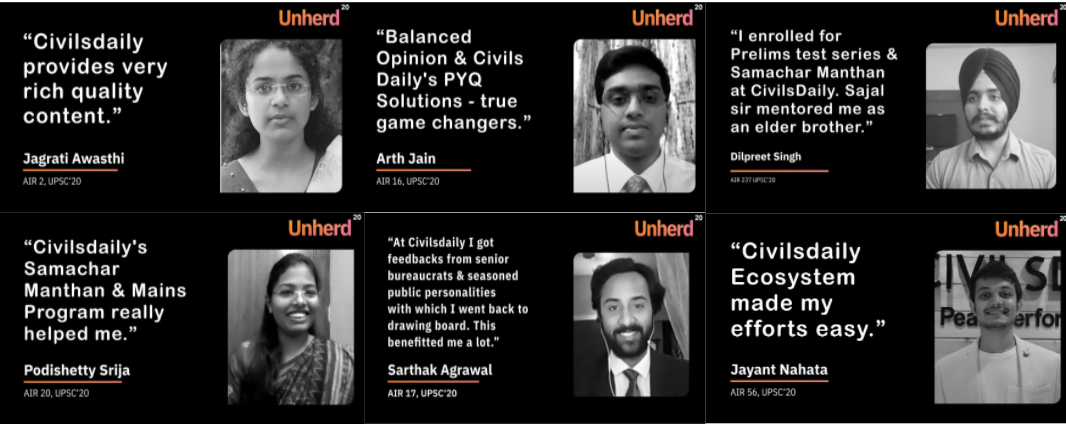
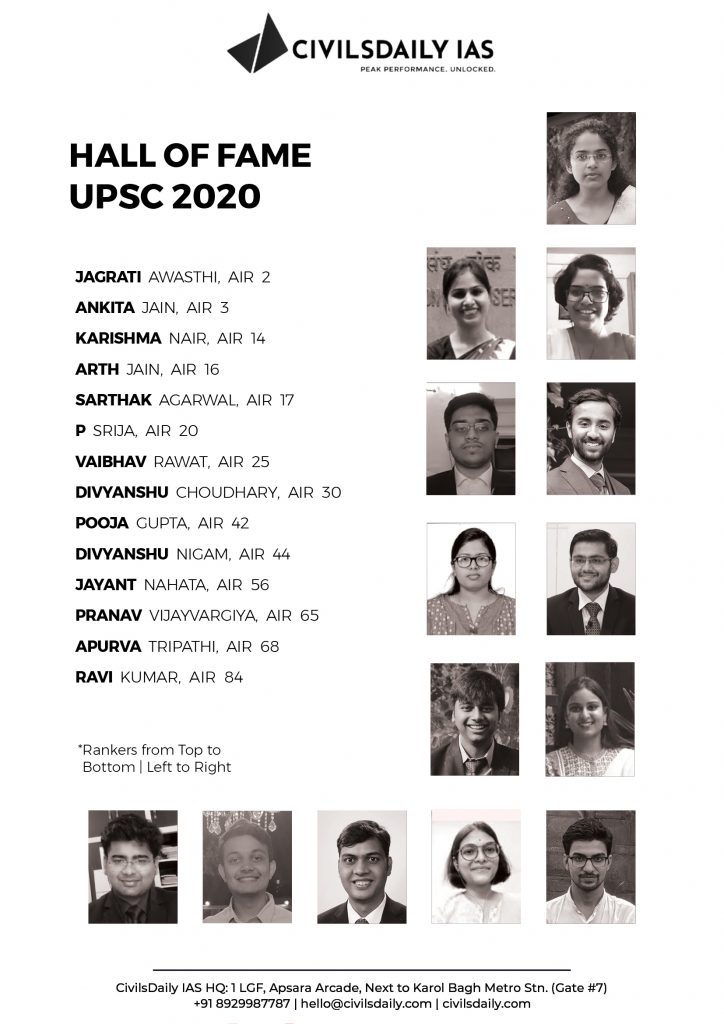
Civilsdaily helped 100+ aspirants get ranks in UPSC 2020. We helped 30 students secure ranks in the Top 100. After speaking with them personally on our UNHERD platform, we understood that there was one thing that was common between all the rankers!
All the rankers committed themselves and NEVER postponed their preparation. They did not waste a single day but started preparing immediately. We also asked them WHY did they start immediately and did not wait?
You will fall into a vicious cycle – Our toppers said that if aspirants do not start preparing immediately, they often fall into a vicious cycle of doubt and confusion. They wait for the right moment to start preparing but keep delaying it for numerous reasons like work, college, not-ready, etc. The more time they waste, the more confused they get, and the syllabus starts piling up. The toppers told us that the best thing they did was to start immediately and it helped them succeed!
Lack of self-analysis can cost you 3-4 years – The toppers revealed that self-analysis is one of the most important things for an aspirant. You need to know the syllabus, the previous year questions for every topic, your strengths, your weaknesses, your learning speed, the best time to study, how to plan the study, etc. Most aspirants who fail the exam do not do self-analysis and just keep reading. This does not help as it wastes a lot of their time. In fact, if you are not sure about your strengths and weaknesses, it could easily cost you 3-4 years in preparation. The toppers also told us that they asked mentors for assessments when they felt confused. Self-analysis helped them focus on their weaknesses and improve them. And finally, they were able to crack the exam.
UPSC is the biggest killer of self-belief – Our toppers told us that the UPSC exam is so tough and vast that it often kills an aspirant’s self-confidence. It becomes extremely difficult for them to remain consistent and motivated for the entire year. The rankers revealed that when they faced inconsistency and lacked self-confidence, they often spoke with their mentors who guided them. They found help in the mentors who understood their concerns and kept them motivated, especially when they felt down and depressed. This helped the rankers become consistent and prepare with the same energy every day!
Self-study with no guidance doesn’t help – The rankers of 2020 told us that preparing for UPSC is like walking on a desert. You will be lost without a guide. They said that even when they were self-studying, they kept asking for guidance from mentors. What to study, what not to study, how to improve their answers, which areas to focus on, etc. The toppers stayed constantly in touch with mentors who helped them at every step. They did the hard work themselves but it would have been a waste if the hard work was not in the right direction.
Always overachieve your daily target by 25% – The toppers said that they had a study plan with targets for every day! But that was not all. They always tried to overachieve the targets by at least 25%. Every time they overachieved, it gave them the confidence to do the same every day. And by the end of their preparation, they had a clear advantage over other aspirants because they studied 25% more than everyone, every single day!
The toppers of 2020 told us that their handwork, right guidance, and smart planning at an early stage helped them succeed. They said that they did not want to postpone their preparation even by a single day as it would cost them ranks. And they were right! They started preparing immediately and are now rank-holders in UPSC!
While UPSC 2023 may seem like a year away from now, looking at the syllabus one can say it’s just about the right time away. As Prelims 2022 approaches in June, more and more aspirants will realising how close they are to 2023 and begin preparing immediately. But it may just be too late by then!
If you are reading this today, you are in luck. You have the opportunity to realise the urgency immediately. March has just begun and you can have an advantage of at least siix months over other aspirants if you start preparing today. And even with a year in your hand, it would take a high level of extremely focused study to crack the exam in June 2023.
The fact is this: You CANNOT waste a single day in experimenting, hunting for resources, trying to collect reading material, etc. Every day from today is more valuable than anything you can imagine, and this is the time to focus with every bit of concentration you have.
Given the time constraint and the urgency of the situation, you need to be practical. Speak with our mentors and get your preparation organised. Our mentors can help you streamline your preparation within 24 hours and will help you save precious time. Right now, nothing is more valuable than your time and if you wish to use it effectively, all it would take is a call with our mentors.
The urgency is real, you can calculate yourself. And every moment you waste is an opportunity wasted. All you need to do is fill this form and our senior mentors will get in touch with you, with a solution designed especially for you! Speak with us, now as it’s a free 1-on-1 mentorship session with 40 minutes dedicated only for you.
Get Motivated to Maintain Overall Consistency for UPSC
It’s understandable we are humans and not programmable robots who can maintain the same level of interest everyday. However, maintaining an overall consistency throughout our preparation is neccessary to clear this competitive and vast exam.
Our philosophy behind MENTORSHIP is to get you out of this Snooze cycle. This ensures that you are the BEST VERSION of yourself in this journey. If you are under the impression that mentorship is weekly calls you attend, then you are mistaken, my friend. Trust us, your mentor will be your ‘FRIEND, PHILOSOPHER AND GUIDE’.
TO EACH THEIR OWN – Every aspirant is different. Their strengths and weaknesses are different. Their time availability is also different. Identifying this is important so you don’t end up making unrealistic targets and lose momentum. Your mentor will make sure you start slow but remain consistent to build your confidence. Making your schedule structured based on our experience of working with 2500+ students is our first priority.
TRACK YOUR PROGRESS – When you see yourself grow, it becomes easier to motivate yourself to push boundaries. Tracking your progress can happen in many ways like mentorship calls or chat sessions or by regular tests. The idea is to ensure that you don’t go off track in your preparation, and even if you do, we have your back.
EVOLUTION – A constant guidance is important to bring consistency to your UPSC preparation. Guidance is not about clearing your doubts or asking you to study when you don’t. It is also about the evolution of your preparation. This is where you and your mentor work as a team. A constant effort to PLAN AND BUILD UP YOUR ABILITY to learn in a faster and more efficient way.
TALK IT OUT – The biggest hurdle in achieving your highest level of consistency is the emotional part. Every now and then, you. surround yourself with negative thoughts, you feel scared and depressed. Instead of resolving these emotional issues, you avoid them as it seems like a waste of your precious time. You have to understand that ignoring emotional troubles does not solve them. What your doing is building an emotional time bomb that may burst a week before your mains or prelims! This is where your MENTOR AS A FRIEND comes in. All our mentors have been through this journey. We understand your fears and anxieties. So, TALK IT OUT.
Don’t let inconsistency keep you away from your dreams.
Fill up the SAMANVAYA form given below. Let us know your problems and we will find a solution to it, just like our students say ” TOGETHER WE CAN AND WE WILL”. BOOK YOUR SLOT FOR YOUR FREE 1-0N-1 COUNSELLING SESSION IN THE NEXT 24 HOURS
How has Civilsdaily Mentorship, helped Aspirants become Toppers?
The most difficult challenge faced by EVERY candidate is inconsistency. Be it inconsistency in studies, answer-writing practice, covering the syllabus, or revision, every candidate finds it difficult to cope with. Buthow do successful candidates manage to FIGHT Inconsistency so consistently?
In UPSC 2020, Civilsdaily helped 80+ students secure ranks in their exams. In the top 100, every 3rd ranker was a Civilsdaily student.
A very recent success story would be Vishwa Shah, student of Civilsdaily Mentor, Sukanya Ma’am. Vishwa has cleared the GPSC exam to become the Deputy Superintendent of Police in Gujarat. He has penned a thank-you note yesterday. Heartiest Congratulations to Vishwa!
One of our other Civilsdaily Student, Shubham Nagargojecleared the exams in 2020 to become an IPS Officer. Shubham was gracious enough to let us know how he felt about Civilsdaily Samanvaya Guidance under Parth sir.
To know how all of them cleared the exam with our mentorship, visit the UnherdPodcast.
Now that results are announced for UPSC 2021 Prelims, out of 15 out of 25 students of Santhosh Gupta sir have been recommended to Mains. One such student, Rahul expresses his gratitude and extends his appreciation.
Most of our Mentors like Sudhanshu sir, Sajal sir, Santhosh sir, Pravin sir, Parth Verma sir and Sukanya Ma’am were UPSC aspirants themselves and have attended UPSC Mains more than five times and UPSC Interview more than twice. Hence their mentorship is always a blend of the best test series, comprehensive notes and current affairs knowledge.
All of them dedicate their time weekly to give 1-on-1 mentorship to every student where they discuss last week’s performance and next week’s approach.
Be it Telegram, Whatsapp or Habitiat channels, they are always available and clear student’s doubts in a turnaround time of 24 Hours.
Why Civilsdaily Mentors are the GPS for Your UPSC-CSE Preparation
Remember there is always light at the end of the tunnel and if you want to get out of the tunnel you have to follow the direction of the light! Our mentors’ give you direction which is divided into daily modules. All you have to do is study and complete them on time.
As every year passes by, we don’t get confident by the previous years’ performance and become laidback. Instead, we become more hungry to convert all our students into toppers.REGISTER HERE TO SCHEDULE YOUR FIRST FREE SAMANVAYA COUNSELLING SESSION IN NEXT 24 HOURS
How are Current Civilsdaily Students Gearing up for UPSC-CSE 2022?
Initially, our Civilsdaily student Smriti wasn’t confident about Prelims when she began her preparation. Though she had joined Civilsdaily in 2020, she started studying for UPSC-CSE back in 2019. At that time, Smriti had enrolled in multiple institutes. Though, most of these institutes had promised a personal mentor, she was unable to get in touch with them on a daily basis. Also those mentors never scheduled test-series on a weekly basis. Hence, despite preparing for a year, Smriti had scored only 35 marks out of 200 in her first test series by Civilsdaily.
She then started writing 20-25 test series over the course of UAP 2021 and in her last test, her scores have drastically improved. She now scores in the range of 130-135 marks in prelims’ and 110+ in mains’ papers.
In Smriti’s own words she describes her Samanvaya Mentorship Experience to be —
“Our parents provide us financial and emotional support, friends provide us moral support and the right mentor gives you logistic and logical support for UPSC. There are days when I felt I won’t be able to compete against lakhs of aspirants. That’s when my mentor, Ravi sir reminded me of my improvement and encouraged me that I can crack it with the same consistency. We need someone, who tells us we are performing well especially when we cannot see that ourselves. The mentorship at Civilsdaily helped me become mentally stronger as a person. In other institutes, mentors are allotted only for doubt resolution. But at Civilsdaily, I am getting end-to-end mentorship via value added notes, classes, test series and detailed evaluation.”
Similarly our another Civilsdaily student, Ashishsums up his Samanvaya experience with Civilsdaily mentor,Pravin Sir, “Because of Pravin sir’s support, I am able to understand a topic in lesser time.”
This is how Pravin sir evaluates Ashish’s Mains Test Series every week. After every test series evaluation, Pravin sir schedules a 1 hour call to discuss how Ashish can improve his marks and the sources he can refer for key topics.
It’s Your Turn Get the Free 40 Min Counselling Session By a CD Mentor
Civilsdaily mentors are so dedicated, consistent and focused for your UPSC goal, that you will eventually become focused into turning your dreams to reality.
At the core of Civilsdaily UPSC mentorship, lies the fact that each one of you will have a unique journey while preparing for the exam. Some will get through on the first attempt without much effort while others will take both more time and more effort.
We want to understand you better to help you optimize your journey so you can focus on the right things and not waste time on the wrong ones. We are asking you to tap into the valuable experiences of mentors who underwent the same grind and realize the pitfalls and understand the shortcuts to make it.
In the first counselling session, we will understand your weaknesses. We then help you to stick to one plan or strategy throughout your preparation. We will then follow up with you on a daily basis to check if you are right on track. TALK TO OUR MENTORS & CLARIFY YOUR DOUBTS NOW
With only 60 days remaining for UPSC 2022 Prelims, your preparation must revolve around revision and attempting tests. At this stage, aspirants become more stressed and anxious than when they first started their preparation. Having a foolproof strategy for the last two months can work wonders — especially for those falling on the borderline, scoring between 80-90 marks in the mock test series. Now is the time to focus on improving your performance and boosting your scores.
While many of you, would have felt easier following a timetable for an entire year, you might not be sure how to revise every topic in the syllabus along with test series and current affairs of 1.5 years within 60 days.
Open to all, Free Live Webinar by IAS Officer Yogesh Kapse (2020 Batch)
Neglecting the last 60 days of preparation can be counterproductive as you will miss the golden opportunity to strengthen the areas where you might be consistently scoring lower.
Just practising test series alone for the entire two months or reading the textbooks is not going to help due to the unpredictable nature of the Prelims exam. Questions from most of the mock test series don’t actually feature in the real exam. However, it teaches one the art of intelligent guessing.
Understanding the concern of 2022 UPSC aspirants, we have invited IAS Officer Yogesh Kapse to guide future civil servants on how he prepared for Prelims 2021 in his last 60 days. Was there a difference in the intensity of preparation? You can register for this webinar to find out.
Yogesh Kapse IAS cleared the exam in 2020 with an All India Rank 249. He is the son of a farmer and had given four attempts previously. While he attended the mains thrice, he attended the interview twice and missed the final ranking by a whisker. His never-give-up attitude is the reason why he is an IAS officer today.
What will you Learn in This Free Live Webinar by IAS Officer Yogesh Kapse?
1. The ideal number of study hours Yogesh Kapse IAS maintained in the 60 Days of Prelims. How did he divide one day for static revision, current affairs revision and test series?
2. Yogesh Kapse’s revision strategy for Prelims. What was the static-dynamic revision plan that made his preparation count in the exam?
3. Is analysing previous year question papers required for UPSC Prelims? Yogesh Kapse IAS answers.
4. How to finish 8 subjects in 8 weeks? Including NCERTs, standard books and test series.
5. Making notes out of test series. How many test series one should take in the last 60 days and how to make notes out of test series?
6. How did Yogesh Kapse make 1 page notes out of a chapter running 25 pages? The elements of your micro-notes from prelims perspective.
7. Important current affairs topics for 2022. What to study and what to exclude right now?
8. What did Yogesh Kapse IAS do to relax and unwind other than social media? Why is it important to take a break to gain better focus?
Webinar Details
This Ask me Anything session is free for all aspirants to attend but is perfect for anyone looking for a refreshing break from their grueling studies. Only limited slots are available, so register ASAP.
This Spotlight is a part of our Mission Nikaalo Prelims-2022.
You can check the broad timetable of Nikaalo Prelims here
Session Details
Morning 12 PM – Prelims Spotlight Session
Evening 06:30 PM – TIKDAM/MCQs Session
Evening 08 PM – Tests on Alternate Days
Join our Official telegram channel for Study material and Daily Sessions Here
Important Amendments in the Indian Constitution
18 Mar 2022
First Amendment Act, 1951
Empowered the state to make special provisions for the advancement of socially and economically backward classes.
Provided for the saving of laws providing for the acquisition of estates, etc.
Added Ninth Schedule to protect the land reforms and other laws included in it from the judicial review. After Article 31, Articles 31A and 31B were inserted.
The Constitution (Seventh Amendment) Act, 1956
The Seventh Amendment brought about the most comprehensive changes so far in the Constitution. This amendment was designed to implement the State Reorganisation Act.
The Second and Seventh schedules were substantially amended for the purpose of the States Reorganization Act.
Constitutional (10th Amendment) Act, 1961
The Tenth Amendment integrates the areas of Free Dadra and Nagar Haveli with the Union of India and provides for their administration under the regulation of making powers of the President.
Constitutional (13th Amendment) Act,1963
Gave the status of a state to Nagaland and made special provisions for it.
The Constitution (24th Amendment) Act, 1971
It amended Article 13 and 368 with a view to removing all possible doubts regarding the power of Parliament to amend the Constitution and procedure thereof.
It gets over the Golak Nath ruling and asserts the power of Parliament, denied to in the Golak Nath, to amend Fundamental Rights.
The Constitution (Twenty-fifth) Amendment Act, 1971
The 25th amendment of the Constitution in 1971 added a new clause, Article 31C to the Constitution. Up to 1971, the position was that Fundamental Rights prevailed over the Directive Principles of State Policy and that a law enacted to implement a Directive Principle could not be valid if it conflicted with a Fundamental Right.
Article 31C sought to change this relationship to some extent by conferring primacy on Articles 39(b) and 39(c) over Articles 14, 19 and 31.
Twenty-Sixth Amendment Act, 1971
Abolished the privy purses and privileges of the former rulers of princely states.
The Constitution (Thirty-fourth Amendment) Act, 1974
By this amendment twenty State Acts concerning land ceiling and land tenure reforms were added to the Ninth Schedule to the Constitution.
The Constitution (Thirty-eight Amendment) Act, 1975
Made the declaration of emergency by the President non-justiciable.
Made the promulgation of ordinances by the President, governors and administrators of Union territories non-justiciable.
Empowered the President to declare different proclamations of national emergency on different grounds simultaneously
The Constitution (42nd Amendment) Act, 1976
The Amendment was meant to enhance enormously the strength of the Government. The major Amendments made in the Constitution by the 42nd Amendment Act are: Preamble The characterization of India as ‘Sovereign Democratic Republic’ has been changed to ‘Sovereign Socialist Secular Democratic Republic’.
The words ‘Unity of the nation’ have been changed to ‘Unity and integrity of the nation’.
Parliament and State Legislatures: The life of the Lok Sabha and State Legislative Assemblies was extended from 5 to 6 years.
Executive: It amended Article 74 to State explicitly that the President shall act in accordance with the advice of the Council of Ministers in the discharge of his functions.
Judiciary: The 42nd Amendment Act inserted Article 32A in order to deny the Supreme Court the power to consider the Constitutional validity of the State law. Another new provision, Article 131A, gave the Supreme Court an exclusive jurisdiction to determine question relating to the Constitutional validity of a central laws. Article 144A and Article 128A, the creatures
of the Constitutional Amendment Act made further innovation in the area of judicial review of the Constitutionality of legislation. Under Article 144A, the minimum number of judges of the Supreme Court to decide a question of Constitutional validity of a Central or State law was fixed as at least seven and further, this required two-thirds majority of the judges sitting declare law as unconstitutional. While the power of the High Court to enforce Fundamental Rights remained untouched, several restrictions were imposed on its power to issue writs ‘for any other purpose’.
Federalism: The Act added Article 257A in the Constitution to enable the Centre to deploy any armed force of the Union, or any other force under its control for dealing with any grave situation of law and order in any State.
Fundamental Rights and Directive Principles: A major change that was made by42nd Constitutional Amendment was to give primacy to all Directive Principles over the Fundamental Rights contained in Articles 14, 19 or 31.
The 42nd Constitutional Amendment added a few more Directive Principles – free legal aid, participations of workers in the management of industries, protection for environment and protection of forests and wildlife of the country.
Fundamental Duties: The 42nd Amendment Act inserted Article 51-A to create a new part called IV-A in the Constitution, which prescribed the Fundamental Duties to the citizens.
Emergency: Prior to the 42nd Amendment Act, the President could declare an emergency under Article 352 throughout the country and not in a part of the country alone. The Act authorized the President to proclaim emergency in any part of the country.
The Constitution (44th Amendment) Act, 1978
It reduced the life of Lok Sabha and State Legislative Assemblies again to five years and thus restore the status quo ante.
It cancelled 39th Amendment which had deprived the Supreme Court of its jurisdiction to decide disputes concerning election of the President and the Vice-President
A new provision was added to Article 74(1) saying that the President could require the council of ministers to reconsider its advice to him, either generally or otherwise and the President should Act in accordance with the advice tendered after such re-consideration. Article 257A was Omitted
It has been provided that an Emergency can be proclaimed only on the basis of written advice tendered to the President by the Cabinet.
Right to Property has been taken out from the list of Fundamental Rights and has been declared a legal right.
The Constitution (Fifty-first Amendment) Act, 1984
The Amendment effectuates some changes in Articles 330 and 332 with a view to provide for reservation of seats in the Lok Sabha for Scheduled Tribes in Meghalaya, Aruncahal Pradesh and Mizoram, as well as in the Legislative Assemblies of Nagaland and Meghalaya.
The Constitution (52nd Amendment) Act, 1985
The amendment is designed to prevent the scourge of defection of Members of Parliament and State Legislatures from one political party to another.
The Constitution (61st Amendment) Act, 1989
The 61st Amendment reduces the voting age from 21 years to 18 years for the Lok Sabha and Assembly election.
The Constitution (Sixty-fifth Amendment) Act, 1990
Article 338 of the Constitution has been amended for the Constitution of a National Commission for Scheduled Castes and Scheduled Tribes consisting of a chairperson, vice-chairperson and five other members who shall be appointed by the President by warrant under his hand and seal.
The Constitution (Sixty-ninth Amendment) Act, 1991
The Amendment Act was to grant Statehood to Delhi as ‘National Capital Territory of Delhi’. It also provides a 70 member assembly and a 7 member Council of Ministers for Delhi.
The Constitution (73rd Amendment) Act, 1992
April 20,1993 as it got rectification by the State legislatures and was assented to by the President of India. After notification, the Panchayati Raj Institutions have now got Constitutional legitimacy.
After part VIII of the Constitution, a separate part IX has been added to the Constitution with the addition in Article 243A and fresh Schedule called Eleventh Schedule enumerating the powers and functions of Panchayti Raj Institutions.
The Act provides for Gram Sabha, a three-tier model of Panchayati Raj, reservation of seats for SCs and STs in proportion to their population and one-third reservation of seats for women.
The Constitution (74th Amendment) Act, 1992
The Act provides constitutional status to Urban Local Bodies. After part VIII of the Constitution, a separate part IXA has been added to the Constitution with the addition in Article 243A and a fresh schedule called Twelfth schedule enumerating the powers and functions of urban local bodies has been incorporated.
The Act provides Municipal Panchayat, Municipal Council and Municipal Corporation, reservation of seats for SCs and STs in proportion to their population and one-third reservation of seats for women
The Constitution (76th Amendment) Act, 1994
This Amendment Act raises the reservation quota of government jobs and seats for admission in the educational institutions in favor of socially and educationally backward classes to 69 per cent in Tamil Nadu.
Further, the Amendment Act has been included in the Ninth Schedule of the Constitution to exempt it from the purview of judicial scrutiny
The Constitution (Seventy-seventh Amendment) Act, 1995
This Amendment has added a new clause (4-a) to Article 16 of the Constitution which empowers the State to make any provisions for reservation in promotions in Government jobs in favour of SCs and STs, if it is of opinion that they are inadequately represented in the services under the State.
This has been done to nullify the effect of the Supreme Court Judgment in the Mandal Commission Case (Indra Sawhney vs. Union of India) in which the Court has held that reservation in promotions cannot be made.
The Constitution (80th Amendment) Act, 2000
Based on the recommendations of the Tenth Finance Commission, an alternative scheme for sharing taxes between the Union and the State has been enacted by the Constitution (Eightieth Amendment) Act, 2000.
Under the new scheme of devolution of revenue between Union and the States, 26 per cent out of gross proceeds of Union taxes and duties is to be assigned to the States in lieu of their existing share in the income-tax, excise duties special excise duties and grants in lieu of tax on railway passenger fares.
The Constitution (85th Amendment) Act, 2001
This Act amended Article 16 (4A) of the Constitution to provide for consequential seniority in the case of promotion by virtue of rule of reservation for Government servants belonging to the Scheduled Castes and the Scheduled Tribes.
The Constitution (86th Amendment) Act, 2002
With a view to making right to free and compulsory education a fundamental right, the Act inserts a new Article, namely, Article 21A conferring on all children in the age group of 6 to 14 years the right to free and compulsory education.
The Act amends in Part-III, Part –IV and Part-IV(A) of the Constitution.
The Constitution (89th Amendment) Act, 2003
The Act adds Article 338A and provides for the creation of National Commission for Scheduled Tribes.
The Constitution (90th Amendment) Act, 2003
The Act amends Article 332 and adds section (6) regarding representation in the Bodo Territorial Areas District in the State of Assam.
The Constitution (Ninety-one Amendment) Act,2003
The Act makes provisions for limiting the size of the Council of Ministers at the Center and in the States and gives teeth to debar a defector from holding any remunerative political post for the remaining tenure of the legislature unless reelected.
The Constitution (Ninety- third Amendment) Act, 2005
Providing reservation for the socially and educationally backward classes, besides the Schedules Castes and the Scheduled Tribes, in private unaided educational institutions.
The Constitution (97th Amendment) Act, 2012
In Part IIIof the constitution, after the words “or unions” the words “Cooperative Societies” was added.
In Part IVa new Article 43Bwas inserted, which says: The state shall endeavour to promote voluntary formation, autonomous functioning, democratic control and professional management of the co-operative societies”.
After Part IXAof the constitution, a Part IXBwas inserted to accommodate state vs centre roles.
The Constitution (99th Amendment) Act, 2014
The National Judicial Appointments Commission (NJAC) was established by the Union government of India by amending the constitution of India through the 99thConstitutional Amendment Act, 201
The Constitution (100th Amendment) Act, 2015
Constitution (100th Amendment) Act 2015 ratified the land boundary agreement between India and Bangladesh.
The act amended the 1st schedule of the constitution to exchange the disputed territories occupied by both the nations in accordance with the 1974 bilateral Land Boundary Agreement.
India received 51 Bangladeshi enclaves (covering 7,110 acres) in the Indian mainland, while Bangladesh received 111 Indian enclaves (covering 17,160 acres) in the Bangladeshi mainland
The Constitution (101st Amendment) Act, 2017
Introduced the Goods and Services Tax.
The Constitution (102nd Amendment) Act, 2018
Constitutional status to National Commission for Backward Classes
The Constitution (103rd Amendment) Act, 2019
A maximum of 10% Reservation for Economically Weaker Sections (EWSs) of citizens of classes other than the classes mentioned in clauses (4) and (5) of Article 15, i.e. Classes other than socially and educationally backward classes of citizens or the Scheduled Castes and the Scheduled Tribes.
Inserted Clause [6] under Article 15 as well as Inserted Clause [6] under Article 16.
A sneak peek into our 1-1 mentoring session for Prelims
Civilsdaily helped 100+ aspirants get ranks in UPSC 2020. We helped 30 students secure ranks in the Top 100. After speaking with them personally on our UNHERD platform, we understood that there was one thing that was common between all the rankers!
All the rankers committed themselves and NEVER postponed their preparation. They did not waste a single day but started preparing immediately. We also asked them WHY did they start immediately and did not wait?
You will fall into a vicious cycle – Our toppers said that if aspirants do not start preparing immediately, they often fall into a vicious cycle of doubt and confusion. They wait for the right moment to start preparing but keep delaying it for numerous reasons like work, college, not-ready, etc. The more time they waste, the more confused they get, and the syllabus starts piling up. The toppers told us that the best thing they did was to start immediately and it helped them succeed!
Lack of self-analysis can cost you 3-4 years – The toppers revealed that self-analysis is one of the most important things for an aspirant. You need to know the syllabus, the previous year questions for every topic, your strengths, your weaknesses, your learning speed, the best time to study, how to plan the study, etc. Most aspirants who fail the exam do not do self-analysis and just keep reading. This does not help as it wastes a lot of their time. In fact, if you are not sure about your strengths and weaknesses, it could easily cost you 3-4 years in preparation. The toppers also told us that they asked mentors for assessments when they felt confused. Self-analysis helped them focus on their weaknesses and improve them. And finally, they were able to crack the exam.
UPSC is the biggest killer of self-belief – Our toppers told us that the UPSC exam is so tough and vast that it often kills an aspirant’s self-confidence. It becomes extremely difficult for them to remain consistent and motivated for the entire year. The rankers revealed that when they faced inconsistency and lacked self-confidence, they often spoke with their mentors who guided them. They found help in the mentors who understood their concerns and kept them motivated, especially when they felt down and depressed. This helped the rankers become consistent and prepare with the same energy every day!
Self-study with no guidance doesn’t help – The rankers of 2020 told us that preparing for UPSC is like walking on a desert. You will be lost without a guide. They said that even when they were self-studying, they kept asking for guidance from mentors. What to study, what not to study, how to improve their answers, which areas to focus on, etc. The toppers stayed constantly in touch with mentors who helped them at every step. They did the hard work themselves but it would have been a waste if the hard work was not in the right direction.
Always overachieve your daily target by 25% – The toppers said that they had a study plan with targets for every day! But that was not all. They always tried to overachieve the targets by at least 25%. Every time they overachieved, it gave them the confidence to do the same every day. And by the end of their preparation, they had a clear advantage over other aspirants because they studied 25% more than everyone, every single day!
The toppers of 2020 told us that their handwork, right guidance, and smart planning at an early stage helped them succeed. They said that they did not want to postpone their preparation even by a single day as it would cost them ranks. And they were right! They started preparing immediately and are now rank-holders in UPSC!
While UPSC 2023 may seem like a year away from now, looking at the syllabus one can say it’s just about the right time away. As Prelims 2022 approaches in June, more and more aspirants will realising how close they are to 2023 and begin preparing immediately. But it may just be too late by then!
If you are reading this today, you are in luck. You have the opportunity to realise the urgency immediately. March has just begun and you can have an advantage of at least siix months over other aspirants if you start preparing today. And even with a year in your hand, it would take a high level of extremely focused study to crack the exam in June 2023.
The fact is this: You CANNOT waste a single day in experimenting, hunting for resources, trying to collect reading material, etc. Every day from today is more valuable than anything you can imagine, and this is the time to focus with every bit of concentration you have.
Given the time constraint and the urgency of the situation, you need to be practical. Speak with our mentors and get your preparation organised. Our mentors can help you streamline your preparation within 24 hours and will help you save precious time. Right now, nothing is more valuable than your time and if you wish to use it effectively, all it would take is a call with our mentors.
The urgency is real, you can calculate yourself. And every moment you waste is an opportunity wasted. All you need to do is fill this form and our senior mentors will get in touch with you, with a solution designed especially for you! Speak with us, now as it’s a free 1-on-1 mentorship session with 40 minutes dedicated only for you.
Get Motivated to Maintain Overall Consistency for UPSC
It’s understandable we are humans and not programmable robots who can maintain the same level of interest everyday. However, maintaining an overall consistency throughout our preparation is neccessary to clear this competitive and vast exam.
Our philosophy behind MENTORSHIP is to get you out of this Snooze cycle. This ensures that you are the BEST VERSION of yourself in this journey. If you are under the impression that mentorship is weekly calls you attend, then you are mistaken, my friend. Trust us, your mentor will be your ‘FRIEND, PHILOSOPHER AND GUIDE’.
TO EACH THEIR OWN – Every aspirant is different. Their strengths and weaknesses are different. Their time availability is also different. Identifying this is important so you don’t end up making unrealistic targets and lose momentum. Your mentor will make sure you start slow but remain consistent to build your confidence. Making your schedule structured based on our experience of working with 2500+ students is our first priority.
TRACK YOUR PROGRESS – When you see yourself grow, it becomes easier to motivate yourself to push boundaries. Tracking your progress can happen in many ways like mentorship calls or chat sessions or by regular tests. The idea is to ensure that you don’t go off track in your preparation, and even if you do, we have your back.
EVOLUTION – A constant guidance is important to bring consistency to your UPSC preparation. Guidance is not about clearing your doubts or asking you to study when you don’t. It is also about the evolution of your preparation. This is where you and your mentor work as a team. A constant effort to PLAN AND BUILD UP YOUR ABILITY to learn in a faster and more efficient way.
TALK IT OUT – The biggest hurdle in achieving your highest level of consistency is the emotional part. Every now and then, you. surround yourself with negative thoughts, you feel scared and depressed. Instead of resolving these emotional issues, you avoid them as it seems like a waste of your precious time. You have to understand that ignoring emotional troubles does not solve them. What your doing is building an emotional time bomb that may burst a week before your mains or prelims! This is where your MENTOR AS A FRIEND comes in. All our mentors have been through this journey. We understand your fears and anxieties. So, TALK IT OUT.
Don’t let inconsistency keep you away from your dreams.
Fill up the SAMANVAYA form given below. Let us know your problems and we will find a solution to it, just like our students say ” TOGETHER WE CAN AND WE WILL”. BOOK YOUR SLOT FOR YOUR FREE 1-0N-1 COUNSELLING SESSION IN THE NEXT 24 HOURS
How has Civilsdaily Mentorship, helped Aspirants become Toppers?
The most difficult challenge faced by EVERY candidate is inconsistency. Be it inconsistency in studies, answer-writing practice, covering the syllabus, or revision, every candidate finds it difficult to cope with. Buthow do successful candidates manage to FIGHT Inconsistency so consistently?
In UPSC 2020, Civilsdaily helped 80+ students secure ranks in their exams. In the top 100, every 3rd ranker was a Civilsdaily student.
A very recent success story would be Vishwa Shah, student of Civilsdaily Mentor, Sukanya Ma’am. Vishwa has cleared the GPSC exam to become the Deputy Superintendent of Police in Gujarat. He has penned a thank-you note yesterday. Heartiest Congratulations to Vishwa!
One of our other Civilsdaily Student, Shubham Nagargojecleared the exams in 2020 to become an IPS Officer. Shubham was gracious enough to let us know how he felt about Civilsdaily Samanvaya Guidance under Parth sir.
To know how all of them cleared the exam with our mentorship, visit the UnherdPodcast.
Now that results are announced for UPSC 2021 Prelims, out of 15 out of 25 students of Santhosh Gupta sir have been recommended to Mains. One such student, Rahul expresses his gratitude and extends his appreciation.
Most of our Mentors like Sudhanshu sir, Sajal sir, Santhosh sir, Pravin sir, Parth Verma sir and Sukanya Ma’am were UPSC aspirants themselves and have attended UPSC Mains more than five times and UPSC Interview more than twice. Hence their mentorship is always a blend of the best test series, comprehensive notes and current affairs knowledge.
All of them dedicate their time weekly to give 1-on-1 mentorship to every student where they discuss last week’s performance and next week’s approach.
Be it Telegram, Whatsapp or Habitiat channels, they are always available and clear student’s doubts in a turnaround time of 24 Hours.
Why Civilsdaily Mentors are the GPS for Your UPSC-CSE Preparation
Remember there is always light at the end of the tunnel and if you want to get out of the tunnel you have to follow the direction of the light! Our mentors’ give you direction which is divided into daily modules. All you have to do is study and complete them on time.
As every year passes by, we don’t get confident by the previous years’ performance and become laidback. Instead, we become more hungry to convert all our students into toppers.REGISTER HERE TO SCHEDULE YOUR FIRST FREE SAMANVAYA COUNSELLING SESSION IN NEXT 24 HOURS
How are Current Civilsdaily Students Gearing up for UPSC-CSE 2022?
Initially, our Civilsdaily student Smriti wasn’t confident about Prelims when she began her preparation. Though she had joined Civilsdaily in 2020, she started studying for UPSC-CSE back in 2019. At that time, Smriti had enrolled in multiple institutes. Though, most of these institutes had promised a personal mentor, she was unable to get in touch with them on a daily basis. Also those mentors never scheduled test-series on a weekly basis. Hence, despite preparing for a year, Smriti had scored only 35 marks out of 200 in her first test series by Civilsdaily.
She then started writing 20-25 test series over the course of UAP 2021 and in her last test, her scores have drastically improved. She now scores in the range of 130-135 marks in prelims’ and 110+ in mains’ papers.
In Smriti’s own words she describes her Samanvaya Mentorship Experience to be —
“Our parents provide us financial and emotional support, friends provide us moral support and the right mentor gives you logistic and logical support for UPSC. There are days when I felt I won’t be able to compete against lakhs of aspirants. That’s when my mentor, Ravi sir reminded me of my improvement and encouraged me that I can crack it with the same consistency. We need someone, who tells us we are performing well especially when we cannot see that ourselves. The mentorship at Civilsdaily helped me become mentally stronger as a person. In other institutes, mentors are allotted only for doubt resolution. But at Civilsdaily, I am getting end-to-end mentorship via value added notes, classes, test series and detailed evaluation.”
Similarly our another Civilsdaily student, Ashishsums up his Samanvaya experience with Civilsdaily mentor,Pravin Sir, “Because of Pravin sir’s support, I am able to understand a topic in lesser time.”
This is how Pravin sir evaluates Ashish’s Mains Test Series every week. After every test series evaluation, Pravin sir schedules a 1 hour call to discuss how Ashish can improve his marks and the sources he can refer for key topics.
It’s Your Turn Get the Free 40 Min Counselling Session By a CD Mentor
Civilsdaily mentors are so dedicated, consistent and focused for your UPSC goal, that you will eventually become focused into turning your dreams to reality.
At the core of Civilsdaily UPSC mentorship, lies the fact that each one of you will have a unique journey while preparing for the exam. Some will get through on the first attempt without much effort while others will take both more time and more effort.
We want to understand you better to help you optimize your journey so you can focus on the right things and not waste time on the wrong ones. We are asking you to tap into the valuable experiences of mentors who underwent the same grind and realize the pitfalls and understand the shortcuts to make it.
In the first counselling session, we will understand your weaknesses. We then help you to stick to one plan or strategy throughout your preparation. We will then follow up with you on a daily basis to check if you are right on track. TALK TO OUR MENTORS & CLARIFY YOUR DOUBTS NOW


![[REMINDER] Last 2 Days to go for Mission Ekalavya – FREE SCHOLARSHIP TEST for UPSC 2023 Foundation Course|| Register Now & Attend the Test on 20th March|| LINK INSIDE](https://d18x2uyjeekruj.cloudfront.net/wp-content/uploads/2022/03/Group-65-3-1200x675.png)