We, at Civilsdaily are extremely happy for everyone who has cleared mains this time. Thank you for giving us a reason to cheer for you. It’s important to give yourself a pat or two, share the news with your family, eat a sweet and start preparing for Interview immediately.
You are just one step closer to achieving your LBSNAA dream! So don’t take the final round for granted and prepare with the same gusto as you did for Prelims and Mains.
For those that couldn’t make it this year, hang in there and don’t lose heart. You still have 2 more months for UPSC 2022 prelims. Before you start your preparation, get afree 1-on-1 counselling from us and understand how you can better your performance in 2022.
Don’t forget to upload your DAF 1 and draft DAF 2 in the above link.
Our team will reach out to you. We will discuss how to best fill your DAF 2, what should be your next step and how to prepare for different aspects.
Highlights of Transcend: Focused offerings for 3 distinct groups of IAS Mains-qualified aspirants
Freshers
Work Ex
Veterans
Dedicated Habitat group, telephonic and the zoom/google meet sessions, SWOT analysis via personalized questionnaire & in-person mock interviews with the panel.
This year, we intend to raise the bar even higher by providing trailblazing professional, personalized mentorship. There are 3 broad categories into which the IAS Mains-qualified candidates are be divided:
#1. Freshers: Facing 1st UPSC interview without work-ex
These candidates have given dedicated and exclusive time to UPSC preparation, often right after their graduation. We also have candidates who decide for UPSC a little later in life. These candidates have a wide variety of backgrounds. Some have quit their jobs to prepare for CSE, some may have household and family responsibilities, etc.
The interview, in the case of these aspirants, will focus on academics, mental alertness, critical power of assimilation, leadership and teamwork, variety and depth of interest, etc.
Freshers have the advantage of ‘excitement’ and ‘happy-go-lucky’ attitude, but they also suffer from fear-of-the-unknown.
For them, Transcend will revolve around psychological strengthening and belief formation besides personality development and polishing of soft skills.
#2. Work-Experience: Facing 1st UPSC interview with work-ex
The second category is of working professionals. These candidates have the advantages of leadership, tactfulness, foresight, and maturity. Of all other categories of candidates, the responses of working professionals are expected to be brief, well crafted, balanced, logical and reflecting emotional intelligence. Leadership is another area these aspirants are tested for.
Transcend will focus intensely on each of these general traits. Stress will be on the trends highlighted by the latest research in these domains.
#3. Veterans: Have faced the UPSC interview board in the past
Candidates who have appeared in the UPSC interview, probably more than once; but have consistently scored low marks.
Such a person has the advantage of the experience of the official set-up. She is aware of the entire process, her DAF and does not have fear-of-the-unknown. She has possibly taken mock interviews in her previous attempts but success eludes her owing to some fundamental flaw, which if unidentified, will compromise her chances yet again.
For veterans, our Transcend mentors will analyze your DAF, previous mock interviews, transcript of real interview/s and will have detailed discussions to pinpoint the weakness. Then will follow the personalized recovery strategy.
We are the only institution in this space that brings such high levels of clarity and purpose to the interview program.
All in all, ‘Transcend’ from Civilsdaily is the finest tool you can choose to uncover the shimmering light of your personality and to realize the simmering desire of your heart.
Take that final leap. You are in good hands now.
What to expect in the coming weeks?
#1. Once you submit your DAF 1 and other details on the link & email, we request you to send a video snippet (shot over a mobile selfie at pravin[at]civilsdaily.com) on the questions listed below. These are basic, time tested questions that do not need any preparation but helps us understand your default presentation styles:
Why do you want to join the civil services?
Why should you be selected over the other candidates?
Which in-service officer has inspired you the most and why?
One feedback that you received from a friend, peer or superior which fundamentally changed the way you operate in the world or look at the world?
We want you to be uninhibited, relaxed and natural when you make this video. All questions are compulsory (especially 2, 4 and 5).
#2. We will get back to you with the feedback on your DAF and this video exercise.
#3. Post that, your progress will be tracked in mock interviews and taken over the telephone, skype, and panel-driven mocks and you will be given access to interact with both our in-house mentors and industry experts to fine-tune your reasonings.
We will work on your innate tendencies and help you carve out the best version of yourself.
GS-1 Social empowerment, communalism, regionalism & secularism.
GS-2 Health & Education
GS-3 Indian Economy, Impact of Liberalization
GS-4 Public/Civil service values and Ethics in Public administration: Status and problems; ethical concerns and dilemmas in government and private institutions
HOW TO ATTEMPT ANSWERS IN DAILY ANSWER WRITING ENHANCEMENT(AWE)?
Daily 4 questions from General studies 1, 2, 3, and 4 will be provided to you.
A Mentor’s Comment will be available for all answers. This can be used as a guidance tool but we encourage you to write original answers.
You can write your answer on an A4 sheet and scan/click pictures of the same.
Upload the scanned answer in the comment section of the same question.
Along with the scanned answer, please share your Razor payment ID, so that paid members are given priority.
If you upload the answer on the same day like the answer of 11th February is uploaded on 11th February then your answer will be checked within 72 hours. Also, reviews will be in the order of submission- First come first serve basis
If you are writing answers late, for example, 11th February is uploaded on 13th February , then these answers will be evaluated as per the mentor’s schedule.
We encourage you to write answers on the same day. However, if you are uploading an answer late then tag the mentor like @Staff so that the mentor is notified about your answer.
*In case your answer is not reviewed, reply to your answer saying *NOT CHECKED*.
Ultimate Assessment Program and Foundation Program includes –
Mentorship (1:1, throughout the preparation till Interview stage)
Masterclasses (complete GS syllabus covered, Only provided in Foundation course)
Samachar Manthan (Current affairs Programme)
Decimate Prelims (Prelims Crash course)
Mains Answer Writing Initiative (On a weekly basis)
Smash Mains (upon Qualifying prelims 2023)
Essay Guidance Program (To score above 120+ in Essay Mains Paper)
Interview Guidance Program (more than 1 mock interview will be conducted with a panel)
Civilsdaily IAS Community for Peer to Peer Interaction
Get all the Civilsdaily courses under Smash Foundation Course for 60% off after you attend our scholarship test and score above the cut-off marks!
Are you a beginner who has no idea about UPSC, but want to check if you have the aptitude for the same? Do you want to assess your performance and interest in UPSC before targetting 2023 preparation?
Then, we have got the perfect opporunity for you. Presenting, Civilsdaily’s UPSC CS 2023, Free-To-Register National Scholarship on 13th & 20th March 2022 .
Last year’s scholarship test by Civilsdaily has seen a phenomenal response and pan India interest for the test. Many toppers have emerged out of the test to be subsequently mentored in the Civilsdaily Foundation Program. So aspirants, ensure you don’t miss out on the benefits of the test.
An average aspirant, pays for Prelims Course, Mains Program, Interview Guidance, Test Series & Study Materials all separately. The fees then comes up to 2-3 Lakhs for one attempt alone.
Identifying this issue, Civilsdaily has designed the Flagship Foundation Course for 2023 aspirants. This course covers the entire 3-stage journey of a UPSC aspirant. From Prelims to Interview -1:1 Mentorship, Weekly Test Series, Classes & Study Materials will be provided.
Another benefit of the program is that it’s an umbrella course wherein an aspirant can access other paid courses of Civilsdaily for FREE.
The main objective of the program is to identify and nurture serious aspirants to become future UPSC toppers. And that’s why we have designed a scholarship test.
Our foundation course will be intensive yet personalised. You will be getting individual coaching on how to conquer the basics, develop analytical skills, inculcate conceptual clarity and acquire the necessary knowledge to face the unpredictable and dynamic UPSC.
Apart from conducting subject-wise classes that covers all the Prelims-Mains syllabus from scratch, aspirants will follow a customised timetable and will complete their revision on a daily basis to attempt our weekly prelims and mains tests. Once the test is over, they will get a strategy call from a mentor, who will clear their doubts and tell them how to improve their performance from next test onwards.
Simply put, like Ekalavya you will be getting a unique coaching experience that eludes other UPSC aspirants. Even aspects like Essay, Ethics and CSAT which is ignored in other normal coaching programs, will be covered over here with tests, mentorship, classes and notes.
If you take the upcoming free UPSC national scholarship test and come out with flying colours, you will get about 60% scholarship on the Civilsdaily Flagship Foundation Course.
Details of the Civilsdaily Free National Scholarship Test
Date – 13th March & 20th March, 2022.
Please Click on Submit after finishing the Test.
Mode: Online
Registration Fee – Free
Language: English
Time: 2 Hrs
Syllabus: GS Paper 1 (Preliminary exam)
No. of Questions: 100
Date: 13th March & 20th March
Time: 10 AM
Result: 27/03/2022
Why should you take the CD’s Scholarship Test?
1. Test your preparation on UPSC-CSE grade questions, at national level.
2. Chance to compete against the best. See where you stand.
3. Identify your subjectwise strengths, weak points, and problem areas before you start preparation.
4. Mentors will provide personalised counselling based on your performance in the scholarship test.
5. A detailed discussion will help you navigate through the challenges during the preparation.
6. Achieve up to 60% scholarship in our exclusive umbrella foundation course.
As the program is rigorous and involves individual attention, we can take only limited enrollments. Hence, we are conducting a Scholarship Exam to identify serious UPSC aspirants on 13th and 20th of March. Depending on your relative score, you can get up to a 60% scholarship.
We are looking for
1. Serious and hardworking aspirants.
2. Ready to dedicate a minimum of 5-8 hours daily.
3. Can complete assigned targets and tests without fail.
4. Only 1 thought in mind and that is – to clear UPSC Civil Services 2023.
5. Willing to take constructive feedback from mentors after each test.
In the intro, mention the sanctions on Russia in the wake of the invasion of Ukraine.
In the body, mention the efforts by the central banks to diversify their reserves away from it to other assets or currencies like the Euro, Renminbi or gold. Also, mention the efforts by Russia and China. Also, mention the persistent dominance of the dollar as a reserve currency and use of it in international trade.
Conclude by mentioning that despite triggers to the move away from the dollar, in reality, it will be a protracted process. Apart from the Euro and gold, most other foreign currencies have some inherent risks associated with them.
In the intro, mention that India has the highest TB burden and India’s commitment to eradicate TB by 2025.
In the challenges mention inadequate diagnostics and treatment; multidrug-resistant tuberculosis (MDR TB); and HIV coinfection. In the approach mention a focus on strategic areas such as integrating TB in health care service delivery, creation of TB free workplace, ensuring socio-economic support to patients, awareness generation and infection control, including screening the vulnerable groups for latent TB, the transformation of societal behaviour to reduce stigma and social discrimination, productive integration of private sector.
Conclude by mentioning that focusing solely on Covid-19 can damage the very fragile gains we have in TB. So, we must ensure programs and care for people are not interrupted or affected.
As India steadily steers its way through the pandemic to safer shores, we must foreground a disease which has been impacting our country for years, and disproportionately affecting women – tuberculosis.
Toll of TB
In India, the TB case fatality ratio increased from 17 per cent in 2019 to 20 per cent in 2020.
According to a joint report (2010-13) of the Registrar General of India and the Centre for Global Health Research, TB was the fifth-leading cause of death among women in the country, accounting for nearly 5 per cent of fatalities in women aged 30–69.
How TB affects women more than men
Much steeper socio-economic price: While both men and women suffer the consequences of this debilitating disease, women patients pay a much steeper socio-economic price.
Beyond clinical metrics: From social ostracisation and lack of family support to the negative impact on marital prospects, women absorb the repercussions of TB beyond the clinical metrics.
Stigma also acts as a strong deterrent when it comes to health-seeking behaviour.
Fewer women, therefore, get included in the available cascade of care for TB.
Measures by government
In 2019, the Health Ministry-Central TB Division developed a national framework for a gender-responsive approach to TB in India.
The document takes cognisance of the challenges faced by women in accessing treatment and offers actionable solutions.
Gender-responsive policy interventions: In December 2021, a parliamentary conference on ‘Women Winning Against TB’ was organised by the Ministry of Women and Child Development where gender-responsive policy interventions were discussed.
The Vice-President of India urged states to take proactive steps such as ensuring nutritional support to women and children and the doorstep delivery of TB services, especially for women from socio-economically weaker backgrounds.
Suggestions
1] Highlight the issue at the relevant forum
One, as elected representatives, we need to come together more to highlight the issue at all relevant forums and spaces.
These meetings see increased participation of women leaders from all walks of life in the community going forward.
2] Strengthen counselling network
We need to strengthen counselling networks for women patients and their families.
Irrespective of where the patient seeks care – public or private sector – build the capacity of healthcare workers to educate the patient’s family about the importance of providing her a supportive environment during the course of her treatment.
3] Nutritional needs
We need to ensure that the nutritional needs of women are being met.
Undernutrition is a serious risk factor for TB and research indicates such risks are higher for women.
It is commendable that the government, through Nikshay Poshan Yojana, has effectively provided a monthly benefit of Rs 500 to enable a nutritious diet for TB patients in the last few years.
For the 2020 cohort, the total amount paid under NPY via DBT has been over Rs 200 crore.
Additionally, we can look to further strengthen inter-departmental coordination, wherein the Public Distribution System can explore appropriate linkages with relevant departments of the MoHFW and even include a protein-rich diet for TB patients.
4] Amplify accurate TB messaging
At a community level, we must amplify accurate TB messaging and showcase how gender plays a role in determining the course of action on the ground.
Conclusion
These are universal problems that must transcend gender binaries. Only when equitable solutions are offered to vulnerable sections of society will we be able to realise the dream of TB-Mukt Bharat.
A sneak peek into our 1-1 mentoring session for Prelims
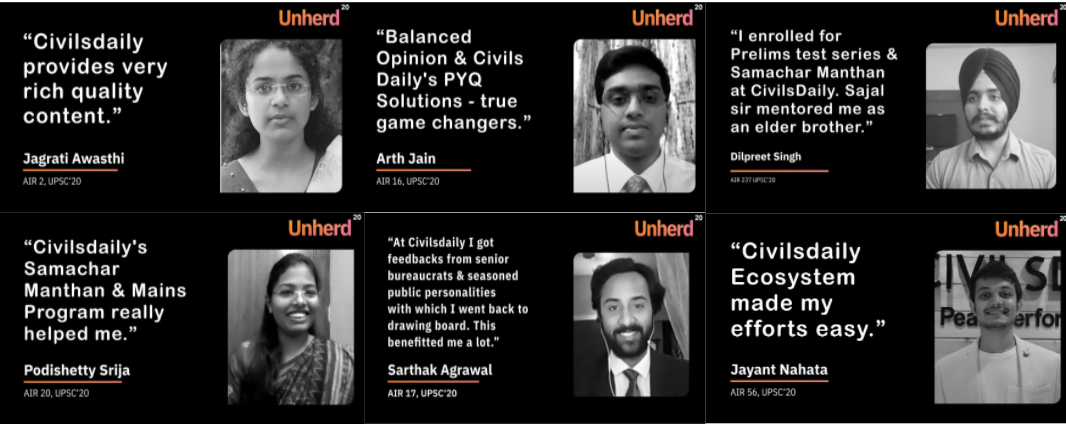
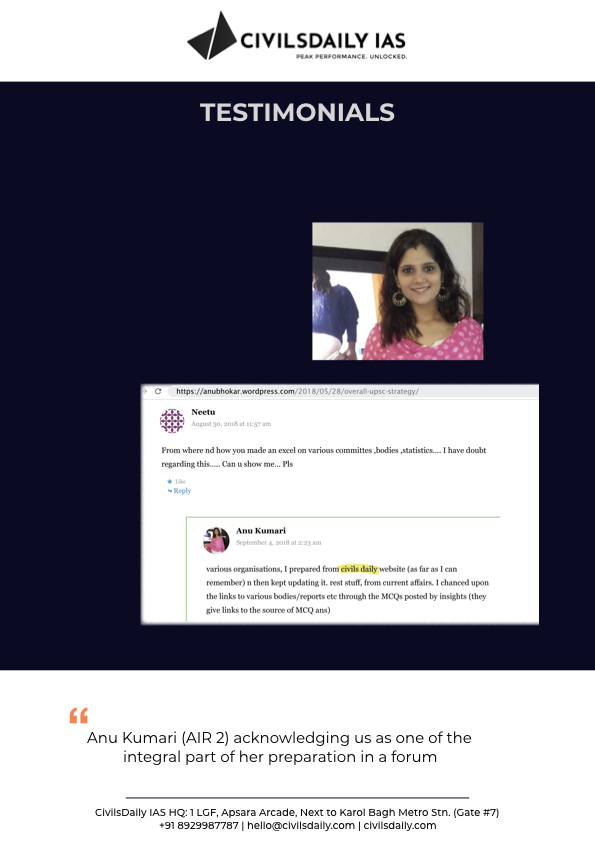
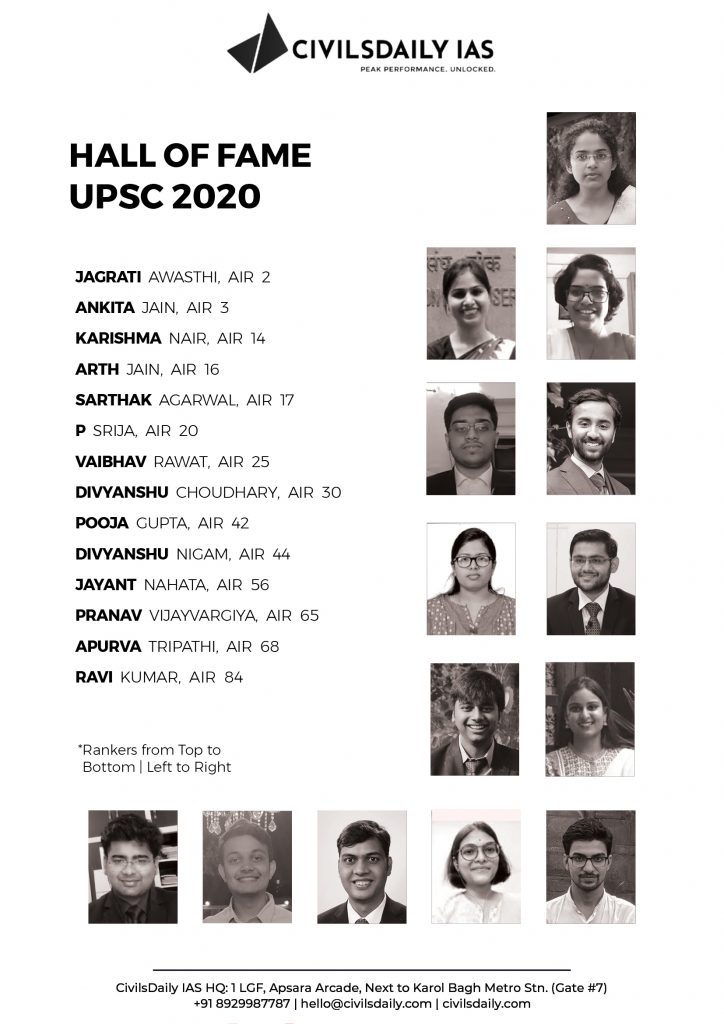
Civilsdaily helped 100+ aspirants get ranks in UPSC 2020. We helped 30 students secure ranks in the Top 100. After speaking with them personally on our UNHERD platform, we understood that there was one thing that was common between all the rankers!
All the rankers committed themselves and NEVER postponed their preparation. They did not waste a single day but started preparing immediately. We also asked them WHY did they start immediately and did not wait?
You will fall into a vicious cycle – Our toppers said that if aspirants do not start preparing immediately, they often fall into a vicious cycle of doubt and confusion. They wait for the right moment to start preparing but keep delaying it for numerous reasons like work, college, not-ready, etc. The more time they waste, the more confused they get, and the syllabus starts piling up. The toppers told us that the best thing they did was to start immediately and it helped them succeed!
Lack of self-analysis can cost you 3-4 years – The toppers revealed that self-analysis is one of the most important things for an aspirant. You need to know the syllabus, the previous year questions for every topic, your strengths, your weaknesses, your learning speed, the best time to study, how to plan the study, etc. Most aspirants who fail the exam do not do self-analysis and just keep reading. This does not help as it wastes a lot of their time. In fact, if you are not sure about your strengths and weaknesses, it could easily cost you 3-4 years in preparation. The toppers also told us that they asked mentors for assessments when they felt confused. Self-analysis helped them focus on their weaknesses and improve them. And finally, they were able to crack the exam.
UPSC is the biggest killer of self-belief – Our toppers told us that the UPSC exam is so tough and vast that it often kills an aspirant’s self-confidence. It becomes extremely difficult for them to remain consistent and motivated for the entire year. The rankers revealed that when they faced inconsistency and lacked self-confidence, they often spoke with their mentors who guided them. They found help in the mentors who understood their concerns and kept them motivated, especially when they felt down and depressed. This helped the rankers become consistent and prepare with the same energy every day!
Self-study with no guidance doesn’t help – The rankers of 2020 told us that preparing for UPSC is like walking on a desert. You will be lost without a guide. They said that even when they were self-studying, they kept asking for guidance from mentors. What to study, what not to study, how to improve their answers, which areas to focus on, etc. The toppers stayed constantly in touch with mentors who helped them at every step. They did the hard work themselves but it would have been a waste if the hard work was not in the right direction.
Always overachieve your daily target by 25% – The toppers said that they had a study plan with targets for every day! But that was not all. They always tried to overachieve the targets by at least 25%. Every time they overachieved, it gave them the confidence to do the same every day. And by the end of their preparation, they had a clear advantage over other aspirants because they studied 25% more than everyone, every single day!
The toppers of 2020 told us that their handwork, right guidance, and smart planning at an early stage helped them succeed. They said that they did not want to postpone their preparation even by a single day as it would cost them ranks. And they were right! They started preparing immediately and are now rank-holders in UPSC!
While UPSC 2023 may seem like a year away from now, looking at the syllabus one can say it’s just about the right time away. As Prelims 2022 approaches in June, more and more aspirants will realising how close they are to 2023 and begin preparing immediately. But it may just be too late by then!
If you are reading this today, you are in luck. You have the opportunity to realise the urgency immediately. March has just begun and you can have an advantage of at least siix months over other aspirants if you start preparing today. And even with a year in your hand, it would take a high level of extremely focused study to crack the exam in June 2023.
The fact is this: You CANNOT waste a single day in experimenting, hunting for resources, trying to collect reading material, etc. Every day from today is more valuable than anything you can imagine, and this is the time to focus with every bit of concentration you have.
Given the time constraint and the urgency of the situation, you need to be practical. Speak with our mentors and get your preparation organised. Our mentors can help you streamline your preparation within 24 hours and will help you save precious time. Right now, nothing is more valuable than your time and if you wish to use it effectively, all it would take is a call with our mentors.
The urgency is real, you can calculate yourself. And every moment you waste is an opportunity wasted. All you need to do is fill this form and our senior mentors will get in touch with you, with a solution designed especially for you! Speak with us, now as it’s a free 1-on-1 mentorship session with 40 minutes dedicated only for you.
Get Motivated to Maintain Overall Consistency for UPSC
It’s understandable we are humans and not programmable robots who can maintain the same level of interest everyday. However, maintaining an overall consistency throughout our preparation is neccessary to clear this competitive and vast exam.
Our philosophy behind MENTORSHIP is to get you out of this Snooze cycle. This ensures that you are the BEST VERSION of yourself in this journey. If you are under the impression that mentorship is weekly calls you attend, then you are mistaken, my friend. Trust us, your mentor will be your ‘FRIEND, PHILOSOPHER AND GUIDE’.
TO EACH THEIR OWN – Every aspirant is different. Their strengths and weaknesses are different. Their time availability is also different. Identifying this is important so you don’t end up making unrealistic targets and lose momentum. Your mentor will make sure you start slow but remain consistent to build your confidence. Making your schedule structured based on our experience of working with 2500+ students is our first priority.
TRACK YOUR PROGRESS – When you see yourself grow, it becomes easier to motivate yourself to push boundaries. Tracking your progress can happen in many ways like mentorship calls or chat sessions or by regular tests. The idea is to ensure that you don’t go off track in your preparation, and even if you do, we have your back.
EVOLUTION – A constant guidance is important to bring consistency to your UPSC preparation. Guidance is not about clearing your doubts or asking you to study when you don’t. It is also about the evolution of your preparation. This is where you and your mentor work as a team. A constant effort to PLAN AND BUILD UP YOUR ABILITY to learn in a faster and more efficient way.
TALK IT OUT – The biggest hurdle in achieving your highest level of consistency is the emotional part. Every now and then, you. surround yourself with negative thoughts, you feel scared and depressed. Instead of resolving these emotional issues, you avoid them as it seems like a waste of your precious time. You have to understand that ignoring emotional troubles does not solve them. What your doing is building an emotional time bomb that may burst a week before your mains or prelims! This is where your MENTOR AS A FRIEND comes in. All our mentors have been through this journey. We understand your fears and anxieties. So, TALK IT OUT.
Don’t let inconsistency keep you away from your dreams.
Fill up the SAMANVAYA form given below. Let us know your problems and we will find a solution to it, just like our students say ” TOGETHER WE CAN AND WE WILL”. BOOK YOUR SLOT FOR YOUR FREE 1-0N-1 COUNSELLING SESSION IN THE NEXT 24 HOURS
How has Civilsdaily Mentorship, helped Aspirants become Toppers?
The most difficult challenge faced by EVERY candidate is inconsistency. Be it inconsistency in studies, answer-writing practice, covering the syllabus, or revision, every candidate finds it difficult to cope with. Buthow do successful candidates manage to FIGHT Inconsistency so consistently?
In UPSC 2020, Civilsdaily helped 80+ students secure ranks in their exams. In the top 100, every 3rd ranker was a Civilsdaily student.
A very recent success story would be Vishwa Shah, student of Civilsdaily Mentor, Sukanya Ma’am. Vishwa has cleared the GPSC exam to become the Deputy Superintendent of Police in Gujarat. He has penned a thank-you note yesterday. Heartiest Congratulations to Vishwa!
One of our other Civilsdaily Student, Shubham Nagargojecleared the exams in 2020 to become an IPS Officer. Shubham was gracious enough to let us know how he felt about Civilsdaily Samanvaya Guidance under Parth sir.
To know how all of them cleared the exam with our mentorship, visit the UnherdPodcast.
Now that results are announced for UPSC 2021 Prelims, out of 15 out of 25 students of Santhosh Gupta sir have been recommended to Mains. One such student, Rahul expresses his gratitude and extends his appreciation.
Most of our Mentors like Sudhanshu sir, Sajal sir, Santhosh sir, Pravin sir, Parth Verma sir and Sukanya Ma’am were UPSC aspirants themselves and have attended UPSC Mains more than five times and UPSC Interview more than twice. Hence their mentorship is always a blend of the best test series, comprehensive notes and current affairs knowledge.
All of them dedicate their time weekly to give 1-on-1 mentorship to every student where they discuss last week’s performance and next week’s approach.
Be it Telegram, Whatsapp or Habitiat channels, they are always available and clear student’s doubts in a turnaround time of 24 Hours.
Why Civilsdaily Mentors are the GPS for Your UPSC-CSE Preparation
Remember there is always light at the end of the tunnel and if you want to get out of the tunnel you have to follow the direction of the light! Our mentors’ give you direction which is divided into daily modules. All you have to do is study and complete them on time.
As every year passes by, we don’t get confident by the previous years’ performance and become laidback. Instead, we become more hungry to convert all our students into toppers.REGISTER HERE TO SCHEDULE YOUR FIRST FREE SAMANVAYA COUNSELLING SESSION IN NEXT 24 HOURS
How are Current Civilsdaily Students Gearing up for UPSC-CSE 2022?
Initially, our Civilsdaily student Smriti wasn’t confident about Prelims when she began her preparation. Though she had joined Civilsdaily in 2020, she started studying for UPSC-CSE back in 2019. At that time, Smriti had enrolled in multiple institutes. Though, most of these institutes had promised a personal mentor, she was unable to get in touch with them on a daily basis. Also those mentors never scheduled test-series on a weekly basis. Hence, despite preparing for a year, Smriti had scored only 35 marks out of 200 in her first test series by Civilsdaily.
She then started writing 20-25 test series over the course of UAP 2021 and in her last test, her scores have drastically improved. She now scores in the range of 130-135 marks in prelims’ and 110+ in mains’ papers.
In Smriti’s own words she describes her Samanvaya Mentorship Experience to be —
“Our parents provide us financial and emotional support, friends provide us moral support and the right mentor gives you logistic and logical support for UPSC. There are days when I felt I won’t be able to compete against lakhs of aspirants. That’s when my mentor, Ravi sir reminded me of my improvement and encouraged me that I can crack it with the same consistency. We need someone, who tells us we are performing well especially when we cannot see that ourselves. The mentorship at Civilsdaily helped me become mentally stronger as a person. In other institutes, mentors are allotted only for doubt resolution. But at Civilsdaily, I am getting end-to-end mentorship via value added notes, classes, test series and detailed evaluation.”
Similarly our another Civilsdaily student, Ashishsums up his Samanvaya experience with Civilsdaily mentor,Pravin Sir, “Because of Pravin sir’s support, I am able to understand a topic in lesser time.”
This is how Pravin sir evaluates Ashish’s Mains Test Series every week. After every test series evaluation, Pravin sir schedules a 1 hour call to discuss how Ashish can improve his marks and the sources he can refer for key topics.
It’s Your Turn Get the Free 40 Min Counselling Session By a CD Mentor
Civilsdaily mentors are so dedicated, consistent and focused for your UPSC goal, that you will eventually become focused into turning your dreams to reality.
At the core of Civilsdaily UPSC mentorship, lies the fact that each one of you will have a unique journey while preparing for the exam. Some will get through on the first attempt without much effort while others will take both more time and more effort.
We want to understand you better to help you optimize your journey so you can focus on the right things and not waste time on the wrong ones. We are asking you to tap into the valuable experiences of mentors who underwent the same grind and realize the pitfalls and understand the shortcuts to make it.
In the first counselling session, we will understand your weaknesses. We then help you to stick to one plan or strategy throughout your preparation. We will then follow up with you on a daily basis to check if you are right on track. TALK TO OUR MENTORS & CLARIFY YOUR DOUBTS NOW
The war in Ukraine and the subsequent economic sanctions will trigger central banks to go back to their drawing boards to reassess their dependency on the greenback.
How sanctions on Russia could lead to de-dollarisation
The imposition of sanctions and the exclusion from SWIFT by the US could trigger a faster de-dollarisation.
The “de-dollarisation” by several central banks is imminent, driven by the desire to insulate them from geopolitical risks, where the status of the US dollar as a reserve currency can be used as an offensive weapon.
This can also trigger a shift in the overall global forex market framework.
The US dollar, which is the world’s reserve currency, can see a steady fall in the current context as leading central banks may look to diversify their reserves away from it to other assets or currencies like the Euro, Renminbi or gold.
How China and Russia are responding?
Efforts are already underway for the possible introduction of a new Russia-China payment system, bypassing SWIFT and combining the Russian SPFS (System for Transfer of Financial Messages) with the Chinese CIPS (Cross-Border Interbank Payment System).
Russia had started its three-pronged efforts towards de-dollarisation in 2014 when sanctions were imposed on it for the annexation of Crimea.
However, these steps haven’t sufficed to effectively shield “fortress Russia”.
China, on the other hand, aims to use trading platforms and its digital currency to promote de-dollarisation.
China has established RMB trading centres in Hong Kong, Singapore and Europe.
In 2021, the People’s Bank of China submitted a “Global Sovereign Digital Currency Governance” proposal at the Bank for International Settlements to influence global financial rules via its digital currency, the e-Yuan.
The IMF has already added Yuan to its SDR (Special Drawing Rights) basket in 2016.
In 2017, the European Central Bank exchanged EUR 500 million worth of its forex reserves into Yuan-denominated securities.
However, the lack of full RMB convertibility will hinder China’s de-dollarisation ambition.
Why the dominance of the dollar continues and how the US benefits from its dominance
Currently, about 60 per cent of foreign exchange reserves of central banks and about 70 per cent of global trade is conducted using USD.
The status of the dollar was enhanced by the collapse of the Bretton Woods system, which essentially eliminated other developed market currencies from competing with the USD.
The association of the USD as a “safe-haven” asset also has a psychological angle to it and like old habits, people continue to view the currency as a relatively risk-free asset.
This status of the reserve currency allows the US government to refinance its debt at low costs in addition to providing foreign policy leverage.
Additionally, sudden dumping of dollar assets by adversarial central banks will also pose balance sheet risks to them as it will erode the value of their overall dollar-denominated holdings.
Consider the question “Examine the factors that explain the dominance of the dollar in the global economy? How such dominance benefits the US?”
Conclusion
While the frequent use of the US dollar as a potential weapon for achieving foreign policy objectives will no doubt accelerate the process of de-dollarisation, there is still a long road ahead.
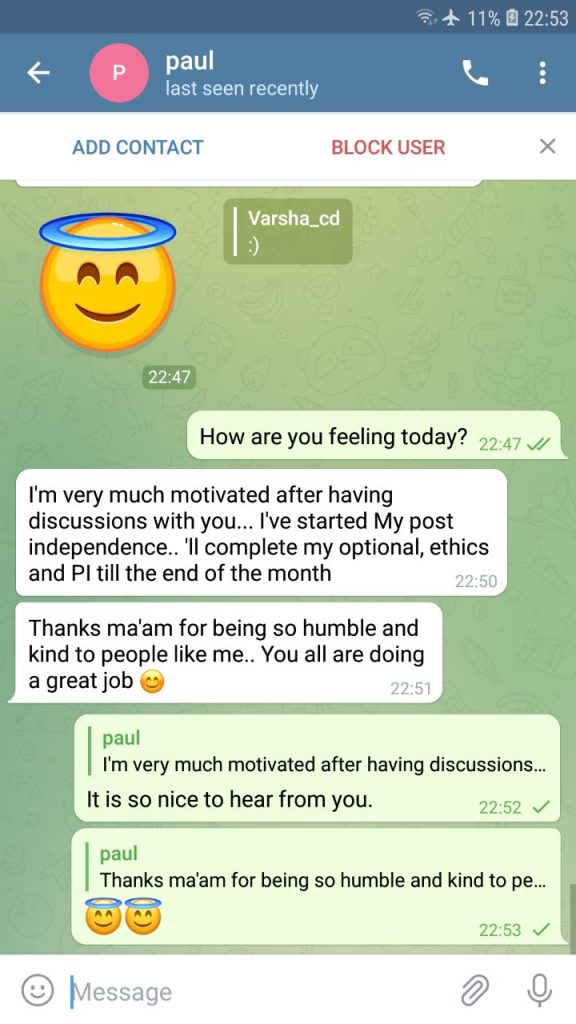
Phase A of Nikaalo Prelims just concluded, and we are happy that it has had a positive impact on many students. Those who joined our free telegram channel experienced a community of like-minded UPSC aspirants who were mentored by Varsha Ma’am. Varsha Ma’am was able to get regularity lacking in their preparation with her morning and evening sessions.
As a result of which, students felt their scores improving, found a renewed interest to follow the timetable and study, took inspiration from their peers on the group and also got access to sources that simplified concepts for them.
Join Nikaalo Prelims and get prelims spotlight notes, follow daily timetable, solve subject-wise mcqs & clarify your doubts with mentors.
Toppers who have cleared UPSC, have always said that even if they at the outset prepared casually, they streamlined their timetable in the last two months. You need a different approach than what you have been following all these days — an approach that pushes your limits for a very uncertain exam with increasing competition and decreasing vacancies.
What is Nikaalo Prelims
Nikaalo Prelims is a free initiative of Civilsdaily IAS to help aspirants to streamline their preparation during the peak months of prelims preparation. Our mentors work day and night to ensure that our aspirants get the best out of it.
What is covered in Nikaalo Prelims?
1. Detailed daily time table
2. Daily sessions on specific topics
3. Daily mcqs
4. Notes
5. All India open test
What is new in Nikaalo Prelims 4.0?
1. This time the program is divided into 3 parts.
2. Part-A: It will continue till February 28, 2022. Under part A, we will cover the Syllabus along with conceptual understanding and better subject wise clarity. There will be daily MCQ based sessions along with Doubt Clearing Sessions.
3. Part-B: It will start from March 1, 2022. Part B includes- daily sessions, daily Prelims Intensive spotlights notes, daily MCQs based quiz, All India test, Doubt Sessions.
4. CSAT: There will be one session dedicated to CSAT.
The Union Home Ministry has placed a US based NGO on its watchlist following an investigation that foreign contributions it sent were being used for climate awareness campaigns, an activity not permissible under the FCRA [Foreign Contribution (Regulation) Act].
About Foreign Contribution Regulation Act (FCRA)
The FCRA regulates foreign donations and ensures that such contributions do not adversely affect internal security.
First enacted in 1976, it was amended in 2010 when a slew of new measures was adopted to regulate foreign donations.
The FCRA is applicable to all associations, groups and NGOs which intend to receive foreign donations.
It is mandatory for all such NGOs to register themselves under the FCRA.
The registration is initially valid for five years and it can be renewed subsequently if they comply with all norms.
Why was FCRA enacted?
The FCRA sought to consolidate the acceptance and utilisation of foreign contribution or foreign hospitality by individuals, associations or companies.
It sought to prohibit such contributions from being used for activities detrimental to national interest.
What was the recent Amendment?
The FCRA was amended in September 2020 to introduce some new restrictions.
The Government says it did so because it found that many recipients were wanting in compliance with provisions relating to filing of annual returns and maintenance of accounts.
Many did not utilise the funds received for the intended objectives.
It claimed that the annual inflow as foreign contributions almost doubled between 2010 and 2019.
The FCRA registration of 19,000 organisations was cancelled and, in some cases, prosecution was also initiated.
How has the law changed?
There are at least three major changes that NGOs find too restrictive.
Prohibition of fund transfer: An amendment to Section 7 of the Act completely prohibits the transfer of foreign funds received by an organisation to any other individual or association.
Directed and single bank account: Another amendment mandates that every person (or association) granted a certificate or prior permission to receive overseas funds must open an FCRA bank account in a designated branch of the SBI in New Delhi.
Utilization of funds: Fund All foreign funds should be received only in this account and none other. However, the recipients are allowed to open another FCRA bank account in any scheduled bank for utilisation.
Shared information: The designated bank will inform authorities about any foreign remittance with details about its source and the manner in which it was received.
Aadhaar mandate: In addition, the Government is also authorised to take the Aadhaar numbers of all the key functionaries of any organisation that applies for FCRA registration or for prior approval for receiving foreign funds.
Cap on administrative expenditure: Another change is that the portion of the receipts allowed as administrative expenditure has been reduced from 50% to 20%.
What is the criticism against these changes?
Arbitrary restrictions: NGOs questioning the law consider the prohibition on transfer arbitrary and too heavy a restriction.
Non-sharing of funds: One of its consequences is that recipients cannot fund other organisations. When foreign help is received as material, it becomes impossible to share the aid.
Irrationality of designated bank accounts: There is no rational link between designating a particular branch of a bank with the objective of preserving national interest.
Un-ease of operation: Due to Delhi based bank account, it is also inconvenient as the NGOS might be operating elsewhere.
Illogical narrative: ‘National security’ cannot be cited as a reason without adequate justification as observed by the Supreme Court in Pegasus Case.
What does the Government say?
Zero tolerance against intervention: The amendments were necessary to prevent foreign state and non-state actors from interfering with the country’s polity and internal matters.
Diversion of foreign funds: The changes are also needed to prevent malpractices by NGOs and diversion of foreign funds.
Fund flow monitoring: The provision of having one designated bank for receiving foreign funds is aimed at making it easier to monitor the flow of funds.
Ease of operation: The Government clarified that there was no need for anyone to come to Delhi to open the account as it can be done remotely.
The World Trade Organization chief has hailed a breakthrough between the EU, the United States, India and South Africa on waiving intellectual property rights on Covid-19 vaccines.
What is a Patent?
A patent is an exclusive right granted for an invention.
In other words, a patent is an exclusive right to a product or a process that generally provides a new way of doing something, or offers a new technical solution to a problem.
To get a patent, technical information about the invention must be disclosed to the public in a patent application.
The patent owner may give permission to, or license, other parties to use the invention on mutually agreed terms.
The owner may also sell the right to the invention to someone else, who will then become the new owner of the patent.
Once a patent expires, the protection ends, and an invention enters the public domain; that is, anyone can commercially exploit the invention without infringing the patent.
Terms of Patent
Patents may be granted for inventions in any field of technology, from an everyday kitchen utensil to a nanotechnology chip.
An invention can be a product – such as a chemical compound, or a process, for example – or a process for producing a specific chemical compound.
Patent protection is granted for a limited period, generally 20 years from the filing date of the application.
Patents are territorial rights. In general, the exclusive rights are only applicable in the country or region in which a patent has been filed and granted, in accordance with the law of that country or region.
Back2Basics: Intellectual Properties
IP is protected in law by, for example, patents, copyright and trademarks, which enable people to earn recognition or financial benefit from what they invent or create.
By striking the right balance between the interests of innovators and the wider public interest, the IP system aims to foster an environment in which creativity and innovation can flourish.
Types of IP:
(1) Copyright
Copyright is a legal term used to describe the rights that creators have over their literary and artistic works.
Works covered by copyright range from books, music, paintings, sculpture and films, to computer programs, databases, advertisements, maps and technical drawings.
(2) Patents
Discussed above
(3) Trademarks
A trademark is a sign capable of distinguishing the goods or services of one enterprise from those of other enterprises.
Trademarks date back to ancient times when artisans used to put their signature or “mark” on their products.
(4) Geographical Indications
Geographical indications and appellations of origin are signs used on goods that have a specific geographical origin and possess qualities, a reputation or characteristics that are essentially attributable to that place of origin.
Most commonly, a geographical indication includes the name of the place of origin of the goods.
(5) Trade secrets
Trade secrets are IP rights on confidential information which may be sold or licensed.
The unauthorized acquisition, use or disclosure of such secret information in a manner contrary to honest commercial practices by others is regarded as an unfair practice and a violation of the trade secret protection.
This Spotlight is a part of our Mission Nikaalo Prelims-2022.
You can check the broad timetable of Nikaalo Prelims here
Session Details
Morning 12 PM – Prelims Spotlight Session
Evening 06:30 PM – TIKDAM/MCQs Session
Evening 08 PM – Tests on Alternate Days
Join our Official telegram channel for Study material and Daily Sessions Here
17th Mar 2022
Local self-government: various committees
Balwant Rai Mehta Committee
Ashok Mehta
GVK Rao
Singhvi
Mandate
To examine working of Community development programme and national extension services
To study Panchayati Raj
Administrative arrangement for rural development and poverty alleviation
Revitalisation of Panchayati raj
Suggestion
3 tier Panchayati Raj linked through indirect election
2 tier – Zila Panchayat and Mandal Panchayat
District the unit of planning, post of district development commissioner
Constitutional protection to Panchayati raj
Titbits
1st Panchayati raj institution in Nagore (Rajasthan)
1st municipality Madras (British times)
Gram sabha is an assembly of all the voters of gram panchayat
74th amendment deals with the district planning committee
⅓ reservation for women in all posts
State election commission appointed by the governor to conduct polls
State finance commission appointed by the governor
Min age to contest the election is 21 years
Duration is 5 years, if dissolved before that, the next panchayat serves only the remaining years
Urban Local Government: Composition and Functions
74th Constitutional Amendment
This act added a new part IX-A to the Constitution entitled as ‘The Municipalities’ and a new Twelfth Schedule containing 18 functional items for municipalities. The main provisions of this Act can be grouped under two categories–compulsory and voluntary. Some of the compulsory provisions which are binding on all States are:
Constitution of Nagar panchayats, municipal councils and municipal corporations in transitional areas (areas in transition from a rural area to urban area), smaller urban areas and larger urban areas respectively;
Reservation of seats in urban local bodies for Scheduled Castes / Scheduled Tribes roughly in proportion to their population;
Reservation of seats for women up to one-third seats;
The State Election Commission, constituted in order to conduct elections in the panchayati raj bodies (see 73rd Amendment) will also conduct elections to the urban local self- governing bodies;
The State Finance Commission, constituted to deal with financial affairs of the Panchayati Raj bodies will also look into the financial affairs of the local urban self governing bodies;
Tenure of urban local self-governing bodies is fixed at five years and in case of earlier dissolution fresh elections are to be held within six months;
Some of the voluntary provisions which are not binding, but are expected to be observed by the States are:
Giving representation to members of the Union and State Legislatures in these bodies;
Providing reservation for backward classes;
Giving financial powers in relation to taxes, duties, tolls and fees etc;
Making the municipal bodies autonomous and devolution of powers to these bodies to perform some or all of the functions enumerated in the Twelfth Schedule added to the Constitution through this Act and/or to prepare plans for economic development.
In accordance with the 74th Amendment, municipal corporations and municipalities (municipal boards or municipal committees) are now regulated in a fairly uniform manner in all the States. However, one must remember that local self-government continues to be a subject in the State List.
Thus, the 73rd and 74th amendments provide a framework for the States in respect of local government. Thus, each State has its own Election Commission which conducts elections to all local bodies after regular intervals of five years.
Each State has its Finance Commission to regulate finances of the local bodies. Seats are reserved in the corporations and municipalities for Scheduled Castes and Tribes. One-third seats are reserved for women in all local bodies – urban and rural.
Composition
The Municipal bodies are constituted of persons chosen by direct election from the territorial constituencies (known as wards) in the municipal area.
However, the Legislature of a State may, by law, provide for the representation in a municipal body of persons having special knowledge or experience of municipal administration, the members of Rajya Sabha, Lok Sabha and the members of Legislative Council and Legislative Assembly of the State, representing constituencies, which comprise wholly or partly the Municipal Area.The state legislature may also provide the manner of the election of the Chairpersons of a municipality.
The state legislature may also provide the manner of the election of the Chairpersons of a municipality.
Empowerment of weaker sections of society and women by reserving seats for such groups is one of the important constitutional provisions of the Constitutional Amendment.
The offices of chairperson are also reserved for SC/ST and women. Thus, at least one year, out of five year duration of Municipal Corporation of Delhi, the office of Mayor is reserved for a woman, and for one year is reserved for a Councillor of Scheduled Caste. It gives a term of five years to the municipalities and if any of them is to be dissolved, it must be given an opportunity of being heard.
Functions of Urban Local Bodies
It is a common practice to divide the organisation of a corporation or a municipality into two parts:
(a) deliberative and (b) executive part
The corporation, council or municipal board or council consisting of the elected representatives of the people constitutes the deliberative part. It acts like a legislature.
It discusses and debates on general municipal policies and performance, passes the budget of the urban local body, frames broad policies relating to taxation, resources raising, pricing of services and other aspects of municipal administration.
It keeps an eye on municipal administration and holds the executive accountable for what is done or not done. For instance, if water supply is not being properly managed, or there is an outbreak of an epidemic, the deliberative wing criticises the role of the administration and suggests measures for improvement.
The executive part of municipal administration is looked after by the municipal officers and other permanent employees. In the corporations, the Municipal Commissioner is the executive head, and all other departmental officers like engineers, finance officers, health officers etc. function under his/her control and supervision.
In a large corporation, such as Delhi or Mumbai Municipal Corporation, the Commissioner is usually a senior IAS officer. In municipalities, the executive officer holds a similar position and looks after the overall administration of a municipality.
Municipal functions are generally classified into obligatory and discretionary types.
The obligatory (compulsory) functions are those that the municipal body must perform. In this category fall such functions as water supply; construction and maintenance of roads, streets, bridges, subways and other public works, street lighting; drainage and sewerage; garbage collection and disposal; prevention and control of epidemics.
Some other obligatory functions are public vaccination and inoculation; maintenance of hospitals and dispensaries including maternity and child welfare centres; checking food adulteration; removal of slums; supply of electricity; maintenance of cremation and burial grounds; and town planning. In some States some of these functions may be taken over by State Government.
The discretionary functions are those that a municipal body may take up if funds permit. These are given less priority. Some of the discretionary functions are construction and maintenance of rescue homes and orphanages, housing for low income groups, organising public receptions, provision of treatment facilities, etc.
Type of urban governments
There are eight types of urban governments in India.
Municipal Corporation: Municipal corporations are created for the administration of big cities like Delhi, Mumbai, Hyderabad and others. A Municipal Corporation has three authorities namely, the council (legislative wing of the corporation), the standing committee (to facilitate the working of the council) and the commissioner (chief executive authority of the corporation).The council consist of councillors directly elected by people and is headed by a Mayor while the Commissioner is appointed by state government and is generally an IAS officer.
Municipality: The municipalities are established for the administration of towns and smaller cities. They are known by various other names like municipal council, municipal committee, municipal board, borough municipality, city municipality and others. In composition they are quite similar to municipal corporations except that head of council is called President /chairman and in place of commissioner they have a chief executive officer/chief municipal officer.
Notified Area Committee: A notified area committee is created for the administration of two types of areas- a fast developing town due to industrialisation, and a town which does not yet fulfill all the conditions necessary for the constitution of a municipality, but which otherwise is considered important by the state government. It is called so because it is created by a notification and unlike the municipality it is an entirely nominated body, i.e. all members, including the Chairman, are nominated by the state government. Thus, it is neither a statutory body (created by law) nor an elected body.
Town Area Committee: It is set up by a separate act of state legislature for the administration of a small town. It is a semi-municipal authority entrusted with limited number of civic functions. It may be wholly elected or wholly nominated or partly elected and partly nominated as provided by state government.
Cantonment Board: It is established for municipal administration for civilian population in the cantonment areas (area where military forces and troops are permanently stationed). It is set up under the provisions of the Cantonment Act, 2006 by central government and works under Defence ministry of central government. It is partly elected and partly nominated body having the Military officer commanding the station as its ex-officio President. Vice president is elected amongst by the elected members of board. The executive officer of the cantonment board is appointed by the President of India.,
Township: It is established by large public enterprises to provide civic amenities to its staff and workers, who live in the housing colonies built near the plant. It is not an elected body and all members, including the town administrator, is appointed by the enterprise itself.
Port Trust: The port trusts are established in the port areas like Mumbai, Kolkata, Chennai and so on for two purposes: (a) to manage and protect the ports; (b) to provide civic amenities. It is created by an Act of Parliament and it consists of both elected and nominated members.
Special Purpose Agency: The states have set up certain agencies to undertake designated activities or specific functions that legitimately belong to the domain of municipal corporations, municipalities or other local urban governments. In other words, these are function based, not area based. They are known as ‘single purpose’, ‘uni-purpose’ or ‘special purpose’ or ‘functional local bodies’ like town improvement trust, housing boards, pollution control boars etc. They are established as statutory bodies by an act of state legislature or as departments by an executive resolution. They function as an autonomous body and are not subordinate agencies to local municipal bodies.
The United States Senate unanimously passed a law making daylight saving time (DST) permanent, scrapping the biannual practice of putting clocks forward and back coinciding with the arrival and departure of winter.
What does this imply?
With clocks in the US going back an hour, the time difference between New York and India will increase from the current nine and a half hours to ten and a half hours.
In the Southern Hemisphere, the opposite has happened, where countries have “sprung forward”, and time difference with India has reduced.
What is DST?
DST is the practise of resetting clocks ahead by an hour in spring, and behind by an hour in autumn (or fall).
During these months, countries that follow this system get an extra hour of daylight in the evening.
Because the spring to fall cycle is opposite in the Northern and Southern Hemispheres, DST lasts from March to October/November in Europe and the US, and from September/October to April in New Zealand and Australia.
Dates for this switch, which happens twice a year (in the spring and autumn) are decided beforehand.
By law, the 28 member states of the EU switch together — moving forward on the last Sunday of March and falling back on the last Sunday in October.
In the US, clocks go back on the first Sunday of November.
Now try this PYQ:
Q.On 21st June, the Sun
(a) Does not set below the horizon at the Arctic Circle
(b) Does not set below the horizon at Antarctic Circle
(c) Shines vertically overhead at noon on the Equator
(d) Shines vertically overhead at the Tropic of Capricorn
How many countries use DST?
DST is in practice in some 70 countries, including those in the European Union.
India does not follow DST; since countries near the Equator do not experience high variations in daytime hours between seasons.
There is, however, a separate debate around the logic of sticking with an only one-time zone in a country as large as India.
What does this system mean to achieve?
The key argument is that DST is meant to save energy.
The rationale behind setting clocks ahead of standard time, usually by 1 hour during springtime, is to ensure that the clocks show a later sunrise and later sunset — in effect a longer evening daytime.
Individuals will wake an hour earlier than usual, complete their daily work routines an hour earlier, and have an extra hour of daylight at the end.
February 26th marked the third anniversary of the Balakot airstrike which was conducted by Indian Air Force targeting the terrorist camps operating in Balakot town of Pakistan.
It was done in response to a suicidal attack on convoy of vehicles carrying CRPF personnel plotted by Jaish-e-Mohammed in Pulwama district of Jammu.
This surgical strike marked a major shift in India’s response to Pakistani sponsored cross border terror activities.
In this article, we will discuss and analyse all aspects of Balakot Air Strike (Surgical Strike), its impact and the way forward against the threat of terror.
What is a Surgical Strike?
Surgical Strike is a military attack that is carried out to damage military targets, minimal collateral damage to the surrounding and the general public infrastructure.
The aim is to eliminate the target without causing collateral damage to nearby areas and civilians.
Surgical strikes require not just detailed and exhaustive planning but need to be carried out with absolute precision to achieve the objective of taking down targets with either no or minimal collateral damage.
Try this question from CS Mains:
Q.The terms ‘Hot Pursuit’ and ‘Surgical Strikes’ are often used in connection with armed action against terrorist attacks. Discuss the strategic impact of such actions. (UPSC CSE 2016)
Reasons for conducting such strikes
Public outrage: Indian policymakers and military planners knew that only a military response would calm the enraged minds of their fellow citizens.
Political backing: Unlike the present instance, however, India’s special operations in Pakistan were kept secret and never revealed to the public.
Significance of the strike
Offensive retaliation: The public announcement of the strike marked a change in India’s policy towards such attacks.
Demonstration of capability: It had become clear that India would at some stage be forced to act. And India acts in full capacity.
Perception change: The acknowledgment came amid scepticism and disputing accounts of the attack.
Paradigm shift in defence policy: Therefore this marked a paradigm shift in India’s response to terror attacks adding a new essence to the defence policy of India.
Risk-taking: The decision to exploit the space below the ceiling of a full blown war to launch a sub-conventional operation seems to have been a well calculated risk.
Beneficial outcome
Reduction in infiltration: It led to a considerable reduction in infiltrations from across the border bringing down the cases of terror attacks.
Support for independent actions: In earlier instances, we would hold ourselves back owing to the ramifications any such act would have internationally. Many countries endorsed India’s move.
Demoralised terrorist organisations: The pro-activeness in taking down infiltrators on their home-ground had a huge impact on demoralising the forces planning India’s destruction.
High morale of public and the economy: The strikes proved to be an important element for maintaining the morale of the people of India and the armed forces.
Demise of terror outfits: Dreaded terror groups like the Islamic State and al Qaeda have failed in their persistent attempts to target India and the country’s interests. (Though they now have emerged as TRF-the resistance front.)
Change of narrative: Pakistan’s ‘high effect low cost war’ becomes a ‘low effect high cost war’ and that is exactly what the surgical strikes have achieved.
Various steps undertaken
A number of steps have been taken to structurally enhance India’s defence capabilities and preparedness:
Defence Procurement Policy: It brought out in 2020 provides for a vision to turn India from an arms importer to an exporter.
Make in India and Atmanirbharta: A huge emphasis has been laid on new initiatives such as Make in India which call for greater indigenisation and relaxed FDI norms in the defence sector to encourage investment in defence production.
Defence collaborations: The government has also entered into a number of agreements with different countries for the modernisation of defence equipment and weapons.
iDEX programme: The government is also tapping the start-up ecosystem through its flagship Innovations in Defence Excellence (iDEX) programme.
Issues with such strikes
Populist measures: Cross-border strikes by a state must not be seen as mocking the authority and political resolve of another government.
No alternative to diplomacy: Such an approach leaves neither side with any room for diplomatic manoeuvre, working severely to the detriment of a political solution.
Army going populist: What surprised many this time was the very public nature of the announcement about the counter strike and claims of heavy casualties inflicted.
Overt Politicization: There has been too much politicking, with the army needlessly dragged into this controversy.
Burden of proof: Even after years, many political factions are seeking more objective proofs from the government and army of the actual operations.
Way forward
There is a necessity to strengthen India’s strategic intent in order to convey to the adversaries that India is militarily capable of averting the terror threats to which the actions like Balakot airstrike stands significant.
This approach shall continue with consistency.
It has been suggested by an expert that the revision of plans and policies pertaining to national security, should be based on the situation involving a thorough assessment.
The strategy of preparedness towards escalation as an immediate response to any terror attack needs to continue.
Beyond the employment of the defence forces, India can also extend its diplomatic influence as a preventive measure to spread the fear of economic sanctions for its major adversary Pakistan.
Ultimate Assessment Program and Foundation Program includes –
Mentorship (1:1, throughout the preparation till Interview stage)
Masterclasses (complete GS syllabus covered, Only provided in Foundation course)
Samachar Manthan (Current affairs Programme)
Decimate Prelims (Prelims Crash course)
Mains Answer Writing Initiative (On a weekly basis)
Smash Mains (upon Qualifying prelims 2023)
Essay Guidance Program (To score above 120+ in Essay Mains Paper)
Interview Guidance Program (more than 1 mock interview will be conducted with a panel)
Civilsdaily IAS Community for Peer to Peer Interaction
Get all the Civilsdaily courses under Smash Foundation Course for 60% off after you attend our scholarship test and score above the cut-off marks!
Are you a beginner who has no idea about UPSC, but want to check if you have the aptitude for the same? Do you want to assess your performance and interest in UPSC before targetting 2023 preparation?
Then, we have got the perfect opporunity for you. Presenting, Civilsdaily’s UPSC CS 2023, Free-To-Register National Scholarship on 13th & 20th March 2022 .
Last year’s scholarship test by Civilsdaily has seen a phenomenal response and pan India interest for the test. Many toppers have emerged out of the test to be subsequently mentored in the Civilsdaily Foundation Program. So aspirants, ensure you don’t miss out on the benefits of the test.
An average aspirant, pays for Prelims Course, Mains Program, Interview Guidance, Test Series & Study Materials all separately. The fees then comes up to 2-3 Lakhs for one attempt alone.
Identifying this issue, Civilsdaily has designed the Flagship Foundation Course for 2023 aspirants. This course covers the entire 3-stage journey of a UPSC aspirant. From Prelims to Interview -1:1 Mentorship, Weekly Test Series, Classes & Study Materials will be provided.
Another benefit of the program is that it’s an umbrella course wherein an aspirant can access other paid courses of Civilsdaily for FREE.
The main objective of the program is to identify and nurture serious aspirants to become future UPSC toppers. And that’s why we have designed a scholarship test.
Our foundation course will be intensive yet personalised. You will be getting individual coaching on how to conquer the basics, develop analytical skills, inculcate conceptual clarity and acquire the necessary knowledge to face the unpredictable and dynamic UPSC.
Apart from conducting subject-wise classes that covers all the Prelims-Mains syllabus from scratch, aspirants will follow a customised timetable and will complete their revision on a daily basis to attempt our weekly prelims and mains tests. Once the test is over, they will get a strategy call from a mentor, who will clear their doubts and tell them how to improve their performance from next test onwards.
Simply put, like Ekalavya you will be getting a unique coaching experience that eludes other UPSC aspirants. Even aspects like Essay, Ethics and CSAT which is ignored in other normal coaching programs, will be covered over here with tests, mentorship, classes and notes.
If you take the upcoming free UPSC national scholarship test and come out with flying colours, you will get about 60% scholarship on the Civilsdaily Flagship Foundation Course.
Details of the Civilsdaily Free National Scholarship Test
Date – 13th March & 20th March, 2022.
Please Click on Submit after finishing the Test.
Mode: Online
Registration Fee – Free
Language: English
Time: 2 Hrs
Syllabus: GS Paper 1 (Preliminary exam)
No. of Questions: 100
Date: 13th March & 20th March
Time: 10 AM
Result: 27/03/2022
Why should you take the CD’s Scholarship Test?
1. Test your preparation on UPSC-CSE grade questions, at national level.
2. Chance to compete against the best. See where you stand.
3. Identify your subjectwise strengths, weak points, and problem areas before you start preparation.
4. Mentors will provide personalised counselling based on your performance in the scholarship test.
5. A detailed discussion will help you navigate through the challenges during the preparation.
6. Achieve up to 60% scholarship in our exclusive umbrella foundation course.
As the program is rigorous and involves individual attention, we can take only limited enrollments. Hence, we are conducting a Scholarship Exam to identify serious UPSC aspirants on 13th and 20th of March. Depending on your relative score, you can get up to a 60% scholarship.
We are looking for
1. Serious and hardworking aspirants.
2. Ready to dedicate a minimum of 5-8 hours daily.
3. Can complete assigned targets and tests without fail.
4. Only 1 thought in mind and that is – to clear UPSC Civil Services 2023.
5. Willing to take constructive feedback from mentors after each test.
HOW TO ATTEMPT ANSWERS IN DAILY ANSWER WRITING ENHANCEMENT(AWE)?
Daily 4 questions from General studies 1, 2, 3, and 4 will be provided to you.
A Mentor’s Comment will be available for all answers. This can be used as a guidance tool but we encourage you to write original answers.
You can write your answer on an A4 sheet and scan/click pictures of the same.
Upload the scanned answer in the comment section of the same question.
Along with the scanned answer, please share your Razor payment ID, so that paid members are given priority.
If you upload the answer on the same day like the answer of 11th February is uploaded on 11th February then your answer will be checked within 72 hours. Also, reviews will be in the order of submission- First come first serve basis
If you are writing answers late, for example, 11th February is uploaded on 13th February , then these answers will be evaluated as per the mentor’s schedule.
We encourage you to write answers on the same day. However, if you are uploading an answer late then tag the mentor like @Staff so that the mentor is notified about your answer.
*In case your answer is not reviewed, reply to your answer saying *NOT CHECKED*.


![[REMINDER] Last 2 Days to go for Mission Ekalavya – SCHOLARSHIP TEST for UPSC 2023 Foundation Course|| Register Now & Attend the Free Test || LINK INSIDE](https://d18x2uyjeekruj.cloudfront.net/wp-content/uploads/2022/03/Group-69-1200x675.jpg)