💥UPSC 2026, 2027, 2028 UAP Mentorship (March Batch) + Access XFactor Notes & Microthemes PDF

Search results for: “”

  • How Are Mentorship Sessions Planned in UPSC 2022 Prelims Super-25?|| 90 days Strategic Study Plan for 25 Chosen Students Appearing in Prelims 2022 ||Aim Everyday for 100+ in Prelims with 2 Veteran UPSC Mentors Giving You 1-1 Guidance|| Over 100+ Tests, Value Added Notes, Revision Classes & Current Affairs of 1.5 years provided by us for Prelims 2022 || Enrol Now for the Program with 70% Success Rate

    Smash Prelims Super-25 Program is back after a thumping success in Prelims 2021. Out of 25 students Santosh sir has mentored, 15 have cleared prelims this time.

    How was Mentorship for UPSC Prelims Conducted in our Recent Super-25 Session by Birendra Sir

    Birendra sir sat down with a student and mentored him for 1 1/2 hours after he had given his test. We were able to get a 3 minute video of him explaining a revision technique that could have helped the student remember important facts in polity. The student says he understands the importance of inter-linking due to sir.

    Birendra sir then highlighted the situations when one has to do revision. A wrong method of revision is to read the entire book. The correct method of revision is to revise only those topics the aspirant was confused with or could not remember the facts. Birendra sir suggested that he would help the student prepare a list of topics he should revise before the next test. During the mock test, he advised the student to analyse if he remembered the topic or not. If he did not, then the student had to make a note of the topic on the side and revise it after test.

    Mentorship of Birendra sir helped solve the student’s persistent problem of how he could revise in limited time.

    From this, you can understand there is no specific format for mentorship. It is conducted atleast 5 times a month and depends on your test performance and your doubts. After mentorship, you will get a fresh direction to improvise your preparation with less confusion and stress.

    This image has an empty alt attribute; its file name is 50f70a4d-c239-44a5-b49b-9b93617a378f-461x1024.jpg
    This image has an empty alt attribute; its file name is IMG-20211029-WA0019-461x1024.jpg
    This image has an empty alt attribute; its file name is IMG-20211029-WA0018-461x1024.jpg
    This image has an empty alt attribute; its file name is IMG-20211029-WA0016-461x1024.jpg

    Why Your Focus for Next 3 Months Must be About Scoring Above Cut-Off Marks in UPSC-CSE Prelims? Isn’t the last 1 Month Enough for This?

    Every year, the competition for UPSC-CSE is increasing while vacancies are decreasing drastically. This year there are only 712 vacancies as against 2019 which had 927 vacancies. However, atleast 10 lakh students will attempt the prelims exam. This is why right now, it’s important to start having an Olympic Athlete mindset. You need to daily focus on scoring above the cut-off marks in your test series.

    Civilsdaily Student and 2019 UPSC-CSE AIR 8 Topper Abhishek Saraf had practiced nearly 6000+ MCQs under us to clear prelims!

    What makes prelims tough? It’s because the paper is unpredictable. If this year, science questions are a breeze then the next year you will have to answer advanced concept-based questions. Unlike Mains, Prelims has negative markings.

    Toppers like Pranav Vijayvergiya (AIR 65) and Swati Sharma (AIR 17) have found Prelims to be tougher than Mains. In fact, Pranav failed to clear Prelims thrice. But, in his fourth attempt he took Civilsdaily mentorship and cleared Prelims, Mains and Interview in one shot!

    Are you feeling low that you are unable to get the required cut-off marks in your test series. Worry not, for about 65% of the UPSC toppers have said that they scored below cut-off marks till December. But by June, they were able to boost their marks to get through the prelims hurdle. It’s time to be like them now. The two mentors alloted to you at Civilsdaily will discuss notes, sources, test scores and even counsel you on your mental health.

    How will Super-25 Program be structured?

    We have neither diluted the criteria for selecting aspirants nor the core strategy. Infact, this year Super-25 will be a more effective version of last year. 

    Four Pillars of Super- 25 Program

    1. It is mentorship led test series and value addition program over 90 days. 
    1. Two-Tier Mentorship: You will have one dedicated mentor during the entire journey, while Santosh Gupta sir will be strategic mentor. Santosh sir will take strategic mentoring calls twice in a week. It would ensure that you do not fall back at any cost and benefit from the experience of two mentors who have cleared the exam 6 times. We will ensure that you achieve not your weekly targets but the target of clearing prelims. 
    1. Number of tests: 60 practice tests (50 questions) + 40 Full length tests ( 12 Basic + 6 advanced + 10 Current affairs test + 8 FLTs+ 4 CSATs) . It means everyday you can give a test. With this, we will ensure that you revise your syllabus 3 times in three months at least. 
    1. Current affairs: Entire Current affairs of 1.5 years ( Jan 2021 – April 2022) will be covered by Core faculty, comprising of Santosh sir, Sajal sir, Sudhanshu sir, Birendra sir and Sukanya Ma’am. You will learn how to link current affairs with static topics on the go.
    1. Strategic Value Addition Sessions: They say that a woodcutter sharpens his axe for 8 hours to cut 1 tree. This is the most popular session aroun taken by Santosh Gupta sir to enrich your knowledge base and analytical ability. 

    Approach of Super-25

    1. Keyword approach to revise syllabus of 1 subject in 2-3 hours.

    2. Focus on FCE approach ( Factual, Conceptual and Elimination ) to enhance your score.

    3. Critical gap filling sessions and notes, learning to link static with current affairs and vice versa.

    4. Evidence based questions to ensure 360 degree testing.

    5. Weekly monitoring of targets by dedicated mentor and your strategic mentor Santosh Gupta.  

    How Super- 25 will help you

    1. Setting a clear strategy for the next 90 days to get 120+ score in Prelims.

    2. Revising the whole syllabus in an effective manner.

    2. Filling critical gaps in preparation.

    4. Practice tests to enhance your chances of qualifying prelims.

    5. Covering the entire current affairs from a prelims perspective.

    Who can be part of Super-25?

    1. Only those who are struck in the range of 80-90 marks in last 2-3 attempts and are desperate to write mains.

    2. Those who have given prelims at least once.

    3. Those willing to give 100% or nothing less. 

    There are no secrets to success, it is a result of preparation, hard work and learning from failure. Are you willing to learn from failures? Let’s start together. 

    This image has an empty alt attribute; its file name is WhatsApp-Image-2021-12-29-at-10.19.42-1024x364.jpeg
    This image has an empty alt attribute; its file name is 1b69644d-1480-4430-b925-0bee98f61ea5-461x1024.jpg
    This image has an empty alt attribute; its file name is a2d57403-4c49-462b-8459-b15e690ea928-1-461x1024.jpg

    Self Preparation with Mentorship: What do Civilsdaily Students think of Santosh Sir’s Mentorship for UPSC-CSE Prelims?

    Santhosh Sir, Core Civilsdaily Mentor. He has attended Interview Thrice & Cleared Prelims 6/6 times with above 145 marks.

    We asked Santosh sir’s students about their opinion on mentorship — if it was something that saved their time or wasted their time in studies and this is what they had to say:

    Kamini: “If I can say in one word, then Santosh sir’s mentorship is unique. Before I joined his program, I used to score 90 marks in Full Length Test Series. Santhosh sir had done in depth analysis of my test papers and suggested ways to reduce the negatives. Right now I am able to score 100+ in advanced test series of not only Civilsdaily but other institutes. He is always available to clear my doubts and solve my issues on call or phone. No issue is too big enough for Santosh sir. He has always told me after you finish a test series, read the same topics again and take another test series the same day to see if your marks improve. From Santosh sir’s polity and economic survey notes, we got questions in 2021 Prelims. I always feel its better to do self studies with mentorship than join coaching institutes and get spoon fed with information.”

    Sweetie Raj: “I am a banking professional, living with a joint family. Attending coaching classes is out of question because I won’t have time to read the books myself. Santosh sir helps me self-study by providing me mentorship daily. I study daily from 9PM to 3AM. Santosh sir has been available for 1 hour strategy calls even during this time. No other teacher would have wanted me to succeed as much as he wants me to. I can understand concepts by myself and don’t need help in that. I want someone who pushes me to complete the target modules, checks if I did my mains answer writing for the day and analyses the previous year question papers with me. Because of Santosh sir, I understood that its just not enough reading one book but at the same time I dont have to waste time reading many books. He tells me the topic-wise sources to refer. Also he has designed a study plan for me that I can follow every week. Once, I told Santhosh sir I was missing test series discussion classes as it was conducted at 7PM. Immediately, he provided me recorded videos and kept the session at 8.30PM.”

    This image has an empty alt attribute; its file name is 1ecb6d73-e5c0-4eb5-8250-6edb1b3a20b7-461x1024.jpg

    Samples From Smash Super-25 Program

    Sample 1-on-1 Mentorship for Smash Prelims
    Sample Notes
    Sample Test Series
    This image has an empty alt attribute; its file name is image-1024x724.png
    This image has an empty alt attribute; its file name is image-1-1024x676.png
    This image has an empty alt attribute; its file name is image-2-1024x475.png
    Sample classes on CSAT & Topic Wise Analysis
    Sample Notes & Handout Material
    This image has an empty alt attribute; its file name is Collage.jpg

    Toppers’ Speak: How Civilsdaily Mentorship Helped Me Clear UPSC?

    https://www.youtube.com/watch?v=DSwO38weHAA

    About Santosh Gupta Sir

    Santosh sir has scored above 140 twice in UPSC prelims and 120 plus in all 6 attempts. He has written all 6 mains and has appeared for Interviews 3 times. He has qualified UPSC EPFO and BPSC 56-59th also. As the Prelims coordinator at Civilsdaily, he has helped 15 out of 25 students clear the prelims examination this year.

  • Prelims Spotlight: Functions/powers of executive

    Dear Aspirants,

    This Spotlight is a part of our Mission Nikaalo Prelims-2022.

    You can check the broad timetable of Nikaalo Prelims here

    Session Details

    Morning 12 PM  – Prelims Spotlight Session

    Evening 06 PM  – TIKDAM/MCQs Session

    Evening 08 PM  – Tests on Alternate Days

    Join our Official telegram channel for Study material and Daily Sessions Here


    11th Mar 2022

    Executive

    Titbits

    1. President, VP both elected indirectly by proportional representation by means of single transferable vote and voting is by secret ballot
    2. Electoral college of president contains elected MPs and elected MLAs (including that of UTs of Delhi and Puducherry) while that of VP includes all MPs (nominated MPs and nominated MLAs not included in presidential electoral college where as nominated MPs are included in Vice presidential but none of the MLAs )
    3. MLCs not included in electoral college of either president or VP
    4. Value of votes of all elected MPs = Value of votes of all elected MLAs
    5. Min age 35 years for both president and VP (LS, MLA = 25, RS, MLC = 30, local bodies =21)
    6. Oath to preserve, protect and defend the constitution to president by CJI while by president to VP
    7. Impeachment for violation of constitution by ⅔ absolute majority
    8. Vacancy in presidential office, VP and in his absence CJI
    9. President acts in accordance with aid and advice of CoM except where situational discretion is necessary (govt losing no confidence motion, no clear majority)
    10. President appoints judges of supreme court as well as high court
    Issue President Governor
    Head Head of the country, head of govt is PM Head of a state, head of govt is CM
    Executive power All executive action in his name Same
    Oath Preserve, protect and defend the constitution Same
    Appointment Indirect election Nominated by president; representative of union in states
    Removal Impeachment President can remove him any time/ pleasure principle
    Grounds of removal Violation of constitution No grounds mentioned
    Advice of council of minister Binding (42nd amendment), can return the advice once (44th amendment) binding save for exceptional circumstances (various supreme court judgements)
    Ordinance Art 123, when either house is not in session, not for CAB Art 213, same
    Ordinary bill Can be sent for reconsideration once to parliament, bound to give assent after that same
    Money bill Can’t send for reconsideration (after all president himself recommends the bill) same
    Constitution amendment bill Has to give his assent (24th amendment) No role
    if governor reserves the bill for president (article 200) Can assent/ withhold assent or send the bill for reconsideration (except money bill which can’t be resent) (article 201) No further role of governor
    If house sends the bill back in the same form Not bound to give assent <governor is bound to give assent after repassage> No role
    Clemency power Can pardon death sentence and court martial sentences Can’t pardon death sentence, no role in military matters

    Bills which must be reserved for President’s consideration

    1. bills derogating the powers of the High Court (art 200)
    2. imposition of taxes on water or electricity in certain cases (Article 288)
    3. during a Financial Emergency (art 360)

    Bills which may be reserved for President’s consideration and assent for specific purposes

    a). To secure immunity from operation of Articles 14 and 19. These are Bills for

    1. acquisition of estates, etc.  (Article 31A(I (b))
    2. giving effect to Directive Principles of State Policy (Article 31C)

    (b) A Bill relating to a subject enumerated in the Concurrent List, to ensure operation of its provisions despite their repugnancy to a Union law or an existing law, by securing President’s assent in terms of Article 254(2)

    (c) Legislation imposing restrictions on trade and commerce

    Titbits

      1. President (governor) appoints the leader of the majority party as PM (CM). Discretion in case of no clear majority.
      2. Ministers are appointed on the advice of PM or CM (no discretion)
    • CM of UTs is appointed by President not Lt. Governor
    1. Ministers hold office during pleasure of president (governor) and are collectively responsible to house of people
    2. Total strength of CoM including PM (CM) not to exceed 15% of membership of LS (91st CAA)
    3. Ministers can be appointed w/o being part of LS or RS but have to get elected w/i 6 months
    4. Ministers/ Attorney general who are not member of a house/ committee can attend the meetings but can’t vote
    5. The cabinet is a subset of CoM and includes only ministers of cabinet rank (article 352)

    Governor of state  v/s LG of Delhi

      Governor/ state LG/ Delhi
    Appointment of CM/ ministers By governor By president
    Ministers hold office till pleasure of Governor President
    Discretion Very limited Can refer any matter to president if not satisfied
    Who can make Laws on state list Only state legislature ordinarily Parliament as well as state legislature

    Civil services

    While ministers are political executives, civil servants are permanent executives as they don’t have to seek the mandate of people every five years.

    All India Services: Common to both centre and states

    1. Recruitment by the centre, serve under states
    2. 3 all India services – IAS, IPS and Indian forest services <created in 1968>
    3. Parliament can create a new IAS if RS passes a resolution by ⅔ majority
    4. Central govt makes service rules in consultation with state govt
    5. Work under the pleasure of the president with safeguards

  • Why society gains when start-ups fail

    Context

    As per the Economic Survey 2021-22, India has become the third-largest startup ecosystem in the world after the US and China.

    Start-up ecosystem in India

    • India attracted huge investment in startups in 2021: Private equity investment was $77 billion, of which $42 billion went to early-stage ventures.
    • Every startup where salaries are paid by investors rather than customers is breathlessly rethinking business plans.

    How do startups benefit society?

    1] Innovation, productivity and job creation:

    • The high failure rate of startups is not a problem per se — society only needs a few successes to harness the gains of innovation, productivity and job creation.
    • A new book, The Power Law makes the case that startup investing is unlike public market investing.
    • He suggests public markets follow a “normal” distribution like human height — most people cluster around the average with a few exceptionally low or high.
    • But venture investments follow a “power law” of distribution, that is, most go to zero but the tiny number that succeeds more than compensate for the losses or mediocrity of the many.

    2] Losses caused by startups are not passed on to society

    • Startups don’t socialise their losses, Corporate bank loans expanded from Rs 18 lakh crore in 2008 to Rs 54 lakh crore in 2014.
    • Such high corporate bank loans created bad loans that needed many lakh crores of government money to recapitalise nationalised banks.
    • This money was diverted from government spending on healthcare, education and defence.
    • The current venture capital binge will also create many write-offs but this cost will fall on consenting adults with broad shoulders — foreign institutions, angel investors and entrepreneurs with successful previous exits.

    3] Startups will solve real problems for Indians:

    • Ending our poverty needs higher productivity regions, cities, sectors, firms and individuals.
    • A modern state is a welfare state that does less commercially so it can do more socially.
    • It needs allies in reimagining financial inclusion, supply chains, distribution logistics, employability, retail, transport, media, healthcare, agriculture and much else.
    • Many of our startups shall redeem their pledge to solve these problems “not wholly or in full measure, but very substantially”.

    Three issues related to startups

    • 1] Fiscal and monetary policy normalisation: The global capital supply fuelling startup funding faces challenges from fiscal and monetary policy normalisation: The rate-sensitive two-year US government bond recently touched a 1.6 per cent yield after being at 0.4 per cent as recently as November — because the risk-free return cannot be return-free-risk forever.
    • Investors are returning to weighing financial sustainability and capital efficiency along with addressable markets.
    • 2] Excesses: This explosive startup funding has created excesses.
    • 3] A different approach of public markets: Private markets are not only delaying IPOs — Amazon went public within three years of starting with less than half the value of a unicorn — but unicorn IPOs’ underperformance suggests that public markets have a different calibration.

    Conclusion

    The few startups that survive will raise India’s soft power and prosperity by using improbable ideas to solve impossible problems. What we need is to ensure the policy environment for the startups to boom.

    UPSC 2022 countdown has begun! Get your personal guidance plan now! (Click here)

  • Water management needs a hydro-social approach

    Context

    The Global Water System Project, which was launched in 2003 as a joint initiative of the Earth System Science Partnership (ESSP) and Global Environmental Change (GEC) programme, epitomises global concern about the human-induced transformation of fresh water and its impact on the earth system and society.

    Valuation of water

    • It is globally estimated that the gap between demand for and supply of fresh water may reach up to 40% by 2030 if present practices continue.
    • SDG 6: The formation of the 2030 Water Resource Group in 2008, at the instance of the World Economic Forum, and the World Bank’s promotion of the group’s activity since 2018, is in recognition of this problem and to help achieve the Sustainable Development Goal (SDG) on water availability and sanitation for all by 2030 (SDG 6).
    • The latest UN World Water Development Report, 2021, titled ‘Valuing Water’, has laid stress on the proper valuation of water by considering five interrelated perspectives: water sources; water infrastructure; water services; water as an input to production and socio-economic development, and socio-cultural values of water.

    Need for hydro-social cycle approach

    • Designing a comprehensive mix of divergent views about water along with ecological and environmental issues held by stakeholder groups is necessary.
    • In this context, a hydro-social cycle approach provides an appropriate framework.
    • It repositions the natural hydrological cycle in a human-nature interactive structure and considers water and society as part of a historical and relational-dialectical process.
    • The anthropogenic factors directly influencing a freshwater system are the engineering of river channels, irrigation and other consumptive use of water, widespread land use/land cover change, change in an aquatic habitat, and point and non-point source pollution affecting water quality.

    The intra- and inter-basin transfer (IBT) of water

    • IBT is a major hydrological intervention to rectify the imbalance in water availability due to naturally prevailing unequal distribution of water resources within a given territory.
    • There are several IBT initiatives across the world.
    • The National River Linking Project of India is one of those under construction.
    • Based on a multi-country case study analysis, the World Wildlife Fund/World Wide Fund for Nature (2009) has suggested a cautious approach and the necessity to adhere to sustainability principles set out by the World Commission on Dams while taking up IBT projects.

    Issues with assumptions, use and management of freshwater resources in India

    1] Contestation on concept of the surplus and deficit basin

    • The basic premise of IBT is to export water from the surplus basin to a deficit basin.
    • However, there is contestation on the concept of the surplus and deficit basin itself as the exercise is substantially hydrological.
    • Besides this, rainfall in many surplus basins has been reported as declining.
    • The status of the surplus basin may alter if these issues are considered.

    2] Low capacity utilisation

    • There is concern about the present capacity utilisation of water resources created in the country.
    • By 2016, India created an irrigation potential for 112 million hectares, but the gross irrigated area was 93 million hectares.
    • There is a 19% gap, which is more in the case of canal irrigation.
    • In 1950-51, canal irrigation used to contribute 40% of net irrigated area, but by 2014-15, the net irrigated area under canal irrigation came down to less than 24%.
    • Groundwater irrigation now covers 62.8% of net irrigated area.
    • Low efficiency of irrigation projects: The average water use efficiency of irrigation projects in India is only 38% against 50%-60% in the case of developed countries.
    • More water consumption for crops: Even at the crop level we consume more water than the global average.
    • Rice and wheat, the two principal crops accounting for more than 75% of agricultural production use 2,850 m 3/tonnes and 1,654 m 3/tonnes of water, respectively, against the global average of 2,291m 3/tonnes and 1,334m 3/ tonnes in the same order.
    • The agriculture sector uses a little over 90% of total water use in India.
    • And in industrial plants, consumption is 2 times to 3.5 times higher per unit of production of similar plants in other countries.
    • Similarly, the domestic sector experiences a 30% to 40% loss of water due to leakage.

    3] Low use of greywater

    • Grey water is hardly used in our country.
    • It is estimated that 55% to 75% of domestic water use turns into greywater depending on its nature of use, people’s habits, climatic conditions, etc.
    • At present, the average water consumption in the domestic sector in urban areas is 135 litres to 196 litres a head a day.
    • If grey water production in the rural areas is considered it will be a huge amount.
    • The discharge of untreated grey water and industrial effluents into freshwater bodies is cause for concern.
    • The situation will be further complicated if groundwater is affected.

    4] Other issues

    • Apart from the inefficient use of water in all sectors, there is also a reduction in natural storage capacity and deterioration in catchment efficiency.

    Way forward

    • The issues are source sustainability, renovation and maintenance of traditional water harvesting structures, grey water management infrastructure, groundwater recharge, increasing water use efficiency, and reuse of water.
    • The axiom that today’s water system is co-evolving and the challenges are mainly management and governance has been globally well accepted.
    • It is important to include less predictable variables, revise binary ways of thinking of ‘either or’, and involve non-state actors in decision-making processes.

    Conclusion

    A hybrid water management system is necessary, where along with professionals and policy makers the individual, a community and society have definite roles in the value chain. The challenge is not to be techno-centric but anthropogenic.

    UPSC 2022 countdown has begun! Get your personal guidance plan now! (Click here)

  • What are the 5 Methods to Maintain Daily Consistency in Current Affairs, Optional & GS Preparation?|| What are the 4 Factors you Need to Work on if you can’t Study Regularly?|| Register for  Free 1-on-1 Mentorship if You are Yet to Restart Your UPSC Preparation

    What are the 5 Methods to Maintain Daily Consistency in Current Affairs, Optional & GS Preparation?|| What are the 4 Factors you Need to Work on if you can’t Study Regularly?|| Register for Free 1-on-1 Mentorship if You are Yet to Restart Your UPSC Preparation

    Since its inception, UPSC-CSE has had toppers from various academic and socio-economic backgrounds who have cracked the exam with flying colours. It’s clear that one doesn’t have to go to Delhi or a coaching centre to crack UPSC-CSE.

    If education, geographical and economic background doesn’t matter, then what does? Attitude, or precisely consistency. If you are persistent and adamant to clear UPSC- CSE and have given more than two attempts till now, then you must replace that with consistency. Because, being persistent might lead you to the door, but it’s consistency that unlocks it.

    In last month’s Samanvaya 1-on-1 counselling sessions, our expert Civilsdaily mentors reached out to aspirants to address their concerns regarding UPSC-CSE preparation. These are the responses they often heard from them —

    How do I start preparing after a gap of 3-4 months?

    It’s easy for me to maintain consistency in GS Preparation but not Revision

    I study daily, but can only remain focused for 2-3 hours. How do I improve?

    My long working hours don’t allow me to study daily.

    Why am I losing interest in completing a subject? It’ s easier to read a new subject everyday.

    This week, we have decided to answer all these questions and take additional questions in our personalised & motivational counselling session

    Key-Takeaways from This Week’s Samanvaya, Free 1-on-1 Counselling Session?

    If you want to experience the same mentorship as Rishab Sharma, then here’s the good news – your first UPSC mentorship is on us and is absolutely free! All you have to do is confirm your slot now.

    This prompted us to reach out to one of our students who is currently an IPS officer, Rishabh Sharma. He cleared the exam in 2020 with AIR 454. After his first attempt, Rishabh had enrolled in Smash Mains program under Sajal sir and also attended our free interview program. Cracking the mighty UPSC-CSE the second time, Rishabh explains what consistency means to him —

    UPSC doesn’t just test your intellect. It tests your patience, mental strength, your emotions, the very character of yours . As far as the journey of CSE is concerned you might know when to start, but you never know when the journey will come to an end. So be consistent and enjoy the journey.

    Every topper follows a plan, a method or strategy that makes it easier for them to study on a daily basis and complete the traget modules of the day. In this free live counselling session, we will explain the many ways you can do to avoid faltering on your preparation.

    1. The difference between a consistent study pattern v/s an inconsistent one. How UPSC-CSE becomes easier over time with consistency?

    2. Social media distraction. How to avoid spending long hours on social media?

    3. Number of ideal breaks everyday. Why is it necessary to reward yourself with a short break from time to time?

    4. Best way to plan your timetable in advance? Why daily timetable should not be rigid but yearly timetable should be well defined?

    5. How to remain consistent when you are not opting for coaching?

    6. What are the practical methods to maintain regularity in studies. Tips to sustain the fire and passion for studies.

    7. Why using Public Libraries is a way to remain consistent in UPSC-CSE preparation?

    8. What are the 4 factors that determine if you can remain consistent for a year? If not, then why should you work on them first before starting UPSC-CSE preparation?

    Get Motivated to Maintain Overall Consistency for UPSC

    It’s understandable we are humans and not programmable robots who can maintain the same level of interest everyday. However, maintaining an overall consistency throughout our preparation is neccessary to clear this competitive and vast exam.

    Our philosophy behind MENTORSHIP is to get you out of this Snooze cycle. This ensures that you are the BEST VERSION of yourself in this journey. If you are under the impression that mentorship is weekly calls you attend, then you are mistaken, my friend. Trust us, your mentor will be your ‘FRIEND, PHILOSOPHER AND GUIDE’.

    TO EACH THEIR OWN – Every aspirant is different. Their strengths and weaknesses are different. Their time availability is also different. Identifying this is important so you don’t end up making unrealistic targets and lose momentum. Your mentor will make sure you start slow but remain consistent to build your confidence. Making your schedule structured based on our experience of working with 2500+ students is our first priority. 

    This image has an empty alt attribute; its file name is WhatsApp-Image-2021-05-05-at-10.14.09-AM.jpeg

    TRACK YOUR PROGRESS – When you see yourself grow, it becomes easier to motivate yourself to push boundaries. Tracking your progress can happen in many ways like mentorship calls or chat sessions or by regular tests. The idea is to ensure that you don’t go off track in your preparation, and even if you do, we have your back.

    This image has an empty alt attribute; its file name is WhatsApp-Image-2021-05-05-at-10.14.09-AM-4-576x1024.jpeg

    EVOLUTION – A constant guidance is important to bring consistency to your UPSC preparation. Guidance is not about clearing your doubts or asking you to study when you don’t. It is also about the evolution of your preparation. This is where you and your mentor work as a team. A constant effort to PLAN AND BUILD UP YOUR ABILITY to learn in a faster and more efficient way.

    This image has an empty alt attribute; its file name is WhatsApp-Image-2021-05-05-at-10.14.09-AM-6.jpeg

    TALK IT OUT – The biggest hurdle in achieving your highest level of consistency is the emotional part. Every now and then, you. surround yourself with negative thoughts, you feel scared and depressed. Instead of resolving these emotional issues, you avoid them as it seems like a waste of your precious time. You have to understand that ignoring emotional troubles does not solve them. What your doing is building an emotional time bomb that may burst a week before your mains or prelims! This is where your MENTOR AS A FRIEND comes in. All our mentors have been through this journey. We understand your fears and anxieties. So, TALK IT OUT.

    This image has an empty alt attribute; its file name is WhatsApp-Image-2021-05-05-at-10.14.09-AM-3.jpeg

    Don’t let inconsistency keep you away from your dreams.

    Fill up the SAMANVAYA form given below. Let us know your problems and we will find a solution to it, just like our students say ” TOGETHER WE CAN AND WE WILL”. BOOK YOUR SLOT FOR YOUR FREE 1-0N-1 COUNSELLING SESSION IN THE NEXT 24 HOURS

    How has Civilsdaily Mentorship, helped Aspirants become Toppers?

    The most difficult challenge faced by EVERY candidate is inconsistency. Be it inconsistency in studies, answer-writing practice, covering the syllabus, or revision, every candidate finds it difficult to cope with. But how do successful candidates manage to FIGHT Inconsistency so consistently?

    This image has an empty alt attribute; its file name is hall-of-fame.jpg

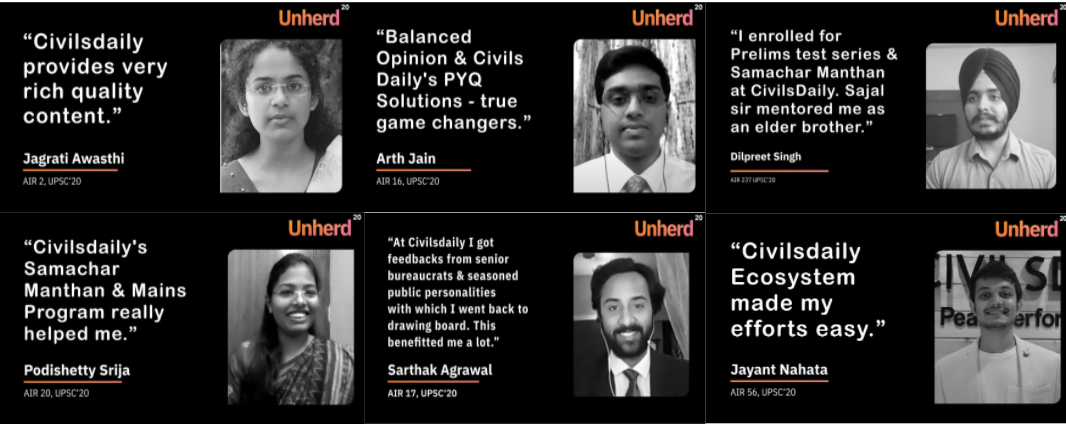
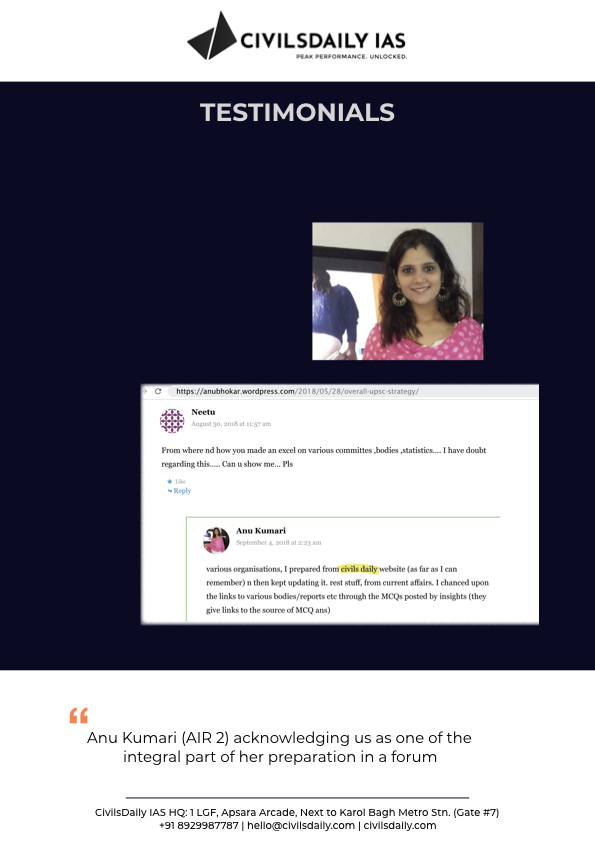
    In UPSC 2020, Civilsdaily helped 80+ students secure ranks in their exams. In the top 100, every 3rd ranker was a Civilsdaily student.

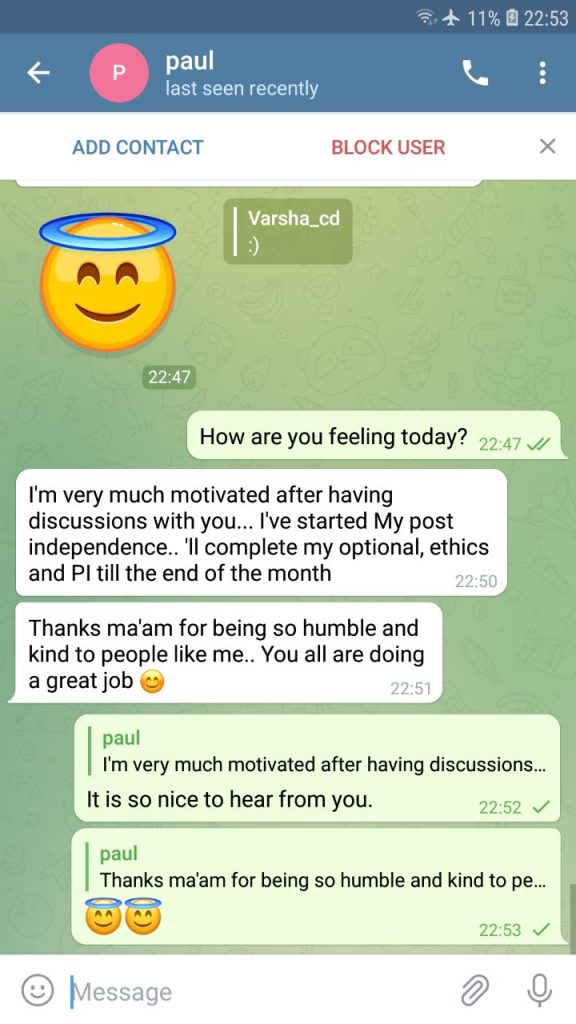
     A very recent success story would be Vishwa Shah, student of Civilsdaily Mentor, Sukanya Ma’am. Vishwa has cleared the GPSC exam to become the Deputy Superintendent of Police in Gujarat. He has penned a thank-you note yesterday. Heartiest Congratulations to Vishwa!

    This image has an empty alt attribute; its file name is WhatsApp-Image-2021-12-27-at-18.49.53-727x1024.jpeg

    One of our other Civilsdaily Student, Shubham Nagargoje cleared the exams in 2020 to become an IPS Officer. Shubham was gracious enough to let us know how he felt about Civilsdaily Samanvaya Guidance under Parth sir.

    This image has an empty alt attribute; its file name is image-1.png
    This image has an empty alt attribute; its file name is WhatsApp-Image-2022-01-11-at-19.37.54-461x1024.jpeg

    To know how all of them cleared the exam with our mentorship, visit the Unherd Podcast.

    Now that results are announced for UPSC 2021 Prelims, out of 15 out of 25 students of Santhosh Gupta sir have been recommended to Mains. One such student, Rahul expresses his gratitude and extends his appreciation.

    Most of our Mentors like Sudhanshu sir, Sajal sir, Santhosh sir, Pravin sir, Parth Verma sir and Sukanya Ma’am were UPSC aspirants themselves and have attended UPSC Mains more than five times and UPSC Interview more than twice. Hence their mentorship is always a blend of the best test series, comprehensive notes and current affairs knowledge.

    This image has an empty alt attribute; its file name is 29d33a91-62aa-45e9-a906-327fbaad5180-1024x814.jpg
    This image has an empty alt attribute; its file name is 50f70a4d-c239-44a5-b49b-9b93617a378f-461x1024.jpg

    All of them dedicate their time weekly to give 1-on-1 mentorship to every student where they discuss last week’s performance and next week’s approach.

    Be it Telegram, Whatsapp or Habitiat channels, they are always available and clear student’s doubts in a turnaround time of 24 Hours.

    This image has an empty alt attribute; its file name is image-9-6.jpg
    This image has an empty alt attribute; its file name is WhatsApp-Image-2021-12-18-at-13.22.45-576x1024.jpeg
    This image has an empty alt attribute; its file name is WhatsApp-Image-2021-12-18-at-13.22.45-1-576x1024.jpeg
    This image has an empty alt attribute; its file name is WhatsApp-Image-2021-12-18-at-13.22.46-576x1024.jpeg
    This image has an empty alt attribute; its file name is WhatsApp-Image-2021-12-18-at-13.22.46-1-576x1024.jpeg
    This image has an empty alt attribute; its file name is WhatsApp-Image-2021-12-18-at-13.22.46-2-576x1024.jpeg
    This image has an empty alt attribute; its file name is WhatsApp-Image-2021-12-18-at-13.22.47-576x1024.jpeg
    This image has an empty alt attribute; its file name is image-9-5.jpg
    This image has an empty alt attribute; its file name is image-8.png

    Why Civilsdaily Mentors are the GPS for Your UPSC-CSE Preparation

    Remember there is always light at the end of the tunnel and if you want to get out of the tunnel you have to follow the direction of the light! Our mentors’ give you direction which is divided into daily modules. All you have to do is study and complete them on time.

    This image has an empty alt attribute; its file name is WhatsApp-Image-2021-11-29-at-21.47.49-1024x527.jpeg
    This image has an empty alt attribute; its file name is IMG-20211030-WA0003-461x1024.jpg
    This image has an empty alt attribute; its file name is IMG-20211029-WA0002-1-461x1024.jpg
    This image has an empty alt attribute; its file name is IMG-20211029-WA0001-1-461x1024.jpg
    This image has an empty alt attribute; its file name is IMG-20211029-WA0019-461x1024.jpg
    This image has an empty alt attribute; its file name is IMG-20211029-WA0018-461x1024.jpg
    This image has an empty alt attribute; its file name is WhatsApp-Image-2021-05-19-at-6.12.52-PM-576x1024.jpeg
    This image has an empty alt attribute; its file name is WhatsApp-Image-2021-05-05-at-10.14.09-AM-3.jpeg
    See the source image
    This image has an empty alt attribute; its file name is WhatsApp-Image-2021-05-19-at-6.12.52-PM-1.jpeg

    As every year passes by, we don’t get confident by the previous years’ performance and become laidback. Instead, we become more hungry to convert all our students into toppers.REGISTER HERE TO SCHEDULE YOUR FIRST FREE SAMANVAYA COUNSELLING SESSION IN NEXT 24 HOURS

    How are Current Civilsdaily Students Gearing up for UPSC-CSE 2022?

    This image has an empty alt attribute; its file name is 5_6161088602806683010.jpg

    Initially, our Civilsdaily student Smriti wasn’t confident about Prelims when she began her preparation. Though she had joined Civilsdaily in 2020, she started studying for UPSC-CSE back in 2019. At that time, Smriti had enrolled in multiple institutes. Though, most of these institutes had promised a personal mentor, she was unable to get in touch with them on a daily basis. Also those mentors never scheduled test-series on a weekly basis. Hence, despite preparing for a year, Smriti had scored only 35 marks out of 200 in her first test series by Civilsdaily.

    She then started writing 20-25 test series over the course of UAP 2021 and in her last test, her scores have drastically improved. She now scores in the range of 130-135 marks in prelims’ and 110+ in mains’ papers.

    In Smriti’s own words she describes her Samanvaya Mentorship Experience to be —

    Our parents provide us financial and emotional support, friends provide us moral support and the right mentor gives you logistic and logical support for UPSC. There are days when I felt I won’t be able to compete against lakhs of aspirants. That’s when my mentor, Ravi sir reminded me of my improvement and encouraged me that I can crack it with the same consistency. We need someone, who tells us we are performing well especially when we cannot see that ourselves. The mentorship at Civilsdaily helped me become mentally stronger as a person. In other institutes, mentors are allotted only for doubt resolution. But at Civilsdaily, I am getting end-to-end mentorship via value added notes, classes, test series and detailed evaluation.”

    Similarly our another Civilsdaily student, Ashish sums up his Samanvaya experience with Civilsdaily mentor, Pravin Sir, “Because of Pravin sir’s support, I am able to understand a topic in lesser time.”

    This image has an empty alt attribute; its file name is ashish-anand-testimonial-1-461x1024.jpg
    This image has an empty alt attribute; its file name is 69f7a70f-c53d-44b4-8e59-f297401650b5-1-461x1024.jpg
    This image has an empty alt attribute; its file name is ashish.jpg

    This is how Pravin sir evaluates Ashish’s Mains Test Series every week. After every test series evaluation, Pravin sir schedules a 1 hour call to discuss how Ashish can improve his marks and the sources he can refer for key topics.

    This image has an empty alt attribute; its file name is test-461x1024.jpg

    It’s Your Turn Get the Free 40 Min Counselling Session By a CD Mentor

    Civilsdaily mentors are so dedicated, consistent and focused for your UPSC goal, that you will eventually become focused into turning your dreams to reality.

    This image has an empty alt attribute; its file name is a2d57403-4c49-462b-8459-b15e690ea928-1-461x1024.jpg

    At the core of Civilsdaily UPSC mentorship, lies the fact that each one of you will have a unique journey while preparing for the exam. Some will get through on the first attempt without much effort while others will take both more time and more effort.

    We want to understand you better to help you optimize your journey so you can focus on the right things and not waste time on the wrong ones. We are asking you to tap into the valuable experiences of mentors who underwent the same grind and realize the pitfalls and understand the shortcuts to make it.

    In the first counselling session, we will understand your weaknesses. We then help you to stick to one plan or strategy throughout your preparation. We will then follow up with you on a daily basis to check if you are right on track. TALK TO OUR MENTORS & CLARIFY YOUR DOUBTS NOW

    This image has an empty alt attribute; its file name is photo1627364370-1024x1024.jpeg
    This image has an empty alt attribute; its file name is AAJ-.jpeg
  • 10th March 2022| Daily Answer Writing Enhancement(AWE)

    Topics for Today’s questions:

    GS-1        Salient features of Indian Society, Diversity of India.

    GS-2      Functions and responsibilities of the Union and the States, issues and challenges pertaining to the federal structure, devolution of powers and finances up to local levels and challenges therein.

    GS-3        Indian Economy

    GS-4        Aptitude and foundational values for Civil Service, integrity, impartiality and non-partisanship, objectivity, dedication to public service, empathy, tolerance and compassion towards the weaker sections. 

    Question 1)


    Q.1 Despite changes in the institution of marriage in recent times, there have been elements of continuity as well. Discuss in the context of India.(10 Marks)


    Question 2)

    Q.2 The intra- and inter-basin transfer (IBT) of water is a major hydrological intervention to rectify the imbalance in water availability. However, IBTs raises larger questions about hydrological assumptions and the use and the management of freshwater resources in India. What are such assumptions and issues with the management of freshwater resources in India? (10 Marks)

    Question 3)

    Q.3 India is fast becoming one of the largest startup ecosystems in the world. In the contest of this, examine the factors driving this growth and its implications for the Indian economy. (10 Marks)

    Question 4)  

    Q.4 Explain why superstitious beliefs and practices abound in India. In this context, discuss the importance of inculcating scientific temper to remove superstitions. (10 Marks)


    HOW TO ATTEMPT ANSWERS IN DAILY ANSWER WRITING ENHANCEMENT(AWE)?

    1. Daily 4 questions from General studies 1, 2, 3, and 4 will be provided to you.

    2. A Mentor’s Comment will be available for all answers. This can be used as a guidance tool but we encourage you to write original answers.

    3. You can write your answer on an A4 sheet and scan/click pictures of the same.

    4.  Upload the scanned answer in the comment section of the same question.

    5. Along with the scanned answer, please share your Razor payment ID, so that paid members are given priority.

    6. If you upload the answer on the same day like the answer of 11th  February is uploaded on 11th February then your answer will be checked within 72 hours. Also, reviews will be in the order of submission- First come first serve basis

    7. If you are writing answers late, for example, 11th February is uploaded on 13th February , then these answers will be evaluated as per the mentor’s schedule.

    8. We encourage you to write answers on the same day. However, if you are uploading an answer late then tag the mentor like @Staff so that the mentor is notified about your answer.

    *In case your answer is not reviewed, reply to your answer saying *NOT CHECKED*. 

    1. For the philosophy of AWE and payment: 

  • Q.4 Explain why superstitious beliefs and practices abound in India. In this context, discuss the importance of inculcating scientific temper to remove superstitions. (10 Marks)

    Mentor’s Comments-

    • Give brief introduction regarding what is superstition.
    • Give various reasons for the prevalence of superstition in India.
    • List the importance of inculcating scientific temper.
  • Q.3 India is fast becoming one of the largest startup ecosystems in the world. In the contest of this, examine the factors driving this growth and its implications for the Indian economy. (10 Marks)

    Mentor’s comment-
  • Q.2 The intra- and inter-basin transfer (IBT) of water is a major hydrological intervention to rectify the imbalance in water availability. However, IBTs raises larger questions about hydrological assumptions and the use and the management of freshwater resources in India. What are such assumptions and issues with the management of freshwater resources in India? (10 Marks)

    Mentor’s comment-
    • https://www.thehindu.com/opinion/op-ed/water-management-needs-a-hydro-social-approach/article65208277.ece
    • In the intro, mention the National River Linking project and provision made in Budget 2022 for the Ken Betwa river link project.
    • In the body mention the hydrological assumptions and issues such as contestation on surplus and deficit basin, capacity utilization in agriculture and industry and concerns with it, lack of use of grey water in India.
    • Conclude by mentioning the need for a hybrid water management system, where along with professionals and policymakers the individual, a community and society have definite roles in the value chain.
  • Q.1 Despite changes in the institution of marriage in recent times, there have been elements of continuity as well. Discuss in the context of India.(10 Marks)

    Mentor’s Comments-

    • Give a brief introduction about the institution of marriage in Indian context.
    • Discuss the changes in institution of marriage in contemporary India.
    • Discuss the continuing features in the institution as compared to the past.
    • Give a brief conclusion.
  • What are the 5 Methods to Maintain Daily Consistency in Current Affairs, Optional & GS Preparation?|| What are the 4 Factors you Need to Work on if you can’t Study Regularly?|| Register for  Free 1-on-1 Mentorship if You are Yet to Restart Your UPSC Preparation

    What are the 5 Methods to Maintain Daily Consistency in Current Affairs, Optional & GS Preparation?|| What are the 4 Factors you Need to Work on if you can’t Study Regularly?|| Register for Free 1-on-1 Mentorship if You are Yet to Restart Your UPSC Preparation

    Since its inception, UPSC-CSE has had toppers from various academic and socio-economic backgrounds who have cracked the exam with flying colours. It’s clear that one doesn’t have to go to Delhi or a coaching centre to crack UPSC-CSE.

    If education, geographical and economic background doesn’t matter, then what does? Attitude, or precisely consistency. If you are persistent and adamant to clear UPSC- CSE and have given more than two attempts till now, then you must replace that with consistency. Because, being persistent might lead you to the door, but it’s consistency that unlocks it.

    In last month’s Samanvaya 1-on-1 counselling sessions, our expert Civilsdaily mentors reached out to aspirants to address their concerns regarding UPSC-CSE preparation. These are the responses they often heard from them —

    How do I start preparing after a gap of 3-4 months?

    It’s easy for me to maintain consistency in GS Preparation but not Revision

    I study daily, but can only remain focused for 2-3 hours. How do I improve?

    My long working hours don’t allow me to study daily.

    Why am I losing interest in completing a subject? It’ s easier to read a new subject everyday.

    This week, we have decided to answer all these questions and take additional questions in our personalised & motivational counselling session

    Key-Takeaways from This Week’s Samanvaya, Free 1-on-1 Counselling Session?

    If you want to experience the same mentorship as Rishab Sharma, then here’s the good news – your first UPSC mentorship is on us and is absolutely free! All you have to do is confirm your slot now.

    This prompted us to reach out to one of our students who is currently an IPS officer, Rishabh Sharma. He cleared the exam in 2020 with AIR 454. After his first attempt, Rishabh had enrolled in Smash Mains program under Sajal sir and also attended our free interview program. Cracking the mighty UPSC-CSE the second time, Rishabh explains what consistency means to him —

    UPSC doesn’t just test your intellect. It tests your patience, mental strength, your emotions, the very character of yours . As far as the journey of CSE is concerned you might know when to start, but you never know when the journey will come to an end. So be consistent and enjoy the journey.

    Every topper follows a plan, a method or strategy that makes it easier for them to study on a daily basis and complete the traget modules of the day. In this free live counselling session, we will explain the many ways you can do to avoid faltering on your preparation.

    1. The difference between a consistent study pattern v/s an inconsistent one. How UPSC-CSE becomes easier over time with consistency?

    2. Social media distraction. How to avoid spending long hours on social media?

    3. Number of ideal breaks everyday. Why is it necessary to reward yourself with a short break from time to time?

    4. Best way to plan your timetable in advance? Why daily timetable should not be rigid but yearly timetable should be well defined?

    5. How to remain consistent when you are not opting for coaching?

    6. What are the practical methods to maintain regularity in studies. Tips to sustain the fire and passion for studies.

    7. Why using Public Libraries is a way to remain consistent in UPSC-CSE preparation?

    8. What are the 4 factors that determine if you can remain consistent for a year? If not, then why should you work on them first before starting UPSC-CSE preparation?

    Get Motivated to Maintain Overall Consistency for UPSC

    It’s understandable we are humans and not programmable robots who can maintain the same level of interest everyday. However, maintaining an overall consistency throughout our preparation is neccessary to clear this competitive and vast exam.

    Our philosophy behind MENTORSHIP is to get you out of this Snooze cycle. This ensures that you are the BEST VERSION of yourself in this journey. If you are under the impression that mentorship is weekly calls you attend, then you are mistaken, my friend. Trust us, your mentor will be your ‘FRIEND, PHILOSOPHER AND GUIDE’.

    TO EACH THEIR OWN – Every aspirant is different. Their strengths and weaknesses are different. Their time availability is also different. Identifying this is important so you don’t end up making unrealistic targets and lose momentum. Your mentor will make sure you start slow but remain consistent to build your confidence. Making your schedule structured based on our experience of working with 2500+ students is our first priority. 

    This image has an empty alt attribute; its file name is WhatsApp-Image-2021-05-05-at-10.14.09-AM.jpeg

    TRACK YOUR PROGRESS – When you see yourself grow, it becomes easier to motivate yourself to push boundaries. Tracking your progress can happen in many ways like mentorship calls or chat sessions or by regular tests. The idea is to ensure that you don’t go off track in your preparation, and even if you do, we have your back.

    This image has an empty alt attribute; its file name is WhatsApp-Image-2021-05-05-at-10.14.09-AM-4-576x1024.jpeg

    EVOLUTION – A constant guidance is important to bring consistency to your UPSC preparation. Guidance is not about clearing your doubts or asking you to study when you don’t. It is also about the evolution of your preparation. This is where you and your mentor work as a team. A constant effort to PLAN AND BUILD UP YOUR ABILITY to learn in a faster and more efficient way.

    This image has an empty alt attribute; its file name is WhatsApp-Image-2021-05-05-at-10.14.09-AM-6.jpeg

    TALK IT OUT – The biggest hurdle in achieving your highest level of consistency is the emotional part. Every now and then, you. surround yourself with negative thoughts, you feel scared and depressed. Instead of resolving these emotional issues, you avoid them as it seems like a waste of your precious time. You have to understand that ignoring emotional troubles does not solve them. What your doing is building an emotional time bomb that may burst a week before your mains or prelims! This is where your MENTOR AS A FRIEND comes in. All our mentors have been through this journey. We understand your fears and anxieties. So, TALK IT OUT.

    This image has an empty alt attribute; its file name is WhatsApp-Image-2021-05-05-at-10.14.09-AM-3.jpeg

    Don’t let inconsistency keep you away from your dreams.

    Fill up the SAMANVAYA form given below. Let us know your problems and we will find a solution to it, just like our students say ” TOGETHER WE CAN AND WE WILL”. BOOK YOUR SLOT FOR YOUR FREE 1-0N-1 COUNSELLING SESSION IN THE NEXT 24 HOURS

    How has Civilsdaily Mentorship, helped Aspirants become Toppers?

    The most difficult challenge faced by EVERY candidate is inconsistency. Be it inconsistency in studies, answer-writing practice, covering the syllabus, or revision, every candidate finds it difficult to cope with. But how do successful candidates manage to FIGHT Inconsistency so consistently?

    This image has an empty alt attribute; its file name is hall-of-fame.jpg

    In UPSC 2020, Civilsdaily helped 80+ students secure ranks in their exams. In the top 100, every 3rd ranker was a Civilsdaily student.

     A very recent success story would be Vishwa Shah, student of Civilsdaily Mentor, Sukanya Ma’am. Vishwa has cleared the GPSC exam to become the Deputy Superintendent of Police in Gujarat. He has penned a thank-you note yesterday. Heartiest Congratulations to Vishwa!

    This image has an empty alt attribute; its file name is WhatsApp-Image-2021-12-27-at-18.49.53-727x1024.jpeg

    One of our other Civilsdaily Student, Shubham Nagargoje cleared the exams in 2020 to become an IPS Officer. Shubham was gracious enough to let us know how he felt about Civilsdaily Samanvaya Guidance under Parth sir.

    This image has an empty alt attribute; its file name is image-1.png
    This image has an empty alt attribute; its file name is WhatsApp-Image-2022-01-11-at-19.37.54-461x1024.jpeg

    To know how all of them cleared the exam with our mentorship, visit the Unherd Podcast.

    Now that results are announced for UPSC 2021 Prelims, out of 15 out of 25 students of Santhosh Gupta sir have been recommended to Mains. One such student, Rahul expresses his gratitude and extends his appreciation.

    Most of our Mentors like Sudhanshu sir, Sajal sir, Santhosh sir, Pravin sir, Parth Verma sir and Sukanya Ma’am were UPSC aspirants themselves and have attended UPSC Mains more than five times and UPSC Interview more than twice. Hence their mentorship is always a blend of the best test series, comprehensive notes and current affairs knowledge.

    This image has an empty alt attribute; its file name is 29d33a91-62aa-45e9-a906-327fbaad5180-1024x814.jpg
    This image has an empty alt attribute; its file name is 50f70a4d-c239-44a5-b49b-9b93617a378f-461x1024.jpg

    All of them dedicate their time weekly to give 1-on-1 mentorship to every student where they discuss last week’s performance and next week’s approach.

    Be it Telegram, Whatsapp or Habitiat channels, they are always available and clear student’s doubts in a turnaround time of 24 Hours.

    This image has an empty alt attribute; its file name is image-9-6.jpg
    This image has an empty alt attribute; its file name is WhatsApp-Image-2021-12-18-at-13.22.45-576x1024.jpeg
    This image has an empty alt attribute; its file name is WhatsApp-Image-2021-12-18-at-13.22.45-1-576x1024.jpeg
    This image has an empty alt attribute; its file name is WhatsApp-Image-2021-12-18-at-13.22.46-576x1024.jpeg
    This image has an empty alt attribute; its file name is WhatsApp-Image-2021-12-18-at-13.22.46-1-576x1024.jpeg
    This image has an empty alt attribute; its file name is WhatsApp-Image-2021-12-18-at-13.22.46-2-576x1024.jpeg
    This image has an empty alt attribute; its file name is WhatsApp-Image-2021-12-18-at-13.22.47-576x1024.jpeg
    This image has an empty alt attribute; its file name is image-9-5.jpg
    This image has an empty alt attribute; its file name is image-8.png

    Why Civilsdaily Mentors are the GPS for Your UPSC-CSE Preparation

    Remember there is always light at the end of the tunnel and if you want to get out of the tunnel you have to follow the direction of the light! Our mentors’ give you direction which is divided into daily modules. All you have to do is study and complete them on time.

    This image has an empty alt attribute; its file name is WhatsApp-Image-2021-11-29-at-21.47.49-1024x527.jpeg
    This image has an empty alt attribute; its file name is IMG-20211030-WA0003-461x1024.jpg
    This image has an empty alt attribute; its file name is IMG-20211029-WA0002-1-461x1024.jpg
    This image has an empty alt attribute; its file name is IMG-20211029-WA0001-1-461x1024.jpg
    This image has an empty alt attribute; its file name is IMG-20211029-WA0019-461x1024.jpg
    This image has an empty alt attribute; its file name is IMG-20211029-WA0018-461x1024.jpg
    This image has an empty alt attribute; its file name is WhatsApp-Image-2021-05-19-at-6.12.52-PM-576x1024.jpeg
    This image has an empty alt attribute; its file name is WhatsApp-Image-2021-05-05-at-10.14.09-AM-3.jpeg
    See the source image
    This image has an empty alt attribute; its file name is WhatsApp-Image-2021-05-19-at-6.12.52-PM-1.jpeg

    As every year passes by, we don’t get confident by the previous years’ performance and become laidback. Instead, we become more hungry to convert all our students into toppers.REGISTER HERE TO SCHEDULE YOUR FIRST FREE SAMANVAYA COUNSELLING SESSION IN NEXT 24 HOURS

    How are Current Civilsdaily Students Gearing up for UPSC-CSE 2022?

    This image has an empty alt attribute; its file name is 5_6161088602806683010.jpg

    Initially, our Civilsdaily student Smriti wasn’t confident about Prelims when she began her preparation. Though she had joined Civilsdaily in 2020, she started studying for UPSC-CSE back in 2019. At that time, Smriti had enrolled in multiple institutes. Though, most of these institutes had promised a personal mentor, she was unable to get in touch with them on a daily basis. Also those mentors never scheduled test-series on a weekly basis. Hence, despite preparing for a year, Smriti had scored only 35 marks out of 200 in her first test series by Civilsdaily.

    She then started writing 20-25 test series over the course of UAP 2021 and in her last test, her scores have drastically improved. She now scores in the range of 130-135 marks in prelims’ and 110+ in mains’ papers.

    In Smriti’s own words she describes her Samanvaya Mentorship Experience to be —

    Our parents provide us financial and emotional support, friends provide us moral support and the right mentor gives you logistic and logical support for UPSC. There are days when I felt I won’t be able to compete against lakhs of aspirants. That’s when my mentor, Ravi sir reminded me of my improvement and encouraged me that I can crack it with the same consistency. We need someone, who tells us we are performing well especially when we cannot see that ourselves. The mentorship at Civilsdaily helped me become mentally stronger as a person. In other institutes, mentors are allotted only for doubt resolution. But at Civilsdaily, I am getting end-to-end mentorship via value added notes, classes, test series and detailed evaluation.”

    Similarly our another Civilsdaily student, Ashish sums up his Samanvaya experience with Civilsdaily mentor, Pravin Sir, “Because of Pravin sir’s support, I am able to understand a topic in lesser time.”

    This image has an empty alt attribute; its file name is ashish-anand-testimonial-1-461x1024.jpg
    This image has an empty alt attribute; its file name is 69f7a70f-c53d-44b4-8e59-f297401650b5-1-461x1024.jpg
    This image has an empty alt attribute; its file name is ashish.jpg

    This is how Pravin sir evaluates Ashish’s Mains Test Series every week. After every test series evaluation, Pravin sir schedules a 1 hour call to discuss how Ashish can improve his marks and the sources he can refer for key topics.

    This image has an empty alt attribute; its file name is test-461x1024.jpg

    It’s Your Turn Get the Free 40 Min Counselling Session By a CD Mentor

    Civilsdaily mentors are so dedicated, consistent and focused for your UPSC goal, that you will eventually become focused into turning your dreams to reality.

    This image has an empty alt attribute; its file name is a2d57403-4c49-462b-8459-b15e690ea928-1-461x1024.jpg

    At the core of Civilsdaily UPSC mentorship, lies the fact that each one of you will have a unique journey while preparing for the exam. Some will get through on the first attempt without much effort while others will take both more time and more effort.

    We want to understand you better to help you optimize your journey so you can focus on the right things and not waste time on the wrong ones. We are asking you to tap into the valuable experiences of mentors who underwent the same grind and realize the pitfalls and understand the shortcuts to make it.

    In the first counselling session, we will understand your weaknesses. We then help you to stick to one plan or strategy throughout your preparation. We will then follow up with you on a daily basis to check if you are right on track. TALK TO OUR MENTORS & CLARIFY YOUR DOUBTS NOW

    This image has an empty alt attribute; its file name is photo1627364370-1024x1024.jpeg
    This image has an empty alt attribute; its file name is AAJ-.jpeg
  • Prelims Spotlight: Functions/powers of legislature

    Dear Aspirants,

    This Spotlight is a part of our Mission Nikaalo Prelims-2022.

    You can check the broad timetable of Nikaalo Prelims here

    Session Details

    Morning 12 PM  – Prelims Spotlight Session

    Evening 06 PM  – TIKDAM/MCQs Session

    Evening 08 PM  – Tests on Alternate Days

    Join our Official telegram channel for Study material and Daily Sessions Here


    10th Mar 2022


    Legislature

    Parliament –

    Loksabha (house of people) + RajyaSabha (Council of states) + President

      LokSabha RajyaSabha
    Other names Lower house, house of people Upper house, council of states
    Total strength (state+UT+nominated) 530+13+2
    (Nomination
    Discontinued)
    229 elected from states + 4 from UTs + 12 Nominated by president
    Maximum strength (state+UT+nominated) 530+20+2
    (Nomination
    Discontinued)
    238 +12
    Mode of election Direct election – First past the post Indirect by MLAs – proportional representation by single transferable vote
    Life cycle 5 yr or until dissolved Continuing chamber (6 year of MP)
    Min age to contest polls 25 30
    Presiding officer Speaker Vice President (Ex officio
    Who can be nominated Anglo Indians
    Special knowledge in Literature, art, science,social service  
      LS RS
    Money Bill, certification and voting on it Introduced here, speaker certifies can vote and amend Can’t be introduced, can’t vote, can only send recommendation within 14 days
    Estimate committee members All 30 from LS No role
    Joint sitting presided by Speaker > deputy speaker Not by VP
    National emergency discontinuation Resolution by LS No role
    No confidence motion, censure motion adjournment motion Only in LS  
      RS LS
    Parliamentary law on state list Authorizes (Art 249)  
    Creation of new AIS Authorizes (Art 312)  
    Introduction of motion to remove VP Introduced here and passed by effective majority LS – simple majority required

    Presiding officers

    Speaker of previous LS vacates post before first meeting of new LS

    President appoint speaker Pro Tem – usually senior most member

    Presides over first meeting, oath to members, election of speaker

    Speaker is elected and pro tem cease to exist

    Speaker fixes the date for election of deputy speaker

    Nominates panel of =<10 chairpersons to preside in his/ deputy’s absence


    Election and removal (Speaker, deputy and vice CP) and salary

    Election -By the members of particular house by simple majority

    Removal – 14 days notice and effective majority of house

    Charged on CFI and thus non votable

    Titbits:

    1. President is part of parliament but not the presiding officer of any house
    2. VP is not the part of parliament yet presiding officer and ex officio chairperson of RS
    3. President can not chair joint sitting even in the absence of speaker and deputy speaker. Deputy CP chairs the sitting in such eventuality
    4. Being elector of same state is not a requirement to contest election of RS or LS (elector in any constituency in India)
    5. Bills introduced by ministers are public bills, those by other members (including members of ruling party) are private bills

    Unique provisions

    1. Question hour and not Zero hour is first hour of parliamentary proceeding.
    2. Indian innovation – Zero hour and Calling attention motion
    3. Not mentioned in rule of procedure – Zero hour (calling attention motion is in rules)
    4. Censure motion should state the reasons and can be initiated against individual minister as well; no such requirement for no confidence motion, only against CoM
    5. Adjournment motion is extraordinary device to draw attention to urgent matter of public importance
      Ordinary Bill Money bill CAB
    Government approval No Required (introduced by minister only) No
    Introduction Either house Only LS Either house
    Passage Simple majority Simple Special
    Amendments Simple majority RS only recommends changes within 14 days Special majority
    Deadlock President can call Joint session after 6 month LS doesn’t have to accept recommendations, bill is passed as such No joint sitting
    Returning by President Can return once for reconsideration or withhold assent Can’t return, either assent or reject Shall assent

    Titbits:

    1. Only 3 joint sittings so far – dowry bill, banking services bill and POTA bill
    2. Only 14 private member bills have been passed so far, last bill (supreme court enlargement of jurisdiction bill )was in 1968
    3. Right of transgender persons bill was passed by RS (1st private member bill to get the nod of upper house in 45 years)

    Budget (Annual Financial Statement, Article 112)

    1. Presentation of budget by FM
    2. General discussion – discuss as a whole
    3. Scrutiny by departmental committees – for 3 to 4 weeks
    4. Voting on demand for grants – voting only in LS and only on non charged expenditure (cut motions at this stage). On last day all remaining demands are put together and put to vote – guillotine
    5. Passing of appropriation bill – voted demands plus charged expenditure, no amendments can be moved here
    6. Passing of finance bill – financial proposals (taxes), amendments to reduce taxes can be moved
    Fund Consolidated fund Contingency Public accounts
    What comes All receipts and payments Money comes from CFI to meet unforeseen expenditure All public money except CFI (provident fund, remittances etc)
    Parliamentary approval Yes No. finance secretary on behalf of president Not required, executive operates

    Titbits:

    1. Charged expenditure can be discussed but not voted
    2. Salary and allowance of SC judges, UPSC members, CAG, President, VP, Speaker, deputy, vice CP etc are charged on CFI
    3. Salaries and Expenditure of election commission is not charged on CFI
    4. Salary of high court judges is charged on CF of states while their pension in charged on CFI

    State legislative assembly (Vidhansabha)

    Vidhan Sabha is equivalent to LS and Vidhan Parishad to RS

    Differences are mentioned below

    Vidhan Parishad (legislative council): 7 states, Andhra, Bihar, J&K, K’taka, Maharashtra, Telangana, UP

    Creation and Abolition of Vidhan Parishad: Vidhan Sabha passes resolution by special majority and Parliament agrees to that resolution by simple majority

    Titbits:

    1. Bill passed by Vidhan Sabha – Vidhan Parishad can amend w/i 3 months – Vidhan Sabha accepts or rejects amendments – Vidhan Parishad can hold the bill for 1 more month
    2. Bill passed by Vidhan Parishad – Vidhan Sabha rejects – bill is killed
    3. No provision for joint sitting in states
    4. Maximum strength of Vidhan Parishad ⅓ of Vidhan Sabha, min 40
    5. ⅚ indirectly elected, ⅙ nominated

    Governor can reserve all the bills for presidential assent

    Once he reserves the bill, his role is over and president can assent, hold back, reject or send the bill for reconsideration

    Situations where Parliament can pass bill on state subject

    Condition Duration
    National emergency 6 months after expiry of emergency
    President’s rule Indefinitely but legislature can repeal or modify
    International treaty/ agreement Indefinitely
    RS passes a resolution by ⅔ majority 1 year of resolution plus 6 months <resolution can be passed again>
    2 or more states pass the resolution <applicable only ti those states> Indefinitely

    Types of majority

    Eg. Total seats – 545

    Vacancies due to death and resignation – 10

    Absence – 20

    Total vote cast – 500 ( 15 present did not cast vote)

    Type Simple Effective Absolute ⅔ majority Special Absolute ⅔
    Definition 50% present and voting +1 50% of (total – vacancies) +1 50% of total + 1 ⅔ present and voting +1 Absolute and ⅔ simultaneously ⅔ of total +1
    Example (500/2) +1 (545-10)/2 +1 (545/2) +1 (⅔*500) +1   (⅔*545)
    Used Ordinary bill, money bill Removal of speaker, deputy speaker in LS, VP and vice Cp in RS No where Art 249, 312, 169 Art 368, removal of judges of supreme court, high court, CAG Impeachment of president

    Parliamentary committees

    Committee Estimates committee Public accounts committee Departmentally related standing committees (24)
    Membership 30 (LS) 22 (15+7) 21+10
    Appointment Elected every year by proportional representation Elected every year by proportional representation Nominated by Speaker and CP
    Chairperson Ruling party member Opposition member from 1967  
    Role Examine estimates included in budget and suggest economies in expenditure Examines audit report of CAG Demand for grants and bills

    Other Standing Committees in each House, divided in terms of their functions, are:

    • Committees to Inquire:
      • Committee on Petitions examines petitions on bills and on matters of general public interest and also entertains representations on matters concerning subjects in the Union List; and
      • Committee of Privileges examines any question of privilege referred to it by the House or Speaker/Chairman;
    • Committees to Scrutinise:
      • Committee on Government Assurances keeps track of all the assurances, promises, undertakings, etc., given by Ministers in the House and pursues them till they are implemented;
      • Committee on Subordinate Legislation scrutinises and reports to the House whether the power to make regulations, rules, sub-rules, bye-laws, etc., conferred by the Constitution or Statutes is being properly exercised by the delegated authorities; and
      • Committee on Papers Laid on the Table examines all papers laid on the table of the House by Ministers, other than statutory notifications and orders which come within the purview of the Committee on Subordinate Legislation, to see whether there has been compliance with the provisions of the Constitution, Act, rule or regulation under which the paper has been laid;
    • Committees relating to the day-today business of the House:
      • Business Advisory Committee recommends allocation of time for items of Government and other business to be brought before the Houses;
      • Committee on Private Members’ Bills and Resolutions of the Lok Sabha classifies and allocates time to Bills introduced by private members, recommends allocation of time for discussion on private members’ resolutions and examines Constitution amendment bills before their introduction by private members in the Lok Sabha. The Rajya Sabha does not have such a committee. It is the Business Advisory Committee of that House which recommends allocation of time for discussion on stage or stages of private members’ bills and resolutions;
      • Rules Committee considers matters of procedure and conduct of business in the House and recommends amendments or additions to the Rules; and
      • Committee on Absence of Members from the Sittings of the House of the Lok Sabha considers all applications from members for leave or absence from sittings of the House. There is no such Committee in the Rajya Sabha. Applications from members for leave or absence are considered by the House itself;
    • Committee on the Welfare of Scheduled Castes and Scheduled Tribes, on which members from both Houses serve, considers all matters relating to the welfare of Scheduled Castes and Scheduled Tribes which come within the purview of the Union Government and keeps a watch whether constitutional safeguards in respect of these classes are properly implemented;
    • Committees concerned with the provision of facilities to members:
      • General Purposes Committee considers and advises Speaker/Chairman on matters concerning affairs of the House, which do not appropriately fall within the purview of any other Parliamentary Committee; and
      • House Committee deals with residential accommodation and other amenities for members;
    • Joint Committee on Salaries and Allowances of Members of Parliament, constituted under the Salary, Allowances and Pension of Members of Parliament Act, 1954, apart from framing rules for regulating payment of salary, allowances and pension to Members of Parliament, also frames rules in respect of amenities like medical, housing, telephone, postal, constituency and secretarial facility;
    • Joint Committee on Offices of Profit examines the composition and character of committees and other bodies appointed by the Central and State governments and Union Territories Administrations and recommends what offices ought to or ought not to disqualify a person from being chosen as a member of either House of Parliament;
    • The Library Committee consisting of members from both Houses, considers matters concerning the Library of Parliament;
    • On 29 April 1997, a Committee on Empowerment of Women with members from both the Houses was constituted with a view to securing, among other things, status, dignity and equality for women in all fields;
    • On 4 March 1997, the Ethics Committee of the Rajya Sabha was constituted. The Ethics Committee of the Lok Sabha was constituted on 16 May 2000.
  • Inland water transport system in India: Potential and challenges

    • Month after setting sail on the Ganga from Patna, a vessel carrying 200 metric tonnes of food grains for the Food Corporation of India (FCI), docked at Guwahati’s Pandu port on the southern bank of the Brahmaputra.
    • The occasion is believed to have taken inland water transport, on two of India’s largest river systems, to the future.

    Why is a Ganga-Brahmaputra cargo vessel in focus?

    • There is nothing unusual about a cargo vessel setting sail from or docking at any river port.
    • This has rekindled hope for the inland water transport system which the landlocked northeast depended on heavily before India’s independence in 1947.

    Inland water service: A necessity for the NE

    • Seamless cargo transportation has been a necessity for the northeast.
    • Around Independence, Assam’s per capita income was the highest in the country.
    • This was primarily because of access for its tea, timber, coal and oil industries to seaports on the Bay of Bengal via the Brahmaputra and the Barak River (southern Assam) systems.
    • Ferry services continued sporadically after 1947 but stopped after the 1965 war with Pakistan, as Bangladesh used to be East Pakistan then.
    • The scenario changed after the river routes were cut off and rail and road through the “Chicken’s Neck”, a narrow strip in West Bengal, became costlier alternatives.
    • The start of cargo movement through the Indo-Bangladesh Protocol (IBP) route is going to provide the business community a viable, economic and ecological alternative.

    How did the water cargo service through Bangladesh come about?

    • The resumption of cargo transport service through the waterways in Bangladesh has come at a cost since the Protocol on Inland Water Transit and Trade was signed between the two countries.
    • India has invested 80% of ₹305.84 crore to improve the navigability of the two stretches of the IBP (Indo-Bangladesh Protocol) routes — Sirajganj-Daikhowa and Ashuganj-Zakiganj in Bangladesh.
    • The seven-year dredging project on these two stretches till 2026 is expected to yield seamless navigation to the north-eastern region.
    • With this, the distance between NW1 and NW2 will reduce by almost 1,000 km once the IBP routes are cleared for navigation.

    Policy boosts to IWs

    • The Government has undertaken the Jal Marg Vikas project with an investment of ₹4,600-crore to augment the capacity of NW1 for sustainable movement of vessels weighing up to 2,000 tonnes.
    • Sailors who made the cargo trips possible have had difficulties steering clear of fishing nets and angry fishermen in Bangladesh.
    • These hiccups will get sorted out with time.

    Why go for IWT?

    • Inland Water Transport (IWT) is a fuel-efficient, environment friendly and cost effective mode of transport having potential to supplement the over-burdened rail and congested roads.
    • It is a boon where road transport is least feasible.

    Back2Basics: Inland Waterways

    UPSC 2022 countdown has begun! Get your personal guidance plan now! (Click here)

  • UPI123Pay: Payment solution for feature phone users

    The Reserve Bank of India has launched a new Unified Payments Interface (UPI) payments solution for feature phone users dubbed ‘UPI123Pay’.

    What is UPI?

    • UPI is an instant real-time payment system developed by NPCI facilitating inter-bank transactions.
    • The interface is regulated by the Reserve Bank of India and works by instantly transferring funds between two bank accounts on a mobile platform.

    What is UPI123Pay?

    • UPI ‘123PAY’ is a three-step method to initiate and execute services for users which will work on simple phones.
    • It will allow customers to use feature phones for almost all transactions except scan and pay.
    • It doesn’t need an internet connection for transactions. Customers have to link their bank account with feature phones to use this facility.
    • Feature phone users will now be able to undertake a host of transactions based on four technology alternatives.
    • They include calling an IVR (interactive voice response) number, app functionality in feature phones, missed call-based approach and also proximity sound-based payments, the RBI said.
    • Such users can initiate payments to friends and family, pay utility bills, recharge the FAST Tags of their vehicles, pay mobile bills and also allow users to check account balances.
    • Customers will also be able to link bank accounts, set or change UPI PINs.

    Others: ‘Digisaathi’

    • A 24×7 helpline for digital payments has also been set up by the National Payments Corporation of India (NPCI).
    • The helpline christened ‘Digisaathi’ will assist the callers/users with all their queries on digital payments via website and chatbot.
    • Users can visit www.digisaathi.info or call on 14431 and 1800 891 3333 from their phones for their queries on digital payments and grievances.

    Why UPI123Pay was created?

    • UPI, which was introduced in 2016, has become one of the most used digital payments platforms in the country.
    • The volume of UPI transactions has already reached ₹76 lakh crore in the current year, compared to ₹41 lakh crore in FY21.
    • However, at present, efficient access to UPI is available largely via smartphones.

    How will users make payments without internet?

    The new UPI payments system offers users four options to make payments without internet connectivity:

    1. Interactive Voice Response (IVR): Users would be required to initiate a secured call from their feature phones to a predetermined IVR number and complete UPI on-boarding formalities to be able to start making financial transactions like money transfer, mobile recharge, EMI repayment, balance check, among others.
    2. App-based functionality: One could also install an app on feature phone through which several UPI functions, available on smartphones, will be available on their feature phone, except scan and pay feature which is currently not available.
    3. Missed call facility: The missed call facility will allow users to access their bank account and perform routine transactions such as receiving, transferring funds, regular purchases, bill payments, etc., by giving a missed call on the number displayed at the merchant outlet. The customer will receive an incoming call to authenticate the transaction by entering UPI PIN.
    4. Proximity sound-based payments: One could utilise the proximity sound-based payments option, which uses sound waves to enable contactless, offline, and proximity data communication on any device.

    How do UPI payments through sound work?

    • UPI payments using sound isn’t new. When Google Pay was first launched in 2017 as Tez, the app had a sound-based system of payments built in.
    • Google called this ‘Cash Mode’ in which phones would emit ultrasonic sounds that could be used by other Tez users to accept and receive money.
    • It’s somewhat like Bluetooth but instead of using radio waves, it uses sound waves to transfer data from one device to the next.
    • A company called ToneTag also produces audio-based point-of-sale machines.

    Is payment through sound secure?

    • Sound wave-based payments are meant to be contactless, but occur within a certain proximity only.
    • Ultrasonic waves are outside the usual human hearing range, but such payment systems can also use audible sounds, something that US-based startup Chirp showcased back in 2011.
    • Devices using such systems are encrypted, and only the devices involved can recognize the emitted waves.
    • The sound waves being emitted are encrypted, meaning the receiving device will need to have decryption codes to complete the transaction.


    UPSC 2022 countdown has begun! Get your personal guidance plan now! (Click here)

  • [pib] National Land Monetisation Corporation (NLMC)

    The Union Cabinet has approved the setting up of a new government-owned firm National Land Monetisation Corporation (NLMC) for pooling and monetizing sovereign and public sector land assets.

    What is NLMC?

    • The National Land Monetisation Corporation (NLMC) is being formed with an initial authorised share capital of ₹5,000 crore and paid-up capital of ₹150 crore.
    • The government will appoint a chairman to head the NLMC through a “merit-based selection process” and hire private sector professionals with expertise.
    • The NLMC will undertake monetization of surplus land and building assets of Central public sector enterprises (CPSEs) as well as government agencies.

    How will it function?

    • NLMC will own, hold, manage and monetise surplus land and building assets of CPSEs under closure and surplus non-core land assets of Government-owned CPSEs under strategic disinvestment.
    • This will speed up the closure process of CPSEs and smoothen the strategic disinvestment process of Government-owned CPSEs, the statement said.
    • NLMC will undertake surplus land asset monetisation as an agency function, and assist and provide technical advice to the Centre in this regard.
    • The NLMC board will comprise senior Government officers and eminent experts, while its chairman and non-Government directors will be appointed through a merit-based selection process, the statement said.
    • The Corporation will have minimal full-time staff, hired directly from the market on a contract basis.

    Stipulated tasks

    • CPSEs have referred around 3,400 acres of land and other non-core assets to the Department of Investment and Public Asset Management (DIPAM) for monetisation.
    • Monetisation of non-core assets of MTNL, BSNL, BPCL, BEML, HMT, is currently at various stages of the transaction, as per latest data in the Economic Survey 2021-22.

    Significance of NLMC

    • The government would be able to generate substantial revenues by monetizing unused and under-used assets.
    • The new corporation will also help carry out monetization of assets belonging to public sector firms that have closed or are lined up for a strategic sale.


    UPSC 2022 countdown has begun! Get your personal guidance plan now! (Click here)

  • [Yojana Archives] National Education Policy 2020

    February 2022

    Context

    • The New Education Policy 2020 aims to mark a revolution in the entire process of teaching and learning.
    • Incorporation of quality in education is a requirement of essence not just in terms of estimation of efficiency but certainly a valuable dimension to reform the system creating new opportunities.
    National Education Policy 2020: Highlights


    The fundamental principles guiding both the education system, as well as the individual institutions within it are:
    ·         Recognizing, identifying and fostering the unique capabilities of each student, in both academic and non-academic spheres.
    ·         Achieving Foundational Literacy and Numeracy by Grade 3.
    ·         Flexibility to choose learning trajectories and own paths of life, as per talents and interests.
    ·         Elimination of hierarchies and silos by ending the separation between curricular and extra-curricular activities, vocational and academic streams etc.
    ·         Multidisciplinary and holistic education across sciences, social sciences, arts, humanities and sports.
    ·         Conceptual understanding instead of rote learning.
    ·         Promoting creativity and critical thinking to encourage logical decision making and innovation.
    ·         Instilling ethics, and human and Constitutional values like empathy, cleanliness, spirit of democracy, equality and justice. Promoting multilingualism.
    ·         Life skills like communication, cooperation and teamwork.
    ·         Regular assessments instead of summative assessment, to end the ‘coaching culture’. Use of technology for increasing access, removing language barriers etc.
    ·         Respect for diversity and local context.
    ·         Equity and inclusion.
    ·         Synergy in curriculum from preschool to higher education.
    ·         Capacity Building and providing a positive working environment to teachers and faculty.
    ·         ‘Light but tight’ regulatory framework through good governance and empowerment.
    ·         Focus on research. Continuous review of progress.
    ·         Pride in Indian culture and knowledge systems.
    ·         Education as a public service and right of every child.
    ·         Investment in education.

    Backgrounder: Education Policies in India

    1. National Education Policy 1968: This was the first policy laying the pathway for further spread of education in the country. It called for increasing the expenditure on education to 6%. It also called for free and compulsory education to everyone, along with development of regional languages and equalization of opportunity for all.
    2. New Education Policy 1986: It was released by the Rajiv Gandhi government. The main features of the policy included inclusion of early childhood care in the ambit of education, emphasis on the education of vulnerable sections like SC, ST, women etc., and providing avenues for inclusive education like distance education and open universities.
    3. National Education Policy 2020: The current policy has been designed keeping in mind the requirements of 21st century and the rapid growth of technology in the world.

    Inspiration for NEP 2020

    The policy derives its inspiration from the below goals:

    • SDG-4: NEP 2020 has been formulated keeping in mind India’s commitments to Sustainable Development Goals, especially SDG 4, i.e. ‘to ensure inclusive and equitable quality education and promote lifelong learning opportunities for all’.
    • Right to Education: It was enacted by the 86th Constitutional Amendment Act in the year 2009 and was enforced in 2010. It introduced a new Article 21A into the Constitution. The act provides for free and compulsory education for children in the age group of 6-14 years.

    Components of NEP 2020

    • The National Education Policy 2020 is divided into four parts:
    1. Part I: School Education
    2. Part II: Higher Education
    3. Part III: Other Key Areas of Focus
    4. Part IV: Making it Happen

    Objectives of the NEP 2020

    • Roadmap for becoming global knowledge superpower: The Policy aims to transform India into a global knowledge superpower.
    • Making of a responsible citizen: The policy seeks to build an informed citizenry, which is aware of its rights and upholds national integrity and sovereignty in high esteem.
    • Legacy pride: The focus is on making people aware of their rich heritage and culture, and take pride in being a national of a country having a great historical legacy, spanning over multiple millennia.
    • Sustainable development: NEP 2020 has an inherent focus on making the children of today, responsible citizens of tomorrow, who understand the importance of sustainable consumption of natural resources.
    • Time-bound development: The policy has a deadline of the year 2040 to implement the provisions mentioned in the policy.

    Various policy initiatives

    • Sarva Shiksha Abhiyan: The central and the state governments have taken active steps through exemplary schemes like the SSA, Rashtriya Madhyamik Shiksha Abhiyan and Teacher Education to promote quality education and access in the disadvantaged and weaker sections of the society.
    • The Right of Children to Free and Compulsory Education Act, 2009: Under this Act, good quality elementary education is mandated to adhere to the standards and provisions of the Act.  
    • NISHTHA (National Initiative for School Heads’ and Teachers’ Holistic Advancement): It is a unique programme under Samagra Shiksha by which the government is trying to revamp the teacher training process with the help of important academic bodies.
    • PM E-Vidya: It is noteworthy to mention and it aims to provide access to a variety of e-resources in 33 languages that involve Indian Sign Language, DIKSHA (one digital platform), Swayam Prabha and Podcast – Shiksha Vani.
    • PM POSHAN Shakti Nirman: It is a centrally sponsored scheme under the National Food Security Act that comprises children of Balvatika to class VIII in government and government-aided schools to be supplied nutritious food to the school-going children.
    • SAFAL Assessment: A competency-based assessment will be introduced through Structured Assessment for Analyzing Learning Level (SAFAL) for grades 3, 5 and 8 in accordance with the NEP.
    • Accreditation initiatives: The School Quality Assessment and Accreditation has been considered as the Standards Setting Authority for Kendriya Vidyalayas, Navodaya Vidyalayas, Private Independent Schools and Government schools affiliated to the Board.
    • Performance Grading Index: It is an index released by the Ministry of Education for measuring performance of states in school education.

    Challenges

    • Gaps in Learning Outcomes: The education system in India suffers from promotion of rote-learning and emphasis on bookish knowledge. This promotes a lack of understanding among the pupils.  
    • Lack of Parental Literacy: Due to the low literacy levels in the previous generation, there is a clear lack of understanding among parents and teachers about pedagogy.  
    • Lack of Motivation: At the same time, students complain of learning being a mechanical process, with teachers scrambling for course completion within the assigned time.
    • Workload on teachers: On the other hand, teachers complain about the overload of work due to additional responsibilities like census duty, preparing mid-day meals, awareness generation programmes and election duties, which are given to them by the government.
    • Ineffective School Leadership: Teachers complain about a lack of effective guidance and leadership from the higher management of the schools.    
    • Lack of Focus on Soft skills: The focus of school education is on rote learning. This diverts attention from the overall development of the child as the children are unable to learn basic life skills like communication and socialization.  

    Way forward

    • Curriculum Revamp: The general perception regarding updates in curriculum is conservative in India. This needs to change as many subjects like IT show a rapid evolution in a short period of time and outdated learning in such subjects may lead to more harm than good.
    • Linkages across School Levels: Again, there is a need to incorporate incremental learning across different levels of schools to make children grasp the concepts in an efficient manner.  
    • Synergy with the World: Care needs to be taken in designing the course material in such a way that the subjects are informative and aligned with the real world.
    • Holistic planning: It is imperative to engage the subject experts who have an idea of latest updates in the field. Therefore, a committee comprising subject experts, teachers, as well as parents, should be formed to look into better designing of the materials.
    • Innovation in Pedagogy: It is well-established that all children have their own speed of learning and understanding a subject. Therefore, the teachers need to be encouraged to improvise teaching methods and engage all students in an inclusive manner.  
    • Proper assessment mechanism: It should be done in a manner which does not create fear of exams in the children. Therefore, there is a need for comprehensive evaluation of children, to be ensured continuously throughout the year.
    • Capacity Building: There is a need to make the teachers stakeholders in the education system, so that they understand their responsibility towards future development of the nation.  

    Conclusion

    • India still suffers from a lack of basic numeracy and foundational literacy as manifested in the ASER report released by the NGO Pratham.
    • In such a context, NEP 2020 has come at the right time and is expected to boost India’s literacy and skill levels across the levels of education.
    • The need is to implement the well-intentioned provisions in the policy in a time-bound manner.
    • This will create hope for a better future for many of the poverty-afflicted households of the country and enhance the standing of the country at the international level and will create livelihoods.
  • Sealed cover’ jurisprudence is appalling

    Context

    A Division Bench of the Kerala High Court has dismissed the appeal filed by a television channel. The trouble emanating from the judgment is that the state need not even show that its security is threatened. It can conveniently choose the ‘sealed cover’ route.

    Background of the case

    • The Ministry had said that the licence could not be renewed for reasons related to national security.
    • The stand of the Government was endorsed by both the Single and Division Benches of the High Court.
    •  In the judgment of March 2, the Division Bench said: “It is true that the nature, impact, gravity and depth of the issue is not discernible from the files.
    • Still, the Bench chose to dismiss the appeals by bluntly saying that “there are clear and significant indications impacting the public order and security of the state”.
    • All that is necessary to ban a news broadcaster are these ‘indications’ — which are never revealed to the broadcaster.

    Issues with the judgement

    1] Violation of the fundamental rights

    • A whole set of rights are directly hit by the ban. The first is the  right to freedom of speech and expression of the television channel.
    • The rights to association, occupation and business are also impacted.
    • Moreover, the viewers also have a right to receive ideas and information.
    • All these rights are altogether suspended by the executive. The only contingency in which these rights under Article 19(1) can be interfered with are reasonable restrictions under Article 19(2).
    • The judgment creates a situation that endorses the breach of fundamental rights on the one hand, and blocks remedy for the victim through a court of law and a process known to law on the other hand.

    2] Takes away the power of judicial review

    • India’s Constitution does not give a free hand to the executive to pass arbitrary orders violating such rights.
    • Basic feature of the Constitution: The Supreme Court of India has repeatedly held that judicial review of executive action is the basic feature of the Constitution.
    • The decisions in Minerva Mills vs Union of India (1980) and L. Chandra Kumar vs Union of India (1997) reiterated this fundamental principle.
    • Test of reasonable restriction: If the executive wishes to limit rights — in this case, censor or restrict speech — it must show that the test of reasonable restrictions is satisfied.
    • The ‘sealed cover’ practice inverses this position.

    3] Lack of examination of national security ground

    • There was no examination of the national security plea based on the proportionality analysis, well established in our recent jurisprudence.
    • Also, when a three-judge Bench in the Pegasus case ( Manohar Lal Sharma vs Union of India, 2021) has categorically held that the state does not get a “free pass every time the spectre of ‘national security’ is raised”.

    Proportionality analysis

    • In Modern Dental College vs State of Madhya Pradesh (2016), the top court adopted the proportionality test “a limitation of a constitutional right will be constitutionally permissible if:
    • (i) it is designated for a proper purpose
    • (ii) the measures undertaken to effectuate such a limitation are rationally connected to the fulfillment of that purpose;
    • (iii) the measures undertaken are necessary in that there are no alternative measures that may similarly achieve that same purpose with a lesser degree of limitation; and finally
    • (iv) there needs to be a proper relation (‘proportionality stricto sensu’ or ‘balancing’) between the importance of achieving the proper purpose and the social importance of preventing the limitation on the constitutional right”.
    • This was reiterated in K.S. Puttaswamy vs Union of India (2017).

    Conclusion

    The MediaOne case might create a real problem area that needs resolution by the Supreme Court.

    UPSC 2022 countdown has begun! Get your personal guidance plan now! (Click here)

  • The Hunt For Our Eklavya Who Can Clear UPSC 2023 Has Begun!|| Mission Eklavya 2023 – India’s Best Scholarship program for UPSC Civil Services|| Register for Free & Stand a Chance to Get 60% off on our UPSC 2023  Smash Foundation Course|| Test on March 13th & 20th, 2022

    The Hunt For Our Eklavya Who Can Clear UPSC 2023 Has Begun!|| Mission Eklavya 2023 – India’s Best Scholarship program for UPSC Civil Services|| Register for Free & Stand a Chance to Get 60% off on our UPSC 2023 Smash Foundation Course|| Test on March 13th & 20th, 2022

    Ultimate Assessment Program and Foundation Program includes – 

    • Mentorship (1:1, throughout the preparation till Interview stage)
    • Masterclasses (complete GS syllabus covered, Only provided in Foundation course)
    • Samachar Manthan (Current affairs Programme)
    • Decimate Prelims (Prelims Crash course)
    • Mains Answer Writing Initiative (On a weekly basis)
    • Smash Mains (upon Qualifying prelims 2023)
    • Essay Guidance Program (To score above 120+ in Essay Mains Paper)
    • Interview Guidance Program (more than 1 mock interview will be conducted with a panel)
    • Civilsdaily IAS Community for Peer to Peer Interaction
    Get all the Civilsdaily courses under Smash Foundation Course for 60% off after you attend our scholarship test and score above the cut-off marks!

    Are you a beginner who has no idea about UPSC, but want to check if you have the aptitude for the same? Do you want to assess your performance and interest in UPSC before targetting 2023 preparation?

    Then, we have got the perfect opporunity for you. Presenting, Civilsdaily’s UPSC CS 2023, Free-To-Register National Scholarship on 13th & 20th March 2022 . 

    Last year’s scholarship test by Civilsdaily has seen a phenomenal response and pan India interest for the test. Many toppers have emerged out of the test to be subsequently mentored in the Civilsdaily Foundation Program. So aspirants, ensure you don’t miss out on the benefits of the test.

    Check Unherd, Topper’s Talk Series for Our Foundation Course Toppers

    https://youtu.be/DSwO38weHAA

    How is the Civilsdaily Flagship Foundational Course A One Stop Solution for UPSC Coaching?

    An average aspirant, pays for Prelims Course, Mains Program, Interview Guidance, Test Series & Study Materials all separately. The fees then comes up to 2-3 Lakhs for one attempt alone.

    Identifying this issue, Civilsdaily has designed the Flagship Foundation Course for 2023 aspirants. This course covers the entire 3-stage journey of a UPSC aspirant. From Prelims to Interview -1:1 Mentorship, Weekly Test Series, Classes & Study Materials will be provided.

    Another benefit of the program is that it’s an umbrella course wherein an aspirant can access other paid courses of Civilsdaily for FREE.

    The main objective of the program is to identify and nurture serious aspirants to become future UPSC toppers. And that’s why we have designed a scholarship test.

    Our foundation course will be intensive yet personalised. You will be getting individual coaching on how to conquer the basics, develop analytical skills, inculcate conceptual clarity and acquire the necessary knowledge to face the unpredictable and dynamic UPSC.

    Apart from conducting subject-wise classes that covers all the Prelims-Mains syllabus from scratch, aspirants will follow a customised timetable and will complete their revision on a daily basis to attempt our weekly prelims and mains tests. Once the test is over, they will get a strategy call from a mentor, who will clear their doubts and tell them how to improve their performance from next test onwards.

    Simply put, like Ekalavya you will be getting a unique coaching experience that eludes other UPSC aspirants. Even aspects like Essay, Ethics and CSAT which is ignored in other normal coaching programs, will be covered over here with tests, mentorship, classes and notes.

    If you take the upcoming free UPSC national scholarship test and come out with flying colours, you will get about 60% scholarship on the Civilsdaily Flagship Foundation Course.

    Details of the Civilsdaily Free National Scholarship Test

    Date – 13th March & 20th March, 2022.

    Please Click on Submit after finishing the Test.

    • Mode: Online
    • Registration Fee – Free
    • Language: English
    • Time: 2 Hrs
    • Syllabus: GS Paper 1 (Preliminary exam)
    • No. of Questions: 100
    • Date: 13th March & 20th March
    • Time: 10 AM
    • Result: 27/03/2022

    Why should you take the CD’s Scholarship Test? 

    1. Test your preparation on UPSC-CSE grade questions, at national level.

    2. Chance to compete against the best. See where you stand.

    3. Identify your subjectwise strengths, weak points, and problem areas before you start preparation.

    4. Mentors will provide personalised counselling based on your performance in the scholarship test. 

    5. A detailed discussion will help you navigate through the challenges during the preparation.

    6. Achieve up to 60% scholarship in our exclusive umbrella foundation course.

    As the program is rigorous and involves individual attention, we can take only limited enrollments. Hence, we are conducting a Scholarship Exam to identify serious UPSC aspirants on 13th and 20th of March. Depending on your relative score, you can get up to a 60% scholarship.

    We are looking for

    1. Serious and hardworking aspirants.

    2. Ready to dedicate a minimum of 5-8 hours daily.

    3. Can complete assigned targets and tests without fail.

    4. Only 1 thought in mind and that is – to clear UPSC Civil Services 2023.

    5. Willing to take constructive feedback from mentors after each test.

    Trusted by Rank 1 & 2:

  • Tobacco and related issues in India

    Context

    Tobacco is a silent killer in our midst that kills an estimated 1.35 million Indians every year.

    The harm caused by tobacco

    • It is the use of tobacco as a result of which more than 3,500 Indians die every single day, as estimated by scientific studies.
    • It also comes at a heavy cost: an annual economic burden of ₹1,77,340 crore to the country or more than 1% of India’s Gross Domestic Product (GDP).

    How price and taxation of tobacco matters

    •  Research from many countries around the world including India shows that a price increase induces people to quit or reduce tobacco use as well as discourages non-users from getting into the habit of tobacco use.
    • There is overwhelming consensus within the research community that taxation is one of the most cost-effective measures to reduce demand for tobacco products.
    • There has been no significant tax increase on any tobacco product for four years in a row.
    • This is quite unlike the pre-GST years where the Union government and many State governments used to effect regular tax increases on tobacco products.
    • As peer-reviewed studies show, the lack of tax increase over these years has made all tobacco products increasingly more affordable.
    •  The absence of a tax increase on tobacco has the potential to reverse the reduction in tobacco use prevalence that India saw during the last decade and now push more people into harm’s way.
    •  It would also mean foregone tax revenues for the Government.

    Way forward

    • The Union Budget exercise is not the only opportunity to initiate a tax increase on tobacco products.
    • The Goods and Services Tax (GST) Council could well raise either the GST rate or the compensation cess levied on tobacco products especially when the Government is looking to rationalise GST rates and increase them for certain items.
    • For example, there is absolutely no public health rationale why a very harmful product such as the bidi does not have a cess levied on it under the GST while all other tobacco products attract a cess.
    • GST Council meetings must strive to keep public health ahead of the interests of the tobacco industry and significantly increase either the GST rates or the GST compensation cess rates applied on all tobacco products.

    Conclusion

    The aim should be to arrest the increasing affordability of tobacco products in India and also rationalise tobacco taxation under the GST.

    UPSC 2022 countdown has begun! Get your personal guidance plan now! (Click here)

More posts