💥UPSC 2026, 2027, 2028 UAP Mentorship (March Batch) + Access XFactor Notes & Microthemes PDF

Search results for: “”

  • What are the 5 Ways to Remain Consistent in your UPSC Preparation?|| Brainstorm with IPS Officer Shubham Nagargoje|| Free Q&A Webinar, Open for All, Limited Slots|| Register Now

    What are the 5 Ways to Remain Consistent in your UPSC Preparation?|| Brainstorm with IPS Officer Shubham Nagargoje|| Free Q&A Webinar, Open for All, Limited Slots|| Register Now

    Success isn’t always because of greatness. It’s about consistency. Consistent hard work leads to success. Greatness will come.” – Dwayne Johnson.

    IPS Officer Shubham Nagargoje lived by this saying during his entire UPSC and RBI Grade B preparation of three years. Hence, failing to clear the UPSC Prelims twice didn’t deter him. He finally got appointment letters both as an RBI Grade B officer and an IPS officer. His joy knew no bounds and the very first thing he did upon hearing the news was hug his roommate and cry tears of joy. Shubham’s inclination in civil service motivated him to reject the former for the latter.

    Free Open for All, Q&A Webinar with Shubham Nagargoje IPS

    As UPSC-CSE aspirants, most of us would have faced the issue of consistency — we achieve our targets for the first month, but soon afterward our preparation (best known to us) fizzles out. Before we know, we would have gone months together without studying due to which we would give the upcoming UPSC exams a miss. This invariably delays the prospects of selection by a year or more.

    But what exactly is consistency? It appears to be a very common word just like ‘sorry’ and ‘thank you’ that everyone throws around. How does it feel to follow consistent life like other UPSC toppers? Consistency in UPSC parlance involves two aspects — being regular and being steadfast. It’s the willpower to read the current affairs in the morning, read the prelims portions in the afternoon, study for your Optional subject in the evening and round it off with a Mains subject at night. It’s the ability to not skip prelims and mains test series on the weekends. And it’s about making time to revise your notes once a week. Even if you miss one of these aspects, you are not true to your preparation.

    Does this sound difficult? Then attend the Ask Me Anything Session with Shubham Nagargoje to understand the five ways you can keep yourself consistent aka motivated for the upcoming UPSC CSE 2021 Mains and UPSC CSE 2022 Prelims exam.

    It’s absolutely free for anyone to attend but due to a fixed duration of 1 hour, we are only having limited slots. So kindly register for the webinar by filling this form right now.

    Key Takeaways of the Free Q&A Webinar with Shubham Nagargoje IPS

    1. Consistency according to Shubham. What did it mean to him?

    2. Day 01 v/s Day 365. How regular studies made him more intellectual, mentally strong and increased his confidence in mastering the topics?

    3. Mistakes aspirants make in the name of consistency. For example, why studying one book for the entire day is a bad idea?

    4. The right approach to Dynamic Prelims. What are the changes Shubham made in his 3rd attempt which helped him clear Prelims?

    5. Acing group studies for UPSC. How did Shubham successfully prepare with his four friends because of which all of them cleared Prelims and Mains?

    6. The time-management technique which helped Shubham stay focused. What were the distractions in Shubham’s preparation and how did he conquer them?

    7. What to write in DAF and what not to. How did Shubham research on his DAF because of which he was able to give a convincing interview?

    8. Navigating through study breaks. How long should a study break be and how to get back to study mode?

    9. Ideal hobbies for UPSC Aspirants. What are the hobbies you should cultivate now that can be a refreshing break for you?

    10. Other Government Exams. What are the other government exams you can study along with UPSC which has a similar syllabus but lesser competition?

    Webinar Details

    If you want to improve your preparation for UPSC, then do attend this webinar by IPS officer Shubham. Registration is free but limited due to the number of questions we can accommodate in the one-hour session. So fill the form below and confirm your attendance ASAP!

    Date: 6 December 2021 (Monday)

    Time: 7 P.M

  • [Burning Issue] Surrogacy in India

    UPSC 2022 countdown has begun! Get your personal guidance plan now! (Click here)

    Recently, the Lok Sabha has passed the Assisted Reproductive Technology (Regulation) Bill, 2021. The Bill seeks to regulate and supervise assisted reproductive technology clinics and banks, prevent misuse of the technology, and promote the ethical practice of the services. The bill has excluded live-in couples, single men, and the LGBTQ community.

    What is Assisted Reproductive Technology (ART)?

    • Assisted reproductive technology (ART) refers to fertility treatments and procedures that can help with difficulties or an inability to conceive children.
    • ART techniques involve the manipulation of eggs, sperm, or embryos to increase the likelihood of a successful pregnancy.
    • It works by removing eggs from a woman’s body. The eggs are then mixed with sperm to make embryos. The embryos are then put back in the woman’s body.
    • In vitro fertilization (IVF) is the most common and effective type of ART.

    Surrogate vs. gestational carrier

    • ART procedures sometimes use donor eggs, donor sperm, or previously frozen embryos. It may also involve a surrogate or gestational carrier.
    • A surrogate is a woman who becomes pregnant with sperm from the male partner of the couple.
    • A gestational carrier becomes pregnant with an egg from the female partner and the sperm from the male partner.
    • The most common complication of ART is a multiple pregnancy. It can be prevented or minimized by limiting the number of embryos that are put into the woman’s body.

    What is Infertility?                     

    • Infertility is when people cannot conceive after a period of regular sexual intercourse without the use of birth control.
    • Primary infertility: Women who are currently married for more than 5 years, currently not pregnant, having no terminated pregnancy, never used contraceptives and have zero total children ever born.
    • Childlessness: Women who are currently married for more than 5 years, currently not pregnant, having no terminated pregnancy, never used contraceptives and have no living children.
    • Census of 1981 estimates infertility in India around 4-6 percent and according to NFHS-1 childlessness is around 2.4 percent of currently married women over 40 years in India.
    • Childlessness in India is around 5.5 percent for 30-49 age group and 5.2 percent for 45-49 age group.
    • According to World Health Organization estimate the overall prevalence of primary infertility in India is between 3.9 to 16.8%.
    • In Indian states prevalence of infertility varies from state to state such as 3.7 percent in Uttar Pradesh, Himachal Pradesh and Maharashtra, to 5 percent in Andhra Pradesh, and 15 percent in Kashmir and prevalence varies in same region across tribes and caste.

    Childlessness: A cause of emotional and psychological distress

    • The inability to have children affects couples and causes emotional and psychological distress in both men and women.
    • Despite the various social, psychological, economic and physical implications, infertility prevention and care often remain neglected public health issues especially for low-income countries that are already under population pressure.
    • But in recent years there is increased awareness to integrate infertility prevention, care and treatment into the basic health care services.

    IVF

    • IVF involves a doctor extracting eggs and fertilizing them in a special lab. Specialists can combine this with an embryo transfer (IVF-ET) and transfer the resulting embryos into a person’s uterus.
    • The Society for Assisted Reproductive Technology states that IVF-ET accounts for 99% of ART procedures.
    • The Centers for Disease Control and Prevention (CDC) lists the 2018 success rates of IVF treatments for one oocyte retrieval from people using their own eggs as:
      • 52% for people aged 35 or younger
      • 38.1% for people aged 35–37
      • 23.5% for people aged 38–40
      • 7.6% for those over the age of 40

    Features of the ART Regulation Bill, 2020

    (1) Defining ART

    • The Bill defines ART to include all techniques that seek to obtain a pregnancy by handling the sperm or the oocytes (immature egg cell) outside the human body and transferring the gamete or the embryo into the reproductive system of a woman.
    • Examples of ART services include –
      1. gamete (sperm or oocyte) donation,
      2. in-vitro-fertilization (fertilizing an egg in the lab), and
      3. gestational surrogacy (the child is not biologically related to surrogate mother)
    • ART services will be provided through:
      1. ART clinics, which offer ART related treatments and procedures, and
      2. ART banks, which store and supply gametes.

    (2) Regulation of ART clinics and banks

    • The Bill provides that every ART clinic and the bank must be registered under the National Registry of Banks and Clinics of India.
    • The National Registry will be established under the Bill and will act as a central database with details of all ART clinics and banks in the country.
    • State governments will appoint registration authorities for facilitating the registration process.
    • Clinics and banks will be registered only if they adhere to certain standards (specialized manpower, physical infrastructure, and diagnostic facilities).
    • The registration will be valid for five years and can be renewed for a further five years. Registration may be cancelled or suspended if the entity contravenes the provisions of the Bill.

    (3) Conditions for gamete donation and supply

    • Screening of gamete donors, collection and storage of semen, and provision of oocyte donor can only be done by a registered ART bank.
    • A bank can obtain semen from males between 21 and 55 years of age, and oocytes from females between 23 and 35 years of age.
    • An oocyte donor should be an ever-married woman having at least one alive child of her own (minimum three years of age).
    • The woman can donate oocyte only once in her life and not more than seven oocytes can be retrieved from her.
    • A bank cannot supply gamete of a single donor to more than one commissioning couple (couple seeking services).

    (4) Conditions for offering ART services

    • ART procedures can only be carried out with the written informed consent of both the party seeking ART services as well as the donor.
    • The party seeking ART services will be required to provide insurance coverage in the favor of the oocytes donor (for any loss, damage, or death of the donor).
    • A clinic is prohibited from offering to provide a child of pre-determined sex. The Bill also requires checking for genetic diseases before the embryo implantation.

    (5) Rights of a child born through ART 

    • A child born through ART will be deemed to be a biological child of the commissioning couple and will be entitled to the rights and privileges available to a natural child of the commissioning couple.
    • A donor will not have any parental rights over the child.

    (6) National and State Boards

    • The Bill provides that the National and State Boards for Surrogacy constituted under the Surrogacy (Regulation) Bill, 2019 will act as the National and State Board respectively for the regulation of ART services.
    • Key powers and functions of the National Board include:
      1. advising the central government on ART related policy matters,
      2. reviewing and monitoring the implementation of the Bill,
      3. formulating code of conduct and standards for ART clinics and banks, and
      4. overseeing various bodies to be constituted under the Bill
    • The State Boards will coordinate enforcement of the policies and guidelines for ART as per the recommendations, policies, and regulations of the National Board.

    (7) Offences and penalties

    • Offences under the Bill include:
    1. abandoning, or exploiting children born through ART,
    2. selling, purchasing, trading, or importing human embryos or gametes,
    3. using intermediates to obtain donors,
    4. exploiting commissioning couple, woman, or the gamete donor in any form, and
    5. transferring the human embryo into a male or an animal
    • These offences will be punishable with a fine between five and ten lakh rupees for the first contravention.
    • For subsequent contraventions, these offences will be punishable with imprisonment for a term between eight and 12 years, and a fine between 10 and 20 lakh rupees.
    • Any clinic or bank advertising or offering sex-selective ART will be punishable with imprisonment between five and ten years, or fine between Rs 10 lakh and Rs 25 lakh, or both.
    • No court will take cognizance of offences under the Bill, except on a complaint made by the National or State Board or any officer authorized by the Boards.

    Need for the ART Regulation Bill

    • To regulate and standardize protocols
      • There are so many such ART clinics that have been running without regulation and there are implications on the health of those who undertake the procedure.
      • Without proper regulation, the unethical practices will increase.
    • To Protect Women and Children
      • The need to regulate the Assisted Reproductive Technology Services is mainly to protect the affected Women and the Children from exploitation
      • The oocyte (a cell in an ovary) donor needs to be supported by an insurance cover. Multiple embryo implantations needs to be regulated and children born through ART need to be protected.
    • Overcoming social stigmas: The ART Bill can overcome the social stigma of being childless and respecting the reproductive rights of a woman.
    • Increasing popularity of ART technique in India
      • India is among countries that have seen the highest growth in the number of ART centers and ART cycles performed every year.
      • India has become one of the major centers of the global fertility industry (ART), with reproductive medical tourism becoming a significant activity the need to regulate it is a much needed step.

    Concerns

    (1) Excludes single men, cohabiting heterosexual couples, and LGBTQ+ individuals

    • The Bill shows progressive attitude by allowing a married heterosexual couples and a woman above the age of marriage to use ARTs however, it excludes single men, cohabiting heterosexual couples and LGBTQ+ individuals and couples from accessing ARTs.
    • LGBTQ+ stands for lesbian, gay, bisexual, transgender, queer (or sometimes questioning), and others. The “plus” represents other sexual identities including pansexual, intersex, and asexual.
    • The Bill seems to violate:
    1. Article 14 of the Constitution
    2. Right to Privacy (In the Puttaswamy case, the Supreme Court held that “the sanctity of marriage, the liberty of procreation, the choice of a family life and the dignity of being” concerned all individuals irrespective of their social status and were aspects of privacy.)
    3. Court’s direction to the States to take positive steps for equal protection for same-sex couples (Navtej Singh Johar vs Union of India, 2018).

    (2) No prohibition on foreign citizens accessing the ARTs: Foreigners can access ART but not Indian citizens in loving relationships. This is an illogical result that fails to reflect the true spirit of the Constitution.

    (3) Bill restricts egg donation to a married woman with a child (at least three years old). Even here, egg donation as an altruistic act is possible only once a woman has fulfilled her duties to the patriarchal institution of marriage.

    (4) Little protection for donors

    • The Bill does little to protect the egg donor. Harvesting of eggs is an invasive process which, if performed incorrectly, can result in death.
    • Need for counseling: The Bill requires an egg donor’s written consent but does not provide for her counseling or the ability to withdraw her consent before or during the procedure.
    • Exploitation of women: A woman receives no compensation or reimbursement of expenses for loss of salary, time and effort. Failing to pay for bodily services constitutes unfree labor, which is prohibited by Article 23 of the Constitution.
    • Only an insurance policy is not enough: The commissioning parties only need to obtain an insurance policy in her name for medical complications or death with no amount or duration specified.

    (5) Ambiguity in disorders

    • The Bill requires pre-implantation genetic testing and where the embryo suffers from “pre-existing, heritable, life-threatening or genetic diseases”, it can be donated for research with the commissioning parties’ permission.
    • These disorders are not specified and the Bill risks promoting an impermissible programme of eugenics.
    • Eugenics is the practice or advocacy of improving the human species by selectively mating people with specific desirable hereditary traits.

    (6) Hides information

    • Children born from ART do not have the right to know their parentage, which is crucial to their best interests and was protected under previous drafts.

    (7) Possible Gamete Shortage

    • Gamete shortage is likely to happen as there is no clarity on if gametes could be gifted between known friends and relatives now, which was not allowed earlier.
    • Gametes are an organism’s reproductive cells. They are also referred to as sex cells. Female gametes are called ova or egg cells, and male gametes are called sperm.

    (8) Poorly Drafted

    • Further, Bill’s prohibition on the sale, transfer, or use of gametes and embryos is poorly worded and will confuse foreign and domestic parents relying on donated gametes.

    (9) Enhanced Punishments

    • The SRB and the Bill impose high sentences (8-12 years) and hefty fines.
    • The poor enforcement of the Pre-Conception and Pre-Natal Diagnostic Techniques (PCPNDT) Act, 1994 demonstrates that enhanced punishments do not secure compliance.

    ART Bill vs. Surrogacy Bill

    • Although the Bill and the SRB regulate ARTs and surrogacy, respectively, there is considerable overlap between both sectors. Yet the Bills do not work in tandem.
    • Core ART processes are left undefined; several of these are defined in the SRB but not the Bill. Definitions of commissioning “couple”, “infertility”, “ART clinics” and “banks” need to be synchronized between the Bills.
    • A single woman cannot commission surrogacy but can access ART. The Bill designates surrogacy boards under the SRB to function as advisory bodies for ART, which is desirable.
    • However, both Bills set up multiple bodies for registration which will result in duplication or worse, lack of regulation, e.g. surrogacy clinic is not required to report surrogacy to National Registry.
    • Also, the same offending behaviors under both Bills are punished differently; punishments under the SRB are greater. Offences under the Bill are bailable but not under the SRB.

    Way Forward

    • ART Regulation Bill 2020 follows the introduction in Parliament of the Surrogacy Regulation Bill 2020, and the approval of the Medical Termination of Pregnancy Amendment Bill 2020. These legislative measures are path breaking steps to protect women’s reproductive rights.
    • However, the above mentioned concerns have to be addressed in order to make India an egalitarian society.
    • Heterosexual couples and LGBTQI community have fought a long way for recognition of their rights, to give them their equal share of rights is the duty of the law makers in the country.

    Try this question for mains:

    Q. What is Assisted Reproductive Technology? Discuss the salient features of ART Regulation Bill, 2020?


    UPSC 2022 countdown has begun! Get your personal guidance plan now! (Click here)

  • What are the 5 Ways to Remain Consistent in your UPSC Preparation?|| Brainstorm with IPS Officer Shubham Nagargoje|| Free Q&A Webinar, Open for All, Limited Slots|| Register Now

    What are the 5 Ways to Remain Consistent in your UPSC Preparation?|| Brainstorm with IPS Officer Shubham Nagargoje|| Free Q&A Webinar, Open for All, Limited Slots|| Register Now

    Success isn’t always because of greatness. It’s about consistency. Consistent hard work leads to success. Greatness will come.” – Dwayne Johnson.

    IPS Officer Shubham Nagargoje lived by this saying during his entire UPSC and RBI Grade B preparation of three years. Hence, failing to clear the UPSC Prelims twice didn’t deter him. He finally got appointment letters both as an RBI Grade B officer and an IPS officer. His joy knew no bounds and the very first thing he did upon hearing the news was hug his roommate and cry tears of joy. Shubham’s inclination in civil service motivated him to reject the former for the latter.

    Free Open for All, Q&A Webinar with Shubham Nagargoje IPS

    As UPSC-CSE aspirants, most of us would have faced the issue of consistency — we achieve our targets for the first month, but soon afterward our preparation (best known to us) fizzles out. Before we know, we would have gone months together without studying due to which we would give the upcoming UPSC exams a miss. This invariably delays the prospects of selection by a year or more.

    But what exactly is consistency? It appears to be a very common word just like ‘sorry’ and ‘thank you’ that everyone throws around. How does it feel to follow consistent life like other UPSC toppers? Consistency in UPSC parlance involves two aspects — being regular and being steadfast. It’s the willpower to read the current affairs in the morning, read the prelims portions in the afternoon, study for your Optional subject in the evening and round it off with a Mains subject at night. It’s the ability to not skip prelims and mains test series on the weekends. And it’s about making time to revise your notes once a week. Even if you miss one of these aspects, you are not true to your preparation.

    Does this sound difficult? Then attend the Ask Me Anything Session with Shubham Nagargoje to understand the five ways you can keep yourself consistent aka motivated for the upcoming UPSC CSE 2021 Mains and UPSC CSE 2022 Prelims exam.

    It’s absolutely free for anyone to attend but due to a fixed duration of 1 hour, we are only having limited slots. So kindly register for the webinar by filling this form right now.

    Key Takeaways of the Free Q&A Webinar with Shubham Nagargoje IPS

    1. Consistency according to Shubham. What did it mean to him?

    2. Day 01 v/s Day 365. How regular studies made him more intellectual, mentally strong and increased his confidence in mastering the topics?

    3. Mistakes aspirants make in the name of consistency. For example, why studying one book for the entire day is a bad idea?

    4. The right approach to Dynamic Prelims. What are the changes Shubham made in his 3rd attempt which helped him clear Prelims?

    5. Acing group studies for UPSC. How did Shubham successfully prepare with his four friends because of which all of them cleared Prelims and Mains?

    6. The time-management technique which helped Shubham stay focused. What were the distractions in Shubham’s preparation and how did he conquer them?

    7. What to write in DAF and what not to. How did Shubham research on his DAF because of which he was able to give a convincing interview?

    8. Navigating through study breaks. How long should a study break be and how to get back to study mode?

    9. Ideal hobbies for UPSC Aspirants. What are the hobbies you should cultivate now that can be a refreshing break for you?

    10. Other Government Exams. What are the other government exams you can study along with UPSC which has a similar syllabus but lesser competition?

    Webinar Details

    If you want to improve your preparation for UPSC, then do attend this webinar by IPS officer Shubham. Registration is free but limited due to the number of questions we can accommodate in the one-hour session. So fill the form below and confirm your attendance ASAP!

    Date: 6 December 2021 (Monday)

    Time: 7 P.M

  • What the latest NFHS data says about the New Welfarism

    Context

    The second and final phase of NFHS-5 was released which covered 11 states (including Uttar Pradesh (UP), Tamil Nadu, Punjab, Rajasthan, Madhya Pradesh (MP), Jharkhand, Haryana, and Chhattisgarh) and about 49 per cent of the population.

    Major findings

    [1] Success of New Welfarism

    • Figure one plots household access to improved sanitation, cooking gas and bank accounts used by women.
    • The improvements are as striking as they were based on the performance of the phase 1 states.
    • In all cases, access has increased significantly, although claims of India being 100 per cent open defecation-free still remain excessive.

    [2] Child-related outcomes

    • India-wide, stunting has declined although the pace of improvement has slowed down post-2015 compared with the previous decade.
    • For example, stunting improved by 0.7 percentage points per year between 2005 and 2015 compared to 0.3 percentage points between 2015 and 2021.
    • On diarrhoea too, adding the new data reverses the earlier finding.
    • However, on anaemia and acute respiratory illness, there seems to have been deterioration.
    • The new child stunting results are significant but also surprising because of the sharply divergent outcomes between the phase 1 and phase 2 states.
    •  The interesting pattern is that nearly all the phase 2 states show large improvements, whereas most of the phase 1 states exhibited a deterioration in performance.

    [3] Catch up by the laggard states

    • If the new child stunting numbers are right, a different picture of India emerges.
    • Apparently, Madhya Pradesh now has fewer stunted children than Gujarat; Uttar Pradesh and Jharkhand are almost at par with Gujarat; Chhattisgarh fares better than Gujarat, Karnataka, and Maharashtra; and Rajasthan and Odisha fare better than Gujarat, Karnataka, Maharashtra, West Bengal, Telangana and Himachal Pradesh!
    • On child stunting, the old BIMARU states (excepting Bihar) are no longer the laggards; the laggards are Gujarat, Maharashtra, and Karnataka, and to a lesser extent, West Bengal, Andhra Pradesh and Telangana.
    • Indeed, the decline in stunting achieved by the poorer states such as UP, MP, Chhattisgarh and Rajasthan would be all the more remarkable given the overall weakness in the economy between 2015 and 2021.

    Conclusion

    When commentators speak of two Indias, it is now important to ask: Which ones and on what metrics.

    UPSC 2022 countdown has begun! Get your personal guidance plan now! (Click here)

  • The politics-policy disconnect in India

    Context

    Decision-making on virtually all governance issues is disconnected from politics and the mobilisation of public opinion.

    Disconnect between politics and policy

    • The repeal of the farm laws is thus a notable instance of politics and policy coming together, although in conflict.
    • The Opposition speaking in one voice in the Parliament helped, but the heavy lifting of organising in the villages and sustaining the protests was done by the farmers’ groups.
    • This disconnect between politics and policy is not a recent development, though it manifests differently across political divides.
    • Policy-first lens and its implications: The liberal side has a policy-first lens but is unable to articulate its ideas in a manner which makes for good politics, repeatedly couching its ideas in a bureaucratic framework disconnected from political organisation.
    • Bureaucracy is downstream from politics and this approach rather than curbing the state may have instead contributed to undermining the democratic process of political accountability since the political class is, by design, not central to the policy in the first place.
    • A politics-first approach: The right, on its side, has a politics-first lens but it derives its politics largely from its social agenda instead of issues of governance.
    • The policy imperatives, if any, are ad hoc and appear to be driven by the demands of running the political apparatus instead of a clear governance agenda.
    • Despite these differences, what is common across parties is the apolitical harnessing of the state as a disburser of different kinds of economic largesse, especially just before elections, as political parties cast about for simple ideas for easy mass communication.

    Reasons for the breakdown of the process

    • Weakly institutionalised nature of state and politics: Indian politics and the state are weakly institutionalised to begin with, which leads to an all-around fuzziness in the relationship between politics and policy.
    • However, this is as much an effect as it is cause, with the direction of change towards greater deinstitutionalisation instead of the opposite.
    • Lack of consensus-building: Another contributing factor is that traditional sites of consensus-building such as media, civil society, and political parties have developed pathologies which have rendered sustained consensus-building almost impossible. 
    • Centralisation of power: The excessive centralisation of power in party platforms and the head of the government (state and national).
    • This renders the individual elected representative extraneous to governance even in their own constituency, where their function is to provide representation and oversight.

    Way forward

    • There’s too much at stake to allow such a state of affairs to continue.
    •  It is important to rescue public interest from partisanship and cut through at least some of the bad-faith crosstalk across partisan divides.
    • Cross-cutting collaboration: There are many issues which lend themselves to cross-cutting collaboration outside of ideological affiliations.
    • Need for reforms: Institutional reforms are required to create such a space but public-spirited individuals across political divides can lay the foundation for such collaboration through issue-based discipline, moderation and intellectual independence.

    Consider the question “There has been a growing disconnect in India between policy and politics. Examine the factors responsible for this. Suggest the way forward.”

    Conclusion

    We need to address the disconnect between policy and politics to make the functioning of democracy more meaningful for us.

    UPSC 2022 countdown has begun! Get your personal guidance plan now! (Click here)

  • Paika Rebellion to be included as ‘case study’ in history textbook

    The 1817 Paika Rebellion of Odisha would be included as a case study in the Class 8 NCERT history textbook, informed the Union Culture Minister.

    Who were the Paiks?

    • The Paiks of Odisha were the traditional landed militia and enjoyed rent free land tenures for their military service and policing functions on a hereditary basis.

    Paika Rebellion

    • When the British started tinkering with the revenue system in 1803, the farming community of Odisha rose in rebellion.
    • At that critical juncture, Bakshi Jagabandhu Bidyadhar — the military chief of the King of Khurda — led his army of Paikas forcing the British East India Company forces to retreat.
    • The rebellion came to be known as Paika Bidroh (Paika rebellion).

    When did it take place?

    • The rebellion, by the landed militia of Khurda called Paiks, predates the first war of independence in 1857 but did not get similar recognition.
    • It took place when the British East India Company wrested the rent-free land that had been given to the Paiks for their military service to the Kingdom of Khurda.

    Try this PYQ from CSP 2020:

    Q. With reference to the history of India, ‘ulgulan’ or the great tumult is the description of the which of the following?

    (a) The revolt of 1857

    (b) The Mappila rebellion of 1921

    (c) The Indigo revolt of 1859-1860

    (d) Birsa Munda’s revolt of 1899-1900


    Post your answers here.


    UPSC 2022 countdown has begun! Get your personal guidance plan now! (Click here)

  • James Webb Space Telescope

    The James Webb Space Telescope, NASA’s largest space science telescope ever constructed, is scheduled to be sent into orbit in December.

    James Webb Space Telescope (JWST)

    • It is a space telescope being jointly developed by NASA, the European Space Agency (ESA), and the Canadian Space Agency (CSA).
    • It has taken 30 years and $10bn to develop, and is being described as one of the grand scientific endeavors of the 21st Century.

    What is the goal of this telescope?

    • The telescope will be able to see just about anything in the sky.
    • However, it has one overriding objective – to see the light coming from the very first stars to shine in the Universe.
    • These pioneer stars are thought to have switched on about 100-200 million years after the Big Bang, or a little over 13.5 billion years ago.
    • Webb will be picking out groupings of these stars.
    • They are so far away their light – even though it moves at 300,000km per second – will have taken billions of years to travel the cosmos.

    JWST mirror

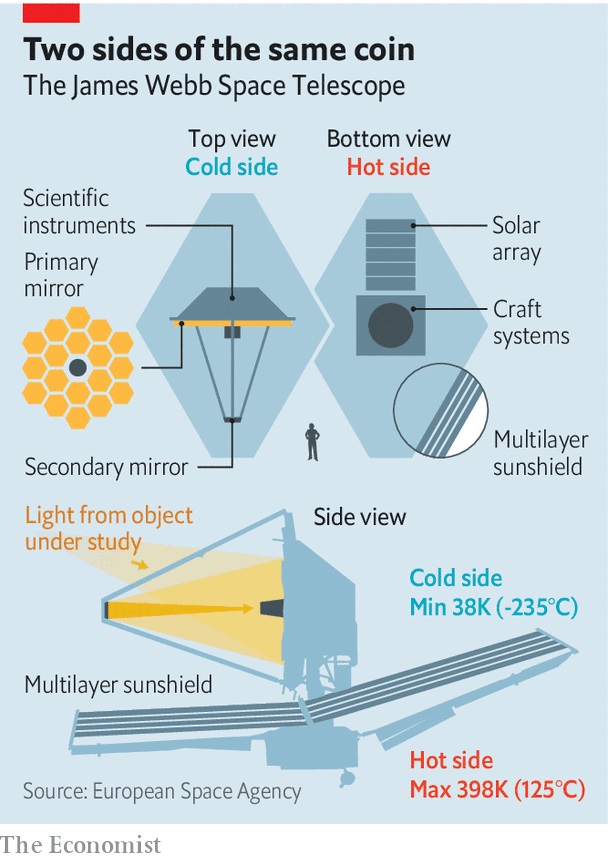
    • One of the most important objects it will carry is a large mirror which will help collect light from the objects being observed.
    • The primary mirror is made of 18 hexagonal-shaped mirror segments — each 1.32 metre in diameter — stitched together in a honeycomb pattern.
    • The primary mirror is a technological marvel.
    • The lightweight mirrors, coatings, actuators and mechanisms, electronics, and thermal blankets when fully deployed form a single precise mirror that is truly remarkable.
    • Each mirror segment weighs approximately 20 kilograms and is made from beryllium.

    Why beryllium?

    • NASA explains that beryllium was used as it is both strong and light.
    • Beryllium is very strong for its weight and is good at holding its shape across a range of temperatures. Beryllium is a good conductor of electricity and heat and is not magnetic.
    • Because it is light and strong, beryllium is often used to build parts for supersonic airplanes and the Space Shuttle.
    • It added that special care was taken when working with beryllium because it is unhealthy to breathe in or swallow beryllium dust.

    So, it does not have gold?

    • After the beryllium mirror segments were polished a thin coating of gold was applied to it. Gold helps improve the mirror’s reflection of infrared light.
    • The gold was coated using a technique called vacuum vapour deposition.
    • The mirrors are kept inside a vacuum chamber and a small quantity of gold is vapourised and deposited on the mirror.
    • The thickness of the gold is just 100 nanometers. So less than 50 grams of gold was used for the entire mirror.
    • A thin layer of glass was also deposited on top of the gold layer to protect it from scratches.


    UPSC 2022 countdown has begun! Get your personal guidance plan now! (Click here)

  • Perform, Achieve and Trade (PAT) Scheme

    A recent report by the Centre for Science and Environment (CSE) has attributed the inefficiency of the PAT scheme to non-transparency, loose targets and overlooked deadlines.

    PAT Scheme

    • Perform Achieve and Trade (PAT) scheme is a flagship program of Bureau of Energy Efficiency under the National Mission for Enhanced Energy Efficiency (NMEEE).
    • NMEEE is one of the eight national missions under the National Action Plan on Climate Change (NAPCC) launched by the Government of India in the year 2008

    Working of the scheme

    • PAT is a market-based compliance mechanism to accelerate improvements in energy efficiency in energy-intensive industries.
    • The energy savings achieved by notified industries is converted into tradable instruments called Energy Saving Certificates (ESCerts).
    • The ESCerts after issuance by the Bureau of Energy Efficiency are traded at Power Exchanges.

    What is PAT cycle?

    • The government shortlists industries and restricts the amount of energy they can consume and defines a time limit of three years by when this restriction should be met as part of PAT.
    • These three years of time are called one PAT cycle.
    • The industries are chosen after in-depth, sector-wise analysis by the government.
    • Industries that participate in this scheme are called designated consumers (DC).
    • Those that overachieve their targets are issued energy savings certificates (ESCerts) that can be traded with industries that have not achieved their targets.
    • Non-achievers have to buy the ESCerts after the three years for compliance.

    Various PAT cycles

    • PAT covered about 13 energy-intensive sectors
    • Sectors included are thermal power plants (TPP), cement, aluminium, iron and steel, pulp and paper, fertilizer, chlor-alkali, petroleum refineries, petrochemicals, distribution companies, railways, textile and commercial buildings (hotels and airports)
    • Announcements for six cycles since 2012 have been made so far


    UPSC 2022 countdown has begun! Get your personal guidance plan now! (Click here)

  • [pib] Scheme for Protection and Preservation of Endangered Languages of India (SPPEL)

    The Government of India has initiated a Scheme known as “Scheme for Protection and Preservation of Endangered Languages of India” (SPPEL) informed the Minister of Culture and Tourism.

    About SPPEL

    • The Scheme was instituted by Ministry of Human Resource Development in 2013.
    • The sole objective of the Scheme is to document and archive the country’s languages that have become endangered or likely to be endangered in the near future.
    • The scheme is monitored by the Central Institute of Indian Languages (CIIL) located in Mysuru, Karnataka.
    • The CIIL has collaborated with various universities and institutes across India for this mission.
    • University Grants Commission (UGC) is also providing financial assistance for the creation of centres for endangered languages at Central and State Universities.

    What are Endangered Languages?

    • At the moment, the languages which are spoken by less than 10,000 speakers or languages that are not been linguistically studied earlier are considered endangered language.

    Present status of the scheme

    • Presently, 117 languages have been listed for the documentation.
    • Documentation in the form of grammar, dictionary and ethno-linguistic profiles of about 500 lesser known languages are estimated to be accomplished in the coming years.


    UPSC 2022 countdown has begun! Get your personal guidance plan now! (Click here)

  • 3rd December 2021| Daily Answer Writing Enhancement(AWE)

    Topics for Today’s questions:

    GS-1    Population and associated issues, poverty, and developmental issues

    GS-2    Federalism

    GS-3    Infrastructure: Energy, Ports, Roads, Airports, Railways etc.

    GS-4    Public/Civil service values and Ethics in Public administration: Status and problems; ethical concerns and dilemmas in government and private institutions

    Questions:

    Question 1)


    Q.1 The recently released empirical data from the National Family Health Survey 2019-20 (NFHS-5) shows that States and UTs are experiencing a sharp decline in fertility rates. What are the key reasons for the decline? Do you think a policy limiting family size is still required? (15 Marks)


    Question 2)

    Q.2 NFHS-5 places India’s total fertility rate (TFR) at 2.0. With ageing states increasingly relying on a workforce from relatively younger states to maintain their economic prosperity, it may be time for us to change our mindset about critical dimensions of India’s federalism. Comment. (10 Marks)

    Question 3)

    Q.3 The global electric mobility revolution is today defined by the rapid growth in electric vehicle (EV) uptake. In the context of this, examine the opportunities offered by the battery storage revolution for India and discuss the measures taken by India to promote the EV ecosystem in India. (10 Marks)

    Question 4)  

    Q.4 Law cannot mention details of human conduct in different situations. Do you agree? If yes, what should guide the conduct of a public administrator if there is a conflict between legality and ethics? (10 Marks)


    HOW TO ATTEMPT ANSWERS IN DAILY ANSWER WRITING ENHANCEMENT(AWE)?

    1. Daily 4 questions from General studies 1, 2, 3, and 4 will be provided to you.

    2. A Mentor’s Comment will be available for all answers. This can be used as a guidance tool but we encourage you to write original answers.

    3. You can write your answer on an A4 sheet and scan/click pictures of the same.

    4.  Upload the scanned answer in the comment section of the same question.

    5. Along with the scanned answer, please share your Razor payment ID, so that paid members are given priority.

    6. If you upload the answer on the same day like the answer of 11th  October is uploaded on 11th October then your answer will be checked within 72 hours. Also, reviews will be in the order of submission- First come first serve basis

    7. If you are writing answers late, for example, 11th October is uploaded on 13th October, then these answers will be evaluated as per the mentor’s schedule.

    8. We encourage you to write answers on the same day. However, if you are uploading an answer late then tag the mentor like @Staff so that the mentor is notified about your answer.

    *In case your answer is not reviewed, reply to your answer saying *NOT CHECKED*. 

    For the philosophy of AWE and payment: 

  • Q.4 Law cannot mention details of human conduct in different situations. Do you agree? If yes, what should guide the conduct of a public administrator if there is a conflict between legality and ethics? (10 Marks)

    Mentor’s Comments-

    • Discuss role of law in ethical guidance and its limitation.
    • Discuss guiding principles for ethical decision making in the above case.
  • Q.3 The global electric mobility revolution is today defined by the rapid growth in electric vehicle (EV) uptake. In the context of this, examine the opportunities offered by the battery storage revolution for India and discuss the measures taken by India to promote the EV ecosystem in India. (10 Marks)

    Mentor’s comment-

  • Q.2 NFHS-5 places India’s total fertility rate (TFR) at 2.0. With ageing states increasingly relying on a workforce from relatively younger states to maintain their economic prosperity, it may be time for us to change our mindset about critical dimensions of India’s federalism. Comment. (10 Marks)

    Mentor’s comment-
    • https://indianexpress.com/article/opinion/columns/national-family-health-survey-demographic-transition-7649702/
    • In the intro, mention the findings of the NFHS-5 survey that indicates India reaching a replacement level of fertility.
    • In the body, mention implications of the declining fertility rate and its asymmetric nature which forces the southern states to rely on the workforce from the relatively younger states. In the next part mention the dimension of federalism such as a freeze in the allocation of Lok Sabha seats and division of central allocation to states.
    • In the conclusion mention that the Sixteenth Finance Commission and the next Delimitation Commission must be freed from the burden of managing the demographic transition, focused on carrying out their tasks in the best interests of Indian federalism.
  • Q.1 The recently released empirical data from the National Family Health Survey 2019-20 (NFHS-5) shows that States and UTs are experiencing a sharp decline in fertility rates. What are the key reasons for the decline? Do you think a policy limiting family size is still required? (15 Marks)

    Mentor’s Comments-

    • In the introduction, explain total fertility rate and replacement rate.
    • In the body, mention factual points from the survey substantiating the statement given.
    • Next, mention the reasons for decline such as female education, postponement of marriage, access to family planning etc
    • Next, mention that it would be odd to limit the family size anymore.
    • Talk about the way forward in states with low fertility rates as well as in states like UP and Bihar where fertility rates are still high.
    • Conclude appropriately.
  • [Yojana Archive] Making Gram Sabhas Vibrant

    November 2021: Panchayti Raj

    Gram Sabha: A backgrounder

    • The Gram Sabha is the fulcrum of the Panchayati Raj and village development.
    • It is the Sabha of the electorate. All other institutions of the Panchayati Raj like the Gram Panchayat, Block Panchayat and Zilla Parishad are constituted by elected representatives.
    • People use the forum of the Gram Sabha to discuss local governance and development, and make need- based plans for the village.
    • The Panchayat implements development programs under the overarching mandate, supervision and monitoring of the Gram Sabha.
    • All decisions of the Panchayat are taken through the Gram Sabha and no decision is official and valid without the consent of the Gram Sabha.

    Constitutional Provisions

    • The term Gram Sabha is defined in the Constitution of India under Article 243(b).
    • Gram Sabha is the primary body of the Panchayati Raj system and by far the largest.
    • It is a permanent body.

    Members of the Gram Sabha

    • Persons, those who are above 18 years of age and
    • living in the village and
    • whose names are included in the electoral rolls for the Panchayat at the village level.

    Meetings of the Gram Sabha

    • According to the State Panchayat Raj Acts, the Gram Sabha must meet at least two to four times in a year.
    • For people’s convenience, in most of the States, four national-international days have been identified as reference dates for these meetings. They are
    • Republic Day (26th January)
    • Labour day (1st May)
    • Independence Day (15th August)
    • Gandhi Jayanti (2nd October)
    • Gram Panchayats are however free to convene Gram Sabha on other dates according to their convenience.

    Who organizes Gram Sabha?

    • Panchayat Secretary (often called the Gram Sevak) after obtaining approval of the Sarpanch should organize the Gram Sabha.
    • Condition: The Sarpanch has to convene a Gram Sabha meeting when either 10% members of Gram Sabha or 50 persons of Gram Sabha (whichever is more) submits their requisition for holding a Gram Sabha.
    • Purpose of the meet: These members have to inform the purpose for the meeting.
    • Convening: A written request for the meeting must be handed over to the Sarpanch during office hours 5 days before the date of meeting.

    Issues with Gram Sabha

    The functioning of Gram Sabha is often criticized due to:

    1. Lack of regularity and transparency
    2. Low participation
    3. Irregular Gram Sabha meetings
    4. Absence of a coherent Gram Sabha agenda, etc.
    • The vulnerable sections of the village community hesitate to voice opinions due to inhibitions on account  of their financial and social standing.
    • The elected representatives of the Gram Panchayat, especially the Sarpanch, exercise significant powers and reduce Gram Sabhas to mere symbolic platform.

    Need & Relevance of Gram Sabha

    • Consensus building: Gram Sabha is a unique institution which would enable the citizens to highlight grass-root level problems and build consensus on possible solutions.
    • Participatory governance: Various flagship programs of the government require large scale mobilization and people’s direct participation.  It provides an ideal platform for this.

    Issues in functioning

    • Lack of funds: There is a need to enlarge the domain of panchayats to be able to raise their own funds.
    • Political interference: The interference of area MPs and MLAs in the functioning of panchayats also adversely affected their performance.
    • Ad-hocism: There is a presence of adhocismi.e. lack of clear setting of agenda in gram sabha, gram samiti meetings and no proper structure.
    • Unclear devolution: This has allowed concentration of powers with the states and thereby restraining the elective representatives who are more aware and sensitive to the ground level issues to take control.
    • Surrogate representation: Often women members are dominated by their spouses.

    Way forward for effective functioning

    The allocation of the Finance Commission’s Untied Grants is a major step towards strengthening financial autonomy. The following recommendations have been made for the effective functioning of GS:

    • Ensuring periodic Gram Sabhas
    • Formulating and distributing Agenda/Action taken Report
    • Preparing Annual Calendar: For spreading information about the annual schedule and the  nature of discussions in the various meetings.
    • Effective Scheduling: To enable the limited resources of District/Block administration to optimise efforts towards conducting the GSs.
    • Convenient Timings: Organizing Sabhas at a convenient time to enable the village population to attend in large numbers.
    • Administrative presence: The district administration should ensure attendance of Group A and B officers in all the Gram Sabha meetings.
    • Augmenting people’s participation: The minimum quorum for the meeting should be 10% of the members out of which at least 30% should be females.
    • Digital/virtual means of citizens’ participation: wherever possible and permissible, may also be considered. The services of elected representatives, SHGs, ASHA workers, Rozgar Sahayaks, etc., should  be utilized to create awareness about participation

    Conclusion

    • To ensure effective functioning of the Gram Panchayats, it is important to revitalize the Gram Sabha as an assembly of the village.
    • Bringing transparency, responsibility, and accountability in Panchayat functioning and its functionaries, would go a long way in creating Gram Panchayats as engines of socio-economic growth in the rural areas.
    • Vibrant Gram Sabhas could also chart ways for achieving India’s Sustainable Development Goals by facilitating their localization to the Gram Panchayat level.

    By facilitating participative democracy, the Gram Sabhas will not only contribute to the socio-economic development of the villages, but also create collective transformational change in the rural areas of the country.

  • India’s electric vehicle push will lead to brighter, greener future

    Context

    The transition to electric mobility is a promising global strategy for decarbonising the transport sector.

    Electricity mobility revolution

    • The global electric mobility revolution is today defined by the rapid growth in electric vehicle (EV) uptake.
    • This phenomenon is today defined by the rapid growth in EV uptake, with EV sales for the year 2020, reaching 2.1 million.
    • Falling battery costs and rising performance efficiencies are fueling the demand for EVs globally.

    Significance of India’s transition to electric mobility

    • India is the fifth largest car market in the world and has the potential to become one of the top three in the near future.
    • India is among a handful of countries that supports the global EV30@30 campaign, which aims for at least 30 per cent new vehicle sales to be electric by 2030.
    • Part of global climate agenda: The push for EVs is driven by the global climate agenda established under the Paris Agreement to reduce carbon emissions in order to limit global warming.
    • Ensuring energy security: It is also projected to contribute in improving the overall energy security situation as the country imports over 80 per cent of its overall crude oil requirements, amounting to approximately $100 billion.
    • Job creation: The push is also expected to play an important role in the local EV manufacturing industry for job creation.
    • Strengthen grid operation: Through several grid support services, EVs are expected to strengthen the grid and help accommodate higher renewable energy penetration while maintaining secure and stable grid operation.

    Battery storage: Opportunities and challenges

    • Promoting sustainable development: With recent technology disruptions, battery storage has great opportunity in promoting sustainable development in the country, considering government initiatives to promote e-mobility and renewable power (450 GW energy capacity target by 2030).
    • Economic opportunity: With rising levels of per capita income, there has been a tremendous demand for consumer electronics in the areas of mobile phones, UPS, laptops, power banks etc. that require advanced chemistry batteries.
    • This makes manufacturing of advanced batteries one of the largest economic opportunities of the 21st century.
    • Concern of absence of manufacturing base: It is estimated that by 2020-30 India’s cumulative demand for batteries would be approximately 900-1100 GWh, but there is concern over the absence of a manufacturing base for batteries in India, leading to sole reliance on imports to meet rising demand.

    Government schemes to promote EV ecosystem

    • To develop and promote the EV ecosystem in the country, government has remodeled Faster Adoption and Manufacturing of Electric Vehicles (FAME II) scheme (Rs 10,000 crore) for the consumer side.
    • It has also launched production-linked incentive (PLI) scheme for Advanced Chemistry Cell (ACC) ( Rs 18,100 crore) for the supplier side.
    • Finally the recently launched PLI scheme for Auto and Automotive Components (Rs 25,938 crore) for manufacturers of electric vehicles was launched.
    • All these forward and backward integration mechanisms in the economy are expected to achieve robust growth in the coming years and will enable India to leapfrog to the environmentally cleaner electric vehicles and hydrogen fuel cell vehicles.

    Benefits of EV ecosystem

    • This will not only help the nation conserve foreign exchange but also make India a global leader in manufacturing of EVs and better comply with the Paris Climate Change Agreement..
    • Battery demand creation: All three schemes cumulatively expect an investment of about Rs 1,00,000 crore which will boost domestic manufacturing and also facilitate EVs and battery demand creation along with the development of a complete domestic supply chain and foreign direct investment in the country.
    • Reduction of oil import bill: The programme envisages an oil import bill reduction of about Rs 2 lakh crore and import bill substitution of about Rs 1.5 lakh crore.

    Conclusion

    India’s push for EV ecosystem is in line with the country’s climate change commitments, will help boost manufacturing sector and also help ensure energy security.

    UPSC 2022 countdown has begun! Get your personal guidance plan now! (Click here)

  • A launch window for India as a space start-up hub

    Context

    After the launch of Sputnik in 1957, space race is on again, but this time, private players are on the power field. This has huge implications for original equipment manufacturers (OEMs) in the space sector in India and is a promising venture for global investors.

    Insignificant share of India in space economy

    • 2% India’s share: The space economy is a $440 billion global sector, with India having less than 2% share in the sector.
    • While total early-stage investments in space technologies in FY21 were $68 billion, India was on the fourth place with investments in about 110 firms, totalling not more than $2 billion.

    Reasons for India’s insignificant private participation

    • Absence of a framework: The reason for the lack of independent private participation in space includes the absence of a framework to provide transparency and clarity in laws.
    • Brain drain: Another aspect to throw light on is the extensive brain drain in India, which has increased by 85% since 2005.
    • Policy bottlenecks: Brain drain can be linked to the bottlenecks in policies which create hindrances for private space ventures and founders to attract investors, making it virtually non-feasible to operate in India.

    Suggestions

    • The laws need to be broken down into multiple sections, each to address specific parts of the value chain and in accordance with the Outer Space Treaty.
    • Dividing into upstream and downstream: Dividing activities further into upstream and downstream space blocks will allow legislators to provide a solid foundation to products/services developed by the non-governmental and private sectors within the value chain.
    • Timeline on licensing: With the technicalities involved in the space business, timelines on licensing, issuance of authorisation and continuous supervision mechanism need to be defined into phases.
    • Insurance and indemnification clarity: Another crucial aspect of space law is insurance and indemnification clarity, particularly about who or which entity undertakes the liability in case of a mishap.
    • In several western countries with an evolved private space industry, there is a cap on liability and the financial damages that need to be paid.
    • Need to generate own IP: Currently, many of the private entities are involved in equipment and frame manufacturing, with either outsourced specifications or leased licences.
    • However, to create value, Indian space private companies need to generate their intellectual property for an independent product or service with ISRO neither being their sole or largest customer nor providing them IP and ensuring buy-backs.

    Possibilities for India and the government’s effort

    • India currently stands on the cusp of building a space ecosystem and with ISRO being the guiding body, India can now evolve as a space start-up hub for the world.
    • Already 350 plus start-ups such as AgniKul Cosmos, Skyroot Technologies, Dhruva Space and Pixxel have established firm grounds for home-grown technologies with a practical unit of economics.
    • Last year the Government of India created a new organisation known as IN-SPACe (Indian National Space Promotion and Authorisation Centre) which is a “single window nodal agency” established to boost the commercialisation of Indian space activities.
    • A supplement to the Indian Space Research Organisation (ISRO), the agency promotes the entry of the Non-Government Private Entities (NGPEs) in the Indian space sector.

    Consider the question “Examine the factors responsible for hindering the participation of the private sector in India’s space industry? Suggest the ways to increase the participation of private sector.”

    Conclusion

    To continue the growth engine, investors need to look up to the sector as the next “new-age” boom and ISRO needs to turn into an enabler from being a supporter. To ensure that the sky is not the limit, investor confidence needs to be pumped up and for the same, clear laws need to be defined.

    UPSC 2022 countdown has begun! Get your personal guidance plan now! (Click here)

    Back2Basics: The Outer Space Treaty

    • The Outer Space Treaty was considered by the Legal Subcommittee in 1966 and agreement was reached in the General Assembly in the same year ( resolution 2222 (XXI)).
    • The Treaty was largely based on the Declaration of Legal Principles Governing the Activities of States in the Exploration and Use of Outer Space, which had been adopted by the General Assembly in its resolution 1962 (XVIII) in 1963, but added a few new provisions.
    • The Treaty was opened for signature by the three depository Governments (the Russian Federation, the United Kingdom and the United States of America) in January 1967, and it entered into force in October 1967.
    • The Outer Space Treaty provides the basic framework on international space law, including the following principles:
    • The exploration and use of outer space shall be carried out for the benefit and in the interests of all countries and shall be the province of all mankind;
    • Outer space shall be free for exploration and use by all States;
    • Outer space is not subject to national appropriation by claim of sovereignty, by means of use or occupation, or by any other means;
    • States shall not place nuclear weapons or other weapons of mass destruction in orbit or on celestial bodies or station them in outer space in any other manner;
    • The Moon and other celestial bodies shall be used exclusively for peaceful purposes;
    • Astronauts shall be regarded as the envoys of mankind;
    • States shall be responsible for national space activities whether carried out by governmental or non-governmental entities;
    • States shall be liable for damage caused by their space objects; and
    • States shall avoid harmful contamination of space and celestial bodies.
  • 2nd December 2021| Daily Answer Writing Enhancement(AWE)

    Topics for Today’s questions:

    GS-1     History of the world will include events from 18th century such as industrial revolution, world wars, redrawal of national boundaries, colonization, decolonization, political philosophies like communism, capitalism, socialism etc.— their forms and effect on the society.

    GS-2    Effect of policies and politics of developed and developing countries on India’s interests, Indian diaspora.

    GS-3    Infrastructure: Energy, Ports, Roads, Airports, Railways etc.

    GS-4    Contributions of moral thinkers and philosophers from India and the world.

    Questions:

    Question 1)


    Q.1 While, the First World War had many far-reaching impacts on the Western Europe and the USA, but it affected India too. Elaborate the impact of First World War on India. (10 Marks)


    Question 2)

    Q.2 “One of the many consequences of China’s assertive posture in Asia has been the emergence of geopolitical coalitions to limit Beijing’s regional dominance. Critically analyse. (10 Marks)

    Question 3)

    Q.3 While around half of the electricity is now being generated privately, most discoms are still state government-owned. What will the implications of using IBC proceedings against the discoms? (10 Marks)

    Question 4)  

    Q.4 “Our lives begin to end the day we become silent about things that matter”- Martin Luther King Jr. Bring out what this quote means to you in the present context. (10 Marks)


    HOW TO ATTEMPT ANSWERS IN DAILY ANSWER WRITING ENHANCEMENT(AWE)?

    1. Daily 4 questions from General studies 1, 2, 3, and 4 will be provided to you.

    2. A Mentor’s Comment will be available for all answers. This can be used as a guidance tool but we encourage you to write original answers.

    3. You can write your answer on an A4 sheet and scan/click pictures of the same.

    4.  Upload the scanned answer in the comment section of the same question.

    5. Along with the scanned answer, please share your Razor payment ID, so that paid members are given priority.

    6. If you upload the answer on the same day like the answer of 11th  October is uploaded on 11th October then your answer will be checked within 72 hours. Also, reviews will be in the order of submission- First come first serve basis

    7. If you are writing answers late, for example, 11th October is uploaded on 13th October, then these answers will be evaluated as per the mentor’s schedule.

    8. We encourage you to write answers on the same day. However, if you are uploading an answer late then tag the mentor like @Staff so that the mentor is notified about your answer.

    *In case your answer is not reviewed, reply to your answer saying *NOT CHECKED*. 

    For the philosophy of AWE and payment: 

  • Q.4 “Our lives begin to end the day we become silent about things that matter”- Martin Luther King Jr. Bring out what this quote means to you in the present context. (10 Marks)

    Mentor’s Comments-

    • Write a short note to establish the relationship between humans and the society.
    • Discuss the importance of speaking out as an essential condition for collective well-being.
    • Elaborate upon the adverse consequences of passively accepting unjust laws or behaviour.
    • Support your arguments with some examples.
    • Conclude accordingly.

More posts