Prime Minister Narendra Modi’s visit to Tamil Nadu during the Aadi Thiruvathirai festival at Gangaikonda Cholapuram drew attention due to its subtle political messaging and focus on the legacy of the Chola dynasty, especially Rajendra Chola I.
How can the Chola administration guide modern local governance?
Land and Revenue Management: They conducted detailed land surveys and classified land for fair taxation. Eg: Modern use of digital land records and GIS mapping can improve urban planning and property tax collection.
Sustainable Infrastructure: Built durable public works with advanced engineering. Eg: The Brihadisvara Temple shows disaster-resilient design, relevant for today’s urban infrastructure.
Grassroots Democratic Traditions: The Chola Sabhas and Ur assemblies practiced local self-governance, aligning with the 73rd and 74th Constitutional Amendments on decentralisation.
Efficient Local Administration: Chola-era institutions handled tax collection, infrastructure upkeep, and dispute resolution, offering a model for accountable and participatory governance today.
Why is Chola water management relevant today?
Sustainable Water Use: The Cholas built tanks, canals, and reservoirs for rainwater harvesting and year-round irrigation. Eg: Tamil Nadu can adopt tank rehabilitation for climate-resilient agriculture.
Integrated River Management: They managed the Cauvery delta through coordinated water channel planning. Eg: Programs like Namami Gange can apply holistic watershed development inspired by Chola methods.
Community-led Water Governance: Local communities maintained water systems, ensuring efficiency and accountability. Eg: Panchayati Raj Institutions can empower village water user associations for decentralised water management.
What can temple architecture teach about seismic safety?
Broad Base & Tapering Design: Chola temples had a wide foundation and pyramid-like structure to distribute weight and resist earthquakes. Eg: Brihadisvara Temple has survived centuries of seismic activity.
Interlocking Stone Technique: Used granite blocks without mortar, allowing flexible movement during tremors. Eg: Airavatesvara Temple stones fit precisely, boosting durability.
Seismic-Sensitive Construction: Built with awareness of local geology and fault lines for quake resilience. Eg: Southern temples remain structurally stable despite past earthquakes.
How does invoking the Chola legacy shape modern politics?
Cultural Nationalism & Historical Pride: Celebrating the Chola dynasty boosts national pride and showcases India’s ancient global influence. Eg: Leaders highlight Chola maritime trade and temple architecture to project a strong civilisational legacy.
Regional Outreach & Political Messaging: Invoking Chola heritage appeals to Tamil identity, aiding political connect with southern states. Eg: PM’s visit to Gangaikonda Cholapuram during Aadi Thiruvathirai signaled a move to gain regional goodwill.
Conclusion: The legacy of the Chola dynasty offers enduring lessons for contemporary India across governance, infrastructure, water management, architecture, and politics. Their grassroots democratic institutions, efficient local administration, and innovative land and water management practices provide a valuable blueprint for strengthening decentralised governance, promoting sustainable development, and enhancing climate resilience.
Mains PYQ:
[UPSC 2022] Discuss the main contributions of Gupta period and Chola period to Indian heritage and culture.
Linkage: This question is directly related to your query as it broadly asks about the “main contributions” of the Chola period to “Indian heritage and culture.” This scope allows for a comprehensive discussion that goes beyond just art and architecture (grand temples). It provides an opportunity to elaborate on the administrative acumen of the Cholas, their water management systems, tax and land revenue collection, and democratic processes, which are highlighted in the sources as significant “mundane facets…of modern relevance” and key aspects of their legacy.
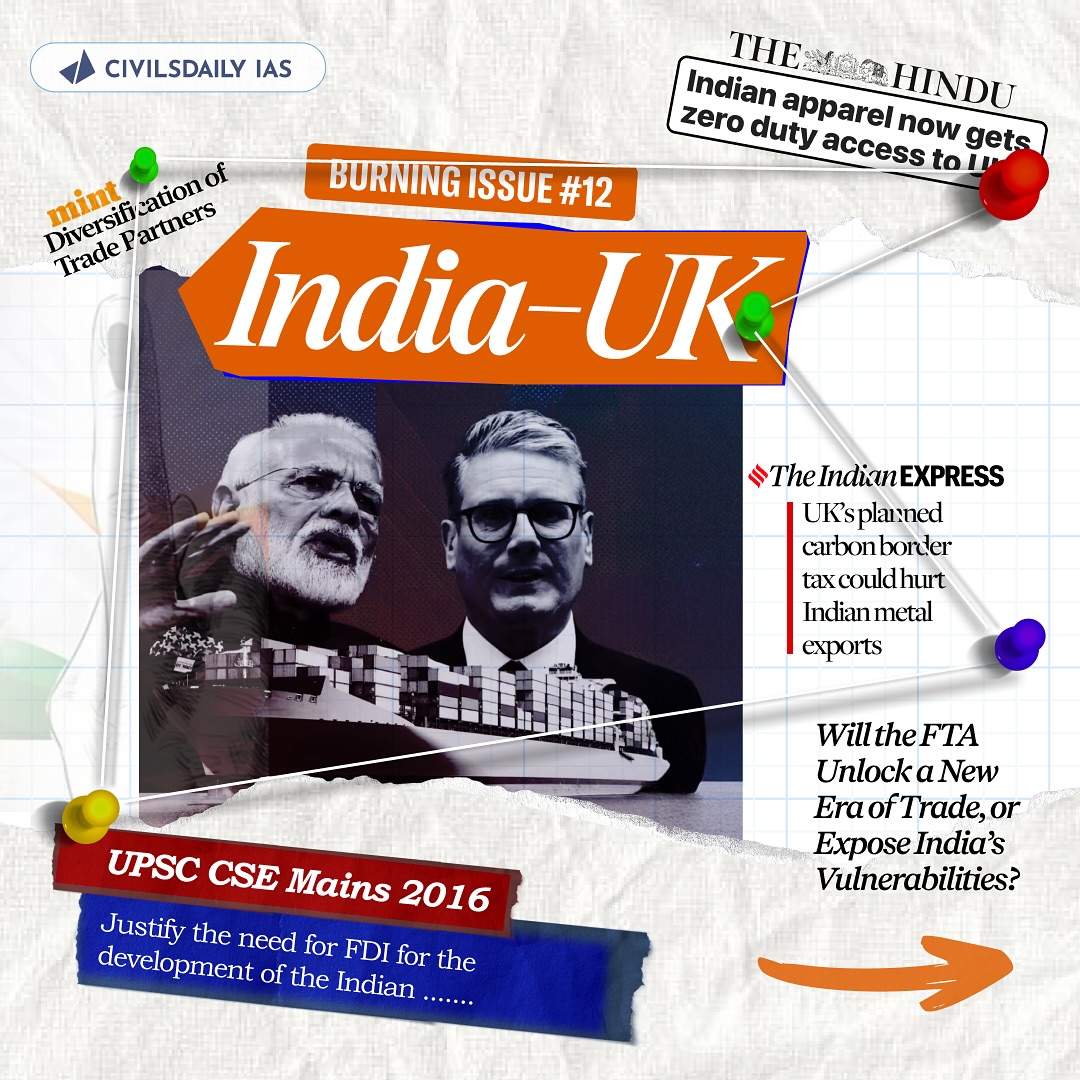
India and the United Kingdom (UK) announced the conclusion of a Free Trade Agreement (FTA) after three years of formal talks. Both countries also agreed to negotiate a reciprocal Double Contributions Convention (DCC).
DCC is a type of Social Security Agreement. o It will support business and trade by ensuring that employees moving between both countries and their employers, will only be liable to pay social security contributions in one country at a time. It will include employees temporarily working in the other country for up to 3 years.
Key Highlights of the India-UK Free Trade Agreement (FTA)
The India-UK FTA brings several direct and indirect benefits, making it a win-win for both countries and unlocking new opportunities.
Benefit
Description
Example
Enhanced Market Access
India gains zero-duty access to UK markets for industrial and agricultural goods; UK exporters get reduced tariffs in India.
Indian processed foods earlier faced 10–12% tariffs — now duty-free in the UK. Tariffs on British whiskey reduced from 150% to 40% over 10 years.
Boost to Key Domestic Sectors
Labour-intensive Indian sectors like textiles, apparel, toys, and footwear benefit; UK gains in automobiles and spirits.
Indian apparel now gets zero-tariff access to UK. Tariffs on British cars slashed from 100% to 10%.
Job Creation & Economic Growth
Trade expansion leads to employment generation and investment in both countries.
India’s textile sector, employing 45+ million people, can boost jobs through increased exports.
Diversification of Trade Partners
India reduces dependency on US/EU; UK diversifies beyond EU post-Brexit.
India currently holds just 1.8% share in UK imports — FTA targets major increase.
Foundation for Future FTAs
Sets a model for India’s trade negotiations with other major economies like the EU and US.
Learnings from tariff cuts and ESG compliance can aid future deals with EU/US.
Key Indian Beneficiaries of the India-UK FTA
Following are the sectors that expect to gain directly from the new trade agreement.
Engineering Export Sector: Expects exports to double due to tariff elimination. EEPC projects $7.55 billion by 2029-30.
Textile & Apparel Industry: Gains edge over Bangladesh/Vietnam with zero-duty access.
Gems & Jewellery Sector: Duty-free exports boost margins on gold and diamond products.
IT & Professional Services: Easier professional mobility and recognition of qualifications.
Indian Employers in the U.K.: Save on social security costs for Indian talent on temporary duty.
Concerns of Indian Farmers Regarding the FTA
While industry celebrates, farmers have voiced legitimate concerns about import competition.
Threat from Cheaper Agri-Imports: U.K. lamb, salmon, and dairy may undercut Indian produce. Eg: Lower-cost U.K. lamb hits local meat producers.
Low-Income Farming Risk: Indian small-scale farmers can’t compete with subsidised imports. Eg: Marginal farmers vulnerable to price crashes.
Lack of Safeguards: No quotas or countervailing duties announced. Eg: Sudden import surges could hurt local markets.
High Production Costs in India: Indian farmers face higher input costs which makes their products less competitive.
Absence of Adjustment Mechanisms: No phased liberalization or protection clauses to give farmers adjustment time.
Implications of the India-UK FTA on India’s future FTAs
The India-UK FTA could serve as a template and test case for future negotiations.
Template for Future FTAs: May influence India’s trade talks with EU and U.S. Eg: Liberalisation on 85% of U.K. imports could raise similar asks.
Sensitive Sector Precedents: Agriculture and alcohol tariff cuts may open the door for more. Eg: U.S. bourbon or EU wine exporters may demand similar access.
Manufacturing Sector Pressure: Greater market openness requires stronger industrial policies. Eg: Indian manufacturing, already weak globally, may face exposure.
Model for Services Negotiations: The services component may guide India’s future demands in professional mobility.
Balancing Atmanirbhar Bharat Goals: India must ensure that opening trade does not contradict its domestic self-reliance agenda.
Way Forward
Targeted reforms and long-term strategies are needed to make Indian textiles globally competitive, sustainable, and future-ready.
Reform Tax Structure & Boost Incentives: Rationalize the GST structure to eliminate the inverted duty issue and offer production-linked incentives (PLI) for MMF textiles to enhance global competitiveness.
Invest in R&D and Modern Manufacturing: Encourage investment in high-performance MMF fabric production, innovation, and compliance infrastructure to meet international standards in technical textiles and sustainability.
Develop Global Design Ecosystem: Build strong global collaborations with design houses and brands to integrate India into high-end global supply chains.
Expand Export Promotion Councils’ Role: Strengthen market intelligence, branding, and global promotion efforts through institutional support.
Enhance Logistics & Supply Chain Efficiency: Improve port, road, and air connectivity to reduce lead times and ensure timely deliveries to global clients.
India’s FTA Experience
Over the past three decades, India has signed several Free Trade Agreements with both regional and bilateral partners. However, the results have been mixed, with some gains in exports but also rising trade deficits and limited gains in services.
What Happened
What It Means
Example
India started signing FTAs in the 1990s
As India opened up its economy, it also began signing free trade agreements to boost trade and investment.
The first FTA was signed with Sri Lanka in 1998.
Export growth to FTA partners
India’s exports grew by 13.4% for manufactured goods and 10.9% overall from 1993 to 2018.
Exports to ASEAN, Korea, Japan increased — but so did imports.
Growth not solely due to FTAs
The rise in exports also happened with countries without FTAs, so FTAs can’t take all the credit.
Export trends were similar for both FTA and non-FTA partners.
SAFTA performed well
India’s trade surplus with SAFTA countries (South Asia) grew massively, meaning India sold more than it bought.
Surplus rose from $4B in 2005-06 to $21B in 2018-19; biggest gains with Nepal and Bangladesh.
Rising trade deficit with some FTA partners
India started importing more than exporting from countries like ASEAN, Japan, and South Korea.
Deficit with ASEAN rose from $8B in 2009-10 to $22B in 2018-19.
FTAs underused by Indian exporters
Many Indian businesses don’t use the FTA benefits due to lack of awareness or complex paperwork.
Only 5–25% of eligible trade goes through the FTA route (very low).
Weak export growth in value-added sectors
Sectors where India could earn more (like leather, textiles, chemicals) didn’t benefit much from FTAs.
In 13 out of 21 sectors under the India-ASEAN FTA, trade balance worsened.
FTAs cover only a small chunk of trade
India’s FTAs account for just about 15% of its total global trade — not enough to shift the big picture.
So even good or bad FTA outcomes don’t drastically change India’s overall trade.
Problems in India’s FTAs
While FTAs are designed to boost trade, India’s actual experience highlights several structural and negotiating weaknesses that reduce their effectiveness.
What’s Going Wrong
What It Means
Example
Unfair tariff deals
India ended up cutting import duties way more than it was required to, while others didn’t match up.
India agreed to cut 74–86% of tariffs in FTAs, while under WTO it only needed to cut 2%.
Non-tariff barriers
Even though tariffs are removed, Indian goods still face hidden restrictions like tough quality checks or complex import rules abroad.
Japan and other partners use strict standards or permits that block Indian goods.
Difficult to use FTAs
Exporters find the paperwork, rules, and benefits too complicated or not worth the trouble.
Complex “rules of origin” and low cost savings make many exporters avoid using FTAs.
No services coverage
India is strong in services (like IT, finance), but many FTAs don’t allow Indian professionals to easily work abroad.
No MRAs – an Indian doctor or engineer may not be recognized in partner countries.
India’s own internal issues
High transport costs, power shortages, and weak infrastructure make Indian products expensive and less competitive.
Exporters can’t meet delivery timelines or pricing benchmarks.
FTA misuse by others
Some countries route goods through FTA partners to bypass duties unfairly.
Copper imports falsely routed through Sri Lanka to claim benefits.
India seen as ‘protectionist’
Policies like Atmanirbhar Bharat and import restrictions make India appear closed off to free trade.
Other countries hesitate to sign or renegotiate FTAs with India.
Spaghetti Bowl Effect
Too many overlapping FTAs cause confusion, conflicting rules, and slow down trade.
India has separate FTAs with Malaysia and Singapore while also part of India-ASEAN CECA — this creates a tangled mess.
Slow pace of FTA talks
India takes too long to close trade deals compared to others.
Vietnam signed an FTA with the EU, but India-EU FTA talks have been dragging since 2007.
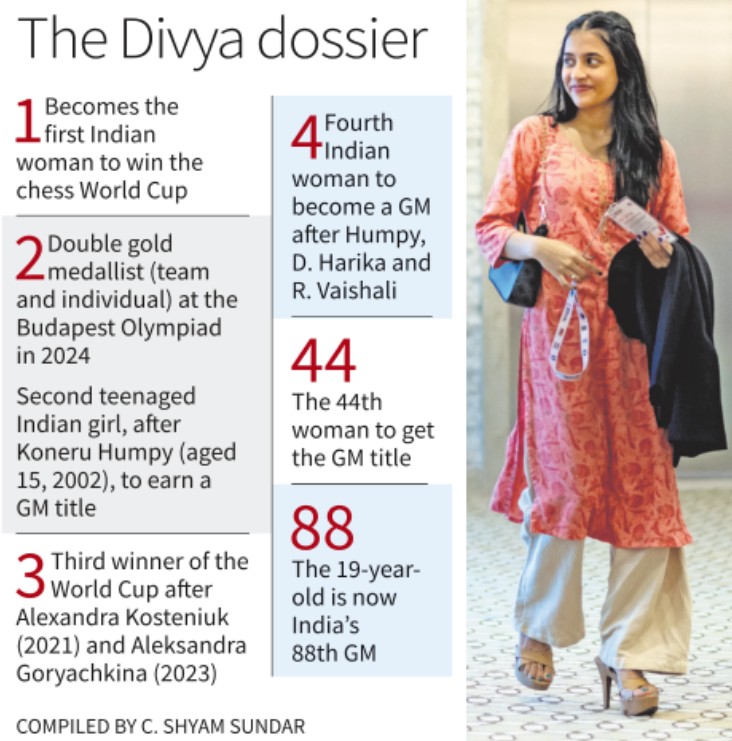
Divya Deshmukh made history by becoming India’s first Women’s World Cup Champion and only the fourth Indian woman Grandmaster, defeating Koneru Humpy in the final at Batumi, Georgia.
Major Achievements of Divya Deshmukh:
2025: Won the FIDE Women’s World Cup, defeating Koneru Humpy. Became India’s 4th woman Grandmaster.
2024: U-20 Girls’ World Champion
2023: Asian Women’s Champion
2022: Indian Women’s National Champion
Olympiad: Key contributor to India’s gold in 2025 Chess Olympiad (Budapest).
2013: Became India’s youngest Woman FIDE Master (WFM) at age 7.
About the FIDE World Chess Championship System:
FIDE (Fédération Internationale des Échecs): Global chess body founded in 1924; headquartered in Switzerland.
World Championship Format: Played over 14 classical games. A player must score 7.5 points to win.
Tiebreaker: If the match ends 7–7, rapid and blitz games are used.
Qualification Path:
Zonal and Continental Championships
FIDE World Cup (knockout)
Candidates Tournament (top player faces reigning champion)
Special Championships:
Women’s World Championship
Junior and Youth Championships
World Rapid & Blitz Championships
Key FIDE Events and Titles:
FIDE World Cup: Knockout format; major path to the Candidates.
FIDE Women’s World Cup: Equivalent format for top female players.
Title Hierarchy:
Grandmaster (GM) – highest title
International Master (IM)
FIDE Master (FM)
Candidate Master (CM)
Women’s Titles: Woman Grandmaster (WGM), Woman International Master (WIM), etc.
[UPSC 2024] Consider the following statements:
I. In the finals of the 45th Chess Olympiad held in 2024, Gukesh Dommaraju became the world’s youngest winner after defeating the Russian player Ian Nepomniachtchi.
II. Abhimanyu Mishra, an American chess player, holds the record of becoming world’s youngest ever Grandmaster.
Which of the statements given above is/are correct?
Options: (a) I only (b) II only * (c) Both I and II (d) Neither I nor II
PM recently stated that 77 stations in Tamil Nadu are being redeveloped under the Amrit Bharat Station Scheme (ABSS), positioning the state as a hub for railway transformation.
About the Amrit Bharat Station Scheme (ABSS):
Launch: 2022 by the Ministry of Railways.
Goal: Modernise and develop railway stations through phased, long-term upgrades.
Master Plans: Each station gets a tailored roadmap for future improvements.
Focus Areas: Multimodal integration, seamless passenger movement, and upgraded amenities.
National Significance: Integral to India’s infrastructure push under the Viksit Bharat vision.
Accessibility & Connectivity: Expanded circulating areas, barrier-free access for persons with disabilities, and smooth links to other transport modes.
Aesthetic Upgrades: Modern façades, clear signage, landscaping, and consistently clean premises.
Technology & Information: Digital displays, real-time train info, and self-service e-ticketing kiosks.
Sustainability: Energy-efficient systems, green-building elements, and water-conservation measures.
Customised Development: Station facilities scaled to local footfall and needs—no one-size-fits-all approach.
[UPSC 2024] Consider the following statements:
I. Indian Railways have prepared a National Rail Plan (NRP) to create a future ready railway system by 2028. II. ‘Kavach’ is an Automatic Train Protection system developed in collaboration with Germany. III. ‘Kavach’ system consists of RFID tags fitted on track in station section.
Which of the statements given above are not correct?
(a) I and II only (b) II and III only (c) I and III only (d) I, II and III*
Frequency: Held annually or biannually, alternating between Indian training zones like Babina and Jodhpur.
Participants: Focuses on armoured and mechanised infantry units from India and Singapore.
Framework: Conducted under United Nations Peacekeeping mandates, simulating mechanised warfare and joint operations.
Key Features:
Format:
Tabletop wargaming and computer-based simulations.
Validates doctrines and standard operating procedures in mechanised warfare.
Operational Objectives:
Improve interoperability and tactical planning.
Execute joint manoeuvres and enhance command-level coordination.
Build mutual understanding of combat and operational doctrines.
Evolution Over Time:
Progressed from basic drills to complex command post exercises and live-fire missions.
Includes scenario-based planning and real-time decision-making via digital simulations.
[UPSC 2008] ‘Hand-in-Hand 2007’, a joint anti-terrorism military training was held by the officers of the Indian Army and officers of the Army of which one of the following countries?
The 2025 State of Food Security and Nutrition in the World (SOFI) report highlights alarming levels of child malnutrition and anaemia among women in India.
About the SOFI Report:
Full Name:State of Food Security and Nutrition in the World
Published by: Food and Agriculture Organization (FAO), the International Fund for Agricultural Development (IFAD), the United Nations Children’s Fund (UNICEF), the World Food Programme (WFP), and the World Health Organization (WHO).
Started in: 1999
Purpose: Tracks global hunger, food insecurity, and nutrition. Monitors SDG-2 (Zero Hunger).
Global Highlights (2025):
Hunger Rate: Dropped from 8.5% (2023) to 8.2% (2024)
Undernourished People: 735 million globally
Double Burden: Undernutrition and obesity rising simultaneously
Healthy Diets: Cost rising due to inflation and climate impacts
India-Specific Findings:
Wasting (Under-5): 18.7% – highest globally (21+ million affected)
Stunting (Under-5): 37.4 million children
Overweight Children: 4.2 million (up from 2.7 mn in 2012)
Anaemia in Women (15–49): 53.7% (203 million affected)
Undernourished Population: 172 million (12% of population)
Unaffordable Healthy Diet: 42.9% can’t afford; cost rose from $2.77 (2017) to $4.07 (2024)
Adult Obesity: Doubled in a decade – now 71.4 million
[UPSC 2016] Which of the following is/are the indicator/ indicators used by IFPRI to compute the Global Hunger Index Report?
[UPSC 2024] What is disaster resilience? How is it determined? Describe various elements of a resilience framework. Also mention the global targets of the Sendai Framework for Disaster Risk Reduction (2015-2030).
Linkage: The article explicitly states that the NDMA has “markedly accelerated its efforts to manage these increasing risks” and initiated a “proactive shift from mere post-disaster response to risk reduction through its Committee on Disaster Risk Reduction (CoDRR)”. This directly links to the concept of “disaster resilience” and “Disaster Risk Reduction (DRR),” which are central to India’s preparedness strategy for GLOF events.
Mentor’s Comment: On July 8, 2025, Nepal experienced a major Glacial Lake Outburst Flood (GLOF), which triggered a flash flood along the Lende River, destroying a China-built friendship bridge and disabling four hydropower plants, cutting off 8% of Nepal’s power supply. This catastrophe highlights the growing threat of GLOFs due to glacial melt from rising temperatures in the Himalayas. The incident has raised concerns over the lack of trans-boundary early warning systems, particularly between China and Nepal. It also drew attention to India’s vulnerability, as the Indian Himalayan Region (IHR) contains 7,500 glacial lakes, many at high risk of GLOF due to climate change, poor monitoring infrastructure, and lack of early warning systems. India’s National Disaster Management Authority (NDMA) has responded by launching a national programme targeting 195 at-risk glacial lakes, focusing on hazard assessment, early warning systems, risk mitigation, and community engagement.
Today’s editorial analyses the major Glacial Lake Outburst Flood (GLOF) in Himalaya region. This topic is important for GS Paper III (Environment) in the UPSC mains exam.
_
Let’s learn!
Why in the News?
Recently, Nepal faced a major Glacial Lake Outburst Flood (GLOF), which led to a sudden flash flood along the Lende River.
What are GLOFs?
GLOFs are sudden floods caused by the breach of natural or man-made dams holding glacial lakes, releasing large volumes of water.
Himalayan Spread: The Himalayas across India, Nepal, Bhutan, and Tibet host thousands of glacial lakes, many near international borders. India has 7,500+ glacial lakes, with 200+ deemed potentially dangerous.
What are their transboundary risks in the Himalayas?
Trans-boundary Risk: GLOFs from upstream countries (e.g. China) can impact downstream nations (India, Nepal, Bhutan) without early warning. Eg: The July 2024 Tibetan GLOF damaged Nepal’s Rasuwagadhi hydropower project with no prior alert.
Lack of Data Sharing: Minimal real-time data exchange between neighbours hampers early warning and risk management. Eg:Nepal got no warning from China during the 2024 GLOF.
How has climate change increased GLOF frequency in the IHR?
Accelerated Glacier Melting: Rising temperatures cause glacier retreat and formation of unstable glacial lakes. Eg:Milam Glacier, Uttarakhand shows rapid retreat, increasing GLOF risk.
Extreme Precipitation: Intense rainfall from climate change can overfill lakes, causing breaches. Eg:Gya GLOF (2014) in Ladakh followed heavy rainfall, damaging infrastructure.
Increased Landslides: Thawing permafrost and unstable slopes trigger landslides into lakes, displacing water and causing GLOFs. Eg:2013 Chorabari Glacier landslide near Kedarnath worsened the flood impact.
What measures has India taken for GLOF mitigation?
Early Warning Systems (EWS): Installed to detect rising water levels and trigger alerts. Eg: EWS at South Lhonak Lake, Sikkim before 2023 GLOF.
Satellite Monitoring: ISRO-NRSC use remote sensing to track glacial lakes. Eg: Monitored via Bhuvan portal in Ladakh, Uttarakhand, Himachal Pradesh.
Risk Mapping: NMSHE identifies high-risk areas for targeted intervention. Eg: Studies in Kinnaur and Chamoli flagged vulnerable lakes.
Engineering Measures: Lake drainage and structural control to prevent overflow. Eg: Work at Tsho Rolpa Lake (Nepal) as a replicable model.
Community Preparedness: NDMA and states run drills and awareness programs. Eg: Mock drills in Uttarkashi and Kullu.
What are the gaps?
Weak Early Warning Systems (EWS): India lacks real-time sensors, automated sirens, and alert mechanisms. Eg: No early alerts during Chamoli disaster (2021).
Low Community Preparedness: Most villages in Sikkim and Uttarakhand lack evacuation protocols and disaster training.
Poor Transboundary Coordination: Minimal data sharing with China hinders early action in regions like Arunachal Pradesh.
Infrastructure Vulnerability: Bridges and dams not designed for GLOFs. Eg:Chungthang dam breach (2023) exposed weak infrastructure.
Limited Scientific Capacity: Shortage of glaciologists, risk modelers, and ground validation limits NDMA’s effectiveness.
Way forward:
Strengthen Early Warning Systems: Deploy real-time sensors, sirens, and automated alerts in high-risk zones.
Enhance Transboundary Cooperation: Establish formal data-sharing agreements with China, Nepal, and Bhutan.
Build Local Preparedness: Conduct regular community drills, awareness drives, and evacuation planning.
Climate-Resilient Infrastructure: Design dams, bridges, and power projects to withstand GLOF surges.
Invest in Research & Capacity: Train glaciologists, improve satellite-ground integration, and support Himalayan climate studies.
Recently, the Protection of Children from Sexual Offences (POCSO) Act, 2012 is under scrutiny as the Supreme Court examines whether consensual sex between adolescents aged 16–18 should be decriminalised.
What are the issues related to criminalising adolescent consent as per SC?
Misuse of Law Against Teens: Criminalising consensual sex between 16–18-year-olds leads to misuse of the law, treating teens in mutual relationships as offenders. Courts observed this goes against the protective intent of the POCSO Act.
Denial of Autonomy: Adolescents lose the right to make consensual choices, as their consent is legally invalid. Under Section 2(d) of POCSO, all under 18 are considered children, ignoring their autonomy.
What legal provisions support the criminalisation of adolescent consent?
Evolving Capacity of Adolescents: The UN Convention on the Rights of the Child (UNCRC), to which India is a signatory, recognises that adolescents have evolving capacities. Eg: International norms suggest that children above 16 may have sufficient maturity to make informed decisions, including about consensual relationships.
Madras High Court (Vijayalakshmi vs. State, 2021): The court observed that consensual relationships among adolescents should not be criminalised when the age difference is modest (within 5 years). Eg: A 17-year-old girl and her 19-year-old partner in a consensual relationship were seen as victims of misuse of POCSO.
Amicus Curiae Submissions to the Supreme Court (2024): Senior Advocate Indira Jaising suggested reading an exception into the POCSO Act to decriminalise consensual sexbetween adolescents aged 16–18. Eg: She argued that consent between sexually mature adolescents should not be labelled as abuse under law.
Law Commission of India Report (2023): While not favouring a change in the age of consent, the Commission recommended “guided judicial discretion” in cases involving 16–18-year-olds in consensual relationships. Eg:Judges may consider the consensual nature while deciding on punishment, avoiding harsh sentences for adolescent partners.
Note:Amicus Curiaeis a Latin term meaning “friend of the court.” It refers to a person or organization not a party to the case, but who offers relevant information, expertise, or insight to assist the court in making its decision.
What about the POSCO?
POCSO stands for the Protection of Children from Sexual Offences Act, 2012. It is a comprehensive law enacted by the Indian Parliament to protect children under 18 years from sexual abuse, sexual harassment, and pornography.
Case Study:
United Kingdom – “Gillick Competence” Doctrine: The UK follows the principle of Gillick competence, where children under 16 can legally consent to medical treatment (including sexual health services) if they are mature enough to understand the consequences. The Sexual Offences Act 2003 criminalises sex under 16, but the law is applied with discretion, especially in mutual consensual relationships between teenagers close in age.
Canada – Close-in-Age Exemption: Under Canada’s Criminal Code, the age of consent is 16, but there is a “close-in-age exemption”. Eg: A 14–15-year-old can legally consent to sex with a partner less than 5 years older if the relationship is not exploitative. This balances protection from abuse with recognition of adolescent development and autonomy.
Way forward:
Legislative Clarity with Close-in-Age Exemption: Amend the POCSO Act to introduce a close-in-age exemption (e.g., age difference ≤5 years) for consensual adolescent relationships between 16–18 years, as suggested by courts like the Madras High Court. This ensures protection from exploitation while avoiding unjust criminalisation.
Comprehensive Adolescent Legal Awareness Programs: Launch school-based sensitisation campaigns to educate teenagers on consent, law, rights, and consequences of sexual activity. This promotes informed decision-making and reduces misuse or misunderstanding of the law.
Mains PYQ:
[UPSC 2023] The Constitution of India is a living instrument with capabilities of enormous dynamism. It is a constitution made for a progressive society”. Illustrate with special reference to the expanding horizons of the right to life and personal liberty.
Linkage: The debate surrounding the POCSO Act and the age of consent for consensual adolescent relationships directly exemplifies how legal frameworks, and indeed the Constitution, must adapt to the realities of a “progressive society”. The call for exemptions or caveats to the POCSO Act, especially when “normal adolescent behaviour” is criminalized.
On July 3, 2025, Russia officially recognised the Islamic Emirate of Afghanistan (IEA), becoming one of the first major powers to do so since the Taliban’s return to power in 2021. This move follows the accreditation of the Taliban’s ambassador to Moscow, and marks a major shift in Russia’s Afghanistan policy, which had previously labelled the Taliban as a terrorist organisation.
Why did Russia recognise the Taliban regime now?
Acknowledging Ground Reality: Russia views the Taliban as the de facto rulers of Afghanistan with control over territory and administration. Eg: Since 2021, the Taliban have exercised uninterrupted control over Kabul and provinces, making them the sole authority maintaining internal order.
Counterterrorism Cooperation: Russia sees the Taliban as a potential partner in counterterrorism, especially against Islamic State-Khorasan (IS-K), which threatens regional and Russian security. Eg: After the Moscow concert hall attack (March 2024) attributed to IS-K, Russia enhanced backchannel security coordination with the Taliban.
Maintaining Strategic Influence in the Region: By recognising the Taliban, Russia aims to safeguard its geopolitical influence in Central and South Asia, countering Western absence and Chinese rise. Eg: Russia’s engagement through the Moscow Format strengthens its regional leadership in Afghan dialogue.
Preceding Legal and Diplomatic Softening: In April 2025, Russia’s Supreme Court suspended the 2003 ban on Taliban activity, allowing legal recognition without full delisting. Eg: The suspension of the terrorist tag created a diplomatic opening for formal recognition.
What are the regional implications of Russia’s move?
Shift in Regional Power Dynamics: Russia’s recognition challenges the Western-led isolation of the Taliban and may encourage other regional powers to formalise ties. Eg: Countries like Iran and China, already engaged economically with the Taliban, may now consider official recognition, altering the diplomatic status quo.
Boost to Taliban’s Legitimacy and Regional Acceptance: Recognition provides the Taliban diplomatic credibility, enabling greater participation in regional forums and access to aid or investment. Eg: The Taliban may now join regional security formats like the Shanghai Cooperation Organisation (SCO) observer sessions more freely.
Enhanced Security Cooperation Against Terrorism: Russia may now collaborate more openly with the Taliban to counter threats like IS-K, stabilising parts of Central Asia. Eg: Joint discussions on border security with Tajikistan and Uzbekistan may increase, helping curb militant infiltration.
How has Russia’s Taliban policy evolved since 1996?
Rejection and Hostility (1996–2001): Russia declared the Taliban a terrorist organisation, opposing its rise in Afghanistan due to fears of Islamist extremism spreading to Chechnya and Central Asia.
Cautious Engagement (2001–2021): While still labelling the Taliban a terrorist group, Russia began unofficial contacts to safeguard regional interests and hosted intra-Afghan peace talks in Moscow.
Strategic Recognition (Post-2021): Following the U.S. withdrawal and Taliban takeover, Russia shifted to a realpolitik approach, officially recognising the Taliban in 2024 to secure influence, counter the West, and stabilise its southern flank.
What does this recognition mean for India and China?
India – Strategic Marginalisation: Russia’s recognition may reduce India’s diplomatic influence in Afghanistan, where it has supported a democratic and inclusive political setup. Eg: India’s $3 billion investments in Afghan infrastructure (like the Afghan Parliament building) may lose strategic value amid a Taliban-dominated regime backed by regional powers.
China – Regional Leverage: It boosts China’s ability to engage the Taliban diplomatically and economically, securing interests in security (Xinjiang) and resource extraction. Eg: China has initiated talks on expanding the Belt and Road Initiative (BRI) into Afghanistan and invested in Mes Aynak copper mines, which may progress with Russian support.
How should India engage with the Taliban post-recognition? (Way forward)
Pragmatic Diplomatic Channels: India should maintain non-recognition-based engagement through back-channel talks and functional diplomacy to protect its strategic and security interests, especially in areas like counter-terrorism and regional connectivity.
Conditional Development Cooperation: India can offer developmental aid and economic projects in health, education, and infrastructure, conditioned on Taliban commitments to human rights and non-support for cross-border terrorism.
Mains PYQ:
[UPSC 2024] Critically analyse India’s evolving diplomatic, economic and strategic relations with the Central Asian Republics (CARs) highlighting their increasing significance in regional and global geopolitics.
Linkage: The article explicitly states that Russia’s decision to officially recognize the Islamic Emirate of Afghanistan (IEA) government sets a “precedent” and that “some Central Asian states and even China may well follow suit”. This direct link indicates that Russia’s strategic shift regarding the Taliban significantly impacts the diplomatic, economic, and strategic relations of CARs, making understanding this “gauntlet” crucial for analyzing regional and global geopolitics.
The National Legal Services Authority (NALSA) has launched the ‘Veer Parivar Sahayata Yojana’, aimed at improving legal aid for defence personnel and their families.
Back2Basics: National Legal Services Authority (NALSA)
Established under: Legal Services Authorities Act, 1987 (in force from 1995)
Mandate: Ensure free, competent legal aid to the socially and economically disadvantaged
Leadership:
Patron-in-Chief: Chief Justice of India
Executive Chairman: Senior Supreme Court Judge
Core Functions:
Legal literacy campaigns
Lok Adalats for amicable dispute resolution
Legal aid in civil and criminal matters
Outreach in rural and vulnerable communities
About Veer Parivar Sahayata Yojana:
Launched by: National Legal Services Authority (NALSA).
Objective: Provide legal assistance to defence personnel, ex-servicemen, and their families.
Key Features:
Legal Clinics: Set up at Zilla, Rajya, and Kendra Sainik Boards
Welfare–Legal Integration: Sainik Boards become legal service hubs
Paralegal Volunteers: Defence families encouraged to participate, enhancing local legal access
Legal Assistance includes:
Land and property disputes
Matrimonial and family matters
Service-related entitlements
Utility/civil grievances (e.g., billing disputes)
Support for personnel in remote/conflict zones
Free Legal Aid in India:
Constitutional Backing
Article 21 (FR): Access to justice as part of the right to life
Article 39A (DPSP): Legal aid and equal justice, added via 42nd Amendment Act, 1976