The Moscow Format of Consultations on Afghanistan was recently held in the Russian capital.
What is the Moscow Format?
The Moscow format was introduced in 2017 on the basis of the six-party mechanism for consultations between special representatives from Russia, Afghanistan, China, Pakistan, Iran and India.
The present meeting includes a group of 10 nations including India, China, Pakistan, Iran and the Central Asian republics with Taliban officials.
Russia had previously convened a new meeting of the ‘Extended Troika’ on Afghanistan which included Russia, the United States, China and Pakistan.
The US pulled out of the last meeting.
Taliban did not participate in the talks but, welcomed the discussion and declared that it will not allow Afghan territory to be used against “stability of the region”.
Key outcomes of the meet
The dialogue called for respect for all Afghan ethnic groups and minorities in a bid to create national reconciliation in the war torn country.
The Russian hosts, presented a White Book on the civilian losses in Afghanistan due to the actions of the NATO forces during the past two decades.
The representatives at the talks also called for “complete unfreezing” of Afghanistan’s assets by Washington.
Urging the Taliban Govt.
Prevent poppy cultivation: Participating countries called upon the Taliban setup to “fulfil its commitments to eradicate terrorism and drug trafficking” that continue to emanate from the Afghan territory.
Stop atrocities: The return of the Taliban has been followed by a series of attacks on Shia Hazaras and growing atrocities against women and political opponents.
Inclusive govt. formation: The participants underscored the importance of forming a “truly inclusive government in Afghanistan, reflecting the interests of all major ethno-political groups of the country.”
On November 16, events to commemorate the martyrdom of Uda Devi, a freedom fighter from the Pasi community, were held at various places in Uttar Pradesh.
Who was Uda Devi?
Uda Devi is remembered not only for her stories of valour but also for her skill as a leader who managed to mobilise people — especially Dalit women — to take up arms against the British.
Born in Ujirao, Lucknow, she was part of the royal guard of Begum Hazrat Mahal of Awadh.
Her husband, Makka Pasi, worked as a foot soldier in the army of Awadh’s Nawab, Wajid Ali Shah.
Hazrat Mahal’s palace had several women belonging to marginalised communities, and their occupation was mostly to take care of the needs of the royalty.
Some of them, who showed promise, were also trained as warriors. Uda Devi was one of them.
Her legend
Amid the revolt of 1857, on June 10, at Chinhat near Ismailganj, a battle was fought between the army of Lucknow and the British troops led by Henry Lawrence, in which Makka Pasi lost his life.
The death of her husband spurred Uda Devi on to take up a more active role in the mutiny.
On November 16, 1857, Uda Devi was among the soldiers who clashed with the British regiment stationed near the Gomti River.
Although not much of the fight has been documented in history, it is said that Uda Devi killed at least three dozen British soldiers from atop a tree before she could be spotted.
Can you recall the Eka Movement of 1921 from your modern history references? If not, take your time to revise. Read about the contribution of Madari Pasi in this movement.
In his address to the Indian diaspora in Bali on the sidelines of the G20 summit, PM Modi mentioned the annual Baliyatra on the banks of the Mahanadi in Cuttack, which celebrates the ancient trade relations between India and Indonesia.
Baliyatra
Baliyatra/ Balijatra, literally ‘voyage to Bali’, is one of India’s largest open-air fairs.
It is organised every year to commemorate the 2,000-year-old maritime and cultural links between ancient Kalinga (today’s Odisha) and Bali and other South and Southeast Asian regions.
Origins of the festival
The origins of the festival, which begins on Kartik Purnima (full moon night in the month of Kartik) can be traced back more than 1,000 years.
The Bay of Bengal region had several ports, and sadhavas (traders) traditionally began their voyage across the sea on this auspicious day, when the winds were favourable for the boats, known as boita, to sail.
The traders would set sail to distant lands of Bali, as well as Java (at the time of the voyage known as “Yawadvipa”), Sumatra, Borneo (all in Indonesia), and Sri Lanka (formerly Ceylon) for trade and cultural expansion.
According to historians, popular items of trade between Kalinga and Southeast Asia included pepper, cinnamon, cardamom, silk, camphor, gold, and jewellery.
Even today, thousands of people across Odisha sail decorative miniature boats made of banana stems, paper, or thermocol to celebrate boita bandana, or the worshipping of the boats.
There is no doubt that UPSC Prelims is the toughest & most vital stage. It is the great filter that weeds out the not-so-serious candidates but at times many serious ones too.
Although there can be many reasons for failing prelims like inadequate syllabus coverage, not attempting mock or test series, not proper planning, lack of conceptual understanding, etc. but the main one is lack of guidance, preparation analysis, and course revision at regular intervals.
Tavishi failed thrice in the Prelims before but after joining Santosh sir’s mentorship cleared Prelim 2022 on her 4th attempt. Schedule a call with Tavishi’s mentor
Moreover, candidates must be prepared for those offbeat MCQs thrown by UPSC in prelims (new things being tried by UPSC- like options, subjects, etc.).
To fill this gap we launched the Smash Prelims program under Santosh Gupta sir last year and the results were amazing.
SMASH PRELIMS 2023: PERSONALIZED MENTORSHIP, TEST SERIES, LECTURES, NOTES
Our Smash Prelims Program started as a pilot project last year with an aim to introduce step-wise improvement in our chosen 40 aspirants. Over a period of 2 months, Santhosh sir inculcated confidence in aspirants who were either newbies or gave too many attempts. This year, we achieved a remarkable 80% success ratio. This year, we have set our eyes on 100%. Yes, we are as ambitious and aspirational just like any other UPSC aspirant.
‘Answer to all your dilemmas of Prelims’: Program inclusion
1) One-to-One mentorship for UPSC Prelims 2023 by dedicated mentors and Santosh sir
2) 44 tests (14 basics + 8 Advanced + 10 FLT + 6 CSAT + 6 CA ) for back to back intensive revision
3) Weekly LIVE Zoom sessions with Santosh Sir for doubt clearance and QnA
4) Value-addition classes on the 50 most important topics for Prelims
5) LIVE MCQs solving (1000 questions) based on elimination techniques for a sure score of 120+ marks
6) 1 year’s complete current affairs (LIVE) by the core CD faculty in featured classes with a LIVE discussion + PDF notes
Highly experienced UPSC-qualified mentors (Experience of 4+ years)
Mentors call after each test to clear your doubts and help cover the entire syllabus
Evidence-based questions based on the UPSC’s current trends
Tests discussions
Weekly LIVE zoom sessions by Santosh sir to learn from his experience of 6 out of 6 prelims with 130+ marks
Ask me anything sessions
Weekly classes cover the 50 most important and scoring areas of UPSC Prelims for a push to 120+ marks (Unmissable for any sincere aspirants) taken by Santosh sir himself based on his own notes
Santosh sir will teach you the secret of elimination methods from his own experience of getting 130+ every time (Learn 36 techniques through solving 1000+ questions with him)
Accuracy improvement classes
Current affairs live classes by core faculty of CD with concise notes from 2022 with a focused approach (2022-23 current affairs will be provided for free)
CA magazine + budget and economic survey will be provided for free
Special Session on Prelims with toppers (Subject experts)
1000+ students qualified for Prelims under Santosh sir’s guidance
Specifically made Current affairs notes + Live classes by core faculty for the entire two years for prelims.
You are 8 times more likely to clear Prelims 2023 with Santosh sir’s mentorship under the Smash Prelims program
About Santosh Gupta sir
Santosh Gupta sir has scored above 140 twice in UPSC prelims and always 120 plus in all 6 attempts. He wrote all 6 mains and appeared for Interviews 3 times. He has qualified for UPSC EPFO and BPSC 56-59th also. He has been teaching and mentoring UPSC aspirants for the last 5 years.
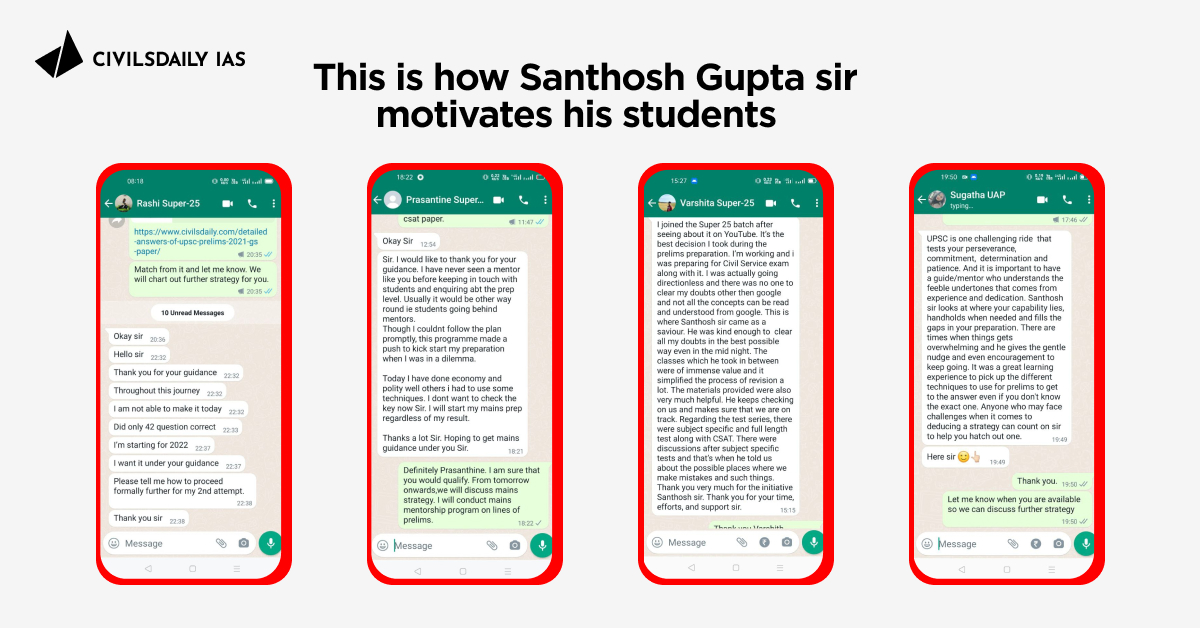
What CivilsDaily’s Smash Prelims students have to say?
HOW TO ATTEMPT ANSWERS IN DAILY ANSWER WRITING ENHANCEMENT(AWE)?
Daily 4 questions from General studies 1, 2, 3, and 4 will be provided to you.
A Mentor’s Comment will be available for all answers. This can be used as a guidance tool but we encourage you to write original answers.
You can write your answer on an A4 sheet and scan/click pictures of the same.
Upload the scanned answer in the comment section of the same question.
Along with the scanned answer, please share your Razor payment ID, so that paid members are given priority.
If you upload the answer on the same day like the answer of 11th February is uploaded on 11th February then your answer will be checked within 72 hours. Also, reviews will be in the order of submission- First come first serve basis
If you are writing answers late, for example, 11th February is uploaded on 13th February , then these answers will be evaluated as per the mentor’s schedule.
We encourage you to write answers on the same day. However, if you are uploading an answer late then tag the mentor like @Staff so that the mentor is notified about your answer.
*In case your answer is not reviewed, reply to your answer saying *NOT CHECKED*.
On 27 September, 2021, Prime Minister Narendra Modi announced the rollout of the Ayushman Bharat Digital Mission with the aim of integrating the different and disparate digital health systems that exist into a National Digital Health Ecosystem.
What is Ayushman Bharat Digital Mission (ABDM)?
The ABDM currently has five main components:
Ayushman Bharat Health Account (ABHA) number: A unique health identification number,
Healthcare Professionals Registry (HPR): A repository of healthcare professionals across both modern and traditional systems of medicine,
Health Facility Registry (HFR): A repository of both public and private health facilities, including hospitals, clinics, diagnostic laboratories, and pharmacies,
Unified Health Interface (UHI): An open protocol for digital health services linking patients with healthcare providers,
ABHA Mobile App: An app allowing an individual to carry electronic health records.
Digitization push of Government: To achieve the Sustainable Development Goals and targets of universal health coverage, the Indian government has expended significant efforts to promote the digitization of the healthcare sector to make health accessible, affordable, and equitably distributed.
Citizens and doctors can access the health registry: The two registries would ostensibly create a database of India’s healthcare institutions and professionals that citizens would be able to access.
Digital health card: The ABHA number and the application allow citizens to securely identify themselves and carry their health records to any healthcare facility.
Targeted health care services: And lastly, the UHI would facilitate greater access to and delivery of healthcare services.
Huge data for research: All of this activity has and will generate a tremendous quantity of data, which will be crucial for research, innovation, and policymaking.
Importance of private sector in health sector
Mixed health care system: India has a mixed healthcare system, which means that it has both public and private healthcare providers. Without significant participation from the private healthcare providers, the ABDM’s ability to achieve its objectives will be limited.
81% doctors are private: This is because private healthcare infrastructure accounts for nearly 62 per cent of all of India’s health infrastructure and the private sector also provides 81 per cent of the doctors in India.
Preference to private healthcare: Both rural and urban population in India seem to prefer seeking treatment from the private sector. Only 33 per cent of the rural and 26 per cent of the urban population depend on the public sector for healthcare.
Why Private health care are opting out of ABDM?
Voluntary participation in ABDM: The voluntary nature of participation in the ABDM has led to a significant portion of private healthcare providers opting to not participate in the universal programme nor integrate into the UHI.
High cost for digital records: Small healthcare providers like charitable hospitals, clinics, diagnostic labs, pharmacies, or nursing homes are less inclined to participate because of the significant costs involved.
Requirement of manpower for digitization: The cost to these healthcare providers, who are most likely in various stages of digitisation, is the number of man hours required to digitise their health records and other data.
Financial cost of digitization: The actual financial cost of upgrading or altering their digital health systems to meet basic required standards to participate in the ABDM and the UHI.
Impact of non-participation by private players
A lack of participation from the private sector will negatively impact the objectives of the ABDM in major way:
Limited success for UHI: Considering the concentration of private healthcare providers in urban areas, a lack of their participation and integration would limit the UHI’s ability to bring previously inaccessible services to the rural population who would otherwise have to travel to access them.
Incomplete data and ineffective policy: The data generated by the ABDM and use of the UHI would be incomplete, which in turn would significantly limit the effectiveness of policy planning and programme delivery.
Conclusion
It is unclear whether the government intends to achieve private sector participation through incentives or mandates. Without either approach, it seems that the ABDM will see little participation from smaller private healthcare providers, though how this will play out remains to be seen.
Mains Question
Q. What is the significance of Private Players in health care system of India? Explain the crucial role of Private health care in Ayushman Bharat digital Mission.
To achieve the export target of $2 trillion by 2030, India is going the whole hog on free trade agreements (FTAs). India is negotiating FTAs with countries such as the European Union, Canada, the U.K., and Israel.
Importance of FTA
FTA include multiple trade aspects: FTAs cover a wide array of topics such as tariff reduction impacting the entire manufacturing and the agricultural sector; rules on services trade; digital issues such as data localization; intellectual property rights that may have an impact on the accessibility of drugs; and investment promotion, facilitation, and protection.
Great impact on economy and society: Consequently, an FTA has a far-reaching impact on the economy and society. Given this, one legitimately expects transparency and greater scrutiny of the FTA process both during and after the negotiations.
What are the problems with Indian FTA negotiations?
Lack of transparency in negotiations: India negotiates most FTAs behind closed doors with very little information about the objectives and processes followed and negligible scrutiny.
No robust framework for FTA negotiations: This is not the case in other countries with whom India is negotiating such an FTA. In the U.K., for example, there are several robust mechanisms that foster a certain degree of transparency in the FTA negotiations. Furthermore, there are institutional apparatuses that enable the scrutiny of the actions of the executive, during and after the signing of the FTA.
Detailed information on FTA’s: Department of International Trade (DFIT), U.K., publishes a policy paper laying down the strategic objectives behind negotiating an FTA and why it is important for the U.K. to have an FTA with a particular country. This policy paper is fairly detailed listing the specific advantages of signing an FTA such as the economic gains expected, distributional impacts, the environmental impact, and the labour and human rights dimensions of the FTA.
Inputs from stakeholders: The policy paper that the DFIT publishes also contains the inputs and responses received by various stakeholders such as businesses, non-governmental organizations, and others. Furthermore, the policy paper also explains the government view on specific suggestions
FTA scrutiny by parliament: In the U.K., the strategic objectives identified by the government for signing an FTA are scrutinized by the U.K. Parliament. This job is performed by the International Agreements Committee (IAC) of the British Parliament. The IAC hears expert witnesses on the FTA, critically examines the government’s strategic objectives for each FTA under negotiation, and offers key recommendations wherever it finds gaps in the government’s approach. The U.K. government then responds to these recommendations.
Parliament has to ratify the FTA: In the U.K, under the Constitutional Reform and Governance Act, 2010, the executive has to lay down a treaty before the British Parliament for 21 sitting days with an explanatory memorandum before ratifying it. This allows Parliament to be apprised of the treaty the executive is going to ratify.
The contrast case of India’s FTA
No publicly produced document in India: In India, no such document is produced publicly that makes a case for signing an FTA and assessing its impact on the environment and society at large. The Commerce Ministry the nodal body dealing with FTAs on its website provides the bare minimum information about FTA negotiations.
No record of discussion with the stakeholders: Seemingly, the Commerce Ministry also undertakes stakeholder consultations and inter-ministerial meetings but there is no public record of these discussions and the government’s response to the concerns of stakeholders.
No parliamentary scrutiny: In India, there is no mechanism for such parliamentary scrutiny of the executive’s actions during the FTA negotiations. India’s parliamentary system allows for department-related parliamentary committees that discuss various topics of importance and offer recommendations. However, the Parliamentary Standing Committee on Commerce (PSCC) rarely scrutinises the Indian government’s objectives behind negotiating and signing an FTA.
No role for parliament to ratify the FTA: In India, there is no mechanism for any role of Parliament in the ratification of treaties including FTAs. Entering into treaties and matters incidental to it such as negotiations, signing and ratification are within the constitutional competence of Parliament. But, Parliament in the last seven-plus decades has not exercised its power on this issue, thus giving the executive unfettered freedom in negotiating, signing, and ratifying treaties including FTAs.
Recommendations for Improving the India’s FTA framework
Publicise the objectives of FTA: India should take a leaf out of the U.K. book and develop a law on entering treaties including FTAs. This law should have the following parts. The executive should make a clear economic case outlining its strategic objectives publicly for entering into negotiations for a treaty such as an FTA.
Mandatory consultation with all stakeholders: The executive should be under an obligation to consult all stakeholders, respond to their concerns and make this information publicly available.
Dedicated parliamentary committee to scrutinize the FTA: The Indian Parliament should constitute a committee on the lines of the U.K.’s IAC that will scrutinise the strategic objectives behind entering into an FTA.
Mechanism to ratify the FTA by parliament: The executive should place the FTA on the floor of Parliament for a certain duration, allowing Parliament to debate it, before ratifying it.
Conclusion
While the executive’s constitutional prerogative of entering into an FTA or international treaties, in general, is indisputable, this power should be exercised in a manner that makes the executive answerable. After all, an integral facet of democracy is to hold the executive to account for its actions. It should be no different for negotiating international treaties including FTAs.
Recent judgments of the Supreme Court of India on the appointment of vice chancellors (VC) in State universities in violation of the regulations of the University Grants Commission (UGC) are significant in the context of higher education in a federal country such as India.
Gambhirdan K. Gadhvi vs The State of Gujarat (March 3, 2022): In the case, Gambhirdan K. Gadhvi vs The State of Gujarat (March 3, 2022), from Sardar Patel University, Gujarat, the Court (Justices M.R. Shah and B.V. Nagarathna) quashed the appointment of the incumbent Vice Chancellor on the ground that the search committee did not form a panel for the appointment of VC, and, therefore, was not in accordance with the UGC Regulations of 2018.
UGC regulations will prevail over state law: It was held that since the State law was repugnant to the UGC regulations, the latter would prevail and the appointment under the State law had become void ab initio.
Professor (Dr) Sreejith P.S vs Dr. Rajasree M.S. (October 21, 2022): In the second case, from Kerala, i.e., Professor (Dr) Sreejith P.S vs Dr. Rajasree M.S. (October 21, 2022), with the Bench of Justices M.R. Shah and M.M. Sundresh, the appointment of the Vice Chancellor of the A.P.J. Abdul Kalam Technological University, Thiruvananthapuram, was challenged on the ground that the search committee recommended only one name, which is against the UGC Regulations.
Supreme court quashed the appointment of VCs: The Court quashed the appointment of the VC on the ground that the provision relating to the search committee in the University Act is repugnant to the UGC Regulations, and was therefore void.
Implications of the recent judgement
Many VCs asked to resigned by Governor: Decision of the Supreme Court triggered unprecedented developments in Kerala with the State Governor, who is the Chancellor of all the universities in Kerala, asking as many as 11 VCs of other universities of the State to resign immediately on the ground that their appointments too had become void after the Supreme Court’s judgment.
Tussle between governor and state: No VC has resigned as per the direction of the Governor. This development has intensified an already raging battle between the state government and the Governor, which is likely to become fiercer with the Kerala High Court quashing the appointment of the VC of the Kerala University of Fisheries and Ocean Studies on November 14 on the ground that this appointment was in violation of the UGC Regulations.
What are the legal and constitutional issues with judgement?
UGC regulations vs state university Act: In both these cases, the issue framed by the Supreme Court is about whether the appointment of VCs should be made as per the UGC Regulations or the provisions of the State University Act.
Education in concurrent list, Centre and state can make a legislation: As education is a subject on the Concurrent list, this question needs to be addressed seriously. A VC is appointed by the Chancellor under the relevant University Act, but the Supreme Court has brought in Article 254 of the Constitution to rule that if provisions of the State law are repugnant to the provisions of the Union law, the State law will become void.
State law declared void over UGC violations: In the cases mentioned above, the top court found that the search committee recommended only one name for the appointment of VC which violates the UGC Regulations which require three to five names, and, therefore, the provision of the State law is void.
Subordinate regulations prevailed over state law: Thus, the Court’s conclusion is that if any provision in the State university law is repugnant to the UGC Regulations, the latter will prevail and the former will become void. So, on the one side we have an Act passed by a legislature and on the other we have regulations made by a subordinate body such as the UGC.
Opinion of experts
State laws are subordinate to the act of parliament: A careful reading of Article 254 would show that the repugnancy under this Article relates to a state law and a substantive law made by Parliament. It impliedly excludes rules, regulations, etc. Rules and regulations are made by subordinate authorities in this case the UGC whereas the substantive law is made by the superior authority, namely Parliament.
State laws are not subordinate to UGC regulations: The repugnancy can arise only between the provisions of the University Acts and the UGC Act, and not the regulations of the UGC.
UGC regulations are inferior to state assembly: The rules and regulations made by the subordinate authority, though laid in Parliament, do not go through the same process as a law. Normally these do not require the approval of Parliament. The rules and regulations have an inferior status as compared to an Act. The Constitution cannot be assumed to equate the Act with the rules.
Article 254 does not include regulations: The Constitution does not, in general terms, define the term law. The inclusive definition of law given in Article 13(2) is applicable only to that Article. It has no application to other Articles, which means the term law does not include the rules, regulations, etc. for the purpose of Article 254.
Violation of federal principle: The regulations made by a subordinate authority of the Union overriding a law made by a state legislature will amount to a violation of federal principles and a negation of the concurrent legislative power granted to the State by the Constitution.
UGC regulations are Not part of UGC act: The UGC Regulations on the appointment of VCs are outside the scope of the main provisions of the UGC Act as none of its provisions refers to the appointment of VCs.
Conclusion
Issue of appointment of vice-chancellor has opened the new conflicting chapter between Centre-state relations. Supreme court’s decision has further added the confusion rather than clarity to the issue. Supreme court need to review the judgements for harmonious relations between Centre and states.
Mains Question
Q. Explain the article 254 about Centre-state legislative relations? How the issue of vice-chancellor appointment is problematic for Centre-state relationship?
Do you put your money to work? Is investing in IPO a better option? Why do companies bring IPO? What is the relation of equity market with the economy of the country?
In this article, we shall discuss the reason behind the IPO Boom’ in India, how are these issues performing on the market after listing and what kind of value addition do they bring to the table.
What is an IPO?
Every company needs money to grow and expand.
They do this by borrowing or by issuing shares.
If the company decides to opt for the second route of issuing shares, it must invite public investors to buy its shares.
This is its first public invitation in the stock market and is called the Initial Public Offering (IPO).
Do you know?
The Dutch are credited with conducting the first modern IPO by offering shares of the Dutch East India Company to the general public.
What does it mean for investors to buy shares?
When one buys such shares, he/she makes an IPO investment.
He/she gets ownership in the company, proportionate to the value of your shares.
These shares then get listed on the stock exchange.
The stock exchange is where you can sell your existing shares in the company or buy more.
How does an IPO work?
The Securities and Exchange Board of India (SEBI) regulates the entire process of investment via an IPO in India.
A company intending to issue shares through IPOs first registers with SEBI.
SEBI scrutinises the documents submitted, and only then approves it.
Who can hold IPOs?
It could be a new, young company or an old company which decides to be listed on an exchange and hence goes public.
Trading of shares
The company which offers its shares, known as an ‘issuer’, does so with the help of investment banks.
After IPO, the company’s shares are traded in an open market.
Those shares can be further sold by investors through secondary market trading.
Why are IPOs held?
Some of the main motivations for undertaking an IPO include:
Raising capital from the sale of the shares
Providing liquidity to company founders and early investors and
Taking advantage of a higher valuation
Benefits offered by IPO
Cheaper avenues of raising capital
More exposure, prestige and enhanced public image
Creating multiple financing opportunity through equity, convertible debt etc
Limitations of IPO
Disclosure of sensitive financial and business information
Risk of company performance in future
Risk of litigation by investors
Market pressure
Cost of trading (transaction cost) borne by the investors
Why is there a boom of IPOs in India?
There are multiple reasons for the spike IPOs:
Monetary push: In in a bid to boost the economy, central banks and governments over the world have been pumping money into the economy.
Liquidity: This money with people is finding its way into the stock markets.
Lower interest rates: As long as the interest rates remain low, investor enthusiasm remains and investors keep making listing gains on the last few issues.
Retailers’ entry: Besides big institutional investors, recent months have seen a hoard of first-time retail investors entering the markets.
Regulatory boosts: Positive changes in the regulatory environment are also forging IPOs as a sustainable path for scaled companies. The SEBI has been highly proactive in this regard.
Concerns raised
The RBI has warned that there is a disconnect between Indian stock markets and the economy, which could pose a risk to the country’s financial stability.
There is a question of sustainability of the spike in stock market.
Conclusion
As a growing economy, India offers tremendous opportunities for entrepreneurs to build global companies.
A very active early-stage VC ecosystem enables entrepreneurs to take that risk in the early stages, and a buoyant private equity market enables strong early-stage businesses to access growth capital.
It is only natural to see a lot more IPOs in the future as these companies scale up.
A knowledgeable and active public market ecosystem with active retail participation alongside FIIs is expected to make the country a solid story for the years to come.