Search results for: “”
-
ISRO Missions and Discoveries
Let’s cover the entire gamut of projects concluded by ISRO in these 2 years.
IRNSS will be covered in a separate article.
GSAT Series
#1. GSAT-6

- GSAT-6 is the twenty fifth geostationary communication satellite of India built by ISRO and twelfth in the GSAT series
- Five of GSAT-6’s predecessors were launched by GSLV during 2001, 2003, 2004, 2007 and 2014 respectively
- After its commissioning, GSAT-6 has joined the group of India’s other operational geostationary satellites
- GSAT-6 Satellite provides communication through five spot beams in S-band and a national beam in C-band for strategic users
- It was launched using GSLV-D6 (Explained below in GSLV Missions)
#2. GSAT-15

- It is a high power satellite being inducted into the INSAT/ GSAT system
- It carries a total of 24 communication transponders in Ku-band as well as a GPS
- Aided GEO Augmented Navigation (GAGAN) payload operating in L1 and L5 bands
- It is the third satellite to carry GAGAN payload after GAST-8 and GSAT-10, which are already providing navigation services from orbit
- It carries a Ku-band beacon as well to help in accurately pointing ground antennas towards the satellite
- It was launched by Ariane-5 VA-227 launch vehicle from Kourou, French Guiana on early morning of November 11, 2015
#3. GSAT-16

- GSAT-16, an advanced communication satellite, weighing 3181.6 kg at lift-off, is being inducted into the INSAT-GSAT system
- GSAT-16 is configured to carry a total of 48 communication transponders, the largest number of transponders carried by a communication satellite developed by ISRO so far, in normal C-band, upper extended C-band and Ku-band
- GSAT-16 carries a Ku-band beacon as well to help accurately point ground antennas towards the satellite
- The designed on-orbit operational life of GSAT-16 is 12 years
- The communication transponders on-board GSAT-16 together ensure continuity of various services currently provided by INSAT-GSAT system and serve as on-orbit spares to meet contingency requirements or for the augmentation of such services
- GSAT-16 was launched into a Geosynchronous Transfer Orbit (GTO) by Ariane-5 VA-221 launch vehicle from Kourou, French Guiana
- GSAT-16 was positioned at 55 deg East longitude in the Geostationary orbit and co-located with GSAT-8, IRNSS-1A and IRNSS-1B satellites
PAYLOADS OF GSAT-16
- 12 Ku-band transponders each with 36 MHz usable bandwidth with footprint covering Indian mainland and Andaman & Nicobar islands
- 24 C-band transponders each with 36 MHz usable bandwidth with footprint covering Indian mainland and island territories
- 12 Upper Extended C-band transponders each with 36 MHz usable bandwidth with footprint covering Indian mainland and island territories
PSLV Missions
#1. PSLV C28/ DMC3 Mission: Heaviest commercial mission ever undertaken by ISRO

- PSLV in its 30th flight (PSLV-C28) launched three identical DMC3 optical earth observation satellites built by Surrey Satellite Technology Limited (SSTL), UK
- PSLV-C28 was the ninth flight of PSLV in ‘XL’ configuration
- With the overall lift-off mass of the five satellites amounting to about 1440 kg, this mission becomes the heaviest commercial mission ever undertaken by Antrix/ISRO
- The three DMC3 satellites, each weighing 447 kg, were launched into a 647 km Sun-Synchronous Orbit (SSO) using the high-end version of PSLV (PSLV-XL) from Satish Dhawan Space Centre, Sriharikota (SDSC-SHAR), the spaceport of India
DMC3
- The DMC3 constellation comprises of three advanced mini-satellites DMC3-1, DMC3-2 and DMC3-3
- It is designed to address the need for simultaneous high spatial resolution and high temporal resolution optical Earth Observation
- Launched into a single Low-Earth Orbit plane and phased with a separation of 120° between them, these satellites can image any target on the Earth’s surface every day
- Major application areas include surveying the resources on earth and its environment, managing urban infrastructure and monitoring of disasters
It also carried two auxiliary satellites from UK:
- CBNT-1, an optical technology demonstrator earth observation micro satellite built by SSTL
- De-OrbitSail, a technology demonstrator nano satellite built by Surrey Space Centre
#2. PSLV C30/ Astrosat
- PSLV, in its 31st flight (PSLV-C30), launched Astrosat into a 650 km orbit of 6 deg inclination to the equator
- Along with Astrosat, six satellites from international customers viz. LAPAN-A2 of Indonesia, NLS-14 (Ev9) of Canada and four identical LEMUR satellites of USA were launched
- PSLV-C30 is the tenth flight of PSLV in its ‘XL’ Configuration
#3. PSLV C29/ TeLEOS-1 Mission/ 6 Singapore satellites
- PSLV, in its 32nd flight (PSLV-C29), launched six satellites of Singapore into a 550 km circular orbit inclined at 15 degrees to the equator
- This is the eleventh flight of PSLV in ‘core-alone’ configuration (without the use of solid strap-on motors)
- Of these six satellites, TeLEOS-1 is the primary satellite weighing 400 kg
- The other five are co-passenger satellites which include two micro-satellites and three nano-satellites:
- VELOX-CI, micro-satellite
- VELOX-II, 6U-Cubesat technology demonstrator
- Athenoxat-1, a technology demonstrator nano-satellite
- Kent Ridge-1, a micro-satellite
- Galassia, 2U-Cubesat
IRNSS Constellation
The recent launches in this series are:
#1. PSLV C-27/ IRNSS-1D
#2. PSLV C-31/ IRNSS-1E
#3. PSLV C32/ IRNSS-1F
#4. PSLV C33/ IRNSS-1G
IRNSS-1G was the 7th and last satellite in the IRNSS constellation.
With this, India has achieved the milestone of being one the very few countries to have its own Positioning System.
[IRNSS will be dealt with in detail in a separate story]
GSLV Missions
#1. GSLV-D6/ GSAT-6
- GSLV-D6 is the ninth flight of India’s Geosynchronous Satellite Launch Vehicle (GSLV)
- It is also the fifth developmental flight of GSLV
- This is the third time the indigenously developed Cryogenic Upper Stage (CUS) is being carried on-board during a GSLV flight
- GSLV-D6 flight is significant since it intends to continue the testing of CUS
- GSLV is designed to inject 2 ton class of communication satellites into Geosynchronous Transfer Orbit (GTO)
- GSAT-6 is explained above
#2. GSLV-Mk III: Launching humans into space

- ISRO killed two birds with one stone when the GSLV Mk3 test with an inert cryogenic stage took off with the CARE (Crew Module Atmospheric Re-entry Experiment)
- The module reached an altitude of 80 km and made a successful splash down in the sea using the largest parachutes ever made in the country
- Once operational, the crew module will host up to three Indian astronauts for orbital missions lasting up to a week in space
- It will make India only the fourth nation in the world after Russia, US and China to have the ability to send humans into space; maybe even to the moon one day
- According to ISRO the schedule for sending the first Indian on an Indian rocket is planned for 2021
- For this, the GSLV Mk3 will have to be man-rated – it has to demonstrate a set number of continuous successful launches
Reusable Launch Vehicle- Technology Demonstrator (RLV-TD)
The cost of access to space is the major deterrent in space exploration and space utilization. A reusable launch vehicle is the unanimous solution to achieve low cost, reliable and on-demand space access

Reusable Launch Vehicle-Technology Demonstration Program or RLV-TD is a series of technology demonstration missions that have been considered as a first step towards realizing a Two Stage To Orbit (TSTO) fully re-usable vehicle.
A Winged Reusable Launch Vehicle technology Demonstrator (RLV-TD) has been configured to act as a flying test bed to evaluate various technologies, namely, hypersonic flight, autonomous landing, powered cruise flight and hypersonic flight using air-breathing propulsion.
2015 Space Pioneer Award

- Space Pioneer award for the year 2015 was presented to Indian Space Research Organisation (ISRO) in the Science and Engineering category during the 34th Annual International Space Development Conference held at Toronto in Canada during May 20 -24, 2015
- National Space Society (NSS) of USA presented this award in recognition of ISRO’s efforts in accomplishing Mars Mission in its very first attempt
- In 2009, NSS has presented similar award to ISRO in recognition of the great accomplishment they have made in the success of the Lunar Probe, Chandrayaan-1
- National Space Society (NSS) is an independent nonprofit educational membership organisation dedicated to the creation of a space faring civilisation
-
Foreign Policy Watch: India-China
Introduction
- On 1 April, 1950, India became the first non-socialist bloc country to establish diplomatic relations with the People’s Republic of China. Prime Minister Nehru visited China in October 1954. While, the India- China border conflict in 1962 was a serious setback to ties; Prime Minister Rajiv Gandhi’s landmark visit in 1988 began a phase of improvement in bilateral relations.
- In 1993, the signing of an Agreement on the Maintenance of Peace and Tranquility along the Line of Actual Control (LAC) on the India-China Border Areas during Prime Minister Narasimha Rao’s visit reflected the growing stability and substance in bilateral ties.
- India-China relations, though occasionally showing signs of peace and cooperation, have often been afflicted by tension and mistrust. With the potential to make big contributions to regional peace and development, these two Asian powers have, by design or accident, themselves been the sources of regional tension and insecurity to some extent.
- Besides their internal dynamics, the interplay of interests and moves of their neigbours, and several external powers would have significant bearing on the equation and relations between them.
Areas of Conflict
(a) Tibet & Dalai Lama.
- This led to the first ever war between these two nations. China is very sensitive about the territorial sovereignty and having Dalai Lama run a shadow government in India has historically been a major irritator for them.
- India’s support for the Dharamasala regime is a huge issue for China, but not even headline-worthy for India.
(b)Two border disputes
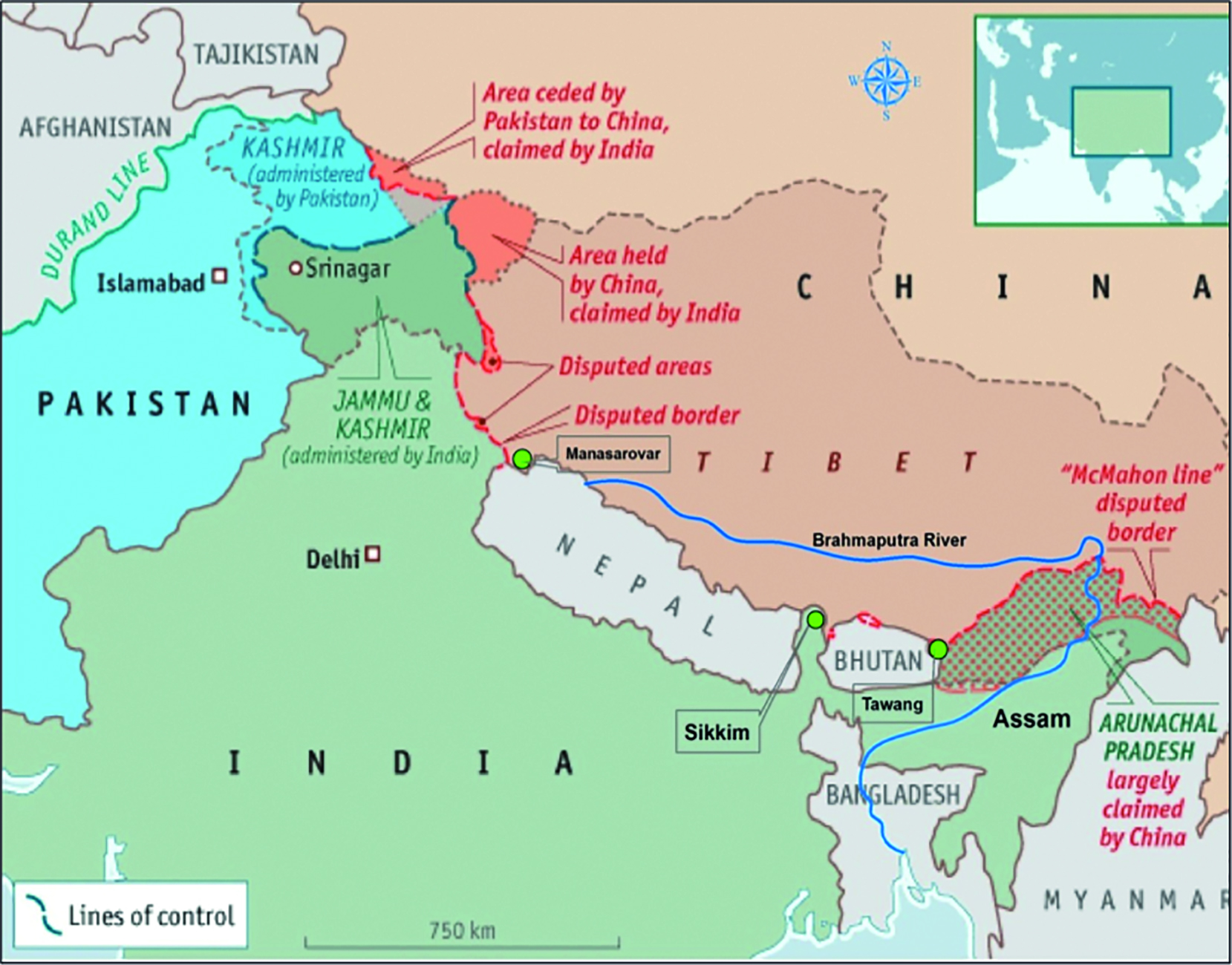
Two border disputes source
- One in a region called Aksai Chin and another in a region called Arunachal Pradesh. Both nations claim both regions although China controls the former and India the latter.
- In both these places the geography favors the current arrangement. With both nations nuclear armed, it is inconceivable for any solution other than formalizing the status quo.
- When Prime Minister Narendra Modi visited China in May 2015, one of his objectives was to persuade the Chinese leadership to restart discussions on the clarification of the Line of Actual Control (LAC) through the exchange of maps.
- The rationale for India’s demand was that, pending a final settlement of the border question, LAC
- clarification would help ease border tensions. But the Chinese leadership was not enthusiastic about India’s proposal. Instead, China called for a comprehensive ‘code of conduct’ for the forces deployed along the border.
- Here, it is useful to remember that both LAC clarification and Confidence Building Measures (CBMs) are part of the agreed principles in the 2005 agreement. This mismatch in desired outcomes was the main obstacle in the recent border talks, and it showed once again India and China’s contrasting approaches to border negotiations at large.
- India’s reluctance to consider a ‘code of conduct’ suggests that it entertains reservations about agreeing to restrictions on its plans for infrastructure development in the border region.
- Perhaps, this reluctance is because of two inferences. One, that the Chinese proposal is aimed at limiting India’s military and infrastructure modernisation, and thereby enabling China to preserve its military advantage in Tibet. And two, accepting the Chinese proposal could potentially curtail the ability to effectively patrol and intercept PLA movements in territory claimed by India.
- The Indian position on the Sino-Pakistan understanding on Chinese activities in PoK has been consistent.
- There are often debates in India-mostly episodic and lacking vigour-about Sino-Pakistan relations.
(c) Domination of Indian Ocean

Domination of Indian Ocean source
- China has been accused of pursuing strategic maneuvers on a well-thought out route encircling India in the Indian Ocean. Beijing has been reaching out to India’s neighbors on the premise of development and trade, allegedly recreating the Silk Route.
- From Nepal in the south east to Myanmar, Bangladesh to Sri Lanka in the south and Pakistan in the west, China plans to choke India diplomatically. There are diplomatic visits, courtesy calls, exchange of gifts and promises between Mr. Modi and the heads of all of the surrounding countries, to not just counter the Chinese influence but also strengthen the Indian presence.
Water issue:
- The dispute between India and china is mainly regarding the Brahmaputra River flowing through the two countries the search for water resources in China and India has persistently been a source of tension between the two countries.
- Chinese efforts to divert the water resources of the Brahmaputra River away from India will worsen a situation that has remained tense since the 1962 Indo-China war.
- The melting glaciers in the Himalayas as a result of accelerating global climate change will have a dramatic effect on this river’s water supply. This will increase water scarcity as well as the likelihood of floods, impact agrarian livelihoods and strain the fragile equilibrium between the two Asian giants.
Pakistan factor:
- The longtime friendship between China and Pakistan, rooted in a time when both countries were deeply mistrustful of India, has long made New Delhi nervous. The relationship has mainly gone one way, with China providing economic assistance and political backing to Pakistan.
- Islamabad is also anxious for an alliance it can use to balance the growing economic and political clout of India. But Pakistan also offers China a gateway to South Asia, Iran and the Arabian Sea, one of the economic beltways that President Xi Jinping has sought to build through the region. Earlier this year, during a visit to Islamabad, Chinese Foreign Minister Wang Yi said China and Pakistan have an “all-weather friendship.”
South China Sea issue and India:
- China opposes India’s oil exploration in the SCS (which has been undertaken at Vietnam’s request) by calling the area of exploration a ‘disputed’ area and asserting ‘Chinese sovereignty’ over the SCS in the ‘historical’ context.
- It has been continuously expressing its reservation in this regard in the last few years, and sometimes quite belligerently at that. India has taken note of the Chinese reservation and has carefully gone ahead in signing a few agreements with Vietnam for oil exploration in the SCS.
- These exploration fields are very much within the maritime space under the actual control of Vietnam. But at the same time, China casually shrugs off the issue of India’s ‘sovereignty’ over POK in the ‘historical’ context.
- China is currently engaged on a variety of investment projects and infrastructural building activities in Gilgit-Baltistan, and these will be expanded under the CPEC project.
- China further explains that the Sino-Pak understanding to implement CPEC through POK is based on a range of bilateral agreements and understandings, including their 1963 Border Agreement.
Trade deficit:
- India faces trade imbalance heavily in favour of China. India has a trade deficit with China of nearly $50 billion, its largest with any country. Singapore, with a population about 240 times smaller than India, sells twice as many goods to China each year.
Reasons for the deficit:
- China imports raw material from India e.g. iron ore and exports the finished goods as it has got core competency in manufacturing sector and provides huge energy subsidies.
- Importing finished goods obviously cost more. India also imports power equipments, consumer electronics and telecommunications gear from china. China is dumping manufactured products in India.
- On the other hand India does not have a large access to Chinese market and with Indian rupee declining while renminbi gaining centre stage the trade deficit is becoming huge.
Maritime Silk Route project: Impact on India:
- Beijing’s plan for a maritime infrastructure corridor in the broader Indo-Pacific region, first proposed by President Xi Jinping’s during his trip to Southeast Asia in October 2013, has attracted attention because of its potential to establish a Chinese foothold in the Indian Ocean. Needless to say, China’s outreach to India – inviting it to join the project – has generated much analytical curiosity.
- The first thing of interest about the MSR is that it was initially mooted as an ASEAN-centered project.∙ The intention then was to enhance connectivity and cultural links in China’s strategic backyard-the South China Sea.
- Beijing later expanded the scope of the project to include the Indian Ocean, but in reaching out to∙ Colombo and New Delhi, it found a willing partner only in the former. India has been ambivalent about the MSR and is yet to make up its mind on joining the project. The problem with the MSR, essentially, is the ‘opaque’ nature of its proposal.
- Outwardly, the project is∙ about the development of massive maritime infrastructure and connectivity in the Indian Ocean and the Western Pacific. Beijing has been careful to project the MSR as an exclusively commercial venture, trying hard to dispel any impressions of it being a cover for maritime military bases.
- Surprisingly, however, China has released no details about the project, and this makes many countries doubt Beijing’s strategic intentions. The lack of specifics not only makes it hard to decipher the MSR’s real purpose, it gives credence to∙ suspicions of geopolitical game play by China. Indeed, for a project being touted as a critical enabler of regional sea-connectivity, Chinese planners would have spent much time and effort developing the fineprint.
- The lack of firm plans, proposals and timelines then does lead to a suspicion that there may be something about the MSR that Beijing is hesitant to reveal quickly. The MSR’s essential∙ rationale is the leveraging of Chinese soft-power.
- The aim apparently is to shore-up China’s image as a benevolent state. Beijing’s would also conceivably use the project’s commercial investments to establish its legitimate interests in the Indian Ocean. And while China can be expected to do everything in its power to force region states to join the project – including offering economic aid to potential partners – the bottom-line for it will be to make an offer to India that is hard to refuse.
- For India, it is instructive that the sales pitch of shared economic gains does not conceal the MSR’s real purpose: ensuring the security of sea lines of communications (SLOCs) in the Indian and Pacific oceans. Since African resources are China’s focus right now, the project could well be a surrogate for a giant Chinese SLOC running all the way from the East African coast, to the Southern coast of China – created, maintained and controlled by Beijing.
- In its ultimate form, therefore, the MSR could end up setting up Chinese logistical hubs in the Indian Ocean, linking up already existing string of pearls. India’s appreciation of the MSR must be based on an objective appraisal of these new realities. Even assuming the project delivers on its economic promise, it could well turn out to be detrimental to India’s geopolitical interests in the IOR.
- As Beijing becomes more involved in building infrastructure in the Indian Ocean, it will play a larger part∙ in the security and governance of the IOR, which could pose a challenge to India’s stature as a ‘security provider’ in the region and also adversely affecting New Delhi’s strategic purchase in its primary area of interest.
China’s Reluctance to Support India’s membership of international bodies
- China has continuously blocked India’s entry in UNSC. Recently China has blocked India’s entry in NSG. Chinese diplomats say Beijing wants NSG entry to be norm-based — in other words, whatever rules govern Indian entry should apply to others too.
- Norm-based entry would, presumably, help Pakistan gain entry, something many in the NSG are certain to resist because of the country’s record as a proliferator of nuclear-weapons technology to Iran, Libya and North Korea.
Areas of Cooperation
- Despite their rivalries, the two countries have played up their cultural links-such as the importation of Buddhism into China by wandering Chinese monks more than 1,500 years ago-and have found ample room for economic cooperation.
- Both are members of the BRICS grouping of emerging economies, which is now establishing a formal lending arm, the New Development Bank, to be based in China’s financial hub of Shanghai and to be headed by a senior Indian banker.
- India also was a founding member of the China-backed Asian Infrastructure Investment Bank, which plans to be formally established by year’s end and seeks to emulate institutions such as the World Bank and International Monetary Fund.
Educational areas:
India and China signed Education Exchange Programme (EEP) in 2006, which is an umbrella agreement for educational cooperation between the two countries. Under this agreement, government scholarships are awarded to 25 students, by both sides, in recognized institutions of higher learning in each other’s country. The 25 scholarships awarded by India are offered by Indian Council for Cultural Relations (ICCR).
Trade cooperation:

India China export & import data source
- Two countries have shown tremendous economic growth. Change in the dynamics of the global economy has provided the opportunity to both countries to cooperate on wider scale. China and India are the major trading partners in the region. During the last decade, bilateral trade has increased notably. In 2014, the trade between China and India exceeded over $65 billion mark.
- According to the Trade Map figures, in 2013, China accounted for 11.1 percent of India’s imports, while 4.1 percent of India exports were destined for China. Chinese exports to India are mainly comprised of electric and electronic equipment, organic chemical, fertilizers and furniture. On the other side, China’s imports from India chiefly consist of cotton, pearls, precious stones, copper ores, slag and ash.
- Bilateral trade has expanded substantially in recent years. Nevertheless, the balance of trade still remains in China’s favor.
- Following table summarizes the latest trends in trade between China and India. Source: China India Trade and Investment Center Though, compared to the past, the economic cooperation between the two countries has accelerated.
- However, there are still enormous opportunities that have not been exploited in such fields as manufacturing, construction, electricity, gas and water industries, infrastructure (such as, roads, buildings, transportation, storage and communication), hotels and tourism, financial institutions, agriculture, healthcare, education and the various training sectors. China and India have synergies in many areas.
- China has wide experience and expertise in the field of construction industry. Due to its international recognition, Chinese firms have been successful in creating infrastructure base for many countries.
- India could utilize Chinese expertise in the development of its high speed railway network, metro lines and other infrastructure facilities. While the sides are seeking to expand bilateral trade to $100 billion this year, China exports far more than it imports, something Indian Prime Minister Narendra Modi hopes to alter with increased market access for Indian goods and services.
Areas of Competition in Africa:
- The rapid economic growth experienced by China and India has resulted in an increase in competition for∙ global resources and investment opportunities. Unsurprisingly, the abundance of natural resources in Africa has made the continent a hotspot for Chinese and Indian economic activity.
- This growing Sino-Indian involvement has been economically beneficial and has resulted in widespread∙ investment and development, with African leaders welcoming the competition. Africa is now the latest front in an increasingly global competition between India and China for new markets,∙ agricultural land and access to natural resources.
- While Western media and politicians have reacted with varying degrees of alarm over the surge of Chinese∙ trade and investment in Africa, Indian companies have been quietly building their presence on the continent.
- As China drives deeper into what many Indians consider their sphere of influence in South Asia, Africa offers∙ an ideal opportunity for Indian firms to challenge China’s growing influence in the region. For many Indians, particularly in certain political circles and on the blogosphere, competition with China is∙ presented in a classical real politik paradigm.
- The headlines misleadingly frame the issue in terms of win/loss or even as a “race” between the two∙ countries. Although it may be compelling, even somewhat entertaining, to draw on 19th century colonial cliches (e.g. the Scramble for Africa or the Great Game) it is entirely misleading as both the Indians and Chinese are employing radically different strategies in Africa than earlier European powers.
- Ironically, the enhanced competition among Chinese and Indian companies will most directly affect∙ European and American firms who are rapidly being shut out of Africa’s emerging markets. While China’s aggressive economic approach has caused it to achieve more influence in Africa than any∙ other country, its dominance is slowly being impeded by India’s growing involvement in the region.
- India has focussed on emphasising its cultural and historical ties to enhance the development of its trade relations with resource-rich countries like Zimbabwe, Ethiopia and Sudan.
- The success of India’s soft power strategy has been evident in countries like Sudan, where Indian∙ corporations have attained near complete control of the local oil and natural gas industry. The same trend is occurring in Zimbabwe where China’s dominance in the energy and resource sectors is∙ being challenged by private and state-owned Indian enterprises.
The US$ 4 billion takeover of Zimbabwean steelmaker Zicosteel, by India’s Essar Group, was hailed by the∙ Zimbabwean Government as the largest foreign direct investment deal in Zimbabwe in recent decades. Competition for the takeover was intense, as various Chinese corporations challenged the Essar Group’s bid.∙
The incident has been viewed by some as a reflection of the intense rivalry developing between China and∙ India, and while China continues to dominate African markets, the success of India’s economic strategies has raised uncertainty towards China’s future economic dominance in the region.
Competition in foreign policy
China and India are still strategic rivals despite their increased economic cooperation.∙
- Alongside the U.S., Japan, and Australia, India is also seen as one of the major actors that have an interest in offsetting China’s dominance over Asia. That India and China came to be known as fellow members of the BRICS does not suffice by itself to reverse∙ the two giants’ inherent tendency towards taking sides with rival groupings which are once again beginning to overwhelm Asia’s strategic environment.
- Moreover, New Delhi set its permanent membership on the United Nations Security Council (UNSC) as a primary national goal in the name of being recognized as a great power on a global scale. In contrast, China pioneers the opposition bloc which stands firmly against any attempts to reform the UNSC because such would mean including not only India but Japan and several other countries in the Council as well.
- The two countries’ strategic interests in South Asia are also mutually exclusive.
- China maintains intimate ties with Pakistan, with high-level defense cooperation at the core thereof, a reality that deeply disturbs India as might be expected. On the other hand, Beijing feels extremely uncomfortable with India’s hosting of the Tibetan opposition.
- China even fears that India might still be supportive of Tibet’s independence. Likewise, there is a heated rivalry between Beijing and New Delhi for influence over Bangladesh, Myanmar,Sri Lanka, and Nepal.
- New Delhi shapes its foreign policy in tandem with the West, backing Myanmar’s opening to the rest of the world as well as its related democratization project.
- However, Beijing believes one of the essential motivations behind such a policy is to detach Myanmar from China’s larger zone of influence.
PM Modi’s visit to China in 2015
- The visit was rich in symbolism and substance and it opened up a new chapter in India-China relations. For the first time, Chinese President Xi Jinping travelled outside Beijing to receive a foreign leader, in Xi’an in his home province of Shaanxi.
- President Xi also accompanied Prime Minister to the Big Wild Goose Pagoda and organized a grand welcome∙ ceremony at the Xi’an city wall.
- There were 24 agreements signed on the government-to-government side, 26 MoUs on the business-tobusiness side and two joint statements, including one on climate change.
- The fact that India and China could come up with over 50 outcome documents in just eight months reveals the huge potential that exists between our two countries, as well as the efforts that we have made to elevate our partnership.
- They included such diverse fields as space cooperation, earthquake engineering, ocean sciences, mining,railways, skill development, education, culture, Yoga, tourism and many more.
- Prime Minister interacted with 21 CEOs of leading Chinese companies and over 40 prominent Indian CEOs attended the Business Forum along with their counterparts from China.
- The 26 business understandings worth over US$ 22 billion signed at the Forum covered such varied sectors as industrial parks, renewable energy, thermal energy, telecommunication, steel, capital goods, IT and media.
- There was, moreover, an action-oriented accord on broad-basing the bilateral partnership, as could be seen from the range of agreements signed and in the establishment of new dialogue mechanisms, such as the one between the DRC and the NITI Aayog and the Think Tanks’ Forum, besides a bilateral consultative mechanism on WTO negotiations.
- Three new institutions were launched in partnership, the Centre for Gandhian and Indian Studies in Shanghai, Yoga College in Kunming, and National Institute for Skill Development and Entrepreneurship in Ahmedabad. Both sides decided to establish new Consulates in each other’s country, in Chengdu and Chennai and to∙ expand our interactions at the sub-national level.
- Two agreements signed-one on cooperation between the Indian Ministry of External Affairs and the∙ International Department of the Central Committee of the CPC and another on the establishment of a State/Provincial Leaders’ Forum-reflect this understanding.
- A number of sister-city and sister-state relations agreements between: Karnataka and Sichuan, Chennai and∙ Chongqing, Hyderabad and Qingdao, Aurangabad and Dunhuang were also signed. Prime Minister also announced the extension of the e-visa facility to Chinese nationals wishing to travel to India.
Other Important issues
(a)ONE BELT

OBOR source
ONE BELT, ONE ROAD (OBOR)
The One Belt, One Road (OBOR) initiative is part of China’s major policy framework to boost domestic development and foreign diplomacy. China also wants to ‘reconstruct’ the world order to fulfill its interests and become a dominant world power.
About OBOR
The “belt and road” have two components—the Silk Road Economic Belt (SREB) that would be established along the Eurasian land corridor from the Pacific coast to the Baltic Sea, and the 21st century Maritime Silk Road (MSR).
- The “belt and road” run through the continents of Asia, Europe and Africa, connecting the vibrant East Asia economic circle at one end and developed European economic circle at the other.
- The SREB focuses on bringing together China, Central Asia, Russia and Europe (the Baltic); linking China with the Persian Gulf and the Mediterranean Sea through Central Asia and West Asia; and connecting China with Southeast Asia, South Asia and the Indian Ocean.
- On land, the initiative will focus on jointly building a new Eurasian Land Bridge and developing China- Mongolia-Russia, China-Central Asia-West Asia and China-Indochina Peninsula economic corridors.
- The 21st-Century MSR, in turn is designed to go from China’s coast to Europe through the South China Sea and the Indian Ocean in one route, and from China’s coast through the South China Sea to the South Pacific in the other.
- To implement the concept, the Chinese have stressed on joint consultation and joint building. China sees this as the most effective model that can be used to safeguard mutual benefits.
What China expects from OBOR?
- Address security threats
- Achieve long-term economic benefits
- Reduce America’s threat to trade lifelines
Analysis
- Analysts point out that the ‘One Belt One Road’ initiative, backed by a solid financial institutional network, once implemented, is expected to accelerate the shift of geo-economic power away from the United States, towards Eurasia.
- More than 4.4 billion people, or 63 per cent of the global population countries, are expected to benefit from China’s game-changing plans.
- Analysts say that the “belt and road” initiative could shift the center of geo-economic power towards Eurasia, and undermine the “Asia Pivot” of the United States and its allies.
- Chinese President Xi Jinping is hopeful that the mega-trade volumes among the Silk Road economies would touch $ 2.5 trillion over the next 10 years.
Pros of India joining OBOR
The technical know-how the project will bring back could be used to develop or iron out issues facing∙ technical bottlenecks.
The OBOR initiative could be icing on the cake for India’s flagship programs like Digital India.
The “Information Silk Route” has the telecom connectivity between the countries through fiber, trunk line and under-sea cables.
This will expand the bandwidth capabilities for India significantly, without which offering e-Governance and∙ delivering public services in an efficient manner will remain a pipe dream and a good marketing campaign. India will have excellent connectivity of various transport modes, and a great facilitator to Make In India∙ initiative if India joins such global infrastructure project.
India’s strategy to counter OBOR
India is not part of OBOR. India reaffirmed its opposition of One-Belt-One-Road initiative of China, with Foreign Secretary stating that New Delhi will join multilateral connectivity initiatives in Asia, only if they were pursued through a consultative process.
- India has indicated that it sees China’s OBOR as a “national Chinese initiative”.
- The defence establishment is concerned that the project might not be altogether benevolent and that these corridors in future could be used for military mobilisation.
- There are concerns in India about being part of a “hegemonic project” that would ensure China led development in the Indian Ocean region.
- The main point of contention for India is the China-Pakistan Economic Corridor or CPEC, which is also part of OBOR.
- For New Delhi, OBOR may be a potential economic opportunity but it also threatens India’s interests.
India’s strategy to counter OBOR
- India recently proposed the ‘Cotton Route’ (seen by many as its answer to the Silk Route) to strengthen economic ties between countries in the Indian Ocean rim.
- It has also launched Project Mausam and Spice Route apparently in response to China’s Belt and Road initiative.
- The ‘Mausam’ project envisages the re-establishment of India’s ancient maritime routes with its traditional trade partners along the Indian Ocean.
- The ‘Spice Route of India’, visualises the India-centered linkup of historic sea routes in Asia, Europe and Africa.
- Many people in India perceive the Mausam Project and the Spice Route as rivals to the Maritime SilkRoad.
(b)SOUTH CHINA SEA (SCS) DISPUTE
The three million square kilometers South China Sea is the maritime heart of Southeast Asia but also a disputable property. Maritime boundaries in the South China Sea are particularly problematic because they involve six separate claimants in a mostly enclosed body of water with a large number of disputed land features.
The South China Sea is ringed by Brunei, China, Indonesia, Malaysia, the Philippines, Taiwan, and Vietnam, and dotted with hundreds of small islands, shoals and reefs, many of them occupied by the disputants.
The fundamental issue in the South China Sea is one of territorial sovereignty, that is, which state has sovereignty over the islands and their adjacent waters.
UNCLOS has no provisions on how to determine sovereignty over offshore islands. As there is no treaty that governs the issue of sovereignty, states have to look for guidance to the rules of customary international law on the acquisition and loss of territory.
Main Disputes:
The Spratly Islands are located in the central part of the South China Sea, north of the island of Borneo (which comprises Brunei Darussalam and the east Malaysian States of Sarawak and Sabah), east of Vietnam, west of the Philippines, and south of the Chinese island of Hainan.
The Spratly Islands are claimed in their entirety by China, Taiwan, and Vietnam, while some islands and other features are claimed by Malaysia and the Philippines. The Spratly Islands consist of more than 140 islets, rocks, reefs, shoals and sandbanks (some totally or occasionally submerged while others are always dry) spread over an area of more than 410,000 square kilometres.
The Paracel Islands are located in the northern part of the South China Sea, approximately equidistant from the coastlines of Vietnam and China (Hainan). They are claimed by China, Taiwan and Vietnam. China forcibly ejected South Vietnamese troops from the Paracels in 1974, and they are now occupied exclusively by China.
China denies the existence of a dispute over these islands, but they are a continual source of tension between China and Vietnam. The Paracels consist of about thirty five islets, shoals, sandbanks and reefs with approximately 15,000 km² of ocean surface.
Woody Island, the largest island in the Paracels, which is about the same land area as all of the Spratly Islands combined. Woody Island is the location of Sansha City, a prefecture-level city established by China in June 2012 as its administrative centre for its claims in the South China Sea.
Scarborough Reef is located in the northern part of the South China Sea between the Philippines and the Paracels, and is claimed by China, the Philippines and Taiwan. Scarborough Reef is located about 130 miles from the Philippine island of Luzon. Most of the reef is either completely submerged or above water at low tide, but it contains several small rocks which are above water at high tide. It has been a major source of tension between China and the Philippines since the Philippines attempted arrest of Chinese fishermen in June 2012.
The Pratas Islands are located just over 200 miles southwest of Hong Kong. They are occupied by Taiwan, and are also claimed by China.
Macclesfield Bank, a large sunken reef that is completely submerged at low tide, is located between Scarborough Reef and the Paracels. It is claimed by China and Taiwan.
Resources as a Driver of Competition
Many analysts feel that resource competition has become one of the key drivers of territorial disputes and tension, particularly in the South China Sea and East China Sea.
The South China Sea, for example, is a major source of fish resources for each of the nations that borders it, and the largest source of fish for China, the Philippines and Vietnam. The over-fishing in coastal waters has led to depletion of resources thus competition has led fishing boats to work towards offshore.
Many energy industry observers believe that the sea also has substantial reserves of oil and natural gas. The rising energy demand in countries has encouraged more offshore energy development in their economic planning.
New technologies are making complicated offshore oil and gas development more feasible, and high energy prices are contributing to the desire to control these resources.
Energy Resources
Because much of the South China Sea has never been fully explored, accurate assessments of exploitable oil and gas reserves do not exist. A report by the Department of Energy’s Energy Information Administration (EIA) in 2008 cited some of the most optimistic estimates-Chinese assessments that it could have reserves totaling 213 billion barrels of oil and 900 trillion cubic feet of natural gas. Many analysts argue, however, that because much of the northern part of the South China Sea is deep, energy resources may not be exploitable on this scale.
In May 2012, the state-owned China National Overseas Oil Corp (CNOOC) unveiled a deep-water drilling rig that could extend its ability to exploit resources into waters deeper than its current capabilities allow. Still, industry analysts believe that international energy companies have considerably more technical ability to develop resources in difficult offshore settings-and thus, much of the sea will likely go undeveloped as long as the disputes continue.
Offshore energy development is based on assertion of sovereignty over parts of the sea, and because such assertions are still widely overlapping, there are increasing chances for conflict. For example, China warned international oil companies in 2006 that they should not work in regions with unsettled territorial disputes where Vietnam was seeking development partners.
In 2012, a Chinese state oil company, the Chinese National Overseas Oil Corp. (CNOOC) offered tenders for offshore oil and gas exploration within Vietnam’s EEZ, overlapping with areas Vietnam had already tendered and, in some cases, in which companies were already exploring and drilling. This action prompted angry reactions in Vietnam, which deemed the moves illegal.
Such disputes have created uncertainties that constrain offshore resource exploration and development, which requires long-term periods of stability.
There are, however, some examples of exploration and development that have taken place in disputed areas. China, the Philippines, and Vietnam have each undertaken oil-and-gas exploration in disputed parts of the South China Sea, and the Philippines and Vietnam have offered exploration and development contracts to international oil-andgas firms, including American companies.
Fishery Resources
Fishing presents another potential source of conflict. The South China Sea is the largest source of fish, an important foodstock, in each of the claimant countries.
The fishing industries of each of the disputants include large numbers of vessels which travel increasingly farther from their home coasts due to overfishing in coastal waters, bringing them into disputed waters. This has led to frequent incidents of harassment of vessels, confiscation of catches and equipment, and sometimes imprisonment of fishermen.
A 2012 dispute between the Philippines and China at Scarborough Shoal, an outcropping of rocks within the Philippines’ EEZ and China’s nine-dash line, began when Philippine coast guard officials boarded Chinese fishing vessels and confiscated illegally obtained shark and coral. Some analysts point to joint management of fisheries as a potential path towards lowering tensions and fostering functional cooperation among disputants.
Attempts for Resolution
- Currently, states in Southeast Asia are utilizing four different strategies to try to solve the issue.
- First, states are pushing for bilateral solutions in incremental stages. Beijing has repeatedly stated a preference for this method, but regional states widely regard it as an attempt to freeze resource development, while doing little to actually resolve the various claims. On the other hand, Vietnam and China recently used bilateral diplomacy to reduce tensions.
- Second, attempts are being made to resolve the issue at the multilateral level, that is utilizing ASEAN. So far it is difficult to achieve much, as only four of ASEAN’s 10 member states are involved in the South China Sea issue, and China has been able to detach the other six members at various times from positions taken by Vietnam, Malaysia, Brunei and the Philippines.
- Third, fostering closer ties to the US also remains an option, as Washington is still the predominant power in the region. The Philippines and Vietnam in particular have sought strategic reassurance through new or renewed security agreements with the US; and Washington – concerned that China covets such a strategic sea line of communication – has responded warmly.
- And fourth, Southeast Asian nations are involving non-regional states in the issue. Vietnam’s agreement with India on drilling in contested waters falls into this strategy, and follows a general campaign by Hanoi to engage external states and oil firms – such as Chevron, Exxon Mobil, BP and Zarubezhneft as a form of pressure on Beijing. But these strategies are not making the slightest difference, and serve only to exacerbate tensions.
India and South China Dispute
India has a strong interest in keeping sea lanes open in the South China Sea. The South China Sea is not only a strategic maritime link between the Pacific and the Indian Oceans, but also a vital gateway for shipping in East Asia.
Almost, 55% of India’s trade with the Asia Pacific transits through the South China Sea. Apart from helping secure energy supplies for countries like Japan and Korea, India has the unique distinction of shipping oil from Sakhalin to Mangalore through sea routes of the region. Therefore, it is vital for India to have access to the region.
If China continues to assert dominance over these waters, it will be difficult for India to continue with its activities through this channel.
But China’s hard line on the South China Sea has affected India too. New Delhi was a bit taken aback after Beijing denounced plans by an Indian Company to develop oil fields in the region.
The Chinese objection was to ONGC Videsh’s (OVL) venture for off-shore oil exploration in water’s belonging to Vietnam (not recognized by China), Beijing urged India to refrain from entering into deals with Vietnamese firms exploring oil and gas in the disputed South China Sea over which China enjoys ‘indisputable’ sovereignty.
India however, in recent years, has been seen as a credible counterweight to China. Southeast Asian countries, wary of continued Chinese aggression in the South China Sea, have encouraged joint maritime exercises with India.
In February 2010, the Indian Navy concluded its Milan series of maritime exercises in the Andaman and Nicobar Islands and almost all ASEAN countries participated in Milan exercise.
India, which has helped Malaysia in building up its Coast Guard in the past, must consider assisting other ASEAN countries. India has a strong Navy with technological credibility that can be leveraged by ASEAN. Collaboration on missile technology, radar systems, defence component systems and supporting hardware are again areas where ASEAN countries can work in partnership with India. China, naturally, does not welcome the ASEAN move to interact militarily with India.
India has also shown keenness to sell Brahmos missiles to friendly countries including the neighboring Southeast Asian countries. Most of the ASEAN countries have been engaged in a defense modernization programme and would like to obtain assistance in weapons up-gradation and systems integration.
Like India, most of the Southeast Asian countries also rely on Russia for their defence procurements. India with its long experience in using Russian products and developed the technological capabilities for low cost servicing could be a potential ally for ASEAN in this field. Assisting ASEAN will also improve India’s relations with the Southeast Asian countries bilaterally and multilaterally and it will also boost India’s morale in balancing China in the IOR.
India’s Interests in the SCS
India has a strong interest in keeping sea lanes open in the SCS.
- The SCS is not only a strategic maritime link between the Pacific and the Indian Oceans, but also a vital gateway for shipping in East Asia. Almost, 55% of India’s trade with the Asia Pacific transits through the SCS.
- Apart from helping secure energy supplies for countries like Japan and Korea, India has the unique distinction of shipping oil from Sakhalin to Mangalore through sea routes of the region. Therefore, it is vital for India to have access to the region. If China continues to assert dominance over these waters, it will be difficult for India to continue with its activities through this channel.
- Presence of India in SCS is not only Counter balance China in South East Asia but it will put pressure on China in South Asia too.
- Presence in South China Sea will help India to have effective control over Malacca strait.
- SCS is crucial in India’s Look East Policy-2.

South china sea dispute source
Recent Ruling of the Tribunal
The Permanent Court of Arbitration (PCA) in The Hague, Netherlands, has ruled that China’s claims of historical rights over South China Sea (SCS) has no legal basis. The case was brought to the court in 2013 by the Philippines, centring on the Scarborough Shoal, but Beijing chose to boycott the proceedings.
What did the arbitration panel rule?
- The court at The Hague ruled that China’s claims to the waters within the so-called “nine-dash line”, with wide-ranging economic interests, was in breach of the UN Convention on the Law of the Sea (UNCLOS).
- The court slammed China for damaging parts of the ecosystem in the Spratly islands- a contested archipelago– on account of overfishing and development of artificial islands.
- The Court also said that China violated the Philippines’ sovereign rights. It said China has caused “severe harm to the coral reef environment” by building artificial islands.
What is the ‘nine-dash’ line?
The ‘nine-dash line’ stretches hundreds of kilometers south and east of its southerly Hainan Island, covering the strategic Paracel and Spratly island chains. China buttresses its claims by citing 2,000 years of history when the two island chains were regarded as its integral parts.
Chinese response to ruling of PCA
- China rejected an international ruling on the South China Sea as “null and void” and devoid of any “binding force”.
- China is contemplating to establish a military Air Defence Identification Zone (ADIZ) in the South China Sea (SCS). The imposition of an ADIZ would require overflying planes to first notify China.
- Many Chinese experts stressed that the entire episode was a cover to enforce the US’ “Pivot of Asia” or Rebalance strategy, aimed at the containment of China.
India’s response
India has made it clear that it recognised that the tribunal had been set up within the jurisdiction of the UN’s Convention on the Law of the Sea (UNCLOS) that must be given the “utmost respect”.
Comment
Despite gloomy predictions about the inevitability of competition between China and India, cooperation between Asia‘s two emerging powers is possible. It, will however, require a much more concerted effort to bridge the gap in socio-cultural understanding that existed between them, there remains a fundamental lack of appreciation on the part of each country of the underlying cultural and societal norms that define the other norms that influence each country‘s perception of its own national interest.
It is argued that greater appreciation of these elements is critical if China and India are to successfully address issues such as the ongoing border dispute and the mounting trade imbalance.
In present and future scenarios, strategic and diplomatic relations between China and India are fraught with complication, tensions and misgivings on both sides upon the historical legacies of relations between the two countries. Much of the mistrust and misgivings emanate from the legacy of the 1962 war between the two countries.
The following five decades have seen generation of Indians growing up with an inherent wariness of China and anything Chinese. The public popular imagination in India was fuelled by the often repeated stories of the great betrayal by the supposed ally nation.
In recent decades after India gained its independence from Britain in 1947, there was a lot of popular hope for a strong and mutually beneficial partnership between the two nations. This was reflected in the popular phrase that was chanted by Indian children in the 1950s: Hindi-Chini bhai-bhai, the general atmosphere of bonhomie and Friendship was such that most Indians could not imagine the advent of Chinese military aggression on their relative unguarded northeast.
-
Foreign Policy Watch: India-Bangladesh
India’s links with Bangladesh are civilisational, cultural, social and economic. There is much that unites the two countries – a shared history and common heritage, linguistic and cultural ties, passion for music, literature and the arts. The two nations were strong allies during the Bangladesh Liberation War in 1971. However, they developed different Cold War alliances in the late 1970s and 80s. With the onset of economic liberalization in South Asia, they forged greater bilateral engagement and trade. The historic Ganges Water Sharing Treaty was concluded in 1996. India and Bangladesh are close strategic partners in counter-terrorism. They are also the largest trading partners in South Asia.Two-way trade is estimated to be over US $7 billion.
Backgrounder
A chronology of key events:
1947 – British colonial rule over India ends. A largely Muslim state comprising East and West Pakistan is established, either side of India. The two provinces are separated from each other by more than 1,500 km of Indian territory.
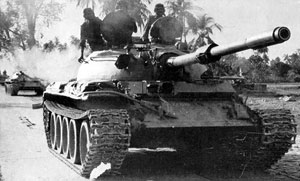
Indian Tank during the war 1949 – The Awami League is established to campaign for East Pakistan’s autonomy from West Pakistan.
1970 – The Awami League, under Sheikh Mujibur Rahman, wins an overwhelming election victory in East Pakistan. The government in West Pakistan refuses to recognise the results, leading to rioting. Cyclone hits East Pakistan – up to 500,000 people are killed.
Independence
Bangladeshi premier Sheikh Mujibur Rahman pictured in 1972 source
1971 – Sheikh Mujib arrested and taken to West Pakistan. In exile, Awami League leaders proclaim the independence of the province of East Pakistan on 26th March. The new country is called Bangladesh. Just under 10 million Bangladeshis flee to India as troops from West Pakistan are defeated with Indian assistance.
1972 – Sheikh Mujib returns, becomes prime minister. He begins a programme of nationalising key industries in an attempt to improve living standards, but with little success.
1974 – Severe floods devastate much of the grain crop, leading to an estimated 28,000 deaths. A national state of emergency is declared as political unrest grows.
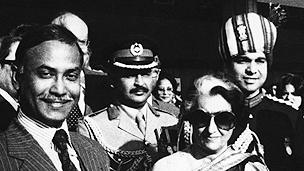
Bangladeshi leader Ziaur Rahman pictured in 1980 source
1975 – Sheikh Mujib becomes president of Bangladesh. The political situation worsens. He is assassinated in a military coup in August. Martial law is imposed.
1976 – The military ban trade unions.
1977 – General Ziaur Rahman assumes the presidency. Islam is adopted in the constitution.
1979 – Martial law is lifted following elections, which Zia’s Bangladesh National Party (BNP) wins.
1981 – Zia is assassinated during abortive military coup. He is succeeded by Abdus Sattar.
Ershad era
1982 – General Ershad assumes power in army coup. He suspends the constitution and political parties.
1983 – Limited political activity is permitted. Ershad becomes president.

Bangladeshi leader Hussain Muhammad Ershad source
1986 – Parliamentary and presidential elections. Ershad elected to a five-year term. He lifts martial law and reinstates the constitution.
1987 – State of emergency declared after opposition demonstrations and strikes.
1988 – Islam becomes state religion. Floods cover up to three-quarters of the country. Tens of millions are made homeless.
1990 – Ershad steps down following mass protests.
1991 – Ershad convicted and jailed for corruption and illegal possession of weapons. Begum Khaleda Zia, widow of President Zia Rahman, becomes prime minister. Constitution is changed to render the position of president ceremonial. The prime minister now has primary executive power. Cyclonic tidal wave kills up to 138,000.
Awami League returns
1996 – Two sets of elections eventually see the Awami League win power, with Sheikh Hasina Wajed, the daughter of Sheikh Mujibur Rahman, becoming prime minister.
1997 – Ershad is released from prison. The opposition BNP begins campaign of strikes against the government.
1998 – Two-thirds of the country devastated by the worst floods ever. Fifteen former army officers sentenced to death for involvement in assassination of President Mujib in 1975.

Garment factory in Ashulia, Bangladesh 2000 September – Sheikh Hasina criticises military regimes in a UN speech, prompting Pakistani leader General Musharraf to cancel talks with her. Relations strained further by row over leaked Pakistani report on 1971 war of independence.
2000 December – Bangladesh expels Pakistani diplomat for comments on the 1971 war. The diplomat had put the number of dead at 26,000, whereas Bangladesh says nearly three million were killed.
2001 April – Seven killed in bomb blast at a Bengali New Year concert in Dhaka. Sixteen Indian and three Bangladeshi soldiers killed in their worst border clashes.

General view of Dhaka, with slum area seen on left 2001 April – High Court confirms death sentences on 12 ex-army officers for killing Mujib. Only four are in custody.
2001 July – Hasina steps down, hands power to caretaker authority, becoming the first prime minister in the country’s history to complete a five-year term.
Coalition government
2001 September – At least eight people are killed and hundreds injured as two bombs explode at an election rally in south-western Bangladesh.
2001 October – Hasina loses at polls to Khaleda Zia’s Nationalist Party and its three coalition partners.

Ramadan prayers outside National Mosque of Bangladesh 2002 July – Pakistani President Musharraf visits; expresses regret over excesses carried out by Pakistan during 1971 war of independence.
2004 Opposition calls 21 general strikes over the course of the year as part of a campaign to oust the government.
2004 May – Parliament amends constitution to reserve 45 seats for female MPs.
2004 August – Grenade attack on opposition Awami League rally in Dhaka kills 22 people. Awami League leader Sheikh Hasina survives the attack.
2006 February – Opposition Awami League ends year-long parliamentary boycott.
Political crisis

Bangladesh opposition protesters, 2006 2006 October – Violent protests over government’s choice of a caretaker administration to take over when Premier Zia completes her term at the end of the month. President Ahmed steps in and assumes caretaker role for period leading to elections due in January 2007.
2006 November – A 14-party opposition alliance led by the Awami League campaigns for controversial election officials to be removed. Chief election commissioner MA Aziz steps aside.
2006 December – Election date set at 22 January. Awami alliance says it will boycott the polls. Awami leader Sheikh Hasina accuses President Ahmed of favouring her rival. Blockade aimed at derailing parliamentary elections paralyses much of the country.
2007 January – A state of emergency is declared amid violence in the election run-up. President Ahmed postpones the poll. Fakhruddin Ahmed heads a caretaker administration.
2007 March – Six Islamist militants convicted of countrywide bomb attacks in 2005 are hanged. They include the leaders of Jagrata Muslim Janata Bangladesh and Jamaat-ul-Mujahideen.
2007 April – Sheikh Hasina is charged with murder. Begum Khaleda Zia is under virtual house arrest. Several other politicians are held in an anti-corruption drive.
2007 August – Government imposes a curfew on Dhaka and five other cities amid violent clashes between police and students demanding an end to emergency rule.
2008 June – Sheikh Hasina is temporarily freed to get medical treatment in the US.
2008 August – Local elections take place, seen as a big step towards restoring democracy. Candidates backed by the Awami League perform strongly.
2008 November – The authorities say general elections will be held on 18 December. Sheikh Hasina returns to lead her party in the poll.
Awami League win
2008 December – General elections: Awami League captures more than 250 of 300 seats in parliament. Sheikh Hasina is sworn in as prime minister in January.
2009 February – Around 74 people, mainly army officers, are killed in a mutiny in Dhaka by border guards unhappy with pay and conditions. Police arrest some 700 guards. A further 1,000 guards are detained in May.
2009 October – The government bans the local branch of the global Islamist organisation Hizb-ut Tahrir, saying it poses a threat to peace.
2010 January – Five former army officers are executed for the 1975 murder of founding PM Sheikh Mujibur Rahman.
2012 May-June – Key figures from the main Islamist party Jamaat-e-Islami, including leader Motiur Rahman Nizami, are charged with war crimes by a government tribunal investigating alleged collaboration with Pakistan during the 1971 independence struggle.
2012 October – Muslim rioters attack Buddhist villages and shrines in south-east Bangladesh after an image said to show a burnt Koran was posted on Facebook. The government denounces the attacks as “premeditated and deliberate acts of communal violence against a minority”.
2013 January – War crimes tribunal sentences prominent Muslim cleric Abul Kalam Azad to death for crimes against humanity during the 1971 independence war. He was tried in absentia, as he had fled abroad.
2013 April – Prime Minister Sheikh Hasina vetoes Islamist bill to outlaw criticism of Islam.
2013 May – European retailers promise to sign an accord to improve safety conditions in factories after a garment factory building collapsed in April, killing more than 1,100 people. Worker protests close hundreds of factories and extract a government pledge to raise the minimum wage and make it easier to form unions.
Jamaat-e-Islami trials
2013 July – At least two people are killed as police clash with thousands of protesters after the conviction of Ghulam Azam, leader of the Jamaat-e-Islami party, for war crimes committed during the 1971 war of independence. Ghulam Azam dies in October 2014.
2013 December – Supreme Court upholds death sentence on Islamist leader Abdul Kader Mullah of the Jamaat-e-Islami party, who was convicted in February of crimes against humanity during the 1971 war of independence.
2014 January – Opposition BNP boycotts parliamentary elections, Prime Minister Sheikh Hasina returns for third term in office.
2014 October – Jamaat-e-Islami Leader Motiur Rahman Nizami and another leading figure, Mir Quasem Ali, found guilty of war crimes during independence war in 1971.
2015 February – Court sentences another senior Jamaat-e-Islami figure, Abdus Subhan, to death for war crimes committed during independence war in 1971.
2015 May – Bangladesh bans Islamist militant group Ansarullah Bangla Team, which claims responsibility for killing and assaulting several pro-secular public figures.
2015 November – Threats to Christians and Shia Muslims challenge government view that two years of attacks on pro-secular public figures are the work of a violent faction of the opposition Jaamat-e-Islami party, after the Islamic State armed group claims responsibility for attack on Shia mosque. Jamaat-e-Islami senior figures Ali Ahsan Mohammad Mujahid and Salahuddin Quader Chowdhury executed on war crimes charges dating back to 1971.
2016 July – The Islamic State group claims an attack on a cafe in Dhaka’s diplomatic quarter in which 20 hostages, including 18 foreigners, are killed but the government rejects the claim saying the militant group Jamaat-ul-Mujahideen was responsible.
2016 September – Business tycoon and senior leader of Bangladesh’s largest Islamist party Jamaat-e-Islami, Mir Quasem Ali, is executed for war crimes committed during the 1971 war of independence.
Why Bangladesh is important to India’s north east?
-
-

Bangala
-
Ports – The nearest port for the Northeast is Kolkata. Kolkata is 1500 km from Aizawl and Agartala. Not just the distance, the route passes through multiple states and through a lot of mountains. Imagine dragging a heavy machinery through this long, narrow road. This makes trade and manufacturing very hard in the Northeast. Every product that is either produced in Northeast or needed in northeast has to be carried through that one road through Siliguri. On the other hand, Chittagong port is only 200km from Tripura and passes through the mostly flat land. A major Bangladeshi railway junction Akhaura is just 10 km from Agartala.
Migration – Major cities in India’s northeast are quite close to the rural hinterland of Bangladesh. For many rural Banglas, it is easy to find jobs in these cities than in Dhaka or Chittagong. Thus, there is a massive migration that is rapidly impacting the demographics of the Northeast. Many tribes feel marginalized in their own territory. India needs Bangladeshi government’s help to arrest the endless flow of migrants.
Separatism – Tripura alone shares 850km of border with Bangladesh. Other states like Mizoram share long borders too [a total of 4000+ km of shared borders between Northeast India and Bangladesh]. Given the long and unpatrolled borders, the separatists and troublemakers in this region easily escape to Bangladesh. It is hard to fight the separatism as long as the separatists have such an easy escape hatch. India needs Bangladesh’s help in patrolling the borders and also bring the fugitives to justice.
Food movement – Eastern side of Bangladesh is quite fertile and produces a lot of rice. This can be easily be moved to Tripura, Mizoram and Manipur rather than dragging the food from West Bengal through the Siliguri corridor or air lifting them.
Risk of Chicken neck – Currently the Siliguri corridor remains the only link between the Northeast and the rest of India. Any problem there – terrorist attacks, natural disasters, etc. – would completely cut off India from the 7 states of North east. Bangaldesh help would reduce that risk substantially
Major irritants with Bangladesh
Boundary Dispute
India’s land border with Bangladesh as per the Ministry of Defence is 4351 km. running through five states, viz., West Bengal (2217kms), Assam (262 kms), Meghalaya (443kms), Tripura (856 kms) and Mizoram (318 kms), including nearly 781 kms of riverine border. The border traverses through 25 districts.
The border is used as a route for smuggling livestock, food items, medicines and drugs from India to Bangladesh. Moreover, illegal immigrants from Bangladesh cross the border to India in search of improving their lives. Because of a large number of illegal immigrants crossing from Bangladesh into India, a controversial shoot-on-sight policy has been enforced by the Indian border patrols.
This policy was initiated with reports of violence between the illegal migrants and Indian soldiers. The border has also witnessed occasional skirmishes between the Indian Border Security Force and the Border Guards Bangladesh, most notably in 2001.
The killing of Bangladeshi nationals by Border Security Force (BSF) has become a major irritant between the two countries in the recent past. It has evoked strong public sentiments in Bangladesh. According to a report of Bangladesh Human Rights Watch organization Odhikar, BSF has, from January 1, 2001 to March 31, 2012, killed 907 Bangladeshis. Bangladesh wants no time lost in stopping these killings.
Further the Agreement on the demarcation of Land Boundary between Bangladesh and India and related matters had been signed in May 1974 between the two great statesmen, Bangabandhu Sheikh Mujibur Rahman, and Smt. Indira Gandhi. This comprehensive agreement was intended to resolve all lingering and vexing problems that history had bequeathed on the two nations. But it has not full filled by both Governments.
During the State visit of the Prime Minister to Bangladesh in September 2011, a “Protocol to the Agreement between the Government of India and the Government of Bangladesh Concerning the Demarcation of the Land Boundary Between India and Bangladesh and Related Matters (LBA)” was signed. It settles the long outstanding land boundary issues related to un-demarcated segment of 6.1 Kms; territories in adverse possession; and exchange of enclaves. The Cabinet has, on 13 February 2013, approved the draft of a Constitution (Amendment) Bill for implementing the India-Bangladesh Land Boundary Agreement (LBA) 1974 and the Protocol to LBA signed in 2011.
The Protocol envisages that 111 Indian Enclaves in Bangladesh and 51 Bangladesh Enclaves in India, as per the jointly verified cadastral enclave maps, shall be exchanged. As per Article 3 of the LBA 1974, when the Enclaves are transferred, people living in these areas shall be given the right of staying on where they are as nationals of the State to which the areas are transferred.
Maritime border
While Bangladesh, having concave coastlines, delimits its sea border southward from the edge of its land boundary, India stretches its claim southeast wards, covering around thousands of miles in the Bay of Bengal.
Due to competing claims of the two countries, delimitation of the sea boundary and determining Bangladesh’s exclusive economic zones have remained unresolved. Moreover, in terms of determining the continental shelf, the presence of the Andamans and Nicobar Islands puts India, in a favourable position.
Territorial Waters
The issue of demarcating territorial waters led to serious differences between the two countries. Questions of ownership over a new born island known as South Talpatty in Bangladesh and New Moore/ Purbasha in India spotted by a satellite picture in 1975 in the estuary of Haribhanga River on the border of the two countries has been a source of contention since its discovery.
In order to settle the above dispute Bangladesh proposed sending a joint Indo‐Bangladesh team to determine the flow of channels of the river on the basis of existing International Law of the Sea. But the Indian counterpart sent forces to establish claims by stationing naval troops on the island in 1981. After initial resentment by Bangladesh, India agreed to resolve the issue through negotiations.
Illegal Migration
Illegal migration is one of the bones of the contention of these two countries, Since the 1971 war of independence that created the state of Bangladesh, millions of Bangladeshi immigrants (the vast majority of them illegal) have poured into neighboring India.
While the Indian government has tried to deport some of these immigrants, the sheer number of them, as well as the porous border between the two countries, has made such an enterprise impossible. It is difficult to assess how many illegal immigrants are currently residing in India. Consider that in 1971, during the civil war in neighboring East Pakistan (the former name of Bangladesh), at least 10-million Bangladeshis poured into West Bengal in India
Illegal migration appears in the eastern and north-eastern parts of the country from neighbouring Bangladesh, threat to India’s internal security, from Bangladesh is impacted on communal, political, social and economic tensions and conflicts in several areas of the northeast of India.The most affected states are West Bengal, Assam, Megalaya, Nagaland, Bihar, and Tripura, although migrants “have spread too far off states like Tamil Nadu, Maharashtra, Gujarat, Rajasthan and Delhi.” Although the exact figure is not known, it is estimated that there are about 15-20 million Bangladeshis staying illegally in India.
The National Investigation Agency has found links with Pakistan in rackets engaged in printing and smuggling fake currency into India. NIA sources said fake currency was now being smuggled into the border with Bangladesh has gaps at some points and immigrants cross into India on foot through the breaks in the fence.
Some also swim across rivers on the border to reach India. The National Investigation Agency has found links with Pakistan in rackets India through its porous border with Bangladesh. Malda district in West Bengal is a key transit point for counterfeiters.
Once they reach India, immigrants obtain fake documents through local agents. Political leaders in parts of West Bengal were also involved in endorsing fake documents such as ration cards for illegal immigrants.
This unfettered illegal migration impacts on national security and socio-economic stability. Intelligence inputs indicate that the Inter Service Intelligence Agency (ISI) of Pakistan is utilizing these migrants as conduits to ferry in terrorists and arms into India. Counterfeit Indian currency with its origins in Bangladesh has flooded border areas, crippling in these parts.
Vote bank politics in Assam is the one of obstacle to control illegal migration from Bangladesh, led to communal violence between indigenous Bodos and Muslims (migrants from Bangladesh) in 2012.
The illegal Bangladeshi immigrants have not only changed the demography and disturbed the ecology of the north-east but have also encouraged them to exercise their political rights in India as citizens. It has been one of the key reasons for the rise of insurgent groups in the north-east as some of the insurgent groups like Assam Gana Sangram Parishad started, and got support of the masses, because of the issue of illegal immigration from Bangladesh. At the same time the immigration laws (Illegal Migrants [Determined by Tribunal] (IMDT) Act 1983) followed in Assam has aided illegal immigrants’ settling in the north-east easy.
Security concernsInsurgency has been playing the role in straining relations of India with Bangladesh. Northeast India has been facing insurgency since 1956 due to feelings of ethnic separatism among its inhabitants.
ISI is operating from Bangladesh, supporting the insurgents in the North east India. National Liberation of Tripura (NLFT), Liberation Front of Assam(ULFA) and National Democratic Front of Bodoland (NDFM) are major insurgent groups in Northeast India. There are some rumours that ULFA has several lucrative income generating Projects in Bangladesh to sustain its insurgency activities in India.
Drug Trafficking
Bangladesh is increasingly being used as a transit point by drug dealers and the drug mafia, which dispatches heroin and opium from Burma, and other countries of the golden triangle, to different destinations.
As a result, Bangladesh’s Department of Narcotics Control has come under the scanner several times and invited criticism. Bangladesh has become the prime transit route for trafficking heroin to Europe from Southeast Asia, according to a report from the International Narcotics Control Board (INCB) 2007 annual report.
INCB notes that the most common methods and routes for smuggling heroin into Bangladesh are by courier from Pakistan, commercial vehicles and trains from India, and via sea through the Bay of Bengal or overland by truck or public transport from Burma.
Trade and Investment
Bangladesh is an important trading partner for India. The two-way trade in FY 2011-2012 was US$5.242 billion with India’s exports to Bangladesh accounting for US$4.743 billion and imports US$0.498 million.
The trade deficit with India is frequently highlighted by Bangladesh as a major contentious issue. Trade deficit for Bangladesh is more than $4 billion. For long, Bangladesh has been urging India to reduce this gap by lifting the tariff barriers as they were a major impediment to the growth of Bangladesh’s exports to India. Responding to Bangladesh’s concern, in November 2011, India granted duty free access to all products, except 10 tobacco and liquor items from Bangladesh which amounts 30% of Bangladesh export.
As much as 98 per cent of Bangladesh products now enjoy zero duty benefits in the Indian market. Bangladesh’s exports to India are expected to cross $1 billion in 2012.
However, Bangladesh is now urging India to remove all non-tariff barriers (NBTs) as it views NTBs as the major obstacles to its export growth. Some of these barriers are: laboratory test for every consignment of food products, cosmetics, and leather and textile products; delay in getting test results; imposition of state tax; packaging requirement, anti-dumping and countervailing duties; inadequate infrastructure facilities such as warehousing, trans-shipment yard, parking yard and; connecting roads at land customs stations of India.
To encourage exports from Bangladesh, India must move proactively to provide facilities of customs and testing at the border check posts.
Besides, removal of non-tariff barriers should be accompanied by tariff reforms since the opportunity cost of non-tariff barriers is very high.A Consumer Unity & Trust Society (CUTS) International report says: “In 2010, value of unexplored market was more than 48 per cent of total value of India- Bangladesh trade and potential saving, which is a proxy for cost of non-tariff barriers, is more than seven per cent of total value of Indo-Bangla trade”.
India is also encouraging investments in Bangladesh. In this regard, a Bilateral Investment Promotion and Protection Agreement have been signed between the two countries. The agreement is expected to increase Indian investment in Bangladesh.
TransitIndia has been urging Bangladesh to provide rail and road transit to connect with its north-eastern states. Technically speaking, the issue of transit was resolved in 1972 when both sides agreed on a mutually beneficial arrangement for the use of their waterways, railways and roadways for commerce between two countries and for passage of goods to places in one country through the territory of the other. Inland water transit has been functional, but the rail and road transit is still waiting to be operational.
Bangladesh’s initial reluctance to granting India rail and road transit was on the grounds that transit facility once given was difficult to take back and such a facility may encourage terrorism and insurgency.
Other concerns included damage to the roads and bridges in Bangladesh by the increased traffic flow from the Indian side.
The reason for delay was that Bangladesh’s infrastructure was not yet prepared to take the load of the increased traffic that will follow with the granting of transit to India. Addressing Bangladesh’s concern, India provided a credit line of $1billion to Bangladesh for development of infrastructure projects. But the credit line could not be used to its potential because of the strict conditions India imposed, to the effect that 85 per cent of the raw materials for the road projects has to be procured from India, on the ground that it produces all the materials necessary.Bangladesh has countered by claiming it too has the necessary raw materials. It could earn $44 million per annum for first five years if it grants transit to India. From the sixth year, earnings would be around $500 million, which could rise to $1 billion. Transit would not only boost connectivity between the two countries, but also offer opportunities for regional connectivity and help Bangladesh develop Chittagong port into a regional hub.
The Chittagong port can become a modern busy port like Singapore and China serving the SAARC countries. Huge foreign investment may be attracted by Bangladesh and finally, a throbbing service sector like banks, insurance, hotels, rest houses, petrol pumps etc. may develop around the Transcontinental roads and railways.
There is an estimate of direct economic gain from transit fees. It ranges from 500 crore taka to 4,666 crore taka. The mutual transit will also give Bangladesh a much shorter route to China and an initiative to link Chinese province of Yunan with Seven Sisters of India, Myanmar, Thailand and Bangladesh.
Water –sharing:
We share 54 trans-boundary rivers, big and small.
Some of the major water sharing disputes
Ganga river dispute
In 1996, the sharing of the Ganga waters was successfully agreed upon between the two nations. However, the major area of dispute has been India’s construction and operation of the Farakka Barrage to increase water supply to the river Hooghly.
Bangladesh complains that it does not get a fair share of the water in the dry season and some of its areas get flooded when India releases excess waters during the monsoons.
Teesta River dispute
Teesta originates in Sikkim, flows through West Bengal in India before entering Bangladesh. It merges with the Brahmaputra River (or Jamuna when it enters Bangladesh). The river is important for both Bangladesh and India for its agricultural use.
Teesta river agreement timeline
In 1983, India and Bangladesh had agreed into an ad hoc sharing of the water during the dry season (October to April) with an allocation of 36 per cent for Bangladesh and 39 per cent for India, leaving 25 per cent to be decided later. But this deal has remained pending for more than 2 decades.
As per an agreement of 2011 the two sides had agreed to share the river’s water 50:50, the same as the 1996 Ganges water-sharing pact between the neighbors. This agreement was not signed due to opposition from chief minister of West Bengal.
Tipaimukh Hydro-Electric power Project
Bangladesh has been demanding to stop the construction of the Tipaimukh Hydro-Electric Power Project on the Barak River on the eastern edge of Bangladesh.
Bangladesh says that the massive dam will disrupt the seasonal rhythm of the river and have an Adverse effect on downstream agriculture, fisheries and ecology of the region. Indian government has assured Bangladesh that it will not take any unilateral decision on the Tipaimukh Hydro-Electric Power Project which may adversely affect Bangladesh.
Chinese Engagement with Bangladesh
Bangladesh and China has decade-long diplomatic ties. 2015 marked the 40th year of their relationship. China is the largest trading partner of Bangladesh in current times with the two-way trade accounting for about US$12 billion in 2014. China is contributing largely to ongoing infrastructural development in Bangladesh.
The growing security and military relations between the two countries in recent days is taking place much to the chagrin of New Delhi. Beijing’s current initiative for setting up financial institutions including the Asian Infrastructure Investment Bank (AIIB) is likely to create new opportunities for Bangladesh in accessing funds for infrastructure development.
Bangladesh’s renewed interest in ocean economy in the Bay of Bengal in the context of UN approved delineation of maritime boundary over the Bay, it needs to engage with technologically and financially sound partners like China, Japan, the United States and South Korea, among others.
Engagement with China may prove to be most important economic relation for Bangladesh considering China’s growing and developed economy and international clout. However, Dhaka needs to balance its relations between New Delhi and Beijing for its own interest.
In fine, India in its current focus on neighbourhood prosperity is going to foster an enduring bilateral relationship with Bangladesh, as perceived from the ongoing engagements between New Delhi and Dhaka. Both countries are on the right track for building rapport in spheres of bilateral importance; however, the deep-seated disputes like that of water-sharing needs to be addressed for good for a better tomorrow.
Recent Developments
Land Boundary Agreement
Brief history:
After the partition of India in 1947, Rangpur was joined to East Pakistan, and Cooch Behar district was merged in 1949 with India. The desire to “de-enclave” most of the enclaves was manifested in a 1958 agreement between Jawaharlal Nehru and Feroz Khan Noon, the respective Prime Ministers, for an exchange between India and Pakistan without considering loss or gain of territory.
But the matter then worked into a Supreme Court case in India, and the Supreme Court ruled that a constitutional amendment was required to transfer the land. So the ninth amendment was introduced to facilitate the implementation of the agreement.
The amendment could not be passed because of an objection to transfer of southern Berubari enclave. Because of India’s deteriorated relations with Pakistan, the issue remained unsolved. With that agreement not ratified, negotiations restarted after East Pakistan became independent as Bangladesh in 1971 following the Bangladesh Liberation War
Attempts have been made to arrive at a comprehensive settlement of the land boundary between India and Bangladesh (the erstwhile East Pakistan) since 1947. The Nehru-Noon Agreement of 1958 and the Agreement Concerning the Demarcation of the Land Boundary between India and Bangladesh and Related Matters of 1974 (referred to as 1974 LBA) sought to find a solution to the complex nature of the border demarcation involved.
However, three outstanding issues pertaining to an un-demarcated land boundary of approximately 6.1 km, exchange of enclaves and adverse possessions remained unsettled.
The list of enclaves was prepared in 1997 by both nations. Two Joint Boundary Working Groups was formed to work out the details of enclaves in 2001. The joint census was carried out it May 2007.
The Protocol (referred to as the 2011 Protocol) to the 1974 LBA, signed on 6th September 2011 during the visit of the Prime Minister to Bangladesh, paves the way for a settlement of the outstanding land boundary issues between the two countries. The both nations announced an intention to swap 162 enclaves, giving residents a choice of nationality.
Indian Parliament in May 2015 passed the constitutional amendment bill regarding the land boundary agreement with Bangladesh. The Lower House, showing rare unanimity, passed the Constitution (119th Amendment) Bill to allow the operationalisation of the 1974 India-Bangladesh Land Boundary agreement.
Major features of agreement:
A settled boundary is an essential prerequisite for effective cross-border cooperation. It reduces friction, helps neighbours consolidate mutually beneficial exchanges and promotes confidence in building better relations.
The 2011 Protocol ensures that the India-Bangladesh boundary is permanently settled with no more differences in interpretation, regardless of the government in power.
- The 2011 Protocol results in a fixed demarcated boundary in all the un-demarcated segments, exchange of 111 Indian enclaves in Bangladesh with 51 Bangladesh enclaves in India and a resolution of all adversely possessed areas.
- In the exchange of enclaves, India transfers 111 enclaves with a total area of 17,160.63 acres to Bangladesh, while Bangladesh would transfer 51 enclaves with an area of 7,110.02 acres to India.
- While on paper, the exchange of enclaves between India and Bangladesh may seem like a loss of Indian land to Bangladesh, the actual scenario is quite different as the enclaves are located deep inside the territory of both countries and there has been no physical access to them from either country.
- Each country will now begin to administer enclaves on its territory and enclave citizens will be able to choose where they want to live and which nationality they would prefer.
- In reality, the exchange of enclaves denotes only a notional exchange of land as the Protocol converts a de facto reality into a de jure situation.
The inhabitants in the enclaves could not enjoy full legal rights as citizens of either India or Bangladesh and infrastructure facilities such as electricity, schools and health services were deficient.
Further, due to lack of access to these areas by the law and order enforcing agencies and weak property rights, certain enclaves became hot beds of criminal activities.Major advantages of land boundary agreement:
These are as follows:
The exchange of enclaves will mitigate major humanitarian problems as the residents in the enclaves and others on their behalf had often complained of the absence of basic amenities and facilities the settlement of Adverse Possessions will lead to tranquility and peace along the border it represents a permanent solution to a decades old issue the newly demarcated boundaries are a fixed boundary, thereby adding to certainty regarding the future
a settled boundary reduces friction, helps neighbours consolidate mutually beneficial exchanges and promotes confidence in building better relations.It paves the way for closer engagement and mutually beneficial relations between India and Bangladesh and the region; this also helps on issues of strategic concern, including security cooperation and denial of sanctuary to elements inimical to India. While land will be exchanged, the Protocol does not envisage the displacement of populations; the Protocol ensures that the India-Bangladesh boundary is permanently settled and there should be no more differences in interpretation, regardless of the government in power.
This deal would also revive the moribund South Asia Growth Quadrangle (SAGQ), comprising India’s north east, Bangladesh, Nepal and Bhutan.
Indo-Bangladesh Maritime Boundary Dispute
In a landmark judgment, the Hague-based Permanent Court of Attribution (PCA) has awarded Bangladesh an area of 19,467 sq km, four-fifth of the total area of 25,602 sq km disputed maritime boundary in the Bay of Bengal with India on July 7.
The UN Tribunal’s award has clearly delineated the course of maritime boundary line between India and Bangladesh in the territorial sea, Exclusive Economic Zone (EEZ) and continental shelf within and beyond 200 nautical miles (nm). Now, Bangladesh’s maritime boundary has been extended by 118,813 sq comprising 12 nm of territorial sea and an EEZ extending up to 200 nm into the high seas.
In addition, the ruling acknowledged Bangladesh’s sovereign rights of undersea resources in the continental shelf extending as far as 345 nm in the high seas, taking Chittagong coast as the base line. The verdict has been broadly accepted by both the countries as a positive development for further consolidation of friendly relations especially given the geo-strategic/political significance of greater Indian Ocean region and South Asian sub-region.
Security and Economic implications for India
- Some are of the scholars’ opinion that the ruling could provide force for the new Indian government to ratify the Land Boundary Agreement and reach an understanding on sharing the waters of the Teesta river with Bangladesh.
- The verdict would contribute towards establishing strategic partnerships among the nations sharing borders in the Bay.
- The award is expected to have positive impact on emerging multilateral forum like BIMSTEC. It may be noted that India has already settled its maritime borders with Sri Lanka, Myanmar and Thailand. Similarly, Bangladesh’s maritime issues with Myanmar are resolved.
- The PCA award assumes strategic significance against the backdrop of China’s close ties with Bangladesh and its growing interests and activities in the Bay region for which India is worried. Now the settlement of maritime disputes between India and Bangladesh may have a restraining influence on the expansionist designs of China.
- Both the countries have accepted the award as it will open the door for exploration of oil and gas in the Bay—the site of huge energy reserves.
- The verdict has recognised India’s sovereignty over New Moore island and received nearly 6000 sq km of the contested zone where the island had once existed.
- India’s discovery of natural gas in 2006 took place in a creek which is situated about 50 km south of the mouth of the Hariabhanga river within the contested zone. The lingering maritime dispute stood in the way of exploration of hydrocarbons in the Bay region. Such as in December, 2013, Australian firm Santos withdrew from two sea-blocks citing security and maritime dispute with Bangladesh.
- Now India’s policy makers could chalk out a long-term strategy for the economic development of the Bay region. To realise its goals, New Delhi may forge bilateral or multilateral partnerships under the framework of sub-regional grouping like BIMSTEC
Implication for Bangladesh
The award has huge economic significance for a small state like Bangladesh. It has cleared the obstacles for Dhaka to open up its waters for foreign firms to explore and exploit hydrocarbons in the Bay. So long, Bangladesh’s maritime dispute with India is believed to have deterred many international petroleum companies to invest in the sea-blocks previously offered by it.
The United Nations Convention of Law of the Sea (UNCLOS) gives a nation 12 nm of territorial control and ensures sovereign rights to explore, exploit and manage natural resources with 200 nm of EEZ.
The economic prospects of the Bay region have increased enormously after Myanmar and India discovered huge natural gas deposits beneath the sea. It is reported that Myanmar discovered 7 trillion cubic feet of hydrocarbon deposits in the region. This was followed by India’s discovery of another 100 trillion cubic feet of natural gas. This prompted Bangladesh—a nation with limited resource base and high demand of energy,to search for offshore energy resources.
In 2008, Bangladesh government divided its claimed territorial sea and EEZ into 28 sea-blocks and leased them to multinational companies to meet its growing energy needs.But Bangladesh was eventually compelled to suspend exploration as both India and Myanmar objected to it.Successive discoveries of massive natural gas have made the delimitation of maritime boundary all the more significant.
- Economically, Bangladesh is a major gainer. Now, Dhaka is in a position to invite foreign companies to explore oil and gas resources in its maritime zones.
- It would definitely help Bangladesh to compensate gas shortages in its gas turbine-run industries and plants and contribute to the country’s economic development.
- India’s ONGC stands a good chance to win lucrative contracts in Bangladeshi offshore gas and oil fields.
- The verdict is also good news for millions of fishermen in both the countries. The amicable settlement has opened up vast sea areas which were not available to them in the last four decades.
- Moreover, both the countries could enhance cooperation in the conservation of the rich bio-diversity of the Sunder bans.
- By clearly delineating the maritime boundary between the two nations, the verdict could help boosting coastal and maritime security in the region. Before the award, both India and Bangladesh could not undertake cooperative measures due to the vexed problem. The verdict has now cleared the hurdles of strengthening security in the maritime front.
- Furthermore, precise demarcation of maritime boundary would assist in preventing the cases of transgression by fishermen of both countries. The PCA award is really a “win-win” situation for both the countries, as described by the Bangladesh foreign minister, if they follow it up with concrete action.
3. Growing radicalism in Bangladesh
Background
In last 2 years many secularist have been heckled to death in Bangladesh.In 2010, the government of Bangladesh, headed by the secularist Awami League established a war crime tribunal to investigate war crimes perpetrated during Bangladesh’s bloody 1971 Liberation war from Pakistan. In February 2013, Abdul Qadeer Molla, a leader of the Bangladeshi Jamaat-e-Islami party (a small Islamist party within the opposition coalition) was sentenced to life imprisonment by the tribunal.
The sentence was condemned by Bangladesh’s secularist bloggers and writers, who helped organize the Shahbagh Protest in response, calling for the death penalty for Molla. The protestors quickly expanded their demands to include outlawing the Jamaat-e-Islami party itself for its role in the 1971 war.
Shortly after the first Shahbag protests, counter-demonstrations, which quickly degenerated into violence, were organized by Islamist groups. Islamist leaders denounced the war crimes tribunal as political and called for an end to the prosecution of Jamaat-e-Islami leaders, instead they demanded the death penalty for secularist bloggers, denouncing them as “atheists” and accusing them of Blasphemy.
According to many Experts the hostility directed toward Bloggers by Islamists is due primarily to the bloggers’ growing political influence in Bangladesh, which represents a major obstacle to the Islamist goal of a religious state.
Though there were occasional attacks on secularists prior to the 2013 Shahbag protests, the frequency of attacks has increased since.
In 2014, a group calling itself “Defenders of Islam” published a “hit list” of 84 Bangladeshis, mostly secularists, of whom nine have already reportedly been killed and others attacked Responsibility for many of the attacks has been claimed by Ansarullah Bangla Team a group which according to police has links with both the youth wing of Jamaat-e-Islami and with Al Qaida. The group has since been banned by the government. Other attacks appear to have been perpetrated by more obscure groups.
How much is politics responsible for this situation?
The killing campaign in Bangladesh is fuelled by the bitter war between Prime Minister Sheikh Hasina’s Awami League, and her opponents on the Right — former Prime Minister Khaleda Zia’s BNP, and its sometime ally, the Jamaat.
Headed into the 2014 elections, the BNP had paralysed the country with weeks of protests, demanding that power be handed over to a neutral caretaker government. The Awami League government, though, held fast, leading the opposition to boycott the elections.
In 2013, meanwhile, the now-iconic Shahbag protests broke out, with young people demanding the death penalty for Jamaat-e-Islami leaders held guilty of 1971 war crimes. In essence, these twin crises pushed the organised right wing out of the political arena, creating a political vacuum. Though the Bangladeshi police and security services have proved effective at containing terrorism, crushing the once-feared Harkat-ul-Jihad-e-Islami, the fear now is that the political vacuum could be capitalised on by jihadists.
The best way of preventing that would be to revive competitive political life in Bangladesh, but the political system remains log jammed, with no end in sight to the Awami League-BNP stand-off.
Significance of these Killing for Bangladesh
- Bangladesh has always prided itself for its religious tolerance and secularism. In fact, the country is a shining example of Islam and democracy coexisting. However, all that is changing quickly with the rise of religious fundamentalism in the country.
- The Islamist fundamentalists, apart from targeting minorities, have targeted all those who have commented on religion and who are fighting for their right to the freedom of expression. These Killings are threat to democracy as freedom of expression is one of the very basic tenet of Democracy.
- The killings Prove that the Islamlist are not just against the minority community but anyone even a Muslim who do not subscribe to their salafist ideology thus most of their victims are liberal Muslims.
- These killings are leading to growing sense of fear and insecurity; people in Bangladesh are living under the threat of Terrorism Moreover, the lukewarm response of the government has only emboldened the radical elements belonging to the Hardline Islamist groups such as ABT and JMB.
- The persistent failure of the Bangladesh Government and the international community to better protect threatened thinkers has created a climate of fear and direct threat to free thought in the country.
- The spate of ideological murders is an assault on Bangladesh’s secular principles and ideas.
Way Forward
Bangladesh is facing an existential crisis today and unless the government takes steps to launch an all-out attack on the members of AMT and JMB, the situation may spiral out of control. It is also surprising that, except for opprobrium in international newspapers on the growing intolerance in the country, many countries like the United States, the United Kingdom, and even neighboring India have remained silent over the issue.
It is time that they exert pressure on the Bangladeshi government to act against the perpetrators of these crimes. The government should also realize by not acting against these perpetrators, the groups will be further emboldened to carry out more such attacks against the secular forces. T
he day is not far when these groups are likely to be exploited by terrorist organizations like al Qaeda and the Islamic State, for not only gaining a toehold in the region, but also an opportunity to radicalize the youth of the country. Before it’s too late, the government must launch an all out attack on these fundamental groups, lest the country fall into an abyss of violence, which would completely destroy the secular character of Bangladesh.
4. BBIN Motor Vehicle Agreement
Introduction
India, Nepal, Bhutan and Bangladesh signed a landmark Motor Vehicles Agreement (MVA) for the Regulation of Passenger, Personnel and Cargo Vehicular Traffic among the four South Asian neighbours in Thimpu, Bhutan. BBIN (Bangladesh, Bhutan, India, Nepal) agreement is a complementary instrument to the existing transport agreements or arrangements at the bilateral levels that the contracting parties will continue to honor.
What will be the benefits of BBIN?
- It Will promote safe, economical efficient and environmentally sound road transport in the sub-region
- Will further help each country in creating an institutional mechanism for regional integration.
- BBIN countries will be benefited by mutual cross border movement of passenger and goods for overall economic development of the region.
- Will further promote our cooperation in trade and commerce apart from further cementing our age old cultural ties
- Enhance regional connectivity.
- Expand people-to-people contact, trade, and economic exchanges between our countries.
- Transforming transport corridors into economic corridors could potentially increase intraregional trade within South Asia by almost 60% and with the rest of the world by over 30%
- A new sub-group in world – BBIN! Regional strength.
What are the challenges ahead?
Building and upgrading roads, railways and waterways infrastructure energy Grids, communications and air links to ensure smooth cross border flow of goods, services, capital, technology and people.
Internal Security concerns
- Illegal migration
- Smuggling, etc.
- Timely implementation of further steps to be taken.
- Trade facilitation at Land border
- Multi-modal transport facility
- Customs system can be shared – this will save time by avoiding duplication
Bhutan has some reservations related to tourism as they want to strictly maintain culture and everything else of the Himalayas as per their own norms including Gross Happiness Index
What more can BBIN do?
Bhutan and Nepal can generate more power and sell to India and Bangladesh
It is not anymore a socialist hangup of exploitation by one country of other. It is mutual growth through co-operation.
Is India planning something similar with other countries?
A major breakthrough has been achieved between India-Myanmar and Thailand. Three nations have agreed to develop a similar framework motor vehicle agreement on the lines of draft SAARC Motor vehicle agreement.
Secretary level discussions were successfully concluded in Bengaluru this month andconsensus has been reached on the text of Agreement.
On conclusion of this Agreement, our sub-region will get access to the larger ASEAN marketthrough seamless passenger and cargo movement.
Areas of cooperation between India and Bangladesh under Sheika Hasina Government
- India’s relations with Bangladesh have certainly witnessed a significant upswing over the past decade, some persistent challenges notwithstanding. Bilateral trade has risen to $7 million. Bangladeshi Prime Minister Sheikh Hasina has been cracking down on hardline elements, and has provided India with logistical assistance, for instance in setting up the Paltana plant in Tripura. Sheikh Hasina, after being elected in December 2009 as Prime Minister, used her huge majority in Parliament to launch two initiatives.
- One was eradication of terrorism from the country, and the other was the trial of the 1971 war criminals for crime against humanity. One Jamaat senior leader has been executed, their mentor Golam Azam has been sentenced to life and cases against others are proceeding. This trial, which was long demanded by the freedom fighters, has set back both the Jamaat and BNP.
- On the terrorism front Sheikh Hasina has scored unprecedented success. Indian insurgents like the ULFA, NSCN (I/M) and others have been rooted out of this country, and Islamic terrorists and extremists have been hit hard. Apart from Bangladesh India has been the greatest beneficiary of the Sheikh Hasina government’s action against terrorism.
- From October 2013, India started exporting 500 megawatts of electricity a day to Bangladesh over a period of 35 years
- Last year the Indian Parliament, unanimously passed the Land Boundary Agreement (LBA) as its 100th Constitutional amendment, thereby resolving all 68-year old border disputes since the end of the British Raj. The bill was pending ratification since the 1974 Mujib-Indira accords.
- Resolution of maritime dispute through UNCLOS PCA in favour of Bangladesh and India not re-appealing it.
- Easing of Visa regime to provide 5 year multiple entry visas to minors below 13 and elderly above 65.
- Bangladesh allowed India to ferry food and grains to the landlocked North east using its territory and infrastructure.
- During the PM modi visit India extended a US$2 billion line of credit to Bangladesh & pledged US$5 billion worth of investments. As per the agreements, India’s Reliance Power agreed to invest US$3 billion to set up a 3,000 MW LNG-based power plant (which is the single largest foreign investment ever made in Bangladesh) & Adani Power will be setting up a 1600 MW coal-fired power plant at a cost of US$1.5 billion.
- Power agreement and internet service: Prime Ministers of India and Bangladesh commissioned international gateway of internet service in Agartala and supply of 100MW power to Bangladesh from Tripura.
Under it India will supply 100 megawatt (MW) of electricity in return for 10 Gigabits per second Internet bandwidth.
100MW power will be supplied from Suryamaninagar grid to the grid in Commilla of southeast Bangladesh.
India is already supplying 500 MW of power to Bangladesh through the Bahrampur-Bheramara interconnection.
North eastern region will get benefit of 10GBPS internet bandwidth from Bangladesh’s submarine cable station at Cox Bazar
- 15-km railway connectivity link between Agartala and Akhaura in Brahmanbaria district of Bangladesh is to be completed in 2017. Akhaura has a rail link to Chittagong too. Once the Agartala-Akhaura railway link is ready, goods brought to Chittagong port can be carried by rail directly to Agartala.
- Both countries are also implementing BBIN motor vehical agreement which allows vehicles to enter each other’s territory and does away with trans-shipment of goods from one country’s truck to another at the border, a time consuming and costly process.
- “Agreement on Coastal Shipping”: India and Bangladesh signed the Standard Operating Procedure (SOP), to operationalize the “Agreement on Coastal Shipping” signed between the two countries in June, 2015.
Salient points about the SOP are
- The Standard Operating Procedure will pave the way to promote coastal shipping between India and Bangladesh and would enhance bilateral trade between the two countries by bringing down the cost of transportation of EXIM cargo.
- The SOP contains provisions which stipulate that India and Bangladesh shall render same treatment to the other country’s vessels as it would have done to its national vessels used in international sea transportation.
- The two sides have also agreed upon the use of vessels of River Sea Vessel (RSV) category for Indo-Bangladesh coastal shipping.
- Joint patrolling in Sudarbans and combined military exercise Operation SAMPRITI.
- The two ways trade is $7 billion. The trade is set to go at $10 billion by 2018 through ports.
- India is second in import destination for Bangladesh. Bilateral trade between India and Bangladesh stood at USD 6.6 billion in 2013-14 with India’s exports at USD 6.1 billion and imports from Bangladesh at USD 462 million, representing more than double the value of USD 2.7 billion five years ago
The following steps should be taken to improve relation between India and Bangladesh.
a) Agreement on water sharing should be given priority. Early resolution of the Teesta issue is necessary.
b) Security cooperation between the two countries has been good. But there is need for institutionalizing this cooperation so that it does not remain restricted to the tenure of a particular government in either country. In this regard, a beginning could be made by signing the bilateral extradition treaty.
c) Connectivity should be given top most priority. Both the countries should work together to operationalise it.
d) There is need for addressing the issue of illegal migration. In this regard innovative measures should be taken to resolve the problem, being extra careful to ensure that illegal migrants do not acquire voting rights and Indian nationality.
e) People-to-people contact needs to be encouraged; hence liberal visa system should be put in place.
f) Trade relationship has improved significantly between the two countries. India has provided zero duty access of Bangladeshi products thereby addressing the tariff related issue to a great extent. The two countries should now consider an agreement on non-tariff barriers.
g) Indian investment should be encouraged in Bangladesh through visits of trade delegations, trade fairs, and bilateral assurances on protection of the interests of potential investors.
h) Progress can be made by cooperating on common challenges like disaster management, food and energy security.
i) Greater involvement of people and wider public debate on foreign policy issues will discourage conspiracy theories and distrust.
j) A greater level of people-to-people contact should be encouraged.
k) Implement the no-firing policy fully. Ensure accountability to ensure that the image of India as an enemy ceases to exist.
l) Fencing needs to be completed speedily and monitored effectively.This would create misgivings but also ensure that Bangladesh knows that India means business. The state governments and the Indian border forces seem receptive to such an idea
m) India and Bangladesh need to strengthen their military ties. They are being revived after a long gap but much more can be done in terms of increasing visits, contacts at various level as well as by selling military hardware. Apart from initiating joint exercises, India should consider the China model of gifting hardware in the initial instance, and offer technical expertise that Bangladeshi military is in need of. They have to be weaned away from Pakistan and China. There can be no overnight successes but sustained efforts are essential. -
-
Judicial Appointments Conundrum Pre-NJAC Verdict
Click here to follow the Post-NJAC Verdict Developments – MOP, RTI, Security Clause, RTI, JSA
Instead of seeing the NJAC verdict as one that leads to a confrontation between the Parliament and the judiciary, the executive must use this as an opportunity to help the Supreme Court in preparing an institutional design so that appointments are fair and transparent.

Two days after the Supreme Court pronounced its verdict on the 99th Constitution Amendment Act and the National Judicial Appointments Commission (NJAC), declaring them to be ultra vires the Constitution.
Questions on judicial review
The reaction of the executive to the NJAC verdict raises the fundamental question,
“Should the exercise of power of judicial review depend upon the will of the Parliament?”
Indian Constitution, unlike the Constitutions of USA and Australia, does not have an express provision of separation of powers but its sweep, operation and visibility are not unclear.
While it is the Parliament’s prerogative to amend the Constitution and make laws, the duty to decide whether the basic elements of the constitutional structure have been transgressed has been placed on the judiciary.
The power to strike down offending amendments to the Constitution on the touchstone of basic structure can be exercised by the superior judiciary alone, uninfluenced by the will of the Parliament.
Our Constitution has given the power of judicial review to the unelected superior judiciary to declare ‘unconstitutional’ a legislative act, once it is found to be violative of the basic structure.

What remains of democracy if there is no rule of law?
The institutional arrangement at the heart of our democracy provides that the will of the people, as reflected in the decisions their elected representatives, is subject to the will of the Constitution, as reflected in the decisions of an independent judiciary.
Parliamentary supremacy refers to the power of Parliament to make laws within the limits imposed by the Constitution.
It also denotes the supremacy of Parliament over the executive, primarily through the accountability of the Council of Ministers to Parliament.
All the three organs of the state derive the power and jurisdiction from our Constitution. Each must operate within the sphere allotted to it.
Judicial function is also a very important sovereign function of the state and provides the foundation for rule of law.
Is it good that judges appoints Judges in India?
It is not wholly correct to say that judges appoint judges in India as consultative participation of the executive is present in the institutionalised procedure prescribed after the Third Judges case.
But assuming it to be so, ours is perhaps the only country where the government is the biggest litigant before the courts, Isn’t it?
Why is this so?
We are one of the very few countries where actions of the political executive in diverse fields, ranging from violation of human rights to wrongful distribution of natural resources and wide range of issues which have huge political ramifications, are brought before the superior judiciary in the public interest litigation (PIL) .
Can judges who are appointed with the direct say of the government be relied upon to deliver neutral and high-quality decisions in such matters?
It is no exaggeration to say that appointment processes shape the ability of courts to hold political institutions to account.
Veto to non-judicial members
In the Second Judges case, the nine-judge Bench exposited that appointment of judges to High Courts and the Supreme Court forms an integral part of the basic structure of our Constitution.
Therefore, the executive cannot interfere with the primacy of judiciary in the matter of appointments.
The NJAC’s flawed composition consisted of the fact that it merged certain components, reflected in the inclusion of Law Minister and two eminent persons and giving any two members the power to veto the decision of the other four.
This directly affected the independence of judiciary in the judicial appointments process.
Way Forward to Fair and Transparent system
Democratic values are strengthened not only by a strong legislature but also by a strong judiciary so that together a mutually respectful and independent partnership on the public’s right to justice is maintained.
The judges who delivered the judgment in the NJAC case also hold the view that an improvement in the working of the collegium system is the need of the hour.
Demands of the Constitution can override the wishes of the people expressed through elected governments.
These are at the very core of a democratic commitment to judicial independence and constitutional supremacy.
In the words of Alexander Hamilton, one of the framers of American Constitution, “where the will of the legislature declared in the statutes is in opposition to the Constitution, the judges ought to be governed by the latter, rather than former.”
Published with inputs from Arun
-
Juvenile Justice (JJ) Act
Everything that you need to know about the recently passed Juvenile Justice Bill
The Juvenile Justice Bill, 2014 introduced by the Minister of Women and Child Development, Maneka Gandhi, in the Lok Sabha on August 12, 2014 and now passed in the both house of Parliament. Let’s take it in brief!

Juvenile Justice?
Let’s first take a glance over its background?
- The new Juvenile Justice Bill, 2015 has a provision that allows juvenile accused aged between 16 and 18 years who are accused of heinous crimes like rape, murder, etc., to be tried under the Indian Penal Code (IPC).
- According to the proposed law, matters are to be presented to the Juvenile Justice Board on a case-by-case basis.
- Board will then decide, based on an assessment of the mental state of the child, whether the crime was committed with/without an understanding of its consequences.
- Based on this assessment, the juvenile offenders will be treated under either IPC or the JJ Act. The board will be aided by experts in making that decision.
Let’s take a dive into the more details
What are the significant provisions of bill?
- The Bill replaces the Juvenile Justice (Care and Protection of Children) Act, 2000.
- It seeks to address challenges in the existing Act such as delays in adoption processes, high pendency of cases, accountability of institutions, etc.
- The UN Convention on the Rights of the Child requires all signatory countries to treat every child under the age of 18 years as equal.
- The provision of trying a juvenile as an adult contravenes the Convention.
- The Bill further seeks to address children in the 16-18 age group, in conflict with law, as an increased incidence of crimes committed by them have been reported over the past few years.
What’s the scope of the bill?
- The Bill defines a child as anyone less than 18 years of age. However, a special provision has been inserted for the possibility of trying 16-18 year olds committing heinous offences, as adults.
- A heinous offence is defined as one for which the minimum punishment under the Indian Penal Code(IPC) is 7 years.
Is that provision leads to violation of Articles 14, 21 and 20(1) of the Constitution?
How does it affect Article 14?
- Article 14 states that every person shall be treated equally before law.
- It has been interpreted that unequal treatment may be permitted between different sets of people only if there is a clear public purpose sought to be achieved by such unequal treatment.
- The Bill creates a distinction between 2 juvenile offenders committing the same offence on the basis of the date of apprehension.
And what about Article 21?
- Article 21 states that no person can be deprived of their right to life or personal liberty, except according to procedure established by law.
- Courts have interpreted this to say that any law or procedure established should be fair and reasonable.
- The differentiation based on the date of apprehension may fail this standard.
So, again Article 20(1) also affects?
- Article 20(1) of the Constitution states that a person cannot be subjected to a penalty greater than what would have been applicable to him, under a law in force at the time of commission of the offence.
- Under the Bill, if a juvenile between the ages of 16-18 years commits an offence and is apprehended at a later date, he may face a higher penalty than what would be applicable to him if he had been apprehended at the time of commission of the offence.
Let’s move forward to main provisions of the bill
Why is there need of Juvenile Justice Boards (JJBs)?
- One or more JJBs to be constituted, for each district, for dealing with children in conflict with law.
- JJBs are composed of a Metropolitan or Judicial Magistrate and 2 social workers, one of whom shall be a woman.
Powers and responsibilities of the JJBs include –
- Ensuring legal aid for a child.
- Adjudicating and disposing of cases related to children in conflict with law.
- Conducting regular inspection of adult jails to ensure no child is lodged in such jails and other inspection visits.
- Conducting inspection visits of residential facilities for such children.
Then, what is the role of Children’s Court?
- A Children’s Court is a Court established under the Commissions for Protection of Child Rights Act, 2005 or a Special Court under the Protection of Children from Sexual Offences Act, 2012.
- It will try 16-18 year olds that commit heinous offences, after confirming that they are fit to be tried as adults.
- It ensures that a child in conflict with law is sent to a place of safety until he attains the age of 21 years, after which he is transferred to a jail.
- During the child’s stay in the place of safety, reformative services such as counselling, etc. shall be provided.
- The Court shall ensure periodic follow up reports by District Child Protection Units.
Let’s know the role of Child Welfare Committees (CWCs)?
States shall constitute one or more CWCs for each district for dealing with children in need of care and protection.
The powers and responsibilities of a CWC include:
- Conducting inquiries.
- Selecting registered institutions for the placement of a child.
- Addressing orphans, abandoned children, surrendered children and sexually abused children, etc.
What are the key recommendations of Parliamentary Standing Committee (PSC) for bill?
The PSC on Human Resource Development (Chair: Dr. Satyanarayan Jatiya) submitted its report on the Bill on February 25, 2015.
[PSC is a committee created by Parliament from time to time to help deliberate or scrutinise activities under its responsibility. It’s created by, and defers to, the Parliament – either the Lok Sabha or the Rajya Sabha.]
Key recommendations include –
Constitutional provisions
- The Committee noted that the 2000 Act recognises the sensitive age of 16-18 year olds and is reformative and rehabilitative in nature.
- Subjecting juveniles to the adult judicial system would go against the principle of Articles 14 (unequal treatment of 16-18 year olds) and 15(3) (against the objective of protecting children) of the Constitution.
- It also said that the Bill was in violation of Articles 20(1) and 21 of the Constitution.
NCRB data
- One of the reasons cited for the Bill’s introduction is an increase in heinous offences committed by 16-18 year olds.
- The Committee stated that this data compiled by NCRB is misleading as it is based on filing of FIRs and not actual convictions.
Implementation
- The Committee observed that the Act is not being implemented well.
- It recommended better implementation and uniform establishment of systems and procedures, by all agencies.
But, Why did Reports and experts differ to passed such law?
- According to the National Crime Records Bureau, juveniles committed 31,725 crimes – 1.2 percent of the total number of serious crimes – in India in 2013.
- By comparison, in the United States, juveniles were responsible for 25 percent of violent crimes in the same year.
- The NCRB data said there were 17,795 cases of theft, burglary and physical assault by juveniles, and 2,074 rapes. The total number of rapes in 2013 was 33,707.
- Child rights activists say judging the maturity of a juvenile is difficult as their brain is different in structure and functioning than that of an adult, and that conclusions drawn would be “unscientific” and “arbitrary”.
- They say authorities should look at the profile of juvenile offenders, many are poor, uneducated and abused and give them the chance to reform, rather than punishing them blindly.
[So, If there are children engaging in violence, it is the fault and failure of the state. The state must respond to the violence of young people with kindness. Isn’t it?]
So, What’s Next ?
- The newly passed law does not allow for juveniles to be sentenced to death or to life imprisonment without the possibility of release.
- However, the new law will not apply to the December 2012 Delhi gangrape as criminal laws cannot be retrospective in nature.
- Still, everyone looks happy for such law, reason we all know that, delayed but at least it finally happened.
What do you think on JJ Act, 2015? Let us know!
Published with inputs from Arun | Image: Credit to ipleaders
-
backlink satış

Selam, dunya. 1 kac haftadir psikolojik olarak cok yogun seyler yasamaktan post paylasmak istemiyordum, fakat bugun duzenin ilk adimi olarak ilginc fakat gorunmeyen bir mutluluk icerisindeyim. Simdi sizlere link insaasi nedir ? ve nasil yonetilmeli, insaa edilmeli ? Bu gucten nasil faydalanmalisin, bunlar hakkinda bilgi aktarmaya calisacagim. Bir yapay zekanin gozunden kaliteli ve temiz bir link insaasi nasil yapilmalidir ! Hadi hep beraber tekrar edelim.
Linkbuilding yani Link insaasi Nedir ? ve Neden Gereklidir ?
Linkinsaasi, seocalismalarinizin guc bolgesi dersek pek yanlis olmaz bunun nedeni sizin, websiteniz disinda gerceklestirdiginiz calismalar sizin, bilinirliginizi ve otoritenizi arttirmaktadir, ic seo ile otorite tamamen zaman ile ve cok yavas ilerlemektedir, bu secenegi bilin fakat gerek duymayin.
Simdi sizlere nasil bir linkinsaasi sizi google un yapay zekasinin gozunde kaliteli,temiz ve guvenilir gosteri ? bunu aktaracagim.
Linkbuilding yani linkinsaasi off page denilen yani sayfa disi anlamina gelen calismalardir, seo calismalariniz icin websiteniz disinda farkli websiteler ile kurulan baglantilardir, bu baglantilar websitenizin otoritesini arttiracaktir, cunku google botlari sizleri farkli siteleri tararken, url adresinizi ve alakali oldugunuz anahtar kelimelerde yukselmenizi saglayacaktir.
Fakat ! Burasi onemli nasil websiteler ile dis baglanti insaasi gerceklestirmelisiniz, simdi bunu ogrenelim ! Aslinda bu nokta tam olarak organik seo ve yapay seo nun kesisim noktasidir, aslinda ole birsey yoktur fakat insanlarin yarattigi algoritmadan tam olarak boyle bir kesisim noktasi gelismistir, yani google yalnizca arama motorunun algoritmasini yonetmiyor, sizlerin zihinlerinizinde artik google algoritmalarinin kontrol altinda gelistirildiginden bahsediyorum.
Simdi bu konuyu burada unutun. Sizde unutun. Nasil websiteler ile baglanti gelistirmelisin ? Burdan devam edelim.
Sizin icin en kolay ve kaliteli gelistirilcek baglanti yontemleri arasinda, temiz comment backlinkler vardir ! Bakin temiz diyorum, temiz ve kaliteli ve kalici.
Temiz Comment Backlink Nedir ?
Temiz comment backlink nedir ? Temiz comment backlink yukarida gormus oldugunuz gibi 71 DA 12 PA ! ( da degerinin degil pa degerinin oncelik oldugunu bilmelisiniz, fakat da degeri pa degerinin degerini arttirmaktadir. )
3,4 adet yorum almis bir kaliteli icerikli bir post Kaliteli icerik ureten milyonlarca siteden 1 tanesi comment backlinkYukarida gormus oldugunuz gibi, kaliteli ve yuksek otorite degerli bir websiteden, guzel bir yorumla anahtar kelimeniz ve site iceriginiz ile alakali backlink almaniz mumkundur,
Bugun 71 DA demek, anlattigi herseye inandiginiz seo hocalarinizin website otorite degerlerinin yaklasik 2,5 katidir. SEO uzun vadedeli bir oyundur, aldiginiz backlink icin oncelik oolarak kalici olmasi olmalidir. Eger kalici olmayacagindan emin oldugunuz bir backlink ekliyorsaniz ve yolunuz uzunsa o yoldan donun ! Hic almayin, uzun vaadede artilarini goreceksinizdir.
En dogal yol ile, bu sekilde websitelerini kesfederek kaliteli ve temiz ve KALICI backlink insaasi yaparsiniz, bu yazimizda yalnizca comment backlink ile yuksek ve kaliteli sandiginiz bir websiteden daha fazla fayda saglayacagindan supheniz olmasin.
Siz Değerli Müşterilerimiz İçin Yeni Ve Kapsamlı Bir Hacklink Paketi yaptık Bu Pakette ( E-ticaret , Adsense , Blog Vb.. ) Sitelerinize Kaliteli Ve Az Çıkışlı Hacklink satın alabilirsiniz. Hacklinklerimiz 0 Güvenli ve Silinmeme Garantilidir Silindiği takdirde Siz Değerli Müşterilerimizin İsteğine göre Aynı Kalitede veya daha kaliteli link değişimini Ücretsiz Şekilde yapmaktayız Bizde Müşteri Memnuniyeti Her Zaman Önemlidir..
Bunların Yanı Sıra Tam 60 Legal içerikli ( Haber, Teknoloji, Blog Sağlık, Yemek VB. ) Sitelerimizden Tanıtım yazısı satışı yapmaktayızPeki Bu Hacklink Paketinin Pr – Alexa ve Ücret Bilgileri Nelerdir ?
backlink satış
Pagerank 8-7-6-5 Şekilde Alexaları 1k’dan 600k’ya kadar Her Kalitede Ve Çeşit Vardır Gerek düz .edu Gerek edu uzantılı veya gov uzantılı yüksek kaliteli hacklink’ler alabilirsiniz Siz değerli müşterilerimiz linklerden Daha çok etki görmesi için az çıkış yapmaktayız ve böylece siteler daha kaliteli etki etmektedir.biz kendimizi bu işe adadık ve nasıl bir galerici veya ticaret yapan insanlar var ise bizde buradan ekmeğimizi kazanıyoruz.. ve elimizden gelen yardımı ve indirimleri müşterilerimize yapıyoruz.. ben bu işi yaklaşık 5 yıldır yapıyorum.. benim Felsefem “MÜŞTERİLERİM KAZANIRSA BEN KAZANIRIM..”
Fiyat konusunda Geldiğimizde 10 Site 100TL 20 site 200TL gibi gidiyor lakin toplu alımlarda indirim yapıyoruz ve bu verdiğim fiyatlar üzerinden pazarlık Sünnettir..
Bana bir Telefon veya Skype Kadar Uzaktasınız
comment backlink
SKYPE: profseocu ( Skype ismi: profseocu )0 Müşteri Memnuniyet Garantisi ve Yüksek Kalite ve Uygun fiyat GARANTİSİ İLE Sektörde 5 Yıllık Tecrübe ile Profesyonel Hacklink Satışı yapıyorum
REFERANSLARDAN SADECE 1 MÜŞTERİMİN SAYAÇ BİLGİLERİ.. SEKTÖR VİDEO
BİZİ DİĞERLERİNDEN AYIRAN EN BÜYÜK ÖZELLİK İŞİMİZE GERÇEKTEN SAHİP ÇIKMAMIZ VE CİDDİ TİCARET AHLAKI İLE YAPMAMIZDIR !
Neden Biz ? biraz bundan bahsedelim..Hacklink’te En büyük Problem Kalkma Silinme Problemidir ! Peki Sizdekiler Siliniyormu ? Çok Nadir olarak silinir çünkü link ekleyeceğimiz sitelere 0 Güvenlik Çekip Siz Müşterilerimize Sunuyoruz.. Peki ya Silindiği vakit ne olacak.. işte en önemli kısım budur Hacklink Olayında Olduki silindi diyelim 7/24 Telefon
-
hacklink satış
Selam, dunya. 1 kac haftadir psikolojik olarak cok yogun seyler yasamaktan post paylasmak istemiyordum, fakat bugun duzenin ilk adimi olarak ilginc fakat gorunmeyen bir mutluluk icerisindeyim. Simdi sizlere link insaasi nedir ? ve nasil yonetilmeli, insaa edilmeli ? Bu gucten nasil faydalanmalisin, bunlar hakkinda bilgi aktarmaya calisacagim. Bir yapay zekanin gozunden kaliteli ve temiz bir link insaasi nasil yapilmalidir ! Hadi hep beraber tekrar edelim.
Linkbuilding yani Link insaasi Nedir ? ve Neden Gereklidir ?
Linkinsaasi, seocalismalarinizin guc bolgesi dersek pek yanlis olmaz bunun nedeni sizin, websiteniz disinda gerceklestirdiginiz calismalar sizin, bilinirliginizi ve otoritenizi arttirmaktadir, ic seo ile otorite tamamen zaman ile ve cok yavas ilerlemektedir, bu secenegi bilin fakat gerek duymayin.
Simdi sizlere nasil bir linkinsaasi sizi google un yapay zekasinin gozunde kaliteli,temiz ve guvenilir gosteri ? bunu aktaracagim.
Linkbuilding yani linkinsaasi off page denilen yani sayfa disi anlamina gelen calismalardir, seo calismalariniz icin websiteniz disinda farkli websiteler ile kurulan baglantilardir, bu baglantilar websitenizin otoritesini arttiracaktir, cunku google botlari sizleri farkli siteleri tararken, url adresinizi ve alakali oldugunuz anahtar kelimelerde yukselmenizi saglayacaktir.
Fakat ! Burasi onemli nasil websiteler ile dis baglanti insaasi gerceklestirmelisiniz, simdi bunu ogrenelim ! Aslinda bu nokta tam olarak organik seo ve yapay seo nun kesisim noktasidir, aslinda ole birsey yoktur fakat insanlarin yarattigi algoritmadan tam olarak boyle bir kesisim noktasi gelismistir, yani google yalnizca arama motorunun algoritmasini yonetmiyor, sizlerin zihinlerinizinde artik google algoritmalarinin kontrol altinda gelistirildiginden bahsediyorum.
Simdi bu konuyu burada unutun. Sizde unutun. Nasil websiteler ile baglanti gelistirmelisin ? Burdan devam edelim.
Sizin icin en kolay ve kaliteli gelistirilcek baglanti yontemleri arasinda, temiz comment backlinkler vardir ! Bakin temiz diyorum, temiz ve kaliteli ve kalici.
Temiz Comment Backlink Nedir ?
Temiz comment backlink nedir ? Temiz comment backlink yukarida gormus oldugunuz gibi 71 DA 12 PA ! ( da degerinin degil pa degerinin oncelik oldugunu bilmelisiniz, fakat da degeri pa degerinin degerini arttirmaktadir. )
3,4 adet yorum almis bir kaliteli icerikli bir post Kaliteli icerik ureten milyonlarca siteden 1 tanesi comment backlinkYukarida gormus oldugunuz gibi, kaliteli ve yuksek otorite degerli bir websiteden, guzel bir yorumla anahtar kelimeniz ve site iceriginiz ile alakali backlink almaniz mumkundur,
Bugun 71 DA demek, anlattigi herseye inandiginiz seo hocalarinizin website otorite degerlerinin yaklasik 2,5 katidir. SEO uzun vadedeli bir oyundur, aldiginiz backlink icin oncelik oolarak kalici olmasi olmalidir. Eger kalici olmayacagindan emin oldugunuz bir backlink ekliyorsaniz ve yolunuz uzunsa o yoldan donun ! Hic almayin, uzun vaadede artilarini goreceksinizdir.
En dogal yol ile, bu sekilde websitelerini kesfederek kaliteli ve temiz ve KALICI backlink insaasi yaparsiniz, bu yazimizda yalnizca comment backlink ile yuksek ve kaliteli sandiginiz bir websiteden daha fazla fayda saglayacagindan supheniz olmasin.
Siz Değerli Müşterilerimiz İçin Yeni Ve Kapsamlı Bir Hacklink Paketi yaptık Bu Pakette ( E-ticaret , Adsense , Blog Vb.. ) Sitelerinize Kaliteli Ve Az Çıkışlı Hacklink satın alabilirsiniz. Hacklinklerimiz 0 Güvenli ve Silinmeme Garantilidir Silindiği takdirde Siz Değerli Müşterilerimizin İsteğine göre Aynı Kalitede veya daha kaliteli link değişimini Ücretsiz Şekilde yapmaktayız Bizde Müşteri Memnuniyeti Her Zaman Önemlidir..
Bunların Yanı Sıra Tam 60 Legal içerikli ( Haber, Teknoloji, Blog Sağlık, Yemek VB. ) Sitelerimizden Tanıtım yazısı satışı yapmaktayızPeki Bu Hacklink Paketinin Pr – Alexa ve Ücret Bilgileri Nelerdir ?
backlink satış
Pagerank 8-7-6-5 Şekilde Alexaları 1k’dan 600k’ya kadar Her Kalitede Ve Çeşit Vardır Gerek düz .edu Gerek edu uzantılı veya gov uzantılı yüksek kaliteli hacklink’ler alabilirsiniz Siz değerli müşterilerimiz linklerden Daha çok etki görmesi için az çıkış yapmaktayız ve böylece siteler daha kaliteli etki etmektedir.biz kendimizi bu işe adadık ve nasıl bir galerici veya ticaret yapan insanlar var ise bizde buradan ekmeğimizi kazanıyoruz.. ve elimizden gelen yardımı ve indirimleri müşterilerimize yapıyoruz.. ben bu işi yaklaşık 5 yıldır yapıyorum.. benim Felsefem “MÜŞTERİLERİM KAZANIRSA BEN KAZANIRIM..”
Fiyat konusunda Geldiğimizde 10 Site 100TL 20 site 200TL gibi gidiyor lakin toplu alımlarda indirim yapıyoruz ve bu verdiğim fiyatlar üzerinden pazarlık Sünnettir..
Bana bir Telefon veya Skype Kadar Uzaktasınız
comment backlink
SKYPE: profseocu ( Skype ismi: profseocu )0 Müşteri Memnuniyet Garantisi ve Yüksek Kalite ve Uygun fiyat GARANTİSİ İLE Sektörde 5 Yıllık Tecrübe ile Profesyonel Hacklink Satışı yapıyorum
REFERANSLARDAN SADECE 1 MÜŞTERİMİN SAYAÇ BİLGİLERİ.. SEKTÖR VİDEO
BİZİ DİĞERLERİNDEN AYIRAN EN BÜYÜK ÖZELLİK İŞİMİZE GERÇEKTEN SAHİP ÇIKMAMIZ VE CİDDİ TİCARET AHLAKI İLE YAPMAMIZDIR !
Neden Biz ? biraz bundan bahsedelim..Hacklink’te En büyük Problem Kalkma Silinme Problemidir ! Peki Sizdekiler Siliniyormu ? Çok Nadir olarak silinir çünkü link ekleyeceğimiz sitelere 0 Güvenlik Çekip Siz Müşterilerimize Sunuyoruz.. Peki ya Silindiği vakit ne olacak.. işte en önemli kısım budur Hacklink Olayında Olduki silindi diyelim 7/24 Telefon
-
seo
Selam, dunya. 1 kac haftadir psikolojik olarak cok yogun seyler yasamaktan post paylasmak istemiyordum, fakat bugun duzenin ilk adimi olarak ilginc fakat gorunmeyen bir mutluluk icerisindeyim. Simdi sizlere link insaasi nedir ? ve nasil yonetilmeli, insaa edilmeli ? Bu gucten nasil faydalanmalisin, bunlar hakkinda bilgi aktarmaya calisacagim. Bir yapay zekanin gozunden kaliteli ve temiz bir link insaasi nasil yapilmalidir ! Hadi hep beraber tekrar edelim.
Linkbuilding yani Link insaasi Nedir ? ve Neden Gereklidir ?
Linkinsaasi, seocalismalarinizin guc bolgesi dersek pek yanlis olmaz bunun nedeni sizin, websiteniz disinda gerceklestirdiginiz calismalar sizin, bilinirliginizi ve otoritenizi arttirmaktadir, ic seo ile otorite tamamen zaman ile ve cok yavas ilerlemektedir, bu secenegi bilin fakat gerek duymayin.
Simdi sizlere nasil bir linkinsaasi sizi google un yapay zekasinin gozunde kaliteli,temiz ve guvenilir gosteri ? bunu aktaracagim.
Linkbuilding yani linkinsaasi off page denilen yani sayfa disi anlamina gelen calismalardir, seo calismalariniz icin websiteniz disinda farkli websiteler ile kurulan baglantilardir, bu baglantilar websitenizin otoritesini arttiracaktir, cunku google botlari sizleri farkli siteleri tararken, url adresinizi ve alakali oldugunuz anahtar kelimelerde yukselmenizi saglayacaktir.
Fakat ! Burasi onemli nasil websiteler ile dis baglanti insaasi gerceklestirmelisiniz, simdi bunu ogrenelim ! Aslinda bu nokta tam olarak organik seo ve yapay seo nun kesisim noktasidir, aslinda ole birsey yoktur fakat insanlarin yarattigi algoritmadan tam olarak boyle bir kesisim noktasi gelismistir, yani google yalnizca arama motorunun algoritmasini yonetmiyor, sizlerin zihinlerinizinde artik google algoritmalarinin kontrol altinda gelistirildiginden bahsediyorum.
Simdi bu konuyu burada unutun. Sizde unutun. Nasil websiteler ile baglanti gelistirmelisin ? Burdan devam edelim.
Sizin icin en kolay ve kaliteli gelistirilcek baglanti yontemleri arasinda, temiz comment backlinkler vardir ! Bakin temiz diyorum, temiz ve kaliteli ve kalici.
Temiz Comment Backlink Nedir ?
Temiz comment backlink nedir ? Temiz comment backlink yukarida gormus oldugunuz gibi 71 DA 12 PA ! ( da degerinin degil pa degerinin oncelik oldugunu bilmelisiniz, fakat da degeri pa degerinin degerini arttirmaktadir. )
3,4 adet yorum almis bir kaliteli icerikli bir post Kaliteli icerik ureten milyonlarca siteden 1 tanesi comment backlinkYukarida gormus oldugunuz gibi, kaliteli ve yuksek otorite degerli bir websiteden, guzel bir yorumla anahtar kelimeniz ve site iceriginiz ile alakali backlink almaniz mumkundur,
Bugun 71 DA demek, anlattigi herseye inandiginiz seo hocalarinizin website otorite degerlerinin yaklasik 2,5 katidir. SEO uzun vadedeli bir oyundur, aldiginiz backlink icin oncelik oolarak kalici olmasi olmalidir. Eger kalici olmayacagindan emin oldugunuz bir backlink ekliyorsaniz ve yolunuz uzunsa o yoldan donun ! Hic almayin, uzun vaadede artilarini goreceksinizdir.
En dogal yol ile, bu sekilde websitelerini kesfederek kaliteli ve temiz ve KALICI backlink insaasi yaparsiniz, bu yazimizda yalnizca comment backlink ile yuksek ve kaliteli sandiginiz bir websiteden daha fazla fayda saglayacagindan supheniz olmasin.
Siz Değerli Müşterilerimiz İçin Yeni Ve Kapsamlı Bir Hacklink Paketi yaptık Bu Pakette ( E-ticaret , Adsense , Blog Vb.. ) Sitelerinize Kaliteli Ve Az Çıkışlı Hacklink satın alabilirsiniz. Hacklinklerimiz 0 Güvenli ve Silinmeme Garantilidir Silindiği takdirde Siz Değerli Müşterilerimizin İsteğine göre Aynı Kalitede veya daha kaliteli link değişimini Ücretsiz Şekilde yapmaktayız Bizde Müşteri Memnuniyeti Her Zaman Önemlidir..
Bunların Yanı Sıra Tam 60 Legal içerikli ( Haber, Teknoloji, Blog Sağlık, Yemek VB. ) Sitelerimizden Tanıtım yazısı satışı yapmaktayızPeki Bu Hacklink Paketinin Pr – Alexa ve Ücret Bilgileri Nelerdir ?
backlink satış
Pagerank 8-7-6-5 Şekilde Alexaları 1k’dan 600k’ya kadar Her Kalitede Ve Çeşit Vardır Gerek düz .edu Gerek edu uzantılı veya gov uzantılı yüksek kaliteli hacklink’ler alabilirsiniz Siz değerli müşterilerimiz linklerden Daha çok etki görmesi için az çıkış yapmaktayız ve böylece siteler daha kaliteli etki etmektedir.biz kendimizi bu işe adadık ve nasıl bir galerici veya ticaret yapan insanlar var ise bizde buradan ekmeğimizi kazanıyoruz.. ve elimizden gelen yardımı ve indirimleri müşterilerimize yapıyoruz.. ben bu işi yaklaşık 5 yıldır yapıyorum.. benim Felsefem “MÜŞTERİLERİM KAZANIRSA BEN KAZANIRIM..”
Fiyat konusunda Geldiğimizde 10 Site 100TL 20 site 200TL gibi gidiyor lakin toplu alımlarda indirim yapıyoruz ve bu verdiğim fiyatlar üzerinden pazarlık Sünnettir..
Bana bir Telefon veya Skype Kadar Uzaktasınız
comment backlink
SKYPE: profseocu ( Skype ismi: profseocu )0 Müşteri Memnuniyet Garantisi ve Yüksek Kalite ve Uygun fiyat GARANTİSİ İLE Sektörde 5 Yıllık Tecrübe ile Profesyonel Hacklink Satışı yapıyorum
REFERANSLARDAN SADECE 1 MÜŞTERİMİN SAYAÇ BİLGİLERİ.. SEKTÖR VİDEO
BİZİ DİĞERLERİNDEN AYIRAN EN BÜYÜK ÖZELLİK İŞİMİZE GERÇEKTEN SAHİP ÇIKMAMIZ VE CİDDİ TİCARET AHLAKI İLE YAPMAMIZDIR !
Neden Biz ? biraz bundan bahsedelim..Hacklink’te En büyük Problem Kalkma Silinme Problemidir ! Peki Sizdekiler Siliniyormu ? Çok Nadir olarak silinir çünkü link ekleyeceğimiz sitelere 0 Güvenlik Çekip Siz Müşterilerimize Sunuyoruz.. Peki ya Silindiği vakit ne olacak.. işte en önemli kısım budur Hacklink Olayında Olduki silindi diyelim 7/24 Telefon
-
yorum backlink botu
Selam, dunya. 1 kac haftadir psikolojik olarak cok yogun seyler yasamaktan post paylasmak istemiyordum, fakat bugun duzenin ilk adimi olarak ilginc fakat gorunmeyen bir mutluluk icerisindeyim. Simdi sizlere link insaasi nedir ? ve nasil yonetilmeli, insaa edilmeli ? Bu gucten nasil faydalanmalisin, bunlar hakkinda bilgi aktarmaya calisacagim. Bir yapay zekanin gozunden kaliteli ve temiz bir link insaasi nasil yapilmalidir ! Hadi hep beraber tekrar edelim.
Linkbuilding yani Link insaasi Nedir ? ve Neden Gereklidir ?
Linkinsaasi, seocalismalarinizin guc bolgesi dersek pek yanlis olmaz bunun nedeni sizin, websiteniz disinda gerceklestirdiginiz calismalar sizin, bilinirliginizi ve otoritenizi arttirmaktadir, ic seo ile otorite tamamen zaman ile ve cok yavas ilerlemektedir, bu secenegi bilin fakat gerek duymayin.
Simdi sizlere nasil bir linkinsaasi sizi google un yapay zekasinin gozunde kaliteli,temiz ve guvenilir gosteri ? bunu aktaracagim.
Linkbuilding yani linkinsaasi off page denilen yani sayfa disi anlamina gelen calismalardir, seo calismalariniz icin websiteniz disinda farkli websiteler ile kurulan baglantilardir, bu baglantilar websitenizin otoritesini arttiracaktir, cunku google botlari sizleri farkli siteleri tararken, url adresinizi ve alakali oldugunuz anahtar kelimelerde yukselmenizi saglayacaktir.
Fakat ! Burasi onemli nasil websiteler ile dis baglanti insaasi gerceklestirmelisiniz, simdi bunu ogrenelim ! Aslinda bu nokta tam olarak organik seo ve yapay seo nun kesisim noktasidir, aslinda ole birsey yoktur fakat insanlarin yarattigi algoritmadan tam olarak boyle bir kesisim noktasi gelismistir, yani google yalnizca arama motorunun algoritmasini yonetmiyor, sizlerin zihinlerinizinde artik google algoritmalarinin kontrol altinda gelistirildiginden bahsediyorum.
Simdi bu konuyu burada unutun. Sizde unutun. Nasil websiteler ile baglanti gelistirmelisin ? Burdan devam edelim.
Sizin icin en kolay ve kaliteli gelistirilcek baglanti yontemleri arasinda, temiz comment backlinkler vardir ! Bakin temiz diyorum, temiz ve kaliteli ve kalici.
Temiz Comment Backlink Nedir ?
Temiz comment backlink nedir ? Temiz comment backlink yukarida gormus oldugunuz gibi 71 DA 12 PA ! ( da degerinin degil pa degerinin oncelik oldugunu bilmelisiniz, fakat da degeri pa degerinin degerini arttirmaktadir. )
3,4 adet yorum almis bir kaliteli icerikli bir post Kaliteli icerik ureten milyonlarca siteden 1 tanesi comment backlinkYukarida gormus oldugunuz gibi, kaliteli ve yuksek otorite degerli bir websiteden, guzel bir yorumla anahtar kelimeniz ve site iceriginiz ile alakali backlink almaniz mumkundur,
Bugun 71 DA demek, anlattigi herseye inandiginiz seo hocalarinizin website otorite degerlerinin yaklasik 2,5 katidir. SEO uzun vadedeli bir oyundur, aldiginiz backlink icin oncelik oolarak kalici olmasi olmalidir. Eger kalici olmayacagindan emin oldugunuz bir backlink ekliyorsaniz ve yolunuz uzunsa o yoldan donun ! Hic almayin, uzun vaadede artilarini goreceksinizdir.
En dogal yol ile, bu sekilde websitelerini kesfederek kaliteli ve temiz ve KALICI backlink insaasi yaparsiniz, bu yazimizda yalnizca comment backlink ile yuksek ve kaliteli sandiginiz bir websiteden daha fazla fayda saglayacagindan supheniz olmasin.
Siz Değerli Müşterilerimiz İçin Yeni Ve Kapsamlı Bir Hacklink Paketi yaptık Bu Pakette ( E-ticaret , Adsense , Blog Vb.. ) Sitelerinize Kaliteli Ve Az Çıkışlı Hacklink satın alabilirsiniz. Hacklinklerimiz 0 Güvenli ve Silinmeme Garantilidir Silindiği takdirde Siz Değerli Müşterilerimizin İsteğine göre Aynı Kalitede veya daha kaliteli link değişimini Ücretsiz Şekilde yapmaktayız Bizde Müşteri Memnuniyeti Her Zaman Önemlidir..
Bunların Yanı Sıra Tam 60 Legal içerikli ( Haber, Teknoloji, Blog Sağlık, Yemek VB. ) Sitelerimizden Tanıtım yazısı satışı yapmaktayızPeki Bu Hacklink Paketinin Pr – Alexa ve Ücret Bilgileri Nelerdir ?
backlink satış
Pagerank 8-7-6-5 Şekilde Alexaları 1k’dan 600k’ya kadar Her Kalitede Ve Çeşit Vardır Gerek düz .edu Gerek edu uzantılı veya gov uzantılı yüksek kaliteli hacklink’ler alabilirsiniz Siz değerli müşterilerimiz linklerden Daha çok etki görmesi için az çıkış yapmaktayız ve böylece siteler daha kaliteli etki etmektedir.biz kendimizi bu işe adadık ve nasıl bir galerici veya ticaret yapan insanlar var ise bizde buradan ekmeğimizi kazanıyoruz.. ve elimizden gelen yardımı ve indirimleri müşterilerimize yapıyoruz.. ben bu işi yaklaşık 5 yıldır yapıyorum.. benim Felsefem “MÜŞTERİLERİM KAZANIRSA BEN KAZANIRIM..”
Fiyat konusunda Geldiğimizde 10 Site 100TL 20 site 200TL gibi gidiyor lakin toplu alımlarda indirim yapıyoruz ve bu verdiğim fiyatlar üzerinden pazarlık Sünnettir..
Bana bir Telefon veya Skype Kadar Uzaktasınız
comment backlink
SKYPE: profseocu ( Skype ismi: profseocu )0 Müşteri Memnuniyet Garantisi ve Yüksek Kalite ve Uygun fiyat GARANTİSİ İLE Sektörde 5 Yıllık Tecrübe ile Profesyonel Hacklink Satışı yapıyorum
REFERANSLARDAN SADECE 1 MÜŞTERİMİN SAYAÇ BİLGİLERİ.. SEKTÖR VİDEO
BİZİ DİĞERLERİNDEN AYIRAN EN BÜYÜK ÖZELLİK İŞİMİZE GERÇEKTEN SAHİP ÇIKMAMIZ VE CİDDİ TİCARET AHLAKI İLE YAPMAMIZDIR !
Neden Biz ? biraz bundan bahsedelim..Hacklink’te En büyük Problem Kalkma Silinme Problemidir ! Peki Sizdekiler Siliniyormu ? Çok Nadir olarak silinir çünkü link ekleyeceğimiz sitelere 0 Güvenlik Çekip Siz Müşterilerimize Sunuyoruz.. Peki ya Silindiği vakit ne olacak.. işte en önemli kısım budur Hacklink Olayında Olduki silindi diyelim 7/24 Telefon
-
tanıtım yazısı
Selam, dunya. 1 kac haftadir psikolojik olarak cok yogun seyler yasamaktan post paylasmak istemiyordum, fakat bugun duzenin ilk adimi olarak ilginc fakat gorunmeyen bir mutluluk icerisindeyim. Simdi sizlere link insaasi nedir ? ve nasil yonetilmeli, insaa edilmeli ? Bu gucten nasil faydalanmalisin, bunlar hakkinda bilgi aktarmaya calisacagim. Bir yapay zekanin gozunden kaliteli ve temiz bir link insaasi nasil yapilmalidir ! Hadi hep beraber tekrar edelim.
Linkbuilding yani Link insaasi Nedir ? ve Neden Gereklidir ?
Linkinsaasi, seocalismalarinizin guc bolgesi dersek pek yanlis olmaz bunun nedeni sizin, websiteniz disinda gerceklestirdiginiz calismalar sizin, bilinirliginizi ve otoritenizi arttirmaktadir, ic seo ile otorite tamamen zaman ile ve cok yavas ilerlemektedir, bu secenegi bilin fakat gerek duymayin.
Simdi sizlere nasil bir linkinsaasi sizi google un yapay zekasinin gozunde kaliteli,temiz ve guvenilir gosteri ? bunu aktaracagim.
Linkbuilding yani linkinsaasi off page denilen yani sayfa disi anlamina gelen calismalardir, seo calismalariniz icin websiteniz disinda farkli websiteler ile kurulan baglantilardir, bu baglantilar websitenizin otoritesini arttiracaktir, cunku google botlari sizleri farkli siteleri tararken, url adresinizi ve alakali oldugunuz anahtar kelimelerde yukselmenizi saglayacaktir.
Fakat ! Burasi onemli nasil websiteler ile dis baglanti insaasi gerceklestirmelisiniz, simdi bunu ogrenelim ! Aslinda bu nokta tam olarak organik seo ve yapay seo nun kesisim noktasidir, aslinda ole birsey yoktur fakat insanlarin yarattigi algoritmadan tam olarak boyle bir kesisim noktasi gelismistir, yani google yalnizca arama motorunun algoritmasini yonetmiyor, sizlerin zihinlerinizinde artik google algoritmalarinin kontrol altinda gelistirildiginden bahsediyorum.
Simdi bu konuyu burada unutun. Sizde unutun. Nasil websiteler ile baglanti gelistirmelisin ? Burdan devam edelim.
Sizin icin en kolay ve kaliteli gelistirilcek baglanti yontemleri arasinda, temiz comment backlinkler vardir ! Bakin temiz diyorum, temiz ve kaliteli ve kalici.
Temiz Comment Backlink Nedir ?
Temiz comment backlink nedir ? Temiz comment backlink yukarida gormus oldugunuz gibi 71 DA 12 PA ! ( da degerinin degil pa degerinin oncelik oldugunu bilmelisiniz, fakat da degeri pa degerinin degerini arttirmaktadir. )
3,4 adet yorum almis bir kaliteli icerikli bir post Kaliteli icerik ureten milyonlarca siteden 1 tanesi comment backlinkYukarida gormus oldugunuz gibi, kaliteli ve yuksek otorite degerli bir websiteden, guzel bir yorumla anahtar kelimeniz ve site iceriginiz ile alakali backlink almaniz mumkundur,
Bugun 71 DA demek, anlattigi herseye inandiginiz seo hocalarinizin website otorite degerlerinin yaklasik 2,5 katidir. SEO uzun vadedeli bir oyundur, aldiginiz backlink icin oncelik oolarak kalici olmasi olmalidir. Eger kalici olmayacagindan emin oldugunuz bir backlink ekliyorsaniz ve yolunuz uzunsa o yoldan donun ! Hic almayin, uzun vaadede artilarini goreceksinizdir.
En dogal yol ile, bu sekilde websitelerini kesfederek kaliteli ve temiz ve KALICI backlink insaasi yaparsiniz, bu yazimizda yalnizca comment backlink ile yuksek ve kaliteli sandiginiz bir websiteden daha fazla fayda saglayacagindan supheniz olmasin.
Siz Değerli Müşterilerimiz İçin Yeni Ve Kapsamlı Bir Hacklink Paketi yaptık Bu Pakette ( E-ticaret , Adsense , Blog Vb.. ) Sitelerinize Kaliteli Ve Az Çıkışlı Hacklink satın alabilirsiniz. Hacklinklerimiz 0 Güvenli ve Silinmeme Garantilidir Silindiği takdirde Siz Değerli Müşterilerimizin İsteğine göre Aynı Kalitede veya daha kaliteli link değişimini Ücretsiz Şekilde yapmaktayız Bizde Müşteri Memnuniyeti Her Zaman Önemlidir..
Bunların Yanı Sıra Tam 60 Legal içerikli ( Haber, Teknoloji, Blog Sağlık, Yemek VB. ) Sitelerimizden Tanıtım yazısı satışı yapmaktayızPeki Bu Hacklink Paketinin Pr – Alexa ve Ücret Bilgileri Nelerdir ?
backlink satış
Pagerank 8-7-6-5 Şekilde Alexaları 1k’dan 600k’ya kadar Her Kalitede Ve Çeşit Vardır Gerek düz .edu Gerek edu uzantılı veya gov uzantılı yüksek kaliteli hacklink’ler alabilirsiniz Siz değerli müşterilerimiz linklerden Daha çok etki görmesi için az çıkış yapmaktayız ve böylece siteler daha kaliteli etki etmektedir.biz kendimizi bu işe adadık ve nasıl bir galerici veya ticaret yapan insanlar var ise bizde buradan ekmeğimizi kazanıyoruz.. ve elimizden gelen yardımı ve indirimleri müşterilerimize yapıyoruz.. ben bu işi yaklaşık 5 yıldır yapıyorum.. benim Felsefem “MÜŞTERİLERİM KAZANIRSA BEN KAZANIRIM..”
Fiyat konusunda Geldiğimizde 10 Site 100TL 20 site 200TL gibi gidiyor lakin toplu alımlarda indirim yapıyoruz ve bu verdiğim fiyatlar üzerinden pazarlık Sünnettir..
Bana bir Telefon veya Skype Kadar Uzaktasınız
comment backlink
SKYPE: profseocu ( Skype ismi: profseocu )0 Müşteri Memnuniyet Garantisi ve Yüksek Kalite ve Uygun fiyat GARANTİSİ İLE Sektörde 5 Yıllık Tecrübe ile Profesyonel Hacklink Satışı yapıyorum
REFERANSLARDAN SADECE 1 MÜŞTERİMİN SAYAÇ BİLGİLERİ.. SEKTÖR VİDEO
BİZİ DİĞERLERİNDEN AYIRAN EN BÜYÜK ÖZELLİK İŞİMİZE GERÇEKTEN SAHİP ÇIKMAMIZ VE CİDDİ TİCARET AHLAKI İLE YAPMAMIZDIR !
Neden Biz ? biraz bundan bahsedelim..Hacklink’te En büyük Problem Kalkma Silinme Problemidir ! Peki Sizdekiler Siliniyormu ? Çok Nadir olarak silinir çünkü link ekleyeceğimiz sitelere 0 Güvenlik Çekip Siz Müşterilerimize Sunuyoruz.. Peki ya Silindiği vakit ne olacak.. işte en önemli kısım budur Hacklink Olayında Olduki silindi diyelim 7/24 Telefon
-
Comment Backlink
Selam, dunya. 1 kac haftadir psikolojik olarak cok yogun seyler yasamaktan post paylasmak istemiyordum, fakat bugun duzenin ilk adimi olarak ilginc fakat gorunmeyen bir mutluluk icerisindeyim. Simdi sizlere link insaasi nedir ? ve nasil yonetilmeli, insaa edilmeli ? Bu gucten nasil faydalanmalisin, bunlar hakkinda bilgi aktarmaya calisacagim. Bir yapay zekanin gozunden kaliteli ve temiz bir link insaasi nasil yapilmalidir ! Hadi hep beraber tekrar edelim.
Linkbuilding yani Link insaasi Nedir ? ve Neden Gereklidir ?
Linkinsaasi, seocalismalarinizin guc bolgesi dersek pek yanlis olmaz bunun nedeni sizin, websiteniz disinda gerceklestirdiginiz calismalar sizin, bilinirliginizi ve otoritenizi arttirmaktadir, ic seo ile otorite tamamen zaman ile ve cok yavas ilerlemektedir, bu secenegi bilin fakat gerek duymayin.
Simdi sizlere nasil bir linkinsaasi sizi google un yapay zekasinin gozunde kaliteli,temiz ve guvenilir gosteri ? bunu aktaracagim.
Linkbuilding yani linkinsaasi off page denilen yani sayfa disi anlamina gelen calismalardir, seo calismalariniz icin websiteniz disinda farkli websiteler ile kurulan baglantilardir, bu baglantilar websitenizin otoritesini arttiracaktir, cunku google botlari sizleri farkli siteleri tararken, url adresinizi ve alakali oldugunuz anahtar kelimelerde yukselmenizi saglayacaktir.
Fakat ! Burasi onemli nasil websiteler ile dis baglanti insaasi gerceklestirmelisiniz, simdi bunu ogrenelim ! Aslinda bu nokta tam olarak organik seo ve yapay seo nun kesisim noktasidir, aslinda ole birsey yoktur fakat insanlarin yarattigi algoritmadan tam olarak boyle bir kesisim noktasi gelismistir, yani google yalnizca arama motorunun algoritmasini yonetmiyor, sizlerin zihinlerinizinde artik google algoritmalarinin kontrol altinda gelistirildiginden bahsediyorum.
Simdi bu konuyu burada unutun. Sizde unutun. Nasil websiteler ile baglanti gelistirmelisin ? Burdan devam edelim.
Sizin icin en kolay ve kaliteli gelistirilcek baglanti yontemleri arasinda, temiz comment backlinkler vardir ! Bakin temiz diyorum, temiz ve kaliteli ve kalici.
Temiz Comment Backlink Nedir ?
Temiz comment backlink nedir ? Temiz comment backlink yukarida gormus oldugunuz gibi 71 DA 12 PA ! ( da degerinin degil pa degerinin oncelik oldugunu bilmelisiniz, fakat da degeri pa degerinin degerini arttirmaktadir. )
3,4 adet yorum almis bir kaliteli icerikli bir post Kaliteli icerik ureten milyonlarca siteden 1 tanesi comment backlinkYukarida gormus oldugunuz gibi, kaliteli ve yuksek otorite degerli bir websiteden, guzel bir yorumla anahtar kelimeniz ve site iceriginiz ile alakali backlink almaniz mumkundur,
Bugun 71 DA demek, anlattigi herseye inandiginiz seo hocalarinizin website otorite degerlerinin yaklasik 2,5 katidir. SEO uzun vadedeli bir oyundur, aldiginiz backlink icin oncelik oolarak kalici olmasi olmalidir. Eger kalici olmayacagindan emin oldugunuz bir backlink ekliyorsaniz ve yolunuz uzunsa o yoldan donun ! Hic almayin, uzun vaadede artilarini goreceksinizdir.
En dogal yol ile, bu sekilde websitelerini kesfederek kaliteli ve temiz ve KALICI backlink insaasi yaparsiniz, bu yazimizda yalnizca comment backlink ile yuksek ve kaliteli sandiginiz bir websiteden daha fazla fayda saglayacagindan supheniz olmasin.
Siz Değerli Müşterilerimiz İçin Yeni Ve Kapsamlı Bir Hacklink Paketi yaptık Bu Pakette ( E-ticaret , Adsense , Blog Vb.. ) Sitelerinize Kaliteli Ve Az Çıkışlı Hacklink satın alabilirsiniz. Hacklinklerimiz 0 Güvenli ve Silinmeme Garantilidir Silindiği takdirde Siz Değerli Müşterilerimizin İsteğine göre Aynı Kalitede veya daha kaliteli link değişimini Ücretsiz Şekilde yapmaktayız Bizde Müşteri Memnuniyeti Her Zaman Önemlidir..
Bunların Yanı Sıra Tam 60 Legal içerikli ( Haber, Teknoloji, Blog Sağlık, Yemek VB. ) Sitelerimizden Tanıtım yazısı satışı yapmaktayızPeki Bu Hacklink Paketinin Pr – Alexa ve Ücret Bilgileri Nelerdir ?
backlink satış
Pagerank 8-7-6-5 Şekilde Alexaları 1k’dan 600k’ya kadar Her Kalitede Ve Çeşit Vardır Gerek düz .edu Gerek edu uzantılı veya gov uzantılı yüksek kaliteli hacklink’ler alabilirsiniz Siz değerli müşterilerimiz linklerden Daha çok etki görmesi için az çıkış yapmaktayız ve böylece siteler daha kaliteli etki etmektedir.biz kendimizi bu işe adadık ve nasıl bir galerici veya ticaret yapan insanlar var ise bizde buradan ekmeğimizi kazanıyoruz.. ve elimizden gelen yardımı ve indirimleri müşterilerimize yapıyoruz.. ben bu işi yaklaşık 5 yıldır yapıyorum.. benim Felsefem “MÜŞTERİLERİM KAZANIRSA BEN KAZANIRIM..”
Fiyat konusunda Geldiğimizde 10 Site 100TL 20 site 200TL gibi gidiyor lakin toplu alımlarda indirim yapıyoruz ve bu verdiğim fiyatlar üzerinden pazarlık Sünnettir..
Bana bir Telefon veya Skype Kadar Uzaktasınız
comment backlink
SKYPE: profseocu ( Skype ismi: profseocu )0 Müşteri Memnuniyet Garantisi ve Yüksek Kalite ve Uygun fiyat GARANTİSİ İLE Sektörde 5 Yıllık Tecrübe ile Profesyonel Hacklink Satışı yapıyorum
REFERANSLARDAN SADECE 1 MÜŞTERİMİN SAYAÇ BİLGİLERİ.. SEKTÖR VİDEO
BİZİ DİĞERLERİNDEN AYIRAN EN BÜYÜK ÖZELLİK İŞİMİZE GERÇEKTEN SAHİP ÇIKMAMIZ VE CİDDİ TİCARET AHLAKI İLE YAPMAMIZDIR !
Neden Biz ? biraz bundan bahsedelim..Hacklink’te En büyük Problem Kalkma Silinme Problemidir ! Peki Sizdekiler Siliniyormu ? Çok Nadir olarak silinir çünkü link ekleyeceğimiz sitelere 0 Güvenlik Çekip Siz Müşterilerimize Sunuyoruz.. Peki ya Silindiği vakit ne olacak.. işte en önemli kısım budur Hacklink Olayında Olduki silindi diyelim 7/24 Telefon
-
Govt plans $2 bn incentive for Green Hydrogen Industry
The govt is planning a $2 billion incentive program for the green hydrogen industry, in a bid to cut emissions and become a major export player in the field.
What is Green Hydrogen?
- Green hydrogen is hydrogen gas produced through the electrolysis of water.
- It is an energy-intensive process for splitting water into hydrogen and oxygen— using renewable power to achieve this.
- The current cost of green hydrogen in India is ₹300 to ₹400 per kg.
Hydrogen Energy: A Backgrounder
- Hydrogen is an important source of energy since it has zero carbon content and is a non-polluting source of energy in contrast to hydrocarbons that have net carbon content in the range of 75–85 per cent.
- Hydrogen energy is expected to reduce carbon emissions that are set to jump by 1.5 billion tons in 2021.
- It has the highest energy content by weight and lowest energy content by volume.
- As per International Renewable Energy Agency (IRENA), Hydrogen shall make up 6 per cent of total energy consumption by 2050.
- Hydrogen energy is currently at a nascent stage of development, but has considerable potential for aiding the process of energy transition from hydrocarbons to renewable.
Why hydrogen?
- Better properties: At standard temperature and pressure, hydrogen is a nontoxic, nonmetallic, odourless, tasteless, colourless, and highly combustible diatomic gas.
- Clean fuel: Hydrogen fuel is a zero-emission fuel when burned with oxygen. It can be used in fuel cells or internal combustion engines. It is also used as a fuel for spacecraft propulsion.
- Ample sources: Hydrogen can be sourced from natural gas, nuclear power, biomass, and renewable power like solar and wind.
- Phasing out carbon: India remains committed to environmental and climate causes with a massive thrust on deploying renewable energy and energy efficiency measures.
- Diversification of our energy basket: This would be the key lever enabling this transition. That’s why the emergence of hydrogen at the centre stage is a welcome development.
How Hydrogen can be produced?
Commercially viable Hydrogen can be produced from –
- Hydrocarbons including natural gas, oil and coal through processes like steam methane reforming, partial oxidation and coal gasification
- Renewables like water, sunlight and wind through electrolysis and photolysis and other thermo-chemical processes.
How is Green Hydrogen produced?
- For source material, green hydrogen today is typically generated from water through a process known as electrolysis, which uses an electric current to split water into its component molecules of hydrogen and oxygen.
- This is done using a device called an electrolyzer, which utilizes a cathode and an anode (positively and negatively charged electrodes).
- This process produces only oxygen – or steam – as a byproduct.
- As for energy supply, to qualify as “green hydrogen,” the source of electricity used for electrolysis must derive from renewable power, such as wind or solar energy.
- Currently the production of green hydrogen is two or three times more expensive than blue hydrogen.
How can green hydrogen be used?
Hydrogen can be used in broadly two ways. It can be burnt to produce heat or fed into a fuel cell to make electricity.
- Fuel-cell Mobility: Hydrogen electric cars and trucks
- Container ships powered by liquid ammonia made from hydrogen
- “Green steel” refineries burning hydrogen as a heat source rather than coal
- Hydrogen-powered electricity turbines that can generate electricity at times of peak demand to help firm the electricity grid
Challenges in producing Green Hydrogen
India’s transition towards a green hydrogen economy (GHE) can only happen once certain key issues are addressed.
- Supply-Chain Issues: GHE hinges upon the creation of a supply chain, starting from the manufacture of electrolysers to the production of green hydrogen, using electricity from a renewable energy source.
- Technology: Green hydrogen needs electrolysers to be built on a scale larger than we’ve yet seen.
- Storage: Either very high pressures or very high temperatures are required, both with their own technical difficulties.
- Explosion Hazard: It is hazardous because of its low ignition energy and high combustion energy.
- Risk to use: Automotive fuels are highly inflammable, but a vehicle laden with hydrogen is likely to be more vulnerable in case of a major accident.
- High Cost of Production: To become competitive, the price per kilogram of green hydrogen has to reduce to a benchmark of $2/kg. At these prices, green hydrogen can compete with natural gas.
- Energy intensivity: Creating green hydrogen needs a huge amount of electricity, which means an enormous increase in the amount of wind and solar power to meet global targets.
- Lack of proper infrastructure, only 500 Hydrogen stations exist globally. Only countable manufacturers are involved as market players in this technology.
- Others: Low user acceptance and social awareness. Developing after-sales service for hydrogen technology.
Policy and Economic Challenges
- Economic sustainability: One of the biggest challenges faced by the industry for using hydrogen commercially is the economic sustainability of extracting green or blue hydrogen.
- Technological challenges: The technology used in production and use of hydrogen like Carbon Capture and Storage (CCS) and hydrogen fuel cell technology are at nascent stage.
- Cost Factor: These technologies are expensive which in turn increases the cost of production of hydrogen and will require a lot of investment which in turn add fiscal pressure on government.
- Higher Maintenance costs: Maintenance costs for fuel cells post-completion of a plant can be costly.
- Need for legal and administrative adherence: Certification mechanisms, recommendations, and regulations for different components of the system.
Way forward
- Hydrogen energy is at a nascent stage of development but has significant potential for realizing the energy transition in India.
- The new policy is a futuristic vision that can help the country not only cut down its carbon emissions but also diversify its energy basket and reduce external reliance.
- India’s transition can be a testament to the world on the achievement of energy security, without compromising the goal of sustainable development.
- The GoI must strongly pursue the objective of creating a GHE to make India a global manufacturing hub and place itself at the top of the green hydrogen export market.
-
![[IMG]](https://d18x2uyjeekruj.cloudfront.net/wp-content/uploads/2017/08/img.jpeg)