đŸ’„Join UPSC 2027,2028 Mentorship (July Batch) + XFactor Notes & Microthemes PDF

Archives: Stories

  • Liquor Policy of States

    Kerala’s Liquor Policy: What’s wrong with it?

    Recently, the Supreme Court upheld the ‘Liquor-Free Kerala’ policy restricting the serving of liquor to five-star hotels in the State. The apex court ruled that the State governments be given a free hand to curtail or ban public consumption of alcohol to protect public health and nutrition.

    Before we go into details, let’s see the time-line of Kerala’s Excise Policy

    2007 – Kerala govt. started tightening its excise policy to make liquor less-freely available in the state, in the interest of public health. It started a policy where only those hotels that were accorded 3-star or more by Union Govt.’s Ministry of Culture will be given new bar licenses.

    2011 – It further tightened the policy by denying licenses to any hotels that were accorded less than 4-star by Union Govt.’s Ministry of Culture. However, those hotels with existing licenses were accorded amnesty, i.e. they were allowed renewal of licenses even if the hotel’s rating was less than 4-star.

    2014 – Only hotels classed as 5-star and above by Union Govt.’s Ministry of Culture, will be allowed to serve liquor.


    What is Liquor-Free Kerala policy?

    The policy seeks to prohibit the sale and service of alcohol in all public places, except bars and restaurants in five-star hotels. To be precise, only five star hotels are now allowed to serve hard liquor. <Something, which is often confused>

    • Other categories of hotels could supply only beer and wine.
    • Govt-run liquor shops are to be phased out at a rate of 10% a year over the next decade.
    • Toddy is exempt from the ban and the drink has long been part of Kerala’s culture.

    Foreign tourists could be satisfied by beer and wine, while the domestic tourism sector will be the most affected as tourists from other states prefer hard liquor.


    What is the need for bringing such a policy?

    • Kerala accounts for 14% of the country’s liquor consumption.
    • Even, the apex court said that it is well established that consumption of liquor is bad for health of humankind.
    • Alcoholism critically impact the household budgets of the poor & may lead to domestic violence.

    DPSP also requires state to endeavour for prohibition of intoxicating drinks and drugs, due to the well-known ill-effects on standards of living and public health.


    How this ban could impact Kerala’s economy?

    • Kerala earns about $ 3.8 billion/year from tourism, which is likely to be hit by the liquor ban. The state govt. has hiked excise duty on beer to 5% and that on liquor to 8% to offset revenue losses.
    • The job opportunities in the tourism sector will also be get affected because of this policy, as the industry provides one out of four jobs in the state.

    Why there is so much criticism against prohibition?

    • Actually, the policy of prohibition does not encourage the people to quit the habit.
    • It leads to underground trade and creates a market for spurious liquor.
    • As a policy, prohibition has met with little success anywhere in India, due to corruption within enforcement agencies.
    • Even when it has helped bring down overall consumption, prohibition has led to loss of lives in hooch tragedies.

    What is the argument for exempting five-star hotels & why is it criticized?

    • The State govt. has argued that it is in the interest of tourism.
    • However, the Supreme Court’s decision to exempt five-star hotel seems unreasonable and arbitrary.
    • The judgment strikes at the root of non-discriminatory treatment under the constitution.

    Let’s analyse the court verdict vis-a-vis fundamental rights?

    The case is known as The Kerala Bar Hotels Association vs State of Kerala.

    The bar associations have argued that the liquor policy violates Art 19(1)(g) and Art 14.

    Article 19(1)(g) – To practice any profession, or to carry on any occupation, trade or business.

    • However, the liberty to freely carry on any trade or business is subject to reasonable restrictions that may be imposed by state in the interest of general public.
    • This argument fails, since Art 47 requires state to make an endeavour towards improving public health, including to bring about prohibition of the consumption of liquor.

    Art 14 – The State shall not deny to any person equality before the law or the equal protection of the laws within the territory of India.

    • The new excise policy had made an unreasonable classification by separately categorizing hotel of 5-star or more and permitting these hotels to serve liquor in public.
    • Therefore, the policy violates Art 14 of constitution by treating persons on an equal standing unequally.

    What could be the better policy alternative?

    Experts argue that a better idea would be to engage non-state actors to step up the campaign for abstention.

    Suggest some better policy alternatives or share some successful case-studies to curb the consumption of liquor.


    Published with inputs from Pushpendra 
  • Biofuel Policy

    India is set to announce a policy on flexible-fuel cars, cars that can run on bio-ethanol and petrol, or a blend of both.

    Biofuel production would help farmers by supporting the diversification of agriculture into energy, power and bio-plastics.

    What are Biofuels?

    Simply put, fuels produced directly/indirectly from organic material i.e. biomass including plant materials and animal waste.

    Biofuels can be solid, liquid or gaseous.

    Primary Biofuels

    Those organic materials which are used in an unprocessed form such as fuel wood, wood chips and pellets, primarily for heating, cooking, electricity production.

    Secondary Biofuels

    Those materials which result from processing of biomass.
    Example: Liquid fuels such as ethanol and biodiesel

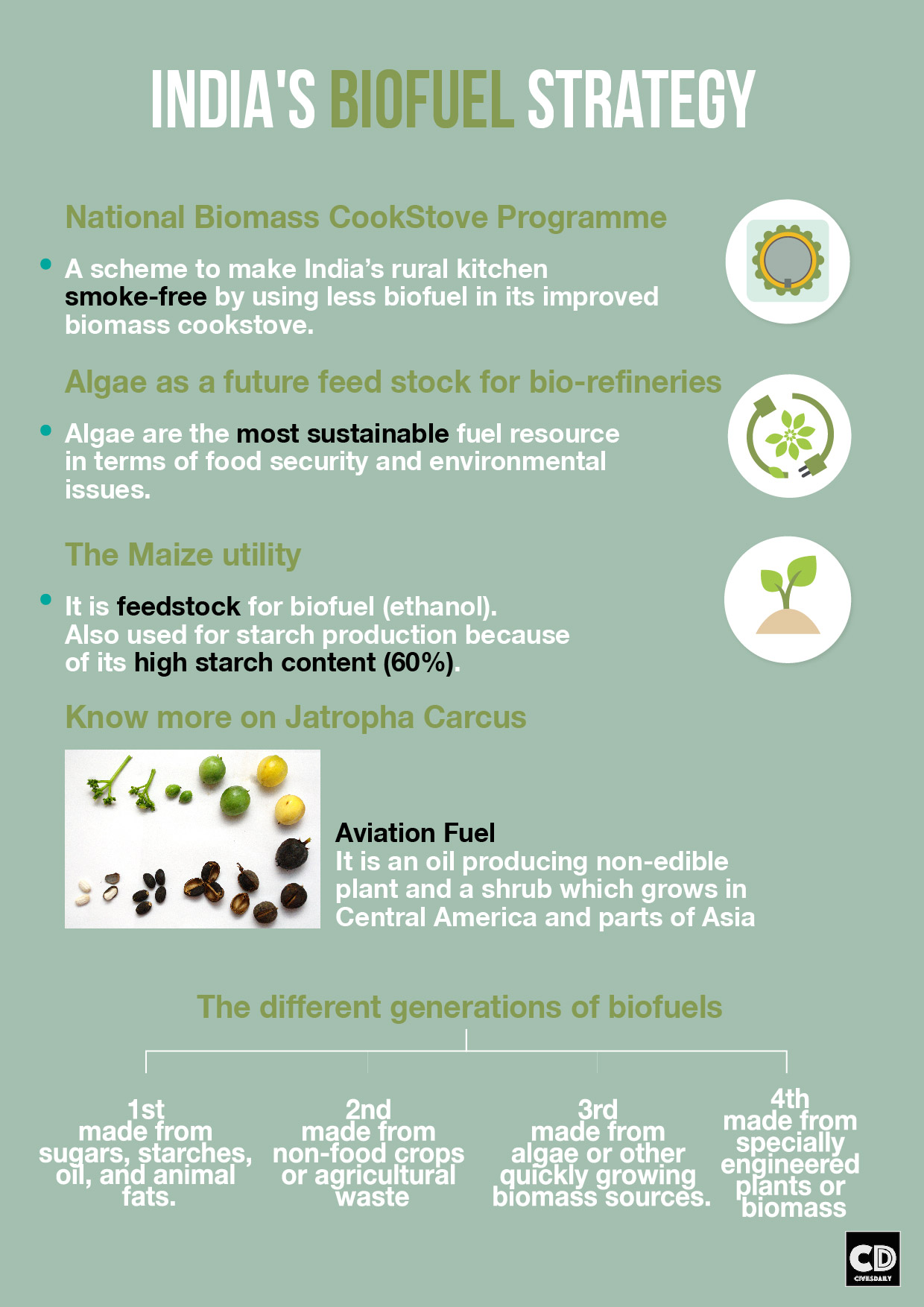
    What are different generations of Biofuels?

    First Generation

    The first generation fuels are conventional biofuels made from sugar, starch or vegetable.
    Issue: They come from a biomass that is also a food source, so it requires a lot of land to grow at a time when there is food shortage in the world.

    Let’s learn about some of the famous examples in this category.

    Ethanol – It is a type of alcohol which can be produced by any feedstock containing significant amount of sugar. It can be blended with petrol or burned in nearly pure form in slightly modified spark-ignition engines.

    1 litre of ethanol produces energy equivalent to two-third of energy produced by 1 litre of petrol.

    Is there any benefit of blending except providing an alternative to sugar industry? Of course, it improves combustion performance and lowers the emissions of Carbon Mono-oxide and Sulfur Di-oxide.

    Biodiesel – It is produced by combining vegetable oil or animal fat with alcohol. It can be blended with traditional diesel fuel or burned in its pure form in compression ignition engines.

    Source – rapeseed, soyabeen, palm, coconut or jatropha oils.

    Energy content is 88-95 % of diesel

    Second Generation

    They come from non-food biomass such as wood, organic waste, food waste, specific biomass crops.
    Issue: The second-generation fuel sources compete with food production for land.

    Third Generation

    They are specifically engineered crops such as algae as the energy source. These algae are grown and harvested to extract oil within them.

    Fourth Generation

    They are aimed at not only producing sustainable energy but also a way of capturing and storing carbon-dioxide. They are carbon-negative i.e. it takes away more carbon-dioxide than it produces.

    National Policy on Biofuels 2015

    The Policy endeavors to facilitate and bring about optimal development and utilization of indigenous biomass feedstocks for production of bio-fuels.

    • It envisages that biofuels will be produced using non-food feedstock on waste lands
    • Encouraged the use of renewable energy resources as alternate fuels to supplement transport fuels
    • Proposed an indicative target of 20% biofuel blending by 2017
    • Major thrust for development of second generation biofuels
    • A Biofuel Steering Committee will be set up to oversee implementation of the Policy

    Criticism – Govt launched National Biodiesel Mission identifying Jatropha as the most suitable tree-borne oilseed for bio-diesel production, which failed miserably. The policy is also criticized for being largely sugarcane centric.

    What is the proposal under flex-fuel policy?

    It aims at decreasing pollution by adopting cleaner alternatives against fossil fuels. It encourages a diversion in the sugar industry’s output away from sugar towards ethanol.

    Sugar industry has an excess supply problem and it helps farmers because of diversification of agriculture into energy, power and bio-plastics.

    What are the challenges to implement this policy?

    • Additional sugarcane cultivation or it can be met by improved farm practices/HYV canes
    • Installing special dispensing units at petrol pumps across the country
    • Automakers need to be given adequate time to comply
    • Oil marketing companies will have to augment storage capacity for ethanol
    • Reforming tax structure so that transport of ethanol across state boundaries is not expensive
    Published with inputs from Pushpendra 
  • Solar Panel Dispute at WTO

    India & US at loggerheads on the Solar Panel dispute

    What is the origin of the dispute?

    In 2010, India launched its national solar programme, which aims at adding 1,00,000 MW of solar power capacity by 2022.

    So, govt. wanted to incentivise the production of solar energy within the country. Therefore, they agreed to enter into long-term power purchase agreements with solar power producers, providing the guarantee for the sale of the energy produced. Thereafter, it would sell such energy through distribution utilities to the ultimate consumer.

    Bone of Contention

    However, there was a clause that a solar power producer, to be eligible to participate under the programme, is required compulsorily to use certain domestically sourced inputs, namely solar cells and modules for certain types of solar projects. In other words, unless a solar power producer satisfies this domestic content requirement, the govt will not ‘guarantee’ the purchase of the energy produced.

    What is India’s argument?

    India principally relied on the ‘govt procurement’ justification, which permitted countries to deviate from their national treatment obligation provided that the measure was related to “the procurement by governmental agencies of products purchased for governmental purposes and not with a view to commercial resale or use in production of goods for commercial sale”.

    India also argued that the measure was justified under the general exceptions since it was necessary to secure compliance with its domestic and international law obligations relating to ecologically sustainable development and climate change.

    What is US’ argument?

    In 2013, the U.S. brought a complaint before the WTO arguing that the domestic content requirement imposed under India’s national solar programme is in violation of the global trading rules.

    It said that India has violated its “national treatment” obligation by unfavourably discriminating against imported solar cells and modules. In other words, India was discriminating between solar cells and modules (which were otherwise identical) on the basis of the national ‘origin’ of the cells and modules, a clear violation of its trade commitment.

    Us has argued that India can achieve its clean energy goals faster and more cost-effectively by allowing solar technologies to be imported from the US and other producers.

    What was the WTO judgment on the issue?

    WTO concluded that India had violated its national treatment obligation, by imposing a mandatory domestic content requirement. The panel found India violated global trade rules by imposing local content requirements for solar cells and solar modules.

    Agreement’s Violated: India violated its commitments under the global trading rules, specifically the General Agreement on Tariffs and Trade (GATT) and the Agreement on Trade Related Investment Measures (TRIMs).

    Explanation: The product being subject to the domestic content requirement was solar cells and modules, but the product that was ultimately procured or purchased by the govt was electricity. Therefore, the domestic content requirement was not an instance of “government procurement”.

    Room for Negotiation

    The verdict was delayed for over 2-3 months, so that India and US can reach an agreement. In this regard, changes were suggested by New Delhi to its solar power programme. India proposed that it would use the domestic content requirement measures for buying solar panels for its own consumption such as by the railways and defence and would not sell the power generated from such subsidized panels for commercial use. However, the US may have rejected India’s offer.

    Why is the ruling being criticized?

    Various environmentalists have criticized the ruling, as it undermines India’s efforts towards promoting the use of clean energy. It threatens the clean energy economy and undermined actions to tackle the climate crisis.

    What is the criticism to India’s stand?

    There appears to be no rational basis for how mandatory local content requirements contribute towards promoting the use of clean energy. If the objective is to produce more clean energy, then solar power producers should be free to choose energy-generation equipment on the basis of price and quality, irrespective of whether they are manufactured locally or not.

    It is also argued that by mandatorily requiring solar power producers to buy locally, the govt is imposing an additional cost for the production of clean energy, which will be ultimately passed on to the ultimate consumer.

    What is alternative in India’s hand?

    Though, the WTO decision may impact the ‘Make in India’ campaign. But, the govt. can give preferential treatment to clean energies in the form of tax rebates for solar power producers, tax breaks, ensuring a strong line of long term credit at low rates, collaborating with global leaders to enhance domestic research and development.

    Future

    The reports indicate that India will prefer an appeal to the appellate body. Simultaneously, India may be exploring the option of filing a counter complaint against the US, as many of its state’s such as Michigan, Texas and California having also reportedly been accused of employing mandatory local content requirements in the renewable energies sector.

    Experts argue that govt should work towards building a business and regulatory environment, which is conducive to manufacturing. The need is for systemic changes in the form of simpler, transparent and consistent laws and effective dispute resolution mechanisms.

    Published with inputs from Pushpendra
  • Pension Reforms

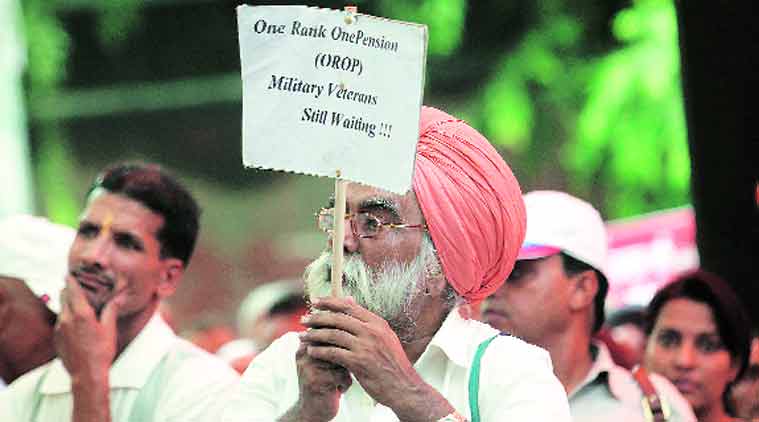
    Everything That You Need to Know on OROP


    • It is a pension scheme for the armed forces personnel which was in existence till 1973.
    • This scheme provided same pension for same rank and for the same length of service irrespective of the date of retirement which was the basis for determining the pension and benefits of the Indian Armed Forces till 1973.
    • OROP was terminated by the government in 1973.

    Which government was in power at that time and who was the PM of India?

    Then came the Koshiyari committee – 

    Bhagat Singh Koshiyari headed a committee which comprised 10 members (an all party parliamentary panel). It was formed in 2011.

    What were the recommendations of the committee?

    1. OROP should be implemented in the defence forces at the earliest and a separate commission should be formed to take decisions on pay allowances, pension, family pension etc. in respect of the defence personnel should be taken into the account by that committee.
    2. The committee recommended to absorb the Armed Forces personnel after their military engagement into other services of government which is a custom in countries like U.S. and China.

    What would be the financial Implications?

    1. Early estimates were around 3000crores for OROP.( by Ministry of Defence)
    2. Revised estimates vary between 8000 to 9000 crores.
    3. According to the Koshiyari committee the estimates for implementation of OROP were around 12000 crores.

    Is OROP expensive for the government?

    1. OROP is affordable by the government as it is a small fraction of the military pension budget.
    2. It includes about 4,00,000 defence civilians.
    3. Defence civilians, which includes the entire civilian bureaucracy in the ministry of defence ,retire at  the age of 60 are mostly based permanently in Delhi and they are not covered by OROP.
    4. It is alleged that they oppose the OROP due to their exclusion from the scheme.

    Government of India on OROP

    1. The government does not subscribe to the definition of Koshiyari committee, but states that there is a need for a new definition of OROP which should be acceptable to all the other ‘stakeholders’.
    2. The stakeholders were neither defined nor identified by the government.
    3. The government stand on the OROP prompted widespread dismay, disappointment and outrage amongst Armed Forces pensioners.
    4. The ministry of defence recommended the proposal for implementation after the approval of the Defence minister.
    5. Now it is with the of the Finance ministry which should make a call on the scheme.
  • Trans Pacific Partnership: Latest updates and developments


    What is the TPP?

    Trans-Pacific Partnership (TPP) is a trade agreement between several Pacific Rim countries concerning a variety of matters of economic policy.

    The aims of the TPP include the lowering of barriers to trade in goods and services, reducing tariffs to zero by 2015. In addition, the TPP hopes to promote investment and job creation in member states.


    How does it come into reality?

    TPP initially called the Trans-Pacific Strategic Economic Partnership Agreement, the pact began as a 2005 trade agreement between Brunei, Chile, New Zealand and Singapore in an effort to integrate their economies, drive growth and create unified regulations.

    In 2008, during the Bush administration, the U.S. joined talks to expand the agreement, along with Australia, Peru and Vietnam. The U.S. trade representative under Obama, Ron Kirk, declared the American interest in forging a broad-based regional pact.

    Then, in 2010, under the new name the Trans-Pacific Partnership, Malaysia entered the discussions, followed by Canada and Mexico in 2012.

    By 2013, Japan began participating in the talks. South Korea and Taiwan have subsequently announced their interest but not formal participation.

    Though all of the negotiating parties belong to the Asia-Pacific Economic Cooperation forum (APEC), the TPP is a separate initiative but with similar goals as APEC’s proposed Free Trade Area of the Asia Pacific.


    Why the Trans-Pacific Partnership Matters?

    The Pacific accord would phase out thousands of import tariffs as well as other barriers to international trade, like Japanese regulations that keep out some American-made autos and trucks.

    It also would establish uniform rules on corporations’ intellectual property, and open the Internet even in communist Vietnam.

    It eventually would end more than 18,000 tariffs that the participating countries have placed on American exports, including autos, machinery, information technology and consumer goods, chemicals and agricultural products as varied as avocados in California and wheat, pork and beef from the Plains states.

    The trade ministers who negotiated it predicted the overall economic and political heft of the 12-nation group would turn the accord into a model for future trade agreements.

    It would overhaul the system for settling disputes between nations and foreign companies, while barring tobacco companies from using that process to block countries’ antismoking initiatives.

    It also would enforce higher standards for labor conditions and environmental protection, including wildlife-trafficking.

    How will it benefits to USA ?

    Expanding the orbit of U.S. free trade is a major foreign policy goal of the Obama administration, and as a part of its desired international “pivot” toward Asia, it hopes to increase its economic presence in the region.

    Supporters of the partnership say by lowering barriers to trade and increasing avenues for economic globalization, the enlarged $2 trillion zone of diminished tariffs would stimulate employment in U.S. and provide an incentive to invest abroad.

    Agreement hopes to show China that the U.S. will remain a committed economic partner for the nations of the Pacific Rim, without excessively provoking Beijing.

    Who opposes the TPP?

    Opposition to the proposed agreement and to the perceived influence of multinational corporations in the process has been led by public health advocates, labor groups and environmentalists and politicians.

    Some U.S. legislators have voiced concerns that the TPP requirements would prevent access to medicine in developing countries, due to excessive patent protection. Doctors Without Borders argues against “dangerous provisions that would dismantle public health safeguards enshrined in international law.”

    Many activists also focused criticisms on the intellectual property section of the proposed partnership, which, according to WikiLeaks, could have “wide-ranging effects on medicines, publishers, internet services, civil liberties and biological patents.”

    As a trade agreement, the TPP would require House and Senate majorities and then the president’s signature. Domestic American opposition has concentrated their skepticism not just on how “free” the agreement would be but also on problems with the “fast track” congressional voting procedure.

    Japanese producers in the anime and manga industry say the TPP could damage their business by allowing companies to halt imports of intellectual property, in order to protect local distributors of licensed merchandise.

    Rice farmers, as well as beef, poultry and pork producers, have mounted firm resistance to the pact, which would dramatically decrease import tariffs.

    Geopolitically, China is concerned that the partnership is designed to exclude its economic activities, while some American officials have expressed doubts whether the market-oriented pact would ever be compatible with Beijing’s command economy.

    In Europe, analysts view the TPP as a trade regime that could set a precedent for the nascent Transatlantic Trade and Investment Partnership (TTIP).


    Published with inputs from Arun
  • Nobel and other Prizes

    Cells’ Toolbox for DNA repair honoured with Nobel Prize in Chemistry


    The Nobel Prize in Chemistry 2015 is awarded to Tomas Lindahl (UK), Paul Modrich (USA) and Aziz Sancar (USA) for having mapped, at a molecular level, how cells repair damaged DNA and safeguard the genetic information.

    Their work has provided fundamental knowledge of how a living cell functions and is, for instance, used for the development of new cancer treatments.

    What’s the DNA repair toolbox ?

    Each day our DNA is damaged by UV radiation, free radicals and other carcinogenic substances, but even without such external attacks, a DNA molecule is inherently unstable.

    Thousands of spontaneous changes to a cell’s genome occur on a daily basis. Furthermore, defects can also arise when DNA is copied during cell division, a process that occurs several million times every day in the human body.

    The reason our genetic material does not disintegrate into complete chemical chaos is that a host of molecular systems continuously monitor and repair DNA.

    The Nobel laureate scientists, who have mapped how several of repair systems function at a detailed molecular level.


    Tomas Lindahl – Puts together the pieces of base excision repair

    In the early 1970s, scientists believed that DNA was an extremely stable molecule, but Tomas Lindahl demonstrated that DNA decays at a rate that ought to have made the development of life on Earth impossible. This insight led him to discover a molecular machinery, base excision repair, which constantly counteracts the collapse of our DNA.

    This was the start of 35 years of successful work, during which Tomas Lindahl has found and examined many of the proteins in the cell’s toolbox for DNA repair.

    Bit by bit, Lindahl pieced together a molecular image of how base excision repair functions, a process in which glycosylases, enzymes similar to the one he had found in 1974, are the first step in the DNA repair process.

    Base excision repair also occurs in human beings and, in 1996, Tomas Lindahl managed to recreate the human repair process in vitro.

    The decisive factor for Tomas Lindahl was the realisation that DNA inevitably undergoes change, even when the molecule is located in the cell’s protective environment. However, it had long been known that DNA can be damaged by environmental assaults such as UV radiation.

    The mechanism used by the majority of cells to repair UV damage, nucleotide excision repair, was mapped by Aziz Sancar, born in Savur, Turkey, and professionally active in the USA.

    Base Excision repair

    Aziz Sancar’s Nucleotide excision repair

    Aziz Sancar has mapped nucleotide excision repair, the mechanism that cells use to repair UV damage to DNA. People born with defects in this repair system will develop skin cancer if they are exposed to sunlight. The cell also utilises nucleotide excision repair to correct defects caused by mutagenic substances, among other things.

    Aziz Sancar’s ability to generate knowledge about the molecular details of the process changed the entire research field. He published his findings in 1983.

    He mapped the next stages of nucleotide excision repair. In parallel with other researchers, including Tomas Lindahl, Sancar investigated nucleotide excision repair in humans.

    The molecular machinery that excises UV damage from human DNA is more complex than its bacterial counterpart but, in chemical terms, nucleotide excision repair functions similarly in all organisms.

    nucleotide_excision_repair


    Paul Modrich – illustrating DNA mismatch repair

    Once his father, a biology teacher, said: “You should learn about this DNA stuff.” This was in 1963, the year after James Watson and Francis Crick had been awarded the Nobel Prize for discovering the structure of DNA.

    A few years later, that “DNA stuff” really became central to Paul Modrich’s life.

    Paul Modrich has demonstrated how the cell corrects errors that occur when DNA is replicated during cell division. This mechanism, mismatch repair, reduces the error frequency during DNA replication by about a thousandfold. Congenital defects in mismatch repair are known, for example, to cause a hereditary variant of colon cancer.

    In conclusion, the basic research carried out by the 2015 Nobel Laureates in Chemistry has not only deepened our knowledge of how we function, but could also lead to the development of lifesaving treatments.

    In the words of Paul Modrich: “That is why curiosity-based research is so important. You never know where it is going to lead
 A little luck helps, too.”


    Irish-born William Campbell and Japan’s Satoshi Omura won half of the prize for discovering avermectin, a derivative of which has been used to treat hundreds of millions of people with river blindness and lymphatic filariasis, or elephantiasis.

    China’s Tu Youyou was awarded the other half of the prize for discovering artemisinin, a drug that has slashed malaria deaths and has become the mainstay of fighting the mosquito-borne disease. She is China’s first Nobel laureate in medicine.

    Lets’s talk about Satoshi Omura’s invention

    Satoshi Ìmura

    So, how did the journey start for Satoshi Omura?

    Satoshi Omura, a Japanese microbiologist and expert in isolating natural products, focused on a group of bacteria, Streptomyces, which lives in the soil and was known to produce a plethora of agents with antibacterial activities (including Streptomycin discovered by Selman Waksman, Nobel Prize 1952).

    Equipped with extraordinary skills in developing unique methods for large-scale culturing and characterization of these bacteria, Omura isolated new strains of Streptomyces from soil samples and successfully cultured them in the laboratory.

    From many thousand different cultures, he selected about 50 of the most promising, one of these cultures later turned out to be Streptomyces avermitilis, the source of Avermectin, a medicine that has nearly eradicated river blindness and radically reduced the incidence of filariasis, which can cause the disfiguring swelling of the lymph system in the legs and lower body known as elephantiasis.


    Bacteria.


    Puzzle about River Blindness?

    Also known as onchocerciasis or Robles’ Disease, is caused by transmission of the parasitic worm Onchocerca volvulus by black flies of the genus Simulium. Vector lives near rivers, thus the name.Inside the host, the worms create larvae that travel to the skin, and infect other flies that bite the victim.

    Symptoms include severe itching, eruptions under the skin, and blindness. About 17-25 million are infected; some 0.8 million have some degree of vision loss. Most infections in sub-Saharan Africa.

    Then, what about Lymphatic Filariasis or Commonly known as elephantiasis ?

    It is tropical disease caused by transmission of parasites classified as nematodes (roundworms) of the family Filariodideato, to humans by mosquitoes.

    Adult worms lodge in lymphatic system and disrupt immune system. Causes abnormal enlargement of body parts, pain, severe disability and social stigma.

    Over 120 million people are infected, about 40 million disfigured or incapacitated. About 1.23 billion in 58 countries are threatened, 80% of whom live in 10 countries, including India, Bangladesh and Nepal.


    Our next Pioneer William C. Campbell

    William C. Campbell

    An expert in parasite biology working in the USA, acquired Omura’s Streptomyces cultures and explored their efficacy.

    Campbell showed that a component from one of the cultures was remarkably efficient against parasites in domestic and farm animals.

    The bioactive agent was purified and named Avermectin, which was subsequently chemically modified to a more effective compound called Ivermectin. 

    Ivermectin was later tested in humans with parasitic infections and effectively killed parasite larvae (microfilaria) .

    Collectively, Omura and Campbell’s contributions led to the discovery of a new class of drugs with extraordinary efficacy against parasitic diseases.


    Scheme.


    What a breakthrough, China’s first Nobel laureate in medicine, Let’s talk about it?


    Youyou Tu

    Ms. Youyou Tu, won Nobel in Medicine for a therapy against malaria.

    Malaria was traditionally treated by chloroquine or quinine, but with declining success. By the late 1960s, efforts to eradicate Malaria had failed and the disease was on the rise.

    At that time, Youyou Tu in China turned to traditional herbal medicine to tackle the challenge of developing novel Malaria therapies.

    Tu revisited the ancient literature and discovered clues that guided her in her quest to successfully extract the active component from Artemisia annua. 

    Tu was the first to show that this component, later called Artemisinin, was highly effective against the Malaria parasite, both in infected animals and in humans.

    Artemisinin represents a new class of antimalarial agents that rapidly kill the Malaria parasites at an early stage of their development, which explains its unprecedented potency in the treatment of severe Malaria.


    Herbal medicine


    How do you think these inventions will change the world?

    The discoveries of Avermectin and Artemisinin have fundamentally changed the treatment of parasitic diseases.

    Ivermectin is highly effective against a range of parasites, has limited side effects and is freely available across the globe.

    The importance of Ivermectin for improving the health and wellbeing of millions of individuals with River Blindness and Lymphatic Filariasis, primarily in the poorest regions of the world, is immeasurable.

    Treatment is so successful that these diseases are on the verge of eradication, which would be a major feat in the medical history of humankind. Malaria infects close to 200 million individuals yearly.

    Artemisinin is used in all Malaria-ridden parts of the world. When used in combination therapy, it is estimated to reduce mortality from Malaria by more than 20% overall and by more than 30% in children. For Africa alone, this means that more than 100 000 lives are saved each year.

    The discoveries of Avermectin and Artemisinin have revolutionized therapy for patients suffering from devastating parasitic diseases.

    Campbell, Ìmura and Tu have transformed the treatment of parasitic diseases. The global impact of their discoveries and the resulting benefit to mankind are immeasurable.

    Published with inputs from Arun