💥Join UPSC 2027,2028 Mentorship (July Batch) + XFactor Notes & Microthemes PDF

Archives: Stories

  • Regional Comprehensive Economic Partnership (RCEP)

    Mega regional trade deals are in vogue in an otherwise fragile global economy. In an environment of falling aggregate demand, these trade deals are seen as a means to insulate economies from market uncertainties.

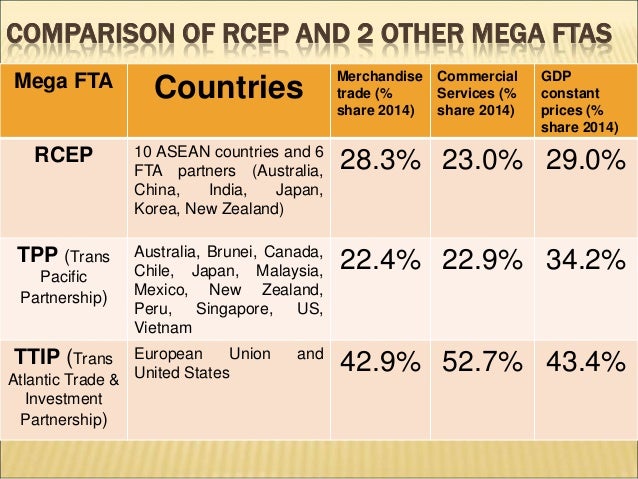
    Three important mega regional’s are currently under negotiation: the Regional Comprehensive Economic Partnership of Asia and the Pacific (RCEP), the Trans-Pacific Partnership (TPP), and the Transatlantic Trade and Investment Partnership (TTIP).

    It is expected that these agreements, once concluded and implemented, will set the stage for a new generation of global trade and investment rules.

    In this article we will explain What is RCEP ,what will be its significance for India and what are the point of contention among countries in RCEP.

    • What is RCEP?
    • Key Features of RCEP
    • Comparison of RCEP with other regional Agreements
    • Significance of RCEP for India
    • Challenges in Final negotiation of RCEP
    • Challenges and concerns for India from Joining RCEP
    • Recent point of contention in RCEP negotiation

    source

    What is RCEP?

    • Regional Comprehensive Economic Partnership (RCEP) is a proposed free trade agreement (FTA) between the ten member states of the Association of Southeast Asian Nations (ASEAN) (Brunei, Burma (Myanmar), Cambodia, Indonesia, Laos, Malaysia, the Philippines, Singapore, Thailand, Vietnam) and the six states with which include India, China, Australia, Japan, South Korea and New zealand.
    • In total, the grouping of 16 nations includes more than 3 billion people, has a combined GDP of about $17 trillion, and accounts for about 40 percent of world trade.
    • If negotiated successfully, RCEP would create the world’s largest trading bloc and have major implications for Asian countries and the world economy.

    Key features of the RCEP

    The RCEP seeks to achieve a modern and comprehensive trade agreement among members. The core of the negotiating agenda would cover trade in goods and services, investment, economic and technical cooperation and dispute settlement. The partnership would be a powerful vehicle to support the spread of global production networks and reduce the inefficiencies of multiple Asian trade agreements that exist presently.

    At the launch of negotiations in 2012, the leaders of each relevant country endorsed the “Guiding Principles and Objectives for Negotiating the Regional Comprehensive Economic Partnership.”

    The key points of this document are as follows:

    (A) Scope of negotiations

    • RCEP will cover trade in goods, trade in services, investment, economic and technical co-operation, intellectual property, competition, dispute settlement and other issues.
    • As expected, ASEAN will be in the “driver’s seat” of this multilateral trade arrangement (though the idea was initially given by Japan), and has been repeatedly endorsed by India.
    • The joint statement issued at the end of the first round of negotiations also reiterated “ASEAN Centrality” in the emerging regional economic architecture.

    (B) Commitment levels

    The RCEP will have broader and deeper engagement with significant improvements over the existing ASEAN+1 FTAs, while recognizing the individual and diverse circumstances of the participating countries.

    (C) Negotiations for trade in goods

    Negotiations should aim to achieve the high level of tariff liberalization, through building upon the existing liberalization levels between participating countries.

    (D) Negotiations for trade in services

    The RCEP will be comprehensive, of high-quality and consistent with WTO rules and all service sectors will be subject to negotiations.

    (E) Negotiations for investment

    Negotiations will cover the 4 pillars of promotion, protection, facilitation and liberalization.

    (F) Participating countries

    Participants will be ASEAN members and FTA Partners. After the completion of the negotiations, countries other than the 16 states may join.
    source

    Significance of RCEP for India

    • India is not a party to two important regional economic blocs: The Asia-Pacific Economic Cooperation and the Trans-Pacific Partnership. New Delhi fears the TPP, although years away from reality, could mean losing some textile and drugs exports to countries like Vietnam, which has embraced both the TPP and the RCEP.
      • TPP is set to change the landscape of global trade. For India, it is most likely to affect sectors like leather goods, plastics, chemicals, textiles and clothing.
      • The RCEP would enable India to strengthen its trade ties with Australia, China, Japan and South Korea, and should reduce the potential negative impacts of TPP and TTIP on the Indian economy.
    • The RCEP agreement would complement India’s existing free trade agreements with the Association of SouthEast Asian Nations and some of its member countries, as it would deals with Japan and South Korea.
    • It would be the world’s largest trading bloc covering a broad spectrum of issues such as trade in goods, services, investment, competition, intellectual property rights, and other areas of economic and technical cooperation.
    • From India’s point of view, the RCEP presents a decisive platform which could influence its strategic and economic status in the Asia-Pacific region and bring to fruition its act east policy.
    • RCEP will facilitate India’s integration into sophisticated “regional production networks” that make Asia the world’s factory. The RCEP is expected to harmonize trade-related rules, investment and competition regimes of India with those of other countries of the group. Through domestic policy reforms on these areas, this harmonization of rules and regulations would help Indian companies plug into regional and global value chains and would unlock the true potential of the Indian economy. There would be a boost to inward and outward foreign direct investment, particularly export-oriented FDI.
    • India enjoys a comparative advantage in areas such as information and communication technology, IT-enabled services, professional services, healthcare, and education services. In addition to facilitating foreign direct investment, the RCEP will create opportunities for Indian companies to access new markets. This is because the structure of manufacturing in many of these countries is becoming more and more sophisticated, resulting in a “servicification” of manufacturing.

    Challenges in Final negotiation of RCEP

    Finalizing the RCEP will not be a cakewalk for India and other countries involved in the negotiations as there are a range of issues that could act as spoilers.

    • Huge economic disparities among the negotiating countries are likely to pose a challenge
    • An inevitable source of trust deficit between China and the rest which has the potential to constrain regional economic cooperation is China’s aggressive postures on territorial disputes with Japan and India and with ASEAN member countries on the South China Sea disputes.This can pose as a hurdle in final negotiation of RCEP
    • The existing 5 ASEAN+1 and 23 ratified bilateral FTAs, varying greatly in their terms, pose a significant hurdle to RCEP negotiations.
    • The lack of commonality across FTAs and varying internal policies of countries would prove to be a difficult task to harmonize and consolidate under RCEP.

    Challenges and concerns for India from Joining RCEP

    For New Delhi, following challenges lie ahead.

    • First, tariff barriers, which have been a matter of discontent in bilateral FTAs, particularly in the case of the ASEAN-India FTA, will be central to the negotiations in the upcoming rounds of RCEP negotiations.
    • Non-trade issues such as environment and labor are likely to be prickly as well and need greater attention. Many Countries in RCEP want a stricter norms and standards on environment and labor issues while India’s interest lie in liberal environment and labor norms as this makes Indian industry competitive. India therefore should bat for liberal environment and labor norms while negotiating in RCEP.
    • India must take steps to strengthen its Medium, Small and Micro Enterprises (MSME) sector, equipping it not only to survive the free flow of trade, but also to become a set of more competitive players. Higher investments in R&D and achieving international standards in terms of delivery are needed.
    • An internal commerce ministry estimate that signing the 16-country Regional Comprehensive Economic Partnership (RCEP) trade agreement will result in a revenue loss of as much as 1.6% of GDP
    • Finally, a major difficulty for India will be negotiating terms with China. India has to be firm and calculative in terms of taking tough policy decisions, while working tirelessly on capacity building of its domestic industries.

    Recent point of contention in RCEP negotiation

    • Recently in the 12thround of RCEP talks The members of the Regional Comprehensive Economic Partnership (RCEP) have, in a sort of ultimatum, asked India to either to consent to eliminate tariffs on most products quickly or leave the talks on the proposed Free Trade Agreement (FTA) that is being negotiated by RCEP itself.
    • The members of RCEP are irked by what they think as India’s obstructionist, defensive and half-hearted approach” that is “delaying” the result of the talks
    • Some member countries, particularly 10- members ASEAN bloc, want India to take a long-term approach and consent to eliminate deities (except in agriculture and industrial goods) on a higher threshold within a decade to help India get the benefit of the opportunities arising out of Global Value Chain.

    References:

  • Mother and Child Health – Immunization Program, BPBB, PMJSY, PMMSY, etc.


    • Aim: To generate awareness and improve efficiency of delivery of welfare services meant for women
    • Launched on 22 January 2015 with an initial corpus of Rs. 100 crore
    • Joint initiative of Ministries of Women & Child Development, Health & Human Resource Development

    Districts Identified

    The three criteria for selection of districts:

    1. Districts below the national average (87 districts/23 states);
    2. Districts above national average but shown declining trend (8 districts/8 states)
    3. Districts above national average and shown increasing trend (5 districts/5 states- selected so that these CSR levels can be maintained and other districts can emulate and learn from their experiences)
    • First Phase:

    100 districts have been identified on the basis of low Child Sex Ratio as per Census 2011 covering all States/UTs as a pilot With at least one district in each state

    • Second Phase

    The scheme has further been expanded to 61 additional districts selected from 11 States/UT having CSR below 918


    Strategies:

    • Implement a sustained Social Mobilization and Communication Campaign to create equal value for the girl child & promote her education
    • Focus on Gender Critical Districts and Cities low on CSR for intensive & integrated action
    • Mobilize & Train Panchayati Raj Institutions/ Urban local bodies/ Grassroot workers as catalysts for social change
    • Ensure service delivery structures/ schemes & programmes are sufficiently responsive to issues Of gender and children’s rights
    • Enable Inter-sectoral and inter-institutional convergence at District/ Block/ Grassroot levels

    Implementation:

    1. Centre: A National Task Force (NTF) headed by Secretary WCD
      State: A State Task Force (STF)
    2. District: District Task Force (DTF) headed by the District Collector/ Deputy Commissioner with representation of concerned departments
    3. Block: A Block Level Committee headed by SDM/ SDO/ BDO
    4. Gram Panchayat/ Municipality: Respective Panchayat Samiti/ Ward Samiti
    5. Village: Village Health Sanitation and Nutrition Committees
    Published with inputs from Swapnil
  • Intellectual Property Rights in India

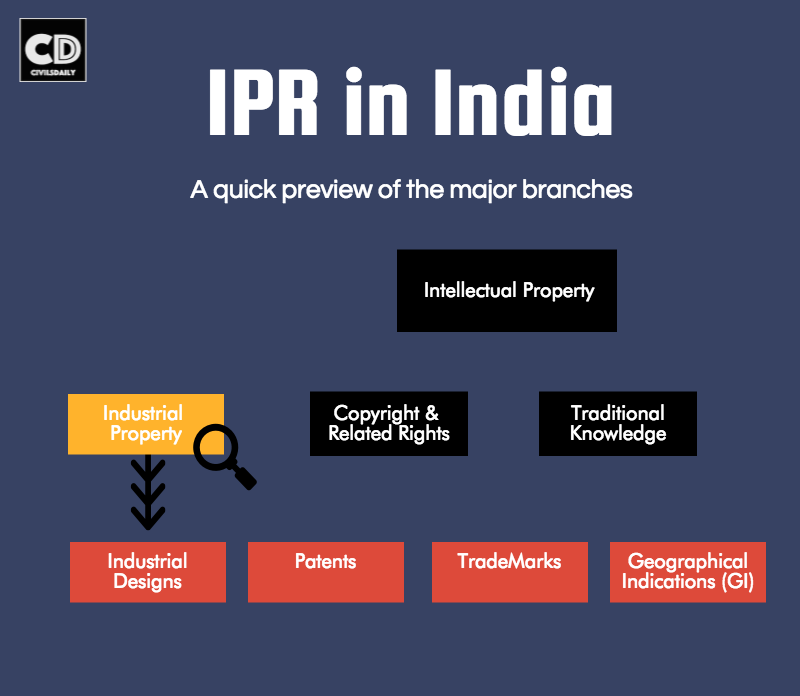
    What are IPRs?

    Intellectual Property Rights (IPRs) are legal rights, which result from intellectual invention, innovation and discovery in the industrial, scientific, literary and artistic fields. These rights entitle an individual or group to the moral and economic rights of creators in their creation.


    Types:

    Patent- It is a set of exclusive rights granted by a sovereign state to an inventor for a limited period of time in exchange for detailed public disclosure of an invention.

    Copyright- It is a legal right created by the law of a country that grants the creator of an original work exclusive rights for its use and distribution. It includes literary & artistic works such as novels, poems, plays, films, musical works, drawing, painting, photography, sculpture, architectural designs

    Trademark- It is a recognizable sign, design, or expression which identifies products or services of a particular source from those of others. Trademarks used to identify services are usually called service marks.

    Industrial design right- It is an intellectual property right that protects the visual design of objects that are not purely utilitarian. An industrial design consists of the creation of a shape, configuration or composition of pattern or color, or combination of pattern and color in three-dimensional form containing aesthetic value. An industrial design can be a two- or three-dimensional pattern used to produce a product, industrial commodity or handicraft.

    Trade secret- It is a formula, practice, process, design, instrument, pattern, commercial method, or compilation of information which is not generally known or reasonably ascertainable by others, and by which a business can obtain an economic advantage over competitors or customers

    Geographical Indication (GI)- It is a name or sign used on certain products which corresponds to a specific geographical location or origin (e.g. a town, region, or country). The use of a geographical indication may act as a certification that the product possesses certain qualities, is made according to traditional methods, or enjoys a certain reputation, due to its geographical origin. A recent example is of Indian variety of Basmati rice getting GI tag.

    From above points, it is clear that IPR is a very sensitive issue in terms of businesses different kinds and international relations as well.

    IPRs in pharmaceutical sector:

    Some sectors are very sensitive in terms of IPRs like pharmaceuticals. Let’s explore briefly into IPR issues in pharmaceutical sector.

    We hear of two kinds of drugs- generic and brand name drugs:

    Generic drugs are those whose patent has expired or does not exist and which can be produced by any registered manufacturer without need of taking permission from any authority and also without any payment of royalty.

    Brand name drugs are those which are patented and cannot be produced without the consent of the patent holder. A royalty is to be paid for production of these drugs.

    But what happens if a company holds patent of an essential drug and there is an emergency in which the drug needs to be provided at low cost for vast populace? In this case, Compulsory Licensing comes to the rescue.

    What is Compulsory Licensing?

    • A compulsory license provides that the owner of a patent or copyright licenses the use of their rights against a payment. This payment is either set by law or determined through some form of arbitration
    • In essence, under a compulsory license, an individual or company seeking to use another’s intellectual property can do so without seeking the rights holder’s consent, and pays the rights holder a set fee for the license
    • This is an exception to the general rule under intellectual property laws that the intellectual property owner enjoys exclusive rights that it may license – or decline to license – to others

    Does there have to be an emergency?

    Not necessarily. This is a common misunderstanding. The TRIPS Agreement does not specifically list the reasons that might be used to justify compulsory licensing. However, the Doha Declaration on TRIPS and Public Health confirms that countries are free to determine the grounds for granting compulsory licences.

    In March 2012, India granted its first compulsory license ever. The license was granted to Indian generic drug manufacturer Natco Pharma Ltd for Sorafenib tosylate, a cancer drug patented by Bayer.

    Here, first thing first, What is TRIPS?

    • TRIPS is an international agreement administered by the World Trade Organization (WTO), which sets down minimum standards for many forms of intellectual property (IP) regulations as applied to the nationals of other WTO Members
    • It was negotiated at the end of the Uruguay Round of the General Agreement on Tariffs and Trade (GATT) in 1994
    • TRIPS requires WTO members to provide copyright rights, covering content producers including performers, producers of sound recordings and broadcasting organizations, geographical indications, including appellations of origin, industrial designs, integrated circuit layout-designs, patents, new plant varieties, trademarks, trade dress, and undisclosed or confidential information
    • The agreement also specifies enforcement procedures, remedies, and dispute resolution procedures

    Now, back to the topic…

    India is a huge market for generic drugs and hence it is very obvious that there must emerge issues out of patents for pharmaceuticals.

    One such case came up in 1998- Novartis v. Union of India & Others

    It was a landmark decision by a two-judge bench of the Supreme Court, on the issue of whether Novartis could patent Glivec in India. It was the culmination of a seven-year-long litigation fought by Novartis. The Supreme Court upheld the Indian patent office’s rejection of the patent application.

    Ground of rejection?

    Novartis claimed patent for he changed form of Glivec on the basis of the increased bio-availability in the body of the patient by making changes in chemical composition of its original anti-cancer drug Imatinib Mesylate. This changed form of the drug could not withstand the ‘enhanced therapeutic efficacy’ test enshrined under Section 3(d) of Indian Patents Act and therefore it was rejected.

    Recently, Gilead got patent for its Hepatitis C drug Solvadi. An application for the same patent was first rejected in January 2015 as lacking inventiveness and novelty. The decision, however, is seen as a major blow to the access to drug movement

    Now let’s turn towards the latest developments in the IPRs in India.

    New IPR Policy

    Govt of India recently released a new National Intellectual Property Rights (IPR) Policy which is in compliance with WTO’s agreement on TRIPS

    Why a new policy?

    • Global drug brands led by US companies have been pushing for changes to India’s intellectual property rules for quite some time now. They have often complained about India’s price controls and marketing restrictions
    • Also, an IPR policy is important for the government to formulate incentives in the form of tax concessions to encourage research and development (R&D)
    • It is also critical to strengthen the Make In India, Startup and Digital India schemes
    • The IPR policy comes at a time when India and other emerging countries faces fresh challenges from the developed world and mega regional trade agreements such as the Trans-Pacific Partnership (TPP)

    Seven objectives:

    1. IPR Awareness: To create public awareness about the economic, social and cultural benefits of IPRs among all sections of society
    2. Generation of IPRs: To stimulate the generation of IPRs
    3. Legal and Legislative Framework: To have strong and effective IPR laws, which balance the interests of rights owners with larger public interest
    4. Administration and Management: To modernize and strengthen service-oriented IPR administration
    5. Commercialization of IPRs: Get value for IPRs through commercialization
    6. Enforcement and Adjudication: To strengthen the enforcement and adjudicatory mechanisms for combating IPR infringements
    7. Human Capital Development: To strengthen and expand human resources, institutions and capacities for teaching, training, research and skill building in IPRs

    Highlights:

    • The new policy calls for providing financial support to the less empowered groups of IP owners or creators such as farmers, weavers and artisans through financial institutions like rural banks or co-operative banks offering IP-friendly loans
    • The work done by various ministries and departments will be monitored by the Department of Industrial Policy & Promotion (DIPP), which will be the nodal department to coordinate, guide and oversee implementation and future development of IPRs in India
    • The policy, with a tagline of Creative India: Innovative India, also calls for updating various intellectual property laws, including the Indian Cinematography Act, to remove anomalies and inconsistencies in consultation with stakeholders
    • For supporting financial aspects of IPR commercialisation, it asks for financial support to develop IP assets through links with financial institutions, including banks, VC funds, angel funds and crowd-funding mechanisms
    • To achieve the objective of strengthening enforcement and adjudicatory mechanisms to combat IPR infringements, it called for taking actions against attempts to treat generic drugs as spurious or counterfeit and undertake stringent measures to curb manufacture and sale of misbranded, adulterated and spurious drugs
    • The policy will be reviewed after every five years to keep pace with further developments in the sector

    International angle:

    Last month, the US Trade Representative kept India, China and Russia on its “Priority Watch List” for inadequate improvement in IPR protection. However, brushing aside concerns of the US on India’s IPR regime, the government said its intellectual property rights laws are legal-equitable and WTO-compliant. Thus, the government has not yielded to pressure from the United States to amend India’s patent laws.

    Benefits:

    • The new policy will try to safeguard the interests of rights owners with the wider public interest, while combating infringements of intellectual property rights
    • By 2017, the window for trademark registration will be brought down to one month. This will help in clearing over 237,000 pending applications in India’s four patent offices
    • It also seeks to promote R&D through tax benefits available under various laws and simplification of procedures for availing of direct and indirect tax benefits
    • Unlike earlier where copyright was accorded to only books and publications, the recast regime will cover films, music and industrial drawings
    • A host of laws will also be streamlined — on semi-conductors, designs, geographical indications, trademarks and patents
    • The policy also puts a premium on enhancing access to healthcare, food security and environmental protection
    • Policy will provide both domestic and foreign investors a stable IPR framework in the country
    • This will promote a holistic and conducive ecosystem to catalyse the full potential of intellectual property for India’s growth and socio-cultural development while protecting public interest
    • It is expected to lay the future roadmap for intellectual property in India, besides putting in place an institutional mechanism for implementation, monitoring and review
    • The idea is to incorporate global best practices in the Indian context and adapt to the same

    Challenges:

    • According to the policy, India will retain the right to issue so-called compulsory licenses to its drug firms, under “emergency” conditions
    • Also, the government has indicated that there is no urgent need to change patent laws that are already fully World Trade Organization-compliant. So India has resisted pressure from the US and other Western countries to amend its patent laws
    • The policy also specifically does not open up Section 3(d) of the Patents Act, which sets the standard for what is considered an invention in India, for reinterpretation


    Published with inputs from Swapnil


  • NPA Crisis

    • What is NPA?
    • Impact of NPA on economy
    • Reasons for the rise in NPA in recent years
    • Why most NPA in Public sector?
    • Steps taken by RBI and Government in last few years to curb NPA
    • How to curb the menace of NPA

    source

    According to RBI’s recent data, the gross non-performing assets (NPAs) of public sector banks are just under Rs 4 lakh crore, and they collectively account for 90 percent of such rotten apples in the country’s banking portfolio.

    In terms of net NPAs, their share is even higher – at 92 percent of the total bad loans reported so far in the banking system. The total NPAs of Indian banks, as a percentage of the total loans, has grown from 2.11 per cent(2008) to 5.08 percent(2016).

    In this article we will explain what is NPA, The reason why NPA increased in India and steps taken by Government in recent years to curb the menace of NPA and what else needs to be done.

    What is NPA?

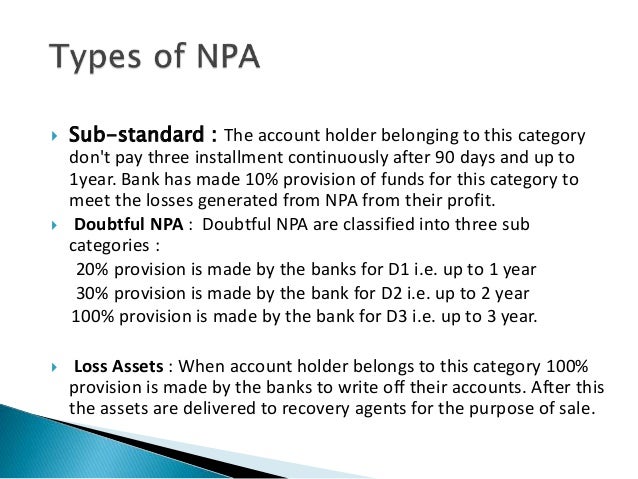
    • The assets of the banks which don’t perform (that is – don’t bring any return) are called Non Performing Assets (NPA) or bad loans. Bank’s assets are the loans and advances given to customers. If customers don’t pay either interest or part of principal or both, the loan turns into bad loan.
    • According to RBI, terms loans on which interest or instalment of principal remain overdue for a period of more than 90 days from the end of a particular quarter is called a Non-performing Asset.
    • However, in terms of Agriculture / Farm Loans; the NPA is defined as under: For short duration crop agriculture loans such as paddy, Jowar, Bajra etc. if the loan (installment / interest) is not paid for 2 crop seasons, it would be termed as a NPA. For Long Duration Crops, the above would be 1 Crop season from the due date.
    source

    Impact of NPA on Economy

    The problem of NPAs in the Indian banking system is one of the foremost and the most formidable problems that had impact the entire banking system. Higher NPA leads to following adverse impact on Economy:

    1. Depositors do not get rightful returns and many times may lose uninsured deposits. Banks may begin charging higher interest rates on some products to compensate Non-performing loan losses
    2. Bank shareholders are adversely affected
    3. Bad loans imply redirecting of funds from good projects to bad ones. Hence, the economy suffers due to loss of good projects and failure of bad investments
    4. When bank do not get loan repayment or interest payments, liquidity problems may ensue.

    Reasons for the rise in NPA in recent years

    • GDP slowdown: Between early 2000’s and 2008 Indian economy were in the boom phase. During this period Banks especially Public sector banks lent extensively to corporates. However, the profits of most of the corporate dwindled due to slowdown in the global and domestic economy, bans in mining projects, delays in environmental related permits ,Land acquisition hurdles and volatility in prices of raw material. This has adversely affected their ability to pay back loans and is the most important reason behind increase in NPA of public sector banks.
    • Relaxed lending Norms: One of the main reasons of rising NPA was the relaxed lending norms especially for corporate honchos when their financial status and credit rating was not analyzed properly. Also, to face competition banks were hugely selling unsecured loans .
    • Priority Sector Lending: There is a myth that main reason for rise in NPA in Public sector banks was Priority sector lending as according to the findings of Standing Committee on Finance , NPAs in the corporate sector are far higher than those in the priority or agriculture sector. However, even if PSL is not the main cause but it is still a cause for rising NPA which can be seen from the fact that As per the latest estimates by the SBI, education loans constitute 20% of its NPAs.
    • The Lack of Bankruptcy code in India and sluggish legal system makes it difficult for banks to recover these loans from both corporate and noncorporate.

    Other factors

    • Banks did not conducted adequate contingency planning, especially for mitigating project risk. They did not factor eventualities like failure of gas projects to ensure supply of gas or failure of land acquisition process for highways.
    • Restructuring of loan facility was extended to companies that were facing larger problems of over-leverage & inadequate profitability. This problem was more in the Public sector banks.
    • Companies with dwindling debt repayment capacity were raising more & more debt from the system.

    Why most NPA in Public sector?

    • Five sectors Textile, aviation, mining, Infrastructure contributes to most of the NPA, since most of the loan given in these sector are by PSB, they account for most of the NPA.
    • Public Sector banks provide around 80% of the credit to industries and it is this part of the credit distribution that forms a great chunk of NPA. Last year, when kingfisher was marred in financial crisis, SBI provided it huge amount of loan which it is not able to recover from it.
    • Less Professional management
    • Political Pressure and interference forces PSB to lend to not so commercially sounds project.

    Steps taken by RBI and Government in last few years to curb NPA

    • Government has launched Mission Indradhanush to make the working of public sector bank more transparent and professional in order to curb the menace of NPA in future.
    • Government has also proposed to introduce Bankruptcy code which will make it easier for banks to Recover the loans from the debtors.
    • RBI introduced number of measures in last few years which include:
      • Tightening the Corporate Debt Restructuring (CDR) mechanism,
      • Setting up a Joint Lenders’ Forum, prodding banks to disclose the real picture of bad loans, asking them to increase provisioning for stressed assets,
      • Introducing a 5:25 scheme where loans are to be amortized over 25 years with refinancing option after every five years, and
      • Empowering them to take majority control in defaulting companies under the Strategic Debt Restructuring (SDR) scheme.

    How to curb the menace of NPA?

    #1. Short Term measures

    • Review of NPA’S/Restructured advances- We need to assess the viability case by case. Viable accounts need to be given more finance for turnaround and unviable accounts should either be given to Asset Reconstruction Company or Management/ownership restructuring or permitting banks to take over the units.
    • Bankruptcy code should be passed as soon as possible. Bankruptcy code will make it easier for banks to recover loans from unviable enterprises.
    • Government should establish ARC with equity contribution from the government and the Reserve Bank of India (RBI). The established ARC should take the tumor (of non-performing assets or NPAs) out” of the banking system. An ARC acquires bad loans from banks and financial institutions, usually at a discount, and works to recover them through a variety of measures, including sale of assets or a turnaround steered by professional management. Relieved of their NPA burden, the banks can focus on their core activity of lending.

    #2. Long term Measures

    • Improving credit risk management– This includes credit appraisal, credit monitoring, and efficient system of fixing accountability and analyzing trends in group leverage to which the borrowing firm belongs to
    • Sources/structure of equity capital– Banks need to see that promoter’s contribution is funded through equity and not debt.
    • Banks should conduct necessary sensitivity analysis and contingency planning while appraising the projects and it should built adequate safeguards against such external factors.
    • Strengthen credit monitoring– Develop an early warning mechanism and comprehensive MIS(Management information system) can play an important role in it.MIS must enable timely detection of problem accounts, flag early signs of delinquencies and facilitate timely information to management on these aspects.
    • Enforce accountability- Till now lower ring officials considered accountable even though loaning decisions are taken at higher level. Thus sanction official should also share the burden of responsibility.
    • Restructured accounts should treated as non performing and technical write offs where Banks remove NPA’S from their balance sheets Permanently should be dispensed with.
    • Address corporate governance issues in PSB- This includes explicit fit and proper criteria for appointment of top executives and instituting system of an open market wide search for Chairman.

    References:

  • Land Reforms

    Land Reforms In India: An Unfinished Business

    The Traditional Land Reforms

    The Britishers in India were not at all keen in adopting progressive land reforms measures for the rural farmers. So, after independence, we adopted several measures to usher in long stalled land reforms.

    1. Abolition of Intermediaries

    Intermediaries like Zamindars, Talukdars, Jagirs and Inams had dominated the agricultural sector in India by the time the country attained independence. Soon after independence, measures for the abolition of the Zamindari system were adopted in different states.

    Reason: This kind of system was exploitative for tenants and Zamindars never invested in agriculture because their rights were not permanent, which ultimately led to low production.

    Outcome: Tenants came in direct contact with government, though he continued to pay rent which was very nominal. This was the most successful land reform in the country, but it benefited only one class of tenants, who were owners of land prior to British land revenue system

    1. Tenancy Reforms

    This reform sought to provide security of tenure to tenants, so that land owners cannot evict them arbitrarily along with regulation of rent. This reform sought to prevent exploitation and giving security of tenure so that they could invest in land. This reform required tenants to legally register with the govt. in order to get protection.

    Outcome: This reform was not very successful, except in states of West Bengal and Kerala, because of lack of political will at the state level. Moreover, since landowners were politically active, they didn’t allow the tenants to register with govt. 

    3. Ceiling on Land holdings and Redistribution of Surplus land

    The third important step of land reforms relates to the imposition of ceiling on land holdings. Ceiling on land holdings implies the fixing of the maximum amount of land that an individual or family can possess.

    This reform sought to bring parity in terms of distribution of land through two aspects: one, the fixation of ceiling limit and two, the acquisition of surplus land and its distribution among the small farmers and landless workers. This reform was accompanied by Bhoodan movement, (launched by Acharya Vinoba Bhave)

    Outcome: Actually, the limit on ceiling was kept very high and the redistributed land was mostly infertile land

    4. Consolidation of Land Holdings

    Consolidation of Holdings means bringing together the various small plots of land of a farmer scattered all over the village as one compact block, either through purchase or exchange of land with others.

    Reason: The average size of land holdings in India is very small. The size of the holdings is decreasing but number of holdings is increasing over time. This is due to the inheritance laws. If farms are small and scattered, we cannot go for mechanization, etc.

    Oucome: Not very successful, because the owners did not had conclusive rights so there was fear among farmers that they may lose land ownership. Moreover, there is mix of fertile and non-fertile land, so it was difficult to get same quality of land.

    5. Cooperative Farming

    It has been advocated to solve the problems of sub-division and fragmentation of holdings. In this system, farmers pool their small holdings for the purpose of cultivation and reap benefits of large scale farming.

    Reason: Economies of scale can reduce input cost

    Outcome: This was the least successful land reform in the country due to inconclusive ownership rights.

    Current Scenario

    Now, the land ceiling cannot be implemented because landholdings are small, but, land consolidation and tenancy reforms are more relevant now.

    Market-led Land Reforms

    These reforms come into picture after the 1991 economic reforms, which gave private sector larger role to play. Post-1991 reforms, land became important for industrial and infrastructure as well, along with agriculture.

    1. Modernization of Land Records

    This reform seeks to solve the issue of inconclusive land ownership rights. This includes survey of land holdings in the country and digitization of land records and revenue records, so there is less subjectivity in terms of ownership rights. It is significant reform because it will facilitate land consolidation.

    National Land Records Modernization Program –  It was launched in 2008, to modernize management of land records, minimize scope of land/property disputes, enhance transparency in the land records maintenance system, and facilitate moving eventually towards guaranteed conclusive titles to immovable properties in the count.

    This will facilitate easy purchase and selling of land.

    2. Facilitating Land Leasing

    There should be compulsory registration for all the land owners and lease holds. Registration of landowners will ensure security of land ownership. They can lease their land to landless/tenants and settle in urban areas. The idea is that, since there is massive rural-urban migration and those who are well-settled in urban areas can lease their land to their village counterparts.

    At present, NITI Aayog is preparing a model agricultural land leasing law, to formalise leasing of agricultural land.

    3. Land Acquisition for Public Purpose

    In 2013, govt. enacted “The Right to Fair Compensation and Transparency in Land Acquisition, Rehabilitation and Resettlement Act, 2013″, to provide just and fair compensation to farmers while ensuring that no land could be acquired forcibly.

    There was a big debate on this issue over the last year, when NDA govt. brought an amendment bill, which sought to remove all necessary checks (such as consent clause, social impact assessment, minimum consent requirement, etc) in land acquisition for 5 sectors namely – defence, rural infrastructure, affordable housing, industrial corridors and infrastructure where central govt. owns land.

    Suggested Readings

    1. Indian Express: Farmer needs a new deal
    2. Indian Express: Land Titling

    Published with inputs from Pushpendra