💥Join UPSC 2027,2028 Mentorship (July Batch) + XFactor Notes & Microthemes PDF

Archives: Stories

  • PPP Investment Models: HAM, Swiss Challenge, Kelkar Committee

    Kelkar Committee Report: Reforming the PPP

    In the Union Budget 2015-16, Finance Minister announced that the PPP mode of infrastructure development has to be revisited, and revitalized. In pursuance of this announcement, a Committee was constituted to look into the issues.

    The proposals include a provision for monetisation of projects, revamp of the model concession agreement and creation of a new institutional mechanism.

    What was committee asked to look into?

    • Review of the experience of PPP Policy.
    • Analyse risks involved in PPP projects in different sectors and suggest optimal risk sharing mechanism.
    • Propose design modifications in PPP based on international best practices and our institutional context.
    • Measure to improve capacity building in govt for effective implementation of the PPP projects.

    Why is there need to reform PPP framework?

    Background: PPP contracts are typically of very high-value, often with huge capital and operating costs.

    • The emergence of risks not foreseen at the time of signing the agreement exposes such projects to potential distress, making them unviable for the developers and prompting demands for a renegotiation of the original terms.


    How to manage risks in PPP projects?

    • Optimal allocation of risks across PPP stakeholders to boost investment.
    • Sector specific model concession pacts to capture interest of all stakeholders.

    What are the design modifications proposed by the committee?

    The Kelkar panel has come out with clear-cut norms on resolving issues and clarifying norms on re-negotiation of contracts.

    • Formulate a national PPP policy and seeking Parliament’s backing for it to be effective.
    • It emphasised upon the need to establish independent sector regulators for faster implementation of infrastructure projects and swifter dispute resolution mechanisms.
    • The report stated that the PPP structure should not be adopted for small projects.
    • It added that the govt should encourage development of airports, ports and railways through PPP, by ensuring easier funding for projects with long gestation periods.

    Let’s take a look at much deeper level about various specific dimensions of PPP framework and panel’s recommendation.

    How to streamline the stalled projects?

    Background: The Ministry of Statistics and Programme Implementation (MOSPI) says that 40% of all central govt infrastructure projects are behind schedule or have overshot their original cost estimates.

    Panel’s view: Follow the example of the Ministry of Road Transport and Highways, and NHAI, which has taken several successful steps in reducing the number of stalled projects in the sector.

    What are the institutions proposed in the report?

    • An Infrastructure PPP Project Review Committee be constituted.
    • It recommends creation of an Infrastructure PPP Adjudication Tribunal.

    How to renegotiate the PPP contracts?

    Background: More than 50% of PPP projects come up for renegotiation.

    The panel has suggested extensive guidelines stipulating the reasons that form the basis for re-negotiation & those that should not be entertained as valid reasons.

    The panel wants full disclosure of few items prior to the renegotiation:

    • Long-term costs
    • Risks and potential benefits
    • Financial implications for the govt

    Panel has suggested formation of an independent body, like a renegotiation commission, which can oversee the renegotiation of model concession agreements across sectors.

    What is panel’s view on Swiss Challenge method?

    Swiss Challenge Method: It is a process of awarding contracts as any person with credentials can submit a development proposal to the govt, which will be made online and a second person can give suggestions to improve and beat that proposal.

    The Panel wants Swiss Challenge method to be actively discouraged.

    Reason: It brings information asymmetries in the procurement process and result in lack of transparency and in the fair and equal treatment of potential bidders in the procurement process.

    Criticism: India’s ambitious plan to build new expressways across the country by adopting the ‘Swiss Challenge’ method has become uncertain.

    Why report calls for changes in anti-corruption law?

    The report calls for promptly amending the Prevention of Corruption Act, 1988

    Reason: To differentiate between genuine errors in decision-making and plain corrupt practices.

    What is panel’s view on 3P India?

    Background: Finance Minister had announced the setting up of 3P India in 2014-15 budget with a corpus of Rs 500 crore.

    The panel wants the revival of a defunct proposal to establish 3P India to support PPP projects. It can function as a centre of excellence, enable research, and review and roll out activities to build capacity

    How to deal with private sector?

    The private sector must be protected against the loss of bargaining power over long time spans. It has asked for comprehensive guidelines to be framed in this regard.

    How to build capacity in PPP projects?

    • Strengthen 3 key pillars of PPP framework – governance, institutions and capacity.
    • Structured capacity building programmes for different stakeholders.
    • A national level institution to back institutional capacity building activities.

    The report pitches for pragmatism, transparency and a business-like attitude for all stakeholders.


    Published with inputs from Pushpendra 
  • Foreign Policy Watch: India-Myanmar

    India and Myanmar relations: Change in dynamics by democratic triumph

    After decades of struggle, finally democracy triumphed over military junta and Myanmar parliament enters democratic era after 54 years of military rule. It’s time to glance over India-Myanmar relations and how India will be benefited from such stable democratic government.

    India and Myanmar have traditionally had much in common, with cultural, historical, ethnic and religious ties, in addition to sharing a long geographical land border and maritime boundary in the Bay of Bengal. Let’s see it in brief!

    How did India and Myanmar engagement begin ?

    • Myanmar is India’s bridge to east, and an important ally for growing its regional power.
    • India and Myanmar’s relationship officially got underway after the Treaty of Friendship was signed in 1951.
    • For many years, India did not open up to the authoritarian regime, and it was only over a period of time that India started engaging with the military junta of Myanmar.
    • The region’s focus has revolved around the SAARC countries and China, Myanmar is becoming increasingly important for India in both a strategic and economic context.

    What about bilateral trade ties?

    • Bilateral trade has grown from $12.4 million in 1980-81 to $2.18 billion in 2013-14.
    • Agricultural items like beans and pulses and forest based products make up nearly 90 percent of India’s imports.
    • Myanmar is also the beneficiary of a duty-free tariff preference scheme for least developed countries (LDCs).
    • Both countries also signed a border trade agreement in 1994 and have 2 trade points along their 1,643 km border.
    • India has also promoted some trade events such as the India Product Show 2012, which represented 19 Indian companies.

    But, How shared cultural links promote unique relations between both countries?

    • The two countries have shared cultural exchanges through various cultural troupes.
    • One such exchange was in 2009 when Myanmar sent a 13 member student group that attended a SAARC cultural festival in India.
    • This was followed by another major event at which the Indian embassy in Yangon organized the annual Indian Film Festival, which is a major event on the Yangon cultural calendar.

    Does India have historical bond with Myanmar?

    • Yes! Yangon was once a center for India’s independence struggle.
    • The Indian National Army (INA), formed by Indian nationalists during World War II in 1942 with the motto of Ittehad, Itmad aur Qurbani (Unity, Faith and Sacrifice).
    • Comprised over 40,000 soldiers, who fought valiantly against the British imperialist forces.
    • Netaji Subhas Chandra Bose became leader of the INA in 1943 and undertook a groundbreaking march towards Indian territories from Burmese soil with the aim of achieving Indian independence.<This time we can expect question on Netaji and his work, as we know current happenings about Netaji’s files declassified>
    • General Aung San, Burma’s independence hero, was a close friend of Netaji, the supreme commander of the INA.
    • That friendship was reflected in cordial relationship between the soldiers of the INA and their counterparts in the Burmese National Army (BNA).
    • So, it’s good to use this historical bond for building more coherent and strong relations with Myanmar.

    How Myanmar is Strategically significant to India?

    • Myanmar is strategically important to India as it is the only ASEAN country that shares a land border with India.
    • It is also the only country that can act as a link between India and ASEAN.
    • Myanmar is India’s gateway to Southeast Asia and could be the required impetus to realize India’s Look East Policy.
    • India has also decided to upgrade the Kalewa-Yargyi road segment to highway standard.
    • Myanmar would develop the Yargyi-Monywa portion, and this would help to connect Moreh in India to Mae Sot in Thailand via Myanmar.
    • This in turn would improve India’s connectivity and relationship with both Myanmar and Thailand.

    How can India become regional pivot in Asia?

    • If India is to become an assertive regional player in Asia, it has to work toward developing policies that would improve and strengthen it domestically.
    • This will encourage more confidence in its ability to lead the region and be an important global player.
    • Competition with China should also be considered and taken seriously. As China’s growing influence in the region would lead to a more one-sided dynamic in the region.
    • China has asserted itself through its soft power as well as through its trade and economic relations with Myanmar by taking up large infrastructure projects in the country.
    • India on the other hand needs to use its soft power more effectively, and at the same time strengthen itself domestically and regionally.

    What are advantages that India has over China with regard to Myanmar?

    • One is the democratic process, which results in different governments at the center and states through free and fair elections.
    • There is also the respect for institutions that are strong enough to hold the country together.
    • Finally, cooperation in different multilateral forums such as ASEAN and BIMSTEC strengthen the relationship between the 2 countries.
    • Apart from these reasons, India has sent a clear signal that while economic ties are important, it is keen to build a holistic relationship and is prepared to assist in institution building in Myanmar.

    What is the significance of Connectivity in India-Myanmar Relations? 

    <How North-Eastern region can play vital role in this?>

    • Myanmar’s vast oil and natural gas reserves and other resources make it a natural partner for many countries in the world.
    • India, being its next door neighbour, cannot be indifferent to this reality.
    • Besides, geo-political considerations, historical and civilizational links, and the ethnic overlap across their borders, have all come together to make India’s North-East the land bridge between the South and South-East Asia through Myanmar.
    • The 1,640 km-long border between Myanmar and the Indian states of Arunachal Pradesh, Nagaland, Manipur and Mizoram signifies the importance of this eastern neighbour for India.
    • India expects to reap various economic benefits by bolstering bilateral trade and investment, which critically depends upon better connectivity in the region.

    How bilateral cooperation agreement gives impetus to India’s Look-East Policy?

    • The strategic location of Myanmar is pivotal to India in reaching out to the economically vibrant South-East Asian countries.
    • India’s Look-East Policy envisages building infrastructure and expanding the transportation network including railroads, aimed at furthering surface connectivity in the region.
    • It is recognized that in addition to more economic contacts, such connectivity will promote social stability in the region by facilitating people-to-people contact amongst trans-border ethnic groups.
    • It is expected that insurgent outfits would lose their recruitment base once the local resources begin to be exploited and employment is generated leading to overall development. 
    • Concrete economic benefits are expected to come up in the region with establishment of border haats.
    • In addition, internal trade routes have the potential to enhance accessibility to sub-regional markets that connect Bangladesh, Myanmar and Bhutan.

    Way forward

    • The basic foundation for the relationship between India and Myanmar has been laid by previous governments, the onus is on the present Indian administration to demonstrate that it can take the relationship to a higher level.
    • India can become a strong regional player through a more proactive approach, cement India’s place in the region and grow into a powerful, global country.


    Published with inputs from Arun
  • Gravitational Wave Observations

    Eureka moment: Gravitational waves found


    Recently, Gravitational waves, the cosmic ripples that distort space-time itself, have been directly detected for the first time. Let’s know about this unprecedented discovery!

    What is so special about this eureka moment?

    • For the first time, scientists have observed ripples in the fabric of space-time called gravitational waves, arriving at the earth from a cataclysmic event in the distant universe
    • This confirms a major prediction of Albert Einstein’s 1915 general theory of relativity and opens an unprecedented new window onto the cosmos
    • Physicists have concluded that the detected gravitational waves were produced during the final fraction of a second of the merger of two black holes to produce a single, more massive spinning black hole
    • This collision of two black holes had been predicted but never observed

    Let’s first know about Albert Einstein’s general theory of relativity?

    • In 1905, Albert Einstein determined that the laws of physics are the same for all non-accelerating observers, and that the speed of light in a vacuum was independent of the motion of all observers. This was the theory of special relativity
    • It introduced a new framework for all of physics and proposed new concepts of space and time
    • Einstein then spent 10 years trying to include acceleration in the theory and published his theory of general relativity in 1915
    • In it, he determined that massive objects cause a distortion in space-time, which is felt as gravity

    [ Einstein’s mathematics showed that massive accelerating objects (such as neutron stars or black holes orbiting each other) would disrupt space-time in such a way that ‘waves’ of distorted space would radiate from the source ]

    What are Gravitational waves?

    Cataclysmic events, such as this artist's rendition of a binary-star merger, are believed to create gravitational waves that cause ripples in space-time
    Cataclysmic events, such as this artist’s rendition of a binary-star merger, are believed to create gravitational waves that cause ripples in space-time. Credits: NASA

    • Gravitational waves are distortions or ‘ripples’ in the fabric of space-time caused by some of the most violent and energetic processes in the Universe
    • These ripples would travel at the speed of light through the Universe, carrying with them information about their cataclysmic origins, as well as invaluable clues to the nature of gravity itself

    What are the Sources of Gravitational Waves?

    • Any object with mass that accelerates (which in science means changes position at a variable rate, and includes spinning and orbiting objects) produces gravitational waves, including humans and cars and airplanes etc.
    • But the gravitational waves made by us here on Earth are much too small to detect
    • The strongest gravitational waves are produced by catastrophic events such as colliding black holes, the collapse of stellar cores (supernovae), coalescing neutron stars or white dwarf stars, the slightly wobbly rotation of neutron stars that are not perfect spheres, and the remnants of gravitational radiation created by the birth of the Universe itself

    InfographLigo-gravitational-waves


    Not one but four types of Gravitational Waves!

    • In order to understand the types of gravitational waves, Laser Interferometer Gravitational Wave Observatory (LIGO) scientists have defined 4 categories of gravitational waves
    • These categories are: Continuous Gravitational Waves, Compact Binary Inspiral Gravitational Waves, Stochastic Gravitational Waves, and Burst Gravitational Waves

    But, Why Detect Them?

    • This will open up a new window of study on the Universe, giving us a deeper understanding of these cataclysmic events, and usher in brand new cutting-edge studies in physics, astronomy, and astrophysics
    • More importantly, since gravitational waves don’t interact with matter (unlike electromagnetic radiation), they travel through the Universe completely unimpeded giving us a crystal clear view of the gravitational wave
    • This will provide astronomers and other scientists, first glimpses of previously unseen and unseeable wonders, and greatly adding to our understanding of the nature of space and time itself

    So, How does LIGO come into the Picture?

    • LIGO( Laser Interferometer Gravitational Wave Observatory) is the world’s largest gravitational wave observatory and a cutting edge physics experiment
    • LIGO exploits the physical properties of light and of space itself to detect and understand the origins of gravitational waves
    • LIGO has 2 widely separated identical detector sites working in unison as a single “observatory”: one in Hanford, southeastern Washington State and the other in rural Livingston, Louisiana
    • LIGO has a very close collaboration with the VIRGO collaboration that analyzes data from VIRGO, a 3 km gravitational wave interferometer located near Pisa, Italy
    • Data from LIGO and Virgo are combined and analyzed together by the LIGO and Virgo collaborations
    • Thus significantly increasing the capability of combined data for detecting and using gravitational waves to learn about nature

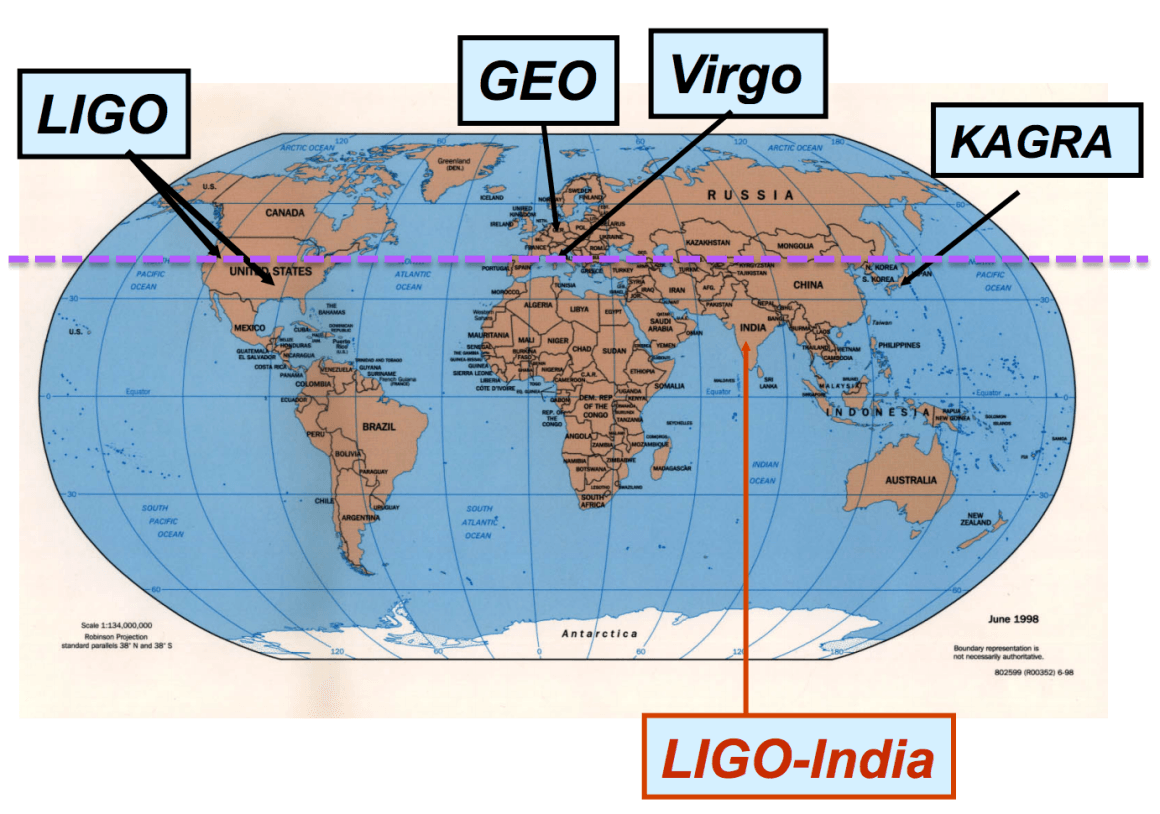
    Is there any Way ahead for India?

    Image - Locations of existing gravitational-wave detectors, and how far out a LIGO in India would be Source: LIGO
    Image – Locations of existing gravitational-wave detectors, and how far out a LIGO in India would be. Source: LIGO

    • Yes, because Union cabinet has approved a proposal to establish a state-of-the-art gravitational wave observatory in India in collaboration with LIGO in the US
    • The project will bring unprecedented opportunities for scientists and engineers to dig deeper into the realm of gravitational wave and take global leadership in this new astronomical frontier
    • This will also bring considerable opportunities in cutting-edge technology for the Indian industry which will be engaged in the construction of the 8-km long beam tube at ultra-high vacuum on a leveled terrain
    • With its establishment, India will join the global network of gravitational wave detectors
    • The establishment of an observatory in India assumes importance because the further the distance between the observatories, the greater will be the accuracy in locating gravity waves
    • Maharashtra and Madhya Pradesh are among the states shortlisted for the experiment

    Can we expect some answers from you guys?

    #Q. Recently, Union cabinet has approved a proposal to establish a gravitational wave observatory, one of the mega science projects in India. Discuss, how will this project help India if it becomes a reality.


    Published with inputs from Arun | Image: space.com
  • Real Estate Industry

    Challenges, opportunities & criticism of the Real Estate Regulatory Bill 2016

    The Real Estate Regulatory Bill, 2016 is being hailed as a much-needed step to reform the real estate sector. It will help regulate the sector and bring in clarity for both buyers and developers.

    What was the need for regulation in the real estate?

    • The real estate sector has some issues such as a lengthy process for project approvals, lack of clear land titles, and prevalence of black money
    • There wasn’t complete transparency as far as govt approvals were concerned
    • There were also instances when projects were sold without adequate clearances
    • The delayed projects, sometimes by up to years and arbitrary changes in layout plans are rampant in the sector

    How does the Bill seeks to regulate the sector?

    The basic thrust of this Bill is to regulate the delivery of projects to home buyers. It provides them a legal safeguard for their investment, and seeks to address timely delivery of houses. It seeks to enforce the contract between the developer and buyer and act as a fast track mechanism to settle disputes

    • It establishes state level regulatory authorities called Real Estate Regulatory Authorities (RERA)
    • The Bill establishes state level tribunals called Real Estate Appellate Tribunals.  Decisions of RERAs can be appealed in these tribunals
    • It makes mandatory the disclosure of all information for registered projects like details of promoters, layout plan, land status, schedule of execution and status of various approvals
    • The Bill prohibits a developer from changing the plan in a project unless two-thirds of the allottees have agreed for such a change
    • It says that builders must specify the time-frame for completion of projects and stick to it, or be ready to pay penalties
    • The Bill mandates that 70% of the amount collected from buyers of a project be used only for construction of that project This provision will effectively allow developers to continue their practice of diverting funds collected for a project towards land acquisition or other projects, and will work in their favour by also allowing them to grow their land and/or project portfolio>

    How will the Real Estate Regulatory Authorities help improve the sector?

    • Residential real estate projects need to be registered with RERAs, except few
    • Promoters cannot book or offer these projects for sale without registering them
    • Real estate agents dealing in these projects also need to register with RERAs
    • On registration, the promoter need to provide details of the project to the RERA

    Challenges ahead

    • The Bill will make life difficult for builders, as they would face more red-tapeism now, especially in procuring relevant approvals.
    • This Bill does not address the developers demand of a single-window clearance from the govt
    • The implementation of the Bill is up to the states, it leaves builders with greater chances of being harassed

    Impact

    • Timely completion of projects would lead to a steady increase in supply of homes
    • It is expected that these measures will eventually bring down home prices and increase demand
    • It will be good for the overall economy too, as the housing sector has strong backward (cement, steel and other building material industries) and forward (furniture and furnishings, interior decoration, electrical and electronics) linkages with other industries
    • More number of job creation in the economy

    Criticism

    • The builder lobbies argued that the bill should have a time-frame for municipal and other authorities to give timely approvals, because the delay in approvals lead to delays in handing over possession of apartments
    • In terms of pricing, which is governed by circle rates, it will be difficult to monitor

    Future

    • The states’ support for faster clearances to projects will be required to make this Bill successful
    • Govt is also trying to bring in a National Urban Rental Housing Policy, which would take into account the requirements of tenancy hassles in modern days
    Published with inputs from Pushpendra
    

    Sagarmala Project: Smart ports for Blue Revolution in India

    The Union Cabinet chaired by the Prime Minister Modi, on March,2015 gave its ‘in-principle’ approval for the concept and institutional framework of Sagarmala Project. Let’s take a glance on it.


    What’s the prime objective of Sagarmala?

    The prime objective of the Sagarmala project is to promote port-led direct and indirect development and to provide infrastructure to transport goods to and from ports quickly, efficiently and cost-effectively.

    What’s the current issue and background of ports in India?

    • At present there are around 200 ports (small and big) in the country, of these, only 12 are major ports which are government owned ports, which handle about 58% of sea-borne traffic.
    • These major ports operate as Trusts under the Major Ports Trust Act, 1963, except for the Port of Ennore, which is a company under the Companies Act.
    • There are legacy issues with these govt owned major ports, they do not keep pace with emerging technology, requirements of international trade, emerging trends in containerisation, flexible rules, size of ships etc.

    Which are the 12 Major Ports ?

    These are Kolkata (including Dock Complex at Haldia), Visakhapatnam, Chennai, V.O. Chidambaranar (Tuticorin), Cochin, New Mangalore, Mormugao, Jawaharlal Nehru Port Trust (JNPT), Mumbai, Kandla and Ennore.


    Just, Look back into the history?

    In 2003, then PM Vajpayee proposed Project Sagarmala with following features:

    • Setup Sagarmala Development Authority (Similar to National highway authority of India).
    • It will get money via Maritime development cess. (5 paise per kg on cargo).
    • It will improve ports, shipping industry, inland water transport, coastal shipping.
    • PPP and FDI to gather more investment.

    Then, which are the Key pillars to achieve Smart-development ?

    • Supporting and enabling Port-led Development through appropriate policy and institutional interventions.
    • Providing for an institutional framework for ensuring inter-agency and states’ collaboration for integrated development.
    • Port Infrastructure Enhancement, including modernization and setting up of new ports.
    • Efficient Evacuation to and from hinterland.

    What are some of the measures to make Smart Ports?

    • Ports should be registered as Companies under Companies Act.
    • The port administration should only look after the provisions of infrastructure and safety and not day-to-day running of the port
    • There is still no regulation to control the trade practices.
    • Hence, there is a dire need to introduce a regulatory architecture that takes care of ex-ante declaration of rates of services.

    Then, what’s the plan to implement such a vast initiative?

    • For a comprehensive and integrated planning for “Sagarmala”, a National Perspective Plan (NPP) for the entire coastline shall be prepared within six months.
    • It will identify potential geographical regions to be called Coastal Economic Zones (CEZ).
    • While preparing the NPP, synergy and integration with planned Industrial Corridors, Dedicated Freight Corridors, National Highway Development Programme, Industrial Clusters and SEZs would be ensured.

    What are the suggestions for effective mechanism at state level?

    • Set up State Sagarmala Committee to be headed by CM / Minister in Charge of Ports.
    • Sagarmala Coordination and Steering Committee (SCSC) shall be constituted under the chairmanship of the Cabinet Secretary and others.
    • This Committee will provide coordination between ministries, state governments and agencies connected with implementation and review the progress of implementation of the National Perspective Plan.

    How does it ensure the sustainable development in CEZ?

    • This would be done by synergising and coordinating with State Governments and line Ministries of Central Government through their existing programmes.
    • Such as those related to community and rural development, tribal development and employment generation, fisheries, skill development, tourism promotion etc.
    • In order to provide funding for such projects and activities that may be covered by departmental schemes a separate fund by the name ‘Community Development Fund’ would be created.

    What’s the role of Institutional Framework ?

    • It has to provide for a coordinating role for the Central Government.
    • It should provide a platform for central, state governments and local authorities to work in tandem and coordination under the established principles of cooperative federalism.

    What’s the role of NSAC?

    A National Sagarmala Apex Committee (NSAC) is envisaged for overall policy guidance and high level coordination, and to review various aspects of planning and implementation of the plan and projects.

    So, Is it Good to have smart ports on the line of Smart Cities?

    Can you answer some questions?

    #1. Can you examine the bottlenecks in Indian port infrastructure and list the initiative taken in recent times to address this issue?

    #Q.2 Indian port infrastructure can be revamped by Sagarmala project by effective management? critically comment.


    Published with inputs from Arun
  • Judicial Pendency

    Overcoming the backlog of cases: Judicial reform

    A British citizen, Will Pike was paralysed during the 2008 Taj Hotel blasts in 2008. Suing the hotel group for compensation, he wanted the trial to take place in London rather than in India. Accepting his contention, the London court allowed the matter, specifically stating that the trial in India could take some ‘twenty years’. This is a befitting example of the pendency in Indian judicial system and how it needs to be urgently addressed.

    THE MAGNITUDE OF THE PROBLEM

    The graphic below states the number of cases pending before the Courts in India. Currently, about 3.25 crore cases are pending in the Indian courts and Judges fear that this number might escalate to about 4 crore cases by the end of 2016. This problem gets escalated due to the crunch of Judges at all levels of Judiciary as seen in the graphic below.


    Timely justice is an integral part of access of justice and this huge backlog of cases amounts to denial and derailment of justice. This article will look into the proposed reforms for addressing this systemic problem.

    10 REFORMS FOR ADDRESSING JUDICIAL PENDENCY

    The 245th Law Commission Report on “Arrears and Backlogs: Creating Additional Judicial (W)omanpower has recommended the following measures

    1. Calculating Adequate Judge Strength through a more scientific analysis of data – In this context, the Commission has negated a simplistic method like Judge-Population ratio (Number of judges required per million people) in favour of a Rate of Disposal Method.

    In the Rate of Disposal Method, one looks at the current rate at which judges dispose of cases. Then, given that the institutions and disposal rate remain the same, the Courts would need how many more additional judges to keep pace with the new filings in Court so that the newly instituted cases do not add to the existing backlog.

    2. Judges to be appointed on a Priority basis: India currently has 1/5th of the number of judges it needs and thus, the Judges need to be appointed on a priority basis.

    3. Increasing the age of retirement for Subordinate Court Judges to 62 years.

    4. Creation of Special Courts for traffic/police challan cases: They constitute about 37.4% of the existing pendency before the subordinate courts.

    5. Provision for staff and infrastructure

    6. Periodic Needs Assessment by High Courts: Monitoring the rate of institution and disposal of cases and revising the adequate strength of Judges since a High Court is equipped with all the information relating to the subordinate courts in the State. The Malimath Committee had recommended setting up of Vigilance Cells in each district by the High Court to monitor the performance of subordinate judicial officers.

    7. Uniform data collection and data management methods : to bring in greater transparency.

    8. Need for a system-wide reform: The Commission has recommended the following:
    ● Greater encouragement to Alternative Dispute Resolution (ADR) and Lok Adalats <Can you tell us the difference among various types of ADRs, mediation, arbitration and conciliation? Answer in comments>
    ● Setting up non-mandatory time frames and performance benchmarks for resolution of different types of cases based on rational criteria.

    OTHER RECOMMENDATIONS

    9. Use of Technology : Has been recommended by the 230th Law Commission Report and the Malimath Committee Report to
    (a) Club cases filed on similar points of law, which can be decided on the basis of a single judgment.
    (b) Track old cases, which have become infructuous and dispose them off quickly
    (c) Setting up E-Courts and ushering in E-filing. Has received a major boost under the e-Courts Integrated Mission Mode Project.

    10. Creation of All-India Judicial Service: Provided for under Article 312 of the Indian Constitution. The idea has been mooted by various bodies including the First Judicial Pay Commission and accepted by the Supreme Court. Art 2012 proposal regarding creation of this service has not received responses from all States and this proposal continues to be hanging in the air <can you tell us the procedure of creation of new all India service? Answer in comments>.

    CONCLUSION:

    Many steps are currently being taken by the Government and the Courts to address this problem.

    • Monthly National Lok Adalats are carried out for expeditious disposal of claims.
    • In March 2016, the Monthly Lok Adalat disposed of about 1.5 lakh cases and settled claims worth Rs. 100 crores <Where can one appeal against the decision of Lok Adalats. Also tell us about the jurisdiction of Lok Adalats. Answer in comments>
    • In criminal cases, the setting-up of fast-track Courts and “plea bargaining” have further expedited matters <Can you tell us what’s plea bargaining? Answer in comments>
    • The e-courts project, aimed at providing better Court management and a database of all pending cases with easier filing of important documents is underway.
    • Moreover, the National Litigation Policy 2015 is awaiting ministerial approval and seeks to reverse the trend of Government being the biggest litigant <did you know one of the argument for rejecting NJAC was that govt was the biggest litigant, therefore can have no role in appointment of judges>.

    However, in view of the burgeoning backlog and urgency of reducing backlog, the efforts need to be severely expedited.


    P.S. This article is published with inputs from a CD user  Joyousjojo (name changed on request).

    P.P.S. If you want to write explainers for CD, mail us your explainer at hello@civilsadily.com

  • Alternative Dispute Resolution Mechanism – NCA, Lok Adalats, etc.

    The Supreme Court recently admitted an SLP (Special Leave Petition) under Article 136 of the Constitution on the setting up of a National Court of Appeal (NCA) with regional benches which will act as final courts of appeal in civil, criminal, revenue and labour matters <Can you tell us, what is SLP in comments>.

    In 1987, in the case of Bihar Legal Support Society v. the Chief Justice of India, the proposal to set up the National Court of Appeal was mooted and welcome by the then Chief Justice P N Bhagwati. The current petition by Chennai based lawyer has once, again brought the issue to the fore.

    The Supreme Court will set up a Constitution Bench to decide on the proposed NCA as primarily, it raises the following question related to the interpretation of the Constitution Answer in comments>.

    As of now, the Supreme Court is the final court of appeal in all cases. With the NCA, the role of the Apex Court would be restricted to hearing only constitutional and public law cases. Would this amount to tinkering with the ‘basic structure’ of the Constitution?

    REASONS WHY NCA COULD BE A WELCOME PROPOSITION?

    Given the never-ending and ever –increasing case-load on the Apex Court, the NCA could be a welcome change on the following grounds:
    (a) Clearing the massive backlog: With the huge pendency of cases in all three levels of Judiciary, the National Court of Appeal with its regional benches may prove to be crucial in clearing the massive backlog of cases. About 98% of the Apex Court’s time is wasted on routine matters like bail pleas, dishonor of cheques, traffic violations, correcting errors in HC judgments.

    With the NCA hearing matters pertaining to civil, criminal, labour and revenue laws, Supreme Court would be able to concentrate on the more important public law concerns.

    (b) Restoring the Apex position of the Apex Court: With the Supreme Court getting an opportunity to hear exclusively on constitutional and public law matters, its position as the final arbiter on constitutional cases and on developing the law will be further strengthened.

    This is in tune with the scenario in England, UK and Wales where the Supreme Court only rules on matters of constitutional importance or sets a new legal precedent.

    (c) Greater access to justice: Access to justice is a fundamental right for all under the Indian Constitution. In the Indian scenario, this is proportionate to the distance from Supreme Court. As per a recent survey, majority of cases come from northern states like 14% from Delhi High Court in comparison to southern states like only 2.5% of cases from Kerala High Court and even fewer from North-eastern States. Setting up NCA with regional benches will help in reducing travelling expenses, with a better cost-benefit ratio.

    WHY SHOULD THE STATUS QUO BE MAINTAINED?

    The Centre has been challenging the move to set up the NCA on the following grounds:

    (a) Dilution of the powers of Apex Court: Currently, many citizens resort to Article 136 of the Constitution in any sort of matter. With the subject matter of disputes being divided amongst NCA and the Supreme Court, Supreme Court’s exclusive power to entertain appeals under Article 136 will be significantly diluted.

    (b) Compromise the unified structure of the Judiciary: Currently, there is one Apex Court with the High Court in states followed by subordinate courts. This integrated structure will suffer a backseat with NCA somewhere in the middle between High Courts and Supreme Court Answer in comments>.

    Moreover, earlier proposals to set up Regional Benches of the Supreme Court with one bench in each region have been rejected by the Supreme Court on the ground that it will affect the unitary character of the Judiciary and that there can be only one Supreme Court.

    For providing greater access to citizens from far-flung areas, it has been proposed that there could be dedicated courtrooms with video conferencing facilities for litigants and lawyers from far-flung areas. This will avoid the need of setting up regional benches and even NCA to a great extent.

    (c) Large-scale Constitutional amendments required: For bringing the NCA into existence, several provisions of the Constitution related to independence of Judiciary, hierarchy of Courts, powers of Supreme Court etc. will have to be amended. Moreover, Article 136 of the Constitution is a part of the basic structure and in view of the decision in Keshvananda Bharati case, limiting the powers of Supreme Court through NCA will be extremely difficult.

    The solution does not lie with creating courts of appeal because it would not bring down litigation. The Supreme Court has to exercise restraint on the manner of interference under its constitutional power. Today people take chances and come to Supreme Court on every issue, including challenging an adjournment order – Attorney General

    Law Commission Recommendation 

    • Law Commission in its 229th report submitted to the government in 2009 recommended setting up of four regional benches at Delhi, Chennai/Hyderabad, Kolkata and Mumbai to deal with appeals arising out of high courts. Earlier 125th report had recommended setting up of NCA Answer in comments>.
    • It said, if necessary Article 130 may be amended to implement its suggestion that Cassation Benches may be set up in four regions, while the Constitution Bench sits in Delhi . < Is Law commission a constitutional or statutory or executive body? Answer in comments>

    But the Supreme Court rejected it in 2010, saying dividing the Supreme Court would affect the country’s unitary character. A Full Court comprising all SC judges reiterated its earlier resolutions passed in 1999, 2001, 2004 and 2006 in this regard.

    CONCLUSION: The burgeoning backlog of cases plaguing all the three levels of judiciary demand more resources and institutional reforms to deal with the problem. However, any proposals to set up institutions like the NCA will require Constitutional amendments and major Legislative will to go through. This at present is not forthcoming. The idea of a National Court of Appeal requires consideration, but in a manner that would not undermine the undoubted authority of the Supreme Court of India. The next hearing for the matter is slated up for April 4.


    P.S. This article is published with inputs from a CD user  Joyousjojo (name changed on request).

    P.P.S. If you want to write explainers for CD, mail us your explainer at hello@civilsadily.com

  • Foreign Policy Watch: India-Pacific Island Nations

    What are Pacific Island Nations (PINs)?

    • These are 14 island countries in Pacific Ocean – Cook Islands, Fiji, Kiribati, Marshall Islands, Micronesia, Nauru, Niue, Palau, Papua New Guinea, Samoa, Solomon Islands, Tonga, Tuvalu, and Vanuatu


    • These countries range in land area from the largest Papua New Guinea (461,700 sq km) to the smallest Nauru (21 sq km)
    • The size of their population ranges from Papua New Guinea (7.7 million) to Niue (1,500)
    • Development indicators also vary widely with per capita income ranging from USD 27,340 (Cook Islands) to USD 1020 (Papua New Guinea)

    Why study about PINs?

    • On August 21, 2015 India hosted the second edition of Forum for India-Pacific Islands Cooperation (FIPIC) summit in Jaipur
    • All the 14 nations of the group participated in the summit
    • So obviously, this becomes an important topic for exam and you cannot ignore this as an unimportant grouping

    Importance of the Pacific area:

    • Though these countries are relatively small in land area and distant from India, many have large exclusive economic zones (EEZs), and offer promising possibilities for fruitful cooperation
    • The Pacific Ocean is the earth’s largest ocean covering 46% of water surface and 33% of the earth’s total surface, making it larger than the entire earth’s land area
    • It is bounded by 41 sovereign states plus Taiwan, and 22 non-independent territories
    • It is rich in marine resources and accounts for 71% of the world’s ocean fishery catch
    • The Pacific has for long been an area of geostrategic interest for countries such as the US, Japan, China, Russia, Australia, and Indonesia – large economies which lie on its boundary
    • Two developed Pacific Island countries – Australia and New Zealand – have tended to dominate regional cooperation forums such as the Pacific Islands Forum (PIF)

    Issues with PINs:

    • They are dispersed and low populated countries
    • They have logistics problems to develop their economies
    • Less manufacturing activity
    • With climate change and global warming, these countries fear of being drowned or disappeared
    • Their natural resources are being depleted day-by-day – sugar, timber etc.
    • India used to import phosphates from the Nauru Island, which is now being depleted
    • Problems in sugar market due to global vagaries

    External influences:

    #1. Australia: These countries are highly influenced by Australia due to its close proximity – for example, Australia helping the development of natural gas of Papua New Guinea etc.

    #2. China

    • China has significantly expanded its foothold in the region, from increasing business and trade ties to setting up diplomatic missions in each of these countries
    • More than 3,000 Chinese companies are already operating in these Island groups in various businesses.
    • China is now the largest bilateral donor in Fiji and the second largest in the Cook Islands, Papua New Guinea, Samoa, and Tonga
    • Last year, China provided around $2 billion credit to these nations collectively
      6 out of 14 Pacific Islands recognize Taiwan as a legitimate govt of China
    • Taiwan is already holding annual meet with these countries to engage them

    #3. These island groups are forming partnerships with EU and other economic groupings

    Where can India engage?

    #1. UNSC: These 14 nations are supporting India’s attempts to become permanent member of UNSC

    #2. Agriculture:

    • These are agriculture oriented economies
    • Major products- palm oil, sugar, and timber
    • We can do value addition to their products- copra, sugar, timber
    • They are diversifying in oil production and we are short on edible oil so this is a major area to work on
    • India can make use of the mahogany (timber) that is extensively grown in these islands, for getting raw materials for paper industry

    #3. Minerals:

    • These islands have plenty of oil, gas, and minerals in their sea beds
    • For example, the Kiribati islands, they are spread over an area that is bigger than the Indian subcontinent and have rich sources of minerals
    • India can form joint ventures and explore these minerals

    #4. Disaster Management: These islands are frequently affected by natural disasters like typhoons, earthquakes etc. India can help them in disaster management

    #5. Services sector:

    • The other biggest potential area which India can leverage from these islands is the development of services sector – IT, tourism, healthcare and fisheries
    • We can explore tourism options to these isolated beautiful spots
    • Tourism also has an advantage from the fact that there are large number of ethnic Indians in these islands
    • Many of these countries send their nationals to India for education though programmes sponsored by the Indian Council of Cultural Relations

    #6. Energy:

    • India is developing renewable energy and has set a target of 175 GW by 2022. It can help the Pacific Islands in this area and provide energy security
    • We can transplant our experience of A&N islands in establishing isolated energy grids in these countries
    • There has been lot of tree cutting for industrialisation and they are using more diesel for power. We can help them by providing assistance in renewable energy

    #7. Democracy:

    • In the past, these pacific islands have faced a threat to democracy
    • For example- there was a coup in Fiji which overthrew the democratically elected government, there was a civil war in Papua New Guinea
    • In this context, India can serve as a stable and solid partner, as it is one of the largest democracies in the world, so that these islands can have an assured trade and investment relations.

    #8. Ethnicity:

    • Unlike other proximate countries like Australia, India has intimate relations, going beyond exploration of natural resources, with these nations
    • Culturally they are linked to India. For example, Fiji has huge number of Indian ethnic population
    • We should leverage this advantage to engage & establish more intimate relations

    #9. Climate Change: India should fight for their cause in the coming UN Climate Change meetings & should see to it that these islands get enough finances for disaster mitigation

    #10. The Pacific Island groups have enthusiastically welcomed India’s offer in telemedicine, tele-education, space cooperation, fostering democracy and community activities

    #11. These countries are in need of MSME and we have good experience in developing them

    FIPIC:

    • The Forum for India–Pacific Islands Cooperation (FIPIC) was launched during PM’s visit to Fiji in November 2014


    • FIPIC includes 14 of the island countries – Cook Islands, Fiji, Kiribati, Marshall Islands, Micronesia, Nauru, Niue, Palau, Papua New Guinea, Samoa, Solomon Islands, Tonga, Tuvalu, and Vanuatu

    Why FIPIC?

    • Though these countries are relatively small in land area and distant from India, many have large exclusive economic zones (EEZs), and offer promising possibilities for fruitful cooperation.
    • India’s focus has largely been on the Indian Ocean where it has sought to play a major role and protect its strategic and commercial interests
    • The FIPIC initiative marks a serious effort to expand India’s engagement in the Pacific region
    • At this moment, total annual trade of about $300 million between the Indian and Pacific Island countries, where exports are around $200 million and imports are around $100 million
    • This is a part of India’s extended Act East Policy

    Summits:

    #1. Suva, Fiji:

    • One of the key outcome of the first summit in Suva, Fiji was that top leadership of both India and Pacific Islands decided to meet at a regular interval and an annual summit was instituted in this regard
    • Other areas- visa on arrival for their nationals, funds for small business, line of credit for a co-generation power plant for Fiji, and a special adaptation fund for technical assistance and capacity building for countering global warming

    #2. Jaipur, India:

    • India announced to convene international conference on blue economy in New Delhi in 2016 and invited all the experts form the island nations
    • Set up Space Application Center, in partnership with ISRO, in any of the 14 countries and friendly port calls by the Indian Navy
    • Pacific leaders have expressed their concerns over climate change and its effect on their respective counties. India also assured them to voice their concerns and appropriate measures at the 2015 United Nations Climate Change Conference (COP 21) in Paris
    • In return all the 14 visiting head of state/government reiterated their support to India’s bid for a permanent memberships at the reformed United Nations Security Council
    • India offered to help the Pacific Islands with their hydrography and coastal surveillance, by engaging the Indian Navy. It would help them have a better understanding of their maritime zone and strengthen security of their EEZs
    • India also announced FIPIC Trade Office at Federation of Indian Chambers of Commerce & Industry (FICCI) to promote Trade & Investment opportunities between India & Pacific Island Countries

    Way ahead:

    • China is already on there and giving large credit, so does it mean India can not build good relations with these nations? No
    • We need to build on our advantages- health tourism, building democratic institutions which they need a lot
    • India’s strong relations with Fiji, which has considerable influence in the region, is a strong point which could help counter the growing Chinese influence
    • Relations with Fiji had improved in India’s favour in the past decade and not only those of Indian origin but also Fijians were friendly towards Indians, which worked to Indian advantage
    • Most of the economies in the region are based on agriculture, fisheries and small-scale industries and India’s capacity in these sectors is even better than Europe and China

    Published with inputs from Swapnil
  • Foreign Policy Watch: India-SCO

    SCO & India

    As of July 2015, India has been accorded full membership of the Shanghai Cooperation Organisation (SCO) along with Pakistan at its Ufa summit held in Russia.

    • SCO is a Eurasian economic, political and military organisation
    • HQ: Beijing, China
    • Established: 2001 in Shanghai by the leaders 6 countries viz. China, Kyrgyzstan, Kazakhstan, Russia, Tajikistan, and Uzbekistan
    • Since 2005, India was having an Observer status of SCO and had applied for full membership in 2014. India would be finally ratified in the member list by 2016

    Connecting the dots with SCO

    Per Chinese and Russian scholars, creation of SCO helped address the security problems and enhance economic cooperation in the Central Asia region. The Western discourse, however, has tended to see the SCO as a mechanism to counter-balance the influence of the United States in the region. Both are correct!

    SCO is considered and tagged as anti-west. Behind the veils, it is alleged that SCO is going to be a NATO like military alliance in East. You might expect a question on that line and be asked to put India’s context in place.

    However, China exaggeratedly says that the SCO was founded on a principle of non-alignment and functions as an effective stabilizer for regional security and peace. China has always maintained that the focus of SCO is on combating the “three evil forces” – terrorism, separatism, and extremism – and other unconventional security menaces.

    Advantage India?

    There are multiple benefits for India as well as the SCO which is concerned with security and stability in the Eurasian space.

    1. India’s presence will help moderate the anti-West bias of the grouping, which will calm Washington’s nerves to a considerable extent
    2. Greater engagement with India will also aid the organisation’s capability to improve regional economic prosperity and security
    3. Membership will give India an opportunity to play an active role in China’s Silk Road initiative which plans to link a new set of routes from the north and east of the country to an old network of routes in the greater Eurasian region.
    4. Indian interest in International North-South Transport Corridor to connect Mumbai with Abbas port in Iran. This route is shorter than the existing Suez Canal and the Mediterranean Sea
    5. SCO may also serve as guarantor for projects such as the Turkmenistan-Afghanistan-Pakistan-India (TAPI) and Iran-Pakistan-India (IPI) pipelines, which are held by India due to security concerns.

    India’s entry is also likely to tip the balance of power in favor of peace and stability in Afghanistan.

    Challenges ahead for SCO?

    It is naive to expect that India’s differences with China regarding the border or its ties with Pakistan will magically disappear. The inclusion of Pakistan in the SCO will also make it difficult for India to enjoy a level playing field.

    Pakistan, which is embroiled in a domestic political crisis, may not be so willing to challenge hardliners in its country, and go along with India in promoting peace and stability in the Eurasian space. We have seen how Indo-Pak presence in SAARC makes it difficult to ink key pacts.

    The clash of interests in a post – 2014 Afghanistan makes prospects of cooperation difficult. There is also a possibility that China may collude with Pakistan to suffocate India’s voice in the decision making process.

    Other than that, India will have to balance the geopolitical ambitions of China and Russia to evolve a mutually beneficial framework.


    Further readings:

    SCO becomes a reasonably hot topic post India’s accession to the member status. If you are comfortable with IR, try these articles  –

  • Oil and Gas Sector – HELP, Open Acreage Policy, etc.

    Recently, Cabinet has approved new Hydrocarbon Exploration and Licensing Policy (HELP), which will replace New Exploration Licensing Policy (NELP), for Oil and Gas exploration, Will that make any change in oil and gas exploration regime? Let’s see this in brief!

    Let’s first take an overview of New Exploration Licensing Policy (NELP)

    • New Exploration Licensing Policy (NELP) was created in 1997
    • To provide an equal platform to both Public and Private sector companies in exploration and production of hydrocarbons
    • Directorate General of Hydrocarbons (DGH) was a nodal agency for its implementation
    • Between 1998 and 2012, there were 9 rounds of oil and gas block auction (NELP 1 to NELP 9)
    • Although 126 discoveries have been made in 41 active blocks, commercial production has commenced only in 3 blocks
    • Reasons for the delay vary from inadequate technology to delayed regulatory approvals
    • Today, only 2 blocks, the Reliance Industries-operated KG D6 block and the Gujarat State Petroleum Corporation-operated Cambay onshore block, are producing oil or gas

    <Let’s Move towards new version of Policy>

    What are the Main facets of HELP policy?

    • Uniform License for exploration and production of all forms of hydrocarbon
    • Open acreage policy
    • Easy to administer Revenue sharing model
    • Marketing and pricing freedom for the crude oil and natural gas produced

    What is Unified Licensing Policy?

    • As the name suggests, all licenses are unified i.e. this allows exploration and production of all hydrocarbons such as oil, gas, coal bed methane and shale oil and gas in a block
    • Contrast this with NELP, which required separate licensing for different types of hydrocarbons time and cost overruns

    Concept of Open Acreage Policy

    • Contractors will now have the flexibility to request bidding for any block on-tap under Open Acreage Licensing
    • Earlier, they had to wait for the government to auction blocks, and could only bid for blocks that were put up for auction
    • This will enable Exploration & Production (E&P) companies choose the blocks from the area they like

    What’s new in Revenue-sharing formula?

    • Present system is that of of production sharing based on Investment Multiple and cost recovery/ production linked payment
    • Under the new revenue-sharing formula, contractors will share the revenue from the time first drop of oil/gas starts flowing from the field.

    How this policy of revenue sharing is in tune with Ease of Doing Business?

    • Earlier, under the Production/profit Sharing Methodology, it became necessary for the Govt to scrutinize cost details of private participants and this led to many delays and disputes<as govt was given its share only after all the costs were recovered, govt had to make sure that private parties do not inflate cost to reduce govt’s share>
    • To prevent loss of government revenue, there were requirements for Government approval at various stages to prevent the contractor from exaggerating the cost
    • Activities could not be commenced till the approval was given.  This process became a major source of delays and disputes
    • Under the new regime, the Govt will not be concerned with the cost incurred and will receive a share of the gross revenue from the sale of oil, gas etc.
    • So, no CAG audit, no approvals required, no micromanagement by govt.
    • Companies would worry less about the govt and focus more on operations
    Parameter Production sharing Contract Revenue Sharing Contract
    Risk Investor can take higher risk as he will be able to recover investment before sharing with govt Won’t take higher risk, has to share revenues from the first drop of oil
    Govt interference Higher as costs have to be rechecked minimal
    Useful for High risk high cost environment such as deep fields Low cost environment, fully explored blocks
    Recommended by Kelkar Committee Rangrajan Committee
    Govt policy NELP HELP

    India remains one of the least explored countries and could hold large potential resources. For example, 15 basins out of a total 26 sedimentary basins in India spread over on-land, offshore and deepwater, are estimated to hold prognosticated hydrocarbon resources of over 200 billion barrels of oil equivalent. Hence some recommend Production sharing contracts for India with investing capacity to manage such contracts better.

     Graded system of royalty to boost investment

    • The current policy regime, in fixing royalties, does not distinguish between shallow water fields (lower costs and risks) and deep/ultra-deep water fields(much higher costs and risks)
    • Under the new policy, there is lower royalty rates for difficult areas compared to NELP royalty rates
    • A graded system of royalty rates have been introduced, in which royalty rates decreases from shallow water to deepwater and ultra-deep water
    • Royalty rate for onland areas have been kept intact so that revenues to the state governments are not affected

    Pricing and Marketing Freedom

    At present, natural gas price is determined by taking into account the average of prices in gas-surplus countries such as the US, Canada and Russia, but proposed formula is market-efficient

    • New Policy allows pricing freedom to companies with a cap on prices to protect consumer interest
    • Gas price will be the lowest of imported fuel price; weighted avg of naphtha, coal and fuel oil; and the price of imported LNG
    • Policy also gives marketing freedom
    • The new price will apply to undeveloped gas discoveries and not on currently producing fields

    So, new price formula combined with lower royalty rates will help in undeveloped gas discoveries in deep-sea, ultra-deep sea and high-temperature, high-pressure fields. Increased investment and competition will eventually bring down gas prices as well as import dependence of India and lead to the development of a competitive gas market in the country.

    From NELP to HELP

    UNIFORM Licensing Policy One license for E&P of all the hydrocarbons from a block
    Open acreage system Licenses on tap
    Revenue sharing model Minimal govt interference
    Marketing and pricing freedom Sell to whoever you want at market determined prices subject to a ceiling price


    How Contract extension will help to remove further obstacles?

    • The grant of extension of production sharing contracts for 28 small, medium sized discovered fields is welcome
    • Because, this move will remove uncertainty and help contractors plan their investments in these blocks
    • The extension will be for 10 years, both for oil and gas fields or economic life of the field, whichever is earlier

    Way forward

    • India currently produces around 90 mmscmd (Million Metric Standard Cubic Meter Per Day) of gas, hardly meeting 40 per cent of the needs (imports majority of gas from Qatar)
    • Oil and Natural Gas Corp (ONGC), Reliance Industries and Gujarat State Petroleum Corporation(GSPC) will now get freedom to price gas from its idle discoveries in deep sea, ultra deepsea and high-pressure and high-temperature areas
    • So, overall we can say that, Govt’s target for O&G seems to be on track, to attract more investments, boost production and take away govt discretion from Oil and Gas Exploration