💥Join UPSC 2027,2028 Mentorship (July Batch) + XFactor Notes & Microthemes PDF

Archives: Stories

  • Uniform Civil Code: Triple Talaq debate, Polygamy issue, etc.


    What is the idea behind a Uniform Civil Code for India?

    Currently, believers of various religions can marry, adopt, inherit property and divorce under their own customs.

    Under a Uniform Civil Code, it is believed, personal laws and sanctioned practices of different religions will be largely harmonised with accepted fair practices for all citizens, under guidelines laid down by Constitution.

    Does the Constitution mention a Uniform Civil Code?

    Article 44 of the Constitution, which is one of the Directive Principles of State Policy, says: “The State shall endeavour to secure for the citizens a uniform civil code throughout the territory of India.”

    Directive Principles are not justiciable or mandatory, only a guideline.


    Then, what is the debate about?

    Articles 29 and 30 guarantee minorities the right to conserve their culture and script, and run their own educational institutions.

    It was understood that minorities could practise their religion and follow their customs and traditions.

    The Supreme Court asked the central government, whether it was willing to bring a Uniform Civil Code to ride over inconsistent personal laws in different religions.

    There was “total confusion” over the incoherent stipulations about marriage, divorce, adoption, maintenance and inheritance.

    Currently, different laws regulate these aspects for adherents of different religions.

    Is the debate over Uniform Civil Code just a Hindu-Muslim issue?

    Far from it. Parsis, Jains, Sikhs, Christians, apart from of course Hindus and Muslims, have their own civil codes.

    While the Muslim Personal Law is yet to be codified (because of deep divisions within), Christian and Parsi codes were specified before Independence.

    The personal laws of Hindus, Jains, Sikhs and others were codified in the 1950s.

    So, What does our secular Constitution say?

    Article 25, which guarantees the freedom to practise, profess and propagate any religion. By the 42nd Amendment of 1976, India was declared a secular nation.

    The understanding of Article 25, the State and its institutions have not interfered with religious practices, including in relation to various personal laws.

    There is a view that this principle runs contradictory to the idea of secularism which requires the State to be inert to religious considerations, and not tacitly support them by following a practice of non-interference, no matter what.

    Clause (2) of Article 25 empowers the State to frame any law to regulate or restrict “secular activity which may be associated with religious practice”, therefore, it is argued, Article 25 is no bar to having a Uniform Civil Code.

    The inconsistency in personal laws has been challenged on the touchstone of Article 14, which ensures the right to equality.

    Historical Judgements

    Litigants have contended that their right to equality is endangered by personal laws that put them at a disadvantage.

    The first prominent case founded on Article 14 was Shah Bano case (1985) in which the apex court ruled that a Muslim woman was entitled to alimony under the general provisions of the CrPC, like anybody else.

    Following protests from Muslim leaders, Rajiv Gandhi’s government in 1986 got the Muslim Women (Protection of Rights on Divorce) Act passed in Parliament, which nullified the ruling.

    In effect, the verdict did a balancing act between the Shah Bano judgment and the 1986 law.

    In Githa Hariharan vs RBI (1999), the top court adjudicated upon the constitutional validity of certain provisions of the Hindu Minority and Guardianship Act, 1956 and the Guardian Constitution and Wards Act, on a petition claiming they violated Articles 14 by treating the father as the natural guardian of a child under all circumstances.

    It ushered in the principle of equality in matters of guardianship for Hindus, making the child’s welfare the prime consideration.

    That’s some history! what is today’s scenario ?

    The BJP, kept the Uniform Civil Code in its 2014 election manifesto. The BJP and RSS have long demanded it, and cited the example of Goa, which has a common law called the Goa Civil Code.

    What the government tells the court next month will be a test of its political will , and mark the next chapter in the evolution of this debate.

    So, do we really want a Uniform Civil Code? Is there a way forward ?

    Yes, you say? Well, there seems only one way to see through this crazy fog.
    Every aspect of the personal laws must be examined in the light of constitutional guarantees to every Indian, equality, justice, right to life.

    Laws that fail to uphold these basics must be thrown away, Isn’t it ?


    Published with inputs from Arun
  • Gold Monetisation Scheme

    PM Modi Launches 3 Gold Schemes

    In a bid to rein in the gold imports and attract investors away from physical assets, PM Modi launches 3 Gold Schemes: 

    1. Gold Coin and Bullion scheme
    2. Gold Monetisation Scheme
    3. Gold Sovereign Bond Scheme

    #1. India Gold Coin and Bullion scheme

    • The coin will be the first ever national gold coin minted in India and will have the National Emblem of Ashok Chakra engraved on one side and Mahatma Gandhi on the other side.
    • Initially, the coins will be available in denominations of 5 and 10 grams.
    • The Indian Gold coin is unique in many aspects and will carry advanced anti-counterfeit features and tamper proof packaging that will aid easy recycling.

    #2. Gold Monetisation Scheme (GMS), 2015

    • Scheme allows you to earn some regular interest on your gold and save you carrying costs as well.
    • It replaced the existing Gold Deposit Scheme, 1999.
    • It offers option to resident Indians to deposit their precious metal and earn an interest of up to 2.5 per cent.

    Who can make deposits?

    • Resident Indians (individuals, HUF, trusts, including mutual funds/exchange traded funds registered under Sebi norms) can make deposits under the scheme.
    • No maximum limit for deposit under the scheme and the metal will be accepted at the Collection and Purity Testing Centres (CPTC) certified by the Bureau of Indian Standards.

    #3. Sovereign Gold Bond Scheme

    • Investors can earn an interest rate of 2.75 per cent per annum by buying paper bonds.
    • Sovereign Gold Bonds will be issued in multiple tranches subject to the overall borrowing limits.
    • The bond would be restricted for sale to resident Indian entities and the maximum allowable limit is 500 grams per person per year.
    • They can be used as collateral for loans and can be sold or traded on stock exchanges


    Few more things to know

    1. Minimum investment in the bond shall be 2 grams.
    2. The bonds can be bought by Indian residents or entities and is capped at 500 grams.
    3. The RBI has fixed the public issue price of sovereign gold bonds at Rs 2,684 per gram.
    4. The borrowing through issuance of Bond will form part of market borrowing programme of Government.
    5. The Bonds will be eligible for Statutory Liquidity Ratio (SLR).

    Why was there a need for such schemes?

    1. To lure tonnes of gold from households into banking system.
    2. According to the World Gold Council, an estimated 22,000-23,000 tonnes of gold is lying idle with households and institutions in India.
    3. Huge gold imports pushed India’s current account deficit (CAD) to a record $190 billion in 2013, prompting the hike its duty on imports to a record 10 percent.
    4. The government wants to reduce the reliance on gold imports over time.

    But, will these schemes succeed in bringing down Gold imports?

    1. Experts who believe, investors will still find 8 percent offered for bank deposits as more attractive.
    2. The present scheme will not bring out even 20 tonnes of gold.
    3. Investors fear that the tax department will hound them questioning the source of gold.

    Okay! But tell me how good are they from investing point of view?

    1. A section of experts feels the interest rates being offered (on both deposits and bonds) are attractive.
    2. For people who have gold as an investment asset, it is a good opportunity to gain some interest out of it.
    3. Gold is always written off as a zero-yield instrument compared to equities, which give dividend and fixed income which gives fixed interest.

    From now on, gold will not only be an instrument of security but will also give earnings and will become part of nation building.


    Published with inputs from Arun
     

  • FDI in Indian economy


    What is Foreign Direct Investment (FDI)?

    FDI means where a foreign company, generally an MNC, may invest in a country in any of the following 3 forms:

    #1. Setup a plant or project to manufacture a commodity- consumer goods, capital goods, automobile, aircrafts, ships etc. It may also engage itself in construction activity- highways, roads, bridges, ports, airports, real estate etc.

    #2. Setup network for providing services- banking, insurance, shipping, telecom, software, civil aviation etc.

    #3. Only provide technology by way of Technology Transfer through any company of the country. It can provide technology only or provide technology along with #1 & #2 above

    Foreign Portfolio Investment (FPI):

    • It means that foreign investors, generally Foreign Institutional Investors in case of India (FIIs are very large investors who invest bulk amounts just like Mutual Funds), invest in country stock market by investing in shares, debentures, bonds, Mutual Funds etc.
    • The objective here is to make capital gains in the stock markets
    • Hence this is investment is also called ‘Hot Money’ or ‘Fly-by-Night Money’ as it has a tendency to move from one country to another in search of quick profit
    • Therefore it has a potential to cause volatility in those markets from where it leaves

    FDI routes:

    #1. Automatic

    A foreign company wishing to invest in India doesn’t have to seek prior approval of any body/ agency in India
    It can straight away bring in investments in India & has only to inform the RBI within 1 month of bringing its investment in a certain sector
    This route is relatively hassle free due to which more than 55% of total FDI has come through this route

    #2. Foreign Investment Promotion Board (FIPB)

    It was established in 1992 (just after L-P-G reforms)
    Investments upto Rs. 5000 crore from notified sectors have to go through its approval

    #3. Cabinet Committee on Economic Affairs (CCEA)

    This approves investments above Rs. 5000 crores from notified sectors

    Merits of FDI:


    • Adds to the productive capacity of a nation (by definition, as mentioned above)
    • Long term and stable- Because an MNC would continue to manufacture in a country, earn profits, engage in exports and thus spread its wings across the world as it enjoys a global name
    • No repayment obligation on part of the country where it is operating. This is the most important feature
    • Brings in capital and bolsters FOREX reserves
    • Brings in technology
    • Helps export promotion (because of global brands)
    • Generates employment
    • Expands markets (domestic as well as foreign)
    • International Best Practices- Brings in latest administrative and work culture
    • Infuses competition among domestic industries

    What is the impact of FDI on Inflation?


    • FDI has been generally touted as a measure to dampen inflation. But this can NOT be concluded in all situations
    • The FDI’s impact on dampening the inflation is based upon the assumption that FDI would result in the developing of country’s back-end infrastructure and crack the supply bottlenecks. Practically, it may or may not happen
    • Economics has no rule to link FDI and Inflation because inflation may have many reasons behind it rather than only infrastructure and supply bottlenecks
    • Generally the FDI’s role in containing inflation is supported by the facts that- it improves infrastructure, improves supply chain, brings permanent investment

    Demerits:

    • May threaten a country’s economic and political sovereignty (remember East
    • India Company which came to India just as a trader)
    • It may bring obsolete technology (this was true especially during 1950-90 because US and UK were the only countries bringing FDI. But now due to many countries bringing FDI, there is competition and this risk is reduced)
    • Focus on short term profit earning tactics rather than long term investments with a view of national industrial development
    • Indulging in cut-throat competition
    • Indulging in transfer pricing practices

    Why Foreign Investors go for FDI?

    • To take advantage of cheaper wages in the country, special investment privileges such as tax exemptions offered by the country as an incentive
    • To gain tariff-free access to the markets of the country
    • To acquire lasting interest in enterprises operating in the target country.

    What attracts FDI?

    • The growth rate of the source economy is an important determinant
    • The political and economic stability of the target region
    • How ‘open’ the economy is towards foreign trade (both imports and exports)
    • The policies, rules, regulations and loopholes incidental thereto
    • For example, Mauritius has been top FDI source for India due to the later (loophole) reasons

    Recent FDI reforms (November 2015):

    #1. Townships, shopping complexes & business centres – all allow up to 100% FDI under the auto route

    Conditions on minimum capitalisation & floor area restrictions have now been removed for the construction development sector

    #2. India’s defence sector now allows consolidated FDI up to 49% under the automatic route

    FDI beyond 49% will now be considered by the Foreign Investment Promotion Board

    Govt approval route will be required only when FDI results in a change of ownership pattern

    #3. Private sector banks now allow consolidated FDI up to 74%

    #4. Up to 100% FDI is now allowed in coffee/rubber/cardamom/palm oil & olive oil plantations via the automatic route

    #5. 100% FDI is now allowed via the auto route in duty free shops located and operated in the customs bonded areas

    #6. Manufacturers can now sell their products through wholesale and/or retail, including through e-commerce without Government Approval

    #7. Foreign Equity caps have now been increased for establishment & operation of satellites, credit information companies, non-scheduled air transport & ground handling services from 74% to 100%

    #8. 100% FDI allowed in medical devices

    #9. FDI cap increased in insurance & sub-activities from 26% to 49%

    #10. FDI up to 49% has been permitted in the Pension Sector

    #11. Construction, operation and maintenance of specified activities of Railway sector opened to 100% foreign direct investment under automatic route

    #12. FDI policy on Construction Development sector has been liberalised by relaxing the norms pertaining to minimum area, minimum capitalisation and repatriation of funds or exit from the project

    To encourage investment in affordable housing, projects committing 30 percent of the total project cost for low cost affordable housing have been exempted from minimum area and capitalisation norms

    #13. Investment by NRIs under Schedule 4 of FEMA (Transfer or Issue of Security by Persons Resident Outside India) Regulations will be deemed to be domestic investment at par with the investment made by residents

    #14. Composite caps on foreign investments introduced to bring uniformity and simplicity is brought across the sectors in FDI policy

    #15. 100% FDI allowed in White Label ATM Operations White Label ATMs? Answer in comments>

    Crux of the reforms:

    • To further ease, rationalise and simplify the process of foreign investments in the country
    • To put more and more FDI proposals on automatic route instead of Government route where time and energy of the investors is wasted
    • Refining of foreign investment norms in construction is to facilitate the construction of 50 million houses for poor
    • Opening up of the manufacturing sector for wholesale, retail and e-commerce is aimed at motivating industries to Make In India and sell it to the customers here instead of importing from other countries

    Sectoral caps:

    • Petroleum Refining by PSU (49%)
    • Teleports (setting up of up-linking HUBs/Teleports),Direct to Home (DTH), Cable Networks (Multi-system operators (MSOs) operating at national, state or district level and undertaking upgradation of networks towards digitalisation and addressability), Mobile TV and Headend-in-the-Sky Broadcasting Service (HITS) – (74%)
    • Cable Networks (49%)
    • Broadcasting content services- FM Radio (26%), uplinking of news and current affairs TV channels (26%)
    • Print Media dealing with news and current affairs (26%)
    • Air transport services- scheduled air transport (49%), non-scheduled air transport (74%)
    • Ground handling services – Civil Aviation (74%)
    • Satellites- establishment and operation (74%)
    • Private security agencies (49%)
    • Private Sector Banking- Except branches or wholly owned subsidiaries (74%)
    • Public Sector Banking (20%)
    • Commodity exchanges (49%)
    • Credit information companies (74%)
    • Infrastructure companies in securities market (49%)
    • Insurance and sub-activities (49%)
    • Power exchanges (49%) power exchanges? What are the issues with them? Hint- Economic Survey 2015-16 Chapter 11>
    • Defence (49% above 49% to CCS)
    • Pension Sector (49%)

    Sectors which need Govt (FIPB/ CCEA) approval:

    • Tea sector, including plantations – 100%
    • Mining and mineral separation of titanium-bearing minerals and ores, its value addition and integrated activities -100%
    • FDI in enterprise manufacturing items reserved for small scale sector – 100%
    • Defence – up to 49% under FIPB/CCEA approval, beyond – 49% under CCS approval (on a case-to-case basis, wherever it is likely to result in access to modern and state-of-the-art technology in the country)
    • Teleports (setting up of up-linking HUBs/Teleports), Direct to Home (DTH), Cable Networks (Multi-system operators operating at National or State or District level and undertaking upgradation of networks towards digitisation and addressability), Mobile TV and Headend-in-the Sky Broadcasting Service(HITS) – beyond 49% and up to 74%
    • Broadcasting Content Services: uplinking of news and current affairs channels – 26%, uplinking of non-news and current affairs TV channels – 100%
    • Publishing/printing of scientific and technical magazines/specialty journals/periodicals – 100%
    • Print media: publishing of newspaper and periodicals dealing with news and current affairs- 26%, Publication of Indian editions of foreign magazines dealing with news and current affairs- 26%
    • Terrestrial Broadcasting FM (FM Radio) – 26%
    • Publication of facsimile edition of foreign newspaper – 100%
    • Airports – brownfield – beyond 74%
    • Non-scheduled air transport service – beyond 49% and up to 74%
    • Ground-handling services – beyond 49% and up to 74%
    • Satellites – establishment and operation – 74%
    • Private securities agencies – 49%
    • Telecom-beyond 49%
    • Single brand retail – beyond 49%
    • Asset reconstruction company – beyond 49% and up to 100%
    • Banking private sector (other than Branches) – beyond 49% and up to 74%, public sector – 20%
    • Insurance – beyond 26% and up to 49%
    • Pension Sector – beyond 26% and up to 49%
    • Pharmaceuticals – brownfield – 100%

    All sectors other than these are under automatic route.

    Sectors where FDI is prohibited:

    • Lottery Business including Government /private lottery, online lotteries, etc.
      Gambling and Betting including casinos etc.
    • Chit funds
    • Nidhi company-(borrowing from members and lending to members only)
    • Trading in Transferable Development Rights (TDRs) <What are TDRs? Answer in comments>
    • Real Estate Business (other than construction development) or Construction of Farm Houses
    • Manufacturing of Cigars, cheroots, cigarillos and cigarettes, of tobacco or of tobacco substitutes
    • Activities/ sectors not open to private sector investment e.g. Atomic Energy and Railway Transport (other than construction, operation and maintenance of
      (i) Suburban corridor projects through PPP,
      (ii) High speed train projects,
      (iii) Dedicated freight lines,
      (iv) Rolling stock including train sets, and locomotives/coaches manufacturing and maintenance facilities,
      (v) Railway Electrification,
      (vi) Signaling systems,
      (vii) Freight terminals,
      (viii) Passenger terminals,
      (ix) Infrastructure in industrial park pertaining to railway line/sidings including electrified railway lines and connectivities to main railway line and
      (x) Mass Rapid Transport Systems)
    • Services like legal, book keeping, accounting & auditing.

    Published with inputs from Swapnil
  • Masala Bonds

    What’s New In The Masala Bonds?


    During his visit to the UK last week, Prime Minister Narendra Modi spoke about the Indian Railways issuing bonds and listing them on the London Stock Exchange.


    Let’s explore the Bonds as a financial instrument and then dive deep into Masala Bonds.

    What are Bonds?

    Bonds are debt instruments which allow the companies or govt. to raise funds only by incurring debt and lender is guaranteed of a fixed repayment (Principle and Interest).

    What are instrument available with Company to raise funds?

    1. Issue Bonds – Companies will have to pay the fixed amount when the bond matures.

    2. Issue Shares – Companies would like to raise money, but don’t want is as a debt, so company will issue shares.

    Can you imagine who (Company/Investor) will prefer what (Debt/Shares)?

    Companies will prefer to raise money through equities i.e. issuing shares because they will part a share of the company to the investors, while the investors will prefer to purchase bonds because bonds are more secured.

    Shares may give higher returns in the long run. So, it is risk-return trade-off.

    How the bonds are more secure than shares?

    In case of liquidation of the company, the bond holders are the one who get their claim before the share holders.

    Now, let’s get into main discussion on Masala Bonds


    What’s new in the Masala Bonds?

    Basically, overseas rupee bonds are known as Masala bonds.

    • Indian firms have earlier raised money abroad through bonds and other forms of borrowings, but always in foreign currency.
    • However, the first overseas rupee bonds were issued in 2013 by the International Finance Corporation, the World Bank’s private sector investment arm.
    • To raise funds for capital expenditure, the Indian Railway Finance Corporation will be issuing bonds denominated in rupees.

    What are the risk associated Indian companies with foreign currency overseas bond? 

    • An Indian company issuing a overseas bond(i.e. in other currencies specially dollar) runs into a risk on account of currency fluctuation.
    • If rupee weakens during the period of bond, then it add significantly to costs at the time of repayment, normally at the end of 5 years.

    How Masala Bonds will benefit Indian companies?

    • If the issuer, issues bonds in rupees, then he gets rid of this risk (currency fluctuation) which passes on to the investor.
    • This bond brings a new and diversified set of investors for Indian companies, and more liquidity in foreign exchanges, apart from bank funding and the corporate bond market in India.

    Does Masala bond offer something for foreign investors?

    The investor who purchases a bond issued by an Indian entity is betting on India, in a hope that currency and inflation would be stable enough to ensure good returns after hedging for foreign exchange risks.

    With India’s GDP or national income rising, and projected to grow at a reasonably fast clip over the next few years, many overseas investors would like to buy into such bonds to join the party and to earn higher returns compared to the US and Europe where interest rates are still low.

    How does Govt. and RBI view Masala Bonds?

    The local currency bond markets can contribute to financial stability by reducing currency mismatches and extending the duration of debt.

    It will also be a sign of early acceptance of the Indian currency in trading and settlement overseas, showing the confidence of investors and can lead to  internationalization of the currency over the medium- and long term.

    Foreign investors prefer to hedge their risks overseas because there are limited products in the Indian market, especially for longer periods.

    The other worry, if the overseas rupee bond market takes off, will be about the growth of the Indian corporate bond market and Indian banks as top companies shift to another market, impacting growth here.

    Was such an approach adopted by any emerging economies in past?

    China’s People’s Bank of China has previously issued yuan denominated bonds to raise funds at a little over 3%.

    China had issued bonds in its own currency in Hong Kong dubbed dimsum bonds and plans to issue more as part of its plan to push its currency for global trade.

    1. Unlike China, the Indian govt. has never borrowed abroad on its own, preferring to push its state owned firms, instead.
    2. RBI, unlike the Chinese central bank, cannot issue debt with no legal sanction for it.

    But these have been borrowings in dollar or other currencies. The Railways bond, on the other hand, will be denominated in rupees.


    Published with inputs from Pushpendra
  • UDAY Scheme for Discoms

    UDAY: Reviving Power Discoms

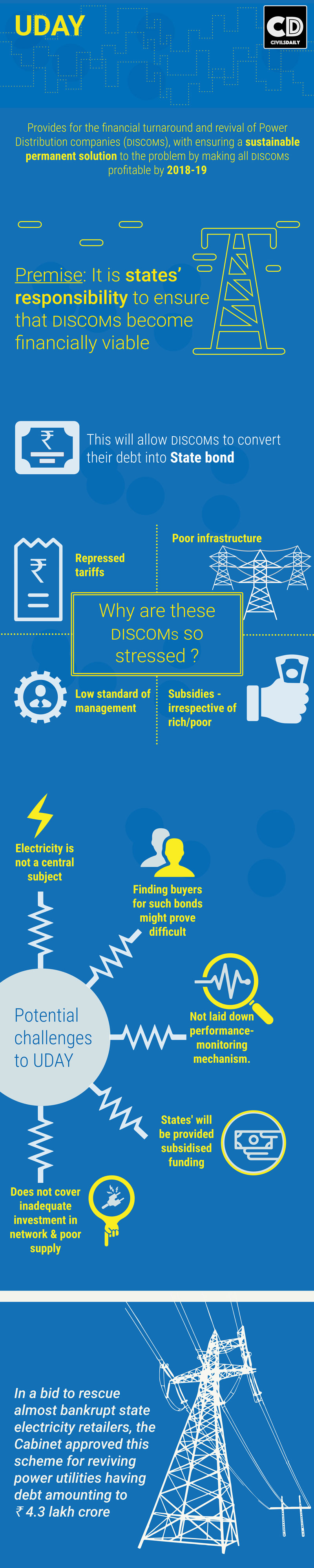
    In a bid to rescue almost bankrupt state electricity retailers, the Cabinet recently approved this scheme for reviving power utilities having debt amounting to Rs 4.3 lakh crore.

    uday-head-for-BLOG

    What is Ujjwal Discom Assurance Yojana?

    UDAY provides for the financial turnaround and revival of Power Distribution companies (DISCOMs), and importantly also ensures a sustainable permanent solution to the problem. It has ambitious target of making all discoms profitable by 2018-19.

    The scheme will ease the financial crunch faced by power distribution companies, that has impaired their ability to buy electricity.

    It is based on the premise that it is states’ responsibility to ensure that discoms become financially viable.

    UDAY


    How UDAY will revive Discoms?

    It has all the 3 elements —

    1. Clear up the legacy issues of past losses and debt.
    2. Provide a financial road map to bring tariffs in line with costs by FY19.
    3. Provide enough deterrents for the state govt to not allow the state discoms to become loss ridden post FY18, as losses start to impact their FRBM limits.
    • The State govt. will takeover the discom liabilities over 2-5 year period.
    • This will allow discoms to convert their debt into State bond. These bonds will have a maturity period of 10-15 years.
    • It will allow transfer of 75% outstanding debts incurred by stressed discoms to States’ debt, 50% in 2015-16 and 25% in 2016-17.
    • The central government will not include the loans of the discoms in calculation of the state’s deficit till 2016-17.

    Why are these Discoms so stressed?

    There are various reasons that lead to Discoms becoming unsustainable over the period of time.

    1. Politics of free power, repressed tariffs and power thefts leading high transmission losses.
    2. Poor infrastructure and low standard of management.
    3. Power subsidies are given to all, irrespective of rich/poor.
    4. Discoms in states of Rajasthan, Tamil Nadu and UP are the most stressed ones.

    Almost 25% T&D ( Transmission & Distribution) losses suffered by discoms. Remaining 75% is sold at a price much lower than discoms’ procurement costs. Wondering Why??

    The most obvious reason is political interference, i.e. tariff is set by a group of largely political appointees.

    Financially stressed DISCOMs are not able to supply adequate power at affordable rates, which hampers quality of life and overall economic growth and development.

    What will be the impact of this scheme?

    • It is expected to help the banks in managing their bad loans.
    • It will relieve discoms who can push power distribution in right way.
    • It will allow states to align tariff costs, so that discoms run on a sustainable basis.

    What are thrust areas of UDAY to turnaround discoms?

    1. Improve operational efficiency.
    2. Reduction in cost of power – By monitoring technical and commercial losses by smart metering and feeder separation.
    3. Reduction in the interest cost of discoms.
    4. Enforcing financial discipline on discoms through alignment with States’ finances.

    What could be potential challenge to UDAY?

    • Electricity is not a central subject, states’ cannot be made to participate in the programme.
    • Finding buyers for such bonds might prove difficult, as these would enjoy the SLR status.
    • It has not laid down a specific performance-monitoring and compliance mechanism.
    • It does not cover inadequate investment in network & poor supply, which is essential for reliable and quality supply.
    • No central monetary assistance is provided, rather states’ will be provided subsidised funding from the central govt.’s power schemes as well as priority in supply of coal.

    Published with inputs from Pushpendra


  • WTO Nairobi meet: Updates on the 10th Ministerial Conference

    WTO Nairobi Ministerial Meeting – What’s at stake for India?

    Recently, the WTO Trade Ministers concluded their talks without any commitment on rich countries being asked to check their domestic subsidies. The negotiations exceeded by one day due to lack of consensus among the developed and developing world.


    India and other developing countries were particular about the re-affirmation to conclude the 14-year old Doha Round. < Let's begin with the basics of WTO negotiations>

    What is Doha Development Round?

    It is the latest round of trade negotiations among the WTO members, which started in 2001, to sign a pact to open up world trade by lowering or eliminating trade barriers.

    The focus is on helping developing countries join the global marketplace, and boost their economies as a result.

    The Doha Round is also known as the Doha Development Agenda.

    What are they negotiating?

    The goal of any trade talks is to make it easier for goods and services to be bought and sold across national borders.

    The negotiations includes:

    • Restricting countries’ use of subsidies for farmers and fishermen.
    • Lowering taxes and regulatory barriers that affect the cross-border trade in services, such as banking and consulting.
    • Negotiating new intellectual property rules on things such as drugs and copyrighted works.

    Why developing countries are pressing for conclusion of Doha round?

    Basically, the benefits for developing countries depends on the the kind of agreement the negotiators come up with.

    However, the developing countries are hoping that stronger restrictions on farm subsidies in developed countries would be good for farmers in the developing world.

    What was the outcome of 2013 Bali Ministerial Meeting?

    • Protection of the interests of poor farmers and food security.< This is what India wants to be honoured and implemented>
    • Exporters from Least developing countries(LDCs), will get duty free, quota free access to markets in foreign countries
    • Trade facilitation agreement, to ease the customs clearance.

    What is Special Safeguard Mechanism and its need for poor & developing countries?

    Basically, SSM will allow developing countries to temporarily increase the import duties on farm products, so as to counter the sudden increase in imports and price falls.< Actually, the developed countries have well-developed and mechanised agriculture along with that, huge subsidies are extended to farmers in these countries>

    This mechanism would empower the developing countries to impose additional duties on agri-products, when their imports breach specified ceilings or price.

    What’s the problem here?
    The negotiations are on the extent to which different categories of developing countries will be allowed to hike duties using the SSM, beyond their tariff.

    What are the new issues that have emerged?

    1. Rich countries are diluting the development dimension. Some developing countries are attempting to categorise nations such as India and China as emerging economies, instead of developing. 
    2. The developed countries are also redefining the developmental aspects.
    3. Rich countries wanted to revitalise WTO by introducing new issues, often called emerging trade issues:
      • Labour and environmental standards
      • Global value chains and promotion of supply chains
      • e-Commerce
      • Competition & investment provisions
      • Environmental and sustainable goods produced using clean and green energy
      • Transparency in govt. procurement
      • Transparency in state-owned enterprises and designated monopolies

    < If these issues are included in the agreement, developing and poor countries feel that these standards or rules might become non-tariff barriers, hurting their exports>

    What is India’s stand on these issues?

    • India has made it clear that it will not undertake any binding commitments.
    • The issues of labour and environment should be taken at concerned international bodies such as ILO and UNFCCC, not at WTO.
    • India wants new issues should also include those with a development angle such as easier movement of natural persons, such as skilled professionals.

    < Developed countries are fearing large scale migration, on account of increase in skilled manpower in developing countries such as India. India is looking for such concessions so that it's skilled manpower can find access to developed countries market.>

    What was India’s demand at Nairobi Meeting?

    • India wants the rich countries to drastically reduce their trade distorting farm subsidies.
    • India wants on priority that a permanent solution to the issue of public food stock holding in developing countries for the purpose of food security.
    • India is also looking for effective implementation of a package for LDCs including duty-free and quota-free market access.

    What does draft declaration at Nairobi says?

    • A commitment to allow developing nations to use special safeguards to protect farmers against import surges.
    • It reflects India’s demand for a reaffirmation from all members to work towards a permanent solution on public stockholding.
    • All countries agreed to the elimination of agricultural export subsidies subject to preservation of Special and Differential Treatment for developing countries such as longer phase-out period for transporting and export subsidies for exporting agricultural products.
    • Developed countries have committed to remove export subsidies immediately, except for a few agricultural products, and developing countries will do so by 2018.
    • However, developing countries will keep the flexibility to cover marketing and transport subsidies for agriculture exports until the end of 2023.
    • The talks concluded without any commitment on rich countries to check their domestic subsidies.
    • There was division among the WTO members on the issue of the reaffirmation of the Doha mandate.
    • However, some of the WTO members excluding India agreed on the timetable to implement a major deal to get rid off tariffs on 201 IT products valued at over $1.3 trillion/annum, and accounting for around 10% of total global trade.

  • Insolvency and Bankruptcy Code

    How is ease of doing business linked with the Insolvency and Bankruptcy Code?

    In India, lack of resolution of insolvency is one of the significant factors for the failure of credit market in the country. The present legislations governing insolvency are fragmented, multi-layered and the adjudication of insolvency matters take place in multiple forum, resulting in an unpredictable regime.

    The Insolvency and Bankruptcy Code has been hailed as an excellent reform for India that will pay a critical role in improving the ease of doing business.

    Why does India need a Bankruptcy law?

    Currently it takes, on an average, more than 4 years to resolve insolvency in India. The proposed Bankruptcy Code will replace over a century-old archaic insolvency act – The Presidency Towns Insolvency Act, 1909.

    • Delays in making decisions on the viability of business.
    • Sometimes, company promoters try to delay reorganisation or attempts to sell-off assets or change of management.
    • Delays in disposing off cases by Debt Recovery Tribunal.
    • Continued litigation at various levels and delays in appellate level.
    • Currently, there are 4 different agencies viz. the HC, the Company Law Board, the BIFR and the DRTs that handle insolvency-related cases.

    How can a modern law help?

    • Speedy closure will help firms on the verge of brink in two ways, i.e. either restructure the firm or sell-off the assets to recover the money.
    • It will promote efficient allocation and greater availability of credits for businesses, as it frees up capital.
    • Development of financial markets such as bond market, due to clarity on repayment for debtors.

    What is the international experience in this regard?

    • US Bankruptcy Code provides for fairly quick liquidation or reorganisation of the company.
    • In UK, once the cases are filed, then after 12 months, either the part of assets are discharged to pay-off debt or court-appointed administrators handle the case, if company can be turned around.

    Was any committee formed to suggest Insolvency reforms?

    • The Bankruptcy Law Reform Committee (BLRC) was set up in August, 2014 under the chairmanship of Mr. T.K. Vishwanathan.
    • It was the first committee with the mandate of suggesting comprehensive and not incremental reforms.
    • The BLRC extensively studied the insolvency regime within India as well as various international jurisdictions.

    What was the recommendation of the Committee?

    • The committee proposed an all-encompassing law for corporate and individual insolvency, reflecting the best practices from across the globe.
    • The corporates should assess the viability of an enterprise in the early stages of insolvency, such that the creditor and the debtors can negotiate a financial arrangement while preserving the economic value of the enterprise.
    • However, if the negotiations fail, then the enterprise is liquidated. The insolvency resolution is required to be done within a period of 180 days.
    • It also suggested fast track insolvency resolution for certain entities which is required to be completed within 90 days.

    What are the provisions of draft Insolvency and Bankruptcy Code?

    The code aims to bring modern framework to deal with bankruptcy and insolvency of variety of economic players, including individuals, but excluding financial firms.

    • It will restore some power to creditors, both financial and operational.
    • It will fast-track mechanism of insolvency resolution process may be applicable to certain categories of entities.
    • The corporate insolvency would have to be resolved within a period 180 days, extendable by 90 days.
    • It also provides for fast-track resolution of corporate insolvency within 90 days.
    • Debt Recovery Tribunals will be adjudicating authority over both individual & unlimited liability partnership firms.
    • National Company Law Tribunal will be adjudicating authority with jurisdiction over companies with limited liability.
    • It has a clause to provide for insolvency professionals who will specialize in helping sick companies. <These professionals will help revive control the management of distressed firm to revive it>
    • It also provides for information utilities that will collate all information about debtors to prevent serial defaulters from misusing the system
    • To setup Insolvency and Bankruptcy Board of India to act as a regulator for these utilities and professionals.
    • The bill also seeks to establish Insolvency and Bankruptcy Fund of India.

    What about Financial Sector Insolvencies?

    • FSLRC recommended creation of a resolution corporation to monitor financial firms and intervene before they go bust.
    • The aim is to close-down the firms which can’t be revived or change their management to protect investors or depositors.

    The reform is dubbed as 2nd most important reform after GST, as it will also improve the ease of doing business in India.


    Published with inputs from Pushpendra
  • Monsoon Updates

    How does El Nino affect Indian Monsoon? A Comprehensive Explainer

    As many reports speculated that El Nino is the main cause of the worsening Indian Monsoon and has played badly with Indian agriculture, we thought that we should take a big picture of El Nino and it’s scope in India.


    • The Monsoon is basically a result of the flow of moisture laden winds because of the variation of temperature across the Indian Ocean.
    • There are a number of climatic phenomena which affect it namely the El nino, La nina etc.
    • We will look at their origin, impact and way forward.

    Now, let’s take a overview and develop our understanding. 

    What happens in a Normal Year?

    • Peru Current = Humboldt Current = Cold Current.
    • During normal year 2 things are very strong – Cold Peru Current and Trade Winds.
    • As a result, cold water is dragged from Peru towards Australia.

    What would be the result of this exchange?

    • Warm water region around Australia is called Western Pacific Pool (WPP).
    • WPP = low pressure = warm air ascends = cloud formation = rain over North Australia
    • This air also joins walker cell and begins descending near Peru.
    • Descending air = anti-cyclonic condition = high pressure = stability = no cloud/rain = Drought in Atacama Desert.

    (Simply, Walker cell is the result of a difference in surface pressure and temperature over the western and eastern tropical Pacific Ocean)

    What happens below the water from Peru to Australia ?

    At Peru coast, cold water upwelling brings nutrient to surface + more lunch for Plankton + more fishes = Peru fishermen gets happy.

    What happens above the water from Australia towards Peru?

    Warm water + low atmospheric pressure = good rainfall over Australia & Indonesia.

    What happens in La Nina Year?

    Same things as in a “normal” year, but 2 things become even “stronger” –

    • Cold Peru Current
    • Trade Winds

    What’s the Result?

    • Too many fishes at Peru coast = oversupply of fishes = prices become dirt cheap.
    • Too much rain / flood over Australia and Indonesia.

    This is what happens in normal and La Nino year, Let’s back to El Nino!


    What happens in an El Nino year?

    Two things become weak.

    • Cold Peru Current
    • Trade Winds
    • As result, cold water is not dragged from Peru to Australia.
    • But reverse happens, warm water is dragged from Australia towards Peru.
    • Consequently, warm water + low pressure condition develops in the Eastern Pacific (Peru) and Cold condition + high pressure in Western Pacific (Australia).

    What will happen if pressure is inversely related with amount of rainfall ?

    • Rain & Floods at Peru, Atacama and even Southern USA
    • Drought at Northern Australia, Indonesia- even bushfires.
    • Storms and Hurricanes in East Pacific.
    • Coral bleaching (high temperature coral dies)

    But, what is the El Nino?

    • El Nino is an Oceanic and Atmospheric phenomenon that leads to unusual warming of water in the Peru coast, occurs every 3-5 years.
    • Consequently, warm water + low pressure condition develops in the Eastern Pacific (Peru) and Cold condition + high pressure in Western Pacific (Australia).
    • Since Pressure is inversely related with amount of rainfall, El Nino causes drought situation in Australia and South East Asia.
    • It weakens the trade winds and changes in Southern Oscillation, thereby affects the rainfall pattern across the world.

    el-nino-phenomenon


    What is Southern Oscillation?

    • Alternating of (tropical) sea level pressure between the eastern and western hemispheres.
    • We can measure Southern Oscillation by observing the pressure difference between Tahiti (French Polynesia) and Darwin (Australia).

    How does El Nino affect Indian Monsoon?

    • El Nino-Southern Oscillation (ENSO) water circulation happens between Australia and Peru.
    • But, the wind movement is part of larger atmospheric circulation hence affects the rainfall over India. But, how?
    • We have learned that During normal year, the warm water moves towards Australia, this pool of warm water is called Western Pacific Pool (WPP).

    So, from WPP air rises above and moves towards two walker cells –

    • Towards Peru coast = this affects rainfall in South America.
    • Towards Mascarene High Pressure zone near East Africa. So, this affect Indian monsoon.

    Why should India worry about?

    • Drought condition decreases the agriculture output, leads to food inflation.
    • Declined supply of cotton, oilseeds and sugarcane negatively affects the textile, edible oil and food processing industries respectively.

    What is the way forward?

    Let’s discuss first Near-term Solutions?

    • Government must expand farm insurance cover and advice financial institutions to settle crop insurance claims in the drought-hit areas without delay. Otherwise, it results in farmer suicides (e.g. Maharashtra farmers’ suicide ).
    • High quality seeds of alternative crops must be distributed among farmers in drought-affected areas.
    • Need of realistic assessment of ground level situation in order to estimate the shortfall of oilseeds and pulses and help traders with market intelligence.
    • Scrapping the APMC Act and allowing free flow of agricultural goods among the states.
    • This would help bridge the mismatch of demand and supply of goods, which is the underlying factor contributing inflation.

    What should be the Long-term Solutions?

    • Developing drought free crop varieties and distributing its subsidized seeds to the farmers. It is a part of National Action plan on climate change in Agriculture.
    • Using low water use technologies like drip and sprinkler irrigation.
    • The MSP regime in India has to provide more remuneration for less water consuming crops.
    • Strengthening community watershed management and development by protecting and conserving local water sources like ponds, lakes etc.
    • Developing early warning systems and alerting the farmers much in advance like recently launched Kisan SMS scheme.

    Do you find more solutions or any way out? then, Let us know!


    Published with inputs from Arun
  • Soil Health Management – NMSA, Soil Health Card, etc.

    Soil Health Card – A Tool For Agri Revolution

    Launched by the central government in February 2015, the scheme is tailor-made to issue ‘Soil card’ to farmers which will carry crop-wise recommendations of nutrients and fertilizers required for the individual farms.

    Agriculture as primary activity in India

    • Agriculture since ages is the mainstay of the Indian population.
    • The story of Indian agriculture has been a spectacular one, with a global impact for its multi-functional success in generating employment, livelihood, food, nutritional and ecological security.
    • Agriculture and allied activities contribute about 18% to the GDP of India (as of 2014-15). The green revolution had heralded the first round of changes.
    • India is the second largest producer of wheat, rice, sugar, groundnut as also in production of cash crops like coffee, coconut and tea.

    What is the scope and focus of government in agriculture?

    • India is now eyeing second Green Revolution in eastern India.
    • The need for enhanced investment in agriculture with twin focus on higher quality productivity and welfare of farmers.
    • In the entire scenario, importantly the government has laid emphasis on the awareness campaign and enhanced agri knowledge for the farming community.

    Why is there a need of awareness in assessing soil health position?

    • Awareness of soil health position and the role of manures would help in higher production of foodgrains in eastern India too and this would help tackle the decline in production in central and peninsular India.
    • The growth in foodgrains, rice and wheat, from eastern India would provide an opportunity to procure and create foodgrain reserves locally.
    • This would reduce the agricultural pressure on Punjab and Haryana as well.


    Is it Gujarat’s model programme?

    • From 2003-04, Gujarat has been the first state to introduce Soil Health cards, to initiate the scientific measures for Soil Health care.
    • In Gujarat, over 100 soil laboratories were set up and the result of scheme was found quite satisfactory.
    • To start with, the agriculture income of Gujarat from Rs 14000 crore in 2000-01 had gone up to staggeringly high Rs 80,000 crore in 2010-11.

    Why did government start taking effective action on soil health card initiative?

    • According to renowned expert and the ‘father of Green Revolution’, M S Swaminathan, there is need to opt for wide range of crops cultivation.
    • The awareness of soil health conditions would only make these operations easier and more result oriented. The government can help farmers adopt crop diversification.
    • The Soil Health Card mechanism definitely aims to help herald some essential revolutionary changes and salutary effect in country’s agricultural scene.
    • Farmers would understand the fertility factor of the land better and can be attracted towards value added newer crops.
    • This would help reduction in risk in farming and also the cost of overall cultivation process would get reduced.

    Why has Soil Health Card portal been launched?

    • Some states are already issuing Soil Health Cards but, it was found that, there was no uniform norm for sampling, testing and distribution of Soil Health Cards across the states.
    • Taking a holistic view on these, the central government has thus rightly taken measures like launching of a Soil Health Card portal.
    • This would be useful for registration of soil samples, recording test results of soil samples and generation of Soil Health Card (SHC) along with Fertilizer Recommendations.
    • Soil Health Card portal aims to generate and issue Soil Health Cards based on either Soil Test-Crop Response (STCR) formulae developed by ICAR or General Fertilizer Recommendations provided by state Governments.

    How will it be implemented by Union and State governments?

    • The scheme has been approved for implementation during 12th Plan with an outlay of Rs.568.54 crore.
    • For the current year (2015-16) an allocation of Rs.96.46 crore – only for the central government share-has been made.
    • The scheme is to be otherwise implemented on 50:50 sharing pattern between Government of India and state Governments.
    • In order to improve quality of soil and ultimately for better nutrient values and higher yields.
    • Experts say while at present, general fertilizer recommendations are followed by farmers for primary nutrients, the secondary and micronutrients are often overlooked.

    Can proactive steps and such programs lead to efficient and effective agriculture? Really?

    • The government is effectively marching in quite ambitiously for a grand success of the Soil Health Card scheme and proposes to ensure that all farmers in the country have their respective Soil Health Cards by 2017.
    • In the first year of NDA regime 2014-15, a sum of Rs 27 crore was sanctioned and in 2015-16, there is an allocation of Rs 100 crore to all the states to prepare soil health cards.
    
    
  • BCCI Reforms – Lodha Committee, etc.

    Lodha Committee Report: Restoring the glory of the game

    To put an end to excesses and imbalances, corruption and red tape, all of which have harmed the game, the Lodha committee has examined reforms in the working of the Board of Control for Cricket in India (BCCI) to make its functioning transparent.


    What is the Lodha committee?

    The Lodha committee was formed in January, 2015 by the Supreme Court after the Mudgal committee report on IPL.

    In its earlier report in July 2015, the Lodha committee delivered its judgement by banning Meiyappan and Kundra for life and suspending the owners of Chennai Super Kings and Rajasthan Royals for 2 years.

    Let’s analyse the report under various dimensions

    The Lodha Committee has suggested sweeping reforms in the structuring and governance of cricket in the country.


    Structural Reforms: A major overhaul

    • The committee recommended that a 9-member apex council replace the 14-member BCCI working committee.
    • Each of these office-bearers has a three-year term and can contest for a maximum three terms.
    • The Lodha Committee also calls for dividing the governance into two parts: cricketing and non-cricketing.

    The non-cricketing management will be handled by 6 professional managers headed by a CEO, and the cricket matters like selection, coaching and performance evaluation should be left to the players

    Organisation & Office-bearers: Restrictions imposed

    • Each of these office-bearers has a 3-year term and can contest for a maximum three terms.
    • There will be a mandatory cooling off period after each term. Therefore, no office-bearer can hold office consecutively in a row.
    • No BCCI office-bearer can be Minister or government servant.

    State Cricket Associations: One Vote/State

    The Committee recommended that one association should represent an entire state and only one vote per state.

    Indian Premier League: Maintain distance

    • It recommends separate governing bodies for the IPL and BCCI.
    • There should be a 15-day gap between IPL season and national calender.

    Betting: Legalize it

    • It made a strong recommendation to lawmakers to legalise betting in cricket for all except cricket players, officials and administrators.
    • The players and others banned officials should disclose their assets to BCCI in a measure to ensure that they do not bet.

    Betting is a $ 400 billion phenomenon practised across the globe and lawmakers in India should enact laws to legalise it.

    Fixing: Criminalize it

    The committee said that match-and spot-fixing should be made a criminal offence.

    Conflict of Interest & Corruption

    • One individual hold only one post in cricket administration. The office-bearers would have to choose between positions in respective state associations and the parent body.
    • A former High Court judge should be appointed as ethics officer by the BCCI to administer issues relating to conflict of interest, misdemeanour and corruption.
    • A former Supreme Court judge should be appointed ombudsman to resolve internal disputes.

    Transparency: Bringing RTI to BCCI

    It recommended that the Legislature must seriously consider bringing BCCI within the purview of the RTI Act

    Securing player’s interest

    • It recommended the setting up of a Players’ Association to safeguard the interests of the cricketers.
    • The report said players that are the driving force of the game, but they had been reduced to the status of employees and subordinates of those governing the game.
    • The idea is to give players voice, use their expertise and skills for the development and betterment of the game

    Women Cricket: Often ignored by BCCI

    The Women’s Cricket Committee to be formed to exclusively pay attention to this much ignored department, along with Women’s Selection Committee.

    The proposed measures could radically alter the way the BCCI functions as well as vastly improve its public image and impart much-needed credibility.


    Published with inputs from Pushpendra