Recently, Cabinet has approved new Hydrocarbon Exploration and Licensing Policy (HELP), which will replace New Exploration Licensing Policy (NELP), for Oil and Gas exploration, Will that make any change in oil and gas exploration regime? Let’s see this in brief!
Let’s first take an overview of New Exploration Licensing Policy (NELP)
New Exploration Licensing Policy (NELP) was created in 1997
To provide an equal platform to both Public and Private sector companies in exploration and production of hydrocarbons
Directorate General of Hydrocarbons (DGH) was a nodal agency for its implementation
Between 1998 and 2012, there were 9 rounds of oil and gas block auction (NELP 1 to NELP 9)
Although 126 discoveries have been made in 41 active blocks, commercial production has commenced only in 3 blocks
Reasons for the delay vary from inadequate technology to delayed regulatory approvals
Today, only 2 blocks, the Reliance Industries-operated KG D6 block and the Gujarat State Petroleum Corporation-operated Cambay onshore block, are producing oil or gas
<Let’s Move towards new version of Policy>
What are the Main facets of HELP policy?
Uniform License for exploration and production of all forms of hydrocarbon
Open acreagepolicy
Easy to administer Revenue sharing model
Marketing and pricing freedom for the crude oil and natural gas produced
What is Unified Licensing Policy?
As the name suggests, all licenses are unified i.e. this allows exploration and production of all hydrocarbons such as oil, gas, coal bed methane and shale oil and gas in a block
Contrast this with NELP, which required separate licensing for different types of hydrocarbons time and cost overruns
Concept of Open Acreage Policy
Contractors will now have the flexibility to request bidding for any block on-tap under Open Acreage Licensing
Earlier, they had to wait for the government to auction blocks, and could only bid for blocks that were put up for auction
This will enable Exploration & Production (E&P) companies choose the blocks from the area they like
What’s new in Revenue-sharing formula?
Present system is that of of production sharing based on Investment Multiple and cost recovery/ production linked payment
Under the new revenue-sharing formula, contractors will share the revenue from the time first drop of oil/gas starts flowing from the field.
How this policy of revenue sharing is in tune with Ease of Doing Business?
Earlier, under the Production/profit Sharing Methodology, it became necessary for the Govt to scrutinize cost details of private participants and this led to many delays and disputes<as govt was given its share only after all the costs were recovered, govt had to make sure that private parties do not inflate cost to reduce govt’s share>
To prevent loss of government revenue, there were requirements for Government approval at various stages to prevent the contractor from exaggerating the cost
Activities could not be commenced till the approval was given. This process became a major source of delays and disputes
Under the new regime, the Govt will not be concerned with the cost incurred and will receive a share of the gross revenue from the sale of oil, gas etc.
So, no CAG audit, no approvals required, no micromanagement by govt.
Companies would worry less about the govt and focus more on operations
Parameter
Production sharing Contract
Revenue Sharing Contract
Risk
Investor can take higher risk as he will be able to recover investment before sharing with govt
Won’t take higher risk, has to share revenues from the first drop of oil
Govt interference
Higher as costs have to be rechecked
minimal
Useful for
High risk high cost environment such as deep fields
Low cost environment, fully explored blocks
Recommended by
Kelkar Committee
Rangrajan Committee
Govt policy
NELP
HELP
India remains one of the least explored countries and could hold large potential resources. For example, 15 basins out of a total 26 sedimentary basins in India spread over on-land, offshore and deepwater, are estimated to hold prognosticated hydrocarbon resources of over 200 billion barrels of oil equivalent. Hence some recommend Production sharing contracts for India with investing capacity to manage such contracts better.
Graded system of royalty to boost investment
The current policy regime, in fixing royalties, does not distinguish between shallow water fields (lower costs and risks) and deep/ultra-deep water fields(much higher costs and risks)
Under the new policy, there is lower royalty rates for difficult areas compared to NELP royalty rates
A graded system of royalty rates have been introduced, in which royalty rates decreases from shallow water to deepwater and ultra-deep water
Royalty rate for onland areas have been kept intact so that revenues to the state governments are not affected
Pricing and Marketing Freedom
At present, natural gas price is determined by taking into account the average of prices in gas-surplus countries such as the US, Canada and Russia, but proposed formula is market-efficient
New Policy allows pricing freedom to companies with a cap on prices to protect consumer interest
Gas price will be the lowest of imported fuel price; weighted avg of naphtha, coal and fuel oil; and the price of imported LNG
Policy also gives marketing freedom
The new price will apply to undeveloped gas discoveries and not on currently producing fields
So, new price formula combined with lower royalty rates will help in undeveloped gas discoveries in deep-sea, ultra-deep sea and high-temperature, high-pressure fields. Increased investment and competition will eventually bring down gas prices as well as import dependence of India and lead to the development of a competitive gas market in the country.
From NELP to HELP
UNIFORM Licensing Policy
One license for E&P of all the hydrocarbons from a block
Open acreage system
Licenses on tap
Revenue sharing model
Minimal govt interference
Marketing and pricing freedom
Sell to whoever you want at market determined prices subject to a ceiling price
How Contract extension will help to remove further obstacles?
The grant of extension of production sharing contracts for 28 small, medium sized discovered fields is welcome
Because, this move will remove uncertainty and help contractors plan their investments in these blocks
The extension will be for 10 years, both for oil and gas fields or economic life of the field, whichever is earlier
Way forward
India currently produces around 90 mmscmd (Million Metric Standard Cubic Meter Per Day) of gas, hardly meeting 40 per cent of the needs (imports majority of gas from Qatar)
Oil and Natural Gas Corp (ONGC), Reliance Industries and Gujarat State Petroleum Corporation(GSPC) will now get freedom to price gas from its idle discoveries in deep sea, ultra deepsea and high-pressure and high-temperature areas
So, overall we can say that, Govt’s target for O&G seems to be on track, to attract more investments, boost production and take away govt discretion from Oil and Gas Exploration
The food processing industry in India is increasingly seen as a potential source for driving the rural economy as it brings about synergy between the consumer, industry and the farmer. However, food processing activity is still at a nascent stage in India with low penetration.
Importance of Food Processing Industry
It holds the potential of reducing enormous wastage of agricultural produce in the absence of processing technologies and cold chain facility
It is labour-intensive industry, which has the potential to employ 13 million people directly and 35 million people indirectly
This will also lead to increase in farm income, generate employment opportunities, foster forward and backward linkage effects, contribute to exports and integrate Indian economy with the rest of world
What is the magnitude and size of this industry?
India is strategically located at the centre of the Middle-East and South-East with a long coastal line and easy sea connectivity as well as plenty of raw material for long period which can attract multi-national companies instead of food processing.
It is the 5th largest industry and has the highest rate of growth as well as a very high employment elasticity. Currently, it accounts for nearly 16% of total employment in the organized manufacturing sector and 32% in unorganized sector.
What are the factors which can drive this industry?
India’s demographic profile with 65% of population below 30 years of age
Fast changing consumption patterns
Increase in disposable incomes of the people
Fast increase in the number of working women, who prefer the packaged food
Growth of organised food retail in India
Nearly 55% of the total expenditure on an average is spent on food and grocery in rural areas and nearly 40% in urban areas and only 10% of what we grow is processed in India
What are the challenges faced by FPI?
Indifference of policy makers as very little outlays are allocated in Five Year Plans. In the XI FYP, an outlay of Rs. 4000 crore was earmarked out of which significant proportion was not spent
The legislation’s like APMC Acts, Essential Commodities Act, etc restricts free movement of commodities
Very poor infrastructure i.e. near absence of technologies, incubation facilities, pre-cooling chambers, irradiation facilities, etc < Food Irradiation is a technology that improves the safety and extends the shelf life of foods by reducing or eliminating microorganisms and insects>
High tariffs in the form of high excise duties as well as import duties
Non-tariff barriers in the form of stringest regulation of laboratory testing, grading, sampling and packaging
Lack of entrepreneurship, as 70% of the total value of food processing items manufactured in India is dominated by the unorganised sector
Lack of training facilities related to this industry
Very low Research & Development
Indian agriculture focuses on traditional crops rather than market-oriented agriculure with diversified commercial crops
What are the Govt efforts to promote this industry?
XI Five Year Plan: Govt. recognized the potential of this sector and launched Mega Food Park. It also adopted various measures such as modernization of Abattoir (Slaughter houses), modernization of meat shops, upgradation of street food, effective implementation of Food Safety and Standards Act 2006, technology upgradation, entrepreneurship development programme, setting up of training institutes, etc
Mega Food Park
These are the parks with state-of-art infrastructure related to all of the facilities required for food processing industry with their captive power plants, transportation and other hygienic facilities to attract food processing units to avail of this infrastructure for manufacturing food-processed items.
The target was to set up 30 Mega Food Parks, but only 9 came up.
XII Five Year Plan: There was significant shift in govt. policy towards this industry in XII FYP, as it allocation to the tune of 4-times as compared to XI FYP, with an outlay of Rs. 15000 crore. It also launched National Mission on Food Processing, in the background of the success of National Mission on Horticulture.
National Mission on Food Processing
The mission has two main principles: Decentralization and Outreach.
The mission is totally centrally sponsored and the responsibility of its implementation lies with the state govt., who will have to take initiative in organizing the unorganized food processors into SHGs (Self-Help Group) and provide them training and other facilities. State govt. will have to bring about synergy between agriculture and food processing industries.
Budget 2016-17
Govt. has decided to allow 100% FDI in multi-brand retail for food products produced and processed in India will play a catalytic role in leapfrogging Indian economy.
Future
It will be the endeavor of policy makers to ensure that food processing industry conform to global standards of health and hygiene and adopt CODEX standards (related to food safety) laid down by Food & Agriculture Organization and WHO, for the protection of consumer health.
Food processing needs a fillip in the form of better logistics, access to credit, technology indigenisation and implementation of food safety laws.
19 April 1951: European Coal and Steel Community Treaty signed by Germany, France, Ireland, Luxembourg, Belgium and Netherlands. May 1952: European Defence Community (EDC) Treaty. August 1954: France rejects the EDC treaty. 25 March 1957: Treaties of Rome signed: creates Common Market / European Economic Community (EEC) and European Atomic Energy Community. 1 January 1958: Treaties of Rome come into effect.
1960s
1961: Britain tries to join the EEC but is rejected. January 1963: Franco-German Treaty of Friendship; they agree to work together on many policy issues. January 1966: Luxembourg Compromise gives majority vote on some issues, but leaves national veto on key areas. 1 July 1968: Full customs union created in the EEC, ahead of schedule. 1967: British application again rejected. December 1969: Hague summit to “relaunch” the Community, attended by heads of state.
1970s
1970: Werner Report argues economic and monetary union possible by 1980. April 1970: Agreement for EEC to raise own funds through levies and customs duties. October 1972: Paris Summit agrees plans for future, including economic and monetary union and ERDF fund to support depressed regions. January 1973: UK, Ireland and Denmark join. March 1975: First meeting of the European Council, where heads of state gather to discuss events. 1979: First direct elections to European Parliament. March 1979: Agreement to create the European Monetary System.
1980s
1981: Greece joins. February 1984: Draft Treaty on European Union produced. December 1985: Single European Act agreed; takes two years to ratify. 1986: Portugal and Spain join. 1 July 1987: Single European Act comes into effect.
1990s
February 1992: Maastricht Treaty / Treaty on European Union signed. 1993: Single Market begins. 1 November 1993: Maastricht Treaty comes into effect. 1 January 1995: Austria, Finland and Sweden join. 1995: Decision taken to introduce the single currency, the Euro. 2 October 1997: Treaty of Amsterdam makes minor changes. 1 January 1999: Euro introduced in eleven counties. 1 May 1999: Treaty of Amsterdam comes into effect.
2000s
2001: Treaty of Nice signed; extends majority voting. 2002: Old currencies withdrawn, ‘Euro’ becomes sole currency in majority of EU; Convention on the Future of Europe created to draw up constitution for larger EU. 1 February 2003: Treaty of Nice comes into effect. 2004: Draft constitution signed. 1 May 2004: Cyprus, Estonia, Hungary, Latvia, Lithuania, Malta, Poland, Slovak Republic, Czech Republic, Slovenia join. 2005: Draft constitution rejected by voters in France and the Netherlands. 2007: Lisbon Treaty signed, this modified the constitution until it was deemed a sufficient compromise; Bulgaria and Romania join. June 2008: Irish voters reject Lisbon Treaty. October 2009: Irish voters accept Lisbon Treaty. 1 December 2009: Lisbon Treaty comes into effect. 2013: Croatia joins. 2016: United Kingdom votes to leave.
The European Union has seven institutions: the European Parliament, the Council of the European Union, the European Commission, the European Council, the European Central Bank, the Court of Justice of the European Union and the European Court of Auditors.
The European Council gives direction to the EU and convenes at least four times a year. It comprises the President of the European Council, the President of the European Commission and one representative per member state; either its head of state or head of government.
The European Council has been described by some as the Union’s “supreme political authority”. It is actively involved in the negotiation of the treaty changes and defines the EU’s policy agenda and strategies.
The European Council uses its leadership role to sort out disputes between member states and the institutions and to resolve political crises and disagreements over controversial issues and policies.
The European System of Financial Supervisors is an institutional architecture of the EU’s framework of financial supervision composed by three authorities: the European Banking Authority, the European Insurance and Occupational Pensions Authority and the European Securities and Markets Authority.
To complement this framework, there is also a European Systemic Risk Board under the responsibility of the ECB.
The aim of this financial control system is to ensure the economic stability of the EU.
The European Parliament allows the citizens of the EU to participate directly in European political affairs. The citizens of the 28 member states appoint their deputies in the national elections for a five-year period. These deputies are to represent the interests of their electors on a European level. The latest elections (by direct universal suffrage) took place in May 2014.
The European Commission (EC) is an institution of the European Union, responsible for proposing legislation, implementing decisions, upholding the EU treaties and managing the day-to-day business of the EU. Commissioners swear an oath at the European Court of Justice in Luxembourg, pledging to respect the treaties and to be completely independent in carrying out their duties during their mandate. The Commission operates as a cabinet government, with 28 members of the Commission (informally known as “commissioners”).
The Court of Justice of the European Union is the Union’s only body of a legal nature. It is a sort of legislative watchdog in charge of verifing the interpretation and the application of community legislation.
Importance of EU:
The European Union is our largest trading partner, and our largest export destination. And it is our largest source of Foreign Direct Investment.
However, India’s exports to EU in 2014-15 had shrunk (-) 4.4 per cent year on year to $49.3 billion. Imports from EU had also contracted (-) 1.5 per cent in 2014-15 to $49.2 billion.
Deadlock in Broad-based Trade and Investment Agreement (BITA)
The BTIA negotiations have remained deadlocked over growing differences regarding greater market access sought by both sides for merchandise exports.
EU’s main Demands
EU has been keen on reducing or abolishing tariffs in several sectors, including in the automobile and wine and spirits sectors.
India’s import duty on cars are between 60 and 120 per cent as against the EU’s 10 per cent.
The EU is keen that India should adopt stringent IP protection standards even if that means going beyond the WTO specified standards.
The problem of India’s model BIT
India’s new model bilateral investment treaty (BIT) is another major contentious issue, especially for foreign investment.
Given the experiences of major European companies such as Vodafone and Cairn, who are battling the imposition of retrospective taxes by India, the EU is deeply concerned about the protection of itsinvestments in India.
India’s main demands
India’s main demands on data security status (crucial for India’s information technology sector to do more business with the EU firms), easier temporary movement of skilled professionals and seamless intracorporatemovement.
The EU should do away with their non-tariff barriers that seem to have been erected mainly to protect some of their local firms but not as much for better safety or quality.
India has also sought agricultural market access in the EU as well as disciplining of Sanitary and Phytosanitary (norms related with plants and animals) and Technical Barriers to Trade.
Other major issues between India and EU:
Human rights violation: One of the ostensible reasons for stalled talks between the European Union (EU) and India had been the EU concern over human right violations in India.
Italian marines case has also played a spoiler in the EU-India relationship.
Arbitrary Ban: In August 2015, India had deferred FTA over the EU imposing a ban on sale of around 700 pharma products.
13TH INDIA-EU SUMMIT
The 13th EU-India Summit was held in Brussels on March 2016.
Outcome of summit:
The 13th India-EU Summit concluded in Brussels without a consensus on a bilateral free trade deal even as progress was made in bilateral cooperation in other fields — from foreign policy to outer space.
Following arethe major outcomes of the summit:
EU-India Agenda for Action-2020
India and the European Union (EU) have endorsed the ‘EU-India Agenda for Action 2020’ as a common road map for the strategic partnership in the next five years.
Foreign Policy and Security Cooperation: Strengthen foreign policy cooperation, in areas of mutual interest such as Asia, Africa, the Middle East/West Asia, Europe, and other relevant areas.
Security: Strengthen cooperation and work towards tangible outcomes on shared objectives of nonproliferation & disarmament, counter-piracy, counter-terrorism (including counter -radicalization) and cyber security.
The two sides agreed to cooperate in countering violent extremism, disrupt recruitment of terrorists and prevent the free passage of foreign fighters.
They have also agreed to explore the possibility of India and EUROPOL, the EU law enforcement agency, to share intelligence.
The Common Agenda on Migration and Mobility (CAMM), which was also adopted, is designed to control and organize migration a pressing concern for the EU.
The Agenda also includes the prevention of human trafficking and promoting international protection as priority areas.
Joint Declaration on an India-EU Water Partnership (IEWP): The objective of this Joint Declaration is to strengthen technological, scientific and management capabilities of India and the EU in the field of water management on the basis of equality, reciprocity and mutual benefit.
Joint Declaration on a Clean Energy and Climate Partnership.
Both sides agreed to further the negotiations on early conclusion of the BTIA.
The European Investment Bank (EIB) signed an agreement with India to release the first tranche of 200 million euros of its total 450 million euros loan towards the construction of the Lucknow Metro’s first line.
Challenges before EU:
Eurozone crisis- The root of this problem is lied in the formation in EU itself. Crisis in one country affects the other countries as well, and now many countries in EU are facing economic crisis(PIGS countries) and it has affected other prosperous countries like France and Germany as well.
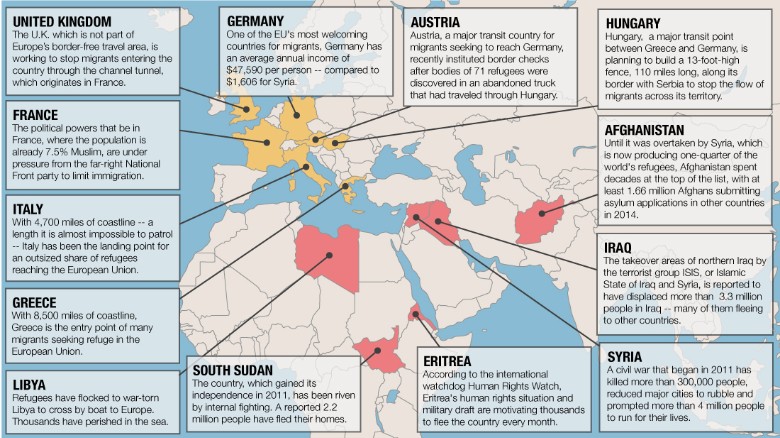
Refugee crisis– Situated aside Mediterranean sea, it has become a destination for many refugees who left their home from West Asia and North Africa due to troubled conditions in these regions. the influx of so many refugees has created problems related to higher economic burden in already suffering europe, law and order problem, ethnic clashes between natives and migrants etc.
Problem of extremism- The rise of ISIL and the recent attacks in Paris and Belgium has exposed the vulnerabilities of youths in europe towards extremist ideologies as the attacks were happened with no outside supports.
Huge number of refugees and migrants have been shifting to Europe, from many countries like Syria, particularly since 2011. They see Europian Union (EU) as their asylum. With more number of refugees coming in at a time when the natives don’t want any more, the whole situation has developed into a crisis. This crisis is called European Refugee Crisis.
The refugees are not only from Syria!
More than 5 Lakh people have crossed to Europe by sea and land. Most of them are from Syria – troubled not only by civil war, but also by the most violent and inhumane atrocities by ISIS. But Syria is not the single source. They come from areas such as the Middle East (Syria, Iraq), Africa (Eritrea, Nigeria, Somalia, Sudan, Gambia), South Asia and Central Asia. According to International Organisation for Migration (IOM) statistics, a substantial number of refugees are also from Afghanistan and Pakistan too due to unending civil conflicts in these countries.
The phrase “European migrant crisis” became widely used in April 2015, when five boats carrying almost two thousand migrants to Europe sank in the Mediterranean Sea, with a combined death toll estimated at more than 1,200 people.
Migrants and Refugees – Statistics
According to UNHCR, the UN’s refugee agency, 59.5 million people were forcibly displaced in 2014 which again rose considerably in 2015.
A record number of 1,07,500 migrants reached the borders of European Union in recent months.
Between 2000 and 2015, around 30, 000 have perished along these borders.
This figures stand as a witness that this crisis didn’t started only after ISIS emerged. The increasing number of unaccompanied minors seeking asylum in Europe is seen as a dangerous growing trend among refugees. In 2014 alone around 24,000 unaccompanied minors applied for asylum. Many of the children who arrive are at the age group of 15 to 17 with no formal schooling adding more headaches to host countries.
The European Response to Migrant Crisis
Germany and the EU have been pushing for other EU members to work out a plan for asylum seekers. Britain leads among countries which strictly rejects it. The Right-Wing PM of Hungary has appealed to refugees not to try and cross into Hungary which has fenced its borders with razor wire. Bulgaria, Czech, Slovakia and Poland all are reluctant in taking of refugees making the situation grave.
Germany is expected to give green signal to almost 1 million applicants for asylum. After extensive criticisms by Media on Refugee crisis, EU has started to take few favourable steps.
Initially Europe greeted immigrants with barbed wires, tear gas and police brutality. Only after huge outcry across International media and from human rights and progressive organisations within Europe, eased the curbs on refugees.
Aylan: Another incident which helped to garner pro- refugee sentiments was photo of dead child Aylan on a beach. A mishap happened from his father who accidently dropped him from an overcrowded boat while trying to escape. These photos send jitters across world and thanks to social media which made sure that this photo was seen by everyone who has an account.
Also Pope Francis statement that every Church in Europe should take a refugee family has given hope to many that it may change the mood in European Right Wing’s mind.
Countries have started to take more refugees peacefully now. European people have been welcoming refugees with water, food, shoes and blankets. Though Italy, Greece and Hungary are the frontline countries of reception, most sort after destinations are Germany, Sweden, Austria and Switzerland.
Why Europe?
Europe is the most preferred destination for the people from this war conflicted regions as its economically prosperous, socially secure and has friendly immigration laws.
Mostly it’s not because refugees are opportunists that they walk to EU but it’s due to dangerous situation they and their families has to live. Endless wars, conflicts have ruined their countries political, economic and social equilibrium.
Also it’s surprising why GCC countries never have been helpful or receptive to refugee crisis especially when it’s happening in their backyard. Rich countries like Saudi Arabia and Qatar has to play more pro- active roles in this situation. So obviously Europe as nearest land seems to be their immediate hope to go as they can trek or use boats or ships to reach.
Macro level causes for Refugee Crisis
West: A short and quick look into history will show you that countries who are responsible for this situation are the ones who have to bear pain of this crisis i.e Europe or to put in a cliché ‘West’ inclusive of US. Middle East can be said as the holy grail of West since oil was accidentally found by two American gentlemen in Saudi Arabia. No doubt it was a boon to natives and even to millions of Asian and African immigrants to Middle East but also it paved the way to unending geo-political crisis across the region. Before finding oil just like Asia and Africa European colonialism had sucked all its wealth and when time came to leave the place like everywhere, Imperial powers left without solving issues created by them mainly land disputes within neighbours. Example is Israel and Palestine issue.
Dictatorship regimes and Islamic fundamentalism: Continuous dictatorship type regimes and Islamic fundamentalism made Middle East most volatile n disturbed place on the planet. Western powers in order to make their oil supply smooth and to be part of Gulf Boom started in early 80’s always took a partial stand on these issues.
Shia-Sunni divide: Another villain to already worsened situation was Shia-Sunni divide among people, society and regimes which led to many conflicts. This reason has led many natives to flee as refugees in the past from Palestine, during Iraq-Iran war, Iraq-Kuwait war etc.
Wars: This refuge crisis has given Europe a reality check on its wars on many regions of MENA (Middle East and North African region). Wars on these lands didn’t ease the situation even though they were able to kill or defeat dictator leaders. By war, infrastructure and liveable conditions of already abysmal level got more deteriorated. These resulted natives of these lands to search green pastures which happened to be Europe and hence started Refugee crisis.
Democracy movements and civil war: Present refugees crisis didn’t started yesterday but it has been seen a huge surge from Libya conflict. If we go again back refugee problem as a crisis started from US, UK joint war to liberate Iraq.
ISIS: Emergence of ISIS just sky rocketed the whole thing. Western powers in a way failed to bring stable regimes to these lands. People in a way got sandwiched between atrocities of ISIS or ineffective regimes backed by West on one side and on the other side hunger, poverty and tyranny. Only way to survive for them was to initiate long walk towards Europe! Thus started one of the biggest Exoduses ever seen in history.
Adding fuel to fire
Saudi Arabia has been attacking and bombing Yemen.
Asylum denied refugees may join ISIS.
Turkey’s intolerance with Kurds
Syrian Conflict have been going on for 4 years but why suddenly this crisis?
War in Syria against ISIS is not getting any better. It made Syrians to leave their country to Turkey which is closest and they thought once war is over, they can return.
Even though Turkey has taken 2 million refugees, it’s not a country for people to stay in the long run as Right to work for refugees are not legal yet. Also new regime of Turkey is also not quite favourable to refuges as previous government. It has made refugees reluctant to go to Turkey.
UN organisations working with millions of refuges in Jordan, Turkey and Lebanon are running short of funds to keep up the relief work and expenses of camp making people to think of going to Europe. Similar is the situation among UN camps catering to the needs of refugees in Eastern Europe.
Many people have saved required money to use legally or illegally to get into Germany.
People have familiarised with the route via Balkan to trek to EU.
EU countries have been sitting as a lame duck all this year’s talking, discussing on refugee crisis without sensing urgent need of a solution or to deal with such a situation.
Still EU should understand that what they are facing now is just a tip of iceberg compared to neighbouring countries of Syria when it comes to dealing with refugees.
Conclusions with Possible Solutions
West in a way with its narrow minded Foreign Policy have destabilized West Asia and Middle East and now cannot show their back on refugee crisis.
Europe should include US which has been largely elusive on whole issue till now.
GCC countries should involve more in accepting refugees. It’s a blunder what Saudi Arabia is doing right now by attacking and bombing Yemen currently which will only add more refugees.
If Europe is going to push back the refugees, the situation will be more vicious. Such a stupidity will increase the chances of refugees joining with ISIS as they won’t have any other options to survive.
Turkey should end its anonymity with Kurds and involve them more into finding a solution and to defeat ISIS.
Assad regime should be made more accountable.
Include Russia and organise an all-out war against ISIS.
Finding a formula based solution which will end all tyranny is not practical but it’s time that Europe and US sit together and re-check their neo imperialistic and double faced foreign policies in West Asia and Middle East.
Also Western powers should stop Saudi Arabia from funding Wahhabis ideology being spread in Middle East society which is resulting in more Islamic fundamentalism helping organisations like ISIS and Boko—Haram.
To all those who oppose to support refuges,“Recognize yourself in he and she who are not like you and me.” – Carlos Fuentes.
INDIA-GERMANY
Introduction
Bilateral relations between Germany and India are based on a sound foundation of mutual respect, understanding and support. The cooperation between both countries covers a wide range of areas from political action and growing economic exchange to landmark cultural events.
It is complementary as India and Germany both contribute their particular and unique strengths to this truly strategic partnership.
The relationship, based on common values of democracy and rule of law has gained significantly in strength in the 1990s following India’s economic liberalization and the end of cold War. The strategic partnership between India and Germany gained light with the signing of Germany and India cooperate closely on the issue of UNSC expansion within the framework of G-4.
Historical Background
The history of Indo-German political relations goes back to the late nineteenth century, when the ‘Imperial German Consulate’ (Kaiserlich Deutsches Generalkonsulat) started operating from Calcutta (now Kolkata).
As one of the first countries, India diplomatically acknowledged and accepted the Federal Republic of Germany after the end of the Second World War in 1945. The diplomatic recognition of Germany by the Indian government smoothened the way for a long lasting and continuous relationship for over 60 years up to the present day.
Thus, in 1951, the Indian Union and Germany decided to establish economic relationships to gear up their partnership. With that in mind, the Indian Prime Minister Jawaharlal Nehru made his first visit to post-war Germany and its first Chancellor Konrad Adenauer (Christian Democratic Union – CDU) in the same year.
Also, Germany established its Consulate General in Bombay (now Mumbai) in 1951, leading of the establishment of a full-fledged Embassy in New Delhi in 1952
Importance of Germany for India
India and Germany share strong bilateral relations extending over economic, cultural and security issues–ECONOMIC IMPORTANCE
Germany is the largest trade-partner of India in Europe.
Germany’s importance can be traced from the fact that India has announced a Fast-Track mechanism for German Companies in the DIPP.
Germany’s looks forward to employ young Indian labour to overcome its demographic deficit.
–STRATEGIC IMPORTANCE
India and Germany seek a permanent seat with veto powers at the United Nations Security Council and have joined with Japan and Brazil to co-ordinate their efforts via the G4 collective.
–SECURITY IMPORTANCE
Technologically advanced Germany can contribute a lot to India to strengthen its security programs. Currently, both nations are holding meetings on Counter-Terrorism and Cyber-Dialogues.
Germany supports India’s membership to NSG and MTCR(Missile Technology and Control Group.
–ROLE OF GERMANY IN INDIA’s RENEWABLE ENERGY SECTOR
Germany has invested heavily in the Green Energy Corridors Partnership and has extended co-operated in the India-Germany Solar Energy Partnership which can help India achieve its target of 175 GW by 2022.
Germany has also extended its help to India’s National Electric Mobility Mission which can reduce the dependence on the fossils.
German Economy
Germany – the fifth largest economy in the world in PPP terms and Europe’s largest – is a leading exporter of machinery, vehicles, chemicals, and household equipment and benefits from a highly skilled labor force German Economy contracted by 5.1% in 2009 but grew by 3.6% in 2010, and 3.1% in 2011.
The recovery was attributable primarily to rebounding manufacturing orders and exports – increasingly outside the Euro Zone. The worsening euro-zone financial crisis and the financial burden it places on Germany as well as falling demand for German exports has made domestic demand a more significant driver of Germany’s economic expansion.
Economic Relations
Germany is India’s most important trading partner within the European Union and the sixth most important trading partner in worldwide comparison. Since the beginning of the Indian reform policy in 1990, the bilateral trade volume has risen from 2.7 billion Euro to 16 billion Euro in 2014.
Germany is the 8th largest foreign direct investor in India since 2000. German FDI in India during the period 1991-February 2015, was valued at US$ 8.25 billion. German FDI in India in 2014 was to the tune of US$ 1.15 Indian investments in Germany have also shown a remarkable increase in the last few years and have invested over US $ 6 billion in Germany, mainly through M&As.
In the first 7 months of 2015, the bilateral trade volume compared to the previous year rose by 13%. German exports rose by 17.5%, while imports from India rose by 8,1%. The German trade surplus of around 1.9 billion Euro in 2014 is based on a high demand for German capital goods.
These are machinery that amount to a third of German exports to India, as well as electronic technology, metal ware, chemicals, automobiles and automotive parts. Indian exports to Germany consist mainly of textiles, chemicals, electronic technology, metal ware, leather and foods.
Angela Merkel Visit to India 2016
Bilateral relations between the Republic of India and the Germany have been traditionally strong due to commercial, cultural and technological co-operation. German Chancellor Angela Merkel travelled to India for the Third Indo- German Inter-Governmental Consultations.
A total of 18 agreements were signed, which covered a wide range of topics — from skill development to education, science and technology to aviation.
Highlights of the visit
Germany returned to India a 10th century Durga idol that had gone missing from a temple in Kashmir over two decades ago.
“Fast-track clearance mechanism”:
In a bid to attract German investment, India decided to set up a “fast-track clearance mechanism”. The only other such country-specific mechanism is for Japan.
The fast-track system for German companies will be taken care of by the Department of Industrial Policy and Promotion (DIPP), and will become operational by March 2016.
The two leaders also underlined the importance of freedom of navigation in international waters and the right of passage and other maritime rights in accordance with international law, in an apparent reference to growing Chinese assertiveness in the South China Sea.
Germany has expressed its inability to sign the Mutual Legal Assistance Treaty (MLAT) with India, citing its provision for “death penalty” for heinous crimes and terror activities.
India and Germany agreed to resume talks towards a free trade agreement between Asia’s third-largest economy and the European Union.
Germany is India’s largest trading partner in the E.U. and one of the top ten global trading partners.
The overall exchange of goods and services between the two countries was valued at around around 15.96 billion euros last year, a drop of €1.14 billion from the level of €16.10 billion registered in 2013.
German Chancellor highlighted problems that German businesses have faced in operating in India, and hoped that the new agreement for a special “fast-track” mechanism would help them secure licences and clearances expeditiously.
Cooperation in clean energy:
The two countries agreed on the India Germany Climate and Renewable Energy Alliance — a comprehensive partnership to harness technology, innovation and finance in order to make affordable, clean and renewable energy accessible to all.
Germany has committed to providing an assistance of over 1 billion Euros for India’s Green Energy Corridor and a new assistance package of over 1 billion Euros for solar projects in India.
Germany is India’s “natural ally”
India’s natural partners would be countries that, on the one hand, do not compete with it either in the Market place or in power politics, and, on the other, have something to offer India that it lacks.
By assisting India in the quest for development and geo-economic growth, Germany has the opportunity to bolster their own rise in geopolitical terms.
Germany has surplus capital, modern technology and a demographic deficit.
India has a deficit of capital, lacks modern technology and has exportable human capital.
UN Security Council reform
Germany and India are vigorously pursuing UN security reform along with Japan and Brazil.
INDIA AND FRANCE
Relations between India and France have traditionally been close and friendly. With the establishment of strategic partnership in 1998, there has been a significant progress in all areas of bilateral cooperation. President François Mr. Hollande was Chief Guest at the Republic Day parade.
The relationship is based on shared values and real convergence on a whole range of regional and global issues.
France was the first country with which India entered into an agreement on Civil Nuclear Cooperation.
France has consistently supported India’s increasing role in international fora, including India’s permanent membership of the UNSC.
Trade relation
India-France trade hovers around $8 billion, which is half of India’s trade with UK or Germany. A big reason for this is the impasse in India’s economic relations with the European Union.
More than a thousand French companies have a total investment of about $20 billion in India.
Strategic partnership
In the post-Cold War period, France was the first country with which India established a ‘strategic partnership’. The only major Western power that described the U.S. as a “hyperpuissance” (hyperpower) and openly espoused the virtues of multi-polarity found a natural ideological convergence with India’sambitions of seeking strategic autonomy.
After the nuclear tests in May 1998, when India declared itself a nuclear state, France was the first major power to open talks with the country.
The strategic dialogue has been institutionalized at the level of National Security Advisors, and covers nuclear, defence, space and counter-terrorism, cyber security issues.
These have been given a boost by the agreement on intelligence-sharing and cooperation on investigations and judicial processes.
Rafale deal
India would buy 36 of the fighter planes in flyaway condition, citing critical operational requirements of the Indian Air Force.
The two countries have signed a MoU on purchase of Rafale fighter jets.
Nuclear agreement
The Jaitapur project, where French company Areva is to set up six nuclear reactors with a total power generation capacity of about 10,000 MW, has been stuck for long because of differences over the cost of the power generated.
Both countries have decided to clear the logjam by splitting the problem into different silos — allowing for separate mechanisms for the pricing issues and for the technical and legal aspects.
Solar energy
French President inaugurated the interim Secretariat of the International Solar Alliance at Gurgaon.
The French Development Agency will allocate for the development of solar energy €300 million over the next five years.
The International Solar Alliance, envisaged to bring together 122 countries that lie wholly or partly between the Tropic of Cancer and the Tropic of Capricorn, is an initiative announced by Mr. Modi at the COP 21 Summit in Paris in November 2015. The member countries are to be those that enjoy 300 or more days in a year of bright sunlight.
INDIA AND ITALY
Italian marine case
An international arbitration tribunal has ruled that Italian marine can return to Italy until it decides a dispute raised by Italy about India’s jurisdiction to try him and his colleague for the killing of two Indian fishermen in February 2012.
Subsequent to tribunal ruling, The Supreme Court ruled that Girone (Italian marine) can return to Italy while an international tribunal decides on a jurisdictional issue between India and Italy. The Supreme Court laid down conditions for releasing Mr. Girone.
He continues to remain under the jurisdiction of the Supreme Court and report to the local police station in Italy once every month. Also, the Italian authorities will keep the Indian embassy informed.
Envoy’s responsibility: The Italian Ambassador will take the responsibility of ensuring his return within a month in case the tribunal rules in favour of trial in India.
Background of the Case
Two Italian marines-Massimiliano Latorre and Mr. Girone are facing the charge of murdering two Indian
fishermen in 2012 off the Kerala coast.
Italy position
The Italian position is that the two marines positioned on board a merchant tanker, theEnrica Lexie, had opened fire to thwart what they perceived as a pirate attack 20.5 nautical miles off Kochi.
It is further argued that the death of the two Indian fishermen occurred in the course of the discharge of their operational duties, and hence functional immunity could be invoked as related to the militarypersonnel of any nation.
Italy argues that the case should not be heard in India because the incident occurred in international waters.
India’s position
India has steadfastly rejected Italian argument and has invoked its sovereign right to prosecute the accused under the provisions of Indian law.
International Tribunal for the Law of the Sea (ITLOS)
In June 2015 Italy approached the International Tribunal for the Law of the Sea (ITLOS) in Hamburg.
The tribunal is adjudicating only on the limited question of whether India or Italy has the jurisdiction to try the two marines.
In August 2015 ITLOS ordered that: “Italy and India shall both suspend all court proceedings and refrain from initiating new ones which might aggravate or extend the dispute submitted to the Annex VII arbitral tribunal or might jeopardise or prejudice the carrying out of any decision which the arbitral tribunal may render.”
Subsequent to the ITLOS ruling, both parties agreed that the dispute would be resolved under the UNCLOS tribunal.
May 2, 2016: A U.N. arbitration court rules that India should release Italian marine Salvatore Girone.
International Tribunal for the Law of the Sea (ITLOS)
It is an intergovernmental organization created by the mandate of the Third United Nations Conference on the Law of the Sea. It was established by the United Nations Convention on the Law of the Sea, signed at MontegoBay, Jamaica, on December 10, 1982.
The tribunal is based in Hamburg, Germany.
The Tribunal has the power to settle disputes between party states.
INDIA-UK
Prime Minister Narendra Modi became the first Indian prime minister to visit the UK in almost a decade.
The two leaders reaffirmed their commitment to working together to build such an enhanced and transformative partnership for the betterment of their two countries and the world.
India and the U.K. announced an enhanced defence and strategic partnership as well as a civil nuclear agreement
Both countries for the first time, jointly pushing for the UN comprehensive convention on international terrorism (CCIT), and strengthening strategic cooperation and intelligence-sharing through annual consultations.
£9.2 Billion of commercial deals between the UK and India announced during the visit and listed in the annex.
Both countries announced three UK-India city partnerships with Indore, Pune and Amravati to support India’s ambitious urban development goals through technical assistance, expertise sharing and business engagement.
Both countries have launched a new Thames/Ganga partnership for healthy river systems. This partnership will consist of a collaborative programme of research and innovation to enable the sustainable management of water resources in the Ganga basin and a policy expert exchange in 2016 supported by the UK Water Partnership.
Announcement of setting up of joint India-UK Vaccine Development collaboration between the Department of Biotechnology and Research Councils, UK.
Trade and investment
U.K. is the largest G20 investor in India, while India invests more in the U.K. than the rest of the European Union combined. India has also emerged as the third largest source of FDI for the U.K. Indian companies employ 110,000 people in the UK.
Foreign direct investment inflows from Britain to India between April 2000 and March 2016 were worth $23.1 billion. The UK has accounted for 8.56% of total foreign direct investment in India during the last 15 years.
Bilateral trade has stalled at the level of $ 15-16 billion.
Visa issue
India has conveyed its concerns to the UK authorities about the new British immigration law that will impact professionals earning below 35,000 pounds annually.
Thousands of Indians and other nationals from outside the European Union (EU) living and working in Britain on a tier-2 visa may have to leave or be deported if they earn less than €35,000 a year once the terms of thevisa expire.
Indian professionals have formed the largest category of individuals issued such visas by the UK over the years.
Indian professionals are also facing visa related challenges in other countries, including the U.S. India has dragged the U.S. to the WTO over its decision to impose high fees on temporary working visas.
Issue of Pakistan
India believes that the UK should take a tougher line with Pakistan on terrorism. The UK argues that it needs to maintain a positive relationship with Pakistan, not least because of the size of the Pakistani diaspora.
UK PM visit to India 2016
In November 2016 Prime Minister of United Kingdom Theresa May was on three day visit to India, and it was her maiden visit to India after becoming Prime Minister of UK. India and United Kingdom enjoys the cordial relations since long time. Both countries are considered as two pillars of the Commonwealth, sharing democratic values and a world view on many political issues including terrorism.
Key Agreements signed during the visit
UK’s PM Theresa May offered frequent registered traveller scheme for Indians travelling to Britain for business.
The UK is also planning to restrict immigration through “work and study routes” which will have an impact on Indians being hired by British firms.
Both countries reaffirmed the importance of the strategic partnership between both and it delivers huge benefits for both countries.
About the traveller Scheme
Under the scheme, Indian nationals frequently visiting to the U.K. and contributing to growth in both countries will have a ‘significantly easier’ entry process including fewer forms to be filled, access to the EU-EEA passport controls, swifter passage through airports.
It will give a boost to trade and investment in both the∙ countries and strengthen ties between two nations.
About the Immigration Scheme
As per the proposal
Immigration system will be re-looked if it provides the right incentives for businesses to invest in British workers.
From December 2016, landlords renting out property to people with no right to be in the UK will be committing a criminal offence and could go to prison.
Immigration checks will be a mandatory requirement for those wanting to get a licence to drive a taxi.
From 2017, banks will have to do regular checks to ensure they are not providing essential banking services to illegal migrants.
Prospective impacts of the Immigration Scheme
The tightened immigration will “ensure gaps in the UK’s labour market.
The crackdown will affect students from India planning to study in the UK; their numbers are already at an all-time low.
The move may make it difficult for British firms to hire from outside the EU, including countries like India.
BREXIT
Brexit is a term used to define United Kingdom coming out of EU. Recently in a referendum conducted in United Kingdom, UK voted by a narrow margin in favour of Brexit. Negotiations are undergoing currently between United Kingdom and European Parliament to negotiate the terms of the exit deal.
About EU
European Union or EU is an experiment to transform the relations between nations based on functionalist ideology. It envisages to transform the relations between nations by enmeshing them in economic, social, cultural, political partnership. EU is currently a block of 28 countries and 19 countries have formed Eurozone.
Formation of European Union is an outcome of Single European Act, 1991. Mashtricht Treaty converted the EU into a monetary union. Lisbon Treaty strengthened political, foreign affairs and security integration of policies of countries of European Union
Lisbon Treaty (Article 50) provides for exit of member countries from European Union. For any country to come out of European Union, it has to negotiate a deal with EU. The deal will provide for a settlement between EU and UK
Opinion of Political Groups
UK Independence Party, under the leadership of Nigel Farrage led the “Leave” campaign of UK
Labour Party, under the leadership of Jeremy Corbyn led the “Stay”’ campaign of UK
David Cameron, ex PM of UK agreed to hold a referendum on Unikted Kingdom’s future in EU. Conservatives were in favour of staying in EU
Why the clamour for Brexit
Economic reasons – The primary contention was that economically, Britain loses more than what it gains.
The first issue being that of membership fees paid – about 340 pounds per year per household
Secondly, it was said that EU’s policies were too protectionist and did not favour competitiveness to the extent that would be beneficial for the British economy
Post the Sovereign Debt Crisis, EU introduced Fiscal Compact and tighter control on national budgets. Britain was not comfortable with these ideas
Germany’s proposal to impose taxes on financial transactions (Tobin Tax) also did not find favour with London, which is an important financial hub.
Immigration issues
Half of British legal migrants come from EU. There is this feeling that they have a negative impact on UK born workers. Adding credence to local fears was the fact that since 1997, 3/4th of jobs created are taken up by EU immigrants
EU’s obligation on its members to accommodate more refugees also did not find favour with UK. Especially at a time when the refugee influx in Europe is at an all time high in light of multiple crisis in Middle East and Africa
There is also this perception that immigrants pose a threat to national security
Sovereignty Issue
EU is a transformative idea in many senses. One of the things that it leads to is the weakening of national sovereignty. EU has been pushing for creation of an Ever Closer Union which would accord greater decision making powers to European Parliament, while, limiting the authority of British Parliament.
Impact of Brexit:
On UKEconomic
EU is a large market. 45% of British exports are directed towards EU. EU is the largest market for UK’s exports and one of the major sources of UK’s imports. Except Germany and Sweden, UK has a positive Balance of Trade with all other countries of EU. Post Brexit, access to EU markets would suffer for UK
Britain has emerged as a major financial hub. Post Brexit, the financial/services sector in UK would take a hit. We have already seen the London Exchange soaring down post Brexit
Immigrants to EU are better educated and skilled and offset the demographic disadvantage. That advantage will be lost for UK.
Geopolitical
It raises questions over the future of Scotland and Northern Ireland. Their desire to stay in Uk was preconditioned on UK remaining a part of EU. The Scots have already started demanding for a referendum on Scotland’s futute in UK. Even in Northen Ireland violence erupted post the Brexit vote
In an interconnected world, being a part of multilateral organizations is key to influence policy matters. No country can do it alone in a rapidly changing international environment. Similarly UK would lose some of its leverage now that it has voted for Brexit. Pursuit of sovereignty in purist terms in an interconnected world is a utopian idea
On EU
The idea of EU stands challenged. EU whose origin lied in the centuries of war that ravaged Europe was a transformative idea in international relations, enmeshing countries in cooperation. With the exit of UK, there is a possibility of other countries such as Greece etc to follow suit. Thus the idea of EU stands challenged.
EU is currently under multiple crisis emanating from financial slowdown, Russian challenge, security concerns. EU and Britain separately would not be able to handle a resurgent Russia. Similarly to deal with the security threats in Europe requires countries to act in concert and not independently
On India
Cons
The immediate impact of Brexit is an increase in risk aversion when it comes to investing, especially in light of the possibility of other countries following suit. This will affect the FPI outflows from foreign portfolio investors.
Rupee may depreciate because of the double effect of foreign fund outflow and dollar rise
IANS report says that Britain ranks 12th in terms of India’s bilateral trade with individual countries. It is also among 7 in top 25 countries with which India enjoys a trade surplus. India invests more in UK than the rest of Europe combined, emerging as the 3rd largest FDI investor. Access to European markets, therefore, is a key driver for Indian companies setting shop in UK. Britain coming out of EU is likely to affect the business prospects of these companies.
Nasscom in a recent report held that IT and ITeS industry of India will have a negative impact of close to $108bn. The impact can be seen in medium term (2-3 years). Indian IT companies with European headquarters in the UK would need to spend on infrastructure and staff for setting up a new office in the EU. (There are approximately 800 Indian companies in Britain)
Immigration (student and professional): Work-related visa restrictions have already resulted in a fall in the number of Indian students in the UK. Following Brexit, the number of Indian students applying to UK universities and colleges might reduce further. Sceptics also fear that visitation rights of relatives who have families in UK might also be affected. Also, those applying for visas in Britain may face a hard time. With Brexit, the government’s stance on immigration will likely curb overall immigration into the country.
Pros
While on the positive side, Brexit has driven away fears of a US Fed rate hike and could lead to lower commodity prices
UK loses a huge preferential market in the EU and would seek to build new alliances and trade pacts. India being one of the the fastest growing economies is rightly poised to gain from this development. The migration of EU skilled labour would decrease and english speaking Indian talent pool is definitely going to benefit out of it.
Indian students should be able to secure more financing for their college degree, as preferential scholarships to EU countries will reduce. This would mean India could be seen exporting more talent than present levels.
Devaluation of rupee might enhance India’s export competitiveness.
The positive side will be the trade deals with india. Indo-Eu bilateral trade agreement has not made much headway in years so we may be able to strike a better agreement with UK.
Also, let us not forget than India is a former colony of Britain and a member of Commonwealth of Nations. With UK separated from EU, it would want to create new economic alliances and may tilt towards its former colonies.
Has 2 departments under it – Dept. of Rural Development and Dept. of Land Resources. National level schemes under them – Pradhan Mantri Gram Sadak Yojana (PMGSY) for rural roads development, Swarnajayanti Gram Swarozgar Yojana (SGSY) rural emploment and for rural housing, Indira Awaas Yojana (IAY) & Integrated Watershed Management Programme (IWMP).
Genetically Modified Organisms(GMO): Developments and Concerns
Recently, Genetic Engineering Appraisal Committee (GEAC) decided to put on hold the government’s decision to commercialise genetically modified (GM) mustard, because of growing outrage by farmer groups against it. Let’s understand its basics in brief!
What is GMO?
GMOs can be defined as organisms (i.e. plants, animals or microorganisms) in which the genetic material (DNA) has been altered in a way that does not occur naturally by mating and/or natural recombination
It allows selected individual genes to be transferred from one organism into another, also between non related species
Foods produced from or using GM organisms are often referred to as GM foods
Recently in India, GM mustard crop was introduced, which was later withdrawn. There is a raging debate going on advantages and disadvantages of GMOs
For a long time, further study was requested by farmers, environmentalist on GMO crops
<Genetic Engineering Appraisal Committee (GEAC) is a body under the Environment Ministry that regulates the use of genetically modified organisms>
Why are GM foods produced?
GM foods are developed – and marketed – because there is some perceived advantage either to the producer or consumer of these foods
This is meant to translate into a product with a lower price, greater benefit (in terms of durability or nutritional value) or both
Initially GM seed developers wanted their products to be accepted by producers and have concentrated on innovations that bring direct benefit to farmers (and food industry generally)
One of the objectives for developing plants based on GM organisms is to improve crop protection
What really is India’s recently developed GM mustard?
A team of scientists at Delhi University led by former vice-chancellor Deepak Pental has bred DMH-11, a genetically modified (GM) mustard hybrid
Hybrids are normally obtained by crossing two genetically diverse plants from the same species
The first-generation offspring resulting from it has higher yields than what either of the parents is individually capable of giving
But there is no natural hybridisation system in mustard, unlike in, say, cotton, maize or tomato
What team has done is, that they have created a viable hybridisation system in mustard using GM technology
The resulting GM mustard hybrid, it is claimed, gives 25-30% more yield than the best varieties such as ‘Varuna’ currently grown in the country
Is there a need, in the first place, for developing a mustard hybrid?
In 2014-15, India imported 14.5 million tonnes of edible oils valued at $10.5 billion
With the country’s own annual edible oil production stuck at below 7.5 million tonnes, of which mustard’s share is roughly a quarter
So, there is need to raise domestic crop yields and cut dependence on imports
Hybrid technology is a potential technique to boost yields, as has been successfully demonstrated in a host of crops
What are the environmental risks?
GMOs contaminate forever. GMOs cross pollinate and their seeds can travel far and wide
It is impossible to fully clean up our contaminated gene pool
Genetic engineering allows plants to survive high doses of weed killers, resulting in higher herbicide residues in our food
GMO crops are creating ‘super weeds’ and ‘super bugs,’ which can only be killed with more toxic poisons
Are there any advantages?
Insect Resistance
Some GMO foods have been modified to make them more resistant to insects and other pests
This means the amount of pesticide chemicals used on the plants are reduced, so their exposure to dangerous pesticides are also reduced
Stronger Crops
Another benefit that GM technology is believed to bring about is that crops can be engineered to withstand weather extremes and fluctuations,
This means that there will be good quality and sufficient yields even under a poor or severe weather condition
Environment Protection
GM crops often requires less time, tools and chemicals, and may help with reducing greenhouse gas emissions, soil erosion and environmental pollution
More Nutritious Foods
According to the UN Food and Agricultural Organization (FAO), some GM foods have been engineered to become more nutritious in terms of vitamin or mineral content.
Economic Benefits
Larger production leading to increased farm income, reduced poverty, low food prices and thus reduced hunger and malnutrition.
Besides new food products are also included, diversifying food varieties
Then, Why has there been so much concern about GM foods among some public interest groups, activists and consumers?
Since the first introduction on the market in the mid-1990s of a major GM food (herbicide-resistant soybeans), there has been concern about such food among activists and consumers, especially in Europe
In fact, public attention has focused on the risk side of the risk-benefit equation, often without distinguishing between potential environmental impacts and public health effects of GMOs
Consumers have questioned the validity of risk assessments, both with regard to consumer health and environmental risks, focusing particulary on long-term effects
Consumer concerns have triggered a discussion on the desirability of labeling GM foods, allowing for an informed choice of consumers
What further developments can be expected in the area of GMOs?
GM organisms are likely to include plants with improved resistance against plant disease or drought, crops with increased nutrient levels, fish species with enhanced growth characteristics
For non-food use, they may include plants or animals producing pharmaceutically important proteins such as new vaccines
The promise of criminal law as an instrument of safety is matched only by its power to destroy. It is arguably the most direct expression of the relationship between a state and its citizens.
Amid the debate on the archaic sedition law that should have no place in democratic India, President Pranab Mukherjee said that the IPC, 1860 requires a thorough revision to meet the needs of the 21st century. Click here to know everything about sedition law
History:
The code was drafted in 1860 on the recommendations of first law commission of India established in 1834 under the Government of India Act 1833 under the Chairmanship of Thomas Babington MacaulayAnswer in comments.>
It came into force in British India(but not princely states) during the early British Raj period in 1862
After the partition of the British Indian Empire, the Indian Penal Code was inherited by its successor states, the Dominion of India and the Dominion of Pakistan, where it continues independently as the Pakistan Penal Code and later in B’desh also
Jammu and Kashmir does not follow IPC but has enacted a separate code known as Ranbir Penal Code (RPC) which is based on IPC
Some notable points:
The IPC replaced Mohammedan Criminal Law, which had a very close relationship with Islam. Thus, the IPC laid the foundation of secularism
It was widely appreciated as a state-of-the-art code and was, indeed, the first codification of criminal law in the British Empire
Today, it is the longest serving criminal code in the common-law world
Today, most of the commonwealth follows the IPC
Law Commission on IPC:
42nd Report (1971)– Law Commission of India for the first time had recommended the repeal of Section 309 (criminalization of suicide)
172nd Report (2000)– Recommended deletion of Section 377 (criminalization of unnatural sexual offences)
210th Report (2008)– Recommended Humanization and Decriminalization of Attempt to Suicide under Section 309
Past attempts at amendment:
Even though the IPC has been haphazardly amended more than 75 times, no comprehensive revision has been undertaken in spite of the 42nd report of the Law Commission in 1971 recommending it
Also the amendment bills of 1971 and 1978 lapsed due to the dissolution of the Lok Sabha
As a result, largely the courts have had to undertake this task, with unsatisfactory outcomes at times
Most amendments have been ad hoc and reactive, in response to immediate circumstances like the 2013 amendment after the Delhi gangrape case
Why amend IPC?
The philosophical stance and fundamental principles of Macaulay’s code were the product of imperialist policy <designed to meet colonial needs to subjugation and exploitation of India and Indians, sedition law for instance>
Some of the concepts underlying the code are either problematic or have become obsolete
there are many new offences, which have to be properly defined and incorporated in the code
Macaulay had himself favoured regular revision of the code whenever gaps or ambiguities were found or experienced
In 1860, the IPC was certainly ahead of the times but has been unable to keep pace since then
Specific cases or problems:
Sedition law, inserted in 1898: It is legitimate to ask whether we need a law on sedition that we ourselves condemned during the Raj. Learn more about sedition law here
Section 295A, The offence of blasphemy: It should have no place in a liberal democracy
Criminal conspiracy: It can be invoked merely when two people agree to commit an offence without any overt act following the agreement. It was added in 1913 by the colonial masters to deal with political conspiracies. Kehar Singh etc were convicted and sentenced to death under the offence of conspiracy ,, though none of them participated in the actual crime or were present at the scene of the crime.
Section 149, Unlawful assembly: The principle of constructive liability under this law is pushed to unduly harsh lengths. Mere membership of the assembly without any participation in the actual crime is sufficient for punishment. Several persons have been sentenced to death and hanged though they were not even present near the scene of the actual crime.
The distinction between “culpable homicide” and “murder” is criticised as the “weakest part of the code”, as the definitions are obscure
Sexual offences under the code reveal patriarchal values and Victorian morality.
Section 377: Unnatural sexual offences (LGBT right). Want to know about argument of Delhi high court in decriminalizing homosexuality, click here to read about Naz Foundation case
Source-dailymail
But why supreme court, parliament itself should repeal the law
Contrarian view point of Justice Hegde
We should not repeal something just because it’s 150 years old.
On Sedition: He favours the sedition law as some restrictions are needed to stop people from abusing and talking against the country. “I believe in sedition law. I am a patriot. Any patriot cannot go on abusing the country. There are certain parameters.” He points to distinction b/w criticizing the person (prime minister), policies, system v/s abusing the state
On IPC: We can not just scrap Indian Penal Code because somebody is involved in a crime (and wants it to be scrapped)
We can not just ape west. Ground realities in India and west are very different and they demand different levels of freedom of expression and religious freedom.