đŸ’„Join UPSC 2027,2028 Mentorship (July Batch) + XFactor Notes & Microthemes PDF

Archives: Stories

  • Irrigation In India – PMKSY, AIBP, Watershed Management, Neeranchan, etc.

    Neeranchal National Watershed Project

    As a part GS-3 – Irrigation systems, We need to focus on relevant projects/schemes launched in 2015-16. We will try to bring all such important projects/schemes. One such project is, “Neeranchal” for the Watershed Component of the Pradhan Mantri Krishi Sinchayi Yojana (PMKSY), Let’s see it in brief!

    What is a watershed?

    A watershed also known as drainage basin is an extent or an area of land where surface water from rain, melting snow or ice converges to a single point at a lower elevation, usually the exit of the basin, where the waters join another waterbody, such as a river, lake etc.


    What is watershed management?

    • Watershed management is an adaptive, comprehensive, integrated multi-resource management planning process that seeks to balance healthy ecological, economic, and cultural/social conditions within a watershed.
    • Watershed management serves to integrate planning for land and water; it takes into account both ground and surface water flow, recognizing and planning for the interaction of water, plants, animals and human land use found within the physical boundaries of a watershed.

    What are the objectives of Neeranchal?

    • The Neeranchal Project will support PMKSY to improve watershed management practices and demonstrate measurable results in selected sub-watersheds
    • It will introduce new hydrological approaches and innovative tools for community participation with a more integrated watershed planning process
    • Pilot new field practices that will improve conservation outcomes, water availability, agricultural yields and climate resilience, and scale up a more effective monitoring and evaluation system to track performance
    • The project will be implemented by the Ministry of Rural Development over a six-year period (2016-21)

    Let’s first learn about Pradhan Mantri Krishi Sinchai Yojana (PMKSY)

    • PMKSY is a central scheme that aims at providing irrigation facilities to every village in the country by converging ongoing irrigation schemes
    • The vision of extending the coverage of irrigation ‘Har Khet Ko Paani’ and improving water use efficiency ‘More crop per drop’ in a focused manner
    • With end to end solution on source creation, distribution, management, field application and extension activities
    • A dynamic annual fund allocation methodology mandates states, to allot more funds to irrigation sectors for becoming eligible to access funds under this scheme, is being considered

    The Pradhan Mantri Krishi Sinchayee Yojana programme should concentrate on 2 important things –

    • First, it should quickly put to use 20–40 million ha of unutilised irrigation potential created in major, medium and minor irrigation projects
    • Second, it should provide better quality power rations to farmers during the time of peak irrigation demand.
    • Madhya Pradesh has done precisely this and multiplied the state’s irrigated area quickly, at small incremental cost, delivering double-digit agricultural growth

    What about funding ?

    • The Government of India and the World Bank have signed a US$ 178.50 million credit for the Neeranchal National Watershed Project to improve watershed management in rural rainfed areas
    • The credit will support the watershed activities of the PMKSY in selected states of Andhra Pradesh, Telangana, Chhattisgarh, Gujarat, Jharkhand, Madhya Pradesh, Maharashtra, Odisha and Rajasthan
    • It will cover about 400 sub-watersheds of about 5,000 ha each and reach approximately 482,000 farmer households and two million people
    • The credit is from the International Development Association (IDA) – the World Bank’s concessionary lending arm with a maturity of 25 years, including a 5 year grace period

    [IDA – International financial institution which offers concessional loans and grants to the world’s poorest developing countries. The IDA is a member of the World Bank Group]

    Concerns that will be addressed by Neeranchal-

    • Bring about institutional changes in watershed and rainfed agricultural management practices in India
    • Build systems that ensure watershed programmes and rainfed irrigation management practices are better focused, and more coordinated, and have quantifiable results
    • Devise strategies for the sustainability of improved watershed. management practices in programme areas, even after the withdrawal of project support
    • Through the watershed plus approach, support improved equity, livelihoods, and incomes through forward linkages, on a platform of inclusiveness and local participation


     What are the benefits?

    • Lead to reducing surface runoff of rainwater
    • It will increase recharge of groundwater and better availability of water in rainfed areas
    • It resulting in incremental rainfed agriculture productivity, enhanced milk yield and increased cropping intensity through better convergence related programmes in project areas
    • It will strengthen and provide technical assistance to enhance delivery capacity
    • This is an area development programme and all people living in the project area will be benefitted

    What are the challenges ahead?

    • Enhanced participation of communities, building stronger capacities and systems to plan, implement, monitor and post-project sustainability of local institutions and assets
    • These challenges, if not resolved, can result in implementation delays, slow disbursements and benefits

    Want to read more?

    Published with inputs from Arun
  • Jallikattu Debate

    • Jallikattu is a bull taming sport played in Tamil Nadu as a part of Pongal celebrations on Mattu Pongal day.

    • Jallikattu is derived from the words ‘calli’ (coins) and ‘kattu’ (tie), which means a bundle of coins is tied to the bull’s horns. In older times, the tamer sought to remove this bundle from the animal’s head to win gold or silver.

    • The southern parts of Tamil Nadu witness bull-taming the most, with Alanganallur near Madurai hosting the largest and most famous of these events.

    source

    • Background
    • Factors against the ban
    • Arguments favouring the ban
    • View of SC
    • What can government do?
    • International experience
    • Way ahead

    Factors against the ban

    • Jallikattu is an ancient sport which has continued since colonial times. So it is an ancient tradition which should be preserved and not banned.
    • In Jallikattu, the objective is to obtain the ‘Jallikattu’ a pouch which contains the reward coins called ‘Jalli’ tied to the horns of the bulls. While the players are not allowed to carry weapons of any kind or wear protective gears, the bulls on the other hand will not have nose rings or ropes.
    • Plus, they’re equipped with a pair of sharp horns which can gore a human within seconds. So it’s actually the bull which has the upper hand in this match.
    • Jallikattu is what’s keeping the native breed of cows from going extinct, according to some local people which is a huge problem for western cattle industry.

    Arguments favouring the ban

    • During Jallikattu, bulls are purposefully scared and petrified and then made to run across the crowd, destroying anything that would come in their way. Various cruel means are adopted to scare and anger the bull like pinching, nailing, stabbing with sticks that have nails at the edges, twisting their tails and even forcefully making them drink alcohol and other drugs. The ropes around their nose are painfully yanked and then they are dragged into the crowd of people who further anger the bull.
    • According to the documents by PETA, these bulls also break their bones in order to escape from the crowd continuously trying to toture them. Casualty and death of humans are also alarmingly high during this game.
    • What started as a simple act of bravado has become an act of cruelty towards animals.
    • The bulls are kept in the waiting area for hours, subjecting it to the scorching sun. The bulls used in the sport are also denied food and water.
    • Due to this sport, innumerable human lives, both of the participants and the audience, have also been lost, as the bulls try to flee from the pain.

    View of SC

    • Supreme court in 2014 banned the sport jallikattu as it violates provisions of Prevention of Cruelty to Animals Act (PCA) and militates the constitutional duty of treating animals with compassion, Article 51A (g).
    • It also reiterated the expansive reading it had given in the past, to Article 21 (Right to Life), which prohibits any disturbance to the environment, including animals, considered essential for human life.

    What can government do?

    The Government must find alternate methods to continue it without hurting the animal or people. Following are some of the alternatives:

    1. Follow the famous Spanish bullfighting example where measures taken to avoid lethal damage
    2. Put effective protection (barricades, speaker announcements, clear demarcation) so that people are not hurt
    3. Create awareness regarding apathy faced by animals. Sports personalities, film stars, eminent jurists can come forward

    International experience

    • The tradition of bullfighting in Spain is cited to legitimise the conduct of Jallikattu and present it as a viable tourist attraction.
    • It is significant that the Spanish state of Catalonia banned the sport in 2012 after a prolonged ‘culture versus rights’ debate.
    • In 2002, Germany took animal rights to a new level by giving animals constitutional protection.

    Way ahead

    • Those who want the sport to be legalised have called for an amendment to the PCA Act and measures to revoke the 2011 notification of the Ministry of Environment and Forests (MoEF) which barred the use of bulls as performing animals.
    • Trying to allow an event that legitimises cruelty to animals would be a direct insult to the carefully reasoned writ of the Supreme Court, a complete negation of the PCA Act and its objectives, and would take the country back by a few steps in the crucial area of Right to Life.
  • Air Pollution

    On the morning of 29 November, Beijing woke up to air pollution levels not seen in over a year. The city’s government immediately issued an alert and ordered factories to stop or reduce production.


    The same morning, Delhi woke up to pollution levels much higher than Beijing’s.

    And it hosted the Delhi half marathon.

    In the name of health awareness, the runners breathed air laced with pollutants exponentially beyond safe levels. And they inhaled 10-20 times as much air as a sedentary person does.

    In sharp contrast, the embassies of Norway and the United States have taken urgent steps to safeguard their personnel. While Norwegian officials are set to get “hardship pay” for working in New Delhi, the US embassy’s school has cancelled outdoor activities for its students.

    The stark difference in attitudes, perhaps, is because most Delhiites know little about how exactly the city’s air is killing them. Slowly. Daily.

    The government has largely failed to make people aware of how the pollution affects them, what the main pollutants are, what precautions they should take, the types of masks they should wear, and suchlike.

    It only dumps air pollution data on a rather glib website, on a page full of numbers and technical terms befitting a chemistry textbook.

    There is no air warning system in Delhi that could alert citizens, shut down schools and prohibit outdoor activity when pollution reaches hazardous levels.

    Most of all, though, the residents should know what exactly makes Delhi’s air so toxic. Even if you know what it is – the toxin is called PM 2.5 – there is no easy way to know how harmful it is.

    So, here’s a primer.

    Why are we talking about PM2.5?

    Delhi’s air is not polluted as much with poisonous gases as it’s with really tiny particles known as PM2.5. And its levels are consistently 16-20 times higher than the prescribed standard. At the time of the half marathon, it was 48 times the limit.

    Greenpeace recently found that even inside Delhi’s classrooms, PM2.5 levels were 11 times the limit.

    What is PM2.5?

    PM stands for particulate matter, while the number refers to the size of the particles. So, PM2.5 is like extremely fine dust whose particles are just 2.5 microns wide — that’s thirty times smaller than the width of a human hair.
    The tiny size makes it harder to prevent PM2.5 from getting into the body, making it deadlier.

    What exactly is PM2.5 made up of?

    There is no easy answer to this since the toxin is identified more by its size than what it contains. It could be a variety of solid or liquid chemicals.

    According to the United States’ Environment Protection Agency, a PM2.5 particle, depending on where it’s emitted from, could contain compounds of any of these four materials:

    Carbon – from cars, trucks, waste burning
    Nitrate – from cars, trucks, thermal power generation
    Sulphate – from thermal power generation
    Crustal – suspended soil and metals
    While individual particles obviously can’t be seen without special equipment, large amounts are visible as haze or smog.

    Why is PM2.5 bad?

    1. Being tiny, these particles easily reach the lungs. From there, they can travel through the bloodstream and reach the heart.
    2. Long exposure to PM2.5 can worsen asthma and heart conditions. They also cause runny nose, sneezing and coughing.
    3. 5 coming from diesel vehicles contains carbon and is a carcinogenic.
    4. It can also cause other heart and lung diseases, or make them worse.
    5. It slow down development of lungs in children and can leave them with reduced lung function for the rest of their lives, according to the WHO.
    6. Illnesses caused by PM2.5 kill at least 3.1 million people a year across the world.
    7. The WHO estimates that exposure to PM2.5 reduces a person’s life expectancy by an average of 8.6 months.

    How much of PM2.5 is safe?

    The WHO says there is no safe level, PM2.5 is harmful in any amount. Still, there are standards on how much PM2.5 is too much.
    As per the WHO’s own standards, the average PM2.5 levels should not exceed 10 mg per cubic metre in one year.
    In one day, it should be under 25. Indian safety limits, however, are more relaxed – at 60.
    WHO says PM2.5 level mustn’t exceed 25 mg/cubic metre. Yet, India has relaxed the limit to 60

    What’s the best protection from PM2.5?

    1. Protecting yourself from PM2.5 doesn’t require gas masks, but cotton masks that can block very fine particles.
    2. It is recommended to use an N-95 mask, the same one used to protect against the H1N1 virus.
    3. Unfortunately, planting more trees does nothing to solve the problem.
    4. Since PM2.5 are particles and not gases, they can’t be processed by the leaves.
    5. In fact, a high tree density can make the exposure worse because the extra moisture in the air would trap the particles instead of letting them fly away with the wind.
    6. The only way to cut down PM2.5 levels is to stop it at the source – cars, factories, waste burning, thermal power plants. Until then, strap on the N-95s.

    Only way to reduce PM2.5 is to stop it at source – cars, factories, waste burning, thermal plants


    Source - CatchNews | Pic - Vox-cdn

    Everything that you want to know on Delhi’s Odd-Even Policy

    Delhi Government releases blueprint for Odd-Even formula December 25, 2015. In an attempt to curb alarming levels of pollution in the Indian capital, Delhi, authorities have announced that private cars with even and odd number plates will be allowed only on alternate days. Let’s see it in brief!


    How will odd-even policy work out?

    • The Odd-Even formula plan seeks to curb the number of vehicles plying in the national capital by limiting 4-wheelers on alternate days.
    • Under it cars with licence plates ending in an odd number will ply on odd dates and those ending with an even number can run on even dates.
    • This will be on a trial basis from 1 to 15 January, 2015.
    • During this implementation, public transport including buses and the Metro will be run at high frequency.
    • The government plans to run 6,000 more buses to accommodate those who can’t drive their cars.

    Then, Who is exempted?

    • The list of 20-plus exemptions from the restrictions include emergency vehicles, fire engines, ambulances, hospitals, hearses, prisons, VIPs, enforcement vehicles and defence ministry vehicles.
    • Among VIPs, leaders of the opposition in the Lok Sabha and Rajya Sabha, Chief Ministers of states, Judges of the Supreme Court and high court and Lokayukta are exempt. <CM of Delhi is not exempted>
    • CNG and electric vehicles are also exempt.
    • Two-wheelers and vehicles driven by or occupied by handicapped persons and female drivers are also exempt.

    So, Will it really help clean the Delhi air?

    • The Centre for Science and Environment (CSE), has welcomed the “emergency action to reduce vehicle numbers on the road” but questioned the absurdity of exempting 2-wheelers, which account for more than 30% of air pollutants generated by the transport sector in Delhi, and women drivers.
    • According to the scientists of the Delhi Pollution Control Committee (DPCC), 80 per cent of PM 2.5 air pollution is caused by vehicular traffic and reduction in its levels, even in outer areas of Delhi shows that reduction of four wheeled vehicles on roads.
    • The latest set of ambient air data collected at 18 locations across Delhi through mobile dust samplers shows a consistent trend of declining levels of PM 2.5 air pollution levels.
    • If we take 250-300 as an average, then there is a drop of 100 points in PM 2.5 levels. This means there is a drop in pollution by about 25 percent. [ Isn’t it great! ]


    But, Where did the odd-even idea come from?

    Car rationing has been tried in many countries around the world.

    • Rationalisation of the movement of private vehicles has been adopted in many countries, starting with Sweden (Stockholm) and extending to other European countries.
    • China (Beijing), Mexico and Colombia (Bogota) have also implemented such measures.

    Let’s glance over some international experiments?

    Beijing

    • The city initiated the alternate day car driving restrictions just ahead of the 2008 Olympic Games and saw pollution levels drop by almost 20%.
    • Currently, Beijing imposes this rule periodically, on days with high air pollution.
    • The city has also restricted its car sales since 2011 to 20,000 car plates every month.
    • However, they have made tremendous efforts to increase public transport such as bus connectivity and metro services. [ Lesson for Delhi ]

    Paris, France

    • The city has been imposing the odd-even number plate rule during periods of high air pollution. On such days, public transport is free.
    • The rule was last implemented in March 2015 when a smog alert was issued.

    Mexico

    • The “Hoy No Circula” was introduced in Mexico around 1989 to combat air pollution.
    • It called for citywide bans, one day per week, based on last digit of the number plates.
    • For example, plates ending in 5 and 6 were not allowed to drive on Mondays while 7 and 8 were not allowed to drive on Tuesdays and so on.
    • This measure was highly successful in bringing carbon monoxide (CO) levels down by almost 11%.
    • However, in the long run, people eventually started buying more cars, rendering the ban inefficient. Therefore, it actually ended in a rise in CO levels in the long run by almost 13%.

    Oh! Are these measures short-term?

    • Yes, these examples show that the system has better potential as a short-term measure.
    • It show that temporary restrictions on vehicles may not reduce air pollution in the long term.
    • Drivers inevitably buy more cheap and inefficient cars with different number plates to get around the rules.
    • Hence, such an initiative must be complemented by other measures to ensure that we have a stable system in the long run.

    So, Are there any long-term measures available?

    Centre for Science and Environment (CSE) has suggested some long-term measures –

    • There is a need to impose restrictions on diesel vehicles to promote electric and alternative fuel vehicles.
    • The electric vehicles should be exempted from any such alternate number plate restriction.
    • The number plate measure needs to be combined with high parking charges and intensified public transport strategy. <This should be the strategy for the entire period of poor air quality as well as a long-term measure>

    International Example

    • Paris has set an example by deciding to phase out diesel cars completely by 2020.
    • London is also planning to ban diesel cars despite having a fuel quality as high as Euro 6.
    • China has already banned diesel cars on roads.India, on the other hand, is still juggling between BS-III and BS-IV norms. <With accepted ground reality, we can not directly implement BS-V/BS-VI in one go>

    What Delhi can do more?

    Immediately link and scale up metro, bus, autos, taxis-walk and cycle –

    • This is needed immediately to connect doorsteps of people with their destinations for effortless movement without the car.
    • Connect each and every neighbourhood with efficient and reliable public transport service.

    Provide safe and barrier free walking and cycling infrastructure –

    • Redesign roads and road network to give safe and priority infrastructure to walkers, cyclists and public transport users.

    Adopt parking policy and taxation measures to restrain car usage –

    • Currently, parking charges in Delhi are one of the lowest in the world.
    • Limit legal parking areas across the city and demarcate them on the ground. Impose high penalty for illegal parking on public space.
    • Impose higher taxes on cars for their congestion and pollution impacts. Use the revenue to build public transport.<Congestion tax can be a good case in this regard>

    How will it affect automobile industry sector?

    • Delhi’s odd-even decision will upset powerful automobile lobbies.
    • The stakes for the car industry are too high in the capital, which is India’s biggest car market.
    • The city has the largest population of registered motorised vehicles in the country, about 89 lakh as on March 31, 2015.
    • Of them, 26 lakh are cars, 28 lakh motorcycles and 27 lakh scooters.
    • In comparison, the number of commercial vehicles like taxis, buses and three-wheelers is about 3.5 lakh.
    • The national capital region (NCR) accounts for 12% of car sales in India and is the biggest car market in the country.
    • The temporary ban, according to reported estimates, will prevent 12,000 new diesel cars from coming on the Delhi roads.

    So, the Odd-Even vehicle formula restriction is a good initiative, it is only a start. To control congestion, reduce pollution and improve liveability, there must be a comprehensive strategy in Delhi.

    At national level, how odd-even policy will affect Make in India programme? Critically analyse.


  • Direct Benefits Transfers

    The government’s DBT plan involves transferring the subsidy amount directly to the beneficiaries’ bank accounts.

    • Here, the government does not have to fiddle around with differential pricing for the underprivileged.
    • This method can effectively address the issue of leakages and go a long way in solving the mis-targeting problem.

    The government has also linked DBT to Aadhaar. Efficient targeting, using Aadhaar-linked data, ensures that the intended beneficiary receives the money in his account, thus helping him as well as reducing the government’s subsidy burden. This has resulted in effectively solving the leakage and mis-targeting problems in some schemes.


    • DBT in India
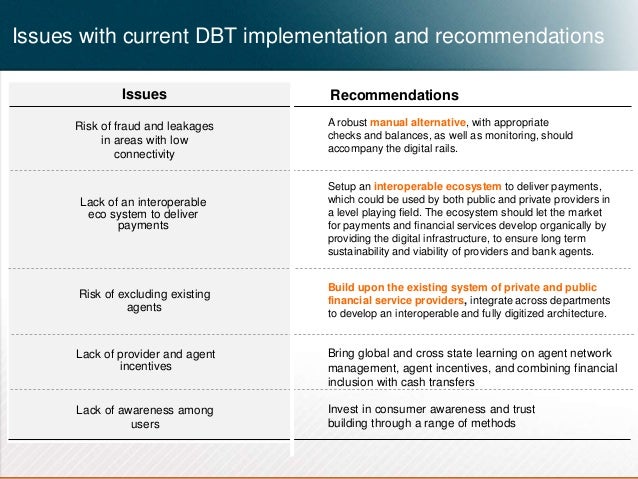
    • Pre requisite of successful DBT
    • Merits of DBT
    • Demerits of DBT
    • DBT in fertilizers
    • Is India ready to implement DBT in all programmes?
    • Suggestions for improvement
    • Conclusion

    DBT in India

    Direct Benefit Transfer is a mechanism to transfer the subsidy amount directly to the bank account of beneficiaries. Main agendas for DBT is to prevent and address following

    1. Leakages
    2. Delays
    3. Reducing structural expenses in distributing the subsidies in hand
    4. Encouraging everyone to have bank account and achieve financial inclusion.

    Right now it is applied to only 4 areas that too in selected districts:

    1. LPG subsidies
    2. Jnani Suraksha Yojana
    3. Old age pension
    4. Scholarships

    Pre requisite of successful DBT

    source

    Merits of DBT (Direct Benefit Transfer)

    • Leakage and delays are prevented.
    • Reduces Corruptions and black money issue.
    • Reduces economical inequalities in rural areas as everyone gets theire share rightfully.
    • Reducing the government expense on PDS, Cooperative society, bureaucracy to distribute scholarships etc.
    • Reduces time, energy and money of people to get their money/commodity.
    • Encourage free and fair market structure. Earlier subsidised grains entering market through backdoor used to distort the price in market.
    • More circulation of money in economy which will lead to at least 0.5% growth in GDP.
    • Government can better focus on other issues and not engaging in distribution.
    • Transportation charge for FCI and NABARD subsidies for warehouses will be reduced.
    • Slowly importance of MSP will reduce while price a farmer would fetch will increase which is win-win situation for farmers, also non-food crops will get importance which is issue right now in India.
    • Financial institutions will pay attention in rural area once people have cash in their hand.
    • Health facility will get better with private hospital giving facilities once people will have money to get treatment.

    Demerits of DBT

    • Money in the hand of poor may get spent in something other than what is needed, a scholarship needed to be spent in education only, but how government can ensure that, once she has sent it to account
    • Most accounts holder are males who have accessibility to banks, hence it will lead to usage by them only. Females may not get their share if they are the intended beneficiaries
    • With lesser banks in rural parts of India, it will be another overhead for people to get their withdrawal
    • Delay in transfer may create more turbulence as many will flock to banks to check on their balances

    DBT in fertilisers

    Government is embarked on rationalizing subsidies as has been seen in LPG subsidy which saved thousands of crores of government exchequer. Now it has proposed for rolling out DBT for fertilizers as has been mentioned in recent economic survey.

    Pros of DBT in fertilizer –

    • It would be beneficial for minimizing the use of fertilizer which would check degradation of soil nutrients and would prevent water contamination.
    • Farmers would be free from moneylender’s debt trap as now they would have secure money in their bank accounts. It would be helpful for inculcating saving habits also in farmers.
    • Released government control on the fertilization market would drive competition and would enhance productivity.
    • Enhanced financial inclusion and financial literacy will give boost to digital India and skill India.
    • No middlemen > no leakage > benefits to the needy > correct use of tax payer’s money (redistribution of wealth).
    • Less burden on government exchequer > fiscal consolidation target >money transferred in job creation and infrastructure development

    However there are some cons which need to be factored – 

    • More money in hand may lead to misuse like in drug, alcohol, unnecessary shopping or gambling etc.
    • May further widen the gap between big farmers and small farmers.
    • Bio-identification can be detrimental for the personal information of farmers if not properly handled.

    Operational challenges –

    • Management of data whether it may be of land, of status of farmer (landholder, tiller or tenant etc) or pertaining to agriculture practice is not up to the level in our country.
    • Though crores of accounts are opened but still there is a good number of people who are unbanked.
    • Some farmers have little knowledge about banking system so they can fall prey of undue interference.

    Is India ready to implement DBT across all programmes?

    The debate of implementing DBT in all subsidy programmes is discussed below. A proper implementation would helpful in following ways –

    • Filling leakages: DBT will help in reducing malpractices like leakages, ultimately giving the beneficiary what he is entitled. Example: LPG subsidy.
    • Increasing incomes: with large number of schemes which are implemented with an intention to increase incomes of the poor, but due to delay and other factors most of the time poor gets subsidy after a long time (like in wages of MNREGA). DBT can reduce these cases.
    • Financial inclusion: with the provision of DBT, poor will get themselves included in financial system of the country, which will help them to get other benefits and will boost their saving.

    Some of the downsides of the implementation – 

    • People may use money for other purposes rather than using it for what it is meant for like in case of PDS.
    • Due to lack of education and financial literacy, poor will keep themselves outside the purview of banks.
    • Inadequate development of the banking channel in rural areas is also a challenge.
    • Lack of adequate documents also leads to exclusion of many poor from banking sector.

    source

    Conclusion

    DBT revolutionized the banking sector by connecting low income segments of society with banks. There is no doubt that DBT has created a firm base for financial inclusion, which will include poor sections to the growth and development processes.

    National Payment Corporation of India (NPCI) has successfully opened 150 million DBT accounts with Adhaar numbers and around 125 million accounts under Jan Dhan Yojana.

    The government is fully relying on this scheme to plug leakages and save costs. It is estimated that over the time it could save up to 1.2% of GDP, which is currently lost in transit.


    References: