💥Join UPSC 2027,2028 Mentorship (July Batch) + XFactor Notes & Microthemes PDF

Archives: Stories

  • Bharat Emission Standards

    Bharat Emission Standards – Everything that you want to know


    Recently, govt. has decided to implement Bharat Standards VI norms on April 1, 2020. This comes in the wake of pressure from the Supreme Court to implement clean vehicular fuel norms soon amid concerns about rising air pollution, especially in Delhi.

    This policy is in line with our commitments at the Paris Climate Change Conference as well as public sentiments against rising air pollution in the cities, especially metros.

    These are norms instituted by the Govt of India to regulate the output of air pollutants from internal combustion engine equipment, including motor vehicles.

    • The standards and the timeline for implementation are set by the Central Pollution Control Board under the Ministry of Environment & Forests and Climate Change.
    • The standards are based on European regulations and were first introduced in 2000.

    What is the current status of emission norms?

    Currently, BS IV norms are applicable in 33 cities in which the required grade of fuel is available.

    In rest of India, we are still following BS III standards.


    Let’s see a little background of its implementation

    1991– India introduced the emission norms for the first time.

    1996– The norms saw some tightening as govt. asked most vehicle manufacturers to incorporate catalytic converters to cut exhaust emissions.
    Govt. also notified fuel specifications based on environmental considerations, which were to be implemented by 2000.

    2000– Govt. notified BS-I and BS-II standards, which were equivalent to Euro I and Euro II respectively. <BS-II was for the NCR and BS-I for the rest of India>

    2005BS-III and BS-II fuel quality norms came to be implemented. <BS-III for 13 major cities and BS-II for the rest of India>

    2010 BS-IV and BS-III fuel quality norms were introduced. <BS-IV for 13 major cities and BS-III for the rest of India>

    It works on a two-pronged strategy to control the air pollutant output.

    1. Reducing the Sulphur content in the fuel.
    2. At engine level, it augments some equipment which reduces emissions.

    What does Auto Fuel Policy have to say?

    Auto Fuel Policy 2003

    • It aims at addressing issues of vehicular emissions and vehicular technologies by applying fuel quality standards.
    • It encouraged the use of CNG/LPG fuel in cities affected by higher pollution levels.
    • It gives the timeline for adopting the Bharat Standards across the country:
      BS IV- 2017
      BS V- 2020
      BS VI- 2024

    Recently, govt had constituted an Expert Committee under the Chairmanship of Shri Soumitra Choudhuri, to draft Auto Fuel Vision and Policy 2025.

    Recommendations of Soumitra Choudhuri committee:

    It presents the road map for auto fuel quality till 2025 for the country,taking into account the achievement under the last Auto Fuel Policy, emission reduction of in use vehicles, growth of vehicles and the supply and availability of fuels.

    • It recommended nationwide fuel standards to be BS-IV. It has proposed to move to BS V from 2020 and BS VI from 2024.
    • To upgrade refineries to produce BS-V petrol and diesel will need Rs.80,000 crore.
    • It recommended Special Fuel Upgradation Cess of 75 paise/litre on fuel to meet the cost.

    Let’s analyse Bharat Standards vis-a-vis Euro Standards

    BS-VI is equivalent to Euro VI. However, many western countries have already graduated to Euro VI.

    But, India is following European emission norms with a time lag of  5 years.

    What are the challenges in implementing BS VI norms?

    Engine

    Engine development firms have cited a technological challenge in implementing the changes.

    They have cited that jumping directly to BS-VI norms would give them little time to design changes in their vehicles.

    Why is it challenging for auto firms to implement it?

    There are two critical components which needs a fitment in the engine. They would have to be adapted to India’s peculiar conditions, where running speeds are much lower than EU or US. Industry estimates of required investment to upgrade from BS-IV to BS-V are to the tune of Rs. 50000 crore.

    1. Diesel Particulate Filter– Its function is to remove particulate matter from diesel exhaust.
      ChallengeProblem is small cars with limited bonnet space would need major redesign to accommodate DPF. Temperature of 600 degrees Celsius is required to burn the soot in DPF, which is difficult to achieve in India due to low driving speeds.
    2. Selective Catalytic Reduction Module– It reduces oxides of Nitrogen.
      Challenge: It needs injection of Aqueous solution into the system, for which separate infrastructure is needed for countrywide supply.

    Fuel

    There are questions about the ability of the oil marketing companies to quickly upgrade fuel quality from BS-III and BS-IV standards to BS-VI.

    The objective of upgradation to higher emission norms is defeated, if the uniform fuel is not available across the country.<This has been seen in reduced efficacy of engines of BS-IV vehicles, while taking inter-state travel>


    Published with inputs from Pushpendra 
  • Foreign Policy Watch: India-Russia

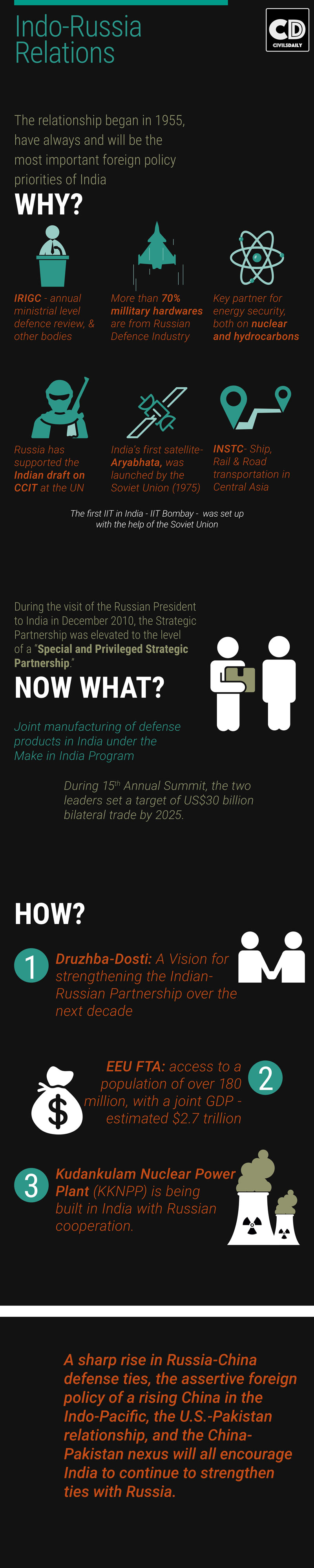
    India-Russia relations : Momentum in transforming Strategic Partnership


    In late December, Indian Prime Minister made his first state visit to Russia to take part in the 16th annual bilateral summit. PM Modi and Russian President Vladimir Putin used the summit to review bilateral ties across a number of areas. Let’s glance over revamped relations of India-Russia!


    Can we have some background of bonding legacy?

    • Relations with Russia are a key pillar of India’s foreign policy, and Russia has been a longstanding time-tested partner of India.
    • India & Russia signed “Declaration on the India-Russia Strategic Partnership” in October 2000.
    • Under the Strategic Partnership, several institutionalized dialogue mechanisms operate at both political and official levels to ensure regular interaction and follow up on cooperation activities.
    • During the visit of the Russian President to India in December 2010, the Strategic Partnership was elevated to the level of a “Special and Privileged Strategic Partnership.

    Let’s dive into the PM’s visit for bilateral summit in Russia?

    • With the signing of sixteen agreements, this is being seen as very significant in sustaining and expanding India-Russia ties.
    • One major step taken is a deepening of India’s defense partnership with Russia for Make in India.
    • On the eve of Modi’s visit to Russia, the Indian government announced the purchase of five S-400 supersonic air defense systems from Russia, costing around $6 billion.
    • For instance, the two sides agreed that the Kamov 226 helicopter would be manufactured in India.

    How will bilateral partnership boost Make in India programme?

    • India and Russia agreed to strengthen the defense partnership in line with the “Make in India” program. So while only the public sector has been involved in defense cooperation between the two countries to date.
    • The new initiatives will encourage joint manufacturing of defense products in India and motivate the private sector to play a role in developing a strong defense manufacturing base in India.
    • It should be emphasized that “Make in India” also aims at having India emerge as an essential player in the global defense market.
    • India is forecast to spend $250 billion over the next decade upgrading its military and Russia wants to seize the opportunity to become a major part of this mission, expressing its readiness to work jointly with India on defense manufacturing.

    So, How does economic and trade cooperation matters in economic growth?

    • Enhancing trade and economic cooperation between India and Russia is a key priority for the two governments.
    • On the economic front, India and Russia decided to institutionalize the CEO’s Forum, which will meet twice a year – once in India and the other in Russia.
    • During 15th Annual Summit, the two leaders set a target of US$30 billion bilateral trade by 2025.
    • Hydrocarbons is an active area for exploring cooperation between the two countries.
    • In May 2014, ONGC and Rosneft signed an MoU for bilateral cooperation in subsurface surveys, exploration, appraisal and hydrocarbons production in the offshore Arctic region of Russia.
    • In September 2015, OVL signed an agreement with Rosneft to acquire 15% stakes in Vankorneft project.


    Did you know about India-Eurasian Economic Union FTA?

    • Moscow is a gateway for India to Central Asia.
    • In this regard a significant move by PM Modi was the effort to move forward on the India-Eurasian Economic Union (EEU) Free Trade Agreement (FTA).
    • The EEU FTA will introduce the free movement of goods, capital, services and people-people contacts and provides for common transport, agriculture and energy policies, with provisions for a single currency and greater integration in the future.
    • The FTA between India and the EEU comprises of Russia, Belarus, Armenia, Kyrgyzstan, and Kazakhstan.
    • It offers India access to a huge market with a population of over 180 million, with a joint GDP of an estimated $2.7 trillion.
    • As Russia tries to re-calibrate its economic orientation towards the Asian region, India, as one of the fastest growing G20 economies can be a significant partner for Russia.

    Shall we move into Political Relations?

    • Annual Summit meeting is the highest institutionalized dialogue mechanism under the Strategic Partnership between India and the Russian Federation.
    • So far, 15 Annual Summit meetings have taken place alternatively in India and Russia with the 15th Annual Summit held in New Delhi during the visit of President Putin to India on 11 December 2014.
    • During the Summit, 20 documents were signed covering cooperation in nuclear energy, defence, hydrocarbons, science & technology, trade and investment etc.
    • Prime Minister Modi and President Putin also adopted a Joint Statement “Druzhba-Dosti: A Vision for strengthening the Indian-Russian Partnership over the next decade.”

    Let’s see our Defence Cooperation with Mighty Russia?

    • India-Russia military technical cooperation has evolved from a simple buyer – seller framework to one involving joint research, development and production of advanced defence technologies and systems.
    • BrahMos Missile System, Joint design and development of the Fifth Generation Fighter Aircraft, as well as the licensed production in India of SU-30 aircraft and T-90 tanks, are examples of such flagship cooperation.
    • An Indian contingent participated in the military parade in Moscow on 9 May 2015, during the 70th anniversary of the victory in the World War II.
    • The Inter Governmental Commission on Military Technical Cooperation (IRIGC-MTC) is in place to review defence cooperation between the two countries.

    Let’s know about importance of International North-South Trade Corridor (INSTC) ?

    • The INSTC was initiated by Russia, India and Iran in September 2000.
    • To establish transportation networks among the member states and to enhance connectivity with the land locked region of Central Asia.
    • The North-South Transport Corridor is an ancient route that connected South Asia with North Europe for centuries.
    • This route was used by the European, Indian, Russian and many other foreign traders.
    • During the late 17th and early 19th centuries, Indian traders used this route to reach out to the Central Asian markets.
    • The modern day INSTC is a multi-modal transportation route linking Indian Ocean and Persian Gulf to the Caspian Sea via Iran, and onward to northern Europe via St. Petersburg in Russia.

    How is it important to India to protect its strategic and economic interest?

    • The INSTC envisages movement of goods from Mumbai (India) to Bandar Abbas (Iran) by sea, from Bandar Abbas to Bandar-e-Anzali (an Iranian port on the Caspian Sea) by road.
    • Then from Bandar-e-Anzali to Astrakhan (a Caspian port in the Russian Federation) by ship across the Caspian Sea, and thereafter from Astrakhan to other regions of the Russian Federation and further into Europe by Russian railways.
    • Given India’s strategic interests in the West and the Central Asian region, and need for greater economic and energy cooperation between South, Central and the West Asian region.
    • New Delhi has stepped up its engagement to reconnect with its extended neighbourhood.

    Was there any momentum on Nuclear power deal?

    • Russia is an important partner in peaceful uses of nuclear energy and it recognizes India as a country with advanced nuclear technology with an impeccable nonproliferation record.
    • In December 2014, Department of Atomic Energy (DAE) and Russia’s Rosatom signed the Strategic Vision for strengthening cooperation in peaceful uses of atomic energy between India and Russia.
    • Kudankulam Nuclear Power Plant (KKNPP) is being built in India with Russian cooperation.
    • KKNPP Unit 1 became operational in July 2013, and attained full generation capacity on 7 June 2014.
    • While its Unit 2 is in the process of commissioning in the later part of 2015.
    • India and Russia have signed a General Framework Agreement on KKNPP Units 3 & 4 and subsequent contracts are under preparation.

    What’s Next to the geopolitical space?

    • Needless to say, defence remains at the centre-stage of the bilateral relationship, although with a diversified supplier base India is at a better position today to negotiate deals with Russia especially concerning technology transfer and co-production.
    • A sharp rise in Russia-China defense ties, the assertive foreign policy of a rising China in the Indo-Pacific, the U.S.-Pakistan relationship, and the China-Pakistan nexus will all encourage India to continue to strengthen ties with Russia.
    • It is clear that India-Russia relations remain vital for both countries amid a changing regional and global security environment.

    Published with inputs from Arun
  • Tourism Sector

    It’s no secret that our Tourism Industry remains heavily underemployed, highly unregulated and its true potential to both Economy and workforce is still unharnessed. 

    With 32 UNESCO recognized natural and cultural heritage sites, India ranks second in Asia and fifth in the world. Still, India’s share in ITAs (International tourist arrivals) is a paltry 0.6%. 

    source

    Why are International / Foreign Tourists important?

    • For one, they bring in much valued Foreign Currency which contributes to our Foreign Exchange Reserves and keeps our Balance of Payment robust. <Note that Tourist expenditure in India counts as “Exports” under BoP accounting>
    • India’s receipts from tourism during 2012 ranked 16th in the world, and 7th among Asian and Pacific countries (World Tourism Organization Report)
    • It helps stabilize our currency in International Market
    • Builds Brand India (Incredible !ndia campaign has proven to boost foreign tourism more than domestic tourism)
    • Although it is notable that domestic tourists contribute to more than 75% of the revenue from Tourism Sector, but its denominated in INR
      • Note:  Under 7th Schedule division of Powers, Pilgrimages outside India comes under Union’s List while those Inside India is covered by State List.

    India’s Comparative performance in International tourist arrivals (ITAs)

    • ITA simply means the percentage of outbound tourists travelling to another country in proportion to all outbound tourists of the world combined.
    • France has the highest share of ITAs, despite being much smaller than a continent size country like India. (India’s share in ITA is 0.6% compared to 7.8 per cent in France)
      • Foreign tourist arrivals by source country: Largest foreign tourists are from USA, 2nd largest from Bangladesh and third largest from UK.
      • Tamil Nadu witnesses most foreign tourist visits.
    •  Although ITAs in India registered a growth of 10.6%, countries like Vietnam and Indonesia continue to have higher shares of FTAs than India
      • Internationally ranking pitiably 41st in terms of Foreign Footfalls- India gets only 77 lakh foreign tourists every year.
      • Travel & Tourism Competitiveness Report 2015 (World Economic Forum) ranks India 52nd out of 141 countries overall in areas other than Foreign Footfall.
        • India has quite good air transport (ranked 35th)
        • Reasonable ground transport infrastructure (ranked 50th).
    • Target: In next 3-5 years, we want to receive >1 crore tourists (and 1% of the ITAs should be in India)

    Who qualifies as a foreign tourist?

    • Staying at least twenty four hours in the country
    • Purpose of whose journey can be classified as either
      • Leisure (recreation, holiday, health, study, religion and sport)
      • Business, family, mission, meeting
    • Following are excluded from category of Foreign Tourists:
      • Persons arriving to take up an occupation or engage in activities remunerated from within the country are not treated as foreign tourists
      • Nationals of Nepal and Bhutan entering India through land routes, are also not included in the data series on foreign tourism

    Burning issue of Foreign Tourists and Sexual Assaults

    • Its noteworthy that 40% of the foreign tourists who came to India in 2013 were women
    • Delhi has repeatedly topped the survey for being the most unsafe and hostile city for Foreign Tourists.
    • How can this be prevented?
      • Foreign tourists in India are advised to take the same precautions like domestic tourists take
      • Code of conduct for tourist destinations and the stake holders there has also been fixed.
      • Accused should be apprehended by the police authorities within a few days and action be initiated to bring the culprits to justice
      • E.g. In the Madhya Pradesh incident in March, 2013, the accused were tried in a Fast Track Court and sentenced to life imprisonment within four months.

    What are other benefits of Tourism Sector to India?

    Economy: 

    • Contributes to 9% of global GDP, In India’s case it contributed 6.8% of the GDP

    Employment and demographics:

    • It is a labour intensive industry (Employs 8.7% of India’s workforce) and provides livelihood to non-farm sector
    • Although Tourism in India being largely an unorganized sector activity, potential for employment is still untapped
    • Women comprise 70% of the workforce and 50% of the workforce is below 25 years

    Other benefits apart from Employment:

    • Helps preserve heritage and culture (Fundamental Duty and DPSP)
    • Niches such as Rural tourism, and Ecotourism can help reverse migration to urban areas
    • Tourism sector can be a powerful antidote to poverty, it eliminates the disadvantage of market inacessibility suffered by poor in respect of their goods and services by bringing consumers to their doorstep

    Tourism reforms by integration with ongoing schemes

    It is said that Tourism as a sector doesn’t need huge budgetary expenditure for its rise as a “sunrise industry”. Here, we look at some of the ways we can make it so by integrating with ongoing schemes of Government of India.

    1. Infrastructure Reforms and Tourism

    • Sagarmala project beginning with Char Dham Yatra linking Puri Jagannatha Temple to Dwaraka by sea via various places off religious interest enroute
    • MNREGA labour for creating permanent assets like tourism infrastructure and facilities


    2. Taxation Reforms, Startup India and Tourism

    • Solve the Multiple Taxation Issues (give tax concessions to Tourism Sector)
    • Tour Operators don’t need to pay service tax, if serving foreign tourist for foreign trips. (e.g. Yatra.com etc)
    • Special Tourism Zones shall be notified and developed to encourage investment in identified areas along with PPP
    • Incentivize Startups which promote Tourism in Niche areas such as Adventure Tourism, Ecotourism, Rural Tourism
    • Devise a National Tourist Maps promoting Unique / Mystery Spots, and Less Known Destinations


    3. Tourist Training Schools, Skill India and Tourism

    • Skill and Etiquettes training to tour operators
    • Certification programmes like Hunar se Rozgar tak (HSRT) and earn while you learn programs
      • Vocational training for tourist guides hospitality business
      • Aims to train 8th class passouts (upto age of 28 years) in Food Production and Beverages services
      • Conducted through Institute of Hotel Management and Food Craft Institutes
      • Diploma in Tourism Management through ITIs


    4. Swachh Bharat and Tourism:

    • Litter/Recycling Bins at accessible places
    • Special focus on cleanliness and women safety of tourist sites
    • Partnering with Shulabh International (NGO) for scaling up pay-and-use toilets rather than depending on free public utilities (as it has been observed that former type remain more user friendly due to regular maintenance than government ones)


    5. Green Urban Policies and Tourism

    • Attempts should be made to design climatically responsive and location sensitive tourism architecture
    • Use energy efficient materials for pavements leading to a tourist landmark (minimal use of hardscape materials)
    • Solar lighting and use of renewable energy must be encouraged


    6. Conservation and Tourism

    • Adopt the principle of “First Conservation Later Tourism” for Cultural Heritage
    • Discourage fountains and water based elements in areas facing water paucity
    • Discourage large scale illumination in areas with electricity shortage (Without compromising on security, of course)


    7. Sugamya Bharat (Accessible India) and Tourism

    • Promote Universally accessible infrastructure for ease of access by differently abled and elderly
    • Use signages that conform to World Tourism Organization, and UNESCO charters for World Heritage Sites

    Annex: Eased norms for Tourit Visa

    • E-visa
      • Will increase foreign tourists by 25%.
      • Foreigner applies online (as opposed to Consulate/Embassy) he’ll get Visa in five days
    • Visa on arrival
      • Foreigner applies online three days before his arrival in India
      • Gets visa on airport, 30 days validity
      • As of 2015, this facility has been enlarged to cover 180 countries
  • e-Commerce: The New Boom

    The recent changes in e-commerce sector


    DIPP recently notified a new FDI policy for e-commerce and certain other rules <What exactly e-commerce is? Answer in comments>

    What are the rules?

    1. 100% foreign direct investment is permitted in the marketplace model of e-commerce
    2. FDI is not permitted in inventory based model of e-commerce

    Additional to these rules for FDI, the other rules are:

    1. An e-commerce entity may provide logistic, warehousing , order fulfilment, call centre, payment collection and other services
    2. An e-commerce entity will not permit more than 25% of the total sales should not be done by one vendor or its group companies
    3. The seller shall be responsible for post sales, warranty and guarantee of goods sold by it
    4. The e-commerce entity will not directly or indirectly affect the sale price of goods or services while maintaining a level playing field

    What does it mean?

    Now let’s analyse its impacts on various stakeholders, one-by-one

    #1. E-Commerce Players


    • Price determination- This is a grey area with unclear rules. One interpretation could be that Govt will determine the price and not the market. This could upset the markets
    • Clearly defining the models- This is a positive development. The marketplace and inventory based models are now concretely and clearly defined by law
    • Group companies- Group companies (Flipkart- WS Retail, Amazon- Cloudtail) are created to work around the e-retail rule which doesn’t allow FDI in B2C multi-brand retail

    The companies will now have to figure out a new way to scale down sales through their group companies

    • Discounts- The rule in itself is notvery clear as it doesn’t explictly spell out the terms ‘deep discounting’ or ‘discount’

    Example- Amazon uses the term ‘promotional funding’ to describe its discounting model, and as is clear, technically doesn’t affect the actual price of the product

    Even though the note says the rules are effective immediately, discounting has continued as is. It shows that that this is still a grey area

    • Inventory based models- This model, which is effectively under multi brand retail, remains out of the FDI route

    #2. The Consumer

    • E-commerce companies have brought in deep competition in the retail sector by way of offering discounts
    • How are the discounts funded? Part of this is funded through a cash burn, and part through operating efficiencies over the brick and mortar setup <What is cash burn? Answer in comments>
    • Restraints on discounts, if workout in real, consumers will lose a lot of power in terms of price and choice

    #3. Brick and Mortar Players


    • Effects on brick and mortar retailers will depend on how the restraints on discount work out
    • Footfalls in Brick & Mortar retail had dropped dramatically, and the pricing change may now draw consumers back
    • However, e-commerce companies and strong retailer lobbies will obviously work to keep their dominance


    Conclusion:

    • Overall, the move is in the right direction, but it lacks strength and complete clarity on various issues (such as pricing, discounting)
    • The grey area in pricing is very open to interpretation, especially on the point of determining the right price, and could be an anti-market move
    • Retail sectr still remains affected by a lot of interest groups and a solid policy change to actually reform retail remains

    After this, you can read this story for more insights- Disrupting the disruptors (The Hindu)