đŸ’„Join UPSC 2027,2028 Mentorship (July Batch) + XFactor Notes & Microthemes PDF

Subject: Conservation & Mitigation

1. Conservation Progs.
2. Worldwide initiatives
3. Mitigation Strategies
4. Conventions and Protocols

  • Species in news: Lion-tailed Macaque

    The Union government allowed a geotechnical investigation that involved drilling of 12 boreholes inside Sharavathi Valley Lion-tailed Macaque Sanctuary in the Western Ghats in Karnataka.

    Try this PYQ:

    Which one of the following groups of animals belongs to the category of endangered species?

    (a) Great Indian Bustard, Musk Deer, Red Panda, Asiatic Wild Ass

    (b) Kashmir Stag, Cheetah, Blue Bull, Great Indian Bustard.

    (c) Snow Leopard, Swamp Deer, Rhesus Monkey, Saras (Crane)

    (d) Lion Tailed Macaque, Blue Bull, Hanuman Langur, Cheetah

    About Lion-tailed Macaque

    • Endemic to rainforests of the Western Ghats, the Lion-tailed Macaque (Macaca Silenus) is an Endangered species, according to IUCN assessment.
    • It is listed in Appendix 1 of the Convention on International Trade in Endangered Species.
    • It is a Schedule 1 species under WPA, 1972 and thereby, accorded the highest protection under the Indian law.
    • Their total (global) population is 2,500 mature individuals.

    Why in news?

    • Sharavathi is likely one of the most exploited rivers.
    • It flows for mere 132 km, but four major power projects on it produce 40 per cent of all hydroelectric power in Karnataka.
    • Yet, in an attempt to squeeze more power from the river flowing through the Western Ghats, a new pumped hydro-storage project has been proposed.
    • This will only intensify the cumulative adverse impact of previous projects on the biodiversity of the Sharavathi valley.
    • In particular, the impacts on the iconic Lion-tailed Macaque are likely to be huge.
  • [pib] Buldhana Pattern of water conservation

    Maharashtra’s ‘Buldana Pattern’ of water conservation’ has won national recognition and the NITI Aayog is in the process of formulating National Policy on water conversation based on it.

    Refer this link to read more about traditional water conservations systems in India:

    https://geographyandyou.com/ten-traditional-water-conservation-methods/

    What is ‘Buldhana Pattern’?

    • It is based on the synchronization of national highway construction and water conservation.
    • It was achieved for the first time in Buldana district of drought-prone Vidarbha region, by using soil from the water bodies, nallas and rivers.
    • This consequently leads to the increase in capacity of water storage across the water-bodies in Buldana district and it came to be known as ‘Buldana Pattern’.
    • Creation of State Water Grid and adopting water Conservations works under this pattern will increase the agriculture production and bring prosperity in farmer’s economic life in Vidarbha.
  • ZSI lists Skinks of India

    Celebrating skinks, Zoological Survey of India has listed 62 species.

    Try this PYQ:

    Q.With reference to India’s Biodiversity, Ceylon frogmouth, Coppersmith barbet, Gray-chinned minivet and White-throated redstart are-

    (a) Birds

    (b) Primates

    (c) Reptiles

    (d) Amphibians

    What are Skinks?

    • Skinks are lizards belonging to the family Scincidae, a family in the infraorder Scincomorpha.
    • With long bodies, relatively small or no legs, no pronounced neck and glossy scales, skinks are common reptiles around homes.
    • Although they are common reptiles and have a prominent role in maintaining ecosystems, not much is known about their breeding habits, and ecology because identification of the species can be confusing.

    Certain notions about them

    • Skinks are highly alert, agile and fast-moving and actively forage for a variety of insects and small invertebrates.
    • The reduced limbs of certain skink species or the complete lack of them make their slithering movements resemble those of snakes, leading people to have the incorrect notion that they are venomous.
    • This results in several of these harmless creatures being killed.

    ZSI study on Skinks

    • A recent publication by the Zoological Survey of India (ZSI) reveals that India is home to 62 species of skinks and says about 57% of all the skinks found in India (33 species) are endemic.
    • Sepsophis (with one species)and Barkudia (with two species) are limbless skinks found in the hills and coastal plains of the eastern coast.
    • Barkudia insularisis believed to be found only in the Barkud Island in Chilka lake in Odisha. Barkudia melanosticta is endemic to Visakhapatnam.
    • Sepsophis punctatus is endemic to the northern part of Eastern Ghats.
    • Five species of Kaestlea (blue-tailed ground skinks) are endemic to the Western Ghats and four species of Ristella (Cat skinks) also endemic to the southern part of Western Ghats.
  • 8 Indian beaches accorded ‘Blue Flag’ tag

    Eight Indian beaches have got an International Blue Flag Certification, said Union Minister of Environment, Forest and Climate Change.

    Note the beaches and their respective states. They can be asked in the ”match the pairs” type questions.

    Citation needed: *As of now, there are 13 Blue flag awarded beaches in India a/c to wikipedia. But Blue Flag website would provide exact figures (which yet to update the official numbers).

    Which are these beaches?

    1. Shivrajpur (Dwarka-Gujarat)
    2. Ghoghla (Diu)
    3. Kasarkod [NOT Kasargod which is in Kerala] and Padubidri (Karnataka)
    4. Kappad (Kerala)
    5. Rushikonda (AP)
    6. Golden Beach (Odisha) and
    7. Radhanagar (A&N Islands)

    Blue Flag Beaches

    • The ‘Blue Flag’ beach is an ‘eco-tourism model’ and marks out beaches as providing tourists and beachgoers clean and hygienic bathing water, facilities/amenities, a safe and healthy environment, and sustainable development of the area.
    • The certification is accorded by the Denmark-based Foundation for Environment Education.
    • It started in France in 1985 and has been implemented in Europe since 1987, and in areas outside Europe since 2001 when South Africa joined.
    • It has 33 stringent criteria under four major heads for the beaches, that is, (i) Environmental Education and Information (ii) Bathing Water Quality (iii) Environment Management and Conservation and (iv) Safety and Services.
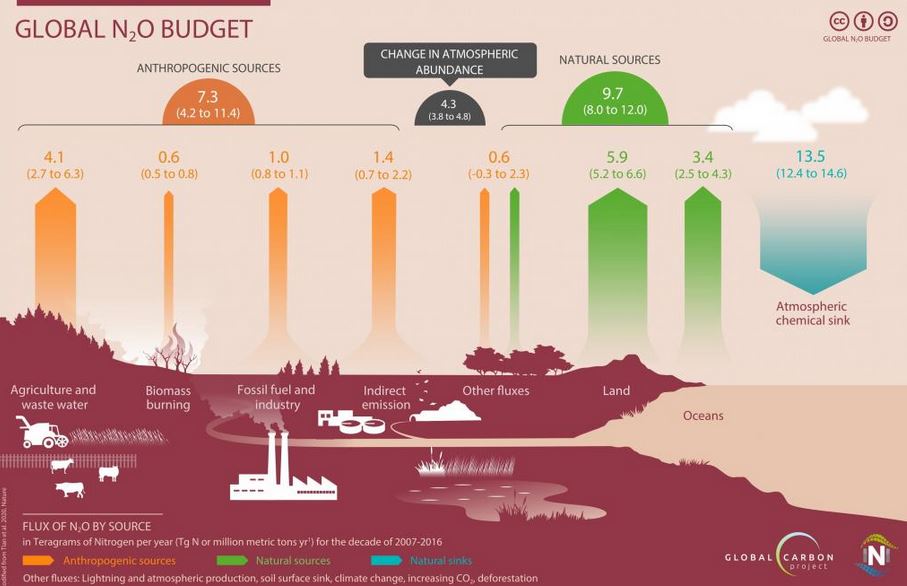
  • Global Nitrous Oxide Pollution

    Human emissions of nitrous oxide (N2O) — a greenhouse gas 300 times more potent than carbon dioxide (CO2) — increased by 30 per cent between 1980 and 2016.

    Observe the above image carefully and try to find out the major contributor of nitrous oxide emission in the Global N2O Budget.

    What is Nitrous oxide?

    • Nitrous oxide is a dangerous gas for the sustainable existence of humans on Earth.
    • It has the third-highest concentration — after CO2 and methane — in our atmosphere among greenhouse gases responsible for global warming.
    • N2O can live in the atmosphere for up to 125 years.
    • Most N2O emissions have come from emerging countries like India, China and Brazil.

    About the research

    • Nitrous oxide global concentration levels have increased from 270 parts per billion (ppb) in 1750 to 331 ppb in 2018 — a jump of 20 per cent.
    • The growth has been the quickest in the past five decades because of human emissions.
    • The research was conducted through an international collaboration between the International Nitrogen Initiative (INI) and the Global Carbon Project of Future Earth, a partner of the World Climate Research Programme.

    Why N2O matters?

    • N2O is also the only remaining threat to the ozone layer, for it accumulates in the atmosphere over a long period of time, just like CO2.
    • The increase in its emissions means that the climatic burden on the atmosphere is increasing from non-carbon sources as well, while the major focus of global climate change negotiations is currently centred on carbon.
    • A major proportion of the N2O emissions in the last four decades came from the agricultural sector, mainly because of the use of nitrogen-based fertilizers.
    • The growing demand for food and feed for animals will further increase global nitrous oxide emissions.
  • [pib] Bio-Pesticide Formulation using Verticillium Lecanii

    Indian researchers have successfully developed new Aqueous Suspension formulation technology of bio-pesticide based on entomopathogenic fungus Verticillium lecanii.

    Try this PYQ:

    Q.Recently, there was a growing awareness in our country about the importance of Himalayan nettle (Girardinia diversifolia) because it is found to be a sustainable source of

    (a) anti-malarial drug

    (b) biodiesel

    (c) pulp for paper industry

    (d) textile fibre

    Verticillium lecanii

    • This bio-pesticide formulation has been found very effective in controlling various insects in seed spice crops (fenugreek, cumin, and coriander).
    • It has a good shelf life, safe to user & environment and it may be effectively used for controlling different agricultural insects especially in seed spice crops.
    • This bio-pesticide may be used as a safer alternative to chemical pesticides to minimize pesticide residue problem.
    • Besides, it may be used as a key input for crop protection from insects pest in organic agriculture and Integrated Pest Management.
  • What is Graded Response Action Plan (GRAP)?

    The Supreme Court has directed Delhi and neighbouring States to implement air pollution control measures under “very poor” and “severe” category air quality of the Graded Response Action Plan (GRAP).

    Note the various measures under the GRAP under various grades of Air Quality.

    Graded Response Action Plan (GRAP)

    • In 2014, when a study by the WHO found that Delhi was the most polluted city in the world, panic spread in the Centre and the state government.
    • Approved by the Supreme Court in 2016, the plan was formulated after several meetings that the Environment Pollution (Prevention and Control) Authority (EPCA) held with state government and experts.
    • The result was a plan that institutionalized measures to be taken when air quality deteriorates.
    • GRAP works only as an emergency measure.

    How does it work?

    • As such, the plan does not include action by various state governments to be taken throughout the year to tackle industrial, vehicular and combustion emissions.
    • When the air quality shifts from poor to very poor, the measures listed under both sections have to be followed since the plan is incremental in nature.
    • If air quality reaches the severe+ stage, GRAP talks about shutting down schools and implementing the odd-even road-space rationing scheme.

    Measures taken under GRAP

    1)Severe+ or Emergency

    (PM 2.5 over 300 ”g/cubic metre or PM10 over 500 ”g/cu. m. for 48+ hours)

    • Stop entry of trucks into Delhi (except essential commodities)
    • Stop construction work
    • Introduce odd/even scheme for private vehicles and minimise exemptions
    • Task Force to decide any additional steps including shutting of schools

    2) Severe

    (PM 2.5 over 250 ”g/cu. m. or PM10 over 430 ”g/cu. m.)

    • Close brick kilns, hot mix plants, stone crushers
    • Maximise power generation from natural gas to reduce generation from coal
    • Encourage public transport, with differential rates
    • More frequent mechanized cleaning of road and sprinkling of water

    3) Very Poor

    (PM2.5 121-250 ”g/cu. m. or PM10 351-430 ”g/cu. m.)

    • Stop use of diesel generator sets
    • Enhance parking fee by 3-4 times
    • Increase bus and Metro services
    • Apartment owners to discourage burning fires in winter by providing electric heaters during winter
    • Advisories to people with respiratory and cardiac conditions to restrict outdoor movement

    4) Moderate to poor

    (PM2.5 61-120 ”g/cu. m. or PM10 101-350 ”g/cu. m.)

    • Heavy fines for garbage burning
    • Close/enforce pollution control regulations in brick kilns and industries
    • Mechanized sweeping on roads with heavy traffic and water sprinkling
    • Strictly enforce a ban on firecrackers

    Has GRAP helped?

    • The biggest success of GRAP has been in fixing accountability and deadlines.
    • For each action to be taken under a particular air quality category, executing agencies are clearly marked.
    • In a territory like Delhi, where a multiplicity of authorities has been a long-standing impediment to effective governance, this step made a crucial difference.
  • [pib] Stockholm Convention on Persistent Organic Pollutants (POPs)

    The Union Cabinet has approved the Ratification of seven chemicals listed under the Stockholm Convention on Persistent Organic Pollutants (POPs).

    Stockholm Convention

    • It is a global treaty to protect human health and environment from POPs, which are identified chemical substances that persist in the environment, bio-accumulate in living organisms, adversely affect human health/ environment and have the property of long-range environmental transport (LRET).

    Key Provisions:  The provisions of the Convention require each party to:

    • Prohibit and/or eliminate the production and use, as well as the import and export, of the intentionally, produced POPs that are listed in Annex A to the Convention
    • Restrict the production and use, as well as the import and export, of the intentionally, produced POPs that are listed in Annex B to the Convention
    • Reduce or eliminate releases from unintentionally produced POPs that are listed in Annex C to the Convention
    • Ensure that stockpiles and wastes consisting of, containing or contaminated with POPs are managed safely and in an environmentally sound manner

    Do you know?

    The Global Environment Facility (GEF) serves as a financial mechanism for the following conventions:

    1. Convention on Biological Diversity (CBD)
    2. United Nations Framework Convention on Climate Change (UNFCCC)
    3. UN Convention to Combat Desertification (UNCCD)
    4. Stockholm Convention on Persistent Organic Pollutants (POPs)
    5. Minamata Convention on Mercury

    What are POPs?

    • Persistent organic pollutants (POPs), sometimes known as “forever chemicals” are organic compounds that are resistant to environmental degradation through chemical, biological, and photolytic processes.
    • Because of their persistence, POPs bioaccumulate with potential adverse impacts on human health and the environment.
    • Many POPs are currently or were in the past used as pesticides, solvents, pharmaceuticals, and industrial chemicals.
    • Although some POPs arise naturally (e.g from volcanoes), most are man-made via total synthesis.

    Threats of POPs

    • Exposure to POPs can lead to cancer, damage to central & peripheral nervous systems, diseases of the immune system, reproductive disorders and interference with normal infant and child development.

    India’s actions on POPs till now

    • The MoEFCC had notified the ‘Regulation of Persistent Organic Pollutants Rules, on March 5, 2018, under the provisions of Environment (Protection) Act, 1986.
    • The regulation prohibited the manufacture, trade, use, import and export seven chemicals which were already listed as POPs under Stockholm Convention-
    1. Chlordecone
    2. Hexabromobiphenyl
    3. Hexabromodiphenyl ether and Heptabromodiphenylether (Commercial octa-BDE)
    4. Tetrabromodiphenyl ether and Pentabromodiphenyl ether (Commercial Penta-BDE)
    5. Pentachlorobenzene
    6. Hexabromocyclododecane and
    7. Hexachlorobutadiene
  • JAL JEEVAN MISSION (PIB)

    What is Jal Jeevan Mission ?

    The Union Minister of Jal Shakti launched a special mission mode campaign to provide potable piped water supply in all schools and anganwadi centres across the nation within 100 days.

    About Jal Jeevan Mission

    • This mission was envisaged by the Prime Minister on 29th September, 2020 while releasing the ‘Margdarshika’ for Gram Panchayats and Paani Samitis for implementation of Jal Jeevan Mission (JJM).
    • Provisions have been made under Jal Jeevan Mission for ensuring safe water through tap water connection in schools, anganwadi centres, health care centres, etc.
    • National Jal Jeevan Mission has reached out to States/ UTs to ensure that during this campaign, Gram Sabhas are convened at the earliest to pass a resolution for providing safe water in all schools, anganwadi centres and other public institutions in the village in the next 100 days.
    • These facilities will be operated and maintained by the Gram Panchayat and/ or its sub-committee i.e. Village Water & Sanitation Committee or Paani Samiti.
    • Jal Jeevan Mission (JJM) aims at the universal coverage of provision of tap water connection to every rural home by 2024. Under the mission, special focus is on women and children.


  • Wildlife Week

    Celebrating Wildlife Week

    • Wildlife Week is celebrated every year in India between October 1 and 8.
    • The annual theme of the campaign is to promote the preservation of fauna – i.e. animal life.
    • Wildlife Week was conceptualized in 1952 with the overall goal of raising awareness to serve the long-term goal of safeguarding the lives of wildlife through critical action.
    • In addition, the Indian Government established an Indian Board of Wild Life which works to improve awareness towards the preservation of wildlife.