The construction of wildlife passages and artificial canopy bridges along the India-Bhutan border has been prompted by increased deaths of the endangered golden langur due to road accidents.
About Golden Langur
Details
Identification
Recognizable by the color of their fur, which gives them their name.
Fur color changes with the seasons.
Young langurs are almost pure white.
Geographic Range
Found in Assam, India, and neighboring Bhutan year-round.
Inhabits an area bordered by the foothills of Bhutan (north), Manas river (east), Sankosh river (west), and Brahmaputra river (south).
Habitat
Occupies moist evergreen and tropical deciduous forests, along with some riverine areas and savannahs in Assam and Bhutan.
Prefers living in the upper canopy of sub-tropical forests in the south and temperate forests in the north.
Conservation Status
IUCN: Endangered
CITES: Appendix I
Wildlife Protection Act, 1972: Schedule I
Habitat
Ripu Reserve Forest and Chakrashila WLS serve as vital habitats.
Fragmented habitats face instability and threats.
PYQ:
[2012] Which one of the following groups of animals belongs to the category of endangered species?
(a) Great Indian Bustard, Musk Deer, Red Panda and Asiatic Wild Ass
(b) Kashmir Stag, Cheetal, Blue Bull and Great Indian Bustard
(c) Snow Leopard, Swamp Deer, Rhesus Monkey and Saras (Crane)
(d) Lion-tailed Macaque, Blue Bull, Hanuman Langur and Cheetal
The Arun River, which flows across Nepal and Tibet, is eroding rock and soil in its basin, leading to the rise of Mount Everest by up to 2 mm a year.
How is Arun River making the Everest taller?
The Arun River is contributing to the rise of Mount Everest through a process called isostatic rebound. Here’s how it works:
1. River Incision:
The Arun River, which flows about 75 km from Mount Everest, is eroding large amounts of rock and soil from the surrounding landscape.
This process of erosion reduces the weight on the Earth’s crust in the Arun River basin.
A study by UCL suggests that the Arun River’s ability to carve out large amounts of rock and other materials may be due to it capturing another river or water system in Tibet.
This process is known as River Incision, where the river cuts downward into its bed, deepening its channel.
The erosion began to accelerate around 89,000 years ago when the Arun River merged with the Kosi River, removing large amounts of landmass and further reducing the weight on the region’s crust.
2. Isostatic Rebound:
When the weight of the land (due to rocks, soil, or even ice) decreases, the Earth’s crust rises to balance the change.
This is similar to how a boat rises in water when heavy cargo is removed.
The removal of landmass in the Arun River basin allows the crust underneath Mount Everest to rise.
AboutArun River
The Arun River originates in the Tibet Autonomous Region of China, where it is known as Phung Chu or Bum-chu in Tibetan.
It flows into Nepal and confluences with the Sun Koshi and Tamur River at Tribenighat, forming the Sapta Koshi River.
Tributaries:
Left tributaries: Yeru Tsanpo, Trakar-chu.
Right tributary: Barun River.
At the Nepal border, the Arun River is approximately 3,500 meters (11,500 ft) above sea level.
The river drains into the Koshi River, significantly contributing to the Sapta Koshi River system in Nepal.
It is the largest trans-Himalayan river in Nepal, playing a crucial role in supporting the region’s hydrology and ecosystems.
It provides around 37% of the total water in the Sapta Koshi system, following the Sun Koshi which contributes 44%.
Recently, the Arun-III Hydro Power Project (900 MW), which constructed with $6.95b Indian assistance, achieved a milestone with a tunnel breakthrough.
PYQ:
[2017] With reference to river Teesta, consider the following statements:
1. The source of river Teesta is the same as that of Brahmaputra but it flows through Sikkim.
2. River Rangeet originates in Sikkim and it is a tributary of river Teesta.
3. River Teesta falls into Bay of Bengal at the border of India and Bangladesh.
Which of the statements given above is/are correct?
Q). Should the pursuit of carbon credits and clean development mechanisms set up under UNFCCC be maintained even though there has been a massive slide in the value of a carbon credit? Discuss with respect to India’s energy needs for economic growth. (UPSC CSE 2014) Q). In the view of the declining average size of land holdings in India which has made agriculture non – viable for a majority of farmers should contract farming and land leasing be promoted in agriculture? critically evaluate the pros and cons. (UPSC CSE 2015) Q). Sikkim is the first ‘Organic State’ in India. What are the ecological and economical benefits of Organic State? (UPSC CSE 2018)
Prelims:
In the context of India, which of the following is/are considered to be practice(s) of eco-friendly agriculture? (UPSC CSE 2020) 1. Crop diversification 2. Legume intensification 3. Tensiometer use 4. Vertical farmingSelect the correct answer using the code given below: (a) 1, 2 and 3 only (b) 3 only (c) 4 only (d) 1, 2, 3, and 4
Mentor’s Comment: Agroforestry plays a crucial role in enhancing the resilience of Indian agriculture through various mechanisms. By integrating trees with crops and livestock, agroforestry provides farmers with multiple income streams, reducing dependence on single crops and mitigating the impact of market fluctuations. The integration of trees provides shade and wind protection, making agricultural systems more resilient to extreme weather events such as droughts and floods. This adaptability is vital for farmers facing unpredictable climate patterns. In today’s editorial, we will focus on Indian-centric issues.
_
Let’s learn!
Why in the News?
Recent studies indicate that with the right policies and financial support, India could sequester an additional 2.5 billion tons of CO2 equivalent by 2030 in the agroforestry sector.
Currently, agro-forestry represents 8.65% of India’s land and contributes 19.3% of its carbon stocks, playing a vital role in both environmental sustainability and economic growth.
India is poised to increase agroforestry area from 28.4 million hectares to 53 million hectares by 2050.
CASE STUDY of UP:
• In Uttar Pradesh, a new agroforestry project aims to connect local farming with the global carbon credit market, potentially generating 4.5 million carbon credits valued at around Rs 230 crore. • This initiative is part of a broader strategy to enhance rural incomes while increasing the state’s green cover from 9.23% to 15% by 2027. • The success of these projects hinges on adapting carbon finance standards to better suit India’s unique agricultural landscape, which could unlock further opportunities for smallholder farmers.
How does the ‘Polluter Pays Principle’apply to carbon credits in agro-forestry?
The Polluter Pays Principle (PPP) is a fundamental concept in environmental economics that holds polluters responsible for the costs associated with their environmental impact.
Responsibility for Emissions: Industries that emit greenhouse gases are required to compensate for their emissions by purchasing carbon credits.
Each credit represents one ton of CO2 or its equivalent that has been sequestered or reduced, which creates a financial incentive for these industries to invest in carbon offset projects like agroforestry.
Market Dynamics: The carbon credit market operates on the principle that companies must buy credits to offset their emissions, thus internalizing the external costs of pollution.
What are the present issues for the Indian Market?
In carbon finance, “common practice” assesses the projects that have additional regional activities (larger areas), meaning they are disqualified from earning carbon credits if they don’t provide additional environmental benefits.
For example, standards like Verra’s VCS and Gold’s current definitions reflect large-scale agricultural practices in regions like Latin America and the U.S., overlooking India’s context of small, fragmented landholdings.
However, in India, approximately 86.1% of farmers have less than two hectares, often practicing agroforestry in a non-systematic manner, which may not meet the additionality criteria. Many Indian farmers are excluded from ARR carbon finance projects due to this.
Why is there a need for an India-centric approach?
Revising standards to fit India’s fragmented small-holder model could allow more farmers to participate in carbon finance projects.
Enhanced Income Streams: Integrating agroforestry with Afforestation, Reforestation, and Revegetation (ARR) initiatives provides farmers with additional income through carbon credits, diversifying their revenue sources.
This integration helps tackle issues such as low productivity, small land holdings, dependence on monsoons, and environmental degradation by promoting sustainable land management practices.
Soil and Ecosystem Health: Agro-forestry practices improve soil quality, enhance water retention, and mitigate erosion, contributing to overall ecosystem health and agricultural productivity.
Biodiversity Conservation: The integration encourages greater biodiversity by incorporating various tree species alongside crops, promoting ecological balance within agricultural landscapes.
Alignment with National Goals: The integration supports India’s climate goals and commitments under international agreements by increasing carbon sequestration potential and enhancing green cover.
Long-Term Sustainability: By establishing a systematic approach to agroforestry through ARR initiatives, farmers can achieve sustainable agricultural practices that ensure long-term productivity and environmental health.
Way Forward:
TheEnergy and Resources Institute (TERI)has launched 19 ARR projects across seven states in India, benefiting over 56,600 farmers.
To scale these initiatives, international carbon finance platforms must revise their standards to align with the realities of Indian agriculture.
A systematic approach to agro-forestry supported by carbon finance can help farmers diversify their income, making them more resilient to climate variability.
The Supreme Court has criticized the Commission for Air Quality Management (CAQM) for its lack of concrete action to curb stubble burning in states neighboring Delhi.
Key issues as per SC:
Non-Compliance and Ineffectiveness: The Supreme Court criticized the CAQM for failing to enforce the CAQM Act, highlighting a lack of concrete measures against stubble burning in Punjab and Haryana.
Lack of Accountability: The Court questioned the CAQM’s accountability, emphasizing the need for concrete actions and consequences for officials who fail to enforce anti-pollution laws.
Staffing and Representation Issues: The Court expressed concerns over staffing shortages in pollution control boards and inadequate representation in CAQM sub-committees, hindering effective operation.
Scepticism on Pollution Reduction Claims: Despite claims of improved air quality and reduced stubble burning, the Court remained doubtful, citing ongoing instances of stubble burning and demanding detailed explanations from the CAQM.
AbouttheCommission for Air Quality Management (CAQM):
Details
Formation
Established in 2021;
Statutory body under the Commission for Air Quality Management in NCR and Adjoining Areas Act, 2021
Objective
To manage air quality in the NCR and adjoining areas comprehensively
Composition
Headed by a full-time chairperson, with members from various states, ministries, and sectors like agriculture, industry, transport, and construction
Powers
Authority to issue directions, inspect industries, entertain complaints, restrict industries, and shut down non-compliant units
Jurisdiction
National Capital Region (NCR) and adjoining areas in Punjab, Haryana, Uttar Pradesh, and Rajasthan
Functions
Coordinates and monitors air quality, sets pollution control parameters, identifies violators, monitors industries, and can overrule state directives
PYQ:
[2018] How is the National Green Tribunal (NGT) different from the Central Pollution Control Board (CPCB)?
1. The NGT has been established by an Act whereas the CPCB has been created by an executive order of the Government.
2. The NGT provides environmental justice and helps reduce the burden of litigation in the higher courts whereas the CPCB promotes cleanliness of streams and wells and aims to improve the quality of air in the country.
Which of the statements given above is/are correct?
(a) 1 only
(b) 2 only
(c) Both 1 and 2
(d) Neither 1 nor 2
[2022]The most significant achievement of modern law in India is the constitutionalization of environmental problems by the Supreme Court.” Discuss this statement with the help of relevant case laws.
[2015] Mumbai, Delhi and Kolkata are the three Mega cities of the country but the air pollution is much more serious problem in Delhi as compared to the other two. Why is this so?
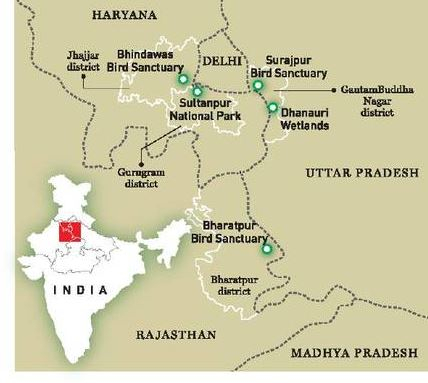
The NGT has ordered the UP government to remove water hyacinth from “Dhanauri wetlands” and questioned its failure to designate the wetland as a Ramsar site.
AboutDhanauri Wetland
Details
Location
Dhanauri village near Dankaur, Uttar Pradesh;
Floodplains of Yamuna.
Key Species
Home to over 120 Sarus Cranes (state bird of Uttar Pradesh) and 217 bird species
Ecological Significance
Important birding and nesting site; recognized as an Important Bird Area by Bird Life International
Bird Population
Hosts over 50,000 waterfowls during migratory seasons (November to March)
Ramsar Criteria
Fulfills 2 Ramsar criteria:
1. Hosts over 1% of biogeographic Sarus Crane population
2. Congregation site for 20,000+ waterfowls
Conservation Status
Documented by BNHS (Bombay Natural History Society); crucial for supporting endangered species
Ramsar Wetlands
The Ramsar Convention, also known as the ‘Convention on Wetlands,’ is an intergovernmental environmental treaty founded by UNESCO in 1971.
It derives its name from the city of Ramsar in Iran, where it was initially signed.
Ramsar sites are wetlands of global significance recognized under this treaty.
The Montreux Record is a register of wetland sites on the brink of ecological changes and in need of close monitoring under the Ramsar Convention.
Ramsar Site Designation Criteria:
Ramsar site designation hinges on several factors:
Representing rare or unique natural wetland types.
Supporting endangered species or threatened ecological communities.
Maintaining biodiversity in specific biogeographic regions.
Offering refuge during adverse conditions.
Regularly accommodating 20,000 or more waterbirds.
Sustaining 1% of a population of a single water-bird species.
Serving as a critical source of food, spawning grounds, nurseries, and migration paths for fish.
Regularly supporting 1% of a population of non-avian wetland-dependent animal species.
The Ministry of Earth Sciences (MoES) successfully concluded the Swachh Sagar, Surakshit Sagar 3.0 campaign on September 21st, 2024, organizing beach clean-up drives at more than 80 locations across India’s coastline.
What is Swachh Sagar, Surakshit Sagar 3.0?
It is a 75-day citizen-led campaign for improving ocean health through collective action.
It is the third edition of a flagship initiative launched to raise awareness about marine pollution and promote the conservation of coastal areas.
The campaign is part of India’s broader Swachh Bharat Mission and Swachhata Hi Seva initiative and aims to promote cleanliness, sustainable practices, and protect marine ecosystems.
It also commemorated International Coastal Cleanup Day.
Key Highlights
More than 60 tons of waste were removed, including plastic, metal, cloth, rubber, and wood debris.
The campaign promoted sustainable coastal practices and encourages communities to adopt eco-friendly habits, playing a vital role in reducing marine debris and conserving biodiversity.
COP29 is set to be hosted by Azerbaijan from November 11 to 22. It has a central focus on finalising a agreement on Climate Finance Action Fund (CFAF) particularly for the post-2025 period.
Proposals by Azerbaijan:
Azerbaijan has included key proposals in the COP29 Action Agenda, such as:
Increasing global energy storage capacity by six times by 2030.
Promoting a global market for green hydrogen.
Ensuring the carbon footprint from digitisation and data centres is kept to a minimum.
About the Climate Finance Action Fund (CFAF):
The CFAF will be capitalised with contributions from fossil fuel producing countries
It will be headquartered with its secretariat in Baku, Azerbaijan.
It will rely on voluntary contributions from fossil-fuel producing countries and companies.
Azerbaijan, a major petroleum economy, will make the first contribution to kickstart the fund.
Fossil-fuel producing countries and companies will have the option to make annual contributions, either as a fixed sum or based on production volumes.
The funds will be divided equally:
50% will go toward climate projects in developing countries.
50% will support developing nations in implementing national climate action plans.
The fund will become operational once it reaches a minimum corpus of $1 billion.
At least 10 countries must commit to being shareholders for the fund to start.
20% of the revenues generated from investments will be deposited in a Rapid Response Funding Facility (2R2F) providing highly concessional and grant-based support.
What did Paris Agreement of 2015 said on Climate Finance?
Under the Paris Agreement (2015), developed countries are obligated to raise at least $100 billion annually to aid developing nations in their fight against climate change.
This amount is expected to increase after 2025.
Negotiations have been slow, and countries are still debating the quantum of finance that industrialised nations should provide.
PYQ:
[2016] With reference to the Agreement at the UNFCCC Meeting in Paris in 2015, which of the following statements is/are correct?
The Agreement was signed by all the member countries of the UN, and it will go into effect in 2017.
It aims to limit the greenhouse gas emissions so that the rise in average global temperature by the end of this century does not exceed 2ºC or even 1.5ºC above pre-industrial levels.
Developed countries acknowledged their historical responsibility in global warming and committed to donate $1000 billion a year from 2020 to help developing countries to cope with climate change.
Select the correct answer using the code given below:
(a) 1 and 3 only
(b) 2 only
(c) 2 and 3 only
(d) 1, 2 and 3
The Cheetah Action Plan (CAP) which aimed to introduce African cheetahs into India’s Open Natural Ecosystems (ONEs), is completing its two years.
About Cheetah:
The cheetah is a fast-running big cat, and there are two types of Cheetahs globally:
African (savannahs, arid mountains, and hilly deserts)
Asiatic (desert and semi-desert areas only in Iran)
Cheetahs live in three main groups: females with cubs, male coalitions, and solitary males. They hunt during the day, preferring dawn and dusk.
The global cheetah population was 6,500 mature individuals (IUCN, 2021).
IUCN Status: Vulnerable (Globally) and Critically Endangered (Asiatic Cheetah)
Cheetah Reintroduction in India:
In India, cheetahs disappeared in the early 1950s due to hunting and the loss of their habitat.
Cheetahs (i.e. Southeast African Cheetah) from Namibia were reintroduced in Kuno National Park(MP) under the Project Cheetah.
This area was deemed a habitat parallel to Maasai Mara (National Park) in Kenya, suitable for cheetahs.
Current Issues:
Despite the initial excitement, all of these cheetahs remain in captivity at Kuno.
Unfortunately, no cheetahs are currently roaming freely in the wild, raising concerns about the success of the reintroduction efforts.
What is Project Cheetah?
Aim: To conserve threatened species and restore ecosystem functions. It is spearheaded by the National Tiger Conservation Authority (NTCA).
The plan involves partnering with other countries to conserve cheetahs, enhancing conservation and eco-tourism in India’s dry forests.
The population should reach Kuno National Park’s capacity in 15 years, needing sustained support.
Sunset Clause: The concept of a sunset clause in the context of Project Cheetah refers to the long-term criteria (at least 30-40 years) for establishing a viable cheetah population in India.
PYQ:
[2012] Consider the following: (2012)
Black-necked crane
Cheetah
Flying squirrel
Snow leopard
Which of the above are naturally found in India?
(a) 1, 2 and 3 only
(b) 1, 3 and 4 only
(c) 2 and 4 only
(d) 1, 2, 3 and 4
Q ‘Climate change’ is a global problem. How India will be affected by climate change? How Himalayan and coastal states of India will be affected by climate change? (UPSC CSE 2015)
Q Describe the major outcomes of the 26th session of the Conference of the Parties (COP) to the United Nations Framework Convention on Climate Change (UNFCCC). What are the commitments made by India in this conference? (UPSC CSE 2021)
Q ‘Clean energy is the order of the day.’ Describe briefly India’s changing policy towards climate change in various international fora in the context of geopolitics. (UPSC CSE 2022)
Prelims:
With reference to the ‘Global Climate Change Alliance’, which of the following statements is/are correct? (UPSC CSE 2017) 1. It is an initiative of the European Union. 2. It provides technical and financial support to targeted developing countries to integrate climate change into their development policies and budgets. 3. It is coordinated by the World Resources Institute (WRI) and the World Business Council for Sustainable Development (WBCSD). Select the correct answer using the codes given below: (a) 1 and 2 only (b) 3 only (c) 2 and 3 only (d) 1, 2 and 3
Mentor’s Comment: The alarming trend of breaching planetary boundaries, highlighted by the shift of Earth’s “overshoot day” from 1970 to 2024, underscores the urgent need for immediate action.
So, what is Earth’s Overshoot Day?
Earth’s Overshoot Day (30 December 1970), is the day when humanity’s demand for resources exceeds the Earth’s ability to regenerate them within a year. The Global Footprint Network, an international research organization, calculates Earth Overshoot Day by dividing the Earth’s biocapacity by humanity’s ecological footprint and multiplying by 365. The remainder is the number of days when humanity exceeds the Earth’s capacity.
Now, as we have exhausted our planet’s capacity to renew its natural resources, we risk upcoming future generations with a depleted and uninhabitable world. We must change our course to not only safeguard the well-being of those currently affected by environmental degradation but also to fulfill our moral obligation to protect the rights and livelihoods of future generations.
_
Let’s learn!
Why in the News?
The Summit of the Future at the UN in September 2024 will bring together stakeholders to explore multilateral solutions to pressing global challenges, to create a more secure and equitable future for all.
About Summit of the Future 2024:
• United Nations is convening this Summit on 20 and 21 September 2024 at UN Headquarters in New York. •Theme: Multilateral Solutions for a Better Tomorrow. •Aim: To bring world leaders together to forge a new international consensus on how we deliver a better present and safeguard the future. •Major Pillars of the Summit: Sustainable development and Financing for development, International peace and security, Science and Technology, Youth and Future generations, Global Governance.
How do different countries view the legal obligations towards future generations?
An argument against Legal Duties: Some, like legal scholar Stephen Humphreys, believe the focus on future generations is just rhetoric belief that distracts from the real needs of people alive today.
It allows governments to prioritize short-term economic gains over environmental protection, by claiming they are securing a better future.
Argument for Future Generations’ Rights: In contrast, a group of legal experts, including Margaretha Wewerinke-Singh, argue that existing human rights law already protects future generations.
They point to the Maastricht Principles, which state that human rights extend across time and that states have legal duties to future generations.
How do Maastricht Principles connect future generations to Climate justice?
•Intergenerational Equity: The Principles assert that human rights are not limited to present generations; they extend to future generations as well. •Right to a Healthy Environment: A core aspect of the Principles is the right to a clean, healthy, and sustainable environment which is essential for ensuring that future generations can enjoy their fundamental human rights, including health, adequate living standards, and access to natural resources. •State Obligations: The Principles clarify that states have binding obligations which include taking proactive measures to combat climate change, promote sustainable development, and prevent environmental degradation that could harm future populations. •Guidance for Legal Frameworks: They help ensure that national and international laws reflect commitments to intergenerational justice, particularly in the context of environmental policies and climate action.
Growing Legal Recognition:
Global Scenario:
Germany’s top court ruled parts of its climate law were unconstitutional for not sufficiently protecting young people’s rights.
Pakistan’s Supreme Court upheld a ban on polluting industries to prevent “decolonizing our future generations”.
Kenya’s High Court stated the present generation has a legal obligation to maintain natural resources for the future.
Norway’sConstitution gives everyone a right to a well-maintained environment for future generations.
Indian Scenario:
Recently, the National Green Tribunal (NGT) of India has also upheld the principle of intergenerational equity in the right to environment.
Need to pay heed to ‘overshoot day’: By prioritizing sustainable practices and responsible stewardship of our planet, we should prevent the irresponsible legacy of environmental bankruptcy and ensure a thriving Earth for generations to come. The time to act is now; our collective future depends on it.
The National Green Tribunal (NGT) has instructed the Central Pollution Control Board (CPCB) to submit a fresh report on the generation and treatment of electronic waste by states and Union territories (UTs).
AboutCentral Pollution Control Board (CPCB):
Details
Constitution
Established in September 1974 under the Water (Prevention and Control of Pollution) Act, 1974.
Additional Powers
Empowered under the Air (Prevention and Control of Pollution) Act, 1981.
Also works under the provisions of the Environment (Protection) Act, 1986.
Nodal Ministry
Functions under the Ministry of Environment, Forest and Climate Change.
Main Objective
To promote the prevention, control, and abatement of water and air pollution across India.
Collects and disseminates technical and statistical data on water and air pollution.
Key Programs
National Air Monitoring Programme (NAMP)
National Water Quality Monitoring Program (NWQMP)
Oversees the National Air Quality Index (NAQI) to provide real-time data on air quality.
Initiatives
Graded Response Action Plan (GRAP)
Clean Air Campaign
PYQ:
[2018] How is the National Green Tribunal (NGT) different from the Central Pollution Control Board (CPCB)?
1. The NGT has been established by an Act whereas the CPCB has been created by an executive order of the Government.
2. The NGT provides environmental justice and helps reduce the burden of litigation in the higher courts whereas the CPCB promotes cleanliness of streams and wells and aims to improve the quality of air in the country.
Which of the statements given above is/are correct-?