đŸ’„Join UPSC 2027,2028 Mentorship (July Batch) + XFactor Notes & Microthemes PDF

Subject: Conservation & Mitigation

1. Conservation Progs.
2. Worldwide initiatives
3. Mitigation Strategies
4. Conventions and Protocols

  • Mass Emission Standards for E12 AND E15 fuels

    The Ministry of Road Transport and Highways (MoRTH) has notified mass emission standards for E 12 (12% Ethanol with Gasoline) and E15 (15% Ethanol 12 with gasoline) fuels.

    What is the news?

    • The ministry has notified test standards for vehicles compliant with ethanol-blended fuel variants E12 and E15.
    • The ministry made it mandatory for all automobile manufacturers to put “clearly visible stickers” on every vehicle informing about its compatibility to the level of ethanol blend (E12, E15, E20).
    • Currently, India is using E10 fuel (petrol blended with 10% ethanol).

    Ethanol Blended Petrol (EBP) Programme

    • Ethanol Blended Petrol (EBP) programme was launched in January, 2003 for supply of 5% ethanol blended Petrol.
    • The programme sought to promote the use of alternative and environment-friendly fuels and to reduce import dependency for energy requirements.
    • OMCs are advised to continue according priority of ethanol from 1) sugarcane juice/sugar/sugar syrup, 2) B-heavy molasses 3) C-heavy molasses and 4) damaged food grains/other sources.
    • At present, this programme has been extended to whole of India except UTs of Andaman Nicobar and Lakshadweep islands with effect from 01st April, 2019 wherein OMCs sell petrol blended with ethanol up to 10%.

    Why ethanol blending?

    • Agricultural waste management: Ethanol blending will solve the problem of agricultural waste as well as sugar rates due to excess production, therefore providing security to sugarcane farmers.
    • Reducing emission: It can help accomplish dual goal of strengthening energy security with low carbon emission.
    • Enhanced participation: It will enable local enterprises and farmers to participate in the energy economy.
    • Reducing import bill: It is another significant benefit. India imports 85% of crude oil.
    • Fuel efficiency: Ethanol blending increases octane number thereby increasing fuel quality in terms of anti-knocking tendency (engine sound)

    Also read:

    [RSTV ARCHIVE] Ethanol Blending: Significance & Road Ahead


    UPSC 2022 countdown has begun! Get your personal guidance plan now! (Click here)

  • Extended Producer Responsibility (EPR) for Plastic Waste Collection

    The Environment Ministry has issued draft rules that mandate producers of plastic packaging material to collect all of their produce by 2024 and ensure that a minimum percentage of it be recycled as well as used in subsequent supply.

    What is EPR?

    • Extended Producer Responsibility (EPR) means the responsibility of a producer for the environmentally sound management of the product (plastic packaging) until the end of its life.
    • India had first introduced EPR in 2011 under the Plastic Waste (Management and Handling) Rules, 2011 and E-Waste Management and Handling Rules, 2011.

    What are the new EPR rules for Plastic Waste?

    (A) Plastic packaging

    • The new EPR guidelines covers three categories of plastic packaging including:
    1. Rigid plastic
    2. Flexible plastic packaging of single layer or multilayer (more than one layer with different types of plastic), plastic sheets and covers made of plastic sheet, carry bags (including carry bags made of compostable plastics), plastic sachet or pouches
    3. Multi-layered plastic packaging which has at least one layer of plastic and at least one layer of material other than plastic.
    • It has also specified a system whereby makers and users of plastic packaging can collect certificates — called Extended Producer Responsibility (EPR) certificates — and trade in them.

    (B) Ineligible plastics for EPR

    • Only a fraction of plastic that cannot be recycled will be eligible to be sent for end-of-life disposal such as road construction, waste to energy, waste to oil and cement kilns.
    • Only methods prescribed by the Central Pollution Control Board will be permitted for their disposal.

    Targets for recycling

    • In 2024, a minimum 50% of their rigid plastic (category 1) will have to be recycled as will 30% of their category 2 and 3 plastic.
    • Every year will see progressively higher targets and after 2026-27, 80% of their category 1 and 60% of the other two categories will need to be recycled.
    • If entities cannot fulfil their obligations, they will on a “case by case basis” be permitted to buy certificates making up for their shortfall.

    Effects on non-compliance

    • Non-compliance, however, will not invite a traditional fine.
    • Instead, an “environmental compensation” will be levied, though the rules do not specify how much this compensation will be.

    Challenges in mandatory EPR

    There are several challenges faced by both producers and bulk consumers that hinder proactive participation.

    • Consumer awareness: Waste segregation has been the greatest challenge in India owing to lack of consumer awareness.
    • Lack of compliance: The plastic producers do not wish to engage in the process holistically and take the effort to build awareness.
    • Large scale involvement: The EPR doesn’t take into account the formalization of informal waste pickers, aggregators and dismantlers.
    • Lack of recycle infrastructure: These challenges range from lack of handling capacity to illegitimate facilities in the forms of multiple accounting of waste, selling to aggregators and leakages.

    Way forward

    • Tracking mechanism: What India needs is to develop tracking mechanisms and provide oversight of waste compliance, in order to ensure that the mechanism of waste disposal is streamlined.
    • Strict enforcement: While enforcement strictness is of paramount importance, it is also vital to build an incentive structure around this to ensure better complicity by the producers.
    • Innovation: The time is ripe for innovators to come up with an alternative for plastics and the strong will of the Government to rid the toxic waste in a sustainable and safe manner.

    Try answering this PYQ:

    Q.In India, ‘extended producer responsibility’ was introduced as an important feature in which of the following?

    (a) The Bio-medical Waste (Management and Handling) Rules, 1998

    (b) The Recycled Plastic (Manufacturing and Usage) Rules, 1999

    (c) The e-Waste (Management and Handling) Rules, 2011

    (d) The Food Safety and Standard Regulations, 2011


    [wpdiscuz-feedback id=”sv0hin90ca” question=”Please leave a feedback on this” opened=”1″]Post your answers here.[/wpdiscuz-feedback]


    Also read:

    [Burning Issue] Ban on Single Use Plastics


    UPSC 2022 countdown has begun! Get your personal guidance plan now! (Click here)

  • Amendments to the Forest Conservation Act, 1980

    The Ministry for Environment, Forests and Climate Change (MoEFCC) has published proposed amendments to the Forest Conservation Act, 1980.

    The Forest (Conservation) Act, 1980

    The FCA is the principal legislation that regulates deforestation in the country.

    • It prohibits the felling of forests for any “non-forestry” use without prior clearance by the central government.
    • The clearance process includes seeking consent from local forest rights-holders and from wildlife authorities.
    • The Centre is empowered to reject such requests or allow it with legally binding conditions.
    • In a landmark decision in 1996, the Supreme Court had expanded the coverage of FCA to all areas that satisfied the dictionary definition of a forest; earlier, only lands specifically notified as forests were protected by the enforcement of the FCA.

    The FCA is brief legislation with only five sections of which-

    • Section 1 defines the extent of coverage of the law,
    • Section 2 restrictions of activities in forest areas and the rest deals with the creation of advisory committees, powers of rule-making and penalties.

    Why is the Act being amended now?

    • The current definition of forests has locked land across the country; even private owners cannot utilise their own property for non-forestry purposes.
    • The pressure for forest land diversion has been coming from — Ministries such as Rail and Roads.
    • Under the Act, any diversion of any forest land for any purpose, including assignment of leases, needs prior approval of the Centre.

    What defines ‘Forest’ under this act?

    • Previously, the Act had applied largely to reserve forests and national parks.
    • In 1996, ruling in T N Godavarman Thirumulpad v Union of India Case, the Supreme Court had expanded the definition and scope of forest land.
    • It would thus include all areas recorded as forest in any government record, irrespective of ownership, recognition and classification.
    • The court also expanded the definition of forests to encompass the “dictionary meaning of forests”.
    • This would mean that a forested patch would automatically become a “deemed forest” even if it is not notified as protected, and irrespective of ownership.
    • The Act would also be applicable over plantations in non-forest land.

    What are the proposed amendments?

    (A) Exemptions for Road and Railways

    • The MoEFCC has proposed that all land acquired by the Railways and Roads Ministries prior to 1980 be exempted from the Act.
    • Once the lands had been acquired for expansion, but subsequently, forests have grown in these areas, and the government is no longer able to use the land for expansion.
    • The Ministries will no longer need clearance for their projects, nor pay compensatory levies to build there.

    (B) Relaxation

    • It distinguishes individuals whose lands fall within a state-specific Private Forests Act or comes within the dictionary meaning of forest as specified in the 1996 Supreme Court order.
    • The government proposes to allow the “construction of structures for bona fide purposes’’ including residential units up to 250 sq m as a one-time relaxation.

    (C) Defense and other projects

    • Defence projects near international borders will be exempted from forest clearance.
    • Oil and natural gas extraction from forested lands will be permitted, but only if technologies such as Extended Reach Drilling are used.
    • Strip plantations alongside roads that would fall under the Act will be exempted.

    What are the concerns?

    • Legalizing private ownership of forests: The rules will facilitate corporate ownership.
    • Deforestation: The exemption of forests on private land will lead to the disappearance of large tracts of forests.
    • Fragmentation: Exemption for private residences on private forest will lead to fragmentation of forests, and open areas such as the Aravalli mountains to real estate.
    • Tribal concerns: The amendments do not address what will happen to tribals and forest-dwelling communities over the cleared lands.
    • Threat to wildlife: Exemption for roads and railways on forest land acquired prior to 1980 will be detrimental to forests as well as wildlife – especially elephants, tigers and leopards.

    Positives with the amendment

    • It has proposed making forest laws more stringent for notified forests, making offences non-bailable with increased penalties including imprisonment of up to one year.
    • It has disallowed any kind of diversion in certain forests.
    • It has attempt to define and identify forests once and for all — something that has been often ambiguous.


    UPSC 2022 countdown has begun! Get your personal guidance plan now! (Click here)

  • Species in news: Dhole or Asiatic Wild Dog

    A recent study has identified some priority talukas/tehsils where habitats can be consolidated to enhance population connectivity for the dhole or Asiatic Wild Dog (Cuon alpinus).

    About Dhole

    Wildlife (Protection) Act, 1972: Schedule II (Absolute protection – offences under these are prescribed the highest penalties.)

    IUCN: Endangered

    • The dhole is a canid native to Central, South, East Asia, and Southeast Asia.
    • India perhaps supports the largest number of dholes, with key populations found in three landscapes — Western Ghats, Central India and Northeast India.
    • It is a highly social animal, living in large clans without rigid dominance hierarchies and containing multiple breeding females.

    Their significance

    • Dholes play an important role as apex predators in forest ecosystems.
    • Factors contributing to this decline include habitat loss, loss of prey, competition with other species, persecution due to livestock predation and disease transfer from domestic dogs.

    Try answering this PYQ:

    Which one of the following groups of animals belongs to the category of endangered species?

    (a) Great Indian Bustard, Musk Deer, Red Panda, Asiatic Wild Ass

    (b) Kashmir Stag, Cheetah, Blue Bull, Great Indian Bustard.

    (c) Snow Leopard, Swamp Deer, Rhesus Monkey, Saras (Crane)

    (d) Lion Tailed Macaque, Blue Bull, Hanuman Langur, Cheetah


    [wpdiscuz-feedback id=”yleiw911x2″ question=”Please leave a feedback on this” opened=”1″]Post your answers here.[/wpdiscuz-feedback]


    UPSC 2022 countdown has begun! Get your personal guidance plan now! (Click here)
  • Using Paddy Straw as Cattle Feed

    Punjab has now proposed to use the paddy crop residue as fodder for animals, especially cattle.

    Why such a move?

    • In Punjab, the total availability of paddy straw is about 20 million tones per annum.
    • The total value of this straw is Rs 400 crore approx., calculated on an average rate of Rs 200/quintal. Almost all of it is burnt in fields.
    • This accounts for economic loss apart from the loss of 77,000 tonnes of nitrogen and 5.6 million tonnes of Total Digestible Nutrients (TDN) which could be used for ruminant production.
    • Also nearly 30.4 per cent of rice straw is used for animal feed in Southeast Asia, Mongolia and China.

    Economics behind paddy straw

    • High silica and lignin content reduces its digestive properties.
    • Higher selenium content in paddy straw also limits its use as fodder in animals as compared to wheat straw.
    • However, if given in moderate quantities (up to 5 kg per animal per day), selenium poses no health hazard to the animal.
    • Paddy straw also contains oxalates (2-2.5%) which leads to calcium deficiency so mineral mixture should always be fed along with the straw.

    Treatments for feeding paddy straw to animals

    • Paddy Straw cannot be directly fed to animals. It has to undergo some treatments.
    • Two of them are: Urea-only treatment and urea plus molasses treatment.

    [A] Urea treatment of paddy straw

    • 14 kg of urea is dissolved in 200 litres water and spray on chopped paddy straw.
    • The fermented straws have soft texture with 6.0-8.0 per cent crude protein, 3.0-4.0 percent DCP and 55-60 per cent TDN.
    • This involves a combination of physical, chemical and biological treatments.
    • The paddy straw is chaffed and moistened (physical) with urea solution (chemical).
    • The breakdown of urea release ammonia gas, a part of which is utilised by microbes (biological) for their proliferation (enriching the straw with microbial protein).
    • This in turn results in breakage of lingo-cellulosic bonds making cellulose and hemi-cellulose assessable for utilization by microbes in the rumen.
    • The digestibility of cellulose increases from 40-45% in untreated paddy straw to 70-75 per cent in fermented wheat straw.

    [B] Urea plus molasses treatment

    • Also called “Urea-Molasses impregnated straw”, this method involves treating paddy straw with urea and molasses.
    • Urea 1 kg and molasses 3 kg was mixed thoroughly and mixed with water 10 kg. This is mixed with chaffed paddy straw and fed to animals on same day.
    • The experts however clarify that for maintenance of body weight in animals, paddy straw alone is not sufficient.
    • Minerals and green fodder supplementation is required.

    How does the nutritional value of paddy straw increase after urea treatment?

    • The TDN values in urea treated paddy straw increased manifold as compared to untreated straw.
    • Crude protein (CP) increased from 4.5% to 8%, digestible crude protein (DCP) from 1.5% to 4% and total digestible nutrients (TDN) from 40% to 55%.
    • The feeding of urea treated straw (6 kg/day) to lactating buffaloes giving about 10 kg milk/day can result in saving about 60 per cent of oilseed cake in the ration.
    • Feeding of paddy straw should be mixed with berseem, cowpea or Lucerne as it forms a maintenance ration.
    • The straw should be fed with concentrate mixture and additional DCP or limestone should be given to the animals to reduce the effect of oxalates.
    • Oxalates also interfere in carbohydrate metabolism perhaps due to non-availability of calcium as cofactor.

    What are the potentially harmful effects?

    • The intake of siliceous forages has been associated with urinary siliceous calculi in drier regions where water may be limited.
    • There have been no definitive studies in India, but urinary calculi are associated with rice straw consumption.
    • It has high selenium (0.5 to 4.5 % ) content which can cause serious health problems in dairy animals.


    UPSC 2022 countdown has begun! Get your personal guidance plan now! (Click here)

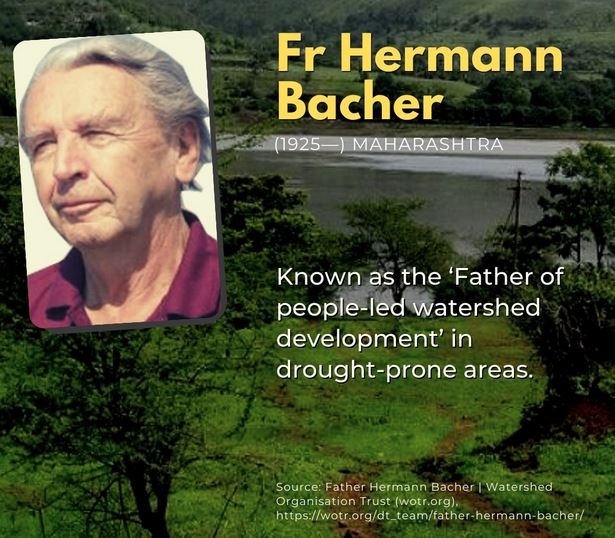
  • Who was Hermann Bacher?

    Hermann Bacher, popularly known as the ‘father of community-led watershed development in India’, passed away at the ripe old age of 97 years in Switzerland September 14, 2021.

    Hermann Bacher

    • Born in 1924, Bacher, came to India in 1948 at the young age of 24 years.
    • He was to spend the next 60 years of his life here, most of it in Maharashtra.
    • Struck by the poverty he saw in rural Maharashtra, he dedicated his life to the upliftment of the poor, the landless and rural women.
    • Bacher was given Germany’s highest civilian award, the Federal Cross of the Order of Merit in 1994, in recognition of his outstanding efforts.
    • In 2017, the United Nations Convention to Combat Desertifiucation (UNCCD) awarded WOTR the prestigious ‘Land for Life Award 2017’.
    • He is widely regarded and respected as a true ‘man of God’ for whom selfless service of the poor was worship at its most sublime. He is fondly remembered as ‘Bacher Baba’.

    Notable works

    • The 1972 droughts in Maharashtra led him to re-calibrate his developmental approach.
    • This meant that in rain-dependent rural Maharashtra, a shift had to be made from ‘resource exploitation’ to sustainable resource use, or ‘resource mobilisation’, as he described it.
    • He helped thousands of landless labourers’ secure title to land under the Land Reforms Act, 1957, beginning in 1965.
    • He also organised lakhs of farmers to develop their farms and increase their agricultural productivity by helping them access irrigation, improved and hybrid seeds etc.

    Pioneering water harvest

    • Since rain fell in the watersheds and landscapes villagers lived in, the only way to harvest and conserve rainwater wherever it fell was to undertake watershed development measures.
    • The idea was that “running water must be made to walk; walking water made to stop and sink underground”.
    • This meant, planting trees and grasses, conserving forests, undertaking soil and water conservation works such as digging contour trenches, raising farm bunds, etc.
    • It also meant building water harvesting structures on the streams (check dams, earthen bunds, etc) in a systematic manner across the entire landscape of the village, beginning from the top.

    Establishing the IGWDP

    • Through his work, was born the idea which later became the large-scale Indo-German Watershed Development Program (IGWDP) that he conceived and launched in Maharashtra in 1989.
    • This was in collaboration with and the support of the Governments of India, Maharashtra and Germany, NABARD and the non-profit sector.
    • Its unique and ground-breaking feature was that it put the villagers in the driver’s seat — the community would plan the programme, implement it and maintain the watershed assets.
    • Funds, substantial amounts, would be given directly to them and they would have to manage and account


    UPSC 2022 countdown has begun! Get your personal guidance plan now! (Click here)

  • India needs a carbon policy for agriculture

    Context

    The UK is set to host the 26th UN Climate Change Conference of the Parties (CoP26) in Glasgow from October 31 to November 12 with a view to accelerate action towards the Paris Agreement’s goals. The focus should be on climate finance and transfer of green technologies at low cost.

    Cause of concern for India

    • According to the Global Carbon Atlas, India ranks third in total greenhouse gas emissions by emitting annually around 2.6 billion tonnes (Bt) CO2eq, preceded by China (10 Bt CO2eq) and the United States (5.4 Bt CO2eq), and followed by Russia (1.7Bt) and Japan (1.2 Bt).
    • India ranked seventh on the list of countries most affected due to extreme weather events, incurring losses of $69 billion (in PPP) in 2019 (Germanwatch, 2021).
    • The fact that 22 of the 30 most polluted cities in the world are in India is a major cause of concern.
    • Delhi is the world’s most polluted capital as per the World Air Quality Report, 2020.

    Issues raised in global negotiation on climate change

    • Nations are still quibbling about historical global emitters and who should take the blame and fix it.
    • Global negotiations on climate change often talk about emissions on a per capita basis and the emission intensity of GDP.
    • Per capita emission: Of the top five absolute emitters, the US has the highest per capita emissions (15.24 tonnes), followed by Russia (11.12 tonnes).
    • India’s per capita emissions is just 1.8 tonnes, significantly lower than the world average of 4.4 tonnes per capita.
    • If one takes emissions per unit of GDP, of the top five absolute emitters, China ranks first with 0.486 kg per 2017 PPP $ of GDP, which is very close to Russia at 0.411 kg per 2017 PPP $ of GDP.
    • India is slightly above the world average of 0.26 (kg per 2017 PPP $ of GDP) at 0.27 kg, while the USA is at 0.25, and Japan at 0.21.
    • In our Nationally Determined Contributions (NDCs) submitted in 2016, India committed to “reduce emission intensity of its GDP by 33 to 35 per cent by 2030 from 2005 level.”

    Sector-wise emission and share of agriculture in it

    • Global emissions show that electricity and heat production and agriculture, forestry and other land use make up 50 per cent of the emissions.
    • But the emissions pie in India owes its largest chunk (44 per cent) to the energy sector, followed by the manufacturing and construction sector (18 per cent), and agriculture, forestry and land use sectors (14 per cent), with the remaining being shared by the transport, industrial processes and waste sectors.
    • The share of agriculture in total emissions has gradually declined from 28 per cent in 1994 to 14 per cent in 2016.
    • However, in absolute terms, emissions from agriculture have increased to about 650 Mt CO2 in 2018, which is similar to China’s emissions from agriculture.
    • Agricultural emissions in India are primarily from the livestock sector (54.6 per cent) in the form of methane emissions due to enteric fermentation and the use of nitrogenous fertilisers in agricultural soils (19 per cent) which emit nitrous oxides; rice cultivation (17.5 per cent) in anaerobic conditions accounts for a major portion of agricultural emissions followed by livestock management (6.9 per cent) and burning of crop residues (2.1 per cent).

    Way forward: Carbon policy for agriculture

    • Reward farmers through carbon credit: A carbon policy for agriculture must aim not only to reduce its emissions but also reward farmers through carbon credits which should be globally tradable.
    • Focus on livestock: With the world’s largest livestock population (537 million), India needs better feeding practices with smaller numbers of cattle by raising their productivity.
    • Switch areas from rice to maize: While direct-seeded rice and alternative wet and dry practices can reduce the carbon footprint in rice fields, the real solution lies in switching areas from rice to maize or other less water-guzzling crops.
    • Efficient fertiliser use: Agricultural soils are the largest single source of nitrous oxide (N2O) emissions in the national inventory.
    • Nitrous oxide emissions from use of nitrogen-fertiliser increased by approximately 358 per cent during 1980-81 to 2014-15.
    • An alternative for better and efficient fertiliser use would be to promote fertigation and subsidise soluble fertilisers.
    • Incentives and subsidies: The government should incentivise and give subsidies on drips for fertigation, switching away from rice to corn or less water-intensive crops, and promoting soluble fertilisers at the same rate of subsidy as granular urea.

    Consider the question “Agriculture sector is one of the significant contributors to the greenhouse gas emissions. This underscores the importance of carbon policy for agriculture in India. In this context, suggest the steps needed to be taken under the policy.” 

    Conclusion

    Carbon policy for agriculture in India would help it meet its goals in reducing emissions while making agriculture climate-resilient.

    UPSC 2022 countdown has begun! Get your personal guidance plan now! (Click here)


    Back2Basics: Anaerobic conditions

    • An anaerobic process in which organic food is converted into simpler compounds, and chemical energy (ATP) is produced. Certain types use the electron transport chain system to pass the electrons to the final electron acceptor, which may be an inorganic or an organic compound, but not oxygen.
  • Renaming of the Jim Corbett National Park

    The Union Minister of State for Environment, Forest and Climate Change has recently proposed to change the name of Corbett National Park to Ramganga National Park.

    Who was Jim Corbett?

    • Born in Nainital in 1875, Edward James Corbett lived in India till Independence, after which he left for Kenya where he died in 1955.
    • India’s best known hunter, Corbett earned fame after he tracked down and killed a number of man-eating tigers and leopards (he is said to have killed over a dozen).
    • An ace shot, Corbett was called upon regularly by the government to track and shoot man-eaters in the villages of Garhwal and Kumaon in Uttarakhand.

    Corbett National Park

    • Jim Corbett National Park is a national park in India located in the Nainital district of Uttarakhand state.
    • The first national park in India, it was established in 1936 during the British Raj and named Haily National Park after a governor of the United Provinces in which it was then located.
    • It was renamed Ramganga National Park, named after the river that flows through it, shortly after Independence and was rechristened yet again as Corbett National Park in 1956.
    • Jim Corbett had played a leading role in its establishment and had died the year before.
    • The park was the first to come under the Project Tiger initiative.

    The tiger reserve

    • The national park along with the neighbouring 301-sq km-Sonanadi Wildlife Sanctuary together make the critical tiger habitat of the Corbett Tiger Reserve.
    • With its hills, grasslands and streams, it is ideal tiger territory.
    • The place from where Project Tiger was launched in 1973, with its tiger population at 163, it boasts of a single largest tiger population in a tiger reserve and one of the highest tiger densities in the country.


    UPSC 2022 countdown has begun! Get your personal guidance plan now! (Click here)

  • Bhoramdeo Tiger Reserve: Fourth TR in Chhattisgarh

    The National Tiger Conservation Authority (NTCA) approved the Chhattisgarh government’s proposal to declare the combined areas of the Guru Ghasidas National Park and Tamor Pingla Wildlife Sanctuary as a Tiger Reserve.

    Bhoramdeo Tiger Reserve

    • The new Reserve is located in the northern part of the state, bordering Madhya Pradesh and Jharkhand.
    • This will be the fourth Tiger Reserve in Chhattisgarh, after the Udanti-Sitanadi, Achanakmar, and Indravati Reserves.
    • The proposal was considered under Section 38V(1) of The Wildlife (Protection) Act, 1972.
    • This section says that the State Government shall, on the recommendation of the Tiger Conservation Authority, notify an area as a tiger reserve.

    A decade in making

    • The Tamor Pingla Wildlife Sanctuary was identified as part of the Sarguja Jashpur Elephant Reserve in 2011.
    • The Guru Ghasidas National Park used to be part of the Sanjay National Park in undivided Madhya Pradesh.
    • Both were identified as reserve forests, and had been in line to be notified as Tiger Reserve since 2011.

    Medium-sized reserve

    • The constituent units of the new Tiger Reserve, Guru Ghasidas National Park and Tamor Pingla Wildlife Sanctuary, are spread over 1,44,000 hectares (1,440 sq km) and 60,850 hectares (608.5 sq km) respectively.
    • Guru Ghasidas National Park is in Koriya district; Tamor Pingla is in Surajpur district in the northwestern corner of Chhattisgarh.


    UPSC 2022 countdown has begun! Get your personal guidance plan now! (Click here)

  • [pib] Central Asian Flyway

    The two-day meeting of 30 range countries of Central Asian Flyway has begun.

    What is Central Asian Flyway?

    • Central Asian Flyway (CAF) is a flyway covering a large continental area of Eurasia between the Arctic Ocean and the Indian Ocean and the associated island chains.
    • It comprises several important migration routes of waterbirds, most of which extend from the northernmost breeding grounds in Siberia to the southernmost non-breeding wintering grounds in West Asia, India, the Maldives and the British Indian Ocean Territory.
    • The CAF range is essentially centred on one of the three major wintering areas of waterfowl in the Old World, namely the Indian subcontinent, the other two being Africa.
    • There are also the African-Eurasian Flyway (AEWA) to the west, and south-east Asia in the East Asian – Australasian Flyway (EAAF) to the east.
    • These wintering areas are geographically separate, and present entirely different ecological, historical and cultural situations.

    Range countries

    • The flyway covers 30 countries of North, Central and South Asia and Trans-Caucasus.
    • India is the core country of the CAF and supports 257 species of water birds.

    Major migratory birds

    • Critically Endangered – northern bald ibis, white-bellied heron, Baer’s pochard
    • Endangered – greater adjutant
    • Vulnerable – black-necked crane, Indian skimmer, lesser adjutant, masked finfoot, Socotra cormorant, wood snipe
    • Near Threatened – black-headed ibis, lesser flamingo, pygmy cormorant, white-eyed gull

    Why designate such flyways?

    • Approximately one in five of the world’s 11,000 bird species11,000 bird species migrate, some covering enormous distances.
    • Conserving migratory birds requires cooperation and coordination along the entire flyway between countries and across national boundaries.

    UPSC 2022 countdown has begun! Get your personal guidance plan now! (Click here)