Consider the following statements:
I. The Reserve Bank of India mandates all the listed companies in India to submit a Business Responsibility and Sustainability Report (BRSR).
II. In India, a company submitting a BRSR makes disclosures in the report that are largely non-financial in nature.
Which of the statements given above is/are correct?
Subject: Economics
-
Consider the following statements
-
Consider the following statements
Consider the following statements:
Statement I: As regards returns from an investment in a company, generally, bondholders are considered to be relatively at lower risk than stockholders.
Statement II: Bondholders are lenders to a company whereas stockholders are its owners.
Statement III: For repayment purpose, bondholders are prioritized over stockholders by a company.Which one of the following is correct in respect of the above statements?
-
Consider the following statements
Consider the following statements:
I. India accounts for a very large portion of all equity option contracts traded globally, thus exhibiting a great boom.
II. India’s stock market has grown rapidly in the recent past, even overtaking Hong Kong’s at some point in time.
III. There is no regulatory body either to warn small investors about the risks of options trading or to act on unregistered financial advisors in this regard.Which of the statements given above are correct?
-
Consider the following statements
Consider the following statements:
Statement I:
In India, income from allied agricultural activities like poultry farming and wool rearing in rural areas is exempted from any tax.
Statement II:
In India, rural agricultural land is not considered a capital asset under the provisions of the Income-tax Act, 1961.
Which one of the following is correct in respect of the above statements? -
[20th June 2026] The Hindu OpED: India’s cheapest power is here, the grid must catch up
PYQ Relevance[UPSC 2013] Write a note on India’s green energy corridor to alleviate the problem of conventional energy.
Linkage: The question examines the role of transmission infrastructure in enabling large-scale renewable energy integration.The article shows that transmission bottlenecks, not generation capacity, have become the main constraint on India’s clean-energy transition, reinforcing the importance of the Green Energy Corridor.Mentor’s Comment
India now produces some of the world’s cheapest solar and wind power, yet more than 50 GW of completed renewable capacity remains stranded not because projects are unfinished, but because grid connectivity and transmission is unavailable.
Why Has Transmission Become the Binding Constraint in India’s Energy Transition?
- Cheapest Source of Power: Solar and wind have emerged as India’s lowest-cost electricity sources, with firm clean power available at around ₹3.5 per kWh when paired with storage.
- Rapid Renewable Expansion: India added over 45 GW of renewable capacity in 2025 and currently has about 250 GW installed, with another 100 GW under construction.
- Existing Base and Pipeline: India currently has about 250 GW of renewable capacity installed and another 100 GW under construction, indicating that transmission expansion is lagging generation growth.
- Stranded Renewable Capacity: More than 50 GW of completed renewable projects remain unable to evacuate power due to transmission shortages.
- Mismatch in Project Timelines: Renewable projects can be commissioned within 12-18 months, whereas transmission corridors often require 3-5 years.
- Future Scale Requirement: India may require nearly 2,000 GW of renewable capacity by 2050 to meet rising electricity demand and electrification goals.
How Can Existing Grid Assets Unlock Nearly 1,000 GW of Additional Clean Energy?
- Storage at Renewable Sites: Batteries can store surplus daytime generation and supply power during evening peaks, significantly increasing utilisation of existing transmission lines.
- Reuse of Coal Corridors: Underutilised transmission infrastructure connected to coal plants can be shared with renewable projects, unlocking the equivalent of nearly 100 GW of clean-energy capacity.
- Leveraging Existing Substations: Available capacity at transmission substations can accommodate additional renewable connections and support battery integration, enabling another 100 GW equivalent.
- Reconductoring Existing Lines: Replacing older conductors with high-temperature, low-sag conductors can nearly double power-carrying capacity on the same towers.
- Combined Impact: Storage, shared infrastructure, and reconductoring together can unlock more than 1,000 GW of clean-energy potential within the existing transmission footprint.
Does Better Grid Utilisation Solve the Problem or Merely Defer It?
- Fastest Short-Term Solution: Grid optimisation can be deployed within months and quickly connect stranded renewable projects.
- Not a Substitute for Expansion: Existing infrastructure alone cannot support India’s projected renewable requirement of 2,000 GW.
- Scale Limitation: Future renewable parks and industrial electrification will require entirely new transmission corridors.
- Sequencing Advantage: Optimisation provides immediate relief while larger transmission projects are planned and executed.
- Grid Expansion Imperative: India plans a 40% expansion of its transmission network over the next decade, costing more than $100 billion. New corridors must incorporate advanced conductors and storage compatibility to avoid recreating future bottlenecks.
- Core Tension: The cheapest and fastest solution is grid optimisation, but the durable solution remains large-scale transmission expansion. Both approaches are necessary.
What Regulatory and Policy Changes Are Needed?
- Storage-Linked Renewable Planning: Regulators should promote greater integration of storage with renewable projects to improve grid utilisation.
- State-Level Implementation: States and distribution utilities must incorporate storage and grid-efficiency measures into procurement and planning decisions.
- Technology-Oriented Procurement: Procurement norms should reward advanced transmission technologies that expand capacity without requiring new corridors.
- Integrated Infrastructure Planning: Renewable energy zones and transmission corridors should be developed in a coordinated manner.
- Future-Proof Transmission Design: New transmission infrastructure should be designed for significantly higher renewable penetration from the outset.
What Does International Experience Reveal About Transmission Bottlenecks?
- United States: Delays in connecting renewable projects to the grid have emerged as a major obstacle to the clean-energy transition.
- Europe: Several European countries face similar transmission constraints despite substantial renewable deployment.
- Common Lesson: Cheap renewable generation alone does not guarantee energy transition success unless transmission capacity keeps pace.
- India’s Advantage: A unified national grid and a strong record of transmission expansion provide India with an opportunity to avoid similar bottlenecks.
Conclusion
India’s energy transition has moved from a generation challenge to a transmission challenge. The fastest gains lie in optimising existing grid infrastructure through storage, shared transmission assets, and reconductoring, which together can unlock nearly 1,000 GW of additional clean-energy potential. However, optimisation only buys time; achieving India’s long-term renewable ambitions requires simultaneous investment in new, high-capacity transmission corridors. India’s success will depend on pursuing both tracks together.
-
India’s First Commercial-Scale Coal-to-Ammonium Nitrate Project

Why in the news?
The Prime Minister will lay the foundation stone of India’s first commercial-scale Coal-to-Ammonium Nitrate Project at Lakhanpur, Jharsuguda district, Odisha. The project, worth ₹25,016 crore, is a major step towards energy security, import substitution, and industrial self-reliance.
Coal Gasification
- A process that converts coal into Synthesis Gas (Syngas), mainly consisting of carbon monoxide (CO) and hydrogen (H₂).
- Syngas can be used to produce Methanol, Urea, Ammonia, Ammonium Nitrate, Synthetic Natural Gas (SNG), Other chemical feedstocks
Lakhanpur Project
- India’s first commercial-scale Coal-to-Ammonium Nitrate facility.
- Developed by Bharat Coal Gasification and Chemicals Limited, a joint venture of Bharat Heavy Electricals Limited and Coal India Limited.
- Located on about 350 acres under Mahanadi Coalfields Limited land.
- Capacity: 2,000 tonnes/day of Ammonium Nitrate.
- Uses indigenous coal gasification technology developed by BHEL.
- Receives ₹1,350 crore support under the Coal Ministry’s incentive scheme.
Significance
- Reduces dependence on imported natural gas, ammonia, methanol, and chemicals.
- Supports Aatmanirbhar Bharat and domestic manufacturing.
- Enhances value addition to India’s vast coal reserves (>400 billion tonnes).
- Expected to boost downstream chemical and fertilizer industries.
[2025] Consider the following substances:
I. Ethanol
II. Nitroglycerine
III. Urea
Coal gasification technology can be used in the production of how many of them?[A] Only one
[B] Only two
[C] All the three
[D] None
-
RBI Temporarily Lifts Interest Rate Ceiling on FCNR(B) & NRE Deposits

Why in the news?
The RBI has temporarily removed the interest rate ceiling on fresh FCNR(B) deposits (3-5 years) and NRE deposits (3 years and above) from 17 June 2026 to 30 September 2026 to attract foreign currency inflows, support the rupee, and ease external financing conditions.
FCNR(B) Deposits
- Foreign Currency Non-Resident (Bank) Deposits allow NRIs to maintain fixed deposits in designated foreign currencies.
- Principal and interest are protected from exchange-rate risk.
- RBI has removed the interest rate cap on fresh and renewed deposits of 3-5 year tenor.
- Banks have already increased FCNR(B) deposit rates to around 7%.
NRE Deposits
- Non-Resident External (NRE) Accounts are rupee-denominated accounts maintained by NRIs.
- Both principal and interest are fully repatriable.
- Interest rate ceiling on fresh and renewed deposits of 3 years and above has been removed temporarily.
- Transfers from NRO to NRE accounts will not qualify for this relaxation.
RBI’s Objective
- Attract larger NRI deposits and foreign currency inflows.
- Strengthen foreign exchange reserves.
- Support rupee stability.
- Reduce overseas borrowing costs for banks and public sector entities.
- Complement RBI’s concessional forex swap facility announced on 5 June 2026.
Expected Impact
- Analysts estimate $30-50 billion of inflows by Q3 FY27.
- Similar FCNR(B) scheme in 2013 attracted nearly $25 billion.
- Increased foreign currency liquidity may ease external sector pressures.
[2021] Consider the following:
1. Foreign currency convertible bonds
2. Foreign institutional investment with certain conditions
3. Global depository receipts
4. Non-resident external deposits
Which of the above can be included in Foreign Direct Investments?[A] 1, 2 and 3
[B] 3 only
[C] 2 and 4
[D] 1 and 4
-
Is India producing more graduates than what the economy can absorb?
Why in the News?
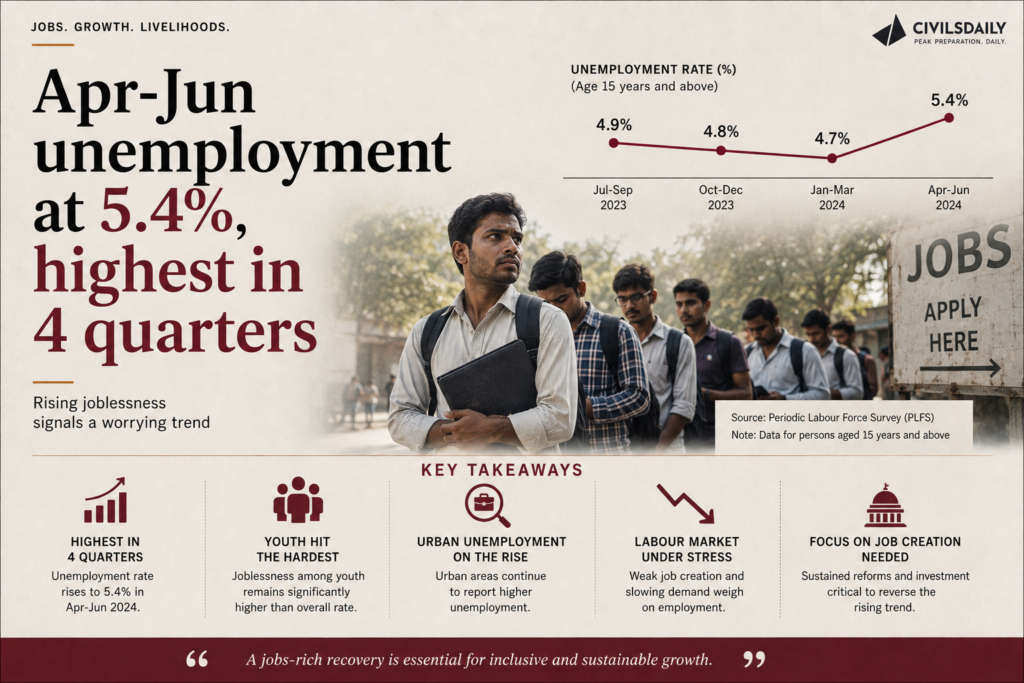
India’s higher education system continues to expand rapidly, producing millions of graduates each year. Yet graduate unemployment remains high, exposing a growing disconnect between educational output and labour market absorption, especially in the age of AI, automation, and capital-intensive growth.
Why is graduate unemployment rising despite expanding economic opportunities?
- Rapid Expansion of Higher Education: Engineering colleges and universities have increased graduate output faster than job creation.
- Sectoral Transition: IT services no longer absorb engineering graduates at earlier levels. New opportunities are emerging in banking, finance, defence, aerospace, semiconductors and space sectors.
- Mismatch in Skills: Employers seek practical and industry-ready skills that many graduates lack.
- Changing Nature of Jobs: New opportunities increasingly require specialised and interdisciplinary competencies.
- Weak Industry Exposure: Many students graduate without sufficient laboratory, manufacturing, or real-world experience.
- Industry-led Training: Companies increasingly run internal training programmes because many graduates lack industry-ready skills.
- Additional Training Burden: Firms often need to retrain recruits before deployment.
Has AI and technological change widened the employability gap?
- Changing Skill Requirements: AI increases demand for problem-solving, analytical, and digital skills.
- Curriculum Lag: Universities cannot redesign programmes at the pace of technological change.
- Mid-Course Labour Market Shift: Many graduates entered college before AI became mainstream. The labour market changed faster than university curricula.
- New Competency Requirements: Employers seek AI literacy, data interpretation, and systems thinking.
- Transition Shock: Graduates trained under older curricula enter a rapidly evolving labour market.
Why is economic growth not translating into proportionate job creation?
- Capital-Intensive Investments: Semiconductors and advanced manufacturing generate high output with fewer workers.
- Automation of Production: Robotics and digital manufacturing reduce labour requirements.
- Automation of Manufacturing: Manufacturing previously absorbed engineers in supervisory and operational roles. Robotics and digital production systems have reduced demand for such middle-level positions.
- Limited Labour Absorption: Manufacturing expansion no longer guarantees mass employment.
- Output-Employment Decoupling: Factory output can rise significantly without a proportional increase in workforce requirements.
Is India facing a graduate surplus or a skills mismatch?
- Not a Numerical Surplus Alone: Several sectors continue to demand skilled professionals.
- Quality Gap: Available graduates often do not possess industry-required competencies.
- Design and R&D Shortage: Advanced sectors need specialised talent that remains limited.
- Employability Deficit: The issue lies more in readiness than in educational attainment.
Is India’s employment challenge a problem of graduate surplus or skill deficit?
- Graduate Expansion: Higher education enrolment has expanded rapidly, producing graduates faster than formal job creation.
- Skill Mismatch: Many graduates lack industry-ready, practical and interdisciplinary skills despite holding degrees.
- Dual Reality: Graduate unemployment coexists with shortages of specialised talent in sectors such as AI, semiconductors, finance and advanced manufacturing.
- Changing Demand Structure: The economy increasingly rewards digital literacy, problem-solving and applied technical competencies over generic credentials.
- Underemployment Trap: Many graduates accept jobs below their qualifications or enter informal and gig work due to limited suitable opportunities.
- Core Challenge: India’s employment problem is a structural mismatch between educational output and labour market demand rather than a pure shortage of jobs or graduates.
Why does manufacturing versus innovation present a false choice?
- Manufacturing Needs Innovation: Modern industry depends on design, research, and technology.
- Innovation Creates High-Value Jobs: R&D and product development generate skilled employment.
- Global Value Chains Reward Innovation: Countries capturing design and intellectual property gain more value.
- Balanced Strategy Required: Manufacturing and innovation must advance together.
Has India developed indigenous technological capabilities?
- Growing Corporate Capability: Firms such as Mahindra and Tata Motors have strengthened engineering capacity.
- Corporate Capability Building: Indian firms have moved beyond assembly and increasingly participate in engineering, design and product development.
- Increasing Design Competence: Indian engineers contribute to complex product development.
- Progress in Indigenous Systems: Domestic technological capabilities have expanded across sectors.
- Capability Gap Persists: Advanced R&D opportunities remain fewer than the number of graduates produced.
Can entrepreneurship absorb the growing graduate workforce?
- Job Creation Beyond Wage Employment: Startups can become major employment generators.
- Need for Risk Capital: Venture funding remains critical for innovation-led firms.
- Technology Entrepreneurship Opportunity: Deep-tech sectors offer long-term employment potential.
- Ecosystem Constraints: Financing and scaling challenges continue to limit startup growth.
What must change in higher education?
- Industry-Academia Integration: Universities and firms must collaborate closely.
- Co-created Curricula: Universities should develop programmes jointly with industry instead of designing courses in isolation.
- Practical Learning: Greater emphasis on laboratories, internships, and projects.
- Skill Development: Education must prioritise employability alongside academic credentials.
- Continuous Upgradation: Institutions must adapt faster to technological change.
Conclusion
India’s problem is not an excess of graduates but a growing mismatch between educational outcomes and labour market requirements. AI, automation, and capital-intensive growth have altered the nature of employment faster than universities have adapted. The solution lies in aligning education, industry, innovation, and entrepreneurship so that graduate creation and job creation move in the same direction.
PYQ Relevance
[UPSC 2023] Skill development programs have succeeded in increasing human resource supply to various sectors. In the context of the statement, analyze the linkages between education, skill and employment.
Linkage: The PYQ examines the link between education, skills and employability in India’s labour market. The article highlights how weak alignment between education, skills and industry demand has contributed to rising graduate unemployment despite expanding higher education.
-
Qadian-Beas Railway Line Project Revived
Why in the news?
The Government of India has revived the Qadian-Beas New Railway Line Project in Punjab after nearly a century. The project was originally approved during 1928-29 by the North-Western Railway but remained incomplete.
Key Highlights
- Length: 39.68 km broad-gauge railway line.
- Cost: Approximately ₹1,400 crore.
- Implementing Agency: Northern Railway.
- Route: Qadian (Gurdaspur) – Dhapai – Ghuman – Butala – Sathiala – Beas (Amritsar).
- Revived under the Socially Desirable Rail Connectivity Programme.
Infrastructure Features
- 2 crossing stations (Ghuman and Butala).
- 11 major bridges and 121 minor bridges.
- 54 Road Under Bridges (RUBs).
- Modern signalling and telecommunication systems.
- Deployment of Kavach, India’s indigenous train collision avoidance system.
Significance
- Connectivity: Brings several areas of Punjab’s Majha region onto the railway network. Improves mobility and accessibility for residents.
- Strategic Importance: Provides an alternative corridor to the Amritsar-Pathankot railway section during emergencies. Enhances resilience of railway operations in northern India.
- Economic Benefits
- Better market access for farmers.
- Faster transportation of agricultural produce.
- Boost to trade, commerce, and small-scale industries.
- Employment generation during construction and operation.
- Tourism: Improves access to major religious destinations including Qadian, Dera Baba Jaimal Singh, Sri Darbar Sahib, Dera Baba Nanak, and Gurdwara Achal Sahib
-
The RBI and its growing fiscal role
Why in the News?
The RBI approved a record surplus transfer of ₹2.87 lakh crore to the Union government for FY26. The transfer follows a sharp expansion in the RBI’s balance sheet and rising earnings from reserve management, foreign assets and market operations, triggering debate over the RBI’s evolving place within India’s fiscal architecture.
Why is the RBI no longer functioning only as a monetary authority?
- Traditional Role: The RBI’s primary mandate is monetary stability, financial stability and currency management.
- Record Fiscal Contribution: The RBI transferred a record ₹2.87 lakh crore to the Union government in FY26, demonstrating its growing importance as a source of fiscal resources.
- Expanding Financial Footprint: The RBI’s balance sheet expanded by 20.6% to ₹91.97 lakh crore by March 2026, increasing the scale at which its operations influence fiscal outcomes.
- Rising Operational Income: Gross income rose by 26%, reflecting the growing revenue-generating capacity of RBI operations.
- Magnitude of Fiscal Impact: The transfer exceeds the annual budgets of several Indian States, indicating the substantial fiscal significance of RBI earnings.
- Institutional Shift: Reserve management, foreign asset holdings and market operations now generate fiscal resources alongside monetary outcomes, giving the RBI a role that extends beyond traditional central banking.
How has the RBI’s management of reserves become a source of fiscal capacity?
- Reserve Management: RBI actively manages foreign exchange reserves, gold holdings and securities portfolios as part of its monetary mandate.
- Gold Reserve Expansion: RBI acquired almost $12 billion worth of gold, increasing the scale of reserve assets under its management.
- Foreign Asset Expansion: RBI purchased roughly $75 billion in foreign currency assets, expanding income-generating reserve holdings.
- Income-Generating Operations: Exchange-rate intervention, foreign asset holdings and securities investments generate significant financial returns.
- Fiscal Contribution: Returns from reserve management increasingly contribute to the RBI surplus transferred to the Union government.
- Institutional Consequence: Activities undertaken for monetary and financial stability now generate substantial fiscal resources, linking reserve management to government finances.
Can a central bank remain institutionally independent when it becomes fiscally important?
- Institutional Distance: Central bank credibility depends on insulation from day-to-day fiscal compulsions.
- Fiscal Dependence: Large surplus transfers strengthen government finances without taxation or borrowing.
- Monetary-Fiscal Interdependence: Decisions affecting the RBI’s balance sheet increasingly affect fiscal outcomes. The growing fiscal role of central banks blurs the traditional boundary between monetary policy and fiscal policy.
- Changing Incentives: Fiscal significance increases political interest in central-bank earnings.
- Global Experience: Quantitative easing demonstrated how central-bank balance sheets can become instruments of fiscal support.
- Core Tension: The RBI remains a monetary authority while simultaneously becoming an important fiscal actor.
Why does the RBI’s growing fiscal role create a federalism challenge?
- Union Ownership: RBI profits accrue entirely to the Union government.
- Outside Fiscal Devolution: RBI transfers are not included in the divisible pool shared through Finance Commission awards.
- No Automatic State Share: States receive no direct claim on RBI-generated revenues.
- Scale of Asymmetry: The ₹2.87 lakh crore transfer exceeds the annual budgets of several States, highlighting the magnitude of resources accruing exclusively to the Centre.
- State Fiscal Constraints: States retain major expenditure responsibilities and face borrowing restrictions under Article 293, limiting their ability to offset revenue asymmetries.
- Fiscal Centralisation: Large public resources generated through monetary institutions strengthen the Centre’s fiscal position.
- Federal Blind Spot: RBI dividend transfers illustrate a wider pattern in which cesses, surcharges and borrowing restrictions increasingly concentrate fiscal resources at the Union level.
Conclusion
The RBI’s record surplus transfer reflects a deeper institutional transformation rather than a one-time financial event. The central bank has evolved from being primarily a guardian of monetary stability into an increasingly important source of fiscal capacity for the Union government. The unresolved challenge is preserving central bank independence and strengthening fiscal federalism as monetary institutions become more deeply intertwined with public finance.