💥Join UPSC 2027,2028 Mentorship (August Batch) + XFactor Notes & Microthemes PDF

Subject: Federal System

  • Floor Test in Jharkhand Assembly

    Introduction

    • The new government has won the trust vote on the floor of the Jharkhand Assembly. A floor test serves as a pivotal check to determine if the executive enjoys the confidence of the legislature.

    What is Floor Test?

    • Definition: A floor test is a constitutional measure employed to ascertain whether the Chief Minister, appointed by the Governor, commands the majority support of the Legislative Assembly.
    • Governor’s Role: The Governor appoints the CM, typically from the party securing the majority of seats in the Assembly.
    • Voting of Confidence: If the majority is challenged or questioned, the Chief Minister must seek a vote of confidence to prove the majority among the members present and voting.
    • Consequences of Failure: Failure to secure the majority in the floor test necessitates the resignation of the Chief Minister.
    • Application: Floor tests are conducted both in the Parliament and state legislative assemblies. They are also utilized in cases of disputes within coalition governments.

    Postponement of Floor Tests

    • Legal Precedent: Recent Supreme Court rulings have clarified that floor tests need not be postponed even if the decision on the disqualification of rebel members is pending.
    • Shivraj Singh Chouhan v/s Speaker Case: The 2020 case involving Shivraj Singh Chouhan established this principle.
    • Discretion in Special Cases: In exceptional situations with no clear majority, the Governor can use discretion to expedite the selection of the Chief Ministerial candidate for a floor test.

    Composite Floor Test

    • Multiple Claimants: When multiple individuals stake a claim to form the government, a Composite Floor Test is conducted.
    • Majority Determination: In cases where the majority is unclear, a special session is convened to ascertain the majority.
    • Counting the Majority: Majority is determined based on those present and voting. Voting can occur through voice votes or division voting, involving electronic gadgets, ballots, or slips.
    • Speaker’s Vote: In case of a tie, the Speaker may cast the deciding vote.

    Challenges with the Floor Test

    • Luring of MLAs: In some instances, ruling party MLAs may be lured with rewards or incentives, undermining the constitutionality and fairness of the floor test.
    • Constitutional and Moral Implications: Such actions are seen as constitutionally immoral and unjust, as they circumvent the Tenth Schedule through engineered defections using the judicial process.

    Back2Basics: No Confidence Motion

    • Rule 198 of Lok Sabha: The process for a No Confidence Motion is explained under this rule in the Lok Sabha.
    • Constitutional provisions: While the Constitution does NOT mention the terms ‘No Confidence Motion’ or ‘floor test,’ Articles 75 and 164 establish the collective responsibility of the executive to their respective legislatures.
    • Procedure: Any Opposition member can move a no-confidence motion, which requires the backing of at least 50 members for acceptance.
    • Discussion Period: The Speaker announces a date for discussion, which must occur within 10 days from the date of acceptance.
  • How Political Parties are created in India?

    political parties

    Introduction

    • Tamil superstar Thalapathy Vijay’s announcement of his political party has sparked interest in the process of registering political entities in India.

    Creating a Political Party

    • Legal Framework: Article 324 of the Indian Constitution and Section 29A of the Representation of the People Act, 1951 empower the Election Commission to lay down guidelines for party registration.
    • Application: A party seeking registration must apply to the Election Commission within 30 days of its formation.
    • Public Notice: The applicant must publish the proposed party name in two national and two local daily newspapers. The notice is also posted on the Election Commission’s website.
    • Documentation: The application, in a prescribed format, must be sent to the Election Commission Secretary within 30 days of party formation. It should include a demand draft of Rs. 10,000, a printed copy of the party’s memorandum, rules, or constitution, and the latest electoral rolls for at least 100 party members.
    • Affidavits: An affidavit, duly signed by the President or General Secretary and sworn before a Magistrate/Notary Public, is required. Additionally, individual affidavits from 100 members confirming non-membership in any other registered political party are essential.

    Need for Registration

    • Not Mandatory: Registration with the Election Commission is not mandatory but comes with advantages under the Representation of the People Act, 1951.
    • Symbol Allotment: Registered party candidates receive priority in the allotment of free symbols over independent candidates.
    • State or National Recognition: Parties can achieve recognition as ‘state parties’ or ‘national parties,’ subject to fulfilling conditions laid out in the Election Symbols (Reservation and Allotment) Order, 1968.

    Recognition Criteria

    • State Party: To be recognized as a state party, a registered party must meet any of these five conditions:
      1. Secure at least 6% of valid votes and win at least 2 seats in an Assembly General Election.
      2. Secure at least 6% of valid votes and win at least 1 seat in a Lok Sabha General Election.
      3. Win at least 3% of the seats or at least 3 seats, whichever is more, in an Assembly General Election.
      4. Win at least 1 out of every 25 seats from a state in a Lok Sabha General Election.
      5. Secure at least 8% of the total valid vote in an Assembly or Lok Sabha General Election.
    • National Party: To attain national party status, a registered party must meet any of these three conditions:
      1. Secure at least 6% of valid votes in an Assembly or Lok Sabha General Election in four or more states and win at least 4 seats in a Lok Sabha General Election from any state.
      2. Win at least 2% of total Lok Sabha seats in a Lok Sabha General Election, spanning at least 3 states.
      3. The party is recognized as a State Party in at least four states.

    Benefits of Recognition

    • Reserved Symbol: State parties receive a reserved symbol within the state, while national parties can use the reserved symbol across the country.
    • Nomination Ease: Such parties require only one proposer for filing nominations.
    • Free Electoral Rolls: They are entitled to two sets of electoral rolls free of cost.
    • Media Access: Recognized parties can use state-owned Akashvani/Doordarshan facilities for broadcasting/telecasting during general elections.
    • Additional Perks: Recognized parties can avail of other advantages such as subsidized land for party offices, among others.
  • Significance of Deputy CM in Indian Politics

    Deputy CM

    Introduction

    • Deputy Chief Ministers (Deputy CMs) have become prominent figures in Indian politics, serving as political compromises and often following coalition governments or a lack of single-party dominance.
    • The role and prevalence of Deputy CMs vary across states and regions.

    Role of Deputy CM

    • Political Compromise: Deputy CMs are appointed to strike a political compromise, especially in coalition governments or when no single leader commands undisputed authority.
    • Representation: Deputy CMs represent various regions, communities, or interest groups within a state, promoting inclusivity.
    • Constitutional Basis: The Constitution does not explicitly mention the position of Deputy CM; however, it is understood to be equivalent in rank to a Cabinet Minister.
    1. Article 163(1): This article outlines the existence of a Council of Ministers in each state, with the Chief Minister at its head, to aid and advise the Governor in the exercise of his functions. While it doesn’t mention Deputy CMs, they are a part of the Council of Ministers, akin to Cabinet Ministers.
    2. Article 164(1): This article states that the Chief Minister shall be appointed by the Governor, and other Ministers shall be appointed by the Governor on the advice of the Chief Minister. It establishes the authority of the Chief Minister in appointing Deputy CMs.

    Prevalence of Deputy Chief Ministers

    • Growing Prominence: Deputy CMs are increasingly common in Indian states, with four of the five states that went to polls in November 2021 having Deputy CMs.
    • National Presence: Most major states, except Tamil Nadu and Kerala, have the position of Deputy CM.
    • Varied Contexts: States like Andhra Pradesh, Maharashtra, and Haryana have multiple Deputy CMs, often reflecting coalition governments or diverse political considerations.

    Historical Overview

    • Pioneering Deputy CM: Anugrah Narayan Sinha was one of the earliest Deputy CMs in India, representing Bihar.
    • Post-1967 Increase: The prevalence of Deputy CMs expanded after the decline of Congress’s dominance in national politics in 1967.
    • Examples: States like Bihar, Uttar Pradesh, Madhya Pradesh, and Haryana have a history of Deputy CMs from various political backgrounds.

    Deputy Prime Ministers

    • Higher Position: India has also seen Deputy Prime Ministers, who held positions of significance at the national level.
    • Notable Figures: Sardar Vallabhbhai Patel, Morarji Desai, Charan Singh, Chaudhary Devi Lal, and Lal Krishna Advani have served as Deputy Prime Ministers.
    • Constitutional Aspects: The role of the Deputy Prime Minister has been debated in court, with the Supreme Court emphasizing that it does not confer additional powers on the Deputy Prime Minister.

    Conclusion

    • Deputy Chief Ministers play a vital role in Indian politics, facilitating political stability and representation.
    • Their prevalence has increased over the years, and they continue to hold significant positions in state governments.
  • What is needed from a Governor is reticence

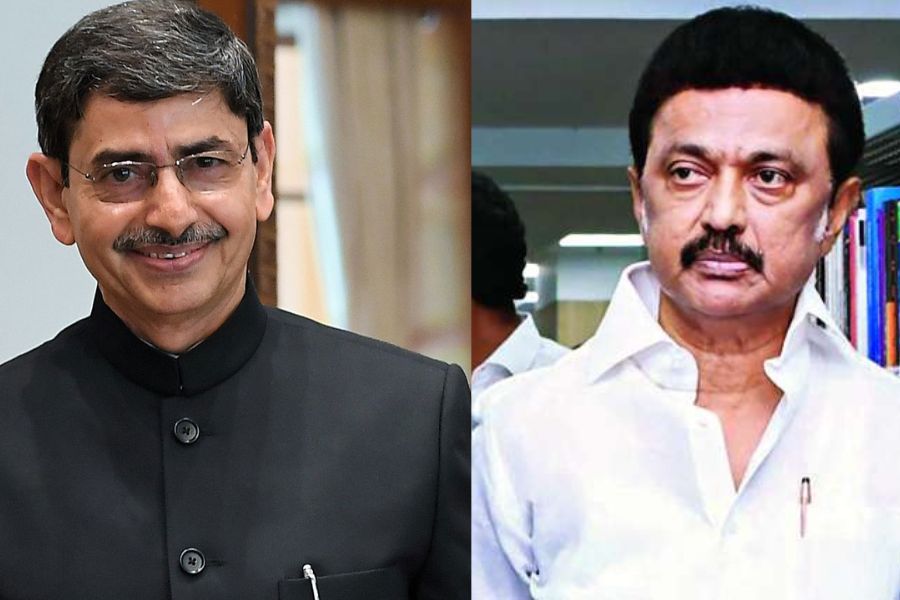
    M.K. Stalin | Governor R N Ravi 'instigates' communal hatred, is threat to  Tamil Nadu's peace: CM Stalin tells President Droupadi Murmu - Telegraph  India

    Central Idea:

    The article discusses the controversial statements made by the Tamil Nadu Governor, R.N. Ravi, regarding the factors leading to India’s Independence. Despite his background in physics and a career in the Intelligence Bureau, Mr. Ravi expressed views on historical events, specifically downplaying the impact of the Quit India movement and attributing British departure to factors like Netaji Subhas Chandra Bose’s actions and the Naval Mutiny.

    Key Highlights:

    • Governor R.N. Ravi, in breach of the expected reticence of constitutional authorities, delves into historical interpretations related to India’s Independence.
    • Ravi suggests that the Quit India movement had minimal impact on the British decision to leave, attributing it more to Netaji Subhas Chandra Bose’s Azad Hind Government and the 1946 Naval Mutiny and Air Force Rebellion.
    • Ravi’s views are reportedly based on Intelligence Bureau files, raising questions about his in-depth study of India’s national movement.

    Key Challenges:

    • Constitutional authorities, like Governors, should refrain from publicly expressing opinions on historical matters unrelated to their duties, especially without comprehensive knowledge.
    • Ravi’s assertion regarding the Quit India movement and the reasons for British departure may stir controversy and be seen as an attempt to rewrite historical narratives.

    Key Terms/Phrases:

    • Quit India movement
    • Intelligence Bureau (IB)
    • Azad Hind Government
    • Naval Mutiny and Air Force Rebellion
    • Netaji Subhas Chandra Bose
    • Mahatma Gandhi
    • Indian National Army (INA)
    • Constitutional authority

    Key Quotes:

    • “The Quit India movement made little impact on the British decision to leave India.” – Governor R.N. Ravi
    • “The British left because they felt ‘insecure’ after the ‘Naval Revolt and the Air Force Rebellion.’” – R.N. Ravi on British Prime Minister Clement Attlee’s alleged statement.

    Anecdotes:

    • The article mentions the lawyer Bhulabhai Desai, Jawaharlal Nehru, and others defending INA officers at their court martial, emphasizing the united front among leaders despite ideological differences.

    Key Statements:

    • Constitutional authorities, like Governors, are expected to maintain reticence and avoid public expressions of opinions on historical events.
    • Mr. Ravi’s views on the Quit India movement and the reasons for British departure may not align with historical consensus.

    Key Examples and References:

    • Reference to the impact of INA trials on British rule withdrawal, as noted in Kailas Nath Katju’s unpublished biography.
    • Mention of historical leaders’ admiration for Netaji Subhas Chandra Bose, despite ideological differences.

    Key Facts/Data:

    • Mr. Ravi’s background in physics and a career in the Intelligence Bureau.
    • INA trials and their impact on public sentiment, as highlighted in Kailas Nath Katju’s biography.

    Critical Analysis:

    • The article criticizes Mr. Ravi for venturing into historical interpretations without a detailed study, emphasizing the need for constitutional authorities to exercise restraint.
    • It questions the validity of Ravi’s claims regarding the Quit India movement’s impact and the factors influencing the British decision to leave.

    Way Forward:

    • Constitutional authorities should adhere to their roles and avoid making public statements on historical events.
    • Encourage informed discussions on historical matters and ensure that statements align with widely accepted historical narratives.
  • What is Ladakh’s demand on Gilgit-Baltistan?

    ladakh

    Introduction

    • The socio-political landscape of Ladakh is witnessing ongoing dialogues and demands on Gilgit-Baltistan, primarily presented by the Leh Apex Body (LAB) and Kargil Democratic Alliance (KDA) to the Ministry of Home Affairs (MHA).
    • The demands encompass a range of issues, including territorial control expansion, restoration of statehood, special status under the Sixth Schedule and Article 371, and exclusive rights over recruitment.

    Ladakh’s Current Status

    • Formation as Union Territory: Ladakh, spanning 59,146 square kilometers, became a Union Territory on August 5, 2019, following the abrogation of Article 370.
    • Governance: Unlike Jammu and Kashmir, Ladakh does not have a legislature but is governed by two elected hill councils, LAHDC-Kargil and LAHDC-Leh.
    • Population and Demographics: Ladakh, with a population of 2.74 lakh (2011 census), is a Muslim-majority UT, with Buddhists dominating Leh district and Shia Muslims in Kargil. The region witnessed varied reactions to the abrogation of Article 370, with Leh supporting UT status and Kargil expressing a desire for reunification with Kashmir.

    Latest Demands of the Region

    • Protests against UT Status: Over the past two years, both Leh and Kargil initiated protests against the UT status without a legislature, advocating for the restoration of statehood.
    • Special Status under Sixth Schedule: There is a collective demand for special status under the Sixth Schedule and Article 371, similar to other northeastern states, to preserve the region’s ecological fragility and limit external influences.
    • Exclusive Recruitment Rights: Ladakh seeks exclusive rights over recruitment, proposing the establishment of the Ladakh Public Service Commission for gazetted jobs and empowering hill councils for lower rung staff recruitment.

    Territorial Control Expansion

    • Historical Context: The memorandum underlines Ladakh’s historical connection to Gilgit-Baltistan, part of the pre-1947 Ladakh district now under Pakistan’s occupation.
    • Territorial Control Demand: Ladakh demands an extension of territorial control up to Gilgit-Baltistan, advocating for attempts to include this area into Ladakh. Reservation of seats for Gilgit-Baltistan is sought once a legislature is granted.
    • Strategic and Stability Considerations: The memorandum emphasizes that empowering locals will enhance stability in the region, especially in the context of Ladakh’s volatile Line of Actual Control (LAC) with China.

    Centre’s Response and Committees Formed

    • Committees Formed: In response to street protests, the Centre formed committees in 2022 and 2024, led by Ministers G. Kishan Reddy and Nityanand Rai, respectively, to engage with LAB and KDA members.
    • Assurance and Ongoing Talks: The Centre assured finding appropriate solutions to language, culture, and land conservation issues in Ladakh. Ongoing talks are aimed at addressing the demands and fostering a structured dialogue between New Delhi and Ladakh.

    Conclusion

    • Ladakh’s socio-political dialogue continues, reflecting the diverse sentiments and demands of its residents.
    • The region’s historical context, strategic considerations, and ecological concerns play a crucial role in shaping the ongoing negotiations.
    • As Ladakh awaits resolutions to its demands, the dialogue remains a critical component in navigating the complex dynamics between the Centre and this unique Union Territory.
  • Tax contribution by States needs to be revisited


    16th Finance Commission - INSIGHTSIAS


    Central Idea:

    The article advocates for the inclusion of tax contribution, particularly from Goods and Services Tax (GST) and petroleum consumption, as a significant efficiency indicator in the distribution formula used by Finance Commissions to allocate Union tax revenue among states. The authors argue that these measures provide a fair and stable representation of a state’s economic contribution to the national exchequer.

    Key Highlights:

    • Finance Commissions play a crucial role in recommending the distribution of Union tax revenues among states.
    • Historically, tax contribution had less weight in the distribution formula, but it was completely dropped since the 10th Finance Commission.
    • The article contends that tax contribution, especially under the GST regime, is a reliable measure of efficiency, unlike other indicators like tax effort and fiscal discipline.
    • The authors propose that GST and petroleum consumption, being stable and indicative of income, should be given a substantial weight in the distribution formula.

    Key Challenges:

    • Resistance from states that may perceive a potential shift in their shares based on tax contribution.
    • The stability of indicators like tax effort and fiscal discipline is questioned, making it challenging to assign them higher weights.
    • The need to ensure that the inclusion of tax contribution does not lead to unfair outcomes or discourage states from adopting progressive tax policies.

    Key Terms:

    • Goods and Services Tax (GST): A unified consumption-based destination tax equally divided between the State and Central governments.
    • Tax Contribution: The amount of revenue generated by a state through taxes, considered as an efficiency indicator.
    • Finance Commission: A body responsible for recommending the distribution of Union tax revenues among states in India.

    Key Phrases:

    • “Equity and efficiency in tax revenue transfers.”
    • “Tax contribution as an efficiency indicator.”
    • “GST and petroleum consumption as fair measures of states’ contributions to the national exchequer.”

    Key Quotes:

    • “Tax contribution is an efficiency indicator because a State’s level of development and economic structure decides its tax contribution.”
    • “GST satisfies the criterion of stability in tax structure, making it an ideal efficiency indicator.”
    • “There is a persuasive case for the 16th Finance Commission to debate and include these ratios as a measure of efficiency.”

    Key Statements:

    • “Since the 10th Finance Commission, tax contribution was dropped from the distribution formula.”
    • “GST is a consumption-based destination tax that is equally divided between the State and Central governments.”
    • “The Finance Commissions have always favored assigning more than 75% weight to equity indicators.”

    Key Examples and References:

    • The article references the 15th Finance Commission’s distribution formula, which included tax effort, fiscal discipline, and demographic performance.
    • The stability of GST as an efficiency indicator is supported by calculations presented by the authors.

    Key Facts:

    • The share of personal and corporate income taxes is 64% in Central tax revenue in 2021-22.
    • Finance Commissions historically assigned 10% to 20% weight to tax contribution in the distribution formula.

    Key Data:

    • The weightage of tax effort in the 15th Finance Commission’s distribution formula was 2.5%, with demographic performance receiving a weight of 12.5%.
    • The recommended weight for equity indicators in the same formula was 85%.

    Critical Analysis:

    The article provides a compelling argument for the inclusion of tax contribution in the distribution formula, highlighting the stability and fairness of GST as an efficiency indicator. However, potential challenges such as resistance from states and the need for careful consideration to prevent unintended consequences are acknowledged.

    Way Forward:

    The authors suggest that the 16th Finance Commission should actively debate and consider including GST and petroleum consumption with a substantial weight in the distribution formula. This, they argue, would better represent states’ contributions to the national exchequer and promote efficiency in resource allocation.

  • Debate on VVPAT Verification in Indian Elections

    vvpat

    Introduction

    • Recent Developments: A political alliance, has requested a meeting with the Election Commission of India (ECI) to discuss and suggest changes regarding the use of Voter Verifiable Paper Audit Trail (VVPAT) machines.
    • Proposal: The alliance proposes that VVPAT slips be handed to voters to place in a separate ballot box, with 100% counting of these slips, to enhance trust in the electoral process.

    What are VVPATs?

    • Function and Purpose: VVPAT machines, attached to EVMs, print a slip showing the voter’s choice, allowing voters to verify their vote for seven seconds before the slip drops into a secured box.
    • Development History: The concept emerged in 2010, leading to the creation of prototypes by Bharat Electronics Limited (BEL) and Electronics Corporation of India (ECIL). After trials and feedback, the design was approved in February 2013.
    • Implementation: The Conduct of Elections Rules, 1961, were amended to incorporate VVPATs. They were first used in Nagaland’s Noksen Assembly constituency in 2013 and were implemented in all polling stations by the 2019 Lok Sabha elections.

    Current VVPAT Slip Counting Protocol

    • EC’s Decision Process: In 2018, the ECI consulted the Indian Statistical Institute (ISI) to determine a statistically robust sample size for VVPAT slip verification.
    • Existing Protocol: Initially, VVPAT slips of one randomly selected polling station per Assembly constituency were counted. This was increased to five polling stations per Assembly seat after a Supreme Court judgment in 2019.
    • ISI Recommendation: The ISI suggested counting VVPAT slips from 479 EVMs to ensure a high confidence level that the proportion of defective EVMs is less than 2%.

    Election Commission’s Stance

    • Current Verification Adequacy: The EC argues that the current practice of verifying VVPATs from five polling stations per Assembly seat exceeds the ISI’s recommendation.
    • Reliability Record: The EC highlights that in past elections, no cases of vote misattribution were detected in VVPAT checks, attributing discrepancies to human errors.
    • Concerns over Full Verification: The EC views 100% VVPAT verification as regressive, time-consuming, and prone to human error, akin to manual ballot voting.

    Conclusion

    • Debate on Electoral Integrity: The discussion around VVPAT verification reflects ongoing concerns about ensuring electoral integrity and public trust in the voting process.
    • Challenges Ahead: Balancing the need for efficient electoral processes with the imperative of maintaining voter confidence remains a critical challenge for the ECI and political parties in India.
  • In news: Electoral Bond Scheme

    Central Idea

    • The government has announced a fresh tranche of electoral bond sales for a 10-day period starting through the authorised branches of State Bank of India across the country.

    About the Electoral Bond Scheme

    Definition Banking instruments for political party donations with donor anonymity.
    Launch 2017-18 Union Budget
    Purchase Method Available to Indian citizens and Indian-incorporated companies from select State Bank of India branches. Can be bought digitally or via cheque.
    Donation Process Purchasers can donate these bonds to eligible political parties of their choice.
    Denominations Available in multiples of ₹1,000, ₹10,000, ₹10 lakh, and ₹1 crore.
    KYC Requirements Purchasers must fulfill existing KYC norms and pay from a bank account.
    Lifespan of Bonds Bonds have a 15-day life to prevent them from becoming a parallel currency.
    Identity Disclosure Donors contributing less than ₹20,000 need not provide identity details like PAN.
    Redemption Electoral Bonds can be encashed only by eligible political parties through an Authorized Bank.
    Eligibility of Parties Only parties meeting specific criteria, including securing at least 1% of votes in the last General Election, can receive Electoral Bonds.
    Restrictions Lifted Foreign and Indian companies can now donate without disclosing contributions as per the Companies Act.
    Objective To enhance transparency in political funding and ensure funds collected by political parties are accounted or clean money.


    Also read:

    Challenging the Electoral Bond Scheme

  • How the Northeast was ‘invented’, 52 years ago?

    Northeast India

    Central Idea

    • On December 30, 1971, two pivotal laws were enacted, reshaping the administrative landscape of Northeast India.
    • These laws marked a transition from the traditional unit of Assam to the broader concept of ‘Northeast India’.

    Formation and Composition of Northeast India

    • States in the Northeast: The region officially includes Arunachal Pradesh, Assam, Manipur, Meghalaya, Mizoram, Nagaland, Sikkim, and Tripura, under the North-Eastern Council.
    • Pre-Independence Structure: Before Independence, Arunachal Pradesh, Assam, Meghalaya, Nagaland, and Mizoram were part of colonial Assam. Manipur and Tripura were princely states with British political officers, while Sikkim, under British paramountcy, became an independent country in 1947 and was annexed by India in 1975. Sikkim joined the North-Eastern Council in 2001.

    Colonial Context and Frontier Province Dynamics

    • Assam as a Frontier Province: Colonial Assam was a frontier province in British India, akin to the North West Frontier Province (now Khyber Pakhtunkhwa, Pakistan).
    • Administrative Divisions: The province was divided into ‘settled districts’ (like present-day Assam and Sylhet in Bangladesh) and ‘excluded areas’ or ‘Hill areas’ (like modern-day Arunachal Pradesh and parts of Nagaland).

    The North Eastern Council (NEC) is composed of the following members:

    • Governors and Chief Ministers of the Member States: Each of the eight states in the North Eastern region, including Assam, Arunachal Pradesh, Meghalaya, Mizoram, Tripura, Sikkim, Nagaland, and Manipur, is represented by their respective Governors and Chief Ministers. These members are ex-officio members of the Council.
    • Chairman: The Chairman is also a member of the Council, although the specific identity of the Chairman is not mentioned in the provided sources.
    • Three Members Nominated by the President: The President of India nominates three additional members to the Council. These members are also part of the NEC

    Post-Independence Security and Administrative Shifts

    • Unique Post-1947 Challenges: After 1947, the region’s borders became largely international, with a narrow land corridor connecting it to the rest of India.
    • Creation of Nagaland: The state of Nagaland was created in 1963, following the Sino-Indian War of 1962, as part of efforts to integrate the Naga people into the Indian state.

    North-Eastern Areas (Reorganisation) Act of 1971

    • Statehood and Union Territories: Manipur and Tripura were elevated to statehood, Meghalaya was formed from Assam, and Mizoram and Arunachal Pradesh were established as union territories, later becoming states in 1987.
    • Strategic Reorganization: This Act represented a strategic shift from the colonial frontier governance to a modern state structure.

    Concept and Implications of ‘Northeast India’

    • Directional Naming and Identity: The term ‘Northeast India’ highlights the region’s distinct identity and its hierarchical relation to the Indian heartland.
    • Racial and Cultural Dimensions: The term ‘Northeasterner’ has often led to racial stereotyping and issues of identity and recognition.

    Conclusion

    • Complex Administrative Evolution: The formation of Northeast India is a testament to the region’s complex history and the Indian state’s response to unique geopolitical challenges.
    • Continued Struggle for Recognition: Despite legislative milestones, Northeast India continues to face challenges in national integration, identity politics, and equitable development.
  • In news: Mullaperiyar Dam

    Mullaperiyar Dam

    Central Idea

    • Tamil Nadu cancelled the decision to open the spillway shutters of Mullaperiyar dam after a lull in rainfall and reduced inflow of water to the dam.

    Do you know?

    The Mullaperiyar dam is located in Kerala on the river Periyar but is operated and maintained by the neighbouring state of Tamil Nadu.

    John Pennycuick (the architect of this dam) sold his family property in England to mobilize money to fund the project! People of the region fondly name their children under his name a remark of reverence.

    Mullaperiyar Dam

    • It is a masonry gravity dam on the Periyar River in Kerala.
    • It is located on the Cardamom Hills of the Western Ghats in Thekkady, Idukki District.
    • It was constructed between 1887 and 1895 by John Pennycuick (who was born in Pune) and also reached in an agreement to divert water eastwards to the Madras Presidency area.
    • It has a height of 53.6 m (176 ft) from the foundation, and a length of 365.7 m (1,200 ft).

    Operational issue

    • The dam is located in Kerala but is operated and maintained by Tamil Nadu.
    • The catchment area of the Mullaperiyar Dam itself lies entirely in Kerala and thus not an inter-State river.
    • In November 2014, the water level hit 142 feet for first time in 35 years.
    • The reservoir again hit the maximum limit of 142 feet in August 2018, following incessant rains in the state of Kerala.
    • Indeed, the tendency to store water to almost the full level of reservoirs is becoming a norm among water managers across States.

    Dispute: Control and safety of the dam

    • Supreme court judgment came in February 2006, has allowed Tamil Nadu to raise the level of the dam to 152 ft (46 m) after strengthening it.
    • Responding to it, the Mullaperiyar dam was declared an ‘endangered’ scheduled dam by the Kerala Government under the disputed Kerala Irrigation and Water Conservation (Amendment) Act, 2006.
    • For Tamil Nadu, the Mullaperiyar dam and the diverted Periyar waters act as a lifeline for Theni, Madurai, Sivaganga, Dindigul and Ramnad districts.
    • Tamil Nadu has insisted on exercising the unfettered colonial rights to control the dam and its waters, based on the 1886 lease agreement.

    Rule of Curve issue

    • A rule curve or rule level specifies the storage or empty space to be maintained in a reservoir during different times of the year.
    • It decides the fluctuating storage levels in a reservoir.
    • The gate opening schedule of a dam is based on the rule curve. It is part of the “core safety” mechanism in a dam.
    • The TN government often blames Kerala for delaying the finalization of the rule curve.

    Back2Basics: Periyar River

    • The Periyar is the longest river in the state of Kerala with a length of 244 km.
    • It is also known as ‘Lifeline of Kerala’ as it is one of the few perennial rivers in the state.
    • It originates from Sivagiri hills of Western Ghats and flows through the Periyar National Park.
    • The main tributaries of Periyar are Muthirapuzha, Mullayar, Cheruthoni, Perinjankutti.