The ousted Bangladeshi PM Sheikh Hasina claimed she could have stayed in power if she had given up St. Martin’s Island and parts of the Bay of Bengal to the United States.
About St Martin’s Island
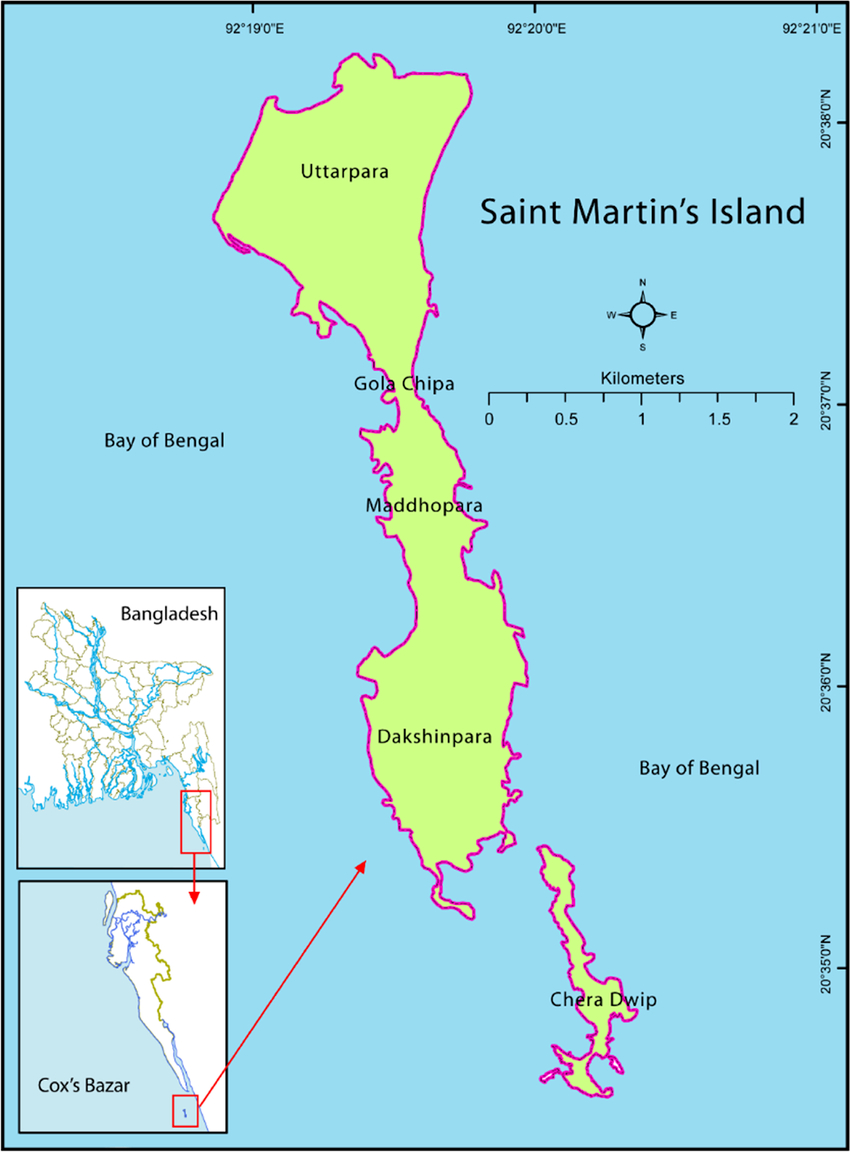
St. Martin’s Island is located in the northeastern region of the Bay of Bengal, near the maritime boundary betweenBangladesh and Myanmar.
It lies about 9 kilometerssouth of the Cox’s Bazar-Teknaf peninsula in Bangladesh.
The island is approximately 7.3 km long and is mostly flat, with an elevation of about 3.6 meters above mean sea level.
It is Bangladesh’s only coral island and is surrounded by coral reefs that extend 10-15 km to the west-northwest of the island.
Historical Background:
The island was originally part of the Teknaf peninsula but gradually submerged into the sea around 5,000 years ago.
It resurfaced approximately 450 years ago.
Arab merchants were among the first settlers in the 18th century. They named it “Jazira” and later “Narikel Jinjira” (Coconut Island).
In 1900, British India annexed the island, and it became known as St. Martin’s Island, named after a Deputy Commissioner of Chittagong.
Strategic importance:
Near the Strait of Malacca: Close to one of the world’s busiest maritime routes, making it strategically important for military oversight.It offers potential for monitoring maritime activities, including strategic interests of global powers.
Border with Myanmar: Proximity to Myanmar adds significance in regional security dynamics.
Other significance for Bangladesh:
It is part of Bangladesh’s EEZ, rich in marine resources like fish, oil, and gas. Also a key tourist destination.
It is important for biodiversity, with coral reefs and diverse marine life.
PYQ:
[2023] Consider the following pairs:
Area of conflict mentioned in news: Country where it is located
1.Donbas: Syria
2.Kachin: Ethiopia
3.Tigray: North Yemen
How many of the above pairs are correctly matched?
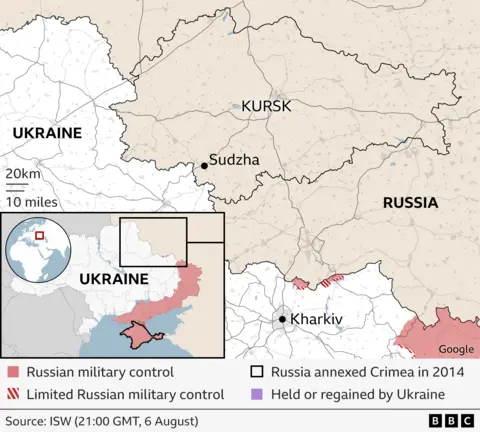
Ukrainian troops have advanced up to 35 kilometers into Russian territory in the Kursk region.
What is the Kursk Operation?
The Kursk operation marks a significant escalation in the ongoing conflict between Ukraine and Russia.
The operation has been characterized by intense fighting, with reports of casualties.
About Kursk Region:
It is located in the western part of Russia, bordering Ukraine to the southwest.
The region holds historical significance Battle of Kursk as the site of the, which took place from July to August 1943 and is recognized as the largest tank battle in history during World War II.
The Kursk region is rich in iron ore, which has led to substantial mining operations in the area.
The region experiences a continental climate, with cold winters and warm summers.
Significance of the Kursk Operation for Ukraine
Strategic Leverage: Strengthens Ukraine’s position in future negotiations by capturing Russian territory for potential land exchanges.
Buffer Zone Creation: Enhances security for contested Ukrainian areas by establishing a protective buffer on Russian soil.
Military Diversion: Forces Russia to redeploy troops, weakening their main front lines and easing pressure on Ukrainian forces.
PYQ:
[2023] Consider the following pairs:
Regions often mentioned in news
Reason for being in news
1. North Kivu and Ituri
War between Armenia and Azerbaijan
2. Nagorno-Karabakh
Insurgency in Mozambique
3. Kherson and Zaporizhzhia
Dispute between Israel and Lebanon
How many of the above pairs are correctly matched?
Q. The protests in Shahbag Square in Dhaka in Bangladesh reveal a fundamental split in society between the nationalists and Islamic forces. What is its significance for India? (UPSC IAS/2013)
Q. Critically examine the compulsions which prompted India to play a decisive roles in the emergence of Bangladesh. (UPSC IAS/2013)
Mentors’ comment: The political crisis in Bangladesh escalated dramatically following Prime Minister Sheikh Hasina’s resignation amid widespread protests against a controversial government job quota system. The unrest has led to significant violence, particularly against Hindu minorities, with reports of targeted attacks and rising casualties. The military has since established an interim government, raising concerns over regional stability and India’s strategic interests. The crisis threatens to disrupt bilateral trade, which reached $13 billion in FY 2023-24, and could impact ongoing infrastructure projects vital for connectivity between India and Bangladesh.
Let’s learn!
__
Why in the news?
Bangladesh is engulfed in chaos following Prime Minister Sheikh Hasina’s abrupt resignation amid escalating student protests over job quotas.
Why Hasina’s fall was not a surprise?
Long-standing Discontent: Widespread protests against Sheikh Hasina’s government had been brewing over issues like acontroversial quota system for government jobs, indicating significant public discontent.
Authoritarian Drift: Hasina’s government has been accused of suppressing opposition and civil society through measures like the Digital Security Act, which has been used to arrest critics and journalists.
Historical Context: Since gaining independence in 1971, Bangladesh has experienced several military coups, political assassinations, and periods of military rule, including the killing of Hasina’s father, Mujibur Rahman, in 1975.
Impact on India-Bangladesh relations:
Loss of a Trusted Ally
Hasina’s leadership enabled India to work closely with Bangladesh on security matters, countering terrorism and strengthening bilateral ties. Her resignation jeopardises India-Bangladesh’s relationship as political dynamics shift in Bangladesh.
Disruption of Trade and Economic Ties
India-Bangladesh bilateral trade reached $13 billion in FY 2023-24, making Bangladesh India’s largest trade partner in South Asia. Hasina’s exit could disrupt these gains, affecting the movement of goods and people.
Discussions for a potential India-Bangladesh Free Trade Agreement (FTA) initiated in October 2023 aimed to boost trade. However, the future of these talks remains uncertain with the interim government in place.
India had a $9.2 billion trade surplus with Bangladesh in FY24. The ongoing unrest has already caused issues like internet disruptions affecting banking and issuing letters of credit, concerning exporters.
Uncertainty over Infrastructure Projects
India has extended $8 billion in credit since 2016 for developing Bangladesh’s road, rail, shipping and port infrastructure. Projects like the Akhaura-Agartala rail link and Khulna-Mongla Port rail line, inaugurated in 2023, could face disruption.
A breakdown in ties could restrict India’s access to the Northeast, currently connected through narrow land corridors.
Existing bus routes and port usage agreements also face potential risks.
Way forward:
Engagement with All Political Factions: India must proactively engage with a broader spectrum of Bangladeshi political parties, including the opposition parties like the Bangladesh National Party (BNP) and Jamaat-e-Islami (JI).
Strengthening Economic Ties and Infrastructure Projects: India should prioritize the continuity of trade and infrastructure projects established under Hasina’s government. This includes reaffirming commitments to the $8 billion credit extended for infrastructure development and ensuring that transit arrangements remain intact.
Since WWII, U.S. foreign policy framed democracies vs. dictatorships, but this binary blurs with recent domestic political trends and shifting allegiances.
The binary between democracy and autocracy in the USA
Difference between Democracy and Autocracy
Democracy is defined as a system of government where the population, typically through elected representatives, exercises power. It emphasizes freedom, constitutional governance, and the protection of fundamental rights.
In contrast, autocracy is characterized by absolute power held by a single ruler, where the will of the ruler supersedes the rights and freedoms of individuals. Autocracies suppress dissent and limit political pluralism, often relying on force and coercion to maintain control.
Current Political Climate
The political landscape in the U.S. has shifted towards a more autocratic style of governance, particularly among factions within the Republican Party. This shift is marked by a growing acceptance of strongman leadership, which seeks to undermine traditional democratic norms and institutions.
Trump’s rhetoric and actions have often reflected a disdain for the checks and balances that are foundational to American democracy. His assertion of broad presidential powers and his attempts to consolidate authority signal a move away from democratic principles toward a more autocratic governance model.
Implications of the Shift
This trend raises concerns about the future of democracy in the U.S. Supporters of Trump and similar populist leaders often view the federal government as an adversary, promoting a narrative that pits “the people” against a corrupt establishment.
What are the different phases of transformation?
Rise of the Administrative State: The first phase was the rise of the administrative state under Theodore Roosevelt, Woodrow Wilson, Franklin Roosevelt, Lyndon Johnson and Richard Nixon.
This broadened the scope of government intervention and generated a complex bureaucracy to address social problems and welfare.
Centralizing Executive Power: As the administrative state grew, presidents needed to bring it under their direct control. During the 1980 transition, Ronald Reagan’s team employed a large staff to centralize control over policy, budgeting, and appointments. This led to the centralized apparatus that now resides in the Executive Office of the President.
In 2024, embracing autocratic tendencies: The populist faction of the Republican Party, concentrated among less educated, blue-collar, white, rural, and religious populations disadvantaged by globalization, embraces a strongman vision of leadership that operates beyond democratic norms.
Trump waged a campaign against norms and institutions of two-party politics, culminating in his efforts to overturn the 2020 election. The Supreme Court’s ruling granting Trump immunity from prosecution for official acts has significantly blurred the line between democracy and autocracy.
The present new normal
Erosion of Democratic Norms and Institutions: Trump showed disdain for legal limitations on presidential power and waged a campaign against democratic norms and institutions. His attempts to overturn the 2020 election results despite losing to Biden exemplified this authoritarian tendency.
Conservatism and Nationalism: Trumpism embraced conservative values like opposition to abortion, support for gun rights, and backing law enforcement.
Trump reshaped U.S. foreign policy to prioritize American interests over global cooperation and multilateralism.
Way forward:
Strengthen Democratic Institutions: Need to reinforce checks and balances to prevent executive overreach, enhance judicial independence, and protect electoral integrity to ensure democratic principles are upheld.
Promote Civic Education and Engagement: Need to educate citizens on democratic values, the importance of pluralism, and the dangers of autocracy to foster informed and active participation in the democratic process.
India will require significant political and diplomatic acumen to navigate the fallout from Sheikh Hasina’s fall, which could destabilize and potentially reshape the geopolitics of the subcontinent.
Why Hasina’s fall was not a surprise?
Long-standing Discontent: Widespread protests against Sheikh Hasina’s government had been brewing over issues like a controversial quota system for government jobs, indicating significant public discontent.
Authoritarian Drift: Hasina’s government has been accused of suppressing opposition and civil society through measures like the Digital Security Act, which has been used to arrest critics and journalists.
Historical Context: Since gaining independence in 1971, Bangladesh has experienced several military coups, political assassinations, and periods of military rule, including the killing of Hasina’s father, Mujibur Rahman, in 1975.
Five Challenges Beyond 1971
Engagement with Opposition: Due to prevailing political uncertainity, India need to distance itself from Hasina and engage with her opponents to maintain credibility and influence in Bangladesh.
Managing Regional Rivalries: India needs to prepare for potential exploitation of the situation by Pakistan and China, which may seek to influence the new government against Indian interests.
Historical Narratives: India needs to navigate the complex historical narratives surrounding the 1971 liberation of Bangladesh, recognizing that many in Bangladesh do not share the same interpretation.
Economic Stability: Ensuring economic stabilization in Bangladesh will be crucial, requiring collaboration with regional partners to prevent extremism and maintain stability.
Recognition of Local Agency: India must acknowledge that Bangladesh has its own political dynamics and agency, which cannot be solely dictated by Indian interests or actions.
What India must prepare for now? (Way forward)
Diplomatic Strategy: India needs to develop a proactive diplomatic strategy to engage with the new government in Bangladesh while avoiding perceptions of interference.
Security Concerns: India must be vigilant about border security and the potential resurgence of anti-India activities, especially if the new government leans towards Pakistan or China.
Economic Engagement: Strengthening economic ties and leveraging people-to-people connections will be essential for maintaining a positive relationship with Bangladesh, regardless of political changes.
Learning from Past Experiences: India should draw lessons from its past experiences with political transitions in the region, such as in Afghanistan, to navigate the current situation effectively.
Collaborative Approach: Working with international partners, including the US and Gulf nations, will be important to address the challenges posed by the political shift in Bangladesh and to ensure regional stability.
Mains PYQ:
Q Critically examine the compulsions which prompted India to play a decisive role in the emergence of Bangladesh. (2013)
Q1 The China-Pakistan Economic Corridor (CPEC) is viewed as a cardinal subset of China’s larger ‘One Belt One Road’ initiative. Give a brief description of CPEC and enumerate the reasons why India has distanced itself from the same. (UPSC IAS/2018)
Q2 China is using its economic relations and positive trade surplus as tools to develop potential military power status in Asia’, In the light of this statement, discuss its impact on India as her neighbour. (UPSC IAS/2017)
Prelims: Q ‘Belt and Road Initiative’ is sometimes mentioned in the news in the context of the affairs of: (a) African Union (b) Brazil (c) European Union (d) China
Note4Students:
Prelims: Internation groups in which India and China are both members;
Mains:Issues between India and China;
Mentor comments: India-China relations are characterized by a complex interplay of cooperation and conflict. Historically rooted in ancient civilizations, the two nations have faced significant challenges, particularly territorial disputes along their shared border. The 2020 clashes heightened tensions, leading to military standoffs and economic measures. Despite these issues, both countries recognize the importance of dialogue and mutual respect, as emphasized in recent diplomatic engagements. The “Five Mutuals” framework aims to foster cooperation, highlighting shared interests and the potential for collaboration in regional and global contexts.
Let’s learn!
__
Why in the News?
The appointment of a new Chinese ambassador to India in May 2024 signals a potential intent to normalize relations.
Five guidelines of ‘Mutuals’
Mutual Respect: This principle emphasizes the importance of recognizing and valuing each other’s unique cultural identities, social systems, and developmental paths.
Mutual Understanding: This guideline focuses on the need for empathy and support, particularly in acknowledging each other’s historical struggles for independence and development. It advocates for increased dialogue and communication at all levels to build political trust and a solid foundation for bilateral relations.
Mutual Trust: This principle highlights the necessity of overcoming suspicion and fostering a strategic perspective on bilateral relations. It encourages both countries to view each other as partners rather than competitors, promoting peaceful coexistence and the resolution of disputes through dialogue.
Mutual Accommodation: This guideline acknowledges that differences and frictions are natural between neighbouring countries. It stresses the importance of effectively managing these differences through dialogue and finding mutually acceptable solutions, ensuring that cooperation is not hindered by isolated incidents.
Mutual Accomplishment: This principle emphasizes the shared goals of national development and revitalization. It encourages China and India to support each other’s growth and collaborate on global issues, reinforcing the idea that their successes are interconnected and beneficial for both nations.
Issues between India and China:
Border Disputes: The most significant source of tension is the unresolved border disputes, particularly in regions like Aksai Chin and Arunachal Pradesh. The deadly clashes in Galwan Valley in 2020 marked a severe escalation, leading to a prolonged military standoff and ongoing military tensions along the Line of Actual Control (LAC).
Unequal Trade Relations: India faces a substantial trade deficit with China, leading to concerns about economic dependence. This imbalance has fueled economic nationalism and calls for reducing reliance on Chinese imports, further straining relations.
Strategic Alliances and Regional Influence: China’s strategic ties with Pakistan and its increasing influence in South Asia and the Indian Ocean have raised alarms in India.
India’s growing partnerships with the United States and other Quad members (Japan and Australia) are viewed by China as a challenge to its regional dominance, exacerbating the security dilemma between the two nations.
Political Pressure: China has used its influence to block India’s attempts to gain membership in international forums, such as the Nuclear Suppliers Group, and to prevent India from placing individuals wanted for terrorism on UN watchlists.
Need an ‘all-round relationship’ (Way forward)
Recognition of Differences: The relationship between China and India acknowledges the inevitability of differences and frictions due to their geographical proximity.
Understanding and correctly perceiving these differences is essential for developing a constructive relationship.
Dialogue and Mutual Accommodation: Byemphasizing the importance of dialogue, both nations can effectively address core interests and concerns, allowing them to reach mutually acceptable solutions. This approach is rooted in the political wisdom of their ancient civilizations.
Comprehensive Cooperation: The relationship is all-encompassing, meaning it should not be defined solely by specific differences.
Cooperation should be resilient enough to withstand isolated incidents, ensuring that broader collaboration continues.
Shared Development Goals: Both countries are at critical stages of national development and revitalization, with common interests that provide ample opportunities for cooperation.
This shared vision fosters mutual accomplishments, promoting unity and collaboration in the Global South.
During his welcome of Vietnamese Prime Minister Pham Minh Chinh, Prime Minister Narendra Modi emphasized the significance of freedom of navigation while subtly referencing China.
Evolution of Bilateral Relations to Strategic Partnership
Early Relations: Cultural and economic links between India and Vietnam date back to the 2nd century, with significant support from India during Vietnam’s struggles against colonialism and foreign intervention, particularly during the Vietnam War.
Formal Diplomatic Relations: Official diplomatic relations were established in 1992, marking the beginning of extensive economic ties, including cooperation in oil exploration, agriculture, and manufacturing.
Upgrade to Strategic Partnership (2007): The relationship was elevated to a “Strategic Partnership” during Vietnamese Prime Minister Nguyen Tan Dung’s visit to India in July 2007. This marked a significant step in formalizing cooperation across various sectors, particularly in defence and security.
Comprehensive Strategic Partnership (2016): During Indian Prime Minister Narendra Modi’s visit to Vietnam in September 2016, the partnership was further upgraded to a “Comprehensive Strategic Partnership.” This upgrade emphasized enhanced cooperation in defence, trade, and cultural exchanges, as well as a shared commitment to regional security.
Vietnam’s Remarkable Strides under Communist Party of Vietnam (CPV) Leadership
Economic Development: Under the CPV’s leadership, Vietnam has experienced significant economic growth and development, embracing a foreign policy of independence and multilateralism.
This approach has positioned Vietnam as a reliable partner in the region, fostering deeper economic ties with countries like India.
Strategic Investments: Vietnam has actively sought to attract Indian investments in various sectors, including renewable energy, pharmaceuticals, and technology.
The Vietnamese government has expressed gratitude for India’s support during the COVID-19 pandemic, particularly in vaccine distribution, which has further solidified ties between the two nations.
Building Bridges in Strategic Relationship through Foreign Policy
Shared Vision for the Indo-Pacific: Both Prime Ministers emphasized their commitment to a free, open, and rules-based Indo-Pacific.
Indian PM’s assertion that India supports development, not expansionism, reflects a mutual stance against aggressive territorial claims, particularly in the South China Sea, where both nations advocate for adherence to international law.
Collective Approach to Conflicts: The leaders highlighted the importance of a collective approach to resolving regional conflicts, including those in Myanmar and West Asia.
This stance underscores their commitment to multilateralism and regional stability, with Vietnam recognizing India’s role as a stabilizing force in the Indo-Pacific.
Significance of the Visit
Strengthening Strategic Ties: Prime Minister Chinh’s visit signifies a deepening of the strategic partnership, with both sides committing to enhanced cooperation in defence, maritime security, and economic development.
The agreement on a $300 million credit line for Vietnam’s maritime capabilities is a notable outcome of the discussions.
Cultural and Economic Connectivity: The visit also marked the signing of multiple agreements across various sectors, including customs, agriculture, and traditional medicine, demonstrating a comprehensive approach to enhancing bilateral relations.
The establishment of digital payment connectivity is another step towards strengthening economic ties.
Way forward:
Strengthening Economic and Trade Ties: Both nations should focus on achieving the proposed bilateral trade target of $20 billion by expanding cooperation in key sectors such as renewable energy, technology, and agriculture.
Enhancing Defense and Security Cooperation: To address regional security challenges, particularly in the context of the South China Sea, India and Vietnam should deepen their defence and security collaboration.
Prime Minister Narendra Modi’s anticipated visit to Ukraine next month should signify a reconfiguration of India’s strategy towards European security.
European Scenario
The war in Ukraine has put the question of Europe right at the top of India’s international agenda, necessitating a reconfiguration of India’s approach to European security.
India should see the war in Ukraine as an imperative for long overdue re-engagement with European peace and security, moving beyond treating it as a “pressure point” from the West or a moment for solidarity with Russia.
Europe is facing hard geopolitical dilemmas, torn between criticizing China, pleasing the US, and dealing with a resentful Russia willing to restructure the European security order.
India’s peace diplomacy in Ukraine, even in a limited way, would be worthwhile given the implications of the war for the Indian economy and security, as history shows that China benefits from conflicts between Russia and the West.
India’s Priorities
Re-engagement with European Security: The war in Ukraine has prompted India to reassess its approach to European geopolitics, which has been largely neglected in recent decades. India aims to strengthen its political and diplomatic ties with Europe, recognizing it as a crucial economic partner and a significant source of technology.
Balancing Relations with Russia and the West: India has maintained a careful balance in its relations with Russia while also courting Western powers. The historical ties with Russia, particularly in defence and energy, remain vital for India, especially as it increases its imports of discounted Russian oil.
Addressing Security Challenges: The ongoing conflict in Ukraine has complicated India’s security landscape, particularly with China’s growing ties to Russia and its strategic manoeuvres in Europe. India should navigate these complexities while ensuring its own security interests are safeguarded.
Promoting Peace Diplomacy: India is positioning itself as a mediator in the Ukraine conflict, emphasizing the importance of peace and dialogue. This diplomatic role not only enhances India’s global standing but also aligns with its long-term interests in promoting stability in a multipolar world.
Future outlook
India’s evolving global priorities reflect its ambition to assert itself as a significant player in international affairs, pursuing economic growth, security, and sustainable development while contributing to the emergence of a multipolar world order.
India’s role in shaping the future of global governance will continue to evolve as it navigates complex geopolitical dynamics and works towards its national interests and the common good of the international community.
Prime Minister Narendra Modi’s likely visit to Ukraine next month should mark a reconfiguration of India’s approach to European security, as the return of war to Europe has created multiple economic challenges for India and complicated its security challenges.
Way forward:
Proactive Diplomacy: India should actively engage with European countries and institutions to strengthen political and diplomatic ties.
Peace Mediation Efforts: India can leverage its neutral stance and diplomatic relations to facilitate peace dialogues and mediation efforts in the Ukraine conflict.
On July 25, Myanmar’s junta and an ethnic group both claimed control of Lashio’s military command after clashes began on July 3.
Background
The 2021 Military coup in Myanmar triggered sustained violent resistance which undermined military control.
Ethnic Armed Organisations (EAOs) and resistance groups, including the People’s Defence Forces (PDFs) and the Brotherhood Alliance, have made significant territorial gains.
The military’s fragile ceasefires have collapsed, leading to a loss of control in strategic areas, including Lashio, with reinforcements now concentrated near Mandalay.
The dominance of the Arakan Army
Large parts of Rakhine province have fallen under the control of the Arakan Army, an ethnic Rakhine Buddhist armed group.
The Arakan Army has seized territories on the borders with Bangladesh, including towns like Buthidaung, and is advancing towards important port cities on the Bay of Bengal coast like Kyauk Phyu, Sittwe, and Ngapali.
Control over these coastal areas gives the Arakan Army leverage to impact the implementation of infrastructure projects like China’s Belt and Road Initiative in Kyauk Phyu and India’s Kaladan project in Sittwe.
Objectives of Ethnic Armed Organizations (EAOs)
Major EAOs have refrained from declaring independence or creating new sovereign states, likely to avoid rallying renewed support for the military.
EAOs aim to establish a genuine federal democratic structure with maximum autonomy for provinces, with some advocating for a confederation.
Carving out new nation-states is challenging due to complex ethnic geographies and overlapping claims over homelands.
China’s Influence
China has engaged with multiple actors, including the military and various EAOs, to protect its massive investments and economic interests in the region.
Beijing has facilitated temporary ceasefires between the military and EAOs and maintains substantive relations with armed groups like the Brotherhood Alliance and United Wa State Army.
China has reportedly supplied defence equipment to both the military and EAOs, ensuring fragmented sovereignty in Myanmar
India’s role
India can share its experiences and institutional frameworks on federalism with stakeholders in Myanmar to help establish a new constitutional framework based on the principles of federalism and democracy.
Example: Despite the ongoing civil war, India has successfully constructed massive infrastructure projects in neighbouring Afghanistan, demonstrating its potential to contribute to regional peace and prosperity in Myanmar.
Way forward
Facilitate Dialogue and Mediation: To address the ongoing conflict in Myanmar, it is crucial for regional powers, including India and China, to facilitate dialogue between the military junta, Ethnic Armed Organizations (EAOs), and the National Unity Government (NUG).
Enhance Humanitarian Support and Development Initiatives: In parallel with diplomatic efforts, there should be an increase in humanitarian assistance to affected populations in conflict zones, particularly in Rakhine State and areas controlled by the Arakan Army.
Mains PYQ:
Q Examine the scope of Fundamental Rights in the light of the latest judgement of the Supreme Court on the Right to Privacy. (2020)
![[8th August 2024] The Hindu Op-ed: The leader who lost touch with Bangladesh](https://www.civilsdaily.com/wp-content/uploads/2024/08/8-Aug-1568x882.jpg)
![[3rd August 2024] The Hindu Op-ed: The five guidelines to a Dragon-Elephant tango](https://www.civilsdaily.com/wp-content/uploads/2024/08/3-Aug-1568x882.jpg)