India hosted a side event on Digital Health during the 77th World Health Assembly.The event saw participation from Quad countries (Australia, Japan, and the United States of America) and delegates from over 100 countries.
Key Highlights of the 7th WHA:
Transformative Role: India highlighted digital health’s role in ensuring equitable and accessible healthcare services, contributing to Universal Health Coverage and SDG 3.
India’s Advancements: WHA noted India’s success in implementing digital public infrastructure at scale, including Aadhaar for digital identities, Unified Payments Interface (UPI) for financial transactions, and Co-WIN for health service delivery during the pandemic.
Transition to UWIN: Co-WIN is being transformed into UWIN for the National Immunization Programme, facilitating immunization records for millions of newborns and mothers, as well as Anganwadi and school health records.
Ayushman Bharat Digital Mission (ABDM): India highlighted efforts under ABDM to create a robust national digital health ecosystem, with over 618 million Unique Health IDs (ABHA IDs) generated, 268,000 registered health facilities, and 350,000 healthcare professionals enlisted.
National Health Claims Exchange (NHCX): GoI is launching NHCX as part of ABDM to transform the insurance payments ecosystem, enabling real-time settlements with auto adjudication of claims through public-private partnerships leveraging digital public infrastructure.
India as a member of FIPIC, has pledged $1 million for relief efforts in flood-hit “Papua New Guinea” showcasing solidarity with the affected nation.
What is the Forum for India–Pacific Islands Cooperation (FIPIC)?
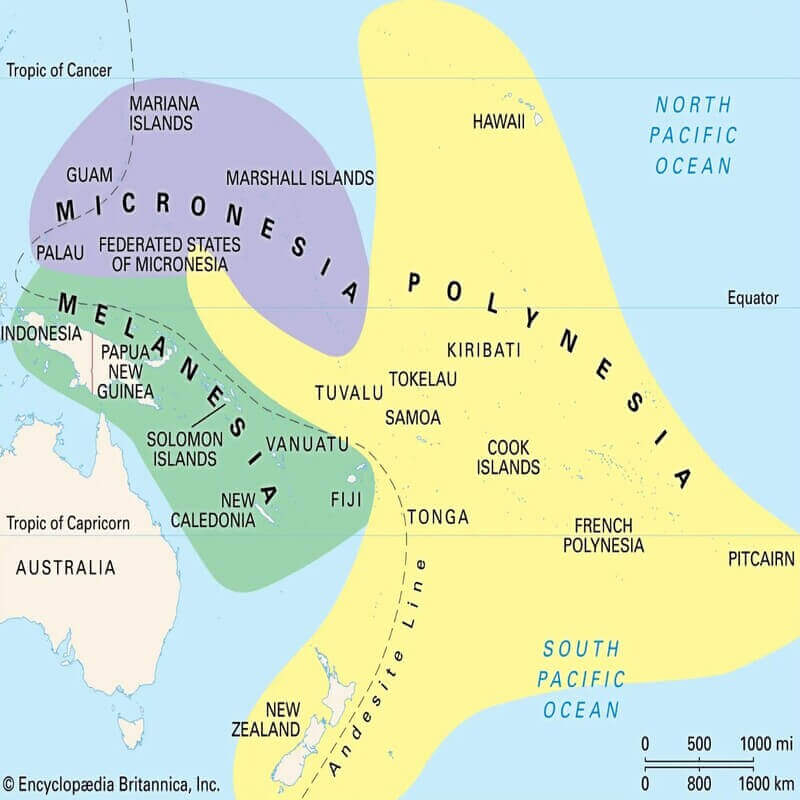
The Forum for India-Pacific Islands Cooperation (FIPIC) is a multilateral platform established by India to enhance cooperation with the Pacific Island countries.
FIPIC was established by India in 2014 during the first FIPIC Summit held in Suva, Fiji.
The initiative was announced by PM Narendra Modi as part of India’s broader “Act East” policy to strengthen engagement with the Pacific Island countries.
Overview
Purpose: To enhance India’s engagement with Pacific Island nations and support their development priorities through cooperative projects and initiatives.
Members: Includes India and 14 Pacific Islands nations (Cook Islands, Fiji, Kiribati, Marshall Islands, Federated States of Micronesia, Nauru, Niue, Samoa, Solomon Islands, Palau, Papua New Guinea, Tonga, Tuvalu, and Vanuatu).
Summits
First Summit – Suva, Fiji (November 2014)
Context: Initiated by Indian Prime Minister Narendra Modi following the re-establishment of democracy in Fiji.
Significance: The summit highlighted the geopolitical interest of major powers in the Pacific, with Chinese leader Xi Jinping visiting Fiji shortly after Modi.
Second Summit – Jaipur, India (August 2015)
Follow-up: As a continuation of the first summit, Modi invited the leaders of the 14 Pacific Islands to Jaipur.
Discussions: Covered cooperation in areas such as the blue economy, oil and natural gas, IT, healthcare, fishing, and marine research. Modi also assured to address their climate change concerns at the 2015 UN Climate Change Conference (COP 21) in Paris.
Third Summit – Papua New Guinea (May 2023)
Current Status: Most recent summit, emphasizing ongoing cooperation and collaboration between India and the Pacific Island nations.
Back2Basics: India’s Act East Policy
Details
Launched in
November 2014, by PM Modi
Objective
To promote economic cooperation, cultural ties, and develop a strategic relationship with countries in the Indo-Pacific region;
Enhancing India’s influence and economic development, especially in the North Eastern Region (NER).
Scope
Extends beyond ASEAN to include East Asian countries.
Intensive and continuous engagement in connectivity, trade, culture, defense, and people-to-people contact at bilateral, regional, and multilateral levels.
Key Dimensions (4C’s)
Culture
Commerce
Connectivity
Capacity building
Security Focus
Enhanced security cooperation, particularly in the context of Chinese assertiveness in the South China Sea and Indian Ocean.
Promoting freedom of navigation and securing India’s role in the region.
Historical Context (Look East Policy)
Look East Policy initiated in 1992 by Prime Minister P.V. Narasimha Rao.
Focused on strengthening economic integration and cultural ties primarily with ASEAN countries.
Aimed to bolster India’s role as a regional power and counter China’s strategic influence.
Evolution from Look East Policy
Act East Policy is an upgrade and expansion of the Look East Policy, incorporating more comprehensive engagement strategies, including security cooperation and broader geographical focus.
Significant Engagements
India’s active participation in regional forums like the East Asia Summit (EAS), ASEAN Regional Forum (ARF), and informal groupings such as the Quad.
Strategic partnerships and dialogues at various international platforms.
The 4th International Conference on Small Island Developing States (SIDS-4) is underway in Antigua and Barbuda.
What are Small Island Developing States (SIDS)?
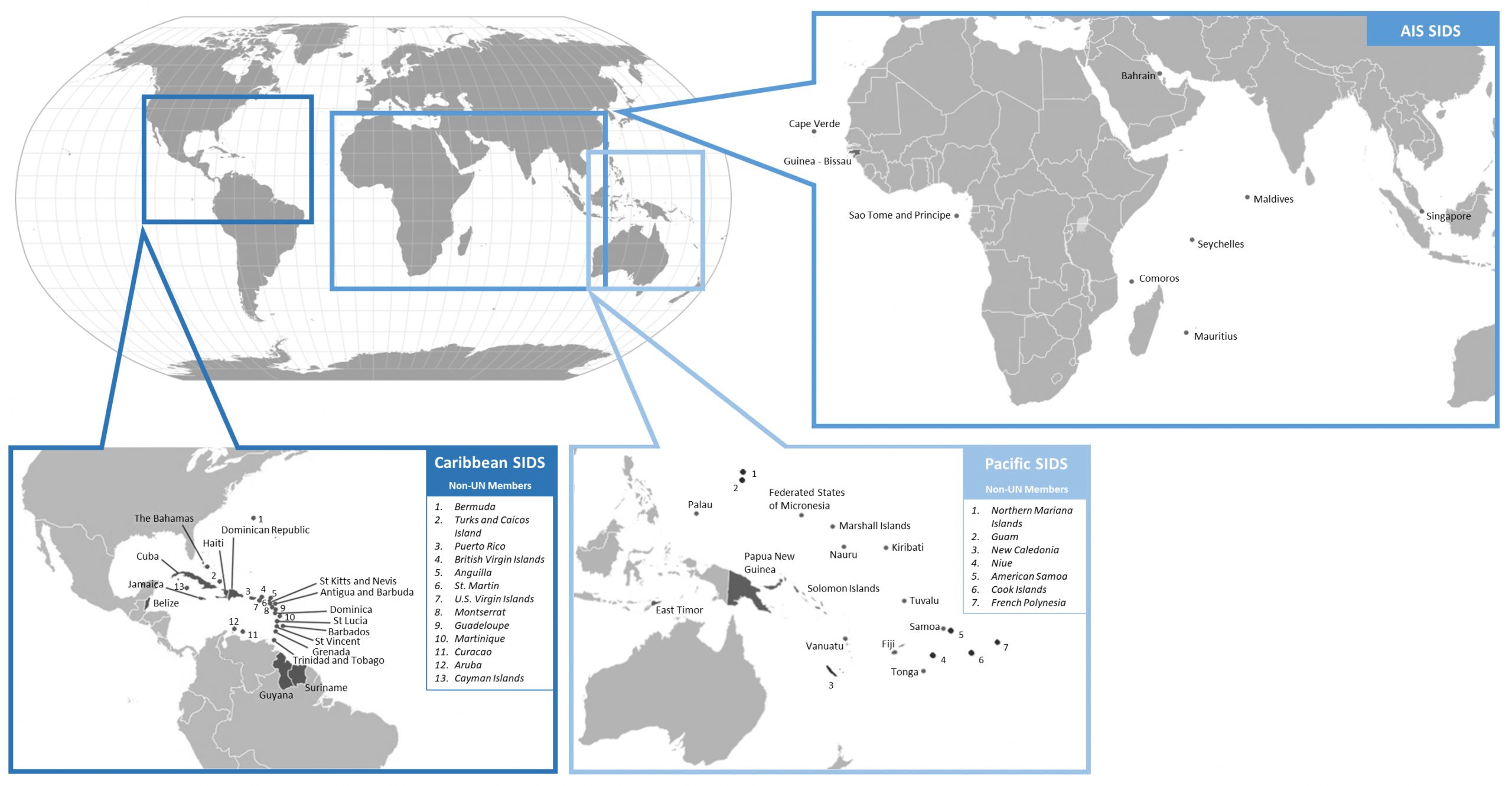
SIDS encompass 39 States and 18 Associate Members of United Nations regional commissions, facing unique social, economic, and environmental vulnerabilities.
SIDS are situated across three regions:
the Caribbean,
the Pacific
the Atlantic, Indian Ocean, and South China Sea (AIS).
Their distinctive challenges were acknowledged at the 1992 United Nations Conference on Environment and Development in Rio de Janeiro, Brazil.
SDGs supporting SIDS
Small island development states are mentioned in several of the Sustainable Development Goals.
For example, Target 7 of Sustainable Development Goal 14 (“Life below Water“) states-
“By 2030, increase the economic benefits to Small Island developing States and least developed countries from the sustainable use of marine resources, including through sustainable management of fisheries, aquaculture and tourism”.
Challenges Faced by SIDS:
Remote geography and reliance on external markets due to narrow resource bases contribute to high import/export costs.
Exclusive Economic Zone (EEZ), substantially larger than landmasses, provides vital resources but poses challenges like high transportation costs and vulnerability to economic shocks.
Biodiversity and Economic Significance:
Biodiversity sustains key industries like tourism and fisheries, often constituting over half of SIDS’ GDP.
Beyond economic benefits, biodiversity holds aesthetic and spiritual value, providing essential services like food supply, erosion prevention, and protection from natural disasters.
UN Programmes Supporting SIDS:
The Barbados Programme of Action (1994), Mauritius Strategy (2005), and Small Island Developing States Accelerated Modalities of Action (SAMOA) Pathway (2014) outline specific actions to achieve sustainable development and address gaps in implementation.
Barbados Programme of Action (1994): It prescribed actions enabling SIDS to achieve sustainable development.
Mauritius Strategy (2005): It addressed remaining gaps in implementing the Barbados Programme of Action.
SAMOA Pathway (2014): It emphasises challenges like climate change and biodiversity loss, outlining priorities for sustainable development.
These programmes underscore the ongoing commitment to supporting SIDS’ development and resilience.
Human Health and Social Development: Enhance food security, and water/sanitation, reduce non-communicable diseases, and promote gender equity.
Partnerships: Foster collaborations among SIDS, UN Agencies, development partners, and stakeholders to achieve sustainable development goals.
PYQ:
[2021] Describe the major outcomes of the 26th session of the Conference of the Parties (COP) to the United Nations Framework Convention on Climate Change (UNFCCC). What are the commitments made by India in this conference?
Q) With growing energy needs should India keep on expanding its nuclear energy programme? Discuss the facts and fears associated with nuclear energy. (250 Words, 15 Marks) (UPSC CSE 2018) Q) In what ways would the ongoing US-Iran Nuclear Pact Controversy affect the national interest of India? How should India respond to its situation? (250 Words, 15 Marks) (UPSC CSE 2018)
Prelims Consider the following countries (UPSC CSE 2015) 1) China 2) France 3) India 4) Israel 5) Pakistan Which among the countries given above are Nuclear Weapons States as recognized by the Treaty on the Nonproliferation of Nuclear Weapons, commonly known as the Nuclear Non-Proliferation Treaty (NPT)? (a) 1 and 2 only. (b) 1, 3, 4 and 5 only (c) 2, 4 and 5 only (d) 1, 2, 3, 4 and 5
Note4Students:
Prelims: Global Issues; Nuclear Non-Proliferation Treaty (NPT);
Mains: Global Security Issues; Nuclear Policies;
Mentor comment: When each country pursues its security without regard for others, we create global insecurity that threatens us all. Almost eight decades after the incineration of Hiroshima and Nagasaki, nuclear weapons still represent a clear danger to global peace and security, growing in power, range, and stealth. States possessing them are absent from the negotiating table, and some statements have raised the prospect of unleashing nuclear hell — “threats that we must all denounce with clarity and force.” Moreover, emerging technologies such as artificial intelligence and cyber and outer space domains have created new risks. We must find a way back to the negotiating table to fully implement the New Measures for the Further Reduction and Limitation of Strategic Offensive Arms or START Treaty.
Let’s learn.
–
Why in the News?
The leaders of France and Russia have raised alarm bells globally with tensions rising between major powers and the threat of nuclear weapons being used.
Background:
French President Macron has warned of an “apocalyptic vision” and the danger of nuclear “annihilation” due to Russia’s invasion of Ukraine. He plans to raise the nuclear aspect at an upcoming European meeting.
Russian President Putin has stated that Russia’s nuclear forces are always on alert and that Moscow will not tolerate Western threats. Russia has also revoked its ratification of the Comprehensive Nuclear Test Ban Treaty.
These statements reflect rising nuclear tensions between Russia and the West over the war in Ukraine. The international community has expressed concern over Russia’s nuclear posturing.
How does the specter of Nuclear conflict raise a Global concern?
Firstly, the absence of influential global leaders on the brink of a potential nuclear threat of war.
Russia is “ready for nuclear war” and would use such weapons if its sovereignty is threatened.
China has recently completed sea trials for an aircraft carrier fitted with electromagnetic catapults and is well on its way to building a fourth carrier.
Secondly, the prevailing economic turmoil across many regions in the world has exacerbated the situation, making the prospect of nuclear war more alarming.
The potential consequences of a nuclear war are catastrophic and far-reaching:
Immediate Effects
Incinerate cities: Intense heat and radiation would incinerate cities within the blast radius leaving millions would suffer fatal burns, blindness, internal injuries, and radiation poisoning.
Burden on Healthcare services: Hospitals and emergency services would be overwhelmed and unable to respond to the massive number of casualties.
Long-Term Effects
Economic Collapse: Radioactive fallout would expose survivors to dangerous radiation levels. Electromagnetic pulses could cripple electrical grids and modern technology.
Potential human extinction: Nuclear winter caused by soot and debris in the atmosphere could lead to global famine, killing billions of people.
Environmental Devastation: Large parts of the Earth could become uninhabitable due to radiation and climate changes. Contaminated Oceans and the extinction of much of Earth’s biological life are some of the long-lasting consequences.
BACK2BASICS
About the Comprehensive Nuclear-Test-Ban Treaty (CTBT):
TheCTBT is a multilateral treaty aimed at prohibiting all nuclear explosions, whether for civilian or military purposes, in all environments. It was adopted by the United Nations General Assembly in 1996 but has not yet entered into force.
The treaty requires ratification by eight key nations, including China, India, Pakistan, North Korea, Israel, Iran, Egypt, Russia, and the United States, which still need to ratify it for it to become effective.
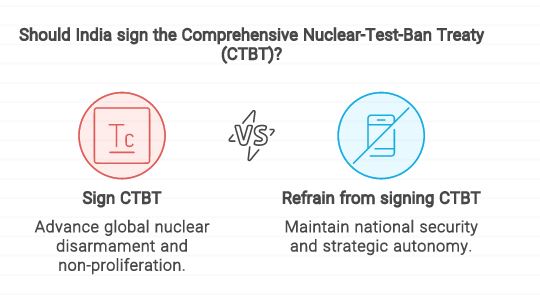
India avoids the signing of CTBT as it would undermine its National security and Strategic Autonomy, as it would constrain its ability to conduct nuclear tests.
The CTBT establishes a global monitoring system to verify compliance and allows for on-site inspections of suspicious events to ensure adherence to its provisions.The treaty’s primary goal is to end nuclear weapon test explosions and promote nuclear disarmament and non-proliferation efforts globally.
The Recent Discussion at the Hoover Institution:
The discussion focused on the U.S.-India civil nuclear deal (2005-08) and its impact on bilateral relations, despite the current nuclear tensions in Europe.
The deal brought a fundamental change in U.S.-India relations, with relevance to resolving current disputes.
India and the U.S. made significant concessions to negotiate the deal:
India agreed to separate its nuclear program and accept safeguards, export controls, and a testing moratorium.
The U.S. amended laws, obtained NSG approval, and helped India get an IAEA safeguards agreement.
The deal lifted roadblocks preventing India from joining the global nuclear regime, giving it a status similar to a nuclear weapon state under the NPT.
Conclusion: The discussions at the Hoover Institution seemed to be that the deal had even more significance than merely an arrangement about revising India’s nuclear status. From India’s standpoint, the India-U.S. nuclear deal originated from India’s desire to obtain high-grade uranium from outside to complement its energy requirements, the deal confirms that nuclear energy could be a major resource for peaceful purposes.
Global AI governance is becoming increasingly intricate, with countries employing diverse approaches. This shows that the Global treaties may face significant challenges despite widespread support.
About the Council of Europe (COE)
The COE is an intergovernmental organization established in 1949. It currently has 46 member states, including the Holy See, Japan, and the U.S., alongside EU countries.
Aim: To uphold human rights, democracy, and the rule of law in Europe.
What is Europe’s AI convention?
Europe’s AI convention, officially known as the Framework Convention on Artificial Intelligence and Human Rights, Democracy and the Rule of Law, represents a significant milestone in AI governance.
Adopted by the Council of Europe (COE) on May 17, this convention addresses the pressing need for comprehensive regulation of AI, particularly concerning its impact on human rights, democracy, and the rule of law.
The scope of the Framework Convention on Artificial Intelligence and Human Rights, Democracy, and the Rule of Law encompasses:
It ensures that activities throughout the lifecycle of Artificial Intelligence (AI) systems align fully with Human Rights, Democracy, and the Rule of Law.
Consistent with the EU AI Act and the OECD’s definition, an AI system is defined as a machine-based system that generates outputs based on input to influence physical or virtual environments.
Coverage:
Application by Parties: The convention applies to activities involving AI systems conducted by both public authorities and private actors acting on their behalf.
Addressing Risks: Parties are required to address risks and impacts from AI systems activities by private actors that are not covered under (a) in a manner consistent with the convention’s objectives.
Difference Between a Framework Convention and a Protocol
Framework Convention: A legally binding treaty specifying broad commitments and objectives.Allows parties discretion in achieving objectives, adapting to their capacities and priorities.Example: Convention on Biological Diversity.
Protocol: Specific agreements are negotiated under a framework convention. Sets specific targets or detailed measures to achieve the broader objectives of the framework convention.Example: Cartagena Protocol on Biosafety under the Convention on Biological Diversity.
Addressing National Security in the AI Convention
Exemptions for National Security: Articles 3.2, 3.3, and 3.4 provide broad exemptions for national security interests, research, development, testing, and national defense, excluding military AI applications from the convention’s scope.
Balancing Flexibility and Regulation: Article 3(b) allows parties some flexibility in applying the convention to the private sector, preventing total exemption but accommodating national security needs.
General Obligations: Articles 4 and 5 ensure the protection of human rights, democratic integrity, and the rule of law, requiring parties to address disinformation and deep fakes as part of their national security measures.
Scope for Further Action: Article 22 allows parties to exceed specified commitments, enabling additional measures to address national security concerns related to AI.
Conclusion: The AI convention is essential because it reinforces existing human and fundamental rights within the context of AI applications, rather than creating new rights. It emphasizes the need for governments to uphold these rights and implement effective remedies and procedural safeguards.
Mains PYQ:
Q “The emergence of the Fourth Industrial Revolution (Digital Revolution) has initiated e-Governance as an integral part of government”. Discuss.(UPSC IAS/2020)
An official stated on Tuesday that India opposes a China-led proposal on investment facilitation at the WTO, arguing that it is a ‘non-trade’ issue beyond the global trade body’s mandate.
About Plurilateral Agreement/Pact:
A plurilateral agreement is a trade agreement between more than two countries, but not necessarily encompass all members of a larger organization such as the World Trade Organization (WTO).
These agreements are binding only on the signatories and not on the entire membership of the organization under annexure-4 of the WTO.
They allow for deeper integration among interested parties without requiring full consensus, which can be difficult to achieve in larger multilateral frameworks.
What is the China-led Investment Facilitation for Development Agreement (IFD)?
The IIFD Agreement is a proposed pact by China, with support from other countries, to streamline and facilitate foreign investment.
The main objectives of the IFD Agreement include:
Enhancing transparency of investment measures.
Streamlining and speeding up investment-related authorization procedures.
Promoting international cooperation, information sharing, and exchange of best practices.
Encouraging sustainable investment practices.
The proponents of the IFD argue that it would bring benefits to all WTO members, especially developing and least-developed countries, by creating a more predictable and transparent investment climate.
India’s Strong Stand against the IFD at WTO MC13
India has taken a firm stance against the inclusion of the IFD Agreement in the WTO framework for several reasons:
Investment is Not a Trade Issue: India argues that investment does not fall within the traditional purview of the WTO, which primarily focuses on trade issues. It points out that past Ministerial decisions have explicitly kept investment outside the WTO’s scope.
Sovereignty Concerns: A significant concern for India is the potential impact on its policy space. The IFD Agreement includes provisions that would require the government to consult with investors on policy matters, which India fears could undermine its ability to make sovereign decisions.
Lack of Consensus: India, along with South Africa, has highlighted the absence of a unanimous consensus among WTO members regarding the inclusion of the IFD as a plurilateral agreement. They argue that without exclusive consensus, it should not be brought onto the formal agenda.
Policy Autonomy: India is wary that the IFD Agreement’s requirements could constrain its autonomy in regulating investments to align with national development priorities and strategies.
Procedural Concerns: India contends that the issue should not have been part of the MC13 agenda and instead, should be discussed at the General Council, given the divisive nature of the proposal among WTO members.
Conclusion: India’s opposition to the IFD Agreement at the WTO stems from a combination of concerns about preserving national sovereignty, adhering to established WTO boundaries regarding trade versus investment issues, and ensuring that any significant changes in the WTO framework are backed by broad-based consensus.
Mains PYQ:
Q The broader aims and objectives of WTO are to manage and promote international trade in the era of globalisation. But the Doha round of negotiations seems doomed due to differences between the developed and the developing countries.” Discuss in the Indian perspective. (UPSC IAS/2016)
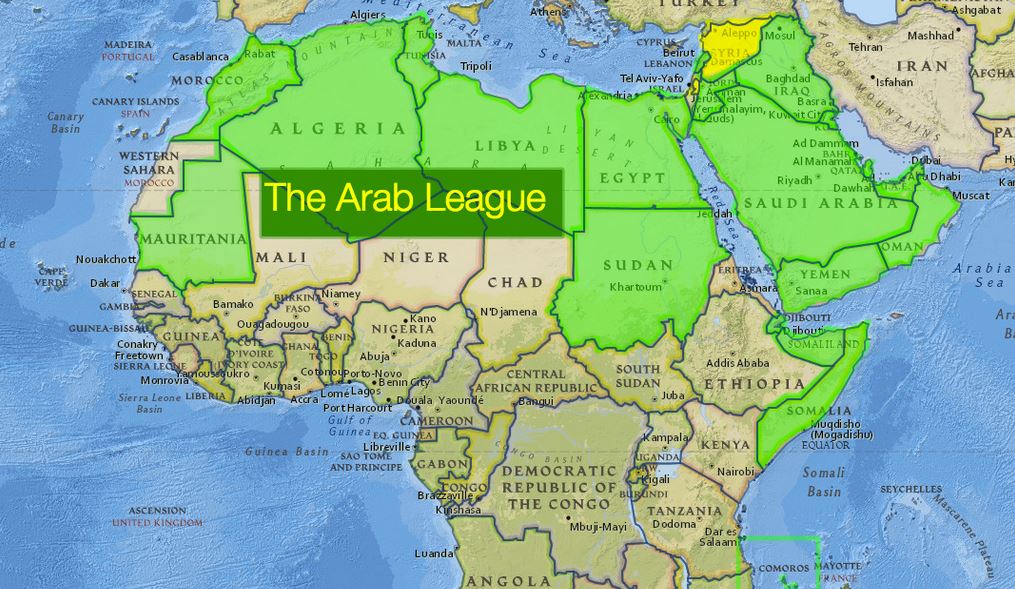
The Arab League called for UN peacekeeping forces in the Palestinian territories during a summit in Bahrain’s Manama. The “Manama Declaration” issued by the league sought UNPKF in the occupied Palestinian territories” until a two-state solution is implemented.
Back2Basics: United Nations Peacekeeping
UN Peacekeeping is a collective effort by the international community, led by the United Nations, to maintain peace and security in regions affected by conflict.
UN peacekeepers are often referred to as Blue Berets or Blue Helmets because of their light blue berets or helmets) can include soldiers, police officers, and civilian personnel.
History:
The concept of UN peacekeeping emerged in the aftermath of World War II, with the establishment of the United Nations in 1945.
The first UN peacekeeping mission was established in 1948, following the Arab-Israeli War, to monitor the ceasefire between Israel and its Arab neighbours.
This mission, known as the United Nations Truce Supervision Organization (UNTSO), set the precedent for future peacekeeping operations.
Since then, the scope and complexity of UN peacekeeping have evolved significantly, with operations conducted across the globe in regions affected by conflict, civil war, and humanitarian crises.
Operations:
UN Peacekeeping is guided by three basic principles:
Consent of the parties
Impartiality
Non-use of force except in self-defence and defence of the mandate
UN peacekeeping operations are deployed with the consent of the main parties to the conflict. It can be deployed at the request of the partiesinvolved in a conflict or with the authorisation of the UN Security Council.
The objectives may vary depending on the specific context but often include monitoring ceasefires, disarming combatants, facilitating the delivery of humanitarian aid, promoting human rights, and supporting the establishment of democratic governance structures.
UN peacekeeping operations operate under the principles of impartiality, consent of the parties, and non-use of force except in self-defence and defence of the mandate.
India’s Role:
India has been one of the largest contributors to UN peacekeeping operations since their inception.
India has contributed nearly 195,000 troops, the largest number from any country, and participated in more than 49 missions and 168 supreme sacrifices while serving in UN missions.
About Arab League
Details
Establishment
Founded on March 22, 1945, in Cairo, Egypt.
Founding Members
Egypt, Iraq, Jordan, Lebanon, Saudi Arabia, Syria.
Objective
Promote economic, cultural, political, and military cooperation among member states. Safeguard independence and sovereignty.
Functions
Operates on consensus among member states. Decisions are made through consultations and discussions.
Regular meetings among Arab leaders to address regional issues, formulate policies, and coordinate actions.
Specialised committees and councils address specific areas of cooperation, such as economic affairs, social affairs, and defence.
Member States
Egypt, Iraq, Jordan, Lebanon, Saudi Arabia, Syria, Libya, Tunisia, Algeria, Bahrain, Comoros, Djibouti, Kuwait, Mauritania, Morocco, Oman, Palestine, Qatar, Somalia, Sudan, United Arab Emirates, and Yemen.
Observer Nations
Non-Arab countries with observer status include Brazil, Eritrea, India, Venezuela, and others.
No voting rights are accorded to Observer nations.
Important Achievements
Proposal of the Arab Peace Initiative in 2002.
Coordination of military efforts in various conflicts.
Promotion of economic cooperation through initiatives such as the Arab Free Trade Area.
Facilitation of cultural and educational exchange programs among member states.
Challenges
Internal divisions, Differences of opinion over the Palestinian-Israeli conflict etc.
PYQ:
[2014] Recently, a series of uprisings of people referred to as ‘Arab Spring’ originally started from
Q) The China Pakistan Economic Corridor (CPEC) is viewed as a cardinal subset of China’s larger ‘One Belt One Road’ initiative. Give a brief description of CPEC and enumerate the reasons why India has distanced itself from the same. (150 Words, 10 Marks). (UPSC CSE 2018)
Q) What introduces friction into the ties between India and the United States is that Washington is still unable to find for India a position in its global strategy, which would satisfy India’s National self-esteem. (UPSC CSE 2019)
Prelims:
‘Belt and Road Initiative’ is sometimes mentioned in the news in the context of the affairs of (UPSC CSE 2016) (a) African Union (b) Brazil (c) European Union (d)China
Note4Students:
Prelims: Global Issues; West Asia; East-Europe Economic Corridor (IMEC);
Mains: Global Security Issues; West Asia; Trades;
Mentor comment: In a world of shifting geopolitical landscapes, India embarked on a grand vision to reshape its economic and strategic ties with the world. At the heart of this vision lay the India-Middle East-Europe Economic Corridor (IMEC), a path-breaking initiative that promised to transform the way India engaged with its partners across the Eurasian landmass. The story began in September 2023, when India, along with the European Union, France, Germany, Italy, Saudi Arabia, the United Arab Emirates (UAE), and the United States, signed an agreement to bring IMEC to life. This ambitious project, designed under the Partnership for Global Infrastructure and Investment (PGII), aimed to stimulate economic development through enhanced connectivity and integration between Asia, the Arabian Gulf, and Europe. For India, IMEC represented a strategic opportunity to assert its presence on the global stage and counter the growing influence of its rival, China.
Let’s learn.
–
Why in the News?
After India signed a landmark 10-year bilateral contract with Iran (Chabahar Port), the U.S. State Department has warned of potential sanctions for any entity considering business deals with Iran.
In the past, American sanctions had delayed the project, which was conceived in 2003.
Practically, the signing of a long-term agreementmarks a significant milestone in India’s infrastructure and trade partnership with Iran.
However, considering US sanctions, India also needs to focus on the next upcoming IMEC Project which is stalled due to West Asian tensions.
How IMEC is countering the Belt and Road Initiative (BRI)?:
IMEC has two corridors – the East corridor (India to Arabian Gulf) and the North corridor (Arabian Gulf to Europe).
1.The East Corridor connects the Indian ports of Kandla, Mumbai, and Mundra to UAE’s ports like Fujairah, Jebel Ali, and Abu Dhabi by sea. 2. The North Corridor link is the Railroad link through Saudi Arabia, and Jordan to European regions like Haifa, Marseille, Messina, and Piraeus.The Railway network for cross-border ship-to-rail transit is based on electricity, digital connectivity, and clean hydrogen export infrastructure.
Significance of IMEC over BRI: It secures regional supply chains by overcoming Pakistan’s obstacle to overland access.
It increases Trade Accessibility and Facilitation which will be effective in countering China’s Belt and Road Initiative (BRI) as it will reduce time by 40% and cost by 30% of transporting goods from India to Europe. Hence, the U.S. is also a major stakeholder.
What is the impact of the recent Gaza War on IMEC? (Challenges faced)
War in Gaza led to project stall; in fact, Iran is threatening to close the Strait of Hormuz.
For example, Adani Group’s plans for Haifa port expansion halted.
The present Gulf region is facing trade and security issues due to ‘Houthis’ blocking Red Sea access for Israel and its allies.
Due to increased shipping time and insurance costs (due to unsafe routes), the trade barriers and eventually inflation have also being increased.
The Role of Oman and Egypt in Strengthening IMEC: (Way Forward)
Oman as an Alternative: Oman’s ports in the Arabian Sea, away from Iranian influence which is the closest and most direct link to Indian ports.Secondly, Oman also has good relations with all its stakeholders
Extending to Egypt: Egypt can act as an alternate spur through Egypt to Mediterranean ports in Europe. This will provide a safe and direct sea route to Europe. Secondly, Egypt’s inclusion balances regional dynamics and has good relations with Israel, Europe, and the U.S.
Conclusion: Today, as the world watches with bated breath, IMEC stands as a testament to India’s vision and determination. It is a story of how a nation, once constrained by geography and politics, found a way to break free and forge its path in the global arena. And as the story continues to unfold, one thing is certain: IMEC will forever change the way India engages with the world, and the world engages with India.
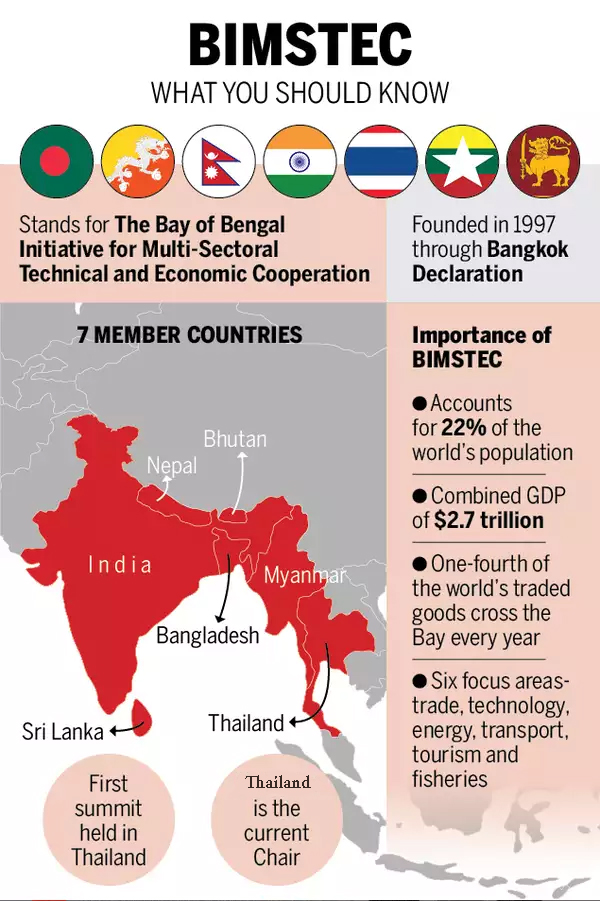
The Ministry of External Affairs has announced that with the establishment of its inaugural charter on May 20th, the Bay of Bengal Initiative for Multi-Sectoral Technical and Economic Cooperation (BIMSTEC) will now accept new members and observers.
About BIMSTEC:
The Bay of Bengal Initiative for Multi-Sectoral Technical and Economic Cooperation (BIMSTEC) formed in 1997 is a multilateral regional organization comprising seven member states: Bangladesh, Bhutan, Sri Lanka, Nepal, Thailand, Myanmar, and India.
Aim: To promote technical and economic cooperation among its member countries, particularly in sectors such as security, connectivity, trade, agriculture, environment, science and technology, and people-to-people contact.
Adoption of the Charter:
After years of deliberation, the BIMSTEC leaders adopted the organization’s first charter during their 5th summit.
This charter provides a legal framework for the group, granting it a “legal personality” and enabling the structured diplomatic dialogue with other countries and regional groupings.
In the context of international organizations like BIMSTEC, obtaining legal personality means that the organization is recognized as a legal entity in its own right, separate from its member states.
Significance of BIMSTEC for all member countries:
The charter’s implementation enhances cooperation and deeper integration within the Bay of Bengal region, benefiting all member states economically and strategically.
Enhanced Cooperation: With the charter in place, member countries can engage in more structured and organized cooperation across various sectors such as security, connectivity, trade, agriculture, environment, science and technology, and people-to-people contact.
Strengthened Regional Integration: The charter facilitates deeper integration within the Bay of Bengal region. By establishing common goals and mechanisms for cooperation, it promotes economic growth, social development, and cultural exchange among member countries.
Diplomatic Dialogue: The charter enables BIMSTEC to enter into structured diplomatic dialogue with other countries and regional groupings. This opens up avenues for broader engagement and partnership, enhancing the geopolitical significance of the BIMSTEC platform.
Challenges in the present world context:
Historical Discord: Long-standing historical discord between member states, such as Bangladesh and Myanmar, presents a challenge to cohesive cooperation within BIMSTEC. These tensions can hinder progress on joint initiatives and impede the organization’s effectiveness.
Geopolitical Complexities: Geopolitical complexities, exacerbated by events like the Rohingya refugee crisis and the coup in Myanmar, add layers of complexity to regional dynamics.
These complexities can strain relationships between member states and complicate efforts to foster collaboration and integration within BIMSTEC.
Stagnation of SAARC: While BIMSTEC offers an alternative platform for regional cooperation, the near stagnation of SAARC underscores the challenges faced by regional organizations in fostering meaningful collaboration.
Way forward:
Need a Conflict Resolution Mechanisms: Implement effective conflict resolution mechanisms to address historical discord and tensions between member states.
High Diplomatic Engagement: Encourage regular diplomatic engagement and dialogue between member states to address geopolitical complexities and build trust.
Mains PYQ
Q Do you think that BIMSTEC is a parallel organization like the SAARC? What are the similarities and dissimilarities between the two? How are Indian foreign policy objectives realized by forming this new organization? (UPSC IAS/2022)
On 20 May 2024, the Prosecutor of the International Criminal Court (ICC) requested arrest warrants against leaders of Hamas and Prime Minister Benjamin Netanyahu of Israel about the events of October 7, 2023, and the conflict in Palestine.
What is the International Criminal Court?
The International Criminal Court formed in 2002, is an Intergovernmental Organization and International Tribunal seated in the Hague, Netherlands.
It deals with the most serious crimes of concern to the international community, including genocide, crimes against humanity, war crimes, and crimes of aggression.
Unlike the international tribunals, the International Criminal Court is a permanent body.
Against whom has the Prosecutor requested warrants of arrest?
Specifically, warrants have been sought for senior Hamas leaders Yahya Sinwar, Mohammed Deif, and Ismail Haniyeh, along with Netanyahu and Israel’s Minister of Defence Yoav Gallant.
The process of ICC decision-making and the scope of the present case:
ICC decisions are binding, but they rely on the cooperation of member states for support.
A panel of judges at the ICC must decide on the Prosecutor’s application for arrest warrants.
If approved, all State Parties are obligated to cooperate, including arresting and extraditing the accused individuals to The Hague.
This could restrict international travel for Netanyahu and Gallant, affecting visits to countries that are State Parties to the Rome Statute.
Israel is not a Party to the Rome Statute. However, the ICC does have jurisdiction over crimes committed by nationals of both State Parties (such as Palestine) and Non-state Parties (such as Israel) on the territory of a State Party (such as Palestine).
International Criminal Court (ICC) Vs. International Court of Justice (ICJ)
ICC
ICJ
Relationship with the UN
ICC is an independent organization not part of the United Nations
ICJ is an integral part of the UN and acts as its primary judicial branch
Members
ICC has around 105 members, focusing on prosecuting individuals for crimes.
ICJ has all 193 UN member countries as its members, primarily resolving disputes between states
Derivation of Authority
ICC derives its authority from the Rome Statute, focusing on prosecuting individuals for crimes against humanity, war crimes, genocide, and crimes of aggression.
ICJ derives its authority from the Charter of the United Nations, settling disputes between countries based on international law
Funding
It mainly functions on contributions made by state parties to the Rome Statute and voluntary contributions
Its funding sources differ based on its status as an organ of the United Nations
Way forward:
Need Enhanced Cooperation: Encouraging greater cooperation between the ICC and the UN to strengthen their effectiveness in addressing international crimes.
Need Wider Membership: Advocating for more countries to become State Parties to the Rome Statute to broaden the ICC’s jurisdiction and reach.
Mains PYQ:
Q India’s relations with Israel have, of late, acquired a depth and diversity, which cannot be rolled back.” Discuss. (UPSC IAS/2018)
![[27 May 2024] The Hindu Op-ed: The spectre of nuclear conflict, once again](https://www.civilsdaily.com/wp-content/uploads/2024/05/27-may1-1568x882.jpg)
![[25 May 2024] The Hindu Op-ed: The missing links in IMEC, as shown by the Gaza war](https://www.civilsdaily.com/wp-content/uploads/2024/05/25-may-1568x882.jpg)