💥Join UPSC 2027,2028 Mentorship (July Batch) + XFactor Notes & Microthemes PDF

Subject: International Relations

  • Maldives bans ‘India Out’ Campaign

    Maldivian President Ibrahim Mohamed Solih issued a decree banning the ‘India Out’ campaign, now led by former President Abdulla Yameen, terming it a “threat to national security”.

    The India-Out Campaign

    • Maldivian protesters recently demanded the Solih administration to ‘stop selling national assets to foreigners’, implying India.
    • ‘India Out’ campaign in Maldives had started sometime last year as on-ground protests in the Maldives and later widely spread across social media platforms under the same hashtag.
    • It is not related to people-to-people conflict (Indian diaspora) but is discontent on close relationship between Maldivian government & India.

    Causes for the anti-India sentiments

    • Political instability: The anti-India sentiment is nearly a decade old and can be traced back to when Abdulla Yameen Abdul Gayoom became president in 2013. He used anti-India sentiments for his political mobilization and started tilting China.
    • Controversy over helicopter gift: Two Dhruv Advanced Light Helicopters (ALF) that were given by India to the Maldives for ocean search-and-rescue operations. Opposition tried to portray this as military presence in the country.
    • Confidential agreements: Most agreements being signed between the Ibrahim Solih government and India are backdoor and has not been publicly discussed in the Maldives Parliament.
    • Alleged interference in domestic politics: India being a big neighbour, there are unsubstantiated perceptions & allegations on Indian Diplomats stationed in Maldives interfering in Domestic affairs.

    Restoration of ties

    • Ibrahim Mohamed Solih who became President in 2018 has restored Maldives close ties with India.

    India-Maldives Relations: A backgrounder

    • India and Maldives are neighbors sharing a maritime border.
    • Both nations established diplomatic relations after the independence of Maldives from British rule in 1966.
    • India was one of the first nations to recognize Maldives’ independence.
    • Since then, India and Maldives have developed close strategic, military, economic and cultural relations.
    • Maldivians generally regard Indians and India as a friend and trusted neighbor in the field economic, social and political.

    Major irritants in ties

    • Political Instability: India’s major concern has been the impact of political instability in the neighborhood on its security and development.
    • Increasing radicalization: In the past decade or so, the number of Maldivians drawn towards terrorist groups like the Islamic State (IS) and Pakistan-based jihadist groups has been increasing.
    • Inclination towards terror: Radicalism in the island nation has increased the possibility of Pakistan-based terror groups using remote Maldivian islands as a launch pad for terror attacks against India and Indian interests.
    • Chinese affinity: China’s strategic footprint in India’s neighborhood has increased. The Maldives has emerged as an important ‘pearl’ in China’s “String of Pearls” construct in South Asia.

    Recent gestures by India

    [1] 2014 Malé drinking-water crisis

    • In the wake of a drinking water crisis in Malé in December 2014, following collapse of the island’s only water treatment plant, Maldives urged India for immediate help.
    • India came to rescue by sending its heavy lift transporters like C-17 Globemaster III, Il-76 carrying bottled water.

    [2] 2020 Covid-19 crisis

    • During the COVID-19 crisis of 2020, India extended help to Maldives in the form of financial, material and logistical support.
    • Also, the IAF airlifted 6.2 tonnes of essential medicines and hospital consumables to Maldives, as part of ‘Operation Sanjeevani’.

    [3] Greater Male Connectivity Project

    • India has recently announced the signing of a $500-million infrastructure project for the construction of the Greater Malé Connectivity Project (GMCP).
    • This infrastructure project, the largest-ever by India in the Maldives, involves the construction of a 6.74-km-long bridge and causeway link.

    Why is Maldives significant for India?

    • Increasing maritime cooperation: As maritime economic activity in the Indian Ocean has risen dramatically in recent decades, the geopolitical competition too in the Indian Ocean has intensified.
    • Toll Gate in Indian Ocean: It is situated at the hub of commercial sea-lanes running through the Indian Ocean. More than 97% of India’s international trade by volume and 75% by value passes through the region.
    • Naval cooperation: Maldives is an important partner in India’s role as the net security provider in the Indian Ocean Region.
    • Important SAARC member: Besides, Maldives is a member of the South Asian Association for Regional Cooperation (SAARC) and the South Asia Subregional Economic Cooperation (SASEC).
    • People To People Contact: There is a significant population of Maldivian students in India. They are aided by a liberal visa-free regime extended by India. There is also medical tourism.
    • Major destination for Tourists: Tourism is the mainstay of the Maldivian economy. The country is now a major tourist destination for some Indians and a job destination for others.

    Conclusion

    • There is a significant Indian diaspora in the Maldives. Innumerable Indians work across the hospitality, education, and health-care sectors of the Maldives economy.
    • India must use its Diaspora more extensively for strengthening its relations.


    UPSC 2022 countdown has begun! Get your personal guidance plan now! (Click here)

  • India’s role in a disordered world

    Context

    Western nations want to throw Russia out of the G-20. China has opposed them. India will be chair of the G-20 from December 1, 2022. The world is greatly disordered. What should India stand for?

    Challenges to the global order

    • The war in Ukraine in February 2022 has put the final nail in the coffin of the boundary-less global economy that seemed to be emerging with the fall of the Berlin Wall and the collapse of the Soviet Union in 1991.
    • Vaccines were hoarded by rich countries in the COVID-19 pandemic: poor countries starved.
    • The World Trade Organization (WTO) was already in a bad state before the novel coronavirus pandemic, with rich and poor countries unable to agree on equitable rules, when COVID-19 froze global supply chains.
    • Institutions of global governance have failed to unite the world.

    Global order and governance challenge

    • In the aftermath of the Second World war, new institutions for global governance were established — the United Nations and the General Agreement on Tariffs and Trade (GATT), and the World Bank and the International Monetary Fund (IMF) to provide finance to build the economies of all countries to eliminate poverty.
    • However, the victors retained their veto power within the United Nations Security Council to determine when force can be used to keep the world in order, and to prevent the proliferation of nuclear power.
    • The UN General Assembly meets every year — now 193 nations strong.
    • It passes many resolutions to address global problems — hunger, poverty, women’s rights, terrorism, climate change, etc.
    • However, “might is right”: members of the Security Council retain their right to deny the democratic will of the Assembly when it does not suit them.
    • Global governance is not democratic.

    G-7 and G-20

    • The United States, the United Kingdom, France, Italy, Japan, West Germany and Canada formed the G7 in 1976. ‘so that the noncommunist powers could come together to discuss economic concerns, which at the time included inflation and recession following the Organization of the Petroleum Exporting Countries (OPEC) oil embargo’.
    • The European Union was invited to attend in 1977.
    • Russia joined in 1998 — and ‘its inclusion was meant as a signal of cooperation between East and West after the collapse of the Soviet Union in 1991’.
    • However, Russia was removed from G-8 in 2014 when it invaded the Crimea. China was never a member.
    • After the Asian financial crisis, the G20 was formed in 1999 with the aim of discussing policies in order to achieve international financial stability.
    • Russia and China are members.
    • Now western nations want to throw Russia out of the G-20. China has opposed them.
    • India will be chair of the G-20 from December 2022.
    • Meanwhile, India is being hectored by officials from the U.S. and the U.K. to support their sanctions on Russia.
    • India has so far refused to be cowed down.

    Backlash against globalisation

    • The belief that unfettered flows of finance and trade across national borders will lift people in all poor countries out of poverty and make the world flatter in terms of inequality has failed.
    •  Strong leaders who put the interests of their own countries first are gaining power through elections — in Turkey, Hungary, Poland, Russia, and even India.
    • Free market capitalism is not ideologically compatible with a genuine democracy.
    • Capitalist institutions are governed by the fundamental principle of ‘property rights’.
    • Whereas, genuine democracies are founded on the principle of equal human rights.
    • The rules of governance of capitalist and democratic institutions have always been in tension within societies.
    • Capitalist institutions want to be unfettered by democratic regulations to make it easier to do business.
    • Democratic institutions want to rein in the competitive animal spirits of capitalism to create a more compassionate capitalism.

    Conclusion

    To prevent violence, it is essential that global governance becomes genuinely democratic. Countries must not attack each other. But they must be given the freedom to evolve their own democracies and economies and not be dictated to by others.

    UPSC 2022 countdown has begun! Get your personal guidance plan now! (Click here)

  • India-UK relations: A new shine to old ties

    Context

    As Prime Minister Narendra Modi hosts British premier Boris Johnson this week in India, the moment is ripe to turn the expansive new possibilities — in trade, investment, high technology, defence, and regional cooperation— into concrete outcomes.

    Background of the India-UK ties and  paradoxes

    • Legacies of colonialism: The bitter legacies of colonialism had made it impossible for the two sides to pursue a sensible relationship in the past.
    • India’s post-colonial engagement with Britain has been riddled with multiple paradoxes.
    • 1] India’s post-post colonial resentment and UK’s claim for special role: Delhi’s lingering post-colonial resentments and London’s unacceptable claim for a special role in the Subcontinent generated unending friction.
    • The consequences of Partition and the Cold War made it harder for Delhi and London to construct a sustainable partnership.
    • The important role played by the US: It was the US that first recognised India’s rapidly-growing relative weight in the international system.
    • At the turn of the millennium, Washington unveiled a policy of assisting India’s rise.
    • This was based on a bipartisan American consensus that a stronger India will serve US interests in Asia and the world.
    • Over the last two decades, it has led to a quick transformation of US relations with India.
    • 2] Washington is setting the pace for Delhi’s relationship with London:  At the dawn of Independence, India saw London as the natural interlocutor with an unfamiliar Washington.
    • Today it is Washington that is setting the pace for Delhi’s relationship with London.
    •  3] China’s role in shaping India’s relations with the West: For Washington, the strategic commitment to assist India’s rise was rooted in the recognition of the dangers of a China-dominated Asia.
    • London in the last two decades was moving in the other direction — a full embrace of Beijing.
    • Once the American deep state decided to confront Chinese power in the late 2010s, London had to extricate itself from the Chinese Communist Party’s powerful spell.
    • As the US unveiled a new Asian strategy, Britain followed with its own “Indo-Pacific tilt” that helped secure the region against China’s muscular policies.
    • 4] Historic tilt towards Pakistan: Unlike the US and France, which are committed to an “India first” strategy in South Asia, Britain remains torn between its new enthusiasm for India and the inertia of its historic tilt towards Pakistan.
    • But India is confident that Pakistan’s relative decline in the region is bound to make it a less weighty factor in India’s bilateral relations with Britain.
    • The question of Pakistan brings us to the fourth paradox—the domestic dynamics of Britain that have tended to sour ties with India.
    • Delhi has figured out that the interconnected politics of India and Britain — shaped by the large South Asian diaspora of nearly four million — can be cut both ways.
    • 5] Making best of historic ties:  If the Tories are romantic about the Raj, nationalists in India bristle at the British imperial connection.
    • Yet, together they are constructing a new relationship between India and Britain.

    Better outlook for bilateral ties

    • As the two sides make a determined effort to transcend the paradoxes, the regional and international circumstances provide a new basis for mutually beneficial engagement.
    • Over the last couple of years, Delhi and London have begun a promising and pragmatic engagement devoid of sentiment and resentment.
    • Having walked out of Europe, Britain needs all the partners it can find and a rising India is naturally among the top political and economic priorities.
    • Delhi meanwhile has become supremely self-assured in dealing with London.
    • With the Indian economy set to become larger than Britain’s in the next couple of years, Delhi is no longer defensive about engaging Britain.
    • Even more important, Delhi recognises the value of a deep strategic partnership with London.

    Conclusion

    The UK has a significant international military presence and wide-ranging political influence. Realists in Delhi are trying to leverage these British strengths for India’s strategic benefit.

    UPSC 2022 countdown has begun! Get your personal guidance plan now! (Click here)

  • What is the UK-Rwanda Asylum Plan?

    The United Kingdom has signed a deal with Rwanda to send some asylum seekers to the East African nation — a move that PM Boris Johnson said will “save countless lives” from human trafficking.

    Immigrants crisis in UK

    • Since 2018, there has been a marked rise in the number of refugees and asylum seekers that undertake dangerous crossings between Calais in France and Dover in England.
    • Most such migrants and asylum seekers hail from war-torn countries like Sudan, Afghanistan, and Yemen, or developing countries like Iran and Iraq.
    • The Britain that has adopted a hardline stance on illegal immigration, these crossings constitute an immigration crisis.
    • The Nationality and Borders Bill, 2021, which is still under consideration in the UK, allows the British government to strip anyone’s citizenship without notice under “exceptional circumstances”.
    • The Rwanda deal is the operationalization of one objective in the Bill which is to deter illegal entry into the United Kingdom.

    What is the Rwanda Deal?

    • The UK and Rwanda Migration and Economic Development Partnership or the Rwanda Deal is a Memorandum of Understanding (MoU) signed between the two governments.
    • Under this deal, Rwanda will commit to taking in asylum seekers who arrive in the UK on or after January 1, 2022, using illegally facilitated and unlawful cross border migration.
    • Rwanda will function as the holding centre where asylum applicants will wait while the Rwandan government makes decisions about their asylum and resettlement petitions in Rwanda.
    • Rwanda will, on its part, accommodate anyone who is not a minor and does not have a criminal record.

    Rationale of the deal

    • The deal aims to combat “people smugglers”, who often charge exorbitant prices from vulnerable migrants to put them on unseaworthy boats from France to England that often lead to mass drownings.
    • The UK contends that this solution to the migrant issue is humane and meant to target the gangs that run these illegal crossings.

    What will the scheme cost the UK?

    • The UK will pay Rwanda £120 million as part of an “economic transformation and integration fund” and will also bear the operational costs along with an, as yet undetermined, amount for each migrant.
    • Currently, the UK pays £4.7 million per day to accommodate approximately 25,000 asylum seekers.
    • At the end of 2021, this amounted to £430 million annually with a projected increase of £100 million in 2022.
    • The Rwanda Deal is predicted to reduce these costs by outsourcing the hosting of such migrants to a third country.

    Will the Rwanda Deal solve the problem of illegal immigration?

    • This deal will be implemented in a matter of weeks unless it is challenged and stayed by British courts.
    • While Boris Johnson’s government is undoubtedly bracing for such legal challenges, it remains unclear if the Rwanda Deal will solve the problem of unlawful crossings.
    • Evidence from similar experiences indicates that such policies do not fully combat “people smuggling”.

    Criticisms of the deal

    • Several activists, refugee and human rights organizations have strongly opposed the new scheme.
    • There are dangers of transferring refugees and asylum seekers to third countries without sufficient safeguards.
    • The refugees are traded like commodities and transferred abroad for processing.
    • Such arrangements simply shift asylum responsibilities, evade international obligations, and are contrary to the letter and spirit of the Refugee Convention.
    • Rwanda also has a known track record of extrajudicial killings, suspicious deaths in custody, unlawful or arbitrary detention, torture, and abusive prosecutions, particularly targeting critics and dissidents.

    Do any other countries send asylum seekers overseas?

    • Yes, several other countries — including Australia, Israel and Denmark — have been sending asylum seekers overseas.
    • Australia has been making full use of offshore detention centres since 2001.
    • Israel, too, chose to deal with a growing influx of asylum seekers and illegal immigrants from places like Sudan and Eritrea by striking deals with third countries.
    • Those rejected for asylum were given the choice of returning to their home country or accepting $3,500 and a plane ticket to one of the third countries.
    • They faced the threat of arrest if they chose to remain in Israel.


    UPSC 2022 countdown has begun! Get your personal guidance plan now! (Click here)

  • A fatal friendship with Beijing

    Context

    China’s intervention has proved disastrous for the economies of Myanmar, Sri Lanka and Pakistan.

    China-Myanmar relations and its implications

    • Myanmar, China’s closest neighbour with a long history of cross border trade, was the first country to voluntarily turn towards Beijing, from 1988, when the State Law and Order Restoration Council (SLORC) took over the reins of government.
    • World sanctions followed, but Beijing reassured the generals of its continued support and in 1989, signed a treaty of trade and cooperation that made China the sole supporter of the illegitimate military government.
    • The strong western sanctions after 2007, made China virtually its sole trading partner.
    • The link with China became essential for the regime’s survival but did little to increase economic prosperity.
    • Wood alone accounts for about 70 per cent of Myanmar’s exports to China.
    • It’s clear that China is stripping bare Myanmar’s centuries-old teak forests.

    Implications for Pakistan

    • In 2012,  Pakistan signed on to the China Pakistan Economic Corridor.
    • New Delhi and Washington imagined wrongly that the CPEC would lead to a major People’s Liberation Army-Navy (PLAN) expansion into the Indian Ocean through Gwadar, which even now is a largely disused port.
    •  As a conservative IMF estimate put it, Islamabad’s poor management of the economy and reckless borrowing has put its immediate financial needs (2022) at $51 billion.
    • Projects chosen are unviable like the Gwadar port and the Lahore Metro and attracted huge public criticism. The CPEC was put on hold and rebooted.
    • The IMF warned Islamabad of the CPEC repayment boosting the current account deficit, forcing Pakistan to cut Chinese interest payments for 10 years.
    • The CPEC has been a humbling experience for China and an economic disaster for Pakistan.

    Implications for Sri Lanka

    • Against all economic surveys and advice, the Hambantota port was built, it floundered and Sri Lanka transferred the land as equity to China for 99 years.
    • From 2012 to 2016, China accounted for 30 per cent of all FDI to Sri Lanka, becoming the top source of foreign investment
    • Today China is funding 50 projects in the country, involving more than $1 billion, including the Colombo Port and the Lakvijaya thermal power plant.
    • Today, the Sri Lankan economy is in complete meltdown, with China holding the largest amount of Sri Lankan debt.
    • Private banks have run out of funds to finance imports. Its main sources of revenue, tourism and remittances, have dried up, and the government is in a crisis.

    Conclusion

    The recourse to availing Chinese money by Myanmar, Pakistan and Sri Lanka has led to a feeling of hubris among the leaders, inducing them to take bad economic decisions in the perception that Beijing is footing the bills.

    UPSC 2022 countdown has begun! Get your personal guidance plan now! (Click here)

  • The war’s many victims

    Context

    Beyond Ukraine’s borders, far beyond the media spotlight, the war has launched a silent assault on the developing world. This crisis could throw up to 1.7 billion people — over one-fifth of humanity — into poverty, destitution and hunger on a scale not seen in decades.

    Impact of the war on the developing world

    • Ukraine and the Russian Federation provide 30 per cent of the world’s wheat and barley, one-fifth of its maize, and over half of its sunflower oil.
    • Together, their grain feeds the poorest and most vulnerable people, providing more than one-third of the wheat imported by 45 African and least-developed countries.
    • At the same time, Russia is the world’s top natural gas exporter, and second-largest oil exporter.
    • But the war is preventing farmers from tending their crops while closing ports, ending grain exports, disrupting supply chains and sending prices skyrocketing.
    • The World Food Programme has warned that it faces the impossible choice of taking from the hungry to feed the starving.
    • It urgently needs $8 billion to support its operations in Yemen, Chad and Niger.
    • But while much of the world has stepped up in solidarity with the people of Ukraine, there is no sign of the same support for the 1.7 billion other potential victims of this war.

    The Global Crisis Response Group on Food, Energy and Finance

    • The group aims to develop coordinated solutions to these interlinked crises, with governments, international financial institutions and other key partners.
    • 1] On food, the group is urging all countries to keep markets open, resist hoarding and unjustified and unnecessary export restrictions, and make reserves available to countries at the highest risk of hunger and famine.
    • 2] On energy, the use of strategic stockpiles and additional reserves could help to ease this energy crisis in the short term.
    • But the only medium- and long-term solution is to accelerate the deployment of renewable energy.
    • 3] And on finance, the G20 and international financial institutions must go into emergency mode.
    • They must find ways to increase liquidity and fiscal space, so that governments in developing countries can invest in the poorest and most vulnerable, and in the Sustainable Development Goals.
    •  Social protection, including cash transfers, will be essential to support desperate families through this crisis.
    • But many developing countries with large external debts do not have the liquidity to provide these safety nets.

    Conclusion

    The only lasting solution to the war in Ukraine and its assault on the poorest and most vulnerable people in the world is peace.

    UPSC 2022 countdown has begun! Get your personal guidance plan now! (Click here)

  • Why is the Black Sea crucial to Russia?

    The sinking of the huge Russian warship Moskva whether due to a Ukrainian missile strike or, as Russia claims, a fire on board — is a serious setback for Russia in the Black Sea.

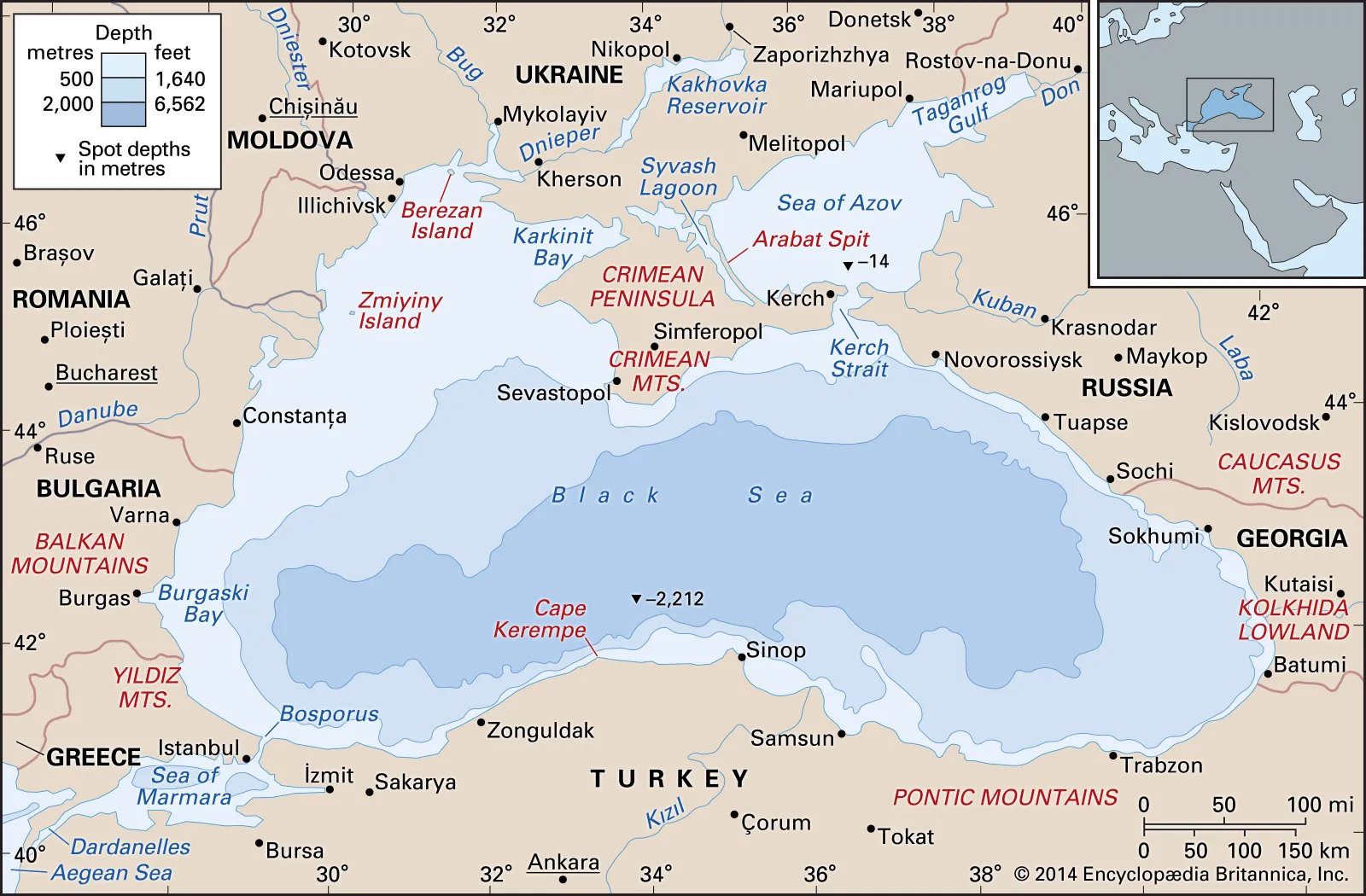
    About Black Sea

    • The famed water body is bound by Ukraine to the north and northwest, Russia and Georgia to the east, Turkey to the south, and Bulgaria and Romania to the west.
    • It links to the Sea of Marmara through the Bosphorus and then to the Aegean through the Dardanelles.

    Significance of Black Sea for Russia

    • Domination of the Black Sea region is a geostrategic imperative for Moscow.
    • Black Sea has traditionally been Russia’s warm water gateway to Europe.
    • For Russia, the Black Sea is both a stepping stone to the Mediterranean.
    • It acts as a strategic buffer between NATO and itself.
    • It showcases the Russian power in the Mediterranean and to secure the economic gateway to key markets in southern Europe.
    • The Rhine-Main-Danube canal connects the Black Sea to the Atlantic Ocean and the North Sea and the port of Odessa serves as a vital link between Ukraine and the outside world.

    Black Sea in the Ukraine war

    • Russia has been making efforts to gain complete control over the Black Sea since the Crimean crisis of 2014.
    • During the ongoing invasion, the domination of the Black Sea has been a major Russian objective, along with the land bridge to connect Russia and Crimea.
    • As such, there have been intense efforts to capture Mariupol, the Sea of Azov port in the breakaway eastern Ukrainian oblast of Donetsk.
    • Mariupol appeared close to falling to the Russians.

    Sinking of the Moskva

    • The sinking of the Moskva is believed to be the worst loss in the history of naval warfare.
    • It was sunk by shore-based anti-ship cruise missiles which took advantage of bad weather and used decoy UAV attacks to defeat the ship’s air defence systems.
    • It demonstrates the success of outside-the-box measures adopted by Ukraine in the war.


    Must answer this PYQ in the comment box:

    Q.Consider the following pairs:

    Sea Bordering country
    1. Adriatic Sea Albania
    2. Black Sea Croatia
    3. Caspian Sea Kazakhstan
    4. Mediterranean Sea Morocco
    5. Red Sea Syria

    Which of the pair given above are correctly matched? (CSP 2020)

    (a) 1, 2 and 4 only

    (b) 1, 3 and 4 only

    (c) 2 and 5 only

    (d) 1, 2, 3, 4 and 5


  • Explained: Red Star over Solomon Islands

    A recent leaked document has revealed that the Solomon Islands in the South Pacific has reached a deal with China. This has raised alarms in Washington and Canberra.

    Where is the Solomon Islands located?

    • The Solomon Islands is a sovereign country consisting of six major islands and over 900 smaller islands in Oceania, to the east of Papua New Guinea and northwest of Vanuatu.
    • Its capital, Honiara, is located on the largest island, Guadalcanal.
    • It is part of the ethnically Melanesian group of islands in the Pacific and lies between Papua New Guinea and Vanuatu.
    • The country takes its name from the Solomon Islands archipelago, which is a collection of Melanesian islands that also includes the North Solomon Islands (a part of Papua New Guinea).
    • It excludes outlying islands, such as the Santa Cruz Islands and Rennell and Bellona.

    Quick recap of its past

    • The islands, which were initially controlled by the British Empire during the colonial era, went through the hands of Germany and Japan.
    • It then went back to the UK after the Americans took over the islands from the Japanese during World War II.
    • The islands became independent in 1978 to become a constitutional monarchy under the British Crown, with a parliamentary system of government.
    • Nevertheless, its inability to manage domestic ethnic conflicts led to close security relations with Australia, which is the traditional first responder to any crisis in the South Pacific.

    What are the contents of the proposed deal?

    • The Framework Agreement has the potential to disturb the established security mechanisms in the South Pacific region.
    • The document explicitly enables Beijing to send its “police, armed police, military personnel and other law enforcement and armed forces” to the islands on the latter government’s request, or if the former sees that the safety of its projects and personnel in the islands are at risk.
    • The document also provides for China’s naval vessels to utilise the islands for logistics support.
    • There have been speculations in the wake of this revelation that China might be building its next overseas naval base in Solomon Islands after Djibouti.

    What is the rationale for the Solomon Islands’ increasing proximity to China?

    • The Solomon Islands had cultivated strong ties with Taiwan, which ended with the emergence of the current government in Honiara.
    • In 2019, the regime change switched Taiwan for China.
    • This was supposedly after Beijing offered half a billion US dollars in financial aid, roughly five times what Taiwan spent on the islands in the past two decades.
    • It has been alleged by the pro-Taiwan Opposition that the incumbent government has been bribed by China.

    Why is China interested in the Solomon Islands?

    • Isolating Taiwan: The Solomon Islands was one among the six Pacific island states which had official bilateral relations with Taiwan.
    • Supporter in UN: The small Pacific island states act as potential vote banks for mobilising support for the great powers in international fora like the United Nations.
    • Larger EEZ: These states have disproportionately large maritime Exclusive Economic Zones when compared to their small sizes.
    • Natural resources: Solomon Islands, in particular, have significant reserves of timber and mineral resources, along with fisheries.
    • Countering US: But more importantly, they are strategically located for China to insert itself between America’s military bases in the Pacific islands and Australia.

    What does this mean for the established geopolitical configuration in the region?

    • Diminishing western influence: The Pacific islands, in the post-World War II scenario, were exclusively under the spheres of influence of the Western powers, in particular the US, UK, France and Australia and New Zealand.
    • Inserting into western hegemony: All of them have territorial possessions in the region, with the three nuclear powers among them having used the region as a nuclear weapons testing ground.
    • Shifting of dependencies: The smaller island nations of the region are heavily dependent on them, especially Australia as it is a resident power.

    Damage control by West

    • Australia has reacted with boosted finances, and by extending its current security mission till 2023 when the islands will host the Pacific Games.
    • The US has responded by considering reopening its embassy in Honiara after a long 29-year gap.
    • New Zealand has shed its typical restraint about China and has criticised it for attempting to militarise the Pacific islands.

    Chinese response to Indo-Pacific

    • It is to be noted that China’s rise in the South Pacific is not without opposition.
    • AUKUS is a recent example of how the established powers are reacting; although, to what extent they can mobilize individual governments against China is questionable.
    • Significant discontent has been brewing within and among the Pacific island states against China’s economic inroads and its adverse impact on their vulnerable economic and political systems.


    UPSC 2022 countdown has begun! Get your personal guidance plan now! (Click here)

  • Russia warns against NATO enlargement

    One of Russian President Vladimir Putin’s closest allies warned NATO that if Sweden and Finland joined the US-led military alliance then Russia would have to bolster its defences in the region, including by deploying nuclear weapons.

    Why in news?

    • Finland, which shares a 1,300-km border with Russia, and Sweden are considering joining the NATO alliance.

    Why do they want to join NATO?

    • The possible accession of Finland and Sweden into NATO to get collective Western security against Russia — would be one of the biggest strategic consequences of the Ukraine war.
    • Finland gained independence from Russia in 1917 and fought two wars against it during Second World War during which it lost some territory to Moscow.
    • Sweden has not fought a war for 200 years and post-war foreign policy has focused on supporting democracy internationally, multilateral dialogue and nuclear disarmament.

    What is NATO?

    • NATO is a military alliance established by the North Atlantic Treaty (also called the Washington Treaty) of April 4, 1949.
    • It sought to create a counterweight to Soviet armies stationed in Central and Eastern Europe after World War II.
    • Its original members were Belgium, Canada, Denmark, France, Iceland, Italy, Luxembourg, the Netherlands, Norway, Portugal, the United Kingdom, and the United States.
    • NATO has spread a web of partners, namely Egypt, Israel, Sweden, Austria, Switzerland and Finland.

    Why was it founded?

    Ans. Communist sweep in Europe post-WWII and rise of Soviet dominance

    • After World War II in 1945, Western Europe was economically exhausted and militarily weak, and newly powerful communist parties had arisen in France and Italy.
    • By contrast, the Soviet Union had emerged from the war with its armies dominating all the states of central and Eastern Europe.
    • By 1948 communists under Moscow’s sponsorship had consolidated their control of the governments of those countries and suppressed all non-communist political activity.
    • What became known as the Iron Curtain, a term popularized by Winston Churchill, had descended over central and Eastern Europe.

    Ideology of NATO

    • NATO ensures that the security of its European member countries is inseparably linked to that of its North American member countries.
    • It commits the Allies to democracy, individual liberty and the rule of law, as well as to the peaceful resolution of disputes.
    • It also provides a unique forum for dialogue and cooperation across the Atlantic.

    What is Article 5 and why is it needed?

    • Article 5 was a key part of the 1949 North Atlantic Treaty, or Washington Treaty, and was meant to offer a collective defence against a potential invasion of Western Europe.
    • It states: (NATO members) will assist the party or parties so attacked by taking forthwith, individually and in concert with the other parties, such action as it deems necessary, including the use of armed force, to restore and maintain the security of the North Atlantic area.
    • However, since then, it has only been invoked once, soon after the 9/11 attack in the United States.

    Why has Article 5 not been invoked this time?

    • The reason is simple: Ukraine is a partner of the Western defence alliance but not a NATO member.
    • As a result, Article 5, or the Collective Defence Pledge, does not apply.
    • While NATO has said it will not be sending troops to Ukraine, it did invoke Article 4, which calls for a consultation of the alliance’s principal decision-making body, the North Atlantic Council.
    • In its history, it has only been activated half a dozen times.
    • But the fact that this time around eight-member nations chose to invoke it was enough to demonstrate the seriousness of the situation at a global level.

    What may prompt NATO to invoke Article 5?

    • NATO will invoke Article 5 only if Russia launches a full-blown attack on one of its allies.
    • Some top US officials have warned of the impact of some of Russia’s cyberattacks being felt in NATO countries.
    • When you launch cyberattacks, they don’t recognize geographic boundaries.
    • Some of that cyberattack could actually start shutting down systems in eastern Poland.

    But what is NATO’s problem with Russia?

    • Russia has long been opposed to Ukraine’s growing closeness with European institutions, particularly NATO.
    • The former Soviet republic shares borders with Russia on one side, and the European Union on the other.
    • After Moscow launched its attack, the US and its allies were quick to respond, imposing sanctions on Russia’s central bank and sovereign wealth funds.


    UPSC 2022 countdown has begun! Get your personal guidance plan now! (Click here)

  • Nepal’s dwindling Forex Reserves

    In an unusual development, the Nepali PM sacked the head of its central bank accusing him of leaking sensitive information and for failing to perform his duties.

    What is the news?

    • Nepal’s forex reserves have plummeted by 18.5% to $9.58 billion in March from $11.75 billion in July 2021.
    • The current forex reserves are not enough to pay the government’s import bills beyond the next seven months or so.
    • Nepal’s central bank recently announced a ban on the import of vehicles and other luxury items, citing liquidity crunch and declining foreign exchange reserves.
    • It is rumoured that the Nepali economy will go into a crisis like Sri Lanka.

    Why have Nepal’s forex reserves fallen?

    • Nepal’s forex reserves situation appears healthy as of now as the country, unlike Sri Lanka, is not burdened by external debt.
    • There are, however, concerns that the lower middle-income economy is being battered repeatedly by external factors and that may precipitate a crisis sometime soon.
    • Nepal which is blessed with one of the finest tourism sectors in South Asia, because of the Himalayan mountain range, suffered during the COVID-19 pandemic as global tourist flow fell.
    • This is followed by the global energy crisis caused by Russia’s invasion of Ukraine.
    • This has put extraordinary inflationary pressure on the economy.

    How bad is the situation?

    • Nepal’s economy is highly dependent on imports as the country buys a range of merchandise goods apart from fuel.
    • The prevailing weak economic indicators mean that Nepal is spending from its forex reserves faster than it can save.
    • Economists contend that Nepal will soon have double-digit inflation. All economic indicators are declining.
    • The real shortfall in forex reserves is because of the decline in foreign remittances which suffered during the pandemic when the Nepalese workforce abroad suffered job losses.

    Can the energy scene in Nepal escalate economic woes?

    • Nepal’s history shows that any uncertainty regarding fuel can trigger serious internal problems as was visible during the 2015-16 blockade when disruption of fuel supply from India.
    • Nepal’s primary supplier of energy is Indian Oil Corporation (IOC).
    • Nepal Oil Corporation (NOC) pays IOC in two installments every month, on the 8th and the 23rd.
    • The NOC has been in crisis for months as high global prices depleted the company’s savings, prompting it to approach the government for a lifeline.
    • The Government of Nepal has agreed to provide NOC the necessary amount to continue supplies from IOC.
    • NOC’s financial status makes it unattractive for banks and as a result the public sector company does not enjoy confidence in the market.

    Paradoxical situation

    • The government is in a paradoxical situation: It has to control imports of products from which it earns the highest amount of tax revenue.
    • Luxury items are the country’s major source of revenue.
    • If revenue shrinks, an economic crisis could be imminent.

    Impact on elections

    • Nepal will hold local level polls next month which will be followed by general elections towards the end of the year.
    • The election process requires considerable financial allocation and Nepal has received support in the past for elections from international donors like the USAID.
    • These donors help in carrying out pre-election staff training and logistics that are part of any democratic process.
    • But there are uncertainties considering the bleak financial situation.
    • It will require at least 10 billion Nepali rupees for the election process and that will mean diversion of a large amount of resources for the democratic process.

    Quick recap: Sri Lankan Crisis

    • Like Nepal, Sri Lanka is a country with a small economy. The Sri Lankan economy is around 1.5 times bigger than Nepal’s.
    • Sri Lanka’s economic crisis was in the making since it suffered a terrorist attack in 2019 which hit its tourism industry, a major contributor to the GDP.
    • Then came the pandemic, which further wiped out tourism incomes. Then there were debt burdens in dollars.
    • The political leadership failed to act to address the looming crisis.
    • The Rajapaksha dynasty made some wrong moves—it cut taxes and started printing money, hugely devaluing the currency.
    • In what looked like a well-intentioned move towards organic farming, the county banned imports of chemical fertilisers. Paddy production failed. The country ran out of money to pay its bills.

    Is Nepal really going the way of Sri Lanka?

    • In Nepal, the situation is not as bleak.
    • Nepal’s current forex reserves are enough to pay for imports of goods and services for about seven and a half months.
    • Tourism, one of the major foreign currency earners, was hit hard by the pandemic, but its gradual revival has given a glimmer of hope.
    • Since Nepal’s currency is pegged to the Indian rupee, a massive devaluation shock is unlikely. Tourism is also rebounding, giving a fillip to foreign currency reserves.

    Back2Basics: Foreign Exchange Reserves

    • Foreign exchange reserves are important assets held by the central bank in foreign currencies as reserves.
    • They are commonly used to support the exchange rate and set monetary policy.
    • In India’s case, foreign reserves include Gold, Dollars, and the IMF’s quota for Special Drawing Rights.
    • Most of the reserves are usually held in US dollars, given the currency’s importance in the international financial and trading system.
    • Some central banks keep reserves in Euros, British pounds, Japanese yen, or Chinese yuan, in addition to their US dollar reserves.


    UPSC 2022 countdown has begun! Get your personal guidance plan now! (Click here)