💥Join UPSC 2027,2028 Mentorship (July Batch) + XFactor Notes & Microthemes PDF

Subject: Science and Technology

  • ISRO Missions and Discoveries

    Let’s cover the entire gamut of projects concluded by ISRO in these 2 years.

    IRNSS will be covered in a separate article.

    GSAT Series

    #1. GSAT-6

    • GSAT-6 is the twenty fifth geostationary communication satellite of India built by ISRO and twelfth in the GSAT series
    • Five of GSAT-6’s predecessors were launched by GSLV during 2001, 2003, 2004, 2007 and 2014 respectively
    • After its commissioning, GSAT-6 has joined the group of India’s other operational geostationary satellites
    • GSAT-6 Satellite provides communication through five spot beams in S-band and a national beam in C-band for strategic users
    • It was launched using GSLV-D6 (Explained below in GSLV Missions)

    #2. GSAT-15

    • It is a high power satellite being inducted into the INSAT/ GSAT system
    • It carries a total of 24 communication transponders in Ku-band as well as a GPS
    • Aided GEO Augmented Navigation (GAGAN) payload operating in L1 and L5 bands
    • It is the third satellite to carry GAGAN payload after GAST-8 and GSAT-10, which are already providing navigation services from orbit
    • It carries a Ku-band beacon as well to help in accurately pointing ground antennas towards the satellite
    • It was launched by Ariane-5 VA-227 launch vehicle from Kourou, French Guiana on early morning of November 11, 2015

    #3. GSAT-16

    • GSAT-16, an advanced communication satellite, weighing 3181.6 kg at lift-off, is being inducted into the INSAT-GSAT system
    • GSAT-16 is configured to carry a total of 48 communication transponders, the largest number of transponders carried by a communication satellite developed by ISRO so far, in normal C-band, upper extended C-band and Ku-band
    • GSAT-16 carries a Ku-band beacon as well to help accurately point ground antennas towards the satellite
    • The designed on-orbit operational life of GSAT-16 is 12 years
    • The communication transponders on-board GSAT-16 together ensure continuity of various services currently provided by INSAT-GSAT system and serve as on-orbit spares to meet contingency requirements or for the augmentation of such services
    • GSAT-16 was launched into a Geosynchronous Transfer Orbit (GTO) by Ariane-5 VA-221 launch vehicle from Kourou, French Guiana
    • GSAT-16 was positioned at 55 deg East longitude in the Geostationary orbit and co-located with GSAT-8, IRNSS-1A and IRNSS-1B satellites

    PAYLOADS OF GSAT-16

    1. 12 Ku-band transponders each with 36 MHz usable bandwidth with footprint covering Indian mainland and Andaman & Nicobar islands
    2. 24 C-band transponders each with 36 MHz usable bandwidth with footprint covering Indian mainland and island territories
    3. 12 Upper Extended C-band transponders each with 36 MHz usable bandwidth with footprint covering Indian mainland and island territories

    PSLV Missions

    #1. PSLV C28/ DMC3 Mission: Heaviest commercial mission ever undertaken by ISRO

    • PSLV in its 30th flight (PSLV-C28) launched three identical DMC3 optical earth observation satellites built by Surrey Satellite Technology Limited (SSTL), UK
    • PSLV-C28 was the ninth flight of PSLV in ‘XL’ configuration
    • With the overall lift-off mass of the five satellites amounting to about 1440 kg, this mission becomes the heaviest commercial mission ever undertaken by Antrix/ISRO
    • The three DMC3 satellites, each weighing 447 kg, were launched into a 647 km Sun-Synchronous Orbit (SSO) using the high-end version of PSLV (PSLV-XL) from Satish Dhawan Space Centre, Sriharikota (SDSC-SHAR), the spaceport of India

    DMC3

    1. The DMC3 constellation comprises of three advanced mini-satellites DMC3-1, DMC3-2 and DMC3-3
    2. It is designed to address the need for simultaneous high spatial resolution and high temporal resolution optical Earth Observation
    3. Launched into a single Low-Earth Orbit plane and phased with a separation of 120° between them, these satellites can image any target on the Earth’s surface every day
    4. Major application areas include surveying the resources on earth and its environment, managing urban infrastructure and monitoring of disasters

    It also carried two auxiliary satellites from UK:

    1. CBNT-1, an optical technology demonstrator earth observation micro satellite built by SSTL
    2. De-OrbitSail, a technology demonstrator nano satellite built by Surrey Space Centre

    #2. PSLV C30/ Astrosat

    • PSLV, in its 31st flight (PSLV-C30), launched Astrosat into a 650 km orbit of 6 deg inclination to the equator
    • Along with Astrosat, six satellites from international customers viz. LAPAN-A2 of Indonesia, NLS-14 (Ev9) of Canada and four identical LEMUR satellites of USA were launched
    • PSLV-C30 is the tenth flight of PSLV in its ‘XL’ Configuration

    #3. PSLV C29/ TeLEOS-1 Mission/ 6 Singapore satellites

    • PSLV, in its 32nd flight (PSLV-C29), launched six satellites of Singapore into a 550 km circular orbit inclined at 15 degrees to the equator
    • This is the eleventh flight of PSLV in ‘core-alone’ configuration (without the use of solid strap-on motors)
    • Of these six satellites, TeLEOS-1 is the primary satellite weighing 400 kg
    • The other five are co-passenger satellites which include two micro-satellites and three nano-satellites:
    1. VELOX-CI, micro-satellite
    2. VELOX-II, 6U-Cubesat technology demonstrator
    3. Athenoxat-1, a technology demonstrator nano-satellite
    4. Kent Ridge-1, a micro-satellite
    5. Galassia, 2U-Cubesat

    IRNSS Constellation


    The recent launches in this series are:

    #1. PSLV C-27/ IRNSS-1D

    #2. PSLV C-31/ IRNSS-1E

    #3. PSLV C32/ IRNSS-1F

    #4. PSLV C33/ IRNSS-1G

    IRNSS-1G was the 7th and last satellite in the IRNSS constellation.

    With this, India has achieved the milestone of being one the very few countries to have its own Positioning System.

    [IRNSS will be dealt with in detail in a separate story]


    GSLV Missions

    #1. GSLV-D6/ GSAT-6

    • GSLV-D6 is the ninth flight of India’s Geosynchronous Satellite Launch Vehicle (GSLV)
    • It is also the fifth developmental flight of GSLV
    • This is the third time the indigenously developed Cryogenic Upper Stage (CUS) is being carried on-board during a GSLV flight
    • GSLV-D6 flight is significant since it intends to continue the testing of CUS
    • GSLV is designed to inject 2 ton class of communication satellites into Geosynchronous Transfer Orbit (GTO)
    • GSAT-6 is explained above

    #2. GSLV-Mk III: Launching humans into space

    • ISRO killed two birds with one stone when the GSLV Mk3 test with an inert cryogenic stage took off with the CARE (Crew Module Atmospheric Re-entry Experiment)
    • The module reached an altitude of 80 km and made a successful splash down in the sea using the largest parachutes ever made in the country
    • Once operational, the crew module will host up to three Indian astronauts for orbital missions lasting up to a week in space
    • It will make India only the fourth nation in the world after Russia, US and China to have the ability to send humans into space; maybe even to the moon one day
    • According to ISRO the schedule for sending the first Indian on an Indian rocket is planned for 2021
    • For this, the GSLV Mk3 will have to be man-rated – it has to demonstrate a set number of continuous successful launches

    Reusable Launch Vehicle- Technology Demonstrator (RLV-TD)

    The cost of access to space is the major deterrent in space exploration and space utilization. A reusable launch vehicle is the unanimous solution to achieve low cost, reliable and on-demand space access


    Reusable Launch Vehicle-Technology Demonstration Program or RLV-TD is a series of technology demonstration missions that have been considered as a first step towards realizing a Two Stage To Orbit (TSTO) fully re-usable vehicle.

    A Winged Reusable Launch Vehicle technology Demonstrator (RLV-TD) has been configured to act as a flying test bed to evaluate various technologies, namely, hypersonic flight, autonomous landing, powered cruise flight and hypersonic flight using air-breathing propulsion.


    2015 Space Pioneer Award

    • Space Pioneer award for the year 2015 was presented to Indian Space Research Organisation (ISRO) in the Science and Engineering category during the 34th Annual International Space Development Conference held at Toronto in Canada during May 20 -24, 2015
    • National Space Society (NSS) of USA presented this award in recognition of ISRO’s efforts in accomplishing Mars Mission in its very first attempt
    • In 2009, NSS has presented similar award to ISRO in recognition of the great accomplishment they have made in the success of the Lunar Probe, Chandrayaan-1
    • National Space Society (NSS) is an independent nonprofit educational membership organisation dedicated to the creation of a space faring civilisation
  • Govt plans $2 bn incentive for Green Hydrogen Industry

    The govt is planning a $2 billion incentive program for the green hydrogen industry, in a bid to cut emissions and become a major export player in the field.

    What is Green Hydrogen?

    • Green hydrogen is hydrogen gas produced through the electrolysis of water.
    • It is an energy-intensive process for splitting water into hydrogen and oxygen— using renewable power to achieve this.
    • The current cost of green hydrogen in India is ₹300 to ₹400 per kg.

    Hydrogen Energy: A Backgrounder

    • Hydrogen is an important source of energy since it has zero carbon content and is a non-polluting source of energy in contrast to hydrocarbons that have net carbon content in the range of 75–85 per cent.
    • Hydrogen energy is expected to reduce carbon emissions that are set to jump by 1.5 billion tons in 2021.
    • It has the highest energy content by weight and lowest energy content by volume.
    • As per International Renewable Energy Agency (IRENA), Hydrogen shall make up 6 per cent of total energy consumption by 2050.
    • Hydrogen energy is currently at a nascent stage of development, but has considerable potential for aiding the process of energy transition from hydrocarbons to renewable.

    Why hydrogen?

    • Better properties: At standard temperature and pressure, hydrogen is a nontoxic, nonmetallic, odourless, tasteless, colourless, and highly combustible diatomic gas.
    • Clean fuel: Hydrogen fuel is a zero-emission fuel when burned with oxygen. It can be used in fuel cells or internal combustion engines. It is also used as a fuel for spacecraft propulsion.
    • Ample sources: Hydrogen can be sourced from natural gas, nuclear power, biomass, and renewable power like solar and wind.
    • Phasing out carbon: India remains committed to environmental and climate causes with a massive thrust on deploying renewable energy and energy efficiency measures.
    • Diversification of our energy basket: This would be the key lever enabling this transition. That’s why the emergence of hydrogen at the centre stage is a welcome development.

    How Hydrogen can be produced?

    Commercially viable Hydrogen can be produced from –

    1. Hydrocarbons including natural gas, oil and coal through processes like steam methane reforming, partial oxidation and coal gasification
    2. Renewables like water, sunlight and wind through electrolysis and photolysis and other thermo-chemical processes.

    How is Green Hydrogen produced?

    • For source material, green hydrogen today is typically generated from water through a process known as electrolysis, which uses an electric current to split water into its component molecules of hydrogen and oxygen.
    • This is done using a device called an electrolyzer, which utilizes a cathode and an anode (positively and negatively charged electrodes).
    • This process produces only oxygen – or steam – as a byproduct.
    • As for energy supply, to qualify as “green hydrogen,” the source of electricity used for electrolysis must derive from renewable power, such as wind or solar energy.
    • Currently the production of green hydrogen is two or three times more expensive than blue hydrogen.

    How can green hydrogen be used?

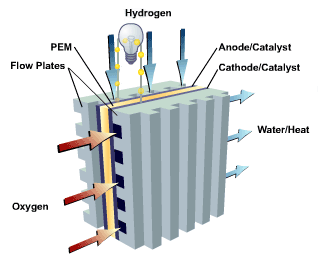
    Hydrogen can be used in broadly two ways. It can be burnt to produce heat or fed into a fuel cell to make electricity.

    • Fuel-cell  Mobility: Hydrogen electric cars and trucks
    • Container ships powered by liquid ammonia made from hydrogen
    • “Green steel” refineries burning hydrogen as a heat source rather than coal
    • Hydrogen-powered electricity turbines that can generate electricity at times of peak demand to help firm the electricity grid

    Challenges in producing Green Hydrogen

    India’s transition towards a green hydrogen economy (GHE) can only happen once certain key issues are addressed.

    • Supply-Chain Issues: GHE hinges upon the creation of a supply chain, starting from the manufacture of electrolysers to the production of green hydrogen, using electricity from a renewable energy source.
    • Technology: Green hydrogen needs electrolysers to be built on a scale larger than we’ve yet seen.
    • Storage: Either very high pressures or very high temperatures are required, both with their own technical difficulties.
    • Explosion Hazard: It is hazardous because of its low ignition energy and high combustion energy.
    • Risk to use: Automotive fuels are highly inflammable, but a vehicle laden with hydrogen is likely to be more vulnerable in case of a major accident.
    • High Cost of Production: To become competitive, the price per kilogram of green hydrogen has to reduce to a benchmark of $2/kg. At these prices, green hydrogen can compete with natural gas.
    • Energy intensivity: Creating green hydrogen needs a huge amount of electricity, which means an enormous increase in the amount of wind and solar power to meet global targets.
    • Lack of proper infrastructure, only 500 Hydrogen stations exist globally. Only countable manufacturers are involved as market players in this technology.
    • Others: Low user acceptance and social awareness. Developing after-sales service for hydrogen technology.

    Policy and Economic Challenges

    • Economic sustainability: One of the biggest challenges faced by the industry for using hydrogen commercially is the economic sustainability of extracting green or blue hydrogen.
    • Technological challenges: The technology used in production and use of hydrogen like Carbon Capture and Storage (CCS) and hydrogen fuel cell technology are at nascent stage.
    • Cost Factor: These technologies are expensive which in turn increases the cost of production of hydrogen and will require a lot of investment which in turn add fiscal pressure on government.
    • Higher Maintenance costs: Maintenance costs for fuel cells post-completion of a plant can be costly.
    • Need for legal and administrative adherence: Certification mechanisms, recommendations, and regulations for different components of the system.

    Way forward

    • Hydrogen energy is at a nascent stage of development but has significant potential for realizing the energy transition in India.
    • The new policy is a futuristic vision that can help the country not only cut down its carbon emissions but also diversify its energy basket and reduce external reliance.
    • India’s transition can be a testament to the world on the achievement of energy security, without compromising the goal of sustainable development.
    • The GoI must strongly pursue the objective of creating a GHE to make India a global manufacturing hub and place itself at the top of the green hydrogen export market.


    Click and get your FREE Copy of CURRENT AFFAIRS Micro Notes

    (Click) FREE 1-to-1 on-call Mentorship by IAS-IPS officers | Discuss doubts, strategy, sources, and more