💥Join UPSC 2027,2028 Mentorship (July Batch) + XFactor Notes & Microthemes PDF

Type: PIB

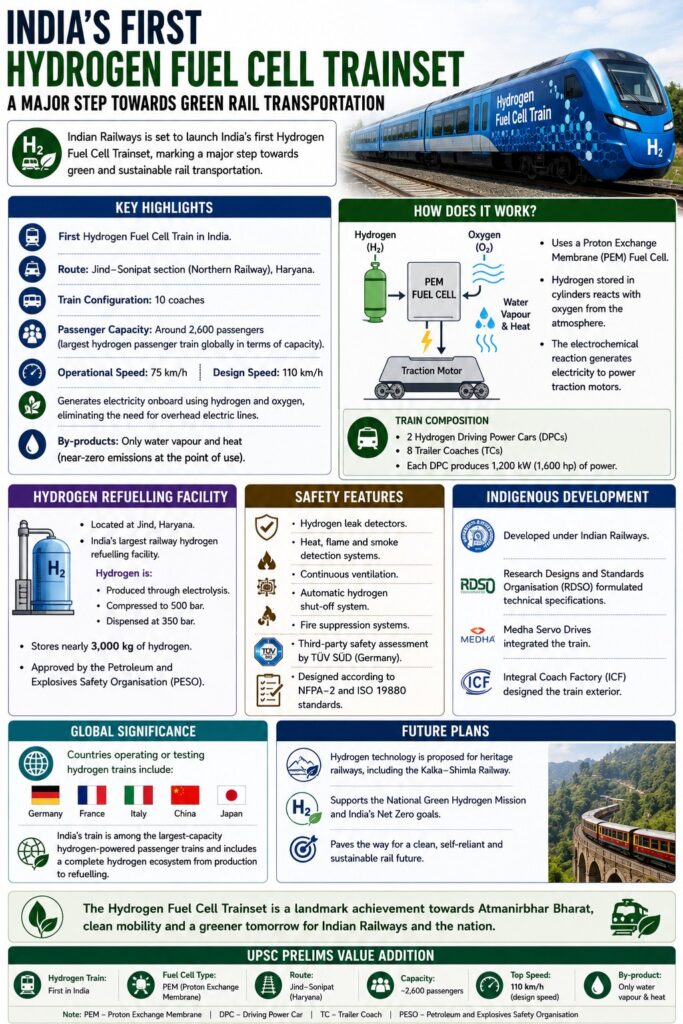
  • India’s First Hydrogen Fuel Cell Train

    Why in News?

    Indian Railways is set to launch India’s first Hydrogen Fuel Cell Trainset, marking a major step towards green and sustainable rail transportation.

    Key Highlights

    • First Hydrogen Fuel Cell Train in India.
    • Route: Jind–Sonipat section (Northern Railway), Haryana.
    • Train Configuration: 10 coaches
    • Passenger Capacity: Around 2,600 passengers (largest hydrogen passenger train globally in terms of capacity).
    • Operational Speed: 75 km/h
    • Design Speed: 110 km/h
    • Generates electricity onboard using hydrogen and oxygen, eliminating the need for overhead electric lines.
    • By-products: Only water vapour and heat (near-zero emissions at the point of use).

    How Does It Work?

    • Uses a Proton Exchange Membrane (PEM) Fuel Cell.
    • Hydrogen stored in cylinders reacts with oxygen from the atmosphere.
    • The electrochemical reaction generates electricity to power traction motors.
    • The train consists of: 2 Hydrogen Driving Power Cars (DPCs) and 8 Trailer Coaches (TCs)
    • Each DPC produces 1,200 kW (1,600 hp) of power.

    Hydrogen Refuelling Facility

    • Located at Jind, Haryana.
    • India’s largest railway hydrogen refuelling facility.
    • Hydrogen is Produced through electrolysis, Compressed to 500 bar, and Dispensed at 350 bar.
    • Stores nearly 3,000 kg of hydrogen.
    • Approved by the Petroleum and Explosives Safety Organisation (PESO).

    Safety Features

    • Hydrogen leak detectors.
    • Heat, flame and smoke detection systems.
    • Continuous ventilation.
    • Automatic hydrogen shut-off system.
    • Fire suppression systems.
    • Third-party safety assessment by TÜV SÜD (Germany).
    • Designed according to NFPA-2 and ISO 19880 standards.

    Indigenous Development

    • Developed under Indian Railways.
    • Research Designs and Standards Organisation (RDSO) formulated technical specifications.
    • Medha Servo Drives integrated the train.
    • Integral Coach Factory (ICF) designed the train exterior.

    Global Significance

    • Countries operating or testing hydrogen trains include Germany, France, Italy, China, and Japan
    • India’s train is among the largest-capacity hydrogen-powered passenger trains and includes a complete hydrogen ecosystem from production to refuelling.

    Future Plans

    • Hydrogen technology is proposed for heritage railways, including the Kalka–Shimla Railway.
    • Supports the National Green Hydrogen Mission and India’s Net Zero goals

    [2026] Which of the following statements with regard to Green Hydrogen is/are correct ?
    1. It is decarbonized hydrogen obtained from natural gas reforming combined with carbon capture and storage (CCS).
    2. It is produced using electrolysis of water with electricity generated by renewable energy.
    3. National Green Hydrogen Mission of India aims for abatement of nearly 50 MMT of annual greenhouse gas emissions by 2030.
    Select the answer using the code given below :

    [A] 1 only

    [B] 2 and 3 only

    [C] 2 only

    [D] 1, 2 and 3
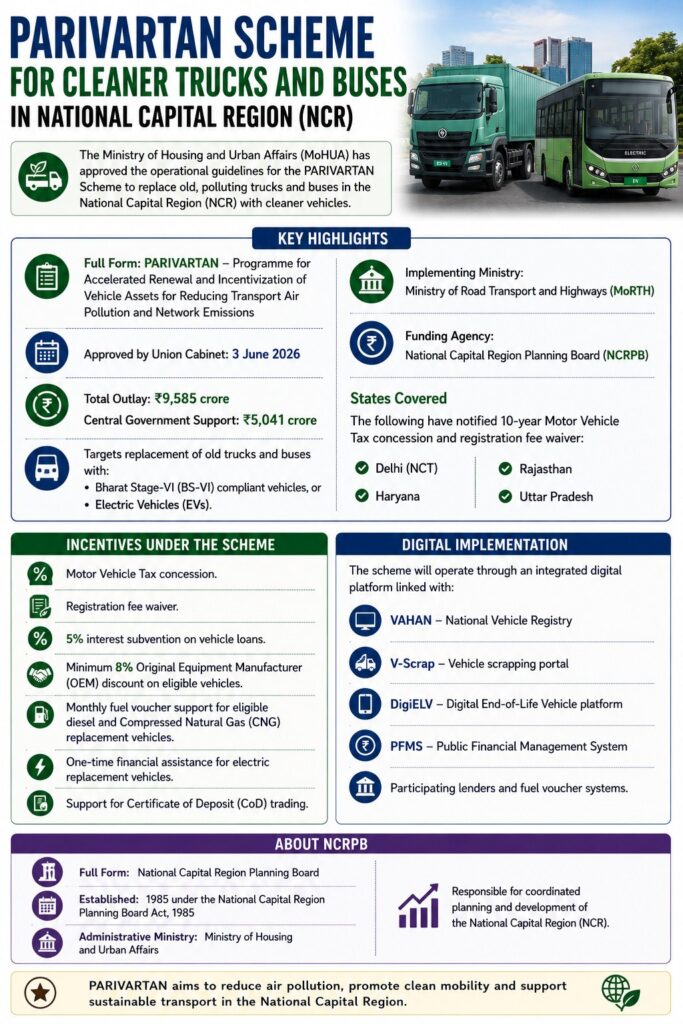
  • PARIVARTAN Scheme

    Why in News?

    The Ministry of Housing and Urban Affairs (MoHUA) has approved the operational guidelines for the PARIVARTAN Scheme to replace old, polluting trucks and buses in the National Capital Region (NCR) with cleaner vehicles.

    Key Highlights

    • Full Form: PARIVARTAN – Programme for Accelerated Renewal and Incentivization of Vehicle Assets for Reducing Transport Air Pollution and Network Emissions
    • Approved by Union Cabinet: 3 June 2026
    • Total Outlay:₹9,585 crore
      • Central Government Support: ₹5,041 crore
    • Targets replacement of old trucks and buses with Bharat Stage-VI (BS-VI) compliant vehicles, or Electric Vehicles (EVs).
    • Implementing Ministry: Ministry of Road Transport and Highways (MoRTH)
    • Funding Agency: National Capital Region Planning Board (NCRPB)
    • States Covered: The following have notified 10-year Motor Vehicle Tax concession and registration fee waiver in Delhi (NCT), Haryana, Rajasthan, and Uttar Pradesh

    Incentives under the Scheme

    • Motor Vehicle Tax concession.
    • Registration fee waiver.
    • 5% interest subvention on vehicle loans.
    • Minimum 8% Original Equipment Manufacturer (OEM) discount on eligible vehicles.
    • Monthly fuel voucher support for eligible diesel and Compressed Natural Gas (CNG) replacement vehicles.
    • One-time financial assistance for electric replacement vehicles.
    • Support for Certificate of Deposit (CoD) trading.

    Digital Implementation

    The scheme will operate through an integrated digital platform linked with:

    • VAHAN – National Vehicle Registry
    • V-Scrap – Vehicle scrapping portal
    • DigiELV – Digital End-of-Life Vehicle platform
    • Public Financial Management System (PFMS)
    • Participating lenders and fuel voucher systems.

    About NCRPB

    • Full Form: National Capital Region Planning Board
    • Established: 1985 under the National Capital Region Planning Board Act, 1985
    • Administrative Ministry: Ministry of Housing and Urban Affairs.
    • Responsible for coordinated planning and development of the National Capital Region (NCR).

    [2025] Consider the following types of vehicles:
    I. Full battery Electric vehicles
    II. Hydrogen fuel cell vehicles
    III. Fuel cell electric hybrid vehicles
    How many of the above are considered as alternative powertrain vehicles?

    [A] Only one

    [B] Only two

    [C] All the three

    [D] None

  • ICAR Foundation Day 2026

    Why in News?

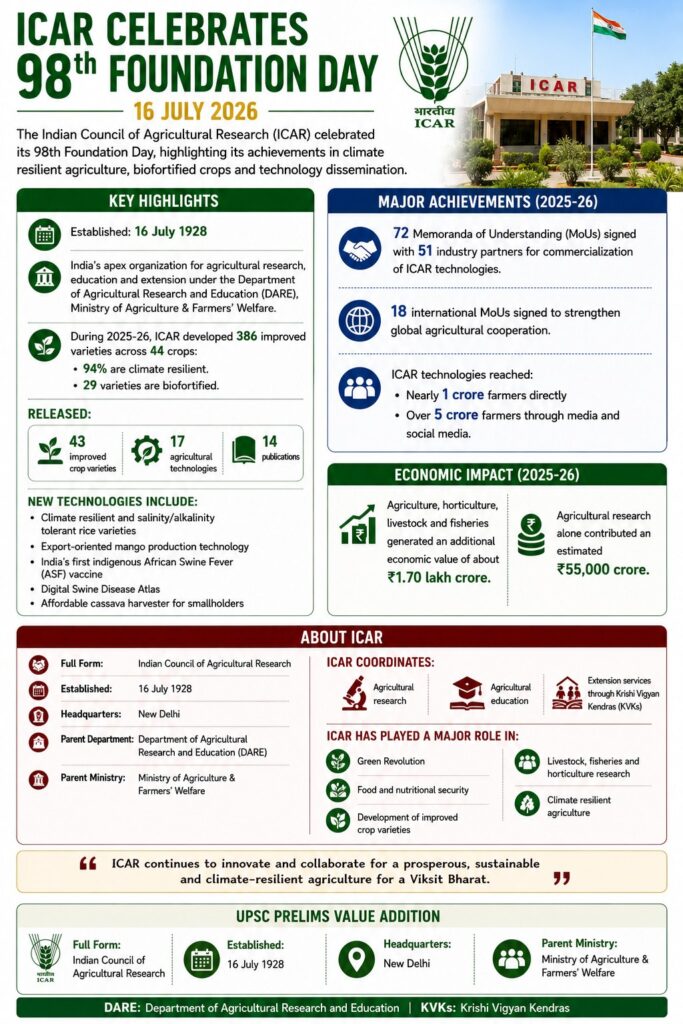
    The Indian Council of Agricultural Research (ICAR) celebrated its 98th Foundation Day (16 July 2026), highlighting its achievements in climate resilient agriculture, biofortified crops and technology dissemination.

    Key Highlights

    • Established: 16 July 1928
    • India’s apex organization for agricultural research, education and extension under the Department of Agricultural Research and Education (DARE), Ministry of Agriculture & Farmers’ Welfare.
    • During 2025-26, ICAR developed 386 improved varieties across 44 crops: 94% are climate resilient and 29 varieties are biofortified.
    • Released: 43 improved crop varieties, 17 agricultural technologies and 14 publications
    • New technologies include:
      • Climate resilient and salinity/alkalinity tolerant rice varieties
      • Export-oriented mango production technology
      • India’s first indigenous African Swine Fever (ASF) vaccine
      • Digital Swine Disease Atlas
      • Affordable cassava harvester for smallholders.
    • 72 Memoranda of Understanding (MoUs) signed with 51 industry partners for commercialization of ICAR technologies.
    • 18 international MoUs signed to strengthen global agricultural cooperation.
    • ICAR technologies reached: Nearly 1 crore farmers directly. Over 5 crore farmers through media and social media.

    Economic Impact

    • Agriculture, horticulture, livestock and fisheries generated an additional economic value of about ₹1.70 lakh crore in 2025-26.
    • Agricultural research alone contributed an estimated ₹55,000 crore.

    About ICAR

    • Full Form: Indian Council of Agricultural Research
    • Established: 16 July 1928
    • Headquarters: New Delhi
    • Parent Department: Department of Agricultural Research and Education (DARE)
    • Parent Ministry: Ministry of Agriculture & Farmers’ Welfare
    • Coordinates: Agricultural research, Agricultural education and Extension services through Krishi Vigyan Kendras (KVKs)
    • Played a major role in: Green Revolution, Food and nutritional security, Development of improved crop varieties, Livestock, fisheries and horticulture research, and Climate resilient agriculture

    [2021] In the context of India’s preparation for climate-smart agriculture, consider the following statements:
    1. The ‘Climate-Smart village’ approach in India is a part of a project led by the climate change, Agriculture and Food Security (CCAFS), an international research programme.
    2. The project of CCAFS is carried out under consultative group on International Agricultural Research (CGIAR) headquartered in France.
    3. The International Crops Research Institute for the Semi-Arid Tropics (ICRISAT) in India is one of the CGIAR’s research centres.
    Which of the statements given above are correct?

    [A] 1 and 2 only

    [B] 2 and 3 only

    [C] 1 and 3 only

    [D] 1,2 and 3

  • Semicon 2.0

    Why in News?

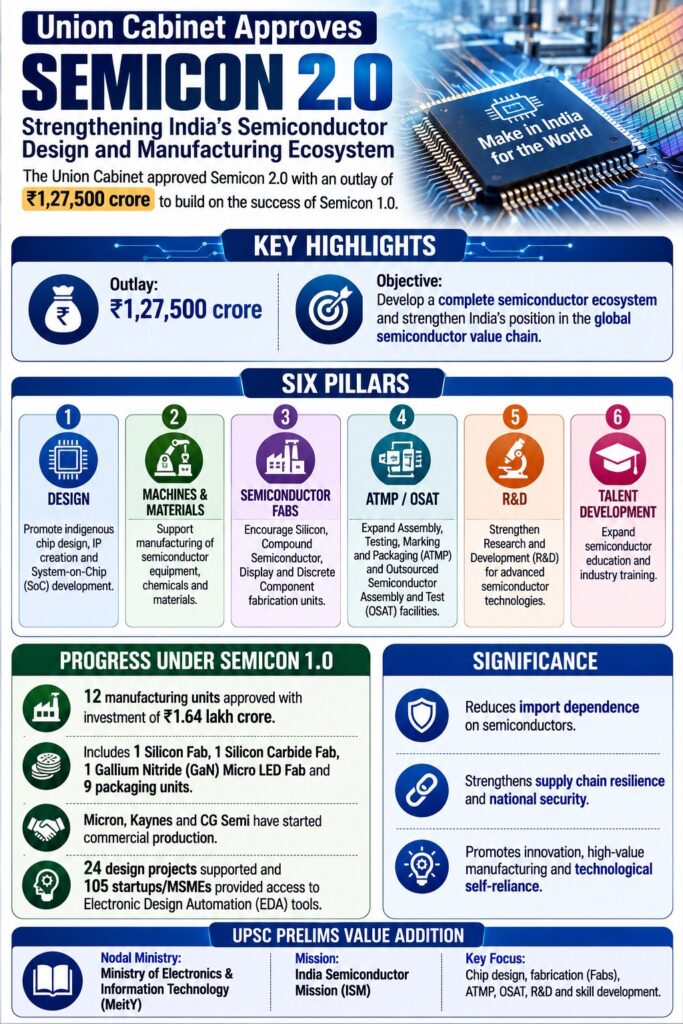
    The Union Cabinet approved Semicon 2.0 with an outlay of ₹1,27,500 crore to strengthen India’s semiconductor design and manufacturing ecosystem after the success of Semicon 1.0.

    Key Highlights

    • Outlay: ₹1,27,500 crore.
    • Objective: Develop a complete semiconductor ecosystem and strengthen India’s position in the global semiconductor value chain.

    Six Pillars

    • Design: Promote indigenous chip design, Intellectual Property (IP) creation and System-on-Chip (SoC) development.
    • Machines & Materials: Support manufacturing of semiconductor equipment, chemicals and materials.
    • Semiconductor Fabs: Encourage Silicon, Compound Semiconductor, Display and Discrete Component fabrication units.
    • ATMP/OSAT: Expand Assembly, Testing, Marking and Packaging (ATMP) and Outsourced Semiconductor Assembly and Test (OSAT) facilities.
    • R&D: Strengthen Research and Development (R&D) for advanced semiconductor technologies.
    • Talent Development: Expand semiconductor education and industry training.

    Progress under Semicon 1.0

    • 12 manufacturing units approved with investment of ₹1.64 lakh crore.
    • Includes 1 Silicon Fab, 1 Silicon Carbide Fab, 1 Gallium Nitride (GaN) Micro LED Fab and 9 packaging units.
    • Micron, Kaynes and CG Semi have started commercial production.
    • 24 design projects supported and 105 startups/MSMEs provided access to Electronic Design Automation (EDA) tools.

    Significance

    • Reduces import dependence on semiconductors.
    • Strengthens supply chain resilience and national security.
    • Promotes innovation, high-value manufacturing and technological self-reliance.

    Prelims Pointer

    • Nodal Ministry: Ministry of Electronics & Information Technology (MeitY)
    • Mission: India Semiconductor Mission (ISM)
    • Key Focus: Chip design, fabrication (Fabs), ATMP, OSAT, R&D and skill development.
  • Periodic Labour Force Survey (PLFS) Monthly Bulletin, June 2026

    Why in News?

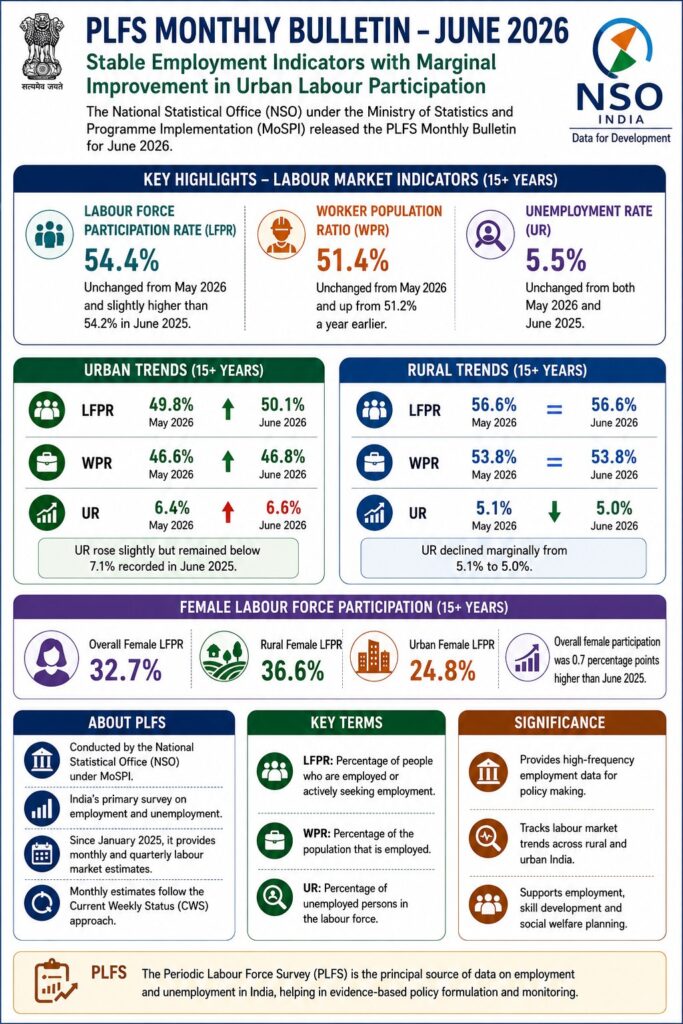
    The National Statistical Office (NSO) under the Ministry of Statistics and Programme Implementation (MoSPI) released the PLFS Monthly Bulletin for June 2026, showing stable employment indicators with a marginal improvement in urban labour participation.

    Labour Market Indicators (15+ years)

    • Labour Force Participation Rate (LFPR): 54.4%, unchanged from May 2026 and slightly higher than 54.2% in June 2025.
    • Worker Population Ratio (WPR): 51.4%, unchanged from May 2026 and up from 51.2% a year earlier.
    • Unemployment Rate (UR): 5.5%, unchanged from both May 2026 and June 2025.

    Urban Trends

    • LFPR increased from 49.8% to 50.1%.
    • WPR improved from 46.6% to 46.8%.
    • UR rose slightly from 6.4% to 6.6%, but remained below 7.1% recorded in June 2025.

    Rural Trends

    • LFPR remained stable at 56.6%.
    • WPR remained stable at 53.8%.
    • UR declined marginally from 5.1% to 5.0%.

    Female Labour Force Participation

    • Overall female LFPR stood at 32.7%.
    • Rural female LFPR was 36.6%.
    • Urban female LFPR remained 24.8%.
    • Overall female participation was 0.7 percentage points higher than June 2025.

    About PLFS

    • Conducted by the National Statistical Office (NSO) under MoSPI.
    • India’s primary survey on employment and unemployment.
    • Since January 2025, it provides monthly and quarterly labour market estimates.
    • Monthly estimates follow the Current Weekly Status (CWS) approach.

    Key Terms

    • Labour Force Participation Rate (LFPR): Percentage of people who are employed or actively seeking employment.
    • Worker Population Ratio (WPR): Percentage of the population that is employed.
    • Unemployment Rate (UR): Percentage of unemployed persons in the labour force.

    Significance

    • Provides high-frequency employment data for policymaking.
    • Tracks labour market trends across rural and urban India.
    • Supports employment, skill development and social welfare planning.

    [2020] With reference to the Indian economy after the 1991 economic liberalization, consider the following statements:

    1.Worker productivity (Rs. per worker at 2004 — 05 prices) increased in urban areas while it decreased in rural areas.
    2.The percentage share of rural areas in the workforce steadily increased.
    3.In rural areas, the growth in non-farm economy increased.
    4.The growth rate in rural employment decreased.

    Which of the statements given above is/are Correct?
    a) 1 and 2 only
    b) 3 and 4 only
    c) 3 only
    d) 1, 2 and 4 only

  • Indian Grey Hornbill Returns to Gir

    Why in News?

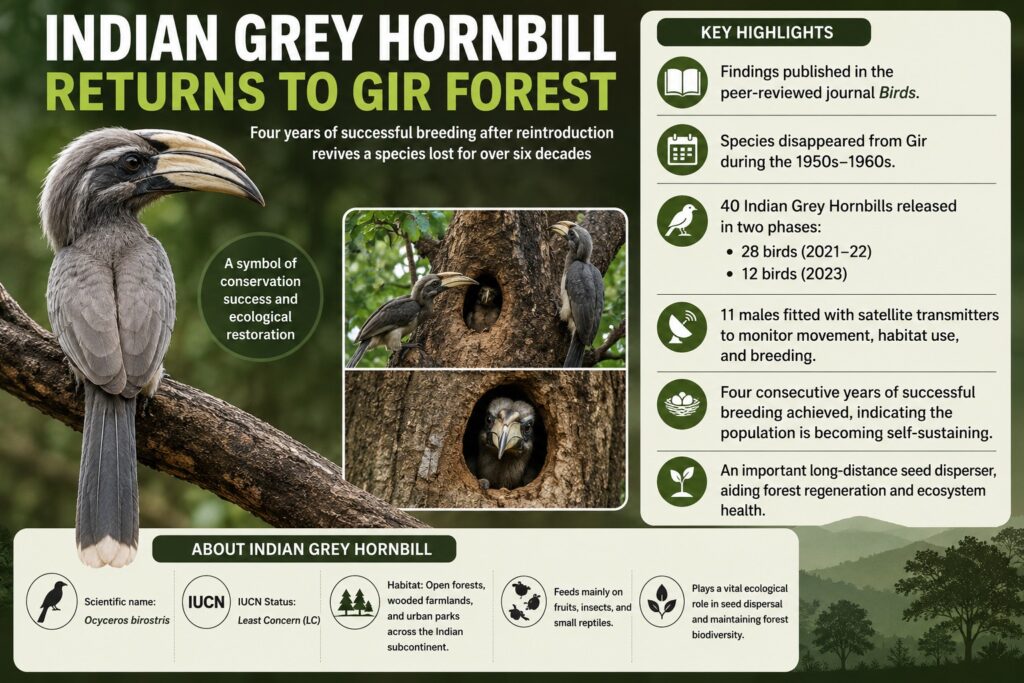
    The Indian Grey Hornbill has recorded four consecutive years of successful breeding in Gujarat’s Gir Forest after being reintroduced in 2021, marking the revival of a species that disappeared from the region over six decades ago.

    Key Highlights

    • The findings were published in the peer-reviewed journal Birds.
    • The species had disappeared from Gir during the 1950s-1960s.
    • 40 Indian Grey Hornbills were released in two phases: 28 birds (2021-22) and 12 birds (2023)
    • 11 males were fitted with satellite transmitters to monitor movement, habitat use, and breeding.
    • The project has achieved four consecutive years of successful breeding, indicating the population is becoming self-sustaining.
    • The Indian Grey Hornbill is an important long-distance seed disperser, aiding forest regeneration.

    About Indian Grey Hornbill

    • Scientific name: Ocyceros birostris
    • IUCN Status: Least Concern (LC)
    • Habitat: Open forests, wooded farmlands, and urban parks across the Indian subcontinent.
    • Feeds mainly on fruits, insects, and small reptiles.
    • Plays a vital ecological role in seed dispersal and maintaining forest biodiversity.

    [2020] With reference to India’s biodiversity, Ceylon frogmouth, Coppersmith barbet, Gray-chinned miniyet and White-throated redstart are

    a) Birds
    b) Primates
    c) Reptiles
    d) Amphibians

  • Future-Ready Workforce for India’s Creative Economy

    Why in News?

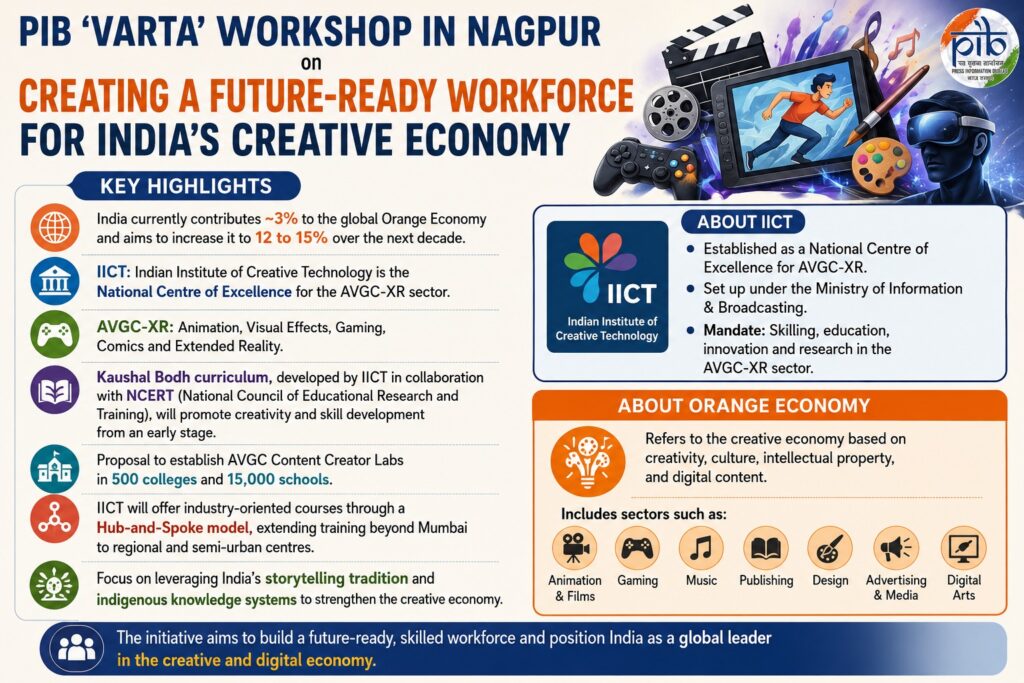
    The Press Information Bureau (PIB) organised a ‘Varta’ workshop on “Creating a Future-Ready Workforce for India’s Creative Economy” in Nagpur.

    Key Highlights

    • India currently contributes ~3% to the global Orange Economy and aims to increase it to 12 to 15% over the next decade.
    • IICT: Indian Institute of Creative Technology is the National Centre of Excellence for the AVGC-XR sector.
    • AVGC-XR: Animation, Visual Effects, Gaming, Comics and Extended Reality.
    • Kaushal Bodh curriculum, developed by IICT in collaboration with NCERT (National Council of Educational Research and Training), will promote creativity and skill development from an early stage.
    • Proposal to establish AVGC Content Creator Labs in 500 colleges and 15,000 schools.
    • IICT will offer industry-oriented courses through a Hub-and-Spoke model, extending training beyond Mumbai to regional and semi-urban centres.
    • Focus on leveraging India’s storytelling tradition and indigenous knowledge systems to strengthen the creative economy.

    About Orange Economy

    • Refers to the creative economy based on creativity, culture, intellectual property, and digital content.
    • Includes sectors such as animation, films, gaming, music, publishing, design, advertising, media, and digital arts.

    [2019] In the context of digital technologies for entertainment, consider the following statements:
    1. In Augmented Reality (AR), a simulated environment is created and the physical world is completely shut out.
    2. In Virtual Reality (VR), images generated from a computer are projected onto real-life objects or surroundings.
    3. AR allows individuals to be present in the world and improves the experience using the camera of smart-phones or PC.
    4. VR closes the world, and transposes an individual, providing complete immersion experience.
    Which of the statements given above is/are correct?

    [A] 1 and 2 only

    [B] 3 and 4

    [C] 1, 2 and 3

    [D] 4 only

  • NESAC Strengthens Space-Based Governance in Northeast

    Why in News?

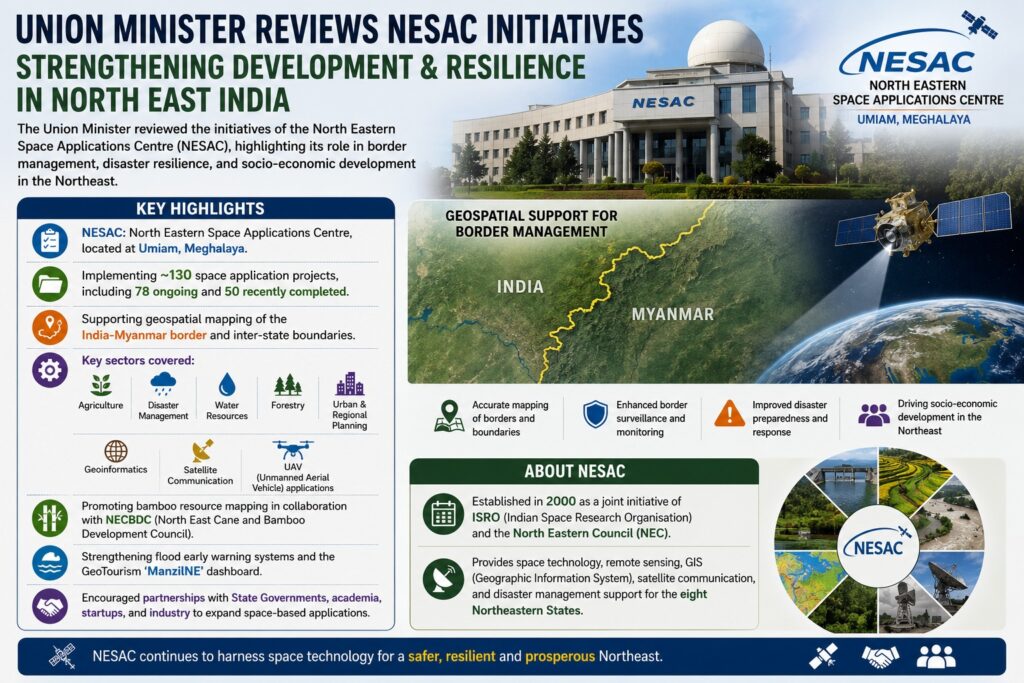
    The Union Minister reviewed the initiatives of the North Eastern Space Applications Centre (NESAC), highlighting its role in border management, disaster resilience, and socio-economic development in the Northeast

    Key Highlights

    • NESAC: North Eastern Space Applications Centre, located at Umiam, Meghalaya.
    • Implementing ~130 space application projects, including 78 ongoing and 50 recently completed.
    • Supporting geospatial mapping of the India-Myanmar border and inter-state boundaries.
    • Key sectors covered: Agriculture, Disaster Management, Water Resources, Forestry, Urban & Regional Planning, Geoinformatics, Satellite Communication, UAV (Unmanned Aerial Vehicle) applications
    • Promoting bamboo resource mapping in collaboration with NECBDC (North East Cane and Bamboo Development Council).
    • Strengthening flood early warning systems and the GeoTourism ‘ManzilNE’ dashboard.
    • Encouraged partnerships with State Governments, academia, startups, and industry to expand space-based applications.

    About NESAC

    • Established in 2000 as a joint initiative of ISRO (Indian Space Research Organisation) and the North Eastern Council (NEC).
    • Provides space technology, remote sensing, GIS (Geographic Information System), satellite communication, and disaster management support for the eight Northeastern States.

    [2024] The North Eastern Council (NEC) was established by the North Eastern Council Act, 1971. Subsequent to the amendment of NEC Act in 2002, the Council comprises which of the following members?
    1. Governor of the Constituent State
    2. Chief Minister of the Constituent State
    3. Three Members to be nominated by the President of India
    4. The Home Minister of India
    Select the correct answer using the code given below:

    [A] 1, 2 and 3 only

    [B] 3 and 4 only

    [C] 2 and 4 only

    [D] 1, 2, 3 and 4

  • Reform Express: Eight New Railway Reforms

    Why in News?

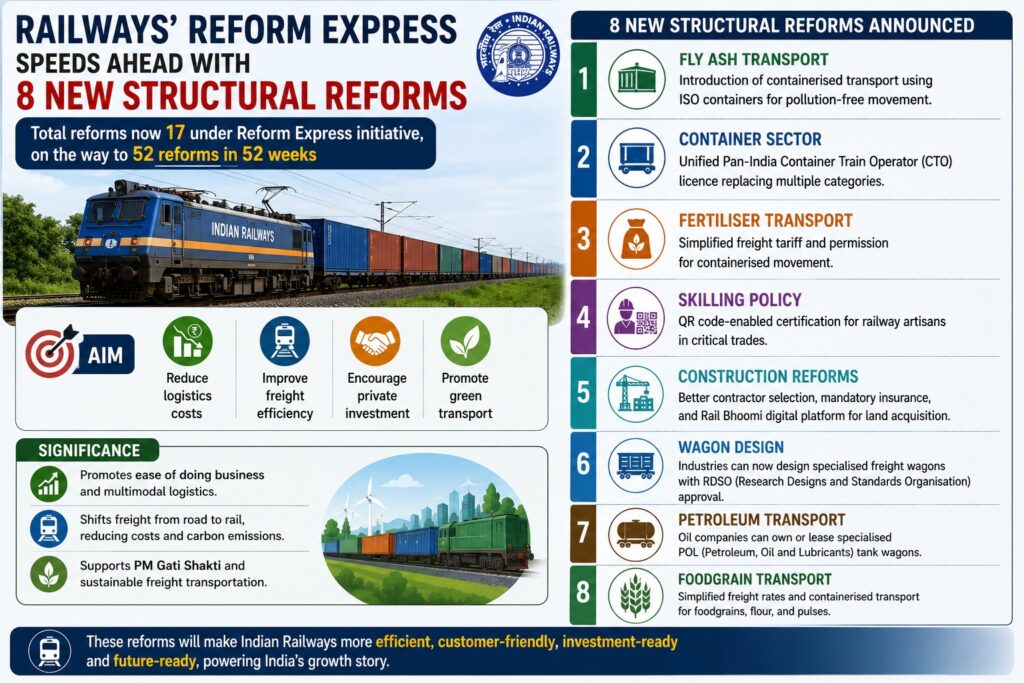
    The Ministry of Railways announced 8 new structural reforms under the Reform Express initiative, taking the total to 17 reforms as part of the target of52 reforms in 52 weeks.

    Key Highlights

    • Aim: Reduce logistics costs, improve freight efficiency, encourage private investment, and promote green transport.
    • Fly Ash Transport: Introduction of containerised transport using ISO containers for pollution-free movement.
    • Container Sector: Unified Pan-India Container Train Operator (CTO) licence replacing multiple categories.
    • Fertiliser Transport: Simplified freight tariff and permission for containerised movement.
    • Skilling Policy: QR code-enabled certification for railway artisans in critical trades.
    • Construction Reforms: Better contractor selection, mandatory insurance, and Rail Bhoomi digital platform for land acquisition.
    • Wagon Design: Industries can now design specialised freight wagons with RDSO (Research Designs and Standards Organisation) approval.
    • Petroleum Transport: Oil companies can own or lease specialised POL (Petroleum, Oil and Lubricants) tank wagons.
    • Foodgrain Transport: Simplified freight rates and containerised transport for foodgrains, flour, and pulses.

    Significance

    • Promotes ease of doing business and multimodal logistics.
    • Shifts freight from road to rail, reducing costs and carbon emissions.
    • Supports PM Gati Shakti and sustainable freight transportation.

    [2025] Consider the following statements:
    I. Indian Railways have prepared a National Rail Plan (NRP) to create a future ready railway system by 2028.
    II. Kavach’ is an Automatic Train Protection system, development in collaboration with Germany.
    III. ‘Kavach’ system consists of RFID tags fitted on track in station section.
    Which of the statements given above are not correct?

    [A] I and II only

    [B] II and III only

    [C] I and III only

    [D] I, II and III

  • Retail Inflation Rises to 4.4%

    Why in News?

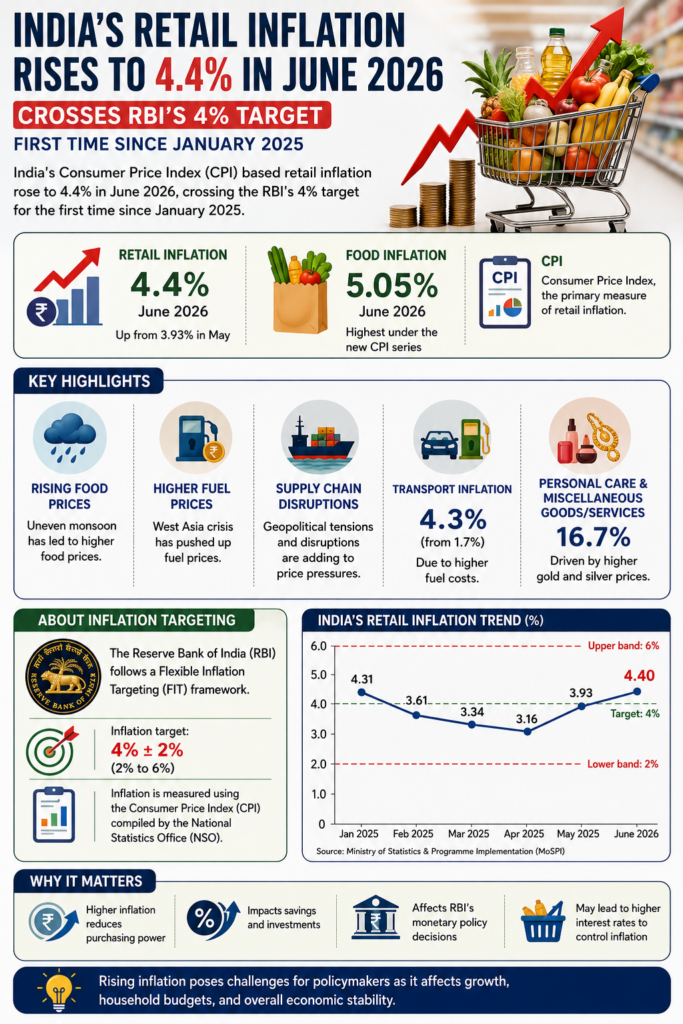
    India’s Consumer Price Index (CPI) based retail inflation rose to 4.4% in June 2026, crossing the RBI’s 4% target for the first time since January 2025.

    Key Highlights

    • CPI: Consumer Price Index, the primary measure of retail inflation.
    • Retail inflation: 4.4% (June 2026), up from 3.93% in May.
    • Food inflation: 5.05%, the highest under the new CPI series.
    • Major drivers:
      • Rising food prices due to an uneven monsoon.
      • Higher fuel prices amid the West Asia crisis.
      • Supply chain disruptions and geopolitical tensions.
    • Transport inflation rose to 4.3% (from 1.7%) because of fuel costs.
    • Inflation in personal care & miscellaneous goods/services reached 16.7%, driven by higher gold and silver prices.

    About Inflation Targeting

    • The Reserve Bank of India (RBI) follows a Flexible Inflation Targeting (FIT) framework.
    • Inflation target: 4% ± 2% (2% to 6%).
    • Inflation is measured using the Consumer Price Index (CPI) compiled by the National Statistics Office (NSO).

    [2022] In India which one of the following is responsible for maintaining for prices stability by controlling inflation?

    [A] Department of Consumer Affairs

    [B] Expenditure Management Commission

    [C] Financial Stability and Development Council

    [D] Reserve Bank of India