đŸ’„Join UPSC 2027,2028 Mentorship (July Batch) + XFactor Notes & Microthemes PDF

Author: B2B

  • Foreign Exchange Rate Determination in India and Types of Exchange Rate

    Foreign Exchange Rate Determination

    Foreign Exchange Rate is the amount of domestic currency that must be paid in order to get a unit of foreign currency. According to Purchasing Power Parity theory, the foreign exchange rate is determined by the relative purchasing powers of the two currencies.

    Example: If a Mac Donald Burger costs $20 in the USA and Re 100 in India, then the exchange rate between India and the USA will be (100/20=5), 1 $ = 5 Re.

    Forces Behind Exchange Rate Determination

    Foreign Exchange is a price of one country currency in relation to other country currency, which like the price of any other commodity is determined by the demand and supply factors. The demand and supply of the foreign exchange rate come from the residents of the respective countries.

    Demand for Foreign Exchange (Foreign Money goes out) Supply of Foreign Exchange (Foreign Money Comes in)
    Foreign Currency is needed to carry out transactions in foreign countries or for the purchase of foreign goods and services (IMPORTS). The source of foreign currency available to the domestic country are foreigners purchasing our goods and services (Exports).
    Foreign currency is needed to invest in foreign country assets/shares/bonds etc. Foreigners investing in Indian Stock markets, Assets, Bonds etc. (FPIs and FDIs)
    Foreign currency is needed to make transfer payments. Example: Indian Parents sending Money to his/her son/daughter studying in the USA. Transfer payments. Example: Indian working in the USA, sending money to his/her old aged parents.
    Indians holding money in overseas Banks Foreigners holding assets in Indian Banks.
    Indians Travelling abroad for Tourism Purpose. Foreigners travelling to India.

    • The DD curve represents the demand for foreign exchange by India. The SS curve represents the supply of foreign exchange to India.
    • The point where both DD and SS curves intersect is the point of equilibrium. At this point demand for foreign exchange is exactly equal to the supply of foreign exchange.
    • At equilibrium point E0, the exchange rate is 1 $ equal to 5 Re.
    • In normal day to day functioning of markets, the exchange rate may fluctuate. If at any point in time, the exchange rate is at E1, then the demand for foreign exchange falls short of supply of foreign exchange, as a result at this point Indians are demanding less foreign currency due to which Re will appreciate vis-Ă -vis foreign currency. The appreciation mainly occurs due to a favourable balance of payment situation (Surplus).
    • By the same token at point E2, demand for foreign exchange is greater than the supply of foreign exchange, at this point Indians are demanding excess foreign exchange than what the foreigners are willing to supply, as a result, at E2 Re will depreciate vis-Ă -vis foreign currency. The depreciation mainly occurs due to the unfavourable balance of payments situation(Deficits).

    Types of Exchange Rate Regimes

    • Fixed Exchange Rate versus Floating Exchange Rate
    Fixed Exchange Rate Floating Exchange Rate
    Under this system, there is complete government intervention in the foreign exchange markets. Under this system, the market is allowed to determine the value of exchange rate freely.
    The government or central bank determines the official exchange rate by linking exchange rate to the price of gold or major currencies like US dollar. The exchange rate is determined by the forces of demand and supply.
    If due to any reason, the exchange rate fluctuates, government intervenes and make sure that equilibrium pre-determined level is maintained. If due to any reason exchange rate fluctuates, the government never intervenes and allows the market to function and determine the true value of exchange rate.
    The only merit of fixed exchange rate system is that it assures the stability of exchange rate. It prevents both currency appreciation and depreciation. The only demerit of floating exchange rate system is that exchange rate fluctuates a lot on day to day basis.
    The many disadvantages of such a system are: It puts a heavy burden on governments to maintain exchange rate. This especially happens during the time of deficits, as the governments need to infuse a lot of money to maintain exchange rate.

    The foreign investors avoid investing in such countries as they fear to lose their investments because they believe that exchange rate does not reflect the true value of the economy.

    The advantages of such a system are: the exchange rate is determined in well-functioning foreign exchange markets with no government interference.

    The exchange rate reflects the true value of the domestic currency which helps in establishing the trust among foreign investor.

    A country can easily access funds/ loans from IMF and other international institutions if the exchange rate is market determined.

    • Managed Floating Exchange rate

    Manage Floating exchange rate lies in between of the two extremes of fixed and floating exchange rate. Under such a system, the exchange is allowed to move freely and determined by the forces of the market (Demand and Supply). But when a difficult situation arises, the central banks of the country can intervene to stabilise the exchange rate.

    There are mainly three sub categories under managed floating exchange rate:

    1. Adjusted Peg System: In this system, a country should try to hold on to a fixed exchange rate system for as long as it can, i.e. until the country’s foreign exchange reserves got exhausted. Once the country’s foreign exchange reserves got exhausted, the country should undergo devaluation of currency and move to another equilibrium exchange rate.
    2. Crawling Peg System: In this system, a country keeps on adjusting its exchange rate to new demand and supply conditions. The system requires that instead of devaluing currency at the time of crisis, a country should follow regular checks at the exchange rate and when require must undertake small devaluations.
    3. Clean Floating: In the clean float system, the exchange rate is determined by market forces of demand and supply. The exchange rate appreciates or depreciates as per market forces and with no government intervention. It is identical to floating exchange rate.
    4. Dirty Floating: In the dirty float system, the exchange rate is to a very large extent is determined by the market forces of demand and supply (so far identical to clean floating), but occasionally the central banks of the countries intervene in foreign exchange markets to smoothen or remove excessive fluctuations from the foreign exchange markets.

    Note for Students

    The Bretton Woods system of exchange rate which was in operation from 1944 till 1971, was one of relative fixed exchange rate as opposed to rigid fixed exchange rate. As a matter of fact, rigid fixed exchange rate as defined above, is never been used in history. Even under the system of Gold Standard 1870-1941, the exchange was relatively fixed and not rigidly fixed.

    Exchange Rate Management in India

    Over the last six decades since independence the exchange rate system in India has transited from fixed exchange rate regime where the Indian Rupee was pegged to the UK Pound to a basket of currencies during the 1970s and 1980s and eventually to the present form of market determined exchange rate regime since 1993.

    • Par Value System (1974-1971): After Independence Indian followed the ‘Par Value System’ whereby the rupee’s external par value was fixed with gold and UK pound sterling. This system was followed up to 1966 when the rupee was devalued by 36 percent.
    • Pegged Regime (1971-1992): India pegged its currency to the US dollar (1971-1991) and to pound (1971-75). Following the breakdown of Breton Woods system, the value of pound collapsed, and India witnessed misalignment of the rupee. To overcome the pressure of devaluation India pegged its currency to a basket of currencies. During this period, the exchange rate was officially determined by the RBI within a nominal band of +/- 5 percent of the weighted average of a basket of currencies of India’s major trading partners.
    • The period since 1991: The transition to market-based exchange rate was in response to the BOP crisis of 1991. As a first step towards transition, India introduces partial convertibility of rupee in 1992-93 under LERMS.
    • Liberalised Exchange Rate Management System (LERMS): The LERMS involved partial convertibility of rupee. Under this system, India followed a dual exchange rate policy, where 40 percent of the exchange rate were to be converted at the official exchange rate and the remaining 60 percent were to be converted at the market-based exchange rate. The exchange rate converted at the official rate were to be used for essential imports like crude, oil, fertilizers, life savings drugs etc. All other imports should be financed at the market-based exchange rate.
    • Market-Based Exchange rate Regime (1993- till present): The LERMS was a transitional mechanism to provide stability during the crisis period. Once the stability is achieved, India transited from LERMS to a full flash market exchange rate system. As a result, since 1993, exchange rate fluctuations are marker determined. In the 1994 budget, 60:40 ratio was removed, and 100 percent conversion at market-based rate was allowed for all goods and capital movements.

    By
    Himanshu Arora
    Doctoral Scholar in Economics & Senior Research Fellow, CDS, Jawaharlal Nehru University

  • FDI and FPI in India, External Commercial Borrowings, Foreign Exchange Reserves in India

    Note4Students: External Commercial Borrowings

    • An external commercial borrowing(ECB) is an instrument used in India to facilitate the access to foreign money by Indian corporations and PSUs (public sector undertakings). ECBs include commercial banks loans, buyers’ credit, suppliers’ credit, securitised instruments such as floating rate notes and fixed rate bonds etc., credit from official export credit agencies and commercial borrowings from the private sector window of multilateral financial institutions such as International Finance Corporation (Washington), ADB, AFIC, CDC, etc. ECBs cannot be used for investment in Stock Market or speculation in real estate.
    • The DEA (Department of Economic Affairs), Ministry of Finance, Government of India along with Reserve Bank of India, monitors and regulates ECB guidelines and policies. For infrastructure and greenfield projects, funding up to 50% (through ECB) is allowed. In telecom sector too, up to 50% funding through ECBs is allowed. Recently Government of India allowed borrowings in Chinese currency yuan. Corporate sectors can mobilize USD 750 million via automatic route, whereas service sectors and NGO’s for microfinance can mobilize USD 200 million and 10 million respectively.
    • Borrowers can use 25 per cent of the ECB to repay rupee debt and the remaining 75 per cent should be used for new projects. A borrower can not refinance its entire existing rupee loan through ECB. The money raised through ECB is cheaper given near-zero interest rates in the US and Europe, Indian companies can repay part of their existing expensive loans from that.

    Exports and Imports Performance of India

    Source: World Bank, World Development Indicators

    The data table highlights the following facts about India’s Exports since 1990’s:

    • There has been a consistent growth in exports as a percentage of GDP since 1990. The exports witnessed highest growth rate during 2000 to 2008.
    • The decline from 2008 onwards is mainly due to Global Financial crisis that hit the World in 2008.
    • Since 2009, exports recovered and reached a peak in the year 2013.
    • Following 2013, exports as a percentage of GDP declined mainly due to a slow recovery in India’s Key European markets.

    Source: World Bank, World Development Indicators

    The data table highlights the following facts about India’s imports since 1990’s:

    • There has been a consistent rise in imports as a percentage of GDP since 1990. The imports witnessed highest growth rate during 2000 to 2008.
    • The decline from 2009 onwards is mainly due to Global Financial crisis that hit the World in 2008 which had resulted in fall of commodity prices (Metals, Minerals, Agricultural Commodities) in the World markets.
    • Since 2009, imports started to rise and reached its peak in the year 2012.
    • Following 2012, imports as a percentage of GDP declined mainly due to fall in crude oil prices and slow recovery in the prices of key commodities.

    Source: World Bank, World Development Indicators

    • One of the important impacts of favourable exports and managed Current account is reflected in India’s increasing Foreign exchange reserves.
    • Foreign exchange reserves after falling to an all-time low of less than USD 5 Billion recovered and increased to USD 41 Billion in the year 2000. The increase in Foreign exchange reserves is due to favourable exports earnings and Foreign investments. They both are the byproduct of India’s opened up economy.
    • The Foreign exchange reserves have risen steadily thereafter. The reserves were USD 250 Billion in the year 2008, USD 300 Billion in the year 2010 and more than USD 360 Billion in the year 2016.

    What Caused the fall in India’s Exports in Recent Years

    India’s goods exports had remained stagnant over the years. After recovering from Global Financial Crisis of 2008, India’s exports had reached a peak of USD 310 billion in the year 2011.

    The successive years have shown stagnant exports till the year 2014. Post-2014, India’s goods exports have collapsed sharply and reached at USD 267 billion and USD 264 billion in the year 2015 and 2016 respectively.

    The reason for the collapse of India’s exports are as follows:

    1. The Global economic situation has remained difficult and the Economies of the Developed World especially US, Europe and Japan are recovering very slow from the Global Financial Crisis of 2008. Due to their slow recovery, their capacity to imports has remained limited, as a result, India losing its important export destinations.
    2. The price of crude oil has collapsed since 2014. Due to fall in crude prices, the economies of Arab nations and oil exporting countries have suffered a lot and are growing at a dismal rate. The low growth rate had resulted in a slowdown in their imports as well. The countries of Arab nations like UAE, Saudi Arabia are key trading partners of India. Their slowdown has led to decline in India’s exports to these regions.
    3. The most important reason for India’s declining exports lies in domestic factors. The main culprit of which above all is India’s exchange rate. The exchange rate is the price of one country currency in terms of another country currency. In the Indian context, it simply determines ‘The amount of dollar or euro or any currency that can be bought using Indian Rupee’.
    4. The Indian Rupee has been overvalued for quite some time. The overvalued rupee simply means that rupee is very expensive for the other nations to buy. Consider the example now.

    1. The other underlying domestic factors that resulted in slow export performance are infrastructure bottlenecks. The health of India’s Roads, Highways, Ports and power sector remains poor and dismal. They all contribute in making export costly and uncompetitive. The poor quality of infrastructure simply increases the cost of transporting goods from factories to main destinations. The increase in cost results to increase in the prices, thereby making goods expensive and uncompetitive.

    Foreign Direct Investment and Foreign Portfolio Investment in India

    Foreign Direct Investment Foreign Portfolio Investment
    FDI is an investment made by a company or individual in the business of another country in the form of either establishing a new business or acquiring the existing business. FPI is an investment made by a company or an individual in the stock markets or debt markets of another country. FPI investors merely purchase equities/shares/bonds/debentures of foreign based countries.
    FDIs are mainly made in Open Economies as opposed to tightly controlled closed economies. FPIs are mainly made with the objective of making quick profits by buying and selling shares, bonds and debentures.
    FDIs are made for a longer period as the foreign investor’s controls and owns the companies in which they have invested. FPIs are made for shorter periods as the foreign investor do not own the companies and only invest in shares of the existing companies.
    FDIs are much Stable. FPIs are highly volatile.
    As per Organisation of Economic Cooperation and Development (OECD), the threshold for an investment to be considered as FDI is 10 percent or more ownership stake. As per Organisation of Economic Cooperation and Development (OECD), investment of less than 10 percent in foreign companies is treated as FPIs. All FPI taken together cannot acquire more than 24 per cent of the paid-up capital of an Indian Company.
    FDIs are normally categorised as being Horizontal or Vertical in nature.

    • A Horizontal investment refers to the foreign firms establishing the same type of Business operations in the host country as it operates in his home country.

    Example; Apple opening up Apple manufacturing unit in India.

    • A Vertical investment refers to the foreign firms establishing different but related business in host countries. Example: Hyundai Motors acquiring or establishing a company in India that supplies car spare parts/raw materials required for manufacturing Cars by Hyundai.
    FPI investor includes Foreign Institutional Investors (FIIs), Foreign Qualified Investors (FQIs).

    • Institutional investors are big institutions like Asset Management Companies, Mutual Funds, Insurance Houses etc. RBI has mandated such big institutions to established to make investments in India’s security markets.
    • FQIs are individual investors or associations residing in Foreign countries. FQIs are small individual investors who invest in foreign countries securities.

    FDI Policy in India and Sectoral Limits

    FDI in India is allowed under two major routes; Automatic Route (Without the approval of Government or RBI) and Government Route (requiring Government approval).

    FDI in Sectors where Government approval is Required Cap/Limit Government Approval
    Mining and mineral separation of titanium-bearing minerals and ores 100% upto 100%
    Food Product Retail Trading 100% upto 100%
    Defense 100% beyond 49%
    Publishing Printing of Scientific abd Technical Magazines 100% upto 100%
    Publication of Foreign Editions Newspaper 100% upto 100%
    Print Media- Publishing of newspaper 26% upto 26%
    Print Media – Publication of Indian editions of foreign magazines dealing with news and current affairs 26% upto 26%
    Air Transport Service – Scheduled, and Regional Air Transport Service 100% beyond 49%
    Investment by Foreign Airlines 49% upto 49%
    Satellites- establishment and operation 100% upto 100%
    Telecom Services 100% beyond 49%
    Trading SBRT 100% beyond 49%
    Pharma- Brownfield 100% beyond 74%
    Banking Private Sector 74% beyond 49%
    Banking Public Sector 20% upto 20%
    Private Security Agencies 74% beyond 49%
    FM Radio Broad Casting 49% upto 49%
    Trading MBRT 51% upto 51%

    Source: Ministry of Commerce

    FDI POLICY Limits under Automatic Routes with Conditions Cap/Limits
    Agriculture 100%
    Plantation Sectors 100%
    Mining of Metals and Non-Metal Ores 100%
    Mining Coal and Lignites 100%
    Manufacturing 100%
    Food Retail Trading 100%
    Broadcasting Carriage Services ( Teleports, DTH, Cable Networks, Mobile TV, HITS) 100%
    Broadcasting Content Service – Up-linking of Non-‘News & Current Affairs’ TV Channels/ Downlinking of TV Channels 100%
    Airport Greenfield 100%
    Airport Brownfield 100%
    Air Transport Service – Non-Scheduled 100%
    Air Transport Service – Helicopter Services/ Seaplane Services 100%
    Ground Handling Services 100%
    Maintenance and Repair organizations; flying training institutes; and technical training institutions 100%
    Construction Development 100%
    Industrial Parks 100%
    Trading Wholesale 100%
    Trading B2B E-commerce 100%
    Duty Free Shops 100%
    Railways Infrastructure 100%
    Credit Information Companies 100%
    White Label ATMS 100%
    Non-Banking Finance Corporations 100%
    Pharma Greenfield 100%
    Petroleum & Natural Gas – Exploration activities of oil and natural gas fields 100%
    Petroleum refining by PSUs 49%
    Infrastructure Company in the Securities Market 49%
    Commodity Exchanges 49%
    Insurance 49%
    Pension 49%
    Power Exchanges 49%

    Source: Ministry of Commerce

    How Beneficial is FDI for Developing Countries like India?

    FDI has proved to be a stable and important source of capital for the developing countries like India. FDI flows were quite consistent and stable in East Asian Countries even during the Asian Financial Crisis of 1997-98. In sharp contrast to FDI, the other forms of foreign investment like Portfolio Investments, equity flows and debt flows were subject to huge reversals during the same period. The consistency of FDI was also evident during the Latin American Crisis of 1980s.

    1. The stability of FDI even during the crisis period led many developing countries to favour FDI over other forms of Short-term inflows. Developing countries favour FDI because it allows them (capital deficit countries) to access scarce capital and invest them in the domestic economy, which can lead to the generation of output and employment.
    2. The Foreign Countries Investors are willing to invest in Developing countries because it allows them to seek highest returns. It also reduces the risk faced by the owner of capital by allowing them to diversify their investment. Example: Imagine the havoc that Global Financial Crisis could have created if all the US and European money was invested only in Developed Countries. They must have lost all their money, had they not invested in developing countries, which were not affected so badly from Global Crisis. FDI thus provides a cushion to Foreign Investors.
    3. The easy movement of capital flows in order to seek high returns also contributes to Developing countries adopting a very high and competitive corporate governance standards, efficient legal institutions and integrated Financial markets. These high standards and integrated markets also help the domestic investors and firms as their money is also secure due to the efficient functioning of legal institutions.
    4. The pressure to attract FDI also improves the functioning of Governments in Developing Countries. The Governments in Developing Countries restricts themselves from pursuing bad economic policies due to the fear of reversal of Foreign Capital.
    5. The gains to the Developing Countries from FDI can also take the form of:
    • FDI allows transfer of technologies that cannot be achieved through other forms of short-term financial investments like FPIs.
    • FDI recipient’s countries also gain in the form of increased employment opportunities due to the investment made by Foreign Firms.
    • The Governments of the host countries also stands to gain due to increase in their corporate tax revenues.

    Note for Students

    The short-term capital or hot money flows poses many risks in developing countries as they are driven mainly by speculative actions based on interest rate or exchange rate differentials. there movements are only for short-term and leaves the host country as the first signs of trouble appears, thus can damage the host economy, thus they are considered as ‘Bad Cholesterol’.

    In contrast FDI is considered as “Good Cholesterol” because it offers a lot of benefits as mentioned above. FDI cannot leave so easily at the first time of trouble, instead it provides a cushion to absorb the shock.

    Reasons for Caution in Dealing with FDI

    Despite the above-mentioned arguments developing countries should be a little cautious about taking a too uncritical attitude towards FDI.

    1. A very high level of FDI in total capital inflows may indicate a sign of weakness for the host country.
    2. It is found that FDI tends to flow in those developing countries which are a lot riskier and lacks proper legal institutions. What can explain these paradoxical findings? One reason could be that FDI is more likely to take place in countries with inefficient markets as Foreign investors can operate more aggressively and directly extracting much more than what they invest. Example: What East India Company have done to India or The US exploitation of Latin America in 20th Century or What Chinese Firms are Currently doing in African Nations.
    3. FDI not only leads to transfer of ownership from domestic to foreign residents but also a mechanism that makes foreign investor to take control of host country firms and their management.
    4. The foreign corporations take over the control of domestic firm not because they have some special competence regarding the operation of companies but simply because they have huge cash that domestic firm’s do not have.
    5. FDI allows Foreign investors to gain crucial inside information about firms they control. This gives them an information advantage over domestic investors who are investing in such firms.
    6. FDI tends to come only in those sectors where returns are high and are beneficial to foreign firms. FDIs has a long tendency to avoid crucial sectors of developing countries like Primary Health and Primary Education.
    7. FDI tends to make domestic firms indebted. The rising debt leads to rising interest burden and reparations of money from domestic firms to parent firms.
    8. Thus, developing countries should follow caution while accepting FDI and should give much more importance on improving the domestic environment for investment and functioning of markets.

    Indian FDI Recent Trends

    Source: Ministry of Commerce and RBI Statistics

    • India received $51 billion in foreign direct investment (FDI), the highest-ever FDI inflow in a fiscal, during April-February FY16. According to data from the DIPP, the previous highest FDI inflow was in FY12 when the country received $46.55 billion, which was a 34 percent increase over $34.8 billion it got in FY11 However, India recorded its largest-ever percentage increase in FDI when it received $22.8 billion in FY07, representing a 155 percent increase over the $8.9 billion in FY06.

    Sectors witnessing Highest FDI inflow

    • Among the sectors, computer hardware and software segment attracted the highest FDI of $5.30 billion (Rs 36,426.9 crore) during the period
    • Followed by services sector ($4.25 billion, or Rs 29,210.25 crores) and trading business ($2.71 billion, or Rs 18,625.8 crore).
    • Automobile industry attracted FDI of $1.78 billion (Rs 12,233.9 crore), while chemicals sector cornered $1.19 billion (Rs 8,178.87 crore) foreign equity investment in April-December 2015.

    Sources of FDI inflow

    •  Singapore replaced Mauritius as the top FDI source for India during the period.
    • India received $10.98 billion (Rs 75,465.5 crore) overseas inflows from Singapore, followed by Mauritius ($6.10 billion, or Rs 41,925.3 crore), the US ($3.51 billion or Rs 24,124.2 crore), the Netherlands ($2.14 billion, or Rs 14,708.22 crore), and Japan ($1.08 billion, or Rs 7,422.8 crore).

    Destination of FDI inflow

    • A state-wise analysis of FDI inflows by the economic survey shows that Delhi, Haryana, Maharashtra, Karnataka, Tamil Nadu, Gujarat and Andhra Pradesh together attracted more than 70% of total FDI inflows to India during the last 15 years.
    • States with vast natural resources like Jharkhand, Bihar, Madhya Pradesh, Chhattisgarh and Odisha have lagged behind.

    By
    Himanshu Arora
    Doctoral Scholar in Economics & Senior Research Fellow, CDS, Jawaharlal Nehru University

  • India’s BOP Performance: Balance of Payment versus Balance of Trade, Current Account versus Capital Account

    BOP on Current Account Versus BOP on Capital Account

    Current Account Capital Account
    BOP on current account includes the sum of three balances.

    • Goods Balance
    • Services Balance
    • Unilateral Transfers
    BOP on capital account includes the sum of two balances

    • Long Term Capital Account
    • Short Term Capital Account
    BOP on Current Account is also called Net Foreign Investment because it represents the contribution of foreign trade to Gross national product. BOP on capital account includes all inward and outward moving capital and investments both Long term and short term).

    • Foreign Direct Investment
    • Foreign Portfolio Investment
    • Government Investments/loans
    BOP on current account covers only earnings and spending. It totally excludes any borrowings and lending. It only includes borrowings and lending by a country.

    Balance of Payment versus Balance of Trade

    Balance of Payment Balance of Trade
    It is a Broad Concept It is a narrower Concept.
    It includes the sum of both Capital and Current account put together. It includes all international transactions between a host/domestic country and Rest of the World. It is defined as the difference between the value of exports of goods and services and value of imports of goods and services between countries.
    It includes items of goods account, services account, unilateral transfers and capital accounts. BOT= Value of Exports – Value of Imports.

    • Trade Balance>> Value of Exports = Value of Imports.
    • Trade Surplus>> Value of Exports is greater than Value of Imports.
    • Trade Deficit>> Value of Exports is smaller than Value of Imports.
    • Can an overall BOP surplus is a good sign? And BOP deficit is a bad sign?
    • The above is not always true, and we have to dig deeper to understand the nature of surplus and deficits in overall BOP.
    • If the overall BOP deficit is caused by Current account deficits (Excess of imports over exports), as opposed to capital account deficits, then BOP deficits are bad for countries.
    • If the overall BOP surplus is caused by current account surplus (Excess of exports over imports), as opposed to capital account surplus, then the surplus may be good for economies.
    A positive trade balance(Surplus) is always better and good for a country since it represents an increase in national income.

    Note for Students

    There is a difference between the terminologies of Balance of Trade and Goods Balance. Goods or Merchandise Balance is defined as difference between the value of merchandise or goods exports and the value of merchandise or goods imports.

    The Balance of Trade on the other hand includes both goods balance (Visible) and services (Invisibles) balance.

    Should a negative trade balance (excess of imports over exports) be treated as undesirable for an economy?

    The answer is No, because, a developing country needs to import vast quantities of capital goods and technologies to build a strong industrial base. Developing country hardly possess resources needed for industrialisation. They have to import all these resources and in the course of doing so, they have to experience a negative trade balance. Therefore, a negative trade balance cannot be described as undesirable in such a situation. Moreover, once the industrial base is setup, a country can reverse its negative trade balance into a positive trade balance by developing export oriented industries.

    BOP Account of a Country

    Balance of Payments of a Country Always Balances

    The items 1 to 7 show the total receipts from all sources. These receipts amount to Rs. 1000 Crores.

    The items 1(a) to 7(a) Show the total payments on all accounts. These payments amount to Rs. 990 Crores. When item 8 included, the total payment is Rs. 1000 Crores, hence the total credit is equal to the total debit.

    Thus, the current account and capital account Balance each other. Thus, the surplus in the current account is equal to the deficit in the capital account. A deficit in the current account is equal to the surplus in the capital account.

    In the above-given table, the balance of current account shows a deficit of Rs. 200 crores but there is a corresponding surplus of Rs. 200 crores in the balance of the capital account.

    Hence the credit and debit sides balance & the balance of payments is in equilibrium.

    The balance of trade of a country may not balance. For instance, if exports exceed imports, there is a surplus and a favourable balance of trade and vice-versa. Only if the value of exports is equal to the value of imports, the balance of trade is said to be in equilibrium.

    But the balance of payments always balances because every transaction must be settled. Hence total debits must be equal to the total credits.

    Current Account Balance: An Evaluation

    The very basic point is to understand what a current account deficit or surplus really means and how it is measured?

    • It can be measured as the difference between the value of exports of goods and services and the value of imports of goods and services.
    • A deficit simply means that a country is importing more goods and services than it is exporting.
    • The current account also includes net incomes such as interests, dividends and unilateral transfers such as Foreign aids.
    • Alternatively, Current Account can also be expressed as the difference between national savings and national investments.
    • A current account deficit reflects a low level of national savings relative to investments (S<I). whereas, a Current account surplus reflects a high level of domestic savings relative to investments (S>I).
    • Current Account = Saving – Investment.

    Whether CAD is Necessarily Bad for an Economy or Not?

    • In theory, a developing country running a CAD is not necessarily a bad thing. A deficit in current account can increase growth and economic development. Although recent examples and research show that developing countries that run a deficit may not grow faster mainly due to less developed financial markets and inefficient use of foreign capital (Foreign capital used to finance consumptions and interest payments).
    • If a current account deficit is financed by borrowing, it is said to be more unsustainable. This is because borrowing is unsustainable in the long term and countries will be burdened with high-interest payments. E.g. Russia was unable to pay its foreign debt back in 1998. Other developing countries have experienced similar repayment problems Brazil, African countries (3rd World debt) Countries with large interest payments have little left over to spend on investment.
    • A factor behind the Asian crisis of 1997 was that countries had run up large current account deficits by attracting capital flows (hot money) to finance the deficit. But, when confidence fell, these hot money flows dried up, leading to a rapid devaluation and crisis of confidence.

    A Case for India’s Current Account Deficit

    • A developing country like India will have more investment opportunities due to its huge domestic market size, but due to its low level of domestic savings, India will not be able to undertake all such opportunities on its own. Thus, a Current account deficit is quite natural.
    • When India runs a CAD, it is increasingly getting dependent on foreign capital to finance it. It will lead to building up of liabilities to the rest of the World. Eventually, these liabilities need to be paid back. Common sense suggests that if India uses its borrowed foreign funds in unproductive spending’s that yields no long term productivity gains, then its ability to repay will be affected and will result in insolvency or Bankruptcy. This is what exactly happened in India during 1980’s and 1990’s leading to full-fledged Balance of Payment Crisis.
    • During 1980’s and 1990’s, India was not able to generate enough surplus in its capital and current accounts to repay what it had borrowed leading to BOP crisis in 1991.
    • Therefore, whether a country should run Current Account Deficit or not will depends on its borrowings from Abroad and on how the country uses its borrowings; if the borrowings/Foreign capital is used efficiently and in productive work then it will generate future revenues and profits that will be greater than the cost of borrowings; but if the borrowings/foreign capital is used inefficiently, and in unproductive works then profits will be less than the cost of borrowings. Hence losses.

    Therefore, the key points to remember regarding CAD is as follows:

    1. If the deficit reflects the excess of imports over exports for a very long time, it may indicate problems and loss of domestic firms’ competitiveness.
    2. The deficit also reflects the excess of investment over savings, which could reflect a highly productive and growing economy. However, if the deficit is due to low savings rather than high investments, it could be due to unproductive consumption or badly manage government finances (Excess subsidies, high government expenditures, public debt etc.)
    3. If the foreign capital supporting investment is used productively to generate more output, jobs and exports, then CAD is not at all bad.
    4. If the foreign capital supporting investment is used unproductively to pay for earlier debt obligations or for consumption purposes, then CAD is bad for an economy.

    Evaluation of CAD in India

    Period one: 1956 to 1976

    The period comprised the second, third, fourth and initial years of Fifth five-year plans. The period saw heavy deficits in the current account. The main reasons for high deficits were three wars with China (1962) and Pakistan (1965 and 1971), severe droughts and food crisis of 1965-66 and first oil price shock of 1973.

    Period Two: 1976 to 1979

    The period is considered as a golden period for India’s Current Account. The comfortable position was due to increase in private remittances (people working abroad and sending money to their families in home countries) from Gulf countries. The second reason was India witnessing a very strong growth in exports and a reduction in oil imports bill mainly due to fall in oil prices. Efforts were made towards export promotion instead of import substitution. Export subsidies were increased from 20% in 1979-80 to 25% in 1987-88 as a proportion of exports.

    Period Three: 1980 to 1991

    The period covered roughly the sixth and seventh five-year plan and was marked by a severe balance of payments difficulties. The earnings from private remittances started to fall during the seventh five-year plan. The gulf crisis of 1990-91 further worsened the current account problem.

    Period Four: Situation since 1991

    The situation since 1991 has been distinctly different from the situation that prevailed earlier. The current account deficit started to improve after 1993. The export performance of Indian industries improves considerably after 1993. The most significant years in India when it comes to current account were; 2001-02, 2002-03 and 2003-04. In all these years, the current account saw a surplus. It is the first time since independence that India witnessed a surplus in its current account. The period also saw strong capital inflows due to strong macroeconomic variables.

    The reasons for satisfactory Balance of Payments situation was as follows:

    1. High Earnings from invisible (Private remittances from abroad and software exports). Earnings from invisible exceeded the deficits on trade account. India was the largest recipient of private remittances (70 Billion US $) in the World in 2012.
    2. Rise in external commercial borrowings. In addition to external commercial borrowings, the period also witnessed an increase in Non-Resident deposits.
    3. Role of Foreign Investments. The liberalized policy was put into place. FDI can happen in more markets, ownership structures.

    Automatic routes were provided in many sectors where the investor merely has to notify RBI 30 days in advance from bringing the funds. Dividend balancing requirements have been removed.

    Role of FIPB: In normal cases, it has to process in 6 months. It can even meet the investor in person to expedite the process. It is empowered to approve 100% FDI in cases of high technology transfers.

    As per 2004-05, apart from a negative list, the automatic route within prescribed limits is to be followed by others. Procedures for FDI were also simplified and included things such as conversion of CBs and preference shares into equity.

    Source: World Bank, World Development Indicators

    Source: World Bank, World Development Indicators

    The Problem: New RBI data on India’s Balance of Payments (BoP) for 2017-18 show current account deficit (CAD) at $48.72 bn, the highest since the record $88.16 bn of 2012-13. With CAD expected to widen to $75 bn during this fiscal due to rising crude oil prices. India BOP situation can become vulnerable.

    Forex as cushion: India’s forex reserves, at $424.55 billion as on March 2018, are actually the eighth largest in the world. Also, they can finance 10.9 months of imports, compared to 7.8 months in March 2014, 7 months in March 2013 (when there was a mini-BoP crisis, with the current account deficit hitting a peak), and 2.5 months in March 1991 (which forced the country to seek International Monetary Fund assistance).

    Therefore, India is not on the verge of any severe BOP crisis as witnessed in 1991. The allusion to a “crisis” from that Balance of Payment standpoint is highly misplaced; the RBI’s current forex war chest is clearly sufficient, both to meet immediate import needs and to stave off a run on the rupee of the kind that was seen during May-August 2013.

    How Countries accumulates Reserves:

    In standard trade theory, Countries generally accumulate reserves by exporting more than what they import. However, India always had deficits on its merchandise trade account, with the value of its imports of goods far in excess of that of exports. At the same time, the country has traditionally enjoyed a surplus on its ‘invisibles’ account. Invisibles accounts basically cover receipts from export of software services, inward remittances by migrant workers, and tourism and — on the other side — payments towards interest, dividend and royalty on foreign loans, investments and technology/brands, besides on banking, insurance and shipping services.

    But with the invisible account surpluses not exceeding trade deficits — it has resulted in the country consistently registering Current Account Deficits.

    A country gets foreign exchange not only from exporting goods and services, but also from capital inflows (FDI, ECB and FPI), whether by way of foreign investment, commercial borrowings or external assistance. In India, for most years, net capital inflows have been more than CAD. The surplus capital flows have, then, gone into building foreign exchange reserves. The most extreme instance was in 2007-08, when net foreign capital inflows, at $107.90 billion, vastly exceeded the CAD of $15.74 billion, leading to reserve accretion of $92.16 billion during a single year. However, there have also been years, such as 2008-09 and 2011-12, which saw reserves depletion due to net capital inflows not being adequate to fund even the CAD.
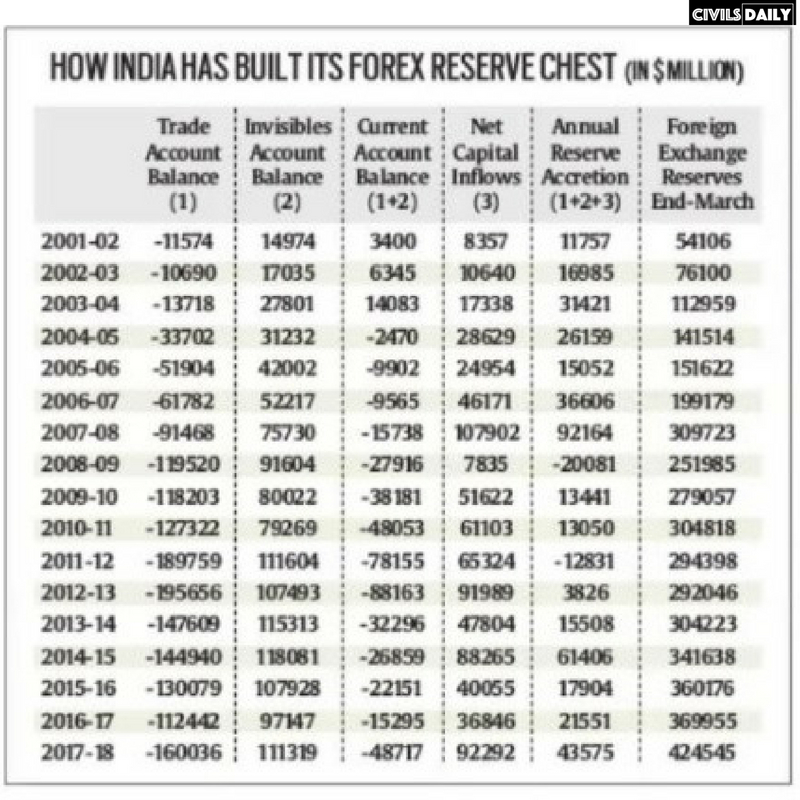
    India and Brazil Case Study: They both represent unique cases of emerging economies that have built foreign exchange reserves largely on the strength of their capital account by attracting inflows of foreign funds (FDI, FPI ECB) rather than current account of the BoP.

    India is even more unique because its currency, unlike the Brazilian real, is relatively stable, and not under frequent speculative attacks. In theory, a country can keep attracting capital flows to fund CADs so long as its growth prospects are seen to be good, and the investment environment is equally welcoming. It would help, though, if such foreign investment also goes towards augmenting the economy’s manufacturing and services export capacities, as opposed to simply producing or even importing for the domestic market. In the long run, that can help narrow the CAD to more sustainable levels.

    The Present Situation: The CAD fell sharply from $88.16 billion in 2012-13 to $15.30 billion in 2016-17, mainly because of India’s oil import bill nearly halving from $164.04 billion to $86.87 billion. However, in 2017-18, the CAD rose to $48.72 billion, courtesy resurgent global crude prices, and is expected to cross $75 billion this fiscal.

    There are signs of capital flows slowing down as well. Foreign portfolio investors have, since April 1, made $7.9 billion worth of net sales in Indian equity and debt markets. This is part of a larger sell-off pattern across emerging market economies, in response to rising interest rates in the US, and the European Central Bank’s plans to end its monetary stimulus programme by the end of 2018.

    The Swiss investment bank Credit Suisse has forecast net capital flows to India for 2018-19 at $55 billion, which will be lower than the projected CAD of $75 billion. In the event, forex reserves may decline for the first time since 2011-12. The RBI’s data already show the total official reserves as on June 8 at $413.11 billion, a dip of $ 11.43 billion over the level of end-March 2018.

    Solving Exports Paradox: Solutions

    The factors affecting exports are both domestic and global. External factors consist of global economic conditions, tariff barriers imposed by partner countries, lack of market access, lack of export diversification, Trade wars, Volatility in international currency markets, geopolitical risks, regional trading agreements etc. Domestic factors include macroeconomy management, price elasticity of exports (if price of an exported good is increased by one percent, by how much percentage will the demand fall), exchange rate competency, inflation risk in the economy, government trade policies.

    A combination of these factors determines the productivity and overall competitiveness of exports. Therefore, the current decline in India’s exports must be analysed by taking into account the state of play of these external and internal factors.

    Many policy thinkers argue that an overvalued rupee is partially responsible for the recent decline in India’s exports. To understand the relationship between exports and exchange rate, we need to look at the growth of India’s exports and real effective exchange rate (REER) between 2002 and 2015.

    Till 2013, the relationship between export growth and REER was mixed ( See chart). After this period, it exhibits a clear trend that an overvalued rupee has affected the growth of India’s exports.

    This corroborates a well-tested hypothesis that “a stronger currency is not good for export outlook”. Many countries in East Asia including China pursued the strategy of relatively undervalued currency to make their exports competitive in global market under their export led industrialisation.

    Therefore, in a highly complex and competitive world, where countries are competing for their export interest, the value of currency must be fairly placed vis-à-vis competing currencies to make one’s export competitive.

    Another factor behind the steep decline in India’s exports could be over-dependence on a few markets such as the US and European Union countries which together account for 40 per cent share in India’s total exports. It is particularly important in view of falling demand, stagnant growth and resultant aggregate demand in these countries.

    While, India is extensively diversifying its exports market towards Asia through regional and bilateral trading agreements. It has made limited progress in terms of diversifying its exports to non-traditional markets such as South America, Africa and Central and Eastern European countries. Therefore, the diversification of India’s exports market is essential for long term export strategy.

    Exchange rate management and competitiveness of Rupee will help in revival of India’s exports. However, exchange rate alone will not resolve India’s export challenge.

    India should make continuous efforts in alleviating supply-side bottlenecks to boost sectoral productivity and export competitiveness.

    India should adopt a calibrated approach towards structural reforms (connectivity, labour laws, ease of doing, MSME promotion etc) to address cyclical as well as structural factors at the external and internal fronts, which are adversely affecting our export performance.

    On the external front, India should engage with likeminded countries and sign free trade agreements which would help us in securing better market access, diversifying our exports and provide greater space for our producers to participate in global production networks.

    On the internal front, India should emphasise on reforming domestic policies and institutions dealing with macroeconomic management (exchange rate, inflation and interest rates), standards, intellectual property rights, trade facilitation, and organisations vis-Ă -vis operational aspects of trade and investment rules and regulations.

    By
    Himanshu Arora
    Doctoral Scholar in Economics & Senior Research Fellow, CDS, Jawaharlal Nehru University
  • India’s Balance of Payments: Current Account, Capital Account, Goods and Services Account

    India’s Balance of Payment’s

    Balance of Payment Account

    Bop is the oldest and the most important statistical statement for any country. In a nutshell BOP of a country is “a systematic record of all economic transactions between the residents of one country with the residents of the other country in a financial year”.

    Economic Transactions include all the foreign receipts and payments made by a country during a given financial year.

    The Foreign receipts include all the earnings and borrowings by a country from the other countries.

    Source of Earnings (Inflows) Source of Borrowings (Inflows)
    • Merchandise Exports
    • Services Exports
    • Interest, Profits, Dividends and Royalties received from Foreign countries.
    • Gifts, Grants and Aids received from Foreign Countries.
    • Private Transfers such as Remittances.


    • Foreign Direct Investments
    • Foreign Portfolio Investments
    • Government Loans from Foreign Governments.
    • Short Term deposits by NRIs and Foreigners.

    The accumulation of foreign receipts (net of payments) over the years becomes Foreign Exchange Reserves of a Country.

    The Payments include all the spending and lending by a country from the countries of the rest of the World.

    Spending’s (Outflows) Lending’s (Outflows)
    • Merchandise Imports
    • Services Imports
    • Interests, Profits, Dividends and Royalties paid to foreign countries
    • Gifts, Grants and Aids given to foreign countries
    • Remittances paid.
    • Outward Foreign Direct Investment by Indian Firms
    • Outward Foreign Portfolio Investment by Indian Citizens
    • Indian Governments Lending’s/Loans to Foreign Governments
    • Short Term Deposits by country residents into foreign countries.

    All the foreign receipts are financial inflows, and all the foreign payments are financial outflows in a given year.

    The Balance of Payments Accounts of any Country includes Six Major accounts which are as follows:

    • Goods Account
    • Services Account
    • Unilateral Transfer Account
    • Long-term Capital Account
    • Short-term Capital Account
    • International Liquidity Account.

    The six major accounts are clubbed together into two most important accounts.

    Goods Account versus Services Account

    Goods Account Services Account
    • It includes the value of Merchandise Exports and Merchandise Imports
    • They are called ‘Visible items’ in the BOP account.
    • If Export of Goods= Import of Goods. We call it ‘Goods Balance’.
    • Positive Goods Balance= Export of Goods> Import of Goods.
    • Negative Goods Balance= Export of Goods< Import of Goods.
    • The services account records all the services exported and imported by a country in a year.
    • Unlike goods which are tangible or visible, services are intangible. Hence are called ‘invisible items in the BOP.
    • The services transactions include:
    • Transportation, Banking and Insurance.
    • Tourism, Travel and Tourist purchases of domestic goods and services.
    • Foreign Students studying in Host countries and Domestic Students studying in Foreign.
    • Expenses of Diplomatic personnel stationed overseas as well as income from diplomatic personnel who are stationed in host countries.
    • Investment Income: Interests, Profits, Dividends and Royalties received from foreign countries and paid out to foreign countries.

    Unilateral Transfer Account

    • The account includes gifts, grants, remittances received from foreign countries and paid to foreign countries.
    • Unilateral transfers are of two types:
    Private Transfer Government Transfer
    • Private Transfers are person to person transfers.
    • These are money/funds received from or paid to a citizen of one country to a citizen of another country.
    • Example: An Indian (Keralite) working in UAE remitting Rs 15000 to his aged parents in Kerala, India.
    • Foreign economic aid and Foreign military aid by one country government to another country government constitute Government to Government transfer.
    • Example: The United States Military Aid to Pakistan is a Government transfer constituting a receipt/Credit item in Pakistan’s BOP (But a payment/debit item from USA’s BOP).

    Why are they called Unilateral Transfers?

    Unilateral receipts and payments are also called ‘Unrequited Transfers’. They are called so because the flow of transfer is unidirectional or in one direction. There is no liability for an automatic reverse flow or repayment obligation in other direction since they are not lending’s and borrowings. These items are simply gifts, and grants exchanged between governments and people of one country with that of others.

    Long Term Capital Account versus Short Term Capital Account

    Long Term Capital Account Short Term Capital Account
    • It includes the amount of Capital that has moved in or out of the country in a year.
    • The Capital that has moved in or out for a period of one or year or more is called Long term capital movement.
    • The Long-term capital account includes the following:
    • Foreign Direct Investment: Investments done by home country citizens and firms in foreign countries and by foreigners in the host country. These movements are induced by different rate of profits between the home and foreign country.
    • Foreign Portfolio Investment: Investments done by home country citizens and firms in stock markets (shares and securities) or debt markets (Bonds) of Foreign countries and by Foreigners in host countries shares and securities. These movements are induced by differences in interest rates, returns or dividends on capital between home and a foreign country.
    • Government Loans: Loan given by the home country government to foreign country government and Foreign country government to home country government.
    • The Capital that moves in or out of a country for a period of less than one-year short-term capital movement.
    • Bank deposits and other short-term payments and credit arrangements fall under this category.
    • These short-term payments are sometimes included under the term ‘Errors and Omissions’ in BOP account.

    Note for Student Box: Is FDI necessarily Good for Host Economies?

    When a Japanese MNC invests in India, India receives a capital inflow in the form of long term capital (FDI). It has a favourable effect on our BOP account. But when the Japanese MNC in India, starts repatriating profits/ sending profits back to their home countries(Japan), there will be a capital outflow from India to Japan.

    The outflow will be recorded in our Services part of Current account as outflow of Income. India, therefore will experience a temporary surplus in its Capital account. But when MNCs starts to send out profits in their home countries, India will experience a permanent outflow from its current account.

    The understanding of this treatment effect of FDI is very important, since it is always assumed that FDI inflow is good for a host country economy.

    Note: I will return to the topic in much detail when I discuss Current account deficit part.

    International Liquidity Account

    International Liquidity Account simply records net changes in Foreign Exchange Reserves. Following table represents an example of how International liquidity account works.

    Case 1) BOP Surplus: When Receipts are Greater than Payments in a BOP Account

    Major Accounts Receipts(Credits) Payments(Debits)
    A. Goods Account 2000 1000
    B. Services Account 1000 500
    C. Unilateral Transfers 200 100
    D. Long-Term Capital Account 1500 500
    E. Errors and Omissions/Short Term Capital Account 200 300
    F. International Liquidity Account 2500 (G-(A+B+C+D+E+F)
    G. Balance of Payments 4900 4900
    • Total Receipts are 4900 Million, and Total Payments are 2400 Million.
    • There is a BOP Surplus of 2500 Million.

    The surplus of 2500 Million will enter into International Liquidity Account as payment item. The economic logic of 2500 Million entering as the debit item is:

    1. The sum represents accumulation of foreign exchange reserves of 2500 Million; or
    2. Purchase of Gold or other currencies by surplus country in order to increase their Foreign Exchange Reserves; or
    3. The surplus country might lend 2500 Million to other countries.

    In all the above cases, the amount is spent on either buying gold, other country currencies or lending. Hence treated as payments.

    Case 2) BOP Deficit: When Payments are Greater than Receipts in a BOP Account

    Major Accounts Receipts(Credits) Payments(Debits)
    A. Goods Account 1000 2000
    B. Services Account 500 1000
    C. Unilateral Transfers 100 200
    D. Long Term Capital Account 500 1500
    E. Errors and Omissions/Short Term Capital Account 300 200
    F. International Liquidity Account 2500 (G-(A+B+C+D+E+F)
    G. Balance of Payments 4900 4900
    • Total Receipts are 2400 Million, and Total Payments are 4900 Million.
    • There is a BOP Deficit of 2500 Million.
    • The important point to ask is how a country will finance its deficit of 2500 Million?
    1. The sum will be spent by drain of past accumulated foreign exchange reserves of 2500 Million; or
    2. Sale of Gold or other currencies held as foreign exchange reserves by deficit country; or
    3. The deficit country might borrow 2500 Million from other countries.

    In all the above cases, the amount is financed by either selling gold, other country currencies or borrowings. Hence treated as receipts. In this case, a deficit country is receiving a payment to finance its deficit, Hence receipts. Whereas, in a surplus case, a surplus country is siphoning off its surplus amount to invest in Gold or Other currencies, Hence payments.


    By
    Himanshu Arora
    Doctoral Scholar in Economics & Senior Research Fellow, CDS, Jawaharlal Nehru University

  • Separation of power in other countries

    Separation of power in the USA

    The United States Constitution has a more rigid separation of powers than the Constitutions of other democracies. In the United States Constitution, Article 1 Section I gives Congress only those “legislative powers herein granted” and proceeds to list those permissible actions in Article I Section 8, while Section 9 lists actions that are prohibited for Congress.

    The vesting clause in Article II places no limits on the Executive branch, simply stating that, “The Executive Power shall be vested in a President of the United States of America.

    The Supreme Court holds “The judicial Power” according to Article III, and it established the implication of Judicial review in Marbury v. Madison. Checks and balances allow for a system based regulation that allows one branch to limit another, such as the power of Congress to alter the composition and jurisdiction of the federal courts. The following are illustrations where there are checks and balances:

    1. The lawmaking power of the Congress is checked by the President through its veto power, which in turn maybe overturn by the legislature
    2. The Congress may refuse to give its concurrence to an amnesty proclaimed by the President and the Senate to a treaty he has concluded
    3. The President may nullify a conviction in a criminal case by pardoning the offender
    4. The Congress may limit the jurisdiction of the Supreme Court and that of inferior courts and even abolish the latter tribunals
    5. The Judiciary in general has the power to declare invalid an act done by the Congress, the President and his subordinates, or the Constitutional Commissions.

    Separation of power in England

    Although the doctrine of separation of power plays a role in the United Kingdom’s constitutional doctrine, the UK constitution is often described as having “a weak separation of powers”. For example, in the United Kingdom, the executive forms a subset of the legislature, as did—to a lesser extent—the judiciary until the establishment of the Supreme Court of the United Kingdom.

    The Prime Minister, the Chief Executive, sits as a member of the Parliament of the United Kingdom, either as a peer in the House of Lords or as an elected member of the House of Commons (by convention, and as a result of the supremacy of the Lower House, the Prime Minister now sits in the House of Commons) and can effectively be removed from office by a simple majority vote.

    Furthermore, while the courts in the United Kingdom are undoubtedly amongst the most independent in the world, the Law Lords, who were the final arbiters of judicial disputes in the UK sat simultaneously in the House of Lords, the upper house of the legislature, although this arrangement ceased in 2009 when the Supreme Court of the United Kingdom came into existence.

    Until 2005, the Lord Chancellor fused the Legislature, Executive and Judiciary, as he was the ex officio Speaker of the House of Lords, a Government Minister who sat in Cabinet and was head of the Lord Chancellor’s Department which administered the courts, the justice system and appointed judges, and was the head of the Judiciary in England and Wales and sat as a judge on the Judicial Committee of the House of Lords, the highest domestic court in the entire United Kingdom, and the Judicial Committee of the Privy Council, the senior tribunal court for parts of the Commonwealth.

    The Lord Chancellor also had certain other judicial positions, including being a judge in the Court of Appeal and President of the Chancery Division. The Lord Chancellor combines other aspects of the constitution, including having certain ecclesiastical functions of the established state church, making certain church appointments, nominations and sitting as one of the thirty-three Church Commissioners. These functions remain intact and unaffected by the Constitutional Reform Act.

    In 2005, the Constitutional Reform Act separated the powers with Legislative functions going to an elected Lord Speaker and the Judicial functions going to the Lord Chief Justice. The Lord Chancellor’s Department was replaced with a Ministry of Justice and the Lord Chancellor currently serves in the position of Secretary of State for Justice.

    Some other countries

    The Commonwealth of Australia Constitution Act, 1900 clearly demarcates the boundaries of the three organs and therefore provides for a very rigid separation of powers.

    Similarly, the French Constitution also provides for separation of powers and divides the national government into the executive, legislative and judicial branch.

  • Judicial pronouncements on the doctrine of separation of powers in India, Judicial review

    The debate about the doctrine of separation of powers, and exactly what it involves in regard to Indian governance, is as old as the Constitution itself. Apart from the directive principles laid down in Part-IV of the constitution which provides for separation of judiciary from the executive, the constitutional scheme does not provide any formalistic division of powers.

    It appeared in various judgments handed down by the Supreme Court after the Constitution was adopted.

    It is through these judicial pronouncements, passed from time to time, that the boundaries of applicability of the doctrine have been determined.

    1. Re Delhi Laws Act case

    In the Re Delhi Laws Act case, it was for the first time observed by the Supreme Court that except where the Constitution has vested power in a body, the principle that one organ should not perform functions that essentially belong to others is followed in India. By a majority of 5:2, the Court held that the theory of separation of powers though not part and parcel of our Constitution, in exceptional circumstances is evident in the provisions of the Constitution itself. As observed by Kania, C.J.:

    “Although in the Constitution of India there is no express separation of powers, it is clear that a legislature is created by the constitution and detailed provisions are made for making that legislature pass laws. Does it not imply that unless it can be gathered from other provisions of the constitution, other bodies-executive or judicial-are not intended to discharge legislative functions?”

    In essence, this judgment implied that all the three organs of the State, i.e., the Legislature, the Judiciary, and the Executive are bound by and subject to the provisions of the Constitution, which demarcates their respective powers, jurisdictions, responsibilities and relationship with one another. Also, that it can be assumed that none of the organs of the State, including the judiciary, would exceed its powers as laid down in the Constitution.

    2. Kesavananda Bharti Case

    In practice, from time to time, disputes continued to arise as to whether one organ of the State had exceeded the boundaries assigned to it under the Constitution.

    This question of what amounts to an excess, was the basis for action in the landmark Kesavananda Bharti Case of 1973. The question placed before the Supreme Court in this case was in regard to the extent of the power of the legislature to amend the Constitution as provided for under the Constitution itself.

    It was argued that Parliament was “supreme” and represented the sovereign will of the people. As such, if the people’s representatives in Parliament decided to change a particular law to curb individual freedom or limit the scope of judicial scrutiny, the judiciary had no right to question whether it was constitutional or not.

    However, the Court did not allow this argument and instead found in favour of the appellant on the grounds that the doctrine of separation of powers was a part of the “basic structure” of our Constitution.

    Thus, the doctrine of “separation of powers” is acknowledged as an integral part of the basic features of our Constitution. It is also agreed that all the three organs of the State, i.e., the Legislature, the Judiciary, and the Executive are bound by and subject to the provisions of the Constitution, which demarcates their respective powers, jurisdictions, responsibilities and relationship with one another.

    It is assumed that none of the organs of the State, including the judiciary, would exceed its powers as laid down in the Constitution. It is also expected that in the overall interest of the country, even though their jurisdictions are separated and demarcated, all the institutions would work in harmony and co-operation to maximize the public good.

    As per this ruling, there was no longer any need for ambiguity as the doctrine was expressly recognized as a part of the Indian Constitution, unalterable even by an Act of Parliament. Thus, the doctrine of separation of powers has been incorporated, in its essence, into the Indian laws.

    3. Indira Nehru Gandhi v. Raj Narain

    However, it was after the landmark case of Indira Nehru Gandhi v. Raj Narain that the place of this doctrine in the Indian context was made clearer. It was observed by Chandrachud J.:

    “That in the Indian Constitution, there is separation of powers in a broad sense only. A rigid separation of powers as under the American Constitution or under the Australian Constitution does not apply to India.”

    Other Cases

    The doctrine of separation of powers was further expressly recognized to be a part of the Constitution in the case of Ram Jawaya Kapur v. State of Punjab, where the Court held that though the doctrine of separation of powers is not expressly mentioned in the Constitution it stands to be violated when the functions of one organ of Government are performed by another.

    This means the Indian Constitution had not indeed recognized the doctrine of separation of powers in its absolute rigidity but the functions of different parts or branches of the Government have been sufficiently differentiated and consequently it can very well be said that our constitution does not contemplate assumption, by one organ or part of the state, of functions that essentially belongs to another.

    In I.C. GolakNath v. State of Punjab, Supreme Court took the help of doctrine of basic structure as propounded in Kesvananda Bharati case and said that Ninth Schedule is violative of this doctrine and hence the Ninth Schedule was made amenable to judicial review which also forms part of the basic structure theory. It was observed:

    “The Constitution brings into existence different constitutional entities, namely, the Union, the States and the Union Territories. It creates three major instruments of power, namely, the Legislature, the Executive and the Judiciary. It demarcates their jurisdiction minutely and expects them to exercise their respective powers without overstepping their limits. They should function within the spheres allotted to them.”

    Checks and Balances

    The concept of constitutional checks arose as an outgrowth of the classical theory of separation of powers. The purpose of this, and of the later development of checks and balances, was to ensure that governmental power would not be used in an abusive manner.

    To prevent one branch from becoming supreme, protect the “opulent minority” from the majority, and to induce the branches to cooperate, government systems that employ a separation of powers need a way to balance each of the branches. Typically this was accomplished through a system of “checks and balances”, the origin of which, like separation of powers itself, is specifically credited to Montesquieu.

    Under the system of checks and balances, one department is given certain powers by which it may definitely restrain the others from exceeding constitutional authority. It may object or resist any encroachment upon its authority, or it may question, if necessary any act or acts which unlawfully interferes with its sphere of jurisdiction and authority.

    The Indian Constitution provides for a scheme of checks and balances between the three organs of government namely, the legislature, the executive and the judiciary, against any potential abuse of power.

    For example,

    • The judges of the Supreme Court and the High Courts in the States are appointed by the executive i.e. the President acting on the advice of the Prime Minister and the Chief Justice of the Supreme Court. But they may be removed from office only if they are impeached by Parliament. This measure helps the judiciary to function without any fear of the executive.
    • Similarly, the executive is responsible to Parliament in its day to day functioning. While the President appoints the leader of the majority party or a person who he believes commands a majority in the Lok Sabha (House of the People or the Lower House) a government is duty bound to lay down power if the House adopts a motion expressing no confidence in the government.
    • Similarly, the judiciary keeps a check on the laws made by Parliament and actions taken by Executives, whether they conform to the constitution or not, using the tool of Judicial Review.

    Judicial Review

    There is, however, one facet in any democratic constitution which cannot be wished away, and that is, the necessity to have machinery by which an authority is brought into existence to decide on the interpretation of constitutional provisions, or as to what the Constitution says and means and to resolve disputes, with finality, between the Central Government and the States, or between the three organs of the State inter se. In every such democratic Constitution it is the apex court of the country, which is conferred such jurisdiction and powers.

    Article 144 of the Constitution declares that all authorities, civil and judicial, shall come to the aid of the Supreme Court. Article 141 is to the effect that the law declared by the Supreme Court is binding on all courts within the territory of India. Articles 129 and 142(2) expressly confer the power of contempt on the Supreme Court of India and Article 215 correspondingly confers such power on the High Courts of the country. This, history has shown, is the most potent weapon in the hands of the superior courts to compel obedience to its will.

    It is only the fear of being sent to jail, which makes the clients and lawyers to be disciplined and respectful to the judges and to faithfully carry out their judgments and orders.

    It is therefore clear that the founding fathers did not allow the Indian Supreme Court to go the way of the US Supreme Court where a belligerent President could turn around and say, “the judge has made his decision, let him now enforce it.”

    Judicial review is a powerful weapon to restrain unconstitutional exercise of power by the legislature and executive.

    However, the only check on judicial power is the self-imposed discipline of judicial restraint. Therefore this doctrine cannot be liberally applied to any modern government, because neither the powers can be kept in water tight compartments nor can any government can run on strict separation of powers.

    • In Suman Gupta v. State of Jammu and Kashmir, the respective State Government reserved certain seats in medical colleges for the students residing in the particular state on reciprocal basis, this policy of state was challenged on the ground that it discriminate among the students on the ground of place of birth.

    The Supreme Court rejected the policy on the ground of discrimination but meanwhile the students who are the beneficiaries of this policy had completed their substantial education, and now it is not in the interests of justice to cancelled their admission, therefore here Supreme Court applied the doctrine of prospective overruling and held that the government must not apply the impugned policy from next academic year.

    Therefore, by using the doctrine of prospective overruling in the above to cases, the Supreme Court maintained the balance between judiciary and other organs of the government. It can also be maintained by using the self-restraint by the judges.

    • In Divisional Manager, Aravali Golf Club v. Chander Hass and Another, the Supreme Court warned the High Court for its over activism.

    The Supreme Court held that since there was no sectioned post of tractor driver against which the respondents could be regularized as tractor driver, the direction of the first appellate court and the single judge to create the post of tractor driver and regularizing he services was completely beyond their jurisdiction. The court cannot direct the creation of post.

    Creation and sanction of post is a prerogative of the executive or legislative authorities and the court cannot arrogate to itself this purely executive or legislative function, and direct creation of posts in any organization. The court further said that the creation of a post is an executive or legislative function and it involves economic factors. Hence, the courts cannot take upon themselves the power of creation of post.

    • Similarly, in Madhu Holmagi v. Union of India, wherein one advocate filed a public interest litigation challenging the “Agreement 123” i.e. Indo-US nuclear treaty proposed to be entered by the Indian government, petitioner contended that court must have to scrutinize the all documents relating to the agreement 123 and must have to prevent the Indian government from entering in to the nuclear deal.

    In this case, court dismissed the petition and also imposed a cost of Rs. 5000 on the petitioner stating that it is an abuse of court proceeding. Because the question raised by the petitioner is a question of policy decision, which is to be decided by the parliament and not by the judiciary.

  • Doctrine of separation of powers in India

    Indian state represents a contemporary approach in constitutionalising the doctrine of separation of powers. Essentially, there is no strict separation of powers under constitution, both in principle and practice.

    In India, there are three distinct activities in the Government through which the will of the people are expressed. The legislative organ of the state makes laws, the executive forces them and the judiciary applies them to the specific cases arising out of the breach of law.

    Each organ while performing its activities tends to interfere in the sphere of working of another functionary because a strict demarcation of functions is not possible in their dealings with the general public. Thus, even when acting in ambit of their own power, overlapping functions tend to appear amongst these organs. 

    The question which is important here is that what should be the relation among these three organs of the state, i.e. whether there should be complete separation of powers or there should be coordination among them.

    “So far as the courts are concerned, the application of the doctrine (the theory of separation of powers) may involve two propositions: namely,

    a) that none of the three organs of Government, Legislative Executive and Judicial, can exercise any power which properly belongs to either of the other two;

    b) that the legislature cannot delegate its powers.”

    -Dr. D.D. Basu

    Constitutional Position

    Separation of Powers

    The Constitution of India embraces the idea of separation of powers in an implied manner. Despite there being no express provision recognizing the doctrine of separation of powers in its absolute form, the Constitution does make the provisions for a reasonable separation of functions and powers between the three organs of Government.

    By looking into the various provisions of the Constitution, it is evident that the Constitution intends that the powers of legislation shall be exercised exclusively by the legislature.

    Similarly, the judicial powers can be said to vest with the judiciary. The judiciary is independent in its field and there can be no interference with its judicial functions either by the Executive or by the Legislature. Also, the executive powers of the Union and the State are vested in the President and the Governor respectively.

    The Constitution of India lays down a functional separation of the organs of the State in the following manner:

    • Article 50: State shall take steps to separate the judiciary from the executive. This is for the purpose of ensuring the independence of judiciary.
    • Article 122 and 212: validity of proceedings in Parliament and the Legislatures cannot be called into question in any Court. This ensures the separation and immunity of the legislatures from judicial intervention on the allegation of procedural irregularity.
    • Judicial conduct of a judge of the Supreme Court and the High Courts’ cannot be discussed in the Parliament and the State Legislature, according to Article 121 and 211 of the Constitution.
    • Articles 53 and 154 respectively, provide that the executive power of the Union and the State shall be vested with the President and the Governor and they enjoy immunity from civil and criminal liability.
    • Article 361: the President or the Governor shall not be answerable to any court for the exercise and performance of the powers and duties of his office.

    Functional overlap

    • The legislature besides exercising law-making powers exercises judicial powers in cases of breach of its privilege, impeachment of the President and the removal of the judges.
    • The executive may further affect the functioning of the judiciary by making appointments to the office of Chief Justice and other judges.
    • Legislature exercising judicial powers in the case of amending a law declared ultra vires by the Court and revalidating it.
    • While discharging the function of disqualifying its members and impeachment of the judges, the legislature discharges the functions of the judiciary.
    • Legislature can impose punishment for exceeding freedom of speech in the Parliament; this comes under the powers and privileges of the parliament. But while exercising such power it is always necessary that it should be in conformity with due process.
    • The heads of each governmental ministry is a member of the legislature, thus making the executive an integral part of the legislature.
    • The council of ministers on whose advice the President and the Governor acts are elected members of the legislature.
    • Legislative power that is being vested with the legislature in certain circumstances can be exercised by the executive. If the President or the Governor, when the legislature or is not in session and is satisfied that circumstances exist that necessitate immediate action may promulgate ordinance which has the same force of the Act made by the Parliament or the State legislature.
    • The Constitution permits, through Article 118 and Article 208, the Legislature at the Centre and in the States respectively, the authority to make rules for regulating their respective procedure and conduct of business subject to the provisions of this Constitution. The executive also exercises law making power under delegated legislation.
    • The tribunals and other quasi-judicial bodies which are a part of the executive also discharge judicial functions. Administrative tribunals which are a part of the executive also discharge judicial functions.
    • Higher administrative tribunals should always have a member of the judiciary. The higher judiciary is conferred with the power of supervising the functioning of subordinate courts. It also acts as a legislature while making laws regulating its conduct and rules regarding disposal of cases.

    Besides the functional overlapping, the Indian system also lacks the separation of personnel amongst the three departments.

    Applying the doctrines of constitutional limitation and trust in the Indian scenario, a system is created where none of the organs can usurp the functions or powers which are assigned to another organ by express or necessary provision, neither can they divest themselves of essential functions which belong to them as under the Constitution.

    Further, the Constitution of India expressly provides for a system of checks and balances in order to prevent the arbitrary or capricious use of power derived from the said supreme document. Though such a system appears dilatory of the doctrine of separation of powers, it is essential in order to enable the just and equitable functioning of such a constitutional system. 

    By giving such powers, a mechanism for the control over the exercise of constitutional powers by the respective organs is established. This clearly indicates that the Indian Constitution in its plan does not provide for a strict separation of powers.

    Instead, it creates a system consisting of the three organs of Government and confers upon them both exclusive and overlapping powers and functions. Thus, there is no absolute separation of functions between the three organs of Government.

  • Theory of Separation of Powers and its Major objectives

    It is established in documents that dogma of separation of powers considers the idea that the governmental functions must be based on a tripartite division of legislature, executive and judiciary.

    The three organs should be separate, distinct and independent in its own sphere so that one does not intrude the territory of the other.

    Previous literature denoted that Aristotle who first perceived and saw that there is a specialization of function in each Constitution developed this doctrine. Later many theorists such as Montesquieu, John Locke and James Harrington described these functions as legislative, executive and judicial.

    The model was first developed in ancient Greece.

    Under this model, the state is divided into branches, each with separate and independent powers and areas of responsibility so that the powers of one branch are not in conflict with the powers associated with the other branches.

    The typical division of branches is into a legislature, an executive, and a judiciary. It can be differentiated with the merging of powers in a parliamentary system where the executive and legislature are unified.

    Theory of Separation of Powers

    Theory of Separation of Powers is based on the concept and based on the idea of individual freedom. Cooley emphasizes the prominence of the doctrine of separation of powers as:

    This arrangement gives each department a certain independence, which operates as a restraint upon such action of others as might encroach on the rights and liberties of the people, and makes it possible to establish and enforce guarantees against attempts at tyranny.

    The modern design of the principle of separation of powers was elaborated in constitutional theory of John Locke (1632-1704), in his second treaties of Civil Government.

    Major objectives of the doctrine of separation of powers

    The main objective of the doctrine is to prevent the abuse of power within different spheres of government. In our constitutional democracy, public power is subject to constitutional control. Different spheres of government should act within their boundaries. The courts are the ultimate guardian of our constitution, they are duty bound to protect it whenever it is violated. Within the context of the doctrine of separation of powers the courts are duty bound to ensure that the exercise of power by other branches of government occurs within the constitutional context. The courts must also observe the limit of their own power.

    Different researchers also rebound their views on the purpose of the doctrine. Montesquieu stated that

    When the legislative and executive powers are united in the same person, or in the same body of magistrates there can be no liberty; because apprehensions may arise, lest the same monarch or senate should enact tyrannical laws, to execute them in a tyrannical manner.

    Again, there is no liberty if the judicial power be not separated from the legislative and executive. Were it joined with the legislative, the life and liberty of the subject would be exposed to arbitrary control; for the judge would be then the legislator. Were joined to the executive power, the judge might behave with violence and oppression.

    Definitions

    The phrase ‘separation of powers’ is ‘one of the most confusing in the vocabulary of political and constitutional thought’. According to Geoffrey Marshall, the phrase has been used ‘with varying implication’ by historians and political scientists, this is because the concept manifests itself in so many ways. In understanding the concept of ‘separation of powers’ one has to take on board the three approaches i.e. Traditional (classical), Modern (contemporary) and Marxist-Leninist approaches.

    Traditional (classical) approach

    The traditional views are presented by Montesquieu who vigorously advocated for a “strict or pure or total or complete or absolute” separation of powers and personnel between three organs of the state i.e.; the Executive, Legislature and Judiciary. Power being diffused between three separate bodies exercising separate functions with no overlaps in function or personnel.

    Montesquieu’s strict doctrine (Tripartite system)

    • In every government there are three sorts of power i.e. legislature, executive and judiciary. The executive, makes peace or war, send or receives embassies, establishes the public security and provides against invasions. The legislature, prince and magistrate enact temporary or perpetual laws and amend or abrogate those that have been already enacted. The judiciary, punishes criminals, or determines the disputes that arise between individuals.
    • Montesquieu warned his countrymen about the danger of vesting all state powers in one person or body of people.
    • That concentrated power is dangerous and leads to despotism of government (tyranny).
    • Legislature should not appoint members of the Executive [i.e. Parliament should not elect the President or the Prime Minister]; and for the same reason the Executive should not have a role in electing members of the Legislature. Neither the Executive nor the Legislature should appoint members of the Judiciary, for if they do the Judiciary will lose its independence. Again, judges should not appoint members of the Executive.
    • That it is the people who should elect members of executive, legislature and judicial officers.
    • State officials should not form part of or belong to two or more organs.
    • He argued, if separate powers of government are placed in different hands, no individual or group of people can monopolize political powers (i.e. differentiation of functions). Thus, he was against absolute power residing in one person or body exercising executive, legislative and judicial powers.
    • To him, the state will perish when the legislature power become more corrupted than the executive.
    • He based this model on the Constitution of the Roman Republic and the British constitutional system. Montesquieu took the view that the Roman Republic had powers separated so that no one could usurp complete power.
    • He (mistakenly) believed that the English constitution establishes functional separation between the legislature, executive and judicial powers. In England, the monarch exercises executive powers, legislative power are shared by hereditary nobility and the peoples’ elected representatives, judging powers vested in persons drawn from the body of the people.

    Summary of doctrine

    The Doctrine of Separation of powers includes the following distinct but overlapping aspects:

    Modern (contemporary) approach

    The doctrine of separation of powers has become an integral part of the governmental structure. But, the practical application of the doctrine differs to a great extent. In theory, the doctrine of separation of powers is supposed to have a threefold classification of functions and corresponding organs.

    But because of the diverse and complex nature of a modern state, where the process of law making, administration and adjudication cannot be clearly demarcated or assigned to separate institutions, the application of this doctrine in strict sense is very difficult. This approach somehow departs or otherwise tries to refine Montesquieu’s strict doctrine of separation of powers.

    Essentially, this approach point out practical difficulties in the application of Montesquieu’s strict doctrine and thus advocates for a ‘mixed government’ or ‘weak separation of powers’ with ‘checks and balances’ to prevent abuses.

    Therefore, this concept insists that the primary functions of the state should be allocated clearly and that there should be checks to ensure that no institution encroaches significantly upon the function of the other.

    To them, Montesquieu’s strict doctrine presents the following problems:-

    • A complete separation of the three organs may lead to constitutional deadlock (disunity of powers). Thus, a complete separation of powers is neither possible nor desirable.
    • Partial separation of powers is required to achieve a mixed and balanced constitutional structure.
    • It would be impractical to expect each branch of government to raise its own finances.
    • The theory is based on the assumption that all the three organs of the government are equality important, but in reality it is not so. In most cases, the executive is more powerful of the three branches of government.

    Marxist-Leninist approach

    Unlike the other two approaches, the Marxist-Leninist approach refutes the application of the doctrine by arguing that the theory of the separation of powers is “nothing but the profane industrial division of labour applied for purposes of simplification and control to the mechanism of the state”. 

    In essence, Marxist-Leninist theory rejects the theory of the separation of powers because it ignores the class nature of society. The existence in a socialist state of state bodies with different jurisdiction means that a certain division of functions in exercising state power is essential while maintaining the unity of state power.

    Why is the doctrine not appreciated?

    The doctrine of separation of power in its true sense is very rigid and this is one of the reasons of why it is not accepted by a large number of countries in the world.

    The main object as per Montesquieu in the Doctrine of Separation of Power is that there should be a government of law rather than having whims of the official. Also, another most important feature of the said doctrine is that there should be the independence of judiciary i.e. it should be free from the other organs of the State and if it is so then justice would be delivered properly. 

    The judiciary is the scale through which one can measure the actual development of the State. If the judiciary is not independent, then it is the first step towards a tyrannical form of government i.e. power is concentrated in a single hand and if it is so then there is a very high chance of misuse of power.

    Hence the Doctrine of Separation of Power does play a vital role in the creation of a fair government and also fair and proper justice is dispensed by the judiciary as there is independence of judiciary.

    The doctrine of separation of powers has come a long way from its theoretical inception. Today, the doctrine in its absolute form is only recognized in letter as it is entirely unfeasible and impractical for usage in the operational practices of a government. With the passage of time, States have evolved from being minimal and non-interventionist to being welfare oriented by playing the multifarious roles of protector, arbiter, controller and provider to the people.

    In its omnipresent role, the functions of the State have become diverse and its problems interdependent hence, any serious attempt to define and separate the functions would only cause inefficiency in the government.

    The modern day interpretation of the doctrine does not recognize the division of Government into three water-tight compartments but instead provides for crossing rights and duties in order to establish a system of checks and balances. The mere separation of powers between the three organs is not sufficient for the elimination of the dangers of arbitrary and capricious government.

    Even after the distinguishing the functions, if an authority wielding public power, is provided an absolute and sole discretion within the body in the matters regarding its sphere of influence, there will be a resultant abuse of such power.

    Therefore, a system of checks and balances is a practical necessity in order to achieve the desired ends of the doctrine of separation of powers. Such a system is not dilatory to the doctrine but necessary in order to strengthen its actual usage.

    In conclusion, it is evident that governments in their actual operation do not opt for the strict separation of powers because it is undesirable and impracticable, however, implications of this concept can be seen in almost all the countries in its diluted form. The discrepancies between the plan and practice, if any, are based on these very grounds that the ideal plan is impractical for everyday use. 

    India relies heavily upon the doctrine in order to regulate, check and control the exercise of power by the three organs of Government. Whether it is in theory or in practical usage, the Doctrine of Separation of Powers is essential for the effective functioning of a democracy.