đŸ’„Join UPSC 2027,2028 Mentorship (July Batch) + XFactor Notes & Microthemes PDF

Author: B2B

  • Income Inequality in India: Causes, Remedies and Consequences

    Analysis of Income Inequality in India

    • In the recent years, India has joined the club of most unequal countries.
    • Based on the new India Human Development Survey (IHDS), which provides data on income inequality for the first time, India scores a level of income equality lower than Russia, the United States, China and Brazil, and more egalitarian than only South Africa.
    • According to a report by the Johannesburg-based company New World Wealth, India is the second-most unequal country globally, with millionaires controlling 54% of its wealth.
    • In India, the richest 1% own 53% of the country’s wealth, according to the latest data from Credit Suisse.
    • The richest 5% own 68.6%, while the top 10% have 76.3%.
    • At the other end of the pyramid, the poorer half held a mere 4.1% of national wealth.
    • The Credit Suisse data shows that India’s richest 1% owned just 36.8% of the country’s wealth in 2000, while the share of the top 10% was 65.9%. Since then they have steadily increased their share of the pie. The share of the top 1% now exceeds 50%.
    • The most obvious conclusion to be drawn is that economic reforms have relatively benefited a tiny group at the top of the Indian income pyramid.
    • The increase in income inequality coincides with the sharp rise in Indian economic growth after 1980.
    • This points to the famous hypothesis put forth by Simon Kuznets—that inequality tends to rise during periods of rapid growth thanks to the uneven pace at which people move from low productivity to high productivity activities.
    • The big difference between India and China is in the fact that the middle 40% in India got 23% of the increase in national income since 1980 while the same group in China got 43%—a massive gap of 20 percentage points. This difference of 20 percentage points was largely captured by the top 1% in India.
    • The Indian top 1% has done extremely well, the Chinese middle has benefited far more than the Indian middle, and the bottom half in both countries has had broadly similar experiences.

    Causes of Income Inequality in India.

    How to reduce Inequalities

    Promotion of Labour Intensive Manufacturing: The failure to promote labour-intensive manufacturing like; Construction, Textile, Clothing, Footwear etc. is the single most reason of rising inequalities. The Labour-intensive manufacturing has the potential to absorb millions of people who are leaving farming.

    The proportion of the labour force in agriculture has come down, but the workers who have left farms have not got jobs in modern factories or offices. Most are stuck in tiny informal enterprises with abysmal productivity levels. If India could somehow reverse this trend and promote labour-intensive manufacturing than inequality could fall.

    More Inclusive Growth: The promotion and adoption of an Inclusive Growth Agenda is the only solution to rising inequality problem. Economic growth which is not inclusive will only exacerbate inequality.

    Skill Development: The development of advanced skills among the youth is a prerequisite if India wants to make use of its demographic dividend. The skilling of youth by increasing investment in education is the only way we can reduce inequality. India needs to become a Skill-led economy.

    Progressive Taxation: Higher taxes on the Rich and the luxuries will help reduce income inequalities.

    Equal Opportunity for all: The Government may devise and set up some sort of machinery which may provide equal opportunities to all rich and poor in getting employment or getting a start in trade and industry. In other words, something may be done to eliminate the family influence in the matter of choice of a profession. For example, the government may institute a system of liberal stipends and scholarships, so that even the poorest in the land can acquire the highest education and technical skill.

    Consequences of Inequality


    By
    Himanshu Arora
    Doctoral Scholar in Economics & Senior Research Fellow, CDS, Jawaharlal Nehru University
  • Inequality in India: Definition and Measures; Lorenz Curve, Gini Coefficient, Income held by Top 10%

    Inequality in India

    Back to Basics: Income Inequality

    Income inequality is the unequal distribution of household or individual income across the various participants in an economy. Income inequality is often presented as the percentage of income to a percentage of the population.
    The simplest way to understand inequality is by analysing the population by dividing it into quintiles (fifth) from poorest to richest and reporting the proportions of income held by them.

    Example: if the bottom 20% of the population held 20% of the economy’s income and the top 20% held 20% of the economy’s income, then we can call the society highly equal. But it is hardly the case, as the bottom 20% of the population hardly owns more than 3% of the total wealth of the economy.

    How to Measure Income Inequality.

    Gini Coefficient
    Gini is the most popular measure of income inequality. The Gini coefficient is derived from the Lorenz Curve.

    Note for Students: Lorenz Curve

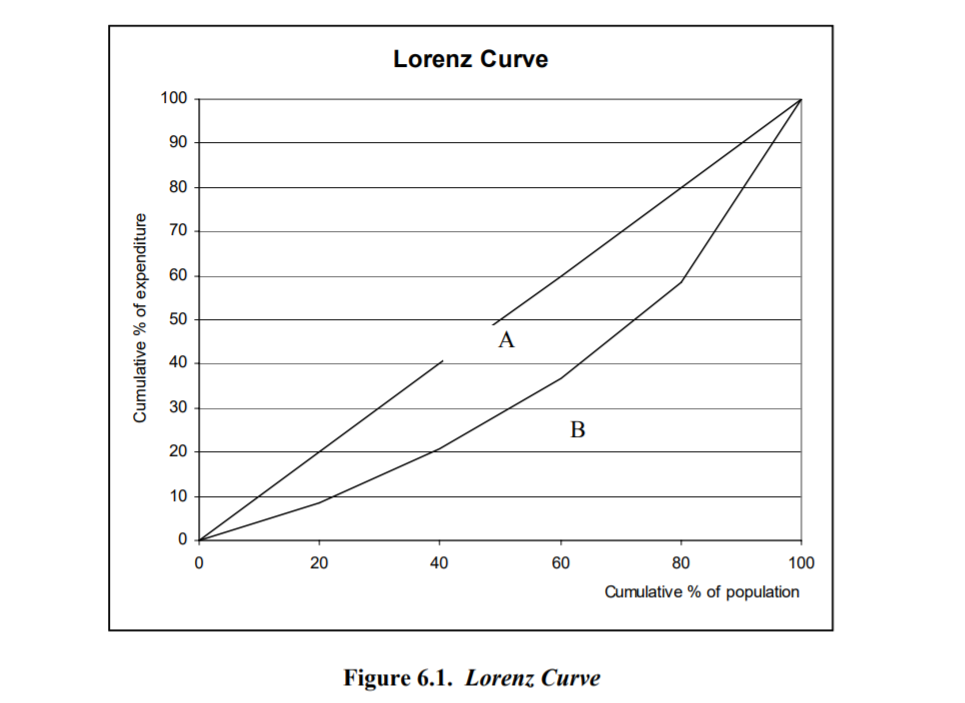
    • The Lorenz curve shows the percentage of total income earned by cumulative percentage of the population.
    • In a perfectly equal society, the “poorest” 25% of the population would earn 25% of the total income, the “poorest” 50% of the population would earn 50% of the total income and the Lorenz curve would follow the path of the 45° line of equality.
    • As inequality increases, the Lorenz curve deviates from the line of equality; the “poorest” 25% of the population may earn 10% of the total income; the “poorest” 50% of the population may earn 20% of the total income and so on.

    To construct the Gini coefficient, graph the cumulative percentage of households (from poor to rich) on the horizontal axis and the cumulative percentage of expenditure (or income) on the vertical axis.

    The Lorenz curve is shown in the figure. The diagonal line represents perfect equality.

    The Gini coefficient is defined as A/(A+B), where A and B are the areas shown on the graph. If A=0 the Gini coefficient becomes 0 which means perfect equality, whereas if B=0 the Gini coefficient becomes 1 which means complete inequality. In this example, the Gini coefficient is about 0.35.

    Income Inequality: A Comparison

    Source: World Bank, 2011.

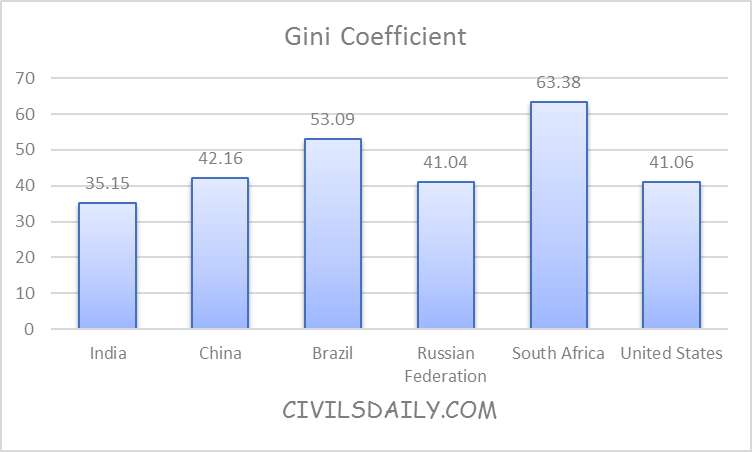
    The above graph represents the Gini Coefficient of the selected Countries for the year 2011.

    The Gini index of 0 represents the perfect equality, whereas the Gini index of 100 represents perfect inequality.

    India has one of the lowest inequality among the BRICS Countries with Gini Index of 35.15.

    Income Inequality: Percentage of Income held by top 10% of the Population

    Source: World Bank, 2011

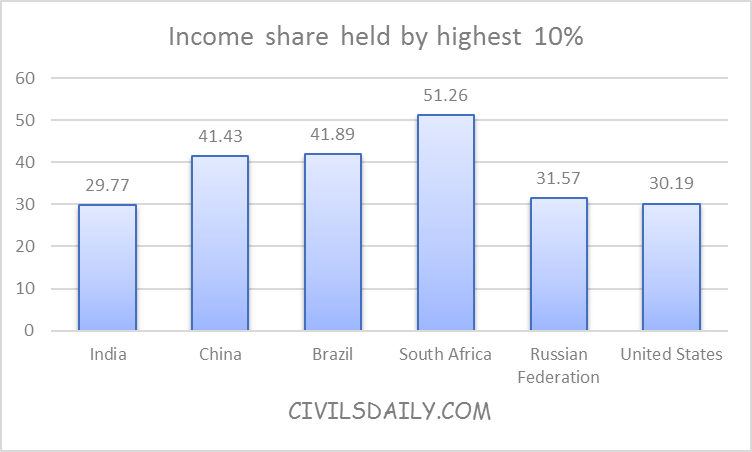
    The graph represents the percentage of the income held by the top 10% of the population in the selected countries.

    The percentage of the income held by the top 10% in India is close to 30 percent.

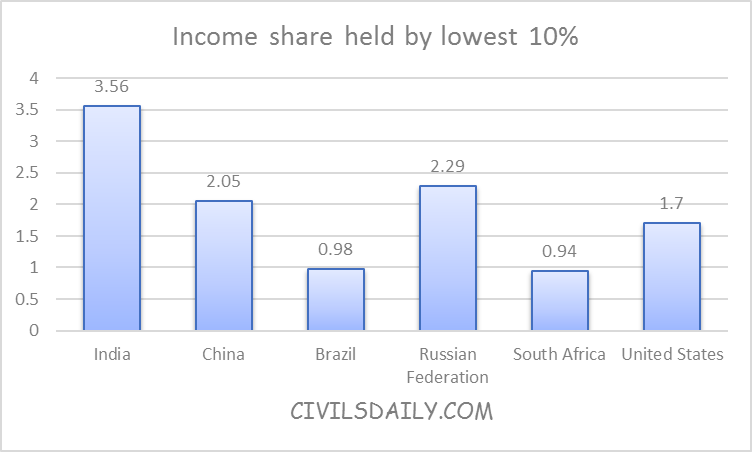
    Income Inequality: Percentage of Income held by the poorest 10% of the population.

    The graph below represents the percentage of the income held by the poorest 10% of the population in the selected countries.

    The percentage of the income held by the poorest 10% in India is close to 3 percent.

    Source: World Bank, 2011

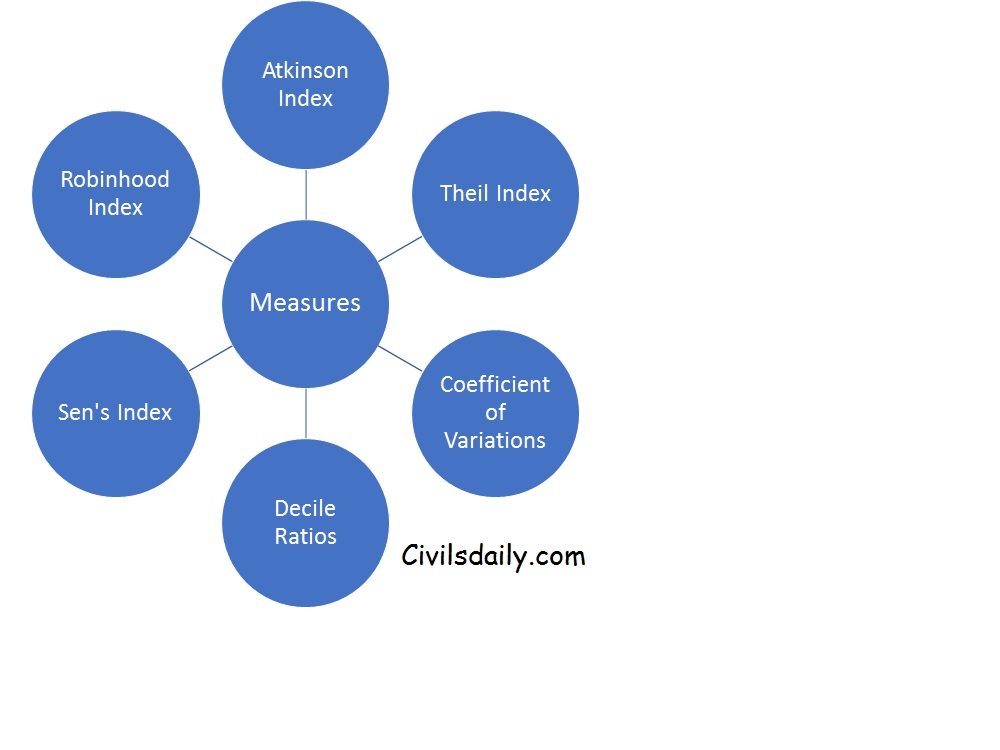
    The Common measures of Inequality


    By
    Himanshu Arora
    Doctoral Scholar in Economics & Senior Research Fellow, CDS, Jawaharlal Nehru University
     

  • Laws for the development and betterment of vulnerable sections

    Laws about vulnerable sections can be seen in two dimensions:

    1. Constitutional
    2. Statutory

    There are certain constitutional provisions which cover all vulnerable sections (common to all).

    Also, there are provisions which deal only with specific sections.

    Constitutional Provisions for the vulnerable section of SC/ST/OBC and minorities

    1. Art. 15(4): Clause 4 of article 15 is the fountainhead of all provisions regarding compensatory discrimination for SCs/STs. This clause was added in the first amendment to the constitution in 1951 after the SC judgment in the case of Champakam Dorairajan vs State of Madras.

    It states thus, “Nothing in this article or in article 29(2) shall prevent the state from making any provisions for the advancement of any socially and economically backward classes of citizens or for Scheduled Castes and Scheduled Tribes.” This clause started the era of reservations in India.

    In the case of Balaji vs State of Mysore, the SC held that reservation cannot be more than 50%. Further, Art. 15(4) talks about backward classes and not backward castes thus caste is not the only criterion for backwardness and other criteria must also be considered.

    Finally, in the case of Indra Sawhney vs the Union of India, SC upheld the decision given under Balaji vs State of Mysore that reservation should not exceed 50% except only in special circumstances. It further held that it is valid to sub-categorize the reservation between backward and more backward classes. However, total should still not exceed 50%. It also held that the carry forward rule is valid as long as reservation does not exceed 50%.

    More constitutional provisions

    1. Art. 15 (5): This clause was added in 93rd amendment in 2005 and allows the state to make special provisions for backward classes or SCs or STs for admissions in private educational institutions, aided or unaided.
    2. Art. 16(4): This clause allows the state to reserve vacancies in public service for any backward classes of the state that are not adequately represented in the public services.
    3. Art. 16 (4A): This allows the state to implement reservation in the matter of promotion for SCs and STs.
    4. Art. 16(4B): This allows the state to consider unfilled vacancies reserved for backward classes as a separate class of vacancies not subject to a limit of 50% reservation.
    5. Art. 17: This eradicates untouchability and its practice in any form. Although the term untouchability has not been demarcated in the constitution or in any act but its meaning is to be understood not in a literal sense but in the context of Indian society.

    Due to the varna system, some people were relegated to do menial jobs such as cleaning toilets. Such people were not to be touched and it was considered a sin to even touch their shadow. They were not even allowed to enter public places such as temples and shops.

    The constitution struggles to remove this abhorring practice by not only making the provision a fundamental right but also allows punishment to whoever practices or abets it in any form.

    Towards this end, Protection of Civil Rights Act 1955 was enacted. It has implemented several measures to eradicate this evil from the society. It stipulates up to 6 months imprisonment or Rs.500 fine or both. It impresses upon the public servant to investigate fully any complaint in this matter and failing to do so will amount to abetting this crime.

    In the case of State of Kar. vs Appa Balu Ingle, SC upheld the conviction for preventing a lower caste person from filling water from a bore well.

    In Asiad Projects Workers case, SC has held that right under Art 17 is available against private individuals as well and it is the duty of the state to ensure that this right is not violated.

    1. Art. 19(5): It allows the state to impose restriction on freedom of movement or of residence in the benefit of Scheduled Tribes.
    2. Art. 40: Provides reservation in 1/3 seats in Panchayats to SC/ST.
    3. Art. 46: Enjoins the states to promote with care the educational and economic interests of the weaker sections, especially SC and STs.
    4. Art. 164: Appoint special minister for tribal welfare in the states of MP, Bihar, and Orrisa.
    5. Art. 275: Allows special grant in aids to states for tribal welfare.
    6. Art. 330/332: Allows reservation of seats for SC/ST in the parliament as well as in state legislatures.
    7. Art. 335: Allows relaxation in qualifying marks for admission in educational institutes or promotions for SCs/STs.

    In the case of State of MP vs Nivedita Jain, SC held that complete relaxation of qualifying marks for SCs/STs in Pre-Medical Examinations for admission to medical colleges is valid.

    1. Art. 338/338A/339: Establishes a National Commission of SCs and STs. Art. 339 allows the central govt. to direct states to implement and execute plans for the betterment of SC/STs.
    2. Art. 340: Permits the president to appoint a commission to investigate the condition of socially and economically backward classes and table the report in the parliament.
  • The World Trade Organisation (WTO) and India

    The World Trade Organisation (WTO)

    A Brief History

    The Shortcomings of GATT

    As a result of these shortcoming’s the WTO was established as an international organization that will oversee the operation of rule based multilateral trading system. The WTO is based on series of trade agreements negotiated during the Uruguay Round (1986-1994). The Marrakesh treaty established the WTO at the end of Uruguay round.

    The Uruguay Round (1986-1995)

    Guiding Principles of The WTO

    Major Agreement of the WTO


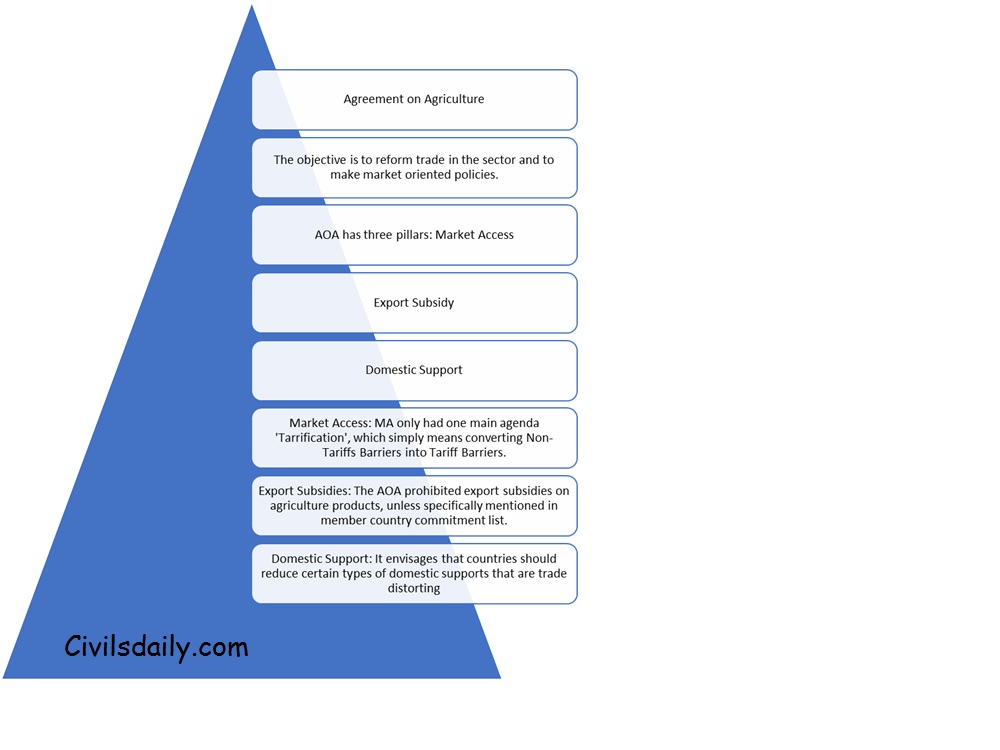
    Export Subsidies under AOA

    • Developed countries needs to reduce the value and volume of export subsidies by 36 percent and 24 percent respectively over a 6-year period.
    • Developing countries had a milder commitment of 24 percent and 10 percent respectively over 10 years period.
    • The export subsidies in the AOA (Part V, Article 9) that are subject to reduction commitments include:
    • Direct subsidies to agricultural producer’s contingent on export performance;
    • Subsidies on agricultural products contingent on their incorporation in exported products;
    • Provision on favorable terms of internal transport and freight charges on export shipments (developing countries are exempt from commitments on this form of subsidy provided that it is not used to circumvent reduction commitments),
    • Subsidies to reduce the cost of marketing exports of agricultural products excluding export promotion and advisory services (here again, developing countries are conditionally exempt from reduction commitments);
    • Sale or disposal for export of non-commercial stocks of agricultural products by the government or its agencies at a price lower than the comparable price charged for a like product by buyers in the domestic market
    • Payments on the export of an agricultural product that are financed by virtue of governmental action whether or not a charge on the public account is involved, including payments that are financed from the proceeds of a levy imposed on the agricultural product concerned or on an agricultural product from which the exported product is derived.

    Domestic Support under WTO

    Domestic support was divided into three kinds of boxes, each representing a different kind of subsidies.

    Green Box:

    • Green box subsidies are considered to be minimum trade distorting in terms of production and trade.
    • Direct income support schemes unlinked to production are examples of the green box. Research and Development support, Providing extra income to farmers etc falls under this category
    • Subsidies under green box does not have any reduction commitments under AOA.
    • The subsidies provided by Rich nations mostly comes under green box.

    Blue Box:

    • Blue box subsidies are considered somewhat less trade distorting, while they directly link production to subsidies, they also set limits on production by imposing quotas.
    • Blue Box subsidies are also exempt form reduction commitments.

    Amber Box:

    • Amber box subsidies constitute all form of domestic support that is considered trade distorting by encouraging excess production.
    • Under WTO principles, “amber box” subsidies create trade distortions because they encourage excessive production through farm subsidies to fertilizers, seeds, electricity and irrigation.
    • Within the amber box, de minimus is the minimal amount of subsidy WTO permits at 1986-88 prices. The de minimus figures for developed and developing countries are at five and 10 per cent of their agricultural production respectively.

    General Agreement on Trade in Services

    • For the first time, trade in services like banking, insurance, travel, transportation, movement of labour was brought within the ambit of negotiations in the Uruguay round.
    • The GATS provide multilateral framework of principles and services under condition of transparency and progressive liberalisation.
    • Negotiations is services under GATS are classified in 4 modes, interests of different countries depend upon this classification:

    Trade Related Intellectual Property Rights

    • TRIPS is an international agreement administered by the World Trade Organization (WTO) that sets down minimum standards for many forms of intellectual property (IP) regulation as applied to nationals of other WTO Members.
    • Prior to the TRIPS agreement the IPR concerning the trade including patent, trademarks, copyrights and industrial designs were governed by the Paris Convention of 1863.
    • The Paris convention was fairly liberal and left the subject matter of patents and IPR on the respective governments.
    • Under these lose laws the commercial interests of the Developed countries were adversely affected.
    • Therefore, TRIPS was concluded during Uruguay Round.

    Trade Related Investment Measures

    • The Agreement on Trade-Related Investment Measures (TRIMS) recognizes that certain investment measures can restrict and distort trade.
    • It states that WTO members may not apply any measure that discriminates against foreign products or that leads to quantitative restrictions, both of which violate basic WTO principles.
    • A list of prohibited TRIMS, such as local content requirements, is part of the Agreement. Recently India was dragged to WTO by U.S. over former’s specification of Domestic Content Requirement in relation to the procurement of Solar Energy cells and equipment.

    India and the WTO

    Indian was one of the 23 founding members of erstwhile GATT. India is also a leader of groups like G 33 and G 77 representing least developed countries. India in initial years due to its policies of import substitution and protecting infant industry was never very active in negotiations.

    India at the WTO meetings

    Ministerial conference Place Outcome India’s Role
    1 Singapore ITA agreement signed

    Trade and investment, competition policy, government procurement and Trade facilitation discussed.

    Mere Presence.
    2 Geneva Global e commerce agreement signed. Mere Presence
    3 Seattle Negotiations failed as developed countries wanted to incorporate environment and labor related issues under WTO. Was vocal in protesting against developed countries.
    4

    5

    6

    7

    8

    DOHA

    Cancun

    Geneva

    Hong Kong

    Bali

    A new round was launched and concerned of developing countries related to TRIPS and Health issues were listened. Market access issues were also taken.

    Members could not arrive at common viewpoint regarding Doha development agenda.

    Countries came forward to create an atmosphere for initiating multilateral negotiations once again.

    It was considered vital if the four-year-old DDA negotiations were to move forward sufficiently to conclude the round in 2006. In this meeting, countries agreed to phase out all their agricultural export subsidies by the end of 2013, and terminate any cotton export subsidies by the end of 2006. Further concessions to developing countries included an agreement to introduce duty-free, tariff-free access for goods from the Least Developed Countries, following the Everything But Arms initiative of the European Union — but with up to 3% of tariff lines exempted. Other major issues were left for further negotiation to be completed by the end of 2006

    Famous for Trade facilitation agreement and Peace clause

    Mostly singled out in its protest. However made its presence and position felt for the very first time.

    Actively protested against EU-USA draft on agriculture with other developing countries.

    Played a constructive role in the process.

    Vocal in protesting against developed countries.

    India argued for settlement of Food stockholding under AMS. Has to settle with Peace clause.

    Source: Compiled from WTO website, Ministerial document and other sources.

    Recent WTO negotiations and India

    • Doha round of trade negotiations has been under way since 2001.
    • The negotiations cover several areas such as agriculture, market access, Trips, dumping and anti-dumping and trade facilitation.
    • The conduct, conclusion and entry into force of the outcome of the negotiations are part of ‘Single undertaking’ that is nothing is agreed until everything is agreed.
    • The Doha round has made very little progress. The subject of DDA featured in almost every round of talks, but nothing substantive has come out.
    • In October 2011, efforts were made by some of the developed countries to use the G 20 summit to advance the agenda for eight ministerial conference scheduled to be held in Geneva in 2011.
    • They wanted to set the stage for plurilateral agreements on selected issues in the WTO negotiations rather than multilateral negotiations. Also, they wanted to introduce new issues for negotiation, namely climate change, energy security and food security.
    • These proposals are however strongly objected by various members including India.
    • At the Geneva conference, during 15-17 December 2011, ministers adopted a number of decisions on IPR, electronic commerce, small economies, LDC’S accession and trade policy reviews.
    • A number of members expressed strong reservations against PLURILATERAL approaches. Members including India stressed that any different approaches in work ahead should conform to the Doha mandate, respect the single undertaking and should be multilateral, transparent and inclusive.
    • Many members highlighted the importance of agriculture negotiations, trade facilitation, special and differential treatment and NTMs.
    • Developing countries, including India, China, Brazil and South Africa met on the sidelines of the conference and issued a declaration emphasizing the development agenda.

    India at the Bali Conference

    • The Bali ministerial conferences of WTO ended in encompass.
    • The two most important issues among many taken at Bali conference are agreement on trade facilitation and public stockholding for food security purpose.
    • The former relates to removing red tapes, reduction of administrative barriers to trade, documentation and transparency, latter deals with the procurement and distribution by government agencies for food security purpose.
    • At the meeting, India maintained its stand that any agreement on trade facilitation must not be taken until a permanent solution is granted for public stockholding issues for food security.
    • Despite intense pressure from the USA, India refused to abide and has allowed the deadline of TFA to pass.
    • The important development during the conference was that India not being able to gather the support of other Developing and LDCs countries despite the fact the LDCs have generally backed the issue of food security.
    • Only three countries Cuba, Bolivia and Venezuela backed India. This signifies that developing countries are divided on the issue of Trade facilitation as it is most likely to benefit the developing countries.

    By
    Himanshu Arora
    Doctoral Scholar in Economics & Senior Research Fellow, CDS, Jawaharlal Nehru University
  • Bilateral, Regional and Global Groupings and Agreements involving India

    India’s Regional Trading Agreements

    1. Indian trade policy has made an important shift in the year 1991, when we have gone for globalisation, trade liberalisation and other market reforms. Thus year 1991, stands as a benchmark year for India’s trade policy.
    2. The next big event in World trade is setting of WTO in 1995, the successor of erstwhile GATT. WTO’s multilateral approach towards trade and as an institution of trade ombudsman is remarkable. It acts as platform between developed and developing countries to negotiate with each other.
    3. The successive rounds of WTO have made rules of trade game much transparent and nearly equal for all. But things have started to change after famous ‘Doha Round’ of 2001 gets staled.
    4. In the initial year differentiation between developed and developing countries was taken as basic principle, with larger responsibility lying on developed World. However since Uruguay round focus has shifted towards reciprocity. This has resulted in conflict between developed and developing countries over trade negotiations and subsequent staling of conferences.
    5. All these have lead to development of what is known as Regional groupings, RTAs and FTAs.
    6. Countries were signing these agreements earlier also, but they were concentrated on some part of world. These agreements give easy market access and tariff benefits to member countries.

    There are many form of integration in world. Economist Jacob Viner has given his theory of ‘Custom Union’ followed by work of J.E Meade. To summarise followings are the ways of integration;

    Preferential trade union; two or more countries can form a trading union and reduce tariffs on imports of each other. They maintain their individual tariffs against Rest of world.

    Free trade area; two or more countries come together and abolish all tariff duties on their trade but retains individual tariffs against ROW.

    Custom union; two or more countries abolish all tariff among themselves and adopts a common tariff barrier against imports of ROW.

    Common market; common market is formed, when two or more countries form a custom union and in addition allows free movement of factor of production among member countries.

    Economic union; it is the highest form of integration where two or more countries forms a common market and in addition proceeds to harmonise and unify their monetary, fiscal and exchange rate policies.

    All of the above forms of integration have trade creation as well as trade diversion effects. To check for such diversion effects WTO has come up with most favoured nation clause, which states that,

    “Any advantage, favour, privilege or immunity granted by any contacting party to any product originating in or destined for any other country shall be accorded immediately and unconditionally to the like product originating in or destined for territories of all other parties”.

    India’s Regional and Free Trade Agreements

    Agreement Member Countries Total Members Type of Agreement Start Date Coverage Area
    Asia Pacific Trade Agreement (APTA) Bangladesh, China, South Korea, India, Sri Lanka 5 Preferential Trading Agreement 1976 All Goods
    India-ASEAN Trade in Goods Agreement Brunei, Cambodia, Indonesia, Laos, Malaysia, Myanmar, Philippines, Singapore, Thailand, Vietnam and India 11 Free Trade Agreement 2010 All Goods
    BIMSTEC- Bay of Bengal Initiative for Multi Sectoral Technical Economic Cooperation Bangladesh, India, Thailand, Myanmar, Sri Lanka, Bhutan and Nepal 7 Under Negotiations Under Negotiation
    IBSA- India, Brazil and South Africa Agreement India, Brazil and South Africa 3 Under Negotiations Under Negotiation
    SAFTA- South Asian Free Trade Agreement India, Pakistan, Nepal, Bhutan, Bangladesh, Afghanistan and Maldives 7 Free Trade Agreement 2006 All Goods
    India-Sri Lanka FTA India and Sri Lanka 2 Free Trade Agreement 2001 All Goods
    India-Malaysia Comprehensive Economic Cooperation Agreement India and Malaysia 2 Free Trade Agreement 2011 Goods and Services
    India-Singapore Comprehensive Economic Cooperation Agreement India and Singapore 2 Free Trade Agreement 2005 Goods and Services
    India-Japan Comprehensive Economic Partnership Agreement India and Japan 2 Free Trade Agreement 2011 Goods and Services
    India-Korea Comprehensive Economic Partnership Agreement India and South Korea 2 Free Trade Agreement 2010 Goods and Services
    India Chile FTA India and Chile 2 Free Trade Agreement 2007 All Goods
    India-Afghanistan FTA India and Afghanistan 2 Free Trade Agreement 2003 All Goods
    India-Bhutan FTA India and Bhutan 2 Free Trade Agreement 2006 All Goods
    India- Nepal FTA India and Nepal 2 Free Trade Agreement 2009 All Goods
    European Union and India FTA EU member countries Under Negotiations Under Negotiation
    MERCOSUR India FTA Argentina, Brazil, Paraguay, Uruguay 5 Free Trade Agreement 2009 All Goods
    India-ASEAN Trade in Services Agreement Brunei, Cambodia, Indonesia, Laos, Malaysia, Myanmar, Philippines, Singapore, Thailand, Vietnam and India 11 Free Trade Agreement 2015 Services
    India-Thailand FTA India and Thailand 2 Free Trade Agreement 2004 All Goods
    Source: Ministry of Commerce and WTO

    By
    Himanshu Arora
    Doctoral Scholar in Economics & Senior Research Fellow, CDS, Jawaharlal Nehru University
  • International Economic Institution’s: ADB, BRICS Bank, AIIB

    Asian Development Bank

    • The Asian Development Bank was conceived in the early 1960s as a financial institution that would be Asian in character and foster economic growth and cooperation in one of the poorest region on the Earth.
    • A resolution passed at the first Ministerial Conference on Asian Economic Cooperation held by the United Nations Economic Commission for Asia and the Far East in 1963 set that vision on the way to becoming reality.
    • The Philippines capital of Manila was chosen to host the new institution, which opened on 19 December 1966, with 31 members that came together to serve a predominantly agricultural region. Takeshi Watanabe was ADB’s first President.

    Role and Aim of ADB

    • The ADB aims for an Asia and Pacific free from poverty. Its mission is to help developing member countries reduce poverty and improve the quality of life of their people. Despite the region’s many successes, it remains home to a large share of the world’s poor: 330 million living on less than $1.90 a day and 1.2 billion on less than $3.10 a day.
    • ADB in partnership with member governments, independent specialists and other financial institutions is focused on delivering projects in developing member countries that create economic and development impact.
    •  As a multilateral development finance institution, ADB provides loans; technical assistance and grants. ADB also provides development assistance, policy advisory and financial resources through co-financing operations.
    • ADB operations are designed to support the three complementary agendas of inclusive economic growth, environmentally sustainable growth and regional integration.
    • ADB employs its resources in the core areas of infrastructure, environment, regional cooperation and integration, education and financial sector development.

    New Development Bank

    At the fourth BRICS Summit in New Delhi (2012), the leaders of Brazil, Russia, India, China and South Africa first proposed the possibility of setting up a New Development Bank to mobilize resources of infrastructure and sustainable projects in BRICS and other emerging countries and developing countries.

    At the fifth BRICS Summit in Durban (2013), the leaders of BRICS countries agreed on establishing NDB. It was also decided that the initial contribution to the bank should be used to finance infrastructure in BRICS.

    At the sixth BRICS Summit in Fortaleza (2014), the leaders of BRICS signed the agreement to establish NDB. In the Fortaleza declaration, the leaders stressed that the NDB would strengthen cooperation among BRICS and will supplement the efforts of other global multilateral institutions like World Bank for global development and collectively work for achieving the goal of strong, sustainable and balanced growth.

    The Fortaleza Declaration further said:

    “The Bank shall have an initial authorized capital of US$ 100 billion. The initial subscribed capital shall be US$ 50 billion, equally shared among founding members. The first chair of the Board of Governors shall be from Russia. The first chair of the Board of Directors shall be from Brazil. The first President of the Bank shall be from India. The headquarters of the Bank shall be located in Shanghai. The New Development Bank Africa Regional Centre shall be established in South Africa concurrently with the headquarters.”

    Need and Significance of New Development Bank

    • The creation of NDB was felt because of the discriminatory attitude of the West towards the developing countries. The BRICS member countries accounting for almost half of the world’s population and about one-fifth of global economic output have only 11 per cent of the votes at international financial institution like the IMF. Both the WB and the IMF are based on the weighted voting system, which provides the rich countries with a big say in the management. There are informal arrangements whereby the American is always at the top in the WB; while the European is in top position in IMF. In those monetary institutions, the developing countries don’t have enough voting rights.
    • The expectation is that the NDB with its total capital of $100 billion would meet short term liquidity requirement of the member countries. An effort has been made to avoid China’s dominance on the bank; for which India is made the president of the bank for the first six years and after this Brazil and Russia would have turns with five years each.
    • The New Development Bank is not just about setting up yet another
      bank. It represents a new political will among new and emerging powers
      in the world to challenge the old architecture of growth.
    • Over the last 20 years, it has been obvious that the growth impetus has
      shifted to Asia and also Africa. The World Bank and the IMF, dominated by the US and Europe, cannot function with limited voting powers for the new tigers. BRICS seeks to challenge their power structure.
    • The setting up of the New Development Bank and the $100 billion currency stabilization fund will signal the emergence of new
      international currencies to challenge the US dollar’s hegemony.
    • In the initial years, the Chinese yuan will get internationalized first, followed by the Indian rupee after about a decade of strong growth in India’s economic and trade shares. Even though the dollar will continue to remain the biggest international currency for the foreseeable future, its share will start falling as the yuan rises. The world will have the dollar, euro, the yen and the yuan as it main currencies over the next decade. The dollar will not remain the only option for the settlement of global trades, especially when intra-Asian, African and Latin American shares of global trade start picking up in the decades ahead.

    Asian Infrastructure and Investment Bank
    Asian Infrastructure and Investment Bank
    is a new multilateral financial institution founded to bring countries together to address the need of deficient infrastructure across Asia. AIIB is a brain child of China. The prime aim of the AIIB is infrastructure development. By establishing interconnectivity across the Asia through advancement in the construction of infrastructure and other productive services, the AIIB can stimulate growth and economic development in the Asian Region.

    Focus Areas of AIIB

    The AIIB And the China

    China has been growing rapidly for a long time, but an important shift in its growth pattern occurred at the time of Global Financial Crisis of 2008.

    During the years preceding GFC, China’s GDP grew at an average rate of 11 percent. The Current Account Surplus was 10 percent of the GDP during all these years. In the six years since the GFC, the external surplus has fallen sharply into the range of 2-3 percent of the GDP.

    China’s growth rate is no doubt impressive as compared to the Rest of the World, but has lost its upward trajectory and has fallen to a new normal of 7-8 percent post-GFC. The reason for fall in China’s growth are; overdependence on exports which lost its momentum post GFC, falling productivity of Chinese investment (for example; if earlier, an investment of 20 percent by Chinese firm produced an 1 percent increase in GDP, but now an investment of 20 percent by Chinese firm only produces 0.7 percent increase in GDP).

    China’s response to these growth changes are partly internal and partly external. On the external side, China is coming up with multilateral investment institutions like AIIB and NDB to finance its falling growth. The plan is to develop infrastructure in and out of China which has the potential to create more jobs, increase the productivity of investment and increase exports of China. The AIIB and NDB are the institutions that will finance China’s new infrastructure projects.

    AIIB and Emerging Economies

    The AIIB is largely welcomed by China’s Asian neighbours as they believe it has the potential to integrate Asia further through the construction of roads, highways, pipelines and railways.

    The allies of China in Asia are also seeing AIIB and other Chinese initiatives as a set back to the United States. They believe that the US has for long dominated the Asia-Pacific and now it’s time for the US to recede its influence from Asia-Pacific. They see the rise of China as a game changer in the region. The Chinese allies follow the erstwhile dream of ‘Asia for Asians’.

    Although, the US has been pressurizing its key allies in Asia, not to join the AIIB, but had received a major setback when its key allies like South Korea, Australia, Japan and Even the United Kingdom joined the initiative.

    The most important reason of many Emerging Countries joining the AIIB is their long-term dissatisfaction with the working of the Western Dominated Multilateral Institutions like World Bank and the IMF.

    The EMEs believes that the governance structure of the existing international financial institutions was biased towards the Western Countries and doesn’t take care of their needs. They further argue that the existing structure is evolving too slowly and doesn’t capture the realities of the 21st century in which the main drivers of global growth and investment are Emerging economies like China, India, Turkey, Indonesia, Brazil and Nigeria etc.

    Their arguments get weight when one sees how slowly reforms are being done in IMF. The US CONGRESS still holds the veto power in the functioning of the IMF.

    The EMEs frustration with the World Bank and IMF is not just about the governance structure and the United States weight in them, but also comes from the fact that the international institution has long ignored the demands of EMEs regarding the construction of infrastructure in their regions. Over the years, the key recommendations of the EMEs regarding growth and development has been rejected by the World Bank and IMF.

    The AIIB and the NDB, therefore, gives much-needed leverage to the EMEs to break the dominance of the US and Europe dominated International Institutions.


    By
    Himanshu Arora
    Doctoral Scholar in Economics & Senior Research Fellow, CDS, Jawaharlal Nehru University
  • Backward Classes: Definition and present living conditions

    Vulnerable groups

    Vulnerable groups are those groups of society which would be susceptible under any unfavourable situations such as where the adults are not capable to provide a satisfactory living for the household due to health issues like disability, illness, age or some other characteristic, and groups whose resource endowment is poor to provide sufficient income from any available source.

    In India, there are numerous socio-economic difficulties that members of particular groups experience which limits their access to health and healthcare. For the government, it is not an easy task to identify the vulnerable groups. Besides, there are multiple and complex factors of vulnerability with different layers and more often than once it cannot be analyzed in isolation. 

    There are several conspicuous factors on the basis of which individuals or members of groups are differentiated in India, i.e., structural factors, age, disability and discrimination that act as barriers to health and healthcare.

    The vulnerable groups that face impartiality include, Women, Scheduled Castes (SC), Scheduled Tribes (ST), Children, Aged, Disabled, Poor migrants, People living with HIV/AIDS and Sexual Minorities. Sometimes, each group faces many obstacles due to their multiple individualities. For example, in a patriarchal civilisation, disabled women have to face double discrimination of being a women and being disabled.

    There is a caste system in India since ancient times and therefore sudras have been browbeaten for the ages. In earlier period, they were deprived of the right to education and thus were left suffering behind, socially and economically. Such people have been categorized into Scheduled Castes.

    Tribal communities, who never mixed with the main society, are similarly challenged and are categorized into Scheduled Tribes.

    Backward Classes

    The constitution of India does not define the term backward classes. It is up to the centre and the states to postulate the classes that belong to this group. However, it is assumed that classes that are not signified passably in the services of the state can be termed backward classes.

    Further, the President can, under Article 340, can establish a commission to scrutinize the condition of socially and educationally backward classes. Structural standards are attached to the different relationships between the subordinate and the prevailing group in every society. The norms act as structural obstacles giving rise to various forms of disparity.

    There is some structural discrimination faced by these vulnerable groups.

    In India, members of gender, caste, class, and ethnic identity experience structural discrimination that has adversely impacted on their health and access to healthcare.

    Women also face dual discrimination being members of specific caste, class or cultural group apart from experiencing gendered susceptibilities. Women have less control on the resources and on important decisions related to their lives. In India, early marriage and childbearing affects women’s health unfavourably.

    About 28 per cent of girls in India, get married below the legal age and experience pregnancy (Reproductive And Child Health – District level Household Survey 2002-04, August 2006). These have serious consequences on the health of women. Reports indicated that maternal mortality is at rising trend in India.

    The average maternal mortality ratio at the national level is 540 deaths per 100,000 live births (National Family Health Survey-2, 2000). It varies between states and regions, i.e., rural-urban. In most cases the deaths occur from avoidable causes.

    A Huge percentage of women are reported to have received no antenatal care. In India, institutional delivery is lowest among women from the lower economic class as against those from the higher class. It has been documented in reports that major proportion of the lower castes and Dalits are still dependent on business and upper class for their living.

    Dalits does not refer to a caste but suggests a group who are in a state of subjugation, social disability and who are helpless and poor. Earlier, they were called as ‘untouchables’ mainly due to their low jobs i.e., cobbler, scavenger, sweeper.

    In a caste-dominated country such as India, Dalits who comprises more than one-sixth of the Indian population, stand as a community whose human rights have been sternly dishonoured. Literacy rates among Dalits are very low, about 24 per cent.

    Their living conditions are very poor or have low access to resources and entitlements. In rural India, they are landless poor agricultural labourers attached to rich landowners from generations or poor casual labourers doing all kinds of available work.

    In the metropolitan, they get low-level job as wage labourers at several work sites, beggars, vendors, small service providers, domestic help, etc. They live in slums and other temporary shelters without any kind of social security. The members of these groups face systemic violence in the form of disavowal of access to land, good housing, education, and employment.

    Structural discrimination against these groups occurs in the form of physical, psychological, emotional and cultural abuse which receives legitimacy from the social structure and the social system. Physical separation of their settlements is common in the villages forcing them to live in the most unhygienic and inhabitable conditions. All these factors affect their health status, access to healthcare, and quality of health service received.

    There are high rates of undernourishment reported among the downgraded groups resulting in mortality, morbidity and anaemia. Access to and utilization of healthcare among the marginalized groups is influenced by their socio-economic status within the society.

    It is observed that structural discrimination unswervingly obstructs equal access to health services by way of prohibiting. 

    The undesirable attitude of the experts towards these groups also acts as an obstacle to receiving quality services from government.

    A large proportion of Dalit girls drop out of primary school in spite of reservations and academic aptitude, because of poverty, humiliation, isolation or bullying by teachers and classmates and punishment for scoring good grades (National Commission Report for SC/ST, 2000). 

    The scavenger community among the Dalits is susceptible to stress and diseases with reduced access to healthcare. The Scheduled Tribes like the Scheduled Castes face structural discrimination within the Indian society. 

    Likewise the Scheduled Castes, the Scheduled Tribes also face marginalization based on ethnicity. There is a desperate need for development of the weaker sections such as the SCs, STs, and OBCs. The SCs, STs and OBCs have been forced to remain as the Weaker Sections of India, and the women confined or oppressed to be the most and multiply exploited sections of the country, for many decades.

    This worst situation cannot and should not continue anymore. There is a need for the Government to act to free and unshackle the weaker Sections, from the lethargies of oppression, marginalisation and backwardness. They have to be elevated to the levels of normal human beings of the world.

  • International Economic Institution’s: The Breton Woods Twins- World Bank and IMF

    International Economic Institution’s

    World Bank and Associated Institutions

    The World Bank Group (WBG) is a family of five international organisations that make leveraged loans to developing countries. It is the largest and most famous development bank in the world and is an observer at the United Nation Development Group.

    The World Bank

    The International Bank for Reconstruction and Development (IBRD), better known as the World Bank, was established under the Bretton Woods System along with the International Monetary Fund.

    The role of IMF was to provide the international liquidity in the International Economy which was hampered due to World War 2. The aim of IMF was to correct Balance of Payment difficulties.

    In the similar vein, the aim of the World Bank was to provide long term development assistance to and loans in reasonable terms to the nations.

    The World Bank or IBRD is a multilateral level inter-governmental Institution. All the member countries have their shares in the capital stock of the World Bank.

    Key Functions of the World Bank as per Article 1 of the Agreement

    Organisation Structure of the World Bank

    The World Bank works on a cooperative structure and currently has 189-member countries. These member countries are represented by a ‘Board of Governor’ are the ultimate policy makers of the World Bank. The Boards of Governors consist of one Governor and one Alternate Governor appointed by each member country. The office is usually held by the country’s minister of finance, governor of its central bank, or a senior official of similar rank.

    The governors delegate specific duties to Executive directors, who works at the Bank premises. The five largest shareholders appoint an executive director, while other member countries are represented by elected executive directors.

    • World Bank Group Current President is Jim Yong Kim who chairs the meetings of the Boards of Directors and is responsible for overall management of the Bank. The President is selected by the Board of Executive Directors for a five-year, renewable term.
    • The Executive Directors make up the Board of Directors of the World Bank. They normally meet at least twice a week to oversee the Bank’s business, including approval of loans and guarantees, new policies, the administrative budget, country assistance strategies and borrowing and financial decisions.

    Is World Bank Biased Towards Developed Countries?

    • It has been a complaint of many developing countries that the bank provides developmental loans at discretionary high-interest rates. For example, some of the loans which India has received in recent years bear an interest of 53.4 per cent including the commission at 1 per cent which is credited to the Bank’s special reserves.
    • The financial aids given by the Bank accounts for a minuscule part of financial requirement essential for various development projects in developing countries.
    • The bank usually asks for the collateral from the under developed countries which are difficult to provide by such countries due to their low level of income and development. The logical question is ‘if the poor and underdeveloped countries have an asset to provide as collateral, why would they approach institutions like the World Bank for loans at a concessional rate?
    • The working, structure and operations of the World Bank are dominated by the Western countries led by the USA, who are also one of the highest stakeholders at the Bank. The bank has often been criticized for not being multilateral in the true sense and works more like a unilateral institution of the Western countries with the main aim of providing profits to them.
    • With the World Bank, there are concerns about the types of development projects funded. Many infrastructure projects financed by the World Bank Group have social and environmental implications for the populations in the affected areas, and the criticism has centred on the ethical issues of funding such projects. For example, World Bank-funded construction of hydroelectric dams in various countries has resulted in the displacement of indigenous peoples of the area.
    • The approach adopted by the bank is not suitable for all the countries. The bank follows ‘One Size Fits All’ strategy while providing development assistance and policies. Such strategies cannot work effectively in a real-life World since problems and situations vary country wise, and a common solution to all of them is not possible and utopian in nature. For example, The problem of Stunting (low height of Children as per their age) for an Indian child can’t be compared with that of an African child. The African child will be much longer in height as compared to its Indian counterpart in same age group. Thus, they both need different types of calories intake as per their geography.

    International Development Assistance

    • The International Development Association (IDA) is the part of the World Bank group that helps the world’s poorest countries. Overseen by 173 shareholder nations, IDA aims to reduce poverty by providing loans (called “credits”) and grants for programs that boost economic growth, reduce inequalities, and improve people’s living conditions.
    • IDA complements the World Bank’s original lending arm—the International Bank for Reconstruction and Development (IBRD). IBRD was established to function as a self-sustaining business and provides loans and advice to middle-income and credit-worthy poor countries. IBRD and IDA share the same staff and headquarters and evaluate projects with the same rigorous standards.
    • IDA is one of the largest sources of assistance for the world’s 75 poorest countries, 39 of which are in Africa, and is the single largest source of donor funds for basic social services in these countries.
    • IDA lends money on concessional terms. This means that IDA credits have a zero or very low-interest charge and repayments are stretched over 25 to 40 years, including a 5- to 10-year grace period. IDA also provides grants to countries at risk of debt distress.
    • In addition to concessional loans and grants, IDA provides significant levels of debt relief through the Heavily Indebted Poor Countries Initiative and the Multilateral Debt Relief Initiative.
    • IDA is a multi-issue institution, supporting a range of development activities, such as primary education, basic health services, clean water and sanitation, agriculture, business climate improvements, infrastructure, and institutional reforms. These interventions pave the way toward equality, economic growth, job creation, higher incomes, and better living conditions. For the period July 1, 2014–June 30, 2017 (IDA17), IDA operations are placing a special emphasis on four thematic areas: climate change, fragile and conflict affected countries, gender equality, and inclusive growth.
    • IDA17 financing is expected to provide, among other things, electricity for an estimated 15-20 million people, life-saving vaccines for 200 million children, microfinance loans for more than 1 million women, and basic health services for 65 million people. Some 32 million people will benefit from access to clean water and another 5.6 million from better sanitation facilities.
    • Many of the issues developing countries face do not respect borders. By helping address these problems, IDA supports security, environmental and health concerns, and works to prevent these threats from becoming global issues.

    International Finance Corporation

    • The IFC was established in 1956 to support the growth of the private sector in the developing world. IFC, a member of the World Bank Group, is the largest global development institution focused exclusively on the private sector in developing countries.
    • The IFC’s stated mission is “to promote sustainable private sector investment in developing countries, helping to reduce poverty and improve people’s lives.”
    • While the World Bank (IBRD and IDA) provides credit and non-lending assistance to governments, the IFC provides loans and equity financing, advice, and technical services to the private sector. The IFC also plays a catalytic role, by mobilizing additional capital through loan syndication and by lessening the political risk for investors, enabling their participation in a given project. The IFC has worked with more than 3319 companies in 140 countries since its inception in 1956.
    • It is a public entity, although its clientele consists of transnational, national, and local private sector companies, operating in a competitive and fast-moving business environment.

    Multilateral Investment Guarantee Agency

    • MIGA is a member of the World Bank Group. Its mission is to promote FDI into developing countries to help support economic growth, reduce poverty and improves people’s lives.
    • At the centre of MIGA’s new FY18-20 strategy are three elements:
    1. A re-affirmed focus on the poorest through support for projects in IDA countries
    2. A continuing emphasis on Fragile and Conflict-affected States, where MIGA has opportunity to have impact where private PRI insurers are unwilling to go, and
    3. An expanded commitment to climate change mitigation and adaptation, targeting 28% of new issuance related to climate change mitigation or adaptation in 2020.

    To deliver on these targets, MIGA’s FY18-20 strategy has four pillars:

    1. Grow core business: MIGA will enable new investments across sectors and regions through building on past efforts to improve operations and delivery in current segments.
    2. Innovate applications: MIGA will continue to create new ways of using its suite of products to create impact, especially through the use of new vehicles, including the IDA 18 Private Sector Window.
    3. Create projects for impact: MIGA will develop, structure and launch new projects by playing a proactive role early in the pipeline through working with governments, state-owned enterprises, and investors.
    4. Create markets: MIGA will drive comprehensive country solutions and spur private sector investment and development by working as part of the WBG’s Cascade Approach.
    • MIGA is owned and governed by its member states, but has its own executive leadership and staff which carry out its daily operations. Its shareholders are member governments which provide paid-in-capital and have the right to vote on its matters. It insures long-term debt and equity investments as well as other assets and contracts with long-term periods. The agency is assessed by the World Bank’s Independent Evaluation Group each year.

    International Monetary Fund

    The IMF is an organization of 189-member countries, working to foster global monetary cooperation, secure financial stability, facilitates international trade, promote high employment and sustainable economic growth along with poverty reduction.

    The IMF was conceived at a United Nation Conference in Bretton Woods, New Hemisphere, United States in July 1944 along with the World Bank. The initial 44-member countries at the conference sought to build a framework for economic cooperation and to avoid a repetition of competitive devaluation of currency which has contributed to ‘Great Depression of the 1930s’.

    The IMF’s primary responsibility is to ensure the stability of international monetary system remains safe, to safeguard the system of the exchange rate and international payments so that countries could transact with each other freely.

    The IMF’s mandate was updated in the year 2012, to include all macroeconomic and financial sector issues that can affect global financial stability.

    IMF at Glance

    Total Member 189 Countries
    Headquarter Washington DC, USA
    Executive Board 24 Directors each representing a single or group of countries
    Total Resources US $668 Billion
    Currency Special Drawings Rights (SDR consists of 5 Key World currencies: US Dollar, Euro, Japanese Yen, UK Pound and Chinese Renminbi.
    Biggest Borrowers Portugal, Greece, Ukraine and Pakistan (as on 31/08/2016)

    Role of IMF in promoting Global Economic Stability

    The IMF advises member countries on economic and financial matters that promote stability, reduce vulnerability to crises, and encourages sustained growth and high living standards. It also monitors global economic trends and developments that affect the health of the international monetary and financial system.

    Economic stability implies avoiding economic and financial crises, volatility in economic activity, high inflation and excessive volatility in foreign exchange and financial markets. Economic instability can increase uncertainty, discourage investment, obstruct economic growth and living standards. The biggest challenge for policy makers is to minimize instability in their own country and abroad without reducing the economy’s ability to improve living standards through rising productivity, employment and sustainable growth.

    How Does IMF help in achieving stability?

    The IMF help countries achieve stability through Surveillance, Assistance and Lending.

    • Surveillance: Every country joining IMF accepts the obligation to subject its economic and financial policies to the scrutiny of the international community. The IMF oversees the international monetary system and monitors the economic and financial developments of its 189-member countries. The surveillance takes place at the global and individual country level. The IMF assesses the domestic policies and risk associated with domestic and balance of payment stability and advises for the same.
    • The IMF produces periodic report known as “World Economic Outlook” and the “Global Financial Stability Report” regarding the same. The report’s analyses global and regional macroeconomic and financial developments.
    • Technical Assistance: The IMF helps countries strengthen their capacity to design and implement sound economic policies. It provides advice and training in areas of core expertise—including fiscal, monetary, and exchange rate policies; the regulation and supervision of financial systems; statistics; and legal frameworks.
    • Lending: Even the best economic policies cannot completely eradicate instability or avert crises. If a member country faces a balance of payment crisis, the IMF can provide financial assistance to support policy programs that will correct underlying macro economic problems, limit disruption to both the domestic and the global economy, and help restore confidence, stability, and growth. The IMF also offers precautionary credit lines for countries with sound economic fundamentals for crisis prevention.

    IMF’s Special Drawing Rights

    The SDR is an international reserve asset created by IMF in 1969 to supplement its member countries official reserves. The value of SDR is based on a basket of five major currencies- the US Dollar, the Euro, the Japanese Yen, the UK Pound and the Chinese Renminbi.

    The Creation of SDR: A country participating in foreign exchange market needs official foreign exchange reserves. The domestic governments hold these foreign exchange reserves in the form of Gold and widely accepted foreign currencies like the US dollar or the Euro. The domestic countries use their foreign exchange reserves during the crisis period or when they need to provide support to their respective currencies and exchange rate. The countries do so by buying their currency in the foreign exchange rate markets by paying through dollar or gold. But the supply of two key international reserve assets- the US dollar and the gold is inadequate for supporting the needs and expansion of the financial flows. Therefore, the international community decided to create a new international reserve asset called ‘SDR’ under the leadership of the IMF.

    IMF Quota System

    Quotas are central to IMF’s financial resource. Each member country of the IMF is assigned a quota of resources based broadly on its relative position in the World Economy. A member country’s quota determines its maximum financial commitment to the IMF, its voting rights and its access to IMF lending’s.

    When a country joins the IMF, it is assigned an initial quota based on its size of the economy. The current quota formula is a weighted average of:

    • Country’s GDP (50 percent weight)
    • Openness of the economy (30 percent weight)
    • Economic variability (15 percent)
    • Intranational/Foreign reserves (5 percent)
    1. Quotas are determined in SDR terms. The largest member of the IMF is the United States, with a current quota of SDR 82.99 Billion and the smallest member is Tuvalu, with a quota of SDR 2.5 Million. India’s current quota is SDR 13.1 Billion.
    2. The quota plays a key role in determining a country’s financial and organisational relationship with the IMF. A member’s quota subscription determines the maximum amount of financial resources the member is obliged to provide to the IMF. The quota determines the member voting power inside the IMF decision making. A number of finances a member can access from the IMF is also based on its share of quota.
    3. The 14th General Quota review which met on January 2016 decided to increase the quota of each of the IMF 189 members to a combined SDR of 477 Billion from about SDR 238.5 Billion. With the move, the IMF has implemented its long pending quota reforms (under pressure from the emerging economies) which will give more voting rights to emerging economies such as India and China in the functioning of the IMF.
    4. With these reforms, India’s quota in the IMF would rise to 2.7 percent, from the existing 2.44 percent. The voting share of Indian in IMF would also increase to 2.6 percent from 2.34 percent. The reforms reflected the increasing role of dynamic emerging and developing countries in the World economy. For the first-time key emerging countries of the BRIC bloc (Brazil, India, China and Russia) will be among the 10 largest members of the IMF. China has become the third largest country in the IMF.
    5. Other top 10 countries include the US, Japan, Germany, France, UK and Italy. Also for the first time, the IMF board will consist entirely of elected executive directors, ending the past tradition of having appointed executive directors.
    6. The reforms shifted more than 6 percent of quota shares from over represented to under-represented countries. the reforms also shifted more than 6 percent quota shares to emerging and developing countries.

    By
    Himanshu Arora
    Doctoral Scholar in Economics & Senior Research Fellow, CDS, Jawaharlal Nehru University

  • Capital and Current Account Convertibility in India

    CLICK:-REGISTER & DISCUSS ETHICS CASE STUDIES & YOUR UPSC PREPARATION WITH 1-1 CD MENTORS FOR FREE

    Convertibility in India

    “My hope is that we will get to full capital account convertibility in a short number of years,” said Raghuram. G. Rajan, ex-governor of the Reserve Bank of India (RBI) on 10 April 2015.

    The International movement of capital is not always free; countries restrict flows of capital as and when needed to safeguard their markets from erratic flows of capital. In India, for example, there are restrictions on the movement of foreign capital and the rupee is not fully convertible on capital account.

    What does Capital Account Convertibility mean?

    CAC means the freedom to convert rupee into any foreign currency (Euro, Dollar, Yen, Renminbi etc.) and foreign currency back into rupee for capital account transactions. In very simple terms it means, Indian’s having the freedom to convert their local financial assets into foreign ones at market determined exchange rate. CAC will lead to a free exchange of currency at a lower rate and an unrestricted movement of capital.

    How is Capital Account Convertibility different from Current Account Convertibility?

    Current Account Convertibility allows free inflows and outflows of foreign currency for all purpose including resident Indians buying foreign goods and services (imports), Indians selling foreign goods and services (exports), Indians receiving and sending remittances, accessing foreign currency for travel, study abroad, medical tourism purpose etc.

    On the other hand, Capital Account Convertibility is widely regarded as the hallmark of developed countries. It is also seen as the major comfort factor for foreign investors since it allows them to reconvert local currency back into their own currency and move out from India.

    To attract foreign investment, many developing countries went in for CAC in the 1980s, not realising that free mobility of capital leaves countries open to both sudden and huge inflows and outflows, both of which can be potentially destabilising. More important, unless you have the institutions, particularly financial institutions capable of dealing with such huge flows, countries may not be able to cope as was demonstrated by the East Asian crisis of the late 90s.

    Present Situation in India

    In India, the Tarapore committee had laid down a three-year road-map, ending 1999-2000, for CAC. It also cautioned that this time-frame could be speeded up, or delayed, depending on the success achieved in establishing the pre-conditions primarily fiscal consolidation, strengthening of the financial system and low rate of inflation. With the exception of the last, the other two preconditions have not been achieved. The Capital Account Convertibility in India will depend on how fast the country meets the preconditions put forward by Tarapore Committee such as fiscal consolidation, inflation control, low level of Non-Performing Assets, low Current account deficit and strengthen financial markets. Sound policies, robust regulatory framework promoting a strong and efficient financial sector, and effective systems and procedures for controlling capital flow greatly enhanced the chances of ensuring that such flows fostered sustainable growth and did not lead to disruption and crisis.

    • Current Account Convertibility: Current account is today fully convertible (operationalized on August 19, 1994). It means that the full amount of the foreign exchange required by someone for current purposes will be made available to him at the official exchange rate and there could be an unprohibited outflow of foreign exchange (earlier it was partially convertible). India was obliged to do so as per Article VIII of the IMF which prohibits any exchange restrictions on current international transactions (keep in mind that India was under pre-conditions of the IMF since 1991).
    • Capital Account Convertibility: After the recommendations of the S.S. Tarapore Committee (1997) on Capital Account Convertibility, India has been moving in the direction of allowing full convertibility in this account, but with required precautions. India is still a country of partial convertibility (40:60) in the capital account, but inside this overall policy, enough reforms have been made, and to certain levels of foreign exchange requirements, it is an economy allowing full capital account convertibility. Following steps have been taken in the direction of capital account convertibility.
    1. Indian corporate is allowed full convertibility in the automatic route up to $ 500 million overseas ventures (investment by Ltd. companies in foreign countries allowed).
    2. Indian corporate is allowed to prepay their external commercial borrowings (ECBs) via automatic route if the loan is above $ 500 million.
    3. Individuals are allowed to invest in foreign assets, shares, etc., up to the level of $ 2,50,000 per annum.
    4. Unlimited amount of gold is allowed to be imported (this is equal to allowing full convertibility in the capital account via current account route, but not feasible for everybody) which is not allowed now.

    The Second Committee on the Capital Account Convertibility (CAC)— again chaired by S.S. Tarapore— handed over its report in September 2006 on which the RBI/the government is having consultations.

    Pros and cons of Capital account Convertibility

    Advantages Disadvantages
    Availability of large funds by improved access to international financial markets. Market determined exchange rates being higher than officially fixed exchange rates can raise import prices and cause Cost-push inflation.
    Reduction in cost of capital. Improper management of CAC can lead to currency depreciation and affect trade and capital flows.
    The incentive for Indians to acquire and hold international securities and assets. The advantages have been found to be short lived as per studies, and also International financial institutions are skeptical about CAC post-2008 crisis.
    Greater financial competitiveness. Speculative activity can lead to capital flight from the country as in case of some South East Asian economies during 1997-98.
    Will help Indian corporate to use External commercial borrowing route without RBI or Govt approval. Imposing control would become difficult in a globalized environment once CAC is introduced.
    Indian residents can hold and transact foreign currency denominated deposits with Indian banks.  
    A Certain class of financial institutions and later NBFCs can access global financial market.  
    Banks and financial institutions can trade in Gold globally and issue loans.  

    By
    Himanshu Arora
    Doctoral Scholar in Economics & Senior Research Fellow, CDS, Jawaharlal Nehru University