💥Join UPSC 2027,2028 Mentorship (July Batch) + XFactor Notes & Microthemes PDF

Author: B2B

  • Situation of Indian Agriculture

    Indian Agriculture: A brief Outlook

    1. Agriculture accounted for 14% of India’s GDP in 2016-17 and provided employment to more than half a billion people. The share of Agriculture in employment is close to 54% as on 2016-17.
    2. Indian Agriculture is dominated by the small-scale farming and is characterised by low productivity.
    3. The average size of land holding in Indian Agriculture is less than 2 hectares.
    4. The low land holding size means that most of the Indian farmer practices subsistence farming, where they consume the majority of what they produce and sell whatever is left.
    5. The Indian Agriculture remains the largest employer of the female labour force in India. The share of women labour force out of total women labour force employed in agriculture is close to 65%.
    6. The Indian agriculture suffers from the twin problem of low productivity and excess workforce employed in it. Due to which the per capita productivity of workforce is very low.
    7. The low productivity results in depressing the wages in the agriculture sector leading to high level of poverty.
    8. Agriculture’s importance in India’s Trade is declining, but it still has a share of about 10% in India’s total exports.
    9. Compare to the high growth in other sectors of the Indian economy, the performance of the Indian agriculture remains poor due to slow and erratic growth rates. The average growth rate of India’s agriculture over the past decades remains low at less than 2%.
    10. At such a low growth rate of the agriculture sector, it is impossible to uplift millions of rural poor out of poverty.
    11. The agriculture sector in India has undergone very limited liberalisation. The state still plays a predominant role in the Indian agriculture.
    12. Concerns about food security and poverty with respect to the second largest population in the world lead the government to remain strongly involved in regulating India’s agriculture through fixing prices for key agricultural products at the farm and consumer levels, high border protection, bans on or support for exports, and massive subsidies for key inputs such as fertilisers, water and electricity.
    13. The Indian agriculture remains one of highly subsidised sector of the economy.
    14. Total foodgrains production in India is estimated to be 272 million tonnes in the year 2016-17.
    15. The estimated production of key cereals like wheat, rice and pulses will be 96.6 million tonnes, 106.7 million tonnes and 22.1 million tonnes respectively in the year 2016-17.
    16. The other major crops grown in India are oilseeds with an estimated production of 33.6 million tonnes, sugarcane at 309 million tonnes, cotton at 32.5 million bales.
    17. As per the land use statistics 2013-14, the total geographical area of the country is 328.7 million hectares, of which 141.4 million hectares is the reported net sown area and 200.9 million hectares is the gross cropped area with a cropping intensity of 142 %.
    18. The net sown area works out to be 43% of the total geographical area. The net irrigated area is 68.2 million hectares.
    19. The sharp deceleration in the growth of the agricultural sector against the backdrop of an impressive growth of the larger economy is widening disparities between the incomes of workers in non-agricultural and agricultural activities.

    Role of Agriculture in Indian Economy

    • A growing agriculture sector is a prerequisite for the development of India.
    • The growing surplus form the agriculture sector is needed to feed the millions of people who live below poverty line and can hardly sustain themselves.
    • The agriculture sector has to maintain a very high growth rate of above 4% in order to sustain the pressure of rising population.
    • A growing agriculture sector controls inflation because increased food supplies and agricultural raw materials keep the prices down and stable.
    • The agriculture sector has an important backward linkage with the industrial sector. The rural consumers are an important source of demand for the industrial goods.


    By
    Himanshu Arora
    Doctoral Scholar in Economics & Senior Research Fellow, CDS, Jawaharlal Nehru University


  • Privatisation of Public Sector Enterprises in India

    Privatisation of Public Sector Enterprises in India

    Privatisation is a process by which the government transfers the productive activity from the public sector to the private sector.

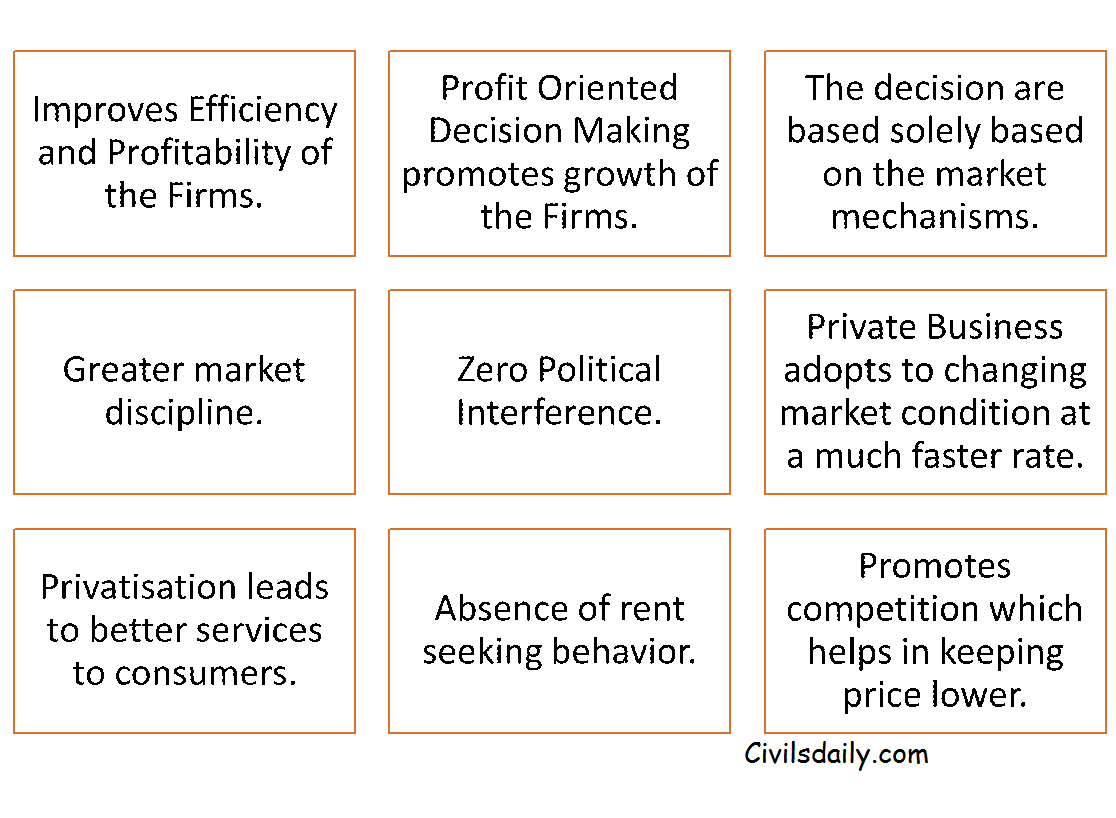
    Privatisation offers many advantages.

    Methods of Privatisation adopted in India.

    Initial Public Offers (IPO).

    IPOs are the most favoured method of privatisation followed in the developed countries of Europe and OECD. Under this method, the shares/equity holdings of the PSUs are sold to the private retail investors and institutions like Mutual Fund houses, Pension Funds and Insurance Companies etc.

    The prerequisite for the IPOs to be successful is that a country must have a well-developed and well-functioning Capital Market.

    The main advantages of the IPO method are:

    • It ensures wide participation of retail investors.
    • It is likely to face less resistance from the PSUs stakeholders like employees, as the method involves only selling of PSUs shares without any change in the management and policies.
    • It can be used to offer shares to the employees.
    • The method is best suited when the government wanted to raise financial resources without losing on the management and control of the PSU.

    Strategic Sale.

    Strategic Sale is a method in which the government decides to sell PSU shares to a strategic partner. The management in all such cases passes to the strategic buyer.

    The various advantages of the method are:

    • The performance of the PSU is expected to improve as the private player selected will already have an expertise in the management and operation of the PSU.
    • The strategic partner will be willing to pay a better price for the PSU as his business interest lies in combining his own business with that of PSU.
    • The method helps in infusion of capital and modernisation of the PSUs.
    • The method also helps the government in transferring the loss making PSU which could not have been attractive to retail buyers otherwise. The strategic partner will acquire such business as he has the prerequisite skills to turnaround the PSU.
    • The method is very important for countries having less developed capital market.

    Disadvantages:

    Sale to Foreign Firms.

    The method is a variant of the strategic sales method where the government decides to sell the PSUs to the foreign firms.

    Management and Employees Buy outs.

    In this route, management and employees come forward to but the shares and equities of the PSUs.

    Disinvestment.

    The method is followed in India from time to time. The method involves the sale of the Public sector equity to the private sector and the public at large.

    Methods of Disinvestment

    There are primarily three different approaches to disinvestments (from the sellers’ i.e. Government’s perspective)

    • Minority Disinvestment


    • Majority Disinvestment


    • Complete Privatisation
    By
    Himanshu Arora
    Doctoral Scholar in Economics & Senior Research Fellow, CDS, Jawaharlal Nehru University


  • Categories of Public Sector Enterprises: Maharatnas; Navratnas; Miniratnas

    Navratnas, Maharatnas and Miniratnas

    The Public Sector Enterprises are run by the Government under the Department of Public Enterprises of Ministry of Heavy Industries and Public Enterprises. The government grants the status of Navratna, Miniratna and Maharatna to Central Public Sector Enterprises based upon the profit made by these CPSEs. The Maharatna category has been the most recent one since 2009, other two have been in function since 1997.

    The Maharatna Status

    The Maharatna PSUs are chosen from those PSUs who holds the status of Navratnas and must be listed on the Indian stock exchange fulfilling the minimum prescribed public shareholding according to the SEBI regulations. The following conditions must be satisfied in order to get Maharatna status:

    • The Average annual turnover of the PSU during the last 3 years is more than Rs. 25,000 crore.
    • The Average annual net worth during the last 3 years is more than Rs. 15,000 crore.
    • The Average annual net profit after tax during the last 3 years is more than Rs. 5,000 crore.
    • The company should have the significant global presence or international operations.

    There are 7 Maharatna CPSEs currently, namely:

    1. Bharat Heavy Electricals Limited
    2. Coal India Limited
    3. GAIL (India) Limited
    4. Indian Oil Corporation Limited
    5. NTPC Limited
    6. Oil & Natural Gas Corporation Limited
    7. Steel Authority of India Limited

    The Navratne Status

    • The company must have ‘Miniratna Category – I‘ status along with a Schedule ‘A’ listing.
    • It should have at least 3 ‘Excellent’ or ‘Very Good’ Memorandum of Understanding (MoU) during the last five years.
    • Along with the above, it should also have a composite score of 60 or above out of possible 100 marks in the 6 selected performance parameters:-
      1. Net Profit to Net Worth (Maximum: 25)
      2. Manpower cost to cost of production or services (Maximum: 15)
      3. Gross margin as capital employed (Maximum: 15)
      4. Gross profit as Turnover (Maximum: 15)
      5. Earnings per Share (Maximum: 10)
      6. Inter-Sectoral comparison based on Net profit to net worth (Maximum: 20)
      7. There are 17 Navratna CPSEs in the country

    The Miniratnas Status

    • The CPSEs that have shown profits in the last continuous three years and have positive net worth can be considered eligible for grant of Miniratna status.
    • Presently, there are 71 Miniratnas in total.
    • The Miniratnas are divided into two categories (I and II).

    Category One: The PSUs that have made profits in the previous three years or have generated a profit RS 30 crore or more in one of the preceding three years.

    Category Two: The PSUs that have made profits in the preceding three years and have a positive net worth in all three preceding years.


    By
    Himanshu Arora
    Doctoral Scholar in Economics & Senior Research Fellow, CDS, Jawaharlal Nehru University
  • Disinvestment Policy in India.

    The Disinvestment Program in India

    Disinvestment of the Shares/Equity of Public Sector Enterprises

    • The government of India has decided to withdraw from the Industrial sector, and in accordance with this decision, it decided to privatize the Public sector enterprises in a gradual and phased manner.
    • The approach adopted by the government in this regard is to bring down its equity shares in all non-strategic Public sector enterprises to 26 percent or lower.
    • For the purpose of privatization, the government has adopted route of disinvestment which involves the sale of the public sector equity to the private sector.
    • In the first round of dis‑investment it was decided to (a) offer a randomly structured portfolio of shares each with notional reserve price based on a complex valuation procedure and (b) to off‑load the shares to institutional investors as a buffer between the Government and the stock market.
    • Financial institutions and mutual funds were offered the opportunity to bid for the bundles. Later, the bidding process was opened up to foreign institutional investors and to the public at large with the stipulation of a certain minimum bid. Almost all the bidding so far has been done by financial institutions or mutual funds.
    • There have been the inevitable controversies about the prices at which some of the initial shares were sold, even though all the disinvestment has been done through an auction process.
    • The Government has decided to permit up to 49% disinvestment of equity so that the government would continue to hold 51%. A firm is legally regarded as a public sector firm in India if the Government holds more than 50% of equity. A company so classified is then subject to all the rules, regulations, procedures etc. connected with government ownership. Thus, a firm in which government ownership goes below 50% can be effectively regarded as being in the private sector even if the government has a dominant share holding.
    • One criticism of this disinvestment process has been that it has essentially been seen as resource raising exercise by the government.
    • A second and, perhaps, more valid criticism is that the valuation of shares is affected by the decision not to reduce government holdings to less than 51 per cent. With the continuing majority ownership of the government the disinvested public enterprises would continue to operate within the constraints of the public sector. Thus, there is a lack of clarity on future corporate plans and prospects of these enterprises. Consequently, it is expected that share bids would be lower than they would otherwise be if there was a clear announcement of eventual disinvestment of greater than 51 per cent.

    Types of Disinvestment Methods in India

    The method is followed in India from time to time. The method involves the sale of the Public sector equity to the private sector and the public at large.

    Methods of Disinvestment

    There are primarily three different approaches to disinvestments (from the sellers’ i.e. Government’s perspective)

    Minority Disinvestment

    A minority disinvestment is one such that, at the end of it, the government retains a majority stake in the company, typically greater than 51%, thus ensuring management control.

    Historically, minority stakes have been either auctioned off to institutions (financial) or offloaded to the public by way of an Offer for Sale. The present government has made a policy statement that all disinvestments would only be minority disinvestments via Public Offers.

    Examples of minority sales via auctioning to institutions go back into the early and mid 90s. Some of them were Andrew Yule & Co. Ltd., CMC Ltd. etc. Examples of minority sales via Offer for Sale include recent issues of Power Grid Corp. of India Ltd., Rural Electrification Corp. Ltd., NTPC Ltd., NHPC Ltd. etc.

    Majority Disinvestment

    A majority disinvestment is one in which the government, post disinvestment, retains a minority stake in the company i.e. it sells off a majority stake. It is also called Strategic Disinvestment.

    Historically, majority disinvestments have been typically made to strategic partners. These partners could be other CPSEs themselves, a few examples being BRPL to IOC, MRL to IOC, and KRL to BPCL. Alternatively, these can be private entities, like the sale of Modern Foods to Hindustan Lever, BALCO to Sterlite, CMC to TCS etc.

    Again, like in the case of minority disinvestment, the stake can also be offloaded by way of an Offer for Sale, separately or in conjunction with a sale to a strategic partner.

    Complete Privatisation

    Complete privatisation is a form of majority disinvestment wherein 100% control of the company is passed on to a buyer. Examples of this include 18 hotel properties of ITDC and 3 hotel properties of HCI.

    Disinvestment and Privatisation are often loosely used interchangeably. There is, however, a vital difference between the two. Disinvestment may or may not result in Privatisation. When the Government retains 26% of the shares carrying voting powers while selling the remaining to a strategic buyer, it would have disinvested, but would not have ‘privatised’, because with 26%, it can still stall vital decisions for which generally a special resolution (three-fourths majority) is required.

    The Way Ahead: What should be the Objectives of Public Sector Enterprises Disinvestment and Restructuring?

    The means of achieving these objectives involve considerations such as the injection of greater competition into the industrial economy in order to foster a healthier market structure.


    By
    Himanshu Arora
    Doctoral Scholar in Economics & Senior Research Fellow, CDS, Jawaharlal Nehru University
  • The Role of Public Sector Enterprises in the Indian Economy.

    Public Sector in the India Economy

    What is Public Sector: A Brief Profile

    The public sector in India is composed of a number of segments

    The Importance/Presence of the Public Sector in the Indian Economy

    Role of the Public Sector in the Indian Economy

    Problems Associated with Public Sector

    Public Sector Reforms in India, 1991

    The Statement on Industrial Policy, of July 24, 1991, recognised the many problems that have manifested themselves in many of the public enterprises and sought to rectify these problems. It noted that many public enterprises have become a burden rather than being an asset to the Government. The statement proposed “it is time therefore that the Government adopt a new approach to public enterprises”.

    1. The areas reserved for the public sector were reduced drastically from 17 to 8(and later to 6). In manufacturing, the only areas which continue to be reserved for the public sector are those related to defence, strategic concerns and petroleum. Even, here there is no bar to the Government inviting the private sector to participate.
    2. Specific attention was given to the issue of industrial sickness in public enterprises and a commitment was made to refer all sick public enterprises to the Board of Industrial and Financial Reconstruction (BIFR) or similar body so that appropriate decisions could be taken on the rehabilitation of these enterprises after examination on a case by case basis.
    3. A commitment was made to provide greater autonomy to remaining public enterprises through the strengthening of the MOU (Memorandum of Understanding) system and by providing greater professional expertise in the Boards of these enterprises.
    4. The decision to dis‑invest equity in the public sector enterprises was also announced in the Statement on Industrial Policy.
    5. To sum up, the intention behind the announcements made in the Statement of Industrial Policy was to undertake a wide ranging public sector reform. The objective was to induce greater efficiency, productivity and competitiveness in the public sector. The enterprises currently in the public sector were to be strengthened so that they are enabled to participate profitably in the new competitive environment that now exists in both the domestic and international economy. If this involves disinvestment or privatisation, it must be accomplished purposively and quickly.

    The Reforms Done so far

    1. De-reservation:
    • In the manufacturing sector, the reserved areas for the public sector now only include defence production and mineral oils.
    • In the case of mineral oils (petroleum exploration, petroleum refining, etc.), however, private investment including foreign investment is being actively invited, but on a discretionary basis.
    • The other reserved areas are in respect of atomic energy, minerals related to atomic energy, coal and lignite, and railway transport. Mining of iron ore, manganese ore, chrome ore, etc., and mining of non‑ferrous metals, which was earlier reserved for the public sector was further dereserved in 1993.
    • Thus, from the original list of 17 (see Annex III) now only 6 areas still remain reserved for the public sector.
    • The public sector enterprises are now open to competition from new entry in all areas of manufacturing except in defence production.

    Revamping of SICK PSU’s

    • The Sick Industrial Companies Act (SICA) has been amended to make mandatory the referral of sick public sector enterprises to the BIFR.
    • Hence, all sick (bankrupt) public sector industrial firms now have to be restructured through revival, rehabilitation, or closure if found to be unviable. Once the bankrupt public sector firms are referred to the BIFR, the government has, by necessity, to make decisions that result from the orders of this Board.
    • After referral to the BIFR the Board first has to decide whether a firm has been correctly referred to them in terms of the definition of sickness (a firm is defined as sick if its net worth has been totally eroded, if it has made losses for two consecutive years and if it has been in existence for more than five years).
    • Once a firm is accepted by the Board for further enquiry, the firm itself is usually asked to put forward its own proposal for a restructuring programme. If this is not found to be satisfactory an operating agency (OA) is usually appointed in order to examine its viability or otherwise.

    Establishment of the National Renewal Fund.

    The National Renewal Fund was established in 1992 to provide a social safety net for workers affected by industrial restructuring. As various enterprises (in both the public and private sectors) undertake a restructuring process, workers would need focused assistance for re‑training, re‑deployment, skill upgradation and other kinds of employment counselling.

    The intention behind the NRF was

    1. to provide compensation to workers who would be affected by industrial restructuring;
    2. to assist such workers in re‑training and re‑deployment;
    3. to provide resources for employment generation in areas affected by industrial restructuring. It also had provision for compensating workers who opt to take voluntary retirement from existing public sector enterprises.

    Greater Autonomy to Public Enterprises

    In the statement on Industrial Policy, a commitment had been made to provide greater autonomy to remaining public enterprises through the strengthening of the Memorandum of Understanding (MOU) system and by providing greater professional expertise in the boards of these enterprises.


    By
    Himanshu Arora
    Doctoral Scholar in Economics & Senior Research Fellow, CDS, Jawaharlal Nehru University
  • Industrial Policy in India: Post 1991 Period; New Industrial Policy-1991, National Manufacturing Policy, Make in India.

    Industrial Policy in India: Post 1991 Reforms, Period

    New Industrial Policy, 1991

    In the backdrop of severe Balance of Payment Crisis of 1991, the Government in continuation of the measured announced during the 1980s announced a New Industrial Policy on July 24, 1991.

    The new industrial policy was a major structural break for the Indian economy. The policy has deregulated the Industrial sector in a substantial manner. The major aims of the new policy were; to carry forward the gains already made in the industrial sector; Correct the existing market distortion from the industrial sector; to provide gainful and productive employment; to attain global competitiveness.

    The Government announced series of Initiative in respect of the following areas:

    Abolishment of Industrial Licensing

    Role of Public Sector Reduced Substantially

    Entry of Foreign Firms and Investments

    Other Important Liberalisation Measures

    National Manufacturing Policy, 2011

    The success of India’s economic story has mainly been due to service’s sector growth. Despite strong policy measures, the industrial sector (especially manufacturing) has stagnated. The maximum contribution of the sector in the overall GDP is close to 15%, which is far less than that of other emerging economies like China (whose share is close to 45%). As a result of which, India has failed to provide gainful employment to its massive labour force.

    Lack of employment in the manufacturing sector has put excessive pressure on the agriculture sector to provide employment, which is not possible under any economic model. The result of this is the phenomenon called “Jobless Growth”, which is specific to India.

    The Government recognising this fact and in order to promote manufacturing sector launched National Manufacturing Policy on November 2011.

    Objectives of the National Manufacturing Policy

    Government Policy support under NMP

    1. The manufacturing policy proposes to create an enabling environment for the growth of manufacturing in India.
    2. The NMP envisages simplification of business regulations significantly.
    3. The NMP proposes the development of the MSMEs sector. The proposal includes technological upgradations of the MSMEs; adoption of business-friendly policies; equity investments.
    4. Skill Development of the youth is the most important part of the NMP.
    5. Setting up of National Investment and Manufacturing Zones(NIMZ) with significant incentives like easy land acquisitions, integrated industrial township development, world-class physical infrastructure.
    6. A total of 12 NMIZ have been announced so far by the government. Out of the total 12, 8 NIMZ are located in the Delhi-Mumbai Industrial Corridor. Other 4 NMIZ is planned to build in; Nagpur; Tumkur (Karnataka); Chittoor (Andhra Pradesh); Medak (Andhra Pradesh).

    Make in India Program

    Make in India is a campaign launched by the government of India on 25 September 2015. The aim of the Make in India program is to project India as an efficient and competitive powerhouse of global manufacturing. The program aims to convert India into “World’s Factory” by promoting and developing India as a leading manufacturing destination and a Hub for the production of manufacturing goods.

    Make in India is essentially an invitation to the foreign companies to come and invest in India on the back of the Government promise to create an environment easy for doing business. But contrary to public perception, no specific concessions have been offered to foreign investors under this scheme till date.

    The government since the launch of the program is trying to make India an attractive destination for global Multinationals by focussing on ease of doing business, liberal FDI regime, improving the quality of Infrastructure and Business-friendly policies.

    The need for the program

    1. The share of Industrial Manufacturing in India’s GDP is 14-15%, which is way below its actual potential. The program aims to increase this share to 25%.
    2. India’s economic performance is a story of “Jobless Growth”. India has failed to generate jobs for his youth entering the labour force. The main reason for low job creation is that the manufacturing sector has failed to take off and still remains dismal.
    3. If India failed to develop a competitive manufacturing sector now than it will be trapped in a “Middle Income Trap”, where India will not be able to grow at a higher growth rate (India will remain a middle-income country with a deficient and uncompetitive economic system).
    4. No country in the World has become rich and developed without developing its Manufacturing sector. The story is true for Britain (Industrial Revolution), USA (In the 1900s), Japan (Since 1950s), East Asian Tigers (In 1970s), China (Since 1990s).
    5. The employment elasticity of the manufacturing sector is highest. Manufacturing is the only sector that has the potential to create jobs at a faster rate and absorb excess labour from agriculture. A weak manufacturing sector, therefore, is a curse for the economy.
    6. The service led growth as witnessed by India since 1991 reforms is not sustainable in the long run as the employment elasticity of the services sector is one of the lowest.
    7. People start consuming services on a large scale once they cross a certain minimum threshold of Income. In the absence of minimum threshold income, the demand for services will stagnate in the future and the phenomenon of the service led growth will be reversed.
    8. The key for India to sustain its service-led growth is to make sure that its manufacturing sector is well developed. A well-developed manufacturing sector will absorb low skilled labours from agriculture sector and employ the productively in factories. Similarly, the high skilled workers will be employed in the High-Tech End of Manufacturing like Electrical Engineering, Aerospace, Automobiles, Defence Manufacturing etc.
    9. Moreover, the benefits from the programme are likely to be multiple and can address issues on economic growth and employment generation as well as fuel consumer demand.
    10. Having said that, the success of the Make in India programme lies in India building capabilities to manufacture world-class products at competitive prices. In today’s dynamic world, achieving the same is far more complex as the variables which impact business are extremely fluid and require businesses to be extremely flexible and adaptive to changes in the environment and technology.

    How Government is supporting the Program

    • Improving Ease of Doing Business and promoting use of technology;

    • Opening up of new sectors for FDI, undertaking de-licensing and deregulation of the economy on a vast scale;

    • Introduction of new and improved infrastructure through industrial corridors, industrial clusters and smart cities;

    • Strengthening IPR infrastructure to nurture innovation; and

    • Building a new mindset in government to partner industry instead of working as a regulator in Economic Growth of the country.

    The Government has taken various measures for the success of Make in India ‘campaign as under:

    a) Industrial Corridors

    Cities/regions have been identified to be developed as investment centres in the Delhi-Mumbai Industrial Corridor in partnership with the State Governments.

    (i) Ahmedabad-Dholera Investment Region, Gujarat;

    (ii) Shendra-Bidkin Industrial Park city near Aurangabad, Maharashtra;

    (iii) Manesar-Bawal Investment Region, Haryana;

    (iv) Khushkhera-Bhiwadi-Neemrana Investment Region, Rajasthan;

    (v) Pithampur-Dhar-Mhow Investment Region, Madhya Pradesh;

    (vi) Dadri-Noida-Ghaziabad Investment Region, Uttar Pradesh; and

    (vii) Dighi Port Industrial Area, Maharashtra.

    b) Foreign Direct Investment

    Liberalisation of the FDI in the majority of sectors to attract investments. Example: 100% FDI under automatic route has been permitted in construction, operation and maintenance in specified Rail Infrastructure projects; FDI in Defence liberalized from 26% to 49%. In cases of modernization of state-of-art proposals, FDI can go up to 100%; the norms for FDI in the Construction Development sector are being eased.

    c) Easing of Laws, Rules and Regulations

    Major changes have been proposed in various laws and rules to overcome regulatory hurdles

    d) Investment Security and Stable and Conducive Government Policies

    The Government is committed to chart out a new path wherein business entities are extended red carpet welcome in a spirit of active cooperation. Invest India will act as the first reference point for guiding foreign investors on all aspects of regulatory and policy issues and to assist them in obtaining regulatory clearances. The Government is closely looking into all regulatory processes with a view to making them simple and reducing the burden of compliance on investors. An Investor Facilitation Centre has been created under Invest India to provide guidance, assistance, handholding and facilitation to investor during the entire circle of the business.

    What more should be done to make India an attractive destination for Global Firms?


    The Sectors:


    By
    Himanshu Arora
    Doctoral Scholar in Economics & Senior Research Fellow, CDS, Jawaharlal Nehru University
  • Industrial Policy in India: Pre 1991 Era

    Industrial Policy in India

    A brief outline of Industrial Policy.

    After Independence, the Government of India adopted an approach to develop Industrial sector of India. India adopted several Industrial Policy resolution to develop the Industrial sector.

    Industrial Policy Prior to 1991.

    Industrial Policy Resolution, 1948.

    The resolution was issued on April 6, 1948. The resolution accepted the importance of both private and public sectors for the development of the industrial sector.

    The 1948 Resolution also accepted the importance of the small and cottage industries as they are suited for the utilisation of local resources and are highly labour intensive.

    The 1948 Resolution divided the Industries into following four categories.

    Industrial Policy Resolution, 1956.

    The Policy Resolution of 1956, laid the following objectives for the growth of the Industrial sector:

    1. To accelerate the rate of growth and to speed up the pace of Industrialisation.
    2. To develop heavy industries and machine making industries.
    3. Expansion of Public Sector.
    4. To reduce disparities in Income and Wealth.
    5. Development of a competitive Cooperative Sector.
    6. To Prevent concentration of Business in few hands and Restriction in Creation of Monopolies.

    The objectives were chosen carefully with the aim of creating employment and reducing poverty.

    The 1956 Resolution further divided the Industries into three Categories.

    To sum up, the 1956 Resolution, emphasised on the mutual dependence and existence of the public and private sectors. The only 4 industries in which private sector are not allowed were Arms & Ammunition, Railways, Air Transport and Atomic Energy. In all other sector, either private sector was allowed to operate freely or will provide help to the government sector as and when needed.

    Industries (Development & Regulation) Act, 1951.

    The Industries Act was passed by the Parliament on October 1951 to control and regulate the process of Industrial development in the country. The Acts main task was to regulate the Industrial sector.

    The specific objectives of the Act were:

    1. Regulation of Industrial Investment and Production according to Five Year Plans.
    2. Protection of small-scale enterprises from giant enterprises.
    3. Prevention of Monopolies and concentration of ownership of industries in few hands.
    4. Balanced Growth and Equitable development of all the regions.
    5. It was also believed that the State is best suited to promote balanced growth by; channelizing investment in the most important sectors; Correlate supply and demand; eliminate competition; ensure optimum utilisation of social capital.

    Major Provisions of the Act

    Restrictive Provisions: It contains all measure provision to curb unfair trade practices.

    Registration: The provisions make registration of industries mandatory irrespective of whether they are private or public in nature. The expansion of the existing business also required licencing and permission.

    Examination and Monitoring of the Industries: After granting of license, it is the responsibility of the state to monitor the performance of the industries. If at any point in time, the industrial unit was found not up to the mark, underutilising its resources or charging excessive prices, the government could set up an enquiry against the unit.

    Cancellation of the Licence: The government has the power to cancel the licence granted to the industrial unit if found, engaging in wrongful behaviour.

    Reformative Provisions:

    The category involved following provisions.

    Direct Control by the Government: Under this provision, the government could set up an enquiry against the industrial unit and can order reform process, if it was not being run properly.

    Control on Price, Distribution and Supply: The Government was empowered by the act to control and regulate the prices, supply and distribution of the goods produced.

    Problems of the Excessive Restrictions imposed by the Government.

    Liberalisation measures adopted in the 1980s

    1. Exemption from Licensing.
    2. Relaxation to MRTP Act and FERA guidelines.
    3. Delicensing of large range of industries.
    4. Re-endorsed of capacity: Benefits were granted under this scheme to industries who successfully achieve capacity utilisation of 90 percent.
    5. Broad Banding of Industries: Under this, the government branded the industries into broad categories. For example; cars, jeeps, tractors, light and heavy commercial vehicles are branded as Four-Wheelers.
    6. Promotion of Economies of scale in production processes to reduce cost by allowing firms to expand.
    7. Development of Backward Areas.
    8. Incentives were provided to the Exporters.
    9. Promotion of Small Scale Industries by increasing their Investment limits.
    10. New Industrial Policy, 1991.