💥Join UPSC 2027,2028 Mentorship (July Batch) + XFactor Notes & Microthemes PDF

Author: CD Staff

  • [Burning Issue] Draft National Education Policy

    CONTEXT

    • Following the submission of the draft National Education Policy 2019, there were protests against the three language formula.
    • The controversial provision was thus revised by Dr Kasturirangan-led committee that submitted it.
    • From the perspective of higher education, its main strength is that it has got its basics right — it appears to have a reasonable understanding of existing problems, and offers a plausible picture of possible solutions that may take us towards a better future. Indeed, the DNEP comes as a refreshing shock to academics long accustomed to policy documents that are rooted in a stubborn denial of basic ground realities.

    Why a new education policy?

    • The extant National Policy on Education, 1986 modified in 1992 required changes to meet the contemporary and futuristic needs of India’s large youth population.
    • A New Education Policy is designed to meet the changing dynamics of the requirements in terms of quality education, innovation and research.
    • The policy aims at making India a knowledge superpower by equipping students with the necessary skills and knowledge.
    • It also focusses on eliminating the shortage of manpower in science, technology, academics and industry.
    • The Draft Policy is built on the foundational pillars of Access, Equity, Quality, Affordability and Accountability.

    Key features

    • Ministry – The committee has proposed to rename the Ministry of Human Resource Development as Ministry of Education (MoE).
    • Curriculum – In school education, a major reconfiguration of the curricular and pedagogical structure was proposed.
    • The policy calls for Early Childhood Care and Education (ECCE) as an integral part of school education.
    • A 5+3+3+4 curricular and pedagogical structure based on cognitive and socio-emotional developmental stages of children was proposed.

    It consists of –

      1. Foundational Stage (age 3-8 yrs): 3 years of pre-primary plus Grades 1-2
      2. Preparatory Stage (8-11 years): Grades 3-5
      3. Middle Stage (11-14 years): Grades 6-8
      4. Secondary Stage (14-18 years): Grades 9-12
    • The policy also seeks to reduce the content load in the school education curriculum.
    • There will be no hard separation of learning areas in terms of curricular, co-curricular or extracurricular areas.
    • All subjects, including arts, music, crafts, sports, yoga, community service, etc will be part of the curricula.
    • The policy promotes active pedagogy to focus on the development of core capacities and life skills, including 21st-century skills.
    • RTE Act – The committee recommends Extension of Right to Education Act 2009 to cover children of ages 3 to 18 (currently, 6-14).
    • Teacher education – The committee proposes for massive transformation in teacher education.
    • It calls for shutting down sub-standard teacher education institutions.
    • It proposes moving all teacher preparation/education programmes into large multidisciplinary universities/colleges.
    • The 4-year integrated stage-specific B.Ed. the programme will eventually be the minimum degree qualification for teachers.
    • Higher education – A restructuring of higher education institutions with three types of higher education institutions was proposed –
    1. Type 1: Focused on world-class research and high-quality teaching
    2. Type 2: Focused on high-quality teaching across disciplines with significant contribution to research
    3. Type 3: High-quality teaching focused on undergraduate education
    • This will be driven by two Missions -Mission Nalanda & Mission Takshashila.
    • There will be re-structuring of Undergraduate programs such as BSc, BA, BCom, BVoc of 3 or 4 years duration and having multiple exits and entry options.
    • Institution – A new apex body Rashtriya Shiksha Ayog is proposed.
    • This is to enable a holistic and integrated implementation of all educational initiatives and programmatic interventions.
    • The body will also coordinate efforts between the Centre and states.
    • The National Research Foundation, an apex body, is proposed for creating a strong research culture.
    • It will help build research capacity across higher education.
    • The four functions of Standard Setting, Funding, Accreditation and Regulation will be separated and conducted by independent bodies.
    • National Higher Education Regulatory Authority will be the only regulator for all higher education including professional education.
    • The policy proposes to create an accreditation eco-system led by a revamped NAAC (National Assessment and Accreditation Council).
    • Professional Standard Setting Bodies for each area of professional education was proposed.
    • UGC is to be transformed into Higher Education Grants Commission (HEGC).
    • The private and public institutions will be treated on par, and education will remain a ‘not for profit’ activity.
    • Besides the above, the committee also recommended several new policy initiatives for –
      1. promoting the internationalization of higher education
      2. strengthening quality open and distance learning
      3. technology integration at all levels of education
      4. facilitating adult and lifelong learning
      5. enhancing the participation of under-represented groups
      6. eliminating gender, social category and regional gaps in education outcomes
    • Language – Promotion of Indian and classical languages and setting up three new National Institutes for Pali, Persian and Prakrit were proposed.
    • Indian Institute of Translation and Interpretation (IITI) has been recommended.
    • The policy called for the proper implementation of the three-language formula (dating back to 1968) in schools across the country.
    • Accordingly, students in Hindi-speaking states should learn a modern Indian language, apart from Hindi and English.
    • In non-Hindi-speaking states, students will have to learn Hindi along with the regional language and English.
    • The controversial three language provision was, however, dropped after protests against it in many states.

    Significance of DEP

    • The draft has diagnosed the problems plaguing the sector, besides providing solutions to problems right from the pre-school level to doctoral studies.
    • It recognizes there is a severe learning crisis and emphasizes the need to focus on building a foundation for reading and arithmetics from Class I onwards. The Annual Status of Education Report (ASER), which says that 50% of Class V students were unable to even read the text meant for students three levels below, proves that Indian children have been lagging in basic learning and numeracy skills.
    • The draft suggests that there should be dedicated arithmetic and reading hours every day in primary schools and advises introduction of specialized sessions to hone logical thinking and language skills.
    • “The draft, for the first time, has rightly suggested solutions for early childhood and primary education. The focus on basic understanding of language and mathematics will help in improving the quality.
    • Restructuring of the higher education system into Tier 1, Tier 2 and Tier 3.: Tier 1 includes research universities focusing equally on research and teaching, Tier 2 includes teaching universities focusing primarily on teaching; and Tier 3 includes colleges focusing only on teaching at undergraduate levels. All such institutions will gradually move towards full autonomy – academic, administrative, and financial. The idea is to spread ‘research culture’ at the undergraduate level.
    • The policy also talks about National Scholarship Fund to financially support students for higher education.
    • Promotion of classical and regional languages have been emphasised upon.
    • The policy also proposes to increase the class of compulsory education up to grade 12 (age-18).
    • The Right of Children to Free and Compulsory Education Act or Right to Education Act – RTE, 2009 (represents Article 21-A of the Indian Constitution) made education, a fundamental right of every child between the ages of 6 and 14.

    Positives of proposals

    1.Liberal and holistic – The most overarching is the acknowledgement that all education is, and ought to be envisioned as, “liberal” and holistic.

    2. Public education – There is a strong re-affirmation of the state’s commitment to public education, much needed at a time when privatisation has seemed to be the overriding objective of governments.

    3. Autonomy – Also welcome is the explicit assurance that institutional autonomy is not just a polite term for financial abandonment.

    4. Ad- hoc and contractual appointments – Finally, the recognition that rampant resort to ad hoc and contractual appointments has crippled higher education and must be stopped immediately will surely bring relief to teachers’ organisations agitating tirelessly on this very issue.

    5.Core Vision – The core vision based on a tripartite division of higher education into teaching universities, research universities, and optimally-sized multidisciplinary undergraduate colleges is sound.

    6. National Research Foundation – The diagnoses and prescriptions for the key areas of governance and regulation are workable as initial starting points, as is the plan to create a National Research Foundation separate from regulatory bodies.

    Issues in the Draft Policy

    • There is less consensus on the integration of foundational learning with schooling. In Europe, compulsory education only begins at the age of 6. In certain countries like Denmark, Germany and Finland, compulsory education begins at the age of 7.
    • There needs to be a discussion on whether literacy and numeracy skills should be developed during the time of foundational learning.
    • In the draft policy, there is no mention of how the State regulatory body will regulate the government institutions.
    • A constitutional amendment is required to change the limits for compulsory schooling in the country. Also, increasing the limit on higher side i.e. up to the age of 18 is not consistent with the limits across the world. Also, it is a very expensive proposition.
    • There is not enough capacity in the country to provide for teachers’ education. Also, M.Ed has been given less importance under the policy. The focus has been more on B.Ed.
    • The draft lacks operational details and does not offer insights into how the policy will be funded. The centre must also ensure that the policy does not face litigation, state resistance, and operational challenges on the ground.
    • Discrimination and Exclusion –
    • It is deeply disappointing that the DNEP has evaded this issue, with the question of Under-Represented Groups (URGs) making no appearance outside school education.
    • Caste discrimination has long been an important issue in higher education and has received intense public attention in recent times, from Rohith Vemula to Payal Tadavi.
    • Moreover, national statistics unambiguously establish that Persons with Disability and Muslims are by far the leading URGs in higher education.
    • Protecting public higher educational institutions from undue governmental interference
    • The proposed institutional framework for higher education — with the National Education Commission chaired by the prime minister at its apex — clearly implies even more governmental control with significantly higher levels of centralisation than what is already the case.
    • The DNEP should have included — but does not — a forthright proposal for dealing with this unavoidable problem.

    Way Forward

    • Education is a concurrent list subject. Apart from a consensus between the centre and the states, all the other stakeholders including institutions, public and academicians should also be consulted.
    • Natal and prenatal studies should also be included in the country’s education system to ensure awareness about the issues related to mother and infants, considering the high MMR and IMR in the country.
    • There should be a course of Masters of Teacher Education. Also, there is a need to build good teacher training institutions.
    • The education policy should maintain a symbiotic relationship between the different regions of the country through the study of different languages.
    • The quality of education provided in the country shall be such that it not only delivers basic literacy and numeracy but also creates an analytical environment in the country.
    • It does look forward-looking, but what the final draft needs to do is differentiate between deregulation and liberalisation. The incentive for the private sector to invest, grow and stand on quality parameters needs to be clearly articulated.
     

  • Gear up for This week’s Samachar Manthan lecture on 23rd June Sunday

    Dear students,

    We understand that the UPSC exam is a generalist exam. It’s more important to cover more issues than to cover one issue in more depth. Hence, through Samachar Manthan, we are trying to maintain a fine balance of covering many important news items and having a detailed discussion on selected topics which require the same. On daily basis a news gets repeated multiple times. Scattered knowledge is not adequately useful when you have to write a 200 words answer within 6-7 minutes. To handle this, Samachar manthan covers such issues in a comprehensive and consolidated manner which is the smart strategy.

    Benefits of Samachar Manthan

    • Packed 3 – 3.5 hours Weekly videos will focus on news and its importance from both prelims and mains perspective.
    • This program will also help you understand how to utilize current affairs in all your prelims and mains papers.
    • This ideology makes this course the best utilization of your time.
    • Detailed coverage would mean analysis from all the angles like background or history, features, significance, challenges and way forward. Also, multiple sources like epw, diplomat magazine etc will be referred to in the video lectures.
    • Such an approach will help in writing multidimensional answers.
    • Also which part of the topic is important from mains and prelims perspective will also be discussed.
    • Audio Visual Learning is more impactful than simply glancing through the material. So that you are able to retain information for long also interlink with any new information you get.
    • 4 stage structure of Video->Notes->testing->review to perfect your preparation
    • The sequence of video->Notes->testing->review is the best way to ensure maximum retention and a rock solid preparation. Each component of the program has been meticulously crafted.

    For example this week, we will be covering the following issues;

    Economics 
    [op-ed snap] A new India for farmers
    Project Sashakt
    National Data Warehouse
    VG Kannan committee to review ATM pricing
    Middle-Income Trap
    Jalan panel defers report on RBI surplus funds
    Cabinet approves ratification of OECD’s multilateral convention to check tax evasion
    [op-ed snap] Faint glimmer: On revival in industrial activity
    [pib] Kimberley Process Certification Scheme

    Enviro & Biodiversity 

    Arabian Sea Cyclones
    ICAT Releases India’s 1st BS – VI Certificate in 2W Segment
    Arctic Kelps: Underwater forests in the Arctic

    Governance
    [op-ed snap] Squandering the gender dividend
    [op-ed snap] Saving childhoods
    Acute Encephalitis Syndrome (AES) outbreak in Bihar
    [op-ed snap] Starting at three: On RTE progress
    [pib] Aadhaar and Other Laws (Amendment) Bill, 2019
    [op-ed snap] Bureaucracy reboot
    Abujh Maria PVTGs
    [op-ed snap] Too good to be true’
    E-Foreigner Tribunal (e-FT)
    [Op-ed snap] Welcome measure

    International Relations 
    [op-ed snap] Foreign policy challenges five years later
    Windrush Scheme
    What SCO summit means for India’s global and regional interests

    Polity 
    Explained: Appointment of the Pro-tem Speaker
    [pib] President’s (not Governor’s) Rule in J&K
    [pib] New Delhi International Arbitration Centre Bill, 2019

    Science Tech 
    [op-ed snap] Artificial Intelligence, the law and the future
    New paper-based test kit for Malaria Detection
    Defence Space Research Agency (DSRA)
    Chandrayaan-2 Mission
    Spectrum-Roentgen-Gamma telescope to create a 3D X-ray map of Universe
    ISRO plans to launch a space station
    Chaukhandi Stupa declared to be “of national importance”
    [op-ed snap] A home in space

    Security Issues 
    Hypersonic Technology Demonstrator Vehicle (HSTDV)

    And these issues will be covered in detail

    • Chandrayaan-2 Mission
    • New Delhi International Arbitration Centre Bill, 2019
    • Acute Encephalitis Syndrome (AES) outbreak in Bihar
    • Kimberley Process Certification Scheme
    • Project Sashakt
    • A new India for farmers

    So to be thorough in your preparation and to have an integrated approach, join Samachar Manthan here.

  • Gear up for This week’s Samachar Manthan lecture on 16th June Sunday

    Dear students,

    We understand that the UPSC exam is a generalist exam. It’s more important to cover more issues than to cover one issue in more depth. Hence, through Samachar Manthan, we are trying to maintain a fine balance of covering many important news items and having a detailed discussion on selected topics which require the same. On daily basis a news gets repeated multiple times. Scattered knowledge is not adequately useful when you have to write a 200 words answer within 6-7 minutes. To handle this, Samachar manthan covers such issues in a comprehensive and consolidated manner which is the smart strategy.

    Benefits of Samachar Manthan

    • Packed 3 – 3.5 hours Weekly videos will focus on news and its importance from both prelims and mains perspective.
    • This program will also help you understand how to utilize current affairs in all your prelims and mains papers.
    • This ideology makes this course the best utilization of your time.
    • Detailed coverage would mean analysis from all the angles like background or history, features, significance, challenges and way forward. Also, multiple sources like epw, diplomat magazine etc will be referred to in the video lectures.
    • Such an approach will help in writing multidimensional answers.
    • Also which part of the topic is important from mains and prelims perspective will also be discussed.
    • Audio Visual Learning is more impactful than simply glancing through the material. So that you are able to retain information for long also interlink with any new information you get.
    • 4 stage structure of Video->Notes->testing->review to perfect your preparation
    • The sequence of video->Notes->testing->review is the best way to ensure maximum retention and a rock solid preparation. Each component of the program has been meticulously crafted.

    For example this week, we will be covering the following issues;

    Economics 
    WTO moratorium on e-commerce customs duties
    Fiscal Performance Index by CII
    India is now the lowest-cost producer of solar power
    [op-ed snap] Going digital
    RBI has cut lending rates for the third consecutive time
    [op-ed snap] Eye on growth
    RBI revises stressed asset resolution norms
    [op-ed snap] The only mantra
    [op-ed snap] Slippery slope
    Gujarat launches India’s first Emission Trading Scheme

    Governance 
    Pension scheme for small shopkeepers, retail traders
    ICMR calls for a complete ban on e-cigarettes
    National Defence Fund
    Government launches new ‘Jal Shakti’ Ministry
    Periodic Labour Force Survey (PLFS) data for 2017-18
    SDG Gender Index
    [op-ed snap] The sum and substance of the jobs data
    [op-ed snap] Crisis defused: on Hindi imposition
    Central Bureau of Investigation (CBI)
    [pib] Jan Shikshan Sansthans
    [pib] Swachh Bharat Mission impact on Groundwater
    ‘Nal Se Jal’ Yojana
    [op-ed snap] Caught napping
    Free transport for women in Delhi
    EBPG quota
    SEBI, MCA sign pact for more data scrutiny
    [op-ed snap] Welfare policy and Modi 2.0

    International Relations
    Explained: OIC’s reference to J&K, and India’s response to it
    OIC on Kashmir
    India’s response
    [op-ed snap] The immediate neighbourhood
    [op-ed snap] Ocean of neighbours
    US asks for social media details of most visa applicants
    New START Policy

    Polity 
    Explained: Dual Mandate in India
    Election panel wants to revisit rule on punishment to voters for false mismatch claims
    Explained: Cabinet Committees

    Science Tech Art Culture 
    Parthenogenesis
    [op-ed snap] Breaking the algorithm

    Security Issues
    UdChalo Initiative
    [pib] Retired Officers Digital Records Archive (RODRA)
    [op-ed snap] Bolster the first line of defence”


    And these issues will be covered in detail

    • Cabinet Committees
    • RODRA
    • Nal se Jal
    •  3 language Formula
    • India’s first emission trading scheme
    • Welfare Policy of new Government

    So to be thorough in your preparation and to have an integrated approach, join Samachar Manthan here.

  • Gear up for This week’s Samachar Manthan lecture on 2nd June Sunday

    Dear students,

    We understand that the UPSC exam is a generalist exam. It’s more important to cover more issues than to cover one issue in more depth. Hence, through Samachar Manthan, we are trying to maintain a fine balance of covering many important news items and having a detailed discussion on selected topics which require the same. On daily basis a news gets repeated multiple times. Scattered knowledge is not adequately useful when you have to write a 200 words answer within 6-7 minutes. To handle this, Samachar manthan covers such issues in a comprehensive and consolidated manner which is the smart strategy.

    Benefits of Samachar Manthan

    • Packed 3 – 3.5 hours Weekly videos will focus on news and its importance from both prelims and mains perspective.
    • This program will also help you understand how to utilize current affairs in all your prelims and mains papers.
    • This ideology makes this course the best utilization of your time.
    • Detailed coverage would mean analysis from all the angles like background or history, features, significance, challenges and way forward. Also, multiple sources like epw, diplomat magazine etc will be referred to in the video lectures.
    • Such an approach will help in writing multidimensional answers.
    • Also which part of the topic is important from mains and prelims perspective will also be discussed.
    • Audio Visual Learning is more impactful than simply glancing through the material. So that you are able to retain information for long also interlink with any new information you get.
    • 4 stage structure of Video->Notes->testing->review to perfect your preparation
    • The sequence of video->Notes->testing->review is the best way to ensure maximum retention and a rock solid preparation. Each component of the program has been meticulously crafted.

    For example this week, we will be covering the following issues;

    Economics
    [op-ed snap] Eye on the monsoon
    Reserve Bank set to create a specialised supervisory cadre
    [op-ed snap] Power under pressure
    Ongole Cattle Breed

    Enviro & Biodiversity
    [pib] ‘Not all animals migrate by choice’ campaign
    ‘Room for the River’ Project
    Species in news: White-throated Rail (or Aldabra Rail)
    Anthropocene as Earth’s new epoch

    Governance
    Taj Mahal: First Indian Heritage Site to Get a Breastfeeding Room
    WHO strategy to tackle global snakebite ’emergency’
    Elephant Bonds
    [pib] Sahara Hostel

    International Relations
    [op-ed snap] The case for informal regional diplomacy’
    [op-ed snap] Moral ambiguity on the Rohingya
    [op-ed snap] The IBSA task list
    Doctrine of Hot Pursuit
    UAE launches ‘Golden Card’ scheme
    UNGA resolution demanding UK withdraw from Chagos Archipelago

    Polity
    United Nations not a State under Article 12: Delhi HC
    Decision of Foreigners Tribunal Will Prevail Over NRC Order
    [op-ed snap] Being responsive

    Science Tech
    [pib] Redefined units of measurement of kilogram, Kelvin, mole and ampere
    Evidence of water found on Ultima Thule
    New plants species with healing properties found in Manipur
    [op-ed snap] Eye in the sky: on RISAT-2B
    [op-ed snap] Full circle: on the change in kilogram’s definition
    ISRO’s new commercial arm NewSpace India officially inaugurated

    Security Issues
    [op-ed snap] A blueprint for a national security strategy


    And these issues will be covered in detail

    • Elephant Bonds
    • Strait of hormuz
    • Anthropocene
    •  Informal regional diplomacy
    • RISAT-2B
    • National security strategy

    So to be thorough in your preparation and to have an integrated approach, join Samachar Manthan here.

  • Prelims Motivation: Conquering the first Bastion

    It was the best of times, it was the worst of times

    These lines from the tale of two cities resonate with the feelings aspirants are having now. These days are filled with fear, apprehensions, anxiety, the excitement of all kinds. There is this hope of qualifying with good margin and also fear of losing at the first stage.

    One thing to know is that each and every aspirant is going through the same ups and downs. This solidarity should give you the assurance that you are not alone and this phase shall pass too.


    Now coming to the D-day. It’s not over until it’s over. To make most of these remaining days following are some tips which may help you in maximising your output.

    1. Last mile is the hardest mile. Set aside your temptations to read anything new. Have faith in whatever you have read. Revise all your basics, test papers, current affairs, UPSC previous years papers.
    2. Focus on factual lists, facts, reports, festivals, dance, heritage sites, national parks, location on maps. Revision of these is a must 2-3 days before exam. It will help you in gaining 6-8 marks extra.
    3. Don’t pay attention to rumours of question paper pattern, cut-off. No-one knows anything. Stay away from last minute tricks to score or any suggestions which you have not applied before. Be confident in your preparation and strategy.
    4. Take care of your physical and mental health. Avoid eating Junk,outside food, overthinking about your performance. Schedule your timetable so that you are at your mental peak from 9.30 to 11.30 by focused study session during this interval.
    5. Plan your commute in advance. Also, travel with one hour margin to the examination centre. It’s better to wait at the centre than hurrying at the last minute to reach the centre and losing your calm.

    On Examination Day

    1. Be well rested.
    2. Keep your stationery. Admit card, ID proof, chocolates, water bottle ready one day before to avoid last minute panic.
    3. Enter the examination hall with immense confidence and mindset that you are well prepared. You will score above your expectations.
    4. At first glance, you may feel like you haven’t heard of the question. Read options carefully then. The answer is in front of you. You need to identify it.
    5. Start filling the bubbles after one hour has passed. Leaving it for the last minute may cost you dearly.
    6. Don’t follow pre-set notions that only these number of questions should be attempted. An easy paper like 2016 will require more attempts and one like 2018 will require lesse number. Paper is same for everyone. You have to be above the cut-off. Take measured risks.
    7. If you feel exhausted during exams, consume chocolate or candy. This boosts your energy levels.
    8. Do not discuss Paper 1 before CSAT. Also, do not be overconfident or overly relaxed in CSAT. Attempt whole paper diligently.

    On a parting note, have unflinching faith in your abilities and what you deserve. You will be amazed at the results you get.


  • [Prelims Spotlight] Pollution

    National Environmental Legislation

    • Our constitution, originally, did not contain any direct provision regarding the protection of natural environment.
    • However, after the United Nations Conference on Human Environment, held in Stockholm in 1972, Indian constitution was amended to include protection of the environment as a constitutional mandate.
    • Environment related legislation came very late in 1972 with Wild Life Protection Act 1971.
    • The forty second amendment Clause (g) to Article 51A of the Indian constitution made it a fundamental duty to protect and improve the natural environment.

    Clause (g) to Article 51A of the Indian constitution states “It shall be the duty of every citizen of India to protect and improve the natural environment including forests, lakes, rivers and wild life and have compassion for living creatures.”

    • There is a directive, given to the State as one of the Directive Principles of State Policy regarding the protection and improvement of the environment.

    Article 48A states “The State shall endeavor to protect and improve the environment and to safeguard the forests and wildlife of the country”.

    • The Department of Environment was established in India in 1980 to ensure a healthy environment for the country. This later became the Ministry of Environment and Forests (MoEF) in 1985.
    • The Environment Protection Act of 1986 (EPA) came into force soon after the Bhopal Gas Tragedy and is considered umbrella legislation as it fills many lacunae in the existing legislations.

    Pollution Related Acts

    • Among all the components of the environment air and water are necessary to fulfill the basic survival needs of all organisms. So, to protect them from degradation the following acts have been passed.
    1. Water Acts
    2. Air Acts
    3. Environment Act
    • A few important legislations of each category with brief description are given below:

    The Water (Prevention and Control of Pollution) Act of 1974 and Amendment, 1988

    • The main objective of this act is to provide prevention and control of water pollution.

    Some important provisions of this Act are given below:

    • The Act vests regulatory authority in State Pollution Control Boards to establish and enforce effluent standards for factories.
    • Central Pollution Control Board performs the same functions for Union Territories and formulate policies and coordinates activities of different State Boards.
    • The Act grants power to SPCB and CPCB to test equipment and to take the sample for the purpose of analysis.
    • Prior to its amendment in 1988, enforcement under the Act was achieved through criminal prosecutions initiated by the Boards.
    • The 1988 amendment act empowered SPCB and CPCB to close a defaulting industrial plant.

    The Water (Prevention and Control of Pollution) Cess Act of 1977

    • The Water Cess Act was passed to generate financial resources to meet expenses of the Central and State Pollution Boards.
    • The Act creates economic incentives for pollution control and requires local authorities and certain designated industries to pay a cess (tax) for water effluent discharge.
    • The Central Government, after deducting the expenses of collection, pays the central board and the states such sums, as it seems necessary.
    • To encourage capital investment in pollution control, the Act gives a polluter a 70% rebate of the applicable cess upon installing effluent treatment equipment.

    The Air (Prevention and Control of Pollution) Act of 1981 and amendment, 1987

    • To implement the decisions taken at the United Nations Conference on the Human Environment held at Stockholm in June 1972, Parliament enacted the nationwide Air Act.
    • The main objectives of this Act are to improve the quality of air and to prevent, control and abate air pollution in the country.

    Important provisions of this Act are given below:

    • The Air Act’s framework is similar to that of the Water Act of 1974.
    • The Air Act expanded the authority of the central and state boards established under the Water Act, to include air pollution control.
    • States not having water pollution boards were required to set up air pollution boards.
    • Under the Air Act, all industries operating within designated air pollution control areas must obtain a “consent” (permit) from the State Boards.
    • The states are required to prescribe emission standards for industry and automobiles after consulting the central board and noting its ambient air quality standards.
    • The Act grants power to SPCB and to test equipment and to take the sample for the purpose of analysis from any chimney, fly ash or dust or any other.
    • Prior to its amendment in 1988, enforcement under the Act was achieved through criminal prosecutions initiated by the Boards.
    • The 1988 amendment act empowered SPCB and CPCB to close a defaulting industrial plant.
    • Notably, the 1987 amendment introduced a citizen’s suit provision into the Air Act and extended the Act to include noise pollution.

    Environment (Protection) Act of 1986

    • In the wake of the Bhopal tragedy, the government of India enacted the Environment (Protection) Act of 1986.
    • The purpose of the Act is to implement the decisions of the United Nations Conference on the Human Environment of 1972, in so far as they relate to the protection and improvement of the human environment and the prevention of hazards to human beings, other living creatures, plants and property.
    • The Act is an “umbrella” for legislations designed to provide a framework for Central Government, coordination of the activities of various central and state authorities established under previous Acts, such as the Water Act and the Air Act.
    • In this Act, main emphasis is given to “Environment”, defined to include water, air and land and the inter-relationships which exist among water, air and land and human beings and other living creatures, plants, micro-organisms and property.
    • “Environmental pollution” is the presence of pollutant, defined as any solid, liquid or gaseous substance present in such a concentration as may be or may tend to be injurious to the environment.
    • “Hazardous substances” include any substance or preparation, which may cause harm to human beings, other living creatures, plants, microorganisms, property or the environment.


    Genetic Engineering Approval Committee (GEAC)

    1. Biosafety concerns have led to the development of regulatory regime in India.
    2. The MoEFCC has notified the Rules for Manufacture, Use/Import/ Export & Storage Of Hazardous Micro Organisms/Genetically Engineered Organisms or Cells, 1989 [‘Rules 1989’]
    3. Aim of ‘Rules 1989’ is to protect environment, nature and health in connection with application of gene technology and micro-organisms.
    4. These rules cover areas of research as well as large scale applications of GMOs and their products including experimental field trials and seed production.
    5. The Rules 1989 also define the competent authorities and composition of such authorities for handling of various aspects of the Rules.


    The Ozone Depleting Substances Rules

    • The rules are framed under the jurisdiction of Environment (Protection) Act.
    • These Rules set the deadlines for phasing out of various ODSs, besides regulating production, trade import and export of ODSs and the product containing ODS.
    • These Rules prohibit the use of CFCs in manufacturing various products beyond 1st January 2003 except in metered dose inhaler and for other medical purposes.
    • Similarly, use of halons is prohibited after 1st January 2001 except for essential use.
    • Other ODSs such as carbon tetrachloride and methylchoroform and CFC for metered dose inhalers can be used upto 1st January 2010.
    • Further, the use of methyl bromide has been allowed upto 1st January 2015.
    • Since HCFCs are used as interim substitute to replace CFC, these are allowed up to 1st January 2040.

    National Ganga River Basin Authority (NGRBA)

    • National Ganga River Basin Authority (NGRBA) is a financing, planning, implementing, monitoring and coordinating authority for the Ganges River, functioning under the Ministry of Water Resources.
    • The mission of the organization is to safeguard the drainage basin which feeds water into the Ganges by protecting it from pollution or overuse.
    • In 2014, the NGRBA has been transferred from the Ministry of Environment and Forests to the Ministry of Water Resources, River Development & Ganga Rejuvenation.
    • It was established by the Central Government of India, in 2009 under Section 3(3) of the Environment Protection Act, 1986, which also declared Ganges as the ‘National River’ of India.

    Composition of NGRBA

    • The Prime Minister the chair of the Authority.

    Members belonging to the government sector are as follows:

    • Prime Minister of India
    • Minister of Environment and Forests (Union Minister)
    • Minister of Finance
    • Minister of Urban Development
    • Minister of Water Resources
    • Minister of Power
    • Minister of Sciences and Technology
    • Chief Ministers of Uttarakhand, Uttar Pradesh, Bihar, Jharkhand and West Bengal
    • Ministry Of Environment and Forests (state minister)
    • Ministry Of Environment and Forests, secretary

    Wild Life (Protection) Act of 1972 and Amendment, 1982

    • In 1972, Parliament enacted the Wild Life Act (Protection) Act.
    • The Wild Life Act provides for
    1. state wildlife advisory boards,
    2. regulations for hunting wild animals and birds,
    3. establishment of sanctuaries and national parks,
    4. regulations for trade in wild animals, animal products and trophies, and
    5. judicially imposed penalties for violating the Act.

    Forest (Conservation) Act of 1980

    • First Forest Act was enacted in 1927.
    • Alarmed at India’s rapid deforestation and resulting environmental degradation, Centre Government enacted the Forest (Conservation) Act in1980.
    • It was enacted to consolidate the law related to forest, the transit of forest produce and the duty livable on timber and other forest produce.
    • Forest officers and their staff administer the Forest Act.
    • Under the provisions of this Act, prior approval of the Central Government is required for diversion of forestlands for non-forest purposes.
    • An Advisory Committee constituted under the Act advises the Centre on these approvals.
    • The Act deals with the four categories of the forests, namely reserved forests, village forests, protected forests and private forests.

    Biodiversity Act 2000

    • India’s richness in biological resources and indigenous knowledge relating to them is well recognized.
    • The legislation aims at regulating access to biological resources so as to ensure equitable sharing of benefitsarising from their use.
    • The Biological Diversity Bill was introduced in the Parliament in 2000 and was passed in 2002.

    Salient features of the biodiversity legislation

    • The main intent of this legislation is to protect India’s rich biodiversity and associated knowledge against their use by foreign individuals and organizations without sharing the benefits arising out of such use, and to check biopiracy.
    • This bill seeks to check biopiracy, protect biological diversity and local growers through a three-tier structure of central and state boards and local committees.
    • The Act provides for setting up of a National Biodiversity Authority (NBA)State Biodiversity Boards (SBBs) and Biodiversity Management Committees (BMCs) in local bodies. The NBA will enjoy the power of a civil court.

    National Green Tribunal Act, 2010

    • Act of the Parliament of India which enables creation of NGT to handle the expeditious disposal of the cases pertaining to environmental issues.
    • It was enacted under India’s constitutional provision of Article 21, which assures the citizens of India the right to a healthy environment.
    • The specialized architecture of the NGT will facilitate fast track resolution of environmental cases and provide a boost to the implementation of many sustainable development measures.
    • NGT is mandated to dispose the cases within six months of their respective appeals.
  • [Prelims Spotlight] Location in News

    1.Kuril islands – In the news, for dispute between Japan and Russia

    2.Falkland island – Argentina seeks support of Saudis for this british territory

    3.Rohingya island – Refugees of a distinct Muslim ethnic group who are effectively stateless have been fleeing Myanmar.

    4.Houthis – Shia rebels from north Yemen (Shia(Iran support) vs Sunni(Saudi support) conflict in Yemen – so, India’s Rahat operation) so, was in news.

    5.Spartly islands –Territorial dispute between Brunei, China,Malaysia,the Philippines,Taiwan, and Vietnam.(Mostly Chinese dominant claim)

    6.Taro Island (in Solomon sea) – located nearby to the northeast part Australia
    (Planning to migration bcoz of rising seas/Global warming).

    7. Lake Victoria – It is the largest lake in Africa and chief reservoir of the Nile, lying mainly in Tanzania and Uganda but bordering on Kenya.

    8. Fuego Volcano –

    • On 3 June 2018,the volcano suddenly produced its most powerful eruption since 1974.
    • Guatemala (Central America)

    9.Sabratha

    • UNESCO declared ‘Sabratha’ heritage site to be at high risk, mainly due to damage caused by armed groups.
    • It lies on the Mediterranean coast, west of modern Tripoli, Libya.

    10.Andaman and Nicobar

    • The Government recently announced the renaming of
    three islands of Andaman and Nicobar archipelago as a
    tribute to Netaji Subhas Chandra Bose.
    • It lies to the south of Myanmar, west of Thailand, and north
    of Indonesia.
    Ross Island was renamed as Netaji Subhas Chandra Bose
    Dweep
    Neil Island as Shaheed Dweep
    Havelock Island as Swaraj Dweep.


  • Gear up for This week’s Samachar Manthan lecture on 26th May Sunday

    Dear students,

    We understand that the UPSC exam is a generalist exam. It’s more important to cover more issues than to cover one issue in more depth. Hence, through Samachar Manthan, we are trying to maintain a fine balance of covering many important news items and having a detailed discussion on selected topics which require the same. On daily basis a news gets repeated multiple times. Scattered knowledge is not adequately useful when you have to write a 200 words answer within 6-7 minutes. To handle this, Samachar manthan covers such issues in a comprehensive and consolidated manner which is the smart strategy.

    Benefits of Samachar Manthan

    • Packed 3 – 3.5 hours Weekly videos will focus on news and its importance from both prelims and mains perspective.
    • This program will also help you understand how to utilize current affairs in all your prelims and mains papers.
    • This ideology makes this course the best utilization of your time.
    • Detailed coverage would mean analysis from all the angles like background or history, features, significance, challenges and way forward. Also, multiple sources like epw, diplomat magazine etc will be referred to in the video lectures.
    • Such an approach will help in writing multidimensional answers.
    • Also which part of the topic is important from mains and prelims perspective will also be discussed.
    • Audio Visual Learning is more impactful than simply glancing through the material. So that you are able to retain information for long also interlink with any new information you get.
    • 4 stage structure of Video->Notes->testing->review to perfect your preparation
    • The sequence of video->Notes->testing->review is the best way to ensure maximum retention and a rock solid preparation. Each component of the program has been meticulously crafted.

    For example this week, we will be covering the following issues;

    Economics 
    [op-ed snap] If food prices rise
    Services Trade Restrictiveness Index by OECD
    [pib] 7th Economic Census 2019
    [op-ed snap] Missing demand: on economic slowdown
    [op-ed snap] IBC hits and misses
    Graphite mining in Arunachal Pradesh
    Reserve Bank proposes 24×7 NEFT money transfer
    [op-ed snap] Trade troubles
    [op-ed snap] External woes
    Masala Bonds
    RBI asks NBFCs to appoint Chief Risk Officer
    Explained: Why an industrial policy is crucial

    Enviro & Biodiversity 
    DNA database for Indian Rhino
    Herbivore census in Gujarat’s Gir forest
    Coastal Regulation Zone: How rules for building along coast have evolved
    [pib] Global Facility for Disaster Reduction and Recovery (GFDRR)
    [op-ed snap] Facing the climate emergency
    [op-ed snap] Green is cool
    [pib] Sasakawa Award for Disaster Risk Reduction

    Governance 
    Global Drug Survey Report 2018
    National Institute of Nutrition
    International Relations
    Explained: Strait of Hormuz — the world’s most important oil artery
    [op-ed snap] All out at sea
    India signs ‘Christchurch Call to Action’
    [op-ed snap] Slippery slope
    [op-ed snap]Charting a clear course in the Indo-Pacific

    Polity
    [op-ed snap] Redactive pricing audit and the CAG’s duties
    [op-ed snap] No apology, please
    Explained: Article 324 and the special role of Election Commission

    Science Tech
    NASA’s Artemis to put first woman on Moon
    Person in news: Ishwar Chandra Vidyasagar
    Chang’e-4 Mission
    Poly-Di-Ketoenamine (PDK): New plastic that could be fully recycled

    Security Issues 
    [pib] High-speed Expendable Aerial Target (HEAT)

    And these issues will be covered in detail

    • Redactive Pricing Audit
    • Strait of hormuz
    • Indo Pacific Vision of India
    • External Trade Troubles
    • Economic Census
    • Climate Challenges

    So to be thorough in your preparation and to have an integrated approach, join Samachar Manthan here.


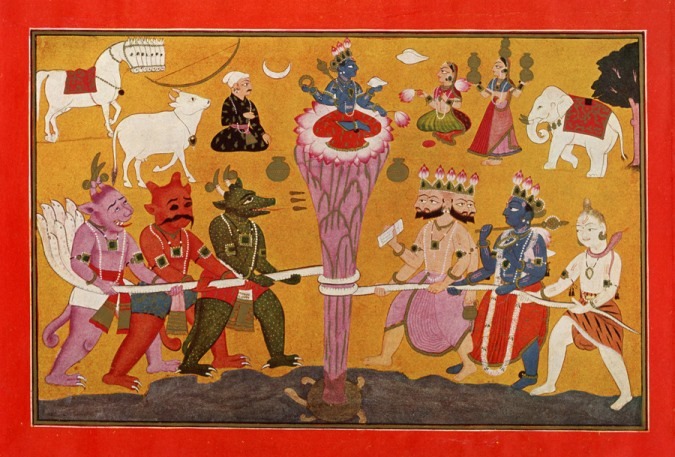
  • [Prelims Spotlight] Indian Paintings and Handicrafts

    Indian Paintings

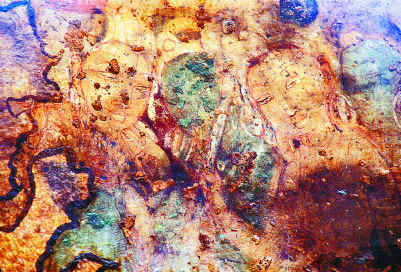
    Prehistoric Cave Paintings 

    • Painted rock shelters by prehistoric cave dwellers
    • Notable example →  Bhimbetka caves in the Kaimur Range, MP (biggest prehistoric art depositoryin India)


    Genres of Indian Painting 

    • Indian paintings can be broadly classified as murals and miniatures.
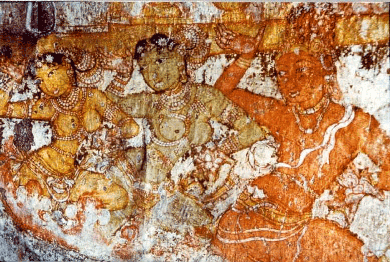
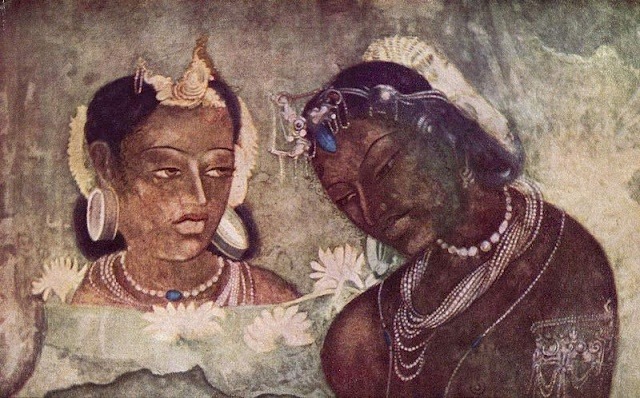
    • Murals are large works executed on the walls of solid structures directly, as in the Ajanta Caves & Kailash temple (Ellora)
    • Miniature paintings are executed on a very small scale for books or albums on perishable material such as paper and cloth.


    Mural Paintings

    • Mural is the only form of painting that is truly three-dimensional, since it modifies and partakes of a given space.
    • Mural paintings are applied on dry wall with the major use of egg, yolk, oil, etc.

    Mural Paintings

    • Notable examples → Ajanta Caves, Bagh Caves, Sittanavasal Caves, Armamalai Cave (Tamil Nadu), Kailasa temple (Ellora Caves)
    • Murals from this period depict mainly religious themes of Buddhist, Jain and Hindu

    Ajanta Murals Paintings 

    • Depict a large number of incidents from the life of the Buddha (Jataka Tales)
    • Exclusively Buddhist, excepting decorative patterns on the ceilings and the pillars.


    Ellora Murals Paintings 

    • Painted in rectangular panels with thick borders with following
    • Prominent features →  Sharp twist of the head + painted angular bents of the arms + sharp projected nose + long drawn open eyes + concave curve of the close limbs


    Badami Mural Paintings 

    • A cave site in Karnataka, patronized by chalukya king, Manglesha
    • Depictions in the caves show Vaishnava affiliation, Therefore, the cave is popularly known as Vishnu cave.

    Badami Mural Paintings

    Murals under the Pallava, Pandava and Cholas 

    • Paintings at the Kanchipuram temple were patronised by Pallava king, Rajsimha
    • Paintings at Tirumalaipuram caves & Jaina caves at Sittanvasal were patronised by Padayas
    • Paintings at Nartamalai & Brihadeswara temple were patronized by Cholas

    Murals under the Pallava, Pandava and Cholas

    Vijayanagara murals (13th century) 

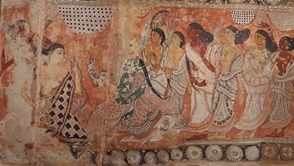
    • Paintings at Virupaksha temple (Hamphi) & Lepakshi temple (Andhra Pradesh) were patronised by Vijayanagara Kings

    Vijayanagara murals


    Miniature Paintings

    • The Palas of Bengal were the pioneers of miniature painting in India.
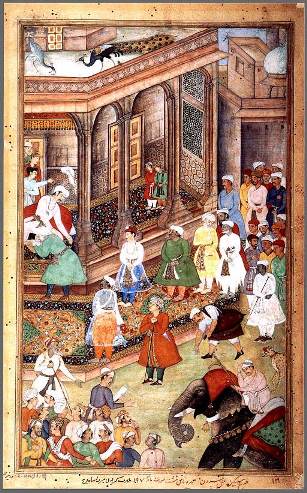
    • The art of miniature painting reached its glory during the Mughal period.

    The Pala School (11th – 12th century)

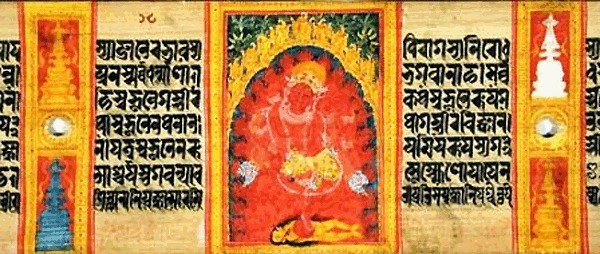
    • Exist in the form of illustrations to the religious texts on Buddhism executed under the Palas of the eastern India & the Jain texts executed in western India
    • The Buddhist monasteries of Nalanda, Odantapuri, Vikramsila & Somarupa were great centers of Buddhist learning and art.
    • A large number of manuscripts on palm-leaf relating to the Buddhist themes were written, illustrated with the images of Buddhist deities at these centers

    Pala School

    • The Pala painting is characterized by sinuous line and subdued tones of colour


    Western Indian School of Painting 

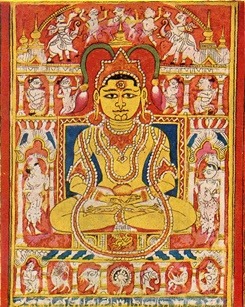
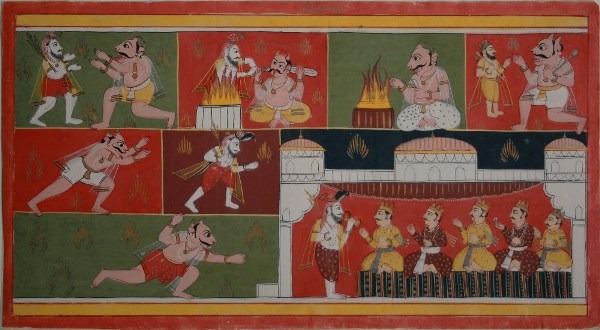
    • Also called Jaina Painting, largely devoted to the illustration of Jaina religious texts of the 12th–16th century
    • Notable sites → Gujrat, Uttar Pradesh, Central India & Orissa
    • Characterized by simple, bright colours, highly conventionalized figures, and wiry, angular drawing

    Western Indian School of Painting


    Mughal Paintings (16th – 19th century) 

    • Mainly confined to miniature illustrations on the books or as single works to be kept in an album
    • Mughal paintings were a unique blend of Indian, Persian (Safavi) and Islamic styles
    • Marked by supple naturalism →  Primarily aristocratic and secular
    • Tried to paint the classical ragas and Seasons or baramasa
    • Tuti-nama – first art work of the Mughal School.
    • Akbar’s reign (1556–1605) ushered a new era in Indian miniature painting.
    • At Zenith under Jahangir who himself was a famous painter
    • Jahangir encouraged artists to paint portraits and durbar scenes.
    • Shah Jahan (1627–1658) continued the patronage of painting.
    • Aurangzeb had no taste for fine arts.


    Mughal Paintings

    • Most significant are Hamza Nama, Razm-Nama or “The Book of War”, Akbar Nama
    • Finest example of this school includes Hamzanama series, started in 1567 & completed in 1582
    • Hamzanama →  Stories of Amir Hamza, illustrated by Mir Sayyid Ali
    • 1200 paintings on themes of Changeznama, Zafarnama Ramayana
    • The paintings of the Hamzanama are of large size, 20” x 27″ and were painted on cloth.
    • They are in the Persian safavi style with dominating colours being red, blue and green
    • Indian tones appear in later work, when Indian artists were employed 


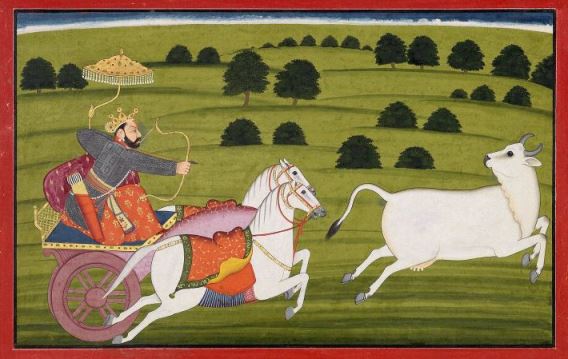
    Rajput Painting (16th – 19th century)

    • the art of the independent Hindu feudal states in India
    • Unlike Mughal paintings which were contemporary in style, Rajput paintings were traditional & romantic
    • Rajput painting is further divided into Rajasthani painting and Pahari painting (art of the Himalayan kingdoms)


    Central Indian and Rajasthani Schools (17th – 19th Century) 
    • Deeply rooted in the Indian traditions, taking inspiration from Indian epics, Puranas, love poems & Indian folk-lore
    • Mughal artists of inferior merit who were no longer required by the Mughal Emperors, migrated to Rajasthan


    Malwa paintings (17th century) 
    • Centred largely in Malwa and Bundelkhand (MP); sometimes referred as Central Indian painting due to its geographical distribution.

    Malwa paintings

    • This school’s most appealing features is its primitive charm & a simple childlike vision


    Kishangarh paintings (18th century) 
    • Distinguished by its individualistic facial type and its religious intensity
    • Developed under the patronage of Raja Savant Singh (1748-1757 AD) by master artist Nihal Chand

    Kishangarh paintings


    Mewar (Udaipur) Paintings (17th – 18th century) 
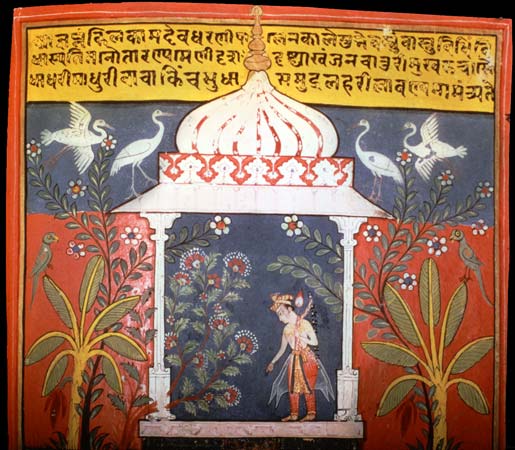
    • Characterized by bold bright contrasting colours and direct emotional appeal
    • The earliest-dated examples come from Ragmala (musical modes) series painted in 1605

    Mewar Paintings

    • Reflects portraiture & life of the ruler, along with religious themes
    Marwar (Jodhpur) Paintings 
    • Executed in a primitive and vigorous folk style
    • Completely uninfluenced by the Mughal style.
    • Portrays court scenes, series of Ragamala & Baramasa


    Bundi paintings (Late 17th century) 
    • Very close to the Mewar style, but the former excels the latter in quality
    • Prominent features → Rich and glowing colours, the rising sun in golden colour, crimson-red horizon, border in brilliant red colour (in Rasikpriya series)
    • Notable examples → Bhairavi Ragini (Allahabad Museum), illustrated manuscript of the Bhagawata Purana (Kota Museum) & a series of the Rasikapriya (National Museum, Delhi)


    Kota paintings (18th – 19th century) 
    • Very similar to Bundi style of paintings
    • Themes of tiger and bear hunt were popular
    • Most of the space in painting is occupied by the hilly jungle


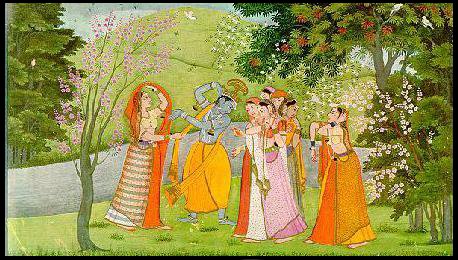
    The Pahari Schools (17th – 19th Century) 

    Comprises the present State of Himachal Pradesh, some adjoining areas of the Punjab, the area of Jammu, & Garhwal in Uttarakhand

    Basohli Paintings (17th – 18th century) 
    • known for its bold vitality of colour, lines & red borders
    • Emotional scenes from a text called “Rasamanjari” →  Krishna legend
    • Favoured oblong format, with the picture space usually delineated by architectural detail, which often breaks into the characteristic red borders
    • Stylized facial type, shown in profile, is dominated by the large, intense eyes

    Basohli Paintings


    Guler painting (Jammu) 
    • Mainly consisting of portraits of Raja Balwant Singh of Jasrota (Jammu) designed by Nainsukh
    • Colours used are soft and cool unlike Basohli school

    Guler painting

    • Style appears to have been inspired by the naturalistic style of the Mughal painting


    Kangra painting (Late 18th century) 
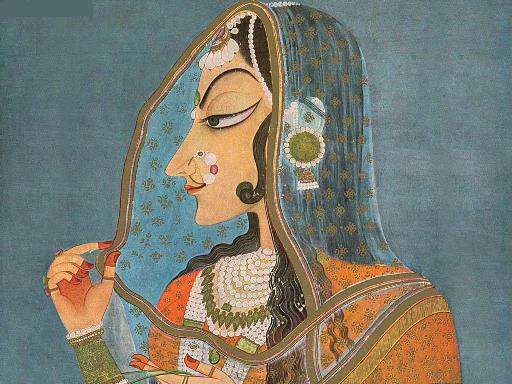
    • The Kangra style is developed out of the Guler style & possesses its main characteristics, like the delicacy of drawing & naturalism
    • The Kangra style continued to flourish at various places namely Kangra, GuIer, Basohli, Chamba, Jammu, Nurpur and Garhwal etc.
    • However, Named as Kangra style as they are identical in style to the portraits of Raja Sansar Chand of Kangra
    • In these paintings, the faces of women in profile have the nose almost in line with the forehead, the eyes are long & narrow, & chin is sharp.

    Kangra painting

    • There is, however, no modelling of figures and hair is treated as a flat mass.
    • Paintings of the Kangra style are attributed mainly to the Nainsukh family.


    Kullu – Mandi painting 
    • A folk style of painting in the Kulu-Mandi area, mainly inspired by the local tradition
    • The style is marked by bold drawing and the use of dark and dull colours


    Independent Paintings

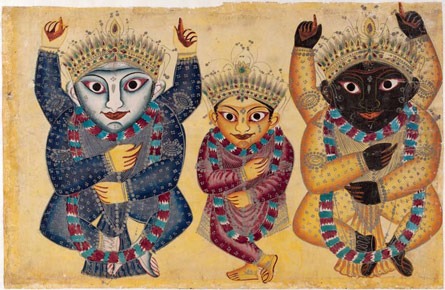
    Kalighat Paintings (Kolkata – 19th century)

    • Patua painters from rural Bengal came and settled in Kalighat to make images of gods and goddesses in the early 19th century
    • They evolved a quick method of painting on mill-made paper
    • Used brush and ink from the lampblack

    Kalighat Paintings


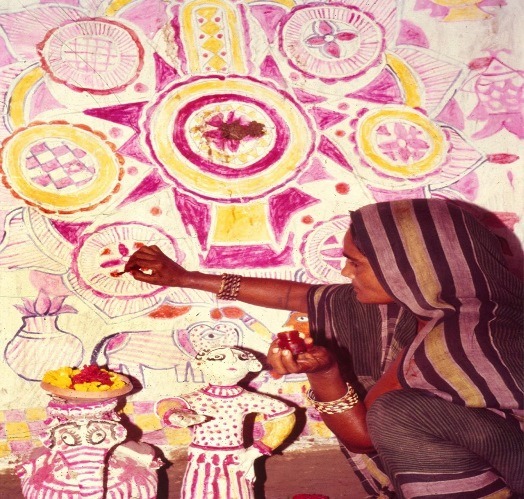
    Madhubani Paintings (Mithila – Bihar) 

    • Colorful auspicious images on the interior walls of homes on the occasion of rituals & festivity → painted by women
    • This ancient tradition, especially elaborated for marriages, continues today.
    • Used to paint the walls of room, known as KOHBAR GHAR in which the newly wedded couple meets for the first time
    • Very conceptual, first, the painter thinks & then “draws her thought”

    Madhubani Paintings


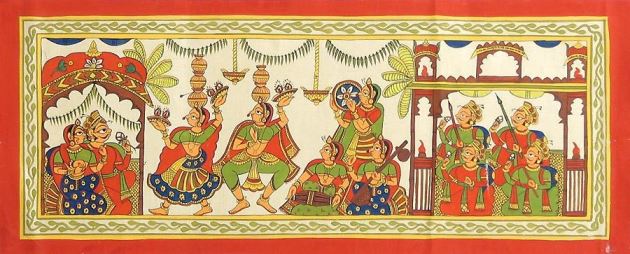
    Phad paintings (Bhilwada, Rajasthan) 

    • Phad is a painted scroll, which depicts stories of epic dimensions about local deities and legendary heroes.
    • Bhopas (local priests) carry these scrolls on their shoulders from village to village for a performance

    Phad paintings

    • Represents the moving shrine of the deity and is an object of worship
    • Most popular & largest Phad – local deities Devnarayanji and Pabuji


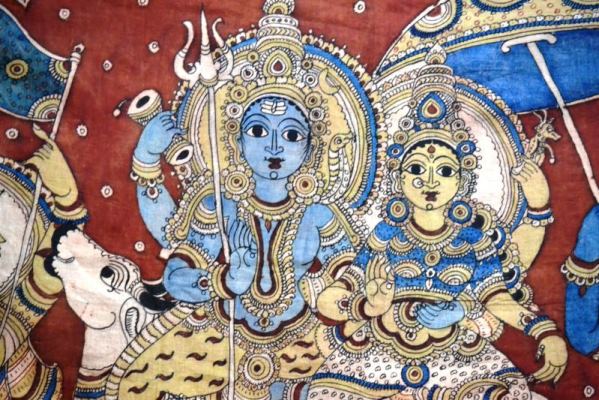
    Kalamkari Paintings (Andhra Pradesh) 

    • Literal meaning is painting done by kalam (pen) , Mainly in Andhra Pradesh (developed under Vijaynagar rulers)
    • Stories from the epics Ramayana, Mahabharata and the Puranas are painted as continuous narratives
    • Mainly to decorate temple interiors with painted cloth panels scene after scene; Every scene is surrounded by floral decorative patterns
      Kalamkari Paintings


    Warli painting

    • Practiced in tribal regions of Maharashtra with subjects, predominantly religious
    • decorative paintings on floors & walls of ‘gond’ and ‘kol’ tribes homes and places of worship
    • made in a geometric patterns like squares, triangles, and circles
    • Unlike other tribal art forms, Warli paintings do not employ religious iconography and is a more secular art form.

    Handicrafts

    Kashmir Embroidered shawls, carpets, namdar silk and walnut wood furniture
    Rajasthan precious stone and jems + tie & dye (Bandhani) fabric + minakari work
    Andhra Pradesh Bidri work and Pochampad saris
    Tamil Nadu bronze sculpture and Kajeevaram silk saris
    Mysore silk, sandalwood items
    Kerala ivory carvings and rosewood furniture
    Assam cane furniture
    Bengal Bankura terracotta modelling and handloom items
    Benaras Brocade & silk saris
    Madhya Pradesh Chanderi and kosa silk
    Lucknow chikan work  (Zardozi Embroidery – Muslims in Lucknow)
    Punjab Phulkari embroidery
    Bengal Kantha embroidery
    Orissa Patola embroidery
    Budhhists Thangka painting
  • [Prelims Spotlight] Isro Missions

    1.RISAT-2B: An all-seeing radar imaging satellite

    • he PSLV-C46 is set to launch RISAT-2B from Satish Dhawan Space Centre in Sriharikota.

    RISAT Constellation

    • RISAT-2B, short for “Radar Imaging Satellite-2B”, is the second in a series of satellites used to observe weather conditions on Earth using radar imagery.
    • RISAT-2 was the first satellite in the series, launched for the purpose of surveillance. RISAT-1 was launched later, to become India’s first all-weather radar imaging satellite.
    • RISAT-2B is to be followed by RISAT-2BR1, 2BR2, RISAT-1A, 1B, 2A and so on.
    • ISRO orbited its first two radar satellites in 2009 & 2012 and it plans to deploy four or five of them in 2019 alone.
    • A constellation of such space-based radars means a comprehensive vigil over the country.
    • Once operational, the satellite will be capable of monitoring weather day and night, in all weather conditions.

    2.Phase 4 of Geosynchronous Satellite Launch Vehicle (GSLV)

    • The Union Cabinet has approved ongoing GSLV continuation programme Phase-4 consisting of five GSLV flights during the period 2021-2024.
    • The will enable the launch of 2 tonne class of satellites for Geo-imaging, Navigation, Data Relay Communication and Space Sciences.
    • It will meet the demand for the launch of satellites at a frequency up to two launches per year, with maximal participation by the Indian industry.

    About GSLV

    • GSLV Continuation Programme was initially sanctioned in 2003, and two phases have been completed and the third phase is in progress and expected to be completed by Q4 of 2020-21.
    • GSLV has enabled independent access to space for 2 tonne class of satellites to Geosynchronous Transfer Orbit (GTO).
    • One of the significant outcomes of the GSLV Continuation Programme is the mastering of the highly complex cryogenic propulsion technology, which is an essential technological capability to launch communication satellites to GTO.
    • This has also paved the way for the development of a high thrust Cryogenic engine & stage for the next generation launch vehicle i.e. GSLV Mk-lll.
    • With the recent successful launch of GSLV-F11 on 19th December 2018, GSLV has successfully orbited 10 national satellites.
    • GSLV with the indigenous Cryogenic Upper Stage has established itself as a reliable launch vehicle for communication, navigation and meteorological satellites and also to undertake future interplanetary missions.

    3.Mission Shakti (Anti-Satellite Missile Test)

    • In an incremental advance, India has successfully conducted an Anti-Satellite (ASAT) missile test, named Mission Shakti.
    • India becomes the fourth country in the world to demonstrate the capability to shoot down satellites in orbit.
    • So far, only the United States, Russia and China have this prowess.

    Mission Shakti

    • While Mission Shakti may have targeted an object in outer space, India has long developed the ability to intercept incoming missiles.
    • In 2011, a modified Prithvi missile mimicked the trajectory of a ballistic missile with a 600-km range.
    • The DRDO-developed Ballistic Missile Defence (BMD) Interceptor Missile successfully engaged an Indian orbiting target satellite in Low Earth Orbit (LEO) in a ‘Hit to Kill’ mode.
    • The interceptor missile was a three-stage missile with two solid rocket boosters.

    4.Young Scientist Programme (YUVIKA)

    Young Scientist Programme

    • ISRO has launched a special programme for School Children called “Young Scientist Programme” “YUva VIgyani KAryakram from this year.
    • The Program is primarily aimed at imparting basic knowledge on Space Technology, Space Science and Space Applications to the younger ones with the intent of arousing their interest in the emerging areas of Space activities.
    • The residential training programme will be of around two weeks duration during summer holidays and it is proposed to select 3 students each from each State/ UTs to participate in this programme covering state, CBSE, and ICSE syllabus.
    • Those who have just finished 9th standard (in the academic year 2018-19) and waiting to join 10th standard (or those who have started 10th Std just now) will be eligible for the programme.
    • The selection will be based on the 8th Std marks.
    • Students belonging to the rural area have been given special weightage in the selection criteria.

    5.PSLV-C45/ Emisat Mission

    • For the sheer number of ‘firsts’ to its credit, the scheduled PSLV-C45/Emisat mission scheduled will be a memorable one for the ISRO.

    PSLV-C45/Emisat

    • C-45, which is set for lift-off from the second launchpad at Sriharikota, will mark the 47th flight of the PSLV.
    • It is meant for electromagnetic spectrum measurements, according to the ISRO.
    • It will be released into an orbit at 749 km.
    • EMISAT is primarily based on on the famous Israeli spy satellite called SARAL or (Satellite with ARgos and ALtika), and inherits its SSB-2 bus protocol for conducting sharp electronic surveillance across the length and breadth of India.
    • The satellite would serve as the country’s roving device for detecting and gathering electronic intelligence from enemy radars across the borders as it circles the globe roughly pole to pole every 90 minutes or so.
    • For the third successive PSLV mission, the ISRO plans to reuse the rocket’s spent fourth stage or PS4 to host short experiments.

    6.ISRO, French agency to set up maritime surveillance system

    • ISRO and its French counterpart CNES has sealed an agreement to set up a joint maritime surveillance system in the country.
    • The two nations will explore putting up a constellation of low-Earth orbiting satellites.

    Oceansat-3-Argos Mission

    • The system will be augmented with the launch of Oceansat-3-Argos mission in 2020 along with a joint infrared Earth-observation satellite.
    • These will identify and track movement of ships globally – and in particular those moving in the Indian Ocean region where France has its Reunion Islands.
    • Before that, they will initially share data from their present space systems and develop new algorithms to analyse them, according to the Paris based National Centre for Space Studies.
    • They work together for the design and development of joint products and techniques, including those involving Automatic Identification System (AIS), to monitor and protect the assets in land and sea.

    7. Use of Space Technology in Agriculture Sector

    • The Ministry of Agriculture and Farmers Welfare, has been pro-active in using the space technology in agricultural sector. Take a look of various initiative in the aid of farmers:

    Various institutional measures

    1. The Department of Agriculture, Cooperation and Farmers Welfare established a Centre, called Mahalanobis National Crop Forecast Centre, in 2012.
    2. It works for operationalization of the space technology developed in the Indian Space Research Organization, for crop production forecasting.
    3. The Soil and Land Use Survey of India uses satellite data for soil resources mapping.

    8.India’s communication satellite GSAT-31 launched successfully

    GSAT-31

    1. It was launched in an elliptical Geosynchronous Transfer Orbit with a perigee (nearest point to Earth) of 250 km and an apogee (farthest point to Earth) of 35,850 km, inclined at an angle of 3.0 degree to the equator.
    2. With a lift-off mass of 2536 kg, GSAT-31 will augment the Ku-band transponder capacity in Geostationary Orbit.
    3. The satellite will provide continuity to operational services on some of the in-orbit satellites.
    4. GSAT-31 will provide DTH Television Services, connectivity to VSATs for ATM, Stock-exchange, Digital Satellite News Gathering (DSNG) and e-governance applications.
    5. The satellite will also be used for bulk data transfer for a host of emerging telecommunication applications.
    6. It is the India’s 40th communication satellite which is configured on ISRO’s enhanced ‘I-2K Bus’, utilising the maximum “bus capabilities” of this type.

    9.ISRO launches Human Space Flight Centre in Bengaluru

    Human Space Flight Centre (HSFC)

    1. The HSFC, the hub of ISRO’s future manned missions, was inaugurated at ISRO headquarters in Bengaluru.
    2. Announced on August 15 2018, the country’s first crewed mission is set to happen by 2022, the 75th year of Independence.
    3. HSFC shall be responsible for the implementation of Gaganyaan project — which involves mission planning, development of engineering systems for crew survival in space, crew selection and training and also pursue activities for sustained human space flight missions.
    4. HSFC will take the support of ISRO centres to implement the first developmental [crewed] flight.

    10.ISRO’s first mission of 2019 to put military satellite Microsat-R in space

    • ISRO’s first mission of 2019 will put into space a 130-kg military imaging satellite, Microsat-R.
    • C-44 will be launched from the older First Launch Pad at the Satish Dhawan Space Centre, Sriharikota.

     Details of Launch

    1. The satellite would be placed within 15 minutes after take-off in a polar orbit 274 km away from Earth.
    2. This is much lower than any of its civil Earth observation spacecraft, which fly pole to pole over the globe at between 400 km and 700 km.

    Payload Details

    Microsat-R

    1. Microsat-R and its payload come assembled from a handful of laboratories of the Defence Research and Development Organisation (DRDO).
    2. It is meant for military use.
    3. The satellite was assembled outside and ISRO only interfaced it” with its own systems and the launch vehicle, just as it treats any customer satellite.

    11.Unispace Nanosatellite Assembly & Training Programme of ISRO

    NNATI Programme

    1. It is a capacity building programme on Nanosatellite development.
    2. It is an initiative by ISRO to commemorate the 50th anniversary of the first United Nations conference on the exploration and peaceful uses of outer space (UNISPACE-50).
    3. The programme provides opportunities to the participating developing countries to strengthen in assembling, integrating and testing of Nanosatellite.
    4. UNNATI programme is planned to be conducted for 3 years by U.R. Rao Satellite Centre of ISRO in 3 batches and will target to benefit officials of 45 countries.

    About UNISPACE+50

    1. It is an event marking the 50th year of the first UN Conference on the Exploration and Peaceful Uses of Outer Space.
    2. It is an initiative of United Nations Office for Outer Space Affairs (UNOOSA).
    3. Three such conferences held earlier recognized the potential of space and laid the guidelines for human activities and international cooperation related to outer space.

    11.ISRO successfully launches hyperspectral imaging satellite HysIS

    HysIS

    1. HysIS stands for Hyper Spectral Imaging Satellite.
    2. The objective of the probe is to provide observations within the visible, near infrared and shortwave infrared bands of the electromagnetic spectrum.
    3. The imaging tools will help the HysIS satellite monitor atmospheric activity and climate change, while also assisting studies of Earth’s magnetic field.
    4. These observations will have a host of applications, prime among which relate to agriculture, forestry, water management, and coastal patterns.
    5. The satellite’s payload also consists of a 730W power backup, and a 64Ah Li-ion battery.
    6. It will continue to make observations till 2023, when the mission ends.
    7. After this launch, the next big event for the Indian space organisation will be its awaited mission to the moon – Chandrayaan-2 – in early 2019.

    12.GROWTH-India telescope’s first science observation

    GROWTH-India Telescope

    1. The GROWTH-India telescope was commissioned six months ago soon after which it saw first light, on the night of June 12.
    2. It is part of a multi-country collaborative initiative – known as the Global Relay of Observatories Watching Transients Happen (GROWTH) – to observe transient events in the universe.
    3. The fully robotic telescope is designed to capture cosmic events occurring over relatively shorter periods of the cosmological timescale: years, days and even hours.
    4. Universities and research institutes from the US, the UK, Japan, India, Germany, Taiwan and Israel are part of the initiative.
    5. Their primary research objective is time-domain astronomy, which entails the study of explosive transients and variable sources (of light and other radiation) in the universe.

    13.ISRO telemedicine nodes for soldiers in high-altitude areas

    Telemedicine Nodes by ISRO

    1. In a major effort to improve emergency medical support to soldiers posted in high-altitude areas, especially Siachen, the Integrated Defence Staff of the Defence Ministry and the ISRO signed a MoU to set up telemedicine nodes in critical places across the country.
    2. ISRO will establish 53 more nodes in the first phase over and above the existing 20, in various establishments of the Army, Navy and Air Force across the country.

    14.Chandrayaan-1 data confirms presence of ice on Moon: NASA

    NASA’s Moon Mineralogy Mapper (M3) is testimony

    1. M3, aboard the Chandrayaan-1 spacecraft, launched in 2008 by the Indian Space Research Organisation (ISRO), was uniquely equipped to confirm the presence of solid ice on the Moon.
    2. Scientists used data from NASA’s Moon Mineralogy Mapper (M3) instrument to identify three specific signatures that definitively prove there is water ice at the surface of the Moon.
    3. It collected data that not only picked up the reflective properties we would expect from ice, but was also able to directly measure the distinctive way its molecules absorb infrared light, so it can differentiate between liquid water or vapour and solid ice.
    4. Most of the new-found water ice lies in the shadows of craters near the poles, where the warmest temperatures never reach above minus 156 degrees Celsius.
    5. Due to the very small tilt of the Moon’s rotation axis, sunlight never reaches these regions.

    15.ISRO set to launch its TV channel

    1. The ISRO is all set for a year-long Vikram Sarabhai centenary celebration starting in August 2019 to honour the visionary scientist and its legendary founding father.
    2. In a few months’ time, it plans to roll out a dedicated ISRO TV channel showcasing space applications, developments and science issues, targeting young viewers and people in remote areas in their language.

    Satellite launches now open to public

    1. As it strengthens its public outreach, ISRO will shortly start allowing the public to watch satellite launches from its Sriharikota launch centre.
    2. Selected students of classes 8 to 10 will be the trained at ISRO for a month and taken to various laboratories and centres across the country.

    Vikram Sarabhai- the legend

    1. Sarabhai, the architect of the Indian space programme, the first ISRO chief and renowned cosmic ray scientist, was born on August 12, 1919.
    2. ISRO’s tributes to Sarabhai start with naming the first Indian moon landing spacecraft of the Chandrayaan-2 mission ‘Vikram’.
    3. Sarabhai was only 28 when he sowed the seeds of a space agency around the late 1940s and 1950s.

    16.Upgraded Vikas engine will soon boost ISRO’s rockets

    Adding more thrust

    1. The Vikas engine will improve the payload capability of PSLV, GSLV and GSLV Mk-III launch vehicles.
    2. The space agency has improved the thrust of the Vikas engine that powers all of them.

    Main beneficiary: GSLV Mk III

    1. The main beneficiary of the high-thrust Vikas engine is said to be the heavy-lifting GSLV-Mark III launcher, which ISRO expects will now put 4,000-kg satellites to space.
    2. This would be the third Mk-III and the first working one to be designated Mk III Mission-1 or M1.
    3. The first MkIII of June 2017 started with a 3,200-kg satellite and the second one is being readied for lifting a 3,500-kg spacecraft.
    4. The Vikas engine is used in the second stage of the light lifting PSLV; the second stage and the four add-on stages of the medium-lift GSLV; and the twin-engine core liquid stage of Mk-III.

    17.ISRO’s PRL scientists discover an ‘EPIC’ planet

    India in elite planet-spotting club

    1. A team from the Physical Research Laboratory, Ahmedabad, has spotted for the first time a distant planet six times bigger than Earth and revolving around a Sun-like star about 600 light years away.
    2. EPIC 211945201b (or K2-236b) is the name given to the planet by the discovery team. The host star is named EPIC 211945201 or K2-236.
    3. With this discovery India has joined a handful of countries which have discovered planets around stars,” PRL’s parent ISRO has announced.
    4. The discovery was made using a PRL-designed spectrograph, PARAS, to measure and confirm the mass of the new planet.

    About EPIC

    1. EPIC was found circling very close to the Sun-like star, going around it once in about 19.5 days and unlikely to be inhabitable because of its high surface temperature of around 600°C.
    2. The team found the planet to be smaller in size than Saturn and bigger than Neptune.
    3. Its mass is about 27 times Earth’s and six times that of Earth at radius.
    4. The scientists estimate that over 60% of its mass could be made up of heavy elements like ice, silicates and iron.