This is an HRD Ministry initiative launched in 2014 with the two-fold aim to provide rural India with professional resource support from institutes of higher education in the field of STEM
And Building institutional capacity in Institutes of higher education in research & training relevant to the needs of rural India
This programme will be launched in collaboration with the Indian Institutes of Technology (IIT), Indian Institutes of Science Education & Research (IISERs) and the National Institutes of Technology (NITs) throughout the country
Each IIT/NIT/IISER will identify 10 villages in its neighborhood and work out technologies to solve the most pressing issues of the region
Various teams from these institutes will visit the villages, identify problems and then aim to find financially-viable schemes.
NFME outlines the strategies for eradication of the disease by 2030
It classifies districts or states/UTs depending upon their Annual Parasite Incidence (API) or malaria
endemicity into categories 0,1,2,3
API number gives the number of cases affected by malaria per 1000 population per annum
The milestones and targets are set for 2016, 2020, 2022, 2024, 2027 and 2030 by when the entire country has sustained zero indigenous cases and deaths due to malaria for 3 years and initiated the processes for certification of malaria elimination status to the country
The objectives of the NFME are to:
Eliminate malaria from all low (Category 1) and moderate (Category 2) endemic states/UTs (26) by 2022
Reduce the incidence of malaria to less than 1 case per 1000 population in all States/UTs and the districts and malaria elimination in 31 states/UTs by 2024
Interrupt indigenous transmission of malaria in all States/ UTs (Category 3) by 2027;
Prevent re-establishment of local transmission of malaria in areas where it has been eliminated and to maintain the malaria-free status of the country by 2030
The Press Freedom Index is an annual ranking of countries compiled and published by Reporters Without Borders based upon the organization’s own assessment of the countries’ press freedom records in the previous year
It intends to reflect the degree of freedom that journalists, news organizations, and netizens have in each country, and the efforts made by authorities to respect this freedom
A smaller score on the report corresponds to greater freedom of the press as reported by the organization
The index only deals with press freedom and does not measure the quality of journalism nor does it look at human rights violations in general
The report is partly based on a questionnaire which asks questions about pluralism, media independence, environment and self-censorship, legislative framework, transparency, and infrastructure
Violence against journalists, netizens, and media assistants, including abuses attributable to the state, armed militias, clandestine organizations or pressure groups, are monitored by RSF staff during the year and are also part of the final score
As a part of revision for Prelims 2018, Here’s a Factoid to brush up your concepts
Name : HySIS (Hyperspectral Imaging Satellite)
Details: Earth observation satellite, using a critical chip it has developed called “optical imaging detector array”
Economic planning has been a central belief of India’s development strategy since independence. Since the time of independence, India has successfully followed the path of planned development.
Understanding How Planning Worked: The Model
The Indian Situation at the time of Independence.
The Choices
The basic question’s that planners had to decide are:
The First question:
The Second Question:
The Third Question:
The Chosen Path by the Indian Planners: Mahalanobis Model
Centralised (Imperative) versus Capitalist Economic Planning
Indicative versus Imperative Economic Planning
The Rationale for Planning in India
The Feature of Indian Planning
The Key Objectives of Planning in India
The Achievements of Planning in India
India’s development strategy, commitments, and approaches towards growth and development, as reflected in the Plans, have undergone various shifts over the years in response to the objective conditions of the economy and challenges of the moment. Some of these changes have been strikingly bold and original, others more modest.
Criticism of Indian Planning: The Debate
Despite the achievement, however, in recent years Indian planning has come under attack from a number of quarters, both within and outside the country. Countries which for long had centrally-planned economies have abandoned planning, at least overtly. It sometimes comes as a surprise to people abroad that India continues to preserve planning as a central pillar of its development strategy despite having had a vibrant market economy for many years now.
The dissatisfaction with planning originates from two main directions.
The Counter Arguments
The Relevance of Planning in the 21st Century India
The Way Forward
All this is not to say, however, that the planning methodology should not change so as to reflect the new economic realities and the emerging requirements. It has, it must, and it will.
First of all, the – inter-sectoral balancing and indicative planning, at least in the sense of working out the optimal investment programme, which has been the centre-piece of Indian planning since the Second Plan, will continue to remain important in the foreseeable future.
Despite the much greater openness of the Indian economy, our very size and diversity will ensure that imports will continue to play a relatively small role in the economy, except in a very few products. Thus, the requirement of planning in estimating the sectoral investment needs will remain.
A more important conceptual issue relates to the nature of the planning problem itself. In a controlled or directed economy, it is only necessary to work out a feasible path from the initial condition to the target. However, in a largely market economy this is not sufficient. Although working out the traditional feasible path continues to be necessary, it needs to be complemented by an assessment of the path the economy is likely to take on a business-as-usual basis.
The planning problem then is how to move from the projected path to the desired. Thus, in addition to the standard planning model, there is need to have two other models: (a) a projection model; and (b) a model which adequately captures the effect of policy measures on key parameters.
By,
Himanshu Arora
Doctoral Scholar in Economics & Senior Research Fellow, CDS, Jawaharlal Nehru University
Heavy metals are generally defined as metals with relatively high densities, atomic weights, or atomic numbers. The criteria used, and whether metalloids are included, vary depending on the author and context
In metallurgy, for example, a heavy metal may be defined on the basis of density, whereas in physics the distinguishing criterion might be atomic number, while a chemist would likely be more concerned with chemical behaviour
More specific definitions have been published, but none of these have been widely accepted. The definitions surveyed in this article encompass up to 96 out of the 118 known chemical elements; only mercury, lead and bismuth meet all of them
Despite this lack of agreement, the term (plural or singular) is widely used in science
A density of more than 5 g/cm3 is sometimes quoted as a commonly used criterion and is used in the body of this article
System of Air Quality and Weather Forecasting and Research (SAFAR)
Ministry of Earth Sciences (MoES), Govt. of India, has introduced a major national initiative “SAFAR” for greater metropolitan cities of India to provide location-specific information on air quality in near real time and its forecast 1-3 days in advance for the first time in India
It was started under the plan scheme “Metropolitan Advisories for Cities for Sports, Tourism (Metropolitan Air Quality and Weather Services)
It has been combined with the early warning system on weather parameters
The SAFAR system is developed by Indian Institute of Tropical Meteorology, Pune, along with ESSO partner institutions namely India Meteorological Department (IMD) and National Centre for Medium Range Weather Forecasting (NCMRWF)
The implementation of SAFAR is done with an active collaboration with local municipal corporations and various local educational institutions and governmental agencies in that Metro city
As a part of revision for Prelims 2018, Here’s a Factoid to brush up your concepts
Name : Kavach (KVx) series laser walls
Defence Forces : Army
Module Type : Tech Misc.
Brief Intro : 1.The hi-tech Kavach (KVx) series laser walls immediately alert the nearest outpost about intrusion attempts and triggers action from a Quick Response Tool(QRT), which is IoT device, developed by CRON Systems, a Delhi-based defence IoT company. 2.CRON Systems has developed Kavach laser walls after working with our jawans on ground and thoroughly understanding their needs and challenges.It takes five KVx-series walls, connected with infra-red, to secure a kilometre-long stretch. Each wall is connected with a quick response tool (QRT), an IoT device, to help jawans respond to alerts.
Areas of Interest – North, South & East India (specifically Kalinga)
The five centuries that passed between the fall of the Mauryas and rise of the Guptas witnessed a lot of political instability and upheaval in the North of India. The South however remained fairly stable.
NORTH INDIA
I. Political Background
As the maps suggest, many kingdoms came up in North India. Despite being foreign rulers, they were assimilated in our culture and influenced it in many ways. The 3 most important among them were
1. Sunga Empire (185BCE–73 BCE) – East India
They succeeded the Mauryan Empire in Magadha. Pushyamitra Sunga was the first king of this dynasty.
2. Indo-Greek Kingdom (180BCE – 010AD) – North West India
The Greeks were the first foreign power in the sub-continent. After Alexander left, his generals stayed back. Hence the term Indo-Greek. They brought the Greek culture. Menander(165-145 BC) was the most important king in this time. In Pali Literature he is known as Milinda.
3. Indo-Scythian or Sakas (200 BC–400 AD) – West India
Sakas or Scythians where nomadic Central Asian tribes who destroyed the Indo-Greek rule in north-western India. They were pushed out from Central Asia and came to India. The Sakas were divided in five branches. Around 100AD, they give rise to Kushana Empire and Western Kshatrapas.
SL No.
Early
Later (100AD)
1
Afghanistan
Kushanas
(60AD–240 AD)
2
Punjab (Taxila)
3
Mathura
4
Maharashtra + Saurashtra
Western Kshatrapa (27 independent)
(35AD–405AD)
5
Central India (Ujjain)
Kanishka is the most celebrated king of Kushana empire. At its peak, his empire extended from Khotan in the northwest to Benaras in the east and Kashmir in north to Saurashtra and Malwa in the south. The capital of his empire was Purushapur i.e. modern Peshawar.
II. Literature
Many important works of literature happened in this era.
Work
Author
Theme
Patronage
Junagarh Rock inscription
Rudradaman I
from the Western Kshatrapa
He’s credited to have issued the 1st long inscription in chaste Sanskrit.
It mentions the repairs he undertook to improve the Sudershana Lake.
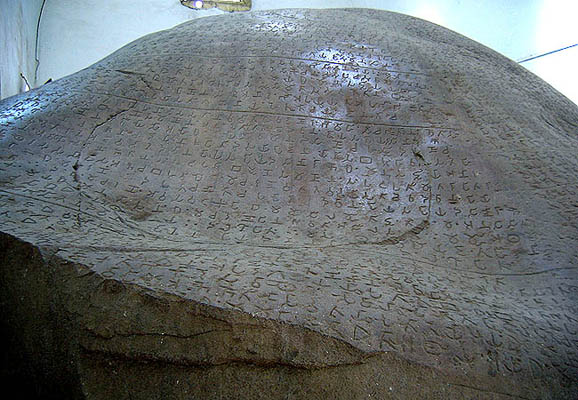
Junagarh Rock also contains inscriptions from Ashoka and Skandgupta (from the Gupta Period almost 800 years later).
Rudradaman I
Milindapanho
Nagasena
Menander asked Nagasena many questions related to philosophy and Buddhism, which together with Nagasena’s answers are recorded in Milindapanho or the Questions of Milinda.
Milinda
Saundarananda, Buddhacharita,
Vajrasuchi
Ashvaghosh
Buddhacharita is a complete lifecof Buddha written in the form of Mahakavya. It is the first Buddist book written in Sanskrit.
Kanishka
Charaka-Samhita
Charaka
Extends Ayurveda and lays down the concept of balance of 3 doshas called Vata, Pitta and Kapha.
Sushruta-Samhita
Sushruta(Father of Surgery)
He mentions more than 120 instruments
Junagarh Rock inscription.
III. Religion
1. Hinduism
Vaishnavism – There were 3 streams centered around worship of Vishnu or Bhagawat
Vishnu as a minor god in Vedic times. Was worshipped as the Sun and fertility cult.
Narayana was a non-vedic tribal god. He was also called bhagavat.
Vishnu came to be identified as the hero of the vrishni tribe known as Krishna-Vasudeva.
By 200BC all these 3 streams merged into one and led to the creation of Bhagvatism. By the end of late Gupta Period, it’s assimilated into Vaishnavism and was commonly referred by the latter.
2. Buddhism
Buddhism continued to receive royal patronage. Many kings of this era were Buddhists. Kanishka’s court was adorned by the presence of such scholars as Parsva, Vasumitra, Ashvaghosha, Charaka, and Nagarjuna.
A major development in Buddhism was it’s splitting up in to two sects –The Hinayana and the Mahayana. Kanishka organized the 4th Buddhist council where this split happened.
Hinayana
Mahayana
Also known as Lesser Vehicle
Greater Vehicle
Treat Buddha has a guide (Since Buddha never said he was God)
Treat Buddha as a God
Worshipped only in form of symbols that represent various stages in the life of Buddha
Worshipped in human form, Bodhisattvas.
Literature only in Pali
Sanskrit
This phase also witnessed the spreading of Mahayana Buddhism to south and south east Asia.
IV. Architecture
1. Stupas
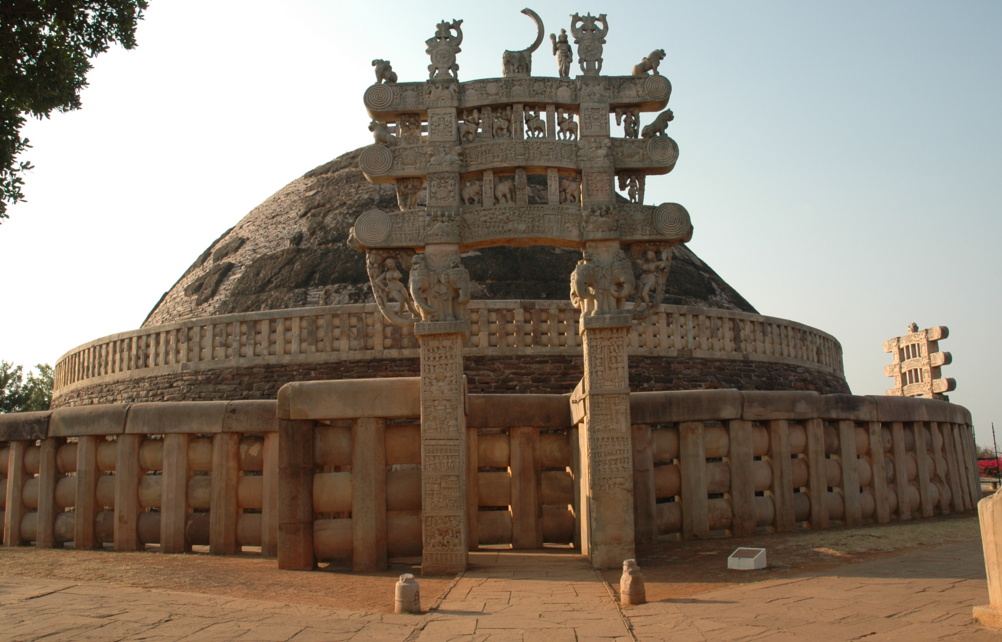
The Sungas were great patrons of art and architecture. They contributed to the expansion of Bharut and Sanchi Stupas.
Bharhut and Sanchi
Bharut
Sanchi
Time Period
100 BC is the accepted date for Bharut. Slightly earlier than Sanchi and Ajanta.
Said to have been started by Ashoka but much of its work has been done in the time of the Sungas.
100 BC.
Said to have been started by Ashoka but much of its work has been done in the time of the Sungas. The decorated gateways with lavish carvings were done by Satavahanas.
Location
Satna District of MP. Was on a major trade route from western coastal regions to Pataliputra.
A very large complex 13-14km from Vidisha, the capital of Mauryan Empire. Vidisha was a very important trading town. It was on the Dakshinapath – an offshoot of the Uttarapath, which connected Taxila to Pataliputra and further east.
Stupa
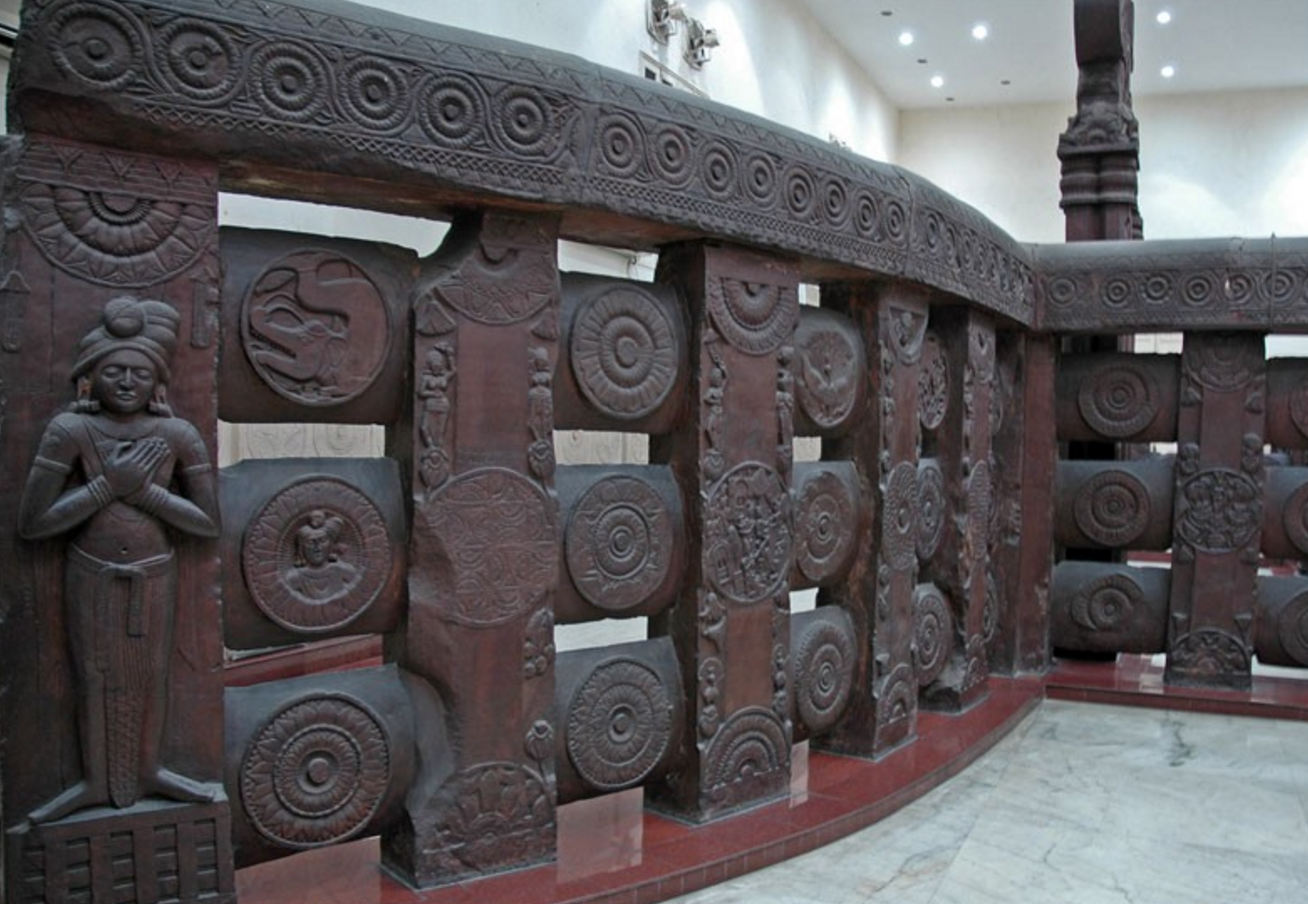
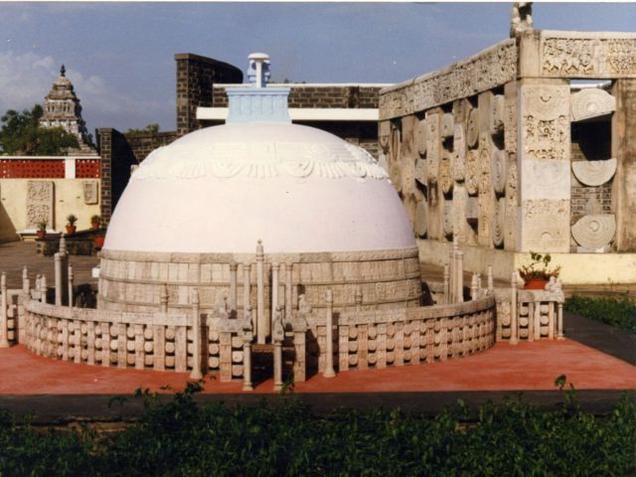
Has been reconstructed in Indian Museum Calcutta
There are 3 stupas
Stupa 1- The Great Stupa. Largest of them. It has 4 gates with Toranas.
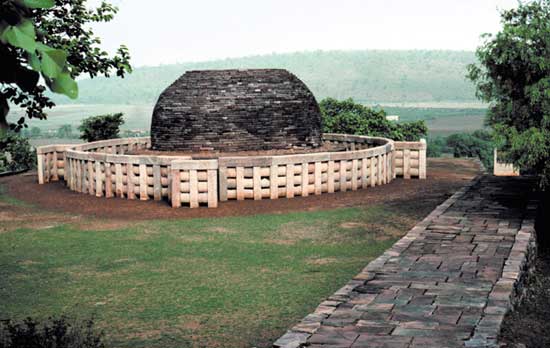
Stupa 2 – This is the earliest stupa. Same time as Bharut but simpler.
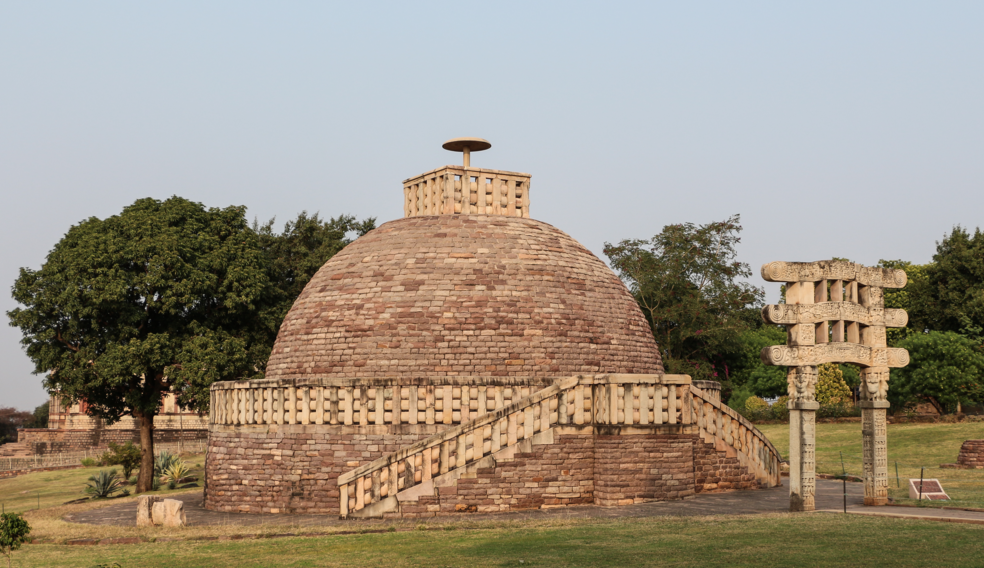
Stupa 3 –Has only 1 Torana.
Bharut : Themes Represented
Discovered by Cunninghum. Has been reconstructed in Indian Museum Calcutta. Stone Architecture. Surrounded by Vedika roughly 3 feet.
Only 1 Torana has been found but it is suspected that there would’ve been 4.
As evident, the Vedika and Torana have beautiful carvings. They are 5 elements –
1. Visual narratives about the life of Buddha
Buddha is represented in his iconic form – feet, bodhi tree, dharmachakra, empty seat and not the human form (symbolizing the Theravadin/ Hinayana Buddhism).
2. Jataka Kathas
Jatakas Stories like the Kaka Jataka(Monoscenic), Ruru Jataka
3. Yakshas and Yakshis
These gods of local cults start assimilating into Buddhism. It is believed that Yakshis were made through the contributions of women.
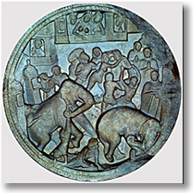
4. Medallions
There are also medallions like the one shown below. They represent the sun god, various bodhisattvas, etc.
Sanchi : Themes Represented
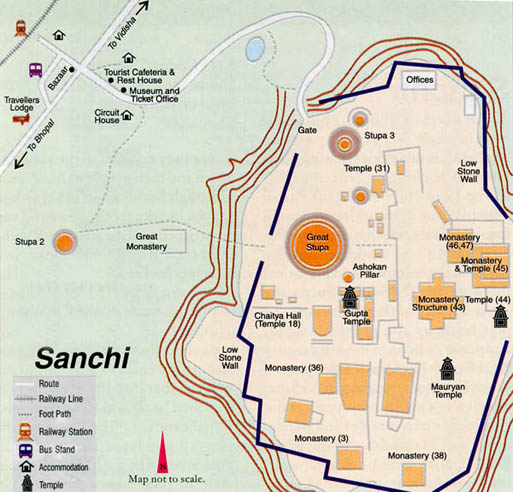
Sanchi Complex has 3 stupas. Follow the Map below.
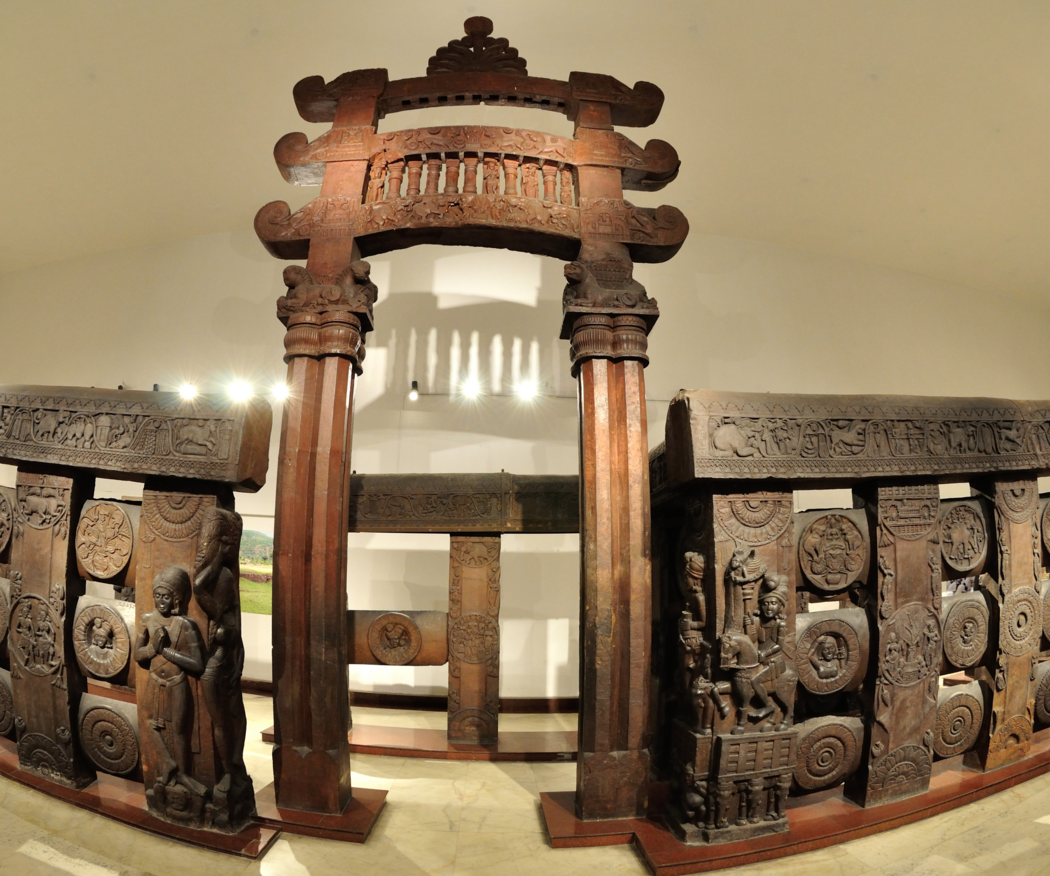
Stupa No. 1 is the largest and is called the Great Stupa. It has 4 gates with Toranas. In the pic, you see the Northern Gate.
There are extensive carvings on the Torana. The themes are similar to those of Bharut.
Stupa 2 – This is the earliest stupa. Same time as Bharut but simpler.
Stupa 3 –Has only 1 Torana.
2. Pillars
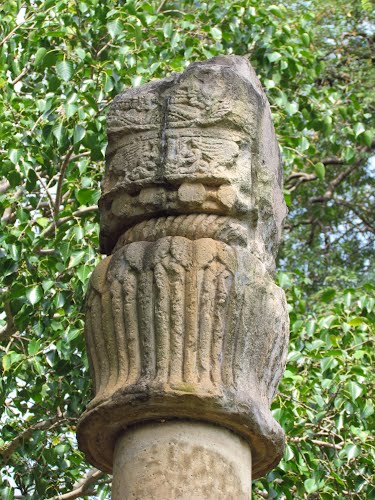
1. Heliodorus Pillar
Stone column erected by Heliodorus, Greek ambassador to the court of the Shunga king Bhagabhadra, around 150BC
In honor of Vasudeva.
V. Independent Art
A. Sunga Art
-Standing sculptures of Yakshas and Yakshis, discovered from Gwalior and Mathura
-Dwarfish Yaksha from the Pithalkhora caves in Central India
B. The Gandhara School and the Mathura School of Art
This period saw the emergence to two very important schools of art – one in Gandhara, North West Frontier Province and the other in Mathura.
The Gandhara Art received patronage from various dynasties – Indo-Greek, Indo Scythian and Kushan Kings. It was during Kanishka’s reign that both these centers flourished.
Gandhara
Mathura
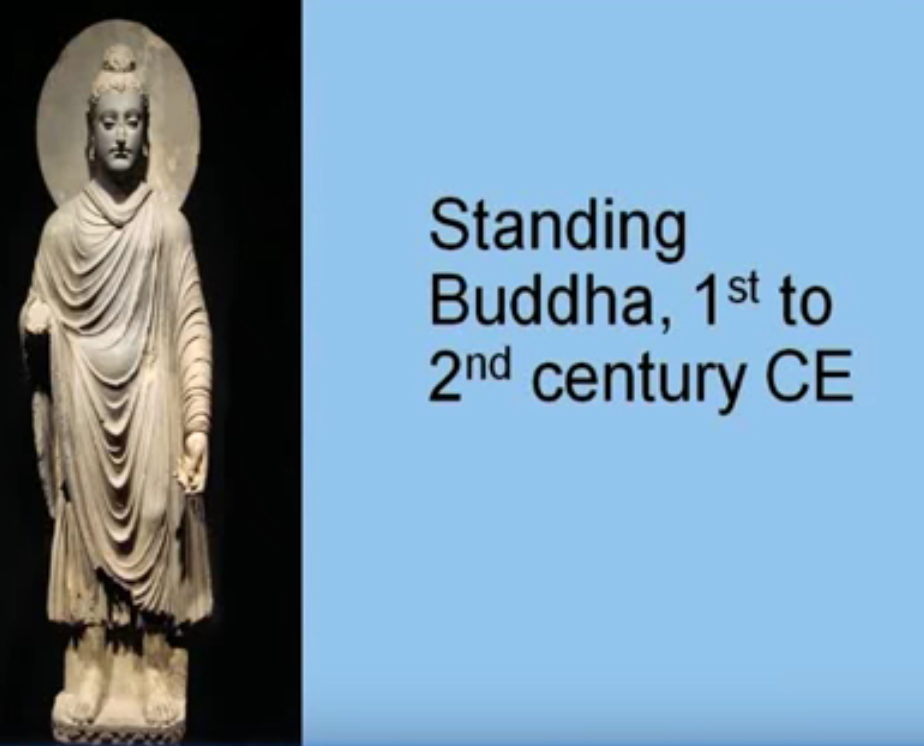
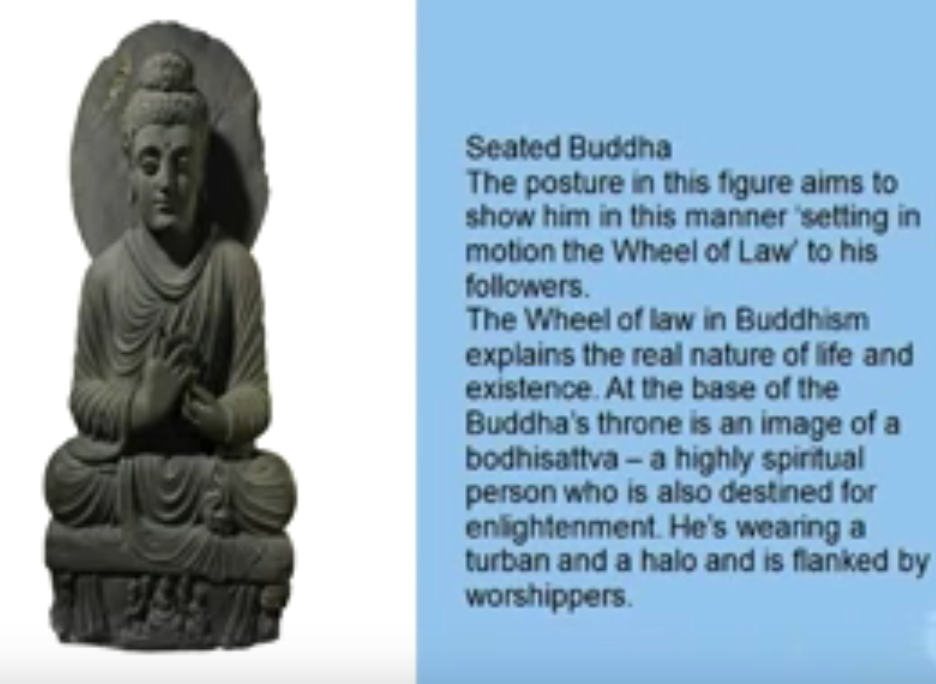
Strong Greek influence and was based on Greco-Roman norms encapsulating foreign techniques and an alien spirit. It is also known as Graeco-Buddhist School of art. Assimilating various traits of Acamenian, Parthian and Bactrian traditions into the local tradition is a hallmark of the Gandhara style.
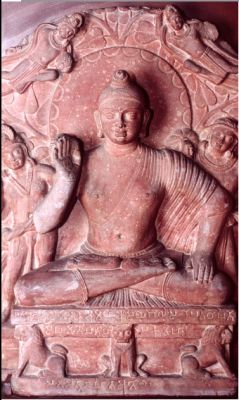
No foreign Influence, however, later it cross fertilized with the Gandhara School. Its development took place indigenously.Initially inspired by Yaksha Images
Blue-grey Mica / Grey Sandstone.
Spotted Red Sandstone
Rendering of drapery with sharp flowing folds similar to those shown in Roman togas.
Finer details and realistic images. Buddha carved out in various Mudras.
Wavy curled hair.
Early period: Light volume having fleshy body.
Later Period: Flashiness reduced. Not much attention to detailed sculpting.
Halo not decorated. Images are very expressive.
The halo around the head of Buddha was profusely decorated. Images less expressive.
Mainly Buddhism
All religions – Hinduism, Buddhism, Jainism
Gandhara School : Themes represented
Buddha is depicted standing frontally with one leg bent.
Greek Deities
Zeus Apollo, Athena indicating the Greeks wanted to preserve their culture.
Portraits of Kings
Other Sites
Mathura School – Themes represented
The Buddhist religion greatly flourished under the patronage of Kushan emperors, and several images of the Buddha and Bodhisattavas were produced after the earlier Yaksha types.
The first purely Indian Style art and sculptures were produced here. Mathura Art is famous for its iconographic traits – identification of particular deities based on the postures, attributes, vehicles.
Common Facial Features – Oval/ Roundish faces, open eyes, thick lips and sharp nose.
Fleshy full-body figures in a number of postures. Female figures are voluptuous, heavy round breasts, narrow waist. Male figures are shown with a slight V shape.
i. Buddhism
Buddha seen in Abhaymudra with one hand raised.
ii. Jainism
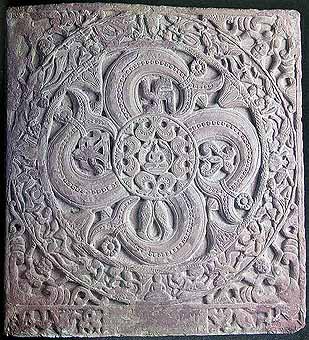
Mathura also becomes an important center of Jainism. A new kind of worshipping develops in this era – that of the Ayagapattas. The Jains produced votive tablets called ayagapattas that contain auspicious marks of worship such as fish couple or matsya yugala, the swatiska, etc.
Jain Ayagapattas with a Tirthankara at the middle.
iii. Shaivism
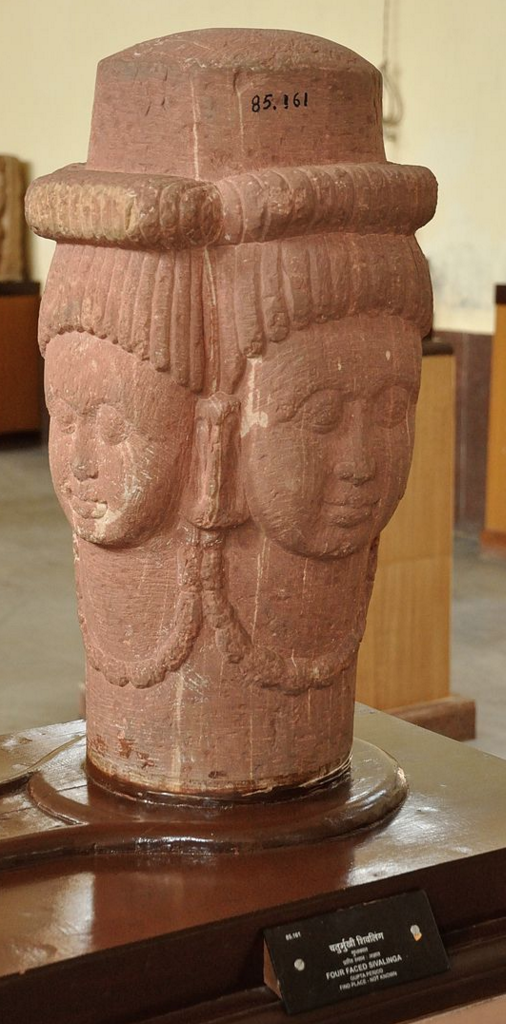
Various Shaiva images have been found from the region though their numbers are limited.
Chaturmukhalinga.
Karttikeya-Skanda
iv. Vaishnavism
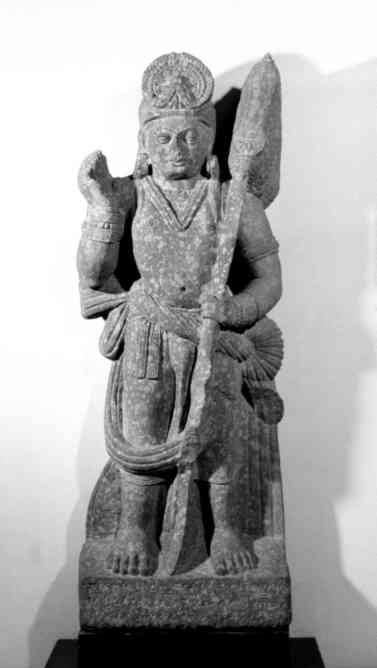
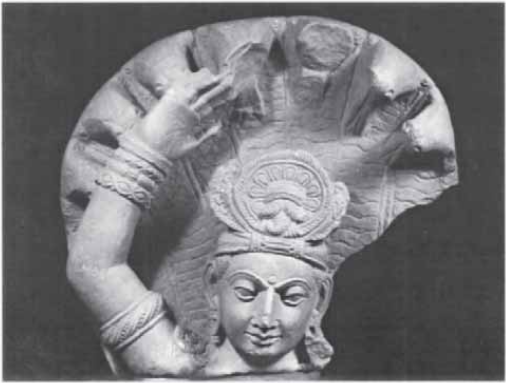
Balarama is shown with a snake canopy . Sometimes he carries a lion-staff plough.
v. Local Cults
Naga Cult is very prominent. A lot of Naga Temples have been found in/around this area.
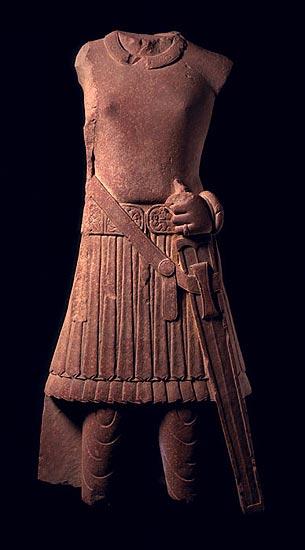
vi. Statue of Kanishka
Last but not the least, we have the statue of Kanishka.
SOUTH INDIA
I. Political Background
In the south, the Sangam Period starts (circa 300BC – 300AD). We see the emergence for 3 main kingdoms
1. Cholas – Kaveri Delta
2. Cheras – Kaveri Karoor
3. Pandya – Vagai, Madhurai
In the Deccan, the Satvahanas declare themselves as independent after the fall of the Mauryan Empire and emerge as a powerful force. Their kingdom is centered around Aurangabad.
Their 3rd king, Satakarni I seems to have performed two Ashvamedhayajna. His achievements are described in detail in the Nanaghat Inscription. Referred to as lord of Dakshinapatha.
The strongest Satvahana ruler – Gautamiputra Satakarni carried out expeditions against the Saka rulers and drove them out of Maharashtra. His achievements are recorded in Nasik inscription. By 225 AD, the Satvahanas are replaced by Ikshwaku (refer map).
II. Literature
A. Sangam Literature
South sees the emergence of Tamil Language. For the first time we come to know of life in South India using literature. Sangam means assembly of scholars. Each Sangam consisted of a number of distinguished poets and erudite scholars who selected the best ones from amongst the works submitted to them. Many female authors seem to have contributed.
The Sangam classics, consisting of 18 works (8 anthologies of lyrics and 10 long poems), are well known for their directness of expression. The eight anthologies called the Ettuttogai are considered to be the earliest work belonging to the BC 300. The 10 poems called Pattupattu. They are divided in to
1) Aham deals purely with the subjective emotions of the lover.
2) Puram deals with objective emotions, mainly the valour and glory of kings, good and evil.
Some important works Sangam works are as follows –
Serves as a manual of precepts to guide one to noble living
Agattiyam
Agathiyar
The first known book on Tamil grammar, believed to be lost beyond redemption.
Tolkāppiyam
Tolkappiyar
Work on the grammar of the Tamil language and the earliest extant work of Tamil Literature and Linguistics. It talks of Thinai(explained below)
Thinai : Another fascinating aspect of Sangam literature is its reference to 5 landscapes(eco-zones) and people associated with them known as Thinai.
Ecozone as mentioned in Sangam Literature
Refers to
Associated human settlement
Marudam
Agricultural lands, Plains
Peasants, farmers
Mullai
Forest
Pastoral people
Palai
Desert Lands
Bandits, Travellers
Kurunji
Mountains/Hilly Areas
Hill tribes
Neydhal
Coastal Areas
Fishermen
B. Tamil Epics outside the Sangam Literature
We have 5 great epics.
No
Name
Author
Notes
1
Silappatikāram
Ilango Adigal
Love story between Kovalan who prefers the courtesan Madhavi of Kaveripattinam over his wife Kannagi.
2
Manimekalai
Cattan
Story of the daughter, Manimekalai, born out of love of Kovalan and Madhavi. There is also an elaborate exposition of the doctrines of Buddhism.
3
Cīvaka Cintāmaṇi
Adopted from Sanskrit Mahapurana, is predominantly sensuous, though Jain philosophy is brought to practical aspects of life
4
Valayapathi
5
Kundalakēci
III. Religion
We see no specific adherence to religion. The Sangam texts were secular in nature(one main reason how they differed from the Vedas)
IV. Architecture
A. Stupas
1. The Amaravati Stupa
Covered with locally available white limestone.
5 pillars at each gateway. These 5 pillars represent the 5 milestones of the life of Buddha (discussed earlier)
Use this tool to explore further – http://www.ancientindia.co.uk/buddha/explore/intro.html.
2. Nagarjunakonda Stupa
Built by the successor of Satvahanas, the Ikshwakus. They continuted the great art traditions of Satvahanas.
B. Rock-cut caves
1. Karle caves & Bhaja caves
Both caves belong to Hinayana Buddhism.
Karla Cave is the largest Hinayana Buddhist Chaitya in India built during Satavahana’s rule. Karla is the best example of rock-cut architecture, which is believed to carve out from a living rock. Some of its 2000 year-old wooden beams are still alive.
Bhaja caves are also mainly Viharas and Chaityas.
Noteworthy are the Dampati and the Mithuna figures as also the pairs riding the magnificent elephant crowning the pillars forming imposing colonnades.
The figures are more than life size and are represented with powerful and muscular physique.
2. Ajanta caves
The earliest group of caves consists of caves 9, 10, 12, 13 and 15A. They were made during the period 100 BCE to 100 CE, probably under the patronage of the Satavahanas who ruled the region.
Check out our Case Study on Ajanta and Ellora to explore more.
V. Independent Art
A. The Amaravati School of Art
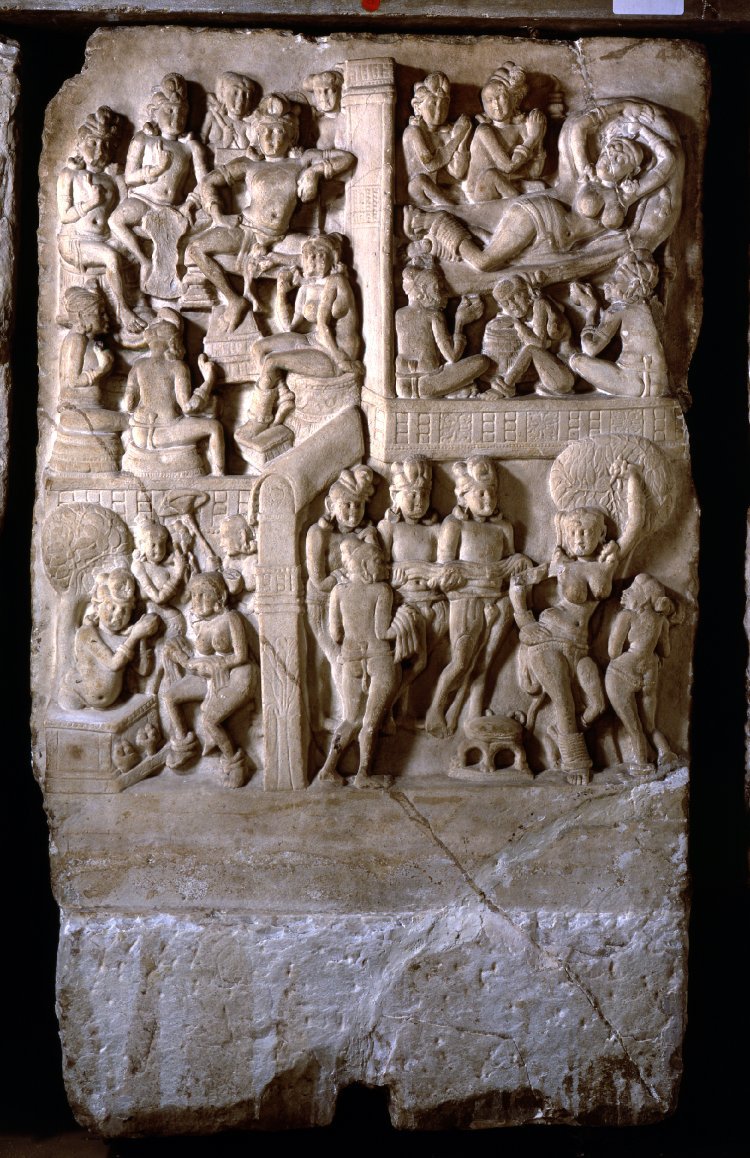
Sculptural form in this area is characterised by intense emotions.
Figures are slender, have a lot of movement, bodies are shown with three bents (i.e. tribhanga), and the sculptural composition is more complex than at Sanchi.
White Marble was used in this art and the themes were Buddha’s life and Jatakas tales. The curly hairs of Buddha is a feature that is influenced by the Greeks.
In this school, the Kings, Princes, Palaces etc. have got prominence.
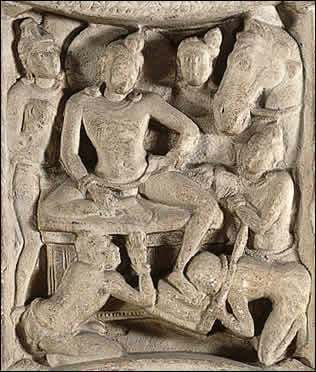
A relief medallion from Amravati belonging to the 2 century A.D. is a masterly representation of a scene showing the subjugation or taming of Nalagiri, a mad elephant let loose on the Buddha.
Carving on outer wall of Amaravati Stupa
A famous carving depicts the adoration of the feet of the Buddha by four women and belongs to the 2nd century A.D. from Amravati.
Three-dimensional space in the relief sculpture is devised by using pronounced volume, angular bodies and complex overlapping.
The E-way bill, short form for electronic way bill, is a document to be generated online under the GST system, when goods of the value of more than ₹50,000 are shipped inter-State or intra-State
The E-way bill must be raised before the goods are shipped and should include details of the goods, their consignor, recipient and transporter
As a part of revision for Prelims 2018, Here’s a Factoid to brush up your concepts
Name: Economic and Social Council (ECOSOC)
Recently in News because : India Has Been Re-Elected To The UN’s Principal Organ, the Economic and Social Council (ECOSOC) for Another Three-Year Term
Objective : ECOSOC is the United Nations’ central platform for reflection, debate, and innovative thinking on sustainable development
Members : The Council’s 54 member Governments are elected by the General Assembly for overlapping three-year terms. Seats on the Council are allotted based on geographical representation with fourteen allocated to African States, eleven to Asian States, six to Eastern European States, ten to Latin American and Caribbean States, and thirteen to Western European and other States
Headquarters : New York
Year Founded : ECOSOC is one of the six main organs of the United Nations established by the UN Charter in 1945
10635Areas of Interest : North India, Central India and South India
Unlike the previous period, this period saw was marked by political stability that ensured and encouraged cultural florescence. The Guptas and Vakatakas were the major powers in the north and central india respectively.
South however witnessed a transitionary period called the Kalabhra Interregnum.
This transitionary period was known as the ‘Dark Ages’ and lasted for 300 years. Not much is known about this time.
More can be read here – http://www.gloriousindia.com/history/kalabhra_interregnum.html
NORTH INDIA
1. Political Background
Gupta Empire extended for close to 300 years – almost twice the duration of Mauryan Empire and 1.5 times the British Empire.
The maps above illustrate how they unified the whole of Northern India by around 480 AD. The Gupta Empire saw many great rulers who patronized art, architecture and science. No wonder it has been referred to as the Golden Age. (this however remains contested as the society in the times of Gupta period showed signs of degeneration).
Finally the Guptas lost out to the Hunas.
II. Literature and Language
A. Sanskrit
Sanskrit was the court language of the Guptas. Needless to say, Classic Sanskrit literature saw tremendous development under their patronage.
Two great epics(Mahakayva), the Ramayana and the Mahabharata were compiled around 4AD. Their importance is as follows
They served as a precursor to various other Sanskrit literature
They are the origins of many of the stories and anecdotes of the social, religious and cultural history of India.
They were translated into various languages that gave them a renewed relevance and meaningful reincarnation.
These epics in-turn shaped new languages providing them with substance and style.
Puranas follow on the lines of epics. Some of the earlier Puranas were compiled in this era. There are 18 Mahapuranas and 19 Upa-puranas.
The Puranas were associated with revivalism of Hinduism. They were in the form of stories which made them more palatable to masses than the earlier bramanical text – the Vedas.
Besides the epics, this period also saw the development of kavya (poetry), nataka (drama) and other literature.
Two things can be noted about plays
They do not come across tragedies.
Characters of high social status speak Sanskrit: whereas those of lower status and women speak Prakrit. This particular feature throws light on the status of Sanskrit and Prakrit in society.
The table below summarizes the important works of this time.
Work
Author
Type
Theme
Patronage
Allahabad Prasasti
Harisena
An inscription. The Allahabad Pillar also has inscriptions by Ashoka and Mughal Emperor Jahangir
Eulogy on the conquests of Samudragupta. Inscribed on the Allahabad Pillar
Samudragupta
Kumarasambhava
Kalidas
Mahakavya(epic poem)
An epic poem depicting birth of Kartikeya, son of shiva and Parvati
Raghuvamsa
Geneology of Lord Rama. The Ikshvakus are also known as Raghuvanshis hence the name.
Malavikagnimitra
Play
Story of love between Agnimitra, the Sunga Prince and the hand-maiden of his chief queen, Mālavikā. Also gives an account of his father Pushyamitra Sunga’s Rajasuya Yagna.
Vikramorvasiya
It’s a Sanskrit drama depicting the love story of Puruvas, a Vedic King and Urvashi. Puruvas is chosen to reflect the qualities of Chandragupt Vikramaditya.
Abhigyana Shakuntala
A sanskrit play which depicts the story of Dushyanta, king of Hastinapur, and Shakuntala, daughter of the sage Vishwamitra and the apsara Menaka.
Ritusamhara
Lyrical Poetry
A mini epic poem on six seasons (Ritu). Considered to be the earliest work of Kalidasa.
Chandragupta II
Meghaduta
Lyrical Poetry
Cloud is a messenger. An exiled yaksha who is pining for his beloved on a lonely mountain peak. When, at the beginning of a monsoon, a cloud perches on the peak, he asks it to deliver a message to his love in the Himalayan city of Alaka.
Chandragupta II
Mricchakatika
Sudraka
Plays
Mrichhakatika means a “little clay cart’. Traces the love story of Charudatta with Vasantsena. There is a hindi movie on the same work starring Rekha and Shekhar Suman.
Vinavasavadatta
Padmaprabhritaka
Bhana (short one-act monologue)
Mudrārākṣasa
Vishakhadatta
Mudrarakshasha means “Ring of the Demon”. It narrates the ascent of Chandragupta Maurya to throne.
Swapnavasavadatta
Bhasa
Vatya King Udayan and his queen Vasavadatta.
Vakyapadiya
Bhartṛhari
Grammar
A treatise on Sanskrit Grammar
Amarakosha
Amarasimha
Grammar
Sanskrit Grammar
Chandragupta II
Aryabhatiyam
Aryabhatta
Maths
Also mentions Suryasiddhanta. Aryabhatta is credited with the discovery of algebra. He formulated the area of triangle which led to the origin of Trigonometry. He *did not* invent zero.
Panchasiddhanta
Varahamihira
Astrology
Gives a summary of 5 schools of astrology – Surya Siddhanta, Romaka Siddhanta, Paulisa Siddhanta, Vasishtha Siddhanta and Paitamaha Siddhanta. Also discusses concepts of Trigonometry.
Brihatsamhita
Varahamihira
Astrology
Note4Students – This information is high priority for prelims. Try to get the correct pronunciation of the texts. Follow the theme to remember their names.
III. Religion
A. Hinduism
Vaishnavism – Bhagavatism had being gaining
Emergence of Pauranic Hinduism
The brahmanical tradition witnessed a decisive change from what was traditionally practised as “Vedic tradition”. Vedic Brahmanism gave way to Pauranic Hinduism. Sacrifices/ Rituals were not entitrely abandoned but they lost their steam.
Where Vedic Brahmanism was intimately linked with lavish sacrifices and upper varna-jatis, the Pauranic Hinduism became widely popular as it was open to all varna-jatis including Shudras, women etc and encouraged the worship of a personal deity.
Its accesibility lay in performing acts that required little investments – the giving of gifts, keeping of fasts and vows, travelling collectively to places of pilgrimages and subscribing to local mythologies.
B. Buddhism
Buddhism no longer received royal patronage unlike the earlier times. Samudragupta’s permission to the King of Ceylon to erect a magnificent monastery in Bodh-Gaya indicates that Buddhism was given a good patronage.
Nalanda prospered under their patronage.
Post 500AD it saw a new phase in Buddhism marked by the following developments
1. Homogenization with Hinduism: Hindus practiced devotion to Buddha as a reincarnation of Lord Vishnu. In a way, Hinduism went on to assimilate Buddhism as a part/ branch of its own.
2. Humble beginnings of what later comes to be known as tantric Buddhism. The new form of text associated with this tradition, the tantras, appeared during the Gupta period, and there are indications that distinctively Tantric rituals began to be employed at this time as well. Tara is a female Bodhisattva in Mahayana Buddhism who appears as a female Buddha in Vajrayana Buddhism. She is known as the “mother of liberation”, and represents the virtues of success in work and achievements.
This will later develop into full fledged Vajrayana cult and reach its peak during the Pala Empire.
C. Jainism
Jainism spread into Gujarat. At Valabhi, took place the compilation of two Jain canonical texts in two councils in 4th and 5th century.
D. Shaktism and Tantrism
Shaktism and Tantrism are closely associated cults. They started as different streams. Shaktism revolves around placing the women at the center. Later this cult starts to be associated with Shaivism, where Shakti is seen as Shivas consort.
The name Tantrism is derived from sacred texts called tantras. The earliest works were written in the Gupta period. In course of time, tantrism manages to penetrate all religion.
IV. Architecture
A. Stupas
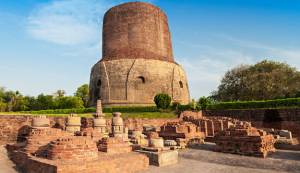
1. Dhamekh Stupa
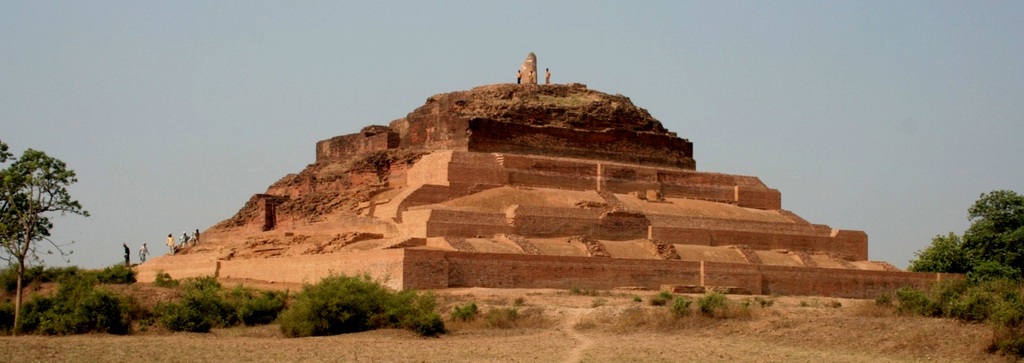
This is the only known example of stupa developed during Gupta era. Originally built in 249 BCE during the reign of king Ashoka of the Maurya Dynasty, this massive and prominent structure has over time gone through several expansions and additions. This solid cylindrical shaped Stupa made of red bricks and stone.
B. Caves
The earliest examples of religious architecture were cave-temples which typically had exteriors decorated with relief sculpture and a single carved doorway.
Inside the shrine, ritual sculptures were placed such as a Shiva linga and the walls were richly decorated with more carvings showing scenes from mythology.
1. Udayagiri Caves
Note4Students – There are a number of places in India with the same name, the most notable being the mountain called Udayagiri at Rajgir in Bihar and the Udayagiri and Khandagiri caves in Orissa. The caves in Orissa correspond to the Jainism.
The Udayagiri caves belonging to the Gupta period are located in Vidisha, Madhya Pradesh.
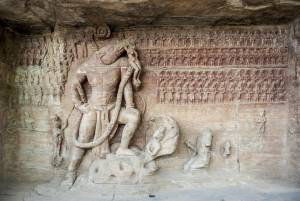
There are about 14 caves but you need to focus on only 1 of them: Cave #5 – Dedicated to the Varaha avatar of Vishnu.
This shrine is one of the finest examples of Gupta art, the celebrated relief showing Vishnu in his incarnation as the boar-headed Varaha. Varaha avatar rescued the Earth from the chaos of the cosmic sea.
The scholars say that when Chandragupta II (Vikramaditya) renovated the cave in this manner, he wanted to portray the rescue of Northern India from the political instability and fragmentation that it had experienced prior to the rise of the Gupta Empire.
2. Junagarh Caves
The so-called “Buddhist Caves” are not actually caves, but three separate sites of rooms carved out of stone to be used as monks’ quarters.
Unique feature = Presence of a 30-50 ft high citadel like feature – Upar Kot in front of the prayer hall
3. Bagh Caves:
Located on the bank of Baghani river in the Dhar district of Madhya Pradesh. These rock cut caves posses the most amazing paintings known to be made by ancient man. According to legend these caves were established by Buddhist monk Dataka. Out of the initial 9 caves only 5 have been extant.
Bagh Caves are known for Mural Paintings – thick mud plaster in brownish orange color. The most famous features of Bagh Caves are these murals made in tempera technique.
Over this plaster there was done lime-priming and then paintings were laid. This is also known as tempera technique, which refers to use of permanent fast-drying painting medium consisting of colored pigment mixed with a water-soluble binder media.
A group of 23 caves, also called as ‘Pandav-Leni’.
These caves belong to the Hinayana Buddhism (have no images of Buddhas)
Contrary to what their name suggests they have nothing to do with the characters of Mahabharata (the Pandavas).
C. Temples
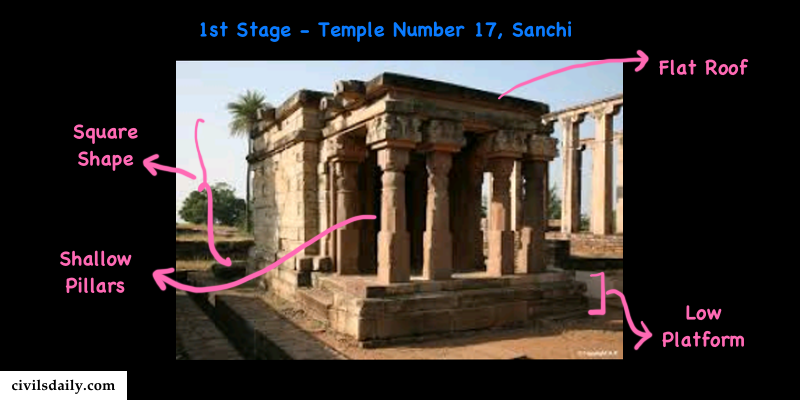
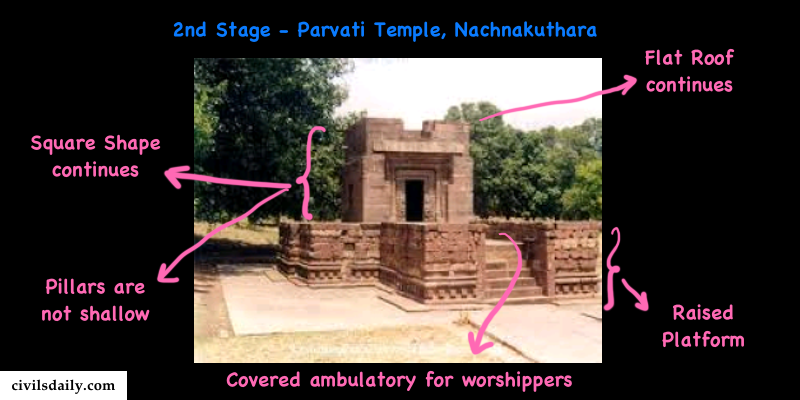
Not satisfied with caves, the Guptas were the first dynasty to build permanent free-standing Hindu temples. This lay the foundation of Nagara School of art. Temple architecture with the development of a square sanctum and pillared portico emerged during the Gupta period.
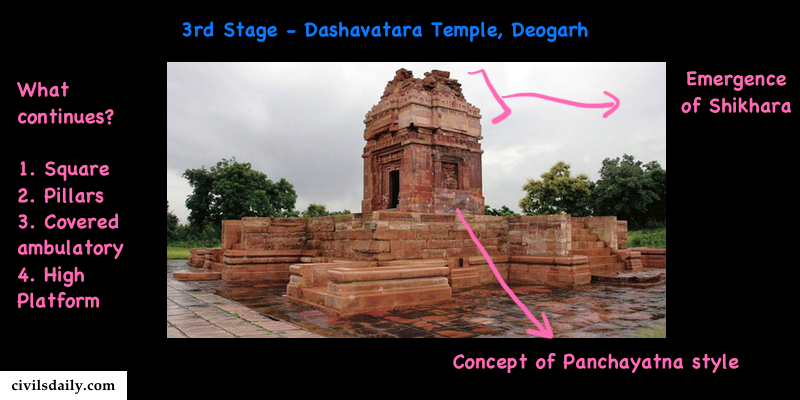
Among the 5 stages of temple development you will find a gradual progression from flat-roofed, monolithic temples in initial stage to the sculptured ‘shikhara’ in the later years.
Most of the features of 2nd stage are carried forward
Flat roof evolved to a curviliniear roof (shikhara)
Introduction of Panchayatan style of temple making
A hindu temple is a Panchayatana one when the main shrine is built on a rectangular plinth with by 4 subsidiary shrines at 4 corners making it a total of 5 shrines. The origin of the name are the sanskrit words Pancha (5) et ayatana (containing).
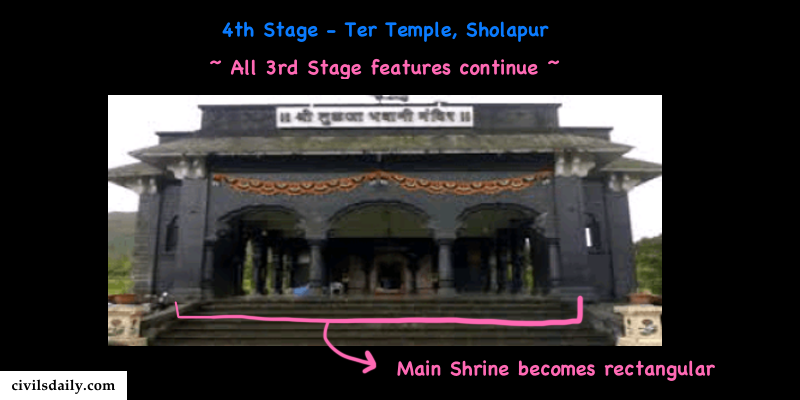
Stage #4 – Ter Temple, Sholapur
Most of the features of 3rd stage are carried forward
Noticable change from square to rectangular shape of the main shrine
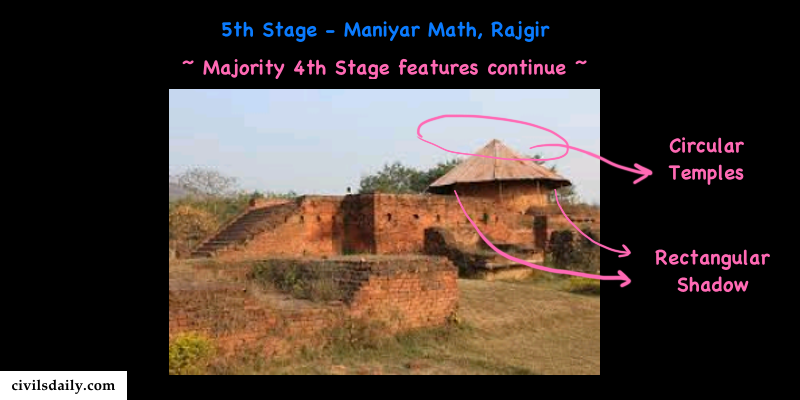
Stage #5
Most of the features of 3rd stage are carried forward
Introduction of circular temples with shallow rectangular projections
Stage 3 Temples in detail –
1. Dasavatara temple, Deogarh, Uttar Pradesh
Dasavatara = Das (10) + Avatara (Incarnation). The temple depicts the 10 avataras of Vishnu.
First North Indian temple with a shikhara.
Earliest known Panchayatana temple in North India.
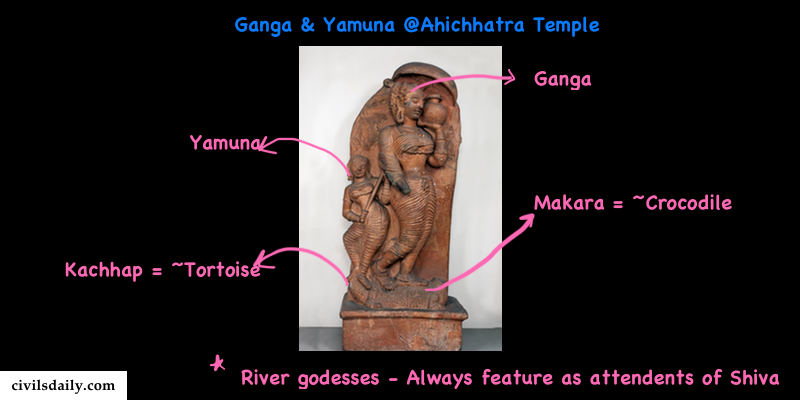
Two river goddesses, the Ganga and Yamuna, are mentioned as attendants of Shiva and this occurs as a regular feature of temple architecture from the doorways of the Dasavatara temple.
There are 3 main reliefs of Vishnu on the temple walls:
On the west – Gajendramoksha is the story of achieving moksha, symbolically communicated by Vishnu’s suppression of an asura Who had taken the form of an elephant
On the east – Nara-Narayan shows the discussion between the human soul and the eternal divine
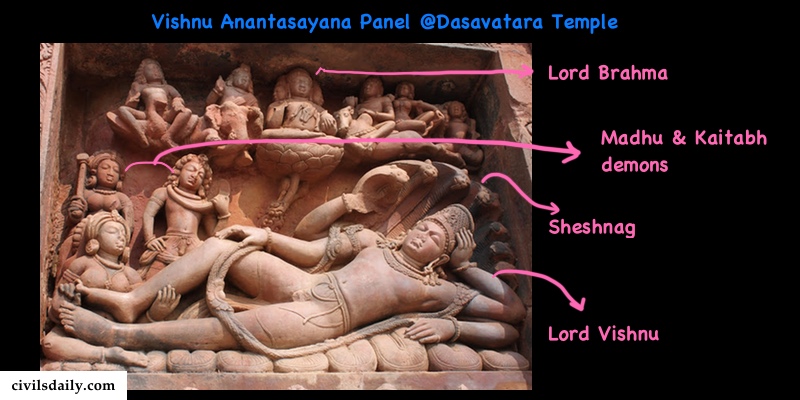
On the south – The Sheshashayana Vishnu panel is a superb piece of art
Sheshashayana is the form of Vishnu where he is shown reclining on the sheshanaga called Ananta whose seven hoods form a canopy over his crowned head
His consort Lakshmi is massaging his right leg and two attendant figures stand behind her
Various gods and celestials are hovering above. Lord Brahma can be seen.
In the lower panel, the two demons Madhu and Kaitabha, in an attacking attitude, are challenged by the four personified weapons of Vishnu
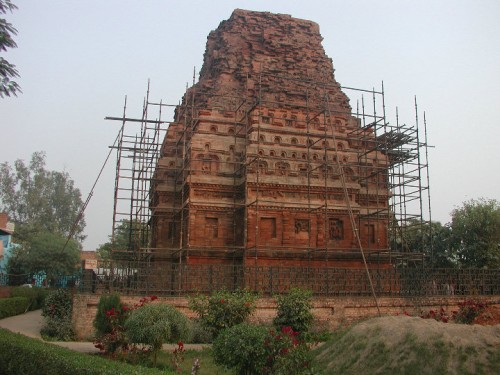
It is the oldest remaining Hindu temple made entirely of bricks/terracotta.
The temple is built on a square plan with double-recessed corners and faces east. There tall pyramidal spire over the garbhagriha.
Terracotta sculpture depicts both secular and religious theme such as deities like ganesha adi virah mahisasaur-mardani and river goddess. Myths and stories representing abduction of Sita and the penance of nara-narayan.
3. Ahichhatra Temple (Shiva Temple)
The Shiva temple at Ahichhatra belongs to the Gupta period 4th century A.D. It is famous for its two life-sized terracotta images of Ganga and Yamuna.
Ganga and Yamuna are installed in niches flanking the main steps leading to the upper terrace of the temple.
Ganga stands on her vehicle, the makara. and Yamuna on the kacchap.
V. Art
A. Sculpture
Mathura School
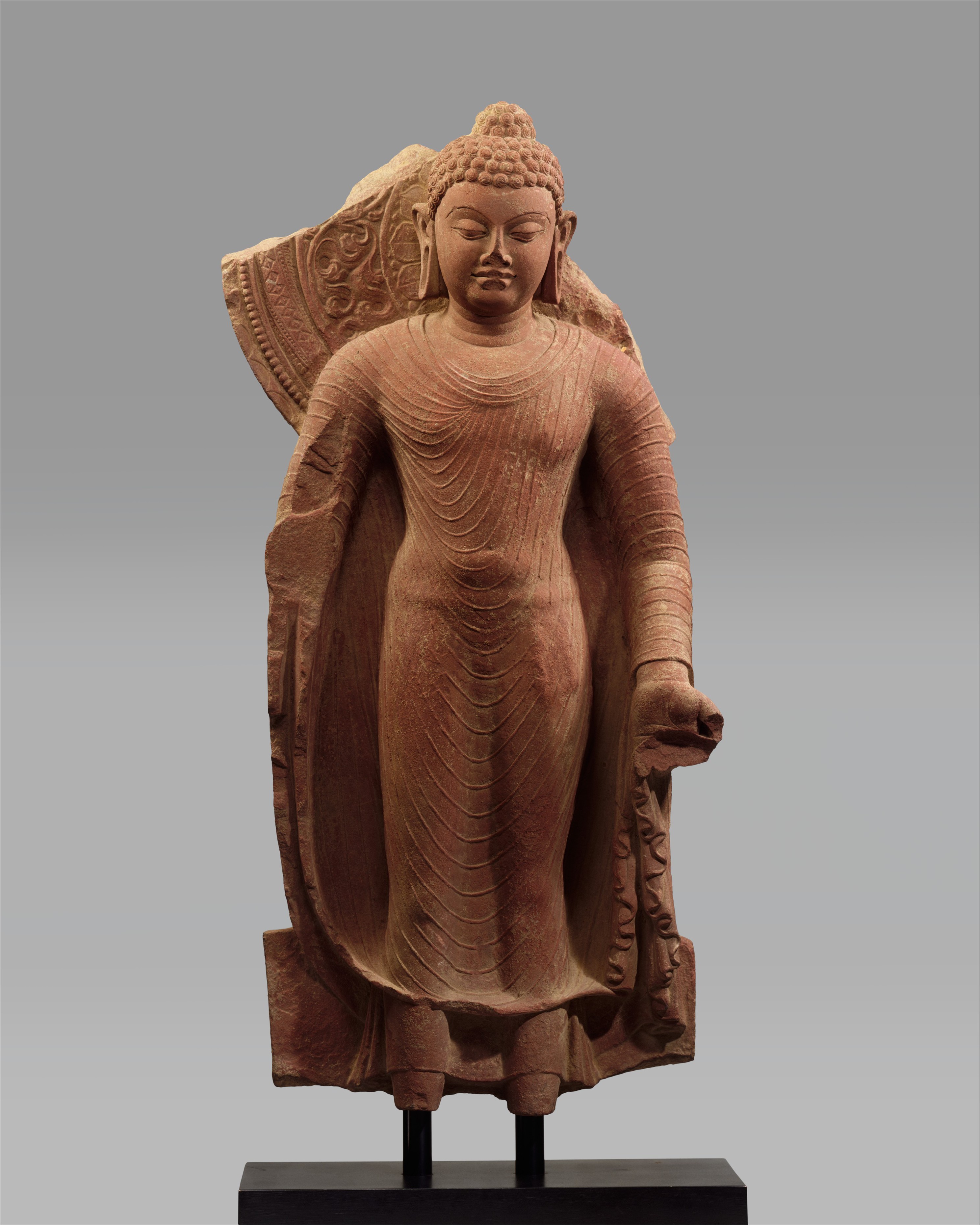
Mathura school also witnessed some development during the Gupta period. A prominent sculpture is Standing Buddha at Matura
Red sandstone image of the Buddha dated to 500AD
Right hand in abhayamudra, assuring protection, and the left holding the hem of the garment.
Smiling countenance with down-cast eyes is robed in spiritual ecstasy
Robe covering both shoulders is skillfully represented with delicately covered schematic folds and clings to the body
Head is covered with schematic spiral curls with a central protuberance and the elaborate halo decorated with concentric bands of graceful ornamentation.
2. The Sarnath School of Sculpture
The art of Bharhut, Amravati, Sanchi and Mathura came closer and closer; melting into one – The Sarnath School.
Its plasticity is derived from that of Mathura and its elegance from that of Amravati. Plasticity is a term used to describe a rich, three-dimensional or sculptural presence of a building.
The human figure takes center stage and nature becomes the background.
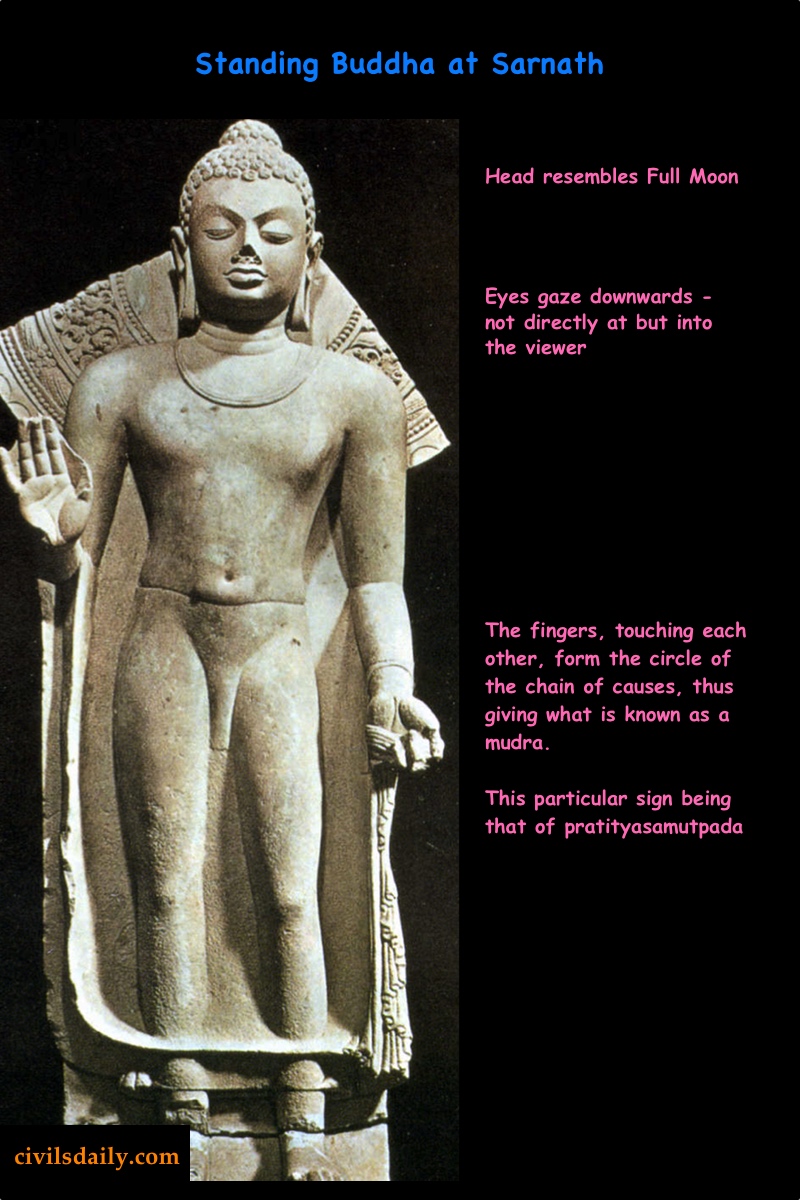
A prominent sculpture is Standing Buddha at Sarnath
his right hand in abhayamudra.
Unlike the delicately carved drapery folds of the Mathura Buddha, only the fringe of the diaphanous robe is here indicated.
The eyes gaze downward, not directly at, but into the viewer
The very fine high-grade surface seems to have a soft bloom -a specially distinctive Sarnath quality
Difference between Sarnath and Mathura School Buddha
Sarnath School
Mathura School
Relaxed attitude in the body of the sculpture. Visible bends
Mathura School had a columnar rigidity in similar works
Very fine draping – almost invisible on the body but left hanging out on the sides
In the Mathura School, the drapes were elaborate and folds were very much visible
The body in its smooth and shining plasticity constitutes the principal theme of the Sarnath artists
Mathura sculpture was more rigid
At Sarnath the material used was cream coloured sandstone
Mathura sculpture was made of moderately fine red sandstone.
Follow the link for more remarkable examples or Sarnath School Sculptures
The Union Government set up the National Commission for Minorities (NCM) under the National Commission for Minorities Act, 1992
Six religious communities, viz; Muslims, Christians, Sikhs, Buddhists, Zoroastrians (Parsis) and Jains have been notified in Gazette of India as minority communities by the Union Government all over India
The NCM adheres to the United Nations Declaration of 18 December 1992 which states that “States shall protect the existence of the National or Ethnic, Cultural, Religious and Linguistic identity of minorities within their respective territories and encourage conditions for the promotion of that identity”
Constitution of India doesn’t define the word ‘Minority’ but has used the word minorities considering two attributes religion or language of a person
The Commission shall consist of
a Chairperson,
a Vice-Chairperson and
Five Members to be nominated by the Central Government from amongst persons of eminence, ability and integrity; provided that five members including the Chairperson shall be from amongst the minority communities
The aim of the Rashtriya Gram Swaraj Abhiyan is to strengthen the Panchayati Raj system across the country and address critical gaps that constrain its success
RGSA seeks to:
Enhance capacities and effectiveness of Panchayats and the Gram Sabhas;
Enable democratic decision-making and accountability in Panchayats and promote people’s participation;
Strengthen the institutional structure for knowledge creation and capacity building of Panchayats;
Promote devolution of powers and responsibilities to Panchayats according to the spirit of the Constitution and PESA Act;
Strengthen Gram Sabhas to function effectively as the basic forum of peoples participation, transparency and accountability within the Panchayat system;
Create and strengthen democratic local self-government in areas where Panchayats do not exist;
Strengthen the constitutionally mandated framework on which Panchayats are founded
Some people have no symptoms whereas others develop yellow discoloration of the skin and whites of the eyes, poor appetite, vomiting, tiredness, abdominal pain, or diarrhea
Hepatitis may be temporary (acute) or long term (chronic) depending on whether it lasts for less than or more than six months
Acute hepatitis can sometimes resolve on its own, progress to chronic hepatitis, or rarely result in acute liver failure
Over time the chronic form may progress to scarring of the liver, liver failure, or liver cancer
As a part of revision for Prelims 2018, Here’s a Factoid to brush up your concepts
Name of the scheme: Swachhata Pakwada
Objectives : Mandates to State and City Governments to undertake extensive audit of toilets in urban areas under ‘Swachh Pakhwada’, to ensure that they are functional and fully used.
Salient Features : – As a part of behavioral change communication, hoardings and posters of ‘Asli Tarakki’ campaign, prioritizing construction of toilets over other needs like owning a scooter or a TV set, are to be prominently and widely displayed during the fortnight. – Google Toilet Locator to be launched for the benefit of the people of National Capital Region which helps in locating the nearest toilet for use.
The period from sixth to late fourth century BC witnessed the rise of territorial polities (mahajanapadas) in North India. This culminated into the establishment of the Mauryan Empire in about 325 BC. The Mauryan Empire was a pan Indian empire founded by Chandragupta Maurya.
Ashoka is considered the most significant ruler of the empire.
II. Literature and Language
The Mauryan era witnessed very few literary contributions. These contributions were either in Prakrit or Pali or Sanskrit.
1. Sanskrit
Work
Author
Type
Theme
Patronage
Arthashastra
Chanakya
Political text written in Sanskrit
Deals with statecraft, polity. Economic policy, military strategy and overall administration of the Mauryan realm.
Chandragupta Maurya
2. Pali and Prakrit
The religious books of Buddhism and Jainism were written in Pali and Prakrit (language of the masses) respectively. This ensured even common men read and understood religion.
The earliest Buddhist works were written in Pali. The Buddhist works can be divided into the canonical and the non-canonical.
The canonical literature is best represented by the “Tripitakas”, that is, three baskets – Vinaya Pitaka, Sutta Pitaka and Abhidhamma Pitaka.
Work
Author
Type
Theme
Vinaya Pitaka
Upali
Buddhist scripture written in Pali. Name meaning basket of discipline.
Deals with monastic rules for monks and nuns.
Abhidhamma Pitaka
Buddhist scripture written in Pali
Deals with philosophy and metaphysics.
Sutta Pitaka
Ananda
Pali collection of Buddhist writings of Thervada Buddhism
Deals with dialogues and discourses on morality and
deals with Dharma.
The non-canonical literature is best represented by the Jatakas. Jatakas are interesting stories of previous births of Buddha. Each birth story is called a Jataka.
The Jain texts were written in Prakrit.
Work
Author
Type
Theme
Kalpasutra
Bhadrabahu
Jain scripture written in Prakrit.
Deals with the life stories of the last two Jain Tirthankaras, Parshvanath and Mahavira.
In the eight day long festival of Paryushan by Jain monks Kalpasutra is read for the general Jain people.
Besides these texts, Megasthenes’ Indica which was written in Greek also sheds light on Mauryan administration.
III. Religion
Mauryan rulers were tolerant towards all religions.
1. Hinduism
Despite increased popularity of Buddhism and Jainism, Hinduism remained popular too. Hinduism underwent changes during this era. Though Yajanas were performed but animal sacrifices were stopped.
2. Buddhism
Buddhism flourished during Ashoka’s realm. He sent his son Mahinda and daughter Sangamitra to Sri Lanka to propagate Buddhism. Ashoka is also credited for construction of 84000 stupas. Ashoka also convened the Third Buddhist Council.
History of Buddhist Council – These councils were Buddhist meetings held periodically which included Buddhist monks, nuns and religious leaders.
Buddhist Council
Timeline
Location
Outcome
Spiritual Leader (Monk)
Patronage
First Buddhist Council
Around 400 BC after Lord Buddha’s death.
Sattapanni caves, Rajgriha
Led to formulation of Sutta and Vinaya Pitaka.
Mahakasyapa
Ajatashatru
Second Buddhist Council
Around 383 BC
Vaishali
The aim was to settle the dispute on practices of Vinaya Pitaka which led to the first schism of Buddhism– Mahasamghikas and Sthaviravadins sects were formed.
Sthaviravadins followed orthodox norms while Mahasamghikas followed less rigid norms.
Yasa
Kalasoka
Third Buddhist Council
Around 251 BC
Pātaliputra
Led to formulation of Abhidhamma Pitaka.
Moggaliputta Tissa
Ashoka
Fourth Buddhist Council
Around 72 AD
Kashmir
Buddhists further divided into two sects- Mahayana and Hinayana.
Vasumitra
Kanishka
Explore more – https://www.youtube.com/watch?v=Cz1413OZGb8
3. Jainism
Growing merchant community made religious grants to Jainism which ensured the religion prospered. Chandragupta Maurya became a Jain follower and sent missions to the South to propagate the religion further. The decline in animal sacrifices was a result of increasing influence of Jainism and Buddhism.
IV. Architecture
For the first time, we see state-sponsored art and architecture. Architectures prior to this period seem to have been made of wood and hence were not able to survive. A case in point is the 80 pillared hall at Kumrahar which is often considered to be a Mauryan palace.
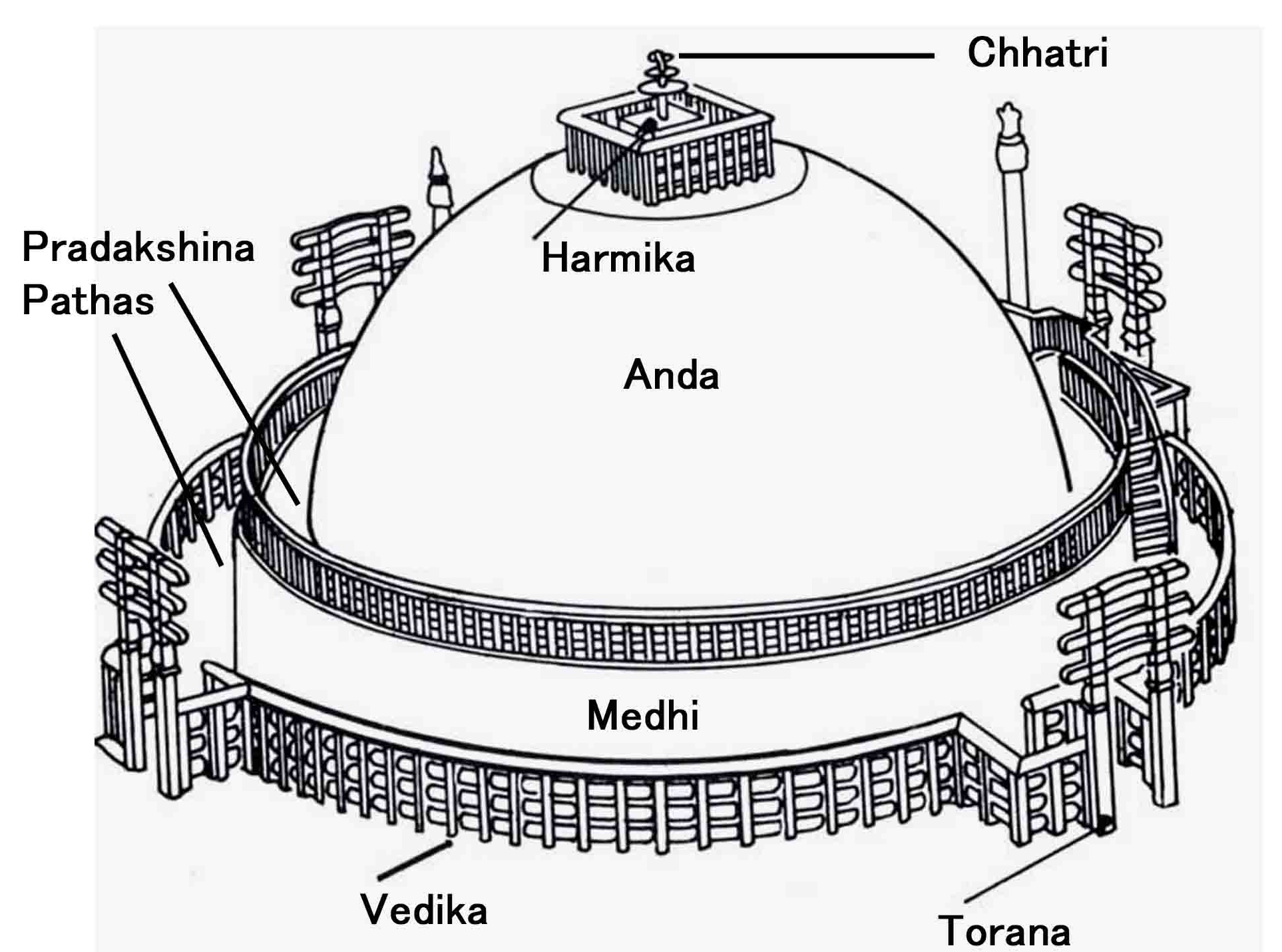
For the first time, we see the construction of Stupas. These are hemispherical dome structures originally built over the relics of Buddha after his death. There were 8 of them in distributed in places where Buddha seemed to have lived – Rajagraha, Vaishali, Kapilvastu, Allakapa, Ramagrama, Vethadipa, Pava, Kushinagar. Ashoka is credited to have commissioned construction of 84000 stupas.
The components of a Stupa are shown in the diagram –
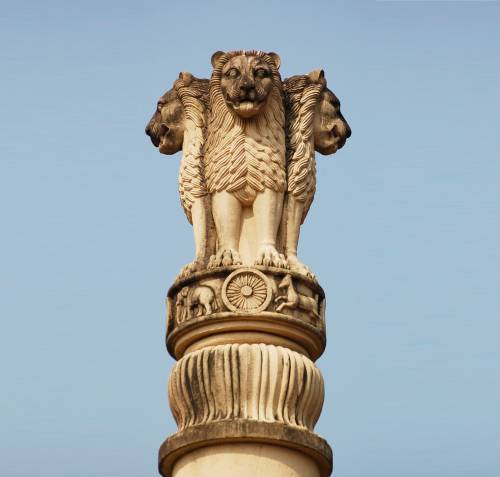
Another remarkable sculpture is Sarnath’s lion capital
Characterized by four Asiatic lions standing back to back
It was adopted as India’s national emblem in 1950.
Figures of horse, lion, bull and elephant are sculpted on the abacus.
This pillar capital symbolized Dharmachakraparivartana that is the first sermon of Buddha.
The abacus has four wheels with 24 spokes each. This wheel with 24 spokes is adopted in the National Flag.
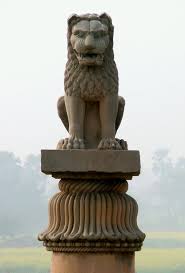
1. Basarah – Bakhira, Bihar
Single crowning lion sitting on a square abacus.
Compared to other capitals, this sculpture is relatively less ornamented.
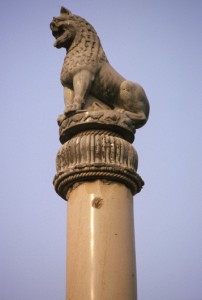
2. Lauriya – Nandangarh Lion Capital
In Champaran district of Bihar.
The pillar is inscribed with edicts of Ashoka
Characterized by round abacus and lion as the crowning animal.
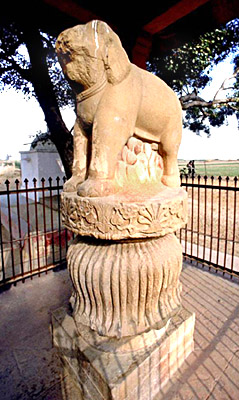
3. Sankisa Elephant Capital
Located in Uttar Pradesh
After Buddha’s death Ashoka installed series of columns in Sankissa among them only the Elephant capital survives.
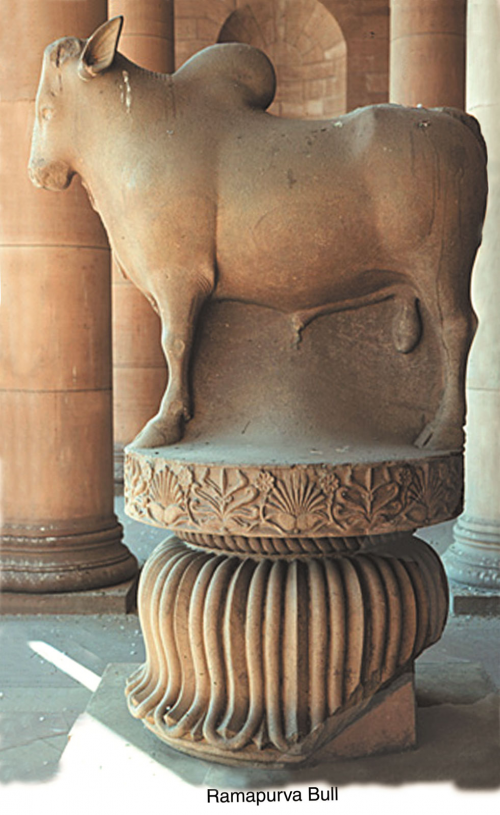
4. Rampurva, Bihar
Is a hybridization of Persian and Indian elements.
The abacus shows Greek influence and has beautiful floral designs.
Zebu bull is depicted as the crowning animal.
C. Temples
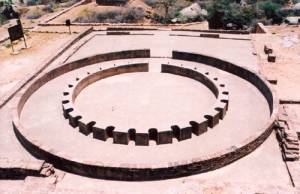
Evidence of the earliest known structural temples has been recovered through excavations at the Bairat District of Jaipur, Rajasthan.
This shrine is dated to the 3rd century B.C
A circular brick and timber shrine of the Mauryan period
Was made of lime-plastered brick work
Points to construction of wooden pillars.
Surrounded by a seven feet wide ambulatory.
Temple 40′ at Sanchi, has a similar plan, it was a stone temple on an apsidal plan enclosed by an ambulatory, and raised on a high, rectangular scale, approached by two flights of steps from diagonally opposite sides. The super-structure was possibly built of wood, and has disappeared.
D. Caves
Many caves were built during the time of Ashoka. They were mostly Chaityas and Viharas (click to read more)
1. BARABARA CAVES
Oldest surviving rock cut cave in India.
These caves are situated in the twin hills of Barabar (four caves) and Nagarjuni (three caves) located in Bihar.
These caves were granted to Ajivika sect by Ashoka. Ashokan inscriptions have been found in this cave.
Caves are carved out of granite and have a polished surface.
Barabar Hill contains four caves, namely, Karan Chaupar, Lomas Rishi, Sudama and Visva Zopri.
Among these most important are Sudama and Lomas Rishi Caves as they are the earliest examples of rock-cut architecture in India
2. LOMAS RISHI CAVE
The arch-like shape facade of Lomas Rishi Caves, imitate the contemporary timber architecture
3. SUDAMA CAVE
This cave has better finishing in comparison to Lomas Rishi cave. Inner walls are highly polished.
V. Independent Art
In visual art of Mauryan period human figures are conspicuously absent. Salient exceptions to this pattern are the yaksha and yakshi sculptures.
A. Sculpture
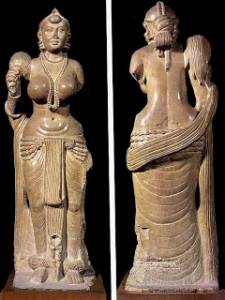
Yaksha and Yakshi figures – Life size figures have been found in Vidisha, Patna and Mathura.
DIDARGANJ YAKSHI
Found from a Didarganj, Patna.
A wonderfully modeled life-size standing image of a Yakshini holding a chauri (flywhisk)
Characterized by elaborate ornamentations and sensuous appeal depicting Indian sculptural tradition.
Highly polished surface made up of sandstone.
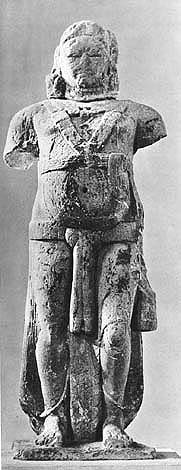
PAKHAM, YAKSHA
Located in Mathura
Made up of sandstone
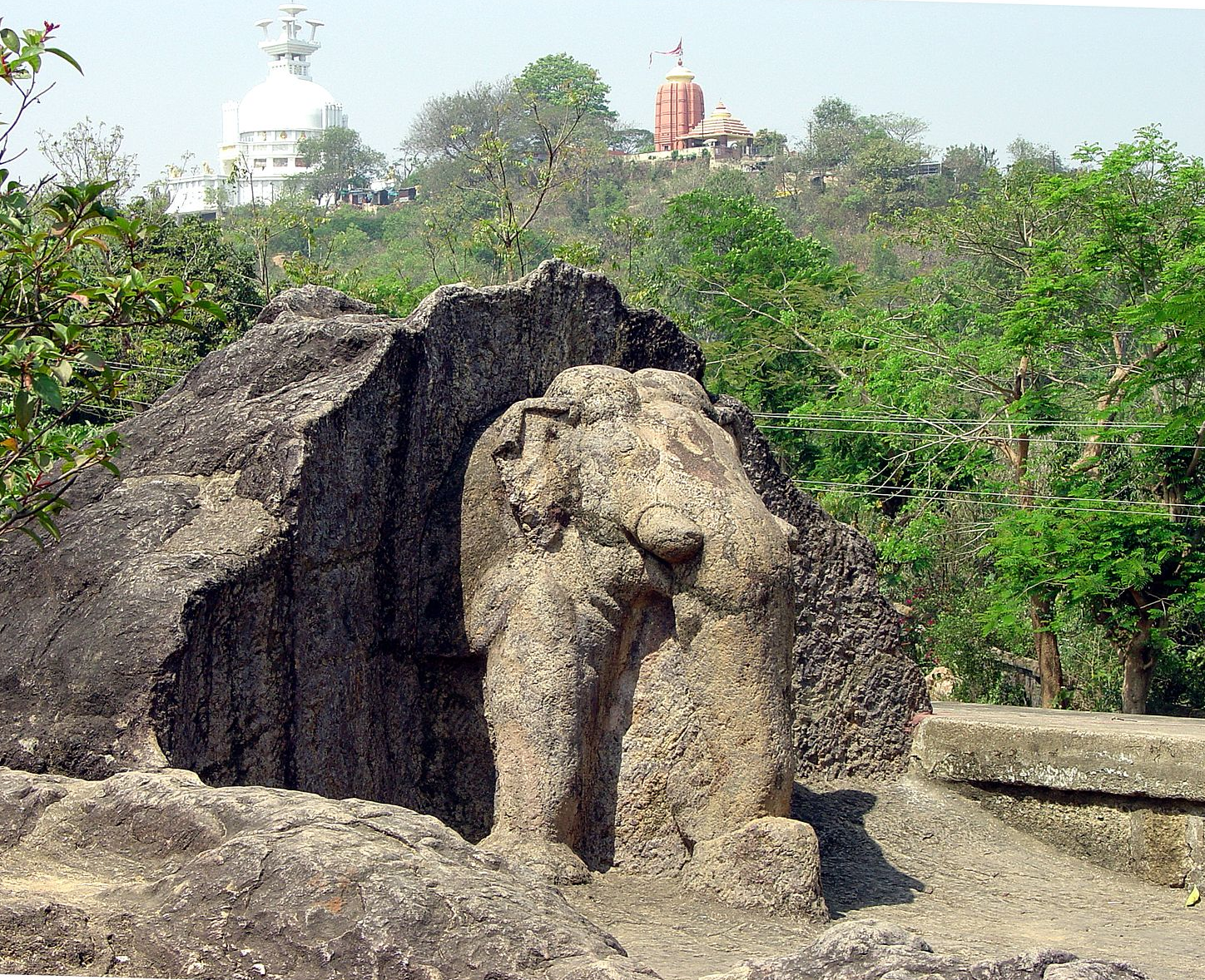
Elephant in Dhauli, Orissa
Dhauli hills are located on the banks of river Daya south of Bhubaneshwar
The oldest Buddhist sculptures in Orissa is the rock-cut elephant above which Ashokan Edicts are spotted.
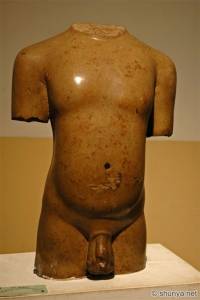
Male Torso, Lohanipur
– Highly polished. The nude torso of a Jain Tirthankara or a saviour of the Digambara sect found at Lohanipur
All drugs are made up of two core components: the API, which is the central ingredient, and the excipients, the substances other than the drug that helps deliver the medication to your system
The Active Pharmaceutical Ingredient (API) is the part of any drug that produces its effects
Excipients are chemically inactive substances, such as lactose or mineral oil
The quality of APIs has a significant effect on the efficacy and safety of medications
‘Swell waves’ are massive ripples that form on the sea due to winds coming from as far away as Madagascar
Swells are collections of waves produced by storm winds raging hundreds of miles out to sea, rather than the product of local winds along beaches
They are often referred to as surface gravity waves
Swell continues to move under winds and waves that have long since changed direction, it can even head in the opposite direction as the wind and waves
They might appear to be tsunami-like waves but have completely different characteristics
They can have heights between 2 m and 3 m and periods between 17-22 seconds
As a part of revision for Prelims 2018, Here’s a Factoid to brush up your concepts
Name : RAMSAR Convention on Wetlands
Brief Intro : The Convention was adopted in the Iranian city of Ramsar in 1971 and came into force in 1975 after UNESCO, the Convention’s depositary received the instruments of accession from the countries. – The RAMSAR Secretariat is based at the headquarters of the International Union for the Conservation of Nature (IUCN) in Gland, Switzerland. – World Wetlands Day is celebrated on February 2nd.
Objective : An intergovernmental treaty that provides the framework for national action and international cooperation for the conservation and wise use of wetlands and their resources.
Type : Conventions
Category: E&B
Year : 1971
Importance (wr. Prelims): Medium
Place : Ramasar
Key Terms/ Institutions spinoffs: The Montreux Record – a register of wetland sites on the List of Wetlands of International Importance where changes in ecological character are of concern. It is maintained as part of the Ramsar List.
India specific trivia : India currently has 26 sites designated as Wetlands of International Importance (Ramsar Sites)
The Sustainable Development Goals (SDGs), otherwise known as the Global Goals, are a universal call to action to end poverty, protect the planet and ensure that all people enjoy peace and prosperity.
The 17 Goals build on the successes of the Millennium Development Goals, while including new areas such as climate change, economic inequality, innovation, sustainable consumption, peace and justice, among other priorities.
The goals are interconnected – often the key to success on one will involve tackling issues more commonly associated with another.
The SDGs work in the spirit of partnership and pragmatism to make the right choices now to improve life, in a sustainable way, for future generations.
They provide clear guidelines and targets for all countries to adopt in accordance with their own priorities and the environmental challenges of the world at large.
The SDGs are an inclusive agenda. They tackle the root causes of poverty and unite us together to make a positive change for both people and planet. “Poverty eradication is at the heart of the 2030 Agenda, and so is the commitment to leave no-one behind,” UNDP Administrator Achim Steiner said. “The Agenda offers a unique opportunity to put the whole world on a more prosperous and sustainable development path. In many ways, it reflects what UNDP was created for.”
The Goals
Goal 1: No Poverty
Targets
By 2030, reduce at least by half the proportion of men, women and children of all ages living in poverty in all its dimensions according to national definitions.
Implement nationally appropriate social protection systems and measures for all, including floors, and by 2030 achieve substantial coverage of the poor and the vulnerable.
By 2030, ensure that all men and women, in particular the poor and the vulnerable, have equal rights to economic resources, as well as access to basic services, ownership and control over land and other forms of property, inheritance, natural resources, appropriate new technology and financial services, including microfinance.
By 2030, build the resilience of the poor and those in vulnerable situations and reduce their exposure and vulnerability to climate-related extreme events and other economic, social and environmental shocks and disasters.
Ensure significant mobilization of resources from a variety of sources, including through enhanced development cooperation, in order to provide adequate and predictable means for developing countries, in particular least developed countries, to implement programmes and policies to end poverty in all its dimensions.
Create sound policy frameworks at the national, regional and international levels, based on pro-poor and gender-sensitive development strategies, to support accelerated investment in poverty eradication actions.
Goal 2: Zero Hunger
Targets
By 2030, end hunger and ensure access by all people, in particular the poor and people in vulnerable situations, including infants, to safe, nutritious and sufficient food all year round
By 2030, end all forms of malnutrition, including achieving, by 2025, the internationally agreed targets on stunting and wasting in children under 5 years of age, and address the nutritional needs of adolescent girls, pregnant and lactating women and older persons
By 2030, double the agricultural productivity and incomes of small-scale food producers, in particular women, indigenous peoples, family farmers, pastoralists and fishers, including through secure and equal access to land, other productive resources and inputs, knowledge, financial services, markets and opportunities for value addition and non-farm employment
By 2030, ensure sustainable food production systems and implement resilient agricultural practices that increase productivity and production, that help maintain ecosystems, that strengthen capacity for adaptation to climate change, extreme weather, drought, flooding and other disasters and that progressively improve land and soil quality
By 2020, maintain the genetic diversity of seeds, cultivated plants and farmed and domesticated animals and their related wild species, including through soundly managed and diversified seed and plant banks at the national, regional and international levels, and promote access to and fair and equitable sharing of benefits arising from the utilization of genetic resources and associated traditional knowledge, as internationally agreed
Increase investment, including through enhanced international cooperation, in rural infrastructure, agricultural research and extension services, technology development and plant and livestock gene banks in order to enhance agricultural productive capacity in developing countries, in particular least developed countries
Correct and prevent trade restrictions and distortions in world agricultural markets, including through the parallel elimination of all forms of agricultural export subsidies and all export measures with equivalent effect, in accordance with the mandate of the Doha Development Round
Adopt measures to ensure the proper functioning of food commodity markets and their derivatives and facilitate timely access to market information, including on food reserves, in order to help limit extreme food price volatility.
Goal 3: Good Health and Well Being
Targets
By 2030, reduce the global maternal mortality ratio to less than 70 per 100,000 live births
By 2030, end preventable deaths of newborns and children under 5 years of age, with all countries aiming to reduce neonatal mortality to at least as low as 12 per 1,000 live births and under-5 mortality to at least as low as 25 per 1,000 live births
By 2030, end the epidemics of AIDS, tuberculosis, malaria and neglected tropical diseases and combat hepatitis, water-borne diseases and other communicable diseases
By 2030, reduce by one third premature mortality from non-communicable diseases through prevention and treatment and promote mental health and well-being
Strengthen the prevention and treatment of substance abuse, including narcotic drug abuse and harmful use of alcohol
By 2020, halve the number of global deaths and injuries from road traffic accidents
By 2030, ensure universal access to sexual and reproductive health-care services, including for family planning, information and education, and the integration of reproductive health into national strategies and programmes
Achieve universal health coverage, including financial risk protection, access to quality essential health-care services and access to safe, effective, quality and affordable essential medicines and vaccines for all
By 2030, substantially reduce the number of deaths and illnesses from hazardous chemicals and air, water and soil pollution and contamination
Strengthen the implementation of the World Health Organization Framework Convention on Tobacco Control in all countries, as appropriate
Support the research and development of vaccines and medicines for the communicable and noncommunicable diseases that primarily affect developing countries, provide access to affordable essential medicines and vaccines, in accordance with the Doha Declaration on the TRIPS Agreement and Public Health, which affirms the right of developing countries to use to the full the provisions in the Agreement on Trade Related Aspects of Intellectual Property Rights regarding flexibilities to protect public health, and, in particular, provide access to medicines for all
Substantially increase health financing and the recruitment, development, training and retention of the health workforce in developing countries, especially in least developed countries and small island developing States
Strengthen the capacity of all countries, in particular developing countries, for early warning, risk reduction and management of national and global health risks
Goal 4: Quality Education
Targets
By 2030, ensure that all girls and boys complete free, equitable and quality primary and secondary education leading to relevant and Goal-4 effective learning outcomes
By 2030, ensure that all girls and boys have access to quality early childhood development, care and preprimary education so that they are ready for primary education
By 2030, ensure equal access for all women and men to affordable and quality technical, vocational and tertiary education, including university
By 2030, substantially increase the number of youth and adults who have relevant skills, including technical and vocational skills, for employment, decent jobs and entrepreneurship
By 2030, eliminate gender disparities in education and ensure equal access to all levels of education and vocational training for the vulnerable, including persons with disabilities, indigenous peoples and children in vulnerable situations
By 2030, ensure that all youth and a substantial proportion of adults, both men and women, achieve literacy and numeracy
By 2030, ensure that all learners acquire the knowledge and skills needed to promote sustainable development, including, among others, through education for sustainable development and sustainable lifestyles, human rights, gender equality, promotion of a culture of peace and non-violence, global citizenship and appreciation of cultural diversity and of culture’s contribution to sustainable development
Build and upgrade education facilities that are child, disability and gender sensitive and provide safe, nonviolent, inclusive and effective learning environments for all
By 2020, substantially expand globally the number of scholarships available to developing countries, in particular least developed countries, small island developing States and African countries, for enrolment in higher education, including vocational training and information and communications technology, technical, engineering and scientific programmes, in developed countries and other developing countries
By 2030, substantially increase the supply of qualified teachers, including through international cooperation for teacher training in developing countries, especially least developed countries and small island developing states
Goal 5: Gender Equality
Targets
End all forms of discrimination against all women and girls everywhere
Eliminate all forms of violence against all women and girls in the public and private spheres, including trafficking and sexual and other types of exploitation
Eliminate all harmful practices, such as child, early and forced marriage and female genital mutilation
Recognize and value unpaid care and domestic work through the provision of public services, infrastructure and social protection policies and the promotion of shared responsibility within the household and the family as nationally appropriate
Ensure women’s full and effective participation and equal opportunities for leadership at all levels of decisionmaking in political, economic and public life
Ensure universal access to sexual and reproductive health and reproductive rights as agreed in accordance with the Programme of Action of the International Conference on Population and Development and the Beijing Platform for Action and the outcome documents of their review conferences
Undertake reforms to give women equal rights to economic resources, as well as access to ownership and control over land and other forms of property, financial services, inheritance and natural resources, in accordance with national laws
Enhance the use of enabling technology, in particular information and communications technology, to promote the empowerment of women
Adopt and strengthen sound policies and enforceable legislation for the promotion of gender equality and the empowerment of all women and girls at all levels
Goal 6: Clean Water and Sanitation
Targets
By 2030, achieve universal and equitable access to safe and affordable drinking water for all
By 2030, achieve access to adequate and equitable sanitation and hygiene for all and end open defecation, paying special attention to the needs of women and girls and those in vulnerable situations
By 2030, improve water quality by reducing pollution, eliminating dumping and minimizing release of hazardous chemicals and materials, halving the proportion of untreated wastewater and substantially increasing recycling and safe reuse globally
By 2030, substantially increase water-use efficiency across all sectors and ensure sustainable withdrawals and supply of freshwater to address water scarcity and substantially reduce the number of people suffering from water scarcity
By 2030, implement integrated water resources management at all levels, including through transboundary cooperation as appropriate
By 2020, protect and restore water-related ecosystems, including mountains, forests, wetlands, rivers, aquifers and lakes
By 2030, expand international cooperation and capacity-building support to developing countries in water- and sanitation-related activities and programmes, including water harvesting, desalination, water efficiency, wastewater treatment, recycling and reuse technologies
Support and strengthen the participation of local communities in improving water and sanitation management
Goal 7: Affordable and Clean Energy
Target
By 2030, ensure universal access to affordable, reliable and modern energy services
By 2030, increase substantially the share of renewable energy in the global energy mix
By 2030, double the global rate of improvement in energy efficiency
By 2030, enhance international cooperation to facilitate access to clean energy research and technology, including renewable energy, energy efficiency and advanced and cleaner fossil-fuel technology, and promote investment in energy infrastructure and clean energy technology
By 2030, expand infrastructure and upgrade technology for supplying modern and sustainable energy services for all in developing countries, in particular least developed countries, small island developing States, and land-locked developing countries, in accordance with their respective programmes of support
Goal 8: Decent Work and Economic Growth
Targets
Sustain per capita economic growth in accordance with national circumstances and, in particular, at least 7 per cent gross domestic product growth per annum in the least developed countries
Achieve higher levels of economic productivity through diversification, technological upgrading and innovation, including through a focus on high-value added and labour-intensive sectors
Promote development-oriented policies that support productive activities, decent job creation, entrepreneurship, creativity and innovation, and encourage the formalization and growth of micro-, small- and medium-sized enterprises, including through access to financial services
Improve progressively, through 2030, global resource efficiency in consumption and production and endeavour to decouple economic growth from environmental degradation, in accordance with the 10-year framework of programmes on sustainable consumption and production, with developed countries taking the lead
By 2030, achieve full and productive employment and decent work for all women and men, including for young people and persons with disabilities, and equal pay for work of equal value
By 2020, substantially reduce the proportion of youth not in employment, education or training
Take immediate and effective measures to eradicate forced labour, end modern slavery and human trafficking and secure the prohibition and elimination of the worst forms of child labour, including recruitment and use of child soldiers, and by 2025 end child labour in all its forms
Protect labour rights and promote safe and secure working environments for all workers, including migrant workers, in particular women migrants, and those in precarious employment
By 2030, devise and implement policies to promote sustainable tourism that creates jobs and promotes local culture and products
Strengthen the capacity of domestic financial institutions to encourage and expand access to banking, insurance and financial services for all
Increase Aid for Trade support for developing countries, in particular least developed countries, including through the Enhanced Integrated Framework for Trade-Related Technical Assistance to Least Developed Countries
By 2020, develop and operationalize a global strategy for youth employment and implement the Global Jobs Pact of the International Labour Organization
Goal 9: Industry, Innovation and Infrastructure
Targets
Develop quality, reliable, sustainable and resilient infrastructure, including regional and trans-border infrastructure, to support economic development and human well-being, with a focus on affordable and equitable access for all
Promote inclusive and sustainable industrialization and, by 2030, significantly raise industry’s share of employment and gross domestic product, in line with national circumstances, and double its share in least developed countries
Increase the access of small-scale industrial and other enterprises, in particular in developing countries, to financial services, including affordable credit, and their integration into value chains and markets
By 2030, upgrade infrastructure and retrofit industries to make them sustainable, with increased resource-use efficiency and greater adoption of clean and environmentally sound technologies and industrial processes, with all countries taking action in accordance with their respective capabilities
Enhance scientific research, upgrade the technological capabilities of industrial sectors in all countries, in particular developing countries, including, by 2030, encouraging innovation and substantially increasing the number of research and development workers per 1 million people and public and private research and development spending
Facilitate sustainable and resilient infrastructure development in developing countries through enhanced financial, technological and technical support to African countries, least developed countries, landlocked developing countries and small island developing States 18
Support domestic technology development, research and innovation in developing countries, including by ensuring a conducive policy environment for, inter alia, industrial diversification and value addition to commodities
Significantly increase access to information and communications technology and strive to provide universal and affordable access to the Internet in least developed countries by 2020
Goal 10: Reduce Inequalities
Targets
By 2030, progressively achieve and sustain income growth of the bottom 40 per cent of the population at a rate higher than the national average
By 2030, empower and promote the social, economic and political inclusion of all, irrespective of age, sex, disability, race, ethnicity, origin, religion or economic or other status
Ensure equal opportunity and reduce inequalities of outcome, including by eliminating discriminatory laws, policies and practices and promoting appropriate legislation, policies and action in this regard
Adopt policies, especially fiscal, wage and social protection policies, and progressively achieve greater equality
Improve the regulation and monitoring of global financial markets and institutions and strengthen the implementation of such regulations
Ensure enhanced representation and voice for developing countries in decision-making in global international economic and financial institutions in order to deliver more effective, credible, accountable and legitimate institutions
Facilitate orderly, safe, regular and responsible migration and mobility of people, including through the implementation of planned and well-managed migration policies
Implement the principle of special and differential treatment for developing countries, in particular least developed countries, in accordance with World Trade Organization agreements
Encourage official development assistance and financial flows, including foreign direct investment, to States where the need is greatest, in particular least developed countries, African countries, small island developing States and landlocked developing countries, in accordance with their national plans and programmes
By 2030, reduce to less than 3 per cent the transaction costs of migrant remittances and eliminate remittance corridors with costs higher than 5 per cent
Goal 11: Sustainable Cities and Communities
Targets
By 2030, ensure access for all to adequate, safe and affordable housing and basic services and upgrade slums
By 2030, provide access to safe, affordable, accessible and sustainable transport systems for all, improving road safety, notably by expanding public transport, with special attention to the needs of those in vulnerable situations, women, children, persons with disabilities and older persons
By 2030, enhance inclusive and sustainable urbanization and capacity for participatory, integrated and sustainable human settlement planning and management in all countries
Strengthen efforts to protect and safeguard the world’s cultural and natural heritage
By 2030, significantly reduce the number of deaths and the number of people affected and substantially decrease the direct economic losses relative to global gross domestic product caused by disasters, including water-related disasters, with a focus on protecting the poor and people in vulnerable situations
By 2030, reduce the adverse per capita environmental impact of cities, including by paying special attention to air quality and municipal and other waste management
By 2030, provide universal access to safe, inclusive and accessible, green and public spaces, in particular for women and children, older persons and persons with disabilities
Support positive economic, social and environmental links between urban, peri-urban and rural areas by strengthening national and regional development planning
By 2020, substantially increase the number of cities and human settlements adopting and implementing integrated policies and plans towards inclusion, resource efficiency, mitigation and adaptation to climate change, resilience to disasters, and develop and implement, in line with the Sendai Framework for Disaster Risk Reduction 2015-2030, holistic disaster risk management at all levels
Support least developed countries, including through financial and technical assistance, in building sustainable and resilient buildings utilizing local materials
Goal 12: Responsible Production and Consumption
Targets
Implement the 10-year framework of programmes on sustainable consumption and production, all countries taking action, with developed countries taking the lead, taking into account the development and capabilities of developing countries
By 2030, achieve the sustainable management and efficient use of natural resources
By 2030, halve per capita global food waste at the retail and consumer levels and reduce food losses along production and supply chains, including post-harvest losses
By 2020, achieve the environmentally sound management of chemicals and all wastes throughout their life cycle, in accordance with agreed international frameworks, and significantly reduce their release to air, water and soil in order to minimize their adverse impacts on human health and the environment
By 2030, substantially reduce waste generation through prevention, reduction, recycling and reuse
Encourage companies, especially large and transnational companies, to adopt sustainable practices and to integrate sustainability information into their reporting cycle
Promote public procurement practices that are sustainable, in accordance with national policies and priorities
By 2030, ensure that people everywhere have the relevant information and awareness for sustainable development and lifestyles in harmony with nature
Support developing countries to strengthen their scientific and technological capacity to move towards more sustainable patterns of consumption and production
Develop and implement tools to monitor sustainable development impacts for sustainable tourism that creates jobs and promotes local culture and products
Rationalize inefficient fossil-fuel subsidies that encourage wasteful consumption by removing market distortions, in accordance with national circumstances, including by restructuring taxation and phasing out those harmful subsidies, where they exist, to reflect their environmental impacts, taking fully into account the specific needs and conditions of developing countries and minimizing the possible adverse impacts on their development in a manner that protects the poor and the affected communities
Goal 13: Climate Actions
Targets
Strengthen resilience and adaptive capacity to climate-related hazards and natural disasters in all countries
Integrate climate change measures into national policies, strategies and planning
Improve education, awareness-raising and human and institutional capacity on climate change mitigation, adaptation, impact reduction and early warning
Implement the commitment undertaken by developed-country parties to the United Nations Framework Convention on Climate Change to a goal of mobilizing jointly $100 billion annually by 2020 from all sources to address the needs of developing countries in the context of meaningful mitigation actions and transparency on implementation and fully operationalize the Green Climate Fund through its capitalization as soon as possible
Promote mechanisms for raising capacity for effective climate change-related planning and management in least developed countries and small island developing States, including focusing on women, youth and local and marginalized communities
Goal 14: Life Below Water
Targets
By 2025, prevent and significantly reduce marine pollution of all kinds, in particular from land-based activities, including marine debris and nutrient pollution
By 2020, sustainably manage and protect marine and coastal ecosystems to avoid significant adverse impacts, including by strengthening their resilience, and take action for their restoration in order to achieve healthy and productive oceans
Minimize and address the impacts of ocean acidification, including through enhanced scientific cooperation at all levels
By 2020, effectively regulate harvesting and end overfishing, illegal, unreported and unregulated fishing and destructive fishing practices and implement science-based management plans, in order to restore fish stocks in the shortest time feasible, at least to levels that can produce maximum sustainable yield as determined by their biological characteristics
By 2020, conserve at least 10 per cent of coastal and marine areas, consistent with national and international law and based on the best available scientific information
By 2020, prohibit certain forms of fisheries subsidies which contribute to overcapacity and overfishing, eliminate subsidies that contribute to illegal, unreported and unregulated fishing and refrain from introducing new such subsidies, recognizing that appropriate and effective special and differential treatment for developing and least developed countries should be an integral part of the World Trade Organization fisheries subsidies negotiation
By 2030, increase the economic benefits to Small Island developing States and least developed countries from the sustainable use of marine resources, including through sustainable management of fisheries, aquaculture and tourism
Increase scientific knowledge, develop research capacity and transfer marine technology, taking into account the Intergovernmental Oceanographic Commission Criteria and Guidelines on the Transfer of Marine Technology, in order to improve ocean health and to enhance the contribution of marine biodiversity to the development of developing countries, in particular small island developing States and least developed countries
Provide access for small-scale artisanal fishers to marine resources and markets
Enhance the conservation and sustainable use of oceans and their resources by implementing international law as reflected in UNCLOS, which provides the legal framework for the conservation and sustainable use of oceans and their resources, as recalled in paragraph 158 of The Future We Want
Goal 15: Life on land
Targets
By 2020, ensure the conservation, restoration and sustainable use of terrestrial and inland freshwater ecosystems and their services, in particular forests, wetlands, mountains and drylands, in line with obligations under international agreements
By 2020, promote the implementation of sustainable management of all types of forests, halt deforestation, restore degraded forests and substantially increase afforestation and reforestation globally
By 2030, combat desertification, restore degraded land and soil, including land affected by desertification, drought and floods, and strive to achieve a land degradation-neutral world
By 2030, ensure the conservation of mountain ecosystems, including their biodiversity, in order to enhance their capacity to provide benefits that are essential for sustainable development
Take urgent and significant action to reduce the degradation of natural habitats, halt the loss of biodiversity and, by 2020, protect and prevent the extinction of threatened species
Promote fair and equitable sharing of the benefits arising from the utilization of genetic resources and promote appropriate access to such resources, as internationally agreed
Take urgent action to end poaching and trafficking of protected species of flora and fauna and address both demand and supply of illegal wildlife products
By 2020, introduce measures to prevent the introduction and significantly reduce the impact of invasive alien species on land and water ecosystems and control or eradicate the priority species
By 2020, integrate ecosystem and biodiversity values into national and local planning, development processes, poverty reduction strategies and accounts
Mobilize and significantly increase financial resources from all sources to conserve and sustainably use biodiversity and ecosystems
Mobilize significant resources from all sources and at all levels to finance sustainable forest management and provide adequate incentives to developing countries to advance such management, including for conservation and reforestation
Enhance global support for efforts to combat poaching and trafficking of protected species, including by increasing the capacity of local communities to pursue sustainable livelihood opportunities
Goal 16: Peace, Justice and Strong Institutions
Targets
Significantly reduce all forms of violence and related death rates everywhere
End abuse, exploitation, trafficking and all forms of violence against and torture of children
Promote the rule of law at the national and international levels and ensure equal access to justice for all
By 2030, significantly reduce illicit financial and arms flows, strengthen the recovery and return of stolen assets and combat all forms of organized crime
Substantially reduce corruption and bribery in all their forms
Develop effective, accountable and transparent institutions at all levels
Ensure responsive, inclusive, participatory and representative decision-making at all levels
Broaden and strengthen the participation of developing countries in the institutions of global governance
By 2030, provide legal identity for all, including birth registration
Ensure public access to information and protect fundamental freedoms, in accordance with national legislation and international agreements
Strengthen relevant national institutions, including through international cooperation, for building capacity at all levels, in particular in developing countries, to prevent violence and combat terrorism and crime
Promote and enforce non-discriminatory laws and policies for sustainable development
Goal 17: Partnership for the Goals
Targets
Finance
Strengthen domestic resource mobilization, including through international support to developing countries, to improve domestic capacity for tax and other revenue collection
Developed countries to implement fully their official development assistance commitments, including the commitment by many developed countries to achieve the target of 0.7 per cent of ODA/GNI to developing countries and 0.15 to 0.20 per cent of ODA/GNI to least developed countries ODA providers are encouraged to consider setting a target to provide at least 0.20 per cent of ODA/GNI to least developed countries
Mobilize additional financial resources for developing countries from multiple sources
Assist developing countries in attaining long-term debt sustainability through coordinated policies aimed at fostering debt financing, debt relief and debt restructuring, as appropriate, and address the external debt of highly indebted poor countries to reduce debt distress
Adopt and implement investment promotion regimes for least developed countries
Technology
Enhance North-South, South-South and triangular regional and international cooperation on and access to science, technology and innovation and enhance knowledge sharing on mutually agreed terms, including through improved coordination among existing mechanisms, in particular at the United Nations level, and through a global technology facilitation mechanism
Promote the development, transfer, dissemination and diffusion of environmentally sound technologies to developing countries on favourable terms, including on concessional and preferential terms, as mutually agreed
Fully operationalize the technology bank and science, technology and innovation capacity-building mechanism for least developed countries by 2017 and enhance the use of enabling technology, in particular information and communications technology
Capacity building
Enhance international support for implementing effective and targeted capacity-building in developing countries to support national plans to implement all the sustainable development goals, including through North-South, South-South and triangular cooperation
Trade
Promote a universal, rules-based, open, non-discriminatory and equitable multilateral trading system under the World Trade Organization, including through the conclusion of negotiations under its Doha Development Agenda
Significantly increase the exports of developing countries, in particular with a view to doubling the least developed countries’ share of global exports by 2020
Realize timely implementation of duty-free and quota-free market access on a lasting basis for all least developed countries, consistent with World Trade Organization decisions, including by ensuring that preferential rules of origin applicable to imports from least developed countries are transparent and simple, and contribute to facilitating market access
Systemic issues
Policy and institutional coherence
Enhance global macroeconomic stability, including through policy coordination and policy coherence
Enhance policy coherence for sustainable development
Respect each country’s policy space and leadership to establish and implement policies for poverty eradication and sustainable development
Multi-stakeholder partnerships
Enhance the global partnership for sustainable development, complemented by multi-stakeholder partnerships that mobilize and share knowledge, expertise, technology and financial resources, to support the achievement of the sustainable development goals in all countries, in particular developing countries
Encourage and promote effective public, public-private and civil society partnerships, building on the experience and resourcing strategies of partnerships
Data, monitoring and accountability
By 2020, enhance capacity-building support to developing countries, including for least developed countries and small island developing States, to increase significantly the availability of high-quality, timely and reliable data disaggregated by income, gender, age, race, ethnicity, migratory status, disability, geographic location and other characteristics relevant in national contexts
By 2030, build on existing initiatives to develop measurements of progress on sustainable development that complement gross domestic product, and support statistical capacity-building in developing countries
By
Himanshu Arora
Doctoral Scholar in Economics & Senior Research Fellow, CDS, Jawaharlal Nehru University