💥Join UPSC 2027,2028 Mentorship (July Batch) + XFactor Notes & Microthemes PDF

Category: Burning Issues

  • [Burning Issue] NPA Crisis: Major Surgery Needed


    http://i.investopedia.com/dimages/graphics/nonperforming_asset.png?width=680&height=680

    Context

    According to RBI’s recent data The pile of bad loans, or stressed assets, is close to Rs10 lakh crore($154 billion) now, which is more than the GDP of at least 137 countries. And what’s more, it is only growing.

    Stressed assets, which include non-performing assets (NPAs) and restructured loans, form some 12% of the total loans in Indian banking now.

    What is NPA?

    1. The assets of the banks which don’t perform (that is – don’t bring any return) are called Non Performing Assets (NPA) or bad loans. Bank’s assets are the loans and advances given to customers. If customers don’t pay either interest or part of principal or both, the loan turns into a bad loan.
    2. According to RBI, terms loans on which interest or instalment of principal remain overdue for a period of more than 90 days from the end of a particular quarter is called a Non-performing Asset.
    3. However, in terms of Agriculture / Farm Loans; the NPA is defined as under- For short duration crop agriculture loans such as paddy, Jowar, Bajra etc. if the loan (instalment/interest) is not paid for 2 crop seasons, it would be termed as an NPA. For Long Duration Crops, the above would be 1 Crop season from the due date

    http://image.slidesharecdn.com/nonperformingassetmanagement-150324234247-conversion-gate01/95/non-performing-asset-management-2-638.jpg?cb=1437494895

    Impact of NPA on Economy

    1. Depositors do not get rightful returns and many times may lose uninsured deposits. Banks may begin charging higher interest rates on some products to compensate for Non-performing loan losses
    2. Bank shareholders are adversely affected
    3. Bad loans imply redirecting of funds from good projects to bad ones. Hence, the economy suffers due to loss of good projects and failure of bad investments
    4. When bank do not get loan repayment or interest payments, liquidity problems may ensue.

    Reasons for the rise in NPA in recent years

    1. GDP slowdown: Between early 2000’s and 2008 Indian economy were in the boom phase. During this period Banks especially Public sector banks lent extensively to corporates. However, the profits of most of the corporate dwindled due to slowdown in the global and domestic economy, bans in mining projects, delays in environmental related permits ,Land acquisition hurdles and volatility in prices of raw material. This has adversely affected their ability to pay back loans and is the most important reason behind increase in NPA of public sector banks.
    2. Relaxed lending Norms: One of the main reasons of rising NPA was the relaxed lending norms especially for corporate honchos when their financial status and credit rating was not analyzed properly. Also, to face competition banks were hugely selling unsecured loans .
    3. Priority Sector Lending: There is a myth that main reason for rise in NPA in Public sector banks was Priority sector lending as according to the findings of Standing Committee on Finance , NPAs in the corporate sector are far higher than those in the priority or agriculture sector. However, even if PSL is not the main cause but it is still a cause for rising NPA which can be seen from the fact that As per the latest estimates by the SBI, education loans constitute 20% of its NPAs.
    4. The Lack of Bankruptcy code in India and the sluggish legal system makes it difficult for banks to recover these loans from both corporate and noncorporate.

    Other factors

    1. Banks did not conduct adequate contingency planning, especially for mitigating project risk. They did not factor eventualities like failure of gas projects to ensure supply of gas or failure of land acquisition process for highways.
    2. Restructuring of loan facility was extended to companies that were facing larger problems of over-leverage & inadequate profitability. This problem was more in the Public sector banks.
    3. Companies with dwindling debt repayment capacity were raising more & more debt from the system.

    Why most NPA in the Public sector?

    1. Five sectors Textile, aviation, mining, Infrastructure contributes to most of the NPA since most of the loan given in these sectors are by PSB, they account for most of the NPA.
    2. Public Sector banks provide around 80% of the credit to industries and it is this part of the credit distribution that forms a great chunk of NPA. Last year, when Kingfisher was marred in a financial crisis, SBI provided it a huge amount of loan which it is not able to recover from it.
    3. Less Professional management
    4. Political Pressure and interference forces PSB to lend to not so commercially sounds project.

    Steps taken by RBI and Government in last few years to curb NPA

    1. The government has launched Mission Indradhanush to make the working of public sector bank more transparent and professional in order to curb the menace of NPA in future.
    2. The government has also proposed to introduce Bankruptcy code which will make it easier for banks to Recover the loans from the debtors.
    3. RBI introduced a number of measures in the last few years which include:
    • Tightening the Corporate Debt Restructuring (CDR) mechanism,
    • Setting up a Joint Lenders’ Forum, prodding banks to disclose the real picture of bad loans, asking them to increase provisioning for stressed assets,
    • Introducing a 5:25 scheme where loans are to be amortized over 25 years with a refinancing option after every five years, and
    • Empowering them to take majority control in defaulting companies under the Strategic Debt Restructuring (SDR) scheme.
    • Amendment in banking law to give RBI more powers: The Banking Regulation Act may be amended to give RBI more powers to monitor bank accounts of big defaulters. The amendment in the banking law will enable setting up of a committee to oversee companies that have been the biggest defaulters of loans.
    • Stringent NPA recovery rules: The government has over the years enacted and tweaked stringent rules to recover assets of defaulters. The Securitisation and Reconstruction of Financial Assets and Enforcement of Security Interest Act or Sarfaesi Act of 2002 was amended in 2016 as it took banks years to recover the assets.

    How to curb the menace of NPA?

    #1. Short-Term measures

    1. Review of NPA’S/Restructured advances- We need to assess the viability case by case. Viable accounts need to be given more finance for turnaround and unviable accounts should either be given to Asset Reconstruction Company or Management/ownership restructuring or permitting banks to take over the units.
    2. Bankruptcy code should be passed as soon as possible. Bankruptcy code will make it easier for banks to recover loans from unviable enterprises.
    3. The government should establish an ARC with the equity contribution from the government and the Reserve Bank of India (RBI). The established ARC should take the tumour (of non-performing assets or NPAs) out” of the banking system. An ARC acquires bad loans from banks and financial institutions, usually at a discount, and works to recover them through a variety of measures, including sale of assets or a turnaround steered by professional management. Relieved of their NPA burden, the banks can focus on their core activity of lending.

    #2. Long-term Measures

    1. Improving credit risk management– This includes credit appraisal, credit monitoring, and efficient system of fixing accountability and analyzing trends in group leverage to which the borrowing firm belongs to
    2. Sources/structure of equity capital– Banks need to see that promoter’s contribution is funded through equity and not debt.
    3. Banks should conduct necessary sensitivity analysis and contingency planning while appraising the projects and it should built adequate safeguards against such external factors.
    4. Strengthen credit monitoring– Develop an early warning mechanism and comprehensive MIS(Management information system) can play an important role in it.MIS must enable timely detection of problem accounts, flag early signs of delinquencies and facilitate timely information to management on these aspects.
    5. Enforce accountability- Till now lower ring officials considered accountable even though loaning decisions are taken at higher level. Thus sanction official should also share the burden of responsibility.
    6. Restructured accounts should treated as non performing and technical write-offs where Banks remove NPA’S from their balance sheets Permanently should be dispensed with.
    7. Address corporate governance issues in PSB- This includes explicit fit and proper criteria for appointment of top executives and instituting system of an open market wide search for Chairman

    Questions

    1. Non-performing assets, restructured loans and written-off assets — collectively called ‘stressed assets’ — have become a major challenge to the country’s banking system. To combat these, what has the government done? Will these measures be effective? Examine.
    2. The problem of non-performing assets (NPAs) in the Indian banking system is said to be big and might affect economic growth of the country. What are the approaches that RBI and government are adopting to clean the banking system of NPAs? Examine.
  • [Burning Issue] India-Maldives Relations

    Recent developments

    1. Maldives immigration authority has not been issuing work visas to Indians since March this year.
    2. This is retaliation from the Maldives for India’s condemnation of Maldivian President Abdulla Yameen’s declaration of emergency in February after the country’s Supreme Court reversed the conviction of opposition leader, Mohammed Nasheed, and others.
    3. The Maldives has also asked India to take back its gift of two Dhruv Advanced Light Helicopters, one manned by the Indian Coast Guard and another by the Indian Navy, by the end of June. Though the Maldivian government has said that these were not the helicopters it wanted, the real worry seems to be the presence of Indian defence personnel who are maintaining and operating the aircraft.
    4. In retaliation, it is learnt that Delhi voted against Malé and in favour of Indonesia for a non-permanent seat at the UN Security Council last week.

    Weakening ties between India and the Maldives

    1. There has been a series of setbacks in India-Maldives ties, starting from March 2015 when Prime Minister Narendra Modi cancelled a visit
    2. Recent moves by Abdulla Yameen, President of the Maldives, have put Malé on a collision course with New Delhi
    3. India criticised the government for its incarceration of former President Maumoon Abdul Gayoom and Chief Justice Abdulla Saeed, sentenced to 19 months in prison for an alleged plot to unseat Mr. Yameen
    4. The Maldives in December 2017 also signed a free trade agreement with China
    5. The Maldives, under Yameen, is also wooing Pakistan, China’s closest friend and ally. Soon after Pakistani army chief General Qamar Javed Bajwa paid a visit to Malé, Islamabad offered a $10 million loan to finance the purchase of two Super Mushak aircraft from Pakistan’s Aeronautical Complex.
    6. The strain is now evident in two areas where India-Maldives ties had been the strongest: strategic relations and people-to-people engagement

    Internal developments in the Maldives which concerned India in recent past

    Islamist radicalisation

    1. In the past decade or so, the number of Maldivians drawn towards terrorist groups like the Islamic State (IS) and Pakistan-based madrassas and jihadist groups has been increasing.
    2. In terms of proportion to population, this number of Maldivian nationals(200) joining IS, is quite high compared to other South Asian countries, irrespective of whether they are Muslim-majority countries.
    3. Political instability and socio-economic uncertainty are the main drivers fuelling the rise of Islamist radicalism in the island nation.
    4. India has two worries in this regard:
    • the exfiltration of members of Indian terror groups like the Students Islamic Movement of India (SIMI) and the Indian Mujahideen (IM) to the Maldives after their crackdown in India
    • the possibility of LeT using remote Maldivian islands as a launch pad for terror attacks against India and Indian interests.

    Overall, India’s concern is regarding how radical Islamist forces have been gaining political influence in the neighbourhood.

    Role of China

    https://s3.amazonaws.com/examsprint-api-prod/production/articles/0150975a6584bcbb4a0308ca029068b4.png

    1. China’s strategic footprint in India’s neighbourhood has increased.
    2. The Maldives has emerged as an important ‘pearl’ in China’s “String of Pearls” for ensuring the security of its sea lanes, especially the unhindered flow of critically-needed energy supplies from Africa and West Asia through the Indian Ocean.
    3. Chinese have remained among the top visitors to the Maldives. Beijing has evinced a keen interest in developing infrastructure in the Ihavandhoo, Marao and Maarandhoo Islands.
    4. During Chinese President Xi Jinping’s visit in 2014, the Maldives agreed to become a partner in China’s Maritime Silk Route.
    5. China has provided grant and loan assistance to the Maldives to build a bridge between the capital and the airport (called the China-Maldives friendship bridge).
    6. Amendments to the Maldivian Constitution in July 2015 allowed foreigners to own land, including investments of over US$ 1 billion for projects where 70 per cent of the land has been reclaimed. Looking at the parameters, China will be the obvious beneficiary.
    7. Chinese nationals now account for the largest tourist arrivals in the islands.
    8. India views the growing Chinese footprint in the Maldives with concern. India’s concern stems from the increasing Chinese strategic presence in the Indian Ocean region.
    9. Though the Maldivian government under Yameen has reassured India that the Chinese presence is purely economic, the concern of ‘places turning into bases’ is genuine
    10. In December 2017, China signed the Free Trade Agreement with the Maldives.
    11. It paves the way for a tighter embrace between Beijing and Maldives and it will also open the Maldives to Chinese goods and tourists in unprecedented numbers.
    12. Delhi saw this as a betrayal of the Maldives’ publicly stated “India First” policy

    Way forward

    1. The Yameen government must reconsider these policies.
    2. India too must pause to consider why relations have soured so badly.
    3. India cannot take its predominant power in South Asia for granted.
    4. Whether it is Nepal, where the people recently elected the pro-Chinese and moderate Communist, K.P. Oli, to power, or the Maldives, Delhi must abandon their perceived arrogance towards its smaller neighbours.
    5. India needs to separate ground reality from its desires — whatever its discomfort with Yameen, it has to learn to deal with him.
    6. Elections are due in the Maldives later this year and Delhi must realistically assess the pros and cons, including its policy towards exiled former president Mohamed Nasheed, before taking sides.
    7. China is here to stay in the Maldives, as well as across the rest of South Asia. Delhi needs to learn to deal with issues realistically.

    Question

    1. There is unmistakable evidence of souring of ties between India and Maldives. Why has the relationship deteriorated? How can it be improved?
  • [Burning Issue] Income support model (Telengana)


    How Telangana supports farmers with Rs 4,000 for every acre they own


    https://i1.wp.com/images.indianexpress.com/2018/06/farmers2.jpg?resize=525%2C293&ssl=1

    Why in News

    1. An income support scheme for farmers in Telangana has earned the appreciation of outgoing Chief Economic Advisor Arvind Subramanian.
    2. It formally gives scope for the feasible framework at pan-India level.

    What Rythu Bandhu provides?

    1. Under Rythu Bandhu, the Telangana government gives every beneficiary farmer Rs 4,000 per acre as investment support before every crop season.
    2. The objective is to help the farmer meet a major part of his expenses on seed, fertiliser, pesticide, and field preparation.
    3. The scheme covers 1.42 crore acres in the 31 districts of the state, and every farmer owning land is eligible.
    4. Officials said 92% of the beneficiaries own less than 5 acres, 5% own 5-10 acres and the remaining 3% own more than 10 acres.

    Payment

    1. The government plans to extend the flat Rs 4,000-per-acre subsidy to the rabi season as well, with the distribution of cheques from November 18.
    2. The government has allocated Rs 12,000 crore for Rythu Bandhu in 2018-19; the 24×7 free power supply to farmers is estimated to cost another Rs 1,000 crore.
    3. The government will issue cheques rather than make direct benefit transfer (DBT) because banks might use the DBT money to adjust against farmers’ previous dues.
    4. The cheques have been distributed along with free Pattadar Dharani passbooks with updated information including ownership and land purchase and sale.

    Beneficiaries

    1. The government had initially drawn up a list of 72 lakh beneficiaries based on a revenue department survey last year.
    2. Lack of proper land records resulted in the total being shortlisted at 57.33 lakh.
    3. But the records are still under rectification and more farmers will be added to the list later.

    Relief from Indebtedness – the major impact

    1. Rythu Bandhu money provides that cushion to the farmer because with that money the farmer can purchase seeds and fertiliser and start sowing.
    2. If a bank approves his loan later then it is of additional help to hire farm labour etc but at least he is not going to moneylenders.

    Criticisms of the scheme

    1. The foremost issue is that it does not exclude rich farmers and wealthy landlords. The scheme does, however, have a provision under which cheques can be returned to the local authorities.
    2. The scheme leaves out tenant cultivators — an estimated 40% of Telangana’s farming population and mostly coming from the poorest and most disadvantaged backgrounds. Tenant farmers cannot be included in the scheme as they cannot submit any proof of cultivation of land, which is done mostly based on informal and oral lease arrangements. Their frequent movement makes it very difficult to identify them. If they are included in the scheme, it will lead to unnecessary litigation.

    Way forward

    1. Acute agri distress is a grim reality that needs to be tackled on a war footing. Schemes like Rythu Bandhu show promise.
    2. Filter out the rich farmers (on the basis of factors like income, land and asset ownership etc) so as to make the model more cost-effective and impactful.
    3. The model will have to be customised to suit the agro-climatic and socio-economic variations across India. A blanket approach will not work.
  • [Burning Issue] Hybrid Electric Vehicles & Fame Scheme

    Hybrid Electric Vehicles

    1. Conventional cars use an internal combustion engine for power.
    2. Battery electric vehicles only use an electric motor and battery, eschewing conventional engines altogether.
    3. Hybrid cars have the advantage of both of above type of vehicle. They have, in addition to the internal combustion engine, also an electric motor and a battery.
    4. If we had better batteries with greater power storage capacity, we would need hybrid cars.
    5. The most advanced hybrids have larger batteries and can recharge their batteries from an outlet. These are known as “plug-in hybrids” and can cover long distances.

    BENEFITS

    1. Fuel Efficiency: It greatly increases fuel efficiency by increasing mileage, turning off combustion engine while driving at lower speeds and when the car is stopped, battery provides power for air conditioning.
    2. While accelerating or at higher speeds, combustion engine can be used, thus not compromising with the power of vehicles.
    3. Global Warming: Will cut down emissions of global warming pollutants by a 1/3 to 1/2.
    4. It will greatly reduce dependence on fossil fuels.
    5. The later model may cut down these emissions even further.

    FAME India – Hybrid and Electric vehicles scheme

    1. Union Government on 1 April 2015 launched Faster Adoption and Manufacturing of Hybrid and Electric vehicles (FAME) – India Scheme
    2. The scheme was launched as part of the National Mission for Electric Mobility to boost eco-friendly vehicles sales in the country

    Key facts

    1. Objective: To support the hybrid or electric vehicles market development and its manufacturing eco-system in the country in order to achieve self-sustenance in stipulated period
    2. The overall scheme is proposed to be implemented over a period next 6 years i.e. till 2020
    3. It envisages providing Rs 795 crore support till 2020 for the manufacturing and sale of electric and hybrid vehicles
    4. It also seeks to provide demand incentives to electric and hybrid vehicles from two-wheeler to buses
    5. Implementation: It will be implemented in phases
    • The Phase-1 will be implemented over a two year period in FY15-16 and FY16-17
    • Based on the outcome and experience from the Phase-1, it will be reviewed for implementation after 31 March 2017
    • Then appropriate fund will be allocated for future.
    1. Four focus areas: Technology development, Pilot Projects, Demand Creation and Charging Infrastructure.
    2. The Department of Heavy Industries under the aegis of Union Ministry of Heavy Industries will be will be nodal department for the scheme

    AAEAAQAAAAAAAATmAAAAJDQxODRjMDAzLWRlNGUtNGE2OC1iY2VjLWY1YzE0YmE3NDVmNA.jpg

    Challenges

    • Funding constraints
      1. The automobile industry is already under a fund crunch due to BS VI fuel norms and banks spooked of NPAs.
    • Market demand
      1. Owing to their higher prices, electric vehicles will not have a very large market in India.
    • Charging Infra
      1. At present, the charging infrastructure is hugely lacking in the country.
      2. Unreliable power is another worry that concerns buyers.
    • High cost of batteries
      1. Batteries for electric vehicles are 40-50% more expensive than regular ones.
    • Disposal of batteries
      1. In the absence of safe disposal options, the used batteries will be a curse on the environment.

    Way forward

    1. Many multilateral financial institutions like Soft Bank of Japan provide cheaper loans for eco-friendly projects. Tap these.
    2. Better charging facilities, efficient electric transmission infrastructure and integration of renewable energy into electricity grid would be a sustainable option for addressing infrastructure deficit.
    3. Encourage local manufacturing through a positive policy environment.
    4. Increasing Public awareness as there is a direct correlation between knowledge of electric vehicles and its adoption.
    5. Battery Swapping, as recommended by NITI Aayog, could significantly reduce the cost of EV and would save the precious charging time.
    6. Batteries in EVs can be a viable option for storing power generated under National Solar Mission [100 GW solar energy by 2022].
  • [Burning Issue] Trafficking of Persons Bill, 2018

    Cabinet approves the Trafficking of Persons Bill, 2018

    Why in news

    The Trafficking of Persons (Prevention, Protection and Rehabilitation) Bill, 2018, has been passed by the Lok Sabha recently.

    What is human trafficking?

    The action or practice of illegally transporting people from one country or area to another, typically for the purposes of forced labour or commercial sexual exploitation.

    As per the definition given by the United Nations Office on Drugs and Crime (UNODC) – ‘Trafficking in Persons as the recruitment, transportation, transfer, harbouring or receipt of persons, by means of the threat or use of force or other forms of coercion, of abduction, of fraud, of deception, of the abuse of power or of a position of vulnerability or of the giving or receiving of payments or benefits to achieve the consent of a person having control over another person, for the purpose of exploitation

    Exploitation shall include, at a minimum, the exploitation of the prostitution of others or other forms of sexual exploitation, forced labour or services, slavery or practices similar to slavery, servitude or the removal of organs.’

    Status of human trafficking in India

    1. As per data released by the National Crime Records Bureau (NCRB), human trafficking numbers rose by almost 20% in 2016 against the previous year.
    2. NCRB said there were 8,132 human trafficking cases last year against 6,877 in 2015, with the highest number of cases reported in West Bengal (44% of cases), followed by Rajasthan (17%). Of the 15,379 victims who were caught in trafficking, 10,150 were female and 5,229 males.

    Schemes and initiatives launched by Government to tackle human trafficking

    1. Ministry of Home Affairs has set up of a dedicated nodal Cell in the MHA for prevention of trafficking. The cell is responsible for providing state governments with the necessary research, studies and information.
    2. The ministry organises workshops for NGOs on issues relating to trafficking of children for commercial sexual exploitation. A special module for counsellors of trafficked victims has been formulated.
    3. Training to all stakeholders such as police, government officials, etc. to better understand the situation and hence respond properly to a suspicious activity or person.
    4. The MWCD runs Shelter based homes Short Stay Homes, Swadhar Homes for women in difficult circumstances.
    5. Ujjawala: A comprehensive scheme for prevention of Trafficking and Rescue and Rehabilitation and Re-integration of victims of trafficking for commercial sexual exploitations.

    Why this law?

    1. No single law: Currently, there is no single law dealing with human trafficking and the crime is covered under different acts administered by at least half-a-dozen ministries, including WCD, home, labour, health, Indian overseas affairs and external affairs. More often than not, this results in lax enforcement.
    2. Trafficking on the rise: Statistics reveal that heinous crimes like trafficking is on the rise. This is shocking and calls for a comprehensive mechanism to tackle the situation
    3. The weakness of the ITPA 1956 act: The law is inadequate as it talks only about prostitution which is an outdated concept for human trafficking.

    Highlights of Bill:

    Trafficking-of-Persons-Bill-iastoppers

    Aggravated forms of trafficking

    1. It takes into consideration aggravated forms of trafficking. It includes trafficking for purpose of forced labour, begging, trafficking of a woman or child for the purpose of marriage or under the pretext of marriage or after marriage, trafficking by administering chemical substance or hormones on a person for the purpose of early sexual maturity etc.
    2. It comprehensively addresses transnational nature of the crime.

    Punishment

    1. It prescribes punishment for promoting and facilitating the trafficking of the person. It includes producing, printing, issuing or distributing unissued, tampered or fake certificates, registration or stickers as proof of compliance with Government requirements or commits fraud for procuring or facilitating the acquisition of clearances and necessary documents from Government agencies.
    2. The punishment prescribed under it ranges from rigorous minimum 10 years to life and fine not less than Rs. 1 lakh. In order to break the organized nexus, both at the national and international level, it mandates for attachment & forfeiture of property and also proceeds for the crime.

    Confidentiality of victims and witnesses

    1. It deals with the confidentiality of victims and witnesses and complainants by not disclosing their identity. It will be maintained by recording their statement through video conferencing (it will help trans-border and inter-State crimes).

    Trial and repatriation

    1. It has provision for time-bound trial and repatriation of the victims. It will be within a period of 1 year from taking into cognizance.
    2. It provides immediate protection of rescued victims and their rehabilitation. T
    3. The victims will be entitled to interim relief immediately within 30 days to address their physical, mental trauma etc. and further appropriate relief within 60 days from the date of filing of charge sheet.

    Rehabilitation Fund

    1. It creates Rehabilitation Fund for the first time.
    2. It will be used for the physical, psychological and social well-being of the victim including education, skill development, health care and psychological support, legal aid, safe accommodation etc.
    3. It mandates designation of courts in each district for the speedy trial of the cases.

    Institutional mechanisms 

    1. It creates dedicated institutional mechanisms at District, State and Central level. They will be responsible for prevention, protection, investigation and rehabilitation work related to trafficking.
    2. The tasks of Anti-Trafficking Bureau at the national level will be performed by National Investigation Agency (NIA).

    Anti-trafficking bureau: 

    1. The bill proposes the establishment of a national anti-trafficking bureau, which shall be entrusted with the gamut of issues aimed at controlling and tackling the menace under various forms.
    2. Functions include coordination, monitoring and surveillance of illegal movement of persons and prevention.
    3. The bureau will also be entrusted with increasing cooperation with authorities in foreign countries for boosting operational and long-term intelligence for investigation of trafficking cases and driving in mutual legal assistance.

    The significance of the bill:

    1. Human Trafficking is the third largest organized crime violating basic human rights. At present, there is no specific law to deal with this crime. The bill addresses the issue of human trafficking from point of view of prevention, rescue and rehabilitation.
    2. The Bill addresses one of the most pervasive yet invisible crimes affecting most vulnerable persons especially women and children.
    3. It will make India leader among South Asian countries to combat trafficking, as UNODC and SAARC nations are looking forward to India to take lead by enacting this law.

    Criticism/challenges

    (a) Drafting error

    1. It proposes a minimum three-year sentence for producing, publishing, broadcasting or distributing any type of material that promotes trafficking or exploitation
    2. A/c to Section 36 “any propaganda material that promotes trafficking of person or exploitation of a trafficked person in any manner” has wide amplitude as Bill does not define what constitutes “promotion”.
    3. For example, in moralistic eyes, any sexual content online could be seen as promoting lustful interests, and thus also promoting trafficking.

    (b) Will Promote censorship

    1. In June 2016, the Union government banned 240 escort sites for obscenity even though it cannot do that under Section 69A or Section 79 of the Information Technology Act, or Section 8 of the Immoral Traffic (Prevention) Act.
    2. In July 2015, the government asked internet service providers (ISPs) to block 857 pornography websites sites on grounds of outraging “morality” and “decency”, but later rescinded the order after widespread criticism.
    3. If historical record is any indication, Section 36 in this present Bill will legitimize such acts of censorship.

    (c) The excessive scope of the bill

    1. Section 39 proposes a weaker standard for criminal acts by proposing that any act of publishing or advertising “which may lead to the trafficking of a person shall be punished” (emphasis added) with imprisonment for 5-10 years.
    2. In effect, the provision mandates punishment for vaguely defined actions that may not actually be connected to the trafficking of a person at all.
    3. The excessive scope of this provision is prone to severe abuse since, without any burden of showing a causal connection, it could be argued that anything “may lead” to the trafficking of a person.

    (d) Multiplicity of institutions

    The bill is silent on whether existing institutional structures – such as child protection units at the state, district, block and community levels established under the Integrated Child Protection Scheme – will work parallel to the proposed institutions under the anti-trafficking bill. This can give rise to the distinct possibility of child victims of trafficking being passed around from one authority to another.

    (e) Consent of Victim is disregarded

    The bill will lead to greater surveillance and adult victims will be sent to rehabilitation homes or repatriated to their places of origin. There is no provision provided if ‘victims’ do not want to go to rehabilitation or accept repatriation which is against Article 19(1)(g) of the Constitution which guarantees the fundamental right to work.’

    (g) Illegal organ trade ignored

    Bill doesn’t address the issue of illegal organ and skin trading, which is a form of human trafficking. There are thousands of victims who complain of being duped after being lured to migrate and sell their organs for hefty money (often deceitfully).

    Way forward

    • Further measures that can be undertaken
    • Increase prosecutions and convictions for all forms of trafficking
    • Developing Standard operating procedures for Victim Identification and training officials in the same.
    • Improving Inter-state co-ordination.
    • Developing a national action plan to combat trafficking.

    Conclusion

     Trafficking of persons (Prevention, Protection and Rehabilitation) Bill is an important legislative step in dealing with the pervasive malaise of human exploitation and trade in humans. It is comprehensive in its coverage, lays down an institutional mechanism, provides for international cooperation and is sensitive towards the needs of the victim.

    Question

    1. Human trafficking is a grim reality in India. In this context critically examine the recently passed ‘The Trafficking of Persons (Prevention, Protection and Rehabilitation) Bill, 2018’.
  • [Burning Issue] Fake News Menace in India


    Context

    In last 1 year at least 20 individuals have been lynched or beaten to death in incidents across India, where rumours on WhatsApp have inspired vigilante mobs to swarm visitors accused of being child kidnappers. Dozens more have been injured in similar attacks.

    Meaning

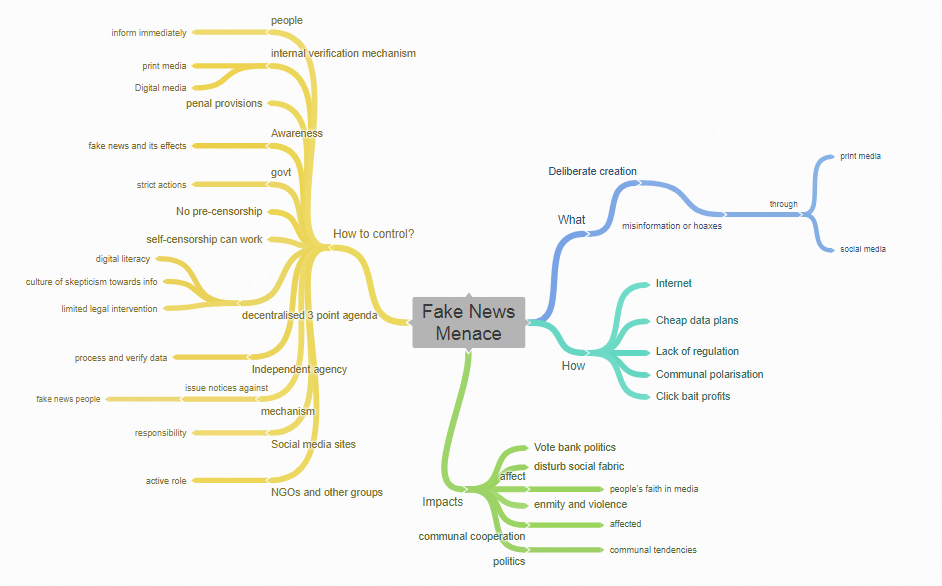
    Fake news refers to the deliberate creation of misinformation or hoaxes spread via traditional print and broadcast news media or online social media shaping the belief of people around the nation and world.

    What gives rise to the fake news?

    1. Lack of regulation – The online platforms, unlike the mainstream media, do not fall under comprehensive regulation. A number of online news/information portals are being set up due to the lack of proper entry barriers. The lack of binding rules and the ability to keep owners and editors private, offers a larger scope for wrongdoing in case of online platforms.
    2. Communal polarisation – The growing polarisation of society on ideological lines has made the job of spreading fake news easier. Also, the spread of hatred-inducing content among leaders/groups of the opposing ideologies, further deepens the prevailing communal hatred.
    3. Reach – In the past, communal violence in India was more a localised affair. However, in recent days it is extensively being triggered through the Internet on a much larger scale. The online and mobile platforms serve like nodal agencies distributing unverified information.
    4. Quick gains – Spreading false news is becoming a way to make advertising money through click baits. In India, numerous sites are being set up to commercialise fake news with click-bait headlines. Users are enticed with multiple link pages to click and continue reading making the content go viral.
    5. Cheap data plans – The proliferation of technology, cheap smartphones, and reasonable data rates has enabled the democratization of online content. The flip side is that the speed of content distribution has made traditional journalistic controls of verification unfeasible.

    Why is fake news dangerous?

    1. People’s faith in social, print and electronic media reduces which could affect the benefits of these Media.
    2. It can lead to violence between two or more communities thereby creating enmity and hatred between them.
    3. It can disturb the social fabric of the society and tensions among communities persists for long times.
    4. It reduces the tendencies of cooperation between different communities.
    5. Political parties try to gain political advantages by polarizing the voter’s mind which further intensifies the tensions between different sections of society.
    6. Politics of development takes back seat and communal tendencies emerge in politics.
    7. In its purest form, fake news is completely made up, manipulated to resemble credible journalism and attract maximum attention and, with it, advertising revenue.
    8. Political campaigning has progressed from mere appeals in the name of identity or loyalty or tall promises to something akin to psychological warfare. Parties that master the tools of such psych ops have a distinct edge over those stuck in the traditional mud. Fake news spreads on social media.

    How can we control the fake news menace?

    Pre-Censorship is Impossible

    1. Pre-censorship of news and information, while being virtually impossible due to the speed of content creation, will also violate the guarantee of free speech under Article 19(1)(a) of the Constitution.
    2. On the one hand, such legislation could divest individuals of autonomy.
    3. On the other, it could bolster the power of the government to censor opinions it is uncomfortable with.
    4. Any screening in the context of social media applications such as WhatsApp could also violate the fundamental right to privacy recognized by the Supreme Court.

    Self- Censorship can work

    1. A cautionary approach warrants avoiding overarching regulation in the form of anti-fake news legislation, irrespective of the benignity of its motivations.
    2. Entrusting a judge, the state or companies like Facebook with the task of making an evaluation of veracity will facilitate judicial, government or private censorship.
    3. This can breed a chilling effect and self-censorship.

    A decentralized three-point agenda to address fake news

    • To ensure critical media literacy, with critical digital literacy as a component.
    1. This would focus on encouraging individuals to learn the skills required to navigate the internet and question the content they are exposed to.
    2. Users should understand the limitations of digital media.
    3. Full Fact and Facebook’s toolkit offer useful suggestions about this. Design changes to social media platforms that flag content can also be incorporated.
    • To nurture a general culture of scepticism among citizens towards information
    1. Good practices, such as verifying the source of the news and corroboration with related news, ought to be advanced in schools and through public education campaigns.
    2. The role of the district administration and local community leaders is key in this regard.
    3. Heartening examples such as the Satyameva Jayate programme in Kannur schools and initiatives by the superintendent of police in Gadwal demonstrate the potential of such an approach.
    • Limited Legal Interventions can be explored
    1. In a limited set of situations, such as when there is threat to life or national security, targeted and proportionate legal interventions can be explored.
    2. They should account for existing speech offences to avoid overlap.
    3. Despite their own flaws, existing provisions on hate speech, sedition and defamation already deal with certain kinds of harm that may be substantially similar to those posed by fake news.

    Other steps Which Government can take

    1. The government must take the initiative to make all sections of the population aware of the realities of this information war and evolve a consensus to fight this war. It must also take strict action
    2. News being spread using chatbots and other automated pieces of software should automatically be selected for special screening. Ordinary consumers of news can play a big role by, first, waking up to the reality that all they read on WhatsApp and Twitter is not the gospel truth, and then, by refusing to pass on what they cannot independently verify with other sources.
    3. Websites that mimic well-known, credible media outlets in their name should be exposed with the vigour with which jokes are shared on social media.
    4. Government should have independent agency to verify the data being circulated in social and other media. The agency should be tasked with presenting real facts and figures.
    5. Government should have mechanism for immediately issuing of notice against sites/people/agencies involved in spreading fake news.
    6. There should be a provision of effective balances and check of filtering fake posts before it getting viral.
    7. Social media websites should be made accountable of such activities so that it becomes their responsibility to have better controlling restricting the spread of fake news.
    8. Government should take active measures for promoting awareness among people about fake news and their consequences.
    9. Government should enlist penal provisions to perpetrators of fake news if it causes violence or deaths.
    10. Government should make mandatory for Print and Electronic media to have internal mechanism for verifying incidents, facts and figures.
    11. Public should verify the accuracy and of reliability of any news or data either from government or any independent agency specifically involved in such task.
    12. Public should not blindly trust any sensitive news and should not forward it to others.
    13. Public should inform concerned department about any fake post as soon as they come across. They should act as active vigilant for maintaining peace and harmony in the society.
    14. NGO’s and other civil society groups can play important role in spreading awareness about the ill effects of fake news.

    Question

    1. In the post-truth world, digitisation and fake news has become a deadly combo. Discuss. What steps can be taken to counter the menace?
  • [Burning Issue] Electoral Bonds

    Government notifies electoral bonds for political donations

    Why in news?

    1. Details such as denominations, validity, and eligibility of the purchasers were announced by Finance minister for the electoral bonds scheme announced during the 2017 Budget
    2. Electoral bonds will allow donors to remain anonymous and pay political parties using banks as intermediaries

    Highlights of the scheme

    • Electoral bonds would be a bearer instrument in the nature of a promissory note and an interest-free banking instrument
    • A citizen of India or a body incorporated in India will be eligible to purchase the bond
    • Electoral bonds can be purchased for any value in multiples of ₹1,000, ₹10,000, ₹10 lakh, and ₹1 crore from any of the specified branches of the State Bank of India
    • The purchaser will be allowed to buy electoral bonds only on due fulfillment of all the extant KYC norms and by making payment from a bank account
    • The bonds will have a life of 15 days (15 days time has been prescribed for the bonds to ensure that they do not become a parallel currency)
    • They can be used to make donations to registered political parties that have secured not less than 1% of the votes polled in the last election to the Lok Sabha or Assembly
    • The bonds shall be available for purchase for a period of 10 days each in the months of January, April, July, and October, with an additional 30 days to be specified by the Central government in the year of a general election
    • The bond shall be encashed by an eligible political party only through a designated bank account with the authorized bank

    Why is the name of the donor not being disclosed?

    • Bonds would get reflected in the balance sheet of the donors
    • Currently,  for a very large part of donation coming to political parties by the donors, quantum and source is not known
    • The past experience has shown that once the names are disclosed, there is a tendency to shift to cash donations.
    • Bonds will ensure cleaner money coming from donors, cleaner money coming to political party and ensure significant transparency

    Why was this scheme brought?

    • To ensure that the funds being collected by the political parties is accounted money or clean money
    • It will also boost digital transactions

    Concerns

    • While the identity of the donor is captured, it is not revealed to the party or public. So transparency is not enhanced for the voter.
    • Also income tax breaks may not be available for donations through electoral bonds. This pushes the donor to choose between remaining anonymous and saving on taxes.
    • Also, privacy of the donor is compromised as the bank will know their identity.
    • The opposition has pointed out that the bonds will help any party that is in power because the government can know who donated what money and to whom.
    • It can tantalize the buyer of the bond into trading in it for profit. An example is in order. Suppose a company (not an honest one) buys bonds worth Rs 200 crore from a designated branch of the SBI. Remember electoral bonds can remain in circulation for 15 days before they find their way into a political party’s coffers. It is during this crucial period that danger lurks. Suppose a moneybag wanting anonymity is on the prowl and there is a sympathetic political party hungering for his munificence? What would happen? Well, he would buy the bonds for Rs 225 crore by paying cash to the original subscriber. Who could have thought the docile electoral bonds would electrify further the hurly-burly world of black money? In other words, there could be two owners of these bonds in the short time period of 15 days they are allowed to circulate without hindrance. Who knows there could be a third within the above example of a Johnny-come-lately offering Rs 230 to the buyer in the black market?

    Way forward

    • Former Chief Election Commissioner S.Y. Quraishi has suggested an alternative worth exploring
    • A National Electoral Fund to which all donors can contribute
    • The funds would be allocated to political parties in proportion to the votes they get.
    • Not only would this protect the identity of donors, it would also weed out black money from political funding.
    • There can be a tax benefit for those who donate to the fund

    Question

    1. Will the electoral bonds scheme be successful in achieving the coveted objective of transparency in political funding? Critically analyse.
  • [Burning Issue] DNA Technology (Use and Application) Regulation Bill, 2018

    Image result for DNA Technology (Use and Application) Regulation Bill 2018.

    Why in news

    The Union Cabinet has approved The DNA Technology (Use and Application) Regulation Bill 2018.

    Key features of the Bill

    1. It allows law enforcement agencies to collect DNA samples, create “DNA profiles” and special databanks for forensic-criminal investigations.
    2. It states that all DNA data, including DNA samples, DNA profiles and records, will be only used for identification of the person and not for any other purpose.
    3. It creates DNA Profiling Board (DPB) that will be the final authority that will authorise the creation of State-level DNA databanks, approve the methods of collection and analysis of DNA-technologies.
    4. It makes accreditation and regulation mandatory for DNA laboratories.
    5. It allows the government to set up DNA databanks across India to store profiles.
    6. These banks will maintain a national database for identification of victims, accused, suspects, undertrials, missing persons and unidentified human remains.
    7. It also empowers the government to impose a jail term of up to 3 years and fine of up to Rs. 1 lakh on those who leak information stored in such facilities.
    8. It prescribes similar punishment for those who seek information on DNA profiles illegally.

    The objective of the Bill

    1. Forensic DNA profiling helps in offences categorized as affecting the human body and those against property. It includes murder, rape, human trafficking, or grievous hurt and theft, burglary, dacoity.
    2. National Crime Records Bureau (NCRB) put the number of such crimes in excess of 3 lakhs per year. Of these, only a very small proportion is being subjected to DNA testing at present.
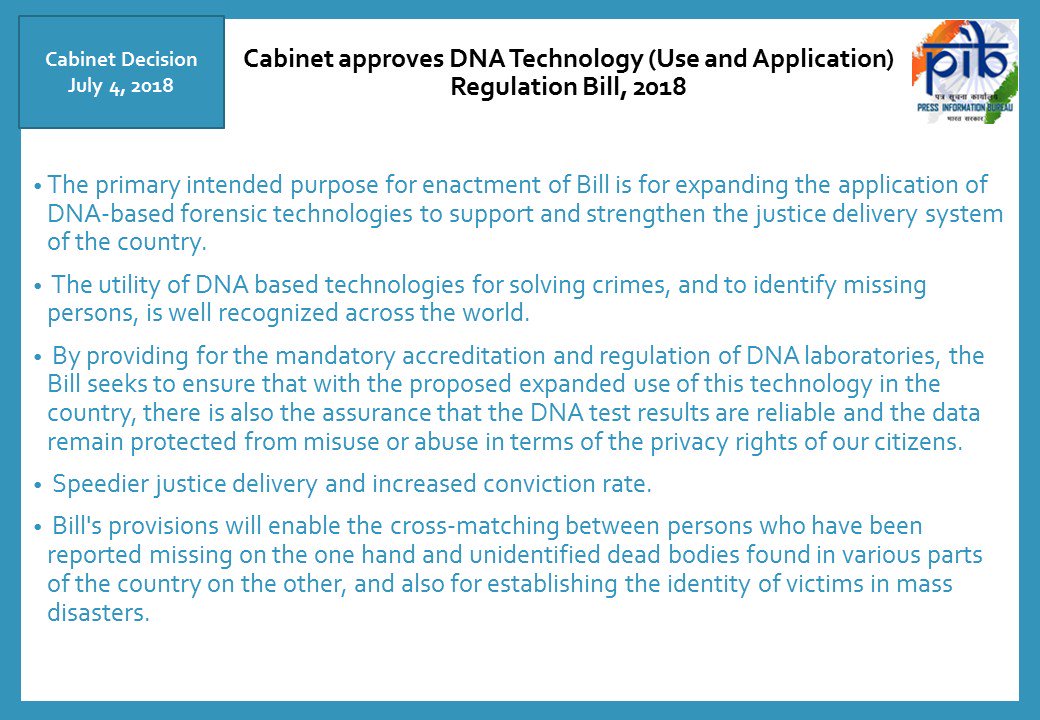
    3. The primary purpose of the Bill is thus to expand the application of DNA-based forensic technologies.

    DNA Profiling Board

    1. The Board, with 11 members, is supposed to be the regulatory authority that will grant accreditation to DNA laboratories and lay down guidelines, standards and procedures for their functioning.
    2. It will advise central and state governments on “all issues relating to DNA laboratories”.
    3. It will also be the authority to make recommendations on ethical and human rights, including privacy, issues related to DNA testing.

    DNA Data Bank

    1. A national databank of DNA profiles is proposed to be set up, along with regional databanks in every state
    2. The new draft does not specify the location of the national databank. All regional DNA databanks will be mandated to share their information with the national databank.
    3. Certain DNA Profiling Board-accredited labs would be authorised to carry out DNA testing and analysis. These are the only places to which DNA samples, picked up from a crime scene can be referred for analysis
    4. Data from the analyses will need to be shared with the nearest regional DNA databank which will store it and share it with the national databank.
    5. The databanks will maintain five sets of databases — for DNA samples picked up from crime scenes, for suspects or undertrials, and for offenders, missing persons, and unidentified dead bodies.

    Significance of Bill

    1. Bill will ensure that with proposed expanded use of DNA profiling technology in the country, there will be also assurance that DNA test results are reliable and data remain protected from misuse or abuse in terms of the privacy rights of our citizens.
    2. It will also ensure speedier justice delivery and increased conviction rate.
    3. It will also enable cross-matching between persons who have been reported missing on one hand and unidentified dead bodies found in various parts of the country on other, and also for establishing the identity of victims in mass disasters.
    4. It will set in place, an institutional mechanism to collect and deploy DNA technologies to identify persons based on samples collected from crime scenes or for identifying missing persons.
    5. The aggregate incidence of such crimes in the country, as per the statistics of the National Crime Records Bureau (NCRB) for 2016, is in excess of 3 lakhs per year.
    6. Of these, only a very small proportion is being subjected to DNA testing at present.
    7. It is expected that the expanded use of this technology in these categories of cases would result not only in speedier justice delivery but also in increased conviction rates, which at present is only around 30% (NCRB Statistics for 2016).

    Criticisms

    1. The main issue is whether DNA technology is foolproof, and whether the proposed law adequately addresses the possibility of abuse.
    2. It has been argued that although DNA technology is the best method available to carry out this kind of identification, it is still probabilistic in nature.
    3. There are chances, however remote, that a wrong match is generated. If the DNA result is taken as the ultimate evidence, no recourse will be available to an individual who has been wrongly matched.
    4. More frequently asserted are the privacy-related objections. Questions such as whose DNA can be collected and under what circumstances, whether the consent of the individual is required, who can access the database, to what uses the DNA information can be put apart from identifying an individual, and the circumstances under which a record can be deleted, have been raised repeatedly.
    5. It has been pointed out that information like ancestry or susceptibility to a disease, or other genetic traits, is liable to be misused.
    6. It has also been argued that DNA tests have not led to an improvement in conviction rates in countries where it is already being followed.

    Way forward

    1. Privacy issue can be handled by adopting the best practices from the world. The Bill does not set a limit to how long someone’s DNA will keep on record. In countries like UK, DNA data of a recordable offence can be kept for only six year.
    2. The Law Commissions report related to scientific collection of data need to be incorporated.
    3. Maintenance of strict confidentiality with regard to keeping of records of DNA profiles and their use as recommended by Malimath report can be followed.
    4. Safeguard to prevent illegal collection and use of DNA data as stated by A. P. Shah Committee.
    5. Need for robust process and structure for collection of DNA samples from crime scene to the laboratory for analysis, to the DNA Bank for storage and comparison.

    Question

    1. Highlighting its key features, critically examine the DNA Technology Regulation Bill 2018. Suggest reforms, if any.
  • [Burning Issue] Amendment in Plastic Waste Management Rules

    Image result for Amendment in Plastic Waste Management Rules

    Change in Plastic Waste Management Rules

    1. The Union ministry of environment, forest and climate change amended the Plastic Waste Management Rules (2016)
    2. According to the amendment, manufacturers, suppliers, and sellers of plastic (and plastic products) across the nation will now be required to phase out, over a period of two years, all such products which have no alternative use or are non-recyclable and non-energy recoverable
    3. This move was preceded by a state-wide ban in Maharashtra on the manufacture, usage, sale (wholesale and retail), distribution, storage and import of plastic bags and all disposable products made out of plastic

    What comprises Plastic waste? What are its components?

    1. The plastics waste constitutes two major categories of plastics – Thermoplastics and Thermoset plastics.
    2. Thermoplastics constitute 80% and Thermoset constitutes approximately 20% of total post-consumer plastics waste generated in India.
    3. The Thermoplastics are recyclable plastics which include; Polyethylene Terephthalate (PET), Low-Density Poly Ethylene (LDPE), Poly Vinyl Chloride (PVC), High-Density Poly Ethylene (HDPE), Polypropylene(PP), Polystyrene (PS) etc.
    4. The Thermoset plastics contains alkyd, epoxy, ester, melamine formaldehyde, phenol formaldehyde, silicon, urea formaldehyde, polyurethane, metalized and multilayer plastics etc.

    Need for this step

    1. India has an uninspiring record when it comes to handling waste
    2. India’s plastic waste is estimated officially at 26,000 tonnes a day
    3. If the Centre and the States had got down to dealing with the existing regulations on plastic waste management and municipal solid waste, a ban would not even have become necessary.
    4. Specifications for the recycling of different types of plastics were issued two decades ago by the Bureau of Indian Standards but it was not implemented on the ground
    5. It is stated that 15, 000 tonnes of plastic waste is generated every day, out of which 9, 000 tonnes is collected and processed, but 6, 000 tonnes of plastic waste is not being collected.
    6. In particular, the plastic carry bags are the biggest contributors of littered waste and every year, millions of plastic bags end up in to the environment vis-a-vis soil, water bodies, water courses and it takes an average of one thousand years to decompose completely.

    Criticisms of this step

    1. To the people employed in the industry, it could mean the shutdown of factories and potential job losses
    2. To the consumer, it would mean choosing between alternatives that are either too expensive, impractical or not as easily available
    3. The unrealistic timeline for the implementation of the plastic ban has caught all stakeholders unawares, making it extremely difficult to comply with.

    Way Forward

    NUDGING CONSUMERS

    1. The government can nudge rather than coerce citizens to demand and use less plastic
    2. One way of doing this would be to give discounts to customers who bring their own bags, or reward points for not requesting a plastic bag—as opposed to fining, penalizing, or charging high prices
    3. Another nudge, which has been extremely successful globally in donation scenarios, is the “opt-out model”. Here, customers would by default be considered as opted-in for non-plastic items, forcing them to manually opt-out to choose otherwise.

    Conclusion

    1. Plastics became popular because they are inexpensive, can be easily produced and offer great convenience
    2. Their wild popularity has turned them into a scourge
    3. We need substitutes for plastic, incentives to re-use, and better waste disposal

    Question

    1. Plastic waste has become a nuisance today. In this context critically discuss the latest amendments to the Plastic Waste Management Rules of 2016. 
  • [Burning Issue] Cashless Economy

    Image result for cashless economy in india

    Introduction

    India continues to be driven by the use of cash; less than 5% of all payments happen electronically, however, the finance minister, in 2016 budget speech, talked about the idea of making India a cashless society, with the aim of curbing the flow of black money.

    Even the RBI has also recently unveiled a document — “Payments and Settlement Systems in India: Vision 2018” — setting out a plan to encourage electronic payments and to enable India to move towards a cashless society or economy in the medium and long-term.

    What is a cashless economy and where does India stand?

    A cashless economy is one in which all the transactions are done using cards or digital means. The circulation of physical currency is minimal.

    India uses too much cash for transactions. The ratio of cash to gross domestic product is one of the highest in the world—12.42% in 2014, compared with 9.47% in China or 4% in Brazil.

    Less than 5% of all payments happen electronically

    The number of currency notes in circulation is also far higher than in other large economies. India had 76.47 billion currency notes in circulation in 2012-13 compared with 34.5 billion in the US.

    Some studies show that cash dominates even in malls, which are visited by people who are likely to have credit cards, so it is no surprise that cash dominates in other markets as well.

    http://letstalkpayments.com/wp-content/uploads/2015/10/Cashless-Society.png

    Benefits of Cashless economy

    1. Reduced instances of tax avoidance because it is financial institutions based economy where transaction trails are left.
    2. It will curb the generation and circulation of black money as all electronic transactions are traceable.
    3. Will reduce real estate prices because of curbs on black money as most of the black money is invested in Real estate prices which inflates the prices of Real estate markets
    4. In the Financial year 2015, RBI spent Rs 27 billion on just the activity of currency issuance and management. This could be avoided if we become a cashless society.
    5. It will pave way for low cost and universal banking services to all as no physical infrastructure is needed other than digital.
    6. There will be greater efficiency and transparency in welfare programmes as money is wired directly into the accounts of recipients.
    7. There will be significant productivity gains as transaction costs across the economy should also come down.
    8. About 14% notes are reported to be fake, which has a huge negative impact on the economy, by going cashless, that can be avoided.

    Challenges in making India a cashless economy

    1. Availability of internet connection and financial literacy.
    2. Though bank accounts have been opened through Jan Dhan Yojana, most of them are lying un-operational. Unless people start operating bank accounts cashless economy is not possible.
    3. There is also a vested interest in not moving towards the cashless economy.
    4. India is dominated by small retailers. They don’t have enough resources to invest in electronic payment infrastructure.
    5. The perception of consumers also sometimes acts a barrier. The benefit of cashless transactions is not evident to even those who have credit cards. Cash, on the other hand, is perceived to be the fastest way of transacting for 82% of credit card users. It is universally believed that having cash helps you negotiate better.
    6. Most card and cash users fear that they will be charged more if they use cards. Further, non-users of credit cards are not aware of the benefits of credit cards.
    7. Indian banks are making it difficult for digital wallets issued by private sector companies to be used on the respective bank websites. It could be restrictions on using bank accounts to refill digital wallets or a lack of access to payment gateways. Regulators will have to take a tough stand against such rent-seeking behaviour by the banks.

    Steps taken by RBI and Government to discourage use of cash

    1. Licensing of Payment banks
    2. Government is also promoting mobile wallets. Mobile wallet allows users to instantly send money, pay bills, recharge mobiles, book movie tickets, send physical and e-gifts both online and offline. Recently, the RBI had issued certain guidelines that allow the users to increase their limit to Rs 1,00,000 based on a certain KYC verification
    3. Promotion of e-commerce by liberalizing the FDI norms for this sector.
    4. The government has also launched UPI which will make Electronic transaction much simpler and faster.
    5. The government has also withdrawn surcharge, service charge on cards and digital payments
    6. The launch of BHIM APP
    7. A discount of 0.75 per cent will be offered on purchase of petrol and diesel through either credit/debit cards, e-wallets and mobile wallets.
    8. Credit/debit card transactions up to Rs 2,000 will be exempt from service tax.
    9. Online booking of railway tickets will get Rs 10-lakh accident insurance.
    10. 1 lakh villages with population less than 10,000 will get 2 PoS machines (swipe machines) each, free of cost supported through financial inclusion fund.
    11. Demonetization (Will be dealt in a separate article)

    Image result for cashless economy in india

    What else needs to be done?

    1. Open Bank accounts and ensures they are operationalized.
    2. Abolishment of government fees on credit card transactions; reduction of interchange fee on card transactions; increase in taxes on ATM withdrawals.
    3. Tax rebates for consumers and for merchants who adopt electronic payments.
    4. Making Electronic payment infrastructure completely safe and secure so that incidents of Cybercrimes could be minimized and people develop faith in the electronic payment system.
    5. Create a culture of saving and faith in the financial system among the rural poor.
    6. The Reserve Bank of India too will have to come to terms with a few issues, from figuring out what digital payments across borders means for its capital controls to how the new modes of payment affect key monetary variables such as the velocity of money.
    7. RBI will also have to shed some of its conservatism, part of which is because it has often seen itself as the protector of banking interests rather than overall financial development.
    8. The regulators also need to keep a sharp eye on any potential restrictive practices that banks may indulge in to maintain their current dominance over the lucrative payments business.

    Though it will take time for moving towards a complete cashless economy, efforts should be made to convert urban areas into cashless areas. As 70% of India’s GDP comes from urban areas if the government can convert that into cashless it will be a huge gain. Therefore different trajectories need to be planned for migration to cashless for those having a bank account and for those not having.

    Questions

    Q.1) What hurdles exist in making India a cashless economy? Discuss benefits of becoming a cashless economy and suggest how government can speed of this transformation.

    Q.2) What challenges does government face in rural areas in its efforts towards a cashless economy? How could these challenges be overcome?