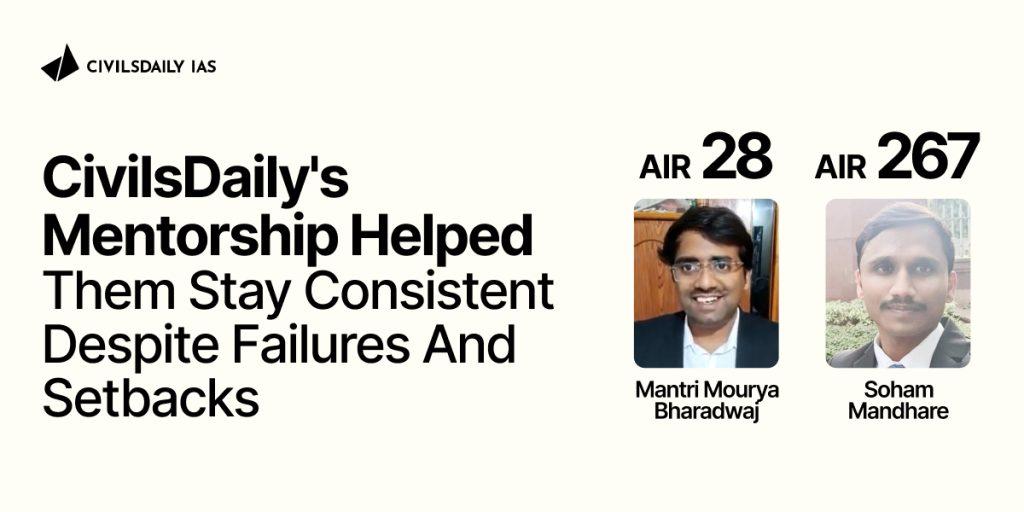
💥Join UPSC 2027,2028 Mentorship (August Batch) + XFactor Notes & Microthemes PDF

Category: Ranker Webinars

  • (WATCH LIVE. Direct link inside) How to approach History and Polity for UPSC – MPSC Prelims 2023? Webinar by Vaibhav Sanas sir, senior IAS faculty

    (WATCH LIVE. Direct link inside) How to approach History and Polity for UPSC – MPSC Prelims 2023? Webinar by Vaibhav Sanas sir, senior IAS faculty

    *Join Zoom Meeting

    https://us06web.zoom.us/j/81520503561?pwd=SHFQRXVtSmxQZXZhNmd0VXBaZ2hEZz09

    Meeting ID: 815 2050 3561

    Passcode: 413618

    4th January at 1 PM | Webinar by Vaibhav Sanas sir, senior IAS faculty | How to approach History and Polity for UPSC – MPSC Prelims 2023? | Get PDFs of Practice MCQs


    Whether it is MPSC or UPSC, Soon we’ll be seeing THE SUNDAY you’ve been preparing for months and years: May 28th, 2023. For many, it will be the very first MPSC/UPSC Prelims exam. For the majority, it will be their 2nd/3rd, or 4th attempt.

    In the MPSC/UPSC Prelims exam, History and Polity, Economics carries almost 40% of the weight in terms of syllabus and questions.

    To score 120+ in Prelims, 2023 aspirants must focus on mastering concepts and current affairs related to these subjects on a priority basis.

    Vaibhav Sanas sir will be discussing the most effective way of approaching these 2 vast and essential subjects of the History and Polity syllabus, how to cover through MCQs that are based on Previous year’s questions, and the current trends of the MPSC/UPSC.


    Strategies & Approaches, in This History-Polity Session by Vaibhav Sanas sir

    1. Strategy to cover one of the core subjects History & Polity, through the most probable MCQs with timetable and timelines. Balancing current affairs and static for these two will be discussed.
    2. The Best, minimum NCERT materials and standard books for Polity Preparation.
    3. Covering and connecting current affairs for the last 1.5 years with this core subject, linked to History & Polity.
    4. Important topics and concepts for Indian Polity & Modern Indian History– the core of the core subjects
    5. The subjects of Indian Polity + Indian HIstory cover India’s current and past political aspects, which makes it an important topic. Knowing its fundamentals is crucial for UPSC exams. So, What is to be learned by heart & which NCERTs and standard books are fit for the polity will be comprehensively discussed through special MCQs.
    6.  The untold secret of ‘how & from where UPSC asks direct questions from NCERTs. How to mark those core areas in NCERTs is going to reveal in this awesome session.

    What The Hindu mentioned about Civilsdaily Mentorship

    Webinar masterclass on 4th Jan 2023, Wednesday
  • Day 2| Daily Answer Wars| CD WarZone

    Topics for Today’s question:

    GS-1         Effects of globalization on Indian society.

    Question:


    HOW TO ATTEMPT ANSWERS IN DAILY ANSWER WARS (DAW)?

    1. Daily 1 question either from General Studies 1, 2, 3 or 4 will be provided via live You Tube video session.
    2. You can write your answer on an A4 sheet and scan/click pictures of the same.
    3. The answer needs to be submitted by joining the telegram group given in the link below.

      https://t.me/cdwarzone

    *In case your answer is not reviewed, reply to your answer saying *NOT CHECKED*. 

    1. For the philosophy of Daily Answer Wars and payment: 
  • [Sansad TV] Perspective: Demonetization Verdict

    [Sansad TV] Perspective: Demonetization Verdict

    Context

    • More than six years after the Centre’s decision to demonetise the Rs 1,000 and Rs 500 denomination notes in 2016, the Supreme Court in a 4:1 majority verdict, has upheld the move.

    SC upholds Demonetization decision

    demonetization
    • Constitutionally valid: The Supreme Court ruled that the decision to scrap the high-value currency notes does not suffer from any legal or constitutional flaw.
    • Valid intention: The judgment said the decision-making process was not flawed merely because the procedure emanated from the government.
    • No overnight phenomena: The decision came up after six month consultation between the Reserve Bank of India and the Union government.
    • Executive decision: The top court also observed that the decision being the executive’s economic policy cannot be reversed.

    What is Demonetization?

    • Demonetization is the process through which a nation’s economic unit of exchange loses its legally enforceable validity.
    • Currencies that are terminated are no more legally considered exchanges and have no financial value.
    • It is a process by which countries opt to reintroduce defunct currencies as legal money.

    Demonetization in India

    2016 is not the first instance of demonetization in India. 

    1. 1946: The RBI demonetized Rs. 1,000 and Rs. 10,000 currency notes which were then under circulation.
    2. 1954: The Government introduced new currency notes of Rs. 1,000, Rs. 5,000, and Rs. 10,000.
    3. 1978: The Janata Party Government under Morarji Desai demonetized Rs. 1,000, Rs. 5,000, and Rs. 10,000 to curb illegal transactions and anti-social activities.

    Reasons behind Demonetization

    While demonetization is exceptional, governments around the globe have used it because of several reasons-

    • Formalization of Economy: Demonetization helps formalize India’s informal economy. It reduces the extent of cash transactions and help in the creation of a less-cash economy.
    • Inflation control: If problems like hyperinflation happen in any country, then the government considers demonetization as a solution to take back control and minimise the adverse situation.
    • Increased Saving: As a result of demonetization, people will tend to deposit their cash in the bank rather than at home. This will help them save more.
    • Eliminating counterfeit currency: Some negative situations or actions like counterfeit currency, terror, and tax fraud can all be eliminated with demonetization.
    • Introducing new system: Demonetization is also used to introduce a new monetary system in some circumstances.
    • Fight corruption: Demonetization is used to improve a cash-based emerging economy as well as fight corruption and criminality.

    Pros and cons of Demonetization

    [A] Pros

    Governments can benefit from currency demonetization in several different ways, from preventing and reducing criminal activity to currency regulation. Below are the advantages of demonetization.

    • Increased money outflow
    • Increased revenue collection
    • Reduced conspicuous consumption
    • Curb over criminal activities and terror financing
    • Forbid tax avoidance and other financial crimes
    • Contributed to the dawn of paperless financial system and UPI
    • Ensured transparent funding of elections and election expenditures

     [B] Cons

    Some disadvantages of demonetization are stated below.

    • Furore and Panic among the general public ex. Long queues in Banks and ATMs
    • Disruption in economic activity and daily expenses
    • Supply-chain disruptions
    • Drop in rural demand
    • Black marketing of the new notes/ Old notes replacement mafias
    • Expenses issuing new currency and coinage minting can be high
    • Illegal activity will not be stopped entirely
    • May create disturbances among individuals

    A critical evaluation

    • Black money is not just cash: The sudden demonetization was premised on the idea that “black means cash”. And, it is in high-denomination currency notes that black money would be held.
    • Benami transactions whitens black money: The truth is that illegal cash transaction, though black money, constitute a very small proportion of the black economy.
    • Much cash was accounted:  Much of the prospected cash in circulation including a major chunk of ‘black money’ was collected back by the RBI.
    • Wealth is dispersed: The wealth is held in a variety of forms like, in undervalued inventory or balances held in tax havens abroad. A return is expected from this wealth. So, cash, on which there is no return, would be a tiny amount – 1% of the black wealth.
    • Schemes were exploited: Deposits in Jan Dhan accounts suddenly swelled as the poor were used as cash mules. Some bankers were caught helping their rich clients do this. There was a 30% charge for this. As a result, new black incomes got generated.
    • Suspicion over timings: Some suggested that demonetization was ordered for political reasons – that it was crucial to win the impending UP elections. It was thought that if the Opposition lost its black-money hoards, it would not be able to campaign effectively.
    • Bluff over objectives: Within days, the government changed the goalpost. It argued that the move would make the economy “cashless”. After few months, the goal became a “less cash economy”.
    • Fuss over fastest growth: Official data showed that the year of demonetization, 2016-’17, had the best growth rate for the decade. The reason is that unorganised sector data is not available so the GDP data uses the organised sector as a proxy to capture it.
    • Embraced as failure: Demonetisation is perceived as an ill-advised step that did not achieve any of its goals. The ruling party understood this and did not showcase it as an achievement in the subsequent elections.

    How demonetization affected the poor?

    • Market vendors had to shut down their shops: Typically, market vendors farm on a daily basis and sell their production. The drop in customer traffic, however, forced the market vendors to shut down their shops.
    • Informal sector collapsed: Informal workers including domestic help, agricultural laborers, workers in factories, micro-business owners, daily-wage workers, etc. receiving their salary in cash were severely disadvantaged.
    • Household expenses distorted: Typically, working class people have basic jobs with fairly low wages. Due to the fact that there is a shortage of cash flow, many low-income workers experienced delayed salary payments.
    • Income loss to farmers: Disruptions, breaks in the supply chains feedback to farmers as sales fall, increased wastage of perishables, lower revenues etc.
    • Gendered impact: Demonetization amplified the inherent discrimination against women in Indian society who are financially excluded. Same was the case with sex workers and transgenders.

    Conclusion

    • Demonetization brought about a policy-induced crisis for the country, adversely impacting the marginalized sections of society – women, farmers and workers – while doing little to curb the black economy.
    • However, it can be termed as a good intended policy with hasty execution.
  • Day 1| Daily Answer Wars| CD WarZone

    Topics for Today’s question:

    GS-1         Salient features of Indian society; Diversity of India

    Question:


    HOW TO ATTEMPT ANSWERS IN DAILY ANSWER WARS (DAW)?

    1. Daily 1 question either from General Studies 1, 2, 3 or 4 will be provided via live You Tube video session.
    2. You can write your answer on an A4 sheet and scan/click pictures of the same.
    3. The answer needs to be submitted by joining the telegram group given in the link below.

      https://t.me/cdwarzone

    *In case your answer is not reviewed, reply to your answer saying *NOT CHECKED*. 

    1. For the philosophy of Daily Answer Wars and payment: 
  • [Sansad TV] Perspective: Draft National Retail Trade Policy, 2022

    [Sansad TV] Perspective: Draft National Retail Trade Policy, 2022

    Context

    What is Retail Trade?

    retail
    • Retail trade is the selling of products and services to customers and includes all the aspects of the sale, such as installation, delivery and customer service.
    • In the context of commerce, retail must be a transaction between a business and a consumer.
    • If a local hardware store buys nails from a manufacturer, it is not a retail transaction.
    • An important term that is associated with retail trade is end-user. An end-user is the person or group who actually uses the product.

    Components of retail trade

    • Wholesalers: Wholesalers are companies that buy large quantities of a product from the manufacturer and then sell them to retail stores. They are often called middlemen because they operate between the companies that manufacture goods and the companies that sell them to consumers.
    • Shipping: When a product is purchased from a manufacturer, it needs to get to the wholesaler and eventually to the retailer. Shipping is a big part of retail trade. Whether the shipping is bulk transport of goods from wholesaler to retailer or small shipments from retailer to consumers, shipping plays a vital role.
    • Service: When consumers purchase certain products for their home that require installation, the install process is part of retail trade. The same goes for the customer service that a consumer might need after they purchase the product or the repair service that might be required on a product that breaks.
    • Sales: One of the most important parts of retail is the front-end sales of the products. Successful retail involves people with knowledge of the products who can communicate with the consumers.

    Features of Retail Trade

    The main characteristics of retail trade are:-

    • Retailer is the last link in the distribution chain.
    • Goods or services are sold directly to consumers by the retailer.
    • Retailer deals with a wide range of goods.
    • Retailer buys and sells a little number of products.
    • Retailer maintains personal relations with the customers.
    • Retailer is generally located in residential areas.
    • Retailer may contact the customers on telephone, Internet, TV or through his retail showroom.
    • Retailer acts as a middleman between wholesalers and customers.

    Why discuss this?

    • Make targeted efforts: This policy would focus on formulating strategies to provide a globally competitive and sustainable environment for the overall development of retail trade through targeted efforts.
    • Huge domestic market: India is the world’s fifth-largest global destination in the retail space.
    • Growth potential: According to a US-based report, the retail industry in India is likely to see 10 per cent annual growth to reach about USD 2 trillion by 2032.
    • Employment generation potential: Another report by CII-Kearney released in 2020 a cohesive national retail policy can help generate 30 lakh more jobs by 2024.

    Major challenges to retail sector

    • Unorganized market: India’s market for retail trade is largely unorganized. It lacks proper formal chains except few giants such as D-Mart.
    • High complexities:  A number of laws, compounded by state-level variations in implementation, create immense complexity for retailers, especially those with a pan-Indian footprint.  
    • Regulatory bottlenecks: If one has to set up a store in organized retail, we probably need approvals from 40 different authorities. Single window clearance could be largely beneficial.
    • Ignores e-commerce: While recognizing that retail trade in India is gaining strength because of e-commerce, this new draft is not applicable for e-commerce, multi-level marketing, direct selling or street vendors.

    About National Retail Trade Policy

    • The policy has been envisioned by DPIIT to formulate the national retail policy to promote the growth of domestic trade.
    • It focuses on formulating strategies to provide a globally competitive and sustainable environment for overall development of retail trade through targeted efforts.
    • The broad objectives of the policy are:
    • Ensuring easy and quick access to affordable credit.
    • Facilitating modernization and digitization of retail trade by promoting modern technology and superior infrastructural support.
    • Development of physical infrastructure across the distribution chain.
    • Promotion of skill development and to improve labour productivity.
    • Providing an effective consultative and grievance redressal mechanism for the sector. 

    Significance of the policy 

    • Promote EODB: This policy will streamline the retail trade and promote ease of doing business in the retail trade sector. 
    • Skill enhancement: It will encourage skill development and create more employment opportunities for all sections of society involved in retail trade.
    • Infrastructure boost: It will identify and address existing infrastructure gaps affecting the retail trade industry.
    • Employment boost: It will leverage retail trade as a tool for socioeconomic development of the country. A cohesive national retail policy can help generate 30 lakh more jobs by 2024. 
    • Investment inflows: It will accelerate investment flow to underdeveloped regions across the country. The retail industry is likely to see 10 percent annual growth to reach about USD 2 trillion by 2032. 
    • Promoting small retailer: It will create a level-playing field for small sellers by providing them access to credit as well as help large, organized retailers with quicker approvals.

    Conclusion

    • A cohesive retail policy built on the pillars of simplification, standardization, and digitalization will pave the way for significant growth and accelerate a short-term economic recovery. 
    • The policy is expected to lay down broad contours of a “prescriptive” framework and States will also have a key role in implementation.

    Crack Prelims 2023! Talk to our Rankers

    (Click) FREE 1-to-1 on-call Mentorship by IAS-IPS officers | Discuss doubts, strategy, sources, and more

  • Let’s Celebrate New Year and CivilsDaily’s Foundation week | 50% OFF on the UPSC Foundation 2023 program | Hurry!🎁The offer ends on 7th January.

    Let’s Celebrate New Year and CivilsDaily’s Foundation week | 50% OFF on the UPSC Foundation 2023 program | Hurry!🎁The offer ends on 7th January.

    Call directly and avail 50% discount +91 7303316700

    CivilsDaily wishes you a Happy New Year! We hope this new year brings you all the joy, prosperity, and success you deserve. Thank you for being a part of our learner community and for your continued support. We look forward to an exciting year ahead and can’t wait to see what the future holds. Here’s to a fresh start and endless possibilities. Wishing you a happy and healthy new year.


    As a token of appreciation for our students and to mark the occasion, we are offering upto 50% discount on UPSC CSE Foundation 2023 courses, and 30% off on all other UPSC courses: Prelims, Mains, Current Affairs, and more.

    Whether you’re a UPSC beginner, a veteran, or an aspirant trying to improve your rank, we have something for everyone. And with the added benefit of the discount, now is the perfect time to gear your preparation in the right direction.

    Don’t miss out on this limited-time offer. Enroll in your preferred course today and take the first step towards achieving your goals. We wish you a happy foundation week and a prosperous new year.

    • 🎁50% instant discount on IAS 2023 Foundation Course
    • ✌️30% instant OFF on any other course

    Limited time offer: 1st to 7th January 2023

    Call directly and avail 50% discount +91 7303316700

    🎁Foundation 2023 with Supermentorship: Pre cum Mains

    Foundation 2023 is built with keeping all these things in mind.
    Nothing more. Nothing less.

    What Differentiates Our Foundation Course?

    • EMI Facility Available @ No Extra Cost!
    • UAP & MasterClass are a combo for comprehensive growth.
    • DDS sessions = Marathons for Active Learning.
    • 200+ doubts resolved & 40+ new mini concepts discussed. Every Day. Day after Day.

    Want to talk to us first? Click here to fill out the Samanvay Form and we will get back to you


    🎁Get Excited – Super Offers are opening here

    All other Toppers’ Choice Courses:- ✌️Get 30% OFF

    • Destroy Prelims 2023
    • Essay Essential Program 2023
    • Smash Prelims Program 2023
    • Samachar Manthan 2023
    • Smash Ethics 2023
    • AWE-Answer Writing Enhancement Program

    Want to talk to us first? Click here to fill out the Samanvay Form and we will get back to you

    What Differentiates Our Mentorship Courses?

    Civilsdaily’s Mentorship is clearly one brand that sets us apart from any other institute in this Domain.


    Trusted by Rank 1 & 2:


    This is what our students have to say…

  • Day 12| Daily Answer Wars| CD WarZone

    Topics for Today’s question:

    GS-1         Modern Indian history from about the middle of the eighteenth century until the present – significant events, personalities, issues.

    Question:


    HOW TO ATTEMPT ANSWERS IN DAILY ANSWER WARS (DAW)?

    1. Daily 1 question either from General Studies 1, 2, 3 or 4 will be provided via live You Tube video session.
    2. You can write your answer on an A4 sheet and scan/click pictures of the same.
    3. The answer needs to be submitted by joining the telegram group given in the link below.

      https://t.me/cdwarzone

    *In case your answer is not reviewed, reply to your answer saying *NOT CHECKED*. 

    1. For the philosophy of Daily Answer Wars and payment: 
  • (WATCH LIVE:-Joining Link Inside) CUET 2023 Workshop: All about CUET – pattern, syllabus, and strategy |🎯FREE Registration- Get Free notes and Telegram group link inside

    (WATCH LIVE:-Joining Link Inside) CUET 2023 Workshop: All about CUET – pattern, syllabus, and strategy |🎯FREE Registration- Get Free notes and Telegram group link inside

    Join Zoom Meeting

    https://us06web.zoom.us/j/81631296363?pwd=T2E1VG9RbHVueGVvYm1EQTNrOStxUT09

    Meeting ID: 816 3129 6363

    Passcode: 586567


    4th January, at 5 PM | You won’t want to miss the Dedicated Workshop on CUET 2023 by Sudhanshu sir | FREE Registration Open

    CUET 2023 exam will be held from the 21st to the 31st of May 2023. This is the right time for you should start your preparation for CUET 2023.


    Table of content

    Sudhanshu sir, senior faculty and Program Director for CUET, will be discussing the most important themes according to the nature and syllabus of CUET 2023. This is going to be important if your want to ace CUET 2023

    Often, college is said to be the best time of your life, according to an old saying. While there’s no denying the fun that comes from throwing the craziest themed parties, living on your own, and finally getting a taste of adulthood. College is also the Gateway to a fulfilling career.

    Sudhanshu Mishra.

    CivilsDaily IAS the leading preparatory institute for Civil Services has more than enough reasons to be the best in CUET exam preparation:

    You won’t want to miss the Dedicated Workshop on CUET 2023 | 4th January, at 1 PM | FREE Registration Open

    Click here and join CUET Telegram Link for FREE

    What is CUET?

    CUET 2023 is one of the most prestigious National level entrance exams that cater to thousands of aspirants every year to get admission into various UG (Undergraduate) and PG (Postgraduate) courses in 45 Central Universities. Students give this exam after class 12th.  

    Why is CUET important?

    Since 2022, admissions to more than 45 universities have been made mandatory under CUET constituting many top-tier colleges and institutes like BHU, DU, JNU, etc. 

    Students who couldn’t get into these top colleges and universities can re-appear and take an attempt in CUET 2023.

    Apart from that, CUET provides a common platform & equal opportunities to all candidates across the country and also from rural & remote areas. 


    Workshop Details:

    • 7th January (Saturday) at 1 PM
    • This is open and FREE to all
    • The zoom link will be emailed to you post-registration

    Key takeaways: How to prepare for CUET 2023?

    • Since you have to prepare while still in school how to balance the CUET 2023 preparation with the school syllabus?
    • Moreover, the nature and syllabus of this exam are derived mostly from school subjects, So how to integrate the preparation instead of preparing after board exams?
    • You must have a timetable to help you cover the syllabus on time. So how to schedule tests, give mock tests on scheduled days, do plenty of revision well before the exam and keep yourself up to date with respect to current affairs and GK.
    • Topics like general aptitude and reading comprehension need not only practice but the know-how of skills and techniques to tackle them in the most efficient manner – with speed and accuracy.
    • As the pattern of the exam is a part of the Civil Services Prelims exam (UPSC). Which NCERTs and which other reference books are to be followed?
    • What should be your CUET 2023 approach for the next 5 months even if you have just started the preparation after this Workshop? Strategy for the next 1 week, 1 month, 3 months, and like that, will be shared with you.
    • Selective and smart study through CUET trend-validated topics and themes: 50 Most Important themes for upcoming CUET 2023 that will guarantee your selection in your favorite college.
    • How to Understand the expectations of CUET, and devise an evolving adaptive strategy for CUET 2023. If your strategy didn’t work, how to restrategize will also be elaborated.
    • How to attempt Mock Tests! How to read & revise PYQs. ‘What to read & what not to read?
    • Short-time smart Revision techniques that are common, standard, and used frequently. What exactly are they?
    • How to take full advantage of the FREE CivilsDaily’s Preparatory Package and personalized mentorship session
    • Last but not the least, apart from all the above discussion everyone joining the session can ask their doubts, fear, queries, Etc

    7th January, at 1 PM | FREE Registration Open


    CivilsDaily’s FREE Workshop package

    Post-webinar we will share important PDFs, timetable framework, and notes.

    Other than this a strategy package will be emailed to you.

    7th January, at 1 PM | FREE Registration Open

  • Day 11| Daily Answer Wars| CD WarZone

    Topics for Today’s question:

    GS-1         Modern Indian history from about the middle of the eighteenth century until the present – significant events, personalities, issues.

    Question:


    HOW TO ATTEMPT ANSWERS IN DAILY ANSWER WARS (DAW)?

    1. Daily 1 question either from General Studies 1, 2, 3 or 4 will be provided via live You Tube video session.
    2. You can write your answer on an A4 sheet and scan/click pictures of the same.
    3. The answer needs to be submitted by joining the telegram group given in the link below.

      https://t.me/cdwarzone

    *In case your answer is not reviewed, reply to your answer saying *NOT CHECKED*. 

    1. For the philosophy of Daily Answer Wars and payment: 
  • (WATCH LIVE- Direct link inside) UPSC Mega Workshop Day AIR 267, Soham Mandhare: Most important themes for UPSC Prelims 2023 and strategy for the next 145 days |🎯FREE Registration

    (WATCH LIVE- Direct link inside) UPSC Mega Workshop Day AIR 267, Soham Mandhare: Most important themes for UPSC Prelims 2023 and strategy for the next 145 days |🎯FREE Registration

    Zoom Link:* https://us06web.zoom.us/j/85474503966?pwd=YVk1WC8rU0ZtNmlhSnZrYnZnaGRVUT09

    Meeting ID: 854 7450 3966

    Passcode: 884680

    30th December, at 7 PM | UPSC Mega Workshop Day AIR 267, Soham Mandhare: Most important themes for UPSC Prelims 2023 and strategy for the next 145 days. | FREE Registration Open

    The UPSC 2023 is just knocking at the door. And the Prelims exam is scheduled for May 28th, 2023. That’s just 4.5 months away.

    Acknowledging the high unpredictability, an infallible strategy, and previous years’- based trend analysis is of utmost importance. If you want to crack UPSC with a rank in 2023, no random study in current affairs, nor every chapter from every subject is required. 

    The Best Way of clearing Prelims is to have a clear vision of essential themes,  a plan for dealing with current affairs, and the ability to maintain clarity of the syllabus

    AIR 267, Soham Mandhare

    UPSC Topper AIR 267, UPSC 2021 will be discussing the most important themes from Current Affairs and GS syllabus for UPSC Prelims 2023. These are going to be the most relevant and probable topics for the upcoming prelims.


    Webinar Details:

    • 30th December (Friday) at 7 PM
    • The zoom link will be emailed to you post-registration

    Key takeaways: How to make a timetable for UPSC?

    • Selective and smart study through UPSC trend-validated topics and themes: 50 Most Important themes for UPSC Prelims 2023 that will guarantee your 120+
    • What should be your Prelims 2023 approach for the next 4.5 months even if you have just started the preparation for UPSC 2023? Strategy for the next 1 week, 1 month, 3 months, and like that, will be shared with you.
    • The rock-steady strategy made by Rankers for UPSC Prelims 2023 for the next 4.5 months.
    • How do UPSC rankers pick specific and certain topics both from current affairs and static GK which are more important than the others? How to build a topper’s thinking and how to cover the UPSC syllabus? The syllabus, and not the books, must be completed.
    • Trend analysis of past 6 years’ papers of UPSC Prelims by Soham Mandhare. Lessons to be learned. ‘Pattern Analysis. UPSC is the most dynamic in nature. So, the most important step is to analyze the pattern of the exam. Find ‘Do’s & ‘Don’ts’ in current affairs.
    • How to attempt Mock Tests! How to read & revise PYQs. ‘What to read & what not to read?
    • How to Understand the expectations of UPSC, and devise an evolving adaptive strategy for UPSC 2023 Prelims and Mains. If your strategy didn’t work, how to restrategize will also be elaborated. What should be your approach for the next 4.5 months even if you have just started the preparation? Strategy for the next 1 week, 1 month, 3 months, and like that, will be shared with you.
    • Short-time smart Revision techniques that are common, standard, and used frequently. What exactly are they?
    • How to take full advantage of the FREE CivilsDaily’s Preparatory Package and personalized mentorship session
    • Last but not the least, apart from all the above discussion everyone joining the session can ask their doubts, fear, queries, Etc

    CivilsDaily’s FREE Webinar package

    Post-webinar we will share important PDFs, timetable framework, and notes.

    Other than this a strategy package will be emailed to you.


    What The Hindu opined about Civilsdaily Mentorship

    Karishma Nair, AIR 14 was also Sajal sir’s student
    AIR 65, Pranav mentored under Sajal sir for UPSC 2020
    best coaching for upsc in delhi