💥Join UPSC 2027,2028 Mentorship (July Batch) + XFactor Notes & Microthemes PDF

Category: Ranker Webinars

  • [Sansad TV] Perspective: India’s Soft Power

    Context

    Despite India’s rich history and unrivaled cultural diversity, the country remains hampered by the lack of a comprehensive soft power strategy, said the Parliamentary standing committee on external affairs. 

    What is Soft Power?

    • In politics (and particularly in international politics), soft power is the ability to co-opt rather than coerce (contrast hard power).
    • It is the capacity to attract and persuade others to do things they otherwise wouldn’t.
    • It involves shaping the preferences of others through appeal and attraction.
    • Soft power resources are the assets that produce attraction or centre of attraction in geopolitical arena.

    Etymology of the word

    • Joseph Nye, a US foreign policy veteran, coined the phrase soft power in 1990.
    • He encourages readers of his book The Future of Power to think of soft power in terms of resources
    • Power is derived from resources, and soft power is no different.
    • Hard power rests on military resources like navy fleets, attack aircraft and a capacity to inflict harm.
    • Soft power rests on three primary resources:
    1. Culture,
    2. Political values and
    3. Foreign policy

    Why discuss this?

    • In addition to economic and military power, the idea of Soft Power has gained traction during the past few decades.
    • Indian arts, culture, yoga and spiritualism, culinary varieties, festivals, music and dance forms etc, have attracted people from all around the world for centuries.

    Projecting India’s Soft Power

    soft power

    Areas which can be used to further India’s soft power include-

    1. Yoga and Ayurveda
    2. Spiritual knowledge of India ex. Save Soil movement by Sadhguru
    3. Indian cuisine
    4. Indian film industry ex. Indian movies are always cherished in EU and South Asia.
    5. Indian sports and games
    6. Indian handicrafts and GI goods ex. PM Modi gifting local handicrafts to foreign dignitaries
    7. Epics like Ramayana and Mahabharata
    8. Sustainable practices of India like environmental friendliness and respect towards other creatures. Ex: About 300 years ago, more than 300 Bishnois were killed while trying to peacefully protect a grove of Khejri trees in Rajasthan.

    Limitations of soft power

    • Soft power has been criticized as for being ineffective or less effective tool in diplomacy.
    • Actors in international relations respond to only two types of incentives: Economic incentives and Forceful coercion.
    • As a concept, it can be difficult to distinguish soft power from hard power.
    • Rising powers such as China, are creating new approaches to soft power ex. Debt Traps, thus using it defensively.
    • Soft power can backfire, leading to reputational damage or loss, or what has been termed ‘soft disempowerment’. Ex. India’s perception in Maldives.

    Initiatives by India showcasing its soft power

    • Principle of ‘Vasudhaiv Kutumbakam’
    • Non-Alignment Movement
    • ‘Neighborhood First’ Policy
    • Vaccine diplomacy
    • Aid to Sri Lanka
    • Developmental aids in Afghanistan
    • Humanitarian assistance for disaster relief (HADR) in the neighborhood
    • Political sensitization of leaders e. Late foreign minister responding to Tweets

    Major achievements

    • India has moral high ground at the world forum especially due to the non-violent manner in which we had achieved our independence.
    • International support for tough decisions like abrogation of article 370, and maintaining neutrality in the Russia-Ukraine War. 
    • It keeps India distant from world conflicts like recently in Syria, Sudan, Israel-Palestine issue. So India earns goodwill from all over the world.

    Threats to India’s soft power

    • India’s older regimes and academia did little to encourage, protect or to benefit from Yoga.
    • Perhaps no other country in recent times has so ignored the potential value of its soft power.
    • There is a cultural battle occurring in the media and academia, in which India’s civilizational views are poorly represented.
    • India’s cultural diplomacy is often labeled by the left liberals as Hindutva Politics.

    Recommendations by the Committee on External Affairs

    • Strategy document: The committee has recommended that a policy document should be prepared on India’s soft power projections along with a Soft Power Matrix for evaluating soft power outcomes.
    • Inter-ministerial synergy: The report highlighted the need for greater synergy among MEA and other Ministries, Departments, and agencies involved in India’s soft power projections and cultural diplomacy.
    • Revamping the Indian Council of Cultural Relations: China is estimated to spend about $10 billion a year just on its Confucius Institutes and soft power promotion whereas ICCR and other agencies put together spend only Rs. 300-400 crore.
    • Increased funding: To step up India’s efforts, the committee recommended a minimum 20% hike in the budget of the Indian Council for Cultural Relations (ICCR). 
    • Talent acquisition: MEA representatives admitted that finding and inducting trained personnel into the government has been a challenge. Bureaucrats, they submitted, were not always the right pick for cultural diplomacy. 

    Way forward

    • India should move beyond asanas and analysis and take action.
    • Having the Indian story merely out there, jostling with a hundred other stories, isn’t necessarily winning the war of narrative.
    • Our cultural outreach must be well-oiled, well-funded, and primed to produce geopolitical clout.
    • Our moves — whether they be hard-to-power thrusts or soft power maneuvers — must emanate from consistent strategy.
    • In the age of the internet, India must amplify its strengths and work rapidly to right the wrongs.

    Click and get your FREE Copy of CURRENT AFFAIRS Micro Notes

    (Click) FREE 1-to-1 on-call Mentorship by IAS-IPS officers | Discuss doubts, strategy, sources, and more

  • Day 3| Daily Answer Wars| CD WarZone

    Topics for Today’s question:

    GS-3         Agriculture and related issues

    Question


    HOW TO ATTEMPT ANSWERS IN DAILY ANSWER WARS (DAW)?

    1. Daily 1 question either from General Studies 1, 2, 3 or 4 will be provided via live You Tube video session.
    2. You can write your answer on an A4 sheet and scan/click pictures of the same.
    3. The answer needs to be submitted by joining the telegram group given in the link below.

      https://t.me/cdwarzone

    *In case your answer is not reviewed, reply to your answer saying *NOT CHECKED*. 

    1. For the philosophy of Daily Answer Wars and payment: 
  • Day 1| Daily Answer Wars| CD WarZone

    Topics for Today’s question:

    GS-3         Agriculture and related issues

    Question


    HOW TO ATTEMPT ANSWERS IN DAILY ANSWER WARS (DAW)?

    1. Daily 1 question either from General Studies 1, 2, 3 or 4 will be provided via live You Tube video session.
    2. You can write your answer on an A4 sheet and scan/click pictures of the same.
    3. The answer needs to be submitted by joining the telegram group given in the link below.

      https://t.me/cdwarzone

    *In case your answer is not reviewed, reply to your answer saying *NOT CHECKED*. 

    1. For the philosophy of Daily Answer Wars and payment: 
  • Consistency comes from Discipline | If discipline is your #1 struggle, let us help plan a strategy for you | Get CD special Prelims Package for FREE – Fill Samanvaya form for IAS 2023

    Consistency comes from Discipline | If discipline is your #1 struggle, let us help plan a strategy for you | Get CD special Prelims Package for FREE – Fill Samanvaya form for IAS 2023

    This world is full of unsuccessful talents, unrewarded geniuses, and educated derelicts. Nothing in this world can take the place of discipline and persistence.

    Click here for details of CivilsDaily’s Preparatory package


    There comes a time in our lives when we realize our calling, in your case, it is cracking the UPSC IAS exam. When to get where we have to go – even if there are no doors or windows, we will walk through a wall. If this is that time for you please continue reading.

    In our discussion with over 1000 bright students last month, we realized that it wasn’t a lack of motivation that stood in the way of their success, it was something else…

    Motivation will get you started but it is discipline alone that will keep you growing. Remember, even a drop of rain every day will make a hole in the most stubborn stone. Be that goddamn drop of rain!

    It is persistence and discipline that is the bridge between your goals and accomplishments.


    Two phases of discipline: 4 failures and then success

    Before and After


    A common misconception about discipline is that it is about punishment and suffering. No, It is not! It is about accountability – daily, weekly, monthly.. for the entire journey of your IAS preparation.

    This image has an empty alt attribute; its file name is ashish.jpg
    The progress of CivilsDaily’s Mentorship student is closely monitored through regular interactions

    How to set and enforce that accountability to keep your journey disciplined and always on track?

    This is where our 3 tier mentoring comes in:

    1. 1st step starts with this Samanvaya call: Once you fill in the form, we get on a 30-40 minute call with you to understand your prep level, working/ study constraints, and current strategies and create a step-by-step plan for the next week, next month and so on

    You get a UPSC ranker as your personalized mentor

    2. You are directed and given access to relevant resources and invite-only platform, Habitat where you can ask your daily doubts, discuss your test-prep questions and have real-time, live sessions on news and op-eds, and find your optional groups.

    This image has an empty alt attribute; its file name is WhatsApp-Image-2021-05-05-at-10.14.09-AM-4-576x1024.jpeg
    Daily target monitoring.

    3. The third and the most personalized tier is the 1 on 1 mentor allotment who stays with you through the course of your UPSC preparation – always-on chat and on scheduled calls to help you assess, evaluate, and chart the next milestone of your IAS 2023-23 journey.

    This image has an empty alt attribute; its file name is Santosh-Sir-7-1024x512.jpg
    This image has an empty alt attribute; its file name is WhatsApp-Image-2022-06-24-at-11.29.32-AM-1024x512.jpeg

    Click to fill the form: Samanvaya for IAS 2023

    What you’ll get as a part of the Special Preparatory Package?

    1. FREE Mentorship session with Senior IAS Mentor on strategy and approach for UPSC 2023. (You can schedule by clicking here as well)
    2. Samachar Manthan’s current week’s module and Mains Questions
    3. Prelims Weekly MCQ PDF
    4. Mains 250+ Value notes
    5. Current month’s Monthly Magazine

    Who are you?

    1. Working Junta? If you are preparing for IAS 2023-24 and working simultaneously, we can help you design a timetable that fits right in your hectic schedule.
    2. First-time prep? If you are in the last year of college or thinking of dropping a year and preparing for IAS 2023-24 full-time, we can help you pick the right books and craft a practical & personal strategy.
    3. UPSC Veteran?

    You just have to take 5 minutes out and fill this form: Samanvaya For IAS 2023

    Once done, we will call you within 24 hours or so.


    Click to fill the form: Samanvaya for IAS 2023

  • [Sansad TV] Perspective: Inter-State Border Disputes in India

    Context

    • Union Home Minister held a meeting with the Chief Ministers of Maharashtra and Karnataka on the border dispute between the two States.
    • Both sides agreed that neither State will press their claims further till the judgement of the Supreme Court on this matter and discuss this issue in detail.

    Inter-state Border Disputes in India: A Backgrounder

    • As of now, no interstate border dispute has been resolved in independent India.
    • Karnataka and Maharashtra are not the only two States involved in the border dispute.  
    • There are boundary disputes arising out of the demarcation of boundaries and claims and counter-claims over territories between-
    states

    [1] Karnataka-Maharashtra

    • The Belgaum district is arguably part of one of the biggest inter-state border disputes in India.
    • The district has a large Marathi and Kannada-speaking populations and has been at the centre of a dispute for a long time.
    • The area came under Karnataka in 1956 when states were reorganized and till then it was under the Bombay presidency.

    [2] Assam-Mizoram

    • The border dispute between Assam and Mizoram is a legacy of two British-era notifications of 1875 and 1933, when Mizoram was called Lushai Hills, a district in Assam.
    • The 1875 notification differentiated Lushai Hills from the plains of Cachar and the other demarcated boundary between Lushai Hills and Manipur.
    • While Mizoram became a state only in 1987 following years of insurgency, it still insists on the boundary decided in 1875.
    • Assam, on the other hand, wants the boundary demarcated in 1986 (based on the 1933 notification).
    • Mizoram says the 1986 agreement is not acceptable as the Mizo civil society was not consulted at that time.

    [3] Haryana-Himachal Pradesh

    • The Parwanoo region has had the spotlight over the border dispute between the two states.
    • It is next to the Panchkula district of Haryana and the state has claimed parts of the land in Himachal Pradesh as its own.

    [4] Himachal Pradesh-Ladakh

    • Himachal and Ladakh lay claim to Sarchu, an area on the route between Leh and Manali.
    • It is considered a major point where travellers stop when travelling between the two cities.
    • Sarchu is in between Himachal’s Lahul and Spiti district and Leh district in Ladakh.

    [5] Arunachal Pradesh-Assam

    • Arunachal’s grievance is that the re-organisation of North Eastern states unilaterally transferred several forested tracts in the plains that had traditionally belonged to hill tribal chiefs and communities to Assam.
    • After Arunachal Pradesh achieved statehood in 1987, a tripartite committee was appointed which recommended that certain territories be transferred from Assam to Arunachal.
    • Assam contested this and the matter is before the Supreme Court.

    [6] Meghalaya-Assam

    • The problem between Assam and Meghalaya started when the latter challenged the Assam Reorganisation Act of 1971, which gave Blocks I and II of the Mikir Hills or present-day Karbi Anglong district to Assam.
    • Meghalaya contends that both these blocks formed part of the erstwhile United Khasi and Jaintia Hills district when it was notified in 1835.
    • Meghalaya bases its case on survey maps of 1872 and 1929 and certain notifications of 1878 and 1951, while Assam wants to go by the rejected recommendations of the Churachand Committee.

    [7] Assam-Nagaland

    • The longest-running border dispute in the North East is between Assam and Nagaland, which began soon after Nagaland became a state in 1963.
    • The Nagaland State Act of 1962 had defined the state’s borders according to a 1925 notification when Naga Hills and Tuensang Area (NHTA) were integrated into a new administrative unit.
    • Nagaland, however, does not accept the boundary delineation and has demanded that the new state should also have all Naga-dominated areas in North Cachar and Nagaon districts.
    • Since Nagaland did not accept its notified borders, tensions between Assam and Nagaland flared up soon after the latter was formed, resulting in the first border clashes in 1965.
    • This was followed by major clashes between the two states along the border in 1968, 1979, 1985, 2007, 2014 and 2021.

    Genesis of such disputes

    • Reorganization considerations: When India started carving out states in 1953, the States Reorganisation Commission said territorial readjustments between (states) should not assume the form of disputes between alien powers.
    • Lingual assertion: Several inter-state border disputes have their roots in the reorganisation of states in the 1950s … (which) was primarily based on language.
    • Colonial division: Many of these state demarcations were based on district boundaries created by the British. For example, partition of Bengal led to present day Assam issue.
    • Inequitable sharing of resources: These territorial contests are part of a larger set of differences over resources between states — over access to river waters.
    • Lack of constitutional mechanism: Article 262 is on the adjudication of disputes relating to waters of inter-state rivers or river valleys. There is no comparable provision on disputes on land.
    • Political opportunism: Frankly, no serious efforts have been made to resolve the disputes. Political parties have used this for vote bank politics.

    Why does NE have so many border disputes?

    • Ethnocentrism was ignored: States Reorganisation Commission went ahead and recommended the creation of just one state, Assam, which would administer what are now Mizoram, Meghalaya, Nagaland, Arunachal Pradesh and Tripura.
    • Difficult border demarcation due to terrain: The other complexity has been terrain — rivers, hills and forests straddle two states in many places and borders cannot be physically marked.
    • Primitive populations were ignored: Colonial maps had left out large tracts of the northeast outside Assam as “thick forests” or marked them “unexplored”. Indigenous communities were, for the most part, left alone.
    • Political motivations behind reorganization: Boundaries would be drawn for administrative convenience when the “need” arose. The 1956 demarcation did not resolve the discrepancies.
    • Historic discrepancies: Mizoram got its first recorded boundary in 1875 after a survey of 6,500 sq. miles of “new” territory, unmapped before, to separate it from Cachar and protect British tea plantations. When Mizoram was created, it was way smaller than the 1875 map by about 750 sq km.  
    • Apathy of centre: The Inter-State Council constituted to support Centre-state and inter-state coordination and collaboration hasn’t met for the last six years although it’s supposed to meet thrice a year.

    Resolving such conflict

    • Zonal councils: The States Reorganization Act, 1956, which established the new linguistic states, also set up an institutional mechanism to settle disputes. It had set five zonal councils, each comprising the chief and two other ministers of each of the constituent states, and a central minister as chairman.
    • Dialogue: Inter-state border disputes can be resolved by the states themselves or by the Centre through dialogue and political settlements.   
    • Central commissions: The Sundaram Commission recommended a border between Assam and Nagaland (but Nagaland rejected the report).
    • Judicial intervention: Disputes can also be settled by the Judiciary. For instance, the Belgaum issue is still pending in the Supreme Court.

    Issues with such disputes

    • Radicalism and Terrorism: Many terror activities in NE are triggered by the sense of alienation and demand for separate nations (as well as flags) to assert their individual identiy.
    • Secessionist tendencies and separatism: Inter-state disputes need to be settled quickly and impartially otherwise they become festering sores which create friction, prevent development, and give a perverse direction to separatism.
    • Blow to federalism: The ugly and violent clashes between the states are against to the spirit of mutual coexistence and thereby a blow to Ek Bharat, Shreshtha Bharat.
    • Domino effect: Domino effect or chain reaction at other disputed borders or in other inter-state disputes such as river water, migration of people etc. due to trust deficit between states.

    Way forward

    • Land survey-based boundary demarcation: The states must set up state committees to work with a survey of India and other neutral agencies for land surveys.
    • Involving indigenous communities: The local communities can also be engaged in this demarcation of borders.
    • Creating no-man’s land: The centre must remove the encroachments from both sides devise a “no lose” (non-zero sum) solution to territory dispute.
    • Strengthening of Inter-State Councils and Zonal Councils: Frequent meetings of thse Councils for convergence of interests between states and suggest institutional solutions to benefit both by dispute resolution.

    Conclusion

    • Mutual resolution: While states decide how best to settle their disputes, India needs a national, centrally enforced moratorium on actions.
    • Stopping provocations: The Election Commission must punish parties and politicians who engage in border provocations.
    • Political restrain: Political elites must not be allowed to inflame passions along disputed borders to satiate their electoral appetites and territorial ambitions.  
    • Preventing further escalations: The task of integrating the Princely States into the Union of India was far too messier. Following in Patel’s footsteps is easier said than done.

    Click and get your FREE Copy of CURRENT AFFAIRS Micro Notes

    (Click) FREE 1-to-1 on-call Mentorship by IAS-IPS officers | Discuss doubts, strategy, sources, and more

  • How to prepare for MPSC-UPSC 2023 & 2024 from scratch? Get detailed strategy, timetable, and best resources for GS and Current Affairs | By IRS, Soham Mandhare, AIR 267, UPSC 2021

    How to prepare for MPSC-UPSC 2023 & 2024 from scratch? Get detailed strategy, timetable, and best resources for GS and Current Affairs | By IRS, Soham Mandhare, AIR 267, UPSC 2021

    On 17th December, 5:30 PM | Integrated Preparation for UPSC and MPSC 2023 -24 from scratch | Soham sir will share a detailed strategy, timetable, and best resources for GS and Current Affairs

    Post-webinar get PERSONALIZED Current Affairs Strategy + MENTORSHIP CALL for MPSC/UPSC 2023-24. 


    Aspirants, preparing for the Civil Service exam, be it UPSC or Maharashtra State Services (MPSC) take more than just hard work. It is about studying in the right direction.

    Now after the pattern change, the MPSC syllabus is aligned with the UPSC, and aspirants can now shoot two birds with one arrow. But for that, you need a perfect strategy, follow the most relevant resources, avoid things that waste your time/attempts, know where you are making mistakes, and fill those loopholes asap.

    Soham sir will be LIVE for a Webinar on 17th December to help to Strategize for UPSC-MPSC 2023/2024 even if you are starting from scratch. (Details below)


    Table of Content


    Post-webinar get PERSONALIZED Current Affairs Strategy + MENTORSHIP CALL for MPSC/UPSC 2023-24. 


    Details of UPSC/MPSC Webinar:

    Topic: How to prepare from scratch for UPSC and MPSC exam for 2023/2024 in an integrated manner?

    Detailed strategy, timetable, and best resources for GS and Current Affairs for an integrated Preparation for UPSC and MPSC

    Date and Time:

    17th December 2022 (Friday) at 5:30 pm

    FREE and Open to all

    Post-seminar CivilsDaily will share a special Preparatory Package both for UPSC & MPSC candidates.

    You are also entitled to a personalized intensive mentorship session by a senior IAS mentor wherein you can avail of a personalized study plan, schedule, and doubt resolution session.

    Post-webinar get PERSONALIZED Current Affairs Strategy + MENTORSHIP CALL for MPSC/UPSC 2023-24. 


    This is for you if you are:

    1. A UPSC/MPSC beginner – confused about the syllabus, prioritizing subjects, making timetables & targets, or just getting started.
    2. A working professional or college student who will be attempting UPSC 2023 -2024 with a job. Facing a serious time crunch and mismanagement in UPSC preparation.
    3. A veteran or aspirant trying to improve your rank in UPSC 2023-2024 attempt.

    Strategic planning will help you fully uncover your options, set priorities for them, and define the methods to achieve them.

    Post-webinar get PERSONALIZED Current Affairs Strategy + MENTORSHIP CALL for MPSC/UPSC 2023-24. 

    Details of the Webinar topics

    This is going to be an interactive 1-1 session with UPSC Ranker. You will get ample time and opportunity to discuss this with Soham sir. These points will be discussed.

    • Why and how to prepare for UPSC and MPSC? How to formulate an integrated preparation plan. Make a plan for the day. Day-to-day time management.
    • Strategy for absolute beginners for UPSC and MPSC
    • What will be the best minimum source that will cover current affairs topics for both exams?
    • Strategy on how to cover overlapping core areas.  
    • Should an aspirant participate in a study group and prepare?
    • What shall be the macro plan for the next 6 months and 18 months for 2024 attempt?
    • How to memorize facts, data, and huge syllabus? How to make revision Cycle strategy
    • How to make notes for both GS and Current Affairs?
    • How and when to start Answer Writing?

    Post-webinar get PERSONALIZED Current Affairs Strategy + MENTORSHIP CALL for MPSC/UPSC 2023-24. 


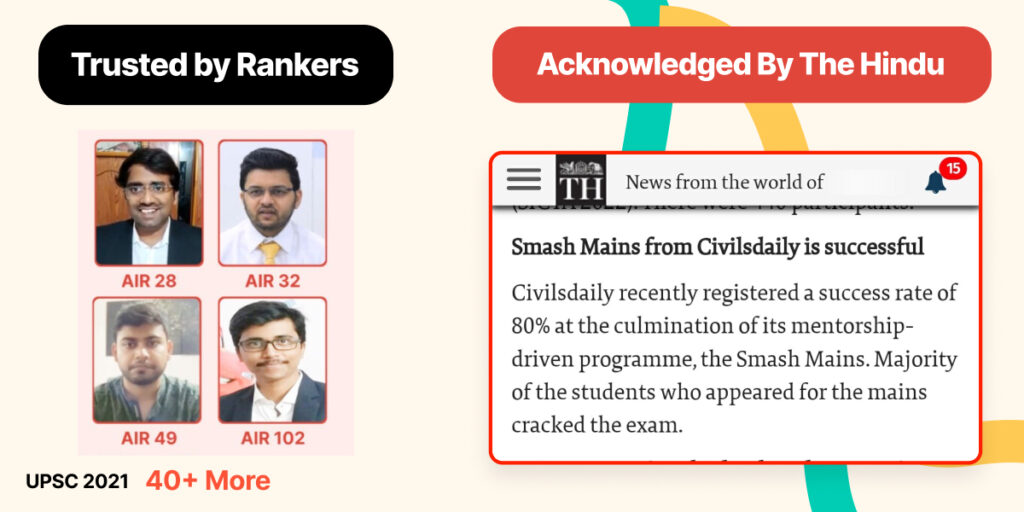
    upsc 2023 exam dateCivilsDaily’s mentorship: Acknowledged by The Hindu
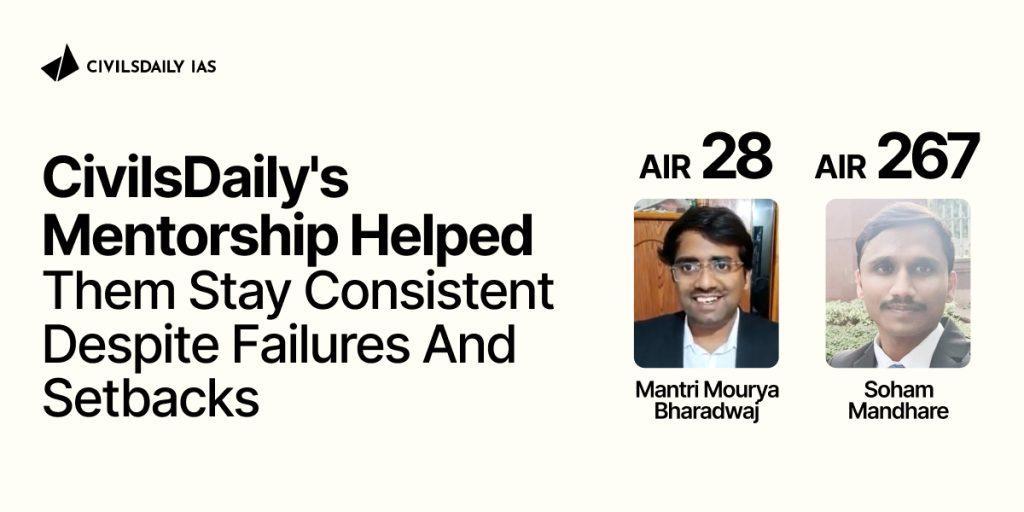

    About Soham Mandhare

    Soham Mandhare’s story is about grit and determination. It is a story of fortitude. Despite all the hardships he secured an AIR 267 in UPSC 2021. She was a student of our Mentorship programs and was taking mentorship under Sajal sir and Sukanya ma’am.

    Soham’s optional was PSIR and he scored one of the highest marks in UPSC Mains exam. He will be mentoring CivilsDaily students as Super Mentor.


    What you’ll get as a part of the Special Preparatory Package?

    As a part of this:

    1. FREE Mentorship session with Senior IAS Mentor on strategy and approach for UPSC/MPSC 2023.
    2. Samachar Manthan (Marathi) current week’s module and Mains Questions
    3. Prelims Weekly MCQ PDF
    4. Mains 250+ Value notes
    5. Current month’s Monthly Magazine

    Post-webinar get PERSONALIZED Current Affairs Strategy + MENTORSHIP CALL for MPSC/UPSC 2023-24. 

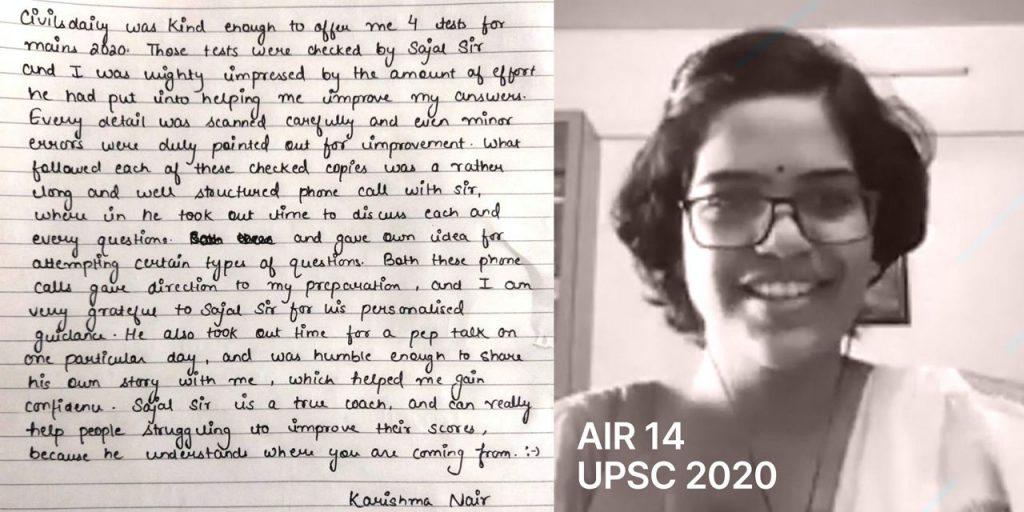
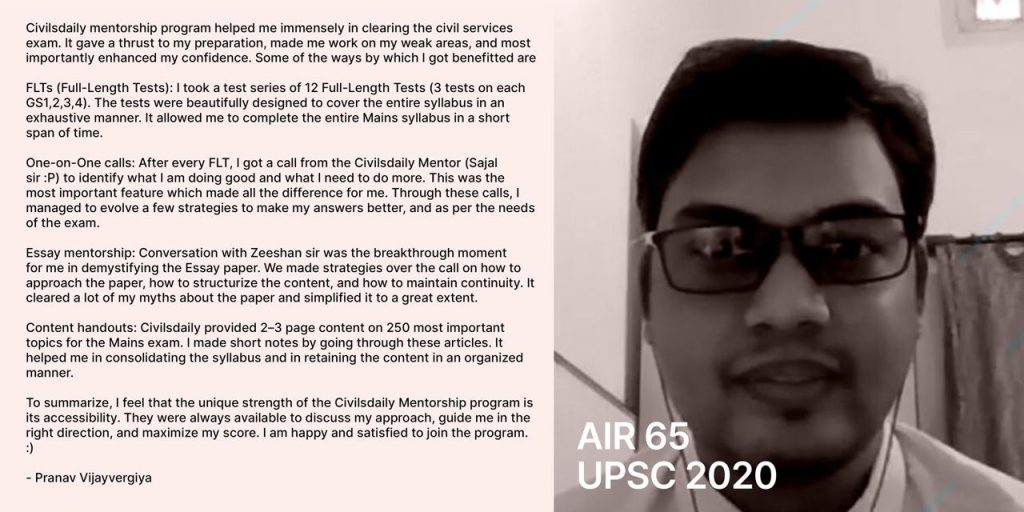
    Karishma Nair, AIR 14 was also CivilsDaily’s mentorship studentAIR 65, and Pranav was a mentorship student for UPSC 2020best coaching for upsc in delhi
    Some of our Ranker from Maharashtra

    Post-webinar get PERSONALIZED Current Affairs Strategy + MENTORSHIP CALL for MPSC/UPSC 2023-24. 

  • CUET 2023 Notification Out | Exams from 21st-31st May 2023 | Get your dream college with Civilsdaily

    CUET 2023 Notification Out | Exams from 21st-31st May 2023 | Get your dream college with Civilsdaily

    The wait is over! National Testing Agency (NTA) under the Ministry of Education has released the Common University Entrance Test (CUET) Exam calendar.

    The exam will be held from 21st to 31st May 2023. This is the right time you should start your preparation for CUET 2023.

    CivilsDaily has top MCQ tests, the best resources, and dedicated mentorship support for CUET 2023 preparation.

    Civilsdaily Crack CUET 2023👉 CLICK & ENROLL HERE

    CUET 2023 Notification


    CUET 2023 Eligibility Criteria

    Candidates must check the following eligibility norms before applying for CUET 2023:

    • Nationality: Indian National citizens will be eligible to apply.
    • Qualification: For Ug, candidates must have qualified 12th level exam (with 50% for the General category and 45% for SC/ST category) whereas, for PG, candidates must have a qualified bachelor’s degree from any recognized board or university.

    Age Limit: There will be no age limit to apply for CUET 2023 examination.

    The pattern of the exam

    The CUET will be held online as a computer-based test (CBT) and in two shifts, Slot I (morning) & Slot II (afternoon). The exam duration will be 3 Hours 15 minutes & 3 Hours 45 minutes respectively, depending on the subject combination chosen by the students. A candidate has to write a minimum of one or more exams in both slots.

    Syllabus of the exam

    Discuss the CUET 2023 syllabus in detail for FREE. Click below and schedule a FREE One-to-One call with senior mentors and faculty from CivilsDaily.

    The students’ fluency in the language is to be tested through questions asked in Reading Comprehension based on different types of passages – Factual, Literary, and Narratives [Literary Aptitude & Vocabulary]. The languages included in Section IA and IB respectively are as mentioned below:

    Section IASection IB
    English, Hindi, Gujarati, Bengali, Assamese, Kannada, Tamil, Telugu, Malayalam, Marathi, Odia, and Urdu.Chinese, German, French, Arabic, Italian, Japanese, Nepali, Russian, Spanish, Tibetan, Dogri, Bodo, Kashmiri, Konkani, Maithili, Manipuri, Santhali, and Sindhi.

    For Domain subjects, CUET aspirants are expected to be thorough with their NCERTs.

    Your NCERT books will be the best source of preparation for the domain-specific paper. One can choose from the following subjects for the domain-specific paper. The candidates may choose a maximum of 6 Subjects from the below-mentioned list.

    • Accountancy/ Book Keeping
    • Biology/ Biological Studies/ Biotechnology/Biochemistry
    • Business Studies
    • Chemistry
    • Computer Science/ Informatics Practices
    • Economics/ Business Economics
    • Engineering Graphics
    • Entrepreneurship
    • Environmental Studies
    • Geography/Geology
    • History
    • Home Science
    • Knowledge Tradition and Practices of India
    • Legal Studies
    • Mathematics
    • Physical Education/ NCC /Yoga
    • Physics
    • Political Science
    • Psychology
    • Sociology

    These are again classified as Domain Subjects and Additional Subjects as below:

    Domain SubjectsAdditional Subjects
    Accountancy, Biology, Business Studies, Chemistry, Computer Sciences, Economics, Geography, History, Home Science, Legal Studies, Maths, Physics, Political Sciences, Psychology, Sociology, and Anthropology.Physical Education, Engineering graphics, Fine arts, Knowledge & Tradition – Practices in India, Entrepreneurship, Teaching aptitude, Mass media, and Agriculture.

    For General aptitude and general awareness tests:

    • General Knowledge & Current Affairs
    • General Mental Ability
    • Numerical Ability
    • Quantitative Reasoning 
    • Logical and Analytical Reasoning

    Click below and schedule a FREE One-to-One call with senior mentors and faculty from CivilsDaily. Also, get FREE resources and tests.

    https://www.civilsdaily.com/course/cuet-2023/
  • UPSC Current Affairs program to ensure a rank in Top 50 | Samachar Manthan new batches launched for UPSC 2023 and 2024

    UPSC Current Affairs program to ensure a rank in Top 50 | Samachar Manthan new batches launched for UPSC 2023 and 2024


    Samachar Manthan, CivilsDaily’s flagship Current Affairs program for UPSC CSE exam has launched two new batches:

    1. Special Batch 2 for UPSC 2023 aspirants (click) this will also focus on Current Affairs backlog coverage for UPSC Prelims 2023
    2. Samachar Manthan new batch for UPSC 2024 aspirants (click)

    Do you know?

    • 85% of UPSC 2022 Prelims and Mains Questions were from CivilsDaily’s Current Affairs Test Series
    • 100+ rankers vouch for the efficacy of Samachar Manthan, a result-oriented Current Affairs program

    Samachar Manthan registered the highest turnout of UPSC rankers from any Current Affairs program available in the market

    Schedule a FREE call to know how to cover the current affairs backlog for UPSC 2023 Prelims. We will be sharing a personalized strategy and timetable for you as per your UPSC preparation situation.

    Schedule a FREE call to know how to make current Affairs your strength


    Click here for Samachar Manthan Yearly for UPSC CSE 2024


    Samachar Manthan Batch 2 for UPSC CSE 2023

    This is going to be a special batch as the focus would be on two things:

    1. Covering the backlog from June 2022 to current month along with answer writing and note making.
    2. Side by side continuing and covering for the current issues for Prelims 2023 and then Mains 2023.

    Since Samachar Manthan is a weekly current affairs program we will be designing it for you so that you are covering multiple weeks of current affairs in one week. Eg. Week 1 (June 2022’s first week’s) will be placed with SM Week 28 (current week’s).

    Schedule a FREE call to know how to cover the current affairs backlog for UPSC 2023 Prelims. We will be sharing a personalized strategy and timetable for you as per your UPSC preparation situation.

    Samachar Manthan Yearly for UPSC CSE 2024

    This will be the full-fleged batch for UPSC 2024 aspirants that will continue till Mains.


    This is what our students have to say about Samachar Manthan and Sajal Sir & other faculties.

    Feedback from our students.

    Our ex-students, now rankers.

    Check out Shahansha’s excerpt on how he cleared UPSC 2020:

    https://youtu.be/6WA8nhi9g8I

    Read more topper’s testimonials (click here)

    Schedule a FREE call to know how to cover the current affairs backlog for UPSC 2023 Prelims. We will be sharing a personalized strategy and timetable for you as per your UPSC preparation situation.

  • Day 11| Daily Answer Wars| CD WarZone

    Topics for Today’s question:

    GS-3         Inclusive growth and issues arising from it.

    Question


    HOW TO ATTEMPT ANSWERS IN DAILY ANSWER WARS (DAW)?

    1. Daily 1 question either from General Studies 1, 2, 3 or 4 will be provided via live You Tube video session.
    2. You can write your answer on an A4 sheet and scan/click pictures of the same.
    3. The answer needs to be submitted by joining the telegram group given in the link below.

      https://t.me/cdwarzone

    *In case your answer is not reviewed, reply to your answer saying *NOT CHECKED*. 

    1. For the philosophy of Daily Answer Wars and payment: 
  • (Watch LIVE) 7-step Integrated Current Affairs strategy for UPSC Prelims & Mains 2023/2024? Linking current affairs to GS in Answer Writing | FREE Webinar + Samachar Manthan current affairs module

    (Watch LIVE) 7-step Integrated Current Affairs strategy for UPSC Prelims & Mains 2023/2024? Linking current affairs to GS in Answer Writing | FREE Webinar + Samachar Manthan current affairs module

    Join Zoom Meeting

    https://us06web.zoom.us/j/89622617083?pwd=cTc2bHlDeUUzNWJxeWVDWnk3VXh2Zz09


    Get FREE Samachar Manthan module after Webinar

    How to collect-analyse-organize-utilize-revise current affairs? Circle 16th (Friday) on the Calendar for Important Webinar for UPSC 2023-24.


    Everybody tells you Current Affairs is crucial for UPSC CSE Prelims and Mains.

    But no one tells you how to cover current affairs, what are the best sources, and how to collect-analyse-organize-utilize-revise current affairs.

    Dimple Chouhan ma’am, senior IAS faculty for Samachar Manthan program will take the most important webinar for you on How to cover current affairs most effectively for UPSC CSE?

    Table of Content


    Current Affairs provide the basis for almost 70-80% of the questions asked in UPSC Prelims and Mains. As per recent exam trends, even the questions on various hardcore GS subjects, including History, Culture, Geography, and politics, have been critically connected with and influenced by current events.

    Webinar Details:

    Date: 16th December, Friday

    Time: 7 PM

    Mode: Online (we will email you the link)

    Registration is FREE and Webinar is Open to all

    Post webinar get PERSONALIZED Current Affairs Strategy + MENTORSHIP CALL for UPSC 2023-24. 

    What are you going to learn in this Webinar?

    Basically, exam-oriented current affairs preparation depends on 4 aspects;

    • Staying informed about the most relevant current topics.
    • Understanding the context (It is not enough to simply know what has happened
    • Organizing & updating your notes for MCQs & Answer writing.
    • Practicing MCQs and forming Mains GS answers 

    In this webinar Dimple ma’am will discuss following points

    1. How to cover daily current affairs in just 1.5 hrs along with notes and answer writing? Especially for working professionals.

    2. How to Link current affairs to GS in Answer Writing?

    3. How Current Affairs can help beat the unpredictability of UPSC paper, especially Prelims. Changing trends, eg: Prelims 2022- many questions from IR.

    4. Issues in Current Affairs coverage- 

    • What to read?
    • What are the sources?
    • How much time should be devoted to Current Affairs?
    • Can newspapers be a substitute for monthly magazines?
    • How to make notes
    • How to integrate CA into Mains answers
    • Daily, weekly coverage vs monthly coverage

    5. Subjects, directly and indirectly, dependent on CA

    Post webinar get PERSONALIZED Current Affairs Strategy + MENTORSHIP CALL for UPSC 2023-24. 

    Materials You Will Receive Post Webinar (Webinar FREE Package)

    • 1-1 discussion on Most Probable current affairs topics for UPSC 2023
    • Smash Prelims notes PDF,
    • 24 weeks’ Micro-Macro masterplan,
    • and MCQ tests.

    About Dimple Ma’am

    Dimple Chouhan is a senior IAS faculty at CivilsDaily. She has been mentoring UPSC aspirants for 4 years now and has mentored 150+ aspirants to Prelims success.


    What The Hindu mentioned about Civilsdaily Mentorship

    Post webinar get PERSONALIZED Current Affairs Strategy + MENTORSHIP CALL for UPSC 2023-24.