💥Mains Ready By December. Smash Mains & Smash PYQ Admissions Open

Category: Ranker Webinars

  • 3rd August 2022| Daily Answer Writing Enhancement(AWE)

    Topics for Today’s questions:

    GS-1        Indian culture will cover the salient aspects of Art Forms, literature and Architecture from ancient to modern times.

    GS-2       Important aspects of governance, transparency and accountability, 

    GS-3        Indian Economy

    GS-4        Public/Civil service values and Ethics in Public administration: Status and problems; strengthening of ethical and moral values in governance; ethical issues in international relations and funding; corporate governance.

    Question 1)


    Q.1 Central Asian contacts had a profound political and cultural impact on India in ancient times. Discuss. (10 Marks)


    Question 2)

    Q.2 What are the issues with the various provisions of the Prevention of Money Laundering Act 2002? Suggest the way forward. (10 Marks)

    Question 3)

    Q.3 What is the significance of foreign exchange reserves for a developing country and what are the reasons for the recent decline in India’s foreign exchange reserves? (10 Marks)

    Question 4)  

    Q.4 Corporate governance and business ethics are key factors influencing investment decisions and determining the flow of capital worldwide. In this context, discuss the inter-relationship between corporate governance and business ethics. (10 Marks)


    HOW TO ATTEMPT ANSWERS IN DAILY ANSWER WRITING ENHANCEMENT(AWE)?

    1. Daily 4 questions from General studies 1, 2, 3, and 4 will be provided to you.

    2. A Mentor’s Comment will be available for all answers. This can be used as a guidance tool but we encourage you to write original answers.

    3. You can write your answer on an A4 sheet and scan/click pictures of the same.

    4.  Upload the scanned answer in the comment section of the same question.

    5. Along with the scanned answer, please share your Razor payment ID, so that paid members are given priority.

    6. If you upload the answer on the same day like the answer of 11th  February is uploaded on 11th February then your answer will be checked within 72 hours. Also, reviews will be in the order of submission- First come first serve basis

    7. If you are writing answers late, for example, 11th February is uploaded on 13th February , then these answers will be evaluated as per the mentor’s schedule.

    8. We encourage you to write answers on the same day. However, if you are uploading an answer late then tag the mentor like @Staff so that the mentor is notified about your answer.

    *In case your answer is not reviewed, reply to your answer saying *NOT CHECKED*. 

    1. For the philosophy of AWE and payment: 

  • [Sansad TV] Perspective: Work from Home Rules

    UPSC 2023 countdown has begun! Get your personal guidance plan now! (Click here)

    Context

    • Work from Home – which became a common feature for almost everyone during the first year of the COVID-19 pandemic, is here to stay.
    • The Department of Commerce has notified an amendment to the 2006 Special Economic Zone rules, allowing up to 50 percent of total employees of IT and IT-enabled Services to work from home.

    Why did the Centre intervene for WFH?

    • The new rules came after there were calls from the industry to make a provision for a countrywide uniform WFH policy for all SEZs.
    • Incidentally, the work from home rules come shortly after the Netherlands passed a law to establish home working as a legal right, in the process becoming one of the first countries to enshrine such flexibility in the law.

    So what do the new rules say? Why is work from home in demand? And is it going to be the future? Let’s find:

    What is Work from Home (WFH)?

    • Employees work from home by using a dedicated laptop/PC connected to the internet and business applications to collaborate and communicate with their team members.
    • While some employees work primarily from their homes, others work occasionally from home and travel to their office half of the time.
    • WFH means employees can set up their workspace in their homes and manage their entire work right from inside their houses, without the need to necessarily go to the office.

    What are the new guidelines?

    • The Ministry of Commerce and Industry has released new guidelines under Rule 43A for work from home (WFH) for employees. 
    • According to the notice issued by the Commerce Ministry, there is flexibility granted to the Development Commissioner (DC) of SEZs to approve a higher number of employees (more than 50%) for any bona-fide reason to be recorded in writing.
    • Furthermore, this fresh rule provides a transition period of 90 days to SEZ units to seek approval, whose employees are already working from home.

    Who all are covered under the new rule? 

    The new rule 43A provides work from home for the following category of employees of a unit in SEZ:

    1. Employees of IT/ITeS SEZ units
    2. Employees, who are temporarily incapacitated
    3. Employees, who are traveling
    4. Employees, who are working offsite

    Major challenges of working from home

    [A] For employers

    • Remote collaboration: Collaboration is one of the biggest work-from-home challenges for companies as employees no longer work from the same physical office space.
    • Employees working from different locations and time zones: The big downside of this perk is that companies end up with a completely distributed workforce with employees working from different locations and time zones.
    • Building and maintaining trust: When employees don’t have face-to-face interactions, there are some obvious trust issues that can arise because of it. Continuous mistrust from team members can often end up demotivating employees and making them feel left out.

    [B] For employees

    • Working too much:   With no excessive breaks or long commutes to the office, remote employees are 20-25 percent more productive than their office counterparts.  
    • Loneliness and depression: With no informal social interactions with colleagues, employees can feel isolated and even develop communication issues with the rest of the team.
    • A lack of community: When you only have face-to-face interactions with your team members on weekly or monthly video calls only, it can be rather challenging to create a sense of camaraderie and bonding within the team.

    WFH benefits both employers and employees

    Here is some work-from-home benefits for both employees and employers:

    • Cost savings: When there are fewer employees coming to the office than usual, organizations need fewer equipment, desks, and space to accommodate them which will directly lead to lowered infrastructure and rental costs.  For employees too, working from home can lead to a lot of cost savings. No morning commute means no extra costs to travel to the office every day. Also, employees no longer need to pay high rents just to stay close to their offices.
    • Flexible schedule and more freedom: When employees work from home, they get the freedom to create their own schedule, according to their productivity levels and personal commitments. They can work in the early mornings or through the nights if that’s when they feel most productive.
    • Hire and retain global talent: Retaining talent becomes easier when companies offer work-from-home perks. For 83 percent of employees, the ability to work from home is a big deciding factor when they consider a new job offer. For companies, that means, allowing employees to work from home can make it easier for them to hire and retain top talent without any kind of location limitations.
    • Better work-life balance: When employees work from home, they no longer have to spend hours driving in the traffic every day, chatting with coworkers near the watercooler, or organizing dinner parties with team members which directly saves them a lot of time that they can in turn use to spend with their friends, family, or just to do things that they like. With more downtime, enough rest, and better work-life balance, employees are able to better focus on the work which leads to higher efficiency and productivity.
    • Positive employee experience: With more flexibility, no everyday bumper-to-bumper commute traffic, and better work-life balance, work from home ends up improving the overall employee experience within the organization. This in turn creates a company culture of high performance where employees want to perform at their best and continuously improve at work.
    • Increase in productivity: When employees get the freedom to create their own work schedule and workspace, they feel more positive and productive. Moreover, with no excessive breaks or disruptions from co-workers, work-from-home employees end up being more productive than their in-office counterparts as well.

    Conclusion

    • Work from home is truly the future of work and it is here to stay.
    • Even though there are some challenges to it, the pros of working from home easily outweigh the cons.
    • Of course, incorporating a work-from-home strategy for the first time can be difficult, but it’s not impossible.

    UPSC 2022 countdown has begun! Get your personal guidance plan now! (Click here)

  • 2nd August 2022| Daily Answer Writing Enhancement(AWE)

    Topics for Today’s questions:

    GS-1        Important Geophysical phenomena such as earthquakes, Tsunami, Volcanic activity, cyclone. etc., geographical features and their location-changes in critical geographical features (including water-bodies and ice-caps) and in flora and fauna and the effects of such changes. 

    GS-2       Effect of policies and politics of developed and developing countries on India’s interests

    GS-3        Issues related to direct and indirect farm subsidies and minimum support prices

    GS-4        Public/Civil service values and Ethics in Public administration: Status and problems; ethical concerns and dilemmas in government and private institutions; laws, rules, regulations and conscience as sources of ethical guidance

    Question 1)


    Q.1 What do you understand by tsunamigenic zones? Giving an account of their global distribution, explain the propagation of tsunamis. (10 Marks)


    Question 2)

    Q.2 What is the significance of the launch of the International North South Transport Corridor (INSTC) for India and the region? (10 Marks)

    Question 3)

    Q.3 What are the World Trade Organisation’s rules over public stockholding of food? What are India’s concerns about it? (10 Marks)

    Question 4)  

    Q.4 Examine the issue of foreign aid in global politics from an ethical perspective. (10 Marks)


    HOW TO ATTEMPT ANSWERS IN DAILY ANSWER WRITING ENHANCEMENT(AWE)?

    1. Daily 4 questions from General studies 1, 2, 3, and 4 will be provided to you.

    2. A Mentor’s Comment will be available for all answers. This can be used as a guidance tool but we encourage you to write original answers.

    3. You can write your answer on an A4 sheet and scan/click pictures of the same.

    4.  Upload the scanned answer in the comment section of the same question.

    5. Along with the scanned answer, please share your Razor payment ID, so that paid members are given priority.

    6. If you upload the answer on the same day like the answer of 11th  February is uploaded on 11th February then your answer will be checked within 72 hours. Also, reviews will be in the order of submission- First come first serve basis

    7. If you are writing answers late, for example, 11th February is uploaded on 13th February , then these answers will be evaluated as per the mentor’s schedule.

    8. We encourage you to write answers on the same day. However, if you are uploading an answer late then tag the mentor like @Staff so that the mentor is notified about your answer.

    *In case your answer is not reviewed, reply to your answer saying *NOT CHECKED*. 

    1. For the philosophy of AWE and payment: 
  • 1st August 2022| Daily Answer Writing Enhancement(AWE)

    Topics for Today’s questions:

    GS-1        Distribution of key natural resources across the world (including South Asia and the Indian sub-continent)

    GS-2        Important aspects of governance, transparency and accountability

    GS-3        Infrastructure: Energy, Ports, Roads, Airports, Railways etc.

    GS-4        Public/Civil service values and Ethics in Public administration: Status and problems; ethical concerns and dilemmas in government and private institutions

    Question 1)


    Q.1 What are polymetallic nodules? Highlight their geographical distribution and state their significance. (10 Marks)


    Question 2)

    Q.2 How whistleblowers contribute to participatory democracy by use of RTI? Suggest the measures to ensure the protection of whistleblowers. (10 Marks)

    Question 3)

    Q.3 What are the factors responsible for the deterioration of the financial position of the state-owned power distribution companies? Is bailout by the government a solution? (10 Marks)

    Question 4)  

    Q.4 There is a need for an effective climate governance structure within the broad framework of corporate governance. Discuss. (10 Marks)


    HOW TO ATTEMPT ANSWERS IN DAILY ANSWER WRITING ENHANCEMENT(AWE)?

    1. Daily 4 questions from General studies 1, 2, 3, and 4 will be provided to you.

    2. A Mentor’s Comment will be available for all answers. This can be used as a guidance tool but we encourage you to write original answers.

    3. You can write your answer on an A4 sheet and scan/click pictures of the same.

    4.  Upload the scanned answer in the comment section of the same question.

    5. Along with the scanned answer, please share your Razor payment ID, so that paid members are given priority.

    6. If you upload the answer on the same day like the answer of 11th  February is uploaded on 11th February then your answer will be checked within 72 hours. Also, reviews will be in the order of submission- First come first serve basis

    7. If you are writing answers late, for example, 11th February is uploaded on 13th February , then these answers will be evaluated as per the mentor’s schedule.

    8. We encourage you to write answers on the same day. However, if you are uploading an answer late then tag the mentor like @Staff so that the mentor is notified about your answer.

    *In case your answer is not reviewed, reply to your answer saying *NOT CHECKED*. 

    1. For the philosophy of AWE and payment: 

  • [Sansad TV] Perspective: Supreme Court’s PMLA Ruling

    UPSC 2022 countdown has begun! Get your personal guidance plan now! (Click here)

    PC: The Hindu

    Context

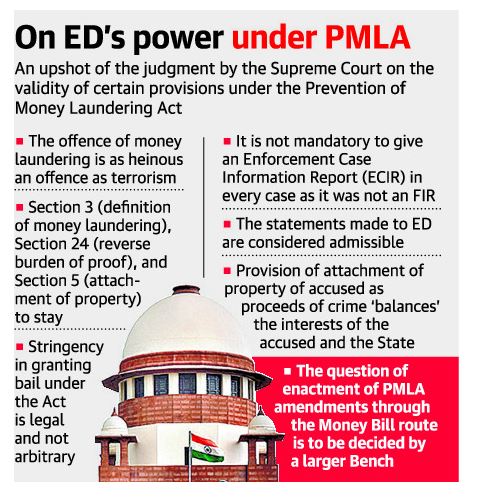
    • Delivering its verdict on a batch of petitions concerning the interpretation of certain provisions of the Act, the SC bench opined that money laundering is a “heinous” crime.
    • In this article, we will talk about the Supreme Court’s ruling on the Prevention of Money Laundering Act.

    Why in news?

    • The verdict came on an extensive challenge raised against the amendments introduced in 2002 Act by way of Finance Acts.
    • Also bail provisions in PMLA act were contested in the apex court.

    Key observations by the Supreme Court

    • Possessions of proceeds: Mere possession of proceeds of crime (without any integration, layering etc.) are sufficient to allege money laundering
    • Preventing crucial crimes: PMLA not only affects the social and economic fabric of a nation but also tends to promote other serious offenses like terrorism and drug trafficking.
    • Curbing illicit financing: The court noted that the law was enacted to address the urgent need for comprehensive legislation to prevent money laundering and prosecute those indulging in activities related to the proceeds of crime.
    • Power of arrests are legible: The court also upheld the EDs powers relating to arrest, attachment of property involved in money laundering, search and seizure under the PMLA, which were challenged by multiple petitioners.
    • Money laundering is no ordinary offence: It is, therefore, a separate class of offence requiring effective and stringent measures to combat the menace of money laundering,” the Court held.
    • Enforcement Case Information Report (ECIR): ECIR cannot be equated with FIR and ECIR is an internal document of the ED. Supply of ECIR to accuse is not mandatory and only disclosure of reasons during arrest is enough.
    • Twin bail: On the issue of twin bail conditions under the PMLA, the court ruled that the stringent conditions for bail under the Act are legal and not arbitrary.
    • Quantum of Punishment: The punishment provided for the offence is certainly one of the principles in deciding the gravity of the offence. However, it cannot be said that it is the sole factor in deciding the severity of offence as contended by the petitioners.
    • Predicate offense: The court made it clear that the offence under Section 3 is dependent on illegal gain of property as a result of criminal activity relating to a scheduled offence. It relates to the process or activity connected with such property that constitutes the offence of money laundering.

    What were the petitions?

    • Petitions were filed against the amendments, which the challengers claimed would violate personal liberty, procedures of law and the constitutional mandate.
    • The petitioners included many veteran politicians who all claimed that the “process itself was the punishment”.
    • There were submissions that the accused’s right against self-incrimination suffered when the ED summoned them and made them sign statements on threats of arrest.
    • But the court said these statements were recorded as part of an “inquiry” into the proceeds of crime.
    • A person cannot claim right against self-incrimination at a summons stage.

    What is Money Laundering?

    • Section 3 of the Act defines money laundering.
    • It initially read that anyone involved in any process or activity connected with the proceeds of crime including its “concealment, possession, acquisition or use” and projecting or claiming it as untainted property shall be guilty of the offense of money-laundering.
    • In 2019, the government made a change to Section 3, adding “or” between the words “concealment”, “possession”, and “acquisition”.
    • The petitioners before the top court, comprising politicians and industrialists, complained that the 2019 amendment enlarged the ambit of the principal section by including mere concealment or possession.

    Explaining beyond legal terms

    • Money laundering is the illegal process of making large amounts of money.
    • This money is generated by a criminal activity but may appear to come from a legitimate source.
    • Criminal activities include drug trafficking, terrorist funding, illegal arms sales, smuggling, prostitution rings, insider trading, bribery, and computer fraud schemes that produce large profits.

    What are the different stages involved in money laundering?

    Generally, money laundering is a three-stage process:

    1. Placement: The crime money is injected into the formal financial system.
    2. Layering: Money injected into the system is layered and spread over various transactions and book-keeping tricks to hide the source of origin.
    3. Integration: Laundered money is withdrawn from the legitimate account to be used for criminal purposes. Now, money enters the financial system in such a way that the original association with the crime is disassociated. The money now can be used by the offender as legitimate money.

    Note: All three sources may not be involved in money laundering. Some stages could be combined or repeated many times.

    What are different methods of money laundering?

    • Smurfing (the criminal breaks up large chunks of cash into multiple small deposits, often spreading them over many different accounts, to avoid detection.)
    • Use of currency exchanges
    • “Mules” (cash smugglers, who sneak large amounts of cash across borders and deposit them in foreign accounts, where money-laundering enforcement is less strict.)
    • Investing in commodities such as gems and gold that can be moved easily to other jurisdictions
    • Discreetly investing in and selling valuable assets such as real estate, cars, and boats;
    • Gambling and laundering money at casinos;
    • Counterfeiting
    • Using shell companies (inactive companies or corporations that essentially exist on paper only).
    • Hawala transactions

    What are some of the national and global efforts to combat money laundering?

    [A] Some of the national efforts are:

    1. Smugglers and Foreign Exchange Manipulators (Forfeiture of Property) Act, 1976,
    2. Narcotic Drugs and Psychotropic Substances Act, 1985, and
    3. Prevention of Money-Laundering Act, 2002 (PMLA), PMLA (Amendment) Act, 2012

    Other than these efforts two important agencies/ units involved are-

    1. Financial Intelligence Unit-IND: It is an independent body reporting directly to the Economic Intelligence Council (EIC) headed by the Finance Minister.
    2. Enforcement Directorate (ED): It is a law enforcement agency and economic intelligence agency responsible for enforcing economic laws and fighting economic crime in India. Main function of ED is to Investigate offenses of money laundering under the provisions of the Prevention of Money Laundering Act, 2002(PMLA).

    Note: India is a full-fledged member of the FATF and follows its guidelines.

    [B] Some of the global efforts are

    • Vienna Convention,
    • 1990 Council of Europe Convention
    • International Organization of Securities Commissions (IOSCO)
    • Financial Action Task Force (It has been set up by the governments of the G-7 countries),
    • IMF
    • United Nations office on Drugs and Crime

    Why prevent money laundering?

    • Corruption in high offices: This is a major facilitator of money laundering.
    • Worldwide nexus: Three “supra-national or transnational” crimes which have brought together the global community are narcotics, money laundering and terrorism.
    • Existence of safe homes: People accused of money laundering run to small nations with no extradition treaty with India where they can buy citizenship.
    • Preventing terrorism: Money laundering and terrorism financing activity in one country can have serious cross-border and even global adverse effects.
    • Huge social costs: This include allowing drug traffickers, smugglers, and other criminals to expand operations and the transfer of economic power from the market, government, and citizens to criminals.

    Critical view of the Judgment

    • Lack of judicial standards: It is argued that the judgment falls short of judicial standards of reviewing legislative action.
    • Downplay of FRs: It invokes legal framework for combating money-laundering so inviolable that possible violation of fundamental rights can be downplayed.
    • Overemphasis on global pledge: The judgment repeatedly invokes the “international commitment” behind Parliament’s enactment of the law to curb the menace of laundering.
    • Selective targeting is justified: The ED has also been manifestly selective in opening money-laundering probes, rendering any citizen vulnerable to search, seizure, and arrest at the whim of the executive.
    • Self-incrimination and reverse burden of proof: This was violative of Article 20(3), which provided protection against self-incrimination.
    • Obsolete arguments: The Court relied on Article 39 of the Constitution, part of the DPSP that mandates the State to prevent concentration of wealth, to uphold the stringent bail conditions under PMLA.
    • Free hand to ED: The constitutionality of several provisions of the PMLA has been considered in the latest judgment and all of them have been upheld, the Court should have at least placed some additional safeguards on exercise of powers by the ED.

    Is further Constitutional Challenge possible?

    • The judgment may be reviewed further by a five or seven-judge bench but the likelihood of the same immediately is not high.
    • As we have seen in the past, judgments of constitutional significance tend to be revisited (if at all) after several years when a situation arises which renders such interference absolutely necessary.
    • But yes a larger bench is already considering the issue of whether amendments can be passed to PMLA under Finance Act like a money bill.
    • It may be worth pointing out, however, that it can sometimes take years for a Constitution Bench (a five, seven or nine-judge bench of the top court) to arrive at a conclusion.

    Way ahead

    • The evolving threats of money laundering supported by the emerging technologies need to be addressed with the equally advanced Anti-Money Laundering mechanisms like big data and artificial intelligence.
    • Both international and domestic stakeholders need to come together by strengthening data sharing mechanisms amongst them to effectively eliminate the problem of money laundering.
    • Similarly, FRs do exist everywhere. And they cannot be used as brackets to prevent investigation agencies since the FRs of large section of population matters than any individual.

    UPSC 2022 countdown has begun! Get your personal guidance plan now! (Click here)

  • How did Mourya study for just 5hr/day, managed a full-time job, and secured an AIR 28 in UPSC 2021: Masterclass  by IAS topper | Register for recorded video + Personalized timetable

    How did Mourya study for just 5hr/day, managed a full-time job, and secured an AIR 28 in UPSC 2021: Masterclass by IAS topper | Register for recorded video + Personalized timetable

    Special session with AIR 28 Mourya Bharadwaj concluded. | Register and get: VIDEO RECORDING + PERSONALIZED TIMETABLE + MENTORSHIP CALL


    This is for those who missed the amazing session by Mourya Bharadwaj on How to clear UPSC while doing a full time job. Get the recording of the session and a super important Personalized timetable PDF.

    Time management is a #UPSCskill that tops all other skills in this long journey. Moreover, the complexity and vastness of the syllabus, unpredictability and ever-changing pattern of the UPSC exam, and cut-throat competition necessitate you to invest your time wisely.

    Over that, if you are a working professional, college student, or homemaker, and preparing for this exam, and if you don’t have a workable timetable, you won’t be able to stay consistent and your preparation will suffer.

    Time management isn’t the main thing. It is the only thing.

    Mourya Bharadwaj, has been CivilsDaily’s mentorship student and he achieved this success, AIR 28 all the while he was working in an MNC.

    Mourya concluded up an interactive session where he engaged and took up questions 1-1 from the aspirants on time management, timetable, and staying consistent.

    Other than the points mentioned above we will be discussing the following issues as well.

    1. Management of Priorities – UPSC, family, life, and work.
    2. Reducing time on non-priorities.
    3. Planning ahead, making targets, staying consistent w.r.t targets.
    4. How should the syllabus be approached to complete it within the time limit?
    5. Balancing prelims-mains on one hand and GS-current affairs on the other.
    6. How to determine the primary focus areas of the Prelims, Mains, and Personality tests?
    7. How to apply bookish as well as classroom knowledge to the exam?’
    Click for Mourya’s epic on consistency and dedication.

    What The Hindu mentioned about Civilsdaily Mentorship

    Special session with AIR 28 Mourya Bharadwaj concluded.| Register and get: VIDEO RECORDING + PERSONALIZED TIMETABLE + MENTORSHIP CALL |Submit your query, and get Telegram group + access to FREE Samachar Manthan module* and mentorship.

  • 29th July 2022| Daily Answer Writing Enhancement(AWE)

    Topics for Today’s questions:

    GS-1         Salient features of world’s physical geography.

    GS-2         Federalism

    GS-3        Awareness in the fields of IT, Space, Computers, robotics, nano-technology, bio-technology and issues relating to intellectual property rights.

    GS-4        Case Studies

    Question 1)


    Q.1 What are Marine Heat Waves (MHW)? Identify the causes of their formation and discuss their consequences for India. (15 Marks)


    Question 2)

    Q.2 What are the issues facing fiscal federalism in India? How do these issues affect the states’ role in addressing the socio-economic inequalities? (10 Marks)

    Question 3)

    Q.3 What are the advantages and issues with e-commerce for medical drugs? (10 Marks)

    Question 4)  

    Q.4 You are a young officer posted as a Sub-Divisional Magistrate in a backward district. You receive a complaint against the appointment of a Dalit woman in a village school for cooking food under the Mid-Day Meal scheme by parents of some students. The parents are putting immense pressure on the school management to discontinue the services of the woman concerned on the basis of long-standing social norms of caste impurity. They also say that if the management fails to take a favourable decision, keeping in mind the prevailing social customs, they will convene a village assembly and take action against the woman and her family members, including boycotting them socially. Based on the above information, address the following: (a) Identify the issues involved in the given case study. (b) Highlighting the reasons behind continuing caste discrimination, discuss the steps which you will take to resolve the present issue. (20 Marks)


    HOW TO ATTEMPT ANSWERS IN DAILY ANSWER WRITING ENHANCEMENT(AWE)?

    1. Daily 4 questions from General studies 1, 2, 3, and 4 will be provided to you.

    2. A Mentor’s Comment will be available for all answers. This can be used as a guidance tool but we encourage you to write original answers.

    3. You can write your answer on an A4 sheet and scan/click pictures of the same.

    4.  Upload the scanned answer in the comment section of the same question.

    5. Along with the scanned answer, please share your Razor payment ID, so that paid members are given priority.

    6. If you upload the answer on the same day like the answer of 11th  February is uploaded on 11th February then your answer will be checked within 72 hours. Also, reviews will be in the order of submission- First come first serve basis

    7. If you are writing answers late, for example, 11th February is uploaded on 13th February , then these answers will be evaluated as per the mentor’s schedule.

    8. We encourage you to write answers on the same day. However, if you are uploading an answer late then tag the mentor like @Staff so that the mentor is notified about your answer.

    *In case your answer is not reviewed, reply to your answer saying *NOT CHECKED*. 

    1. For the philosophy of AWE and payment: 

  • Register for recorded video + templates | Brainstorming and rough work – The 1st step to 150+ marks | FREE UPSC Essay Masterclass by Zeeshan sir | Read example inside.

    Register for recorded video + templates | Brainstorming and rough work – The 1st step to 150+ marks | FREE UPSC Essay Masterclass by Zeeshan sir | Read example inside.

    Special session with Zeeshan Hashmi sir concluded. | Register and get: VIDEO RECORDING + FREE ESSAY TEMPLATES, TEST + MENTORSHIP CALL


    For those who missed the amazing session by Zeeshan Hashmi sir on Brainstorming and rough work for UPSC Essay. Get the recording of the session and a super important webinar PDF.

    Get the full PDF in your email id.

    The Webinar was a great success and many important points were discussed

    Writing a good essay in the UPSC mains exam is a skill that must be perfected with practice. And before that one must know the nuances of the skill. There is a process to a great essay.

    A great UPSC essay starts with brainstormed random ideas, disjointed facts…chaos, formulated into a ‘blueprint’. That’s the first step before you actually start writing it.

    The moment you zero in on the topic from a particular section, you start thinking about various points, facts, concepts, quotes, etc. to be put into that essay. The first few minutes before you start your essay become chaotic.

    The process to brainstorm and make a blueprint through rough work will channel that chaos into something beautiful, a 150+ scorer essay.

    Develop a method to ‘brainstorming madness’ with Zeeshan Hashmi

    Webinar details: Following points and themes will be touched upon and discussed.

    Session concluded yesterday.

    The zoom link will be emailed to you.

    What you will get post-webinar?

    1. Best practices PDF by Zeeshan
    2. Two FREE UPSC essay tests
    3. Access to CivilsDaily Mains Bootcamp telegram group

    Example Topic: Life must be understood backwards but it must be lived forward.

    Students find it difficult to pen down relevant points/ideas. But when provided with templates, they find it relatively easy to think of new points/ideas.

    Zeeshan sir will share such templates and help you make one in the webinar.

    Example: PESTEL is a commonly known template.

    ‘L’ Stands for legal. Taking an example, Section 377 of IPC (Homosexuality), it imposes Victorian morality on Contemporary India. The Supreme Court of India has partially struck it down in consonance with the need of the time. Thus Indian Judiciary has kept the legacy of the law alive by not completely striking it down but suitably modifying it to meet the changing needs of the time.

    Note:- Above elaboration is ‘Analytical’ in nature and not just factual. The same rule needs to be followed in Essays. We pick content, dada, facts, figures, and examples that we have and link them to the main demand of the topic.


    Feedback on Zeeshan sir’s mentorship by AIR 65, Pranav (from Quora: https://qr.ae/pvH4yA)

    Similarly, many dimensions/points can be drawn from the ‘economic’ component of the template.

    1. Indian Constitution describes itself to be Socialistic but India is very much a free market economy
    2. LPG Reforms gave a huge impetus to the Tertiary sector
    3. Economic Planning has been reduced to an indicative exercise through the setting up of the NITI Ayog.

    Similarly, Zeeshan sir will discuss and share a template on brainstorming.

    About Zeeshan Hashmi sir

    Zeeshan sir is a senior IAS mentor at CivilsDaily and he has been mentoring UPSC aspirants and now rankers for more than 6 years now. He has an experience with 5 UPSC interviews (including IFoS). He will be taking up your questions in the webinar and would be connecting with you in the Telegram group as well.

    AIR 117, Nisha was Zeeshan sir’s student

    Zeeshan sir will be taking a LIVE webinar on coming Thursday. Through a LIVE Essay writing session, he will be teaching and helping you master the skills required to make a blueprint for UPSC essay.

    What The Hindu mentioned about Civilsdaily Mentorship

  • 28th July 2022| Daily Answer Writing Enhancement(AWE)

    Topics for Today’s questions:

    GS-1          Social Empowerment, Regionalism, Communalism & Secularism

    GS-2         Governance: Government policies and interventions for development in various sectors and issues arising out of their design and implementation.

    GS-3        Indian Economy, Inclusive Growth & Issues

    GS-4        Contributions of moral thinkers and philosophers from India and the world.

    Question 1)


    Q.1 Regionalism in India is a multi-dimensional phenomenon, at once geo-cultural, politico-economic and, above all, psychological. Discuss. (15 Marks)


    Question 2)

    Q.2 How populist policies and freebies affect the interest of the country? What are the factors that need to be considered while formulating the policies for welfare? (10 Marks)

    Question 3)

    Q.3 What is gross domestic product (GDP) ? What are the implications of weakened correlation between GDP growth and formal sector jobs? (10 Marks)

    Question 4)  

    Q.4 “I understand democracy as something that gives the weak the same chance as the strong.” ― Mahatma Gandhi. Explain. (10 Marks)


    HOW TO ATTEMPT ANSWERS IN DAILY ANSWER WRITING ENHANCEMENT(AWE)?

    1. Daily 4 questions from General studies 1, 2, 3, and 4 will be provided to you.

    2. A Mentor’s Comment will be available for all answers. This can be used as a guidance tool but we encourage you to write original answers.

    3. You can write your answer on an A4 sheet and scan/click pictures of the same.

    4.  Upload the scanned answer in the comment section of the same question.

    5. Along with the scanned answer, please share your Razor payment ID, so that paid members are given priority.

    6. If you upload the answer on the same day like the answer of 11th  February is uploaded on 11th February then your answer will be checked within 72 hours. Also, reviews will be in the order of submission- First come first serve basis

    7. If you are writing answers late, for example, 11th February is uploaded on 13th February , then these answers will be evaluated as per the mentor’s schedule.

    8. We encourage you to write answers on the same day. However, if you are uploading an answer late then tag the mentor like @Staff so that the mentor is notified about your answer.

    *In case your answer is not reviewed, reply to your answer saying *NOT CHECKED*. 

    1. For the philosophy of AWE and payment: 

  • [Sansad TV] Perspective: CAATSA Waiver for India

    UPSC 2022 countdown has begun! Get your personal guidance plan now! (Click here)

    Context

    • The US House of Representatives has passed by voice vote a legislative amendment that approves waiver to India against the punitive CAATSA sanctions for its purchase of the S-400 missile defence system from Russia.
    • The amendment was authored and introduced by Indian-American Congressman Ro Khanna.
    • It had urged the Biden administration to use its authority to provide India with a CAATSA waiver to in the face of aggression from China.

    What is the CAATSA?

    • CAATSA is a law that came into effect in the US in 2017, meant to punish countries having deep engagements with Russia, North Korea, and Iran using economic sanctions.
    • It said countries having a “significant transaction” with Russian intelligence and military agents will be subject to at least five kinds of sanctions.
    • Ordinary transactions will not invite sanctions, and the decision of who has sanctions imposed on them comes down to the interpretation of “significant transaction”.
    • This is one of the various waivers or exemptions mentioned, such as the transaction not affecting US strategic interests, not endangering the alliances it is a part of, etc.

    Why did the US enact a law like CAATSA?

    • The US flagged issues of Russia’s alleged interference in the 2016 Presidential elections, and its role in the Syrian war as some of the reasons for punishing engagement with it.
    • EU countries that had even more significant ties with Russia for oil and gas supply before the Ukraine-Russia conflict in 2022, had also criticised CAATSA.

    Countries facing sanctions

    • The US has placed sanctions on China and Turkey for purchase of the S-400.
    • The sanctions included denial of export licences, ban on foreign exchange transactions, blocking of all property and interests in property within the US jurisdiction and a visa ban.

    Reasons behind exemption to India

    • CAATSA impacts Indo-US ties, and dents the image of the US as a reliable partner at a time when it is projecting India as a key player in its Indo-Pacific strategy.
    • US administration for countries like India has favoured relief, citing the “strategic opportunity” that India presents, and also the opportunity “to trade in arms with India”.
    • Indeed, the US defence industry sees India as a major market, over the last decade, deals with India have grown from near zero to $15 billion.
    • Both in term of the number and value of contracts, the US is way ahead of other major suppliers.
    • The CAATSA exemption also underlines the growing defence and security cooperation that has seen India sign a logistics pact with the US.
    • Also US designated India as a Major Defence Partner, and both countries coming together on Indo-Pacific strategy, the newly resurrected Quad.
    • It also marks an acceptance by the US of the point of principle that as a sovereign country, India cannot be dictated on its strategic interests by a third country.

    Benefits to US by this waiver

    • This connection is centred on an eventual ‘payback’ to the US for lifting the spectre of CAATSA, looming over New Delhi since 2018.
    • India is procuring some 140-odd F/A-18s for both the Indian Navy and the Indian Air Force for around $30-35 billion.
    • Prospective F/A-18 sales would significantly boost the US economy, buffeted by unemployment and inflation running at 8.6%, its highest since 1981.
    • The waiver amendment also urged the US to do more to support India’s decision to reduce its reliance on Russian-made weapons.

    Why did India sign the S-400 deal?

    • Security paradigm: S-400 is very important for India’s national security considerations due to the threats from China, Pakistan and now Afghanistan.
    • Air defence capability: The system will also offset the air defence capability gaps due to the IAF’s dwindling fighter squadron strength.
    • Russian legacy: Integrating the S-400 will be much easier as India has a large number of legacy Russian air defence systems.
    • Strategic autonomy: For both political as well as operational reasons, the deal is at a point of no return.

    Way forward

    • The revision in bilateral ties is consistent with the prevailing strategic tone of bilateral ties.
    • Through associations like Quad and, more recently, I2U2, strategic linkages have also been strengthened.
    • India’s strategic interests require a shift away from Russians who are increasingly leaning over China.
    • Following its invasion of Ukraine, Russia’s reliance on China has grown dramatically, and this position is considered unlikely to change in the near future.

    UPSC 2022 countdown has begun! Get your personal guidance plan now! (Click here)