💥Join UPSC 2027,2028 Mentorship (August Batch) + XFactor Notes & Microthemes PDF

Distribution: weekly

  • Democracy Index 2019


    The latest edition of the Democracy Index spells gloom for India. The world’s biggest democracy slipped 10 places in the 2019 global ranking to 51st place.

    Democracy Index

    • The report is published by The Economist Intelligence Unit — the research and analysis division of The Economist Group, which is the sister company to The Economist newspaper.
    • It records how global democracy fared, analysing 165 independent states and two territories.
    • The 2019 survey attributes the primary cause of “the democratic regression” to “an erosion of civil liberties in the country”.

    India’s performance

    • India’s overall score fell from 7.23 to 6.9, on a scale of 0-10, within a year (2018-2019) — the country’s lowest since 2006.
    • India was graded in electoral process and pluralism (8.67), government functioning (6.79), political participation (6.67), political culture (5.63) and civil liberties (6.76).
    • In the Asia and Australasia region, India ranks eighth, behind Taiwan and Timor-Leste.
    • The report talks about the repeal of both Article 370 and Article 35A and various restrictions such as house arrests, internet shutdowns and excessive use of forces.

    India: A flawed democracy?

    The Index also categorizes India under “flawed democracies”, i.e. countries that hold free and fair elections and where basic civil liberties are respected, but have significant weaknesses in aspects of democracy, such as problems in governance, an underdeveloped political culture and low levels of political participation.

  • Global Risks Report 2020

    The top five risks to humanity are recently published in the Global Risks Report of the World Economic Forum (WEF).

    Top five risks

    • An important finding of the report is that today’s younger generation, consisting of “Millenials” born after 1980 have ranked environmental risks higher than other older respondents in the short- and long-terms.
    • According to the report, the top five risks by likelihood over the next decade are:
    1. Extreme weather events like floods and storms
    2. Failure of climate change mitigation and adaptation
    3. Major natural disasters like earthquakes, tsunamis, volcanic eruptions and geomagnetic storms
    4. Major biodiversity losses and ecosystem collapse
    5. Human-made environmental damage and disasters

    Top 5 risks by severity of impact over the next 10 years

    • Failure of climate change mitigation and adaptation
    • Weapons of mass destruction
    • Major biodiversity loss and ecosystem collapse
    • Extreme weather events (e.g. floods, storms, etc.)
    • Water crises

    Top most strongly connected global risks

    • Extreme weather events + failure of climate change mitigation and adaptation
    • Large-scale cyber-attacks + breakdown of critical information infrastructure and networks
    • High structural unemployment or underemployment + adverse consequences of technological advances
    • Major biodiversity loss and ecosystem collapse + failure of climate change mitigation and adaptation
    • Food crises + extreme weather events

    Other risks

    • The report also warned about the increasing economic and societal costs due to non-communicable diseases and the lack of research on vaccines and drug resistance to address the threat of pandemics in the recent future.
    • Economic confrontations” and “domestic political polarization” are significant short-term risks in 2020, the report said.
    • This is a warning for the global South including India and Africa where social unrest has seen a rise. For example, unrest has grown among India’s youth.
  • ‘Time to Care’ Report


    The report ‘Time to Care’  was recently released ahead of the 50th Annual Meeting of the World Economic Forum (WEF).

    ‘Time to Care’ Report

    • It is published by Oxfam International.
    • Its calculations are based on the latest data sources available, including from the Credit Suisse Research Institute’s Global Wealth Databook 2019 and Forbes’ 2019 Billionaires List.

    Findings of the report

    • Although global inequality has declined over the past three decades, domestic income inequality has risen in many countries, particularly in advanced economies and reached historic highs.
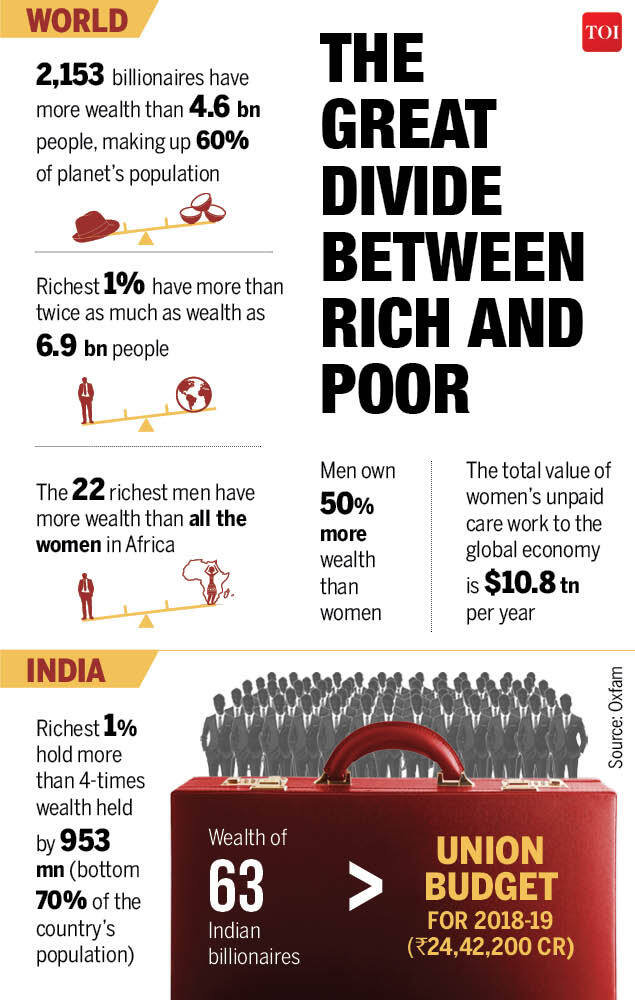
    • The report said that the world’s 2,153 billionaires have more wealth than the 4.6 billion people who make up 60 per cent of the planet’s population.
    • The report flagged that global inequality is shockingly entrenched and vast and the number of billionaires has doubled in the last decade, despite their combined wealth having declined in the last year.
    • The Oxfam report further said “sexist” economies are fuelling the inequality crisis by enabling a wealthy elite to accumulate vast fortunes at the expense of ordinary people and particularly poor women and girls.

    Income inequality in India

    • India’s richest 1 per cent hold more than four-times the wealth held by 953 million people who make up for the bottom 70 per cent of the country’s population.
    • The total wealth of all Indian billionaires is more than its full-year budget.
    • Regarding India, Oxfam said the combined total wealth of 63 Indian billionaires is higher than the total Union Budget of India for the fiscal year 2018-19 which was at Rs 24,42,200 crore.
    • It further said women and girls put in 3.26 billion hours of unpaid care work each and every day — a contribution to the Indian economy of at least Rs 19 lakh crore a year, which is 20 times the entire education budget of India in 2019 (Rs 93,000 crore).
    • He said women and girls are among those who benefit the least from today’s economic system.
    • They spend billions of hours cooking, cleaning and caring for children and the elderly. Unpaid care work is the ‘hidden engine’ that keeps the wheels of our economies, businesses and societies moving.

    Data on earnings

    • Oxfam said governments are massively under-taxing the wealthiest individuals and corporations and failing to collect revenues that could help lift the responsibility of care and tackle poverty and inequality.
    • As per the report, it would take a female domestic worker 22,277 years to earn what a top CEO of a technology company makes in one year.
    • With earnings pegged at Rs 106 per second, a tech CEO would make more in 10 minutes than what a domestic worker would make in one year.
    • Besides, direct public investments in the care economy of 2 per cent of GDP would potentially create 11 million new jobs and make up for the 11 million jobs lost in 2018, the report said.
  • Vyom Mitra: ISRO’s half-humanoid


    ISRO unveiled its first ‘woman’ astronaut during the event ‘Human Spaceflight and Exploration’.

    Vyom Mitra

    • The AI-based robotic system is being developed at a robotics lab at the VSSC in Thiruvananthapuram.
    • Vyom Mitra will be used for an unmanned flight of ISRO’s GSLV III rocket in December 2020, which, along with a second unmanned flight in July 2021.
    • This will serve as the test of ISRO’s preparedness for its maiden manned space mission, Gaganyaan, being targeted for 2022 to mark 75 years of India’s independence.

    Functions of the humanoid

    • Vyommitra, equipped with a head, two arms and a torso, is built to mimic crew activity inside the crew module of Gaganyaan.
    • Attaining launch and orbital postures, responding to the environment, generating warnings, replacing carbon dioxide canisters, operating switches, monitoring of the crew module, receiving voice commands, responding via speech (bilingual) are among its functions listed.
    • It will have a human-like face, with lips synchronised for movement to mimic speech.
    • Once it is fully developed, Vyommitra will be able to use equipment on board the spacecraft’s crew module, like safety mechanisms and switches, as well as receive and act on commands sent from ground stations.
  • Blue Corner Notice

    Interpol has issued a Blue Corner notice to help locate an infamous fugitive self-styled godman weeks after the Gujarat Police sought the agency’s intervention for this.

     ‘Blue Corner’ notice

    • According to the Interpol website, “Notices are international requests for cooperation or alerts allowing police in member countries to share critical crime-related information.”
    • There are seven types of notices — Red Notice, Yellow Notice, Blue Notice, Black Notice, Green Notice, Orange Notice, and Purple Notice.
    • The Blue Notice is issued to “collect additional information about a person’s identity, location or activities in relation to a crime.”

    Blue notices a/c to CBI

    • The Central Bureau of Investigation (CBI) website refers to Blue Notices as ‘B Series (Blue) Notices’.
    • It says, “The ‘B’ series notices are also called ‘enquiry notices’ and may be issued in order to have someone’s identity verified; to obtain particulars of a person’s criminal record; to locate someone who is missing or is an identified or unidentified international criminal or is wanted for a violation of ordinary criminal law and whose extradition may be requested.”
  • [pib] SERVICE Initiative

    The Steel Authority of India Ltd has launched an initiative called SERVICE to promote Voluntary Philanthropist Activities (VPA) by its employees.

    About SERVICE

    • SERVICE stands for “SAIL Employee Rendering Voluntarism and Initiatives for Community Engagement (SERVICE)”.
    • It aims to promote and facilitate philanthropist activities by the employees in a structured manner.
    • The Minister also launched a portal for the employees to register for the scheme.
    • This dedicated portal will act as a platform for enabling faster interaction and communication amongst the various stakeholders.
  • Thirty Metre Telescope (TMT) in Hawaii


    India, a partner in the construction of one of the largest telescopes in the world, TMT, has said it wants the project to be moved out of the proposed site at Mauna Kea, a dormant volcano in Hawaii.

    Thirty Metre Telescope

    • The TMT is a proposed astronomical observatory with an extremely large telescope (ELT) that has become the source of controversy over its planned location on Mauna Kea on the island of Hawaii in the US state of Hawaii.
    • It is being built by an international collaboration of government organisations and educational institutions, at a cost of $1.4 billion.
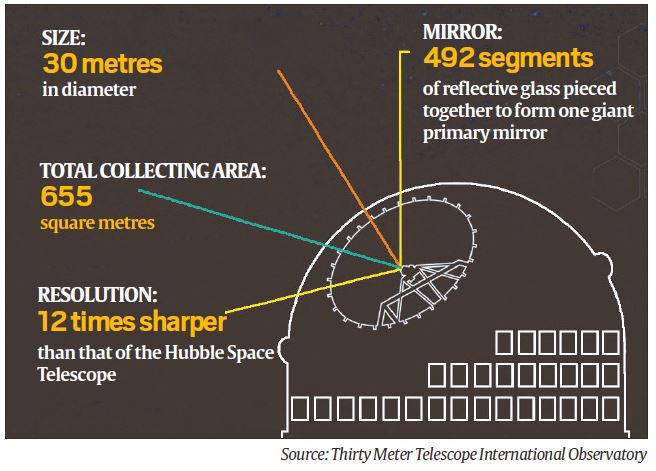
    • “Thirty Metre” refers to the 30-metre diameter of the mirror, with 492 segments of glass pieced together, which makes it three times as wide as the world’s largest existing visible-light telescope.
    • The larger the mirror, the more light a telescope can collect, which means, in turn, that it can “see” farther, fainter objects.
    • It would be more than 200 times more sensitive than current telescopes and would be able to resolve objects 12 times better than the Hubble Space Telescope.

    Utility of the telescope

    • One of its key uses will be the study of exoplanets, many of which have been detected in the last few years, and whether their atmospheres contain water vapour or methane — the signatures of possible life.
    • For the first time in history, this telescope will be capable of detecting extraterrestrial life.
    • The study of black holes is another objective.
    • While these have been observed in detail within the Milky Way, the next galaxy is 100 times farther away; the TMT will help bring them closer.
  • InvITs and REITs


    Markets regulator SEBI has put in place a framework for the rights issue of units by listed REIT and InvITs.

    What are InvITs and REITs?

    Infrastructure Investment Trusts (InvIT)

    • An Infrastructure Investment Trust (InvITs) is like a mutual fund, which enables direct investment of small amounts of money from possible individual/institutional investors in infrastructure to earn a small portion of the income as return.
    • InvITs work like mutual funds or real estate investment trusts (REITs) in features.
    • InvITs can be treated as the modified version of REITs designed to suit the specific circumstances of the infrastructure sector.
    • They are similar to REIT but invest in infrastructure projects such as roads or highways which take some time to generate steady cash flows.

    Real Estate Investment Trusts (REIT)

    • A REIT is roughly like a mutual fund that invests in real estate although the similarity doesn’t go much further.
    • The basic deal on REITs is that you own a share of property, and so an appropriate share of the income from it will come to you, after deducting an appropriate share of expenses.
    • Essentially, it’s like a group of people pooling their money together and buying real estate except that it’s on a large scale and is regulated.
    • The obvious pitch for a REIT is that it enables individuals to generate income and capital appreciation with money that is a small fraction of what would be required to buy an entire property.
    • However, the resemblance to either mutual funds or to owning property ends there.
    • According to Indian regulation on REITs, these are meant to primarily own finished and rented out commercial properties –– 80 per cent of the investments must be in such assets. That excludes a real estate that is under development.

    Why need InvITs and REITs?

    • Infrastructure and real estate are the two most critical sectors in any developing economy.
    • A well-developed infrastructural set-up propels the overall development of a country.
    • It also facilitates a steady inflow of private and foreign investments, and thereby augments the capital base available for the growth of key sectors in an economy, as well as its own growth, in a sustained manner.
    • Given the importance of these two sectors in the country, and the paucity of public funds available to stimulate their growth, it is imperative that additional channels of financing are put in place.

    What did SEBI rule?

    • SEBI said the issuer will have to disclose objects of the issue, related-party transactions, valuation, financial details, review of credit rating and grievance redressal mechanism in the placement document.
    • The SEBI had first notified REITs and InvIT Regulations in 2014, allowing setting up and listing of such trusts which are popular in some advanced markets.
  • Persons in news: Warren Hastings and his Impeachment Case

    Donald Trump’s impeachment trial started in the US Senate. A precedent being discussed is that of the Warren Hastings case — the famous failed attempt by the British Parliament to impeach India’s first governor-general.

    Warren Hastings

    • Warren Hastings, the first governor-general of Bengal (and the first de facto Governor-General of India), is considered among the most significant colonial administrators to have ruled India.
    • First as the governor of Bengal (1772-1774) and then as Governor-General (1774-1785), Hastings strengthened British rule in India and made profound changes in administration.
    • Hastings’s conduct while in office was called into question after he returned to Britain in 1785, most prominently by Edmund Burke, the noted British parliamentarian and philosopher.

    What was his impeachment case?

    • In 1786, impeachment proceedings were initiated against Hastings, probing his alleged mismanagement, mistreatment of natives, and personal corruption while in India.
    • William Pitt, the then British Prime Minister, first defended Hastings, but then joined the chorus against him.
    • Hastings’s argued that ‘Western’ standards of legality could not be applied in the East.
    • But Burke insisted that under the Law of Nature, people in India were entitled to the same protection as those in Britain.
    • In 1795, however, the House of Lords acquitted Hastings, and the impeachment failed.
    • Burke warned that such a verdict would live in “perpetual infamy”, and the trial gave rise to a wider debate on the role of the East India Company in India.

    Back2Basics

    Warren Hastings and his major works

    From 1772, Warren Hastings served as Governor-General of Fort Williams and the regulating act was passed after his arrival.

    Important events under his rule :


    • Hastings abolished the Dual System that had been established by Robert Clive. In the Dual System, the company had Diwani rights (rights to collect revenue) and the Nizam or Indian chiefs had the administrative authority.
    • The judicial powers of the Zamindars were abolished. Civil and criminal courts were established. Two appellate courts were established at Calcutta, one for civil (Sadar Diwani Adalat) and one for criminal (Sadar Nizamat Adalat) cases.
    • Hastings abolished the system of dastaks which were misused by company officials and traders earlier.
    • He implemented several reforms in all walks of administration. The Regulating Act 1773 and Pitts India Act, 1784 were important acts passed during his tenure.


  • Corona Virus


    Chinese scientists have confirmed can spread between human beings.

    Corona Virus

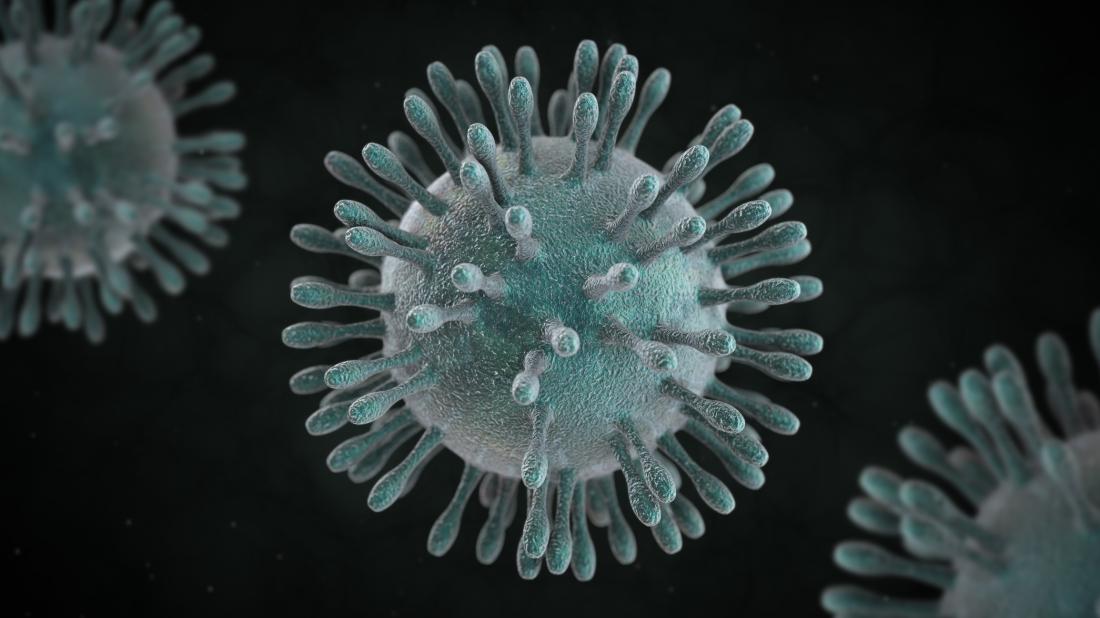
    • Corona viruses are large family of viruses, which cause illnesses to people and also circulate in animals including camels, cats and bats.
    • They cause illness ranging from the common cold to more severe diseases such as Middle East Respiratory Syndrome and Severe Acute Respiratory Syndrome.
    • 2019-nCoV is a new strain that has not been previously identified in humans.
    • Much remains to be understood about the new coronavirus, which was first identified in China earlier this month.
    • Not enough is known about 2019-nCoV to draw definitive conclusions about how it is transmitted, clinical features of disease, or the extent to which it has spread. The source also remains unknown.

    Why is it called the Wuhan Virus?

    • The first cases emerged in Wuhan in central China’s Hubei province.
    • On December 31 last year, authorities confirmed that a large number of patients with unexplained pneumonia were admitted in hospitals in the city.

    Symptoms of infection

    • According to the WHO, common signs include fever, cough, and shortness of breath. Serious infections can lead to pneumonia, kidney failure, and death.
    • Although human-to-human transmission has now been confirmed, the WHO says animals are the outbreak’s likely primary source. It is not known yet which animals are responsible.
    • To prevent the spread of all respiratory infections, the WHO in general asks people to cover their mouths and noses when coughing or sneezing, and to frequently wash their hands.
    • Direct contact with farm or wild animals should be avoided — similar outbreaks in the past, like the Severe Acute Respiratory Syndrome (SARS) emerged from markets where people were in contact with live animals.

    Why is there concern around the world?

    • People see a similarity with the SARS outbreak that infected over 8,000 people and killed around 775 in more than 35 countries worldwide in 2002-03.
    • SARS too, was caused by a mystery coronavirus, and started in China.
    • The source of the virus remained unknown for 15 years, until Chinese scientists in 2017 traced it back to a colony of horseshoe bats living in remote cave in Yunnan province.
    • The virus was carried by civet cats which are sold in markets in China.
    • Fears that SARS could reappear and memories of China misleading the rest of the world on the extent and seriousness of the outbreak have not gone away.