💥Join UPSC 2027,2028 Mentorship (August Batch) + XFactor Notes & Microthemes PDF

Distribution: weekly

  • [op-ed of the day] Delhi-Davos disconnect-India must find ways to take advantage of new opportunities

    Context

    Given its increased heft in the global economic order, India ought to be at the leading edge of the current debate of the future of capitalism.

    The emergence of “stakeholder capitalism”

    • Interests of all shareholder: Klaus Schwab, who founded the World Economic Forum 50 years ago, wants capitalists to look beyond their shareholders and consider the interests of all the stakeholders.
      • Long overdue debate: Some hope that the debate on stakeholder capitalism is a long-overdue recognition of the capitalist excesses of recent decades.
    • Generating value for customers: Last August, the Business Roundtable in the US, which brings together some of the top American corporates, said American companies must now generate value for customers.
      • Invest in their employees.
      • Deal fairly with suppliers and support the communities in which they operate even as they service their shareholders.
    • Scepticism over “interests of all shareholders”: Sceptics say that this is a nice way of saying the right things, repackaging old ideas on corporate social responsibility and creating illusions about reforming capitalism.
      • Cynics insist that it will be business as usual for the world’s capitalists.
      • Reflection of deeper crisis: Beyond this divide between optimists and pessimists, the discourse on “stakeholder capitalism” is a reflection of the deeper crisis afflicting the global economy today.

    Three major challenges according to WEF

    • In its annual survey on global risks, the WEF has identified many challenges. Three of them stand out.
    • First Challenge: Polarised politics
      • In the US Trump is unlikely to be defensive.
      • While the dominant sentiments see Trump as the very embodiment of nationalism and populism that are polarising politics around the world.
      • Others point to the structural conditions that have bred these forces.
      • America’s working-class whose wages haven’t risen in decades, whose jobs are less secure than ever rallied behind Trump.
      • Politics in the US: Much the same happened in the British elections last year.
      • Tory leader Boris Johnson won a sweeping mandate by breaking into the working-class strongholds of the Labour Party.
    • Second Challenge: Trade war
      • Trump had a long record of denouncing free trade.
      • Many had hoped that Trump will moderate his anti-globalist rhetoric once in office.
      • Attack on a core principle of globalisation: Trump has taken a pickaxe to the core principles of the globalised economic order – free trade, open borders and multilateralism.
      • Renegotiating the treaties: The US has renegotiated a 25-year old trade agreement with America’s neighbours, Canada and Mexico.
      • The threat of all-out-trade war with China: Trump’s threat of an all-out trade war with China over the last couple of years has led to an interim agreement.
      • The agreement commits Beijing to reduce its trade surplus with the US by importing more.
      • The trade deficit of the US with EU: At Davos, Trump is expected to turn his ire on the EU, which has a near $200 billion trade surplus with the US.
    • Third challenge: Technology
      • War in technology domain: The trade wars among the world’s major capitalist centres is accentuated by the technological revolution, especially in the digital domain.
      • Need for coordination: The Davos report on global risks argues that the realisation of the full potential of new technologies depends on unprecedented coordination among all stakeholders.
      • Digital fragmentation: What is emerging instead is “digital fragmentation” marked by the extension of geopolitical and geo-economic rivalries into the new domain.
      • Digital issues have come to the front and centre of American arguments with Europe.

    Conclusion

    • India must find ways to take advantage of the new opportunities from the unfolding rearrangement of the global capitalist system.
     

  • [op-ed snap] Redesigning India’s ailing data system

    Context

    As official statistics is a public good, giving information about the state of the economy and success of governance, it needs to be independent to be impartial.

    GDP calculation and its significance

    • What is GDP:
      • Assigning a value to products and services: In effect, it adds apples and oranges, tractors and sickles, trade, transport, storage and communication, real estate, banking and government services through the mechanism of value.
      • GDP covers all productive activity for producing goods and services, without duplication.
      • The System of National Accounting (SNA): It is designed to measure production, consumption, and accumulation of income and wealth for assessing the performance of the economy.
    • What is the significance of GDP data?
      • Influence the market: GDP data influence markets, signalling investment sentiments, the flow of funds and balance of payments.
      • The input-output relations impact productivity and allocation of resources.
      • Demand and supply influences prices, exchange rates, wage rates, employment and standard of living, affecting all walks of life.
    • Issues over the present series of GDP:
      • Nominal GDP: The data on GDP are initially estimated at a current price known as nominal GDP.
      • Real GDP: Nominal GDP minus the inflation effect is real GDP.
      • Price Index: There is a way of adjusting inflation effect through an appropriate price index.
      • Pricing series issue with the service sector: The present series encountered serious problems for the price adjustment, specifically for the services sector contributing about 60% of GDP.
      • Absence of price index: There is an absence of appropriate price indices for most service sectors.
      • What the absence of series means: The deflators used in the new series could not effectively separate out price effect from the current value to arrive at a real volume estimate at a constant price.
      • Methodical issue: Replacing Annual Survey of Industries (ASI) with the Ministry of Corporate Affairs MCA21 posed serious data and methodological issues.

    Need for the change in the approach of data collection

    • The approach for the collection of data remains largely the same for long.
      • Price and production indices are constructed using a fixed base Laspeyres Index.
      • The yield rate for paddy is estimated by crop cutting experiments.
      • The organisation of field surveys for collection of data on employment-unemployment, consumer expenditure, industrial output, assets and liabilities continue.
    • Why data collection for yields need to change?
      • Productivity and remunerative price of output are major concerns for agriculture.
      • Data collection from diverse factors: It is necessary to collect data on factors such as soil conditions, moisture, temperature, water and fertilizer use determining yield, the impact of intermediary and forward trade on farm gate price and so on.
      • Israel collects these data for analysis to support productivity.
      • Need to leverage the e-governance: The initiative under e-governance enabled the capturing of huge data, which need to be collated for their meaningful use for the production of official statistics.

    Data Logistics

    • Need of data from the other areas: Along with GDP, we need data to assess-
      • Inclusive growth.
      • Fourth-generation Industrial Revolution riding on the Internet of things.
      • Robotics-influencing employment and productivity.
      • Environmental protection.
      • Sustainable development and social welfare.
    • How to deal with the data inconsistency
      • We need systems which have the capability to sift through a huge volume of data seamlessly to look for reliability, validity, consistency and coherence.
      • Such a system is possible through a versatile data warehouse as a component of bigdata technology.
      • Rangarajan Committee recommendation: Setting up of such system has been wanting as thoughtful and well-meaning key recommendations of the Rangarajan Commission and subsequent recommendations from 2006 onwards by successive National Statistical Commissions.

    Way forward

    • The need for a new system: The present national accounting and analytical framework miss out on many important dimensions of the economy.
      • We need a new framework for analysis for such a complex system and evolutionary process.
      • The system needs to take into account automation, robotisation and other labour-replacing technologies affecting profitability, structural change and general welfare.
    • Need to find alternative avenues for the unemployed and jobs lost: In order to inject efficiency and stability, there is a need to have detailed data on how: markets clear, prices are formed, risks build-up, institutions function and, in turn, influence the lifestyle of various sections of the people.
    • Knowing market microstructure: It is also needed to know in greater detail about market microstructure and optimality therein, the role of technology and advanced research, changing demand on human skills, and enterprise and organising ability.
    • Monopoly must be contained:  The loss caused to the economy through monopoly power, inefficient input-output mix, dumping, obsolete technology and product mix must be contained.
    • Ensure distribution of wealth: The consensus macroeconomic framework of analysis assumes symmetric income distribution and does not get into the depth of structural issues.
      • In the changed situation of availability of microdata, there is a need to build a system to integrate the micro with the macro, maintaining distributional characteristics.

    Conclusion

    Data is the new oil in the modern networked economy in pursuit of socio-economic development. The economics now is deeply rooted in data, measuring and impacting competitiveness, risks, opportunities and social welfare in an integrated manner, going much beyond macroeconomics. There is a need for commitment to producing these statistics transparently.


  • Global Social Mobility Report 2020


    The Global Social Mobility Report was recently released at the ongoing World Economic Forum at Davos, Switzerland.

    Global Social Mobility Report

    • The World Economic Forum organizes the well-known annual gathering of the world’s most influential business and political decision-makers at Davos.
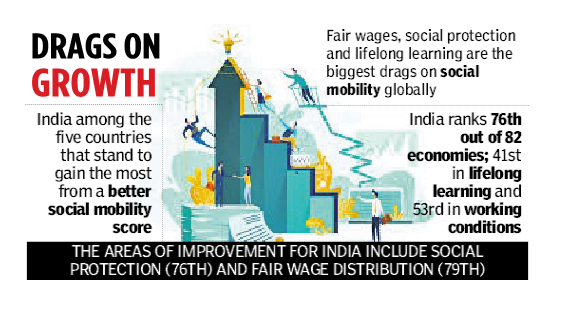
    • It has come out with its first-ever Global Social Mobility Report, which has ranked India a lowly 72 out of the 82 countries profiled.
    • According to the report, the Nordic economies such as Denmark and Finland top the social mobility rankings while countries like India, Pakistan, Bangladesh and South Africa languish at the bottom (see Table 1).

    Table 1: WEF’s Global Social Mobility Rankings

    Country Rank (out of 82)
    Denmark 1
    Germany 11
    United Kingdom 21
    United States 27
    Russia 39
    China 45
    Saudi Arabia 52
    Brazil 60
    India 76
    Pakistan 79


    What is the context for this report?

    • Notwithstanding fast global growth, inequalities have been growing across the world.
    • The rise of inequality has not only created massive social unrest but also adversely affected the global consensus on the kind of economic policies that countries follow.
    • A good example of this is the rise of trade protectionism across the world over the past few years.
    • Be it US or the UK several countries have started looking inwards in the hope that greater trade protectionism will help allay the fears and apprehensions of domestic workers.

    What is Social Mobility?

    • Typically, inequalities are measured in income terms. And this measure has been found inadequate.
    • As the report states, “many situations exist where, despite high levels of absolute income mobility, relative social mobility remains low.
    • For example, in economies such as China and India, economic growth can lift entire populations upward in terms of absolute income, but an individual’s status in society relative to others remains the same”.
    • The report states: “The notion of relative social mobility is more closely related to the social and economic status of an individual relative to their parents. I
    • n a country with a society with perfect relative mobility, a child born in a low-income family would have as much chance to earn a high income as a child born to parents who earn a high income”.

    Thus, the concept of social mobility is much broader than just looking at income inequality. It encompasses several concerns such as:

    • Intragenerational mobility: The ability for an individual to move between socio-economic classes within their own lifetime.
    • Intergenerational mobility: The ability for a family group to move up or down the socio-economic ladder across the span of one or more generations.
    • Absolute income mobility: The ability for an individual to earn, in real terms, as much as or more than their parents at the same age.
    • Absolute educational mobility: The ability for an individual to attain higher education levels than their parents.
    • Relative income mobility: How much of an individual’s income is determined by their parents’ income.
    • Relative educational mobility: How much of an individual’s educational attainment is determined by their parents’ educational attainment.

    Why does social mobility matter?

    • How far an individual can move up in the society determines a lot whether one is closer to the income “floor” (or poor) or “ceiling” (or rich).
    • Social mobility levels, then, can help us understand both the speed – that is, how long it takes for individuals at the bottom of the scale to catch up with those at the top – and the intensity – that is, how many steps it takes for an individual to move up the ladder in a given period – of social mobility.
    • Research also shows that countries with high levels of relative social mobility—such as Finland, Norway or Denmark— exhibit lower levels of income inequality.
    • Conversely, countries with low relative social mobility—such as India, South Africa or Brazil—also exhibit high levels of economic inequality.
    • That’s why it matters for countries like India to increase social mobility.


    As shown in Table 2, it would take a whopping 7 generations for someone born in a low-income family in India to approach mean income level; in Denmark, it would only take 2 generations.


    Table 2: Income Mobility across Generations

    Country Number of generations required by a poor family member to achieve mean income level
    Denmark 2
    United States/ United Kingdom 5
    Germany/ France 6
    India/China 7
    Brazil/South Africa 9


    So, how is social mobility calculated?

    The WEF’s Global Social Mobility Index assesses the 82 economies on “10 pillars” spread across the following five key dimensions of social mobility:

    1. Health;
    2. Education (access, quality and equity, lifelong learning);
    3. Technology;
    4. Work (opportunities, wages, conditions);
    5. Protection and Institutions (social protection and inclusive institutions).

    How did India perform on each of the 10 pillars of social mobility?

    India’s overall ranking is a poor 76 out of the 82 countries considered. Thus it should not come as any surprise that India ranks lowly in individual parameters as well.

    Table 3 below provides the detailed breakup.

    Table 3: Where India ranks on the 10 Pillars of Social Mobility

    Parameter Rank (out of 82 countries)
    Health 73
    Access to Education 66
    Quality and Equity in Education 77
    Lifelong learning 41
    Access to Technology 73
    Work Opportunities 75
    Fair Wage Distribution 79
    Working Conditions 53
    Social Protection 76
    Inclusive Institutions 67


    Back2Basics

    World Economic Forum (WEF)

    • The WEF based in Cologny-Geneva, Switzerland, is an NGO founded in 1971.
    • The WEF’s mission is cited as “committed to improving the state of the world by engaging business, political, academic, and other leaders of society to shape global, regional, and industry agendas”.
    • It is a membership-based organization, and membership is made up of the world’s largest corporations.
    • The WEF hosts an annual meeting at the end of January in Davos, a mountain resort in Graubünden, in the eastern Alps region of Switzerland.

    Various reports published by WEF:

    [Tikdam: Most (Not all) reports titled with ‘Global’ are released by WEF.]

    1. Global Competitiveness Report
    2. Global Information Technology Report
    3. Global Gender Gap Report
    4. Global Travel and Tourism Report
    5. Global Enabling Trade Report etc.
  • Thawing of Permafrost


    A recent study makes a disturbing connection between the loss of Arctic sea ice and thawing (melting) of permafrost in the region, with global implications.

    What is Permafrost?

    • ‘Permafrost’ or permanently frozen ground is land that has been frozen at or below 0 degrees Celsius for two or more consecutive years.
    • A staggering 17 per cent of Earth’s entire exposed land surface is comprised of permafrost.
    • Composed of rock, sediments, dead plant and animal matter, soil, and varying degrees of ice, permafrost is mainly found near the poles, covering parts of Greenland, Alaska, Northern Canada, Siberia and Scandinavia.
    • The Arctic region is a vast ocean, covered by thick ice on the surface (called sea ice), surrounded by land masses that are also covered with snow and ice.

    Permafrost thawing

    • When permafrost thaws, water from the melted ice makes its way to the caves along with ground sediments, and deposits on the rocks.
    • In other words, when permafrost thaws, the rocks grow and when permafrost is stable and frozen, they do not grow.

    Why thawing?

    • The link between the Siberian permafrost and Arctic sea ice can be explained by two factors:
    • One is heat transport from the open Arctic Ocean into Siberia, making the Siberian climate warmer.
    • The second is moisture transport from open seawater into Siberia, leading to thicker snow cover that insulates the ground from cold winter air, contributing to its warming.
    • This is drastically different from the situation just a couple of decades ago when the sea ice acted as a protective layer, maintaining cold temperatures in the region and shielding the permafrost from the moisture from the ocean.
    • If sea ice (in the summer) is gone, permafrost start thawing.

    Impact on Climate Change

    • Due to relentlessly rising temperatures in the region, since the late-twentieth century, the Arctic sea ice and surrounding land ice are melting at accelerating rates.
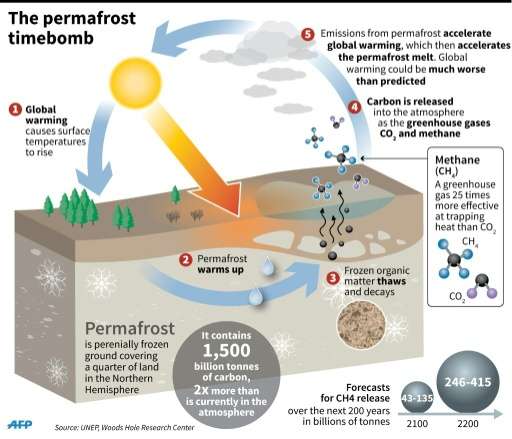
    • When permafrost thaws due to rising temperatures, the microbes in the soil decompose the dead organic matter (plants and animals) to produce methane (CH4) and carbon dioxide (CO2), both potent greenhouse gases.
    • CH4 is at least 80 times more powerful than CO2 on a decadal timescale and around 25 times more powerful on a century timescale.
    • The greenhouse gases produced from thawing permafrost will further increase temperatures which will, in turn, lead to more permafrost thawing, forming an unstoppable and irreversible self-reinforcing feedback loop.
    • Experts believe this process may have already begun. Giant craters and ponds of water (called ‘thermokarst lakes’) formed due to thawing have been recorded in the Arctic region. Some are so big that they can be seen from space.

    Why a matter of concern?

    • An estimated 1,700 billion tonnes — twice the amount currently present in the atmosphere — of carbon is locked in all of the world’s permafrost.
    • Even if half of that were to be released to the atmosphere, it would be game over for the climate.
    • Scientific estimates suggest that the Arctic Ocean could be largely sea ice-free in the summer months by as early as 2030, based on observational trends, or as late as 2050, based on climate model projections.
  • UAE declared ‘Reciprocating Territory’ by India

    Recently, the Ministry of Law and Justice issued an Extraordinary Gazette Notification, declaring the UAE to be a “reciprocating territory” under Section 44A of the Civil Procedure Code, 1908. The notification also declared a list of courts in the UAE to be “superior Courts” under the same section.

    What is a ‘Reciprocating Territory’ ?

    • Essentially, orders passed by certain designated courts from a ‘reciprocating territory’ can be implemented in India, by filing a copy of the decree concerned in a District Court here.
    • The courts so designated are called ‘superior Courts’.

    What does Section 44 of the CPC say?

    Section 44A, titled “Execution of decrees passed by Courts in reciprocating territory”, provides the law on the subject of execution of decrees of Courts in India by foreign Courts and vice versa.

    Under Explanation 1 of S. 44A:

    • “Reciprocating territory” means any country or territory outside India which the Central Government may, by notification in the Official Gazette, declare to be a reciprocating territory for the purposes of this section; and “superior Courts”, with reference to any such territory, means such Courts as may be specified in the said notification.”
    • 44A (1) provides that a decree passed by “a superior Court” in any “reciprocating territory” can be executed in India by filing a certified copy of the decree in a District Court, which will treat the decree as if it has been passed by itself.
    • According to Explanation-2, the scope of the Section is restricted to decrees for payment of money, not being sums payable “in respect of taxes or other charges of a like nature or in respect of a fine or other penalty”.
    • It also cannot be based on an arbitration award, even if such an award is enforceable as a decree or judgment.

    Other countries with such status

    • Apart from Dubai, the other countries declared to be “reciprocating territories” are: United Kingdom, Singapore, Bangladesh, Malaysia, Trinidad & Tobago, New Zealand, the Cook Islands (including Niue) and the Trust Territories of Western Samoa, Hong Kong, Papua New Guinea, Fiji, Aden.

    Why such move?

    • The notification was the only remaining part of a 1999 agreement between the UAE and India related to cooperation in civil and commercial matters.
    • The decision is believed to help bring down the time required for executing decrees between the two countries.
    • With this, Indian expatriates in the UAE would no longer be able to seek safe haven in their home country if they are convicted in a civil case in the UAE.
  • [pib] UNCITRAL


    An International Arbitration Tribunal has dismissed all claims brought against  India in entirety. The arbitration arose out of the cancellation of Letters of Intent for the issuance of telecom licences to provide 2G services in five telecommunications circles by reason of India’s essential security interests.

    UNCITRAL

    • The UN Commission on International Trade Law (UNCITRAL) is a subsidiary body of the U.N. General Assembly responsible for helping to facilitate international trade and investment.
    • Established by the UNGA in 1966, UNCITRAL’s official mandate is “to promote the progressive harmonization and unification of international trade law” through conventions, model laws, and other instruments that address key areas of commerce, from dispute resolution to the procurement and sale of goods.
    • UNCITRAL carries out its work at annual sessions held alternately in New York City and Vienna, where it is headquartered.
    • The Tribunal constituted in accordance with the UNCITRAL Arbitration Rules 1976 is seated at the Hague, Netherlands, and proceedings are administered by the Permanent Court of Arbitration.
  • Steppe Eagle


    A lone endangered steppe eagle (Aquila nipalensis) has been sighted by a group of birdwatchers in a paddy field near Vijayawada.

    Steppe Eagle

    • The Steppe Eagle is a migratory raptor which has undergone extremely rapid population declines within all its range.
    • It breeds in Russia, Kazakhstan, and Mongolia during the winter season.
    • Steppe eagle is the second-largest migratory eagle species to India.
    • IUCN Status: It has moved from ‘Least Concern’ to ‘Endangered’
  • [op-ed of the day] Equity’s weak pulse and commodified medicine

    Context

    As the government tries to overhaul the public health system in India, its time to take into account the advent and the role played by the private sector and its implications.

    The advent of the private sector

    • Increase in the role of the private sector in the post-Independence era: Post-Independence, the private sector increased its footprint in India.
      • Perpetual sub-optimal investments in public health allowed the private sector to capitalise, flourish, and increasingly gain the confidence of the masses.
      • The private sector went from having about 1,400 enterprises in 1950 to more than 10 lakh in 2010-11.
      • To doctors, this promised greater professional liberty, lesser restrictions, and higher incomes.
      • After liberalisation, the greater focus shifted to the lucrative tertiary-care sector and led to an onslaught of sophisticated private health care in cities.

    The dominance of the private sector and malpractices

    • The scale of dominance: Private sector has over 70% of the health-care workforce and 80% of allopathic doctors, has meant that it is scarcely possible for a health-care provider to function in defiance of its norms.
      • Pervasive malpractices: The pervasiveness of malpractices in this market has come to ensure that few could survive without condoning them.
      • Nexus of the private players: Players in this market, in much of their malpractices, have also learnt to function as a harmonious family.
      • Organised form to safeguard interest: The family plays its role in safeguarding its members, acquainting them with its norms and interests, and leveraging the power of its patriarchs to defend its interests in society.
      • Standards of success dictated by the markets: It is little wonder that the market has also come to dictate the avenues of aggrandisement and yardsticks of professional success for health-care professionals.
      • Benchmark of quality changed: Business finesse and social adroitness rather than clinical excellence and empathy become the touchstones of calibre in this market.

    Failure of the government

    • Absence of national system: The larger chunk of Indian health care (and health workforce) could not be brought under a “national system” having some form of overarching state control or involvement.
      • If such a system existed it could avail of essential health care without most people having to rely on a vagarious market, except as a luxury.
      • Example of the UK’s NHS: The National Health Service of the United Kingdom, remains the single largest health-care provider.
      • NHS employs nearly the entire health-care workforce.
      • NHS makes essential health care available to all practically free at the point of service.
    • Consequences of the absence of such system: The absence ensures is that the profit-driven private sector, the minor component, caters mainly to the affluent lot as largely a matter of deliberate choice rather than desperate compulsion.
      • Hopes of benefits of free-market belied: The Indian example, much like the United States’, bespeaks the failure of the idea that a free market will compel players to be more efficient.
      • The exploitation of the loops by the private players: Rather than increasing efficiency, the players have found it expedient to scrupulously exploit the prevailing cracks in the system and employ devious methods in order to maximise profits.

    Conclusion

    • Health-care providers, just like others, are moulded by their social surroundings. When necessary controls are loosened, the connatural vices are let loose; when the habitat is conducive to values, the right traits develop.
    • A system that starts off with health care as an overt tradable commodity it threatens the development of virtues in the system.
    • On the other hand, a system founded on the concept of equity cultivates a totally different culture of patient care.


  • Pulse Polio Programme

    The beginning of this year’s Pulse Polio Programme was inaugurated from the Rashtrapati Bhavan itself.  To prevent the virus from coming to India, the government has since March 2014 made the Oral Polio Vaccination (OPV) mandatory for those travelling between India and polio-affected countries.

    The Pulse Polio Programme

    • India launched the Pulse Polio immunisation programme in 1995, after a resolution for a global initiative of polio eradication was adopted by the World Health Assembly (WHA) in 1988.
    • Children in the age group of 0-5 years are administered polio drops during national and sub-national immunisation rounds (in high-risk areas) every year.

    India is polio-free

    • According to the Ministry of Health, the last polio case in the country was reported from Howrah district of West Bengal in January 2011.
    • The WHO on February 24, 2012, removed India from the list of countries with active endemic wild polio virus transmission.
    • Two years later, the South-East Asia Region of the WHO, of which India is a part, was certified as polio-free.

    Back2Basics

    What is Polio?

    • The WHO defines polio or poliomyelitis as a highly infectious viral disease, which mainly affects young children.
    • The virus is transmitted by person-to-person, spread mainly through the faecal-oral route or, less frequently, by a common vehicle (e.g. contaminated water or food) and multiplies in the intestine, from where it can invade the nervous system and can cause paralysis.
    • Initial symptoms of polio include fever, fatigue, headache, vomiting, stiffness in the neck, and pain in the limbs. In a small proportion of cases, the disease causes paralysis, which is often permanent.
    • There is no cure for polio, it can only be prevented by immunization.
  • Drone Census

    India’s first drone census has seen only 2,500 Ownership Acknowledgment Numbers (OANs) being issued by the Ministry of Civil Aviation (MoCA) since five days of beginning.

    Drone Census

    • The MoCA had issued a notice providing a one-time opportunity for voluntary disclosure of all drones and operators starting from January 14.
    • The DGCA issued the Civil Aviation Requirements (CAR), Section 3 – Air Transport Series X, Part I, Issue I, dated August 27, 2018 regulates use of drones.
    • It provides the process for obtaining Unique Identification Number, Unmanned Aircraft Operator Permit (UAOP) and other operational requirements; there are drones that do not comply with the CAR.
    • If a drone is not enlisted by 5 p.m. on January 31, then it will most definitely be confiscated.
    • After January 31, only authorised retailers will be allowed to sell them after uploading buyers’ Know your Customer (KYC) and sale invoice, similar to the sale of mobile phones and cars.

    Why such move?

    • The exercise will give the government a picture of who owns what kind of drone in which part of the country.
    • It will help in making policy decisions that should ideally become the base for understanding the scale of operations.