💥Join UPSC 2027,2028 Mentorship (August Batch) + XFactor Notes & Microthemes PDF

Distribution: weekly

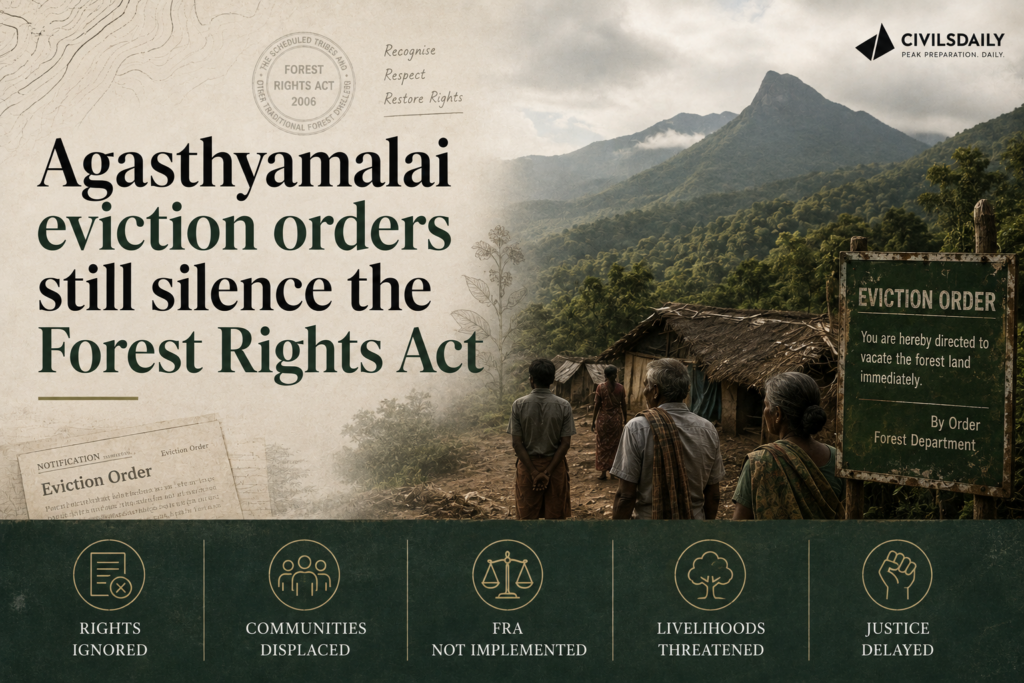
  • Agasthyamalai eviction orders still silence the Forest Rights Act

    Why in the News

    The Forest Department has issued eviction notices to thousands of households in the Agasthyamalai Biosphere Reserve (ABR) following a Supreme Court order for time-bound removal of forest encroachments. The issue highlights the tension between forest conservation and rights under the Forest Rights Act, 2006.

    What is the Forest Rights Act, 2006?

    • Full name: Scheduled Tribes and Other Traditional Forest Dwellers (Recognition of Forest Rights) Act, 2006.
    • Recognises forest rights of Scheduled Tribes (STs) and other traditional forest dwellers.
    • Cut-off: Eligible occupation must pre-date 13 December 2005.
    • Claims are initiated and verified by Gram Sabhas and examined by higher-level committees.
    • Key safeguard: Eviction cannot take place until recognition and verification are completed.

    What is the Agasthyamalai Biosphere Reserve?

    • ABR: Agasthyamalai Biosphere Reserve.
    • Covers about 3,500 sq km across Tamil Nadu and Kerala.
    • Includes Kalakkad-Mundanthurai, Srivilliputhur-Megamalai and Periyar Tiger Reserves, along with wildlife sanctuaries.

    What is the Central Empowered Committee?

    • CEC: Central Empowered Committee.
    • Constituted under Supreme Court directions to monitor forest and environmental compliance.
    • It surveyed the Agasthyamalai landscape and reported violations involving non-forestry activities.

    Who are Other Traditional Forest Dwellers?

    • OTFDs: Other Traditional Forest Dwellers.
    • Non-tribal communities primarily dependent on forests for livelihood.
    • They must demonstrate three generations or 75 years of dependence before 13 December 2005.

    What did the Supreme Court order?

    1. Time-bound eviction plan, with rehabilitation where applicable.
    2. Legal action against wilful violators, including 118 government servants found to be encroachers.
    3. Ecological restoration after eviction.
    4. No new forest diversion or non-forest activity in ABR until encroachments are removed.
    5. Possible deployment of paramilitary forces for enforcement.

    Key Issue: Conservation vs Forest Rights

    • Conservation: Evictions aim to restore critical tiger habitat and remove non-forest activities.
    • Rights concern: Eviction before completion of FRA recognition and verification can violate statutory safeguards.
    • Data problem: Lack of reliable data on occupation outside FRA’s scope makes it difficult to distinguish genuine rights-holders from actual encroachers.

    Statutory Framework

    • FRA, 2006: Forest rights recognition.
    • FCA, 1980: Forest (Conservation) Act, 1980, regulates diversion of forest land.
    • WLPA, 1972: Wild Life (Protection) Act, 1972, governs protected areas.
    • PESA, 1996: Panchayats (Extension to Scheduled Areas) Act, 1996, strengthens Gram Sabha powers in Scheduled Areas.
    • SC/ST PoA Act, 1989: Scheduled Castes and Scheduled Tribes (Prevention of Atrocities) Act, 1989.

    Back2Basics: Forest Rights Act

    • Nodal Ministry: Ministry of Tribal Affairs.
    • Beneficiaries: Forest-dwelling STs and eligible OTFDs.
    • Three rights: Individual forest rights, community rights and Community Forest Resource (CFR) rights.
    • Gram Sabha: Starting point for claims.
    • Key safeguard: No eviction before completion of recognition and verification.

    “[2021] At the national level, which ministry is the nodal agency to ensure effective implementation of the Scheduled Tribes and Other Traditional Forest Dwellers (Recognition of Forest Rights) Act, 2006?

    (a) Ministry of Environment, Forest and Climate Change

    (b) Ministry of Panchayati Raj

    (c) Ministry of Rural Development

    (d) Ministry of Tribal Affairs
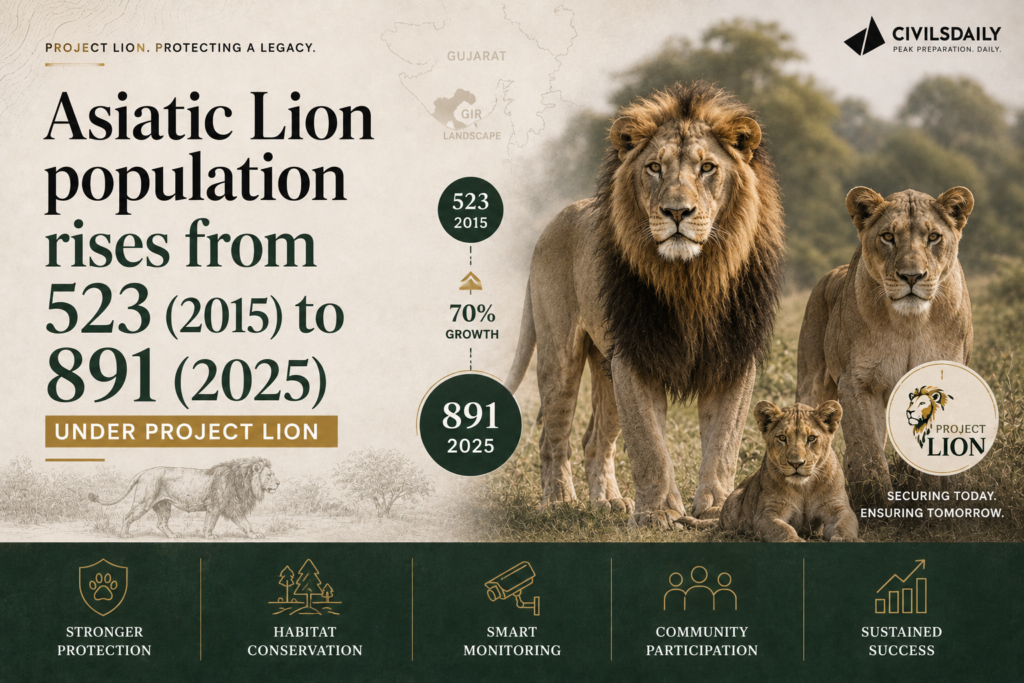
  • Asiatic lion population rises from 523 (2015) to 891 (2025) under Project Lion

    Why in the News

    India’s Asiatic lion population increased from 523 in 2015 to 891 in 2025, the highest recorded count. Project Lion, launched in 2020, aims to strengthen conservation of the species and its Gir landscape.

    What is Project Lion?

    • Launched: 2020 for long-term conservation of the Asiatic lion.
    • Focus: Habitat improvement, disease surveillance, scientific monitoring and community participation.
    • Tools: Radio-collaring, camera traps and genetic/gene-pool conservation.
    • Need: The entire wild population is concentrated in one landscape, creating a major single-population risk.

    Latest Population Status

    • 2015: 523 lions
    • 2025: 891 lions
    • Key concern: Many lions now occur outside protected areas, increasing human-wildlife conflict.
    • Habitat: Gir is approaching its carrying capacity, strengthening the case for a second home.

    Back2Basics: Asiatic Lion

    • Scientific name: Panthera leo persica
    • IUCN: Endangered
    • CITES: Appendix I
    • Wild Life (Protection) Act, 1972: Schedule I
    • Only wild population: India
    • Natural range: Gir landscape, Gujarat
    • Proposed second home: Barda Wildlife Sanctuary, Porbandar.

    Why is a Second Home Needed?

    1. Single-site risk: Disease or disaster in Gir could threaten the entire species.
    2. Habitat saturation: Increasing population is pushing lions beyond protected areas.
    3. Human-wildlife conflict: Greater interaction with people and livestock.
    4. Disease risk: Outbreaks such as Canine Distemper Virus (CDV) can threaten large carnivores.
    5. Habitat fragmentation: Mining, roads and railways can disrupt dispersal corridors.

    Statutory Framework

    • WLPA, 1972: Wild Life (Protection) Act, 1972, provides legal protection to wildlife.
    • FCA, 1980: Forest (Conservation) Act, 1980, regulates forest diversion.
    • BDA, 2002: Biological Diversity Act, 2002, promotes conservation and sustainable use.
    • EPA, 1986: Environment (Protection) Act, 1986, provides the broader environmental framework.

    Government Initiatives

    • Project Lion (2020): Asiatic lion conservation.
    • Project Tiger (1973): Tiger conservation.
    • Project Elephant (1992): Elephant and corridor conservation.
    • Project Snow Leopard (2009): Snow leopard and Himalayan ecosystem conservation.
    • Integrated Development of Wildlife Habitats: Supports protected areas and endangered species recovery.

    [2019] Consider the following statements:

    1. Asiatic lion is naturally found in India only.

    2. Double-humped camel is naturally found in India only.

    3. One-horned rhinoceros is naturally found in India only.

    Which of the statements given above is / are correct?

    (a) 1 only

    (b) 2 only

    (c) 1 and 3 only

    (d) 1, 2 and 3

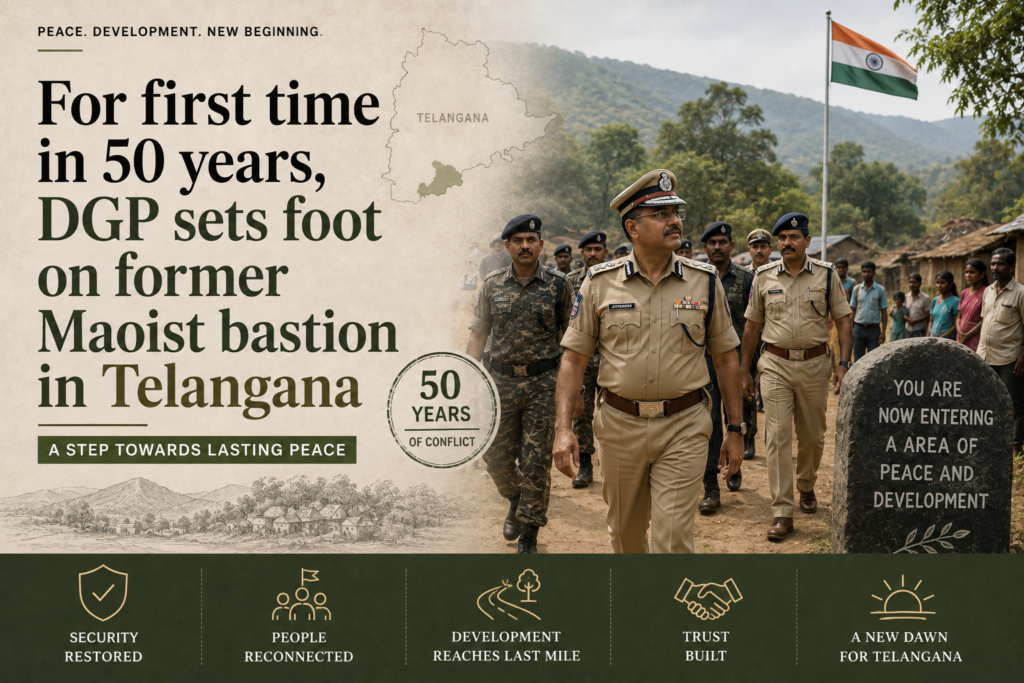
  • For first time in 50 years, DGP sets foot on former Maoist bastion in Telangana

    Why in the News

    For the first time in 50 years, a Director General of Police set foot on the Telangana side of Karregutta, a hill once used to house Central Committee members of the banned Communist Party of India (Maoist). The visit marks the decline of Left Wing Extremism under Operation Kagar, with around 700 surrenders in Telangana and the top leadership largely killed, arrested, or surrendered.

    What is Operation Kagar?

    1. Definition: Operation Kagar is a coordinated anti-Maoist offensive launched by security forces in pursuit of the central government’s deadline for a Naxal-free India.
    2. Scope: It combines intensified security operations with surrender-and-rehabilitation measures across the Maoist-affected belt.

    Who are the CPI (Maoist)?

    1. Definition: The Communist Party of India (Maoist), or CPI (Maoist), is a banned Left Wing Extremist organisation that seeks to overthrow the state through armed struggle.
    2. Leadership: Its former General Secretary Muppala Lakshmana Rao, alias Ganapati, was the longest-serving general secretary of the outfit.

    What happened at Karregutta?

    1. The DGP’s visit: The Telangana Director General of Police entered the Telangana side of Karregutta accompanied by a large contingent of police and revenue personnel.
    2. The message: The delegation’s size was meant to signal that it is now safe to visit the area, where earlier only specialised forces such as Greyhounds and COBRA units operated briefly during operations.
    3. Tricolour hoisted: The contingent hoisted the national flag at the spot.
    4. Tourism plan: The DGP announced the kaccha road into the forest would be tarred and the area developed into a tourist spot.
    5. Surrender support: Surrendered Maoists are given a lump-sum grant, including the bounty announced on their heads, to start a new life.

    What is the current status of the Maoist decline?

    1. Surrenders: Around 700 Maoists surrendered in Telangana alone during the operation.
    2. Leadership losses: By March 31, several Central Committee members of the CPI (Maoist) were killed, arrested, or had surrendered.
    3. Top commander killed: Former General Secretary Nambala Keshava Rao, alias Basavaraju, was killed in a police encounter in May 2025.
    4. Factional split: After Basavaraju’s death the party split into two factions, one led by Mallojula Venugopal Rao, alias Sonu, and another by Thippiri Tirupathi, alias Devuji, who later surrendered.
    5. Few absconding: Only two to three top Maoists remain absconding, chief among them Ganapati.

    Conclusion

    A DGP entering Karregutta after five decades, followed by the hoisting of the Tricolour, signals the sharp decline of the Maoist movement in Telangana under Operation Kagar. With around 700 surrenders, the top leadership neutralised, and only a handful absconding, the insurgency’s organisational base has collapsed. The next milestone is the government’s deadline for a Naxal-free India and the rehabilitation of surrendered cadres into mainstream society.

    Back2Basics:

    Left Wing Extremism in India (Foundational Context)

    1. About: Left Wing Extremism (LWE), also called Naxalism, is an armed insurgency by Maoist groups aiming to capture state power through violence.
    2. Geography: It has historically concentrated in a forested tribal belt across Chhattisgarh, Jharkhand, Odisha, Telangana, and neighbouring States.
    3. Nodal ministry: The Ministry of Home Affairs coordinates the national response through security and development measures.

    Communist Party of India (Maoist)

    1. Formation: Formed in 2004 through the merger of the People’s War Group and the Maoist Communist Centre of India.
    2. Status: Designated a terrorist organisation under the Unlawful Activities (Prevention) Act, 1967.
    3. Objective: Seeks to overthrow the Indian state through protracted armed struggle.
    4. Armed wing: Operates the People’s Liberation Guerrilla Army.

    Government Initiatives against LWE

    1. SAMADHAN doctrine: An overarching strategy covering smart leadership, aggressive strategy, motivation, actionable intelligence, and technology.
    2. Security Related Expenditure Scheme: Reimburses States for security operations, training, and rehabilitation of surrendered cadres.
    3. Aspirational Districts Programme: Targets development in the most backward districts, many of them LWE-affected.
    4. Road connectivity projects: The Road Requirement Plan and RCPLWE scheme build roads to open up affected areas.
    5. Surrender and Rehabilitation Policy: Provides grants, vocational training, and support to those who lay down arms.

    Key Facts about LWE

    1. Shrinking footprint: The number of LWE-affected districts has fallen sharply over the past decade.
    2. Declining violence: Incidents and casualties have dropped substantially with intensified operations.
    3. Elite forces: Greyhounds of Telangana and Andhra Pradesh and the CoBRA units of the CRPF are specialised anti-Maoist forces.

    Challenges in Countering LWE

    1. Development deficit: Persistent gaps in roads, health, and education sustain grievances in affected areas.
    2. Difficult terrain: Dense forests and hilly terrain aid guerrilla movement and hamper operations.
    3. Tribal alienation: Displacement and land alienation feed recruitment among tribal populations.
    4. Rehabilitation gaps: Surrendered cadres struggle to find a foothold in mainstream society.
    5. Cross-border and inter-State movement: Cadres exploit State boundaries to evade coordinated action.

    Way Forward

    1. Sustained development: Extend roads, connectivity, and public services into cleared areas.
    2. Robust rehabilitation: Ensure surrendered cadres receive grants, skills, and livelihoods.
    3. Protect tribal rights: Implement the Forest Rights Act and Fifth Schedule protections effectively.
    4. Consolidate security gains: Hold cleared areas and prevent the movement’s revival across State borders.

    UPSC Relevance

    [UPSC 2018] Left Wing Extremism (LWE) is showing a downward trend, but still affects many parts of the country. Briefly explain the Government of India’s approach to counter the challenges posed by LWE.

    Linkage: The PYQ examines the Government’s approach to tackling Left Wing Extremism. Operation Kagar demonstrates the security and surrender components of this approach. The article also highlights the need for rehabilitation and development after security gains.

  • Russia’s share in India’s oil imports jumps to 48% in June

    Why in the News

    Russia’s share in India’s crude oil imports rose to an all-time high of 48 percent in June 2026, even as India cut its total crude imports. This comes as the US Senate has passed a bill to levy tariffs of up to 100 percent on the top buyers of Russian oil and gas, placing India’s energy security and its trade exposure to the United States in direct tension.

    What is the Sanctioning Russia and Iran Act of 2026?

    1. Definition: The Lindsey O. Graham Sanctioning Russia and Iran Act of 2026 is a US bill that authorises secondary tariffs of up to 100 percent on countries that continue to buy Russian oil and gas. It targets the largest purchasers of these products from Russia.
    2. Status: The bill was passed by the US Senate and still requires passage by the US House of Representatives before it becomes law.

    What are the tariff triggers under the bill?

    1. Top-buyer test: Tariffs apply to a country that was among the five largest importers of Russian crude oil or natural gas in the 12 months preceding the Act’s enactment.
    2. Continuation test: The tariff applies if that country continues to import Russian oil or gas beyond 30 days after enactment.
    3. Sanctions-evasion clause: Tariffs can also be imposed on countries found to have helped Russia evade sanctions.
    4. India’s exposure: India, alongside China, is one of the top two importers of Russian oil, so it qualifies under these criteria.

    What do the June import figures show?

    1. Fall in total imports: June crude oil imports of 18.2 million metric tonnes (MMT) were 16.5 percent lower than in May 2026 and 13 percent lower than in June the previous year.
    2. Import bill still high: The June oil import bill was 22 percent lower than in May but still 40 percent higher than in June last year, due to elevated crude prices.
    3. Russian purchases held up: India imported 8.7 MMT of Russian oil in June, only 1 percent lower than May and 25 percent higher than a year earlier.
    4. Record Russian share: Russia’s share reached 48 percent by quantity and 48.6 percent by value, rising every month since March.
    5. UAE at a high: The United Arab Emirates (UAE) supplied 17.5 percent of imports by volume and 18 percent by value, its highest share so far.
    6. Concentration: Russia and the UAE together accounted for nearly two-thirds of India’s oil imports in June, the highest combined share from any two countries.
    7. Shrinking discount: The premium Russia charged India rose from a discount as recently as February 2026 to a premium of $10.6 per tonne in June, down from $77.7 per tonne in April.

    How has India pre-empted sanctions exposure?

    1. Ship-to-ship transfers: The Ministry of Petroleum and Natural Gas said exposure was pre-empted through ship-to-ship transfer operations in international waters via the Red Sea route through Yanbu and Fujairah.
    2. Avoiding a single choke point: The aim was to ensure that no single choke point or sanctions regime could halt India-bound cargo.
    3. Refinery flexibility: Indian refineries spent a decade acquiring the flexibility to switch between crude grades and shipping routes when disruption struck.

    Why does the record Russian share expose India?

    1. Energy security dependence: India cannot quickly cut back on Russian oil while supplies through the Strait of Hormuz remain constrained by the West Asia conflict.
    2. Trade and tariff risk: Continued high Russian purchases place India within the top-buyer criteria of the US bill, risking tariffs of up to 100 percent.
    3. Ambiguity on evasion: It is unclear whether India’s ship-to-ship arrangements would be treated as helping Russia evade sanctions.

    Conclusion

    India’s rising dependence on discounted Russian crude has hit a record 48 percent share, secured through diversified shipping routes even as total imports fell. This leaves India balancing its energy security against the risk of secondary tariffs under the US bill. The immediate milestone is the bill’s fate in the US House of Representatives, which will determine whether the tariff threat becomes law.

    Back2Basics:

    Strait of Hormuz

    1. Designation: A narrow strait linking the Persian Gulf to the Gulf of Oman and the Arabian Sea.
    2. Bordering states: Bordered by Iran to the north and Oman and the UAE to the south.
    3. Significance: One of the world’s most critical oil transit choke points, carrying a large share of seaborne crude.

    What is Energy Security? (Foundational Context)

    1. About: Energy security is the uninterrupted availability of energy sources at an affordable price.
    2. Rationale: It matters because India imports the bulk of its crude oil, leaving growth and prices exposed to external supply shocks.
    3. Core dimensions: It rests on availability, affordability, accessibility, and diversification of both sources and supply routes.

    Key Facts about India’s Oil Imports

    1. Import dependence: India imports over 85 percent of its crude oil requirement.
    2. Global standing: India is among the world’s largest crude oil importers and consumers.
    3. Key choke point: The Strait of Hormuz, between the Persian Gulf and the Arabian Sea, carries a large share of India’s West Asian crude.

    Challenges to India’s Energy Security

    1. High import dependence: Reliance on imports for most crude exposes the economy to price and supply shocks.
    2. Geopolitical concentration: A large combined share from Russia and the UAE concentrates supply risk in two sources.
    3. Choke-point vulnerability: Disruption at the Strait of Hormuz can constrain West Asian supply.
    4. Sanctions exposure: Purchases from sanctioned suppliers risk secondary tariffs and financial penalties.
    5. Price volatility: War-driven crude price spikes inflate the import bill and widen the current account deficit.

    Way Forward

    1. Diversify sources: Expand purchases from a wider set of suppliers to reduce concentration.
    2. Build strategic reserves: Enlarge strategic petroleum reserves to cushion supply shocks.
    3. Accelerate clean energy: Scale up renewables, biofuels, and electric mobility to cut import dependence over time.
    4. Secure shipping routes: Maintain logistical flexibility across grades and routes to withstand choke-point disruption.

    PYQ Relevance

    [UPSC 2025] Energy security constitutes the dominant kingpin of India’s foreign policy, and is linked with India’s overarching influence in Middle Eastern countries. How would you integrate energy security with India’s foreign policy trajectories in the coming years?

    Linkage: The PYQ examines the integration of India’s energy security with its foreign policy. India’s record 48% dependence on Russian crude highlights the geopolitical dimension of energy security. The article shows the need to diversify suppliers and routes while balancing ties with Russia, the US and West Asia.

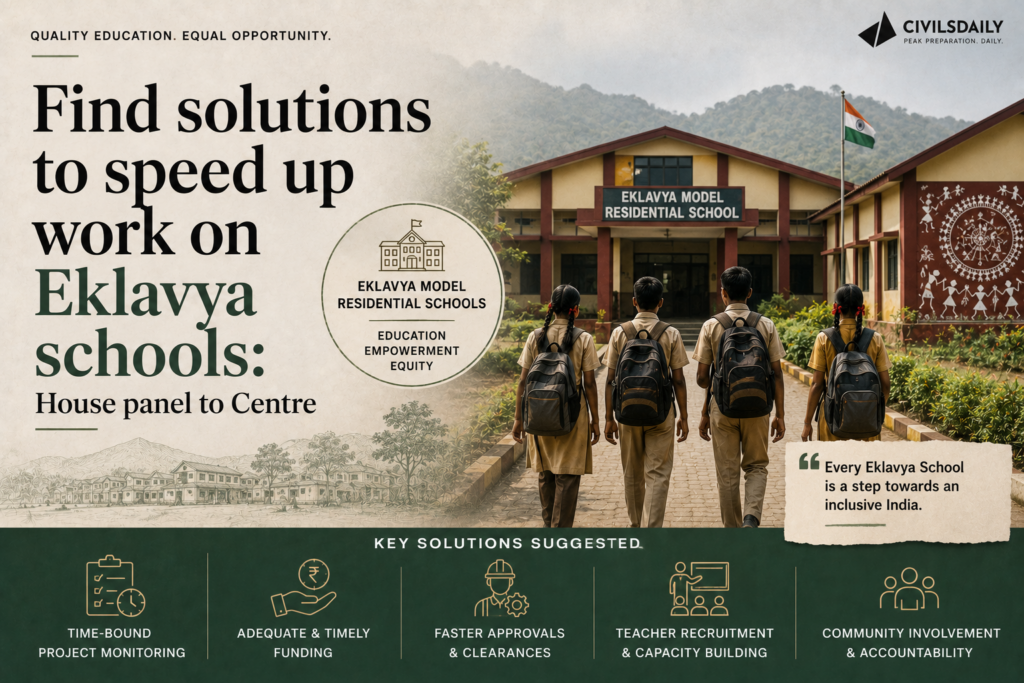
  • Find solutions to speed up work on Eklavya schools: House panel to Centre

    Why in the News

    The Parliamentary Standing Committee on Social Justice and Empowerment flagged delays in constructing and operationalising Eklavya Model Residential Schools (EMRS). Only 428 of 728 sanctioned schools have been completed, while 118 continue from government or rented buildings.

    What is EMRS?

    • EMRS: Eklavya Model Residential Schools.
    • Provides free residential education from Classes 6 to 12 to Scheduled Tribe (ST) students in tribal-majority and remote areas.
    • Nodal Ministry: Ministry of Tribal Affairs.
    • Managing body: National Education Society for Tribal Students (NESTS).
    • Aim: Improve educational access while preserving tribal cultural identity.

    What did the Panel Find?

    • 428/728 schools completed.
    • 249 under construction.
    • 51 at pre-construction stage.
    • 118 schools operate from temporary government/rented buildings.
    • Delays have caused construction cost escalation.
    • Panel suggested an independent monitoring agency and an alternative implementation mechanism.

    Scholarship Concerns

    • Scholarship funds are often released in the next academic year due to delays in State/Union Territory verification.
    • The Committee criticised the repeated explanation that States need more time for verification.
    • It also recommended reviewing the ₹8 lakh annual income ceiling for the free coaching scheme for Scheduled Castes (SCs) and Other Backward Classes (OBCs).
    • Government accepted 14 of 25 recommendations; the panel rejected responses on four issues.

    Why is Implementation Weak?

    1. Federal dependence: Central schemes depend on States for construction and verification.
    2. Weak monitoring: Delays accumulate without independent oversight.
    3. Cost escalation: Delays increase construction costs and budget requirements.
    4. Portal mismatch: Scholarship portals and State verification timelines do not align well.

    Constitutional Framework

    • Article 15(4): Enables special provisions for advancement of socially and educationally backward classes and STs.
    • Article 46: Directs the State to promote educational and economic interests of STs.
    • Article 275(1): Provides Central grants for tribal welfare and Scheduled Areas.
    • Article 342: Specifies Scheduled Tribes.
    • Fifth & Sixth Schedules: Provide special arrangements for administration of Scheduled and tribal areas.

    Back2Basics: EMRS

    • Full form: Eklavya Model Residential Schools.
    • Nodal Ministry: Ministry of Tribal Affairs.
    • Implementing body: NESTS, National Education Society for Tribal Students.
    • Classes: 6 to 12.
    • Target: ST students in tribal-majority and remote areas.
    • Purpose: Quality residential education with cultural preservation.

    Key Government Initiatives

    • Pre-Matric & Post-Matric Scholarships: Financial support for ST students.
    • National Fellowship and Scholarship for Higher Education of ST Students: Supports higher education.
    • PM-JANMAN: Pradhan Mantri Janjati Adivasi Nyaya Maha Abhiyan, focused on Particularly Vulnerable Tribal Groups (PVTGs).
    • Dharti Aaba Janjatiya Gram Utkarsh Abhiyan: Development of tribal villages.
    • Vanbandhu Kalyan Yojana: Umbrella framework for tribal development.
  • Amendments to FCRA to bring more transparency

    Why in the News

    India’s ambassador to the United States publicly defended the amendments to the Foreign Contribution (Regulation) Act after a US Congressman claimed the changes would let the Indian government take control of churches and charities. The envoy argued the amendments bring more transparency and follow national security practice adopted by other democracies.

    What is the Foreign Contribution (Regulation) Act?

    1. Definition: The Foreign Contribution (Regulation) Act (FCRA) is the law that governs the acceptance and use of foreign donations by non-governmental organisations (NGOs), civil society bodies, educational institutions, and religious organisations. It requires such bodies to register and channel foreign funds through a laid-down process.
    2. Objective: The stated purpose is to ensure foreign contributions do not compromise national interest or the integrity of public and political life.

    What do the 2026 amendments change?

    1. Vesting of assets already in law: When a registration is cancelled or surrendered, foreign contributions and the assets created from them already vest in a State Government authority under a provision in force since 2010.
    2. A designated safeguard authority: The 2026 Bill adds a designated authority to safeguard those assets rather than leaving them unprotected.
    3. A way back: If the organisation restores its registration, all assets and unused funds are returned in full.
    4. Protection for places of worship: Where a cancelled association created property connected to a place of worship, that property passes to another FCRA-registered association of the same faith to ensure continuity of worship.
    5. Faith-neutral application: The Act applies to all organisations regardless of religion, community, or ideology, and faith-based welfare, religious education, and maintenance of places of worship remain eligible for foreign funding.

    Why does the government say FCRA regulation is justified?

    1. Sovereign step: Regulating foreign financial flows in public and political spaces is presented as a sovereign act driven by national security concerns.
    2. Internal matter: Legislative decisions concerning India are treated as internal affairs decided by Parliament.
    3. Accepted global feature: The government frames such regulation as a standard feature of modern governance in many democracies.

    How do other countries regulate foreign funding?

    1. United States: The Foreign Agents Registration Act (FARA) has operated since 1938, requiring agents of foreign principals to register and disclose their activities.
    2. United States: The Foreign Account Tax Compliance Act (FATCA) has operated since 2010, mandating reporting of foreign-held financial accounts.
    3. Australia: Legislated foreign-influence transparency rules in 2018.
    4. Canada: Enacted its foreign-funding framework in 2024.
    5. United Kingdom: Its foreign-influence registration scheme came into force in July 2025.
    6. European Union: Is currently legislating a comparable framework.

    What is the scale of FCRA-regulated funding?

    1. NGO base: India has over three million NGOs, of which only 14,450 hold FCRA registration.
    2. Legislative timeline: India first enacted FCRA in 1976, followed by a new Act in 2010, with further amendments in 2016, 2018, and 2020.
    3. Use of funds: Registered associations routinely receive foreign funds for health, education, disaster relief, research, and humanitarian work.

    Conclusion

    The government’s position is that the 2026 FCRA Bill adds safeguards for the assets of cancelled associations, a route to restore them, and specific protection for places of worship, framed as a transparency and national-security measure rather than a takeover of religious bodies. The next step is passage of the 2026 Bill and the accompanying Rules, which the government describes as the continuation of a phased strengthening of the law since 1976.

    Regulation of Foreign Funding of NGOs in India (Foundational Context)

    1. About: Foreign funding of civil society is regulated so that donations from abroad do not influence India’s internal politics or security.
    2. Administering authority: FCRA is administered by the Ministry of Home Affairs, which grants, renews, and cancels registrations.
    3. Design feature: Registered bodies must receive all foreign contributions in a single designated bank account for monitoring.

    Laws and Rules Governing Foreign Contributions

    1. Foreign Contribution (Regulation) Act, 1976: The original law regulating the acceptance of foreign donations by associations.
    2. Foreign Contribution (Regulation) Act, 2010: Replaced the 1976 Act, tightened registration, and required renewal every five years; introduced vesting of assets of cancelled associations in a State authority.
    3. 2020 Amendment: Barred sub-granting of foreign funds, capped administrative expenses at 20 percent, and mandated an SBI New Delhi FCRA account.
    4. 2026 Bill and Rules: Add a designated authority to safeguard assets of cancelled registrations and protect property linked to places of worship.

    Back2Basics: FCRA regulatory framework

    1. Governing Act: Foreign Contribution (Regulation) Act, 2010, as amended.
    2. Administering ministry: Ministry of Home Affairs.
    3. Jurisdiction: Applies to associations, individuals, and companies receiving foreign contributions, excluding certain government bodies.
    4. Key requirement: Mandatory registration or prior permission, five-yearly renewal, and receipt of funds in a designated account.

    Challenges to the FCRA Regime

    1. Compliance burden: Frequent amendments and strict banking rules raise the administrative cost for small NGOs.
    2. Registration cancellations: Large-scale cancellations have disrupted health, education, and relief work dependent on foreign grants.
    3. Chilling effect: Uncertainty over renewals discourages legitimate civil society activity.
    4. Ambiguity in definitions: Broad terms such as activities against national interest allow wide discretion.
    5. International friction: Foreign governments and donors periodically object, creating diplomatic exposure.

    Way Forward

    1. Predictable timelines: Fix clear, time-bound decisions on registration, renewal, and restoration to reduce uncertainty.
    2. Proportionate compliance: Scale reporting requirements to the size of the organisation.
    3. Transparent grounds: Publish specific reasons for cancellation to allow effective appeal.
    4. Stakeholder consultation: Consult civil society and faith-based bodies before framing subordinate Rules.

    [2025, GS2, 10 marks] Civil Society Organizations are often perceived as being anti-State actors rather than non-State actors. Do you agree? Justify.”

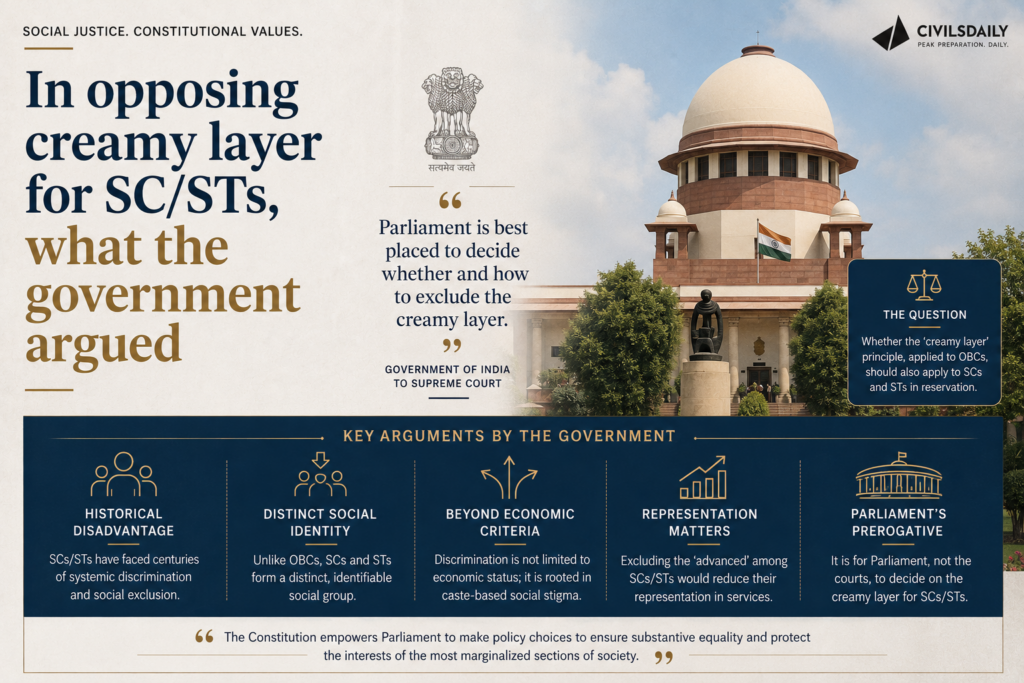
  • In opposing creamy layer for SC/STs, what the government argued

    Why in the News

    The Centre has filed an affidavit in the Supreme Court opposing the introduction of a “creamy layer” income filter within reservations for Scheduled Castes (SCs) and Scheduled Tribes (STs). It has argued that the historical disadvantage faced by these communities is rooted in untouchability and social exclusion, not economic backwardness, and that any change to reservation policy is for Parliament to decide, not the courts.

    What is the creamy layer concept?

    1. Definition: The creamy layer is an income and status filter that excludes the socially and economically advanced members of a backward class from reservation benefits. Its purpose is to ensure quota benefits reach the genuinely disadvantaged within a group rather than its better-off sections.
    2. Origin and current scope: It was introduced by the 1992 Indra Sawhney judgment as a test for Other Backward Classes (OBCs). It has never been applied to SCs and STs.

    Who does reservation currently apply to in India?

    1. Category-wise quota: Central reservation stands at 15 percent for SCs, 7.5 percent for STs, and 27 percent for OBCs on the non-creamy-layer principle.
    2. Economically Weaker Sections: A 10 percent quota for Economically Weaker Sections (EWS) applies to those outside the SC, ST, and OBC categories.
    3. The ceiling: The Indra Sawhney judgment fixed a 50 percent ceiling on total reservations, though the EWS quota and some State laws now exceed it.
    4. Creamy layer coverage: The creamy layer income exclusion currently applies only to OBCs, not to SCs or STs.

    Which constitutional provisions govern reservation?

    1. Article 15(4): Allows the State to make special provisions for the advancement of socially and educationally backward classes, SCs, and STs.
    2. Article 16(4): Permits reservation in public appointments for any backward class inadequately represented in State services.
    3. Article 16(4A) and 16(4B): Enable reservation in promotions for SCs and STs and the carry-forward of unfilled reserved vacancies.
    4. Articles 341 and 342: Empower the President to notify the initial lists of SCs and STs; once notified, inclusion or exclusion can be made only by an Act of Parliament.
    5. Article 335: Requires that reservation claims be balanced with the maintenance of administrative efficiency.
    6. Articles 338 and 338A: Establish the National Commission for Scheduled Castes and the National Commission for Scheduled Tribes.
    7. 103rd Constitutional Amendment, 2019: Inserted Articles 15(6) and 16(6) to provide the 10 percent EWS reservation.

    What did the petition seek?

    1. Income-based preferences: The Public Interest Litigation (PIL), filed by a politician and advocate, sought income-based preferences across all reserved categories, including OBCs and EWS.
    2. Elite capture argument: It argued that affluent families within the SC and ST categories monopolise reservation benefits, depriving the most marginalised of access to education and public employment.
    3. Reliance on the 2024 ruling: It relied on the 2024 Supreme Court judgment permitting sub-classification of SCs and STs, in which four of the seven Constitution Bench judges suggested extending the creamy layer principle to these groups.

    What is sub-classification of Scheduled Castes?

    1. Definition: Sub-classification allows a State to divide the single SC list into sub-groups and reserve a portion of the SC quota for the most backward castes within it. The 2024 judgment upheld this power, holding SCs are not a socially homogeneous class.

    Why does the government distinguish SC/ST identification from OBC identification?

    1. Basis of SC status: SCs face historical disadvantage stemming from the practice of untouchability, a form of social exclusion not tied to income.
    2. Basis of ST status: STs are identified by their distinct cultures, geographical isolation, and backwardness.
    3. Basis of OBC status: OBCs are identified primarily through a combination of social, educational, and economic disadvantages, which makes an economic filter relevant to them.
    4. Objective of SC/ST quotas: The stated aim is social equality, overcoming historical discrimination, and inclusive participation in public life, since discrimination against these groups does not occur on the basis of economic conditions.

    What legal precedents did the Centre cite?

    1. Indra Sawhney (1992): Upheld the Mandal Commission report on OBC reservation and introduced the creamy layer test, expressly confining it to OBCs and holding it has no relevance for SCs and STs.
    2. E V Chinnaiah (2005): Held that even if a situation ever required excluding a creamy layer from SCs, only Parliament could take the necessary legislative steps.
    3. Separation of powers: The affidavit argued courts cannot direct the executive to adopt a particular policy merely because a fairer or wiser alternative exists, and the judiciary cannot substitute for the legislature in framing public policy.

    Why is the demand for a creamy layer contested?

    1. The case for it: Affluent SC and ST families capturing quota benefits leaves the poorest within these groups without access, which undercuts the stated goal of reaching the most marginalised.
    2. The case against it: Caste-based discrimination and untouchability persist regardless of a family’s income, so an economic filter would exclude people who still face social stigma.
    3. The judicial split: The 2024 Bench itself divided, with a minority favouring the extension of the creamy layer to SCs and STs, which keeps the question legally open.

    What are the major debates surrounding reservation?

    1. Social justice versus economic upliftment: Whether reservation is a remedy for historical social injustice or a tool for economic advancement, which decides if income can ever be a valid filter.
    2. The 50 percent ceiling: The Indra Sawhney cap is under pressure from State laws and the EWS quota, raising whether the ceiling is still binding.
    3. Sub-classification and creamy layer for SC/ST: The 2024 ruling reopened whether SCs form a homogeneous class and whether the better-off within them should be excluded.
    4. The empirical gap: The absence of updated caste and income data on quota beneficiaries weakens both the elite-capture claim and its rebuttal.
    5. EWS and reserved categories: The exclusion of SCs, STs, and OBCs from the EWS quota is debated as either fair balancing or fresh discrimination.

    What are the challenges to applying a creamy layer to SC/STs?

    1. Persistence of untouchability: Social exclusion continues irrespective of income, so an economic test may exclude those still facing discrimination.
    2. Absence of reliable data: No comprehensive dataset tracks the income profile of SC and ST beneficiaries, making a fair income threshold hard to set.
    3. Constitutional bar on judicial rewriting: Under Articles 341 and 342, only Parliament can alter SC and ST entitlements, limiting judicial intervention.
    4. Risk of under-representation: An income filter could shrink the eligible pool and leave reserved seats unfilled where few qualify.
    5. Definitional complexity: Fixing who counts as advanced within a socially stigmatised group is contested and administratively difficult.

    Conclusion

    The Centre’s position is that SC and ST reservation addresses caste-based social exclusion, not poverty, so the creamy layer test built for OBCs cannot be transposed onto them, and any change is a matter for Parliament. The dispute turns on an unresolved question of whether reservation is fundamentally a social-justice remedy or an economic one. Until Parliament acts or the Supreme Court settles the 2024 split, the creamy layer will not apply to SCs and STs.

    Back2Basics:

    Indra Sawhney v. Union of India (1992)

    1. What it decided: A nine-judge Supreme Court bench upheld 27 percent OBC reservation based on the Mandal Commission report.
    2. Creamy layer: It introduced the creamy layer exclusion for OBCs and confined it to them.
    3. The ceiling: It capped total reservation at 50 percent, except in extraordinary circumstances.
    4. Promotions: It barred reservation in promotions, a bar later addressed through the 77th Constitutional Amendment and Article 16(4A).

    Reservations in India

    1. About: Reservation is a form of protective discrimination that sets aside seats in education, public employment, and legislatures for historically disadvantaged groups.
    2. Scale: It covers SCs, STs, OBCs, and EWS across central and State institutions, with categories and percentages varying by State.
    3. Constitutional anchor: It flows from the equality code in Articles 14 to 16 read with the Directive Principle in Article 46, which directs the State to promote the interests of weaker sections.

    Way Forward

    1. Generate quota data: Collect updated caste-wise and income-wise data on beneficiaries to ground policy in evidence rather than assertion.
    2. Respect the legislative domain: Leave changes to SC and ST entitlements to Parliament as required by Articles 341 and 342.
    3. Target the most backward: Use the 2024 sub-classification power to reach the poorest castes within the SC list without diluting the social-justice basis.
    4. Strengthen non-quota support: Expand scholarships, coaching, and infrastructure so advancement does not depend on reservation alone.
  • Ten years later, looking back and ahead at GeM

    Why in the News

    The Government e-Marketplace (GeM) completed 10 years, connecting around 1.37 lakh government buyers with 25 lakh sellers/service providers and achieving nearly ₹20 lakh crore cumulative Gross Merchandise Value (GMV).

    What is GeM?

    • GeM: Government e-Marketplace.
    • Launched on 9 August 2016.
    • A digital platform for government procurement of goods and services.
    • Replaced the Directorate General of Supplies and Disposals (DGS&D).
    • Integrates product discovery, bidding, contract award and payment.

    How does GeM Improve Procurement?

    1. End-to-end digitisation: Covers the complete procurement cycle.
    2. Transparency: Creates an auditable digital trail.
    3. Reduced discretion: Limits face-to-face interaction and scope for favouritism.
    4. Single window: Simplifies registration and standardises procurement.
    5. Inclusion: Gives Micro and Small Enterprises (MSEs), start-ups and women-led firms direct access to government buyers.

    What Does the Data Show?

    • Cumulative GMV: About ₹20 lakh crore.
    • Buyers: 1.37 lakh.
    • Sellers/service providers: 25 lakh.
    • Categories: 10,644 product and 350 service categories.
    • MSEs: Around 60% of orders by volume and over 45% of GMV.
    • Measured benefit: IIT Delhi study estimated ₹86,571.69 crore in benefits over the last three financial years through price and process efficiencies.

    What Problems Does GeM Address?

    • Reduces corruption and procurement discretion.
    • Improves Ease of Doing Business (EoDB) for suppliers.
    • Expands opportunities for MSMEs and start-ups.
    • Enables faster procurement.
    • Promotes competitive prices and better use of public funds.
    • Supports domestic manufacturing and Atmanirbhar Bharat.

    What is Public Procurement?

    • Public procurement is the process through which government bodies purchase goods, works and services using public funds.
    • Core principles: Transparency, Fair competition, Non-discrimination, Value for money, and Accountability

    Challenges

    1. Quality assurance: Risk of substandard products in a large digital catalogue.
    2. MSME payment delays: Delayed payments affect working capital.
    3. Bid rigging: Cartelisation can undermine competition.
    4. Digital divide: Smaller sellers may lack connectivity or digital skills.
    5. Grievance redress: Delays in resolving quality, delivery and payment disputes.
    6. Cybersecurity: Concentration of procurement data increases cyber risks.

    Back2Basics: GeM

    • Full form: Government e-Marketplace.
    • Launch: 9 August 2016.
    • Nodal Ministry: Ministry of Commerce and Industry.
    • Predecessor: DGS&D, Directorate General of Supplies and Disposals.
    • Purpose: Transparent and efficient government procurement.
    • Users: Government buyers, sellers and service providers.
    • Focus: Particularly beneficial for MSMEs, start-ups and women entrepreneurs.

    Government Initiatives

    • Public Procurement (Preference to Make in India) Order, 2017: Preference for domestically manufactured goods.
    • Public Procurement Policy for MSEs, 2012: Procurement preference for Micro and Small Enterprises.
    • Vivad se Vishwas for MSMEs: Relief mechanism for eligible MSME contractual disputes.
    • TReDS: Trade Receivables Discounting System, helping MSMEs obtain liquidity against receivables.

    [2025, GS2, 10 marks] E-governance projects have a built-in bias towards technology and back-end integration than user-centric designs. Examine.”

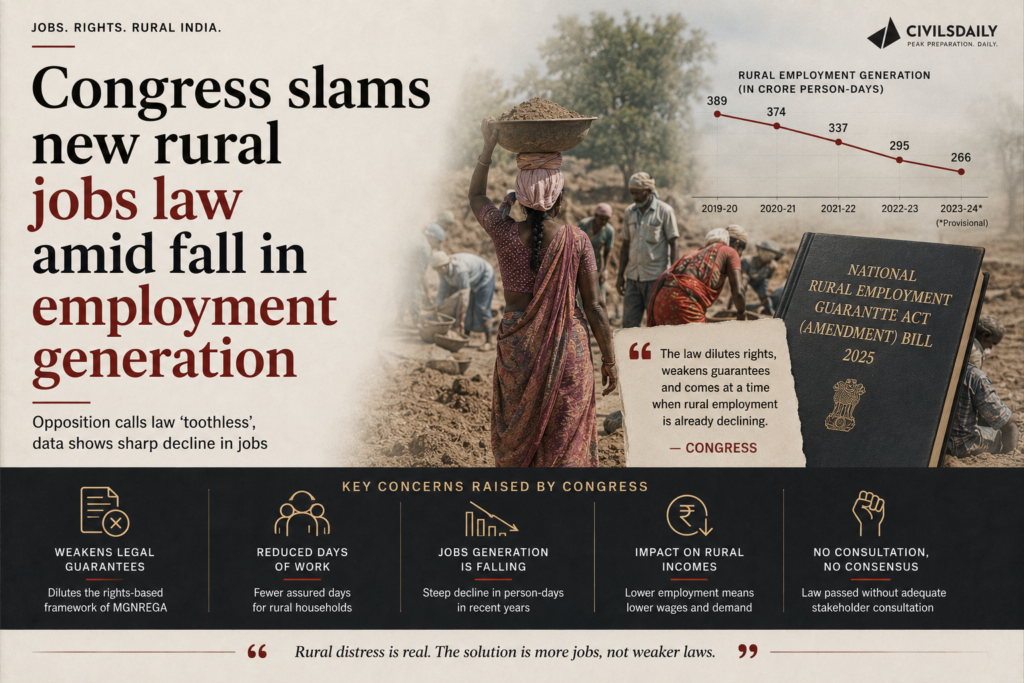
  • Congress slams new rural jobs law amid fall in employment generation

    Why in the News

    Person-days under the Viksit Bharat Guarantee for Rozgar and Ajeevika Mission (Gramin) (VB-G RAM G) fell 49.94% year-on-year in July 2026, its first month of implementation, compared with Mahatma Gandhi National Rural Employment Guarantee Act (MGNREGA). The decline has raised concerns about moving from a demand-driven legal guarantee to a more centralised, technology-dependent model.

    What is the Viksit Bharat Guarantee for Rozgar and Ajeevika Mission (Gramin)?

    1. About: VB-G RAM G is the central rural employment and livelihood scheme that replaced MGNREGA. It is administered by the Union Rural Development Ministry.
    2. Design shift: Access is made increasingly dependent on technology and biometric authentication, and the scheme is centralised rather than run through gram panchayats.
    3. Key change: Critics state it removes the legal guarantee of employment that defined MGNREGA, converting an entitlement into a discretionary programme.

    What is a person-day and why is the July figure significant?

    1. Person-day: A person-day is a unit that measures the amount of work done by one person in a working day, the standard metric for employment generated under rural works schemes.
    2. The fall: Person-days generated in July 2026 were 49.94% lower than those generated under MGNREGA in July of the previous year, roughly halving recorded rural work in the first implementing month.

    Why has the Opposition attacked the new scheme?

    1. Loss of guaranteed work: The scrapping of MGNREGA stripped millions of families of their “right to work”, replaced by a scheme that wiped out around 50% of labourer employment in the first month.
    2. Centralisation: The scheme centralises delivery and imposes a heavy financial burden on State governments, weakening the earlier panchayat-led model.
    3. Technology gating: Making access dependent on technology and biometric authentication makes it harder for workers to claim their rights.
    4. Loss of local autonomy: MGNREGA had empowered gram panchayats and freed workers from dependence on the political whims of the government of the day.
    5. Pending dues: Rs 17,144 crore in pending MGNREGA funds to the States was flagged as unpaid.

    What wider distress does the data point to?

    1. Kharif shortfall: There is a 26.50% shortfall in sowing for the kharif crop, raising the demand for rural wage work at the very moment the scheme has contracted.
    2. Drought assistance gap: The Opposition questioned whether any assistance had been provided to drought-affected States.
    3. Funding pattern dispute: Even BJP-ruled States had demanded a review of the funding pattern of VB-G RAM G, indicating cross-party concern over State fiscal burden.

    Conclusion

    The near-halving of person-days in the first month captures the core risk of replacing a demand-driven legal guarantee with a centralised, technology-gated scheme, that the guarantee itself, not the branding, was what protected rural workers in distress. The data release coincides with a kharif sowing shortfall and State demands to review the funding pattern. The next test is whether the government revises the funding model and restores enrolment before the lean agricultural season deepens rural unemployment.

    What is a demand-driven employment guarantee?

    1. About: It is a legal framework under which the state must provide wage employment on demand to any eligible household, making work an enforceable entitlement rather than a target-based programme.
    2. Rationale: It exists to provide a rural safety net during agricultural distress and to set a wage floor, with the guarantee acting as automatic stabiliser when other work dries up.
    3. Distinguishing feature: Provision is triggered by the worker’s demand, not by a fixed budget or administrative ceiling, so contraction in person-days signals suppressed or unmet demand.

    Key Concerns Regarding Rural Employment Guarantee Schemes

    1. Wage payment delays: Chronic delays in wage disbursal erode the entitlement’s value and deter workers.
    2. Fund devolution to States: Centralised control and delayed release strain State finances and stall works.
    3. Technology exclusion: Biometric and app-based attendance systems exclude workers with poor connectivity or authentication failures.
    4. Suppressed demand: Administrative rationing and closed muster rolls understate genuine demand for work.

    Back2Basics: MGNREGA

    1. Full name: Mahatma Gandhi National Rural Employment Guarantee Act, 2005, a UPA-era law.
    2. Ministry: Union Ministry of Rural Development.
    3. Aim: Guaranteed at least 100 days of wage employment in a financial year to every rural household whose adult members volunteer to do unskilled manual work.
    4. Beneficiaries: Adult members of any rural household, without a poverty-line or caste restriction.
    5. Design features: Legal right to work, demand-driven provision, works planned and executed through gram panchayats, and an unemployment allowance if work is not provided in time.

    Government Initiatives / Schemes for Rural Livelihoods

    1. VB-G RAM G: The current central rural employment and livelihood mission that replaced MGNREGA.
    2. Deendayal Antyodaya Yojana – National Rural Livelihoods Mission (DAY-NRLM): Promotes self-help groups and self-employment for rural poor women.
    3. Pradhan Mantri Awaas Yojana – Gramin: Provides pucca housing to rural households.
    4. Deen Dayal Upadhyaya Grameen Kaushalya Yojana: Skill training and placement for rural youth.

    Challenges in Rural Employment Delivery

    1. Payment delays: Wage and material payment delays discourage participation and stall projects.
    2. State fiscal burden: A shift of cost-sharing to States constrains scheme rollout in weaker States.
    3. Technology-driven exclusion: Biometric attendance and app-based systems drop workers who cannot authenticate.
    4. Weak asset quality: Poor planning produces low-value, non-durable assets from works undertaken.
    5. Corruption and leakage: Ghost workers and inflated muster rolls divert funds from genuine beneficiaries.
    6. Suppressed demand recording: Under-registration of work demand hides the true extent of rural distress.

    Way Forward

    1. Restore the legal guarantee: Retain an enforceable right to work as the anchor of the scheme rather than a discretionary target.
    2. Timely fund release: Clear pending dues to States and set statutory timelines for wage payment.
    3. Inclusive technology: Provide offline fallbacks and grievance redress for biometric and connectivity failures.
    4. Countercyclical scaling: Expand allocation automatically in drought and low-sowing years to match rural distress.
    5. Panchayat empowerment: Keep planning and execution with gram panchayats to preserve local accountability.

    [2011] Among the following who are eligible to benefit from the “Mahatma Gandhi National Rural Employment Guarantee Act”?

    (a) Adult members of only the scheduled caste and scheduled tribe households

    (b) Adult members of below poverty line (BPL) households

    (c) Adult members of households of all backward communities

    (d) Adult members of any household

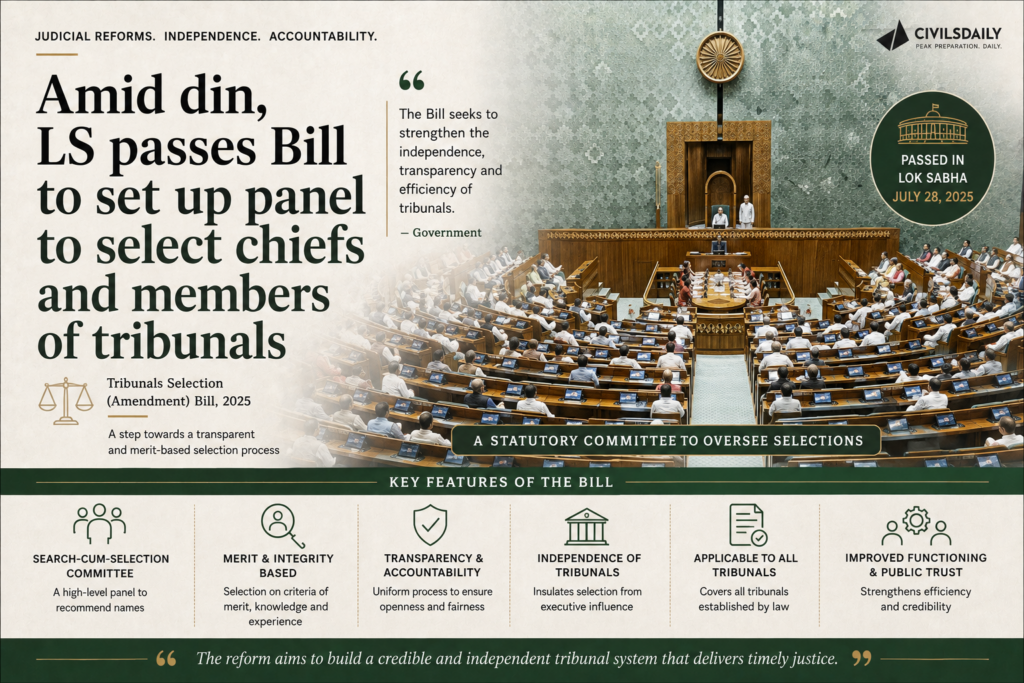
  • Amid din, LS passes Bill to set up panel to select chiefs and members of tribunals

    Why in the news

    The Lok Sabha passed the Tribunals Reforms Bill, 2026 by voice vote without debate, creating a National Tribunals Commission (NTC) to select chairpersons and members of various tribunals. The Bill follows the Supreme Court striking down parts of the Tribunals Reforms Act, 2021 for violating separation of powers and judicial independence. It reopens the settled question of who controls tribunal appointments, the executive that the tribunals adjudicate against, or an independent body insulated from it.

    What is the National Tribunals Commission (NTC)?

    1. Purpose: The NTC is a proposed statutory body to conduct the selection of chairpersons and members of tribunals through a single, uniform process. It centralises appointments that were earlier run separately for each tribunal.
    2. Composition: It will have a chairperson and four members, two judicial and two technical. A retired Supreme Court judge or a retired Chief Justice of a High Court will be eligible to head it.
    3. Seat and scope: It will be headquartered in New Delhi and will prescribe qualifications, selection, appointment, salaries, allowances, tenure, resignation, removal, and other service conditions of tribunal members.
    4. Origin: The Supreme Court itself directed the creation of an independent commission with professional expertise, transparent selection, and an oversight mechanism for appointments.

    What is the current status of tribunal appointments in India?

    1. Statutory basis: Tribunals were introduced through the 42nd Constitutional Amendment, 1976, which added Part XIV-A and Articles 323A and 323B. They function as specialised adjudicatory bodies outside the regular court hierarchy.
    2. Bodies covered by the Bill: The selection process applies to the Central Administrative Tribunal, Armed Forces Tribunal, National Green Tribunal, Income Tax Appellate Tribunal, and the National Consumer Disputes Redressal Commission.
    3. Rationalisation drive: The Union government began rationalising tribunals in 2015 and Parliament passed the Tribunals Reforms Act, 2021 to that end. Parts of that Act were struck down by the Supreme Court.
    4. Existing safeguard: Judicial review of tribunal decisions by High Courts under Articles 226 and 227 remains, since the Court has held this power to be part of the basic structure.

    Constitutional Provisions Related to Tribunals

    1. Article 323A: Empowers Parliament to establish administrative tribunals for service matters of public servants.
    2. Article 323B: Empowers appropriate legislatures to set up tribunals for other matters such as taxation, land reforms, and industrial disputes.
    3. 42nd Amendment, 1976: Inserted Part XIV-A and the two tribunal Articles into the Constitution.
    4. Article 226 and Article 227: Vest High Courts with writ jurisdiction and power of superintendence over tribunals, a check the Supreme Court has ruled cannot be ousted.
    5. Article 136: Retains the Supreme Court’s power to grant special leave to appeal against tribunal orders.
    6. Article 50: Directive Principle requiring separation of the judiciary from the executive, the value the appointment dispute turns on.

    Why did the Supreme Court strike down parts of the 2021 Act?

    1. Separation of powers: The Court held that several provisions were contrary to separation of powers, as they gave the executive dominant control over appointments to bodies that adjudicate against the executive.
    2. Judicial independence: Provisions were found to undermine the independence of tribunal members whose tenure and removal the executive influenced.
    3. Conflict with precedent: The provisions were inconsistent with earlier judgments laying down standards for the appointment, tenure, and functioning of tribunal members.
    4. Short tenures and search committees: Earlier versions prescribed a four-year term and search-cum-selection committees weighted towards government nominees, which the Court repeatedly rejected as diluting judicial character.

    How does the Bill respond to the Court’s concerns?

    1. Uniform process: The Law Minister stated the Bill brings uniformity to selection and appointment and improves efficiency, transparency, and independence.
    2. Judicial presence: A retired Supreme Court judge or retired High Court Chief Justice heading the commission answers the Court’s demand for professional and judicial expertise in selection.
    3. No jurisdictional change: The Minister clarified the legislation does not alter the jurisdiction of any tribunal, keeping the substantive powers of each body intact.
    4. Institutional oversight: A permanent commission replaces ad hoc, tribunal-by-tribunal appointment machinery, matching the oversight mechanism the Court directed.

    Major debates surrounding tribunalisation in India

    1. Curtailment of ordinary courts: Tribunals divert cases from High Courts, raising the concern that they curtail the jurisdiction and constitutional role of the regular judiciary.
    2. Executive control versus independence: The core dispute is whether the government, a frequent litigant before tribunals, should dominate the appointment and service conditions of members who judge it.
    3. Effectiveness versus multiplicity: Tribunals were meant to reduce pendency, yet vacancies, poor infrastructure, and appeals routed back to constitutional courts have blunted that promise.
    4. Competing rulings: The line of Madras Bar Association cases and Rojer Mathew (2019) repeatedly set standards on tenure and composition that successive laws failed to meet, driving the current Bill.
    5. Access to justice: Whether specialised, low-cost adjudication genuinely widens access, or whether weak tribunals leave litigants worse off than in ordinary courts.

    Challenges to the National Tribunals Commission

    1. Composition balance: Two technical members alongside two judicial members can still tilt selection towards executive preference if the technical members are serving or retired bureaucrats.
    2. Vacancy backlog: A new selection body does not by itself clear the large pending vacancies that have crippled tribunals such as the National Green Tribunal and Debt Recovery Tribunals.
    3. Infrastructure and funding: Tribunals depend on the parent ministry for premises, staff, and budget, which the commission does not address.
    4. Fresh litigation risk: Any residual executive dominance in the composition invites another round of constitutional challenge, extending the cycle of struck-down laws.
    5. Uniformity versus specialisation: A single commission for bodies as varied as the Armed Forces Tribunal and the consumer commission may struggle to weigh domain-specific expertise.
    6. Independence of secretariat: Day-to-day functioning still routes through executive-controlled staff, which can dilute the intended insulation.

    Conclusion

    The central question is not whether tribunals should exist but who controls the people who staff them, since executive dominance over appointments compromises the independence that specialised adjudication requires. The 2026 Bill responds to the Supreme Court’s direction by creating a judicially headed National Tribunals Commission with a uniform process. Its success depends on whether the composition genuinely insulates members from the executive they adjudicate against, and on whether vacancies and infrastructure gaps are addressed alongside the appointment reform.

    What is the Separation of Powers Doctrine?

    1. About: It is the principle that legislative, executive, and judicial functions are distributed among distinct organs so that no single organ concentrates power.
    2. Rationale: It exists to prevent tyranny and protect liberty through mutual checks, and in India it underpins judicial independence as part of the basic structure.
    3. Indian form: India follows a functional, not rigid, separation, with checks and balances rather than watertight compartments, reinforced by Article 50 and judicial review.

    Key Concerns Regarding Separation of Powers in India

    1. Executive encroachment on judiciary: Control over appointments, tenure, and funding of tribunals lets the executive influence bodies meant to be independent.
    2. Delegated legislation: Wide rule-making powers transfer effective law-making to the executive with limited legislative scrutiny.
    3. Judicial overreach: Expansive judicial activism blurs the line between adjudication and policy-making.
    4. Appointment tussles: Recurring friction between the executive and judiciary over the collegium and tribunal selections reflects an unsettled balance.

    Statutory Framework Governing Tribunals

    1. Article 323A: Basis for administrative tribunals in service matters.
    2. Article 323B: Basis for tribunals in taxation, land reforms, and other listed matters.
    3. Administrative Tribunals Act, 1985: Established the Central Administrative Tribunal and State Administrative Tribunals.
    4. Tribunals Reforms Act, 2021: Rationalised tribunals and set service conditions, parts of which the Supreme Court struck down.
    5. Tribunals Reforms Bill, 2026: Proposes the National Tribunals Commission and repeals the 2021 Act once enacted.

    Back2Basics: Landmark rulings on tribunals

    1. L. Chandra Kumar v. Union of India (1997): Held that judicial review by High Courts under Articles 226 and 227 is part of the basic structure and cannot be excluded; tribunals are supplementary, not substitutes, for courts.
    2. Union of India v. R. Gandhi (Madras Bar Association, 2010): Laid down that tribunal members must have judicial character and that executive dominance in selection is unconstitutional.
    3. Rojer Mathew v. South Indian Bank (2019): Struck down rules on tribunal appointments and service conditions for compromising independence.
    4. Madras Bar Association v. Union of India (2021): Reaffirmed minimum tenure and search committee composition standards, directly shaping the 2026 Bill.

    Way Forward

    1. Insulated composition: Weight the selection body towards judicial members and independent experts rather than serving bureaucrats.
    2. Fill vacancies promptly: Use the commission to clear the standing backlog of member vacancies across tribunals on a time-bound basis.
    3. Single nodal ministry: Route tribunal administration and funding through a single, arm’s-length authority to end dependence on the litigating ministry.
    4. Fixed tenure and security: Guarantee tenure, salary, and removal protections consistent with the Supreme Court’s standards to prevent renewed litigation.
    5. Periodic performance audit: Institute an independent review of tribunal pendency, disposal, and infrastructure to keep them a genuine complement to courts.

    “[2018, GS2, 15 marks] How far do you agree with the view that tribunals curtail the jurisdiction of ordinary courts? In view of the above, discuss the constitutional validity and competency of the tribunals in India.”