💥Join UPSC 2027,2028 Mentorship (August Batch) + XFactor Notes & Microthemes PDF

Distribution: weekly

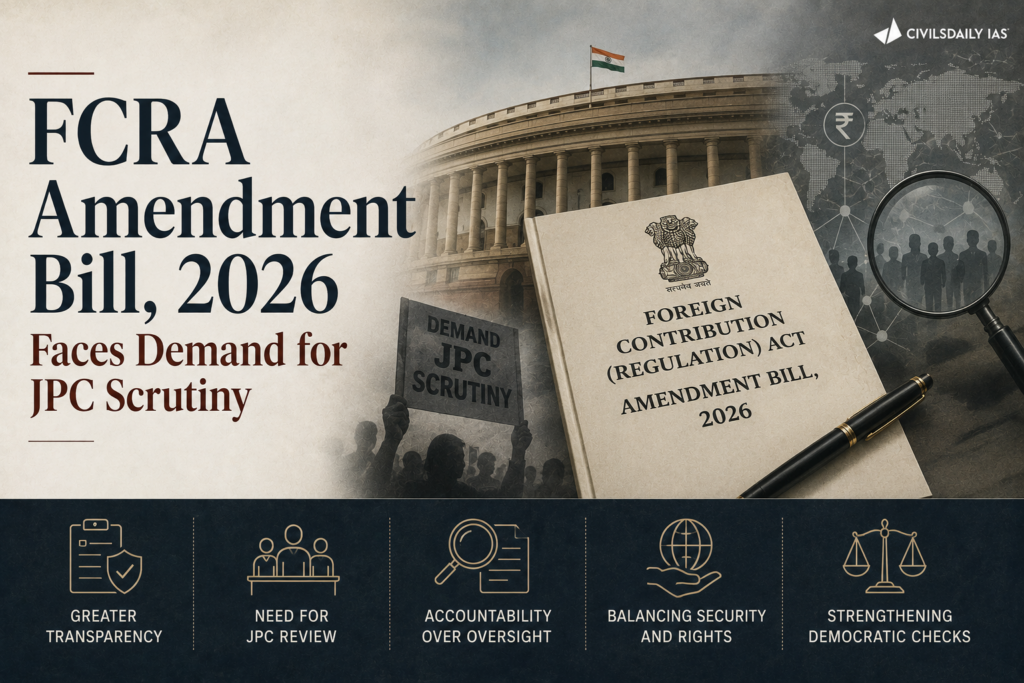
  • FCRA Amendment Bill, 2026 faces demand for JPC scrutiny

    Why in the News

    The Opposition, the Mizoram Chief Minister, and Christian bodies are pressing for the Foreign Contribution (Regulation) Amendment Bill, 2026 to be referred to a Joint Parliamentary Committee (JPC) before the coming session.

    What is the FCRA?

    1. Definition: The Foreign Contribution (Regulation) Act, 2010 (FCRA) governs the receipt and use of foreign funds by individuals, associations, and NGOs in India.
    2. Registration regime: Organisations need FCRA registration or prior permission to receive foreign donations, with periodic renewal.

    Why is the amendment contested?

    1. Compliance burden: Critics argue tighter conditions could choke funding for civil society and faith-based organisations.
    2. Federal and minority concern: State governments and church bodies see the changes as targeting specific organisations.
    3. Scrutiny demand: Referral to a JPC is sought to allow detailed clause-by-clause examination before passage.

    Requirement for JPC Referral

    A Bill can be referred to a Joint Parliamentary Committee (JPC) when:

    1. Either House proposes referral: The Lok Sabha or Rajya Sabha may move a motion to refer the Bill to a JPC.
    2. House approval: The motion must be approved by the concerned House.
    3. Agreement of both Houses: Since a JPC includes members from both Houses, the other House must also agree to the referral.
    4. Government or Opposition request: Referral can be proposed by the government or opposition, but Parliament decides.
    5. No constitutional compulsion: There is no mandatory constitutional requirement that a Bill must be sent to a JPC.

    Note: A Joint Parliamentary Committee (JPC) is not a constitutional body, as the Constitution of India does not explicitly provide for or mandate its creation. Instead, a JPC is an ad-hoc (temporary) parliamentary committee established by the Parliament of India under the Rules of Procedure of the houses for a specific purpose, duration, and mandate

    [2025, GS2, 10 marks] Civil Society Organizations are often perceived as being anti-State actors rather than non-State actors. Do you agree? Justify.”

    [2014] Which one of the following is the largest Committee of the Parliament?

    [A] The Committee on Public Accounts

    [B] The Committee on Estimates

    [C] The Committee on Public Undertakings

    [D] The Committee on Petitions.
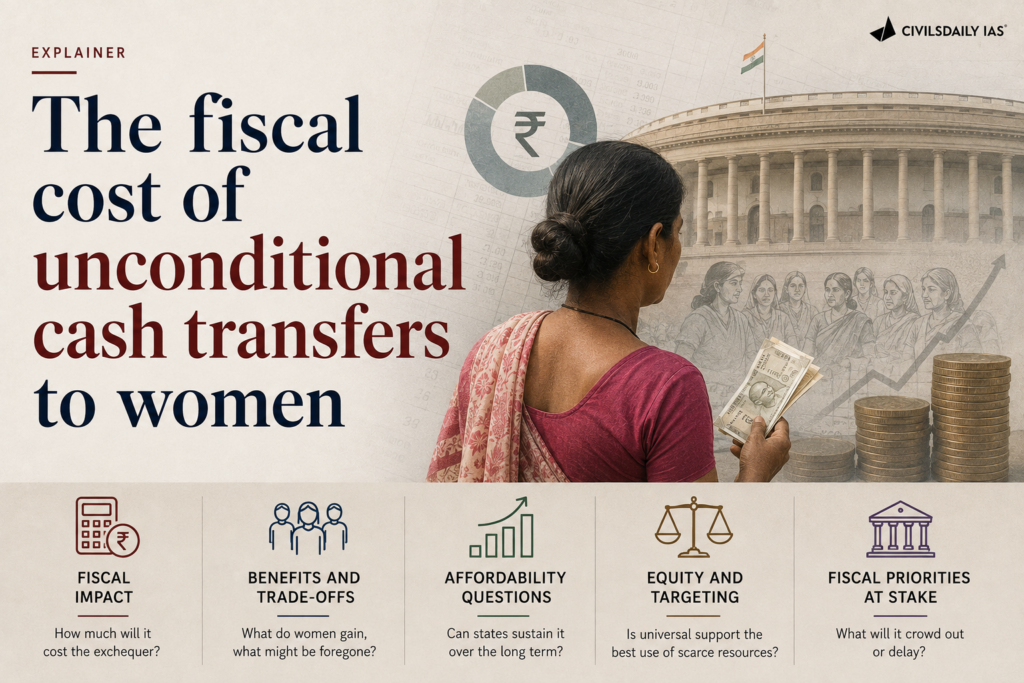
  • [10th August 2026] The Hindu OpED: The fiscal cost of unconditional cash transfers to women

    PYQ Relevance
    [UPSC 2022]
    Reforming the government delivery system through the Direct Benefit Transfer Scheme is a progressive step, but it has its limitations too. Comment.
    Linkage: The PYQ Examines DBT-based welfare delivery, fiscal sustainability, and the trade-off between welfare transfers and human-capital expenditure. The article highlights the trade-off between cash transfers and spending on education, health and development.

    Mentor’s Comment

    Delhi rolled out the Lakshmi Yojana on August 1, an unconditional cash transfer (UCT) of ₹2,500 a month for eligible women, joining a rapidly growing list of States running similar schemes since 2023. Fresh State-wise expenditure data show that in several States this spending already exceeds the entire education or health budget, reopening the question of what these transfers displace. The concern is set against the 16th Finance Commission’s award period.

    What is an unconditional cash transfer?

    • Definition: A UCT is a direct income payment to a beneficiary with no work, attendance, or behaviour condition attached, unlike a conditional transfer or an in-kind subsidy.
    • This wave: The current schemes target women with a fixed monthly sum, framed as income support rather than a service.

    Why are states rushing to launch women’s UCT schemes?

    • Electoral promise: Most schemes were pledged at assembly elections and rolled out immediately, drawing the label of a pre-poll dole.
    • Near-universal spread: From 2023 onward almost every major state added a scheme, making it politically hard for any state to abstain.
    • Compensation framing: Some argue the transfers compensate women for the state’s failure to create broad opportunity and services.

    Are these transfers a benefit to women or a burden on states?

    • Used productively: Evaluations show women mostly spend the money on food, health and education, so the transfer reaches real welfare needs.
    • Fiscal pressure: The same spending expands a recurring liability that presses on existing health and education budgets.
    • Genuine trade-off: The tension is real, the cash is used well by recipients yet competes with the public services those recipients depend on.

    How much fiscal space do states actually have?

    • Committed spending: The 16th Finance Commission notes almost 44% of state expenditure is locked in interest payments, pensions and salaries.
    • Shrinking social share: Social sector revenue expenditure has stayed stable as a share of total spending since 2011-12 but has declined as a share of GDP since 2020-21.
    • Little room: With most of the budget pre-committed, new UCT outlays crowd against fresh investment in services and infrastructure.

    How large are these schemes across states?

    • Share of total spending: UCT outlays range from 10.03% of total expenditure in Jharkhand and 7.84% in West Bengal down to 0.97% in Goa and 0.26% in Himachal Pradesh.
    • Share of education spending: In the largest-scheme states the UCT bill exceeds half the entire education budget, near 74% in Jharkhand and Karnataka and 54% in West Bengal.
    • Named schemes and amounts: Karnataka Gruha Lakshmi (Rs 2,000), Madhya Pradesh Ladli Behna (Rs 1,500), Tamil Nadu Kalaignar Magalir Urimai Thogai (Rs 1,000), Maharashtra Majhi Ladki Bahin (Rs 1,500), Jharkhand Maiya Samman (Rs 2,500), Odisha Subhadra (Rs 10,000 a year), Assam Orunodoi (Rs 1,250), and Delhi Lakshmi Yojana (Rs 2,500).

    Do the transfers reach the poorest, or do barriers exclude them?

    • Rationalisation cuts: Maharashtra and Madhya Pradesh have reduced beneficiary numbers in the name of rationalisation.
    • Gatekeeping criteria: Delhi’s scheme requires a recommendation from the local MLA or MP, plausibly to cap numbers before rollout.
    • Access barriers: Lack of documents, weak bank access and errors in digital records still exclude eligible women.

    Conclusion:

    The transfers are used well by the women who receive them, but states have little fiscal room, since most spending is pre-committed and the social sector share of GDP is already falling. Without new resource mobilisation, the schemes are financed by squeezing the very education and health services their beneficiaries rely on. The unresolved question is whether states raise revenue to fund them or let public services erode.

    Back2Basics: 16th Finance Commission

    • Award period: The 16th Finance Commission’s recommendations cover the five years beginning 2026-27.
    • What it is: A constitutional body under Article 280, constituted every five years.
    • Mandate: Recommends the sharing of central taxes between the Centre and states (vertical devolution) and among states (horizontal devolution), plus grants-in-aid.

    [2022, GS2, 10 marks] Reforming the government delivery system through the Direct Benefit Transfer Scheme is a progressive step, but it has its limitations too. Comment.

  • Gujarat port concessions near expiry, reopening the BOOT debate

    Why in the News

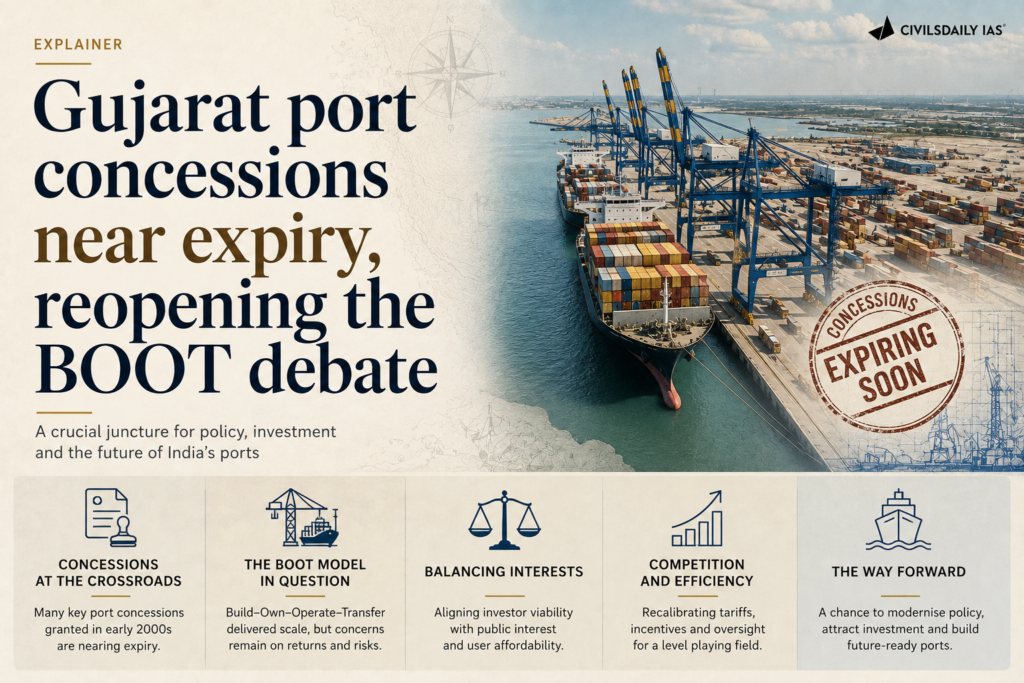
    Concessions for Gujarat’s Pipavav and Mundra ports near expiry, reopening the debate on the Build-Own-Operate-Transfer (BOOT) model and how India structures private port infrastructure.

    What is the BOOT model?

    1. Definition: Under Build-Own-Operate-Transfer (BOOT), a private operator finances, builds, and runs an asset for a fixed concession period, then transfers it back to the public authority.
    2. Application: Gujarat’s 1997 BOOT framework let private players develop ports like Mundra and Pipavav on state maritime board land.

    What is at stake as concessions expire?

    1. Asset transfer terms: Expiry forces a decision on renewal, renegotiation, or transfer of high-value operating ports.
    2. Investment signal: The treatment of expiring concessions shapes confidence for greenfield private ports such as Vizhinjam and Dhamra.
    3. Federal split: Major ports fall under the Centre while non-major ports like Gujarat’s fall under state maritime boards, complicating policy.

    “[2026] Consider the following statements with reference to the Sagarmala Programme of the Government of India :
    I. The Sagarmala Programme seeks to achieve port-led economic growth through cost-effective and sustainable coastal infrastructure.
    II. The success of the Sagarmala Programme is reflected in significant growth in coastal and inland waterway shipping, along with improved global port rankings.
    III. Sagarmala 2.0 aims to position India as global maritime innovation hub aligned with Atmanirbhar Bharat and Viksit Bharat 2047 visions.
    Which of the following relationships among the above statements is/are correct?
    1. Statement II validates the effectiveness of the strategies envisioned in statement I.
    2. Statement III extends the objectives of statement I by embedding them into a future-oriented innovation framework.
    3. Statement I contradicts statement III by focusing only on traditional infrastructure instead of modern innovation.
    Select the answer using the code given below:

    [A] 1 only

    [B] 1 and 2

    [C] 2 and 3

    [D] 3 only

  • India crosses 300 GW of non-fossil power capacity

    Why in the News

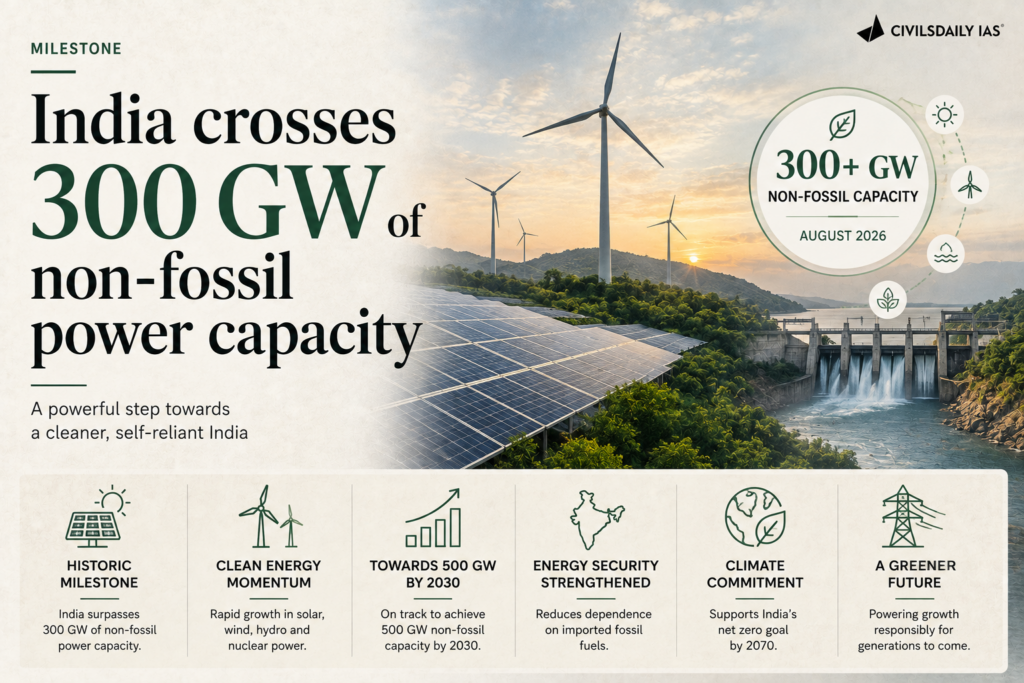
    India’s non-fossil fuel capacity has crossed 300 GW, achieving about 60% of the 500 GW target for 2030. The key challenge is converting installed capacity into actual electricity generation.

    What is the 500 GW Target?

    1. Panchamrit pledge: India committed at COP26, Glasgow (2021) to achieve 500 GW of non-fossil electricity capacity by 2030.
    2. Coverage: Includes solar, wind, hydro and nuclear capacity.
    3. Not total capacity: It excludes fossil-fuel capacity such as coal and gas.

    Why Capacity ≠ Generation?

    1. Capacity factors: Solar and wind are intermittent, so installed capacity does not translate proportionately into electricity generated.
    2. Storage gap: Batteries and pumped-storage hydropower are needed to provide reliable renewable power.
    3. Grid constraints: Transmission and grid-balancing infrastructure must expand alongside renewable capacity.
    4. Peak demand mismatch: Renewable generation may not coincide with periods of highest electricity demand.

    Value Addition

    • Panchamrit: 500 GW non-fossil capacity by 2030; 50% energy requirements from renewables; reduce projected carbon emissions by 1 billion tonnes; reduce emissions intensity by 45%; achieve net zero by 2070.
    • Key challenge: Shift from capacity addition → reliable, dispatchable clean power.

    “[2022, GS3, 15 marks] Do you think India will meet 50 percent of its energy needs from renewable energy by 2030? Justify your answer. How will the shift of subsidies from fossil fuels to renewables help achieve the above objective? Explain.”

    [2026] Consider the following statements with reference to India’s response to climate change:
    I. India’s Long-Term Low Emission Development Strategy (LT-LEDS) is a crucial tool for achieving net-zero emissions by 2070
    II. India’s 4th Biennial Update Report (BUR-4) submitted in December, 2024 recorded around 8% decrease in Greenhouse gas emissions in 2020 over 2019.
    III. Climate-resilient development necessarily depends on quick and short-term achievement of emission reduction targets.
    Which of the following relationships among the above statements is/are correct?
    1. Statement I is empirically supported by statement II.
    2. Statement III contradicts the approach implicit in statement I.
    3. Statement I and statement III together establish the premise of long-term sustainability.
    Select the answer using the code given below:

    [A] 1 only

    [B] 1 and 2

    [C] 2 and 3

    [D] 3 only

  • India’s Lepidoptera Diversity

    Why in the News?

    The Zoological Survey of India (ZSI) has published the Catalogue of Lepidoptera (Butterflies & Moths) of India in the peer-reviewed journal Zootaxa. The catalogue, prepared over nearly 12 years, provides an updated national inventory of India’s butterfly and moth diversity.

    Key Findings

    • India has 13,703 species of Lepidoptera.
    • This represents about 8.25% of the world’s known Lepidoptera.
    • Butterflies: 1,417 species
    • Moths: 12,286 species
    • These are distributed across: 3,705 genera, 240 subfamilies, 102 families, 31 superfamilies

    Geometroidea

    • 2,205 species of Geometroidea have been catalogued in India.
    • They belong to: 479 genera, 13 subfamilies, and 4 families
    • They constitute around 8.8% of the world’s known Geometroidea.
    • Many are nocturnal pollinators, complementing daytime pollinators such as butterflies.
    • Note: Geometridae is a very large family of slender-bodied, broad-winged moths.
  • Phoenix Species Project

    Why in the News

    The Phoenix Species Project, led by Re:wild and the Bezos Earth Fund with the IUCN Species Survival Commission, has launched a $200 million global initiative to recover 100 of the world’s most threatened species.

    What is the Phoenix Species Project?

    • Target: 100 species classified as Critically Endangered (CR) or Extinct in the Wild (EW) on the IUCN Red List.
    • Geographical spread: 30 countries.
    • Species covered: Mammals, birds, reptiles, amphibians, fish, invertebrates and plants.
    • Funding: $200 million
      • $100 million from Bezos Earth Fund
      • $100 million from Re:wild and supporting foundations.
    • Approach: Long-term, locally led species recovery rather than short-term conservation grants.

    Important species under the project

    • Bowmouth guitarfish: Threatened by the shark-fin trade; found in shallow waters from South Africa to Japan and Australia.
    • Hickory Nut Gorge green salamander: Restricted to a small canyon in North Carolina.
    • Charco Azul pupfish: Extinct in the wild; freshwater habitat was lost due to drought and water extraction.
    • Night parrot: Rare, nocturnal ground-dwelling bird of Australia’s arid regions.
  • El Nino and hoarding push up Karnataka rice prices

    Why in the News

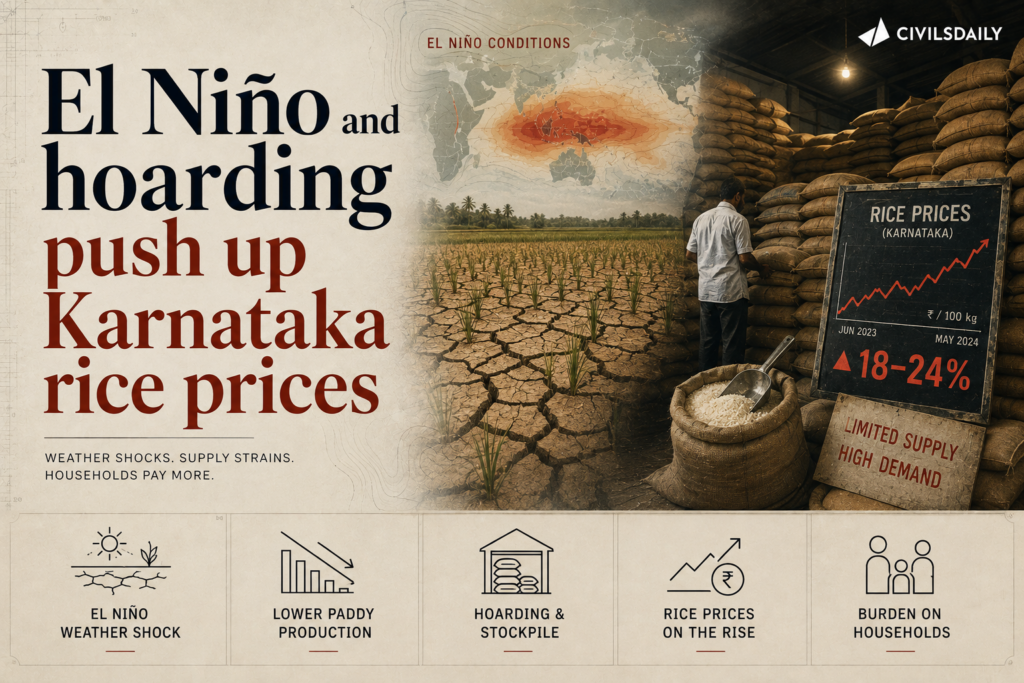
    Deficit June to July rainfall, linked to El Niño, along with hoarding and war driven demand, pushed up rice prices in Karnataka while kharif paddy sowing remained below target. The episode highlights the vulnerability created by water intensive paddy cultivation during drought conditions.

    What drove the shock?

    • Rainfall deficit: El Niño associated dry conditions affected monsoon rainfall.
    • Low sowing: Paddy acreage remained below the kharif target.
    • Reservoir stress: Low storage reduced irrigation availability.
    • Tungabhadra canal breach: Further disrupted water supply.

    Why is Paddy Water Intensive?

    • Conventional transplanted rice requires substantial water, particularly during crop establishment.
    • Dependence on irrigation reservoirs makes paddy cultivation vulnerable to drought and declining storage.
    • Concentration of paddy in water stressed regions can create a water-energy-food nexus problem.

    Sustainable Alternatives

    1. Direct Seeded Rice (DSR)

    • Seeds are sown directly instead of raising and transplanting seedlings.
    • Reduces water and labour requirements.
    • Avoids prolonged standing water associated with conventional transplantation.

    2. Crop Diversification

    • Shift from paddy towards relatively less water intensive crops such as jowar, bajra, pulses and oilseeds.
    • Can improve water-use efficiency and climate resilience.

    3. Micro-irrigation and Water Management

    • Efficient irrigation, laser land levelling, rainwater harvesting and improved farm water management can reduce water wastage.

    MSP Dimension

    • Paddy receives MSP support, providing farmers with a price assurance mechanism.
    • For 2026-27, the MSP for paddy (common) is ₹2,441/quintal.
    • However, assured prices can also influence farmers to continue cultivating water intensive crops even in water stressed regions.

    “[2019] With reference to the cultivation of Kharif crops in India in the last five years, consider the following statements:
    1. Area under rice cultivation is the highest.
    2. Area under the cultivation of jowar is more than that of oilseeds.
    3. Area of cotton cultivation is more than that of sugarcane.
    4. Area under sugarcane cultivation has steadily decreased.
    Which of the statements given above are correct?
    (a) 1 and 3 only
    (b) 2, 3 and 4 only
    (c) 2 and 4 only
    (d) 1, 2, 3 and 4
    Answer: (a)”

  • Oil companies reject contamination claims against E20 petrol

    Why in the News

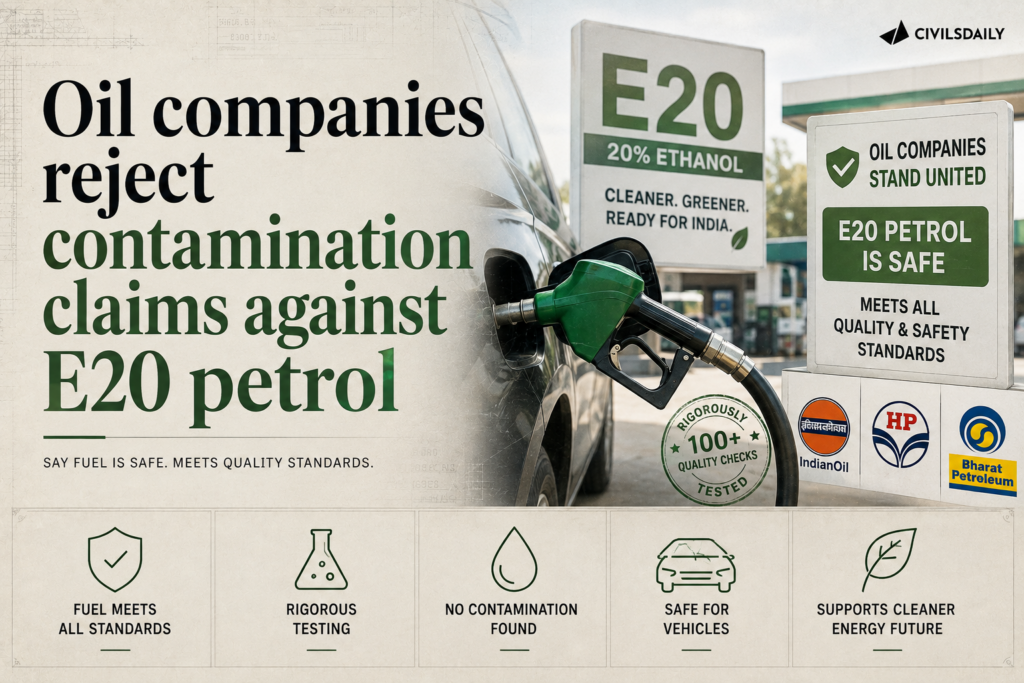
    Oil marketing companies rejected contamination allegations against E20 petrol after pan India testing, highlighting concerns over fuel quality, engine compatibility and consumer confidence.

    What is the Ethanol Blending Programme?

    • Objective: Reduce crude oil import dependence, improve energy security and support farmers.
    • E20: Petrol containing 20% ethanol.
    • India achieved the E20 blending target ahead of its earlier 2030 deadline.
    • Key Feedstocks: Sugarcane and molasses. Maize, and Surplus rice and other approved agricultural feedstocks

    Technical Trade-offs

    • Lower energy density: May reduce fuel economy.
    • Engine compatibility: Older vehicles may require compatible components.
    • Higher octane: Ethanol has a high octane rating and can improve combustion characteristics.

    “[2020] According to India’s National Policy on Biofuels, which of the following can be used as raw materials for the production of biofuels?
    1. Cassava
    2. Damaged wheat grains
    3. Groundnut seeds
    4. Horse gram
    5. Rotten potatoes
    6. Sugar beet
    Select the correct answer using the code given below:
    (a) 1, 2, 5 and 6 only
    (b) 1, 3, 4 and 6 only
    (c) 2, 3, 4 and 5 only
    (d) 1, 2, 3, 4, 5 and 6

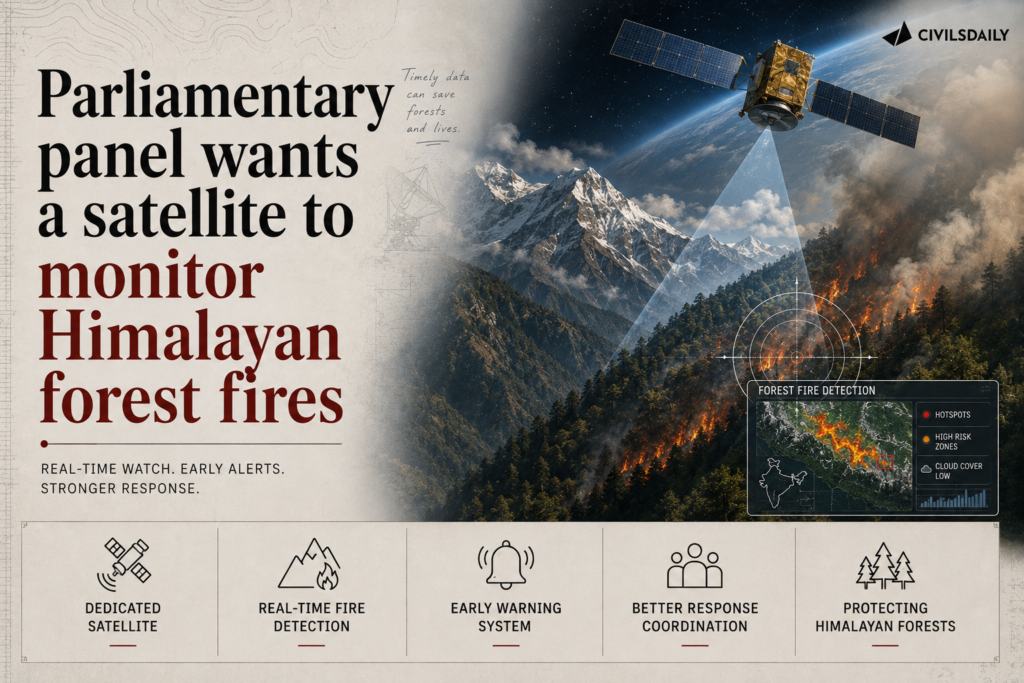
  • Parliamentary panel wants a satellite to monitor Himalayan forest fires

    Why in the News

    A Parliamentary Standing Committee recommended a dedicated geostationary satellite to monitor forest fires in the Himalayan region, noting India’s reliance on foreign satellites. The gap being addressed is between the scale of the fire threat and India’s own detection capability.

    What did the committee recommend?

    1. Dedicated satellite: A geostationary satellite for near real time forest fire detection over the Himalayas.
    2. Institutional build out: National Disaster Response Force (NDRF) regional centres for faster response.
    3. Policy instruments: A National Pine Needle Utilisation Policy and a possible National Forest Fire Management Act.

    Why is current detection inadequate?

    1. Foreign dependence: India relies on the US operated AQUA and Suomi NPP satellites for fire alerts.
    2. Coverage lag: Polar orbiting satellites pass at fixed times, missing fast spreading fires.

    Why is the Himalayan region especially vulnerable?

    1. Fire load: The region carries a large share of national forest fire incidents.
    2. Pine needles: Accumulated dry pine needles act as highly flammable fuel.

    What are the challenges to the proposal?

    1. Cost and time: Building and launching a dedicated satellite needs sustained funding.
    2. Ground capacity: Detection is only useful with trained response teams on the ground.
    3. Policy status: The recommendations are not yet enacted measures.

    “[2019] For the measurement/estimation of which of the following are satellite images/remote sensing data used?
    1. Chlorophyll content in the vegetation of a specific location
    2. Greenhouse gas emissions from rice paddies of a specific location
    3. Land surface temperatures of a specific location
    Select the correct answer using the code given below.
    (a) 1 only
    (b) 2 and 3 only
    (c) 3 only
    (d) 1, 2 and 3

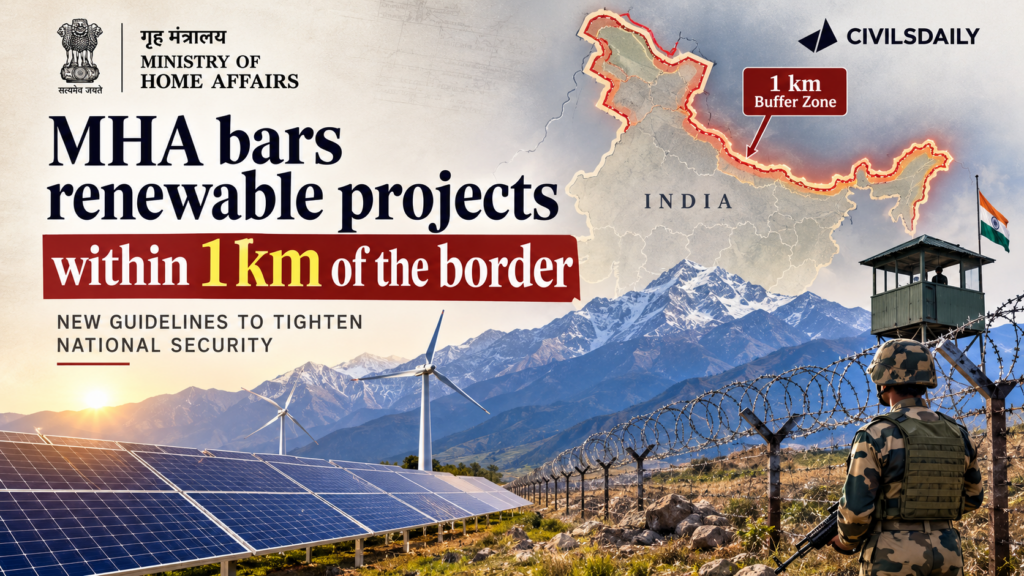
  • MHA bars renewable projects within 1 km of the border

    Why in the News

    The Ministry of Home Affairs (MHA) notified national security guidelines barring renewable energy projects within 1 km of the international border. The measure sets the security interest of border zones against the rapid build out of clean energy capacity.

    What do the new border guidelines mandate?

    1. 1 km ban: No solar, wind, or hybrid project is permitted within 1 km of the international border.
    2. Clearance zone: Projects up to 50 km from the border need prior security clearance.

    Which additional restrictions apply?

    1. Foreign staffing: Personnel from Pakistan, Bangladesh, and China face restrictions in these zones.
    2. Land transfer: Curbs apply to land transfer near sensitive stretches.

    Why is border area management the core concern?

    1. Line of Control and LAC: The guidelines cover both the Line of Control (LoC) and the Line of Actual Control (LAC).
    2. Surveillance risk: Large installations near the border can aid hostile mapping or interference.

    What is the trade off created?

    1. Clean energy loss: High irradiance border districts lose out on renewable investment.
    2. Execution friction: Layered clearances can slow project timelines.

    “[2016, GS3, 12.5 marks] Border management is a complex task due to difficult terrain and hostile relations with some countries. Elucidate the challenges and strategies for effective border management.”