💥Join UPSC 2027,2028 Mentorship (August Batch) + XFactor Notes & Microthemes PDF

Distribution: weekly

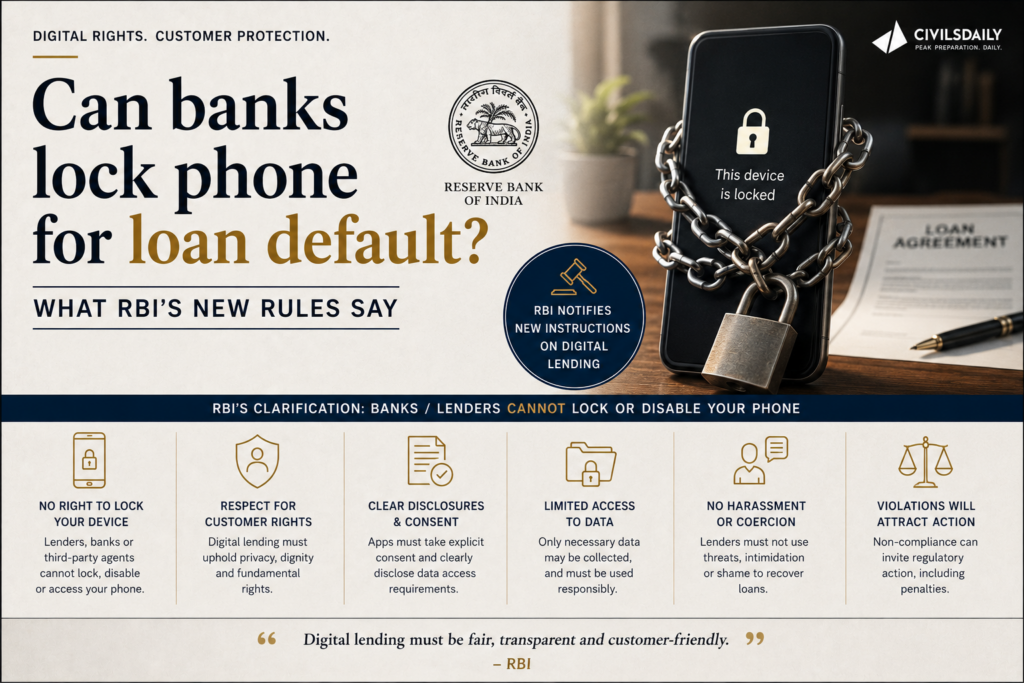
  • Can banks lock phone for loan default? What RBI’s new rules say

    Why in the News

    The Reserve Bank of India (RBI) has issued a comprehensive set of rules governing how commercial banks recover unpaid loans, coming into force on January 1, 2027. The framework introduces India’s first detailed regulation of technology-based restrictions on mobile phones financed through bank loans, balancing lenders’ recovery rights against borrower protection.

    What is the RBI’s new loan-recovery framework?

    1. Comprehensive recovery rules: The framework governs the conduct of banks and outsourced recovery agents in recovering unpaid loans, and applies to all commercial banks.
    2. Board-governed process: It makes recovery a board-governed process rather than a purely operational function, requiring a documented recovery policy.
    3. Effective date: It comes into force on January 1, 2027.

    Can banks now lock a financed phone?

    1. Only for device loans: Technology-based restrictions can be used only where the loan specifically financed that smartphone, tablet or laptop.
    2. Disclosure required: The loan agreement must clearly disclose these restrictions in advance.
    3. 30-day threshold: No restriction can be activated until the account is 30 days past due, despite notices to the borrower.
    4. Gradual escalation: Restrictions must be introduced gradually.
    5. 60-day limit for full lock: Complete restrictions can be imposed only after 60 days of non-payment, and outgoing calls cannot be blocked before that.

    What safeguards protect borrowers?

    1. Essential functions protected: Banks cannot disable incoming calls, SMS services or emergency functions.
    2. Work not disrupted: Restrictions must not interfere with activities necessary for the borrower’s work or employment.
    3. Visibility: Borrowers must be able to view the status of restrictions on their device at any time.
    4. Fast restoration: Once overdue amounts are paid, functionality must be restored within one hour.
    5. Compensation: Where restoration is delayed by the bank, compensation of Rs 250 per hour is payable until access is restored, subject to a ceiling equal to the loan amount.
    6. Data protection: Banks and third-party technology providers are barred from accessing personal data stored on borrowers’ devices.

    How are recovery agents regulated?

    1. Fixed contact hours: Agents can contact borrowers only between 8 am and 7 pm, unless the borrower requests otherwise.
    2. Identification: They must identify themselves through identity cards and authorisation letters and carry copies of notices issued by the bank.
    3. Certification: Only certified individuals can undertake recovery work.
    4. Background checks: Banks must conduct background verification before appointing agents and periodically thereafter.

    How are banks held accountable?

    1. Call recording: Banks must record recovery-related calls, keep records for at least six months and inform borrowers that conversations are recorded.
    2. No aggressive incentives: Recovery targets and incentive structures should not encourage aggressive behaviour.
    3. Grievance redressal: Every bank must set up a dedicated grievance redressal mechanism for recovery complaints, detailed in loan documents and communications.
    4. Direct responsibility: Banks are made directly responsible for the conduct of outsourced recovery personnel.

    Why were fresh directions issued?

    1. Retail lending boom: India’s retail lending market has expanded rapidly, driven by digital loans, unsecured personal credit and Buy Now Pay Later products.
    2. Device financing: Growth in financing for smartphones and consumer electronics raised the practice of remotely disabling devices.
    3. Rising complaints: Complaints about harassment by recovery agents and aggressive collection practices have grown.

    Conclusion

    The RBI has converted loan recovery from an operational function into a board-governed, rights-based process, and for the first time regulated the remote disabling of financed devices. The framework takes effect on January 1, 2027, and its impact will depend on how banks build recovery policies, certify agents and enforce the device-restriction safeguards. The next milestone is compliance readiness across all commercial banks before the effective date.

    Back2Basics: Reserve Bank of India (RBI)

    1. Type: Central bank and monetary authority of India.
    2. Established: 1935, nationalised in 1949.
    3. Governing Acts: RBI Act, 1934 and Banking Regulation Act, 1949.
    4. Headquarters: Mumbai.
    5. Core functions: Monetary policy, currency issue, banker to the government, banking regulation and supervision, and management of foreign exchange.

    What are the RBI’s Functions?

    1. About: The RBI is India’s central bank, established in 1935, responsible for monetary policy, currency issuance and financial system regulation.
    2. Rationale: It exists to maintain price stability, ensure adequate credit flow and safeguard the stability of the banking and payments system.
    3. Regulatory scope: It regulates commercial banks on liquidity of assets, branch expansion, mergers, winding-up and, increasingly, conduct towards customers.

    Statutory Framework Governing Bank Regulation

    1. Reserve Bank of India Act, 1934: Establishes the RBI and its monetary and regulatory powers.
    2. Banking Regulation Act, 1949: Empowers the RBI to license, supervise and regulate banks, including branch expansion, mergers and winding-up.
    3. Payment and Settlement Systems Act, 2007: Provides for RBI regulation of payment systems, including digital lending rails.
    4. Consumer Protection Act, 2019: Reinforces borrower rights against unfair practices.

    Government and RBI Initiatives for Borrower Protection

    1. Fair Practices Code for Lenders: Sets standards for transparency and conduct in lending.
    2. RBI Integrated Ombudsman Scheme: Provides a single redressal window for customer complaints against banks and lenders.
    3. Digital Lending Guidelines, 2022: Regulate loan disbursal, data use and recovery by digital lenders.
    4. RBI Retail Direct and Financial Literacy programmes: Improve borrower awareness and protection.

    Key Facts about RBI Regulation of Banks

    1. Effective date of new recovery rules: January 1, 2027.
    2. Compensation cap: Rs 250 per hour for delayed restoration, ceiling equal to the loan amount.
    3. Recovery contact window: 8 am to 7 pm.
    4. Record retention: At least six months for recovery calls.

    Challenges in Loan Recovery and Retail Lending

    1. Agent harassment: Aggressive and coercive collection practices remain widespread.
    2. Digital coercion: Remote disabling of financed devices can cut borrowers off from work and emergencies.
    3. Data misuse: Access to personal data on devices raises privacy risks.
    4. Over-leverage: Rapid unsecured and Buy Now Pay Later lending raises default risk.
    5. Enforcement gaps: Outsourced agents are hard to monitor and hold accountable.
    6. Grievance delays: Weak redressal leaves borrowers without timely remedy.

    Way Forward

    1. Enforce certification: Ensure only verified, certified agents undertake recovery.
    2. Audit device restrictions: Independently audit compliance with the 30-day and 60-day safeguards.
    3. Strengthen redressal: Make grievance mechanisms accessible and time-bound.
    4. Protect data: Enforce the bar on accessing personal data with strict penalties.
    5. Promote responsible lending: Tighten underwriting for unsecured and device-linked credit.

    PYQ Relevance

    [2013] The Reserve Bank of India regulates the commercial banks in matters of

    (1) liquidity of assets

    (2) branch expansion

    (3) merger of banks

    (4) winding-up of banks.

    Select the correct answer using the codes given below:

    (a) 1 and 4 only

    (b) 2, 3 and 4 only

    (c) 1, 2 and 3 only

    (d) 1, 2, 3 and 4

  • The MSME opportunity lies in clustering them

    Why in the News

    Youth unemployment protests and the passage of the Micro, Small and Medium Enterprises Development (Amendment) Bill, 2026, have refocused attention on the Micro, Small and Medium Enterprises (MSME) sector as a job engine. The central argument is that industrial strength comes not from supporting isolated firms but from building clusters, dense ecosystems where suppliers, labour, research institutions and capital reinforce one another.

    What is a cluster-based development model?

    1. Definition: A cluster is a geographic concentration of firms in a related activity, together with their suppliers, workers, research institutions and finance, located close enough to reinforce one another.
    2. Core idea: Proximity generates shared benefits that an isolated firm cannot capture on its own.

    What is the “Little Giant” programme?

    1. Chinese niche-firm scheme: The Little Giant programme is a Chinese policy that supports technically strong small firms operating in narrow specialised niches.
    2. Support offered: It provides these firms with financing, tax support and research and development assistance.

    How significant is the MSME sector in India?

    1. Number of firms: India has 63 million MSMEs.
    2. Employment: They employ more than 320 million people.
    3. Output share: They contribute about 31% of Gross Domestic Product (GDP) and 35% of manufacturing output.
    4. Exports: They account for 49% of exports.
    5. Structural weakness: The sector remains largely informal, fragmented and concentrated in low-value activities.

    What does the MSME Development (Amendment) Bill, 2026, address?

    1. Delayed payments: It seeks to tackle the problem of delayed payments to smaller firms.
    2. Dispute resolution: It aims to ease dispute resolution for MSMEs.
    3. Compliance burden: It reduces some compliance burdens on the sector.
    4. Limits: It does not by itself resolve the deeper problems of credit access and the burden of Goods and Services Tax (GST), labour, environmental and tax compliance.

    Why do clusters work?

    1. Knowledge spillovers: Technical know-how spreads quickly through worker mobility, informal interaction and shared service providers.
    2. Talent pooling: A cluster creates a real labour market that attracts and retains specialised workers, which an isolated firm struggles to hire.
    3. Lower fixed costs: Firms share infrastructure such as testing labs, effluent-treatment plants, cold storage and logistics hubs.

    What do global cluster models demonstrate?

    1. United States, Research Triangle: In North Carolina, universities such as Duke, the University of North Carolina at Chapel Hill and North Carolina State anchored biotechnology and pharmaceutical ecosystems by connecting research with industry.
    2. China, Guangdong: Industrial zones with land, tax incentives and infrastructure created thick supplier networks, letting firms design, fabricate and prototype quickly.
    3. China, Little Giant programme: Dedicated support to technically strong small firms in narrow niches through financing, tax support and research assistance.

    Why have India’s existing cluster schemes underperformed?

    1. Infrastructure grants, not ecosystems: India already runs the MSME Cluster Development Programme and PM MITRA textile parks, but many function more like infrastructure grants than true ecosystem builders.
    2. Firm-level lending: Banks still assess firms individually despite a large MSME credit gap, ignoring cluster-level ties.
    3. Disconnected universities: Top Indian universities often remain disconnected from nearby industry, unlike US and Chinese models.

    What policies can make clusters engines of jobs?

    1. Specialised hubs: Move from generic industrial estates to sector-specific clusters, such as auto components in Pune and electronics in Sriperumbudur.
    2. An Indian Little Giant scheme: Identify hidden champions in fields like precision castings and defence components, and give them dedicated credit lines, faster patent processing, research support and priority procurement.
    3. Cluster-level financing: Assess shared collateral, buyer-supplier ties and collective performance, expanding the Tiruppur textile model through the Small Industries Development Bank of India (SIDBI) and cluster-focused non-banking financial companies.
    4. University-industry links: Place universities at the centre of the ecosystem as suppliers of talent, lab infrastructure and innovation.

    Conclusion:

    MSMEs can become engines of jobs, productivity and exports only if policy shifts from isolated firm support to ecosystem building. The Amendment Bill helps with payments, disputes and compliance, but the binding constraints of fragmented finance and weak knowledge networks are addressed only at the cluster level. Strong specialised clusters, cluster-based finance and closer university-industry ties are the missing preconditions.

    Back2Basics:

    About MSMEs in India

    1. Definition: MSMEs are enterprises classified by investment in plant and machinery or equipment and by annual turnover.
    2. Classification: Micro (investment up to Rs 1 crore, turnover up to Rs 5 crore), Small (up to Rs 10 crore and Rs 50 crore), Medium (up to Rs 50 crore and Rs 250 crore).
    3. Economic role: MSMEs are the second-largest employer after agriculture and a backbone of manufacturing and exports.
    4. Registration: Firms register on the Udyam portal for formal recognition and scheme access.

    Statutory Framework Governing MSMEs

    1. Micro, Small and Medium Enterprises Development Act, 2006: Provides the legal definition and framework for MSMEs and for tackling delayed payments.
    2. MSME Development (Amendment) Bill, 2026: Strengthens provisions on delayed payments, dispute resolution and compliance.
    3. Factoring Regulation Act, 2011: Enables receivables financing that helps MSMEs address delayed payments.

    MSME Classification and Support

    1. Governing Act: Micro, Small and Medium Enterprises Development Act, 2006.
    2. Ministry: Ministry of Micro, Small and Medium Enterprises.
    3. Development bank: SIDBI is the principal financial institution for the sector.
    4. Registration portal: Udyam Registration.
    5. Composite criteria: Classification uses both investment and turnover.

    Government Initiatives for MSMEs

    1. MSME Cluster Development Programme: Supports common facilities and infrastructure for firm clusters.
    2. PM MITRA Parks: Integrated textile parks to build scale and supplier networks.
    3. Credit Guarantee Fund Trust for Micro and Small Enterprises (CGTMSE): Provides collateral-free credit guarantees.
    4. PM Vishwakarma: Supports traditional artisans and craftspeople.
    5. Prime Minister’s Employment Generation Programme (PMEGP): Credit-linked subsidy for micro-enterprise creation.

    Key Facts about the MSME Sector

    1. Firm count: 63 million MSMEs.
    2. Employment: More than 320 million people.
    3. GDP share: About 31%.
    4. Export share: 49%.
    5. Manufacturing output share: 35%.

    Challenges in the MSME Sector

    1. Credit gap: Limited access to affordable formal credit, worsened by firm-level rather than cluster-level assessment.
    2. Compliance burden: GST, labour, environmental and tax compliance weigh heavily on small firms.
    3. Informality: Most MSMEs remain outside the formal system, limiting scale and finance.
    4. Low value addition: Concentration in low-value activities caps productivity and wages.
    5. Delayed payments: Late payments from buyers strain working capital.
    6. Weak technology and skills: Limited access to research, testing and specialised labour.

    Way Forward

    1. Build specialised clusters: Concentrate resources in sector-specific hubs rather than generic estates.
    2. Cluster-based lending: Reform credit appraisal to use collective performance and supplier ties.
    3. Identify hidden champions: Support niche high-performers with dedicated finance and procurement.
    4. Integrate universities: Anchor clusters with research institutions for talent and innovation.
    5. Ease compliance: Simplify and consolidate regulatory requirements for small firms.

    PYQ Relevance

    [UPSC 2023] Faster economic growth requires increased share of the manufacturing sector in GDP, particularly of MSMEs. Comment on the present policies of the Government in this regard.

    Linkage: Examines how MSMEs can drive manufacturing-led economic growth. The article highlights the shift from firm-level support to cluster-based MSME development. It shows how finance, infrastructure, skills and industry-university linkages can raise MSME productivity and jobs

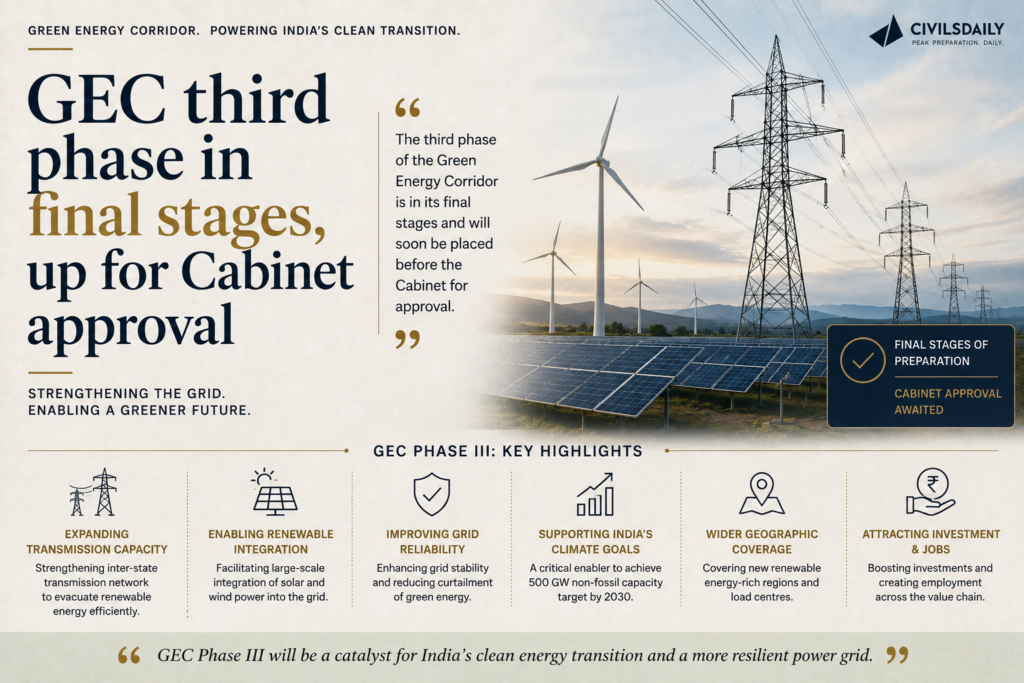
  • GEC third phase in final stages, up for Cabinet approval

    Why in the News?

    The government is in the final planning stages of the third phase of the intra-state Green Energy Corridor (GEC) and has sent the scheme to the Union Cabinet for approval. The phase carries an outlay of more than Rs 50,000 crore and targets the evacuation of about 135 gigawatts (GW) of renewable energy, marking a shift towards strengthening transmission from renewable-energy rich States.

    What is the Green Energy Corridor (GEC)?

    1. Renewable evacuation network: GEC is a scheme to build transmission infrastructure that carries electricity from renewable-energy rich areas to demand centres.
    2. Grid synchronisation: It links variable solar and wind generation with conventional power stations in the grid so that renewable power can be evacuated reliably from one location to another.

    What does GEC Phase III propose?

    1. Cabinet stage: The third phase has been sent to the Union Cabinet for final approval.
    2. Outlay: The scheme carries an outlay of more than Rs 50,000 crore.
    3. Evacuation target: The Ministry of New and Renewable Energy (MNRE) aims to evacuate about 135 GW of renewable energy in this phase.
    4. Focus area: The phase concentrates on augmenting intra-state transmission lines in renewable-energy rich States.

    Why have earlier phases faced delays?

    1. Right of way: Difficulty in securing right of way for transmission lines held up Phase I.
    2. Award delays: Delay in awarding project packages slowed progress.
    3. Forest clearances: Delays in forest clearances stalled work.
    4. Great Indian Bustard clearances: Clearances tied to the protection of the critically endangered Great Indian Bustard (GIB), whose habitat overlaps solar and wind zones in Rajasthan and Gujarat, delayed Phase I.
    5. State and regulatory issues: Non-participation of States during tendering, tender consultation and regulatory issues affected Phase II.

    Conclusion:

    GEC Phase III awaits Cabinet clearance and, if approved, will extend intra-state transmission capacity to evacuate about 135 GW of renewable power. With most Phase II packages already awarded and expected to complete within two years, the next milestone is Cabinet approval and the resolution of recurring right-of-way, forest and GIB clearance bottlenecks that have delayed earlier phases.

    Back2Basics: Green Energy Corridor (GEC) Scheme

    1. Ministry: Ministry of New and Renewable Energy.
    2. Objective: Build intra-state and inter-state transmission systems to evacuate renewable power.
    3. Structure: Implemented in phases, with intra-state components handled by State transmission utilities.
    4. Support: Funded through a mix of central grants, State contributions and multilateral loans.
    5. Beneficiaries: Renewable-energy rich States and the wider grid.

    About Renewable Energy Transmission in India

    1. Definition: Renewable energy transmission moves power generated from solar, wind and other renewable sources to consumption centres across States.
    2. Why it matters: Renewable generation is concentrated in a few resource-rich States, so evacuation infrastructure is essential to avoid stranded capacity.
    3. India’s standing: India is among the world’s largest renewable energy markets and has set large capacity addition targets for 2030.
    4. Structural feature: Variable renewable output requires grid balancing with conventional and storage capacity.

    Government Initiatives for Renewable Energy

    1. National Solar Mission: Promotes large-scale solar deployment under the National Action Plan on Climate Change.
    2. PM-KUSUM: Supports solar pumps and grid-connected solar for farmers.
    3. PM Surya Ghar: Muft Bijli Yojana: Promotes rooftop solar for households.
    4. Production Linked Incentive for solar modules: Builds domestic solar manufacturing capacity.
    5. Green Hydrogen Mission: Promotes production of green hydrogen using renewable power.

    Key Facts about India’s Renewable Energy Sector

    1. 2030 target: India aims for 500 GW of non-fossil fuel electricity capacity by 2030.
    2. Nodal ministry: Ministry of New and Renewable Energy.
    3. Grid operator: Grid Controller of India manages national load dispatch.
    4. Species overlap: The Great Indian Bustard is a critically endangered species whose habitat intersects renewable zones, driving clearance conditions.

    Challenges in Renewable Energy Transmission

    1. Land and right of way: Acquiring land and corridors for transmission lines is slow and contested.
    2. Clearance delays: Forest and wildlife clearances, including GIB-related conditions, hold up projects.
    3. State coordination: Uneven State participation in tendering and implementation delays intra-state work.
    4. Grid integration: Variable renewable output strains grid stability without adequate balancing.
    5. Financing and viability: Distribution company finances and cost recovery remain weak.
    6. Storage gap: Limited storage capacity constrains round-the-clock renewable supply.

    Way Forward

    1. Fast-track clearances: Streamline forest and wildlife clearances with mitigation for GIB habitat, including undergrounding of lines where feasible.
    2. Strengthen State participation: Improve incentives and coordination for State utilities in tendering.
    3. Expand storage: Scale up battery and pumped-hydro storage alongside transmission.
    4. Timely awards: Reduce delays in awarding and executing project packages.
    5. Grid modernisation: Invest in smart grids and forecasting to manage variable generation.

    PYQ Relevance

    [UPSC 2022] Do you think India will meet 50 percent of its energy needs from renewable energy by 2030? Justify your answer. How will the shift of subsidies from fossil fuels to renewables help achieve the above objective? Explain.

    Linkage: The PYQ examines India’s transition towards renewable energy and the challenges in achieving its 2030 targets. GEC Phase III strengthens renewable energy evacuation and grid infrastructure.
    This supports India’s 2030 renewable-energy targets.

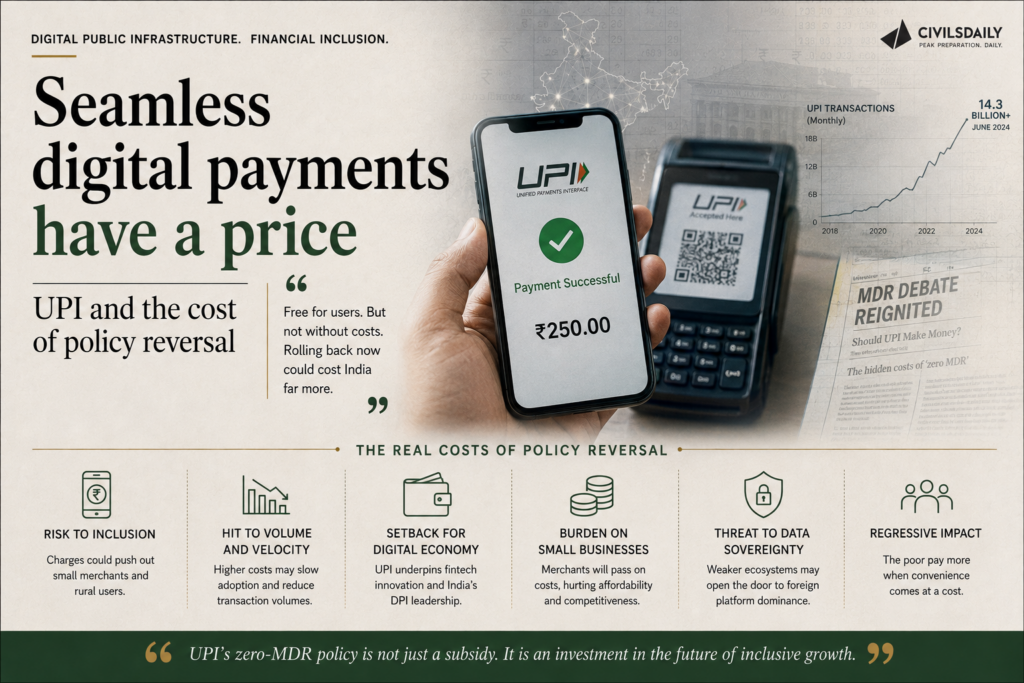
  • Seamless digital payments have a price / UPI and the cost of policy reversal

    Why in the News

    Parliament has passed the Taxation and Other Laws (Amendment) Bill, 2026, allowing a legal framework for possible charges on Unified Payments Interface (UPI) and RuPay debit card transactions. The debate centres on whether digital payments should remain free to promote inclusion or adopt a sustainable funding model.

    What is UPI?

    • UPI: Unified Payments Interface.
    • Enables instant bank-to-bank payments through mobile applications.
    • Operated by the National Payments Corporation of India (NPCI).
    • Processed 23.6 billion transactions in July.

    What is Merchant Discount Rate (MDR)?

    • MDR: Merchant Discount Rate.
    • A fee charged for processing digital payments, generally paid by merchants.
    • Credit-card MDR: around 1-3%.
    • Debit-card MDR: up to 0.9%.
    • UPI has followed a zero-MDR regime since 2020.

    What Does the 2026 Bill Do?

    • Amends Section 10A of the Payment and Settlement Systems Act, 2007.
    • Creates legal space for the government to notify charges on specified electronic payment modes.
    • A proposed MDR of 0.25-0.5% has been discussed for UPI transactions above ₹2,000.
    • This could cover about 5% of transactions by volume but around 65% by value.
    • The government has stated that consumers and small merchants will not bear MDR and the final framework is yet to be decided.

    Why is Zero-MDR Considered Unsustainable?

    1. Infrastructure costs: Huge transaction volumes require continuous investment.
    2. Fraud prevention: Cybersecurity and fraud-control systems require funding.
    3. Government support: ₹8,730 crore was provided through incentives during 2021-22 to 2024-25.
    4. Funding gap: This covered only a limited share of industry costs.
    5. Market concentration: PhonePe and Google Pay together account for around 80% of UPI transactions.

    What is a Two-Sided Market?

    • A platform connecting two groups whose participation reinforces each other.
    • UPI: Consumers ↔ Payment platforms ↔ Merchants
    • More users attract more merchants, while more merchants attract more users. Therefore, imposing a charge on one side may reduce the network effect.

    Why Could MDR Affect UPI?

    Arguments for charges

    • Provides sustainable revenue for infrastructure.
    • Supports innovation and fraud prevention.
    • May attract more competitors into the UPI ecosystem.

    Arguments against charges

    • Could discourage merchants and consumers from using digital payments.
    • Intermediaries may absorb the cost rather than pass it on.
    • Could weaken India’s financial inclusion and formalisation gains.
    • May encourage a shift back towards cash.

    About India’s Digital Payments Ecosystem

    • RBI: Reserve Bank of India, the regulator.
    • NPCI: National Payments Corporation of India, operator of major retail payment rails.
    • Banks and fintechs: Participate as payment service providers.
    • UPI: Real-time account-to-account payment system.
    • RuPay: India’s domestic card payment network.

    Statutory Framework

    • Payment and Settlement Systems Act, 2007: Regulates payment systems under RBI supervision.
    • Section 10A: Provides the framework for charges on specified electronic payment modes.
    • RBI Act, 1934: Establishes the Reserve Bank of India.
    • Information Technology Act, 2000: Provides legal recognition to electronic records and authentication.

    Back2Basics: NPCI

    • Full form: National Payments Corporation of India.
    • Established: 2008.
    • Nature: Not-for-profit company.
    • Promoted by: Banks under the guidance of RBI and Indian Banks’ Association (IBA).
    • Key systems: UPI, RuPay, Immediate Payment Service (IMPS), FASTag and Bharat Bill Payment System (BBPS).

    Government Initiatives

    • UPI Incentive Scheme: Supports the cost of low-value UPI transactions.
    • Digital India Programme: Expands digital infrastructure and inclusion.
    • BHIM: Bharat Interface for Money, NPCI’s UPI application.
    • RuPay: Domestic card network.
    • JAM: Jan Dhan-Aadhaar-Mobile trinity supporting digital transfers and financial inclusion.

    “[2026] Which one of the following statements about Unified Payments Interface (UPI) and Central Bank Digital Currency (Digital Rupee) is NOT correct?

    (a) UPI is a real-time payment system but Digital Rupee is akin to sovereign paper currency

    (b) In case of UPI, settlement for end users happens instantly; in case of Digital Rupee, wallet balance gets transferred to another wallet (no traditional settlement)

    (c) UPI transactions are recorded by banks and reflected in bank statements; in case of Digital Rupee, no data is captured in bank statements

    (d) In both the cases (UPI and Digital Rupee), the liability lies with the users and their respective banks

  • Evidence of non-Mendelian inheritance in mice

    Why in the News

    Researchers have reported evidence of non-Mendelian inheritance in mice, involving DNA methylation, genomic imprinting and paramutation. Nanopore sequencing helped detect these epigenetic marks.

    What is Epigenetic Inheritance?

    1. Definition: Transmission of heritable changes in gene activity without altering the underlying DNA sequence.
    2. Major mechanism: Chemical modifications such as DNA methylation can influence whether genes are switched on or off.
    3. Non-Mendelian: Unlike classical Mendelian inheritance, the inherited information is not limited to changes in the DNA sequence.
    4. Genomic imprinting: Expression of certain genes depends on whether they are inherited from the mother or father.
    5. Paramutation: One allele can induce a heritable change in the expression of another allele without changing its DNA sequence.
    6. Nanopore sequencing: Can detect certain DNA modifications, including methylation, while sequencing DNA.

    Why does it matter?

    • Expands inheritance theory: Heritable information can involve regulatory/epigenetic states in addition to DNA sequence.
    • Environment and inheritance: Some environmental factors can influence epigenetic states, though not every acquired epigenetic change is necessarily inherited.
    • Disease relevance: Abnormal epigenetic regulation is associated with cancers and other diseases.
    • Biotechnology: Advanced sequencing can help identify epigenetic modifications alongside DNA sequences.

    “[2021, GS3, 15 marks] What are the research and developmental achievements in applied biotechnology? How will these achievements help to uplift the poorer sections of society?

    [2021] In the context of hereditary diseases, consider the following statements:
    1. Passing on mitochondrial diseases from parent to child can be prevented by mitochondrial replacement therapy either before or after in vitro fertilization of egg.
    2. A child inherits mitochondrial diseases entirely from mother and not from father.
    Which of the statements given above is/are correct?

    [A] 1 only

    [B] 2 only

    [C] Both 1 and 2

    [D] Neither 1 nor 2

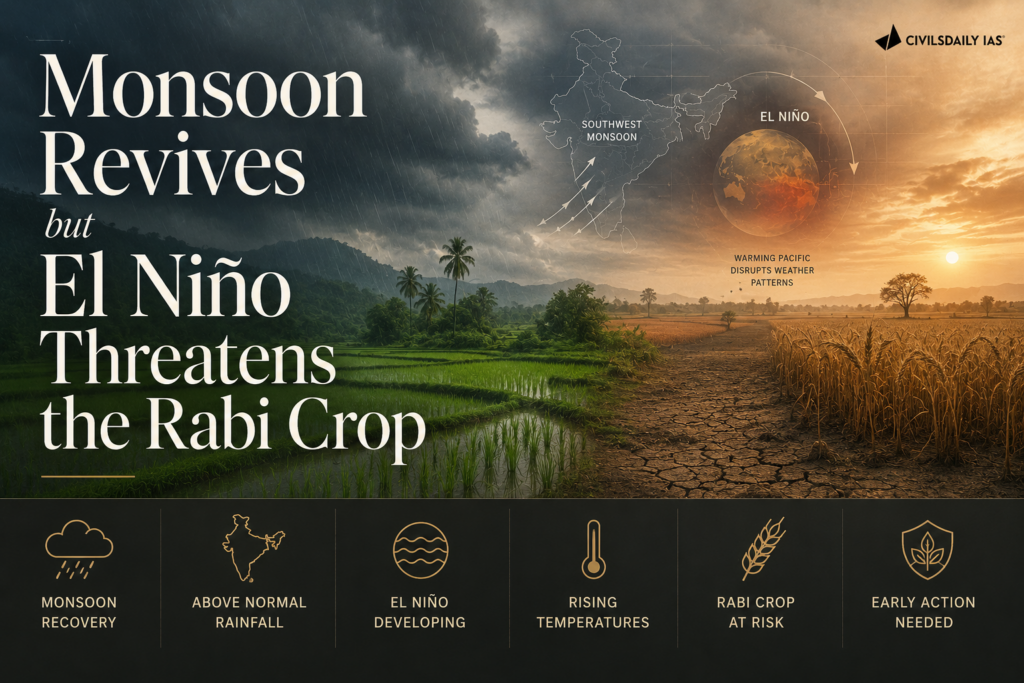
  • Monsoon revives but El Nino threatens the rabi crop

    Why in the News

    The southwest monsoon has revived, cutting the seasonal deficit to 11.5%, but warns that a possible El Nino threatens the rabi crop and keeps urea supply in focus.

    What is El Nino?

    1. Definition: El Nino is the abnormal warming of the central and eastern Pacific that weakens the Indian monsoon and disrupts rainfall.
    2. Crop link: A weak or erratic monsoon reduces soil moisture and reservoir storage needed for the winter rabi crop.

    Why does the rabi outlook matter?

    1. Food and prices: Wheat and other rabi crops shape food inflation and buffer stocks.
    2. Input dependence: Adequate urea and irrigation are needed to protect rabi output if rainfall falters.
    3. Recovery is partial: A narrowed deficit does not remove the risk that late-season El Nino conditions bring.

    Conclusion

    A recovering monsoon eases the kharif outlook but leaves rabi exposed to El Nino. The next milestone is confirmation of El Nino conditions before the rabi season.

    PYQ Relevance

    [UPSC 2015]How far do you agree that the behavior of the Indian monsoon has been changing due to humanizing landscapes? Discuss.

    Linkage: The PYQ explores changing monsoon behaviour and its impact on Indian agriculture. El Niño-induced rainfall variability shows how climatic and human factors can alter monsoon patterns and crop outcomes.

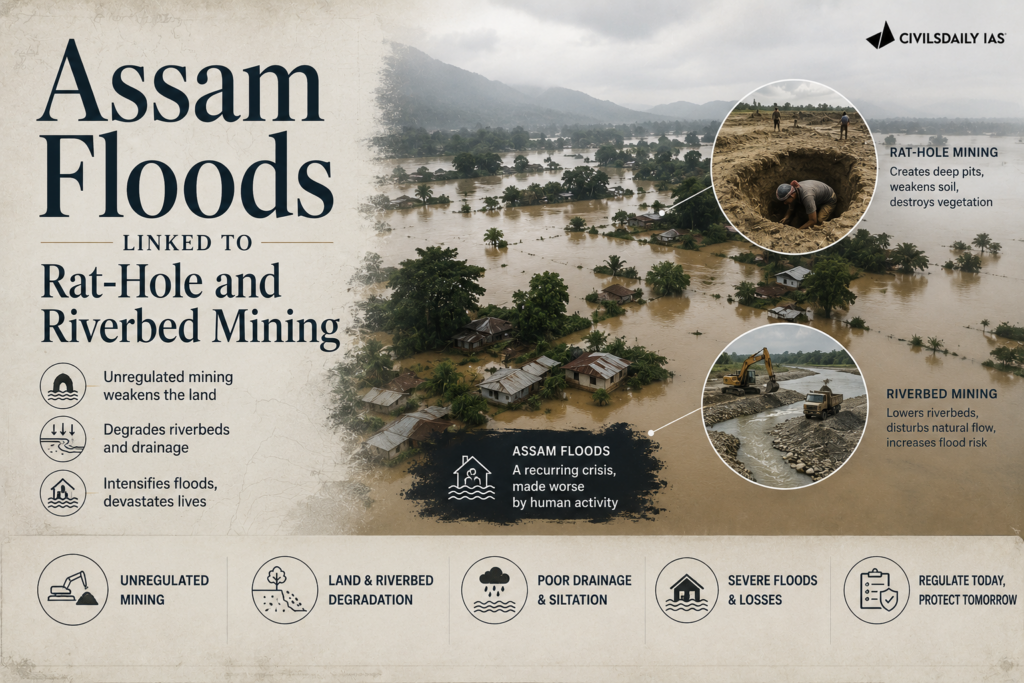
  • Assam floods linked to rat-hole and riverbed mining

    Why in the News

    Localised floods in Sivasagar, Charaideo and Jorhat districts of Assam have drawn attention to the role of rat-hole coal mining and riverbed mining in altering local drainage and aggravating flood impacts.

    What is Rat-Hole Mining?

    1. Method: A hazardous form of coal extraction through narrow horizontal tunnels, often too small for mechanised mining.
    2. Region: Historically prevalent in Meghalaya and other parts of Northeast India.
    3. NGT Ban: The National Green Tribunal (NGT) banned rat-hole coal mining in Meghalaya in 2014, citing environmental degradation and safety concerns.
    4. Environmental impact: Unregulated mining can disturb soil, drainage channels and river systems.

    How Can Mining Aggravate Floods?

    • Altered drainage: Mining and riverbed extraction can modify natural water-flow pathways.
    • Siltation: Mining activities can increase sediment entering waterways, reducing effective channel capacity.
    • Loss of natural buffers: Landscape disturbance can reduce the ability of terrain to absorb and retain water.
    • Compounded disaster: Heavy rainfall combined with degraded drainage can intensify flooding and displacement.

    Governance Issue

    • NGT ban → weak enforcement → continued illegal mining → environmental degradation → greater disaster vulnerability

    [2018] Which of the following is/are the possible consequence/s of heavy sand mining in riverbeds ?

    1. Decreased salinity in the river
    2.Pollution of groundwater
    3.Lowering of the water-table
    Select the correct answer using the code given below :

    (a) 1 only

    (b) 2 and 3 only

    (c) 1 and 3 only

    (d) 1, 2 and 3

  • India’s first open-access ecoacoustic biodiversity dataset

    Why in the News

    Researchers have released India’s first open-access, crowdsourced ecoacoustic biodiversity dataset, capturing 518 species across 5,815 minutes of recordings from 25 states and union territories.

    What is ecoacoustics?

    1. Ecoacoustics is the study of sounds produced by organisms and the surrounding environment to understand ecosystems, biodiversity and ecological change.
    2. Instead of relying only on visual surveys, passive acoustic recorders can continuously capture:
      • Bird calls, Insect sounds, Frog and bat calls, Reptile and mammal vocalisations, Marine animal sounds, Background environmental sounds such as rain, wind and human activity

    Why does it matter?

    1. Non-invasive monitoring: Sound-based surveys track biodiversity cheaply and continuously across large areas.
    2. Open science: An open-access, crowdsourced dataset lets any researcher reuse the data for conservation.
    3. Baseline data: It creates a reference against which future biodiversity loss can be measured.

    [2023] Which of the following organisms perform waggle dance for others of their kin to indicate the direction and the distance to a source of their food?

    [A] Butterflies

    [B] )Dragonflies

    [C] Honeybees

    [D] Wasps

  • BNHS launches India’s first invasive-fish removal programme

    Why in the News

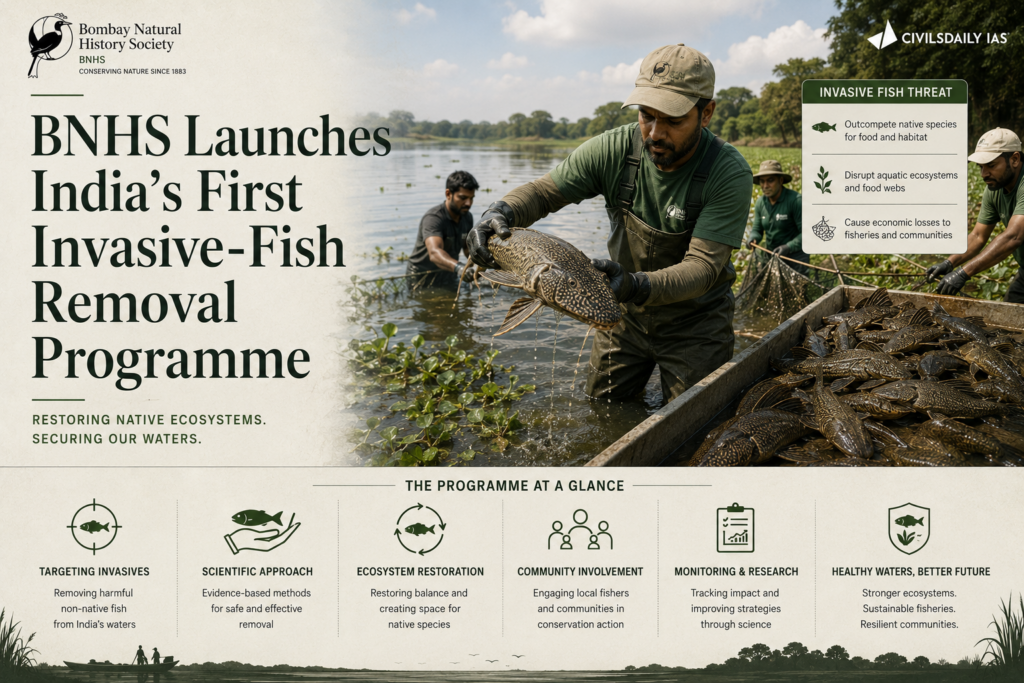
    The Bombay Natural History Society (BNHS) has launched India’s first community-driven removal programme for the invasive suckermouth catfish in Ujani Reservoir, Maharashtra.

    Suckermouth Catfish: Key Facts

    • Origin: Amazon River basin, South America.
    • Entry into India: Introduced through the aquarium trade and later released into natural waterways.
    • Local name: “Helicopter fish”.
    • Why invasive?
      • Feeds on fish eggs.
      • Competes with native bottom-feeding fish.
      • Burrows into riverbanks and can weaken earthen structures.
      • Adapts to adverse conditions.

    Scale of the Invasion

    • Around 97% of fish in Ujani are alien species including suckermouth catfish, Tilapia and African catfish.
    • Native fish account for only 3%.
    • Suckermouth catfish alone constitute around 30 to 40% of the total fish population.

    Impact on Fishermen

    • Around 20,000 people including fishermen, traders, transporters and labourers depend on the reservoir.
    • Invasive fish damage fishing nets and reduce the catch of economically valuable Rohu, Catla and Mrigal.
    • Fishermen may need to replace nets every 15 to 20 days, adding to costs.

    BNHS Removal Model

    • Collection centre established at Bhigwan fish market.
    • Fishermen receive financial incentives for collecting the invasive fish.
    • 36+ tonnes have already been removed.
    • Fish is processed into molasses used as fertiliser.
    • Creates a removal + livelihood + waste-utilisation model.

    “[2023] Invasive Species Specialist Group (that develops Global Invasive Species Database) belongs to which one of the following organizations?

    (a) The International Union for Conservation of Nature

    (b) The United Nations Environment Programme

    (c) The United Nations World Commission for Environment and Development

    (d) The World Wide Fund for Nature.

  • India-Israel defence ties under scrutiny

    Why in the News

    An Amnesty International report alleges India sent at least 2,596 shipments of military equipment and components to Israel since the Gaza war began. An opinion piece argues the disclosure reflects the depth of a quarter-century strategic partnership rather than a sudden shift.

    What anchors the India-Israel defence partnership?

    • Kargil origin: The relationship’s foundation was the 1999 Kargil War, when Israel rapidly supplied ammunition, drones and precision-guided munitions.
    • Technology transfer: Unlike many Western suppliers, Israel has been willing to transfer sophisticated military technology to India.
    • Platforms: Israel is a major source of drones, missiles, radars and surveillance systems for India’s armed forces.

    Why does the Amnesty report matter if it signals no policy change?

    • Customer to contributor: The report suggests India is no longer only a buyer but a contributor to Israel’s defence supply chain.
    • Timing: The shipments occurred during one of Israel’s most internationally criticised military campaigns, sharpening the scrutiny.
    • No rupture: The disclosure underscores an existing trajectory rather than marking a new departure in policy.

    How has the partnership evolved beyond buyer and seller?

    • Make in India: Under the Make in India initiative, Israeli defence firms have set up joint ventures and local manufacturing in India.
    • Localised production: Drones, electronics, missile systems and components are now produced within India’s defence industrial base.
    • Two-way flow: Localisation lets India supply components back into Israel’s supply chain, not just import finished systems.

    What are the domestic and external consequences?

    • Domestic politics: Opposition elements sceptical of closer ties with Israel’s government may use the disclosures to embarrass the ruling party.
    • Limited traction: Public attention is focused elsewhere, on the student agitation over exam paper leaks, blunting the political impact.
    • Arab reaction: Some Gulf displeasure is likely, but Arab partners were probably already aware of the expanding links, and there is no unified Arab stance on Israel today.
    • Wider Muslim world: States such as Turkey and Malaysia may voice diplomatic outrage, but New Delhi is unlikely to change policy in response.

    Does the partnership pose an ethical dilemma?

    • Strategic value versus ethics: The report raises the ethics of joint weapons production with a government whose conduct in Gaza drew widespread global disapproval.
    • Palestinian cause: Deep defence ties sit against India’s traditional support for a two-state solution and the Palestinian cause.
    • Gulf balance: India must weigh the partnership against its energy, trade and diaspora interests across the Gulf.

    Conclusion

    The report confirms a mature strategic partnership rather than a rupture, and India is unlikely to change course. The unresolved question is the ethics of contributing to a defence supply chain during a condemned campaign, and how India squares this with its stated support for the Palestinian cause and its Gulf interests.

    Back2Basics: India-Israel relations

    • Multilateral track: India and Israel cooperate through the I2U2 grouping (India, Israel, UAE, US) and the India-Middle East-Europe Economic Corridor (IMEC).
    • Full ties: India established full diplomatic relations with Israel in 1992, four decades after recognising it in 1950.
    • Strategic partnership: Ties were elevated to a Strategic Partnership in 2017, the first visit by an Indian Prime Minister to Israel.

    PYQ Relevance

    [UPSC 2018] India’s relations with Israel have, of late, acquired a depth and diversity, which cannot be rolled back.” Discuss.

    Linkage: The PYQ examines the growing depth and strategic importance of India-Israel relations. Defence cooperation, technology partnerships and the Gaza conflict highlight both the opportunities and diplomatic challenges in the relationship.