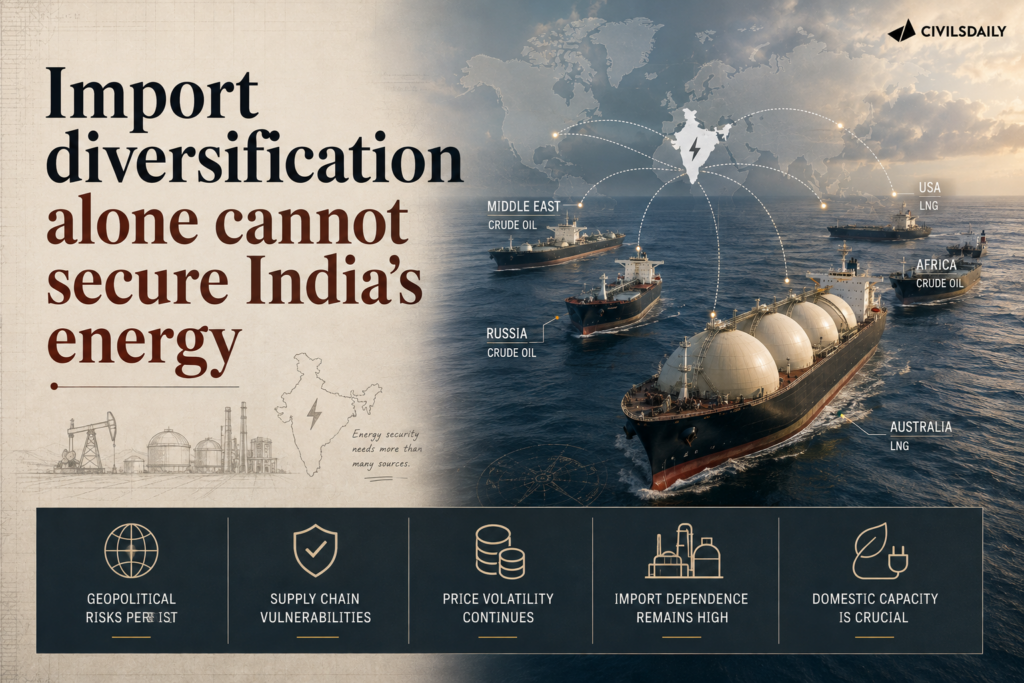
Diversifying import sources cannot by itself secure India’s energy supply while crude and gas still transit a few chokepoints. The tension is between the visible fix of new suppliers and the hidden vulnerability of the routes those supplies travel.
What is the energy security problem being described?
Route dependence: India’s crude and Liquefied Petroleum Gas (LPG) flows still pass through a handful of maritime chokepoints.
Supplier shift alone: Adding new source countries does not remove the risk if the shipping route stays the same.
Which chokepoints concentrate the risk?
Strait of Hormuz: The Gulf’s primary oil export chokepoint, exposed to conflict escalation.
Bab el-Mandeb: The Red Sea gateway threatened by Houthi attacks on shipping.
How does external policy compound the exposure?
US tariff pressure: Trade measures constrain India’s room to optimise import decisions.
Conflict spillover: West Asia instability raises both price and insurance costs.
Domestic transition: Faster renewable and storage build out reduces import dependence over time.
Conclusion
The central idea is that supplier diversification treats the symptom, not the structural route risk. Real energy security needs resilience against chokepoint disruption, not just a longer supplier list.
PYQ Relevance
[UPSC 2017] The question of India’s Energy Security constitutes the most important part of India’s economic progress. Analyze India’s energy policy cooperation with West Asian Countries.
Linkage: The PYQ examines India’s energy security through its dependence on West Asian energy supplies and strategic partnerships. The article highlights how chokepoint dependence and regional instability can undermine India’s energy security despite diversification of suppliers.
PYQ Relevance [UPSC 2019] ‘What introduces friction into the ties between India and the United States is that Washington is still unable to find for India a position in its global strategy, which would satisfy India’s National self-esteem and ambitions’ Explain with suitable examples. Linkage: The PYQ examines the structural frictions in India-US ties arising from differences in strategic priorities and expectations. The article shows how the relationship is shifting from strategic convergence to reciprocal, transactional cooperation, reinforcing the PYQ’s concern over divergent expectations.
Mentor’s Comment
An analysis argues the India-US partnership now runs on ‘flexible realism’ rather than shared containment of China. The first decade of the India-U.S. partnership was propelled by shared concern over China’s rise, not by identical values. As Washington moves toward interest-based alliance building, India’s strategic relevance will depend less on China’s trajectory and more on India’s own economic, technological, and military weight. This is a test of how convincingly India can operationalise strategic autonomy through multi-alignment.
What is the shift in the partnership’s logic?
From convergence to reciprocity: The relationship is moving from a China driven strategic alignment to a value for value calculus.
Tariff signal:Trump tariffs on Indian goods illustrate that shared interests no longer guarantee concessions.
Why does the tariff dispute signal a deeper shift in American foreign policy, not merely a trade rift?
Not an isolated trade dispute: The tariffs accompany demands for greater burden-sharing, tighter technology restrictions, and a more reciprocal approach to partnerships, indicating a policy pattern rather than a standalone measure.
Flexible realism defined: This approach places national interest at the centre of foreign policy and treats trade, technology, industrial policy, and security as integrated instruments of statecraft.
Departure from the post-Cold War order: Partnerships are judged by the tangible strategic and economic value they deliver, not by shared values or historical goodwill.
Not a retreat from engagement: The approach recalibrates how the U.S. pursues its interests rather than signalling disengagement from global affairs.
What strategic logic sustained the India-U.S. partnership over the past decade, and why can this convergence no longer be assumed?
China as the organising driver: India’s growing strategic importance to the U.S. followed directly from China’s emergence as Washington’s principal strategic competitor.
Convergence visible across domains: Defence cooperation, the Quad, technology partnerships, and supply-chain resilience all expanded on the back of this shared concern.
Values were a backdrop, not the driver: Democratic values provided a favourable political context, but strategic convergence on China was the actual engine of cooperation.
Assumption no longer holds: India can no longer assume that intensifying U.S.-China competition will automatically enhance its own strategic relevance.
New basis of assessment: Washington will increasingly judge partners, including India, by reciprocal economic benefit, technological capability, and strategic contribution.
How is the basis of the India-U.S. partnership shifting from convergence to complementarity?
First phase defined: The initial phase of the relationship rested on strategic convergence driven by China’s rise.
Second phase defined: The next phase depends on strategic complementarity, with each side contributing capabilities that reinforce the other.
Substantive domains: Defence cooperation, critical technologies, resilient supply chains, and advanced manufacturing will matter for their own economic and strategic value, not only as tools to manage China.
Net strategic effect: This evolution could make the partnership more balanced and resilient rather than weaker.
Reframing India’s relevance: A more capable India becomes a more valuable partner for the U.S. and is also better placed to pursue its own strategic interests independently.
Why is the shift happening now?
Domestic priorities: Washington is prioritising reciprocal trade gains over grand strategy.
Multipolar drift: A more contested global order weakens automatic alignment.
What is India’s central challenge in this new phase of the relationship?
Relevance must be self-generated: India’s strategic relevance must increasingly flow from its own economic dynamism, technological capability, defence preparedness, and diplomatic influence.
From remaining relevant to becoming indispensable: The task is not just to stay useful in Washington’s calculus but to build the capabilities that make India an indispensable partner.
Convergence still matters, but is insufficient alone: Shared concern over China will remain important but can no longer be the sole basis for sustaining momentum.
Dual payoff: Building these capabilities would strengthen the India-U.S. partnership and reinforce India’s own strategic autonomy at the same time.
How should India respond?
Strategic autonomy: Preserve independent decision making rather than lock into one camp.
Multi alignment: Deepen ties across the European Union, Japan, and the Global South.
Strategic complementarity: Offer the US areas where Indian and American interests genuinely reinforce each other.
Conclusion
The tariffs mark a transition in American statecraft from strategic convergence to reciprocity-based partnership, and the India-U.S. relationship must transition correspondingly from a China-driven first phase to a capability-driven second phase. Strategic convergence around China will persist but can no longer be assumed sufficient on its own. India’s task is to build the economic, technological, and defence capabilities that make it an indispensable partner in its own right, using strategic autonomy and multi-alignment to convert this recalibration into greater agency rather than vulnerability.
India officially marked 27 places in Arunachal Pradesh with standard names on Survey of India maps, responding to China’s attempts to rename locations in the State.
What is the Cartographic Dispute?
China: Calls Arunachal Pradesh Zangnan and periodically assigns Chinese names to locations.
India: Rejects China’s claims and maintains that Arunachal Pradesh is an integral part of India.
Strategic Locations
Long Ju: Site of a 1959 India China boundary confrontation.
Thag La: Strategic ridge associated with the 1962 India China War.
Why Does Naming Matter?
LAC: Reinforces India’s position along the disputed Line of Actual Control.
Sovereign record: Official mapping creates a formal cartographic record of India’s territorial claims.
Information warfare: Place naming is also a tool of strategic signalling and narrative competition.
What Remains Unresolved?
The India China boundary dispute remains unsettled despite diplomatic and military negotiations.
Cartographic measures do not by themselves alter the ground position or resolve the boundary.
Back2Basics: Survey of India
Status: India’s national mapping agency and one of the oldest scientific departments of the Government of India.
Ministry: Department of Science and Technology.
Role: Prepares official topographic and boundary maps.
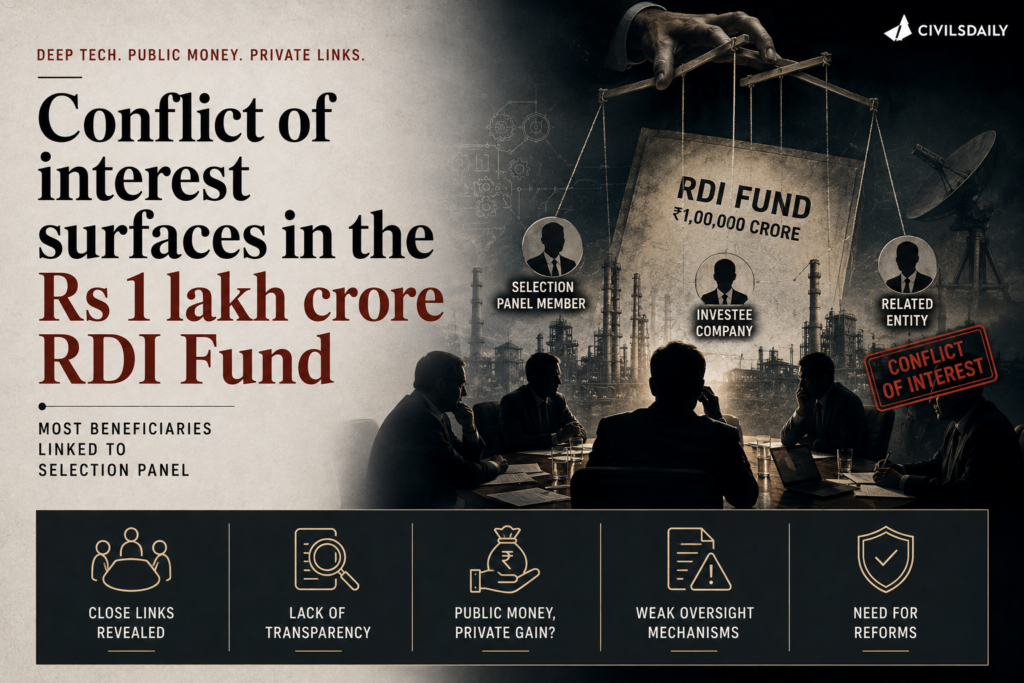
An investigation found that a large share of soft loans under the Research, Development and Innovation (RDI) Fund went to firms linked to the fund’s own selection panel. The tension is between fast tracking private deep tech financing and preserving impartial public fund governance.
What is the Research, Development and Innovation (RDI) Fund?
Corpus: A Rs 1 lakh crore fund to provide low cost, long tenure financing for private research and deep technology.
Anchor body: It operates under the Anusandhan National Research Foundation (ANRF) framework, with the Technology Development Board (TDB) disbursing loans.
What is the conflict of interest concern?
Panel linkage: Members of the selection panel had financial ties to firms that received public funding.
Concentration: A majority of the sanctioned loans went to entities connected to those approving them.
What safeguards does the government cite?
Super majority: Approvals require a super majority of the selection committee.
Stake disqualification: Members holding a stake above a threshold are barred from that decision.
Cost cap: Public funding is capped at a share of total project cost.
Disclosure: Members must declare any negative interest before voting.
Why does the safeguard design still draw scrutiny?
Small expert pool: India’s narrow deep tech expert base makes overlaps between funders and funded hard to avoid.
Verification gap: Declared interests need independent audit to prevent capture.
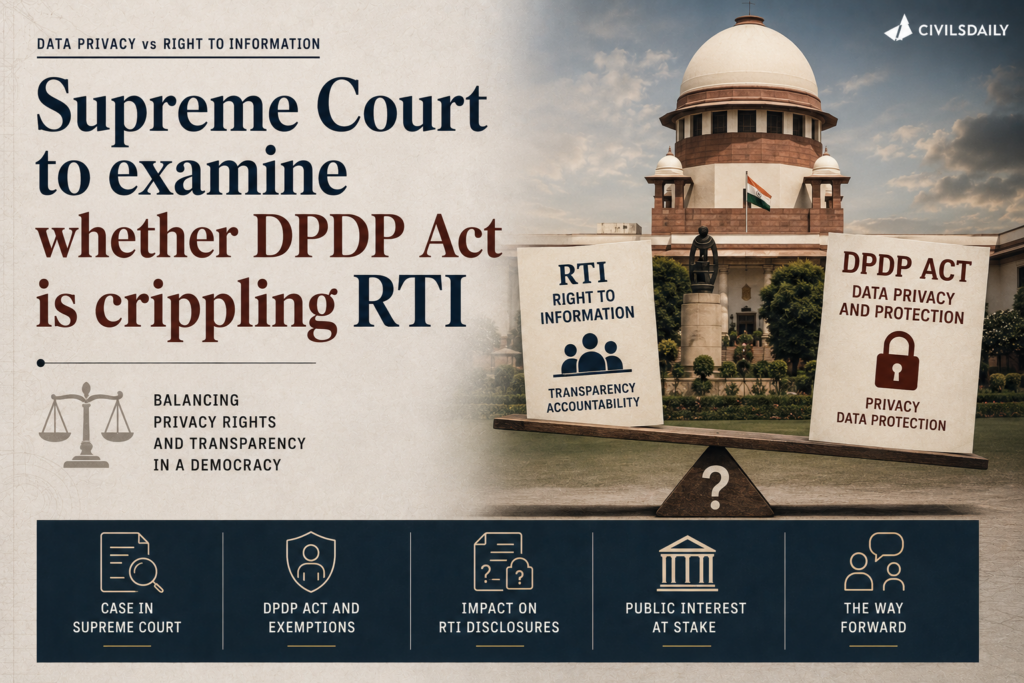
The Supreme Court has agreed to examine whether the Digital Personal Data Protection Act, 2023 is being used to defeat the Right to Information Act, 2005. The conflict is between the right to informational privacy and the right of citizens to access public information.
What is Section 44(3) of the DPDP Act, 2023?
Amending provision: Section 44(3) amended Section 8(1)(j) of the RTI Act, which governs exemption of personal information.
Effect: It removed the earlier public interest override, allowing any personal information to be withheld.
Why does this threaten the Right to Information?
Blanket exemption: Officials can now deny information by labelling it ‘personal data’ without a public interest test.
Journalism risk: Investigative reporting that relies on named records could be gagged.
Accountability loss: Asset disclosures and beneficiary lists that expose wrongdoing may fall outside access.
What is the case for the privacy safeguard?
Fundamental right: Privacy was recognised as a fundamental right under Article 21 in the K.S. Puttaswamy judgment.
Data misuse: Uncontrolled disclosure of personal data can enable profiling and harm.
What must be resolved for the two laws to coexist?
Public interest test: A restored balancing standard is the missing precondition for reconciling access and privacy.
Conclusion
The central question is whether privacy protection can be read so widely that it nullifies transparency. The next milestone is the Court’s substantive hearing on the challenge to Section 44(3).
Back2Basics: Right to Information Act, 2005
Objective: Empowers citizens to seek information from public authorities to promote transparency and accountability.
Key body: Central and State Information Commissions adjudicate appeals and complaints.
Section 8: Lists exemptions from disclosure, including the personal information clause now amended.
“[2020, GS2, 10 marks] ‘Recent amendments to the Right to Information Act will have profound impact on the autonomy and independence of the Information Commission’. Discuss.”
A government move that could permit charges on Unified Payments Interface (UPI) transactions has revived the question of a Merchant Discount Rate (MDR). The tension is between funding the rising cost of a free public payments rail and preserving the zero cost model that drove its mass adoption.
What is the Merchant Discount Rate (MDR)?
Definition: The MDR is the fee a merchant pays a bank for accepting a digital payment from a customer.
Current position: MDR on UPI and RuPay debit card payments has been zero since 2020, shifting the settlement cost onto the system.
How would the proposed charge actually work?
Large merchants only: Any MDR would apply to person to merchant (P2M) payments above a threshold, not to small traders.
Enabling law: The change is routed through the Taxation and Other Laws (Amendment) Bill 2026.
What is the case against charging for UPI?
Adoption risk: A fee could push small merchants back toward cash and reverse formalisation gains.
Alternative funding: The RBI’s surplus could subsidise the payments rail instead of a merchant levy.
What are the pressures forcing the question?
Scale cost: Processing billions of monthly transactions imposes real infrastructure and settlement costs on banks.
Sustainability: A permanently free model leaves no revenue to maintain and expand the network.
“[2018] Which one of the following best describes the term ‘Merchant Discount Rate’ sometimes seen in news? (a) The incentive given by a bank to a merchant for accepting payments through debit cards pertaining to that bank. (b) The amount paid back by banks to their customers when they use debit cards for financial transactions for purchasing goods or services. (c) The charge to a merchant by a bank for accepting payments from his customers through the bank’s debit cards. (d) The incentive given by the Government to merchants for promoting digital payments by their customers through Point of Sale (PoS) machines and debit cards.
The Supreme Court passed an order on 4 August 2026 on the digital arrest scam. It directed banks, states and regulators toward faster action on mule accounts and cyber fraud. The scams persist because they are run largely from overseas hubs.
What is the digital arrest scam?
Definition: Fraudsters impersonate authorities and coerce victims into transferring money under threat of fake arrest. There is no legal basis or process called digital arrest.
Targets: Older victims fall prey through deference to authority and fear of legal trouble.
New targets: Scammers now also target youth and professionals, and senior citizens whom advisories have not reached.
Why are digital arrests keep happening?
Human Psychology & Social Engineering: Cybercriminals use social engineering tactics to manipulate people into revealing sensitive information. Fraudsters also exploit emotions like fear (threatening legal action), excitement (fake lottery wins), or urgency (fake emergency fund requests). Cybercriminals often impersonate trusted sources such as banks, government agencies, or even close friends.
Weak Cybersecurity Practices: Common weaknesses include weak password and credentials use, unpatched software and system and poor security hygiene.
Rapidly Evolving Cybercrime Techniques: Cybercriminals constantly evolve their methods to stay ahead of security measures.
Digital Payments & Financial Fraud Risks: With the rise of digital transactions, cybercriminals have developed sophisticated methods to exploit online payment systems like fake UPI requests & QR codes, card skimming & SIM swaps and crypto & investment scams.
Dark Web & Cybercrime Networks: The dark web serves as a marketplace for stolen data, malware tools, and illegal activities. Cybercrime has become an organized industry where criminals buy and sell stolen data and identity theft, organised cyber-crime syndicates and also offer Ransomware-as-a-Service (RaaS) as well.
Lack of Strong Cyber Laws & Enforcement: Despite increasing cyber threats, many scams go unpunished due to slow law enforcements response, cross border crime challenges and lack of cyber crime awareness and policies.
What did the Supreme Court order?
Debit holds: It directed the Reserve Bank of India (RBI) to circulate a standard operating procedure for temporary debit holds on mule accounts.
State action: States must notify cybercrime coordination centres and operationalise electronic Zero FIRs.
Compensation: An inter departmental committee must examine a victim compensation framework.
Data cited: Complaints on the National Cyber Crime Reporting Portal fell from 1,23,672 in 2024 to 16,377 in the first half of 2026.
Recovery: Money was restored in 36,290 cases involving Rs 18.05 crore.
What are the key terms in the response?
Indian Cybercrime Coordination Centre (I4C): the nodal body coordinating action against cyber fraud and running the reporting portal.
Mule account: a bank account used to receive and move fraud proceeds across states.
Zero FIR: a First Information Report that can be filed at any police station regardless of jurisdiction.
MuleHunter.AI: a detection system used in over 20 banks to flag mule accounts.
Why do these scams persist despite falling complaints?
Nimble methods: Fraudsters route calls through SIM boxes to mask origin and appear as Indian numbers.
Deepfakes: They deploy deepfakes on video calls to dupe victims and stay untraceable.
Few convictions: Convictions are rare as many schemes are run from overseas scam compounds.
Overseas hubs: Compounds operate in Myanmar, the wider Golden Triangle and Cambodia, some with official patronage.
Trafficking link: Indians are trafficked and coerced to run digital crimes against fellow citizens.
Conclusion
Detection systems and swift account freezes limit the damage even when perpetrators escape conviction. The core problem lies in overseas scam compounds beyond domestic law enforcement reach. New Delhi must use diplomatic pressure with China, the United States and ASEAN to compel host countries to act.
Back2Basics
Electronic-Zero FIR (e-zero FIR)
An e-Zero FIR is an automated digital system in India that converts high-value cyber financial fraud complaints (above ₹10 lakh) filed via the National Cyber Crime Reporting Portal or the 1930 helpline directly into a Zero FIR. It eliminates jurisdictional delays during the critical “golden hour” for fund recovery
Key Features and Workflow
Automatic Registration: Eligible financial fraud reports trigger an instant e-Zero FIR without requiring an initial physical station visit.
System Integration: Combines the I4C portal, state e-FIR mechanisms, and the NCRB’s Crime and Criminal Tracking Network & Systems (CCTNS).
Auto-Routing: The system instantly routes the electronic document to the correct territorial cybercrime station based on the victim’s location.
Mandatory Follow-Up: Complainants must visit the designated local police station within three days to sign and convert the e-Zero FIR into a regular FIR under the Bharatiya Nagarik Suraksha Sanhita (BNSS).
PYQ Relevance
[UPSC 2022] What are the different elements of cyber security? Keeping in view the challenges in cyber security, examine the extent to which India has successfully developed a comprehensive National Cyber Security Strategy.
Linkage: The PYQ tests India’s cyber security framework and response to cybercrime. The article highlights recent measures to strengthen India’s response to digital arrest scams and cyber fraud.
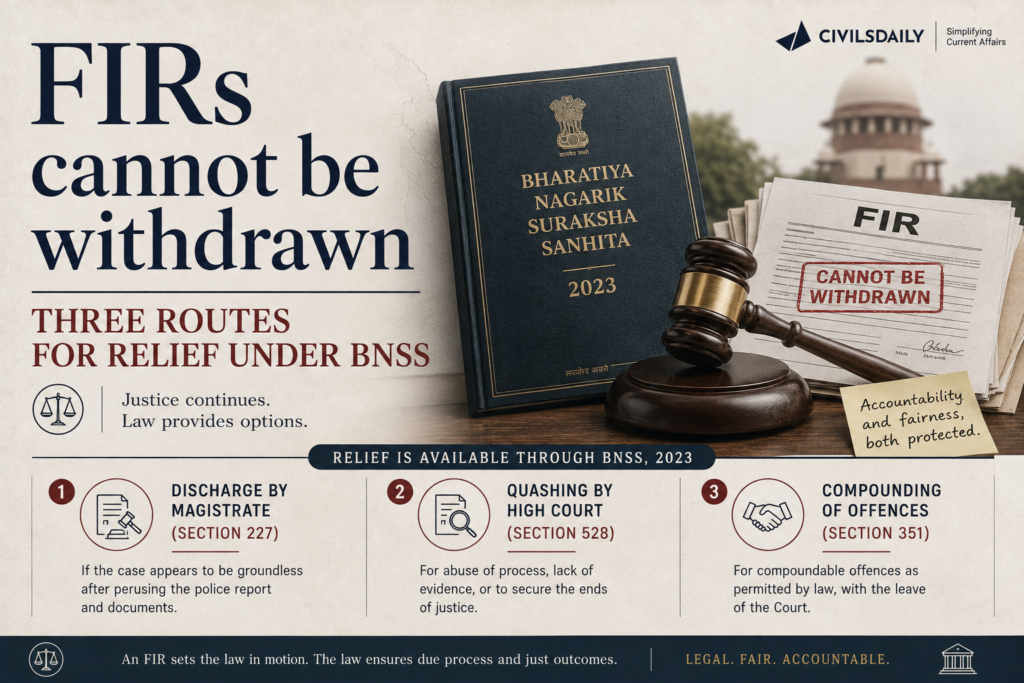
The Supreme Court has clarified that State Governments cannot simply withdraw or cancel FIRs against student protesters through executive orders. Criminal proceedings can end only through procedures provided under the Bharatiya Nagarik Suraksha Sanhita (BNSS), 2023.
What is a First Information Report (FIR) under the BNSS?
Definition: An FIR is the first written record of information relating to a cognizable offence received by the police.
Purpose: It sets the criminal investigation in motion under the Bharatiya Nagarik Suraksha Sanhita (BNSS), 2023.
No Executive Power: A government cannot cancel or erase an FIR through an executive order. Only the subsequent criminal proceedings can be terminated through legal procedures.
Route 1: Closure Report
Provision: If the police find insufficient evidence during investigation, they may submit a closure report before the jurisdictional Magistrate under Section 193 of BNSS.
Judicial Scrutiny: The Magistrate is not bound to accept the report and may order further investigation or take cognizance.
Key Case:Abhinandan Jha v. Dinesh Mishra (1967) affirmed the Magistrate’s independent powers.
Route 2: Withdrawal from Prosecution
Provision: Under Section 360 of BNSS, the Public Prosecutor, with the court’s consent, may withdraw from prosecution before judgment.
Independent Decision: The request must reflect the prosecutor’s own assessment and not merely government instructions.
Court’s Role: The court must ensure the withdrawal is in good faith and public interest.
Victim’s Rights: The victim must be given an opportunity to be heard.
Key Case:Sheonandan Paswan v. State of Bihar (1986).
Route 3: Quashing by the High Court
Provision:Section 528 of BNSS preserves the High Court’s inherent powers to prevent abuse of process and secure the ends of justice.
Direct Remedy: An accused person may directly approach the High Court for quashing of criminal proceedings.
Limited Use: Courts have consistently held that this power should be exercised sparingly, particularly while investigation is ongoing.
Important Judicial Precedent
Baroda Dynamite Case (1980): The Supreme Court upheld withdrawal of prosecutions arising from the Emergency period.
Principle: Withdrawal may be justified where it promotes public peace, reconciliation and good governance, provided legal safeguards are followed.
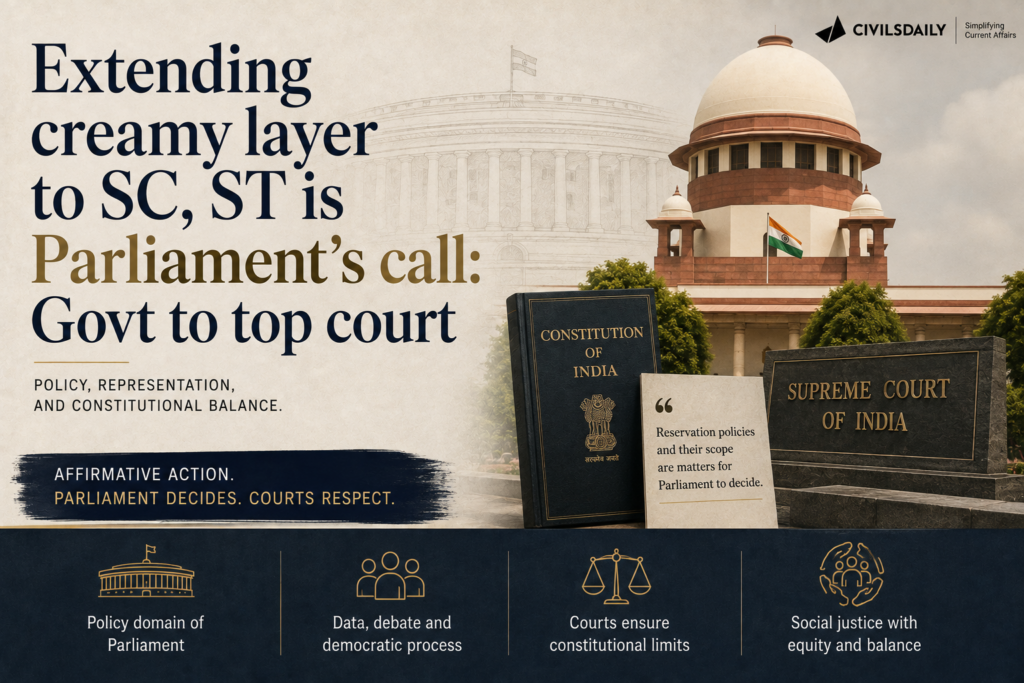
The Centre has told the Supreme Court that the creamy layer principle cannot be extended to Scheduled Castes (SCs) and Scheduled Tribes (STs) through judicial directions. It argued that any such change requires a decision by Parliament, as reservation for SCs and STs is based on historical and social discrimination rather than economic status.
What is the Creamy Layer Principle?
Definition: Excludes the socially advanced and economically better off members of a reserved category from availing reservation benefits.
Origin: Introduced for Other Backward Classes (OBCs).
Current Position: The principle does not apply to SCs and STs, whose reservation is based on historical discrimination and social exclusion.
What did the Centre argue before the Supreme Court?
Parliament’s Authority: Only Parliament can decide whether to extend the creamy layer principle to SCs and STs.
Constitutional Basis: Any exclusion must follow the procedure under Article 341(2) (and similarly Article 342 for STs).
Need for Evidence: Any income based classification should be preceded by a comprehensive empirical study.
Separation of Powers: Courts should not direct the executive to frame such a policy without legislative backing.
Reservation Basis: SC and ST identification depends on historical social disadvantage, not merely economic criteria.
Key Judicial Precedents
State of Punjab v. Davinder Singh (2024): Held that sub classification within SCs and STs for equitable distribution of reservation benefits is constitutionally permissible.
E.V. Chinnaiah v. State of Andhra Pradesh (2005): Held that altering the SC list requires legislative action under Article 341.
Ashoka Kumar Thakur v. Union of India (2008): Clarified that the creamy layer principle does not apply to SCs and STs.
What is the core issue?
Equitable Distribution: Petitioners seek greater benefits for the poorest sections within SCs and STs.
Social Justice vs Economic Criteria: The Centre maintains that SC/ST reservation addresses historical social stigma, not poverty alone.
Institutional Question: The case raises the issue of whether such reforms should come through judicial intervention or Parliamentary legislation.
India’s gold market is witnessing a structural shift as investment demand and gold backed loans grow rapidly, while jewellery demand declines. The trend has also highlighted the limited success of the Gold Monetisation Scheme (GMS), 2015 in mobilising idle household gold.
What is the Gold Monetisation Scheme (GMS), 2015?
Objective: Mobilise idle gold held by households and institutions into the formal financial system.
Mechanism: Individuals and institutions deposit physical gold with authorised banks and earn interest on the deposits.
Challenges: Limited participation due to taxation concerns, sentimental attachment to gold and procedural complexities.
How is India’s gold demand changing?
Overall Demand: Total gold demand increased 2% year on year to 282 tonnes in the first half of the year.
Jewellery Demand: Fell 17.1% to 141.2 tonnes, among the weakest first quarter levels since 2000.
ETF Investment: Gold Exchange Traded Funds (ETFs) recorded a net inflow of 20 tonnes in the first quarter.
Bars and Coins: Demand rose 21.3% in volume and 105.5% in value during the first half of FY27.
Price Rise: Domestic gold prices have increased more than fivefold over the past decade.
Why are households pledging gold instead of selling it?
Collateral Preference: Households increasingly use gold as collateral for loans rather than selling it.
Gold Loan Growth: Outstanding gold loan portfolios reached about Rs 5.4 lakh crore by June 2026.
Retail Loans: Bank loans backed by pledged jewellery touched about Rs 4.3 lakh crore by February 2026.
Limited Recycling: Despite record high prices, households continue to retain gold, resulting in low recycled supply.
External Stability: Household gold holdings and central bank gold purchases have supported India’s external balance and moderated pressure on the rupee.
What are the concerns?
Financial Stability: Rapid expansion of gold loans requires close regulatory monitoring.
RBI Measures: Borrowers must fully repay principal and interest before the same gold can be repledged.
Price Risk: A sharp decline in gold prices could affect lenders through lower collateral values.
[2016] What is/are the purpose/purposes of Government’s ‘Sovereign Gold Bond Scheme’ and ‘Gold Monetization Scheme’? 1. To bring the idle gold lying with Indian households into the economy. 2. To promote FDI in the gold and jewellery sector. 3. To reduce India’s dependence on gold imports. Select the correct answer using the code given below. (a) 1 only (b) 2 and 3 only (c) 1 and 3 only (d) 1, 2 and 3