💥Join UPSC 2027,2028 Mentorship (August Batch) + XFactor Notes & Microthemes PDF

Distribution: weekly

  • Taxation and Other Laws (Amendment) Bill and the UPI levy

    Why in the News

    The Lok Sabha passed the Taxation and Other Laws (Amendment) Bill, 2026 on 6 August 2026. The Bill gives legal backing to modify the zero charge regime on some digital payments. Analysis links the move to United States trade pressure over digital payment barriers.

    What is the zero Merchant Discount Rate regime on UPI and RuPay?

    1. Merchant Discount Rate (MDR): the fee a merchant pays to banks and card networks for processing a digital payment.
    2. Zero MDR rule: since 2020 India has barred any charge on Unified Payments Interface (UPI) and RuPay debit card transactions.
    3. Effect on users: UPI stays free at the point of payment, which drove mass adoption.
    4. Bill change: the amendment removes the link between the Payment and Settlement Systems Act, 2007 and the Income Tax Act, and lets the government modify the zero charge regime.
    5. Scope: any charge would apply to merchants, not end users, and the steering committee headed by the National Payments Corporation of India (NPCI) is yet to decide.

    What else does the Bill do?

    1. Manufacturing: it aims to promote domestic electronics manufacturing.
    2. Foreign capital: it replaces a June ordinance that exempted interest income and capital gains earned by Foreign Portfolio Investors from government securities.

    Why is the change linked to United States trade demands?

    1. Section 301 lever: the United States Trade Representative (USTR) runs a Section 301 investigation, a tool to act against foreign trade barriers.
    2. Barrier tag: in March 2026 USTR classified India’s digital payment policies as favouring domestic players.
    3. Lost business: Visa and Mastercard cite lost potential business as Indian consumers shifted to free UPI.
    4. Market cap concern: USTR flagged that two United States owned providers processed over 80 percent of UPI transactions, alongside the 30 percent cap on third party apps.
    5. Precedent: India earlier scrapped the 6 percent equalisation levy on digital services under similar pressure.

    What are the concerns around the levy?

    1. Adoption risk: charges could slow UPI use if passed to merchants and then to prices.
    2. Policy autonomy: critics read the change as a concession under trade negotiation rather than domestic reform.
    3. Revenue pool: an interoperable zero cost platform limits card network fee income, which the change could restore.

    [2026] Which one of the following best describes the key objective of India’s ‘Open Network for Digital Commerce’ (ONDC) initiative?
    (a) To allow digital government control over all digital commerce transactions
    (b) To replace private e-commerce players
    (c) To break the dominance of large e-commerce platforms by enabling interoperability across networks
    (d) To mandate UPI-based payments for all online transactions

  • Why is the government offloading stake in LIC?

    Why in the News

    The Government of India has launched an Offer for Sale (OFS) to reduce its stake in the Life Insurance Corporation of India (LIC). The move aims to meet SEBI’s minimum public shareholding (MPS) requirement and contribute to the government’s FY27 disinvestment target.

    What is an Offer for Sale (OFS)?

    • Definition: An Offer for Sale (OFS) is a mechanism through which an existing shareholder (promoter) sells shares to the public through the stock exchange.
    • No Fresh Capital: The company does not receive any funds; the sale proceeds go to the selling shareholder.
    • Current Issue: The Government offered 2.5% equity, with a 4% green shoe option, at a floor price of Rs 382 per share.
    • Discount: The floor price represented about a 10% discount to LIC’s closing market price on 3 August.

    What is the Minimum Public Shareholding (MPS) norm?

    • Requirement: SEBI mandates that listed companies maintain a minimum level of public shareholding.
    • LIC Deadline: LIC has been given time until 16 May 2027 to achieve 10% public shareholding.
    • Purpose: The OFS helps LIC move towards compliance with this regulatory requirement.

    Why is the Government selling its stake now?

    • Regulatory Compliance: To meet SEBI’s public shareholding norms.
    • Disinvestment Target: The sale contributes towards the FY27 disinvestment target of Rs 80,000 crore.
    • Estimated Receipts: At the base price, the issue could raise around Rs 31,000 crore.
    • Strong Demand: The institutional investor portion was oversubscribed 3.32 times, leading to the exercise of the green shoe option.
    • Implementing Agency: The process is managed by the Department of Investment and Public Asset Management (DIPAM).

    What is LIC’s position in the insurance sector?

    • Market Leader: LIC accounted for over 56% of India’s life insurance market in FY26.
    • Systemically Important: LIC is designated as a Domestic Systemically Important Insurer (D-SII), subject to enhanced regulatory supervision.
    • Listing History: LIC’s 2022 IPO sold 3.5% government stake and raised Rs 20,557 crore.

    [2025] Consider the following statements:
    I. Capital receipts create a liability or cause a reduction in the assets of the Government.
    II. Borrowings and disinvestment are capital receipts.
    III. Interest received on loans creates a liability of the Government.
    Which of the statements given above are correct?
    (a) I and II only

    (b) II and III only

    (c) I and III only

    (d) I, II and III

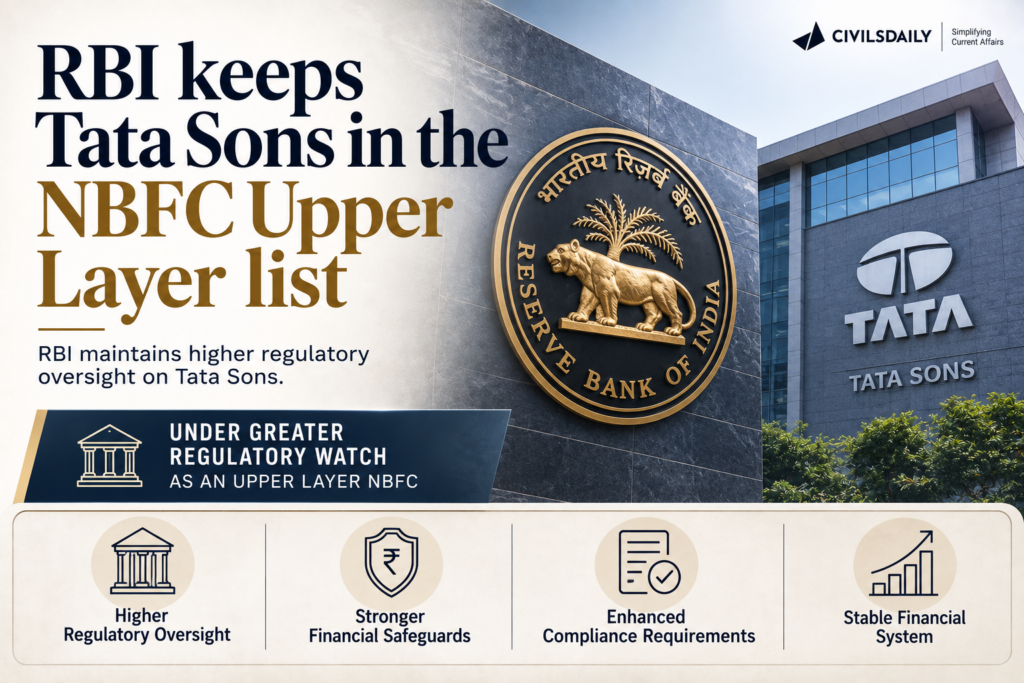
  • RBI keeps Tata Sons in the NBFC Upper Layer list

    Why in the News

    The Reserve Bank of India (RBI) has retained Tata Sons in the NBFC Upper Layer (NBFC-UL) under its Scale Based Regulation (SBR) framework. This revives the requirement for Tata Sons to list on a stock exchange, while its request for deregistration as an NBFC remains under RBI’s consideration.

    What is the NBFC Upper Layer under the Scale Based Regulation (SBR) Framework?

    • Definition: The Scale Based Regulation (SBR) framework classifies NBFCs into four layers based on their size, activity and risk profile.
    • Upper Layer (NBFC-UL): Covers large, systemically important NBFCs requiring enhanced regulatory oversight.
    • Eligibility: RBI identifies NBFC-UL entities with assets of Rs 1 lakh crore or more.
    • Mandatory Listing: An NBFC classified in the Upper Layer must list on a recognised stock exchange within three years.
    • Minimum Tenure: Once classified, an NBFC remains in the Upper Layer for at least five years, even if it later falls below the threshold.

    What is a Core Investment Company (CIC)?

    • Definition: A Core Investment Company (CIC) is an NBFC that primarily holds investments in its group companies rather than engaging in public lending.
    • Tata Sons: RBI classifies Tata Sons as a Core Investment Company under the NBFC Upper Layer.

    Why has the listing issue resurfaced?

    • Debt Repaid: Tata Sons repaid its borrowings in 2024 and no longer directly raises public funds.
    • Indirect Public Funds: RBI considers investments held by listed Tata companies in Tata Sons as an indirect form of public funding.
    • Deregistration Pending: Tata Sons has sought deregistration as an NBFC, but RBI has stated that the Upper Layer classification is without prejudice to that request.
    • Internal Differences: The proposed listing has divided the Tata Trusts, while the Pallonji Mistry Group supports listing to unlock shareholder value.

    What additional regulations apply to NBFC Upper Layer entities?

    • Capital Requirements: Higher capital adequacy norms, including Common Equity Tier 1 (CET1) requirements.
    • Governance Standards: Mandatory board committees, stronger provisioning norms and prudent compensation policies.
    • Current Coverage: RBI has classified 17 NBFCs in the Upper Layer, including Bajaj Finance, Tata Capital and Shriram Finance.

    [2026] Consider the following statements about the Non-Banking Financial Companies (NBFCs) in India:
    1. NBFCs cannot accept demand deposits.
    2. All the NBFCs operating in India have to be registered with the RBI.
    3. NBFCs form part of the payment and settlement system and can issue cheque drawn on itself.
    4. Deposit insurance facility of Deposit Insurance and Credit Guarantee Corporation (DICGC) is not available to the depositors of deposit taking NBFCs.
    Which of the statements given above is/are correct?
    (a) 1 and 4

    (b) 1, 2 and 3

    (c) 4 only

    (d) 2, 3 and 4

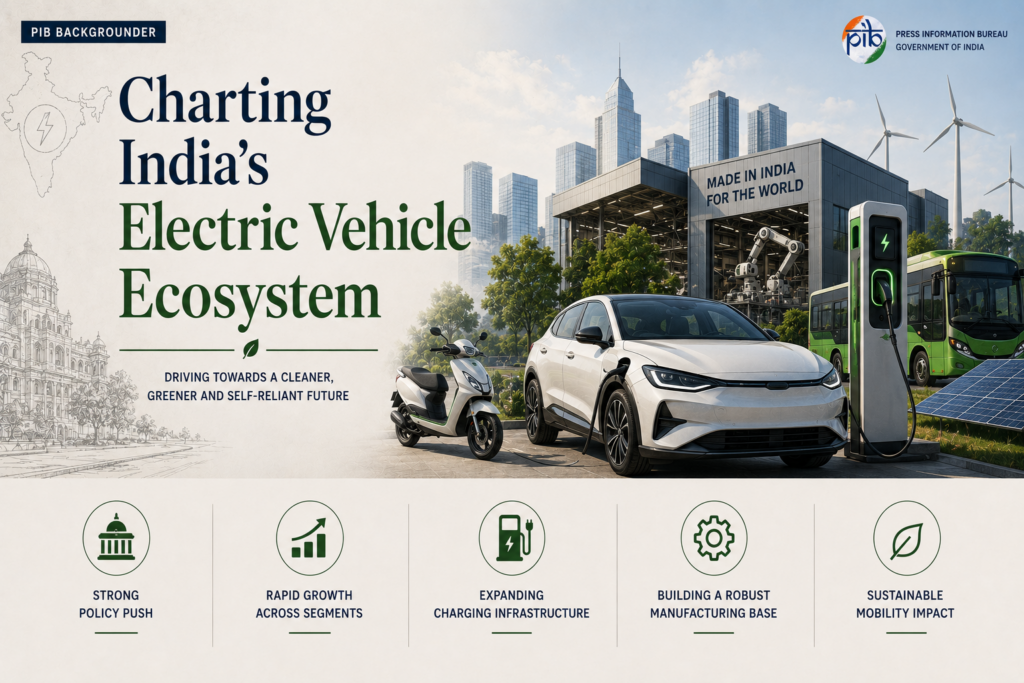
  • PIB Backgrounder Charts India’s Electric Vehicle Ecosystem

    Why in the News

    A PIB Backgrounder has highlighted the rapid growth of India’s Electric Vehicle (EV) ecosystem, showcasing significant progress in EV adoption, charging infrastructure, battery manufacturing, and government support.

    What does the Backgrounder Highlight?

    • EV Penetration: Increased from 0.08% in 2016 to 8.26% in 2026.
    • EV Sales: Rose from about 50,000 units in 2016 to 2.3 million units in 2025.
    • Charging Infrastructure: India had 52,718 public charging stations by July 2026, with a target of about 1.32 million stations by 2030.
    • National Goal: Achieve a 30% share of electric vehicles in new vehicle sales by 2030 under the EV30@30 initiative.

    PM E-DRIVE Scheme

    • Full Form: PM Electric Drive Revolution in Innovative Vehicle Enhancement (PM E-DRIVE).
    • Launched: 2024, replacing the FAME scheme.
    • Outlay: ₹10,900 crore.
    • Coverage: Electric two-wheelers. Electric three wheelers. Electric trucks. Electric buses. Electric ambulances.
    • Objective: Accelerate EV adoption through demand incentives and supporting infrastructure.

    Battery Manufacturing Push

    Production Linked Incentive (PLI) Scheme for Advanced Chemistry Cell (ACC)

    • Outlay: ₹18,100 crore.
    • Manufacturing Target: 50 GWh of Advanced Chemistry Cell battery capacity.
    • Objective: Promote domestic battery manufacturing and reduce import dependence.

    Earlier Initiative: FAME Scheme

    • Full Form: Faster Adoption and Manufacturing of Electric Vehicles (FAME).
    • Launched: 2015.
    • Phase II: Implemented until 2024.
    • Replaced by: PM E-DRIVE in 2024.

    [2025] In the context of electric vehicle batteries, consider the following elements:

    I. Cobalt

    II. Graphite

    III. Lithium

    IV. Nickel

    How many of the above usually make up battery cathodes?

    (a) Only one (b) Only two (c) Only three (d) All the four

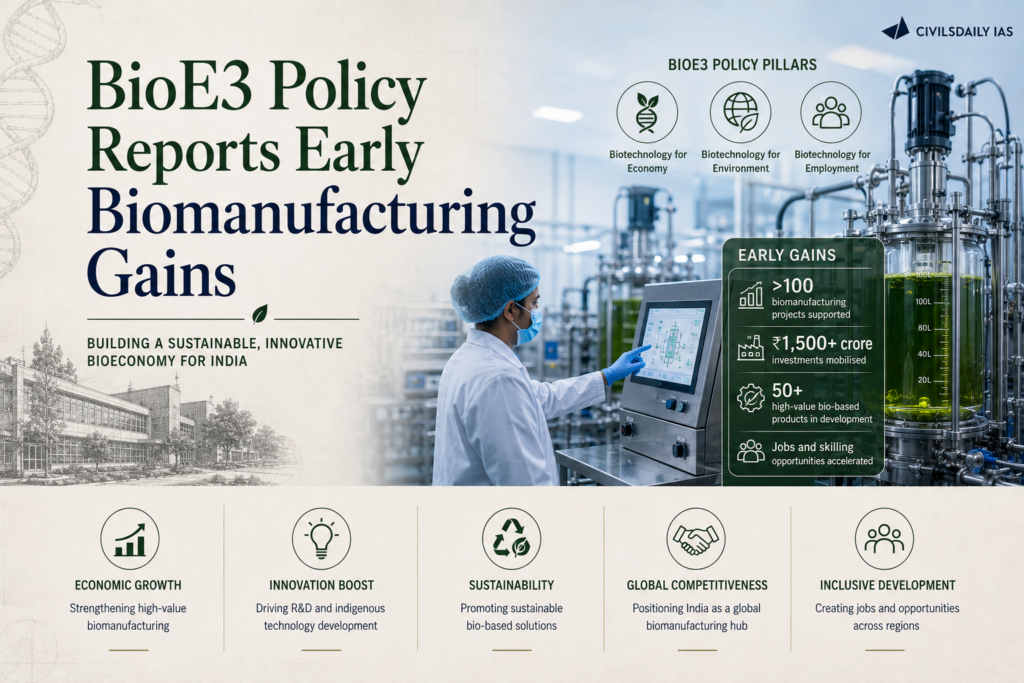
  • BioE3 Policy Reports Early Biomanufacturing Gains

    Why in the News

    The Government has highlighted the early achievements of the Biotechnology for Economy, Environment and Employment (BioE3) Policy, demonstrating growing investments and capacity in India’s biomanufacturing sector.

    What is the BioE3 Policy?

    • Full form: Biotechnology for Economy, Environment and Employment (BioE3) Policy.
    • Approved: 2024 by the Union Cabinet.
    • Implementing Agency: Department of Biotechnology (DBT).
    • Objective: Promote high capacity biomanufacturing to drive economic growth, environmental sustainability, and employment generation.

    Key Features of the Policy

    • Focus Areas: The policy identifies six thematic sectors:
      • Bio based chemicals.
      • Smart proteins.
      • Precision biotherapeutics.
      • Climate resilient agriculture.
      • Biofuels and carbon capture.
      • Marine and space biotechnology.
    • Funding Pattern:
      • Government support of up to 70% of project cost.
      • Remaining contribution from the private sector.
    • Industry Participation:
      • Over 600 beneficiaries have utilised BioE3 facilities.
      • Private investment commitments have reached about ₹602 crore.
    • Long term Goal: Support India’s vision of a $300 billion bioeconomy by 2030.

    What is Biomanufacturing?

    • Definition: The production of chemicals, fuels, materials, pharmaceuticals and other products using biological systems such as microorganisms, enzymes or engineered cells.
    • Benefits:
      • Reduces dependence on fossil fuel based manufacturing.
      • Promotes sustainable industrial production.
      • Supports the circular bioeconomy.

    What is a Biofoundry?

    • A highly automated research facility that designs, builds, tests and analyses biological systems.
    • Accelerates the development of new biotechnology products through automation and artificial intelligence.

    [2026] Which of the following statements with regard to GenomeIndia Project is/are correct ?
    1. It is a part of the Human Genome Project.
    2. The project is funded by the Department of Biotechnology (DBT), Government of India.
    3. Its primary aim is to build a catalogue of genetic diversity of the Indian population.
    Select the answer using the code given below:

    [A] 1 only

    [B] 2 and 3 only

    [C] 1 and 2 only

    [D] 1, 2 and 3

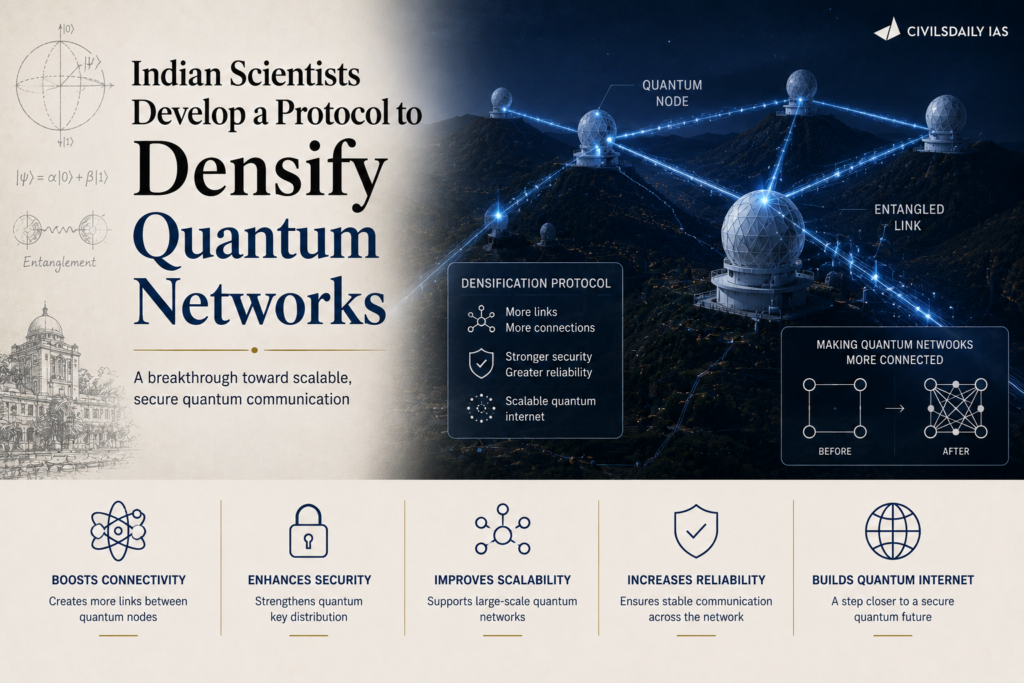
  • Indian Scientists Develop a Protocol to Densify Quantum Networks

    Why in the News

    Indian scientists have developed a new routing protocol called General Concurrence Percolation (GCP) to improve the efficiency and connectivity of quantum networks, marking a significant advance in quantum communication.

    What is the General Concurrence Percolation (GCP) Protocol?

    • Innovation: A routing protocol designed to strengthen quantum entanglement across a quantum network.
    • Approach: Uses localized geometric routing to identify the shortest communication paths.
    • Key feature: Preserves intermediate network nodes instead of disconnecting them, improving network stability.
    • Outcome: Simulations show the protocol reduces the minimum entanglement required to connect an entire quantum network.

    What is Quantum Entanglement?

    • Definition: A quantum phenomenon in which two or more particles remain correlated so that the state of one is intrinsically linked to the state of the other, regardless of distance.
    • Challenge: Entanglement weakens over long distances, making reliable quantum communication difficult.
    • Importance: It is the foundation of quantum communication, quantum cryptography, and quantum computing.

    Why is the Development Significant?

    • Improves the efficiency of long distance quantum communication.
    • Reduces the amount of entanglement needed for network connectivity.
    • Makes future quantum internet infrastructure more robust and scalable.
    • Supports secure communication through quantum encryption technologies.
    • Strengthens India’s capabilities in advanced quantum technologies.

    [2026] Which of the following statements with regard to the National Quantum Mission (NQM) is/are correct?
    1. It aims at developing intermediate-scale quantum computers with 50 – 1000 physical qubits.
    2. Its implementation includes setting up of four Thematic Hubs (T-Hubs) in academic and national R&D institutes across India.
    Select the answer using the code given below :

    [A] 1 only

    [B] 2 only

    [C] Both 1 and 2

    [D] Neither 1 nor 2

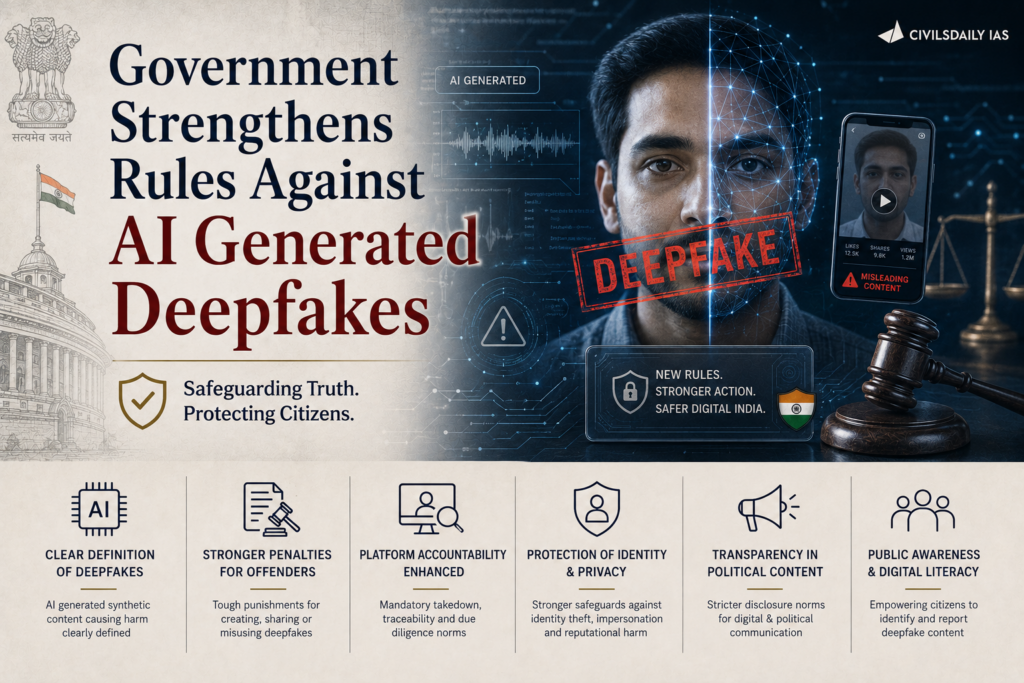
  • Government Strengthens Rules Against AI Generated Deepfakes

    Why in the News

    The Government has strengthened the regulatory framework against AI generated deepfakes by amending the Information Technology (Intermediary Guidelines and Digital Media Ethics Code) Rules, 2021.

    What are the New Amendments?

    • Legal framework: Amendments have been made to the Information Technology (Intermediary Guidelines and Digital Media Ethics Code) Rules, 2021, framed under the Information Technology Act, 2000.
    • New definition: Introduces the concept of Synthetically Generated Information (SGI), covering deepfakes and other AI generated content.
    • Mandatory labelling: Platforms must clearly label synthetic content and embed traceable metadata to identify AI generated material.
    • User declaration: Significant Social Media Intermediaries (SSMIs) must obtain a declaration from users on whether uploaded content is synthetic.
    • Verification tools: SSMIs are required to deploy tools to verify user declarations.
    • Harmful content: The framework specifically targets:
      • Child Sexual Abuse Material (CSAM)
      • Non consensual intimate imagery
      • AI enabled impersonation and fraud

    What is a Deepfake?

    • Definition: Deepfakes are AI generated synthetic media in which a person’s face, voice, or likeness is created or manipulated using deep learning techniques.
    • Uses: Can be used for entertainment, education and content creation, but also for misinformation, identity theft, financial fraud and cybercrime.

    [2020] With the print state of development, Artificial Intelligence can effectively do which of the following?
    1. Bring down electricity consumption in industrial units
    2. Create meaningful short stories and songs
    3. Disease diagnosis
    4. Text -to -Speech Conversion
    5. Wireless transmission of electrical energy
    Select the correct answer using the code given below:

    [A] 1, 2, 3 and 5 only

    [B] 1, 3 and 4 only

    [C] 2, 4 and 5 only

    [D] 1, 2, 3, 4 and 5

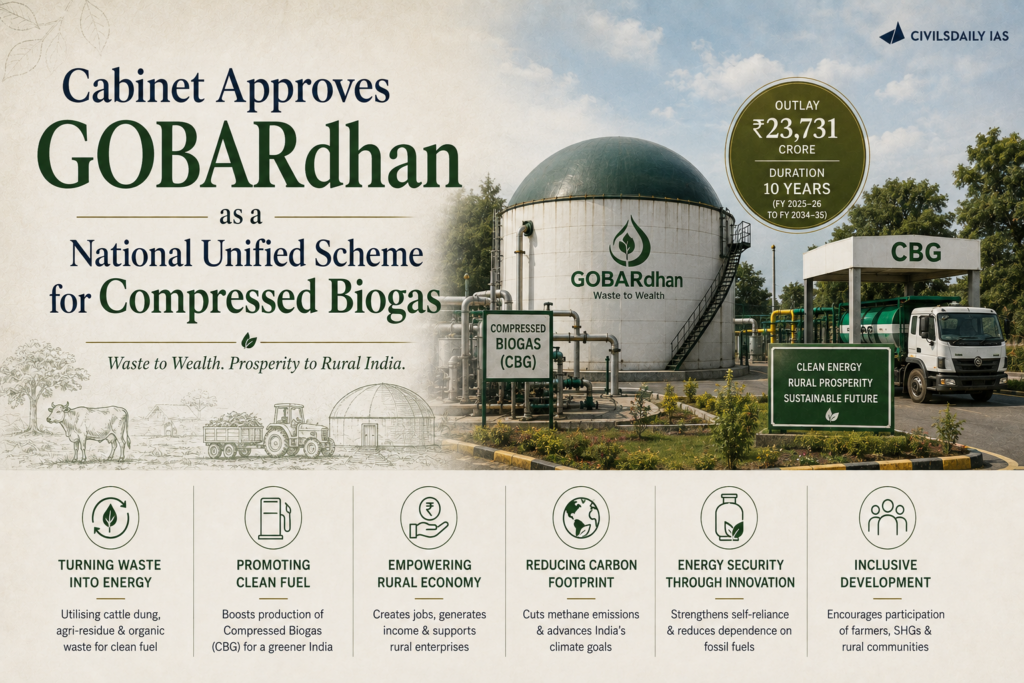
  • Cabinet Approves GOBARdhan as a National Unified Scheme for Compressed Biogas

    Why in the News

    The Union Cabinet has approved GOBARdhan as a National Unified Scheme for Compressed Biogas (CBG) to accelerate domestic biogas production, promote clean energy, and strengthen the circular economy.

    What is the GOBARdhan Scheme?

    • Full form: Galvanizing Organic Bio Agro Resources Dhan (GOBARdhan).
    • Launched: 2018 under the Swachh Bharat Mission (Grameen).
    • Nodal Ministry: Ministry of Petroleum and Natural Gas.
    • Objective: Promote production of Compressed Biogas (CBG) from organic waste while improving waste management, clean energy access, and farmers’ income.

    Key Features of the National Unified Scheme

    • Total Outlay: ₹23,731 crore.
    • Duration: FY 2027 to FY 2036 (10 years).
    • CBG Blending Obligation (CBGO):
      • 3% in the first year.
      • 4% in the second year.
      • 5% from the third year onwards in City Gas Distribution (CGD) networks.
    • Price Support: Administered price of about ₹2,110 per MMBTU for a minimum of 10 years.
    • Capital Assistance: Up to ₹2 crore per tonne per day of CBG production capacity for new projects.
    • Target: Achieve nearly a tenfold increase in domestic CBG production.

    What is Compressed Biogas (CBG)?

    • Definition: Purified biogas with more than 90% methane content.
    • Feedstock: Produced from agricultural residue, cattle dung, municipal solid waste, sewage, and other biodegradable waste.
    • Uses: Can replace Compressed Natural Gas (CNG) in transport, industry, and cooking.

    [2016] Which of the following are the key features of ‘National Ganga River Basin Authority (NGRBA)?
    1. River basin is the unit of planning and management.
    2. It spearheads the river conservation efforts at the national level.
    3. One of the Chief Ministers of the States through which the Ganga flows becomes the Chairman of NGRBA on rotation basis.
    Select the correct answer using the code given Below.

    [A] 1 and 2 only

    [B] 2 and 3 only

    [C] 1 and 3 only

    [D] 1, 2 and 3

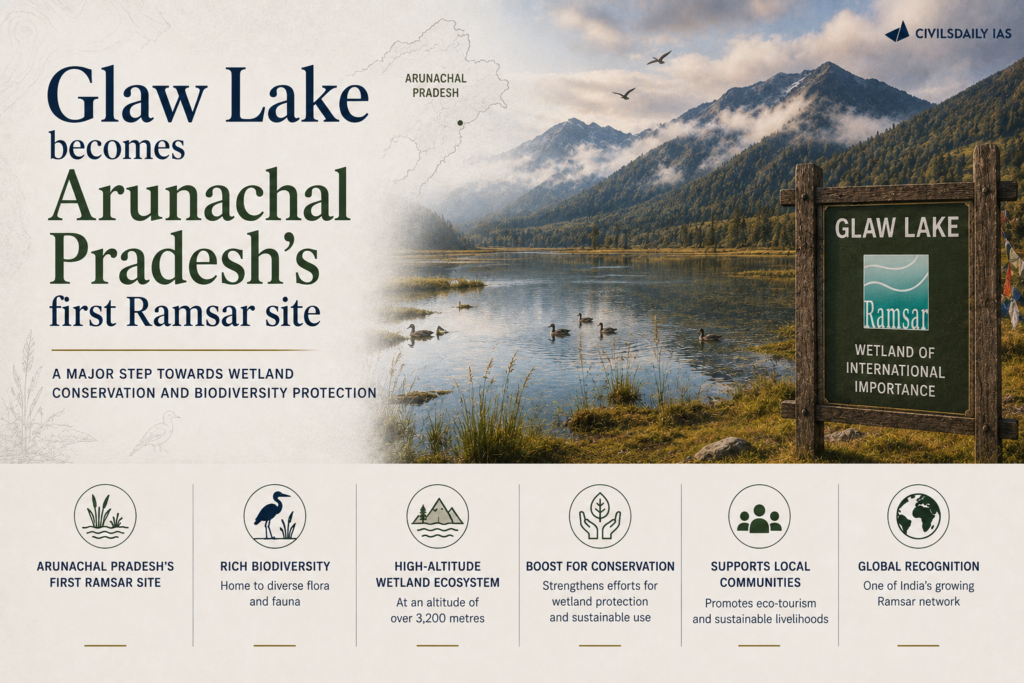
  • Glaw Lake becomes Arunachal Pradesh’s first Ramsar site

    Why in the News

    Glaw Lake has been designated as Arunachal Pradesh’s first Ramsar Site, making it the state’s first Wetland of International Importance under the Ramsar Convention.

    What is the Ramsar Convention?

    • International treaty: An intergovernmental treaty for the conservation and wise use of wetlands.
    • Adopted: 2 February 1971 at Ramsar, Iran.
    • Came into force: 1975.
    • Objective: Promote the conservation and sustainable use of wetlands through national action and international cooperation.
    • India: A Contracting Party to the Convention.

    What is a Ramsar Site?

    • A wetland designated under the Ramsar Convention for its international ecological importance.
    • Selected based on criteria such as:
      • Unique wetland ecosystems.
      • Biodiversity significance.
      • Habitat for threatened species.
      • Importance for migratory waterbirds.

    Why is Glaw Lake Significant?

    • Location: Arunachal Pradesh.
    • First Ramsar Site: It is the first Wetland of International Importance from the state.
    • Recognition: Enhances conservation of the Eastern Himalayan wetland ecosystem.
    • Implementation: Designated under the Ramsar Convention with the involvement of the Ministry of Environment, Forest and Climate Change (MoEFCC) and the Wetlands Division.

    [2019] With reference to Wetlands, consider the following statements:
    1. Under Ramsar Convention, it is mandatory on the part of the Government of India to protect and conserve all the wetlands in the territory of India.
    2. They are covered with hydric soils.
    3. Wetlands are often referred to as Kidneys of the Earth.
    Which of the statements given above is/are correct?

    [A] 1 and 2 only

    [B] 2 and 3 only

    [C] 1 and 3 only

    [D] 1, 2 and 3

  • Rising private R&D spending should be channelled into manufacturing

    Why in the News

    For the first time, private industry has overtaken the government as the largest source of Research and Development (R&D) spending in India, marking a significant shift in the country’s innovation ecosystem. However, India’s overall R&D investment remains low compared to major economies.

    What does the R&D data show?

    • Private sector leads: Private industry contributed 51.8% of India’s total R&D expenditure in 2023 to 2024.
    • Low R&D intensity: India’s Gross Expenditure on R&D (GERD) is only 0.84% of GDP.
      • Global comparison: China: 2.58%, United States: 3.45%, South Korea: 4.94%
    • Limited research workforce: India has only 354 researchers per million population, much lower than leading innovation economies.

    Why should R&D focus on manufacturing?

    • Higher value addition: Promotes movement from low-end assembly to high-technology manufacturing.
    • Import substitution: Reduces dependence on imported technologies and critical components.
    • Employment generation: Encourages advanced manufacturing, creating skilled jobs and strengthening industrial competitiveness.
    • Global competitiveness: Supports initiatives such as Make in India and Atmanirbhar Bharat.

    What institutional support exists?

    Anusandhan National Research Foundation (ANRF)

    • Established under: ANRF Act, 2023.
    • Corpus: ₹50,000 crore over five years.
    • Objective: Promote research, innovation and collaboration among academia, industry and government.
    • Key role:
      • Mobilise private sector investment in research.
      • Coordinate research funding across institutions.
      • Strengthen India’s innovation ecosystem.

    Prelims Pointers

    • GERD (Gross Expenditure on Research and Development): Total national expenditure on R&D as a percentage of GDP.
    • Private industry is now India’s largest R&D spender.
    • ANRF replaced the Science and Engineering Research Board (SERB) as the apex research funding body.
    • India spends less than 1% of GDP on R&D.

    [2015] Which of the following statements is/are correct regarding National Innovation Foundation-India (NIF)?
    1. NIF is an autonomous body of the Department of Science and Technology under the Central Government
    2.NIF is an initiative to strengthen the highly advanced scientific research in India’s premier scientific institutions in collaboration with highly advanced foreign scientific institutions.
    Select the correct answer using the code given below.

    [A] 1 only

    [B] 2 only

    [C] Both 1 and 2

    [D] Neither 1 nor 2