💥Join UPSC 2027,2028 Mentorship (August Batch) + XFactor Notes & Microthemes PDF

Distribution: weekly

  • How ‘ghost particles’ can point the way to spent nuclear fuel

    Why in the News

    Scientists have achieved the first high precision measurement of the neutrino signature from spent nuclear fuel, enabling remote monitoring of nuclear material and strengthening global nuclear non proliferation efforts.

    What is a neutrino?

    • Ghost particle: A neutrino is a nearly massless, electrically neutral subatomic particle that interacts only through the weak nuclear force and gravity.
    • Produced in nuclear reactions: They are emitted in large numbers during nuclear fission, radioactive decay, and reactions inside stars.
    • Highly penetrating: Since neutrinos rarely interact with matter, they can pass through the Earth almost unaffected, making them extremely difficult to detect.

    What did the study achieve?

    • First precise measurement: Researchers in France made the first high precision measurement of the neutrino emissions from spent nuclear fuel.
    • Remote monitoring: The neutrino signal can be measured without physically opening or handling the spent fuel.
    • Scientific validation: The findings were published in a leading peer reviewed physics journal.

    Why is this important for nuclear non proliferation?

    • Supports IAEA safeguards: Enables the International Atomic Energy Agency (IAEA) to verify spent nuclear fuel remotely.
    • Detects diversion: Changes in the neutrino signal can indicate diversion of plutonium or other fissile material for weapons.
    • Strengthens nuclear safeguards: Provides a non intrusive and tamper resistant method to improve verification of nuclear material.
    • Enhances transparency: Builds confidence in peaceful civilian nuclear programmes.

    Prelims Pointers

    • The International Atomic Energy Agency (IAEA) is the UN agency responsible for promoting peaceful uses of nuclear energy and implementing nuclear safeguards.
    • Neutrinos are electrically neutral, nearly massless particles that interact via the weak nuclear force.
    • Nuclear reactors and spent nuclear fuel continuously emit neutrinos.
    • Spent nuclear fuel contains plutonium that can potentially be separated for nuclear weapons, making its monitoring important.

    “[2020] In India, why are some nuclear reactors kept ‘IAEA Safeguards’ while others are not?
    (a) Some use uranium and others use thorium
    (b) Some use imported uranium and others use domestic supplies
    (c) Some are operated by foreign enterprises and others are operated by domestic
    (d) Some are State-owned and others are privately-owned

  • The road ahead for the Asiatic lion as its range spreads

    Why in the News

    The Asiatic lion population has recovered strongly but is increasingly living outside protected areas. The tension is between a conservation success in numbers and the rising conflict and risk that dispersal brings.

    What is the Asiatic lion?

    1. Endemic species: The Asiatic lion (Panthera leo persica) survives only in and around the Gir landscape of Gujarat.
    2. Status change: The International Union for Conservation of Nature (IUCN) moved it from Critically Endangered to Endangered.
    3. Single population: The entire wild population is concentrated in one region, making it vulnerable to a single event.

    How has the population and range changed?

    1. Recovery: Numbers grew from about 100 to 150 six decades ago to over 1,000 today.
    2. Dispersal: Nearly half the lions now live outside protected areas.
    3. Satellite groups: For the first time, data shows that more than half—497 lions—now live outside the core Gir protected areas in nine distinct satellite populations spread across 11 districts, spanning a territory of 35,000 square kilometers.

    Why does the spread create new risks?

    1. Habitat threat: A proposed limestone mine in the Babarkot corridor threatens a dispersal route.
    2. Disease risk: Past outbreaks of Canine Distemper Virus and babesiosis killed many lions.
    3. Green Status: The species remains assessed as “largely depleted” despite the numeric recovery.

    Back2Basics: Asiatic Lion (Gir)

    1. IUCN status: Endangered.
    2. Legal protection: Listed in Schedule I of the Wild Life (Protection) Act, 1972.
    3. Habitat: Gir National Park and Wildlife Sanctuary and surrounding landscape in Gujarat.
    4. Significance: Gir is the only natural home of the wild Asiatic lion.

    “[2024] Consider the following statements:
    1. Lions do not have a particular breeding season.
    2. Unlike most other big cats, cheetahs do not roar.
    3. Unlike male lions, male leopards do not proclaim their territory by scent marking.
    Which of the statements given above are correct?
    (a) 1 and 2 only
    (b) 2 and 3 only
    (c) 1 and 3 only
    (d) 1, 2 and 3

  • How excessive police force turns peaceful marches into medical crises 

    Why in the News

    An analysis examines how crowd control weapons meant to be non lethal cause serious injury during protests. The tension is between the state’s duty to maintain order and its obligation to protect the right to protest safely.

    What are less lethal weapons?

    1. Non lethal intent: Less lethal weapons are meant to disperse crowds without killing, but can cause serious harm.
    2. Common types: They include tear gas, pepper and PAVA spray, lathis, pellet guns, and shock batons.
    3. Chemical agents: Tear gas is a riot control agent that irritates the eyes and respiratory tract.

    Which are the types of less lethal weapons?

    1. Tear Gas: A chemical riot-control agent that causes intense eye irritation, tearing, coughing, breathing difficulty, and temporary disorientation. Its main chemical compounds include CS Gas (2-chlorobenzalmalononitrile), CN Gas (Chloroacetophenone), OC Gas (Oleoresin Capsicum), CR Gas (Dibenzoxazepine) and Chloropicrin (PS).
    2. Pepper Spray: An oleoresin capsicum (OC)-based spray that causes severe burning of the eyes, skin, and respiratory tract, leading to temporary incapacitation.
    3. PAVA Spray: A synthetic pepper spray (Pelargonic Acid Vanillylamide) that causes intense eye irritation and pain with a more controlled and consistent effect than natural pepper spray.
    4. Lathi: A wooden or polycarbonate baton used by police for crowd control through physical force.
    5. Pellet Guns: Firearms that discharge multiple small pellets to disperse crowds; they can cause serious injuries, particularly to the eyes. They are loaded with cartridges containing hundreds of small metal sub-projectiles.
    6. Shock Batons (Stun Batons): Handheld electroshock devices that deliver a brief electric shock to temporarily immobilise a person through pain and muscle disruption.

    Why do these weapons cause medical crises?

    1. Misuse at range: Pellet guns fired at close range or at the head cause blinding injuries.
    2. Enclosed spaces: Tear gas used in confined areas raises the risk of asphyxiation.
    3. Vulnerable groups: Children and people with respiratory illness face higher harm.

    What do international and domestic norms say?

    1. Chemical Weapons Convention: Under the Organisation for the Prohibition of Chemical Weapons rules, the Chemical Weapons Convention bans tear gas in warfare while permitting it for domestic policing.
    2. UN guidance: The United Nations Guidance on Less Lethal Weapons sets limits on their use.
    3. Precedent: The 2016 pellet gun injuries in Jammu and Kashmir left many with permanent vision loss.

    Conclusion

    The weapons are lawful for policing yet routinely cause disproportionate harm in practice. The unresolved gap is enforceable standards on how and when they are deployed.

    Back2Basics

    The United Nations Guidance on Less Lethal Weapons

    The United Nations Human Rights Guidance on the Use of Less-Lethal Weapons in Law Enforcement, released by the UN Human Rights Office (OHCHR), provides international standards for the lawful design, testing, training, and deployment of less-lethal equipment to prevent unnecessary harm, abuse, and human rights violations during policing and assemblies.

    Core Principles

    1. Legality: Use must be strictly authorized by domestic and international law.
    2. Necessity: Force is applied only when strictly necessary to achieve a legitimate law enforcement objective.
    3. Proportionality: Harm caused must not outweigh the objective; excessive force is prohibited.
    4. Accountability: States and agencies must track, record, and review every deployment of less-lethal systems.

    Scope and Covered Equipment

    1. Chemical Irritants: Regulations on tear gas and pepper spray deployment parameters.
    2. Kinetic Impact Projectiles: Standards for rubber bullets and beanbag rounds to avoid lethal head or torso strikes.
    3. Electric-Shock Weapons: Protocols for Tasers and other projectile stun systems.
    4. Area-Effect Tools: Oversight on water cannons and acoustic disruption gear.

    PYQ Relevance

    [UPSC 2021] Though the Human Rights Commissions have contributed immensely to the protection of human rights in India, yet they have failed to assert themselves against the mighty and powerful. Analyzing their structural and practical limitations, suggest remedial measures.

    Linkage: The PYQ examines India’s human rights protection framework and institutional accountability. The article highlights excessive use of less-lethal weapons and the need for stronger human rights safeguards and accountability.

  • [6th August 2026] The Hindu OpED: A climate resilience pathway between India and China

    PYQ Relevance
    [UPSC 2024]
    The West is fostering India as an alternative to reduce dependence on China’s supply chain and as a strategic ally to counter China’s political and economic dominance.’ Explain this statement with examples.
    Linkage: The PYQ examines India-China strategic competition and the scope for selective cooperation amid geopolitical rivalry. The article shows how climate resilience and disaster management can provide a limited, low-risk avenue for India–China engagement despite strategic distrust.

    Mentor’s Comment

    El Niño delayed India’s monsoon, followed by intense rainfall that caused severe flooding in Mumbai, Surat, Assam, and Odisha. Similar extreme weather also affected Guangxi, Shaanxi, and Gansu in China, highlighting the increasing frequency of climate-related disasters. Shared exposure to extreme climate events is proposed as a low risk avenue for India China cooperation. The tension is between deep strategic rivalry and a narrow band of mutual interest in disaster resilience.

    How do India and China face similar climate challenges?

    1. Urbanisation: Wetlands, forests and permeable land are replaced by concrete, reducing natural water absorption.
    2. Drainage Deficit: Outdated drainage systems and poor waste management aggravate urban flooding.
    3. Loss of Green Spaces: Shrinking green cover increases runoff and weakens climate resilience.
    4. Coastal Risks: Coastal megacities face extreme rainfall, storm surges and sea-level rise.
    5. Inland Extremes: Inland cities experience recurring heatwaves, droughts and flash floods.
    6. Economic Costs: Climate disasters disrupt supply chains, reduce productivity and cause economic losses.
    7. Health Impacts: Frequent floods and heat events increase disease burden and public health risks.

    Past Engagement: How have India and China cooperated on climate resilience?

    1. Climate Frameworks: Since the early 1990s, summit-level joint statements, MoUs and agreements have promoted practical climate cooperation.
    2. Disaster & Data Cooperation: Collaboration covered floods, earthquakes, droughts, extreme weather, along with hydrological, oceanic and seismic data sharing, joint R&D and governance exchange.
    3. Strategic Economic Dialogues: Six dialogues focused on sustainable urban planning, waste management, sewage treatment, water efficiency and capacity building.
    4. Sister City Agreements: Delhi-Beijing, Mumbai-Shanghai and Chennai-Chongqing were created to implement joint urban resilience projects, but diplomatic tensions limited execution.
    5. Mutual Learning: China offers data-driven planning (transport, housing, drainage), while India contributes early warning systems, Heat Action Plans, cool roofs, nature-based solutions and community-led adaptation.
    6. Future Cooperation: Scope exists for sponge cities, resilient agriculture, hydrological modelling, Himalayan glacier monitoring and revival of shared water agreements (which ceased in 2022).

    What is the proposed cooperation pathway?

    In April 2026, the visit by a Chinese delegation led by China’s Special Envoy for Climate Change to New Delhi suggests that climate cooperation remains a priority.

    1. Shared exposure: Both countries face recurring monsoon floods and urban flooding disasters.
    2. Low risk domain: Disaster mitigation and urban resilience avoid the sensitivities of border and trade disputes.
    3. Existing channels: An April 2026 visit by a Chinese Special Envoy and past sister city agreements offer a base.

    What models could underpin it?

    1. Sponge cities: China’s urban water absorption model is cited as a resilience approach.
    2. Glacier concerns: Shared Himalayan glacier risks link both countries’ water security.
    3. City linkages: Past agreements between major cities offer a template for exchange.

    Why is the pathway limited?

    1. Strategic distrust: Border tensions constrain deeper engagement.
    2. Asymmetry: Cooperation must manage a large power imbalance.
    3. Narrow scope: Resilience cooperation cannot resolve the core rivalry.

    How can India and China bridge the climate finance gap?

    1. Public Funding Dependence: Climate adaptation is financed mainly through public funds in both countries.
    2. Private Capital: Expand blended finance, municipal bonds and credit enhancement to mobilise private investment.
    3. Ecosystem Gaps: Climate finance markets remain nascent, constrained by weak local capacity and regulatory gaps.
    4. Knowledge Exchange: Share evidence-based practices on innovative climate finance models.
    5. Global South Leadership: Develop common standards, metrics and fiscal frameworks for climate resilience financing.
    6. Win-Win Cooperation: Climate finance collaboration offers a low-risk pathway to strengthen India–China engagement and resilience.

    Conclusion

    Climate resilience offers a contained space for engagement without touching the strategic core. The unresolved question is whether either side will invest political capital in so narrow a domain.

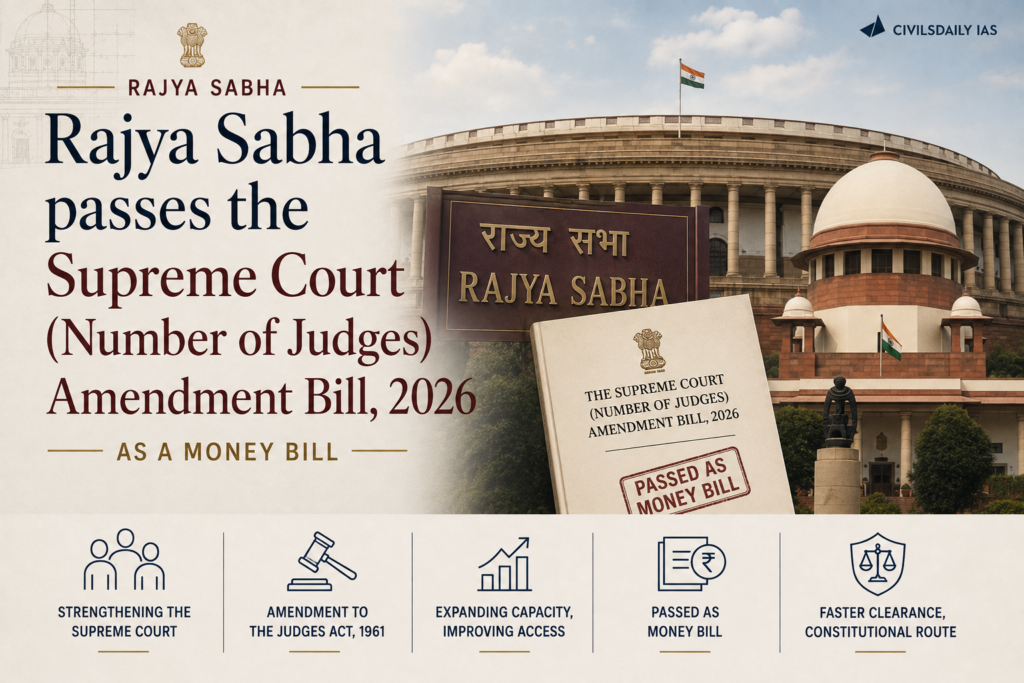
  • Rajya Sabha passes the Supreme Court (Number of Judges) Amendment Bill, 2026 as a Money Bill

    Why in the News

    Parliament passed the Supreme Court (Number of Judges) Amendment Bill, 2026, increasing the sanctioned strength of the Supreme Court through the Money Bill route, triggering debate over the constitutional validity of bypassing the Rajya Sabha.

    What is a Money Bill?

    • Constitutional basis: Defined under Article 110 of the Constitution.
    • Scope: A Bill is a Money Bill only if it deals exclusively with matters such as:
      • Taxation, Government borrowing, Custody or withdrawal of money from the Consolidated Fund of India, Contingency Fun, and Appropriation of public money
    • Speaker’s certification: The Speaker of the Lok Sabha decides whether a Bill is a Money Bill, and the certification is endorsed on the Bill.
    • Limited role of Rajya Sabha: The Rajya Sabha can only recommend amendments within 14 days, which the Lok Sabha may accept or reject.

    What does the Bill provide?

    • Higher judicial strength: Increases the sanctioned strength of the Supreme Court from 34 to 38 judges, including the Chief Justice of India (CJI).
    • Replaces an Ordinance: Substitutes the Ordinance promulgated in May 2026.
    • Government’s objective: Reduce case pendency, improve judicial efficiency, and strengthen access to justice.

    Why is the Money Bill route controversial?

    • Constitutional issue pending: The validity of certifying certain laws as Money Bills is under consideration by a larger Constitution Bench of the Supreme Court.
    • Concern over precedent: In the Aadhaar judgment (2018), the dissenting opinion described the use of the Money Bill route for substantive legislation as a “fraud on the Constitution.”
    • Reduced parliamentary scrutiny: Since the Rajya Sabha has only an advisory role, critics argue that the route weakens bicameral legislative oversight.

    “[2014] The power to increase the number of judges in the Supreme Court of India is vested in?
    (a) The President of India.
    (b) The Parliament.
    (c) The Chief Justice of India.
    (d) The Law Commission.

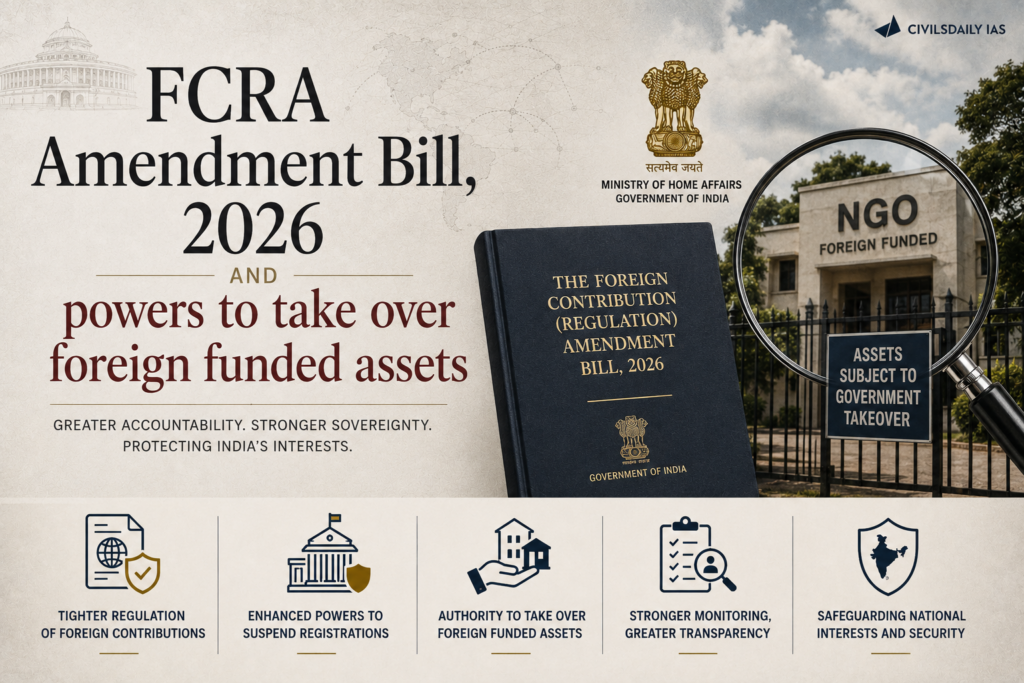
  • FCRA Amendment Bill, 2026 and powers to take over foreign funded assets

    Why in the News

    FCRA Amendment Bill, 2026 will amend the foreign funding law would let a designated authority take over the assets of organisations that lose their registration. The tension is between the state’s control over foreign money and the autonomy of civil society and religious bodies.

    What is the Foreign Contribution (Regulation) Act, 2010?

    1. Governing law: The Foreign Contribution (Regulation) Act, 2010 (FCRA) regulates the acceptance and use of foreign donations by individuals and organisations.
    2. Registration: Bodies receiving foreign funds must register and route money through a designated bank account.
    3. Home Ministry: The Union Home Ministry administers registration, renewal, and cancellation.

    Key Rules and Goals

    1. Main Goal: Stop foreign money from harming the country, public order, or politics.
    2. Who Cannot Get Funds: Politicians, judges, government workers, and news media cannot accept foreign money.
    3. Bank Routing: Groups must use a single, approved bank account to get these funds.

    What does the amendment propose?

    1. Cessation clause: A new provision defines cessation of an FCRA certificate on cancellation or lapse. A certificate stops working if an organization fails to apply for renewal, gets denied, or lets the 5-year validity expire. The Bill proposes to increase oversight into processes relating to the handling of assets upon cancellation, surrender, or cessation of a certificate of registration, the management of defunct organisations, and other administrative and compliance processes.
    2. Asset vesting: On cessation, foreign contributions and assets vest in a government appointed Designated Authority, with proceeds going to the government.
    3. Retrospective reach: A clause would apply the vesting to assets already acquired.

    Why is the Bill contested?

    1. Sweeping powers: Critics argue it lets the executive seize and sell the assets of non governmental organisations.
    2. Faith bodies: Christian and other religious institutions fear disproportionate impact.
    3. Constitutional concerns: Objections cite Articles 14, 25, 26 and 300A on equality, religious freedom, and property.

    What are the challenges to the FCRA framework?

    1. Funding squeeze: Foreign contribution inflows have already fallen sharply after earlier tightening. Amnesty International India had to freeze operations in 2020 after the government froze its bank accounts over FCRA compliance disputes.
    2. Compliance burden: Small organisations struggle with reporting and renewal requirements.
    3. Chilling effect: Advocacy and rights groups face uncertainty over registration.
    4. Discretion risk: Wide discretion in cancellation invites arbitrariness.
    5. Judicial overhang: Asset vesting is likely to face challenge in the courts.

    Conclusion

    The Bill shifts the balance from regulating foreign money toward controlling the organisations that receive it. The next milestone is whether the government refers it to a Select Committee before passage.

    Back2Basics

    The Foreign Contribution (Regulation) Amendment Bill, 2026:

    It was introduced in the Lok Sabha on March 25, 2026 and it establishes a framework for managing and disposing of assets and unutilised foreign contributions of organizations that lose their FCRA certification.

    Key Provisions of the Bill

    1. Designated Authority: Creates an official body to supervise, manage, and temporarily or permanently vest assets created using foreign funds if an organization’s certificate is cancelled, surrendered, or expires.
    2. Places of Worship: Requires the authority to preserve the religious character of any asset that functions as a place of worship.
    3. Rationalized Penalties: Reduces maximum imprisonment terms for minor or technical violations of the Act from five years down to one year.
    4. Investigation Coordination: Mandates that state-level agencies secure central government approval prior to launching independent FCRA-related investigations.

    PYQ Relevance

    [UPSC 2015] Examine critically the recent changes in the rule governing foreign funding of NGOs under the Foreign Contribution (Regulation) Act (FCRA), 1976.

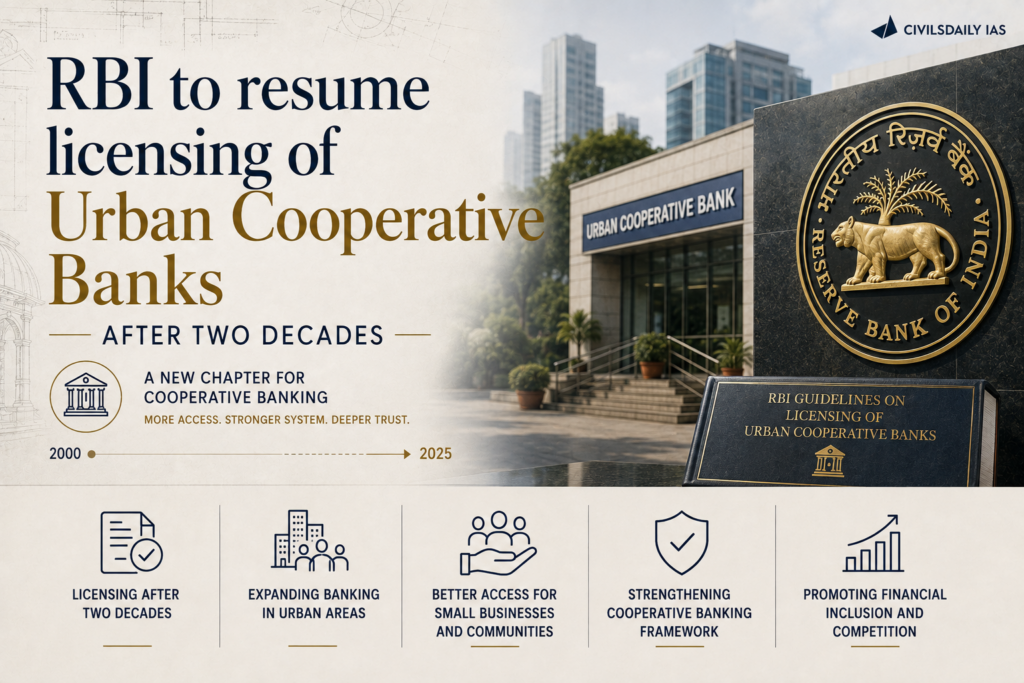
  • RBI to resume licensing of Urban Cooperative Banks after two decades

    Why in the News

    The Reserve Bank of India (RBI) has announced that it will resume issuing licences for new Urban Cooperative Banks (UCBs) on an on tap basis, ending a pause of more than two decades. The move follows regulatory reforms aimed at strengthening governance and supervision in the cooperative banking sector.

    What is an Urban Cooperative Bank (UCB)?

    • Cooperative bank: A UCB is a cooperative society that provides banking services primarily in urban and semi urban areas.
    • Ownership: Owned and managed by its members on the principle of one member, one vote.
    • Dual regulation:
      • RBI: Banking operations, licensing, prudential norms and supervision.
      • State/Central Registrar of Cooperative Societies: Management, elections and administration.
    • Size: India has around 1,457 Urban Cooperative Banks.

    What is RBI changing?

    • On tap licensing: New UCB licences will be granted throughout the year, instead of one time licensing windows.
    • Review of concentration norms: RBI will revisit concentration risk norms for rural cooperative banks.
    • Interest rate framework: Plans to rationalise the interest rate framework across regulated entities for greater consistency.

    Why was licensing suspended?

    • Governance failures: Several UCBs suffered from weak governance, poor risk management and financial irregularities.
    • Bank failures: High profile failures raised concerns about depositor protection and financial stability.
    • Regulatory limitations: The dual control structure often hampered effective supervision.

    Why has RBI resumed licensing?

    • Stronger regulation: Amendments to the Banking Regulation Act, 1949 have enhanced RBI’s supervisory powers over cooperative banks.
    • Improved governance: Regulatory reforms have strengthened oversight and accountability.
    • Financial inclusion: New UCBs can expand access to affordable banking and credit in underserved urban and semi urban areas.

    Prelims Pointers

    • Urban Cooperative Banks (UCBs) operate mainly in urban and semi urban areas.
    • They are subject to dual regulation by the RBI and the Registrar of Cooperative Societies.
    • The Banking Regulation (Amendment) Act, 2020 strengthened RBI’s supervisory powers over cooperative banks.
    • On tap licensing allows eligible entities to apply for banking licences at any time instead of waiting for a specific licensing window.

    “[2021] With reference to ‘Urban Cooperative banks’ in India, consider the following statements:
    1.They are supervised and regulated by local boards set up by the State Governments.
    2.They can issue equity shares and preference shares.
    3.They were brought under the purview of the Banking Regulation Act, 1949 through an Amendment in 1966.
    Which of the statements given above is/are correct?
    (a) 1 only
    (b) 2 and 3 only
    (c) 1 and 3 only
    (d) 1, 2, and 3

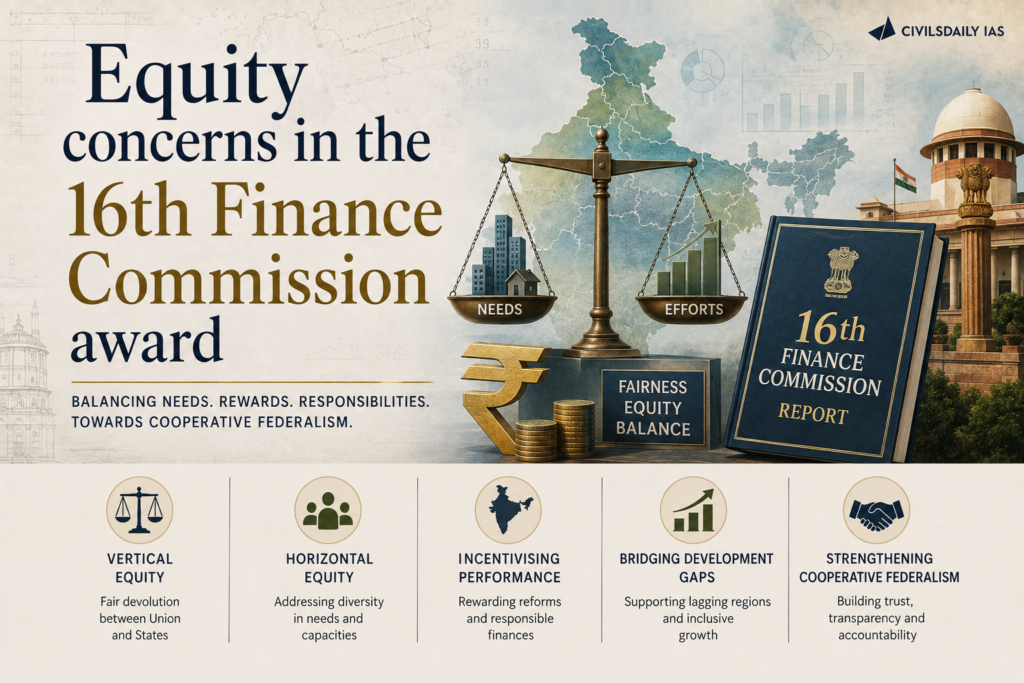
  • Equity concerns in the 16th Finance Commission award

    Why in the News

    The 16th Finance Commission has retained the size of the tax pool for States but reshaped the grants that equalise between them. The tension is between fiscal efficiency and the constitutional intent of equity across unequal States.

    What is the Finance Commission?

    1. Constitutional body: The Finance Commission is set up under Article 280 every five years to recommend the sharing of taxes between the Union and the States.
    2. Vertical devolution: It fixes the share of central taxes that goes to States as a whole.
    3. Horizontal devolution: It sets the formula distributing that share among individual States.

    What are the Key Recommendations of the 16th Finance Commission?

    • Vertical devolution retained at 41%: The States’ share of the divisible pool stays at 41%, the same level as the 15th Finance Commission, giving continuity and predictability.
    • Income distance weight trimmed: The income distance weight in the horizontal formula is cut from 45% to 42.5%.
    • New GDP contribution weight: A 10% GDP contribution weight is introduced in the horizontal formula.
    • Revenue Deficit Grants eliminated: The Revenue Deficit Grants that plugged the gap for States unable to meet committed expenditure are discontinued.
    • Sector and State specific grants cut: Most sector specific and State specific grants are removed.
    • Grants in aid share halved: Grants in aid fall from 19.4% to 8.3% of total transfers.

    Why do the changes raise equity concerns?

    • Rewarding the prosperous: A GDP contribution weight favours already prosperous States that contribute more to national output.
    • Removing the equaliser: Revenue Deficit Grants had cushioned States that cannot meet committed expenditure from their own revenue.
    • Constitutional intent: Grants in aid under Article 275 are meant to lift weaker States, and a shrinking grant share works against that purpose.

    Conclusion

    The award tilts the transfer system toward fiscal performance and away from equalisation. The unresolved question is whether poorer States can meet their obligations once the grant cushion is withdrawn.

    What is Fiscal Federalism?

    • About: Fiscal federalism is the division of taxation powers, expenditure responsibilities, borrowing powers, and intergovernmental transfers among the different levels of government in a federal system.
    • Rationale: It is not merely a mechanism for dividing taxes, it ensures that a citizen’s access to essential public services does not depend excessively on the fiscal capacity of the State in which they live. Indian fiscal federalism reconciles three imbalances.
    • Vertical fiscal imbalance: The Union has access to buoyant, broad based taxes, while the States carry expenditure intensive responsibilities such as health, education, agriculture, police, and local infrastructure.
    • Horizontal fiscal imbalance: States differ widely in income, resources, geography, demographics, and revenue raising ability, so a lower income State cannot fund the same services as a richer one at similar tax rates.
    • Third tier fiscal imbalance: Panchayats and Municipalities carry substantial service delivery duties but have limited own source revenue and depend on transfers from the Union and the States.

    Constitutional Framework Governing Fiscal Federalism

    • Article 246 and the Seventh Schedule: Divides legislative and taxation powers through the Union, State, and Concurrent Lists, placing public order, health, agriculture, and local government largely in the State domain.
    • Article 246A: Inserted by the 101st Constitutional Amendment Act, 2016, gives Parliament and State Legislatures concurrent power over Goods and Services Tax, with Parliament exclusive over inter State GST.
    • Article 270: Defines the taxes forming the divisible pool shared with the States on the Finance Commission’s recommendation.
    • Article 271: Allows Union surcharges, which along with cesses are excluded from the divisible pool.
    • Article 275: Empowers Parliament to give grants in aid from the Consolidated Fund of India to States in need, including for Scheduled Tribes and Scheduled Areas.
    • Article 280: Requires the President to constitute a Finance Commission every five years to recommend vertical and horizontal devolution, the principles of grants in aid, and measures to augment State funds for local bodies.
    • Article 282: Permits the Union or a State to make grants for any public purpose, the constitutional basis for many discretionary and centrally sponsored transfers.
    • Articles 243-I and 243-Y: Require States to constitute State Finance Commissions every five years for Panchayats and Municipalities respectively.
    • Article 293: Lets States borrow within India, but a State indebted to the Union needs Union consent for further borrowing.
    • Article 279A: Establishes the GST Council, institutionalising cooperative Union State decision making on indirect taxes.

    [2023] Consider the following :
    1. Demographic performance
    2. Forest and ecology
    3. Governance reforms
    4. Stable government
    5. Tax and fiscal efforts
    For the horizontal tax devolution, the Fifteenth Finance Commission used how many of the above as criteria other than population area and income distance?
    (a) Only two
    (b) Only three
    (c) only four
    (d) All five

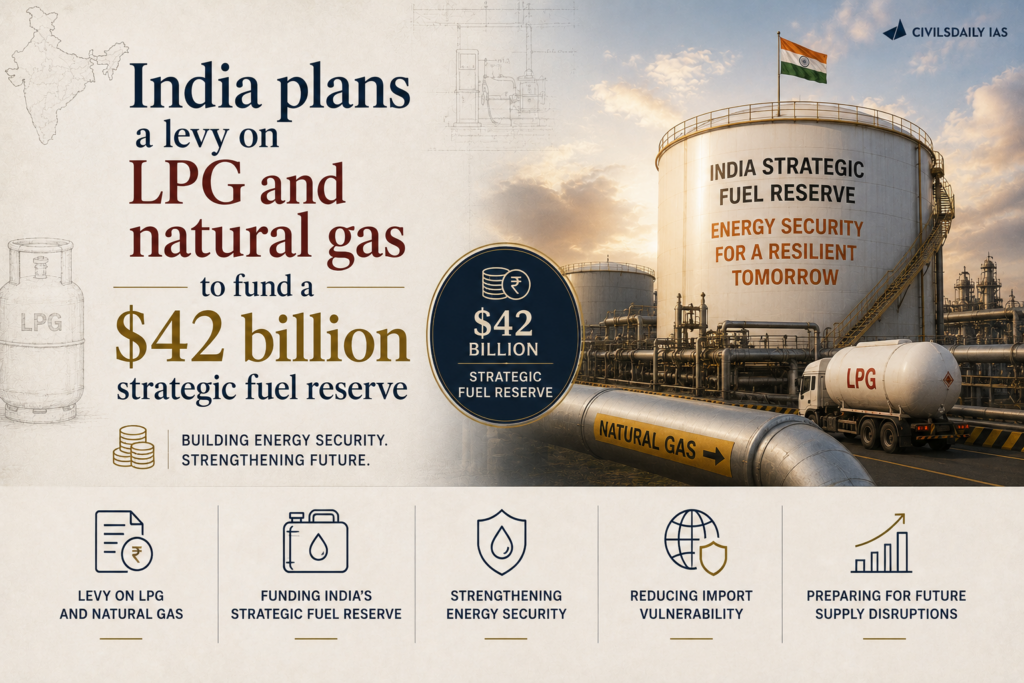
  • India may charge gas users to fund planned $42 billion fuel reserves, sources say

    Why in the News

    India proposed to fund an enlarged strategic fuel reserve through a small charge on cooking gas and natural gas. The move exposes the trade off between building energy insurance and raising the household fuel bill.

    What is a Strategic Petroleum Reserve?

    1. Emergency stockpile: A strategic petroleum reserve is a government held store of fuel to cushion supply shocks and price spikes.
    2. Current cover: India’s existing reserves hold crude oil at underground sites managed by the Indian Strategic Petroleum Reserves Limited (ISPRL).
    3. New feature: For the first time the buffer would extend beyond crude to cover LNG and LPG.

    How would the new reserve be funded?

    1. LPG charge: A levy of about Rs 1.29 per kg on cooking gas is proposed.
    2. Gas charge: A levy of about Rs 1.43 per standard cubic metre on natural gas is proposed.
    3. Annual pool: The charges would raise close to $1.5 billion a year.
    4. Cover target: The reserve would hold roughly two months of crude and LNG and six weeks of LPG.

    Why does energy security drive this now?

    1. Import dependence: India imports about 90% of its crude and is the third largest oil importer.
    2. Chokepoint risk: Disruption at the Strait of Hormuz has already forced diversification of LNG sources.
    3. Price volatility: A larger buffer reduces exposure to sudden price surges.

    Conclusion

    The proposal marks a shift from a crude only buffer to a broader fuel insurance system, paid for by consumers. The next milestone is the formal notification of the levy and the reserve’s expansion plan.

    Back2Basics

    Cooking gas and Natural gas

    Cooking gas (Liquefied Petroleum Gas or LPG) and natural gas (Piped Natural Gas or PNG) differ primarily in chemical composition, how they are stored, and how they are delivered to homes.

    Key Differences in Composition and Properties

    1. Chemical Makeup: Cooking gas (LPG) is made of propane and butane (C₃H₈ and C₄H₁₀), while natural gas is primarily methane (CH₄).
    2. Energy Output: LPG has a higher calorific value, meaning it produces more heat per unit and cooks food faster than natural gas.
    3. Behavior in Leaks: LPG is heavier than air and settles near the floor during a leak, whereas natural gas is lighter than air and rises/disperses quickly upward.

    PYQ Relevance

    [UPSC 2025]“Energy security constitutes the dominant kingpin of India’s foreign policy, and is linked with India’s overarching influence in Middle Eastern countries.” How would you integrate energy security with India’s foreign policy trajectories in the coming years?

    Linkage: The PYQ examines the role of energy security in shaping India’s foreign policy and strategic interests. The article highlights India’s plan to expand strategic fuel reserves to reduce import risks and strengthen long-term energy security.

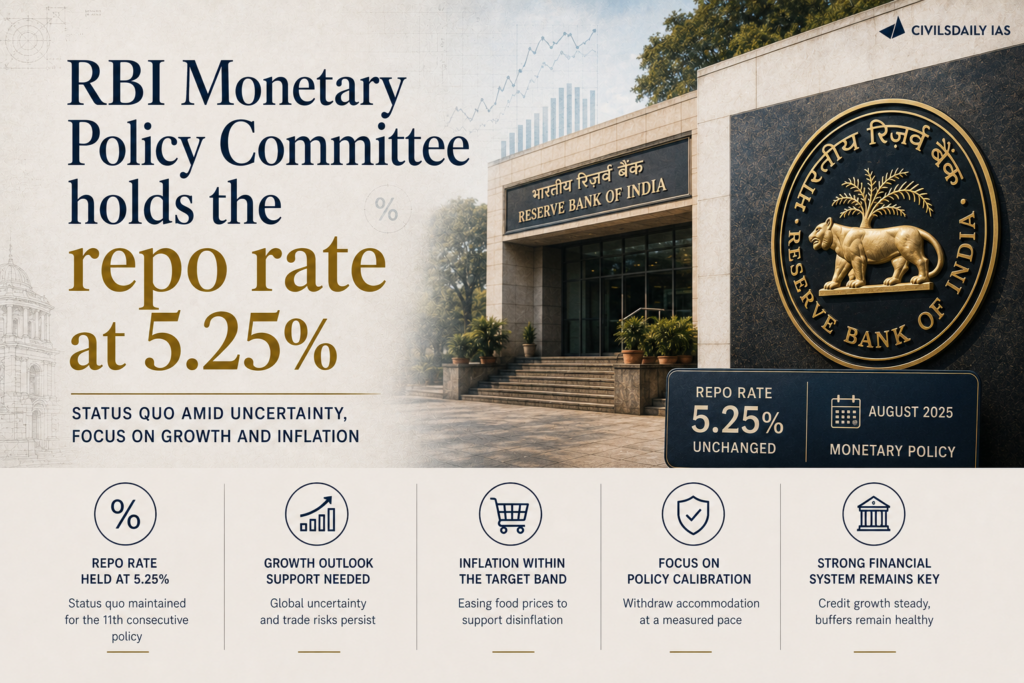
  • RBI Monetary Policy Committee holds the repo rate at 5.25%

    Why in the News

    The Monetary Policy Committee (MPC) of the Reserve Bank of India (RBI) has kept the policy repo rate unchanged at 5.25%, balancing inflation risks against the need to support economic growth amid global uncertainties.

    What is the Monetary Policy Committee (MPC)?

    • Statutory body: Constituted under the Reserve Bank of India Act, 1934 (amended in 2016).
    • Composition: Six members:
      • Three RBI members: Governor (Chairperson), Deputy Governor in charge of Monetary Policy, and one RBI nominee.
      • Three external members: Appointed by the Central Government.
    • Decision-making: Each member has one vote; in case of a tie, the Governor has a casting vote.
    • Mandate: Maintain Consumer Price Index (CPI) inflation at 4%, with a tolerance band of 2% to 6%.

    What did the MPC decide?

    • Repo rate unchanged: Retained at 5.25%.
    • Policy stance: Continues to remain neutral.
    • Liquidity corridor:
      • Standing Deposit Facility (SDF): 5.0%
      • Marginal Standing Facility (MSF): 5.5%
      • Bank Rate: 5.5%
    • Growth outlook: Real GDP growth projected at 6.7%.
    • Inflation outlook: CPI inflation rose to 4.4% in June 2026, crossing the 4% target after remaining below it for 16 months.

    Why did the MPC maintain the status quo?

    • Global uncertainties: Rising crude oil prices and geopolitical tensions in West Asia pose inflation risks.
    • Monsoon concerns: An El Nino driven deficient monsoon could increase food inflation.
    • Data dependent approach: The MPC prefers to wait for clearer inflation and growth signals before changing policy rates.

    Back2Basics: Reserve Bank of India (RBI)

    • Established: 1935 under the Reserve Bank of India Act, 1934.
    • Functions: Monetary authority of India, Banker to the Government, Banker to banks, Regulator and supervisor of the banking system, and Manager of foreign exchange reserves.
    • Major monetary policy instruments: Repo Rate, Standing Deposit Facility (SDF), Marginal Standing Facility (MSF), Cash Reserve Ratio (CRR), Statutory Liquidity Ratio (SLR), Open Market Operations (OMOs)

    “[2017] Which of the following statements is/are correct regarding the Monetary Policy Committee (MPC)?
    1. It decides the RBI’s benchmark interest rates.
    2. It is a 12-member body including the Governor of RBI and is reconstituted every year.
    3. It functions under the chairmanship of the Union Finance Minister.
    Select the correct answer using the code given below:
    (a) 1 only
    (b) 1 and 2 only
    (c) 3 only
    (d) 2 and 3 only