💥Join UPSC 2027,2028 Mentorship (August Batch) + XFactor Notes & Microthemes PDF

Distribution: weekly

  • In news: Kisan Rail Project

    kisan rail

    Punjab has assured Kerala Government to provide paddy straw for usage as fodder for livestock using the Kisan Rail Project.

    Why such move?

    • Kerala, being a land-stressed coastal state, does not generate enough roughage that can be used as fodder for cattle.
    • It ranks second in milk production after Punjab.
    • The move will help Punjab to deal with the excessive paddy straw which contributes to stubble burning.

    About Kisan Rail Project

    • In the Union Budget 2020-21 an announcement was made by the Union Finance Minister regarding the launch of Kisan Rail.
    • The idea behind running Kisan Rail services is to move perishables including fruits, vegetables, meat, poultry, fishery and dairy products from production or surplus regions to consumption or deficient regions.
    • The speedy rail movement would thus ensure minimum damage during transit.

    How can farmers transport their produce?

    • The farmers have to approach the Chief Parcel Supervisor of the Railway Stations from where the Kisan Rail service is scheduled to originate or to have enroute stoppage, along with their consignment.
    • Due care is taken to ensure that the packing condition is not faulty.
    • The consignment is weighed and charges are levied as per the prescribed parcel rates (P-scale).

    Salient features

    • 50 percent subsidy is given in freight for transportation of fruits and vegetables.
    • The subsidy is being borne by the Ministry of Food Processing Industries under their Operation Greens – TOP to Total scheme.
    • There is no minimum limit on quantity that can be booked, enabling small famers to reach bigger and distant markets.
    • Kisan Rails are based on the concept of multi commodity, multi consignor, multi consignee and multi stoppages – to help small farmers with lesser produce to transport their consignment without any middleman.

    Need for such scheme

    • Farmers, especially small and marginal farmers, often find it difficult to sell their produce in markets beyond a certain distance.
    • This is primarily due to factors such as non-availability of affordable transport, delay in transit resulting in damage/decay to produce, and unwillingness of road transporters to carry small sized consignments.

    Benefits provided

    • Access to markets: Vast network of Indian Railways enables farmers from remote villages to connect to the mainstream market and sell their agricultural produce.
    • Helps prevent food wastage: It saves times and encourages farmers to transport their perishables to greater distances and bigger markets.
    • Getting better deal for farmers: Kisan Rail is a factor enabling improvement in terms of trade for farmers and the real returns received by farmers for their produce.
    • Doubling farmers’ income: Access to such markets will enable farmers to sell their produce at a better price, which will go a long way in fulfilling Government’s vision of ‘doubling farmers’ income.’


    Click and get your FREE Copy of CURRENT AFFAIRS Micro Notes

  • US removes India from its Currency Monitoring List

    The United States’ Department of Treasury has removed India from its Currency Monitoring List. India had been on the list for the last two years for alleged manipulation of Rupee.

    What is Currency Manipulation?

    • Currency manipulation refers to actions taken by governments to change the value of their currencies relative to other currencies in order to bring about some desirable objective.
    • It is a designation applied by the US Department of the Treasury, to countries that engage in what is called “unfair currency practices” that give them a trade advantage.
    • The typical claim – often doubtful – is that countries manipulate their currencies in order to make their exports effectively cheaper on the world market and in turn make imports more expensive.

    Why do countries manipulate their currencies?

    • In general, countries prefer their currency to be weak because it makes them more competitive on the international trade front.
    • A lower currency makes a country’s exports more attractive because they are cheaper on the international market.
    • For example, a weak Rupee makes Indian exports less expensive for offshore buyers.
    • Secondly, by boosting exports, a country can use a lower currency to shrink its trade deficit.
    • Finally, a weaker currency alleviates pressure on a country’s sovereign debt obligations.
    • After issuing offshore debt, a country will make payments, and as these payments are denominated in the offshore currency, a weak local currency effectively decreases these debt payments.

    US treasury’s criteria for currency monitoring

    To be labelled a manipulator by the U.S. Treasury:

    • Countries must at least have a $20 billion-plus bilateral trade surplus with the US
    • foreign currency intervention exceeding 2% of GDP and a global current account surplus exceeding 2% of GDP

    Which are the countries under this list?

    • China, Japan, Korea, Germany, Malaysia, Singapore, and Taiwan are the seven economies that are a part of the current Currency Monitoring List.
    • China’s failure to publish foreign exchange intervention and broader lack of transparency around key features of its exchange rate mechanism.


    Click and get your FREE Copy of CURRENT AFFAIRS Micro Notes

  • Who was Nadaprabhu Kempegowda?

    kempegowda

    PM unveiled a 108-feet tall bronze statue of ‘Nadaprabhu’ Kempegowda in Bengaluru, credited to be the city’s founder.

    Who was Nadaprabhu Kempegowda?

    • Nadaprabhu Kempegowda, a 16th century chieftain of the Vijayanagara empire, is credited as the founder of Bengaluru.
    • It is said that he conceived the idea of a new city while hunting with his minister, and later marked its territory by erecting towers in four corners of the proposed city.
    • Kempegowda is also known to have developed around 1,000 lakes in the city to cater to drinking and agricultural needs.
    • He was from the dominant agricultural Vokkaliga community in south Karnataka.

    Political motives behind

    • Kempegowda is an iconic figure among Karnataka’s second most dominant Vokkaliga community after Lingayats.
    • Political parties plan to woo the Vokkaliga community by honoring Kempegowda.
    • The statue would be known as the ‘Statue of Prosperity’.


    Click and get your FREE Copy of CURRENT AFFAIRS Micro Notes

  • Forgotten Heroes: Indian Soldiers in World War-II

    Soldiers

    Context

    • On the eleventh hour of the 11th day of the 11th month of 1918, the guns fell silent over Europe, bringing an end to a brutal first world war that drew in soldiers and contributions from around the world. Indian soldiers and their contribution are not widely recognized in India.

    Background of Indian involvement World War II

    • Fight against Fascism: Two conflicts and a reticence Indian reticence over these two conflicts arises from the uneasy relationship between the Indian contribution to fighting fascism on a global stage and the nationalist movement for freedom at home.
    • Betrayal of nationalistic expectation: The success of the first is seen to have come at the cost of the second. It began with the betrayal of nationalist expectations of greater autonomy for India in return for support during the Great War.
    • No consultation with Indian leaders: This was compounded by the bitterness of Viceroy Lord Linlithgow declaring war on Germany on India’s behalf in 1939 without consulting Indian leaders, and further roiled by the pitting of Indian against Indian when Netaji Subhas Chandra Bose’s Indian National Army sided with the Axis Powers in the hope that this might bring freedom.
    • Fighting for India and for World: But the failure of Indian independence to follow automatically from India’s participation in the wars does not mean that the war efforts extended colonial rule, or were all about protecting Britain: there was fighting on Indian soil to defend India.

    Soldiers

    What is Indian soldiers role in World War II

    • Support of nationalist leaders: Almost 1.5 million men volunteered to fight in the Great War. Indians mobilized four days after Britain declared war on Germany, with the support of nationalist leaders, including Mahatma Gandhi.
    • War in Europe, Asia and Africa: Indians fought with valor and distinction in the trenches of Europe, West Asia and North Africa, earning 11 Victoria Crosses along the way. Of those men, about 74,000 never came home.
    • Largest volunteer for war: India raised the largest ever volunteer army, of 2.5 million, for the Second World War. More than 87,000 of those men are cremated or buried in war cemeteries around the world and in India.
    • Thirty-one Victoria Crosses: 15 % of the total Victoria crosses went to soldiers from undivided India. Without Indian soldiers, non-combatant labourers, material and money, the course of both conflicts would have been very different as acknowledged by Field Marshal Auchinleck, Britain’s last Commander-in-Chief of the Indian.

    The issue of Non-recognition of India’s contribution

    • Indian soldiers are honored by Britain: In Britain, the contribution of the Commonwealth including the Indian subcontinent is memorialized in the Commonwealth Memorial Gates that lead up to Buckingham Palace. The Gates commemorate the campaigns where Commonwealth soldiers served with distinction; there is also a canopy inscribed with the names of the Commonwealth recipients of the George and Victoria Crosses.
    • Indian soldiers fought the Britain’s war: Much of India’s recent history is encapsulated in these gates, in a spirit of gratitude and equality. Britain, after all, has much to be grateful for, but Indians seem less keen to acknowledge this. British perfidy, however, does not in any way reduce the sacrifices of those who fought for freedom. Those who went abroad to fight alongside white British soldiers returned with the knowledge that they were equal to their colonial masters. In not recognizing and honoring this, we push those men back into colonial subjugation.
    • Britain betrayed the hopes of freedom: Some of this ambivalence owes itself to the atrocities of colonial history, which must be acknowledged too. Britain may have handed out 11 Victoria Crosses over the course of the First World War, but it betrayed the hopes of nationalists with the imposition of martial law after the war ended, culminating in the horror of Jallianwala Bagh in April 1919.

    Soldiers

    Does India fought the war for its own sake?

    • Indian fought the Japanese: These were not just European wars to defend foreign lands. India was threatened in the Second World War by advancing Japanese forces who got as far as Burma/Myanmar. They were repulsed in the battles of Imphal and Kohima between March and July 1944. These were brutal battles. In Kohima, the two sides were at one point separated by the width of a tennis court. A Commonwealth cemetery on Garrison Hill, Kohima, contains this epitaph (by John Maxwell Edmonds): ‘When You Go Home, Tell Them of Us, and Say/For Your Tomorrow, We Gave Our Today’.
    • Ultimate sacrifice for India’s freedom: The memory of the almost 10 million battlefield deaths in the First World War and the 15 million or more who were killed fighting the Second World War is now honored in countries around the world on November 11, with nationwide silences and the laying of wreaths. Not so much in India apart from in Army cantonments and at the British Consulate in Kolkata even though over 1,61,000 men made the ultimate sacrifice for India’s freedom.

    Conclusion

    • Seventy-five years after Independence, it is time to honor India’s immense contribution to the world wars and move it from a footnote in another country’s history to the main stage, where it belongs. These were India’s wars too.

    Mains Question

    Q. What role the Indian soldier played in Second world War? What are the issues regarding non recognition of contribution of Indian soldiers in world wars?

    Click and Get your FREE copy of Current Affairs Micro notes

  • Current Account Deficit (CAD) likely to be lower at 3% this fiscal

    deficit

    The SBI has estimated a lower current account deficit at 3% for this fiscal as against the minimum consensus of 3.5%, citing rising software exports, remittances and a likely $5-billion jump in forex reserves via swap deals.

    What is Current Account Deficit (CAD)?

    deficit

    • A current account is a key component of balance of payments, which is the account of transactions or exchanges made between entities in a country and the rest of the world.
    • This includes a nation’s net trade in products and services, its net earnings on cross border investments including interest and dividends, and its net transfer payments such as remittances and foreign aid.
    • A CAD arises when the value of goods and services imported exceeds the value of exports, while the trade balance refers to the net balance of export and import of goods or merchandise trade.

    Components of Current Account

    Current Account Deficit (CAD) =  Trade Deficit + Net Income + Net Transfers

    (1) Trade Deficit

    • Trade Deficit = Imports – Exports
    • A Country is said to have a trade deficit when it imports more goods and services than it exports.
    • Trade deficit is an economic measure of a negative balance of trade in which a country’s imports exceeds its exports.
    • A trade deficit represents an outflow of domestic currency to foreign markets.

    (2) Net Income

    • Net Income = Income Earned by MNCs from their investments in India.
    • When foreign investment income exceeds the savings of the country’s residents, then the country has net income deficit.
    • This foreign investment can help a country’s economy grow. But if foreign investors worry they won’t get a return in a reasonable amount of time, they will cut off funding.
    • Net income is measured by the following things:
    1. Payments made to foreigners in the form of dividends of domestic stocks.
    2. Interest payments on bonds.
    3. Wages paid to foreigners working in the country.

    (3) Net Transfers

    • In Net Transfers, foreign residents send back money to their home countries. It also includes government grants to foreigners.
    • It Includes Remittances, Gifts, Donation etc

    How Current Account Transaction does takes place?

    • While understanding the Current Account Deficit in detail, it is important to understand what the current account transactions are.
    • Current account transactions are transactions that require foreign currency.
    • Following transactions with from which component these transactions belong to :
    1. Component 1 : Payments connection with Foreign trade – Import & Export
    2. Component 2 : Interest on loans to other countries and Net income from investments in other countries
    3. Component 3 : Remittances for living expenses of parents, spouse and children residing abroad, and Expenses in connection with Foreign travel, Education and Medical care of parents, spouse and children

    What has the SBI said?

    • The biggest impact on CAD is oil imports, which form as much as 30% of the country’s import bills.
    • Every $10 increase in crude prices impacts the CAD to the tune of 40 basis points while the same on fuel inflation is 50 bps and also results in 23 bps decline in growth.
    • Strong remittances and software exports had lowered CAD by 60 basis points (bps) in the June quarter.
    • Forex reserves, which have declined from $642 billion in September 2021 to about $531 billion last week, are expected to rise by $5 billion as swap transactions reverse.


    Click and get your FREE Copy of CURRENT AFFAIRS Micro Notes

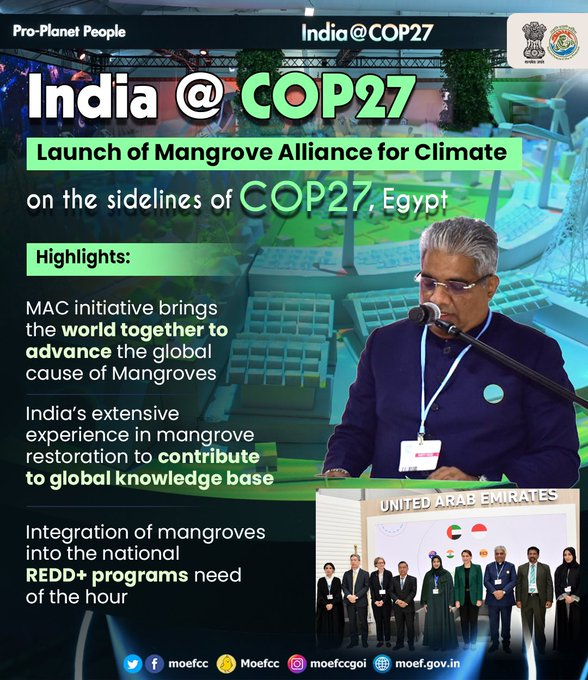
  • Mangrove Alliance for Climate (MAC) launched at COP27

    mangroves

    At the 27th Session of the Conference of Parties (COP27), this year’s UN climate summit, the Mangrove Alliance for Climate (MAC) was launched with India as a partner.

    Mangrove Alliance for Climate (MAC)

    • An initiative led by the UAE and Indonesia, the MAC includes India, Sri Lanka, Australia, Japan, and Spain.
    • It seeks to educate and spread awareness worldwide on the role of mangroves in curbing global warming and its potential as a solution for climate change.
    • Under MAC, UAE intends to plant 3 million mangroves in the next two months, in keeping with UAE’s COP26 pledge of planting 100 million mangroves by 2030.

    Working of MAC

    • MAC would work on a voluntary basis. It means that there are no real checks and balances to hold members accountable.
    • Instead, the parties will decide their own commitments and deadlines regarding planting and restoring mangroves.
    • The members will also share expertise and support each other in researching, managing and protecting coastal areas.

    Why protect mangroves?

    • Infrastructure projects — industrial expansion, shifting coastlines, coastal erosion and storms, have resulted in a significant decrease in mangrove habitats.
    • Between 2010 and 2020, around 600 sq km of mangroves were lost of which more than 62% was due to direct human impacts, the Global Mangrove Alliance said in its 2022 report.

    Importance of mangroves

    mangrove

    • Biodiversity: Mangrove forests — consisting of trees and shrub that live in intertidal water in coastal areas — host diverse marine life.
    • Fishing grounds: They also support a rich food web, with molluscs and algae-filled substrate acting as a breeding ground for small fish, mud crabs and shrimps, thus providing a livelihood to local artisanal fishers.
    • Carbon sinks: Equally importantly, they act as effective carbon stores, holding up to four times the amount of carbon as other forested ecosystems.
    • Cyclone buffers: When Cyclone Amphan struck West Bengal in May, its effects were largely mitigated by the Sundarbans flanking its coasts along the Bay of Bengal.

    Threats to Mangroves

    • Anthropogenic activities: They are a major threat to the mangroves. Urbanization, industrialization and the accompanying discharge of industrial effluents, domestic sewage and pesticide residues from agricultural lands threaten these fragile ecosystems.
    • Saltpan and aquaculture: This causes huge damage to the mangroves. Shrimp farming alone destroyed 35,000 hectares of mangroves worldwide.
    • Destruction for farming: 40% of mangroves on the west coast has been converted into farmlands and other settlements in just 3 decades.
    • Sea-level rise: This is another challenge to these mangroves- especially on the Bay of Bengal coast.

    Mangroves in India

    • India holds around 3 percent of South Asia’s mangrove population.
    • Besides the Sundarbans in West Bengal, the Andaman region, the Kutch and Jamnagar areas in Gujarat too have substantial mangrove cover.

    How can India benefit from MAC?

    • India is home to one of the largest remaining areas of mangroves in the world — the Sundarbans.
    • It has years of expertise in restoration of mangrove cover that can be used to aid global measures in this direction.
    • The move is in line with India’s goal to increase its carbon sink.


    Try this PYQ:

    Q.Which one of the following is the correct sequence of ecosystems in the order of decreasing productivity?

    (a) Oceans, lakes, grasslands, mangroves

    (b) Mangroves, oceans, grasslands, lakes

    (c) Mangroves, grasslands, lakes, oceans

    (d) Oceans, mangroves, lakes, grasslands


    [wpdiscuz-feedback id=”42xiisqgv0″ question=”Please leave a feedback on this” opened=”1″]Post your answers here.[/wpdiscuz-feedback]


    Click and get your FREE Copy of CURRENT AFFAIRS Micro Notes

  • Energy Transition Accelerator (ETA): A new carbon offset scheme by the US

    eta

    The US has unveiled a new carbon offset scheme called Energy Transition Accelerator (ETA) for climate finance.

    Energy Transition Accelerator (ETA)

    • ETA is carbon offset plan that will allow companies to fund clean energy projects in developing countries and gain carbon credits that they can then use to meet their own climate goals.
    • The plan will be developed by the US along with the Bezos Earth Fund and the Rockefeller Foundation.
    • It would receive inputs from public and private
    • The concept is to put the carbon market to work, deploy capital otherwise undeployable, and speed up the transition from dirty to clean power.

    Benefits of ETA

    • It may be good for renewable energy projects for sure and for those coal plants that are very old and unviable and which India wishes to shut down.
    • The scheme comes at a time when there is growing mistrust among developing countries about developed nations failing to deliver on climate finance commitments.

    Limitations of ETA

    • The proposed initiative would be insufficient to make up for the lack of funding from rich countries.
    • What developing countries need is predictable finance – not offset markets.
    • The proposed initiative cannot make up for the US’s failure to provide its fair share of climate finance – an estimated $40 billion of the unmet goal of $100 billion a year.

    Conclusion

    • ETA appears to be a substitute for deep decarbonization needed within the US and other industrialized countries.
    • For developing countries like India, the first priority would be to meet their own targets and not provide offsets for reductions in developed nations.


    Click and get your FREE Copy of CURRENT AFFAIRS Micro Notes

  • Impact of Pandemic on Vulnerable Section: SC, ST and OBC

    Impact of Pandemic

    Context

    • SC/ST and OBC have been impacted disproportionately by the pandemic as various social indicators shows vulnerabilities of this communities.

    Impact of pandemic on education

    • On the one hand, with policies mandating the promotion of students, promotion rates at the secondary school level rose significantly and repetition rates nosedived during the pandemic years (2020-21 and 2021-22).
    • On the other, the inability to attend physical school and the lack of access to digital education caused a massive drop in learning levels after the COVID-19 outbreak.

    Impact of Pandemic

    Impact on education of SC, ST and OBC

    • Increasing promotion rate: Notably, the promotion rate among Scheduled Caste (SC) and Scheduled Tribe (ST) students increased sharply after the outbreak. The promotion rate among Other Backward Classes (OBC) students continued to rise unabated.
    • Repetition rate declining: The repetition rates too drastically came down in the pandemic years with some 1% students repeating their class across all communities. Notably, the gap in the repetition rate between SC/ST students and general category students declined greatly after the outbreak.
    • Declining learning outcomes: While the promotion rate surged and the repetition rate declined, the marks scored by school students in National Achievement Survey (NAS) exams dropped significantly across classes and in most subjects.
    • Disproportionate impact: There is a disproportionately greater impact on SC and ST students as their learning outcomes reduced the most while their promotion rates saw the highest degree of rise among all the communities.

    Impact on livelihood of vulnerable sections of the society

    • High job loss probability: The researchers found that compared to workers from upper castes, the probability of job loss was three times higher for those who are SC and two times higher for OBC workers.
    • Comparatively higher unemployment: In December 2019, 39% of upper caste workers were employed and by April 2020, the percentage had dropped to 32%. The fall was more pronounced for SC workers, 44% of whom were employed in December 2019, but only 24% were employed in April 2020. For OBCs and STs the fall was from 40% to 26% and 48% to 33%, respectively.
    • Poor education poor Opportunities: According to researchers, the upper castes are endowed with higher human capital, i.e. educational achievement, and are in jobs less vulnerable to pandemic disruption. What is surprising is that the impact on scheduled caste is three times worse. Not only has the pandemic exposed the pre-existing inequities but has amplified them.

    Impact of Pandemic

    How women are affected due to the pandemic?

    • Effect on mental health: Women in low-caste women may be at a greater risk for worse mental health outcomes and higher perceived loneliness relative to high-caste women.
    • Social exclusion and job losses: Prior research has found that low-caste women have been found to experience greater social exclusion greater job loss and greater barriers to healthcare and thus may experience both worse mental health and higher loneliness.
    • Rising loneliness: Women in SC/ST and OBC groups will experience worse mental health, and higher perceived loneliness relative to women in the general caste group. We expect that this difference will be robust even when accounting for sociodemographic factors.
    • Victims of systemic disadvantage: Women in general and women of weaker sections in particular, are victims of multiple systemic disadvantages, which exacerbated during the pandemic. Rural women, especially the female wage workers, endured greater socio-economic difficulties as their livelihood opportunities were abruptly halted by the lockdown.
    • Visible gendered impact of pandemic: There is nothing natural in the gendered impact of pandemic, but the social norms and behaviour put them at greater risks due to unequal gender preference that is inbuilt in the social structure and culture.

    Conclusion

    • Pandemic have disproportionately affected the Indian society. Whether it is access to healthcare or vaccination SC, ST and OBC had a disadvantage. Lot of studies and research have assessed the caste specific impact of coronavirus and projected the dismal state of vulnerable groups. Government must look all these data while drafting the future policies for vulnerable communities.

    Mains Question

    Q. Analyze the learning outcome of SC/ST students after the pandemic. Assess the impact of pandemic on women belonging to SC, ST and OBC community.

    Click and Get your FREE copy of Current Affairs Micro notes

  • In news: Pashmina Wool

    pashmina

    Traders of Pashmina shawls are complaining that “obsolete testing methods” have resulted in many of their export consignments being flagged for the presence of ‘Shahtoosh’ guard hair, which is obtained from endangered Tibetan antelopes.

    Shahtoosh, on the other hand, is the fine undercoat fibre obtained from the Tibetan Antelope, known locally as ‘Chiru’, a species living mainly in the northern parts of the Changthang Plateau in Tibet.  

    What is Pashmina?

    • Pashmina is a fine type of cashmere wool. The textiles made from it were first woven in Kashmir.
    • The wool comes from a number of different breeds of the cashmere goat; such as the changthangi or Kashmir pashmina goat from the Changthang Plateau in Tibet and part of the Ladakh region and few parts of Himachal Pradesh.
    • Often shawls called shahmina are made from this material in Kashmir and Nepal; these shawls are hand spun and woven from the very fine cashmere fibre.
    • Traditional producers of pashmina wool are people known as the Changpa.
    • Bureau of Indian Standards (BIS) has published an Indian Standard for identification, marking and labelling of the already GI tagged Pashmina products to certify its purity.

    About Pashmina goat

    • The Changthangi or Pashmina goat is a special breed of goat indigenous to the high altitude regions of Ladakh in Jammu and Kashmir.
    • They are raised for ultra-fine cashmere wool, known as Pashmina once woven. The Textiles are handspun and were first woven in Kashmir.
    • The Changthangi goat grows a thick warn undercoat which is the source of Kashmir Pashmina wool – the world’s finest cashmere measuring between 12-15 microns in fiber thickness.
    • These goats are generally domesticated and reared by nomadic communities called the Changpa in the Changthang region of Greater Ladakh.
    • The Changthangi goats have revitalized the economy of Changthang, Leh and Ladakh region.


    Try this PYQ:

    Q.With reference to ‘Changpa’ community of India, consider the following statement:

    1. They live mainly in the State of Uttarakhand.
    2. They rear the Pashmina goats that yield fine wool.
    3. They are kept in the category of Scheduled Tribes.

    Which of the statements given above is/are correct?

    (a) 1 only

    (b) 2 and 3 only

    (c) 3 only

    (d) 1, 2 and 3


    [wpdiscuz-feedback id=”80popdecv9″ question=”Please leave a feedback on this” opened=”1″]Post your answers here.[/wpdiscuz-feedback]


    Click and get your FREE Copy of CURRENT AFFAIRS micro notes

  • G20 Presidency: India can be voice for developing world

    G20

    Context

    • Government of India launched the logo, website and theme for India’s presidency of the G20, setting the tone for the country’s G20 presidency, beginning December 1. Modi’s clarion call was “One Earth, One Family, One Future”, aptly underscored by the phrase “Vasudhaiva Kutumbakam”.

    What is G-20?

    • Formed in 1999, the G20 is an international forum of the governments and central bank governors from 20 major economies.
    • It brings together 19 of the world’s major economies and the European Union.
    • Its members account for more than 80% of global GDP, 75% of trade and 60% of population
    • To tackle the problems or address issues that plague the world, the heads of governments of the G20 nations periodically participate in summits.
    • India has been a member of the G20 since its inception in 1999.

    Do you know the aims and objective of G20?

    • The Group was formed with the aim of studying, reviewing, and promoting high-level discussion of policy issues pertaining to the promotion of international financial stability.
    • The forum aims to pre-empt the balance of payments problems and turmoil on financial markets by improved coordination of monetary, fiscal, and financial policies.
    • It seeks to address issues that go beyond the responsibilities of any one organization.
    • Its members account for more than 80% of global GDP, 75% of trade and 60% of population.

    G20

    Current Global scenario and India’s G20 Presidency

    • War between Russia and west: It must nonetheless countenance a complex geopolitical moment, with tensions between G7 nations and Russia over the war in Ukraine, and growing friction between the US and China.
    • India’s efforts to be a meditator: PM Modi’s recent advice to President Putin that “now is not the time for war” is anchored in the ethos of peace and non-violence, the legacy of Buddha and Gandhi.
    • Energy crisis: The developmental agenda must receive first billing. Differences over energy diversification and the emerging challenges in trade and technology will need reconciliation.
    • Economic crisis: Stagflation in the US, China and Europe threatens to affect the global economic outlook. Policy coherence in macroeconomics and trade is an important imperative.
    • Supply chain disruptions: At the “Global Supply Chain Resilience” meeting in October 2021, Modi advocated cooperation on three critical aspects trusted source, transparency and time frame to improve global supply chains. At the SCO Summit this year, he cited the disruption of supply chains due to the Ukraine crisis and spoke of the unprecedented energy and food crises.

    g20

    What India can show to the world?

    • Growing economy and rising stature: India’s G20 presidency coincides with its growing confidence, matched by its rising stature and high economic growth rate.
    • India’s digital infrastructure: India’s commitment to digital transformation will be a key element in forging an accessible and inclusive digital public architecture. The country’s exemplary success with the Unified Payments Interface (UPI), Direct Benefits Transfer and Aadhaar authentication in welfare schemes has growing relevance to the developing world.
    • Efforts for TRIPS waiver on vaccine: The use of the CoWIN platform enhanced vaccine accessibility and equity. India has made a strong pitch for a TRIPS waiver to ensure equitable access to vaccine production.
    • Vaccine assistance to the world: India’s commitment to advancing South-South cooperation is well acknowledged. At the height of the pandemic, India provided 250 million vaccine doses to 101 countries, apart from other medical assistance.
    • SAGAR and Blue Economy: India’s global initiatives in recent years such as SAGAR (Security and Growth for All in The Region), “blue economy”, “clean oceans”, and disaster-resilient infrastructure have the potential to gain traction in the G20.
    • India as true climate leader: PM Modi’s “Panchamrit” announcements at COP26 — net zero by 2070, non-fossil energy capacity to 500 GW by 2030, 50 per cent of energy requirement through renewables by 2030, reduction of carbon emission by 1 billion tonnes by 2030, and reduction of carbon intensity in the Indian economy to less than 45 per cent by 2030 — established India as a climate leader.

    What should be India’s Priority as President of G20?

    • Open application programming interface: As economies everywhere move rapidly towards digitalization, it is important to develop a consensus on an open source, open application programming interface (API) and an interoperable framework for public digital platforms on which the private sector can freely innovate. This would help maximize the impact of the digital transformation for the global public good, including new data, measurement tools, indicators of economic growth and the achievement of Sustainable Development Goals (SDGs).
    • Promotion of LiFE philosophy: At the COP26 in Glasgow, Modi proposed Mission LiFE, which places individual behavior at the centre of the global climate action narrative. The Mission intends to establish and nurture a global network of individuals known as Pro-Planet People (P3), committed to adopting and promoting environmentally friendly lifestyles. This is based on the idea that responsible individual behavior can undo the damage wrought upon nature.
    • Focus on climate financing: At COP27 as well as during its G20 presidency, India will have to focus attention on climate finance, especially a new quantified goal beyond the existing annual $100 billion pledge by Advanced Economies (AEs) to assist developing nations in climate change adaptation and mitigation from 2020 to 2025. The delayed pledge is expected to be fulfilled in 2023 during India’s presidency and from there on, the G20 needs to raise the bar.
    • Clean energy partnership: The G20 presidency will provide India with an opportunity to give impetus to several of its initiatives for clean energy partnerships especially in solar, wind and hydrogen with the EU, Japan and the US. It will provide a platform to give a fillip to the idea of, “One Sun, One World, One Grid”, first mooted by Modi at the International Solar Alliance (ISA) in 2018.
    • Achieving the Net Zero target: India has the scale and capacity to set a shining example of rapid and decarbonized economic growth to help realize the G20’s global net zero ambitions. A viable international framework for development and international trade in GH2, together with green ammonia and green shipping, is the key. Reliable supplies of critical minerals and technological collaborations for energy storage, including a global battery coalition, could provide answers.
    • Nuclear energy as an alternative: Given the nascent support today for civilian nuclear energy in Europe due to energy market volatility, the G20 could work toward an expanded and robust civilian nuclear energy cooperation framework, including for small modular reactors.
    • Reforming the multilateralism: Multilateral institutions are perceived today as unrepresentative, ineffective, or worse still, both. The call for a new multilateralism and reassessment of the Global Financial Order to ensure adequate credit enhancement and blended finance for sustainable green transitions reflects a popular global sentiment.

    g20

    Conclusion

    • India’s presidency should represent the widest and most vulnerable constituencies, especially in South Asia. This can truly advance intra-South Asian economic integration, which is so essential for India’s rise.

    Mains question

    Q. India assumed G20 presidency with a mantra of Vasudhaiva Kutumbakam. In light of this What should be the India’s Priority as President?